Nuclear Energy
What is nuclear energy
Energy emitted during detoration of heavy
radioactive element or during combining of
two lighter radioactive element is called
nuclear energy.
Nuclear reaction takes place in two ways
a) By nuclear fission
b) by nuclear fusion
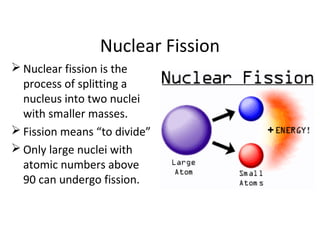
Nuclear Fission
 Nuclear fission is the
process of splitting a
nucleus into two nuclei
with smaller masses.
 Fission means “to divide”
 Only large nuclei with
atomic numbers above
90 can undergo fission.
Binding energy
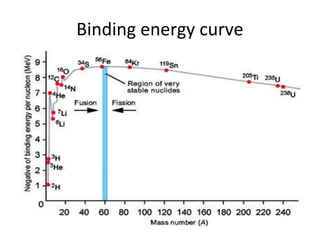
After Fe every element has tendency to show
nuclear fission reaction.
But effective nuclear fission reaction is shown
by the large nuclei with atomic numbers above
90 .
It is due to binding energy per nucleon
B.E=m *931.5MeV/A
Where ,m=mass of radioactive element
A=mass number
Binding energy curve
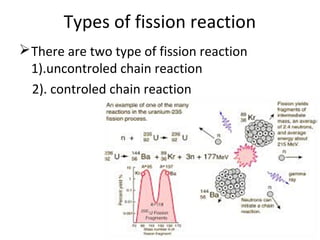
Types of fission reaction
There are two type of fission reaction
1).uncontroled chain reaction
2). controled chain reaction
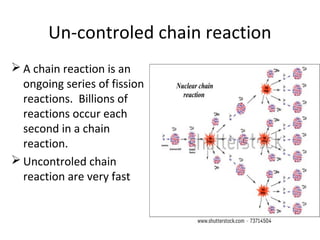
Un-controled chain reaction
 A chain reaction is an
ongoing series of fission
reactions. Billions of
reactions occur each
second in a chain
reaction.
 Uncontroled chain
reaction are very fast
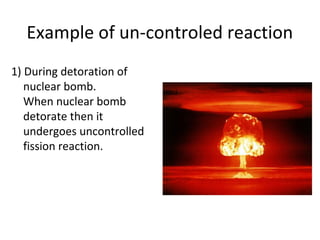
Example of un-controled reaction
1) During detoration of
nuclear bomb.
When nuclear bomb
detorate then it
undergoes uncontrolled
fission reaction.
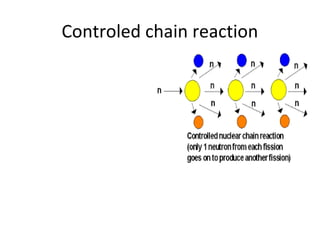
Controled chain reaction
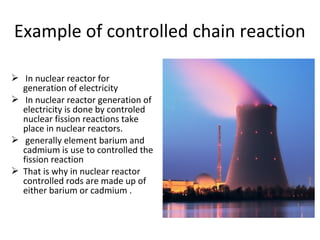
Example of controlled chain reaction
 In nuclear reactor for
generation of electricity
 In nuclear reactor generation of
electricity is done by controled
nuclear fission reactions take
place in nuclear reactors.
 generally element barium and
cadmium is use to controlled the
fission reaction
 That is why in nuclear reactor
controlled rods are made up of
either barium or cadmium .
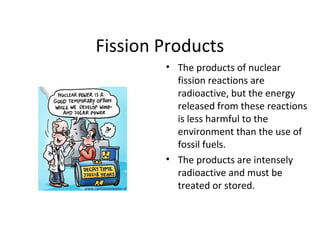
Fission Products
• The products of nuclear
fission reactions are
radioactive, but the energy
released from these reactions
is less harmful to the
environment than the use of
fossil fuels.
• The products are intensely
radioactive and must be
treated or stored.
Why radioactive element decay in very
large time
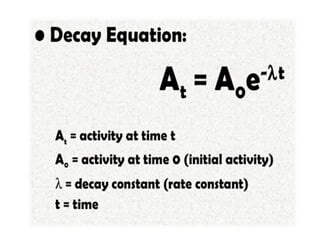
• The rateof radioactive decay of any
radioactive is directly proportional to its initial
amount.
• And when we remove proportional sign then
It become equal to product of of decay
constant and initial amount.
• After integration it yield equation which vary
exponentially .
Nuclear Fusion
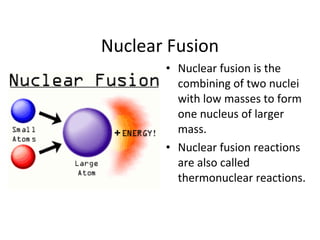
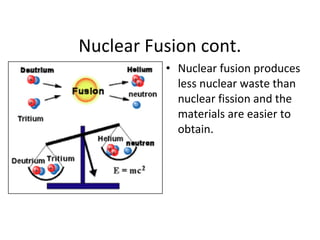
• Nuclear fusion is the
combining of two nuclei
with low masses to form
one nucleus of larger
mass.
• Nuclear fusion reactions
are also called
thermonuclear reactions.
Nuclear Fusion example
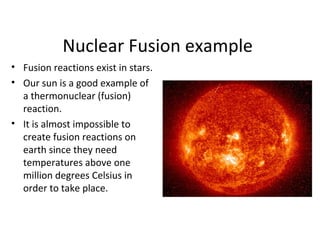
• Fusion reactions exist in stars.
• Our sun is a good example of
a thermonuclear (fusion)
reaction.
• It is almost impossible to
create fusion reactions on
earth since they need
temperatures above one
million degrees Celsius in
order to take place.
Why radition of radioactive element is
harmful
• During decay of radioactive element it emit
alpha particle, beta particle,positron particle
and gamma radation.
• These are very harmful for envirnment and
human being.
• These radation causes cancer,slowness in
mind working and majour is skin cancer
Nuclear Fusion cont.
• Nuclear fusion produces
less nuclear waste than
nuclear fission and the
materials are easier to
obtain.
Why 1gram radioactive element
emit more energy than 1gram non
radioactive element
• Its only due to mass defect which occur in radioactive
element
But not in non-radioactive element.
Advantages of Nuclear energy
• Clean
• Plentiful Supply
• High energy content in uranium
– Small fuel pellet
– Can provide base load power
– Energy savings in transportation
• Operating cost is low after construction
Disadvantage of using Nuclear
energy
• Clean
• Plentiful Supply
• High energy content in uranium
–Small fuel pellet
–Can provide base load power
–Energy savings in transportation
• Operating cost is low after construction

0708 nuclear energy

  • 1.
  • 2.
    What is nuclearenergy Energy emitted during detoration of heavy radioactive element or during combining of two lighter radioactive element is called nuclear energy. Nuclear reaction takes place in two ways a) By nuclear fission b) by nuclear fusion
  • 3.
    Nuclear Fission  Nuclearfission is the process of splitting a nucleus into two nuclei with smaller masses.  Fission means “to divide”  Only large nuclei with atomic numbers above 90 can undergo fission.
  • 4.
    Binding energy After Feevery element has tendency to show nuclear fission reaction. But effective nuclear fission reaction is shown by the large nuclei with atomic numbers above 90 . It is due to binding energy per nucleon B.E=m *931.5MeV/A Where ,m=mass of radioactive element A=mass number
  • 5.
  • 6.
    Types of fissionreaction There are two type of fission reaction 1).uncontroled chain reaction 2). controled chain reaction
  • 7.
    Un-controled chain reaction A chain reaction is an ongoing series of fission reactions. Billions of reactions occur each second in a chain reaction.  Uncontroled chain reaction are very fast
  • 8.
    Example of un-controledreaction 1) During detoration of nuclear bomb. When nuclear bomb detorate then it undergoes uncontrolled fission reaction.
  • 9.
  • 10.
    Example of controlledchain reaction  In nuclear reactor for generation of electricity  In nuclear reactor generation of electricity is done by controled nuclear fission reactions take place in nuclear reactors.  generally element barium and cadmium is use to controlled the fission reaction  That is why in nuclear reactor controlled rods are made up of either barium or cadmium .
  • 11.
    Fission Products • Theproducts of nuclear fission reactions are radioactive, but the energy released from these reactions is less harmful to the environment than the use of fossil fuels. • The products are intensely radioactive and must be treated or stored.
  • 12.
    Why radioactive elementdecay in very large time • The rateof radioactive decay of any radioactive is directly proportional to its initial amount. • And when we remove proportional sign then It become equal to product of of decay constant and initial amount. • After integration it yield equation which vary exponentially .
  • 13.
    Nuclear Fusion • Nuclearfusion is the combining of two nuclei with low masses to form one nucleus of larger mass. • Nuclear fusion reactions are also called thermonuclear reactions.
  • 15.
    Nuclear Fusion example •Fusion reactions exist in stars. • Our sun is a good example of a thermonuclear (fusion) reaction. • It is almost impossible to create fusion reactions on earth since they need temperatures above one million degrees Celsius in order to take place.
  • 16.
    Why radition ofradioactive element is harmful • During decay of radioactive element it emit alpha particle, beta particle,positron particle and gamma radation. • These are very harmful for envirnment and human being. • These radation causes cancer,slowness in mind working and majour is skin cancer
  • 17.
    Nuclear Fusion cont. •Nuclear fusion produces less nuclear waste than nuclear fission and the materials are easier to obtain.
  • 18.
    Why 1gram radioactiveelement emit more energy than 1gram non radioactive element • Its only due to mass defect which occur in radioactive element But not in non-radioactive element.
  • 19.
    Advantages of Nuclearenergy • Clean • Plentiful Supply • High energy content in uranium – Small fuel pellet – Can provide base load power – Energy savings in transportation • Operating cost is low after construction
  • 20.
    Disadvantage of usingNuclear energy • Clean • Plentiful Supply • High energy content in uranium –Small fuel pellet –Can provide base load power –Energy savings in transportation • Operating cost is low after construction