NUCLEAR PHARMACY
Presented by ; Dr.Imran Masood
Drimranmasood@iub.edu.com
What is Nuclear Pharmacy?
• A specialty area of pharmacy practice is one that
requires a concentration of knowledge in a once
specific area.
• The development of nuclear pharmacy as a
specialty area followed the development of
nuclear medicine as a recognized specialty by
the American Medical Association in the early
1970's.
2
What is Nuclear Pharmacy?
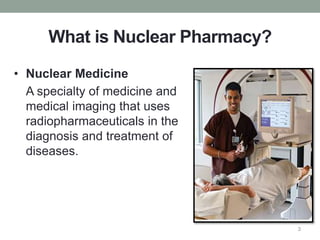
• Nuclear Medicine
A specialty of medicine and
medical imaging that uses
radiopharmaceuticals in the
diagnosis and treatment of
diseases.
3
What is Nuclear Pharmacy?
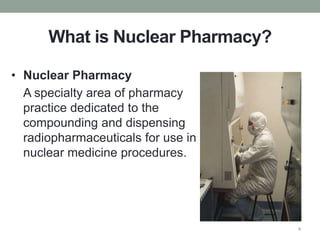
• Nuclear Pharmacy
A specialty area of pharmacy
practice dedicated to the
compounding and dispensing
radiopharmaceuticals for use in
nuclear medicine procedures.
4
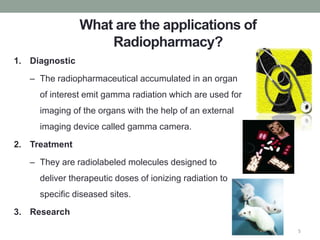
What are the applications of
Radiopharmacy?
1. Diagnostic
– The radiopharmaceutical accumulated in an organ
of interest emit gamma radiation which are used for
imaging of the organs with the help of an external
imaging device called gamma camera.
2. Treatment
– They are radiolabeled molecules designed to
deliver therapeutic doses of ionizing radiation to
specific diseased sites.
3. Research
5
The Nuclear Pharmacist Role
1. Order, receipt, storage and inventory control of
radioactive drugs (radiopharmaceuticals), other drugs
used in nuclear medicine, and related supplies
2. Preparation of radiopharmaceuticals by combining
radioisotopes with reagent kits, and compounding
radiopharmaceuticals that are not commercially
available
3. Functional checks of instruments, equipment and
devices and determination of radiopharmaceutical
quality and purity
4. Filling of prescription orders
6
The Nuclear Pharmacist Role
5. Packaging, labeling and transport of
radiopharmaceuticals
6. Proper handling of hazardous chemicals and biological
specimens
7. Communicating radiopharmaceutical-related information
to others
8. Assuring that patients receive proper preparation before
radiopharmaceutical administration and trouble-
shooting unanticipated outcomes
9. Laboratory testing of new radiopharmaceuticals, new
compounding procedures, quality control methods and
participation in clinical trials
King Saud University 7
Employment Opportunities
• Nuclear Pharmacists work in a wide variety of
settings:
1.Nuclear pharmacies
2.Hospitals
3.Academia
4.Industry
5.Government and private research institutes
8
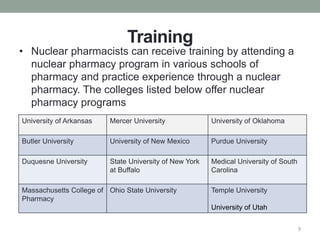
Training
• Nuclear pharmacists can receive training by attending a
nuclear pharmacy program in various schools of
pharmacy and practice experience through a nuclear
pharmacy. The colleges listed below offer nuclear
pharmacy programs
9
University of Arkansas Mercer University University of Oklahoma
Butler University University of New Mexico Purdue University
Duquesne University State University of New York
at Buffalo
Medical University of South
Carolina
Massachusetts College of
Pharmacy
Ohio State University Temple University
University of Utah
Certification
• Upon successful completion of a nuclear
pharmacist training program, nuclear
pharmacists can be certified through an
examination offered by the Board of
Pharmaceutical Specialties (BPS).
• Such nuclear pharmacists are then designated
as Board Certified Nuclear Pharmacists (BCNP).
For more information
10
Design of a Nuclear Pharmacy
• Protection of personnel from radiation hazard.
– Control of personnel radiation exposure is
performed with approved personal
dosimeters, which are regularly checked
and their readings recorded.
• Avoidance of contamination of work area.
• Radiation detection instruments.
• Clean air.
• Disposal of radioactive waste.
11
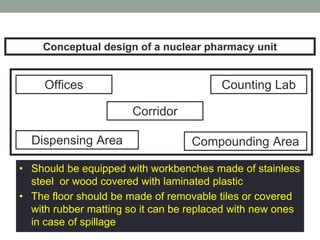
Dispensing Area
Counting Lab
Compounding Area
Offices
Corridor
Conceptual design of a nuclear pharmacy unit
• Should be equipped with workbenches made of stainless
steel or wood covered with laminated plastic
• The floor should be made of removable tiles or covered
with rubber matting so it can be replaced with new ones
in case of spillage
Operation of a Nuclear Pharmacy
1. Receiving of radioactive materials
2. Preparation of radiopharmaceuticals
3. Quality control tests of radiopharmaceuticals
4. Storage
5. Dispensing
6. Radioactive waste disposal
7. Infectious waste disposal
13
Receiving radioactive materials
• Delivered directly to nuclear medicine
department or nuclear pharmacy (short half-
lives)
• Packages should be monitored within 3 hr if
delivered during normal hours
• Packages should be monitored within 3 hr from
the beginning of the next working day if
delivered after working hours
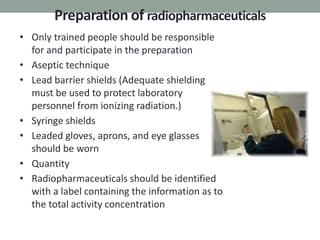
Preparation of radiopharmaceuticals
• Only trained people should be responsible
for and participate in the preparation
• Aseptic technique
• Lead barrier shields (Adequate shielding
must be used to protect laboratory
personnel from ionizing radiation.)
• Syringe shields
• Leaded gloves, aprons, and eye glasses
should be worn
• Quantity
• Radiopharmaceuticals should be identified
with a label containing the information as to
the total activity concentration
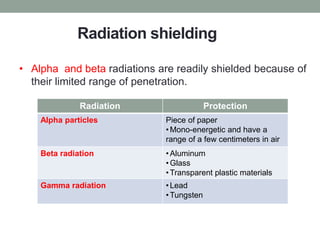
Radiation shielding
• Alpha and beta radiations are readily shielded because of
their limited range of penetration.
Radiation Protection
Alpha particles Piece of paper
•Mono-energetic and have a
range of a few centimeters in air
Beta radiation •Aluminum
•Glass
•Transparent plastic materials
Gamma radiation •Lead
•Tungsten
Quality Control Tests of Radiopharmaceuticals
• Before despising for humans
• Colloidal and macro-aggregated preparation
should be checked for particle size.
• Workstations and their environment should
regularly be monitored with respect to
microbiological quality.
Quality control tests of radiopharmaceuticals
• Visual Inspection of Product
- Visual inspection of the compounded radiopharmaceutical
shall be conducted to ensure the absence of foreign
matter and also to establish product identity by confirming
that
(1)a liquid product is a solution, a colloid, or a suspension
(2) a solid product has defined properties that identify it.
• Assessment of Radioactivity
-The amount of radioactivity in each compounded
radiopharmaceutical should be verified and documented
prior to dispensing, using a proper standardized
radionuclide (dose) calibrator.
Storage
• Should be properly
stored to prevent
degradation by light or
temperature
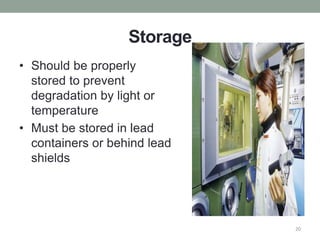
• Must be stored in lead
containers or behind lead
shields
20
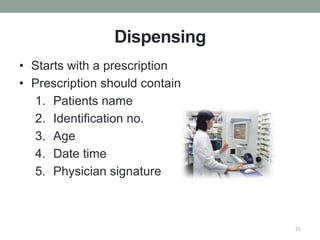
Dispensing
• Starts with a prescription
• Prescription should contain
1. Patients name
2. Identification no.
3. Age
4. Date time
5. Physician signature
21
Radioactive waste disposal
• Syringes, vials containing residual activities,
needles, contaminated papers, liquid waste
• According to guideline
1. Decay in storage
2. Release into a sewerage system
3. Transfer to an authorized recipient
(disposable facility)
4. Others (incineration and atmospheric
release of radioactive gases)
22
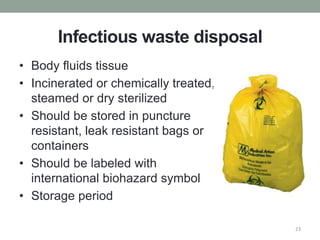
Infectious waste disposal
• Body fluids tissue
• Incinerated or chemically treated,
steamed or dry sterilized
• Should be stored in puncture
resistant, leak resistant bags or
containers
• Should be labeled with
international biohazard symbol
• Storage period
23
Thank You
24

Nuclear pharmacy.pptx

  • 1.
    NUCLEAR PHARMACY Presented by; Dr.Imran Masood Drimranmasood@iub.edu.com
  • 2.
    What is NuclearPharmacy? • A specialty area of pharmacy practice is one that requires a concentration of knowledge in a once specific area. • The development of nuclear pharmacy as a specialty area followed the development of nuclear medicine as a recognized specialty by the American Medical Association in the early 1970's. 2
  • 3.
    What is NuclearPharmacy? • Nuclear Medicine A specialty of medicine and medical imaging that uses radiopharmaceuticals in the diagnosis and treatment of diseases. 3
  • 4.
    What is NuclearPharmacy? • Nuclear Pharmacy A specialty area of pharmacy practice dedicated to the compounding and dispensing radiopharmaceuticals for use in nuclear medicine procedures. 4
  • 5.
    What are theapplications of Radiopharmacy? 1. Diagnostic – The radiopharmaceutical accumulated in an organ of interest emit gamma radiation which are used for imaging of the organs with the help of an external imaging device called gamma camera. 2. Treatment – They are radiolabeled molecules designed to deliver therapeutic doses of ionizing radiation to specific diseased sites. 3. Research 5
  • 6.
    The Nuclear PharmacistRole 1. Order, receipt, storage and inventory control of radioactive drugs (radiopharmaceuticals), other drugs used in nuclear medicine, and related supplies 2. Preparation of radiopharmaceuticals by combining radioisotopes with reagent kits, and compounding radiopharmaceuticals that are not commercially available 3. Functional checks of instruments, equipment and devices and determination of radiopharmaceutical quality and purity 4. Filling of prescription orders 6
  • 7.
    The Nuclear PharmacistRole 5. Packaging, labeling and transport of radiopharmaceuticals 6. Proper handling of hazardous chemicals and biological specimens 7. Communicating radiopharmaceutical-related information to others 8. Assuring that patients receive proper preparation before radiopharmaceutical administration and trouble- shooting unanticipated outcomes 9. Laboratory testing of new radiopharmaceuticals, new compounding procedures, quality control methods and participation in clinical trials King Saud University 7
  • 8.
    Employment Opportunities • NuclearPharmacists work in a wide variety of settings: 1.Nuclear pharmacies 2.Hospitals 3.Academia 4.Industry 5.Government and private research institutes 8
  • 9.
    Training • Nuclear pharmacistscan receive training by attending a nuclear pharmacy program in various schools of pharmacy and practice experience through a nuclear pharmacy. The colleges listed below offer nuclear pharmacy programs 9 University of Arkansas Mercer University University of Oklahoma Butler University University of New Mexico Purdue University Duquesne University State University of New York at Buffalo Medical University of South Carolina Massachusetts College of Pharmacy Ohio State University Temple University University of Utah
  • 10.
    Certification • Upon successfulcompletion of a nuclear pharmacist training program, nuclear pharmacists can be certified through an examination offered by the Board of Pharmaceutical Specialties (BPS). • Such nuclear pharmacists are then designated as Board Certified Nuclear Pharmacists (BCNP). For more information 10
  • 11.
    Design of aNuclear Pharmacy • Protection of personnel from radiation hazard. – Control of personnel radiation exposure is performed with approved personal dosimeters, which are regularly checked and their readings recorded. • Avoidance of contamination of work area. • Radiation detection instruments. • Clean air. • Disposal of radioactive waste. 11
  • 12.
    Dispensing Area Counting Lab CompoundingArea Offices Corridor Conceptual design of a nuclear pharmacy unit • Should be equipped with workbenches made of stainless steel or wood covered with laminated plastic • The floor should be made of removable tiles or covered with rubber matting so it can be replaced with new ones in case of spillage
  • 13.
    Operation of aNuclear Pharmacy 1. Receiving of radioactive materials 2. Preparation of radiopharmaceuticals 3. Quality control tests of radiopharmaceuticals 4. Storage 5. Dispensing 6. Radioactive waste disposal 7. Infectious waste disposal 13
  • 14.
    Receiving radioactive materials •Delivered directly to nuclear medicine department or nuclear pharmacy (short half- lives) • Packages should be monitored within 3 hr if delivered during normal hours • Packages should be monitored within 3 hr from the beginning of the next working day if delivered after working hours
  • 15.
    Preparation of radiopharmaceuticals •Only trained people should be responsible for and participate in the preparation • Aseptic technique • Lead barrier shields (Adequate shielding must be used to protect laboratory personnel from ionizing radiation.) • Syringe shields • Leaded gloves, aprons, and eye glasses should be worn • Quantity • Radiopharmaceuticals should be identified with a label containing the information as to the total activity concentration
  • 16.
    Radiation shielding • Alphaand beta radiations are readily shielded because of their limited range of penetration. Radiation Protection Alpha particles Piece of paper •Mono-energetic and have a range of a few centimeters in air Beta radiation •Aluminum •Glass •Transparent plastic materials Gamma radiation •Lead •Tungsten
  • 18.
    Quality Control Testsof Radiopharmaceuticals • Before despising for humans • Colloidal and macro-aggregated preparation should be checked for particle size. • Workstations and their environment should regularly be monitored with respect to microbiological quality.
  • 19.
    Quality control testsof radiopharmaceuticals • Visual Inspection of Product - Visual inspection of the compounded radiopharmaceutical shall be conducted to ensure the absence of foreign matter and also to establish product identity by confirming that (1)a liquid product is a solution, a colloid, or a suspension (2) a solid product has defined properties that identify it. • Assessment of Radioactivity -The amount of radioactivity in each compounded radiopharmaceutical should be verified and documented prior to dispensing, using a proper standardized radionuclide (dose) calibrator.
  • 20.
    Storage • Should beproperly stored to prevent degradation by light or temperature • Must be stored in lead containers or behind lead shields 20
  • 21.
    Dispensing • Starts witha prescription • Prescription should contain 1. Patients name 2. Identification no. 3. Age 4. Date time 5. Physician signature 21
  • 22.
    Radioactive waste disposal •Syringes, vials containing residual activities, needles, contaminated papers, liquid waste • According to guideline 1. Decay in storage 2. Release into a sewerage system 3. Transfer to an authorized recipient (disposable facility) 4. Others (incineration and atmospheric release of radioactive gases) 22
  • 23.
    Infectious waste disposal •Body fluids tissue • Incinerated or chemically treated, steamed or dry sterilized • Should be stored in puncture resistant, leak resistant bags or containers • Should be labeled with international biohazard symbol • Storage period 23
  • 24.