A SEMINAR REPORT
On
FUSION ENERGY
Submitted in partial fulfillment of the requirements for the award of the degree of
BACHELOR OF TECHNOLOGY
In
ELECTRICAL & ELECTRONICS ENGINEERING
Of
JAWAHARLAL NEHRU TECHNOLOGICAL UNIVERSITY, ANANTAPUR
By
D. SATHYA PHANEESHWAR
168P1A0243
DEPARTMENT OF ELECTRICAL & ELECTRONICS ENGINEERING
ADITYA COLLEGE OF ENGINEERING, MADANAPALLE
JAWAHARLAL NEHRU TECHNOLOGICAL UNIVERSITY, ANANTAPUR
ANDHRA PRADESH
2016-2020
ADITYA COLLEGE OF ENGINEERING
(Approved by AICTE, New Delhi, Affiliated to JNTUA, Anantapuramu)
Valasapalli Post, MADANAPALLE-517325, Chittoor Dist. A.P
DEPARTMENT OF ELECTRICAL & ELECTRONICS ENGINEERING
CERTIFICATE
This is to certify that, this technical seminar work entitled “FUSION
ENERGY” submitted in a partial fulfillment of the requirements for the award of
the degree of BACHELOR OF TECHNOLOGY in “ELECTRICAL AND
ELECTRONICS ENGINEERING” is a result of bonafide work carried out in the
batch IV B.Tech-II semester by “D. SATHYA PHANEESHWAR” bearing
Register No: 168P1A0243 from JNTU-ANANTAPUR during the academic year
2019-2020.
Mr. G. VIJAYA KUMAR Mr. M. RAMPRASAD REDDY
Seminar supervisor HOD-EEE
ACKNOWLEDGEMENT
I express my deep sense of gratitude to Mr. G. VIJAYA KUMAR, Seminar
Supervisor, for supporting and encouraging at each stage of my seminar work and guided
me to do my best.
I would like to express my sincere thanks to MRS.PIKASO PAL, guide, who gave
me an opportunity to work under his guidance.
I sincerely thank Mr. M. RAMPRASAD REDDY, HOD, Department of
Electrical & Electronics Engineering, for his valuable support and constant encouragement
given to me during this work.
It is my privilege and pleasure to express our profound sense of respect, gratitude and
indebtedness to Dr. S. RAMALINGA REDDY, Principal for guiding and providing
facilities for the successful completion of my seminar work.
My sincere thanks to the MANAGEMENT of Aditya College of Engineering,
Madanapalle for providing excellent infrastructure and lab facilities that helped me to go
through the different areas of the interest to do my seminar work.
Last but not least, I wish to acknowledge my parents and friends for giving moral
strength and encouragement.
D. SATHYA PHANEESHWAR
168P1A0243
IV B. Tech -II Sem
Electrical & Electronic Eng.
CONTENTS
Title Page No.
ABSTRACT i
LIST OF FIGURES Ii
Chapter 1
1.1 Introduction 1
1.2 Statement of the problem 1
1.3 Aim and Objective 2
1.4 Overview of Fusion 2
CHAPTER 2
2.1 Nuclear Energy 3
2.2 Types of Nuclear Energy 3
2.3 Nuclear Fission 3
2.4 Nuclear Fusion 4
2.5 Types of Fusion Reaction 4
CHAPTER 3
3.1Types of Fusion Reactors 6
3.2 Tokamak Reactor 6
3.3 Magnetic Target Fusion Reactor 7
3.4 Lockheed Martin Compact Fusion Reactor (CFR) 9
CHAPTER 4
Need of Fusion Energy 12
CHAPTER 5
Progress in Fusion 14
CHAPTER 6
Advantages of Fusion Energy 16
CHAPTER 7
CONCLUSION 17
REFERENCE 18
i
ABSTRACT
Energy consumption is increasing every day. By using traditional non-renewable sources
(which are satisfying the needs of the world for a long time) are causing climatic changes like Global
Warming, Renewables on the other hand, can provide green energy but they cannot compete with
the traditional methods. And also, one the biggest drawback of renewables is they are not consistent.
They cannot be generated anytime we require. Nuclear Fission Reactors to generate electricity. But
that has a setback like Reactor Malfunctioning, Harmful Radio Active waste generation. FUSION
ENERGY can be the best alternative for our world’s energy needs. Fusion power is a form of power
generation in which energy is generated by using fusion reactions to produce heat for electricity
generation. Fusion reactions fuse two lighter atomic nuclei to form a heavier nucleus, releasing
energy. Devices designed to harness this energy are known as fusion reactors.
The fusion reaction normally takes place in a plasma of deuterium and tritium heated to
millions of degrees. In stars, gravity contains these fuels. Outside of a star, the most researched way
to confine the plasma at these temperatures is to use magnetic fields. The major challenge in realizing
fusion power is to engineer a system that can confine the plasma long enough at high enough
temperature and density.As a source of power, nuclear fusion has several theoretical advantages over
fission. These advantages include reduced radioactivity in operation and as waste, ample fuel
supplies, and increased safety. However, controlled fusion has proven to be extremely difficult to
produce in a practical and economical manner.
ii
LIST OF FIGURES
Figure No. Title of the Figure Page No.
2.3.1 Fission Reaction 3
2.4.1 Fusion Reaction 4
2.5.1 Types of Fusion Reactions 5
3.2.1 Tokamak Fusion Reactor 6
3.3.1 Magnetic Target Fusion Reactor 7
3.4.1 Lockheed Martin Compact Fusion Reactor 9
4.1.1 Cost per Unit Prediction 12
5.1 Mega Amp Spherical Tokamak 15
FUSION ENERGY
DEPARTMENT OF EEE, ACEM Page 1
CHAPTER-1
1.1 INTRODUCTION
Fusion Energy is the most promising form of energy generation for the future. It is a
type of nuclear reaction happening between two isotopes of hydrogen to produce energy in the
form of heat and then convert it into electricity.
However, it is not similar to the Nuclear Fission which is being used currently. The
basic physics behind Nuclear Fission and Nuclear Fusion is completely different. A Nuclear
Fission reaction generates energy by splitting one atom which has bigger nucleus into two small
atoms. While Fusion on the other hand, it generates energy by combining two atoms of small
nuclei into one atom of bigger nucleus.
Nuclear Reaction by Fission is harmful and dangerous. The Radio Active waste
produced in Fission reaction is dangerous and can be used for making Nuclear weapons. Fusion
is a safe, eco-friendly and controllable reaction which is not dangerous at any manner and the
radio active waste generated by it cannot be used for making Nuclear Warfare.
Nuclear Fusion is a reaction which power all of the stars in the sky. In fact, Nuclear
Fusion is the only way of producing energy in the cosmic scale. To create fusion on planet
Earth, we need to create a device that can literally able to hold Sun in it.
To get energy from fusion, gas from a combination of types of hydrogen – deuterium
and tritium – is heated to very high temperatures (100 million degrees Celsius). One way to
achieve these conditions is a method called ‘magnetic confinement' – controlling the hot gas
(known as a plasma) with strong magnets. The most promising device for this is the ‘tokamak',
a Russian word for a ring-shaped magnetic chamber. However, the reactor never archived a
fusion reaction with net positive energy output. Various other kinds of Nuclear Fusion Reactors
are also being developed and constructed by different governments and private organisations
around the world to archive Sun’s way of generating Energy.
1.2 STATEMENT OF THE PROBLEM
Electricity consumption is increasing day by day. Humanity is becoming more
dependent on electricity like never before. With the advent of electric transportation, the
reliance on electricity is growing to a new height. We are depending on Fossil fuels like coal,
natural gas, petroleum to generate electricity on a big way. They are causing so many
FUSION ENERGY
DEPARTMENT OF EEE, ACEM Page 2
environmental effects like Global Warming etc. While we are using certain Renewable sources
of generating power like Solar, Wind, and Hydro, each one of them has different kinds of
drawbacks.
To meet the humongous growth of electricity demand, none of the sources can reliably,
efficiently and without harming environment to generate electricity. Therefore, Fusion Energy
is the single way of producing power to match the ever-growing demand in the future.
1.3 AIM AND OBJECTIVE
The main of Fusion energy generation is to match the ever-growing energy demand of
the electricity and supply the power to the customers reliably, efficiently and without harming
environment and also in a cost-effective manner.
1.4 OVERVIEW OF FUSION ENEGY
The search for harnessing Star’s way of generating electricity began in 1920-1930
period Hans Bethe, discovered that nuclear fusion was possible and that it was
the energy source for the sun. Beginning in the 1940's researchers began to look for ways to
initiate and control fusion reactions to produce useful energy on earth.
From the start, the task was difficult, because fusion reactions required temperatures of
hundreds of millions of degrees, too hot to be contained by any solid chamber. Instead,
physicists sought to contain the hot plasma with magnetic fields, using, for example, the pinch
effect where electric currents moving in the same direction attract each other through their
magnetic fields. This approach was called “magnetic confinement”.
The reaction is everyday becoming a step closer as many scientists are researching and
experimenting various methods to reach the ultimate goal of mimicking the star. This is will be
the ultimate feet every attempted by humanity in 21st
century if we figured out the secrets of
the star.
FUSION ENERGY
DEPARTMENT OF EEE, ACEM Page 3
CHAPTER 2
2.1 NUCLEAR ENERGY
Nuclear energy is formed by Nuclear reactions which will generate heat, which most
frequently is then used to steam turbines to produce electricity. In this process, Radioactive
decay is formed which is not that safe to have physical contact.
2.2 TYPES OF NUCLEAR REACTION
Depending on the way a nuclear reaction occurs, it is categorized into two ways.
They are 1. Nuclear Fission
2. Nuclear Fusion
2.3 NUCLEAR FISSION
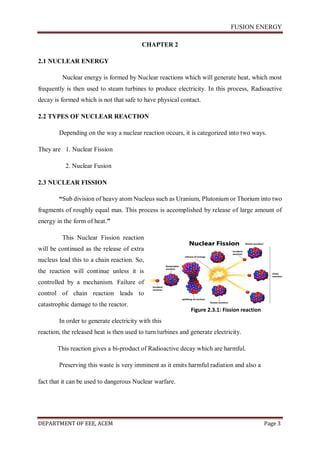
“Sub division of heavy atom Nucleus such as Uranium, Plutonium or Thorium into two
fragments of roughly equal mas. This process is accomplished by release of large amount of
energy in the form of heat.”
This Nuclear Fission reaction
will be continued as the release of extra
nucleus lead this to a chain reaction. So,
the reaction will continue unless it is
controlled by a mechanism. Failure of
control of chain reaction leads to
catastrophic damage to the reactor.
In order to generate electricity with this
reaction, the released heat is then used to turn turbines and generate electricity.
This reaction gives a bi-product of Radioactive decay which are harmful.
Preserving this waste is very imminent as it emits harmful radiation and also a
fact that it can be used to dangerous Nuclear warfare.
Figure 2.3.1: Fission reaction
FUSION ENERGY
DEPARTMENT OF EEE, ACEM Page 4
2.4 NUCLEAR FUSION
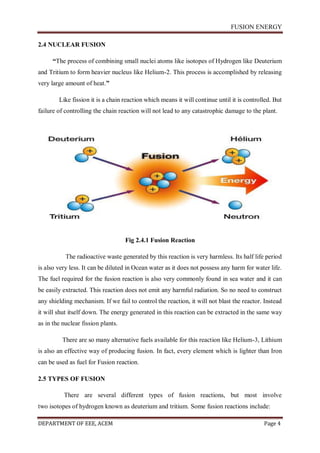
“The process of combining small nuclei atoms like isotopes of Hydrogen like Deuterium
and Tritium to form heavier nucleus like Helium-2. This process is accomplished by releasing
very large amount of heat.”
Like fission it is a chain reaction which means it will continue until it is controlled. But
failure of controlling the chain reaction will not lead to any catastrophic damage to the plant.
Fig 2.4.1 Fusion Reaction
The radioactive waste generated by this reaction is very harmless. Its half life period
is also very less. It can be diluted in Ocean water as it does not possess any harm for water life.
The fuel required for the fusion reaction is also very commonly found in sea water and it can
be easily extracted. This reaction does not emit any harmful radiation. So no need to construct
any shielding mechanism. If we fail to control the reaction, it will not blast the reactor. Instead
it will shut itself down. The energy generated in this reaction can be extracted in the same way
as in the nuclear fission plants.
There are so many alternative fuels available for this reaction like Helium-3, Lithium
is also an effective way of producing fusion. In fact, every element which is lighter than Iron
can be used as fuel for Fusion reaction.
2.5 TYPES OF FUSION
There are several different types of fusion reactions, but most involve
two isotopes of hydrogen known as deuterium and tritium. Some fusion reactions include:
FUSION ENERGY
DEPARTMENT OF EEE, ACEM Page 5
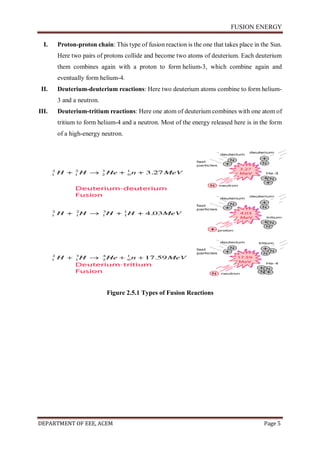
I. Proton-proton chain: This type of fusion reaction is the one that takes place in the Sun.
Here two pairs of protons collide and become two atoms of deuterium. Each deuterium
them combines again with a proton to form helium-3, which combine again and
eventually form helium-4.
II. Deuterium-deuterium reactions: Here two deuterium atoms combine to form helium-
3 and a neutron.
III. Deuterium-tritium reactions: Here one atom of deuterium combines with one atom of
tritium to form helium-4 and a neutron. Most of the energy released here is in the form
of a high-energy neutron.
Figure 2.5.1 Types of Fusion Reactions
FUSION ENERGY
DEPARTMENT OF EEE, ACEM Page 6
CHAPTER 3
3.1 TYPES OF FUSION REACTORS
There are different types of reactors that are being developed around the world with
different designs, operation mechanisms and sizes of reaction. But there are mainly three
kinds of reactors. They are Tokamak Reactor, Magnetized Target Fusion Reactor and
Lockheed Martin Compact Fusion Reactor.
3.2 TOKAMAK REACTOR
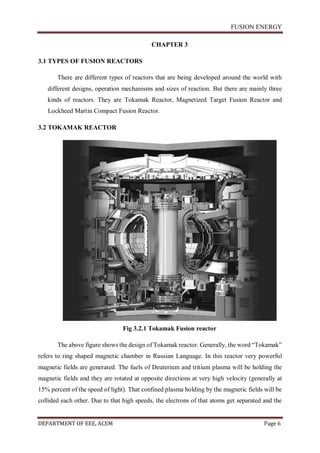
Fig 3.2.1 Tokamak Fusion reactor
The above figure shows the design of Tokamak reactor. Generally, the word “Tokamak”
refers to ring shaped magnetic chamber in Russian Language. In this reactor very powerful
magnetic fields are generated. The fuels of Deuterium and tritium plasma will be holding the
magnetic fields and they are rotated at opposite directions at very high velocity (generally at
15% percent of the speed of light). That confined plasma holding by the magnetic fields will be
collided each other. Due to that high speeds, the electrons of that atoms get separated and the
FUSION ENERGY
DEPARTMENT OF EEE, ACEM Page 7
nucleus of two atoms are exposed. Then they will touch each other and get fused. And they will
become a heavier atom Helium with release of a neutron and massive amount of heat. The heat
then be absorbed the Molten Salt mechanism and then it is used to heat the water to turn the
turbines to generate the electricity. In this way, fusion occurs in this type of reactors. This
reactor is being built by ITER (International Thermo Nuclear Experimental Reactor). In this
project many countries including China, India, Britain etc are participated. There are even more
governments working on this type of reactors like USA, EU, etc. Of all the others, ITER has
done a lot of progress among others and it is also contributing so much by collecting data which
then be used for refining the operating method.
3.3 MAGNETISED TARGET FUSION REACTOR
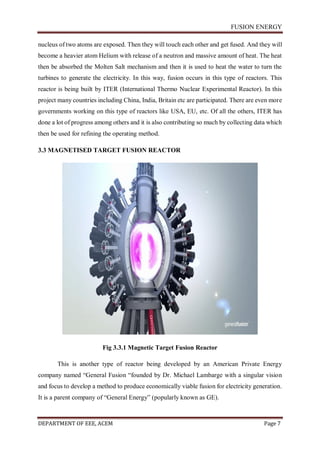
Fig 3.3.1 Magnetic Target Fusion Reactor
This is another type of reactor being developed by an American Private Energy
company named “General Fusion “founded by Dr. Michael Lambarge with a singular vision
and focus to develop a method to produce economically viable fusion for electricity generation.
It is a parent company of “General Energy” (popularly known as GE).
FUSION ENERGY
DEPARTMENT OF EEE, ACEM Page 8
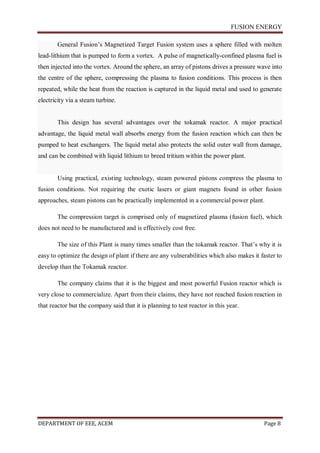
General Fusion’s Magnetized Target Fusion system uses a sphere filled with molten
lead-lithium that is pumped to form a vortex. A pulse of magnetically-confined plasma fuel is
then injected into the vortex. Around the sphere, an array of pistons drives a pressure wave into
the centre of the sphere, compressing the plasma to fusion conditions. This process is then
repeated, while the heat from the reaction is captured in the liquid metal and used to generate
electricity via a steam turbine.
This design has several advantages over the tokamak reactor. A major practical
advantage, the liquid metal wall absorbs energy from the fusion reaction which can then be
pumped to heat exchangers. The liquid metal also protects the solid outer wall from damage,
and can be combined with liquid lithium to breed tritium within the power plant.
Using practical, existing technology, steam powered pistons compress the plasma to
fusion conditions. Not requiring the exotic lasers or giant magnets found in other fusion
approaches, steam pistons can be practically implemented in a commercial power plant.
The compression target is comprised only of magnetized plasma (fusion fuel), which
does not need to be manufactured and is effectively cost free.
The size of this Plant is many times smaller than the tokamak reactor. That’s why it is
easy to optimize the design of plant if there are any vulnerabilities which also makes it faster to
develop than the Tokamak reactor.
The company claims that it is the biggest and most powerful Fusion reactor which is
very close to commercialize. Apart from their claims, they have not reached fusion reaction in
that reactor but the company said that it is planning to test reactor in this year.
FUSION ENERGY
DEPARTMENT OF EEE, ACEM Page 9
3.4 LOCKHEED MARTIN COMPACT FUSION REACTOR
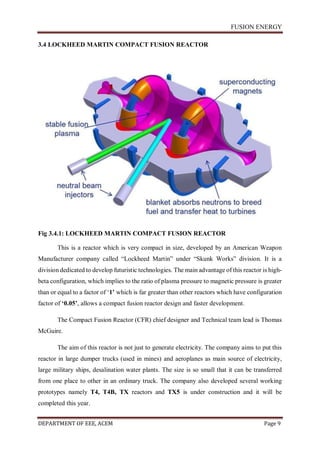
Fig 3.4.1: LOCKHEED MARTIN COMPACT FUSION REACTOR
This is a reactor which is very compact in size, developed by an American Weapon
Manufacturer company called “Lockheed Martin” under “Skunk Works” division. It is a
division dedicated to develop futuristic technologies. The main advantage of this reactor is high-
beta configuration, which implies to the ratio of plasma pressure to magnetic pressure is greater
than or equal to a factor of ‘1’ which is far greater than other reactors which have configuration
factor of ‘0.05’, allows a compact fusion reactor design and faster development.
The Compact Fusion Reactor (CFR) chief designer and Technical team lead is Thomas
McGuire.
The aim of this reactor is not just to generate electricity. The company aims to put this
reactor in large dumper trucks (used in mines) and aeroplanes as main source of electricity,
large military ships, desalination water plants. The size is so small that it can be transferred
from one place to other in an ordinary truck. The company also developed several working
prototypes namely T4, T4B, TX reactors and TX5 is under construction and it will be
completed this year.
FUSION ENERGY
DEPARTMENT OF EEE, ACEM Page 10
T-4 reactor:
Technical results presented on the T4 experiment in 2015 showed a cold, partially
ionized plasma with the following parameters: peak electron temperature of 20 Electron
volts, 1016 m−3 electron density, less than 1% ionization fraction and 3 kW of input power. No
confinement or fusion reaction rates were presented.
McGuire presented two theoretical reactor concepts in 2015. One was an ideal
configuration weighing 200 metric tons with 1 meter of cryogenic radiation shielding and
15 tesla magnets. The other was a conservative configuration weighing 2,000 metric tons,
with 2 meters of cryogenic radiation shielding and 5 Tesla magnets.
T-4B reactor:
The T4B prototype was announced in 2016
Parameters:
 1 m diameter × 2 m long
o 1 MW, 25 keV H-neutral beam heating power
o 3 ms duration
 Assume 500 kW is converted into fast ions.
 n = 5×10¹⁹ m−3
 β = 1 (field = 0.1 T)
 V = 0.2 m3, 1170 J total energy
 Peak Ti = 75 eV
 Peak Te = 250 eV
 Peak sheath loss = 228 kW, about equal to Pei
 Peak ring cusp loss = 15 kW
 Peak axial cusp loss = 1 kW
TX reactor:
Parameters:
 7 m diameter × 18 m long, 1 m thick blankets
 320 MW gross
 40 MW heating power, 2.3 s
FUSION ENERGY
DEPARTMENT OF EEE, ACEM Page 11
 n = 5×10²⁰ m−3
 β = 1 (field = 2.3 T)
 V = 16.3 m3, 51 MJ total energy
 Ti = 9.6 keV
 Te = 12.6 keV
FUSION ENERGY
DEPARTMENT OF EEE, ACEM Page 12
CHAPTER 4
NEED FOR FUSION ENERGY
New, environmentally sustainable forms of electricity will be required to meet the
aspirations of a growing world population.
By 2050, an expected rise in global population from seven billion to ten billion and
better living standards could lead to a two to threefold increase in energy consumption.
No single technology will fulfil this demand. Each has strengths and weaknesses, and a
mix of power sources will be needed to meet the challenges of energy security, sustainable
development and environmental protection. Future energy supply options may comprise fossil
fuels, nuclear fission, fusion, and renewables.
At present, 80% of the developed world's energy comes from fossil fuels.
Environmental problems – the greenhouse effect and the effects of acidic pollution – and
diminishing fuel supplies mean that reliance on coal, gas and oil will have to be severely
constrained.
Nuclear fission will continue to make a major contribution to electricity generation but
its growth could be curtailed by issues of public and political acceptability. Supplies from
renewable sources are reliant on environmental conditions, and are therefore not guaranteed to
be constant. They are also subject to technology challenges of energy storage. To provide
constant baseload electricity, predictable, non-varying sources of energy are needed. This
means a short-term reliance on fossil fuels and fission and then the addition of fusion power as
soon as it becomes available.
Fusion offers a secure, long-term source of
supply, with important advantages. These include: no
production of greenhouse gases from the fusion
process; no long-lived radioactive waste (all waste will
be recyclable within 100 years); inherent safety
features; and almost unlimited fuel supplies. On current
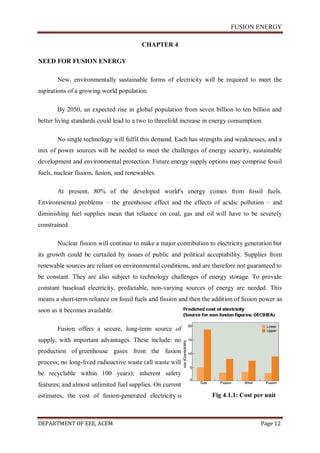
estimates, the cost of fusion-generated electricity is Fig 4.1.1: Cost per unit
Prediction
FUSION ENERGY
DEPARTMENT OF EEE, ACEM Page 13
predicted to be broadly comparable to that obtained from fission, renewable sources and fossil
fuels.
Fusion, therefore, could have a key role to play in the energy market of the future, with
the potential to produce at least 20% of the world's electricity by 2100.
FUSION ENERGY
DEPARTMENT OF EEE, ACEM Page 14
CHAPTER 5
PROGRESS IN FUSION
Many of the scientific hurdles in fusion have now been overcome by researchers. The
world's largest tokamak, JET (Joint European Torus), has produced 16 megawatts of fusion
power and proved the technical feasibility of fusion using deuterium and tritium, currently
considered the most efficient fuels. The challenge now is to prove fusion can work on a power
plant scale.
International fusion research is following a roadmap to achieve power generation by 2050.
It focuses on three main projects:
 ITER – a multinational project that is being built in the south of France. ITER will be a
500 megawatt tokamak (equivalent to a small power plant) and aims to confirm that
fusion power will be possible on a commercial scale;
 IFMIF (International Fusion Materials Irradiation Facility) – a device that will test the
materials needed in a fusion power station, planned to operate in parallel with ITER;
 DEMO – a demonstration power plant supplying fusion electricity to the grid. This is
being designed now and would be constructed during ITER and IFMIF operation. If
successful, it will be followed by the first generation of commercial fusion power
stations.
Fusion in the UK
The United Kingdom's fusion research programme is based at Culham Centre for Fusion
Energy (CCFE) in Oxfordshire. The work is funded by the Engineering and Physical Sciences
Research Council and by the European Union under the Euratom treaty.
The UK contributes to fusion research in two main ways:
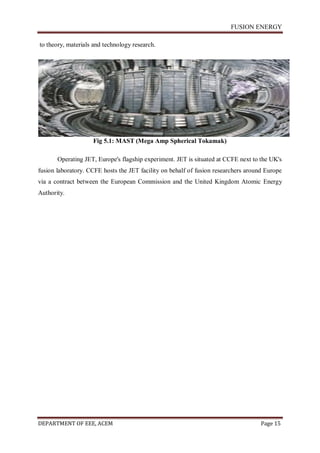
 Its own fusion program, cantered on the MAST (Mega Amp Spherical Tokamak)
device. The UK program also makes important contributions to ITER preparations and
FUSION ENERGY
DEPARTMENT OF EEE, ACEM Page 15
to theory, materials and technology research.
Fig 5.1: MAST (Mega Amp Spherical Tokamak)
Operating JET, Europe's flagship experiment. JET is situated at CCFE next to the UK's
fusion laboratory. CCFE hosts the JET facility on behalf of fusion researchers around Europe
via a contract between the European Commission and the United Kingdom Atomic Energy
Authority.
FUSION ENERGY
DEPARTMENT OF EEE, ACEM Page 16
CHAPTER 6
ADVANTAGES OF FUSION ENERGY
The world needs new, cleaner ways to supply our increasing energy demand, as concerns grow
over climate change and declining supplies of fossil fuels. Power stations using fusion would
have a number of advantages:
 ZEO CARBON EMISSION:
. The only by-products of fusion reactions are small amounts of helium, which is an inert
gas that will not add to atmospheric pollution.
 ABUNDANT FUELS:
Deuterium can be extracted from water and tritium is produced from lithium, which is found
in the earth's crust. Fuel supplies will therefore last for millions of years.
 ENERGY EFFICIENCY:
One kilogram of fusion fuel can provide the same amount of energy as 10 million kilograms
of fossil fuel.
 NO LONG-LIVED RADIO ACTIVE WASTE:
Only plant components become radioactive and these will be safe to recycle or dispose of
conventionally within 100 years.
 SAFETY:
The small amounts of fuel used in fusion devices (about the weight of a postage stamp at
any one time) means that a large-scale nuclear accident is not possible.
 RELIABLE POWER:. Fusion power plants should provide a base load supply of large
amounts of electricity, at costs that are estimated to be broadly similar to other energy
sources.
FUSION ENERGY
DEPARTMENT OF EEE, ACEM Page 17
CONCLUSION
Since the birth of electricity, there is no perfect way of producing power, every
method we are following has a disadvantage. I believe if we figured out the most
economical way of producing Fusion Power and creating the perfect Fusion Reactor
will be the most unprecedented achievement to the humanity in 21st
century. Because
it will be the most perfect manner of creating unlimited, uninterrupted way of producing
clean, safe, sustainable source of electricity.
FUSION ENERGY
DEPARTMENT OF EEE, ACEM Page 18
REFERENCES
[1]. http://www.ccfe.ac.uk/introduction.aspx - “Introduction to the fusion Energy”
[2]. https://en.wikipedia.org/wiki/Nuclear_power - “Nuclear Power and its types”
[3]. https://energyeducation.ca/encyclopedia/Nuclear_fusion - “Types of Nuclear Fusion reactions”
[4]. https://www.youtube.com/watch?v=mZsaaturR6E – “Tokamak Reactor”
[5]. https://www.youtube.com/watch?v=2m9kC1yRnLQ – “Magnetic Target Fusion Reactor”
[6]. https://www.lockheedmartin.com/en-us/products/compact-fusion.html - “Lockheed Martin
Compact fusion reactor.”

Fusion energy

  • 1.
    A SEMINAR REPORT On FUSIONENERGY Submitted in partial fulfillment of the requirements for the award of the degree of BACHELOR OF TECHNOLOGY In ELECTRICAL & ELECTRONICS ENGINEERING Of JAWAHARLAL NEHRU TECHNOLOGICAL UNIVERSITY, ANANTAPUR By D. SATHYA PHANEESHWAR 168P1A0243 DEPARTMENT OF ELECTRICAL & ELECTRONICS ENGINEERING ADITYA COLLEGE OF ENGINEERING, MADANAPALLE JAWAHARLAL NEHRU TECHNOLOGICAL UNIVERSITY, ANANTAPUR ANDHRA PRADESH 2016-2020
  • 2.
    ADITYA COLLEGE OFENGINEERING (Approved by AICTE, New Delhi, Affiliated to JNTUA, Anantapuramu) Valasapalli Post, MADANAPALLE-517325, Chittoor Dist. A.P DEPARTMENT OF ELECTRICAL & ELECTRONICS ENGINEERING CERTIFICATE This is to certify that, this technical seminar work entitled “FUSION ENERGY” submitted in a partial fulfillment of the requirements for the award of the degree of BACHELOR OF TECHNOLOGY in “ELECTRICAL AND ELECTRONICS ENGINEERING” is a result of bonafide work carried out in the batch IV B.Tech-II semester by “D. SATHYA PHANEESHWAR” bearing Register No: 168P1A0243 from JNTU-ANANTAPUR during the academic year 2019-2020. Mr. G. VIJAYA KUMAR Mr. M. RAMPRASAD REDDY Seminar supervisor HOD-EEE
  • 3.
    ACKNOWLEDGEMENT I express mydeep sense of gratitude to Mr. G. VIJAYA KUMAR, Seminar Supervisor, for supporting and encouraging at each stage of my seminar work and guided me to do my best. I would like to express my sincere thanks to MRS.PIKASO PAL, guide, who gave me an opportunity to work under his guidance. I sincerely thank Mr. M. RAMPRASAD REDDY, HOD, Department of Electrical & Electronics Engineering, for his valuable support and constant encouragement given to me during this work. It is my privilege and pleasure to express our profound sense of respect, gratitude and indebtedness to Dr. S. RAMALINGA REDDY, Principal for guiding and providing facilities for the successful completion of my seminar work. My sincere thanks to the MANAGEMENT of Aditya College of Engineering, Madanapalle for providing excellent infrastructure and lab facilities that helped me to go through the different areas of the interest to do my seminar work. Last but not least, I wish to acknowledge my parents and friends for giving moral strength and encouragement. D. SATHYA PHANEESHWAR 168P1A0243 IV B. Tech -II Sem Electrical & Electronic Eng.
  • 4.
    CONTENTS Title Page No. ABSTRACTi LIST OF FIGURES Ii Chapter 1 1.1 Introduction 1 1.2 Statement of the problem 1 1.3 Aim and Objective 2 1.4 Overview of Fusion 2 CHAPTER 2 2.1 Nuclear Energy 3 2.2 Types of Nuclear Energy 3 2.3 Nuclear Fission 3 2.4 Nuclear Fusion 4 2.5 Types of Fusion Reaction 4 CHAPTER 3 3.1Types of Fusion Reactors 6 3.2 Tokamak Reactor 6 3.3 Magnetic Target Fusion Reactor 7 3.4 Lockheed Martin Compact Fusion Reactor (CFR) 9 CHAPTER 4 Need of Fusion Energy 12 CHAPTER 5 Progress in Fusion 14 CHAPTER 6 Advantages of Fusion Energy 16 CHAPTER 7
  • 5.
  • 6.
    i ABSTRACT Energy consumption isincreasing every day. By using traditional non-renewable sources (which are satisfying the needs of the world for a long time) are causing climatic changes like Global Warming, Renewables on the other hand, can provide green energy but they cannot compete with the traditional methods. And also, one the biggest drawback of renewables is they are not consistent. They cannot be generated anytime we require. Nuclear Fission Reactors to generate electricity. But that has a setback like Reactor Malfunctioning, Harmful Radio Active waste generation. FUSION ENERGY can be the best alternative for our world’s energy needs. Fusion power is a form of power generation in which energy is generated by using fusion reactions to produce heat for electricity generation. Fusion reactions fuse two lighter atomic nuclei to form a heavier nucleus, releasing energy. Devices designed to harness this energy are known as fusion reactors. The fusion reaction normally takes place in a plasma of deuterium and tritium heated to millions of degrees. In stars, gravity contains these fuels. Outside of a star, the most researched way to confine the plasma at these temperatures is to use magnetic fields. The major challenge in realizing fusion power is to engineer a system that can confine the plasma long enough at high enough temperature and density.As a source of power, nuclear fusion has several theoretical advantages over fission. These advantages include reduced radioactivity in operation and as waste, ample fuel supplies, and increased safety. However, controlled fusion has proven to be extremely difficult to produce in a practical and economical manner.
  • 7.
    ii LIST OF FIGURES FigureNo. Title of the Figure Page No. 2.3.1 Fission Reaction 3 2.4.1 Fusion Reaction 4 2.5.1 Types of Fusion Reactions 5 3.2.1 Tokamak Fusion Reactor 6 3.3.1 Magnetic Target Fusion Reactor 7 3.4.1 Lockheed Martin Compact Fusion Reactor 9 4.1.1 Cost per Unit Prediction 12 5.1 Mega Amp Spherical Tokamak 15
  • 8.
    FUSION ENERGY DEPARTMENT OFEEE, ACEM Page 1 CHAPTER-1 1.1 INTRODUCTION Fusion Energy is the most promising form of energy generation for the future. It is a type of nuclear reaction happening between two isotopes of hydrogen to produce energy in the form of heat and then convert it into electricity. However, it is not similar to the Nuclear Fission which is being used currently. The basic physics behind Nuclear Fission and Nuclear Fusion is completely different. A Nuclear Fission reaction generates energy by splitting one atom which has bigger nucleus into two small atoms. While Fusion on the other hand, it generates energy by combining two atoms of small nuclei into one atom of bigger nucleus. Nuclear Reaction by Fission is harmful and dangerous. The Radio Active waste produced in Fission reaction is dangerous and can be used for making Nuclear weapons. Fusion is a safe, eco-friendly and controllable reaction which is not dangerous at any manner and the radio active waste generated by it cannot be used for making Nuclear Warfare. Nuclear Fusion is a reaction which power all of the stars in the sky. In fact, Nuclear Fusion is the only way of producing energy in the cosmic scale. To create fusion on planet Earth, we need to create a device that can literally able to hold Sun in it. To get energy from fusion, gas from a combination of types of hydrogen – deuterium and tritium – is heated to very high temperatures (100 million degrees Celsius). One way to achieve these conditions is a method called ‘magnetic confinement' – controlling the hot gas (known as a plasma) with strong magnets. The most promising device for this is the ‘tokamak', a Russian word for a ring-shaped magnetic chamber. However, the reactor never archived a fusion reaction with net positive energy output. Various other kinds of Nuclear Fusion Reactors are also being developed and constructed by different governments and private organisations around the world to archive Sun’s way of generating Energy. 1.2 STATEMENT OF THE PROBLEM Electricity consumption is increasing day by day. Humanity is becoming more dependent on electricity like never before. With the advent of electric transportation, the reliance on electricity is growing to a new height. We are depending on Fossil fuels like coal, natural gas, petroleum to generate electricity on a big way. They are causing so many
  • 9.
    FUSION ENERGY DEPARTMENT OFEEE, ACEM Page 2 environmental effects like Global Warming etc. While we are using certain Renewable sources of generating power like Solar, Wind, and Hydro, each one of them has different kinds of drawbacks. To meet the humongous growth of electricity demand, none of the sources can reliably, efficiently and without harming environment to generate electricity. Therefore, Fusion Energy is the single way of producing power to match the ever-growing demand in the future. 1.3 AIM AND OBJECTIVE The main of Fusion energy generation is to match the ever-growing energy demand of the electricity and supply the power to the customers reliably, efficiently and without harming environment and also in a cost-effective manner. 1.4 OVERVIEW OF FUSION ENEGY The search for harnessing Star’s way of generating electricity began in 1920-1930 period Hans Bethe, discovered that nuclear fusion was possible and that it was the energy source for the sun. Beginning in the 1940's researchers began to look for ways to initiate and control fusion reactions to produce useful energy on earth. From the start, the task was difficult, because fusion reactions required temperatures of hundreds of millions of degrees, too hot to be contained by any solid chamber. Instead, physicists sought to contain the hot plasma with magnetic fields, using, for example, the pinch effect where electric currents moving in the same direction attract each other through their magnetic fields. This approach was called “magnetic confinement”. The reaction is everyday becoming a step closer as many scientists are researching and experimenting various methods to reach the ultimate goal of mimicking the star. This is will be the ultimate feet every attempted by humanity in 21st century if we figured out the secrets of the star.
  • 10.
    FUSION ENERGY DEPARTMENT OFEEE, ACEM Page 3 CHAPTER 2 2.1 NUCLEAR ENERGY Nuclear energy is formed by Nuclear reactions which will generate heat, which most frequently is then used to steam turbines to produce electricity. In this process, Radioactive decay is formed which is not that safe to have physical contact. 2.2 TYPES OF NUCLEAR REACTION Depending on the way a nuclear reaction occurs, it is categorized into two ways. They are 1. Nuclear Fission 2. Nuclear Fusion 2.3 NUCLEAR FISSION “Sub division of heavy atom Nucleus such as Uranium, Plutonium or Thorium into two fragments of roughly equal mas. This process is accomplished by release of large amount of energy in the form of heat.” This Nuclear Fission reaction will be continued as the release of extra nucleus lead this to a chain reaction. So, the reaction will continue unless it is controlled by a mechanism. Failure of control of chain reaction leads to catastrophic damage to the reactor. In order to generate electricity with this reaction, the released heat is then used to turn turbines and generate electricity. This reaction gives a bi-product of Radioactive decay which are harmful. Preserving this waste is very imminent as it emits harmful radiation and also a fact that it can be used to dangerous Nuclear warfare. Figure 2.3.1: Fission reaction
  • 11.
    FUSION ENERGY DEPARTMENT OFEEE, ACEM Page 4 2.4 NUCLEAR FUSION “The process of combining small nuclei atoms like isotopes of Hydrogen like Deuterium and Tritium to form heavier nucleus like Helium-2. This process is accomplished by releasing very large amount of heat.” Like fission it is a chain reaction which means it will continue until it is controlled. But failure of controlling the chain reaction will not lead to any catastrophic damage to the plant. Fig 2.4.1 Fusion Reaction The radioactive waste generated by this reaction is very harmless. Its half life period is also very less. It can be diluted in Ocean water as it does not possess any harm for water life. The fuel required for the fusion reaction is also very commonly found in sea water and it can be easily extracted. This reaction does not emit any harmful radiation. So no need to construct any shielding mechanism. If we fail to control the reaction, it will not blast the reactor. Instead it will shut itself down. The energy generated in this reaction can be extracted in the same way as in the nuclear fission plants. There are so many alternative fuels available for this reaction like Helium-3, Lithium is also an effective way of producing fusion. In fact, every element which is lighter than Iron can be used as fuel for Fusion reaction. 2.5 TYPES OF FUSION There are several different types of fusion reactions, but most involve two isotopes of hydrogen known as deuterium and tritium. Some fusion reactions include:
  • 12.
    FUSION ENERGY DEPARTMENT OFEEE, ACEM Page 5 I. Proton-proton chain: This type of fusion reaction is the one that takes place in the Sun. Here two pairs of protons collide and become two atoms of deuterium. Each deuterium them combines again with a proton to form helium-3, which combine again and eventually form helium-4. II. Deuterium-deuterium reactions: Here two deuterium atoms combine to form helium- 3 and a neutron. III. Deuterium-tritium reactions: Here one atom of deuterium combines with one atom of tritium to form helium-4 and a neutron. Most of the energy released here is in the form of a high-energy neutron. Figure 2.5.1 Types of Fusion Reactions
  • 13.
    FUSION ENERGY DEPARTMENT OFEEE, ACEM Page 6 CHAPTER 3 3.1 TYPES OF FUSION REACTORS There are different types of reactors that are being developed around the world with different designs, operation mechanisms and sizes of reaction. But there are mainly three kinds of reactors. They are Tokamak Reactor, Magnetized Target Fusion Reactor and Lockheed Martin Compact Fusion Reactor. 3.2 TOKAMAK REACTOR Fig 3.2.1 Tokamak Fusion reactor The above figure shows the design of Tokamak reactor. Generally, the word “Tokamak” refers to ring shaped magnetic chamber in Russian Language. In this reactor very powerful magnetic fields are generated. The fuels of Deuterium and tritium plasma will be holding the magnetic fields and they are rotated at opposite directions at very high velocity (generally at 15% percent of the speed of light). That confined plasma holding by the magnetic fields will be collided each other. Due to that high speeds, the electrons of that atoms get separated and the
  • 14.
    FUSION ENERGY DEPARTMENT OFEEE, ACEM Page 7 nucleus of two atoms are exposed. Then they will touch each other and get fused. And they will become a heavier atom Helium with release of a neutron and massive amount of heat. The heat then be absorbed the Molten Salt mechanism and then it is used to heat the water to turn the turbines to generate the electricity. In this way, fusion occurs in this type of reactors. This reactor is being built by ITER (International Thermo Nuclear Experimental Reactor). In this project many countries including China, India, Britain etc are participated. There are even more governments working on this type of reactors like USA, EU, etc. Of all the others, ITER has done a lot of progress among others and it is also contributing so much by collecting data which then be used for refining the operating method. 3.3 MAGNETISED TARGET FUSION REACTOR Fig 3.3.1 Magnetic Target Fusion Reactor This is another type of reactor being developed by an American Private Energy company named “General Fusion “founded by Dr. Michael Lambarge with a singular vision and focus to develop a method to produce economically viable fusion for electricity generation. It is a parent company of “General Energy” (popularly known as GE).
  • 15.
    FUSION ENERGY DEPARTMENT OFEEE, ACEM Page 8 General Fusion’s Magnetized Target Fusion system uses a sphere filled with molten lead-lithium that is pumped to form a vortex. A pulse of magnetically-confined plasma fuel is then injected into the vortex. Around the sphere, an array of pistons drives a pressure wave into the centre of the sphere, compressing the plasma to fusion conditions. This process is then repeated, while the heat from the reaction is captured in the liquid metal and used to generate electricity via a steam turbine. This design has several advantages over the tokamak reactor. A major practical advantage, the liquid metal wall absorbs energy from the fusion reaction which can then be pumped to heat exchangers. The liquid metal also protects the solid outer wall from damage, and can be combined with liquid lithium to breed tritium within the power plant. Using practical, existing technology, steam powered pistons compress the plasma to fusion conditions. Not requiring the exotic lasers or giant magnets found in other fusion approaches, steam pistons can be practically implemented in a commercial power plant. The compression target is comprised only of magnetized plasma (fusion fuel), which does not need to be manufactured and is effectively cost free. The size of this Plant is many times smaller than the tokamak reactor. That’s why it is easy to optimize the design of plant if there are any vulnerabilities which also makes it faster to develop than the Tokamak reactor. The company claims that it is the biggest and most powerful Fusion reactor which is very close to commercialize. Apart from their claims, they have not reached fusion reaction in that reactor but the company said that it is planning to test reactor in this year.
  • 16.
    FUSION ENERGY DEPARTMENT OFEEE, ACEM Page 9 3.4 LOCKHEED MARTIN COMPACT FUSION REACTOR Fig 3.4.1: LOCKHEED MARTIN COMPACT FUSION REACTOR This is a reactor which is very compact in size, developed by an American Weapon Manufacturer company called “Lockheed Martin” under “Skunk Works” division. It is a division dedicated to develop futuristic technologies. The main advantage of this reactor is high- beta configuration, which implies to the ratio of plasma pressure to magnetic pressure is greater than or equal to a factor of ‘1’ which is far greater than other reactors which have configuration factor of ‘0.05’, allows a compact fusion reactor design and faster development. The Compact Fusion Reactor (CFR) chief designer and Technical team lead is Thomas McGuire. The aim of this reactor is not just to generate electricity. The company aims to put this reactor in large dumper trucks (used in mines) and aeroplanes as main source of electricity, large military ships, desalination water plants. The size is so small that it can be transferred from one place to other in an ordinary truck. The company also developed several working prototypes namely T4, T4B, TX reactors and TX5 is under construction and it will be completed this year.
  • 17.
    FUSION ENERGY DEPARTMENT OFEEE, ACEM Page 10 T-4 reactor: Technical results presented on the T4 experiment in 2015 showed a cold, partially ionized plasma with the following parameters: peak electron temperature of 20 Electron volts, 1016 m−3 electron density, less than 1% ionization fraction and 3 kW of input power. No confinement or fusion reaction rates were presented. McGuire presented two theoretical reactor concepts in 2015. One was an ideal configuration weighing 200 metric tons with 1 meter of cryogenic radiation shielding and 15 tesla magnets. The other was a conservative configuration weighing 2,000 metric tons, with 2 meters of cryogenic radiation shielding and 5 Tesla magnets. T-4B reactor: The T4B prototype was announced in 2016 Parameters:  1 m diameter × 2 m long o 1 MW, 25 keV H-neutral beam heating power o 3 ms duration  Assume 500 kW is converted into fast ions.  n = 5×10¹⁹ m−3  β = 1 (field = 0.1 T)  V = 0.2 m3, 1170 J total energy  Peak Ti = 75 eV  Peak Te = 250 eV  Peak sheath loss = 228 kW, about equal to Pei  Peak ring cusp loss = 15 kW  Peak axial cusp loss = 1 kW TX reactor: Parameters:  7 m diameter × 18 m long, 1 m thick blankets  320 MW gross  40 MW heating power, 2.3 s
  • 18.
    FUSION ENERGY DEPARTMENT OFEEE, ACEM Page 11  n = 5×10²⁰ m−3  β = 1 (field = 2.3 T)  V = 16.3 m3, 51 MJ total energy  Ti = 9.6 keV  Te = 12.6 keV
  • 19.
    FUSION ENERGY DEPARTMENT OFEEE, ACEM Page 12 CHAPTER 4 NEED FOR FUSION ENERGY New, environmentally sustainable forms of electricity will be required to meet the aspirations of a growing world population. By 2050, an expected rise in global population from seven billion to ten billion and better living standards could lead to a two to threefold increase in energy consumption. No single technology will fulfil this demand. Each has strengths and weaknesses, and a mix of power sources will be needed to meet the challenges of energy security, sustainable development and environmental protection. Future energy supply options may comprise fossil fuels, nuclear fission, fusion, and renewables. At present, 80% of the developed world's energy comes from fossil fuels. Environmental problems – the greenhouse effect and the effects of acidic pollution – and diminishing fuel supplies mean that reliance on coal, gas and oil will have to be severely constrained. Nuclear fission will continue to make a major contribution to electricity generation but its growth could be curtailed by issues of public and political acceptability. Supplies from renewable sources are reliant on environmental conditions, and are therefore not guaranteed to be constant. They are also subject to technology challenges of energy storage. To provide constant baseload electricity, predictable, non-varying sources of energy are needed. This means a short-term reliance on fossil fuels and fission and then the addition of fusion power as soon as it becomes available. Fusion offers a secure, long-term source of supply, with important advantages. These include: no production of greenhouse gases from the fusion process; no long-lived radioactive waste (all waste will be recyclable within 100 years); inherent safety features; and almost unlimited fuel supplies. On current estimates, the cost of fusion-generated electricity is Fig 4.1.1: Cost per unit Prediction
  • 20.
    FUSION ENERGY DEPARTMENT OFEEE, ACEM Page 13 predicted to be broadly comparable to that obtained from fission, renewable sources and fossil fuels. Fusion, therefore, could have a key role to play in the energy market of the future, with the potential to produce at least 20% of the world's electricity by 2100.
  • 21.
    FUSION ENERGY DEPARTMENT OFEEE, ACEM Page 14 CHAPTER 5 PROGRESS IN FUSION Many of the scientific hurdles in fusion have now been overcome by researchers. The world's largest tokamak, JET (Joint European Torus), has produced 16 megawatts of fusion power and proved the technical feasibility of fusion using deuterium and tritium, currently considered the most efficient fuels. The challenge now is to prove fusion can work on a power plant scale. International fusion research is following a roadmap to achieve power generation by 2050. It focuses on three main projects:  ITER – a multinational project that is being built in the south of France. ITER will be a 500 megawatt tokamak (equivalent to a small power plant) and aims to confirm that fusion power will be possible on a commercial scale;  IFMIF (International Fusion Materials Irradiation Facility) – a device that will test the materials needed in a fusion power station, planned to operate in parallel with ITER;  DEMO – a demonstration power plant supplying fusion electricity to the grid. This is being designed now and would be constructed during ITER and IFMIF operation. If successful, it will be followed by the first generation of commercial fusion power stations. Fusion in the UK The United Kingdom's fusion research programme is based at Culham Centre for Fusion Energy (CCFE) in Oxfordshire. The work is funded by the Engineering and Physical Sciences Research Council and by the European Union under the Euratom treaty. The UK contributes to fusion research in two main ways:  Its own fusion program, cantered on the MAST (Mega Amp Spherical Tokamak) device. The UK program also makes important contributions to ITER preparations and
  • 22.
    FUSION ENERGY DEPARTMENT OFEEE, ACEM Page 15 to theory, materials and technology research. Fig 5.1: MAST (Mega Amp Spherical Tokamak) Operating JET, Europe's flagship experiment. JET is situated at CCFE next to the UK's fusion laboratory. CCFE hosts the JET facility on behalf of fusion researchers around Europe via a contract between the European Commission and the United Kingdom Atomic Energy Authority.
  • 23.
    FUSION ENERGY DEPARTMENT OFEEE, ACEM Page 16 CHAPTER 6 ADVANTAGES OF FUSION ENERGY The world needs new, cleaner ways to supply our increasing energy demand, as concerns grow over climate change and declining supplies of fossil fuels. Power stations using fusion would have a number of advantages:  ZEO CARBON EMISSION: . The only by-products of fusion reactions are small amounts of helium, which is an inert gas that will not add to atmospheric pollution.  ABUNDANT FUELS: Deuterium can be extracted from water and tritium is produced from lithium, which is found in the earth's crust. Fuel supplies will therefore last for millions of years.  ENERGY EFFICIENCY: One kilogram of fusion fuel can provide the same amount of energy as 10 million kilograms of fossil fuel.  NO LONG-LIVED RADIO ACTIVE WASTE: Only plant components become radioactive and these will be safe to recycle or dispose of conventionally within 100 years.  SAFETY: The small amounts of fuel used in fusion devices (about the weight of a postage stamp at any one time) means that a large-scale nuclear accident is not possible.  RELIABLE POWER:. Fusion power plants should provide a base load supply of large amounts of electricity, at costs that are estimated to be broadly similar to other energy sources.
  • 24.
    FUSION ENERGY DEPARTMENT OFEEE, ACEM Page 17 CONCLUSION Since the birth of electricity, there is no perfect way of producing power, every method we are following has a disadvantage. I believe if we figured out the most economical way of producing Fusion Power and creating the perfect Fusion Reactor will be the most unprecedented achievement to the humanity in 21st century. Because it will be the most perfect manner of creating unlimited, uninterrupted way of producing clean, safe, sustainable source of electricity.
  • 25.
    FUSION ENERGY DEPARTMENT OFEEE, ACEM Page 18 REFERENCES [1]. http://www.ccfe.ac.uk/introduction.aspx - “Introduction to the fusion Energy” [2]. https://en.wikipedia.org/wiki/Nuclear_power - “Nuclear Power and its types” [3]. https://energyeducation.ca/encyclopedia/Nuclear_fusion - “Types of Nuclear Fusion reactions” [4]. https://www.youtube.com/watch?v=mZsaaturR6E – “Tokamak Reactor” [5]. https://www.youtube.com/watch?v=2m9kC1yRnLQ – “Magnetic Target Fusion Reactor” [6]. https://www.lockheedmartin.com/en-us/products/compact-fusion.html - “Lockheed Martin Compact fusion reactor.”