NSGA-III based energy efficient protocol for wireless sensor
networks
Er. HARJOT KAUR
Research Scholar
Shri Venkateshwara,
University,Gajraula
Jot2812@yahoo.com
Dr. Gaurav Tejpal
Professor Shri Venkateshwara,
University,Gajraula
Gaurav_tejpal@gmail.com
Dr. Sonal Sharma
Assistant Professor,
Department of Computer
Applications
Uttaranchal University
Dehradun, India
sonal_horizon@rediffmail.com
ABSTRACT: Energy efficiency has recently turned out to be primary issue in wireless sensor networks.
Sensor networks are battery powered, therefore become dead after a certain period of time. Thus,
improving the data dissipation in energy efficient way becomes more challenging problem in order to
improve the lifetime for sensor devices. The clustering and tree based data aggregation for sensor
networks can enhance the network lifetime of wireless sensor networks. Non-dominated Sorting Genetic
Algorithm (NSGA) -III based energy efficient clustering and tree based routing protocol is proposed.
Initially, clusters are formed on the basis of remaining energy, then, NSGA-III based data aggregation
will come in action to improve the inter-cluster data aggregation further. Extensive analysis demonstrates
that proposed protocol considerably enhances network lifetime over other techniques.
INDEX TERMS: Wireless Sensor Networks, Ant Colony Optimization, Energy Efficient, Particle swarm
optimization.
1. Introduction
With the advent of Wireless Sensor Networks, inaccessible environments can be easily monitored. It is a
powerful tool to gather data in many applications like military surveillance, battle-field, forestry, oceanography,
temperature, pressure, humidity, etc. [1]. WSNs contain number of sensor nodes which are connected together
and to a base station. WSNs include sensing of data through sensor nodes, processing of data, and transmission
to base station. Charging and reinstallation of sensor nodes do not possible in difficult environments. So, energy
conservation is a big challenge in WSNs. Recently, researchers gave a solution to this problem by organizing the
nodes into clusters and enhance the life-time of WSNs [2]. Further, routing protocols are implemented in cluster
WSNs to guide the selection of Cluster Heads (CHs) and discover best route to save the energy of nodes [3]. A
typical cluster based wireless sensor network is shown in Figure 1
International Journal of Computer Science and Information Security (IJCSIS),
Vol. 15, No. 9, September 2017
22 https://sites.google.com/site/ijcsis/
ISSN 1947-5500
Figure 1: Typical clustering environment of wireless sensor network
Lin et al. (2015) [4] utilized evolutionary game theory to select CH to reduce the hot-spot problem. In
this method, size of cluster is optimized through optimal cluster size algorithm. The appropriate selection of
CHs reduces the energy consumption and enhances the life of network. Gong et al. (2015) [5] designed a routing
protocol ETARP (i.e., Energy Efficient Trust-Aware Routing Protocol for Wireless Sensor Networks) to reduce
the energy consumption and increase the security during communication among nodes in WSNs. The selection
of route between sensor nodes is based on utility theory. Shi et al. (2015) [6] addressed the issue of mobile sinks
like route maintenance in WSNs by introducing dynamic layered routing protocol. The distribution frequencies
and scopes of routing updates are minimized using the combination of dynamic anchor selection and dynamic
layered Voronoi scoping.
Leu et al. (2015) [7] utilized Regional Energy Aware Clustering with Isolated Nodes (REAC-IN)
algorithm to select CHs based on weight. Weight is calculated considering each sensor’s residual energy and
regional average energy of every sensor in all clusters. Shen et al. (2015) [8] solved the problem of delay in
message transmission in underwater WSNs using Location-Aware Routing Protocol (LARP). In this method,
position knowledge of sensor nodes is used to facilitate message transmission. Bouyer et al. (2015) [9] used
fuzzy C-means (FCM) algorithm to create optimum number of CHs in LEACH algorithm to reduce the energy
and prolong the network life-time. Cai et al. (2015) [10] proposed Bee-Sensor-C routing protocol inspired from
BeeSensor (i.e. bee-inspired routing protocol) that can form clusters dynamically and transmit the data in
parallel fashion.
Shankar et al. (2016) [11] used hybrid Particle Swarm Optimization (PSO) and Harmony Search
Algorithm (HSA) to select CH efficiently utilizing minimum energy. Zahedi et al. (2016) [12] presented the
problem of uneven distribution of CHs, unbalanced clustering, and their scope to limited applications of WSNs.
They used fuzzy c-means clustering algorithm to create balanced clusters and Mamdani fuzzy inference system
to select suitable CHs. Fuzzy rules are optimized through swarm intelligence algorithm based on firefly
algorithm.
Sabet and Naji (2016) [13] implemented the multi-level route-aware clustering (MLRC) technique to
save energy in decentralized clustering protocols. The main advchromosomeage of this protocol is that it creates
a cluster and routing tree, simultaneously, to reduce an unnecessary generation of routing control packets.
Naranjo et al. (2017) [14] presented Prolong- Stable Election Protocol (P-SEP) to elect the CHs among
heterogeneous nodes in fog-supported WSNs to increase the life of network. Xenakis et al. (2017) [15] utilized
simulated annealing technique to control the topology by maximizing the network coverage and lifetime of
WSNs as objective functions. Nayak and Vathasavai (2017) [16] utilized type-2 fuzzy logic in WSNs to make a
decision for CH efficiency. Ouchitachen et al. (2017) [17] implemented IMOWCA (Improved Multi-Objective
Weighted Clustering Algorithm) for the selection of CHs. Residual energy is used to select the best performing
node for further communication with BS. Base Station Genetic Algorithm is utilized to balance the energy
among different clusters.
Elshrkawey et al. (2017) [18] addressed the issues of LEACH protocol like improper selection
of CH, formation of unbalanced clusters, and continuous transmission of updating data. They used threshold
value to elect CHs, sensor nodes send their updated data in their allotted time, and modified TDMA scheduling
International Journal of Computer Science and Information Security (IJCSIS),
Vol. 15, No. 9, September 2017
23 https://sites.google.com/site/ijcsis/
ISSN 1947-5500
is utilized to break steady state phase. Rani et al. (2017) [19] used E-CBCCP protocol to cache the data at CH
and relay node to evade the communication of same data packets. Control packets are used to inform all sensor
nodes that data packets are same and do not transmit the data packets. Laouid et al. (2017) [20] designed an
approach to select the best route based on hop count and residual energy of each sensor node to maximize the
life of network.
Ez-zazi et al. (2017) [21] utilized adaptive coding scheme considering channel state and
distance between inter nodes to scrutinize the trade-off between energy efficiency and reliability. Huang et al.
(2017) [22] used public transportation vehicles as mobile sinks to gather data. To balance the energy
consumption, an energy-aware routing and energy-aware unequal clustering algorithms are used. Zhao et al.
(2017) [23] utilized layer-based diffusion particle swarm optimization approach to optimize the position of sink
and sensor to sink route to maximize the lifetime of WSNs.
In this paper, we propose improved method for General Self-Organized Tree based Energy Balance
routing protocol (tree-based). In present tree-based protocol routing tree is manufactured where tree centered
routing is performed to transmit knowledge to the bottom section however in that if the parent node dies the
topography must be repair again that'll consume a lot of power and there might be loss of knowledge also. To
prevail around the problem of sign delay and knowledge reduction in the system because of the nodes
disappointment in the root to sink, cluster based aggregation process can be utilized. In big system, well-
organized sign of knowledge to the sink requires obtaining the maximum route according to how many trips;
therefore, knowledge can be aggregated at group head which is to be transmitted to the bottom station. The
clustering strategy may minimize knowledge redundancy and reduce the congestive routing traffic in knowledge
transmission. Following the clustering tree centered routing at the cluster-heads it is required to obtain the
shortest route between the source and the sink, but the smallest route issue is NP-Hard in nature [22].
Contribution: Following are our main contributions in this research paper:
i. First of all, we have evaluated the performance of some well-known existing energy efficient
protocols for WSNs.
ii. Based upon the comparative analysis we have found that effective inter-cluster data aggregation
using metaheuristic techniques can improve the network lifetime further.
iii. We have designed and implemented a well-known NSGA-III based clustering tree-based protocols
to enhance the results further.
iv. Extensive analysis has also been done to evaluate the effectiveness of the proposed technique.
Rest of the paper is organized as follows: In Section 2, network energy model is described for WSNs. Section 3,
describes the proposed technique with suitable mathematical formulation. Experimental Set-up and results are
demonstrated in Section 4. Concluding remarks are demonstrated in Section 5.
2. Network Energy Model
In this research work, we have randomly deployed WSN with “N” sensor nodes in M*N network field. All
nodes even including the sink are stationary in nature. Each node has its own unique identification number. Each
node monitors the given environment and communicate data with sink. Whenever communication is done given
node have to spent some energy based upon the distance (D) with sink. All the communication links are
symmetric in nature.
2.1. Energy Model
Whenever a node sends or receives it has to spend some energy based upon two channel propagation models
called
free space (D 	power loss) for the purpose of one-hopordirect transmission and the multipath fading channel (D
power loss) for packet transmission via multihop. Therefore, energy consumption model can be mathematically
defined as follows:
E T (L, D)
LE ( ) + Lε 	 D , D < D ,
E ( ) + Lε D D ≥ D ,
(1)
International Journal of Computer Science and Information Security (IJCSIS),
Vol. 15, No. 9, September 2017
24 https://sites.google.com/site/ijcsis/
ISSN 1947-5500
here ?? is the size of data packet, ε 	 is free space energy loss, ??mp is multipath energy loss. D , is a threshold
distance which determine which energy model will be used. It can be calculated as follows:
D = 	
(2)
3.2 CH formation
In this section level-based clustering will be discussed. CHs are formed using energy aware threshold function.
Which means nodes who has more energy will have more probability to become CHs.
Each node generates random value and try to become CH. If random value is less than evaluated Threshold
(T(i)), then it will become CH, become member node otherwise. T(i) can be mathematically evaluated as
follows
( ) =
	
. 	
	
	
∗
( )
( )
For all nodes if E	 (r)>0 (3)
Here r represents the current round in WSNs network lifetime, E	 (r) is the current energy of given node i.
E represents average remaining energy which is evaluated using eqn. (4).
E =
∑ ( )
for every node i (4)
N is the number of total nodes.
3. NSGA-III based tree-based technique
In this section, we propose an NSGA-III-tree-based based routing to develop shortest path among available CHs
and sink. NSGA-III is a well-known metaheuristic technique which can find optimal path between given set of
nodes with sink as destination.
3.1 NSGA-III based path selection
1. Initialize CHs as chromosomes combined with sink as Destination.
2. Going of virtual chromosome depends on the amount of pheromone on the CH distances.
3. The first in NSGA-III could be the trail collection between neighbouring clusters, some synthetic
chromosomes (CHs) are simulated from the CHs to the sink.
4. The ahead chromosomes are choosing the following CH randomly for initially taking the data
from the length matrix and the chromosomes who are successful in achieving the sink are updating the
pheromone deposit at the edges visited by them by an amount (CL), where M is the sum total
journey period of the chromosome and D a constants chromosome price that is adjusted in line with the
fresh
problems to the perfect value.
5. if	the	link	between	two	CHs	exists, then	
P, 	will	be	updated		
else	
Pij	 = 	0.
end
6. Evaluate	the	distance	between	the	cluster	head	i	and	cluster	head	j	
η .
( , )
E (i, j) = E _
+ E × S = E _ + γ ×∥ d , ∥ 2 × S
//where E (i, j)	represents Energy distance metric between two CHs i and j; ||.||2 represents the Euclidean
distance;	E _
	 is the overhead energy of transmitter electronics and E is the transmission energy
and	γ is a coefficient of amplifying and S is the pack size.
7. P	values	will	be	updated	by	all	the	chromosomes	which	have	reached	the	BS	successfully.	
8. Now	the	path	with	best	P	value	(minimum	distance)	is	selected	and	assign	as	initial	solution	for
International Journal of Computer Science and Information Security (IJCSIS),
Vol. 15, No. 9, September 2017
25 https://sites.google.com/site/ijcsis/
ISSN 1947-5500
4. Experimental set-up and results
The MATLAB simulation tool is used for simulation purpose. It evaluates the performance of the proposed
technique with existing technique i.e. tree-based on the following metrics i.e. stability period, network lifetime,
residual energy (average remaining energy), and throughput by taking 100 sensor nodes. Other parameters for
simulation are adapted from the tree-based. The sensors distributed arbitrarily in a 100×100 area with base
station at (100m, 100m). Table 1 shows the various simulation parameters for comparative analysis.
Table 1: WSNs Set-up
Parameter Value
Area(x,y) 100,100
Base station(x,y) 100,100
Nodes(n) 100
Probability(p) 0.1
Initial Energy 0.25
transmiter_energy 50 ∗ 10
receiver_energy 50 ∗ 10
Free space(amplifier) 10 ∗ 10
Multipath(amplifier) 0.0013 ∗ 10
Effective Data aggregation 5 ∗ 10
Maximum lifetime 2000
Data packet Size 4200
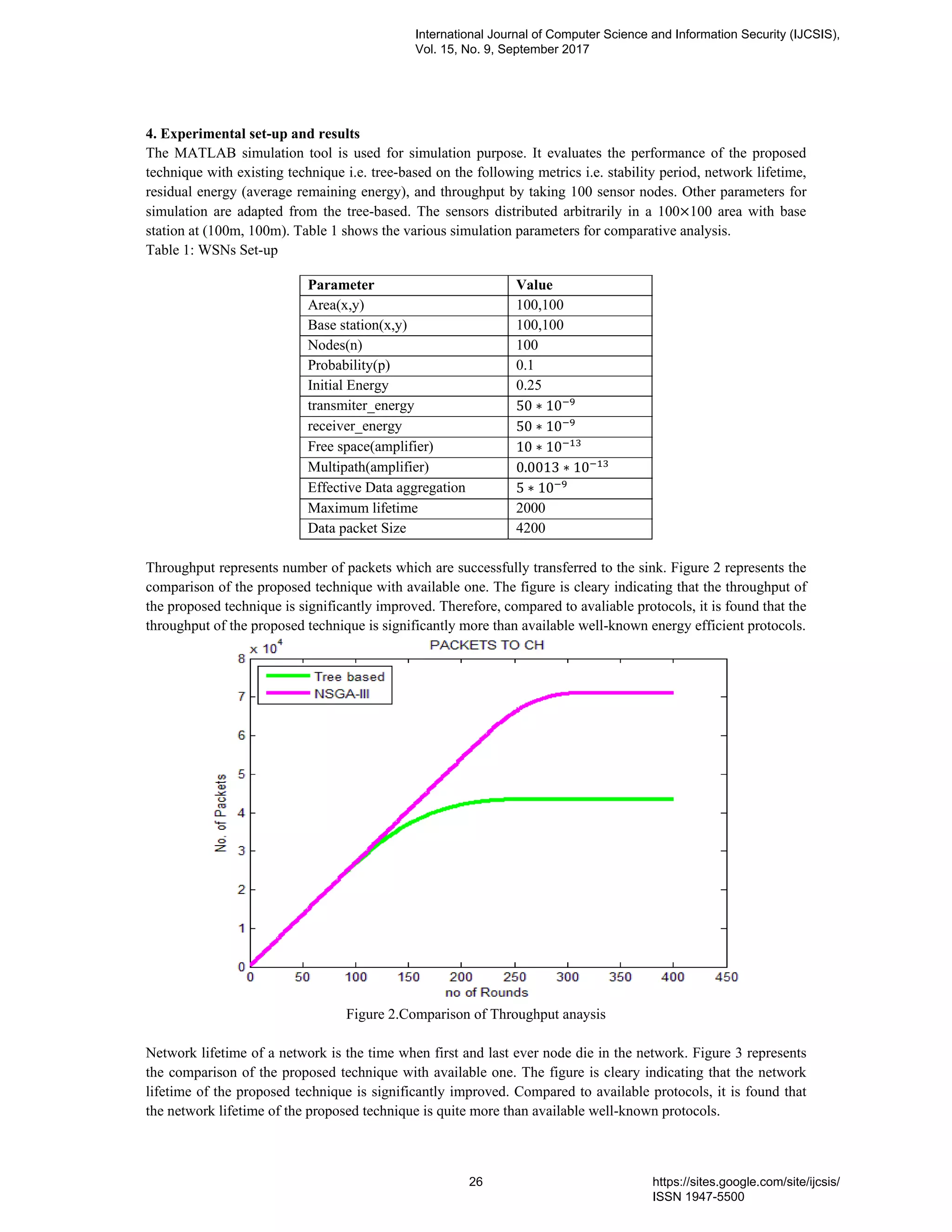
Throughput represents number of packets which are successfully transferred to the sink. Figure 2 represents the
comparison of the proposed technique with available one. The figure is cleary indicating that the throughput of
the proposed technique is significantly improved. Therefore, compared to avaliable protocols, it is found that the
throughput of the proposed technique is significantly more than available well-known energy efficient protocols.
Figure 2.Comparison of Throughput anaysis
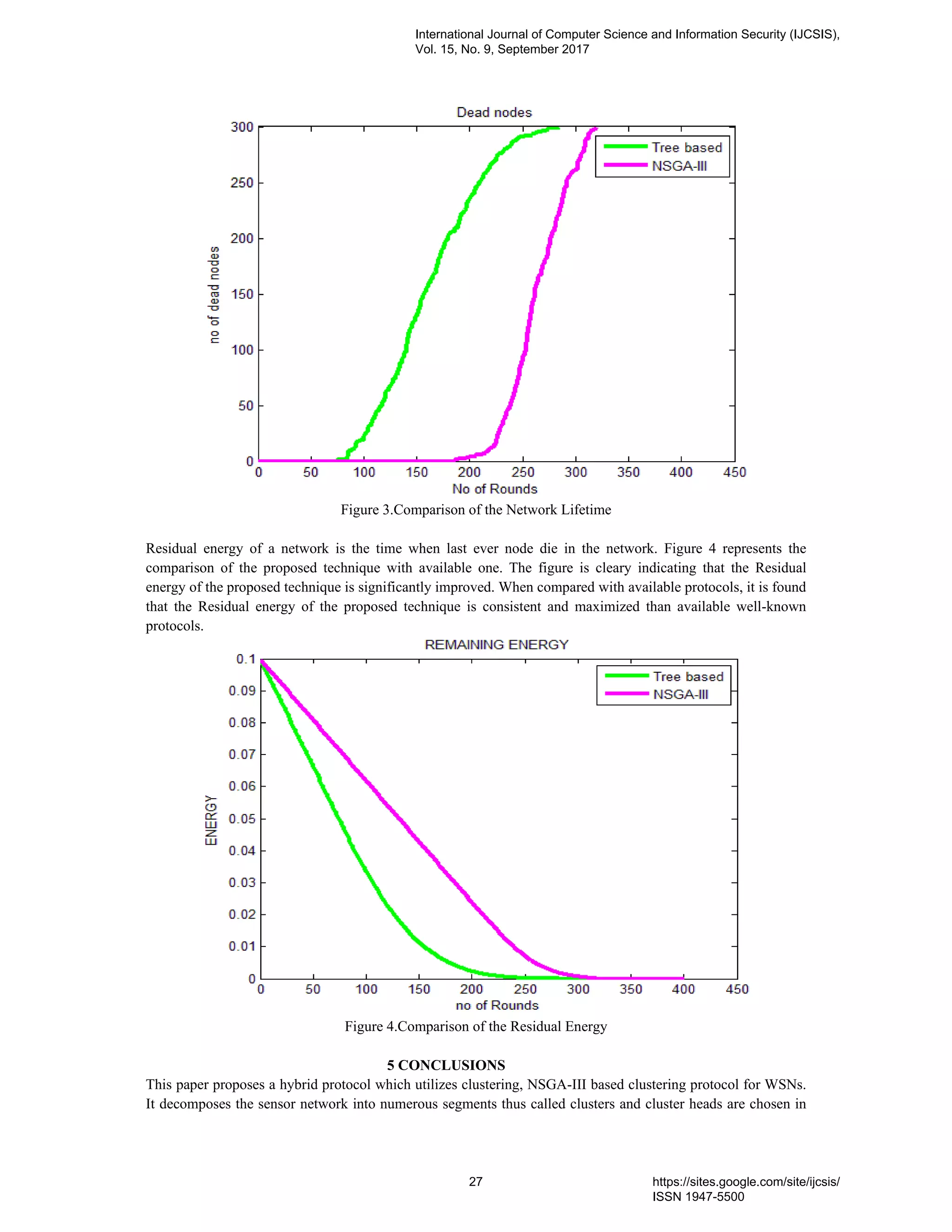
Network lifetime of a network is the time when first and last ever node die in the network. Figure 3 represents
the comparison of the proposed technique with available one. The figure is cleary indicating that the network
lifetime of the proposed technique is significantly improved. Compared to available protocols, it is found that
the network lifetime of the proposed technique is quite more than available well-known protocols.
International Journal of Computer Science and Information Security (IJCSIS),
Vol. 15, No. 9, September 2017
26 https://sites.google.com/site/ijcsis/
ISSN 1947-5500
Figure 3.Comparison of the Network Lifetime
Residual energy of a network is the time when last ever node die in the network. Figure 4 represents the
comparison of the proposed technique with available one. The figure is cleary indicating that the Residual
energy of the proposed technique is significantly improved. When compared with available protocols, it is found
that the Residual energy of the proposed technique is consistent and maximized than available well-known
protocols.
Figure 4.Comparison of the Residual Energy
5 CONCLUSIONS
This paper proposes a hybrid protocol which utilizes clustering, NSGA-III based clustering protocol for WSNs.
It decomposes the sensor network into numerous segments thus called clusters and cluster heads are chosen in
International Journal of Computer Science and Information Security (IJCSIS),
Vol. 15, No. 9, September 2017
27 https://sites.google.com/site/ijcsis/
ISSN 1947-5500
every cluster. Then, tree based data aggregation come in action and collects sensing information directly from
cluster heads by utilizing short distance communications. The NSGA-III optimization evaluates the shortest path
among sink and cluster heads. The use of compressive sensing reduces the packet size which is going to be
transmitted in the sensor network. The MATLAB simulation tool is used for simulation purpose. It evaluates the
performance of the proposed technique with existing technique i.e. tree-based on the following metrics i.e.
stability period, network lifetime, residual energy (average remaining energy), and throughput by taking 100
sensor nodes. Other parameters for simulation are adapted from the tree-based. The sensors distributed
arbitrarily in a 100×100 area with base station at (100m, 100m). Extensive analysis shows that the hybrid
protocol considerably enhances network lifetime by conserving the energy in more efficient manner than other
protocols at present deployed for sensor networks.
There is no conflict of interest regarding the publication of this paper.
References
[1] Arora, Vishal Kumar, Vishal Sharma, and Monika Sachdeva. "A survey on LEACH and other’s routing
protocols in wireless sensor network." Optik-International Journal for Light and Electron Optics 127,
no. 16 (2016): 6590-6600.
[2] Azharuddin, Md, Pratyay Kuila, and Praschromosomea K. Jana. "Energy efficient fault
tolerchromosome clustering and routing algorithms for wireless sensor networks." Computers &
Electrical Engineering 41 (2015): 177-190.
[3] García Villalba, Luis Javier, Ana Lucila Sandoval Orozco, Alicia Triviño Cabrera, and Claudia Jacy
Barenco Abbas. "Routing protocols in wireless sensor networks." Sensors 9, no. 11 (2009): 8399-8421.
[4] Lin, Deyu, Quan Wang, Deqin Lin, and Yong Deng. "An energy-efficient clustering routing protocol
based on evolutionary game theory in wireless sensor networks." International Journal of Distributed
Sensor Networks 11, no. 11 (2015): 409503.
[5] Gong, Pu, Thomas M. Chen, and Quan Xu. "ETARP: an energy efficient trust-aware routing protocol
for wireless sensor networks." Journal of Sensors 2015 (2015).
[6] Shi, Lei, Zheng Yao, Baoxian Zhang, Cheng Li, and Jian Ma. "An efficient distributed routing protocol
for wireless sensor networks with mobile sinks." International Journal of Communication Systems 28,
no. 11 (2015): 1789-1804.
[7] Leu, Jenq-Shiou, Tung-Hung Chiang, Min-Chieh Yu, and Kuan-Wu Su. "Energy efficient clustering
scheme for prolonging the lifetime of wireless sensor network with isolated nodes." IEEE
communications letters 19, no. 2 (2015): 259-262.
[8] Shen, Jian, Hao-Wen Tan, Jin Wang, Jin-Wei Wang, and Sung-Young Lee. "A novel routing protocol
providing good transmission reliability in underwater sensor networks." Sensors 16, no. 1 (2015): 171-
178.
[9] Bouyer, Asgarali, Abdolreza Hatamlou, and Mohammad Masdari. "A new approach for decreasing
energy in wireless sensor networks with hybrid LEACH protocol and fuzzy C-means algorithm."
International Journal of Communication Networks and Distributed Systems 14, no. 4 (2015): 400-412
[10] Cai, Xuelian, Yulong Duan, Ying He, Jin Yang, and Changle Li. "Bee-sensor-C: an energy-efficient
and scalable multipath routing protocol for wireless sensor networks." International Journal of
Distributed Sensor Networks 11, no. 3 (2015): 976127.
[11] Shankar, T., S. Shanmugavel, and A. Rajesh. "Hybrid HSA and PSO algorithm for energy efficient
cluster head selection in wireless sensor networks." Swarm and Evolutionary Computation 30 (2016):
1-10.
[12] Zahedi, Zeynab Molay, Reza Akbari, Mohammad Shokouhifar, Farshad Safaei, and Ali Jalali. "Swarm
intelligence based fuzzy routing protocol for clustered wireless sensor networks." Expert Systems with
Applications 55 (2016): 313-328.
[13] Sabet, Maryam, and Hamidreza Naji. "An energy efficient multi-level route-aware clustering algorithm
for wireless sensor networks: A self-organized approach." Computers & Electrical Engineering 56
(2016): 399-417.
International Journal of Computer Science and Information Security (IJCSIS),
Vol. 15, No. 9, September 2017
28 https://sites.google.com/site/ijcsis/
ISSN 1947-5500
[14] Naranjo, Paola G. Vinueza, Mohammad Shojafar, Habib Mostafaei, Zahra Pooranian, and Enzo
Baccarelli. "P-SEP: a prolong stable election routing algorithm for energy-limited heterogeneous fog-
supported wireless sensor networks." The Journal of Supercomputing 73, no. 2 (2017): 733-755.
[15] A. Xenakis, F. Foukalas, G. Stamoulis, I. Katsavounidis. “Topology control with coverage and lifetime
optimization of wireless sensor networks with unequal energy distribution.” Computers & Electrical
Engineering, June 2017.
[16] Nayak, Padmalaya, and Bhavani Vathasavai. "Energy Efficient Clustering Algorithm for Multi-Hop
Wireless Sensor Network Using Type-2 Fuzzy Logic." IEEE Sensors Journal 17, no. 14 (2017): 4492-
4499.
[17] Hicham Ouchitachen, Abdellatif Hair, Najlae Idrissi, Improved multi-objective weighted clustering
algorithm in Wireless Sensor Network, Egyptian Informatics Journal, Volume 18, Issue 1, March 2017,
Pages 45-54,
[18] Mohamed Elshrkawey, Samiha M. Elsherif, M. Elsayed Wahed, An Enhancement Approach for
Reducing the Energy Consumption in Wireless Sensor Networks, Journal of King Saud University -
Computer and Information Sciences, Available online 7 April 2017, ISSN 1319-1578.
[19] Shalli Rani, Syed Hassan Ahmed, Jyoteesh Malhotra, Rajneesh Talwar, Energy efficient chain based
routing protocol for underwater wireless sensor networks, Journal of Network and Computer
Applications, Volume 92, 15 August 2017, Pages 42-50, ISSN 1084-8045.
[20] Abdelkader Laouid, Abdelnasser Dahmani, Ahcène Bounceur, Reinhardt Euler, Farid Lalem,
Abdelkamel Tari, A distributed multi-path routing algorithm to balance energy consumption in wireless
sensor networks, Ad Hoc Networks, Volume 64, September 2017, Pages 53-64.
[21] Imad Ez-zazi, Mounir Arioua, Ahmed El Oualkadi, Pascal Lorenz, On the performance of adaptive
coding schemes for energy efficient and reliable clustered wireless sensor networks, Ad Hoc Networks,
Volume 64, September 2017, Pages 99-111, ISSN 1570-8705.
[22] Han, Zhao, Jie Wu, Jie Zhang, Liefeng Liu, and Kaiyun Tian. "A General Self-Organized Tree-Based
Energy-Balance Routing Protocol for Wireless Sensor Network." pp. 1-2, 2014.
International Journal of Computer Science and Information Security (IJCSIS),
Vol. 15, No. 9, September 2017
29 https://sites.google.com/site/ijcsis/
ISSN 1947-5500

NSGA-III Based Energy Efficient Protocol for Wireless Sensor Networks

  • 1.
    NSGA-III based energyefficient protocol for wireless sensor networks Er. HARJOT KAUR Research Scholar Shri Venkateshwara, University,Gajraula Jot2812@yahoo.com Dr. Gaurav Tejpal Professor Shri Venkateshwara, University,Gajraula Gaurav_tejpal@gmail.com Dr. Sonal Sharma Assistant Professor, Department of Computer Applications Uttaranchal University Dehradun, India sonal_horizon@rediffmail.com ABSTRACT: Energy efficiency has recently turned out to be primary issue in wireless sensor networks. Sensor networks are battery powered, therefore become dead after a certain period of time. Thus, improving the data dissipation in energy efficient way becomes more challenging problem in order to improve the lifetime for sensor devices. The clustering and tree based data aggregation for sensor networks can enhance the network lifetime of wireless sensor networks. Non-dominated Sorting Genetic Algorithm (NSGA) -III based energy efficient clustering and tree based routing protocol is proposed. Initially, clusters are formed on the basis of remaining energy, then, NSGA-III based data aggregation will come in action to improve the inter-cluster data aggregation further. Extensive analysis demonstrates that proposed protocol considerably enhances network lifetime over other techniques. INDEX TERMS: Wireless Sensor Networks, Ant Colony Optimization, Energy Efficient, Particle swarm optimization. 1. Introduction With the advent of Wireless Sensor Networks, inaccessible environments can be easily monitored. It is a powerful tool to gather data in many applications like military surveillance, battle-field, forestry, oceanography, temperature, pressure, humidity, etc. [1]. WSNs contain number of sensor nodes which are connected together and to a base station. WSNs include sensing of data through sensor nodes, processing of data, and transmission to base station. Charging and reinstallation of sensor nodes do not possible in difficult environments. So, energy conservation is a big challenge in WSNs. Recently, researchers gave a solution to this problem by organizing the nodes into clusters and enhance the life-time of WSNs [2]. Further, routing protocols are implemented in cluster WSNs to guide the selection of Cluster Heads (CHs) and discover best route to save the energy of nodes [3]. A typical cluster based wireless sensor network is shown in Figure 1 International Journal of Computer Science and Information Security (IJCSIS), Vol. 15, No. 9, September 2017 22 https://sites.google.com/site/ijcsis/ ISSN 1947-5500
  • 2.
    Figure 1: Typicalclustering environment of wireless sensor network Lin et al. (2015) [4] utilized evolutionary game theory to select CH to reduce the hot-spot problem. In this method, size of cluster is optimized through optimal cluster size algorithm. The appropriate selection of CHs reduces the energy consumption and enhances the life of network. Gong et al. (2015) [5] designed a routing protocol ETARP (i.e., Energy Efficient Trust-Aware Routing Protocol for Wireless Sensor Networks) to reduce the energy consumption and increase the security during communication among nodes in WSNs. The selection of route between sensor nodes is based on utility theory. Shi et al. (2015) [6] addressed the issue of mobile sinks like route maintenance in WSNs by introducing dynamic layered routing protocol. The distribution frequencies and scopes of routing updates are minimized using the combination of dynamic anchor selection and dynamic layered Voronoi scoping. Leu et al. (2015) [7] utilized Regional Energy Aware Clustering with Isolated Nodes (REAC-IN) algorithm to select CHs based on weight. Weight is calculated considering each sensor’s residual energy and regional average energy of every sensor in all clusters. Shen et al. (2015) [8] solved the problem of delay in message transmission in underwater WSNs using Location-Aware Routing Protocol (LARP). In this method, position knowledge of sensor nodes is used to facilitate message transmission. Bouyer et al. (2015) [9] used fuzzy C-means (FCM) algorithm to create optimum number of CHs in LEACH algorithm to reduce the energy and prolong the network life-time. Cai et al. (2015) [10] proposed Bee-Sensor-C routing protocol inspired from BeeSensor (i.e. bee-inspired routing protocol) that can form clusters dynamically and transmit the data in parallel fashion. Shankar et al. (2016) [11] used hybrid Particle Swarm Optimization (PSO) and Harmony Search Algorithm (HSA) to select CH efficiently utilizing minimum energy. Zahedi et al. (2016) [12] presented the problem of uneven distribution of CHs, unbalanced clustering, and their scope to limited applications of WSNs. They used fuzzy c-means clustering algorithm to create balanced clusters and Mamdani fuzzy inference system to select suitable CHs. Fuzzy rules are optimized through swarm intelligence algorithm based on firefly algorithm. Sabet and Naji (2016) [13] implemented the multi-level route-aware clustering (MLRC) technique to save energy in decentralized clustering protocols. The main advchromosomeage of this protocol is that it creates a cluster and routing tree, simultaneously, to reduce an unnecessary generation of routing control packets. Naranjo et al. (2017) [14] presented Prolong- Stable Election Protocol (P-SEP) to elect the CHs among heterogeneous nodes in fog-supported WSNs to increase the life of network. Xenakis et al. (2017) [15] utilized simulated annealing technique to control the topology by maximizing the network coverage and lifetime of WSNs as objective functions. Nayak and Vathasavai (2017) [16] utilized type-2 fuzzy logic in WSNs to make a decision for CH efficiency. Ouchitachen et al. (2017) [17] implemented IMOWCA (Improved Multi-Objective Weighted Clustering Algorithm) for the selection of CHs. Residual energy is used to select the best performing node for further communication with BS. Base Station Genetic Algorithm is utilized to balance the energy among different clusters. Elshrkawey et al. (2017) [18] addressed the issues of LEACH protocol like improper selection of CH, formation of unbalanced clusters, and continuous transmission of updating data. They used threshold value to elect CHs, sensor nodes send their updated data in their allotted time, and modified TDMA scheduling International Journal of Computer Science and Information Security (IJCSIS), Vol. 15, No. 9, September 2017 23 https://sites.google.com/site/ijcsis/ ISSN 1947-5500
  • 3.
    is utilized tobreak steady state phase. Rani et al. (2017) [19] used E-CBCCP protocol to cache the data at CH and relay node to evade the communication of same data packets. Control packets are used to inform all sensor nodes that data packets are same and do not transmit the data packets. Laouid et al. (2017) [20] designed an approach to select the best route based on hop count and residual energy of each sensor node to maximize the life of network. Ez-zazi et al. (2017) [21] utilized adaptive coding scheme considering channel state and distance between inter nodes to scrutinize the trade-off between energy efficiency and reliability. Huang et al. (2017) [22] used public transportation vehicles as mobile sinks to gather data. To balance the energy consumption, an energy-aware routing and energy-aware unequal clustering algorithms are used. Zhao et al. (2017) [23] utilized layer-based diffusion particle swarm optimization approach to optimize the position of sink and sensor to sink route to maximize the lifetime of WSNs. In this paper, we propose improved method for General Self-Organized Tree based Energy Balance routing protocol (tree-based). In present tree-based protocol routing tree is manufactured where tree centered routing is performed to transmit knowledge to the bottom section however in that if the parent node dies the topography must be repair again that'll consume a lot of power and there might be loss of knowledge also. To prevail around the problem of sign delay and knowledge reduction in the system because of the nodes disappointment in the root to sink, cluster based aggregation process can be utilized. In big system, well- organized sign of knowledge to the sink requires obtaining the maximum route according to how many trips; therefore, knowledge can be aggregated at group head which is to be transmitted to the bottom station. The clustering strategy may minimize knowledge redundancy and reduce the congestive routing traffic in knowledge transmission. Following the clustering tree centered routing at the cluster-heads it is required to obtain the shortest route between the source and the sink, but the smallest route issue is NP-Hard in nature [22]. Contribution: Following are our main contributions in this research paper: i. First of all, we have evaluated the performance of some well-known existing energy efficient protocols for WSNs. ii. Based upon the comparative analysis we have found that effective inter-cluster data aggregation using metaheuristic techniques can improve the network lifetime further. iii. We have designed and implemented a well-known NSGA-III based clustering tree-based protocols to enhance the results further. iv. Extensive analysis has also been done to evaluate the effectiveness of the proposed technique. Rest of the paper is organized as follows: In Section 2, network energy model is described for WSNs. Section 3, describes the proposed technique with suitable mathematical formulation. Experimental Set-up and results are demonstrated in Section 4. Concluding remarks are demonstrated in Section 5. 2. Network Energy Model In this research work, we have randomly deployed WSN with “N” sensor nodes in M*N network field. All nodes even including the sink are stationary in nature. Each node has its own unique identification number. Each node monitors the given environment and communicate data with sink. Whenever communication is done given node have to spent some energy based upon the distance (D) with sink. All the communication links are symmetric in nature. 2.1. Energy Model Whenever a node sends or receives it has to spend some energy based upon two channel propagation models called free space (D power loss) for the purpose of one-hopordirect transmission and the multipath fading channel (D power loss) for packet transmission via multihop. Therefore, energy consumption model can be mathematically defined as follows: E T (L, D) LE ( ) + Lε D , D < D , E ( ) + Lε D D ≥ D , (1) International Journal of Computer Science and Information Security (IJCSIS), Vol. 15, No. 9, September 2017 24 https://sites.google.com/site/ijcsis/ ISSN 1947-5500
  • 4.
    here ?? isthe size of data packet, ε is free space energy loss, ??mp is multipath energy loss. D , is a threshold distance which determine which energy model will be used. It can be calculated as follows: D = (2) 3.2 CH formation In this section level-based clustering will be discussed. CHs are formed using energy aware threshold function. Which means nodes who has more energy will have more probability to become CHs. Each node generates random value and try to become CH. If random value is less than evaluated Threshold (T(i)), then it will become CH, become member node otherwise. T(i) can be mathematically evaluated as follows ( ) = . ∗ ( ) ( ) For all nodes if E (r)>0 (3) Here r represents the current round in WSNs network lifetime, E (r) is the current energy of given node i. E represents average remaining energy which is evaluated using eqn. (4). E = ∑ ( ) for every node i (4) N is the number of total nodes. 3. NSGA-III based tree-based technique In this section, we propose an NSGA-III-tree-based based routing to develop shortest path among available CHs and sink. NSGA-III is a well-known metaheuristic technique which can find optimal path between given set of nodes with sink as destination. 3.1 NSGA-III based path selection 1. Initialize CHs as chromosomes combined with sink as Destination. 2. Going of virtual chromosome depends on the amount of pheromone on the CH distances. 3. The first in NSGA-III could be the trail collection between neighbouring clusters, some synthetic chromosomes (CHs) are simulated from the CHs to the sink. 4. The ahead chromosomes are choosing the following CH randomly for initially taking the data from the length matrix and the chromosomes who are successful in achieving the sink are updating the pheromone deposit at the edges visited by them by an amount (CL), where M is the sum total journey period of the chromosome and D a constants chromosome price that is adjusted in line with the fresh problems to the perfect value. 5. if the link between two CHs exists, then P, will be updated else Pij = 0. end 6. Evaluate the distance between the cluster head i and cluster head j η . ( , ) E (i, j) = E _ + E × S = E _ + γ ×∥ d , ∥ 2 × S //where E (i, j) represents Energy distance metric between two CHs i and j; ||.||2 represents the Euclidean distance; E _ is the overhead energy of transmitter electronics and E is the transmission energy and γ is a coefficient of amplifying and S is the pack size. 7. P values will be updated by all the chromosomes which have reached the BS successfully. 8. Now the path with best P value (minimum distance) is selected and assign as initial solution for International Journal of Computer Science and Information Security (IJCSIS), Vol. 15, No. 9, September 2017 25 https://sites.google.com/site/ijcsis/ ISSN 1947-5500
  • 5.
    4. Experimental set-upand results The MATLAB simulation tool is used for simulation purpose. It evaluates the performance of the proposed technique with existing technique i.e. tree-based on the following metrics i.e. stability period, network lifetime, residual energy (average remaining energy), and throughput by taking 100 sensor nodes. Other parameters for simulation are adapted from the tree-based. The sensors distributed arbitrarily in a 100×100 area with base station at (100m, 100m). Table 1 shows the various simulation parameters for comparative analysis. Table 1: WSNs Set-up Parameter Value Area(x,y) 100,100 Base station(x,y) 100,100 Nodes(n) 100 Probability(p) 0.1 Initial Energy 0.25 transmiter_energy 50 ∗ 10 receiver_energy 50 ∗ 10 Free space(amplifier) 10 ∗ 10 Multipath(amplifier) 0.0013 ∗ 10 Effective Data aggregation 5 ∗ 10 Maximum lifetime 2000 Data packet Size 4200 Throughput represents number of packets which are successfully transferred to the sink. Figure 2 represents the comparison of the proposed technique with available one. The figure is cleary indicating that the throughput of the proposed technique is significantly improved. Therefore, compared to avaliable protocols, it is found that the throughput of the proposed technique is significantly more than available well-known energy efficient protocols. Figure 2.Comparison of Throughput anaysis Network lifetime of a network is the time when first and last ever node die in the network. Figure 3 represents the comparison of the proposed technique with available one. The figure is cleary indicating that the network lifetime of the proposed technique is significantly improved. Compared to available protocols, it is found that the network lifetime of the proposed technique is quite more than available well-known protocols. International Journal of Computer Science and Information Security (IJCSIS), Vol. 15, No. 9, September 2017 26 https://sites.google.com/site/ijcsis/ ISSN 1947-5500
  • 6.
    Figure 3.Comparison ofthe Network Lifetime Residual energy of a network is the time when last ever node die in the network. Figure 4 represents the comparison of the proposed technique with available one. The figure is cleary indicating that the Residual energy of the proposed technique is significantly improved. When compared with available protocols, it is found that the Residual energy of the proposed technique is consistent and maximized than available well-known protocols. Figure 4.Comparison of the Residual Energy 5 CONCLUSIONS This paper proposes a hybrid protocol which utilizes clustering, NSGA-III based clustering protocol for WSNs. It decomposes the sensor network into numerous segments thus called clusters and cluster heads are chosen in International Journal of Computer Science and Information Security (IJCSIS), Vol. 15, No. 9, September 2017 27 https://sites.google.com/site/ijcsis/ ISSN 1947-5500
  • 7.
    every cluster. Then,tree based data aggregation come in action and collects sensing information directly from cluster heads by utilizing short distance communications. The NSGA-III optimization evaluates the shortest path among sink and cluster heads. The use of compressive sensing reduces the packet size which is going to be transmitted in the sensor network. The MATLAB simulation tool is used for simulation purpose. It evaluates the performance of the proposed technique with existing technique i.e. tree-based on the following metrics i.e. stability period, network lifetime, residual energy (average remaining energy), and throughput by taking 100 sensor nodes. Other parameters for simulation are adapted from the tree-based. The sensors distributed arbitrarily in a 100×100 area with base station at (100m, 100m). Extensive analysis shows that the hybrid protocol considerably enhances network lifetime by conserving the energy in more efficient manner than other protocols at present deployed for sensor networks. There is no conflict of interest regarding the publication of this paper. References [1] Arora, Vishal Kumar, Vishal Sharma, and Monika Sachdeva. "A survey on LEACH and other’s routing protocols in wireless sensor network." Optik-International Journal for Light and Electron Optics 127, no. 16 (2016): 6590-6600. [2] Azharuddin, Md, Pratyay Kuila, and Praschromosomea K. Jana. "Energy efficient fault tolerchromosome clustering and routing algorithms for wireless sensor networks." Computers & Electrical Engineering 41 (2015): 177-190. [3] García Villalba, Luis Javier, Ana Lucila Sandoval Orozco, Alicia Triviño Cabrera, and Claudia Jacy Barenco Abbas. "Routing protocols in wireless sensor networks." Sensors 9, no. 11 (2009): 8399-8421. [4] Lin, Deyu, Quan Wang, Deqin Lin, and Yong Deng. "An energy-efficient clustering routing protocol based on evolutionary game theory in wireless sensor networks." International Journal of Distributed Sensor Networks 11, no. 11 (2015): 409503. [5] Gong, Pu, Thomas M. Chen, and Quan Xu. "ETARP: an energy efficient trust-aware routing protocol for wireless sensor networks." Journal of Sensors 2015 (2015). [6] Shi, Lei, Zheng Yao, Baoxian Zhang, Cheng Li, and Jian Ma. "An efficient distributed routing protocol for wireless sensor networks with mobile sinks." International Journal of Communication Systems 28, no. 11 (2015): 1789-1804. [7] Leu, Jenq-Shiou, Tung-Hung Chiang, Min-Chieh Yu, and Kuan-Wu Su. "Energy efficient clustering scheme for prolonging the lifetime of wireless sensor network with isolated nodes." IEEE communications letters 19, no. 2 (2015): 259-262. [8] Shen, Jian, Hao-Wen Tan, Jin Wang, Jin-Wei Wang, and Sung-Young Lee. "A novel routing protocol providing good transmission reliability in underwater sensor networks." Sensors 16, no. 1 (2015): 171- 178. [9] Bouyer, Asgarali, Abdolreza Hatamlou, and Mohammad Masdari. "A new approach for decreasing energy in wireless sensor networks with hybrid LEACH protocol and fuzzy C-means algorithm." International Journal of Communication Networks and Distributed Systems 14, no. 4 (2015): 400-412 [10] Cai, Xuelian, Yulong Duan, Ying He, Jin Yang, and Changle Li. "Bee-sensor-C: an energy-efficient and scalable multipath routing protocol for wireless sensor networks." International Journal of Distributed Sensor Networks 11, no. 3 (2015): 976127. [11] Shankar, T., S. Shanmugavel, and A. Rajesh. "Hybrid HSA and PSO algorithm for energy efficient cluster head selection in wireless sensor networks." Swarm and Evolutionary Computation 30 (2016): 1-10. [12] Zahedi, Zeynab Molay, Reza Akbari, Mohammad Shokouhifar, Farshad Safaei, and Ali Jalali. "Swarm intelligence based fuzzy routing protocol for clustered wireless sensor networks." Expert Systems with Applications 55 (2016): 313-328. [13] Sabet, Maryam, and Hamidreza Naji. "An energy efficient multi-level route-aware clustering algorithm for wireless sensor networks: A self-organized approach." Computers & Electrical Engineering 56 (2016): 399-417. International Journal of Computer Science and Information Security (IJCSIS), Vol. 15, No. 9, September 2017 28 https://sites.google.com/site/ijcsis/ ISSN 1947-5500
  • 8.
    [14] Naranjo, PaolaG. Vinueza, Mohammad Shojafar, Habib Mostafaei, Zahra Pooranian, and Enzo Baccarelli. "P-SEP: a prolong stable election routing algorithm for energy-limited heterogeneous fog- supported wireless sensor networks." The Journal of Supercomputing 73, no. 2 (2017): 733-755. [15] A. Xenakis, F. Foukalas, G. Stamoulis, I. Katsavounidis. “Topology control with coverage and lifetime optimization of wireless sensor networks with unequal energy distribution.” Computers & Electrical Engineering, June 2017. [16] Nayak, Padmalaya, and Bhavani Vathasavai. "Energy Efficient Clustering Algorithm for Multi-Hop Wireless Sensor Network Using Type-2 Fuzzy Logic." IEEE Sensors Journal 17, no. 14 (2017): 4492- 4499. [17] Hicham Ouchitachen, Abdellatif Hair, Najlae Idrissi, Improved multi-objective weighted clustering algorithm in Wireless Sensor Network, Egyptian Informatics Journal, Volume 18, Issue 1, March 2017, Pages 45-54, [18] Mohamed Elshrkawey, Samiha M. Elsherif, M. Elsayed Wahed, An Enhancement Approach for Reducing the Energy Consumption in Wireless Sensor Networks, Journal of King Saud University - Computer and Information Sciences, Available online 7 April 2017, ISSN 1319-1578. [19] Shalli Rani, Syed Hassan Ahmed, Jyoteesh Malhotra, Rajneesh Talwar, Energy efficient chain based routing protocol for underwater wireless sensor networks, Journal of Network and Computer Applications, Volume 92, 15 August 2017, Pages 42-50, ISSN 1084-8045. [20] Abdelkader Laouid, Abdelnasser Dahmani, Ahcène Bounceur, Reinhardt Euler, Farid Lalem, Abdelkamel Tari, A distributed multi-path routing algorithm to balance energy consumption in wireless sensor networks, Ad Hoc Networks, Volume 64, September 2017, Pages 53-64. [21] Imad Ez-zazi, Mounir Arioua, Ahmed El Oualkadi, Pascal Lorenz, On the performance of adaptive coding schemes for energy efficient and reliable clustered wireless sensor networks, Ad Hoc Networks, Volume 64, September 2017, Pages 99-111, ISSN 1570-8705. [22] Han, Zhao, Jie Wu, Jie Zhang, Liefeng Liu, and Kaiyun Tian. "A General Self-Organized Tree-Based Energy-Balance Routing Protocol for Wireless Sensor Network." pp. 1-2, 2014. International Journal of Computer Science and Information Security (IJCSIS), Vol. 15, No. 9, September 2017 29 https://sites.google.com/site/ijcsis/ ISSN 1947-5500