International Journal of Wireless & Mobile Networks (IJWMN), Vol.17, No. 4, August 2025
DOI:10.5121/ijwmn.2025.17401 1
OPTIMIZED CLUSTER BASED ENERGY AWARE
ROUTING (OCEAR) TO PROLONG NETWORK
LIFETIME IN WSNS
Rajkumar M Vadgave, Manjula S, Savitri Kanshete
Department of Electronics & Communication Engineering, Bheemanna Khandre Institute
of Technology, Bhalki, India
ABSTRACT
Designing energy-efficient WSN is complex. Effective routing is crucial for energy efficiency due to its
impact on energy consumption during communication. In WSNs, clustering involves selecting a CH, which
acts as a leader and consumes more energy. This process groups nodes into clusters, minimizing the
communication range that each CH manages. This paper introduces the Optimized Cluster-Based Energy-
Aware Routing (OCEAR) protocol to extend WSN lifetimes. Nodes are organized into clusters based on
node angle and variance, enhancing CH load balancing and distribution. We assess communication
models in different scenarios to find those aligning with the free space model, thereby reducing energy use
compared to the multipath fading model. We derive closed-form expressions for the optimal CH number
and location, linked to network size and energy use, and set an objective function to optimize CH selection
based on node energy and CH location. OCEAR's energy efficiency is ideal for battery-dependent devices
and resource-limited systems, leading to longer device lifetimes and reduced costs. Compared to LEACH-
C, IAFSA, and SCA-LM, OCEAR offers superior energy efficiency and network durability.
KEYWORDS
Wireless Sensor Networks (WSNs); Cluster Head (CH); Base Station (BS); Internet of Things (IoT)
1. INTRODUCTION
Fifth generation (5G) wireless communication technology is now essential to many services, such
as mobile Internet and IoT devices [1]. Numerous industries, including agriculture, building
management, smart homes, traffic control, incident response, and many more, use WSNs. As
WSNs are commonly used in contemporary ubiquitous systems, which frequently combine IoT
and pervasive computing, our discovery may have important ramifications in these fields.
Numerous applications have been made possible by the notable improvements in transmission
rates, decreased latency, and higher system capacity brought about by 5G technologies [2]. For
instance, maintaining the network and changing the batteries in sensor nodes might be difficult in
agricultural irrigation systems [3].The network may suffer major and occasionally irreversible
harm when a node fails owing to low energy, resulting in the loss of thorough field monitoring
data [4]. Because of this, it's critical to reduce node energy consumption, especially when long-
distance data transmission and required data collecting are involved. As a result, the problem of
creating an energy-efficient routing protocol to reduce nodes' transmission energy requirements
and increase network lifetime has emerged as a crucial one.
WSNs energy consumption is directly related to data transmission and cluster division in cluster
routing algorithms. Consequently, clustering routing methods have continued to be a major area
of study for WSN. These algorithms can be broadly divided into two categories: distributed
International Journal of Wireless & Mobile Networks (IJWMN), Vol.17, No. 4, August 2025
2
routing algorithms [5][6] and centralized clustered routing algorithms [7]-[9], with LEACH and
LEACH-C serving as examples of both. both type of method is best suited for a certain set of
application scenarios. Centralized clustering routing algorithms are able to choose the best cluster
head or path selection in each cycle, whereas distributed techniques require greater computing,
storage, and power capacities from sensor nodes. When it comes to cluster formation, some
researchers choose to divide clusters before choosing cluster heads [10], whereas others would
rather divide clusters first [11].Some researchers have suggested primary cluster head, secondary
cluster head, or dual cluster head architectures as ways to conserve energy [12]. Factors like
clustering uniformity, BS location, distance, remaining energy, cluster head load, and cluster
head selection frequency are usually considered when choosing cluster heads dynamically [13].
There are typically two ways of data transmission used during the data transmission phase:
single-hop [14] and multi-hop [15], depending on the location of the BS.
Finding the most energy-efficient route from cluster heads to the BS is essential in the context of
inter-cluster multi-hop transmission. Some algorithms use the idea of chaining [16] to create
chain structures inside or between clusters, drawing inspiration from the PEGASIS protocol, with
the goal of lowering node energy consumption. Scholars have also investigated network energy-
related aspects from the perspective of non-uniform clustering [12], [14], or system heterogeneity
[17]. Furthermore, in an effort to investigate novel strategies and concepts for enhancing WSN
clustering routing algorithms, recent developments in WSN research have seen the introduction
of a number of creative algorithms and improvements to preexisting prototypes, such as the
sparrow search algorithm [17], artificial intelligence algorithms [8], genetic evolution algorithms
[18], and combinations with fuzzy logic algorithms [19].Clusters are frequently sized differently,
with smaller clusters close to the BS and bigger clusters farther away, in order to enhance the
balance of energy consumption across CHs. The goal of this strategy is to avoid adding more data
forwarding duties to CHs near the BS, which could hasten the rate at which energy is used up
[20]. Nevertheless, this approach falls short in addressing the problem of imbalanced energy
consumption resulting from large differences in the quantity of CH loads.
Maximizing network longevity and improving energy economy in clustering routing protocols
require addressing the issues of choosing the right number of cluster heads, distributing them
optimally within the monitoring region, and guaranteeing balanced cluster head loads. In order to
increase the network lifespan in WSNs, we provide the OCEAR protocol in this research to
enhance distribution uniformity and balance the burden among CHs, sensor nodes are grouped
into clusters according to node angle and variance in cluster sizes. In order to reduce energy
consumption brought on by the multipath fading model, the protocol additionally takes into
account various communication models between nodes, finally choosing scenarios that meet the
free space model.
We construct closed-form formulas for the ideal CH position and quantity by demonstrating the
mathematical relationship between network size, number and placement of CHs, and overall
energy usage. With the use of these formulas, we optimize CH selection by formulating an
objective function that takes into account both the nodes' residual energy and the optimal
placement of CH. This method yields an energy-efficient routing protocol intended to lower
energy consumption and increase network lifespan when paired with a node clustering technique
and a CH selection strategy based on the ideal CH locations.
2. LITERATURE SURVEY
It has shown some flexibility and efficacy to use one or two augmented swarm intelligence
optimization methods to the clustering routing problems in WSNs. Nonetheless, there remains
room for development in terms of lowering energy usage and prolonging the network's lifespan.
International Journal of Wireless & Mobile Networks (IJWMN), Vol.17, No. 4, August 2025
3
It was proposed in [21] that the robust global search ability of the beetle antennae search (BAS)
algorithm might be used to improve the position update procedure in the contraction and
encirclement stage of the whale optimization algorithm (WOA). To further improve the
efficiency and logic of the clustering process, a selection function based on energy and distance
was suggested. This paper successfully integrates the strengths of the BAS and WOA algorithms,
applying them to WSN clustering routing to achieve significant energy savings in nodes. In [22],
a routing algorithm designed to conserve energy is introduced, employing a new optimization
strategy to solve the multi-objective formulation of the developed WSN protocol. The Adaptive
Remora Optimization Algorithm (AROA) is utilized for cluster head selection, allowing for the
efficient derivation of multiple functions.
A technique was presented in [23] that involves first segmenting the cluster region and then
determining the first cluster centres using the Cuckoo algorithm. We then used the K-means
technique to generate homogeneous clusters. For the data transmission phase, energy-efficient
routing algorithms for cluster heads were also devised. A fuzzy neural network was proposed in
[24] as a potential method for choosing cluster heads, and particle swarm optimization was added
to improve routing. Relay load factor, gateway-to-sink distance, and number of relay nodes were
among the variables considered in the fitness function analysis. The program demonstrated
potential, despite its complexity and the fuzzy neural network component's need for additional
development. It was proposed in [25] that the sparrow search algorithm's location update formula
may be improved by include the adaptive t-distribution; this improvement was verified. The
LEACH protocol was then modified using the improved algorithm, which produced a cluster
head selection process that was more optimal. It was observed, though, that it took a while for the
percentage of dead nodes to reach 80%, suggesting that different nodes used different amounts of
energy. In order to solve this problem, [26] developed the PFCRE clustering routing protocol,
which combines particle swarm optimization and fuzzy logic to increase energy efficiency, solve
energy depletion problems, and lengthen network lifespan. An enhanced particle swarm
optimization technique is used by the PFCRE protocol to create clusters with balanced loads and
low energy usage. Furthermore, each cluster head's ideal routing is ascertained by a fuzzy
inference system, which considers factors like residual energy, the distance to the base station,
and the frequency of selection as a relay to balance traffic load and minimize energy consumption.
The application of chaos theory to enhance the distribution of clustering centers in the firefly
algorithm for clustering was suggested in [27]. There was a dual cluster head system in place; the
primary cluster head handled data fusion and information receiving, while the secondary cluster
head oversaw data transmission. The Bellman-Ford multi-hop route technique was applied during
data transmission. Nevertheless, this method caused the first dead node to show sooner. "Genetic
Algorithm (GA)-based Unequal Clustering and Routing Protocol for WSN," or GA-UCR, is a
brand-new protocol that was created in [28]. The residual energy of CH nodes, the distance
between CHs and the BS or sink, and inter-cluster separation are the three fitness functions that
are incorporated into this protocol's GA for CH selection.The GA is used to address the NP-
hardness of the inter-cluster multi-hopping and data routing to the BS. Three fitness factors are
used in this method: the number of hops, the distance between the CH and the next-hop node, and
the residual energy of the next-hop nodes. A proposal for the Improved Artificial Fish Swarm
Algorithm (IAFSA) was made in [29]. It consists of three steps: identifying the ideal number of
cluster heads, selecting cluster heads based on energy and distance, and iteratively figuring out
the initial center of the Fuzzy C-Means (FCM) algorithm. The evaluation of the network's
longevity and efficacy involved timing the failure of the first node and the failure of half of the
nodes. Simulation results indicated that while the algorithm showed promise, further
improvements are needed to better balance energy consumption.
International Journal of Wireless & Mobile Networks (IJWMN), Vol.17, No. 4, August 2025
4
A novel clustered routing algorithm called SCA-LMa combination of the Lévy mutation and the
Sine Cosine Algorithm (SCA)is presented in [30]. To maintain a suitable count during the cluster
head selection process, the number of cluster heads is constantly modified based on the number
of remaining nodes. To guarantee energy efficiency among cluster head candidates, only nodes
with high energy levels are taken into consideration. In order to encourage a more equal
distribution inside clusters, the fitness function is made to take intra-cluster distance into
consideration. In order to pick cluster heads, the algorithm uses an improved step size search
factor from the Sine Cosine Algorithm and adds Lévy mutation to create population variety.
An improved SCA tailored for WSNs was presented in [31]. This enhanced algorithm was used
for WSN clustering routing and contrasted with the conventional LEACH algorithm. It included
an inertia weight factor and a fitness function based on node distances and residual energy. The
outcomes, however, indicated that the network lifetime extension was not as successful as
anticipated. We suggest the OCEAR protocol to enhance network lifetime analysis and
elongation in WSNs by building on findings from earlier studies.
3. PROPOSED METHOD
As stated in [32], sensor nodes are dispersed at random over a circular monitoring area with a
radius of . To estimate the energy consumption of these sensor nodes, we apply the well-known
model described in [33]. is the energy required to transmit a -bit data packet across a
distance. For either the transmitter or the receiver, the coefficient is denoted by the symbol .
The energy consumption linked to the multipath fading model and the free space model is
represented by the coefficients and , respectively. With equation (1), the distance
threshold, is computed.
(1)
The energy consumption for receiving -bit data by the data reception module is determined
using equation (2).
= (2)
To minimize the significant energy consumption associated with long-distance communication
between nodes, we propose the following scenario analysis. This analysis aims to identify
situations where nodes adhere to the free space model, specifically under the condition of CH
relay. For a circular monitoring area centered on the BS, if there are cluster heads that ensure
the communication distance between nodes aligns with the free space model, the radius of the
monitoring area must satisfy the conditions outlined in equation (3).
(3)
To identify the best clusters, an optimization algorithm is required because identifying optimal
clusters is an NP-hard problem and swarm intelligence (SI) algorithms that have shown excellent
performance in determining the ideal segmentation threshold include the artificial bee colony, Bat
Algorithm (BA), and particle swarm optimization [34]. Since the accuracy of identifying the
optimal solution for inter-cluster nodes is minimal across these algorithms, we employ BA [35] to
derive as the objective function, where denotes the set of angle segmentation thresholds.
International Journal of Wireless & Mobile Networks (IJWMN), Vol.17, No. 4, August 2025
5
The bat population is represented as when finding the ideal
segmentation threshold using BA. Equation (4) is used to update the frequency of bats.
(4)
Here, the bats' minimum and maximum frequencies are indicated by, and ,
respectively. With ∈ [0, 1], the variable is a random vector with uniform distribution. The
position and velocity of the bat at time are updated using equations (5) and (6).
(5)
(6)
Using equation (7), the new solution is locally updated once a solution is determined to be the
current best option.
(7)
Within the range is a random vector with uniform distribution in this context.
Whereas represents the average bat noise level, the variable represents the global optimal
solution. Rounding up is indicated by the brackets .
It is crucial to choose the right CH for every cluster after the cluster formation phase is finished.
The location and number of CHs have a major impact on the network's energy consumption as
well as the effectiveness of data transmission. We seek to identify the ideal distance ( ) and
number of CHs ( ) between the CH and base station in order to minimize network energy
consumption. The total network energy consumption can be minimized when and meet the
requirements given in equations (8) and (9).
(8)
(9)
Nodes are evenly spaced out over a circle with a radius of B. A partition of the area into P
clusters will result in A/P−1 cluster nodes (CNs) and one CH for each cluster. As a result, the
energy used by one CH and the A/P −1 CMs together make up each cluster's total energy
consumption. We define the minimum energy consumption circle , centered at the base station,
with a radius , based on the optimal distance between the CH and the BS .
CHs should ideally be positioned close to the minimum energy consumption circle in order to
minimize the overall network energy consumption. As such, choosing CHs near is crucial, and
nodes with higher residual energy should be given priority. This method lessens the possibility of
these nodes running out of energy too soon and helps prevent the replacement of CHs close to
from occurring frequently. Consequently, as shown in equation (10), an attribute function [16]
is created to take into consideration both the best place for CHs and the remaining energy in
International Journal of Wireless & Mobile Networks (IJWMN), Vol.17, No. 4, August 2025
6
nodes. The CH for every cluster is then selected from among the nodes with the highest
attribute value.
(10)
Under this situation, the control parameters and range from [0,1] provided that
. The greatest and minimum distances from each node in the cluster to ,
respectively, are represented by the variables and . The distance between
node to is indicated by .
The residual and initial energy of node are represented by and respectively.
CNs will periodically gather and send their data to the CH during their assigned TDMA timeslots
after choosing the CHs and scheduling transmissions. This data will then be received by the CHs,
who will then compile it before sending it to the BS.
Table 1: Proposed Algorithm
Here is the flow chart of OCEAR approach:
1. BS Initialization
 Set up network parameters and gather information on node locations and remaining energy levels.
2. Determine Optimal CH Configuration
 Calculate the ideal number and positions for CHs.
3. Cluster Formation
 Form clusters based on the angle of nodes and the variance in their numbers.
4. Selection of CHs
 Choose CHs for each cluster.
5. Disseminate Hello Packets
 Notify nodes of their cluster assignments and their role as CH or Cluster Nodes (CNs).
6. Node Role Confirmation
 Nodes receive hello packets to determine if they are CHs or CNs and identify their cluster
membership.
7. Role Decision: Is the Node a CH?
 Yes (CH Role):
 Send packets to inform CNs that CH is selected
 No (CN Role):
 Receive packets to identify the CH.
8. TDMA Time Slot Allocation
 Inform CNs of their assigned time slots.
9. Data Aggregation and Transmission
 CHs aggregate data from CNs and send it to the BS for further analysis.
10. Compute Energy Consumption
 Compute energy usage for all nodes.
11. Energy Status Check
 Are all nodes depleted of energy?
o Yes: Terminate the process.
o No: Has there been a change in the number of dead nodes?
 Yes: Reassess the location and remaining energy of all active nodes, then repeat from step
4.
 No: Continue by recalculating energy consumption, and then proceed from step 2.
The centralized OCEAR protocol is described in this section. It consists of three main stages:
data transmission, CH selection, and clustering formation. These three stages are included in
International Journal of Wireless & Mobile Networks (IJWMN), Vol.17, No. 4, August 2025
7
every full round of the protocol, which is carried out in iterative rounds. Algorithm 1 describes
the OCEAR procedure in its entirety. It is significant to remember that the BS oversees the first
two OCEAR phases before giving all nodes instructions on how to finish configuring the network.
In particular, the OCEAR protocol will dynamically re-select CHs based on the updated node
residual energy and restart the clustering formation phase if the number of dead nodes changes.
Only the cluster selection phase will be carried out if the number of dead nodes remains
unchanged.
4. RESULTS AND ANALYSIS
The following assumptions have been considered: Nodes are distributed randomly within the
monitoring area, following a uniform distribution pattern. Both nodes and the base station (BS)
remain stationary after deployment. Each node starts with equal initial energy and
communication range and can determine its geographic position and orientation relative to the BS
using GPS or other positioning methods. Nodes with limited power can perform calculations,
process data, and forward information. The BS is centrally located within the monitoring area and
can access information from all nodes.
Simulations are conducted using MATLAB. The network life cycle is defined by the occurrence
of the first node failure. The OCEAR algorithm is evaluated against LEACH-C [9], IAFSA [29],
and SCA-LM [30] using metrics such as clustering and cluster head (CH) selection, energy
consumption, network life cycle, and applicability. Simulation parameters are as follows: the
region size is 250, the number of nodes ranges from 50 to 250, the number of BSs is 100, the
probability of selecting cluster heads is 0.05, packet size is 4000 bits, and initial energy per node
is 0.5J. Figure 1 illustrates the node clustering and CH selection process after 200 rounds of the
OCEAR algorithm.
Figure 1: Schematic diagram of nodes clustering and CH selection when OCEAR algorithm runs to 200
rounds; when number of nodes 250 and BS 100
International Journal of Wireless & Mobile Networks (IJWMN), Vol.17, No. 4, August 2025
8
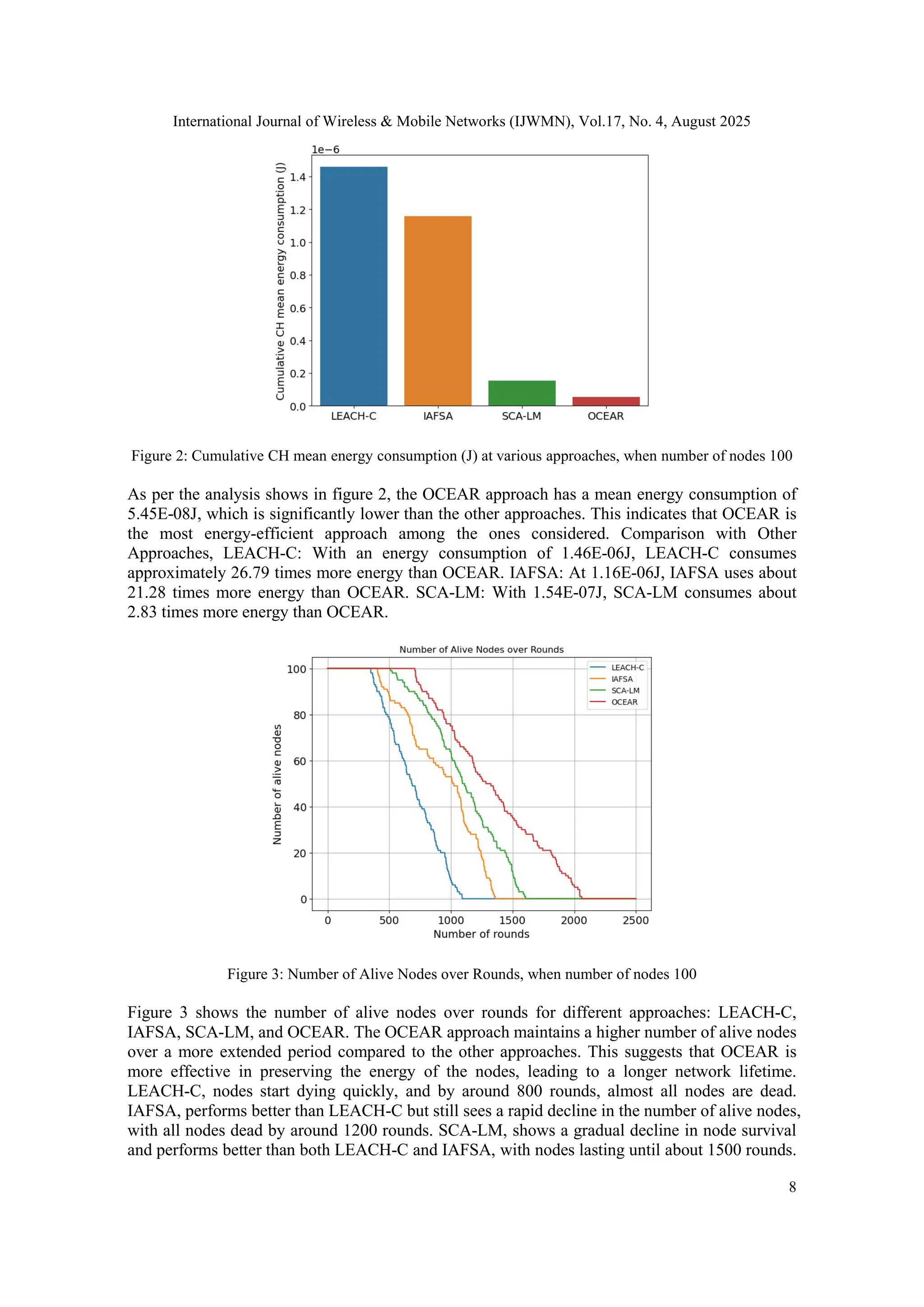
Figure 2: Cumulative CH mean energy consumption (J) at various approaches, when number of nodes 100
As per the analysis shows in figure 2, the OCEAR approach has a mean energy consumption of
5.45E-08J, which is significantly lower than the other approaches. This indicates that OCEAR is
the most energy-efficient approach among the ones considered. Comparison with Other
Approaches, LEACH-C: With an energy consumption of 1.46E-06J, LEACH-C consumes
approximately 26.79 times more energy than OCEAR. IAFSA: At 1.16E-06J, IAFSA uses about
21.28 times more energy than OCEAR. SCA-LM: With 1.54E-07J, SCA-LM consumes about
2.83 times more energy than OCEAR.
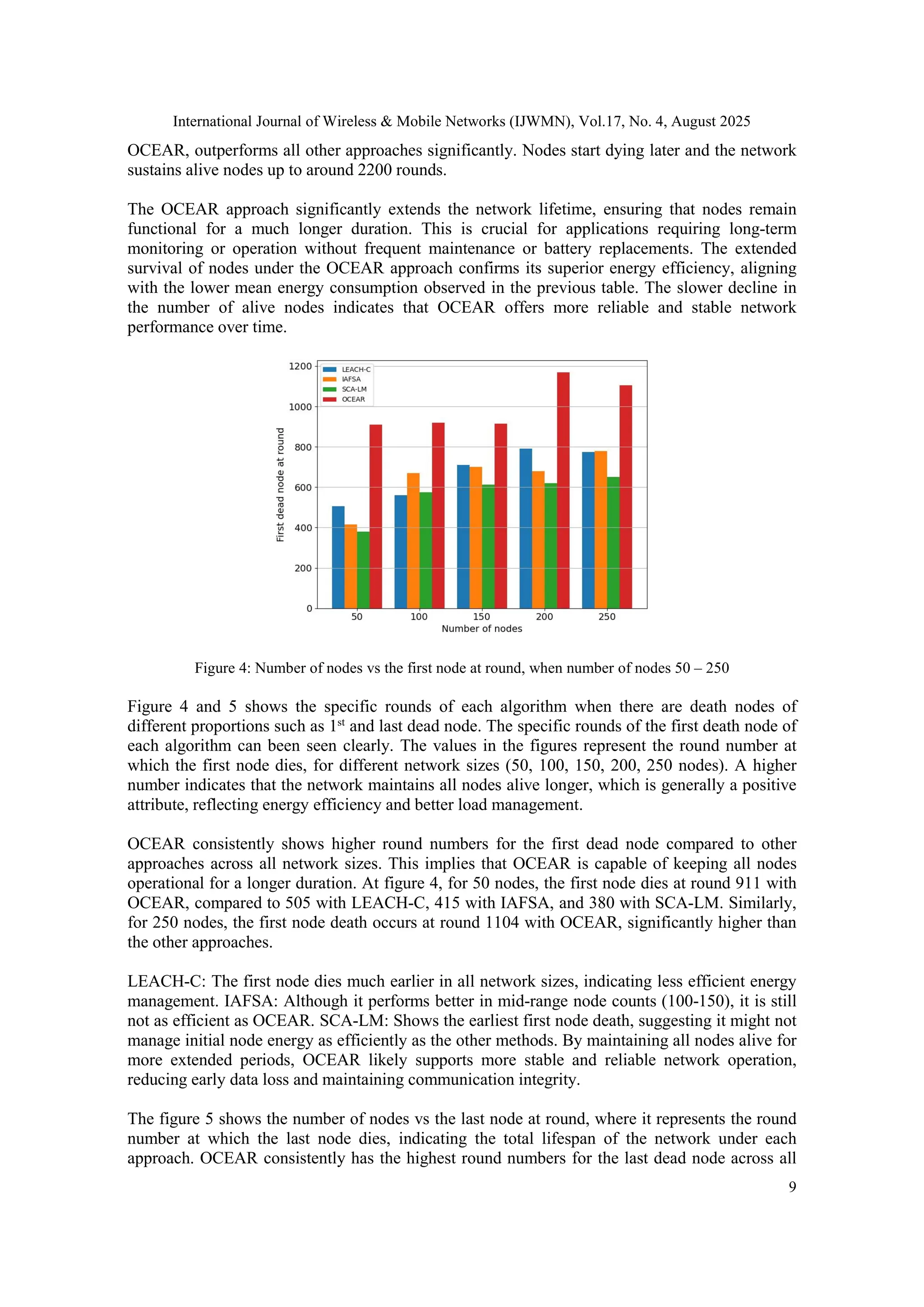
Figure 3: Number of Alive Nodes over Rounds, when number of nodes 100
Figure 3 shows the number of alive nodes over rounds for different approaches: LEACH-C,
IAFSA, SCA-LM, and OCEAR. The OCEAR approach maintains a higher number of alive nodes
over a more extended period compared to the other approaches. This suggests that OCEAR is
more effective in preserving the energy of the nodes, leading to a longer network lifetime.
LEACH-C, nodes start dying quickly, and by around 800 rounds, almost all nodes are dead.
IAFSA, performs better than LEACH-C but still sees a rapid decline in the number of alive nodes,
with all nodes dead by around 1200 rounds. SCA-LM, shows a gradual decline in node survival
and performs better than both LEACH-C and IAFSA, with nodes lasting until about 1500 rounds.
International Journal of Wireless & Mobile Networks (IJWMN), Vol.17, No. 4, August 2025
9
OCEAR, outperforms all other approaches significantly. Nodes start dying later and the network
sustains alive nodes up to around 2200 rounds.
The OCEAR approach significantly extends the network lifetime, ensuring that nodes remain
functional for a much longer duration. This is crucial for applications requiring long-term
monitoring or operation without frequent maintenance or battery replacements. The extended
survival of nodes under the OCEAR approach confirms its superior energy efficiency, aligning
with the lower mean energy consumption observed in the previous table. The slower decline in
the number of alive nodes indicates that OCEAR offers more reliable and stable network
performance over time.
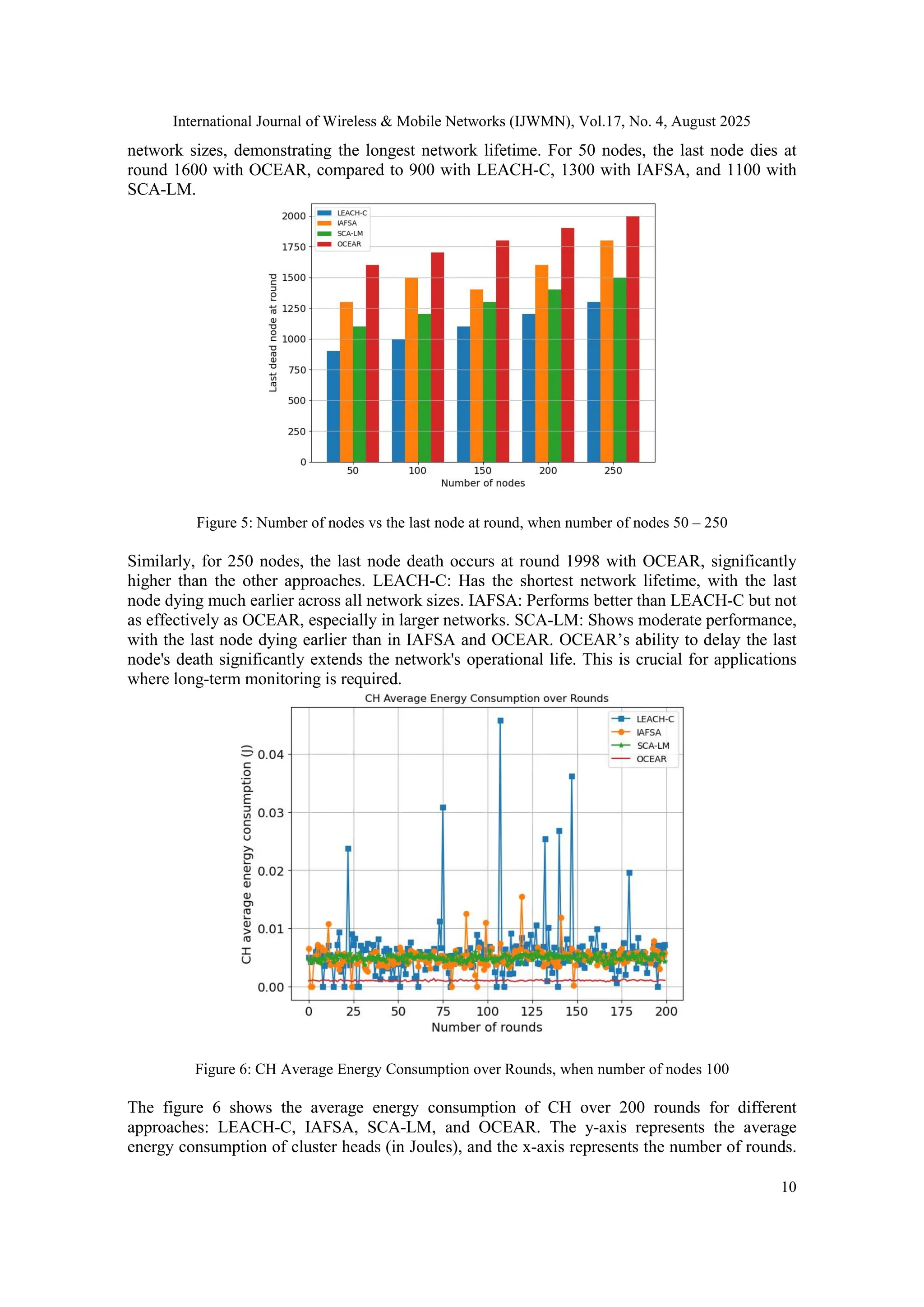
Figure 4: Number of nodes vs the first node at round, when number of nodes 50 – 250
Figure 4 and 5 shows the specific rounds of each algorithm when there are death nodes of
different proportions such as 1st
and last dead node. The specific rounds of the first death node of
each algorithm can been seen clearly. The values in the figures represent the round number at
which the first node dies, for different network sizes (50, 100, 150, 200, 250 nodes). A higher
number indicates that the network maintains all nodes alive longer, which is generally a positive
attribute, reflecting energy efficiency and better load management.
OCEAR consistently shows higher round numbers for the first dead node compared to other
approaches across all network sizes. This implies that OCEAR is capable of keeping all nodes
operational for a longer duration. At figure 4, for 50 nodes, the first node dies at round 911 with
OCEAR, compared to 505 with LEACH-C, 415 with IAFSA, and 380 with SCA-LM. Similarly,
for 250 nodes, the first node death occurs at round 1104 with OCEAR, significantly higher than
the other approaches.
LEACH-C: The first node dies much earlier in all network sizes, indicating less efficient energy
management. IAFSA: Although it performs better in mid-range node counts (100-150), it is still
not as efficient as OCEAR. SCA-LM: Shows the earliest first node death, suggesting it might not
manage initial node energy as efficiently as the other methods. By maintaining all nodes alive for
more extended periods, OCEAR likely supports more stable and reliable network operation,
reducing early data loss and maintaining communication integrity.
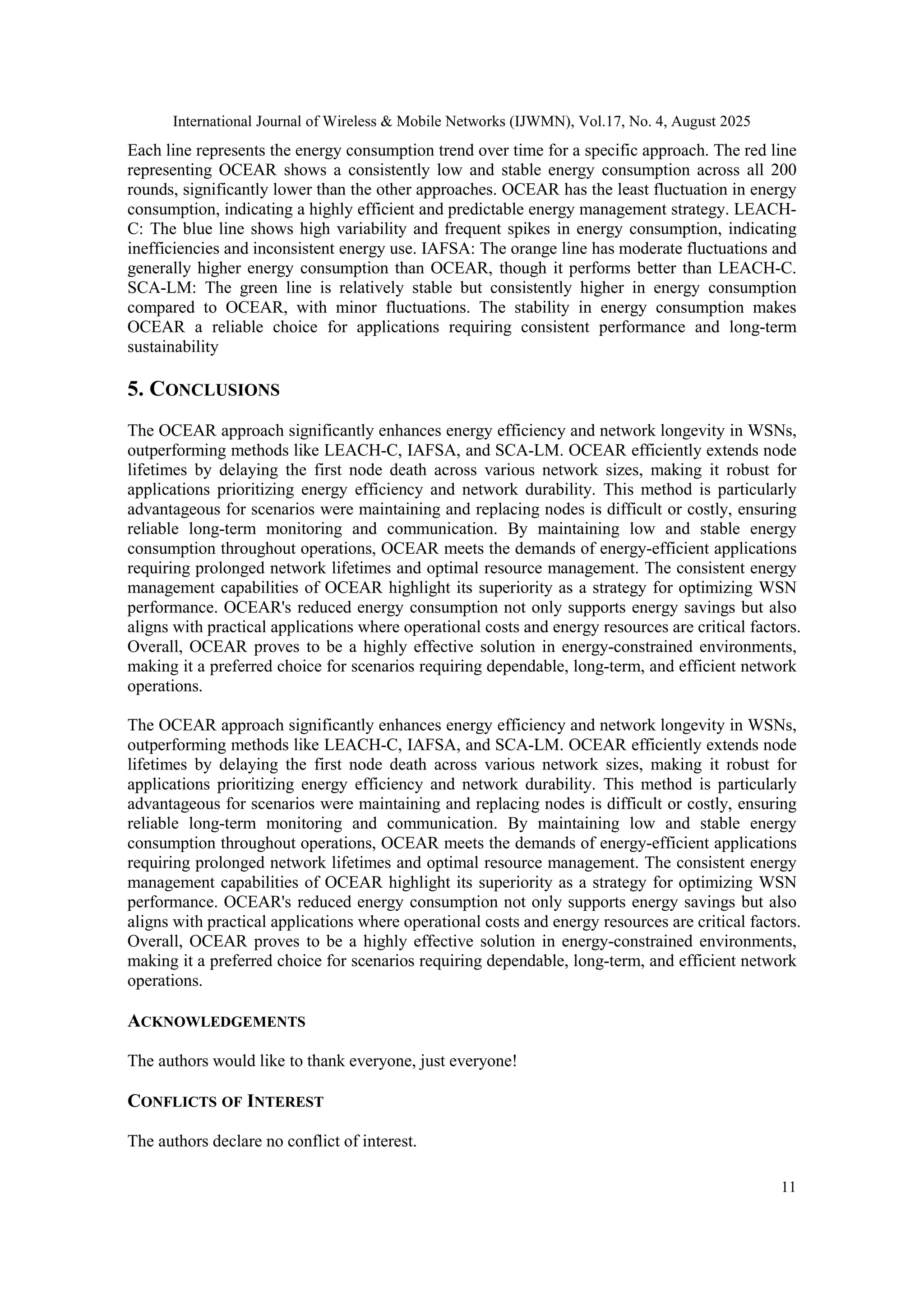
The figure 5 shows the number of nodes vs the last node at round, where it represents the round
number at which the last node dies, indicating the total lifespan of the network under each
approach. OCEAR consistently has the highest round numbers for the last dead node across all
International Journal of Wireless & Mobile Networks (IJWMN), Vol.17, No. 4, August 2025
10
network sizes, demonstrating the longest network lifetime. For 50 nodes, the last node dies at
round 1600 with OCEAR, compared to 900 with LEACH-C, 1300 with IAFSA, and 1100 with
SCA-LM.
Figure 5: Number of nodes vs the last node at round, when number of nodes 50 – 250
Similarly, for 250 nodes, the last node death occurs at round 1998 with OCEAR, significantly
higher than the other approaches. LEACH-C: Has the shortest network lifetime, with the last
node dying much earlier across all network sizes. IAFSA: Performs better than LEACH-C but not
as effectively as OCEAR, especially in larger networks. SCA-LM: Shows moderate performance,
with the last node dying earlier than in IAFSA and OCEAR. OCEAR’s ability to delay the last
node's death significantly extends the network's operational life. This is crucial for applications
where long-term monitoring is required.
Figure 6: CH Average Energy Consumption over Rounds, when number of nodes 100
The figure 6 shows the average energy consumption of CH over 200 rounds for different
approaches: LEACH-C, IAFSA, SCA-LM, and OCEAR. The y-axis represents the average
energy consumption of cluster heads (in Joules), and the x-axis represents the number of rounds.
International Journal of Wireless & Mobile Networks (IJWMN), Vol.17, No. 4, August 2025
11
Each line represents the energy consumption trend over time for a specific approach. The red line
representing OCEAR shows a consistently low and stable energy consumption across all 200
rounds, significantly lower than the other approaches. OCEAR has the least fluctuation in energy
consumption, indicating a highly efficient and predictable energy management strategy. LEACH-
C: The blue line shows high variability and frequent spikes in energy consumption, indicating
inefficiencies and inconsistent energy use. IAFSA: The orange line has moderate fluctuations and
generally higher energy consumption than OCEAR, though it performs better than LEACH-C.
SCA-LM: The green line is relatively stable but consistently higher in energy consumption
compared to OCEAR, with minor fluctuations. The stability in energy consumption makes
OCEAR a reliable choice for applications requiring consistent performance and long-term
sustainability
5. CONCLUSIONS
The OCEAR approach significantly enhances energy efficiency and network longevity in WSNs,
outperforming methods like LEACH-C, IAFSA, and SCA-LM. OCEAR efficiently extends node
lifetimes by delaying the first node death across various network sizes, making it robust for
applications prioritizing energy efficiency and network durability. This method is particularly
advantageous for scenarios were maintaining and replacing nodes is difficult or costly, ensuring
reliable long-term monitoring and communication. By maintaining low and stable energy
consumption throughout operations, OCEAR meets the demands of energy-efficient applications
requiring prolonged network lifetimes and optimal resource management. The consistent energy
management capabilities of OCEAR highlight its superiority as a strategy for optimizing WSN
performance. OCEAR's reduced energy consumption not only supports energy savings but also
aligns with practical applications where operational costs and energy resources are critical factors.
Overall, OCEAR proves to be a highly effective solution in energy-constrained environments,
making it a preferred choice for scenarios requiring dependable, long-term, and efficient network
operations.
The OCEAR approach significantly enhances energy efficiency and network longevity in WSNs,
outperforming methods like LEACH-C, IAFSA, and SCA-LM. OCEAR efficiently extends node
lifetimes by delaying the first node death across various network sizes, making it robust for
applications prioritizing energy efficiency and network durability. This method is particularly
advantageous for scenarios were maintaining and replacing nodes is difficult or costly, ensuring
reliable long-term monitoring and communication. By maintaining low and stable energy
consumption throughout operations, OCEAR meets the demands of energy-efficient applications
requiring prolonged network lifetimes and optimal resource management. The consistent energy
management capabilities of OCEAR highlight its superiority as a strategy for optimizing WSN
performance. OCEAR's reduced energy consumption not only supports energy savings but also
aligns with practical applications where operational costs and energy resources are critical factors.
Overall, OCEAR proves to be a highly effective solution in energy-constrained environments,
making it a preferred choice for scenarios requiring dependable, long-term, and efficient network
operations.
ACKNOWLEDGEMENTS
The authors would like to thank everyone, just everyone!
CONFLICTS OF INTEREST
The authors declare no conflict of interest.
International Journal of Wireless & Mobile Networks (IJWMN), Vol.17, No. 4, August 2025
12
REFERENCES
[1] W. Saad, M. Bennis, M. Chen, “A Vision of 6GWireless Systems: Applications”, Trends,
Technologies, and Open Research Problems. IEEE Netw. 2020, 34, 134–142.
[2] H. Zhang, T. Zhou, T. Xu, H. Hu, “ Remote Interference Discrimination Testbed Employing AI
Ensemble Algorithms for 6G TDD Networks.” Sensors 2023, 23, 2264.
[3] T. A. Lakshmi, B. Hariharan, and P. Rekha, “A survey on energy efficient routing protocol for IoT
based precision agriculture,” in Proc. Int. Conf. Commun. Electron. Syst. (ICCES), Jul. 2019, pp.
1284–1288.
[4] X.-Q. Zhao, Y.-P. Cui, C.-Y. Gao, Z. Guo, and Q. Gao, “Energy-efficient coverage enhancement
strategy for 3-D wireless sensor networks based on a vampire bat optimizer,” IEEE Internet Things
J., vol. 7, no. 1, pp. 325–338, Jan. 2020.
[5] B. Wang and D. S. Fu, ‘‘Improved for LEACH routing protocol in wireless sensor network,’’
Instrum. Technique Sensor., no. 8, pp. 71–73, Aug. 2016.
[6] J. Pradeep and M. P. M. Kumar, ‘‘Distributed entropy energy-efficient clustering algorithm for
heterogeneous wireless sensor network based chaotic firefly algorithm cluster head selection,’’ J.
Crit. Rev., vol. 7, no. 8, pp. 1208–1215, 2020.
[7] W. B. Heinzelman, A. P. Chandrakasan, and H. Balakrishnan, ‘‘An application-specific protocol
architecture for wireless microsensor networks,’’ IEEE Trans. Wireless Commun., vol. 1, no. 4, pp.
660–670, Oct. 2002.
[8] L. L. Pang, J. Y. Xie, and Q. Q. Xu, ‘‘Neural network-based routing energysaving algorithm for
wireless sensor networks,’’ Comput. Intell. Neurosci., vol. 2022, pp. 1–11, Jul. 2022, doi:
10.1155/2022/3342031.
[9] C. H. Lin and F. Jiang, ‘‘Research of multidimensional optimization of LEACH protocol based on
reducing network energy consumption,’’ J. Electr. Comput. Eng., vol. 2021, pp. 1–9, Feb. 2021, doi:
10.1155/2021/6658454.
[10] J. Bhola, S. Soni, and G. K. Cheema, ‘‘Genetic algorithm based optimized leach protocol for energy
efficient wireless sensor networks,’’ J. Ambient Intell. Hum. Comput., vol. 11, no. 3, pp. 1281–1288,
Mar. 2020.
[11] J. Sun and K. L. Zhu, ‘‘WSN clustering routing algorithm based on improved S-FCM and PSO
algorithm,’’ J. Xi’an Univ. Posts Telecommun., vol. 27, no. 2, pp. 7–16, Mar. 2022.
[12] H. Chen and Y. Gao, ‘‘Uneven clustering routing algorithm for WSNs based on double cluster
heads,’’ Comput. Eng., vol. 48, no. 10, pp. 184–192, Oct. 2022.
[13] N. Moussa and A. El Belrhiti El Alaoui, ‘‘An energy-efficient clusterbased routing protocol using
unequal clustering and improved ACO techniques for WSNs,’’ Peer PeerNetw. Appl., vol. 14, no. 3,
pp. 1334–1347, May 2021.
[14] J. X. Miao et al., ‘‘Non-uniform clustering routing algorithm for balanced energy consumption in
WSN,’’ Comput. Eng. Des., vol. 43, no. 2, pp. 301–307, Feb. 2022.
[15] A. Rezaeipanah, P. Amiri, H. Nazari, M. Mojarad, and H. Parvin, ‘‘An energy-aware hybrid
approach for wireless sensor networks using reclustering-based multi-hop routing,’’ Wireless Pers.
Commun., vol. 120, no. 4, pp. 3293–3314, Oct. 2021.
[16] W. P. An and Y. F. Shao, ‘‘Wireless sensor network routing protocol based on improved gray wolf
optimization algorithm,’’ Chin. J. Sens. Actuators., vol. 35, no. 5, pp. 676–682, May 2022.
[17] K. Krishnamoorthi, S. Diwakaran, P. Vijayakumari, P. G. Kuppusamy and E. Kosalendra, "A
Robust and Improved sparrow search algorithm for optimization in wireless sensor network," 2023
International Conference on Artificial Intelligence and Knowledge Discovery in Concurrent
Engineering (ICECONF), Chennai, India, 2023, pp. 1-7
[18] S. Birtane, O. K. Sahingoz and H. Korkmaz, "Vibrational Genetic Algorithm-Based Deployment of
Wireless Sensor Networks With Heterogeneous Nodes in Irregularly Shaped Areas," in IEEE
Access, vol. 12, pp. 62926-62941, 2024.
[19] K. Joshi, M. Kaur and L. Gupta, "Design of Clustering Algorithm for Energy Efficient and Secure
WSN using Fuzzy Logic," 2023 International Conference on Sustainable Computing and Smart
Systems (ICSCSS), Coimbatore, India, 2023, pp. 1448-1453.
[20] Y. Xiuwu, L. Qin, L. Yong, and X. Renrong, “Uneven clustering routing algorithm based on
glowworm swarm optimization,” Ad Hoc Netw., vol. 93, Oct. 2019, Art. no. 101923.
International Journal of Wireless & Mobile Networks (IJWMN), Vol.17, No. 4, August 2025
13
[21] F. Zhao, N. Gao, and K. Y. Zhang, ‘‘WSNs clustering routing protocol based on whale optimization
algorithm and beetle antennae search,’’ Transducer Microsyst. Technol., vol. 41, no. 9, pp. 42–45,
2022.
[22] Solayan Kaviarasan and Rajkumar Srinivasan, “Developing a novel energy efficient routing
protocol in WSN using adaptive remora optimization algorithm”, Expert Systems with Applications,
volume 244, pages 122873, 2024, 0957-4174.
[23] K. L. Zhu and A. J. Sun, ‘‘WSN clustering routing algorithm based on Cuckoo search algorithm
optimized K-means,’’ Chin. J. Internet Things., vol. 6, no. 1, pp. 73–81, Mar. 2022
[24] M. L. Yang and C. Lu, ‘‘Routing Optimization algorithm based on entropy weight adaptive
clustering and improved PSO in WSN,’’ Comput. Appl. Softw., vol. 39, no. 7, pp. 109–116, Jul.
2022.
[25] Q. C. Sun, Z. L. Zhu, and F. Q. Zhang, ‘‘Optimizing WSN clustering protocol based on improved
SSA,’’ Radio Commun. Technol., vol. 48, no. 1, pp. 132–139, Jun. 2022.
[26] Hu, H., Fan, X., Wang, C. et al. Particle swarm optimization and fuzzy logic based clustering and
routing protocol to enhance lifetime for wireless sensor networks. Cluster Comput (2024)
[27] A.J. Sun and S. P. Zheng, ‘‘WSN clustering algorithm based on chaos optimized firefly algorithm,’’
Chin. J. Sens. Actuators., vol. 34, no. 9, pp. 1224–1230, Sep. 2021.
[28] Gunjan, Sharma, A.K. & Verma, K. GA-UCR: Genetic Algorithm Based Unequal Clustering and
Routing Protocol for Wireless Sensor Networks. Wireless Pers Commun 128, 537–558 (2023)
[29] Y. F. Chang, B. J. Song, X. P. Chen, and Y.-X. Zhu, ‘‘WSN clustering algorithm based on
improved artificial fish swarm algorithm and fuzzy cmeans,’’ J. Inf. Eng. Univ., vol. 23, no. 1, pp.
18–23, Feb. 2022.
[30] X. Guo, Y. Ye, L. Li, R. Wu and X. Sun, "WSN Clustering Routing Algorithm Combining Sine
Cosine Algorithm and Lévy Mutation," in IEEE Access, vol. 11, pp. 22654-22663, 2023.
[31] X. He, Z. Z. Ning, and X. Y. Yang, ‘‘WSN clustering routing protocol based on improved sine
cosine algorithm,’’ J. Xi’an Univ. Posts Telecommun., vol. 26, no. 2, pp. 15–20, Mar. 2021
[32] M. Arghavani, M. Esmaeili, M. Esmaeili, F. Mohseni, and A. Arghavani, “Optimal energy aware
clustering in circular wireless sensor networks,” Ad Hoc Netw., vol. 65, pp. 91–98, Oct. 2017.
[33] W. B. Heinzelman, A. P. Chandrakasan, and H. Balakrishnan, “An application-specific protocol
architecture for wireless microsensor networks,” IEEE Trans. Wireless Commun., vol. 1, no. 4, pp.
660–670, Oct. 2002.
[34] Houssein, E.H., El-din Helmy, B., Oliva, D., Elngar, A.A., Shaban, H. “Multi-level Thresholding
Image Segmentation Based on Nature-Inspired Optimization Algorithms: A Comprehensive
Review.” In: Oliva, D., Houssein, E.H., Hinojosa, S. (eds) Metaheuristics in Machine Learning:
Theory and Applications. Studies in Computational Intelligence, vol 967. Springer, Cham. 2021.
[35] X.-S. Yang and A. H. Gandomi, “Bat algorithm: A novel approach for global engineering
optimization,” Eng. Comput., vol. 29, no. 5, pp. 464–483, 2012
AUTHORS
Rajkumar M Vadgave, Received the BE in Electronics and Communication
Engineering from VTU Belagavi University in 2011 and M.Tech in Communication
Systems from VTU Belagavi University in 2013 and Ph.D from VTU Belagavi
University in 2025. He is currently working as Assistant Professor in the Dept of E & CE
Bheemanna Khandre Institute of Technology Bhalki. He has authored or coauthored
more than 10 refereed journals and conference papers. His research interest includes
wireless sensor network, communication system.
Manjula S, Received the BE in Electronics and Communication Engineering from
Gulbarga University in 1997 and M.Tech in Electronics and Communication from VTU
RVD University in 2006 and Ph.D degree from Singhania University in 2014. She is
currently working as Professor in the Dept of E & CE Bheemanna Khandre Institute of
Technology Bhalki. . She has authored or coauthored more than 20 refereed journals
and conference papers. His research interest includes w communication system.
Savitri Kanshette, Received the BE in Electronics and Communication Engineering
International Journal of Wireless & Mobile Networks (IJWMN), Vol.17, No. 4, August 2025
14
from VTU Belagavi University in 2018 and M.Tech in Digital Communication and Networking from VTU
Belagavi University in 2020. She is currently working as Assistant Professor in the Dept of E & CE
Bheemanna Khandre Institute of Technology Bhalki. She has authored or coauthored more than 2 refereed
journals and conference papers. His research interest includes wireless sensor network, communication
system.

Optimized Cluster Based Energy Aware Routing (OCEAR) to Prolong Network Lifetime in WSNs

  • 1.
    International Journal ofWireless & Mobile Networks (IJWMN), Vol.17, No. 4, August 2025 DOI:10.5121/ijwmn.2025.17401 1 OPTIMIZED CLUSTER BASED ENERGY AWARE ROUTING (OCEAR) TO PROLONG NETWORK LIFETIME IN WSNS Rajkumar M Vadgave, Manjula S, Savitri Kanshete Department of Electronics & Communication Engineering, Bheemanna Khandre Institute of Technology, Bhalki, India ABSTRACT Designing energy-efficient WSN is complex. Effective routing is crucial for energy efficiency due to its impact on energy consumption during communication. In WSNs, clustering involves selecting a CH, which acts as a leader and consumes more energy. This process groups nodes into clusters, minimizing the communication range that each CH manages. This paper introduces the Optimized Cluster-Based Energy- Aware Routing (OCEAR) protocol to extend WSN lifetimes. Nodes are organized into clusters based on node angle and variance, enhancing CH load balancing and distribution. We assess communication models in different scenarios to find those aligning with the free space model, thereby reducing energy use compared to the multipath fading model. We derive closed-form expressions for the optimal CH number and location, linked to network size and energy use, and set an objective function to optimize CH selection based on node energy and CH location. OCEAR's energy efficiency is ideal for battery-dependent devices and resource-limited systems, leading to longer device lifetimes and reduced costs. Compared to LEACH- C, IAFSA, and SCA-LM, OCEAR offers superior energy efficiency and network durability. KEYWORDS Wireless Sensor Networks (WSNs); Cluster Head (CH); Base Station (BS); Internet of Things (IoT) 1. INTRODUCTION Fifth generation (5G) wireless communication technology is now essential to many services, such as mobile Internet and IoT devices [1]. Numerous industries, including agriculture, building management, smart homes, traffic control, incident response, and many more, use WSNs. As WSNs are commonly used in contemporary ubiquitous systems, which frequently combine IoT and pervasive computing, our discovery may have important ramifications in these fields. Numerous applications have been made possible by the notable improvements in transmission rates, decreased latency, and higher system capacity brought about by 5G technologies [2]. For instance, maintaining the network and changing the batteries in sensor nodes might be difficult in agricultural irrigation systems [3].The network may suffer major and occasionally irreversible harm when a node fails owing to low energy, resulting in the loss of thorough field monitoring data [4]. Because of this, it's critical to reduce node energy consumption, especially when long- distance data transmission and required data collecting are involved. As a result, the problem of creating an energy-efficient routing protocol to reduce nodes' transmission energy requirements and increase network lifetime has emerged as a crucial one. WSNs energy consumption is directly related to data transmission and cluster division in cluster routing algorithms. Consequently, clustering routing methods have continued to be a major area of study for WSN. These algorithms can be broadly divided into two categories: distributed
  • 2.
    International Journal ofWireless & Mobile Networks (IJWMN), Vol.17, No. 4, August 2025 2 routing algorithms [5][6] and centralized clustered routing algorithms [7]-[9], with LEACH and LEACH-C serving as examples of both. both type of method is best suited for a certain set of application scenarios. Centralized clustering routing algorithms are able to choose the best cluster head or path selection in each cycle, whereas distributed techniques require greater computing, storage, and power capacities from sensor nodes. When it comes to cluster formation, some researchers choose to divide clusters before choosing cluster heads [10], whereas others would rather divide clusters first [11].Some researchers have suggested primary cluster head, secondary cluster head, or dual cluster head architectures as ways to conserve energy [12]. Factors like clustering uniformity, BS location, distance, remaining energy, cluster head load, and cluster head selection frequency are usually considered when choosing cluster heads dynamically [13]. There are typically two ways of data transmission used during the data transmission phase: single-hop [14] and multi-hop [15], depending on the location of the BS. Finding the most energy-efficient route from cluster heads to the BS is essential in the context of inter-cluster multi-hop transmission. Some algorithms use the idea of chaining [16] to create chain structures inside or between clusters, drawing inspiration from the PEGASIS protocol, with the goal of lowering node energy consumption. Scholars have also investigated network energy- related aspects from the perspective of non-uniform clustering [12], [14], or system heterogeneity [17]. Furthermore, in an effort to investigate novel strategies and concepts for enhancing WSN clustering routing algorithms, recent developments in WSN research have seen the introduction of a number of creative algorithms and improvements to preexisting prototypes, such as the sparrow search algorithm [17], artificial intelligence algorithms [8], genetic evolution algorithms [18], and combinations with fuzzy logic algorithms [19].Clusters are frequently sized differently, with smaller clusters close to the BS and bigger clusters farther away, in order to enhance the balance of energy consumption across CHs. The goal of this strategy is to avoid adding more data forwarding duties to CHs near the BS, which could hasten the rate at which energy is used up [20]. Nevertheless, this approach falls short in addressing the problem of imbalanced energy consumption resulting from large differences in the quantity of CH loads. Maximizing network longevity and improving energy economy in clustering routing protocols require addressing the issues of choosing the right number of cluster heads, distributing them optimally within the monitoring region, and guaranteeing balanced cluster head loads. In order to increase the network lifespan in WSNs, we provide the OCEAR protocol in this research to enhance distribution uniformity and balance the burden among CHs, sensor nodes are grouped into clusters according to node angle and variance in cluster sizes. In order to reduce energy consumption brought on by the multipath fading model, the protocol additionally takes into account various communication models between nodes, finally choosing scenarios that meet the free space model. We construct closed-form formulas for the ideal CH position and quantity by demonstrating the mathematical relationship between network size, number and placement of CHs, and overall energy usage. With the use of these formulas, we optimize CH selection by formulating an objective function that takes into account both the nodes' residual energy and the optimal placement of CH. This method yields an energy-efficient routing protocol intended to lower energy consumption and increase network lifespan when paired with a node clustering technique and a CH selection strategy based on the ideal CH locations. 2. LITERATURE SURVEY It has shown some flexibility and efficacy to use one or two augmented swarm intelligence optimization methods to the clustering routing problems in WSNs. Nonetheless, there remains room for development in terms of lowering energy usage and prolonging the network's lifespan.
  • 3.
    International Journal ofWireless & Mobile Networks (IJWMN), Vol.17, No. 4, August 2025 3 It was proposed in [21] that the robust global search ability of the beetle antennae search (BAS) algorithm might be used to improve the position update procedure in the contraction and encirclement stage of the whale optimization algorithm (WOA). To further improve the efficiency and logic of the clustering process, a selection function based on energy and distance was suggested. This paper successfully integrates the strengths of the BAS and WOA algorithms, applying them to WSN clustering routing to achieve significant energy savings in nodes. In [22], a routing algorithm designed to conserve energy is introduced, employing a new optimization strategy to solve the multi-objective formulation of the developed WSN protocol. The Adaptive Remora Optimization Algorithm (AROA) is utilized for cluster head selection, allowing for the efficient derivation of multiple functions. A technique was presented in [23] that involves first segmenting the cluster region and then determining the first cluster centres using the Cuckoo algorithm. We then used the K-means technique to generate homogeneous clusters. For the data transmission phase, energy-efficient routing algorithms for cluster heads were also devised. A fuzzy neural network was proposed in [24] as a potential method for choosing cluster heads, and particle swarm optimization was added to improve routing. Relay load factor, gateway-to-sink distance, and number of relay nodes were among the variables considered in the fitness function analysis. The program demonstrated potential, despite its complexity and the fuzzy neural network component's need for additional development. It was proposed in [25] that the sparrow search algorithm's location update formula may be improved by include the adaptive t-distribution; this improvement was verified. The LEACH protocol was then modified using the improved algorithm, which produced a cluster head selection process that was more optimal. It was observed, though, that it took a while for the percentage of dead nodes to reach 80%, suggesting that different nodes used different amounts of energy. In order to solve this problem, [26] developed the PFCRE clustering routing protocol, which combines particle swarm optimization and fuzzy logic to increase energy efficiency, solve energy depletion problems, and lengthen network lifespan. An enhanced particle swarm optimization technique is used by the PFCRE protocol to create clusters with balanced loads and low energy usage. Furthermore, each cluster head's ideal routing is ascertained by a fuzzy inference system, which considers factors like residual energy, the distance to the base station, and the frequency of selection as a relay to balance traffic load and minimize energy consumption. The application of chaos theory to enhance the distribution of clustering centers in the firefly algorithm for clustering was suggested in [27]. There was a dual cluster head system in place; the primary cluster head handled data fusion and information receiving, while the secondary cluster head oversaw data transmission. The Bellman-Ford multi-hop route technique was applied during data transmission. Nevertheless, this method caused the first dead node to show sooner. "Genetic Algorithm (GA)-based Unequal Clustering and Routing Protocol for WSN," or GA-UCR, is a brand-new protocol that was created in [28]. The residual energy of CH nodes, the distance between CHs and the BS or sink, and inter-cluster separation are the three fitness functions that are incorporated into this protocol's GA for CH selection.The GA is used to address the NP- hardness of the inter-cluster multi-hopping and data routing to the BS. Three fitness factors are used in this method: the number of hops, the distance between the CH and the next-hop node, and the residual energy of the next-hop nodes. A proposal for the Improved Artificial Fish Swarm Algorithm (IAFSA) was made in [29]. It consists of three steps: identifying the ideal number of cluster heads, selecting cluster heads based on energy and distance, and iteratively figuring out the initial center of the Fuzzy C-Means (FCM) algorithm. The evaluation of the network's longevity and efficacy involved timing the failure of the first node and the failure of half of the nodes. Simulation results indicated that while the algorithm showed promise, further improvements are needed to better balance energy consumption.
  • 4.
    International Journal ofWireless & Mobile Networks (IJWMN), Vol.17, No. 4, August 2025 4 A novel clustered routing algorithm called SCA-LMa combination of the Lévy mutation and the Sine Cosine Algorithm (SCA)is presented in [30]. To maintain a suitable count during the cluster head selection process, the number of cluster heads is constantly modified based on the number of remaining nodes. To guarantee energy efficiency among cluster head candidates, only nodes with high energy levels are taken into consideration. In order to encourage a more equal distribution inside clusters, the fitness function is made to take intra-cluster distance into consideration. In order to pick cluster heads, the algorithm uses an improved step size search factor from the Sine Cosine Algorithm and adds Lévy mutation to create population variety. An improved SCA tailored for WSNs was presented in [31]. This enhanced algorithm was used for WSN clustering routing and contrasted with the conventional LEACH algorithm. It included an inertia weight factor and a fitness function based on node distances and residual energy. The outcomes, however, indicated that the network lifetime extension was not as successful as anticipated. We suggest the OCEAR protocol to enhance network lifetime analysis and elongation in WSNs by building on findings from earlier studies. 3. PROPOSED METHOD As stated in [32], sensor nodes are dispersed at random over a circular monitoring area with a radius of . To estimate the energy consumption of these sensor nodes, we apply the well-known model described in [33]. is the energy required to transmit a -bit data packet across a distance. For either the transmitter or the receiver, the coefficient is denoted by the symbol . The energy consumption linked to the multipath fading model and the free space model is represented by the coefficients and , respectively. With equation (1), the distance threshold, is computed. (1) The energy consumption for receiving -bit data by the data reception module is determined using equation (2). = (2) To minimize the significant energy consumption associated with long-distance communication between nodes, we propose the following scenario analysis. This analysis aims to identify situations where nodes adhere to the free space model, specifically under the condition of CH relay. For a circular monitoring area centered on the BS, if there are cluster heads that ensure the communication distance between nodes aligns with the free space model, the radius of the monitoring area must satisfy the conditions outlined in equation (3). (3) To identify the best clusters, an optimization algorithm is required because identifying optimal clusters is an NP-hard problem and swarm intelligence (SI) algorithms that have shown excellent performance in determining the ideal segmentation threshold include the artificial bee colony, Bat Algorithm (BA), and particle swarm optimization [34]. Since the accuracy of identifying the optimal solution for inter-cluster nodes is minimal across these algorithms, we employ BA [35] to derive as the objective function, where denotes the set of angle segmentation thresholds.
  • 5.
    International Journal ofWireless & Mobile Networks (IJWMN), Vol.17, No. 4, August 2025 5 The bat population is represented as when finding the ideal segmentation threshold using BA. Equation (4) is used to update the frequency of bats. (4) Here, the bats' minimum and maximum frequencies are indicated by, and , respectively. With ∈ [0, 1], the variable is a random vector with uniform distribution. The position and velocity of the bat at time are updated using equations (5) and (6). (5) (6) Using equation (7), the new solution is locally updated once a solution is determined to be the current best option. (7) Within the range is a random vector with uniform distribution in this context. Whereas represents the average bat noise level, the variable represents the global optimal solution. Rounding up is indicated by the brackets . It is crucial to choose the right CH for every cluster after the cluster formation phase is finished. The location and number of CHs have a major impact on the network's energy consumption as well as the effectiveness of data transmission. We seek to identify the ideal distance ( ) and number of CHs ( ) between the CH and base station in order to minimize network energy consumption. The total network energy consumption can be minimized when and meet the requirements given in equations (8) and (9). (8) (9) Nodes are evenly spaced out over a circle with a radius of B. A partition of the area into P clusters will result in A/P−1 cluster nodes (CNs) and one CH for each cluster. As a result, the energy used by one CH and the A/P −1 CMs together make up each cluster's total energy consumption. We define the minimum energy consumption circle , centered at the base station, with a radius , based on the optimal distance between the CH and the BS . CHs should ideally be positioned close to the minimum energy consumption circle in order to minimize the overall network energy consumption. As such, choosing CHs near is crucial, and nodes with higher residual energy should be given priority. This method lessens the possibility of these nodes running out of energy too soon and helps prevent the replacement of CHs close to from occurring frequently. Consequently, as shown in equation (10), an attribute function [16] is created to take into consideration both the best place for CHs and the remaining energy in
  • 6.
    International Journal ofWireless & Mobile Networks (IJWMN), Vol.17, No. 4, August 2025 6 nodes. The CH for every cluster is then selected from among the nodes with the highest attribute value. (10) Under this situation, the control parameters and range from [0,1] provided that . The greatest and minimum distances from each node in the cluster to , respectively, are represented by the variables and . The distance between node to is indicated by . The residual and initial energy of node are represented by and respectively. CNs will periodically gather and send their data to the CH during their assigned TDMA timeslots after choosing the CHs and scheduling transmissions. This data will then be received by the CHs, who will then compile it before sending it to the BS. Table 1: Proposed Algorithm Here is the flow chart of OCEAR approach: 1. BS Initialization  Set up network parameters and gather information on node locations and remaining energy levels. 2. Determine Optimal CH Configuration  Calculate the ideal number and positions for CHs. 3. Cluster Formation  Form clusters based on the angle of nodes and the variance in their numbers. 4. Selection of CHs  Choose CHs for each cluster. 5. Disseminate Hello Packets  Notify nodes of their cluster assignments and their role as CH or Cluster Nodes (CNs). 6. Node Role Confirmation  Nodes receive hello packets to determine if they are CHs or CNs and identify their cluster membership. 7. Role Decision: Is the Node a CH?  Yes (CH Role):  Send packets to inform CNs that CH is selected  No (CN Role):  Receive packets to identify the CH. 8. TDMA Time Slot Allocation  Inform CNs of their assigned time slots. 9. Data Aggregation and Transmission  CHs aggregate data from CNs and send it to the BS for further analysis. 10. Compute Energy Consumption  Compute energy usage for all nodes. 11. Energy Status Check  Are all nodes depleted of energy? o Yes: Terminate the process. o No: Has there been a change in the number of dead nodes?  Yes: Reassess the location and remaining energy of all active nodes, then repeat from step 4.  No: Continue by recalculating energy consumption, and then proceed from step 2. The centralized OCEAR protocol is described in this section. It consists of three main stages: data transmission, CH selection, and clustering formation. These three stages are included in
  • 7.
    International Journal ofWireless & Mobile Networks (IJWMN), Vol.17, No. 4, August 2025 7 every full round of the protocol, which is carried out in iterative rounds. Algorithm 1 describes the OCEAR procedure in its entirety. It is significant to remember that the BS oversees the first two OCEAR phases before giving all nodes instructions on how to finish configuring the network. In particular, the OCEAR protocol will dynamically re-select CHs based on the updated node residual energy and restart the clustering formation phase if the number of dead nodes changes. Only the cluster selection phase will be carried out if the number of dead nodes remains unchanged. 4. RESULTS AND ANALYSIS The following assumptions have been considered: Nodes are distributed randomly within the monitoring area, following a uniform distribution pattern. Both nodes and the base station (BS) remain stationary after deployment. Each node starts with equal initial energy and communication range and can determine its geographic position and orientation relative to the BS using GPS or other positioning methods. Nodes with limited power can perform calculations, process data, and forward information. The BS is centrally located within the monitoring area and can access information from all nodes. Simulations are conducted using MATLAB. The network life cycle is defined by the occurrence of the first node failure. The OCEAR algorithm is evaluated against LEACH-C [9], IAFSA [29], and SCA-LM [30] using metrics such as clustering and cluster head (CH) selection, energy consumption, network life cycle, and applicability. Simulation parameters are as follows: the region size is 250, the number of nodes ranges from 50 to 250, the number of BSs is 100, the probability of selecting cluster heads is 0.05, packet size is 4000 bits, and initial energy per node is 0.5J. Figure 1 illustrates the node clustering and CH selection process after 200 rounds of the OCEAR algorithm. Figure 1: Schematic diagram of nodes clustering and CH selection when OCEAR algorithm runs to 200 rounds; when number of nodes 250 and BS 100
  • 8.
    International Journal ofWireless & Mobile Networks (IJWMN), Vol.17, No. 4, August 2025 8 Figure 2: Cumulative CH mean energy consumption (J) at various approaches, when number of nodes 100 As per the analysis shows in figure 2, the OCEAR approach has a mean energy consumption of 5.45E-08J, which is significantly lower than the other approaches. This indicates that OCEAR is the most energy-efficient approach among the ones considered. Comparison with Other Approaches, LEACH-C: With an energy consumption of 1.46E-06J, LEACH-C consumes approximately 26.79 times more energy than OCEAR. IAFSA: At 1.16E-06J, IAFSA uses about 21.28 times more energy than OCEAR. SCA-LM: With 1.54E-07J, SCA-LM consumes about 2.83 times more energy than OCEAR. Figure 3: Number of Alive Nodes over Rounds, when number of nodes 100 Figure 3 shows the number of alive nodes over rounds for different approaches: LEACH-C, IAFSA, SCA-LM, and OCEAR. The OCEAR approach maintains a higher number of alive nodes over a more extended period compared to the other approaches. This suggests that OCEAR is more effective in preserving the energy of the nodes, leading to a longer network lifetime. LEACH-C, nodes start dying quickly, and by around 800 rounds, almost all nodes are dead. IAFSA, performs better than LEACH-C but still sees a rapid decline in the number of alive nodes, with all nodes dead by around 1200 rounds. SCA-LM, shows a gradual decline in node survival and performs better than both LEACH-C and IAFSA, with nodes lasting until about 1500 rounds.
  • 9.
    International Journal ofWireless & Mobile Networks (IJWMN), Vol.17, No. 4, August 2025 9 OCEAR, outperforms all other approaches significantly. Nodes start dying later and the network sustains alive nodes up to around 2200 rounds. The OCEAR approach significantly extends the network lifetime, ensuring that nodes remain functional for a much longer duration. This is crucial for applications requiring long-term monitoring or operation without frequent maintenance or battery replacements. The extended survival of nodes under the OCEAR approach confirms its superior energy efficiency, aligning with the lower mean energy consumption observed in the previous table. The slower decline in the number of alive nodes indicates that OCEAR offers more reliable and stable network performance over time. Figure 4: Number of nodes vs the first node at round, when number of nodes 50 – 250 Figure 4 and 5 shows the specific rounds of each algorithm when there are death nodes of different proportions such as 1st and last dead node. The specific rounds of the first death node of each algorithm can been seen clearly. The values in the figures represent the round number at which the first node dies, for different network sizes (50, 100, 150, 200, 250 nodes). A higher number indicates that the network maintains all nodes alive longer, which is generally a positive attribute, reflecting energy efficiency and better load management. OCEAR consistently shows higher round numbers for the first dead node compared to other approaches across all network sizes. This implies that OCEAR is capable of keeping all nodes operational for a longer duration. At figure 4, for 50 nodes, the first node dies at round 911 with OCEAR, compared to 505 with LEACH-C, 415 with IAFSA, and 380 with SCA-LM. Similarly, for 250 nodes, the first node death occurs at round 1104 with OCEAR, significantly higher than the other approaches. LEACH-C: The first node dies much earlier in all network sizes, indicating less efficient energy management. IAFSA: Although it performs better in mid-range node counts (100-150), it is still not as efficient as OCEAR. SCA-LM: Shows the earliest first node death, suggesting it might not manage initial node energy as efficiently as the other methods. By maintaining all nodes alive for more extended periods, OCEAR likely supports more stable and reliable network operation, reducing early data loss and maintaining communication integrity. The figure 5 shows the number of nodes vs the last node at round, where it represents the round number at which the last node dies, indicating the total lifespan of the network under each approach. OCEAR consistently has the highest round numbers for the last dead node across all
  • 10.
    International Journal ofWireless & Mobile Networks (IJWMN), Vol.17, No. 4, August 2025 10 network sizes, demonstrating the longest network lifetime. For 50 nodes, the last node dies at round 1600 with OCEAR, compared to 900 with LEACH-C, 1300 with IAFSA, and 1100 with SCA-LM. Figure 5: Number of nodes vs the last node at round, when number of nodes 50 – 250 Similarly, for 250 nodes, the last node death occurs at round 1998 with OCEAR, significantly higher than the other approaches. LEACH-C: Has the shortest network lifetime, with the last node dying much earlier across all network sizes. IAFSA: Performs better than LEACH-C but not as effectively as OCEAR, especially in larger networks. SCA-LM: Shows moderate performance, with the last node dying earlier than in IAFSA and OCEAR. OCEAR’s ability to delay the last node's death significantly extends the network's operational life. This is crucial for applications where long-term monitoring is required. Figure 6: CH Average Energy Consumption over Rounds, when number of nodes 100 The figure 6 shows the average energy consumption of CH over 200 rounds for different approaches: LEACH-C, IAFSA, SCA-LM, and OCEAR. The y-axis represents the average energy consumption of cluster heads (in Joules), and the x-axis represents the number of rounds.
  • 11.
    International Journal ofWireless & Mobile Networks (IJWMN), Vol.17, No. 4, August 2025 11 Each line represents the energy consumption trend over time for a specific approach. The red line representing OCEAR shows a consistently low and stable energy consumption across all 200 rounds, significantly lower than the other approaches. OCEAR has the least fluctuation in energy consumption, indicating a highly efficient and predictable energy management strategy. LEACH- C: The blue line shows high variability and frequent spikes in energy consumption, indicating inefficiencies and inconsistent energy use. IAFSA: The orange line has moderate fluctuations and generally higher energy consumption than OCEAR, though it performs better than LEACH-C. SCA-LM: The green line is relatively stable but consistently higher in energy consumption compared to OCEAR, with minor fluctuations. The stability in energy consumption makes OCEAR a reliable choice for applications requiring consistent performance and long-term sustainability 5. CONCLUSIONS The OCEAR approach significantly enhances energy efficiency and network longevity in WSNs, outperforming methods like LEACH-C, IAFSA, and SCA-LM. OCEAR efficiently extends node lifetimes by delaying the first node death across various network sizes, making it robust for applications prioritizing energy efficiency and network durability. This method is particularly advantageous for scenarios were maintaining and replacing nodes is difficult or costly, ensuring reliable long-term monitoring and communication. By maintaining low and stable energy consumption throughout operations, OCEAR meets the demands of energy-efficient applications requiring prolonged network lifetimes and optimal resource management. The consistent energy management capabilities of OCEAR highlight its superiority as a strategy for optimizing WSN performance. OCEAR's reduced energy consumption not only supports energy savings but also aligns with practical applications where operational costs and energy resources are critical factors. Overall, OCEAR proves to be a highly effective solution in energy-constrained environments, making it a preferred choice for scenarios requiring dependable, long-term, and efficient network operations. The OCEAR approach significantly enhances energy efficiency and network longevity in WSNs, outperforming methods like LEACH-C, IAFSA, and SCA-LM. OCEAR efficiently extends node lifetimes by delaying the first node death across various network sizes, making it robust for applications prioritizing energy efficiency and network durability. This method is particularly advantageous for scenarios were maintaining and replacing nodes is difficult or costly, ensuring reliable long-term monitoring and communication. By maintaining low and stable energy consumption throughout operations, OCEAR meets the demands of energy-efficient applications requiring prolonged network lifetimes and optimal resource management. The consistent energy management capabilities of OCEAR highlight its superiority as a strategy for optimizing WSN performance. OCEAR's reduced energy consumption not only supports energy savings but also aligns with practical applications where operational costs and energy resources are critical factors. Overall, OCEAR proves to be a highly effective solution in energy-constrained environments, making it a preferred choice for scenarios requiring dependable, long-term, and efficient network operations. ACKNOWLEDGEMENTS The authors would like to thank everyone, just everyone! CONFLICTS OF INTEREST The authors declare no conflict of interest.
  • 12.
    International Journal ofWireless & Mobile Networks (IJWMN), Vol.17, No. 4, August 2025 12 REFERENCES [1] W. Saad, M. Bennis, M. Chen, “A Vision of 6GWireless Systems: Applications”, Trends, Technologies, and Open Research Problems. IEEE Netw. 2020, 34, 134–142. [2] H. Zhang, T. Zhou, T. Xu, H. Hu, “ Remote Interference Discrimination Testbed Employing AI Ensemble Algorithms for 6G TDD Networks.” Sensors 2023, 23, 2264. [3] T. A. Lakshmi, B. Hariharan, and P. Rekha, “A survey on energy efficient routing protocol for IoT based precision agriculture,” in Proc. Int. Conf. Commun. Electron. Syst. (ICCES), Jul. 2019, pp. 1284–1288. [4] X.-Q. Zhao, Y.-P. Cui, C.-Y. Gao, Z. Guo, and Q. Gao, “Energy-efficient coverage enhancement strategy for 3-D wireless sensor networks based on a vampire bat optimizer,” IEEE Internet Things J., vol. 7, no. 1, pp. 325–338, Jan. 2020. [5] B. Wang and D. S. Fu, ‘‘Improved for LEACH routing protocol in wireless sensor network,’’ Instrum. Technique Sensor., no. 8, pp. 71–73, Aug. 2016. [6] J. Pradeep and M. P. M. Kumar, ‘‘Distributed entropy energy-efficient clustering algorithm for heterogeneous wireless sensor network based chaotic firefly algorithm cluster head selection,’’ J. Crit. Rev., vol. 7, no. 8, pp. 1208–1215, 2020. [7] W. B. Heinzelman, A. P. Chandrakasan, and H. Balakrishnan, ‘‘An application-specific protocol architecture for wireless microsensor networks,’’ IEEE Trans. Wireless Commun., vol. 1, no. 4, pp. 660–670, Oct. 2002. [8] L. L. Pang, J. Y. Xie, and Q. Q. Xu, ‘‘Neural network-based routing energysaving algorithm for wireless sensor networks,’’ Comput. Intell. Neurosci., vol. 2022, pp. 1–11, Jul. 2022, doi: 10.1155/2022/3342031. [9] C. H. Lin and F. Jiang, ‘‘Research of multidimensional optimization of LEACH protocol based on reducing network energy consumption,’’ J. Electr. Comput. Eng., vol. 2021, pp. 1–9, Feb. 2021, doi: 10.1155/2021/6658454. [10] J. Bhola, S. Soni, and G. K. Cheema, ‘‘Genetic algorithm based optimized leach protocol for energy efficient wireless sensor networks,’’ J. Ambient Intell. Hum. Comput., vol. 11, no. 3, pp. 1281–1288, Mar. 2020. [11] J. Sun and K. L. Zhu, ‘‘WSN clustering routing algorithm based on improved S-FCM and PSO algorithm,’’ J. Xi’an Univ. Posts Telecommun., vol. 27, no. 2, pp. 7–16, Mar. 2022. [12] H. Chen and Y. Gao, ‘‘Uneven clustering routing algorithm for WSNs based on double cluster heads,’’ Comput. Eng., vol. 48, no. 10, pp. 184–192, Oct. 2022. [13] N. Moussa and A. El Belrhiti El Alaoui, ‘‘An energy-efficient clusterbased routing protocol using unequal clustering and improved ACO techniques for WSNs,’’ Peer PeerNetw. Appl., vol. 14, no. 3, pp. 1334–1347, May 2021. [14] J. X. Miao et al., ‘‘Non-uniform clustering routing algorithm for balanced energy consumption in WSN,’’ Comput. Eng. Des., vol. 43, no. 2, pp. 301–307, Feb. 2022. [15] A. Rezaeipanah, P. Amiri, H. Nazari, M. Mojarad, and H. Parvin, ‘‘An energy-aware hybrid approach for wireless sensor networks using reclustering-based multi-hop routing,’’ Wireless Pers. Commun., vol. 120, no. 4, pp. 3293–3314, Oct. 2021. [16] W. P. An and Y. F. Shao, ‘‘Wireless sensor network routing protocol based on improved gray wolf optimization algorithm,’’ Chin. J. Sens. Actuators., vol. 35, no. 5, pp. 676–682, May 2022. [17] K. Krishnamoorthi, S. Diwakaran, P. Vijayakumari, P. G. Kuppusamy and E. Kosalendra, "A Robust and Improved sparrow search algorithm for optimization in wireless sensor network," 2023 International Conference on Artificial Intelligence and Knowledge Discovery in Concurrent Engineering (ICECONF), Chennai, India, 2023, pp. 1-7 [18] S. Birtane, O. K. Sahingoz and H. Korkmaz, "Vibrational Genetic Algorithm-Based Deployment of Wireless Sensor Networks With Heterogeneous Nodes in Irregularly Shaped Areas," in IEEE Access, vol. 12, pp. 62926-62941, 2024. [19] K. Joshi, M. Kaur and L. Gupta, "Design of Clustering Algorithm for Energy Efficient and Secure WSN using Fuzzy Logic," 2023 International Conference on Sustainable Computing and Smart Systems (ICSCSS), Coimbatore, India, 2023, pp. 1448-1453. [20] Y. Xiuwu, L. Qin, L. Yong, and X. Renrong, “Uneven clustering routing algorithm based on glowworm swarm optimization,” Ad Hoc Netw., vol. 93, Oct. 2019, Art. no. 101923.
  • 13.
    International Journal ofWireless & Mobile Networks (IJWMN), Vol.17, No. 4, August 2025 13 [21] F. Zhao, N. Gao, and K. Y. Zhang, ‘‘WSNs clustering routing protocol based on whale optimization algorithm and beetle antennae search,’’ Transducer Microsyst. Technol., vol. 41, no. 9, pp. 42–45, 2022. [22] Solayan Kaviarasan and Rajkumar Srinivasan, “Developing a novel energy efficient routing protocol in WSN using adaptive remora optimization algorithm”, Expert Systems with Applications, volume 244, pages 122873, 2024, 0957-4174. [23] K. L. Zhu and A. J. Sun, ‘‘WSN clustering routing algorithm based on Cuckoo search algorithm optimized K-means,’’ Chin. J. Internet Things., vol. 6, no. 1, pp. 73–81, Mar. 2022 [24] M. L. Yang and C. Lu, ‘‘Routing Optimization algorithm based on entropy weight adaptive clustering and improved PSO in WSN,’’ Comput. Appl. Softw., vol. 39, no. 7, pp. 109–116, Jul. 2022. [25] Q. C. Sun, Z. L. Zhu, and F. Q. Zhang, ‘‘Optimizing WSN clustering protocol based on improved SSA,’’ Radio Commun. Technol., vol. 48, no. 1, pp. 132–139, Jun. 2022. [26] Hu, H., Fan, X., Wang, C. et al. Particle swarm optimization and fuzzy logic based clustering and routing protocol to enhance lifetime for wireless sensor networks. Cluster Comput (2024) [27] A.J. Sun and S. P. Zheng, ‘‘WSN clustering algorithm based on chaos optimized firefly algorithm,’’ Chin. J. Sens. Actuators., vol. 34, no. 9, pp. 1224–1230, Sep. 2021. [28] Gunjan, Sharma, A.K. & Verma, K. GA-UCR: Genetic Algorithm Based Unequal Clustering and Routing Protocol for Wireless Sensor Networks. Wireless Pers Commun 128, 537–558 (2023) [29] Y. F. Chang, B. J. Song, X. P. Chen, and Y.-X. Zhu, ‘‘WSN clustering algorithm based on improved artificial fish swarm algorithm and fuzzy cmeans,’’ J. Inf. Eng. Univ., vol. 23, no. 1, pp. 18–23, Feb. 2022. [30] X. Guo, Y. Ye, L. Li, R. Wu and X. Sun, "WSN Clustering Routing Algorithm Combining Sine Cosine Algorithm and Lévy Mutation," in IEEE Access, vol. 11, pp. 22654-22663, 2023. [31] X. He, Z. Z. Ning, and X. Y. Yang, ‘‘WSN clustering routing protocol based on improved sine cosine algorithm,’’ J. Xi’an Univ. Posts Telecommun., vol. 26, no. 2, pp. 15–20, Mar. 2021 [32] M. Arghavani, M. Esmaeili, M. Esmaeili, F. Mohseni, and A. Arghavani, “Optimal energy aware clustering in circular wireless sensor networks,” Ad Hoc Netw., vol. 65, pp. 91–98, Oct. 2017. [33] W. B. Heinzelman, A. P. Chandrakasan, and H. Balakrishnan, “An application-specific protocol architecture for wireless microsensor networks,” IEEE Trans. Wireless Commun., vol. 1, no. 4, pp. 660–670, Oct. 2002. [34] Houssein, E.H., El-din Helmy, B., Oliva, D., Elngar, A.A., Shaban, H. “Multi-level Thresholding Image Segmentation Based on Nature-Inspired Optimization Algorithms: A Comprehensive Review.” In: Oliva, D., Houssein, E.H., Hinojosa, S. (eds) Metaheuristics in Machine Learning: Theory and Applications. Studies in Computational Intelligence, vol 967. Springer, Cham. 2021. [35] X.-S. Yang and A. H. Gandomi, “Bat algorithm: A novel approach for global engineering optimization,” Eng. Comput., vol. 29, no. 5, pp. 464–483, 2012 AUTHORS Rajkumar M Vadgave, Received the BE in Electronics and Communication Engineering from VTU Belagavi University in 2011 and M.Tech in Communication Systems from VTU Belagavi University in 2013 and Ph.D from VTU Belagavi University in 2025. He is currently working as Assistant Professor in the Dept of E & CE Bheemanna Khandre Institute of Technology Bhalki. He has authored or coauthored more than 10 refereed journals and conference papers. His research interest includes wireless sensor network, communication system. Manjula S, Received the BE in Electronics and Communication Engineering from Gulbarga University in 1997 and M.Tech in Electronics and Communication from VTU RVD University in 2006 and Ph.D degree from Singhania University in 2014. She is currently working as Professor in the Dept of E & CE Bheemanna Khandre Institute of Technology Bhalki. . She has authored or coauthored more than 20 refereed journals and conference papers. His research interest includes w communication system. Savitri Kanshette, Received the BE in Electronics and Communication Engineering
  • 14.
    International Journal ofWireless & Mobile Networks (IJWMN), Vol.17, No. 4, August 2025 14 from VTU Belagavi University in 2018 and M.Tech in Digital Communication and Networking from VTU Belagavi University in 2020. She is currently working as Assistant Professor in the Dept of E & CE Bheemanna Khandre Institute of Technology Bhalki. She has authored or coauthored more than 2 refereed journals and conference papers. His research interest includes wireless sensor network, communication system.