Bring Velocity to Your "New Product Introductions" with SAP BPM
About the Presenter SOA-BPM Solution Architect  Over 8 years of SAP solutions experience in PS, MM, EAM etc.  Co-inventor of multiple patents in  Enterprise SOA Worked on several BPM projects, including areas such as  Claims Processing, Materials Mater Data and New Product Introduction Worked at SAP Labs in the past wherein was responsible for PIC Governance and Enterprise Services Repository Managed and Architected three large projects on Enterprise SOA  Abhinava Pratap Singh SOA-BPM Solution Architect Incture Technologies Pvt. Ltd. [email_address]
About Incture Technologies Led by a strong team of ex-SAP employees with singular focus on SOA-BPM driven innovation for SAP customers. Largest BPM implementation partner in Asia – 5 major SAP  NW BPM implementations in Asia Enabling BPM adoption by customers with series of  BPM Workshops  Thought leadership in SOA-BPM with  large investments on solution and technology assets in SAP BPM Located close to SAP Labs and SAP Global Delivery Centre in Bangalore and has strong multi year collaboration (over 2000 man months) with SAP Development teams Combined advantage of deep skills and competitive cost (100+ delivery team is centred in  Bangalore, IT hub of India) Member of SAP Design Partner Council  – Advisor to SAP BPM, BRMS, CE, Java technology teams
Agenda
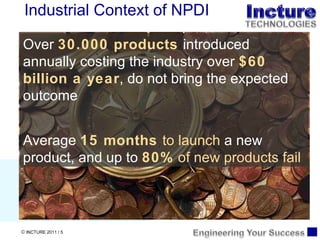
Industrial Context of NPDI Over  30.000 products  introduced annually costing the industry over  $60 billion a year , do not bring the expected outcome Average  15 months  to launch  a new product, and up to  80%  of new products fail
Key Factors in NPDI
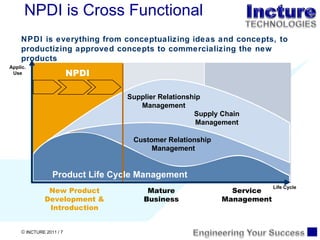
NPDI is Cross Functional NPDI is everything from conceptualizing ideas and concepts, to productizing approved concepts to commercializing the new products New Product Development & Introduction Mature Business Service Management Product Life Cycle Management Supply Chain Management Customer Relationship  Management Supplier Relationship Management Life Cycle Applic. Use NPDI
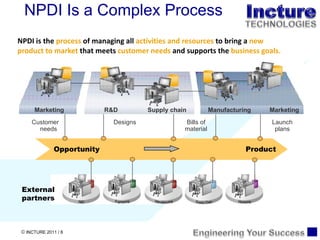
NPDI Is a Complex Process NPDI is the  process  of managing all  activities and resources  to bring a  new product to market  that meets  customer needs  and supports the  business goals. Marketing R&D Supply chain Manufacturing Marketing Designs Bills of  material Customer needs  Launch plans Opportunity Product External partners
Agenda
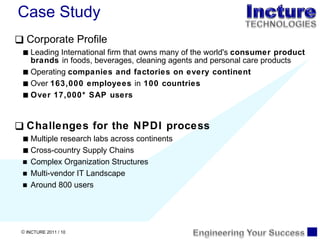
Corporate Profile Leading International firm that owns many of the world's  consumer product brands  in foods, beverages, cleaning agents and personal care products Operating  companies and factories on every continent Over  163,000 employees  in  100 countries  Over 17,000* SAP users Challenges for the NPDI process Multiple research labs across continents Cross-country Supply Chains Complex Organization Structures  Multi-vendor IT Landscape Around 800 users Case Study
The New Product in this case is a material (SKU) which comprises of the following Multiple Raw Materials to be sourced from multiple vendors Semi-finished Materials to be produced in-house at different plants Finished Product to be sold from multiple selling plants Packaging Material New Product
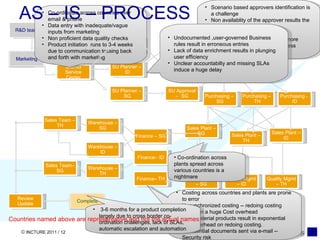
Co-ordinates across countries over email & phone  Data entry with inadequate/vague inputs from marketing Non proficient data quality checks Product initiation  runs to 3-4 weeks due to communication tossing back and forth with marketing Scenario based approvers identification is a challenge Non availablity of the approver results the entire process to halt Poor data quality Injects delay of a week or even more No escaltion mechanism to address delays Costing across countries and plants are prone to error Unsynchronized costing -- redoing costing results in a huge Cost overhead Multi-material products result in exponential cost overhead on redoing costing. confidential documents sent via e-mail -- Security risk Undocumented ,user-governed Business rules result in erroneous entries Lack of data enrichment results in plunging user efficiency Unclear accountabilty and missing SLAs induce a huge delay AS – IS – PROCESS  Co-ordination across plants spread across various countries is a nightmare 3-6 months for a product completion largely due to cross border co-ordination challenges, lack of SLAs, automatic escalation and automation Countries named above are representative and not the actual names R&D team Shared Service Center SU Planner –  TH SU Planner –  SG SU Planner –  ID SU Approval – TH SU Approval –  SG SU Approval –  ID Consolidation & Wait Purchasing –  TH Purchasing –  SG Purchasing -  ID Sales Plant – TH Sales Plant – SG Sales Plant – ID Quality Mgmt – TH Quality Mgmt – SG Quality Mgmt – ID Finance– TH Finance– ID Finance – SG Warehouse – TH Warehouse – SG Warehouse – ID Sales Team – TH Sales Team– SG Review Update
Pain Points in NPDI Long Cycle Times NPDI takes around 3-6 months time creating a huge  competitive disadvantage Poor Data Quality Overhead of a shared service centre to co-ordinate and run human eye based data quality checks Leading to 100+ material rejects every month Low visibility into the process leading to monitoring challenges Costing of materials across countries and departments lead to miscalculation  Process document integration and Auditing capabilities missing Non-uniform process Different Countries follow different processes Email and telephone based co-ordination Inability to quickly adapt new business rules  User having to work with monolithic MIRO SAP GUI screens and supplement them with excels, mails, calls
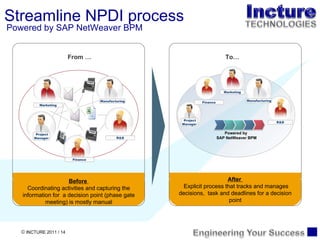
Streamline NPDI process  Powered by SAP NetWeaver BPM Before  Coordinating activities and capturing the information for  a decision point (phase gate meeting) is mostly manual From … After   Explicit process that tracks and manages decisions,  task and deadlines for a decision point Project Manager  Marketing R&D Finance Manufacturing To… Powered by  SAP NetWeaver BPM Project Manager  Marketing R&D Manufacturing Finance
Manage  New Product Development (NPD) as a project Deal with various materials types in a  consistent and coordinated  way across the project Automatically assign tasks   only when pre-requisite tasks are completed , thereby removing the need for individual to monitor that each pre-requisite task is completed Remove the co-ordination overhead  of costing across countries and entities Assign tasks to the team or individuals that can action the item , thereby removing from the process delays associated with individuals managing task assignment Remove manual data collection  Ensure that a material is available to procure, make or sell according to business requirements Objectives -1
Ensure that  the access and authorizations are consistently applied  across the ECC (ERP) and BPM platforms Impose an order on the process that conformed to the sequencing requirements of ERP material master creation Accommodate the  country based diversities Provide the business with a  uniform, consistent and generic view of material master creation  that accommodates New product development requirements Costing orchestration  - Plant level The variety of business scenarios Provide a basis for discussing and structuring the in country variability Objectives -2
Agenda
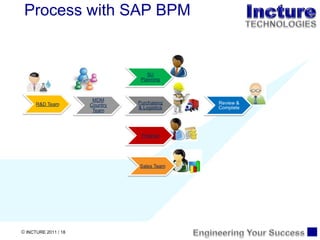
Process with SAP BPM
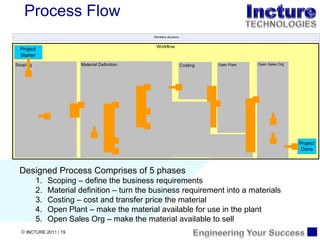
Process Flow Designed P r ocess Comprises of 5 phases Scoping – define the business requirements Material definition – turn the business requirement into a materials Costing – cost and transfer price the material  Open Plant – make the material available for use in the plant Open Sales Org – make the material available to sell
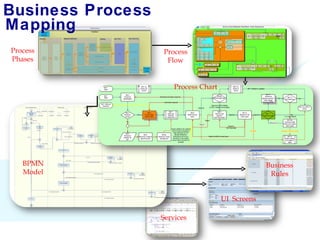
Business Process Mapping Services UI  Screens Business Rules BPMN Model Process Chart Process Flow Process Phases
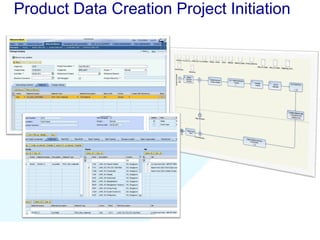
Product Data Creation Project Initiation
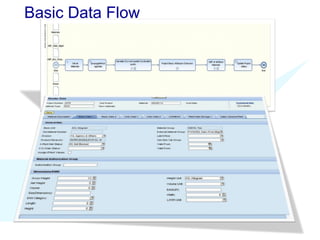
Basic Data Flow
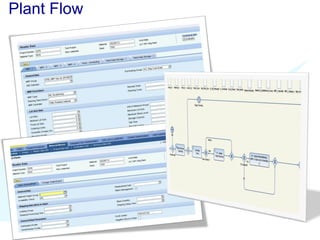
Plant Flow
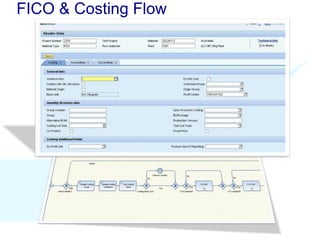
FICO & Costing Flow
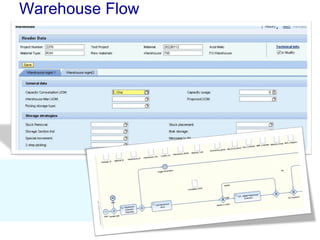
Warehouse Flow
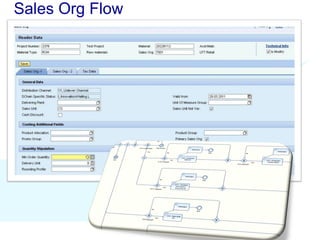
Sales Org Flow
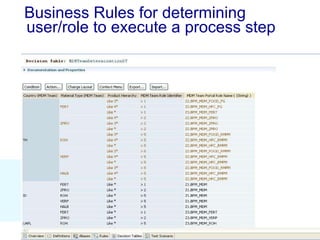
Business Rules for determining user/role to execute a process step
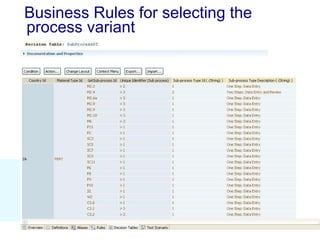
Business Rules for selecting the process variant
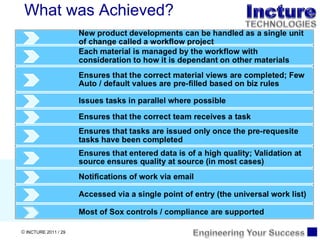
What was Achieved?
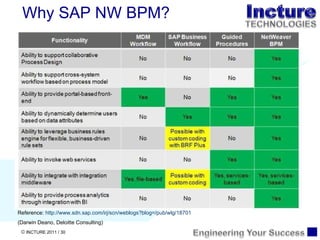
Why SAP NW BPM? Reference:  http://www.sdn.sap.com/irj/scn/weblogs?blog=/pub/wlg/18701 (Darwin Deano, Deloitte Consulting)
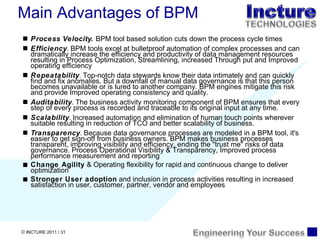
Process Velocity.  BPM tool based solution cuts down the process cycle times Efficiency .  BPM tools excel at bulletproof automation of complex processes and can dramatically increase the efficiency and productivity of data management resources resulting in Process Optimization, Streamlining, increased Through put and Improved operating efficiency  Repeatability .  Top-notch data stewards know their data intimately and can quickly find and fix anomalies. But a downfall of manual data governance is that this person becomes unavailable or is lured to another company. BPM engines mitigate this risk and provide Improved operating consistency and quality. Auditability .  The business activity monitoring component of BPM ensures that every step of every process is recorded and traceable to its original input at any time. Scalability .  Increased automation and elimination of human touch points wherever suitable resulting in reduction of TCO and better scalability of business. Transparency .  Because data governance processes are modeled in a BPM tool, it's easier to get sign-off from business owners. BPM makes business processes transparent, improving visibility and efficiency, ending the "trust me" risks of data governance. Process Operational Visibility & Transparency, Improved process performance measurement and reporting Change Agility  & Operating flexibility for rapid and continuous change to deliver optimization Stronger User adoption  and inclusion in process activities resulting in increased satisfaction in user, customer, partner, vendor and employees  Main Advantages of BPM
Why BRMS? BRMS  rules are primarily used for Tasking -  Based on Country, Plant, Material Group, Key customer, MRP Type, Purchasing group, Product Hierarchy SLA Values -  Based on the Workflow step and milestone Defaulting Rules  - Based on the Country, Material Type, Screen name, Tab name Mandatory Rules  -Based on the Country, Material Type, Screen name, Tab name UI Dependent Default rules  - Based on country, screen name, tab name, attribute name MDM country team rules  - Based on country, material type, P.H
Agenda
 
This publication has been prepared for the Incture Technologies Pvt Ltd. All rights reserved. All copyright in this publication and related works is owned by Incture.   No part of this publication may be reproduced or transmitted in any form or for any purpose without the express permission of Incture. The information contained herein may be changed without prior notice. This document is a preliminary version and not subject to your license agreement or any other agreement with Incture. This document contains only intended strategies, developments, and functionalities of the Incture products and services and is not intended to be binding upon Incture to any particular course of business, product strategy, and/or development. Incture assumes no responsibility for errors or omissions in this document. Incture does not warrant the accuracy or completeness of the information, text, graphics, links, or other items contained within this material. This document is provided without a warranty of any kind, either express or implied, including but not limited to the implied warranties of merchantability, fitness for a particular purpose, or non-infringement. Incture shall have no liability for damages of any kind including without limitation direct, special, indirect, or consequential damages that may result from the use of these materials. This limitation shall not apply in cases of intent or gross negligence. The statutory liability for personal injury and defective products is not affected. Incture has no control over the information that you may access through the use of hot links contained in these materials and does not endorse your use of third-party Web pages nor provide any warranty whatsoever relating to third-party Web pages. Some software products marketed by Incture and its distributors contain proprietary software components of other software vendors. All product and service names mentioned are the trademarks of their respective companies. Data contained in this document serves informational purposes only. National product specifications may vary. This publication is for information purposes only. While due care has been taken during the compilation of this publication to ensure that the information is accurate to the best of Incture ’s knowledge and belief, the content is not to be construed in any manner whatsoever as a substitute for professional advice. Incture neither recommends nor endorses any specific products or services that may have been mentioned in this publication and nor does it assume any liability or responsibility for the outcome of decisions taken as a result of any reliance placed on this publication. Copyright 2011 Incture Technologies All Rights Reserved

Npi with bpm webinar

  • 1.
    Bring Velocity toYour "New Product Introductions" with SAP BPM
  • 2.
    About the PresenterSOA-BPM Solution Architect Over 8 years of SAP solutions experience in PS, MM, EAM etc. Co-inventor of multiple patents in Enterprise SOA Worked on several BPM projects, including areas such as Claims Processing, Materials Mater Data and New Product Introduction Worked at SAP Labs in the past wherein was responsible for PIC Governance and Enterprise Services Repository Managed and Architected three large projects on Enterprise SOA Abhinava Pratap Singh SOA-BPM Solution Architect Incture Technologies Pvt. Ltd. [email_address]
  • 3.
    About Incture TechnologiesLed by a strong team of ex-SAP employees with singular focus on SOA-BPM driven innovation for SAP customers. Largest BPM implementation partner in Asia – 5 major SAP NW BPM implementations in Asia Enabling BPM adoption by customers with series of BPM Workshops Thought leadership in SOA-BPM with large investments on solution and technology assets in SAP BPM Located close to SAP Labs and SAP Global Delivery Centre in Bangalore and has strong multi year collaboration (over 2000 man months) with SAP Development teams Combined advantage of deep skills and competitive cost (100+ delivery team is centred in Bangalore, IT hub of India) Member of SAP Design Partner Council – Advisor to SAP BPM, BRMS, CE, Java technology teams
  • 4.
  • 5.
    Industrial Context ofNPDI Over 30.000 products introduced annually costing the industry over $60 billion a year , do not bring the expected outcome Average 15 months to launch a new product, and up to 80% of new products fail
  • 6.
  • 7.
    NPDI is CrossFunctional NPDI is everything from conceptualizing ideas and concepts, to productizing approved concepts to commercializing the new products New Product Development & Introduction Mature Business Service Management Product Life Cycle Management Supply Chain Management Customer Relationship Management Supplier Relationship Management Life Cycle Applic. Use NPDI
  • 8.
    NPDI Is aComplex Process NPDI is the process of managing all activities and resources to bring a new product to market that meets customer needs and supports the business goals. Marketing R&D Supply chain Manufacturing Marketing Designs Bills of material Customer needs Launch plans Opportunity Product External partners
  • 9.
  • 10.
    Corporate Profile LeadingInternational firm that owns many of the world's consumer product brands in foods, beverages, cleaning agents and personal care products Operating companies and factories on every continent Over 163,000 employees in 100 countries Over 17,000* SAP users Challenges for the NPDI process Multiple research labs across continents Cross-country Supply Chains Complex Organization Structures Multi-vendor IT Landscape Around 800 users Case Study
  • 11.
    The New Productin this case is a material (SKU) which comprises of the following Multiple Raw Materials to be sourced from multiple vendors Semi-finished Materials to be produced in-house at different plants Finished Product to be sold from multiple selling plants Packaging Material New Product
  • 12.
    Co-ordinates across countriesover email & phone Data entry with inadequate/vague inputs from marketing Non proficient data quality checks Product initiation runs to 3-4 weeks due to communication tossing back and forth with marketing Scenario based approvers identification is a challenge Non availablity of the approver results the entire process to halt Poor data quality Injects delay of a week or even more No escaltion mechanism to address delays Costing across countries and plants are prone to error Unsynchronized costing -- redoing costing results in a huge Cost overhead Multi-material products result in exponential cost overhead on redoing costing. confidential documents sent via e-mail -- Security risk Undocumented ,user-governed Business rules result in erroneous entries Lack of data enrichment results in plunging user efficiency Unclear accountabilty and missing SLAs induce a huge delay AS – IS – PROCESS Co-ordination across plants spread across various countries is a nightmare 3-6 months for a product completion largely due to cross border co-ordination challenges, lack of SLAs, automatic escalation and automation Countries named above are representative and not the actual names R&D team Shared Service Center SU Planner – TH SU Planner – SG SU Planner – ID SU Approval – TH SU Approval – SG SU Approval – ID Consolidation & Wait Purchasing – TH Purchasing – SG Purchasing - ID Sales Plant – TH Sales Plant – SG Sales Plant – ID Quality Mgmt – TH Quality Mgmt – SG Quality Mgmt – ID Finance– TH Finance– ID Finance – SG Warehouse – TH Warehouse – SG Warehouse – ID Sales Team – TH Sales Team– SG Review Update
  • 13.
    Pain Points inNPDI Long Cycle Times NPDI takes around 3-6 months time creating a huge competitive disadvantage Poor Data Quality Overhead of a shared service centre to co-ordinate and run human eye based data quality checks Leading to 100+ material rejects every month Low visibility into the process leading to monitoring challenges Costing of materials across countries and departments lead to miscalculation Process document integration and Auditing capabilities missing Non-uniform process Different Countries follow different processes Email and telephone based co-ordination Inability to quickly adapt new business rules User having to work with monolithic MIRO SAP GUI screens and supplement them with excels, mails, calls
  • 14.
    Streamline NPDI process Powered by SAP NetWeaver BPM Before Coordinating activities and capturing the information for a decision point (phase gate meeting) is mostly manual From … After Explicit process that tracks and manages decisions, task and deadlines for a decision point Project Manager Marketing R&D Finance Manufacturing To… Powered by SAP NetWeaver BPM Project Manager Marketing R&D Manufacturing Finance
  • 15.
    Manage NewProduct Development (NPD) as a project Deal with various materials types in a consistent and coordinated way across the project Automatically assign tasks only when pre-requisite tasks are completed , thereby removing the need for individual to monitor that each pre-requisite task is completed Remove the co-ordination overhead of costing across countries and entities Assign tasks to the team or individuals that can action the item , thereby removing from the process delays associated with individuals managing task assignment Remove manual data collection Ensure that a material is available to procure, make or sell according to business requirements Objectives -1
  • 16.
    Ensure that the access and authorizations are consistently applied across the ECC (ERP) and BPM platforms Impose an order on the process that conformed to the sequencing requirements of ERP material master creation Accommodate the country based diversities Provide the business with a uniform, consistent and generic view of material master creation that accommodates New product development requirements Costing orchestration - Plant level The variety of business scenarios Provide a basis for discussing and structuring the in country variability Objectives -2
  • 17.
  • 18.
  • 19.
    Process Flow DesignedP r ocess Comprises of 5 phases Scoping – define the business requirements Material definition – turn the business requirement into a materials Costing – cost and transfer price the material Open Plant – make the material available for use in the plant Open Sales Org – make the material available to sell
  • 20.
    Business Process MappingServices UI Screens Business Rules BPMN Model Process Chart Process Flow Process Phases
  • 21.
    Product Data CreationProject Initiation
  • 22.
  • 23.
  • 24.
  • 25.
  • 26.
  • 27.
    Business Rules fordetermining user/role to execute a process step
  • 28.
    Business Rules forselecting the process variant
  • 29.
  • 30.
    Why SAP NWBPM? Reference: http://www.sdn.sap.com/irj/scn/weblogs?blog=/pub/wlg/18701 (Darwin Deano, Deloitte Consulting)
  • 31.
    Process Velocity. BPM tool based solution cuts down the process cycle times Efficiency . BPM tools excel at bulletproof automation of complex processes and can dramatically increase the efficiency and productivity of data management resources resulting in Process Optimization, Streamlining, increased Through put and Improved operating efficiency Repeatability . Top-notch data stewards know their data intimately and can quickly find and fix anomalies. But a downfall of manual data governance is that this person becomes unavailable or is lured to another company. BPM engines mitigate this risk and provide Improved operating consistency and quality. Auditability . The business activity monitoring component of BPM ensures that every step of every process is recorded and traceable to its original input at any time. Scalability . Increased automation and elimination of human touch points wherever suitable resulting in reduction of TCO and better scalability of business. Transparency . Because data governance processes are modeled in a BPM tool, it's easier to get sign-off from business owners. BPM makes business processes transparent, improving visibility and efficiency, ending the "trust me" risks of data governance. Process Operational Visibility & Transparency, Improved process performance measurement and reporting Change Agility & Operating flexibility for rapid and continuous change to deliver optimization Stronger User adoption and inclusion in process activities resulting in increased satisfaction in user, customer, partner, vendor and employees Main Advantages of BPM
  • 32.
    Why BRMS? BRMS rules are primarily used for Tasking - Based on Country, Plant, Material Group, Key customer, MRP Type, Purchasing group, Product Hierarchy SLA Values - Based on the Workflow step and milestone Defaulting Rules - Based on the Country, Material Type, Screen name, Tab name Mandatory Rules -Based on the Country, Material Type, Screen name, Tab name UI Dependent Default rules - Based on country, screen name, tab name, attribute name MDM country team rules - Based on country, material type, P.H
  • 33.
  • 34.
  • 35.
    This publication hasbeen prepared for the Incture Technologies Pvt Ltd. All rights reserved. All copyright in this publication and related works is owned by Incture. No part of this publication may be reproduced or transmitted in any form or for any purpose without the express permission of Incture. The information contained herein may be changed without prior notice. This document is a preliminary version and not subject to your license agreement or any other agreement with Incture. This document contains only intended strategies, developments, and functionalities of the Incture products and services and is not intended to be binding upon Incture to any particular course of business, product strategy, and/or development. Incture assumes no responsibility for errors or omissions in this document. Incture does not warrant the accuracy or completeness of the information, text, graphics, links, or other items contained within this material. This document is provided without a warranty of any kind, either express or implied, including but not limited to the implied warranties of merchantability, fitness for a particular purpose, or non-infringement. Incture shall have no liability for damages of any kind including without limitation direct, special, indirect, or consequential damages that may result from the use of these materials. This limitation shall not apply in cases of intent or gross negligence. The statutory liability for personal injury and defective products is not affected. Incture has no control over the information that you may access through the use of hot links contained in these materials and does not endorse your use of third-party Web pages nor provide any warranty whatsoever relating to third-party Web pages. Some software products marketed by Incture and its distributors contain proprietary software components of other software vendors. All product and service names mentioned are the trademarks of their respective companies. Data contained in this document serves informational purposes only. National product specifications may vary. This publication is for information purposes only. While due care has been taken during the compilation of this publication to ensure that the information is accurate to the best of Incture ’s knowledge and belief, the content is not to be construed in any manner whatsoever as a substitute for professional advice. Incture neither recommends nor endorses any specific products or services that may have been mentioned in this publication and nor does it assume any liability or responsibility for the outcome of decisions taken as a result of any reliance placed on this publication. Copyright 2011 Incture Technologies All Rights Reserved

Editor's Notes

  • #6 Let ‘ s look at the customer pain point and the motivation for using BPM to streamline the process for bringing new products to market faster. Over 30.000 products introduced annually Costing the industry over $60 billion a year, do not bring the expected outcome.
  • #8 Let ’s take a look at the wave chart that shows the use of applications over the lifecycle of a new product. While PLM manages all data and information of the product lifecycle, NPDI is focused on the innovation, product development and commercialization process. NPDI are all processes and capabilities needed from the first idea of a product to the market launch of the new product. The art of NPDI is to achieve an efficient and successful process for each new product balanced with the mature business. Speed, efficiency, and flexibility of these processes are key.
  • #9 The perfect process for bringing new products to market allows companies to respond quickly and effectively to market opportunities It starts when a new opportunity is identified and is not completed until the product is successfully reaching customers It embraces almost all functions in the company and many of the companies external partners And it must be closely managed to ensure that both the needs of the customer and the business are met The process is so critical that, if badly executed, nothing will be able to make up for it And yet, despite this, we find wide-spread problems with the NPDI process
  • #13 Key points to talk about Process flows through 100’s of people in multiple countries…a strong case for people orchestration across countries and departments Multiple points where the process gets stuck up due to people
  • #15 Let ‘ s have a look at the issues with the process today and how using SAP NetWeaver BPM and SAP Portfolio and Project Management can streamline the process. Without BPM coordinating activities and capturing the information for a decision point (phase gate meeting) is mostly manual. Whereas with the support of BPM the process is actively managed so that decisions, tasks and deadlines are controlled.
  • #19 !
  • #32 BPM is the foundation of a successful strategy for Integrating an MDM hub to other data source and target systems and integrating different people & departments into collaborative end-to-end processes.