This note is compiled as a reference document for LEO CDP and USPA Company.
Last modification date: 26 Jan, 2022 by Nguyễn Tấn Triều (Thomas)
Email: trieu@leocdp.com
I would like to thank my investors ( https://lavadigital.net and https://www.akadigital.net )
Also I would like to thank my first clients, for their patience and putting their trust in LEO CDP.
https://www.talentnet.vn
https://mafc.com.vn
[Notes] Customer 360 Analytics with LEO CDP
Table of Content
Part 1: Why should every business need to deploy a CDP ?
1. Big data is the reality of business today
2. What are technologies to manage customer data ?
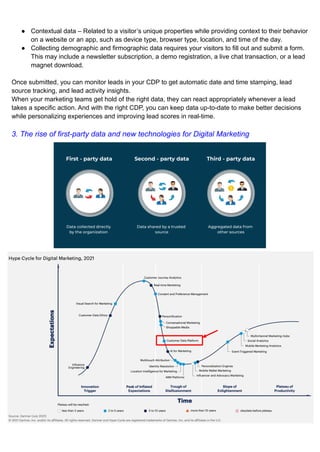
3. The rise of first-party data and new technologies for Digital Marketing
4. How to apply USPA mindset to build your CDP for data-driven business
Part 2: How to use LEO CDP for your business
1. Core functions of LEO CDP for marketers and IT managers
2. Data Unification for Customer 360 Analytics
3. Data Segmentation
4. Customer Personalization
5. Customer Data Activation
Part 3: Case study in O2O Retail and Ecommerce
1. How to build customer journey map for ecommerce and retail
2. How to do customer analytics to find ideal customer profiles
The ideal customer profile in a B2B context
The ideal customer profile in a B2C context
3. Manage product catalog for customer personalization
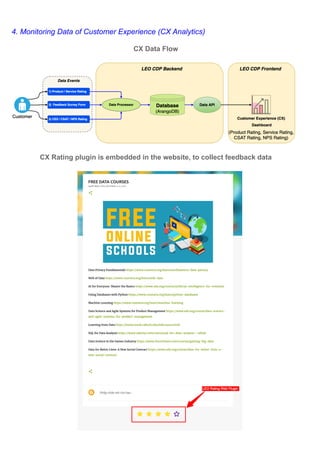
4. Monitoring Data of Customer Experience (CX Analytics)
CX Data Flow
CX Rating plugin is embedded in the website, to collect feedback data
An overview of CX Report
A CX Report in a customer profile
5. Monitoring data with real-time event tracking reports
Event Data Flow
Summary Event Data Report
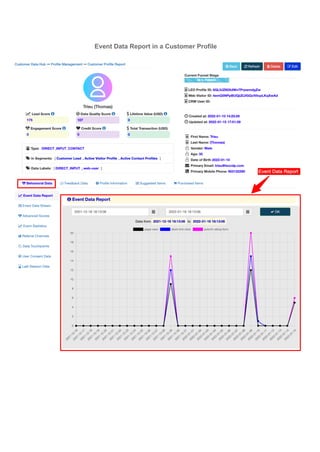
Event Data Report in a Customer Profile
Part 4: How to setup an instance of LEO CDP for free
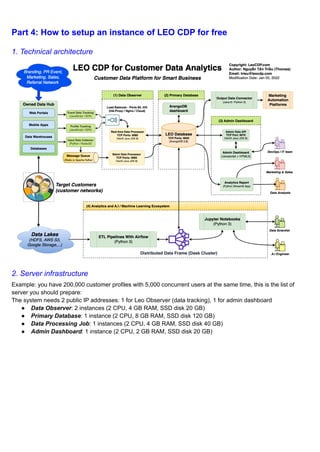
1. Technical architecture
2. Server infrastructure
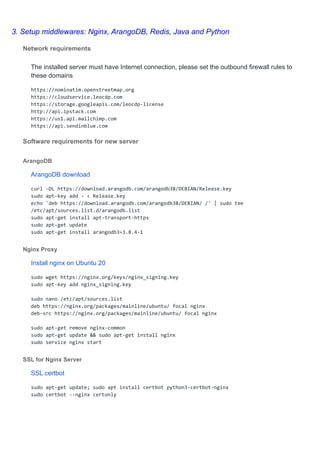
3. Setup middlewares: Nginx, ArangoDB, Redis, Java and Python
Network requirements
Software requirements for new server
ArangoDB
Nginx Proxy
SSL for Nginx Server
Java 8 JVM
Redis
Install Notes for Linux Server
Clone binary code for new server
Set DNS hosts for LEO CDP workers
4. Setup data for testing and system verification
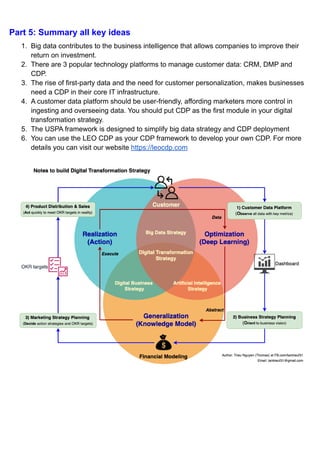
Part 5: Summary all key ideas
Part 1: Why should every business need to deploy a CDP ?
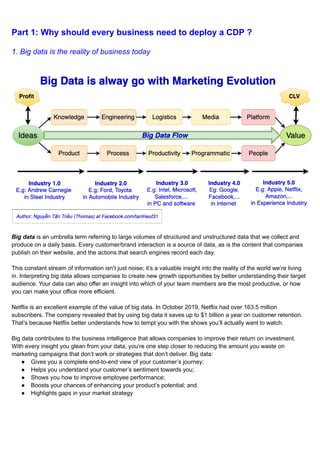
1. Big data is the reality of business today
Big data is an umbrella term referring to large volumes of structured and unstructured data that we collect and
produce on a daily basis. Every customer/brand interaction is a source of data, as is the content that companies
publish on their website, and the actions that search engines record each day.
This constant stream of information isn’t just noise; it’s a valuable insight into the reality of the world we’re living
in. Interpreting big data allows companies to create new growth opportunities by better understanding their target
audience. Your data can also offer an insight into which of your team members are the most productive, or how
you can make your office more efficient.
Netflix is an excellent example of the value of big data. In October 2019, Netflix had over 163.5 million
subscribers. The company revealed that by using big data it saves up to $1 billion a year on customer retention.
That’s because Netflix better understands how to tempt you with the shows you’ll actually want to watch.
Big data contributes to the business intelligence that allows companies to improve their return on investment.
With every insight you glean from your data, you’re one step closer to reducing the amount you waste on
marketing campaigns that don’t work or strategies that don’t deliver. Big data:
● Gives you a complete end-to-end view of your customer’s journey;
● Helps you understand your customer’s sentiment towards you;
● Shows you how to improve employee performance;
● Boosts your chances of enhancing your product’s potential; and
● Highlights gaps in your market strategy
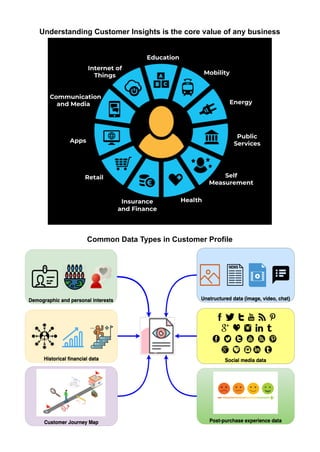
Understanding Customer Insights is the core value​
​of any business
Common Data Types in Customer Profile
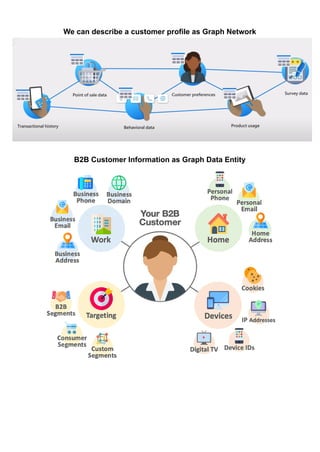
We can describe a customer profile as Graph Network
B2B Customer Information as Graph Data Entity
2. What are technologies to manage customer data ?
Customer data can be collected on digital platforms and customer journeys. To optimize customer experience
and create more innovative products and services, we need a technology platform to capture, analyze and
understand our customers.
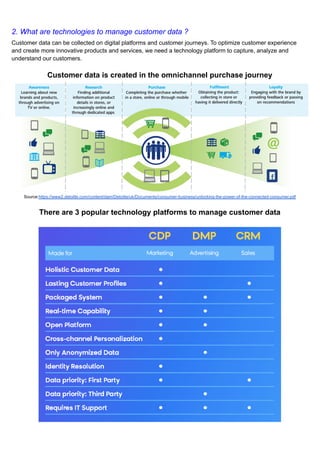
Customer data is created in the omnichannel purchase journey
Source:https://www2.deloitte.com/content/dam/Deloitte/uk/Documents/consumer-business/unlocking-the-power-of-the-connected-consumer.pdf
There are 3 popular technology platforms to manage customer data
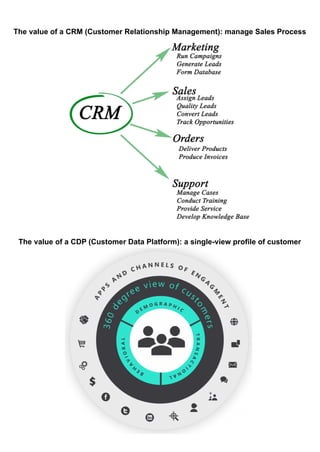
The value of a CRM (Customer Relationship Management): manage Sales Process
The value of a CDP (Customer Data Platform): a single-view profile of customer
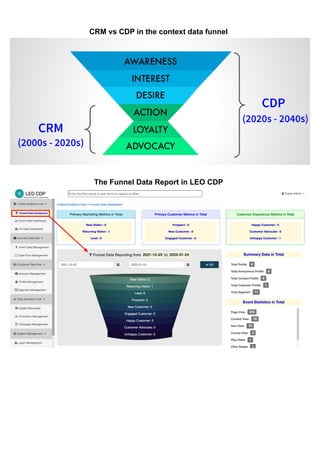
CRM vs CDP in the context data funnel
The Funnel Data Report in LEO CDP
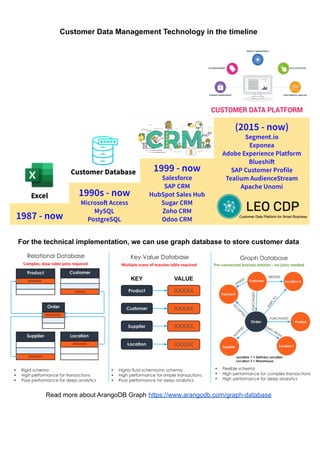
Customer Data Management Technology in the timeline
For the technical implementation, we can use graph database to store customer data
Read more about ArangoDB Graph https://www.arangodb.com/graph-database
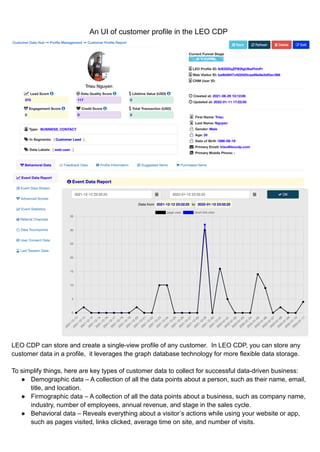
An UI of customer profile in the LEO CDP
LEO CDP can store and create a single-view profile of any customer. In LEO CDP, you can store any
customer data in a profile, it leverages the graph database technology for more flexible data storage.
To simplify things, here are key types of customer data to collect for successful data-driven business:
● Demographic data – A collection of all the data points about a person, such as their name, email,
title, and location.
● Firmographic data – A collection of all the data points about a business, such as company name,
industry, number of employees, annual revenue, and stage in the sales cycle.
● Behavioral data – Reveals everything about a visitor’s actions while using your website or app,
such as pages visited, links clicked, average time on site, and number of visits.
● Contextual data – Related to a visitor’s unique properties while providing context to their behavior
on a website or an app, such as device type, browser type, location, and time of the day.
● Collecting demographic and firmographic data requires your visitors to fill out and submit a form.
This may include a newsletter subscription, a demo registration, a live chat transaction, or a lead
magnet download.
Once submitted, you can monitor leads in your CDP to get automatic date and time stamping, lead
source tracking, and lead activity insights.
When your marketing teams get hold of the right data, they can react appropriately whenever a lead
takes a specific action. And with the right CDP, you can keep data up-to-date to make better decisions
while personalizing experiences and improving lead scores in real-time.
3. The rise of first-party data and new technologies for Digital Marketing
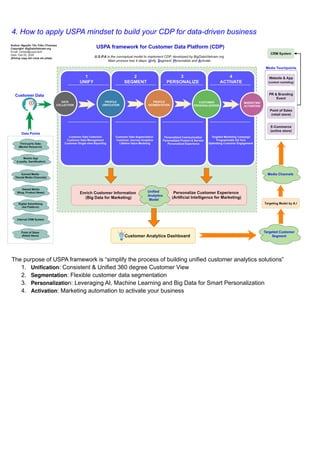
4. How to apply USPA mindset to build your CDP for data-driven business
The purpose of USPA framework is “simplify the process of building unified customer analytics solutions”
1. 𝗨𝗻𝗶𝗳𝗶𝗰𝗮𝘁𝗶𝗼𝗻: Consistent & Unified 360 degree Customer View
2. 𝗦𝗲𝗴𝗺𝗲𝗻𝘁𝗮𝘁𝗶𝗼𝗻: Flexible customer data segmentation
3. 𝗣𝗲𝗿𝘀𝗼𝗻𝗮𝗹𝗶𝘇𝗮𝘁𝗶𝗼n: Leveraging AI, Machine Learning and Big Data for Smart Personalization
4. 𝗔𝗰𝘁𝗶𝘃𝗮𝘁𝗶𝗼𝗻: Marketing automation to activate your business
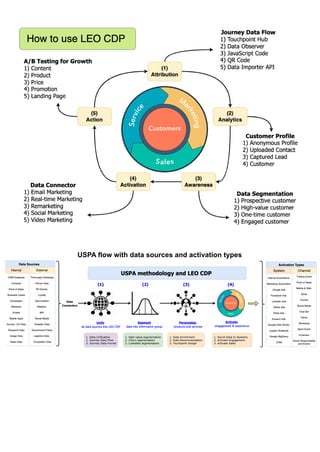
USPA flow with data sources and activation types
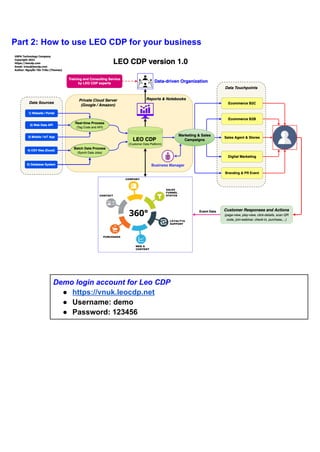
Part 2: How to use LEO CDP for your business
Demo login account for Leo CDP
● https://vnuk.leocdp.net
● Username: demo
● Password: 123456
1. Core functions of LEO CDP for marketers and IT managers
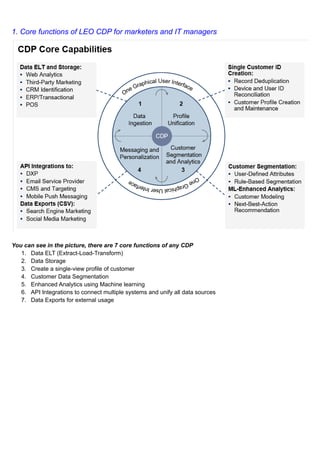
You can see in the picture, there are 7 core functions of any CDP
1. Data ELT (Extract-Load-Transform)
2. Data Storage
3. Create a single-view profile of customer
4. Customer Data Segmentation
5. Enhanced Analytics using Machine learning
6. API Integrations to connect multiple systems and unify all data sources
7. Data Exports for external usage
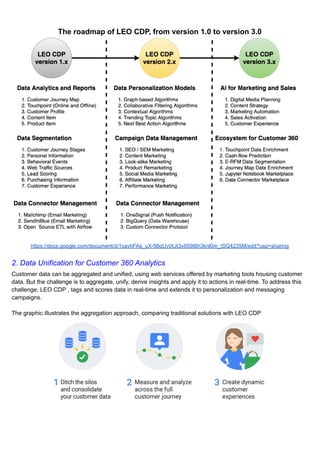
The roadmap of LEO CDP, from version 1.0 to version 3.0
https://docs.google.com/document/d/1cavhFAs_uX-98qUvtXJI3v859I6h3knl0m_tSQ4235M/edit?usp=sharing
2. Data Unification for Customer 360 Analytics
Customer data can be aggregated and unified, using web services offered by marketing tools housing customer
data. But the challenge is to aggregate, unify, derive insights and apply it to actions in real-time. To address this
challenge, LEO CDP , tags and scores data in real-time and extends it to personalization and messaging
campaigns.
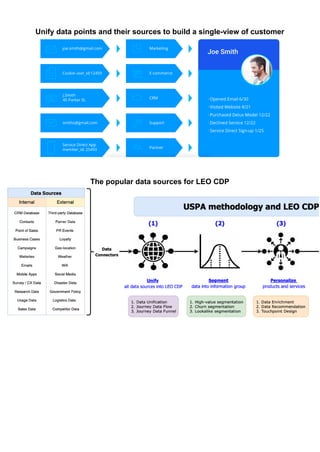
The graphic illustrates the aggregation approach, comparing traditional solutions with LEO CDP
Unify data points and their sources to build a single-view of customer
The popular data sources for LEO CDP
3. Data Segmentation
Data segmentation is how you divide and organize your data into defined groups, so you can sort through it and
view it more easily. Segmented data will provide your team with clear, actionable information that can be used in
your sales and marketing.
We’ll focus on data segmentation for sales and marketing (sometimes referred to as sales segmentation). But,
data segmentation isn’t only useful for sales and marketing.We’ll also look at how you can apply data
segmentation to your existing customer database to identify insights that can improve customer satisfaction, and
grow revenue.
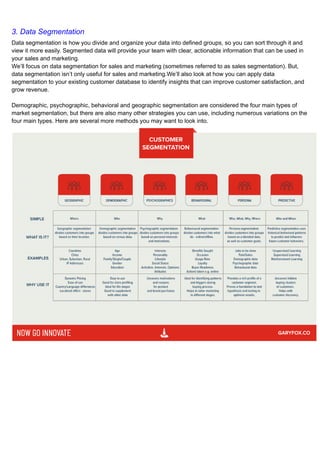
Demographic, psychographic, behavioral and geographic segmentation are considered the four main types of
market segmentation, but there are also many other strategies you can use, including numerous variations on the
four main types. Here are several more methods you may want to look into.
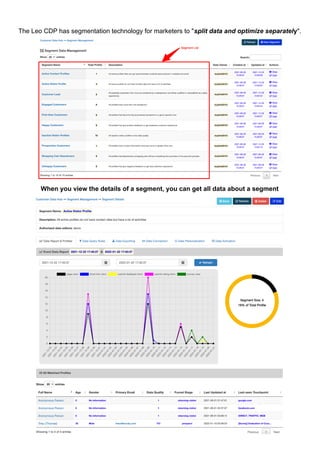
The Leo CDP has segmentation technology for marketers to "split data and optimize separately".
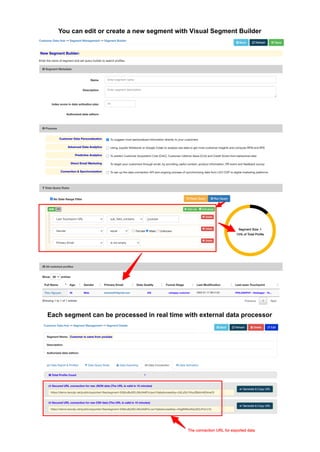
When you view the details of a segment, you can get all data about a segment
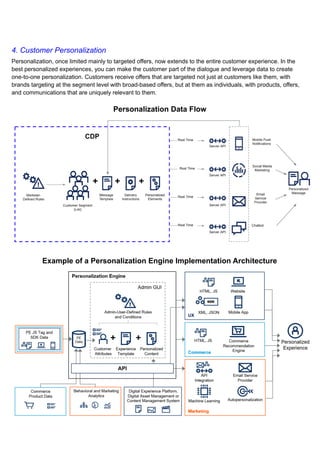
You can edit or create a new segment with Visual Segment Builder
Each segment can be processed in real time with external data processor
4. Customer Personalization
Personalization, once limited mainly to targeted offers, now extends to the entire customer experience. In the
best personalized experiences, you can make the customer part of the dialogue and leverage data to create
one-to-one personalization. Customers receive offers that are targeted not just at customers like them, with
brands targeting at the segment level with broad-based offers, but at them as individuals, with products, offers,
and communications that are uniquely relevant to them.
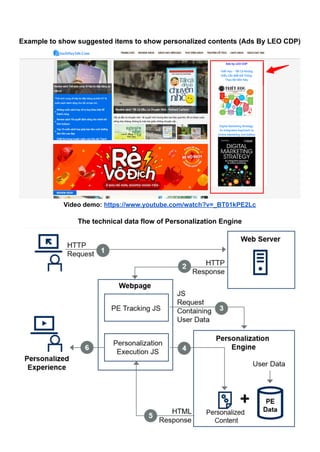
Personalization Data Flow​
​
Example of a Personalization Engine Implementation Architecture
Example to show suggested items to show personalized contents (Ads By LEO CDP)
Video demo: https://www.youtube.com/watch?v=_BT01kPE2Lc
The technical data flow of Personalization Engine
​
​
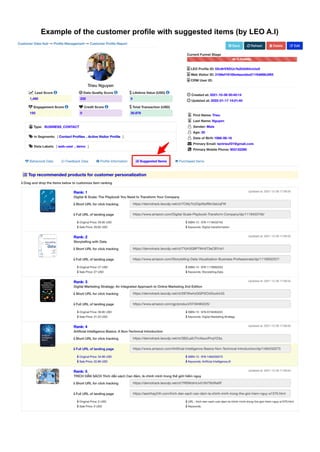
Example of the customer profile with suggested items (by LEO A.I)
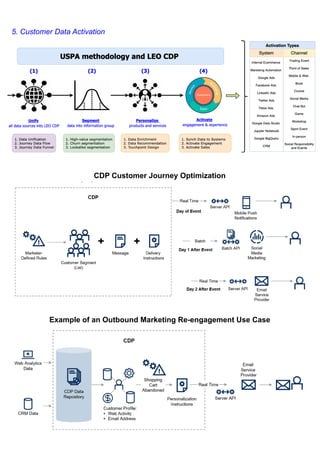
5. Customer Data Activation
CDP Customer Journey Optimization
Example of an Outbound Marketing Re-engagement Use Case
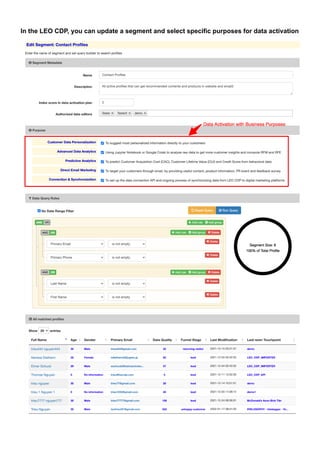
In the LEO CDP, you can update a segment and select specific purposes for data activation
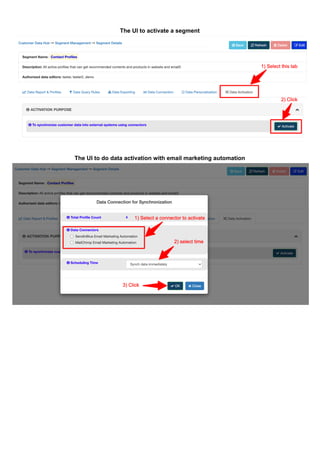
The UI to activate a segment
The UI to do data activation with email marketing automation
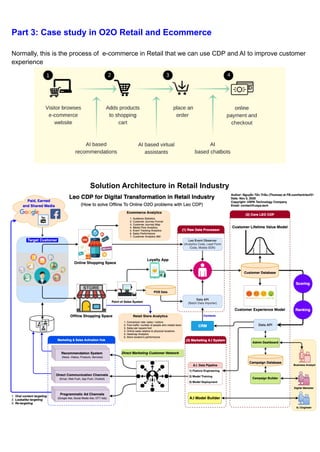
Part 3: Case study in O2O Retail and Ecommerce
Normally, this is the process of e-commerce in Retail that we can use CDP and AI to improve customer
experience
Solution Architecture in Retail Industry
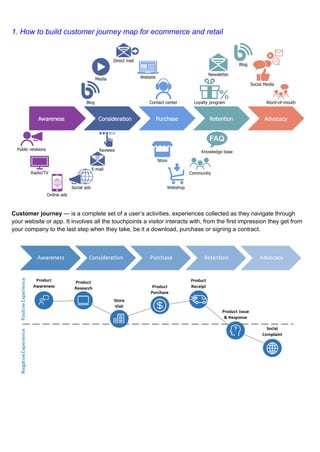
1. How to build customer journey map for ecommerce and retail
Customer journey — is a complete set of a user’s activities, experiences collected as they navigate through
your website or app. It involves all the touchpoints a visitor interacts with, from the first impression they get from
your company to the last step when they take, be it a download, purchase or signing a contract.
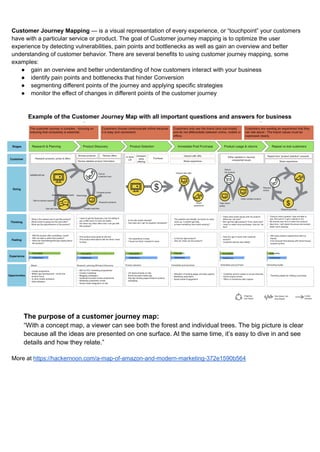
Customer Journey Mapping — is a visual representation of every experience, or “touchpoint” your customers
have with a particular service or product. The goal of Customer journey mapping is to optimize the user
experience by detecting vulnerabilities, pain points and bottlenecks as well as gain an overview and better
understanding of customer behavior. There are several benefits to using customer journey mapping, some
examples:
● gain an overview and better understanding of how customers interact with your business
● identify pain points and bottlenecks that hinder Conversion
● segmenting different points of the journey and applying specific strategies
● monitor the effect of changes in different points of the customer journey
Example of the Customer Journey Map with all important questions and answers for business
The purpose of a customer journey map:
“With a concept map, a viewer can see both the forest and individual trees. The big picture is clear
because all the ideas are presented on one surface. At the same time, it’s easy to dive in and see
details and how they relate.”
More at https://hackernoon.com/a-map-of-amazon-and-modern-marketing-372e1590b564
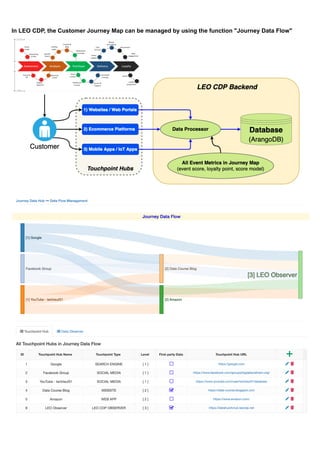
In LEO CDP, the Customer Journey Map can be managed by using the function "Journey Data Flow"
​
​
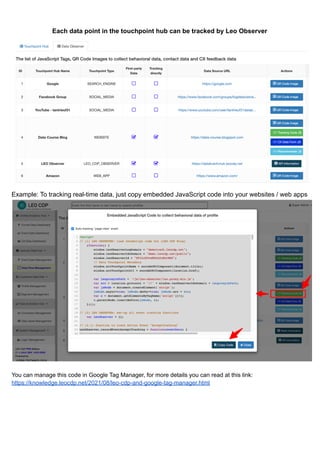
Each data point in the touchpoint hub can be tracked by Leo Observer
Example: To tracking real-time data, just copy embedded JavaScript code into your websites / web apps
You can manage this code in Google Tag Manager, for more details you can read at this link:
https://knowledge.leocdp.net/2021/08/leo-cdp-and-google-tag-manager.html
2. How to do customer analytics to find ideal customer profiles
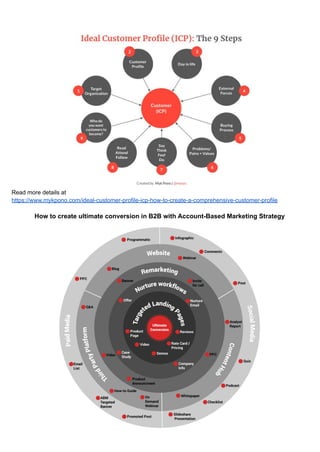
The ideal customer profile in a B2B context
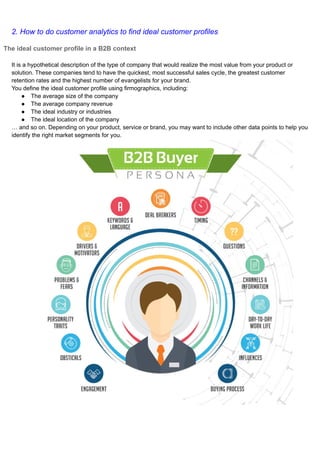
It is a hypothetical description of the type of company that would realize the most value from your product or
solution. These companies tend to have the quickest, most successful sales cycle, the greatest customer
retention rates and the highest number of evangelists for your brand.
You define the ideal customer profile using firmographics, including:
● The average size of the company
● The average company revenue
● The ideal industry or industries
● The ideal location of the company
… and so on. Depending on your product, service or brand, you may want to include other data points to help you
identify the right market segments for you.
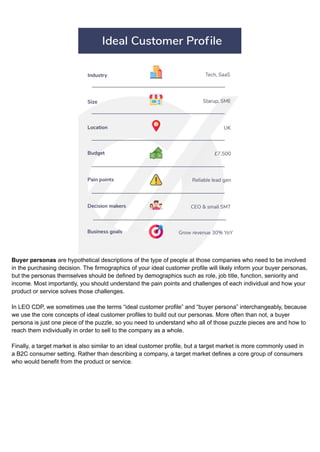
Buyer personas are hypothetical descriptions of the type of people at those companies who need to be involved
in the purchasing decision. The firmographics of your ideal customer profile will likely inform your buyer personas,
but the personas themselves should be defined by demographics such as role, job title, function, seniority and
income. Most importantly, you should understand the pain points and challenges of each individual and how your
product or service solves those challenges.
In LEO CDP, we sometimes use the terms “ideal customer profile” and “buyer persona” interchangeably, because
we use the core concepts of ideal customer profiles to build out our personas. More often than not, a buyer
persona is just one piece of the puzzle, so you need to understand who all of those puzzle pieces are and how to
reach them individually in order to sell to the company as a whole.
Finally, a target market is also similar to an ideal customer profile, but a target market is more commonly used in
a B2C consumer setting. Rather than describing a company, a target market defines a core group of consumers
who would benefit from the product or service.
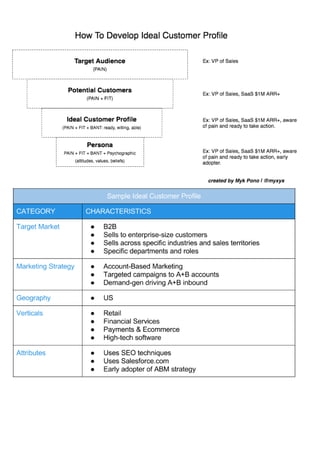
Read more details at
https://www.mykpono.com/ideal-customer-profile-icp-how-to-create-a-comprehensive-customer-profile
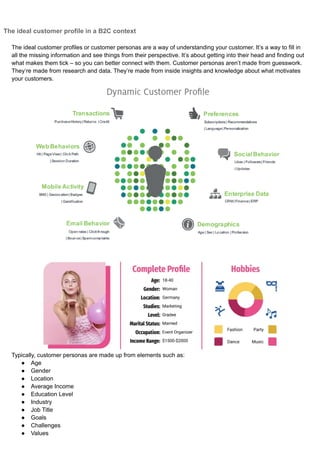
How to create ultimate conversion in B2B with Account-Based Marketing Strategy
The ideal customer profile in a B2C context
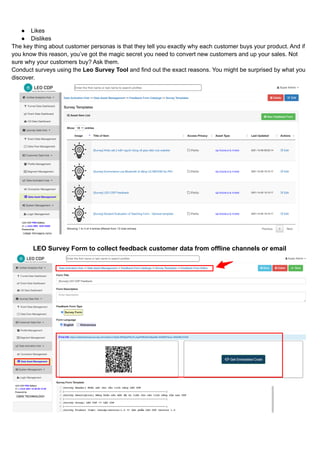
The ideal customer profiles or customer personas are a way of understanding your customer. It’s a way to fill in
all the missing information and see things from their perspective. It’s about getting into their head and finding out
what makes them tick – so you can better connect with them. Customer personas aren’t made from guesswork.
They’re made from research and data. They’re made from inside insights and knowledge about what motivates
your customers.
Typically, customer personas are made up from elements such as:
● Age
● Gender
● Location
● Average Income
● Education Level
● Industry
● Job Title
● Goals
● Challenges
● Values
● Likes
● Dislikes
The key thing about customer personas is that they tell you exactly why each customer buys your product. And if
you know this reason, you’ve got the magic secret you need to convert new customers and up your sales. Not
sure why your customers buy? Ask them.
Conduct surveys using the Leo Survey Tool and find out the exact reasons. You might be surprised by what you
discover.
LEO Survey Form to collect feedback customer data from offline channels or email
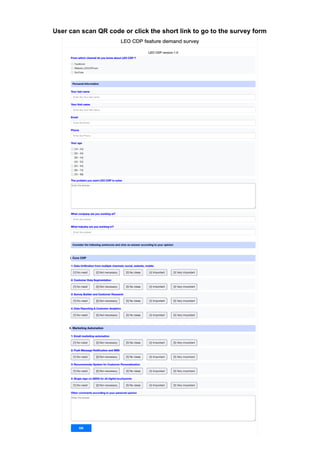
User can scan QR code or click the short link to go to the survey form
​
​
3. Manage product catalog for customer personalization
A product catalog is a document enlisting essential product information such as product dimensions, pricing,
material and more.
Both B2B and B2C industries leverage product catalogs. And, they aren’t limited to the eCommerce space.
Service-based businesses and offline shops use product catalogs too.
The aim? Well, that depends on who the audience is.
So if a buyer were browsing through your product catalog, the goal would be to convert them. Similarly, if a sales
rep were using it, the aim would be to provide them with product information to encourage contextual
conversations that convert prospects into buyers.
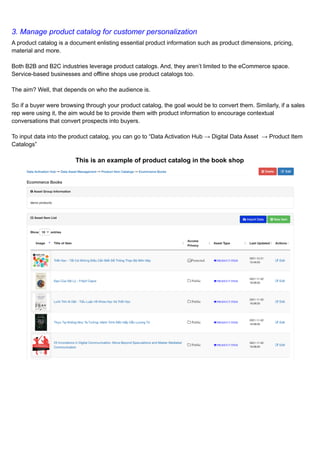
To input data into the product catalog, you can go to “Data Activation Hub → Digital Data Asset → Product Item
Catalogs”
This is an example of product catalog in the book shop
​
​
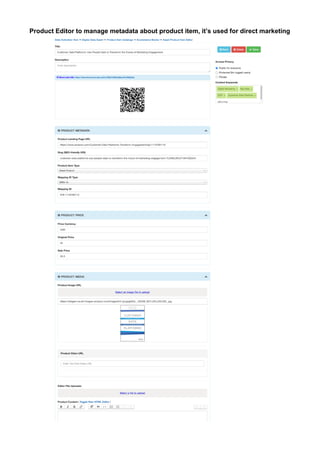
Product Editor to manage metadata about product item, it’s used for direct marketing
4. Monitoring Data of Customer Experience (CX Analytics)
CX Data Flow
CX Rating plugin is embedded in the website, to collect feedback data
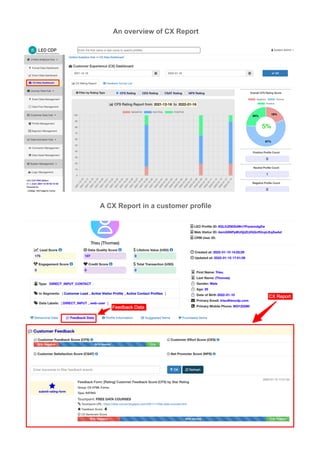
An overview of CX Report
A CX Report in a customer profile
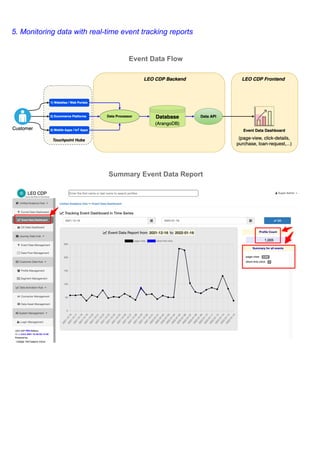
5. Monitoring data with real-time event tracking reports
Event Data Flow
Summary Event Data Report
​
​
Event Data Report in a Customer Profile
Part 4: How to setup an instance of LEO CDP for free
1. Technical architecture
2. Server infrastructure
Example: you have 200,000 customer profiles with 5,000 concurrent users at the same time, this is the list of
server you should prepare:
The system needs 2 public IP addresses: 1 for Leo Observer (data tracking), 1 for admin dashboard
● Data Observer: 2 instances (2 CPU, 4 GB RAM, SSD disk 20 GB)
● Primary Database: 1 instance (2 CPU, 8 GB RAM, SSD disk 120 GB)
● Data Processing Job: 1 instances (2 CPU, 4 GB RAM, SSD disk 40 GB)
● Admin Dashboard: 1 instance (2 CPU, 2 GB RAM, SSD disk 20 GB)
3. Setup middlewares: Nginx, ArangoDB, Redis, Java and Python
Network requirements
The installed server must have Internet connection, please set the outbound firewall rules to
these domains
https://nominatim.openstreetmap.org
https://cloudservice.leocdp.com
https://storage.googleapis.com/leocdp-license
http://api.ipstack.com
https://us1.api.mailchimp.com
https://api.sendinblue.com
Software requirements for new server
ArangoDB
ArangoDB download
curl -OL https://download.arangodb.com/arangodb38/DEBIAN/Release.key
sudo apt-key add - < Release.key
echo 'deb https://download.arangodb.com/arangodb38/DEBIAN/ /' | sudo tee
/etc/apt/sources.list.d/arangodb.list
sudo apt-get install apt-transport-https
sudo apt-get update
sudo apt-get install arangodb3=3.8.4-1
Nginx Proxy
Install nginx on Ubuntu 20
sudo wget https://nginx.org/keys/nginx_signing.key
sudo apt-key add nginx_signing.key
sudo nano /etc/apt/sources.list
deb https://nginx.org/packages/mainline/ubuntu/ focal nginx
deb-src https://nginx.org/packages/mainline/ubuntu/ focal nginx
sudo apt-get remove nginx-common
sudo apt-get update && sudo apt-get install nginx
sudo service nginx start
SSL for Nginx Server
SSL certbot
sudo apt-get update; sudo apt install certbot python3-certbot-nginx
sudo certbot --nginx certonly
Java 8 JVM
Java 8 from Amazon
wget -O- https://apt.corretto.aws/corretto.key | sudo apt-key add -
sudo add-apt-repository 'deb https://apt.corretto.aws stable main'
sudo apt-get update; sudo apt-get install -y java-1.8.0-amazon-corretto-jdk
sudo apt-get install fontconfig
Redis
Redis on Ubuntu
sudo apt-get update; sudo apt -y install redis-server
Install Notes for Linux Server
Clone binary code for new server
sudo adduser leocdp; sudo usermod -aG sudo leocdp
sudo -iu leocdp
sudo visudo
=> At the end of file, add this line: leocdp ALL=(ALL) NOPASSWD: ALL
sudo mkdir /build; sudo chown leocdp:leocdp /build/
cd /build
git clone https://github.com/trieu/leo-cdp-free-edition.git leo-cdp
Set DNS hosts for LEO CDP workers
sudo nano /etc/hosts
Add Local DNS for all servers
● [the network IP of ArangoDB Server] leocdp.database
● [the network IP of Redis Server] leocdp.redis
● [the network IP of LeoCDP Admin] leocdp.admin
● [the network IP of LeoCDP Data Observer] leocdp.observer0
Example DNS for 1 ArangoDB server, 1 Redis server, 1 Admin Dashboard and 2 data observers
10.2.0.5 leocdp.database
10.4.0.3 leocdp.redis
10.4.0.3 leocdp.admin
10.1.0.8 leocdp.observer1
10.1.0.11 leocdp.observer2
4. Setup data for testing and system verification
Run the shell-script: ./ setup-new-leocdp.sh
You should check the latest notes at this link:
https://github.com/trieu/leo-cdp-free-edition/blob/main/all-documents/NOTES-FOR-NEW-SETUP.md
Part 5: Summary all key ideas
1. Big data contributes to the business intelligence that allows companies to improve their
return on investment.
2. There are 3 popular technology platforms to manage customer data: CRM, DMP and
CDP.
3. The rise of first-party data and the need for customer personalization, makes businesses
need a CDP in their core IT infrastructure.
4. A customer data platform should be user-friendly, affording marketers more control in
ingesting and overseeing data. You should put CDP as the first module in your digital
transformation strategy.
5. The USPA framework is designed to simplify big data strategy and CDP deployment
6. You can use the LEO CDP as your CDP framework to develop your own CDP. For more
details you can visit our website https://leocdp.com
The End of Notes
————
Follow my YouTube’s channel to get more knowledge about LEO CDP
https://youtube.com/user/tantrieuf31database

[Notes] Customer 360 Analytics with LEO CDP

  • 2.
    This note iscompiled as a reference document for LEO CDP and USPA Company. Last modification date: 26 Jan, 2022 by Nguyễn Tấn Triều (Thomas) Email: trieu@leocdp.com I would like to thank my investors ( https://lavadigital.net and https://www.akadigital.net ) Also I would like to thank my first clients, for their patience and putting their trust in LEO CDP. https://www.talentnet.vn https://mafc.com.vn
  • 3.
    [Notes] Customer 360Analytics with LEO CDP Table of Content Part 1: Why should every business need to deploy a CDP ? 1. Big data is the reality of business today 2. What are technologies to manage customer data ? 3. The rise of first-party data and new technologies for Digital Marketing 4. How to apply USPA mindset to build your CDP for data-driven business Part 2: How to use LEO CDP for your business 1. Core functions of LEO CDP for marketers and IT managers 2. Data Unification for Customer 360 Analytics 3. Data Segmentation 4. Customer Personalization 5. Customer Data Activation Part 3: Case study in O2O Retail and Ecommerce 1. How to build customer journey map for ecommerce and retail 2. How to do customer analytics to find ideal customer profiles The ideal customer profile in a B2B context The ideal customer profile in a B2C context 3. Manage product catalog for customer personalization 4. Monitoring Data of Customer Experience (CX Analytics) CX Data Flow CX Rating plugin is embedded in the website, to collect feedback data An overview of CX Report A CX Report in a customer profile 5. Monitoring data with real-time event tracking reports Event Data Flow Summary Event Data Report Event Data Report in a Customer Profile Part 4: How to setup an instance of LEO CDP for free 1. Technical architecture 2. Server infrastructure 3. Setup middlewares: Nginx, ArangoDB, Redis, Java and Python Network requirements Software requirements for new server ArangoDB Nginx Proxy SSL for Nginx Server Java 8 JVM Redis Install Notes for Linux Server Clone binary code for new server Set DNS hosts for LEO CDP workers 4. Setup data for testing and system verification Part 5: Summary all key ideas
  • 4.
    Part 1: Whyshould every business need to deploy a CDP ? 1. Big data is the reality of business today Big data is an umbrella term referring to large volumes of structured and unstructured data that we collect and produce on a daily basis. Every customer/brand interaction is a source of data, as is the content that companies publish on their website, and the actions that search engines record each day. This constant stream of information isn’t just noise; it’s a valuable insight into the reality of the world we’re living in. Interpreting big data allows companies to create new growth opportunities by better understanding their target audience. Your data can also offer an insight into which of your team members are the most productive, or how you can make your office more efficient. Netflix is an excellent example of the value of big data. In October 2019, Netflix had over 163.5 million subscribers. The company revealed that by using big data it saves up to $1 billion a year on customer retention. That’s because Netflix better understands how to tempt you with the shows you’ll actually want to watch. Big data contributes to the business intelligence that allows companies to improve their return on investment. With every insight you glean from your data, you’re one step closer to reducing the amount you waste on marketing campaigns that don’t work or strategies that don’t deliver. Big data: ● Gives you a complete end-to-end view of your customer’s journey; ● Helps you understand your customer’s sentiment towards you; ● Shows you how to improve employee performance; ● Boosts your chances of enhancing your product’s potential; and ● Highlights gaps in your market strategy
  • 5.
    Understanding Customer Insightsis the core value​ ​of any business Common Data Types in Customer Profile
  • 6.
    We can describea customer profile as Graph Network B2B Customer Information as Graph Data Entity
  • 7.
    2. What aretechnologies to manage customer data ? Customer data can be collected on digital platforms and customer journeys. To optimize customer experience and create more innovative products and services, we need a technology platform to capture, analyze and understand our customers. Customer data is created in the omnichannel purchase journey Source:https://www2.deloitte.com/content/dam/Deloitte/uk/Documents/consumer-business/unlocking-the-power-of-the-connected-consumer.pdf There are 3 popular technology platforms to manage customer data
  • 8.
    The value ofa CRM (Customer Relationship Management): manage Sales Process The value of a CDP (Customer Data Platform): a single-view profile of customer
  • 9.
    CRM vs CDPin the context data funnel The Funnel Data Report in LEO CDP
  • 10.
    Customer Data ManagementTechnology in the timeline For the technical implementation, we can use graph database to store customer data Read more about ArangoDB Graph https://www.arangodb.com/graph-database
  • 11.
    An UI ofcustomer profile in the LEO CDP LEO CDP can store and create a single-view profile of any customer. In LEO CDP, you can store any customer data in a profile, it leverages the graph database technology for more flexible data storage. To simplify things, here are key types of customer data to collect for successful data-driven business: ● Demographic data – A collection of all the data points about a person, such as their name, email, title, and location. ● Firmographic data – A collection of all the data points about a business, such as company name, industry, number of employees, annual revenue, and stage in the sales cycle. ● Behavioral data – Reveals everything about a visitor’s actions while using your website or app, such as pages visited, links clicked, average time on site, and number of visits.
  • 12.
    ● Contextual data– Related to a visitor’s unique properties while providing context to their behavior on a website or an app, such as device type, browser type, location, and time of the day. ● Collecting demographic and firmographic data requires your visitors to fill out and submit a form. This may include a newsletter subscription, a demo registration, a live chat transaction, or a lead magnet download. Once submitted, you can monitor leads in your CDP to get automatic date and time stamping, lead source tracking, and lead activity insights. When your marketing teams get hold of the right data, they can react appropriately whenever a lead takes a specific action. And with the right CDP, you can keep data up-to-date to make better decisions while personalizing experiences and improving lead scores in real-time. 3. The rise of first-party data and new technologies for Digital Marketing
  • 13.
    4. How toapply USPA mindset to build your CDP for data-driven business The purpose of USPA framework is “simplify the process of building unified customer analytics solutions” 1. 𝗨𝗻𝗶𝗳𝗶𝗰𝗮𝘁𝗶𝗼𝗻: Consistent & Unified 360 degree Customer View 2. 𝗦𝗲𝗴𝗺𝗲𝗻𝘁𝗮𝘁𝗶𝗼𝗻: Flexible customer data segmentation 3. 𝗣𝗲𝗿𝘀𝗼𝗻𝗮𝗹𝗶𝘇𝗮𝘁𝗶𝗼n: Leveraging AI, Machine Learning and Big Data for Smart Personalization 4. 𝗔𝗰𝘁𝗶𝘃𝗮𝘁𝗶𝗼𝗻: Marketing automation to activate your business
  • 14.
    USPA flow withdata sources and activation types
  • 15.
    Part 2: Howto use LEO CDP for your business Demo login account for Leo CDP ● https://vnuk.leocdp.net ● Username: demo ● Password: 123456
  • 16.
    1. Core functionsof LEO CDP for marketers and IT managers You can see in the picture, there are 7 core functions of any CDP 1. Data ELT (Extract-Load-Transform) 2. Data Storage 3. Create a single-view profile of customer 4. Customer Data Segmentation 5. Enhanced Analytics using Machine learning 6. API Integrations to connect multiple systems and unify all data sources 7. Data Exports for external usage
  • 17.
    The roadmap ofLEO CDP, from version 1.0 to version 3.0 https://docs.google.com/document/d/1cavhFAs_uX-98qUvtXJI3v859I6h3knl0m_tSQ4235M/edit?usp=sharing 2. Data Unification for Customer 360 Analytics Customer data can be aggregated and unified, using web services offered by marketing tools housing customer data. But the challenge is to aggregate, unify, derive insights and apply it to actions in real-time. To address this challenge, LEO CDP , tags and scores data in real-time and extends it to personalization and messaging campaigns. The graphic illustrates the aggregation approach, comparing traditional solutions with LEO CDP
  • 18.
    Unify data pointsand their sources to build a single-view of customer The popular data sources for LEO CDP
  • 19.
    3. Data Segmentation Datasegmentation is how you divide and organize your data into defined groups, so you can sort through it and view it more easily. Segmented data will provide your team with clear, actionable information that can be used in your sales and marketing. We’ll focus on data segmentation for sales and marketing (sometimes referred to as sales segmentation). But, data segmentation isn’t only useful for sales and marketing.We’ll also look at how you can apply data segmentation to your existing customer database to identify insights that can improve customer satisfaction, and grow revenue. Demographic, psychographic, behavioral and geographic segmentation are considered the four main types of market segmentation, but there are also many other strategies you can use, including numerous variations on the four main types. Here are several more methods you may want to look into.
  • 20.
    The Leo CDPhas segmentation technology for marketers to "split data and optimize separately". When you view the details of a segment, you can get all data about a segment
  • 21.
    You can editor create a new segment with Visual Segment Builder Each segment can be processed in real time with external data processor
  • 22.
    4. Customer Personalization Personalization,once limited mainly to targeted offers, now extends to the entire customer experience. In the best personalized experiences, you can make the customer part of the dialogue and leverage data to create one-to-one personalization. Customers receive offers that are targeted not just at customers like them, with brands targeting at the segment level with broad-based offers, but at them as individuals, with products, offers, and communications that are uniquely relevant to them. Personalization Data Flow​ ​ Example of a Personalization Engine Implementation Architecture
  • 23.
    Example to showsuggested items to show personalized contents (Ads By LEO CDP) Video demo: https://www.youtube.com/watch?v=_BT01kPE2Lc The technical data flow of Personalization Engine ​ ​
  • 24.
    Example of thecustomer profile with suggested items (by LEO A.I)
  • 25.
    5. Customer DataActivation CDP Customer Journey Optimization Example of an Outbound Marketing Re-engagement Use Case
  • 26.
    In the LEOCDP, you can update a segment and select specific purposes for data activation
  • 27.
    The UI toactivate a segment The UI to do data activation with email marketing automation
  • 28.
    Part 3: Casestudy in O2O Retail and Ecommerce Normally, this is the process of e-commerce in Retail that we can use CDP and AI to improve customer experience Solution Architecture in Retail Industry
  • 29.
    1. How tobuild customer journey map for ecommerce and retail Customer journey — is a complete set of a user’s activities, experiences collected as they navigate through your website or app. It involves all the touchpoints a visitor interacts with, from the first impression they get from your company to the last step when they take, be it a download, purchase or signing a contract.
  • 30.
    Customer Journey Mapping— is a visual representation of every experience, or “touchpoint” your customers have with a particular service or product. The goal of Customer journey mapping is to optimize the user experience by detecting vulnerabilities, pain points and bottlenecks as well as gain an overview and better understanding of customer behavior. There are several benefits to using customer journey mapping, some examples: ● gain an overview and better understanding of how customers interact with your business ● identify pain points and bottlenecks that hinder Conversion ● segmenting different points of the journey and applying specific strategies ● monitor the effect of changes in different points of the customer journey Example of the Customer Journey Map with all important questions and answers for business The purpose of a customer journey map: “With a concept map, a viewer can see both the forest and individual trees. The big picture is clear because all the ideas are presented on one surface. At the same time, it’s easy to dive in and see details and how they relate.” More at https://hackernoon.com/a-map-of-amazon-and-modern-marketing-372e1590b564
  • 31.
    In LEO CDP,the Customer Journey Map can be managed by using the function "Journey Data Flow" ​ ​
  • 32.
    Each data pointin the touchpoint hub can be tracked by Leo Observer Example: To tracking real-time data, just copy embedded JavaScript code into your websites / web apps You can manage this code in Google Tag Manager, for more details you can read at this link: https://knowledge.leocdp.net/2021/08/leo-cdp-and-google-tag-manager.html
  • 33.
    2. How todo customer analytics to find ideal customer profiles The ideal customer profile in a B2B context It is a hypothetical description of the type of company that would realize the most value from your product or solution. These companies tend to have the quickest, most successful sales cycle, the greatest customer retention rates and the highest number of evangelists for your brand. You define the ideal customer profile using firmographics, including: ● The average size of the company ● The average company revenue ● The ideal industry or industries ● The ideal location of the company … and so on. Depending on your product, service or brand, you may want to include other data points to help you identify the right market segments for you.
  • 34.
    Buyer personas arehypothetical descriptions of the type of people at those companies who need to be involved in the purchasing decision. The firmographics of your ideal customer profile will likely inform your buyer personas, but the personas themselves should be defined by demographics such as role, job title, function, seniority and income. Most importantly, you should understand the pain points and challenges of each individual and how your product or service solves those challenges. In LEO CDP, we sometimes use the terms “ideal customer profile” and “buyer persona” interchangeably, because we use the core concepts of ideal customer profiles to build out our personas. More often than not, a buyer persona is just one piece of the puzzle, so you need to understand who all of those puzzle pieces are and how to reach them individually in order to sell to the company as a whole. Finally, a target market is also similar to an ideal customer profile, but a target market is more commonly used in a B2C consumer setting. Rather than describing a company, a target market defines a core group of consumers who would benefit from the product or service.
  • 36.
    Read more detailsat https://www.mykpono.com/ideal-customer-profile-icp-how-to-create-a-comprehensive-customer-profile How to create ultimate conversion in B2B with Account-Based Marketing Strategy
  • 37.
    The ideal customerprofile in a B2C context The ideal customer profiles or customer personas are a way of understanding your customer. It’s a way to fill in all the missing information and see things from their perspective. It’s about getting into their head and finding out what makes them tick – so you can better connect with them. Customer personas aren’t made from guesswork. They’re made from research and data. They’re made from inside insights and knowledge about what motivates your customers. Typically, customer personas are made up from elements such as: ● Age ● Gender ● Location ● Average Income ● Education Level ● Industry ● Job Title ● Goals ● Challenges ● Values
  • 38.
    ● Likes ● Dislikes Thekey thing about customer personas is that they tell you exactly why each customer buys your product. And if you know this reason, you’ve got the magic secret you need to convert new customers and up your sales. Not sure why your customers buy? Ask them. Conduct surveys using the Leo Survey Tool and find out the exact reasons. You might be surprised by what you discover. LEO Survey Form to collect feedback customer data from offline channels or email
  • 39.
    User can scanQR code or click the short link to go to the survey form ​ ​
  • 40.
    3. Manage productcatalog for customer personalization A product catalog is a document enlisting essential product information such as product dimensions, pricing, material and more. Both B2B and B2C industries leverage product catalogs. And, they aren’t limited to the eCommerce space. Service-based businesses and offline shops use product catalogs too. The aim? Well, that depends on who the audience is. So if a buyer were browsing through your product catalog, the goal would be to convert them. Similarly, if a sales rep were using it, the aim would be to provide them with product information to encourage contextual conversations that convert prospects into buyers. To input data into the product catalog, you can go to “Data Activation Hub → Digital Data Asset → Product Item Catalogs” This is an example of product catalog in the book shop ​ ​
  • 41.
    Product Editor tomanage metadata about product item, it’s used for direct marketing
  • 42.
    4. Monitoring Dataof Customer Experience (CX Analytics) CX Data Flow CX Rating plugin is embedded in the website, to collect feedback data
  • 43.
    An overview ofCX Report A CX Report in a customer profile
  • 44.
    5. Monitoring datawith real-time event tracking reports Event Data Flow Summary Event Data Report ​ ​
  • 45.
    Event Data Reportin a Customer Profile
  • 46.
    Part 4: Howto setup an instance of LEO CDP for free 1. Technical architecture 2. Server infrastructure Example: you have 200,000 customer profiles with 5,000 concurrent users at the same time, this is the list of server you should prepare: The system needs 2 public IP addresses: 1 for Leo Observer (data tracking), 1 for admin dashboard ● Data Observer: 2 instances (2 CPU, 4 GB RAM, SSD disk 20 GB) ● Primary Database: 1 instance (2 CPU, 8 GB RAM, SSD disk 120 GB) ● Data Processing Job: 1 instances (2 CPU, 4 GB RAM, SSD disk 40 GB) ● Admin Dashboard: 1 instance (2 CPU, 2 GB RAM, SSD disk 20 GB)
  • 47.
    3. Setup middlewares:Nginx, ArangoDB, Redis, Java and Python Network requirements The installed server must have Internet connection, please set the outbound firewall rules to these domains https://nominatim.openstreetmap.org https://cloudservice.leocdp.com https://storage.googleapis.com/leocdp-license http://api.ipstack.com https://us1.api.mailchimp.com https://api.sendinblue.com Software requirements for new server ArangoDB ArangoDB download curl -OL https://download.arangodb.com/arangodb38/DEBIAN/Release.key sudo apt-key add - < Release.key echo 'deb https://download.arangodb.com/arangodb38/DEBIAN/ /' | sudo tee /etc/apt/sources.list.d/arangodb.list sudo apt-get install apt-transport-https sudo apt-get update sudo apt-get install arangodb3=3.8.4-1 Nginx Proxy Install nginx on Ubuntu 20 sudo wget https://nginx.org/keys/nginx_signing.key sudo apt-key add nginx_signing.key sudo nano /etc/apt/sources.list deb https://nginx.org/packages/mainline/ubuntu/ focal nginx deb-src https://nginx.org/packages/mainline/ubuntu/ focal nginx sudo apt-get remove nginx-common sudo apt-get update && sudo apt-get install nginx sudo service nginx start SSL for Nginx Server SSL certbot sudo apt-get update; sudo apt install certbot python3-certbot-nginx sudo certbot --nginx certonly
  • 48.
    Java 8 JVM Java8 from Amazon wget -O- https://apt.corretto.aws/corretto.key | sudo apt-key add - sudo add-apt-repository 'deb https://apt.corretto.aws stable main' sudo apt-get update; sudo apt-get install -y java-1.8.0-amazon-corretto-jdk sudo apt-get install fontconfig Redis Redis on Ubuntu sudo apt-get update; sudo apt -y install redis-server Install Notes for Linux Server Clone binary code for new server sudo adduser leocdp; sudo usermod -aG sudo leocdp sudo -iu leocdp sudo visudo => At the end of file, add this line: leocdp ALL=(ALL) NOPASSWD: ALL sudo mkdir /build; sudo chown leocdp:leocdp /build/ cd /build git clone https://github.com/trieu/leo-cdp-free-edition.git leo-cdp Set DNS hosts for LEO CDP workers sudo nano /etc/hosts Add Local DNS for all servers ● [the network IP of ArangoDB Server] leocdp.database ● [the network IP of Redis Server] leocdp.redis ● [the network IP of LeoCDP Admin] leocdp.admin ● [the network IP of LeoCDP Data Observer] leocdp.observer0 Example DNS for 1 ArangoDB server, 1 Redis server, 1 Admin Dashboard and 2 data observers 10.2.0.5 leocdp.database 10.4.0.3 leocdp.redis 10.4.0.3 leocdp.admin 10.1.0.8 leocdp.observer1 10.1.0.11 leocdp.observer2 4. Setup data for testing and system verification Run the shell-script: ./ setup-new-leocdp.sh You should check the latest notes at this link: https://github.com/trieu/leo-cdp-free-edition/blob/main/all-documents/NOTES-FOR-NEW-SETUP.md
  • 49.
    Part 5: Summaryall key ideas 1. Big data contributes to the business intelligence that allows companies to improve their return on investment. 2. There are 3 popular technology platforms to manage customer data: CRM, DMP and CDP. 3. The rise of first-party data and the need for customer personalization, makes businesses need a CDP in their core IT infrastructure. 4. A customer data platform should be user-friendly, affording marketers more control in ingesting and overseeing data. You should put CDP as the first module in your digital transformation strategy. 5. The USPA framework is designed to simplify big data strategy and CDP deployment 6. You can use the LEO CDP as your CDP framework to develop your own CDP. For more details you can visit our website https://leocdp.com
  • 50.
    The End ofNotes ———— Follow my YouTube’s channel to get more knowledge about LEO CDP https://youtube.com/user/tantrieuf31database