What You Need to Know About CDPs
Use First Party Data to Fuel Your Multichannel & Marketing Development
Presented by:
Today’s Logistics
● Session recording and slides will be sent
● Submit questions to our panelists
● Join in on our poll questions throughout
● Resources available as handouts
Persephanie Arellano
Webinar Coordinator
Overview
Founded in 2007
Part of Elite SEM as of 2018
Google Premier Partner
600+ Active Retail Clients
Top 50 Fastest Growing Company San Diego
Solutions
Retail-focused PPC & Shopping
Amazon Sales Acceleration
Amazon Vendor Services
Facebook Performance Marketing
Creative Services
Today’s Speakers
Sam Ngo
Director of Product
Marketing
Andrew Richardson
VP of Analytics &
Marketing Science
Today’s Agenda
● Breakdown of Customer Data Platforms (CDP)
● Top Ways a CDP Enhances Your Marketing Strategy
● Understanding Your Customers’ Buying Journey
● How to Decide if You Need a CDP
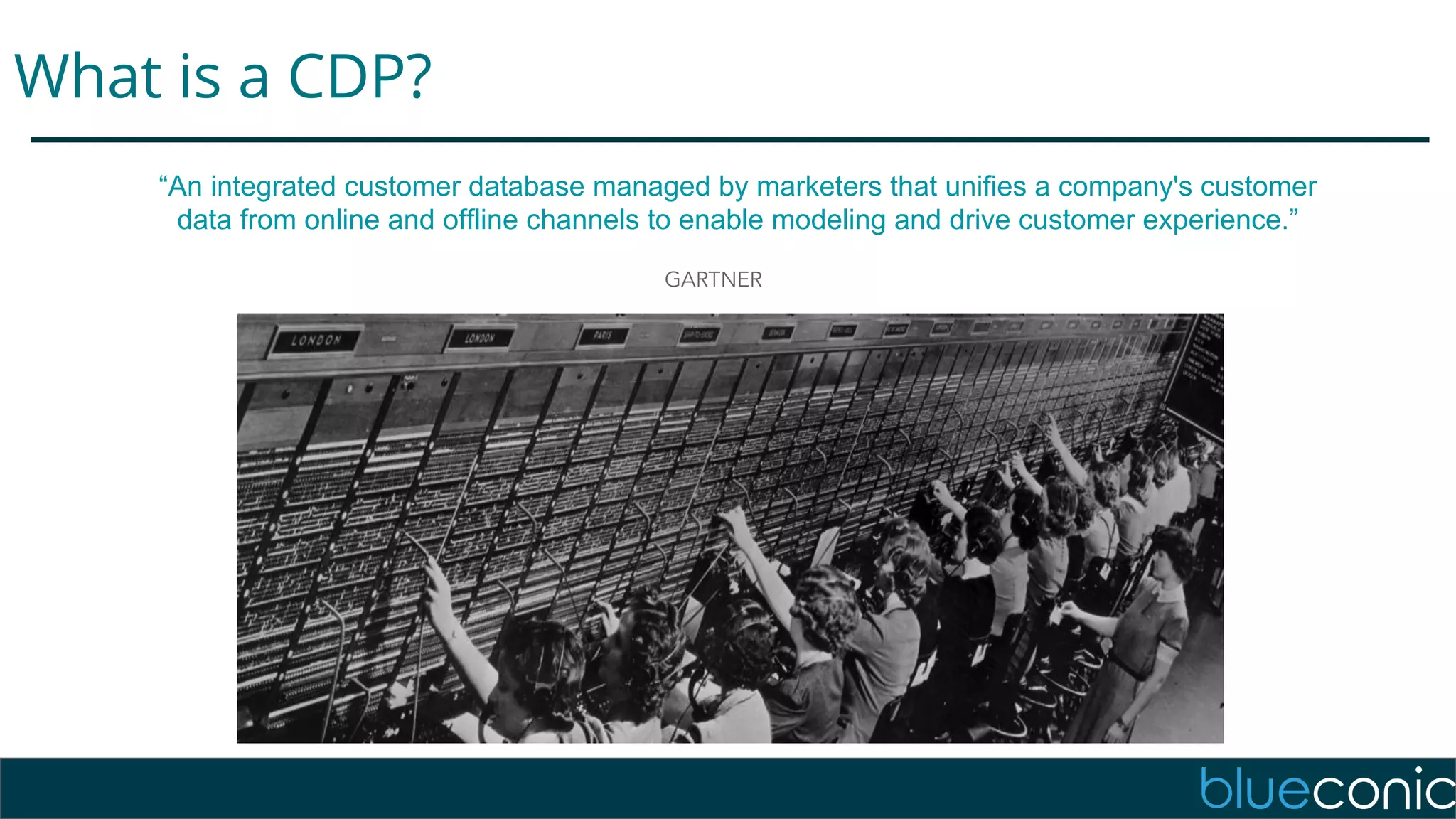
What is a CDP?
“An integrated customer database managed by marketers that unifies a company's customer
data from online and offline channels to enable modeling and drive customer experience.”
GARTNER
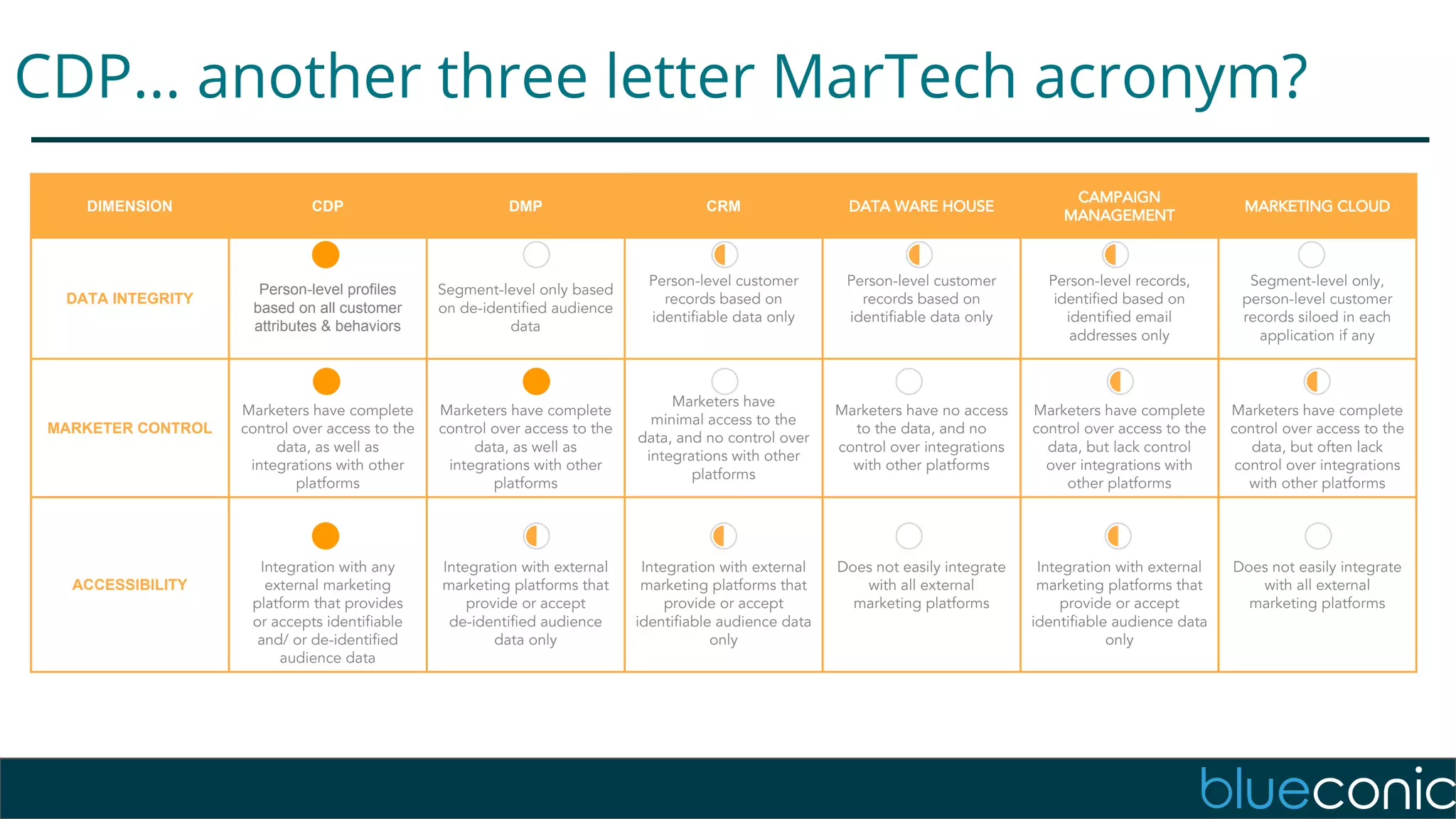
CDP... another three letter MarTech acronym?
DIMENSION CDP DMP CRM DATA WARE HOUSE
CAMPAIGN
MANAGEMENT
MARKETING CLOUD
DATA INTEGRITY
Person-level profiles
based on all customer
attributes & behaviors
Segment-level only based
on de-identified audience
data
Person-level customer
records based on
identifiable data only
Person-level customer
records based on
identifiable data only
Person-level records,
identified based on
identified email
addresses only
Segment-level only,
person-level customer
records siloed in each
application if any
MARKETER CONTROL
Marketers have complete
control over access to the
data, as well as
integrations with other
platforms
Marketers have complete
control over access to the
data, as well as
integrations with other
platforms
Marketers have
minimal access to the
data, and no control over
integrations with other
platforms
Marketers have no access
to the data, and no
control over integrations
with other platforms
Marketers have complete
control over access to the
data, but lack control
over integrations with
other platforms
Marketers have complete
control over access to the
data, but often lack
control over integrations
with other platforms
ACCESSIBILITY
Integration with any
external marketing
platform that provides
or accepts identifiable
and/ or de-identified
audience data
Integration with external
marketing platforms that
provide or accept
de-identified audience
data only
Integration with external
marketing platforms that
provide or accept
identifiable audience data
only
Does not easily integrate
with all external
marketing platforms
Integration with external
marketing platforms that
provide or accept
identifiable audience data
only
Does not easily integrate
with all external
marketing platforms
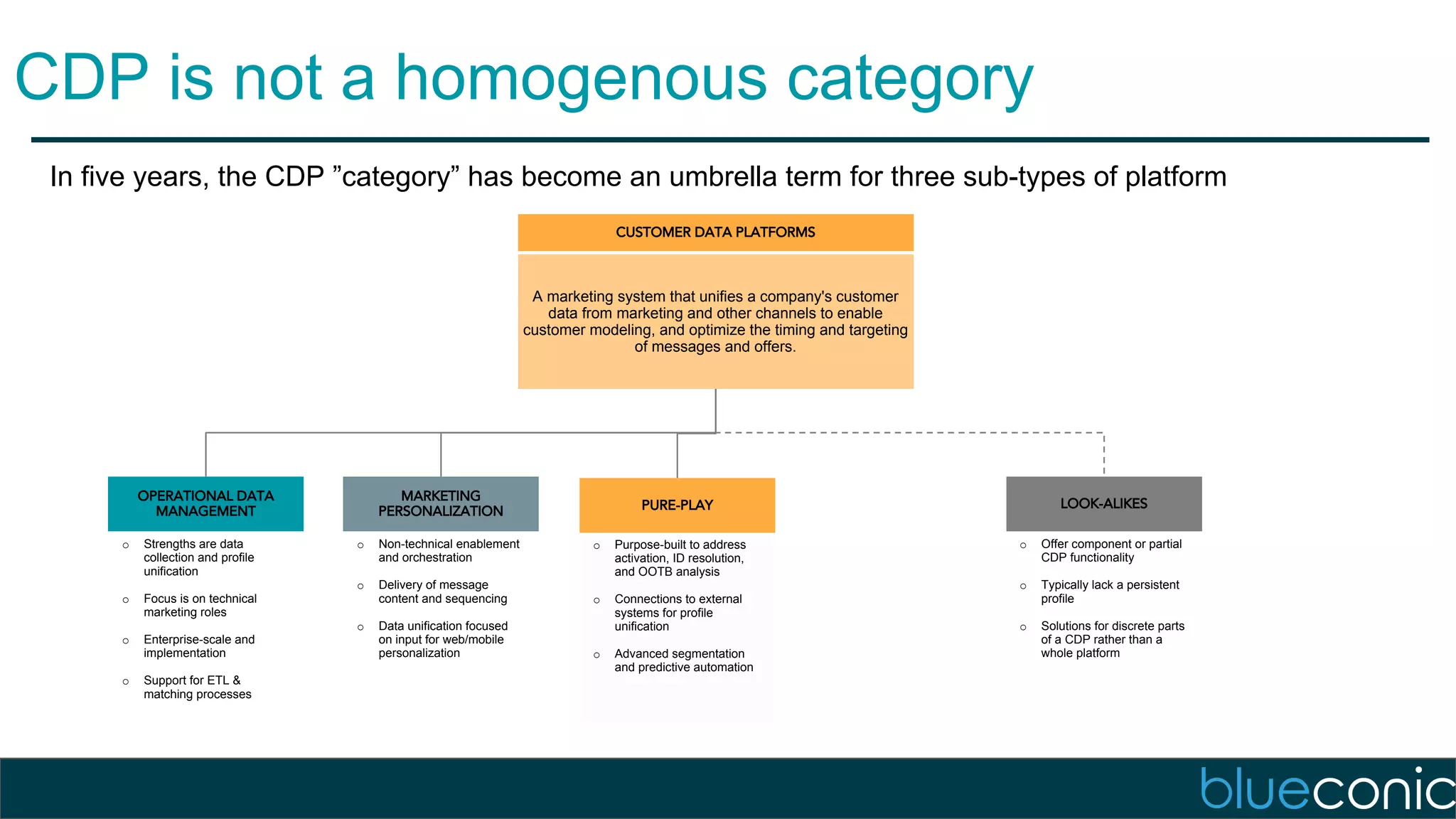
In five years, the CDP ”category” has become an umbrella term for three sub-types of platform
A marketing system that unifies a company's customer
data from marketing and other channels to enable
customer modeling, and optimize the timing and targeting
of messages and offers.
o Strengths are data
collection and profile
unification
o Focus is on technical
marketing roles
o Enterprise-scale and
implementation
o Support for ETL &
matching processes
o Non-technical enablement
and orchestration
o Delivery of message
content and sequencing
o Data unification focused
on input for web/mobile
personalization
o Purpose-built to address
activation, ID resolution,
and OOTB analysis
o Connections to external
systems for profile
unification
o Advanced segmentation
and predictive automation
o Offer component or partial
CDP functionality
o Typically lack a persistent
profile
o Solutions for discrete parts
of a CDP rather than a
whole platform
Source: “Market Guide for Customer Data Platforms for Marketing” July 2018
OPERATIONAL DATA
MANAGEMENT
MARKETING
PERSONALIZATION PURE-PLAY LOOK-ALIKES
CUSTOMER DATA PLATFORMS
CDP is not a homogenous category
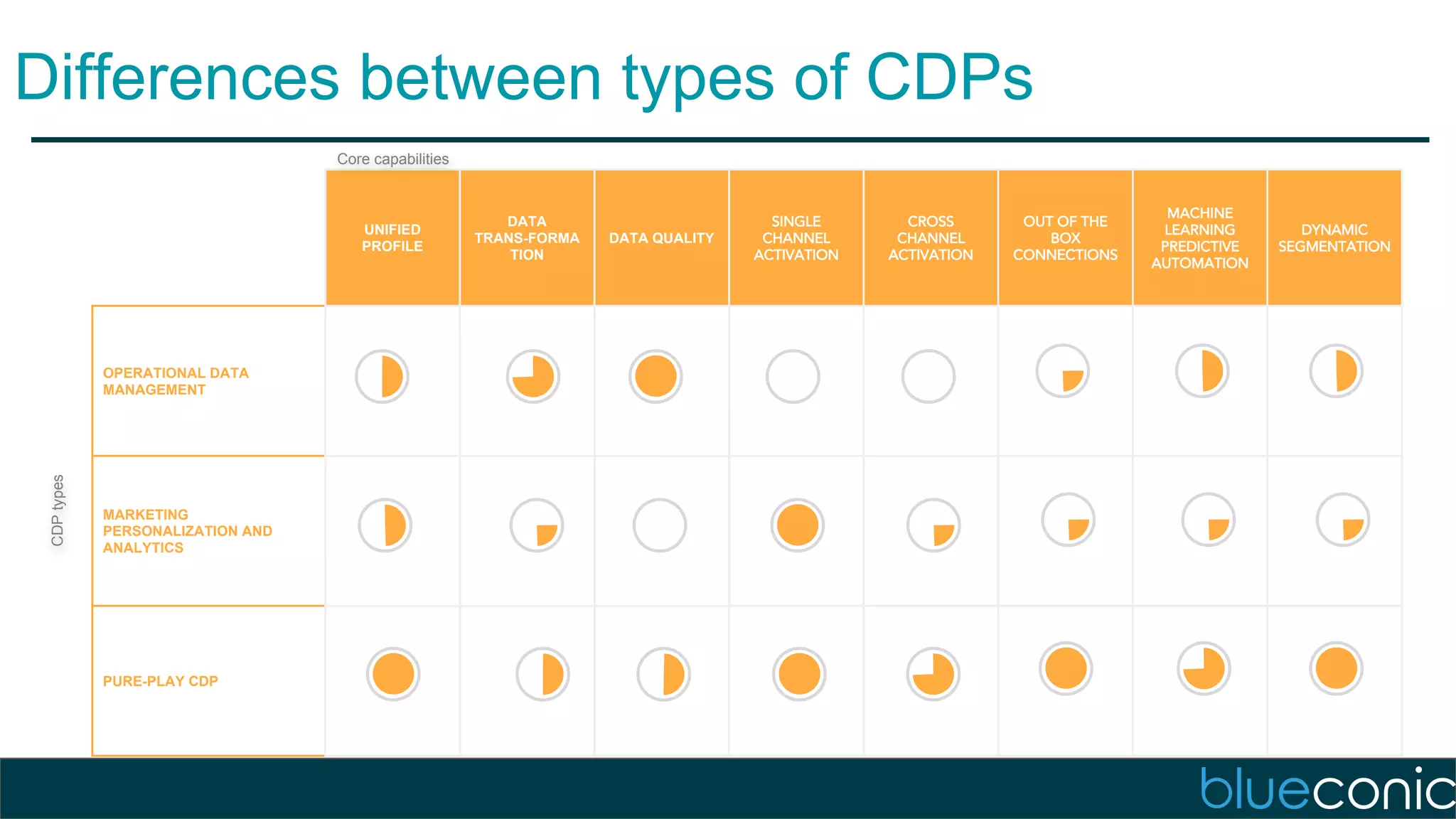
UNIFIED
PROFILE
DATA
TRANS-FORMA
TION
DATA QUALITY
SINGLE
CHANNEL
ACTIVATION
CROSS
CHANNEL
ACTIVATION
OUT OF THE
BOX
CONNECTIONS
MACHINE
LEARNING
PREDICTIVE
AUTOMATION
DYNAMIC
SEGMENTATION
OPERATIONAL DATA
MANAGEMENT
MARKETING
PERSONALIZATION AND
ANALYTICS
PURE-PLAY CDP
CDPtypes
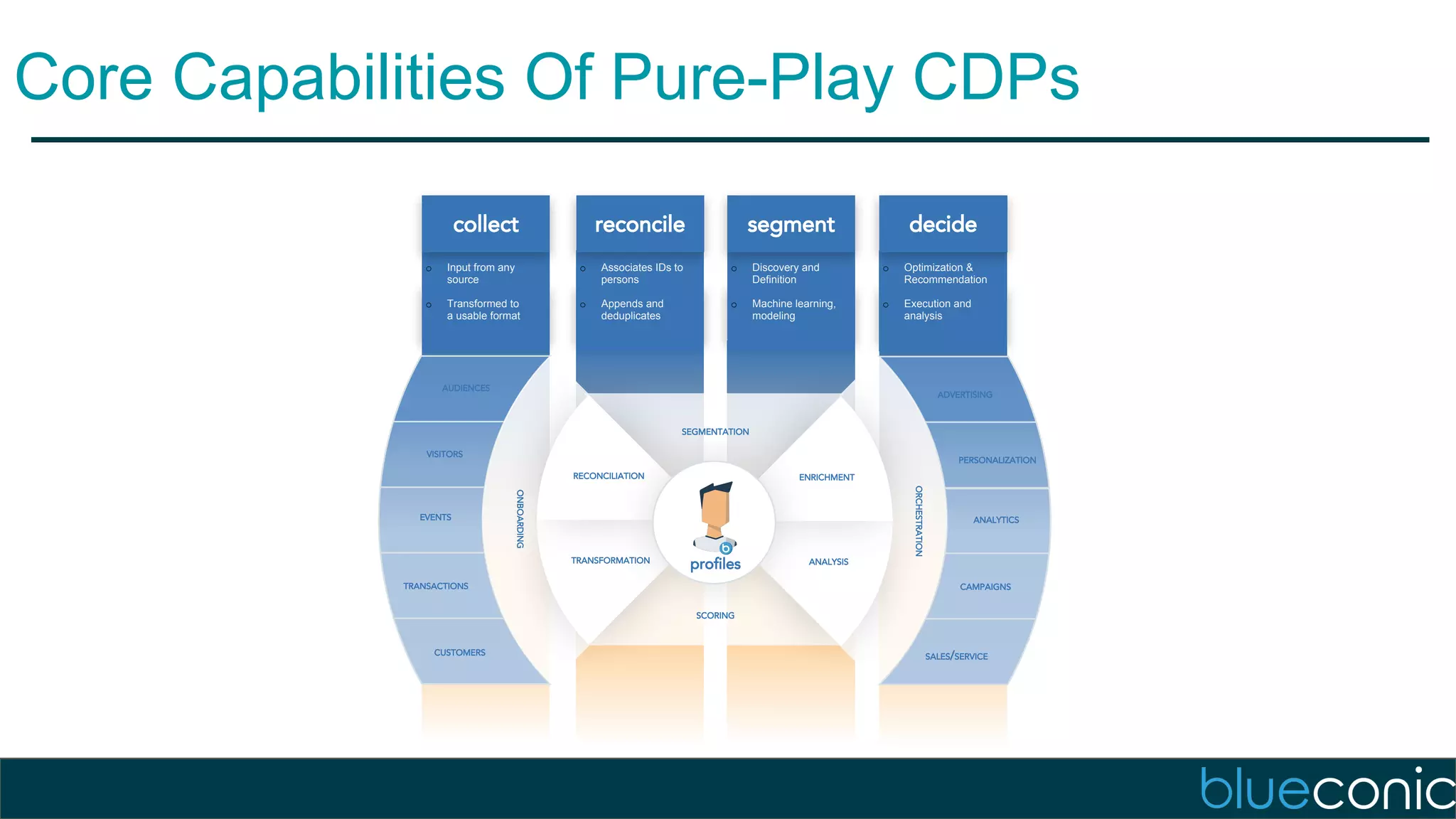
Core capabilities
Differences between types of CDPs
decidesegmentcollect reconcile
SCORING
TRANSFORMATION
ONBOARDING
SEGMENTATION
ORCHESTRATION
ADVERTISING
PERSONALIZATION
ANALYTICS
CAMPAIGNS
SALES/SERVICE
AUDIENCES
VISITORS
EVENTS
TRANSACTIONS
CUSTOMERS
ANALYSIS
ENRICHMENTRECONCILIATION
profiles
Core Capabilities Of Pure-Play CDPs
o Optimization &
Recommendation
o Execution and
analysis
decide
o Discovery and
Definition
o Machine learning,
modeling
segment
o Input from any
source
o Transformed to
a usable format
collect
o Associates IDs to
persons
o Appends and
deduplicates
reconcile
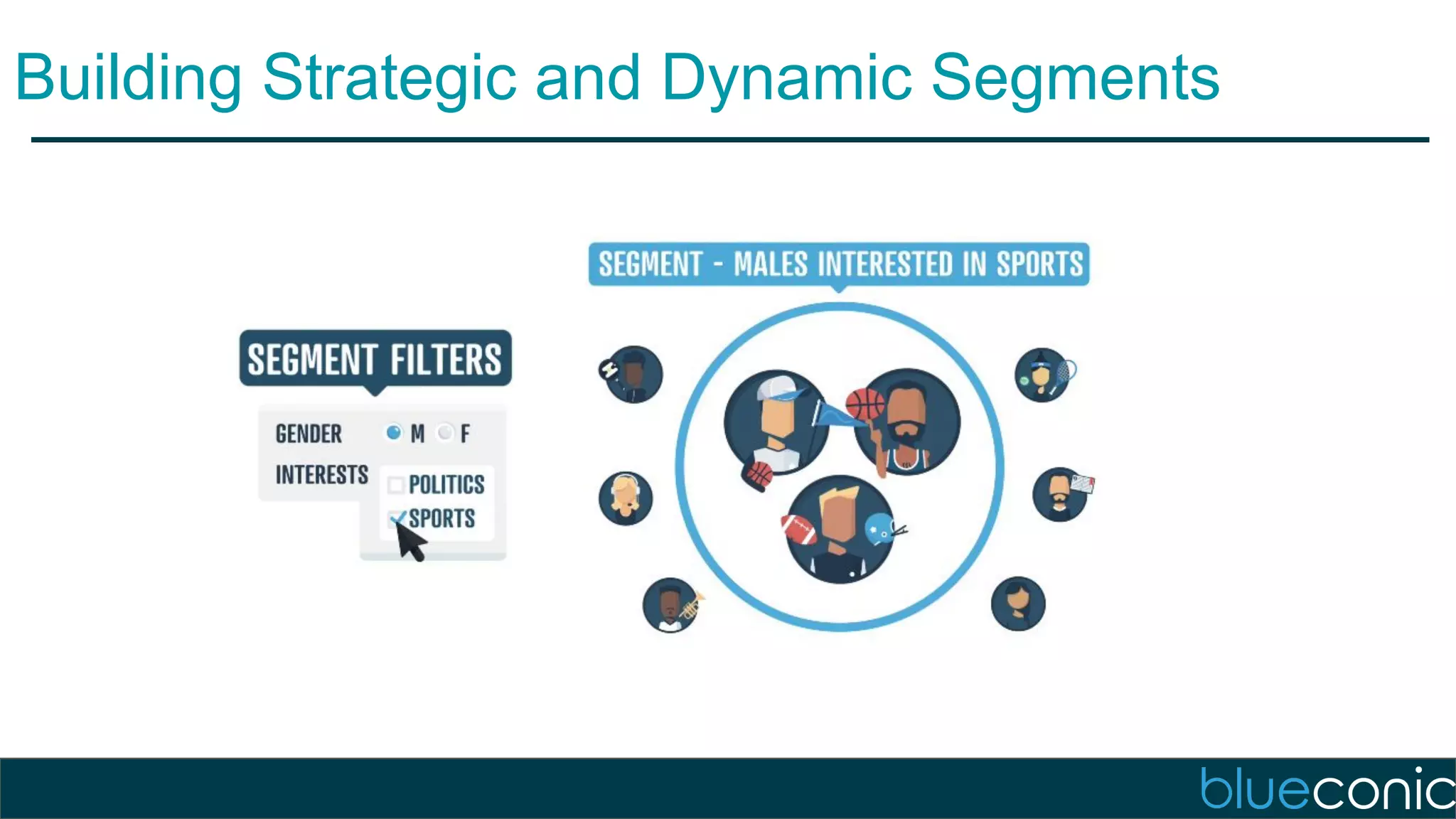
Building Strategic and Dynamic Segments
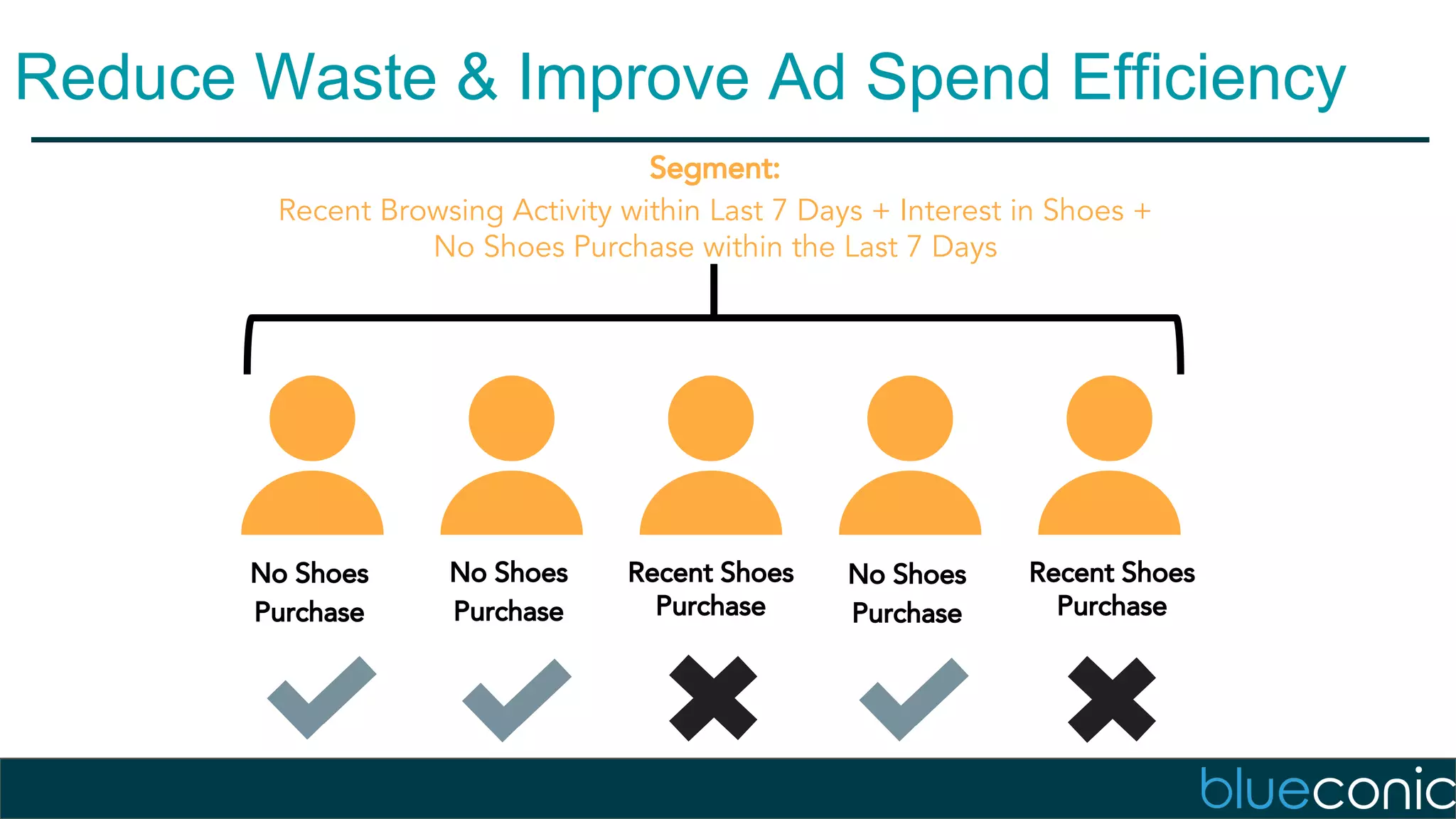
Reduce Waste & Improve Ad Spend Efficiency
Segment:
Recent Browsing Activity within Last 7 Days + Interest in Shoes +
No Shoes Purchase within the Last 7 Days
No Shoes
Purchase
No Shoes
Purchase
Recent Shoes
Purchase
No Shoes
Purchase
Recent Shoes
Purchase
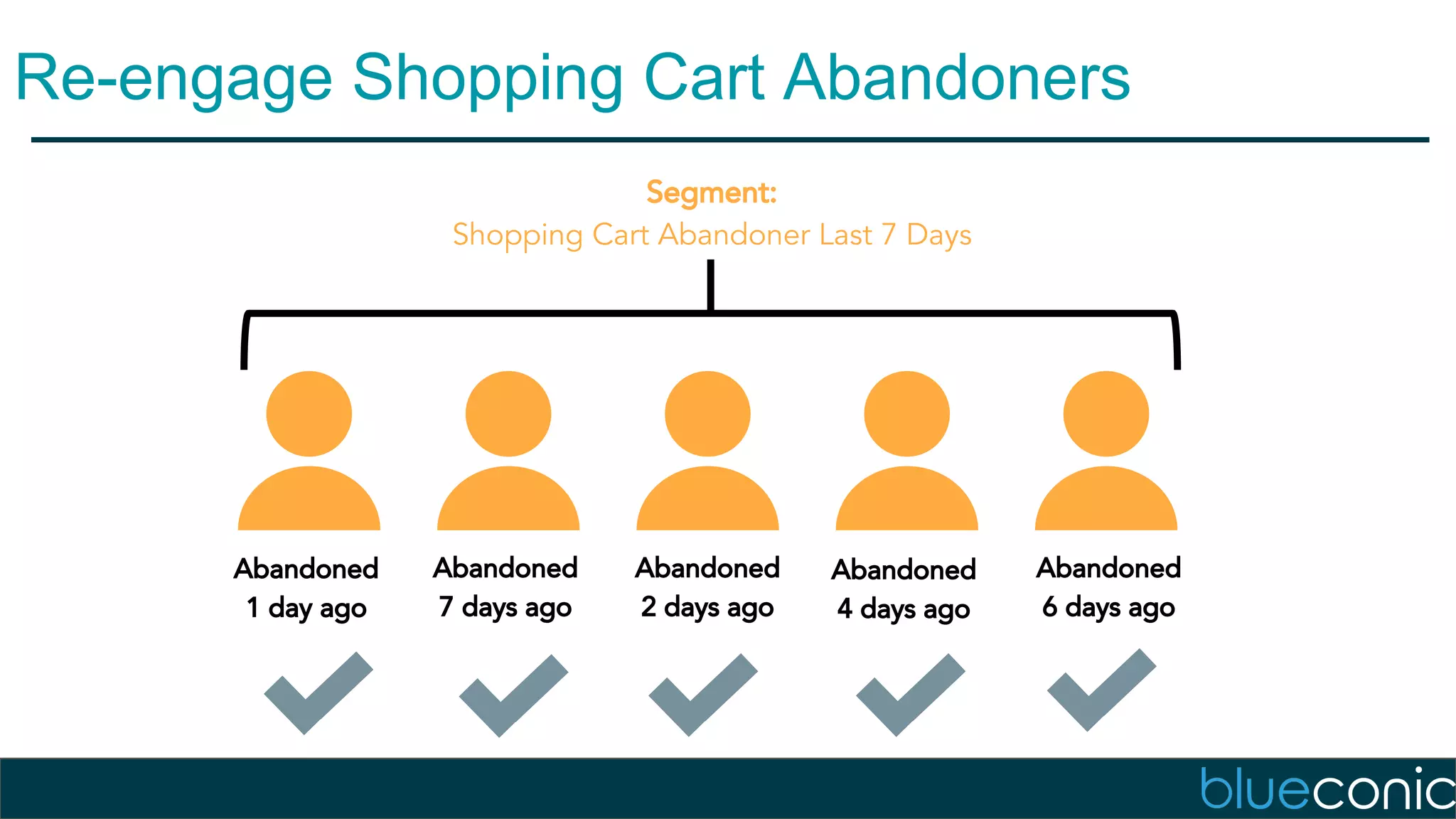
Segment:
Shopping Cart Abandoner Last 7 Days
Abandoned
1 day ago
Abandoned
7 days ago
Abandoned
2 days ago
Abandoned
4 days ago
Abandoned
6 days ago
Re-engage Shopping Cart Abandoners
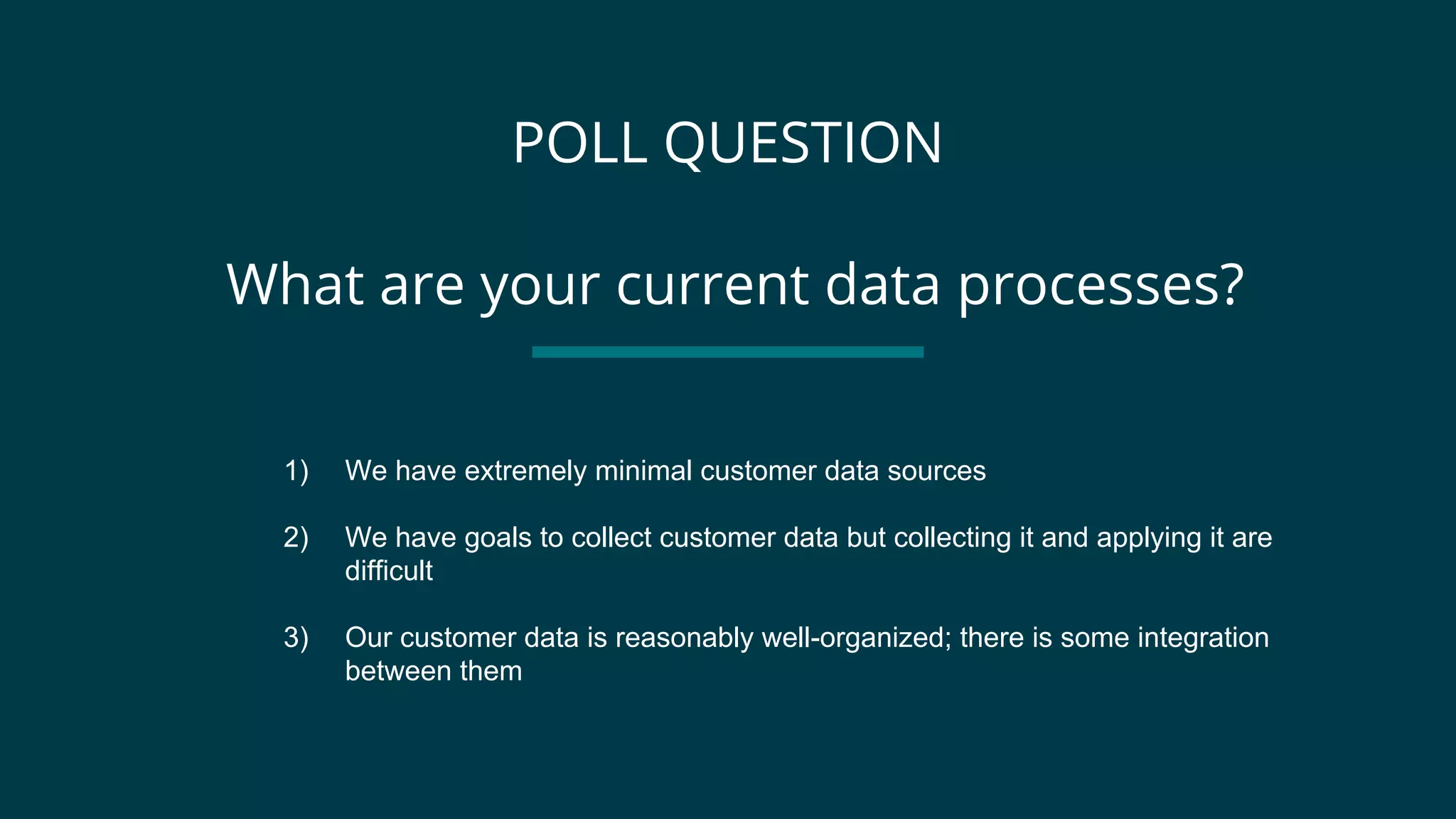
POLL QUESTION
1) We have extremely minimal customer data sources
2) We have goals to collect customer data but collecting it and applying it are
difficult
3) Our customer data is reasonably well-organized; there is some integration
between them
What are your current data processes?
Start where you are.
Use what you have.
Do what you can.
-Arth
ur Ashe
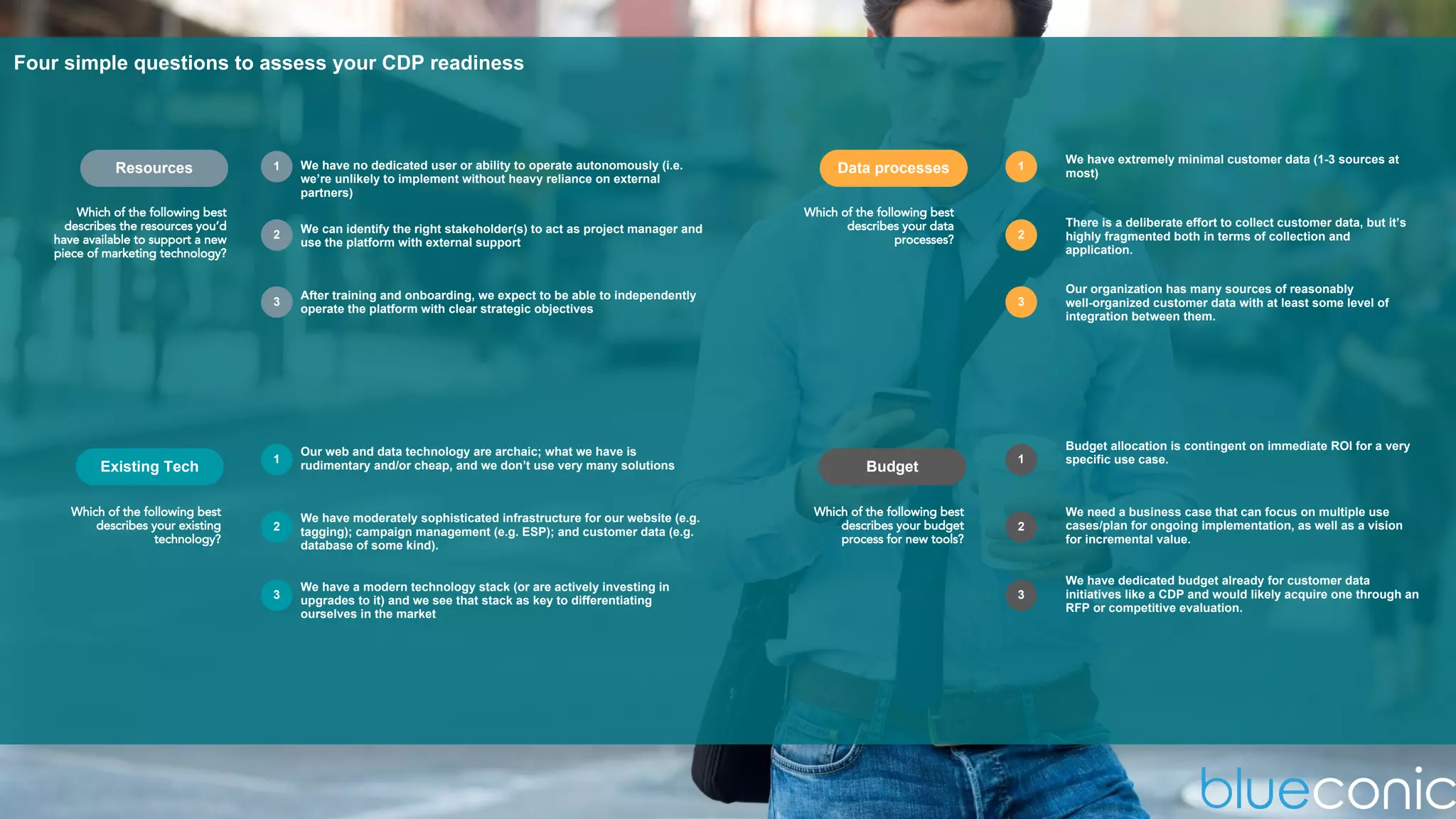
Resources
We can identify the right stakeholder(s) to act as project manager and
use the platform with external support
2
3
After training and onboarding, we expect to be able to independently
operate the platform with clear strategic objectives
We have no dedicated user or ability to operate autonomously (i.e.
we’re unlikely to implement without heavy reliance on external
partners)
1
Which of the following best
describes the resources you’d
have available to support a new
piece of marketing technology?
Which of the following best
describes your existing
technology?
Four simple questions to assess your CDP readiness
Existing Tech
We have moderately sophisticated infrastructure for our website (e.g.
tagging); campaign management (e.g. ESP); and customer data (e.g.
database of some kind).
2
3
We have a modern technology stack (or are actively investing in
upgrades to it) and we see that stack as key to differentiating
ourselves in the market
Our web and data technology are archaic; what we have is
rudimentary and/or cheap, and we don’t use very many solutions
1
Data processes
There is a deliberate effort to collect customer data, but it’s
highly fragmented both in terms of collection and
application.
2
3
Our organization has many sources of reasonably
well-organized customer data with at least some level of
integration between them.
We have extremely minimal customer data (1-3 sources at
most)
1
Budget
We need a business case that can focus on multiple use
cases/plan for ongoing implementation, as well as a vision
for incremental value.
2
3
We have dedicated budget already for customer data
initiatives like a CDP and would likely acquire one through an
RFP or competitive evaluation.
Budget allocation is contingent on immediate ROI for a very
specific use case.1
Which of the following best
describes your data
processes?
Which of the following best
describes your budget
process for new tools?
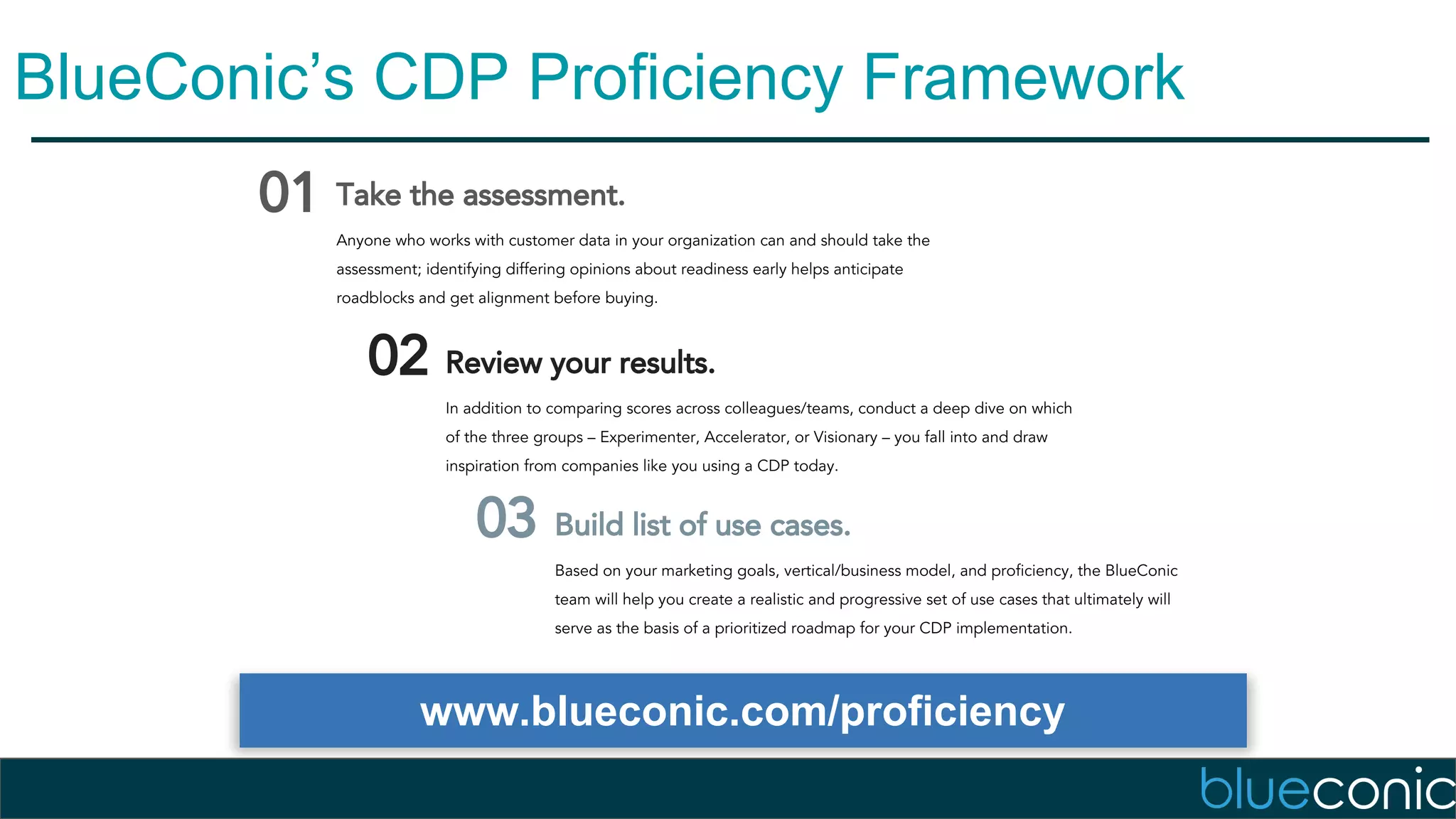
www.blueconic.com/proficiency
01
02
03
Take the assessment.
Anyone who works with customer data in your organization can and should take the
assessment; identifying differing opinions about readiness early helps anticipate
roadblocks and get alignment before buying.
Review your results.
In addition to comparing scores across colleagues/teams, conduct a deep dive on which
of the three groups – Experimenter, Accelerator, or Visionary – you fall into and draw
inspiration from companies like you using a CDP today.
Build list of use cases.
Based on your marketing goals, vertical/business model, and proficiency, the BlueConic
team will help you create a realistic and progressive set of use cases that ultimately will
serve as the basis of a prioritized roadmap for your CDP implementation.
BlueConic’s CDP Proficiency Framework
POLL QUESTION
Where are you currently in your CDP journey?
● What’s a CDP? I’m here to learn.
● We’ve heard some pitches, need to know more.
● We’ve narrowed it down to a couple partners.
● We currently use a CDP today
First, some thanks...
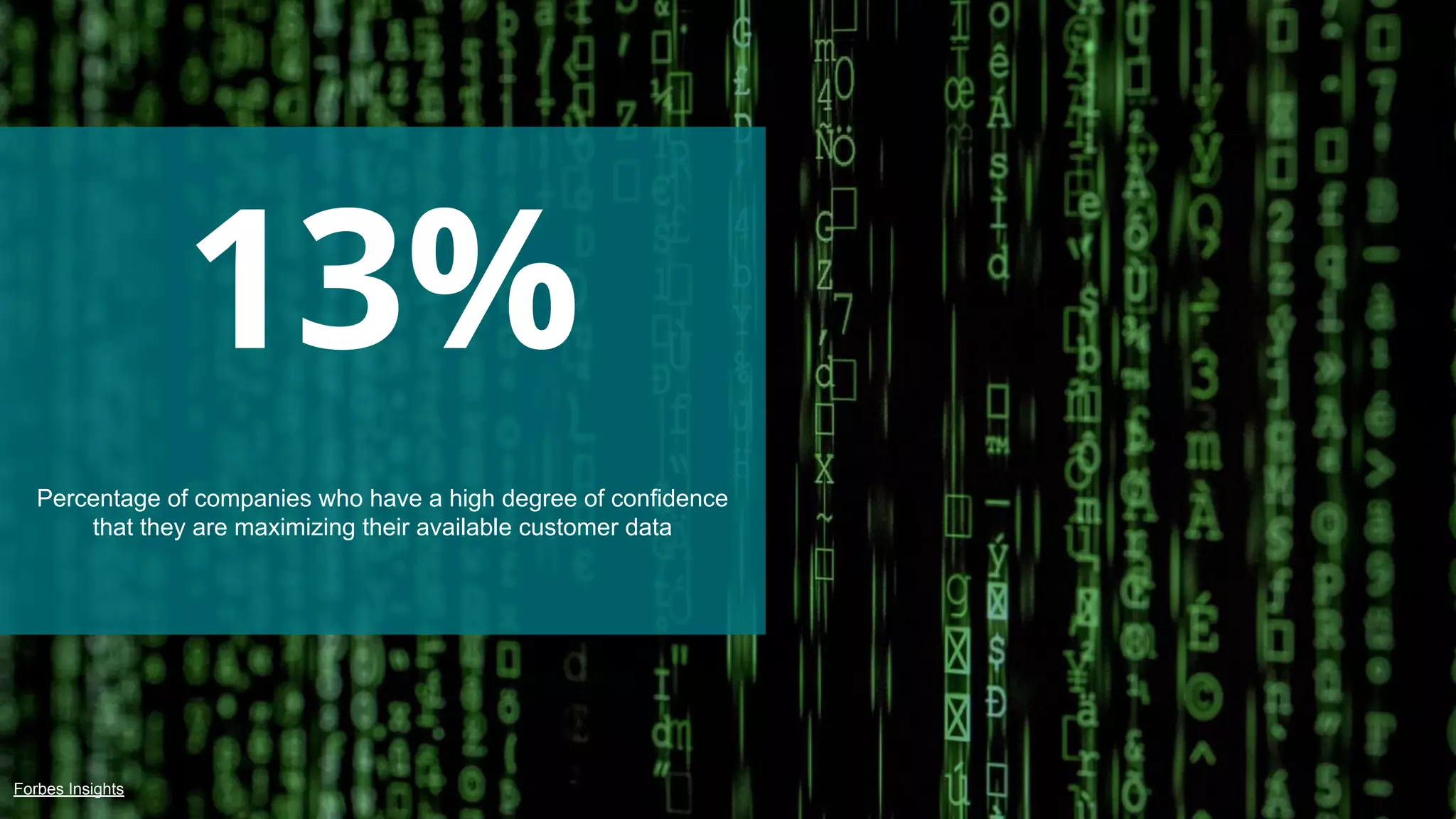
13%
Percentage of companies who have a high degree of confidence
that they are maximizing their available customer data
Forbes Insights
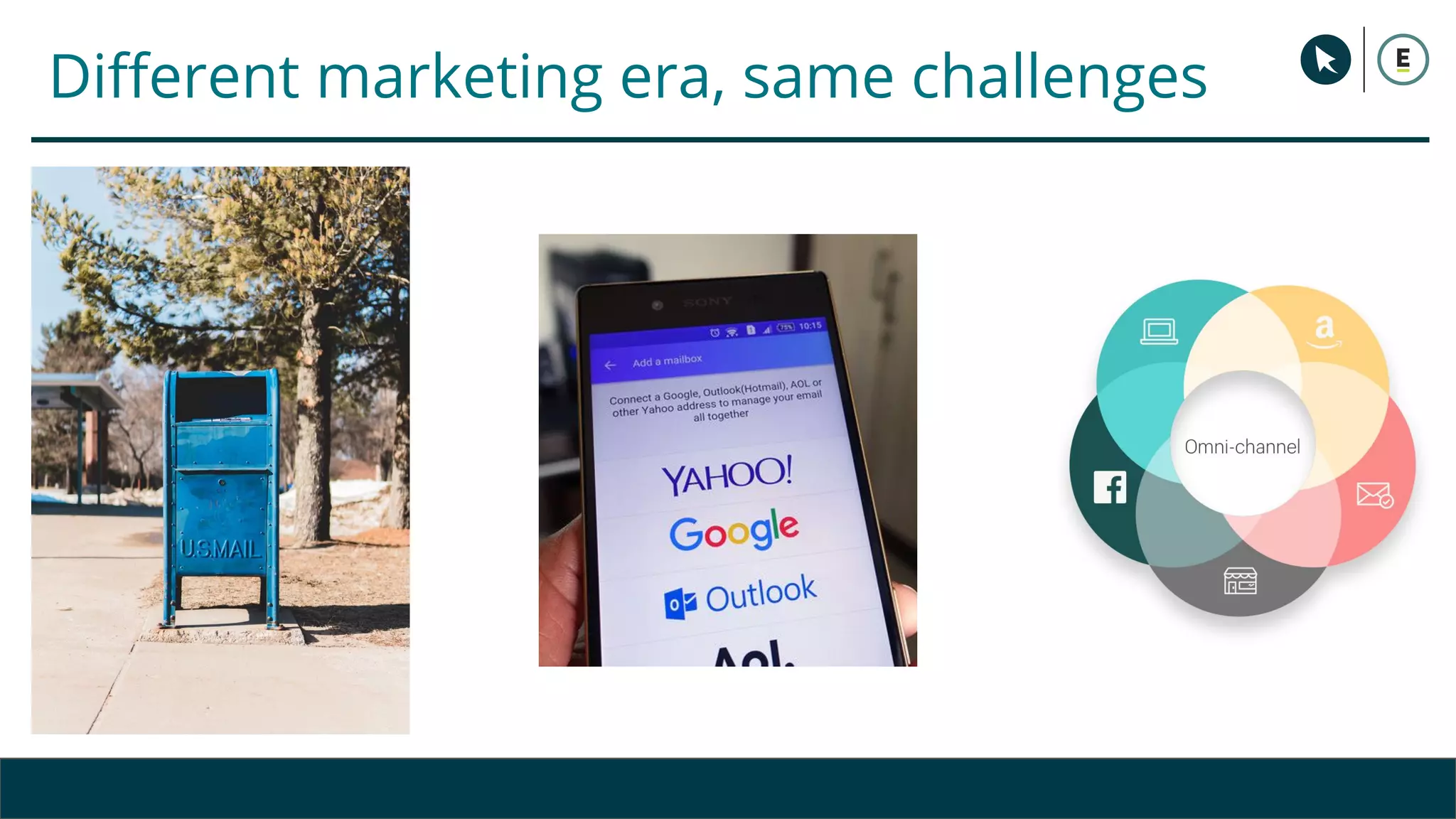
Different marketing era, same challenges
Why is this so
difficult and
confusing?
Copyright 2017 - Q4 Amazon Virtual Summit
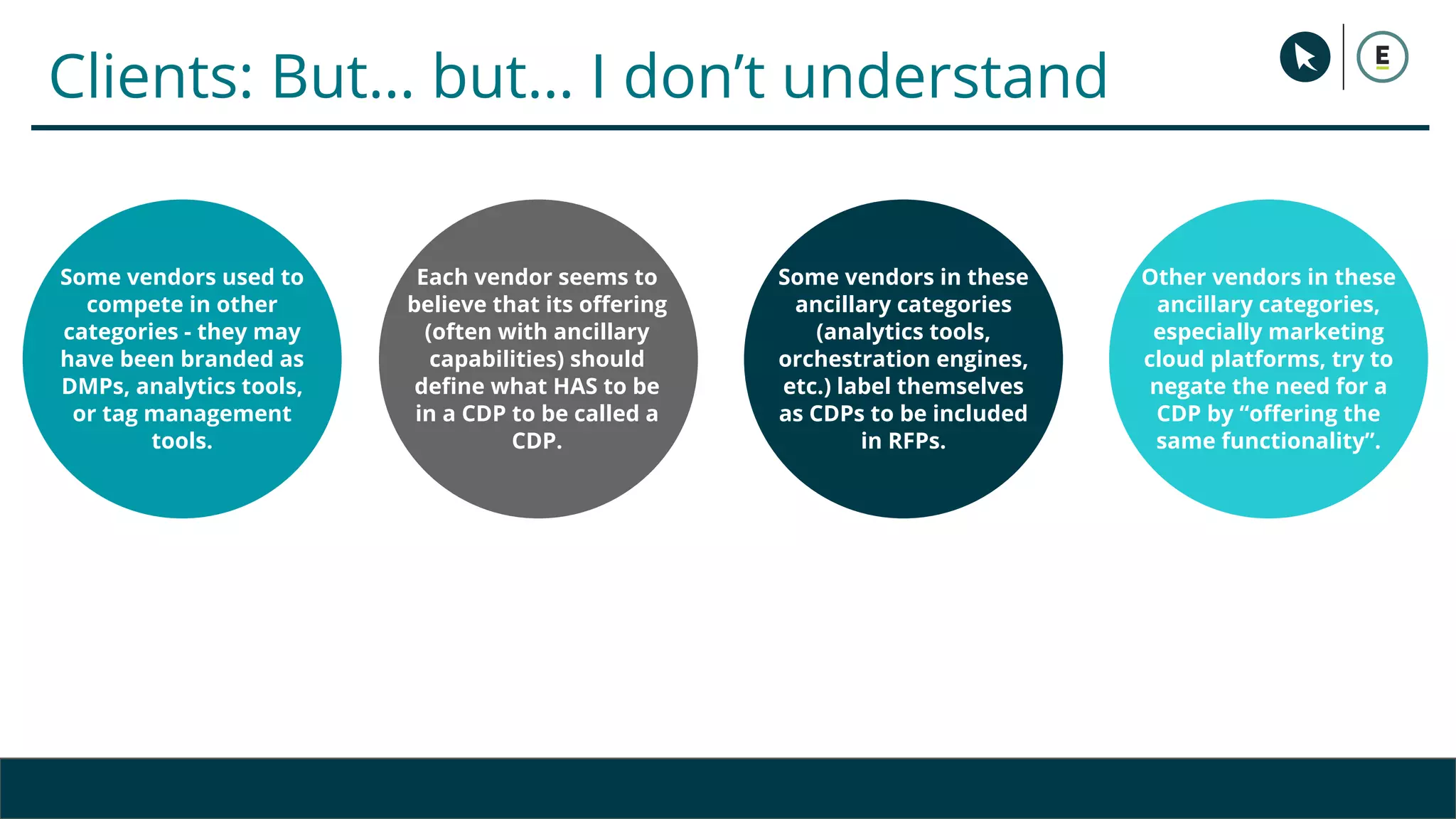
Some vendors in these
ancillary categories
(analytics tools,
orchestration engines,
etc.) label themselves
as CDPs to be included
in RFPs.
Some vendors used to
compete in other
categories - they may
have been branded as
DMPs, analytics tools,
or tag management
tools.
Each vendor seems to
believe that its offering
(often with ancillary
capabilities) should
define what HAS to be
in a CDP to be called a
CDP.
Clients: But… but… I don’t understand
Other vendors in these
ancillary categories,
especially marketing
cloud platforms, try to
negate the need for a
CDP by “offering the
same functionality”.
The result? SOS - Shiny Object Syndrome
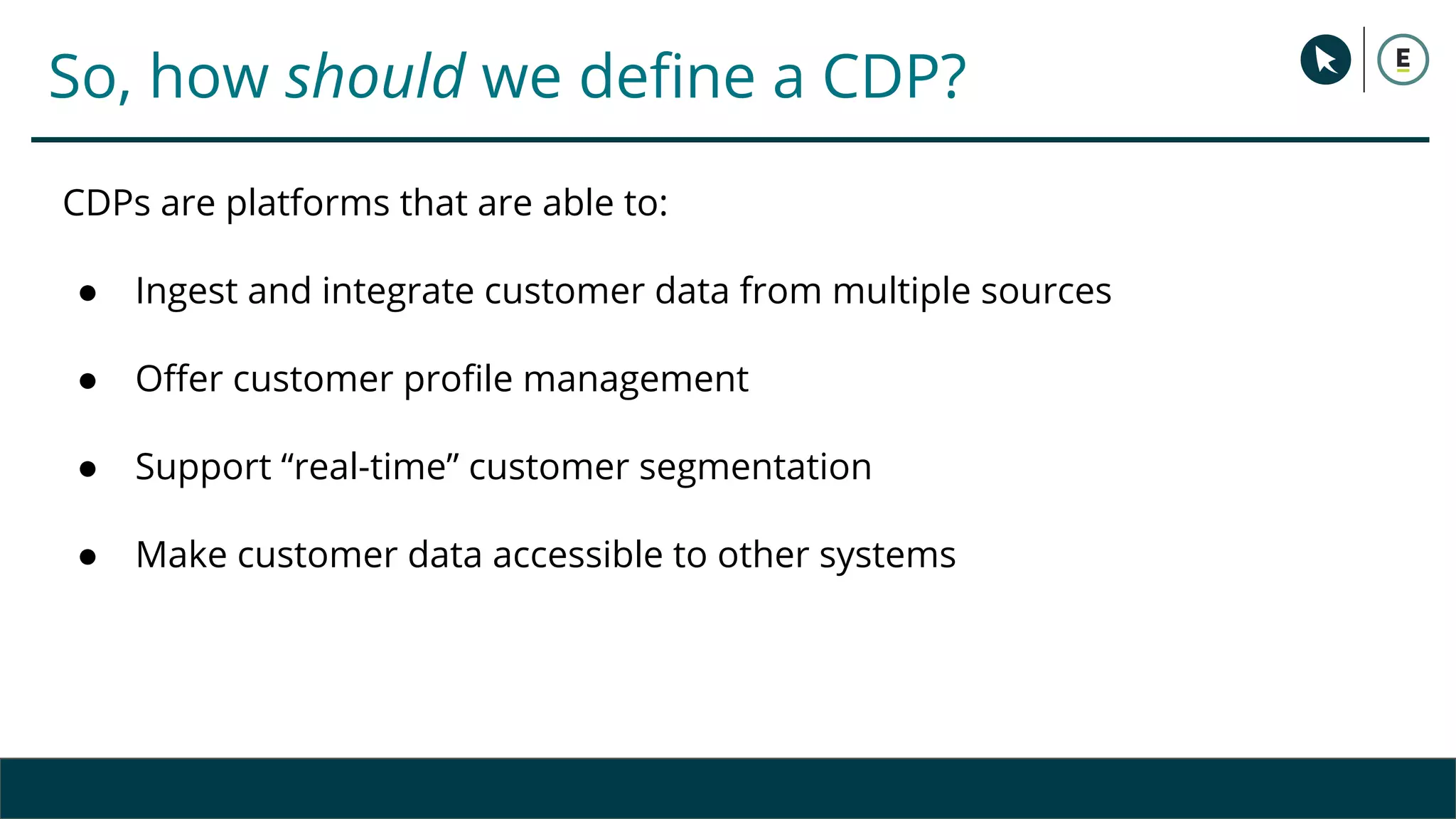
So, how should we define a CDP?
CDPs are platforms that are able to:
● Ingest and integrate customer data from multiple sources
● Offer customer profile management
● Support “real-time” customer segmentation
● Make customer data accessible to other systems
How can I use
this magical
platform?
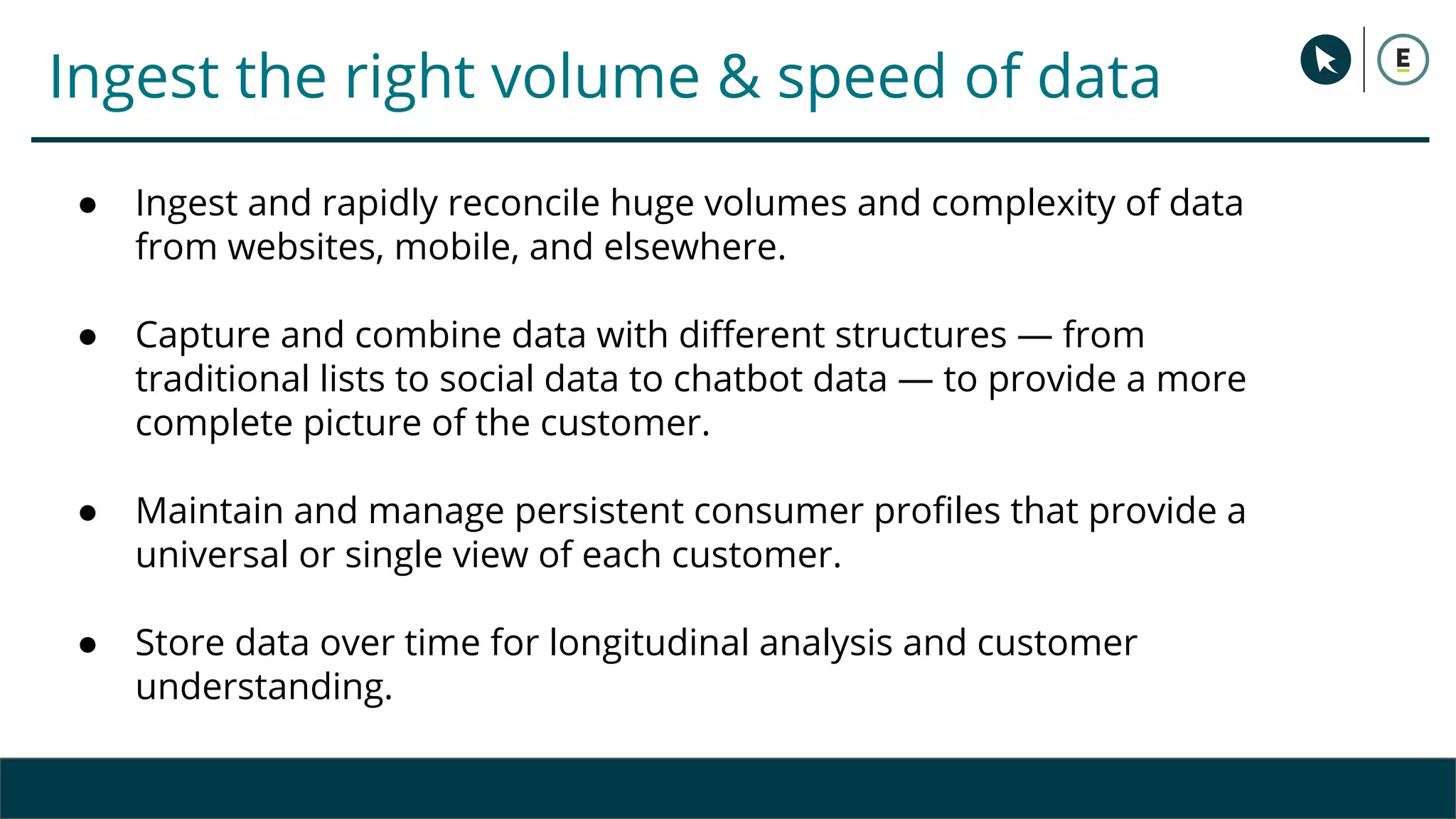
Ingest the right volume & speed of data
● Ingest and rapidly reconcile huge volumes and complexity of data
from websites, mobile, and elsewhere.
● Capture and combine data with different structures — from
traditional lists to social data to chatbot data — to provide a more
complete picture of the customer.
● Maintain and manage persistent consumer profiles that provide a
universal or single view of each customer.
● Store data over time for longitudinal analysis and customer
understanding.
Ingest the right volume & speed of data
Data AggregationAll Data Sources Reporting & Insights
Data Preparation & Management
Delivers Daily Analysis-Ready Data
Integrate All Data Sources
Actively Monitor All Connections
Automated & Scalable Dashboards
Flexible Analysis & Insights
Focused On Delivering Value
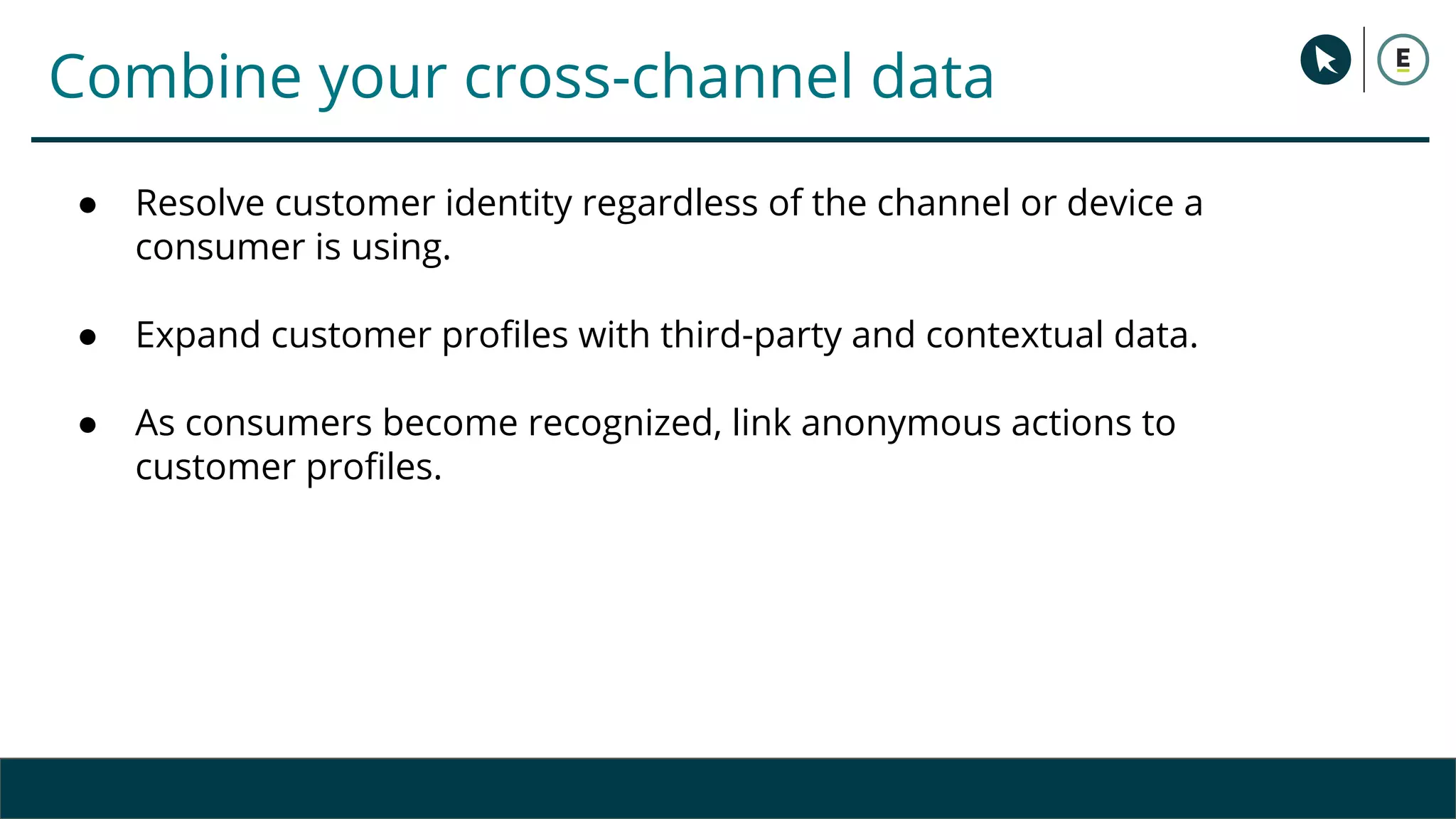
Combine your cross-channel data
● Resolve customer identity regardless of the channel or device a
consumer is using.
● Expand customer profiles with third-party and contextual data.
● As consumers become recognized, link anonymous actions to
customer profiles.
Combine your cross-channel data
Source: robertheaton.com
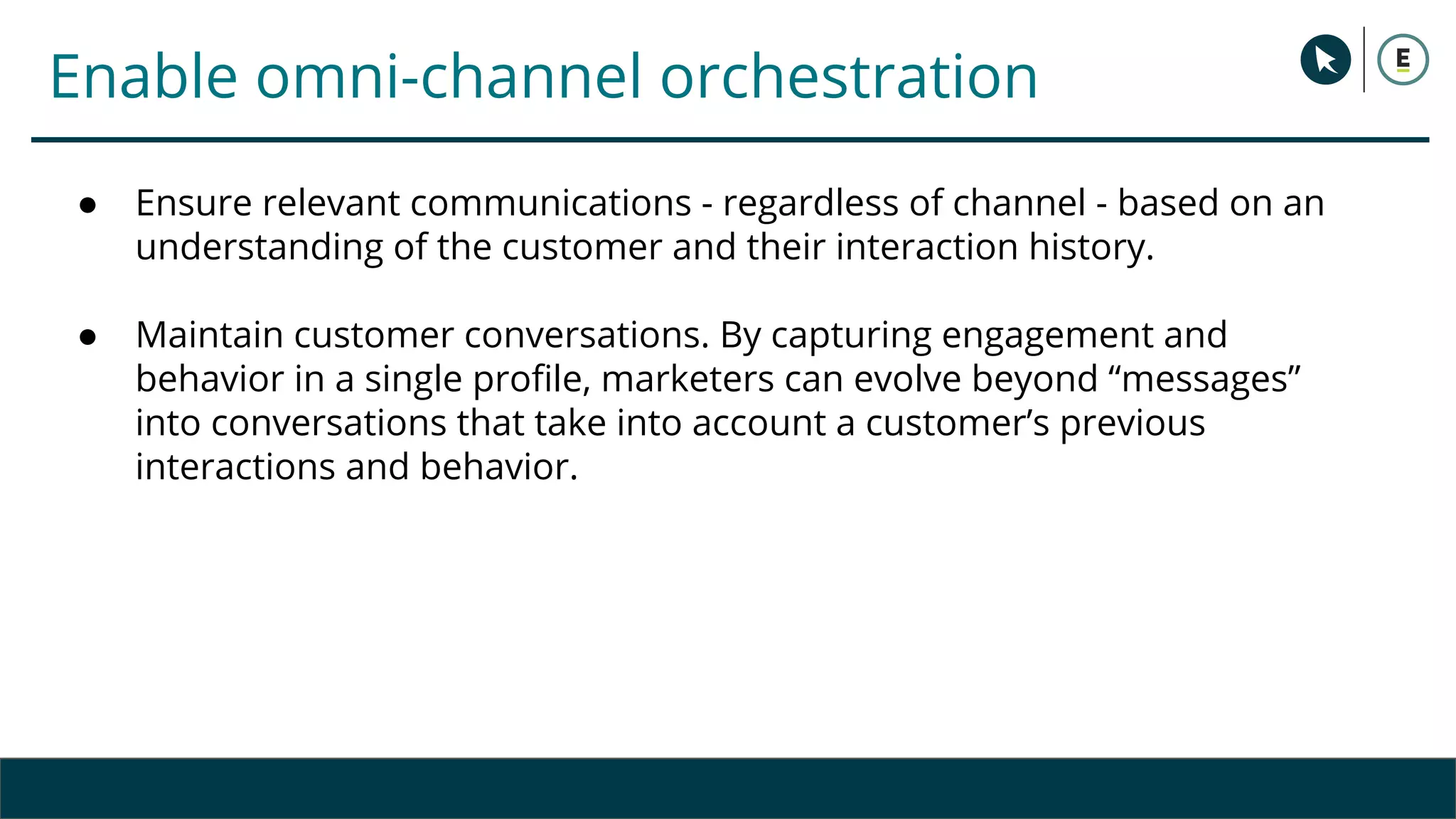
Enable omni-channel orchestration
● Ensure relevant communications - regardless of channel - based on an
understanding of the customer and their interaction history.
● Maintain customer conversations. By capturing engagement and
behavior in a single profile, marketers can evolve beyond “messages”
into conversations that take into account a customer’s previous
interactions and behavior.
Audience insights for all (not just analytics)
● Reduce the time to answer customer questions. Marketers with
limited technical know-how can query customer data and make
informed customer decisions.
● Free up time for data scientists and IT. As marketers engage with
customer data and learn to perform basic analytics and segmentation,
it liberates data science teams to work on more advanced — and
valuable — analyses.
Real-time customer interactions
● Enable personalization. By capturing previous activity, third-party and
contextual data, and maintaining persistent profiles, CDPs power
personalization initiatives to anonymous and known customers.
● Improve engagement through other systems. By making data
accessible to third-party systems, CDPs boost the value of each
system - ensuring the next best message and action regardless of the
point of interaction.
Real-time customer interactions
Copyright 2017 - Q4 Amazon Virtual Summit
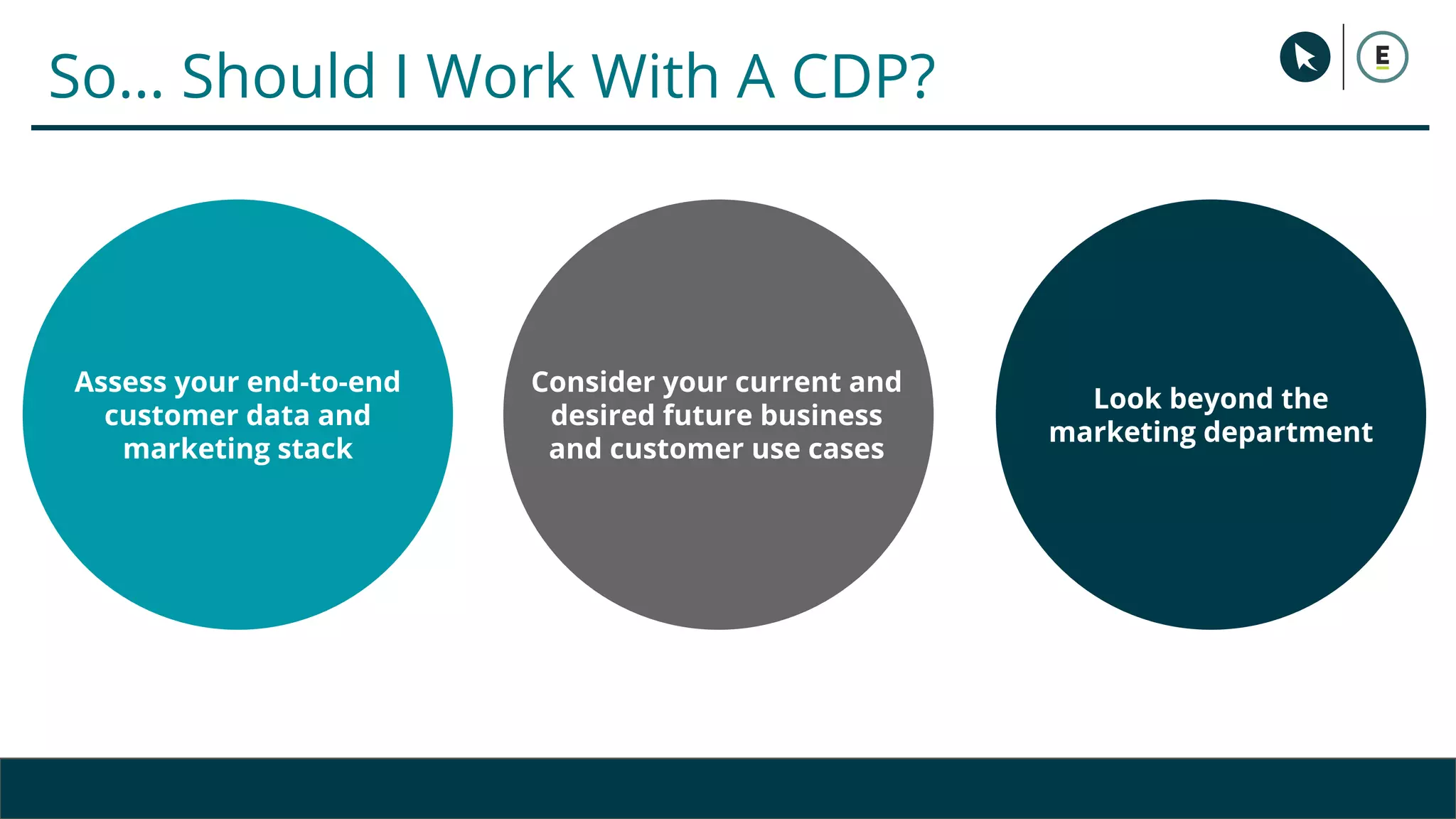
Look beyond the
marketing department
Assess your end-to-end
customer data and
marketing stack
Consider your current and
desired future business
and customer use cases
So… Should I Work With A CDP?
Copyright 2017 - Q4 Amazon Virtual Summit
Assess your end-to-end
customer data and
marketing stack
So… Should I Work With A CDP?
● Do you have multiple engagement channels? If so, do you
have an existing approach to combining data (including
offline and online data) from these upstream systems?
● Do you have an existing approach to translate event
streams from multiple sources into customer-based data
points by applying identity resolution, privacy rules, and
profile attribute functions from other upstream systems?
● Is your data collection standardized across modes of
interaction, development teams, and external sources and
systems?
● Do you generate universal customer profiles and make
these profiles and attributes accessible to the analytics
and/or engagement solutions that may need it, in the
required timeframe and format?
Copyright 2017 - Q4 Amazon Virtual Summit
Assess your end-to-end
customer data and
marketing stack
So… Should I Work With A CDP?
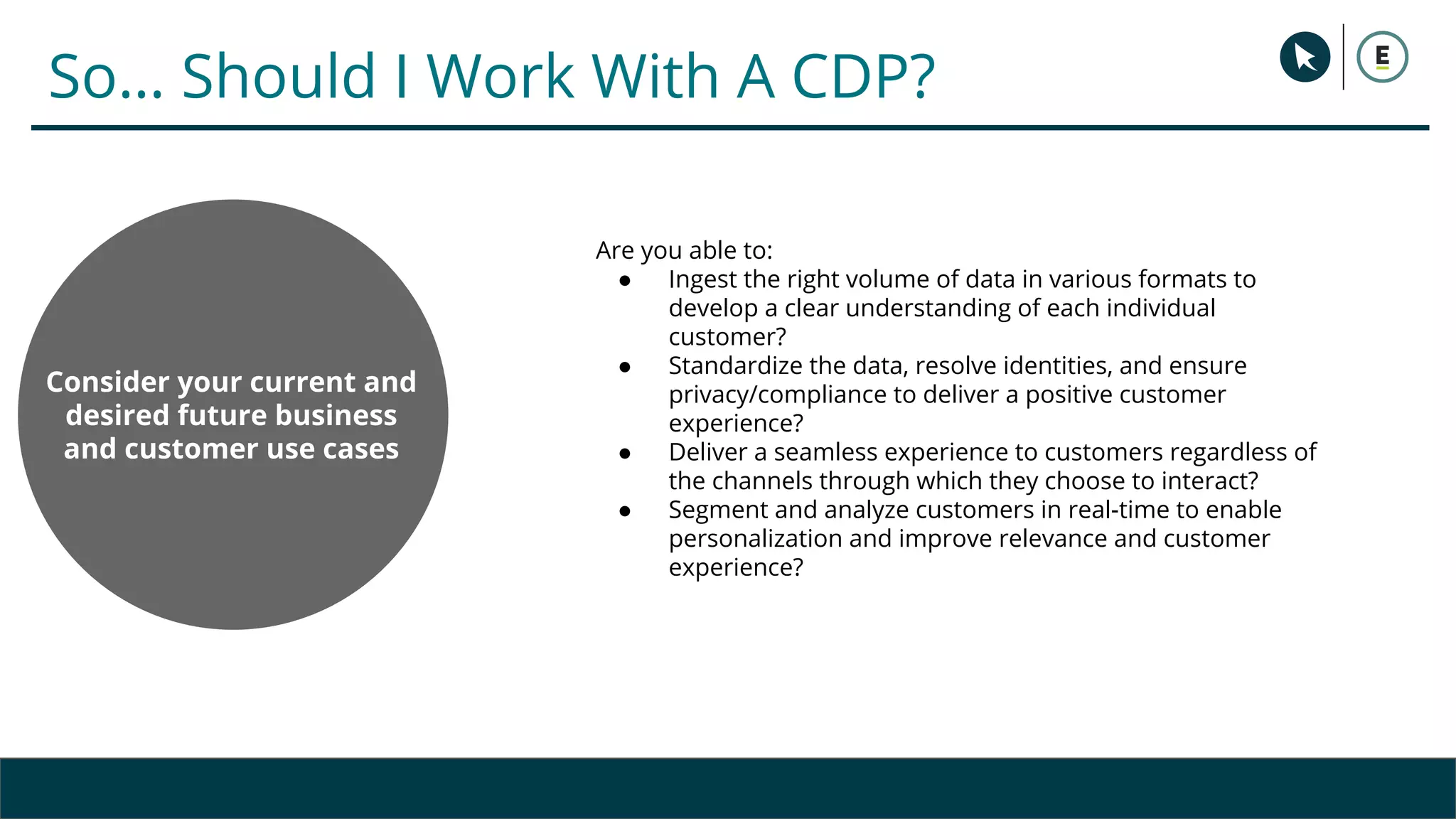
Are you able to:
● Ingest the right volume of data in various formats to
develop a clear understanding of each individual
customer?
● Standardize the data, resolve identities, and ensure
privacy/compliance to deliver a positive customer
experience?
● Deliver a seamless experience to customers regardless of
the channels through which they choose to interact?
● Segment and analyze customers in real-time to enable
personalization and improve relevance and customer
experience?
Consider your current and
desired future business
and customer use cases
Copyright 2017 - Q4 Amazon Virtual Summit
Assess your end-to-end
customer data and
marketing stack
So… Should I Work With A CDP?
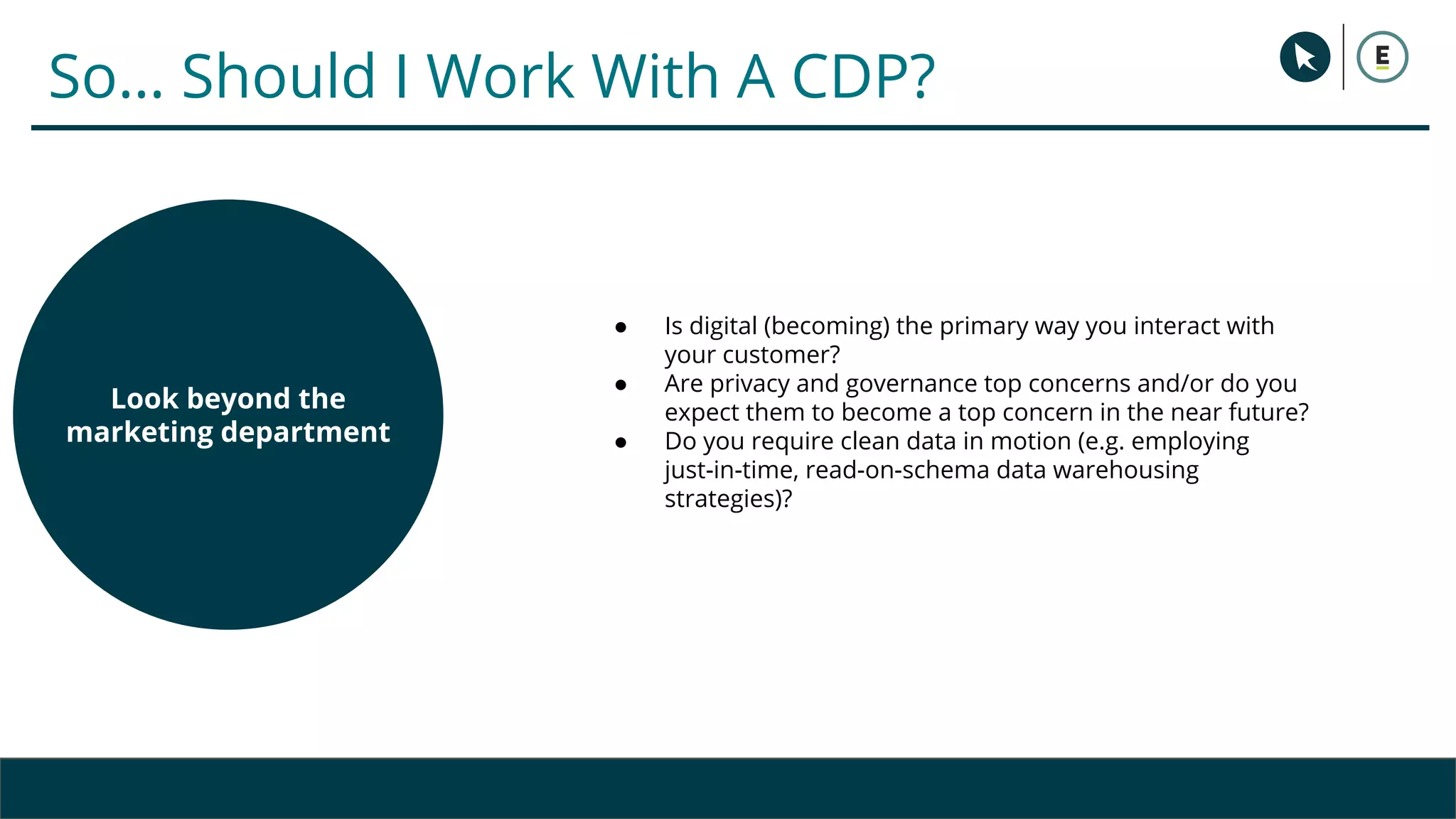
● Is digital (becoming) the primary way you interact with
your customer?
● Are privacy and governance top concerns and/or do you
expect them to become a top concern in the near future?
● Do you require clean data in motion (e.g. employing
just-in-time, read-on-schema data warehousing
strategies)?
Consider your current and
desired future business
and customer use cases
Look beyond the
marketing department
SMALL TEXT
STACK TEXT ROW 1
STACK TEXT ROW 2
Schedule Your 1-1
Paid Media Consultation
Q & A
Sam Ngo
Director of Product
Marketing
Andrew Richardson
VP of Analytics &
Marketing Science

What You Need to Know About CDPs

  • 1.
    What You Needto Know About CDPs Use First Party Data to Fuel Your Multichannel & Marketing Development Presented by:
  • 2.
    Today’s Logistics ● Sessionrecording and slides will be sent ● Submit questions to our panelists ● Join in on our poll questions throughout ● Resources available as handouts Persephanie Arellano Webinar Coordinator
  • 3.
    Overview Founded in 2007 Partof Elite SEM as of 2018 Google Premier Partner 600+ Active Retail Clients Top 50 Fastest Growing Company San Diego Solutions Retail-focused PPC & Shopping Amazon Sales Acceleration Amazon Vendor Services Facebook Performance Marketing Creative Services
  • 4.
    Today’s Speakers Sam Ngo Directorof Product Marketing Andrew Richardson VP of Analytics & Marketing Science
  • 5.
    Today’s Agenda ● Breakdownof Customer Data Platforms (CDP) ● Top Ways a CDP Enhances Your Marketing Strategy ● Understanding Your Customers’ Buying Journey ● How to Decide if You Need a CDP
  • 6.
    What is aCDP? “An integrated customer database managed by marketers that unifies a company's customer data from online and offline channels to enable modeling and drive customer experience.” GARTNER
  • 7.
    CDP... another threeletter MarTech acronym? DIMENSION CDP DMP CRM DATA WARE HOUSE CAMPAIGN MANAGEMENT MARKETING CLOUD DATA INTEGRITY Person-level profiles based on all customer attributes & behaviors Segment-level only based on de-identified audience data Person-level customer records based on identifiable data only Person-level customer records based on identifiable data only Person-level records, identified based on identified email addresses only Segment-level only, person-level customer records siloed in each application if any MARKETER CONTROL Marketers have complete control over access to the data, as well as integrations with other platforms Marketers have complete control over access to the data, as well as integrations with other platforms Marketers have minimal access to the data, and no control over integrations with other platforms Marketers have no access to the data, and no control over integrations with other platforms Marketers have complete control over access to the data, but lack control over integrations with other platforms Marketers have complete control over access to the data, but often lack control over integrations with other platforms ACCESSIBILITY Integration with any external marketing platform that provides or accepts identifiable and/ or de-identified audience data Integration with external marketing platforms that provide or accept de-identified audience data only Integration with external marketing platforms that provide or accept identifiable audience data only Does not easily integrate with all external marketing platforms Integration with external marketing platforms that provide or accept identifiable audience data only Does not easily integrate with all external marketing platforms
  • 8.
    In five years,the CDP ”category” has become an umbrella term for three sub-types of platform A marketing system that unifies a company's customer data from marketing and other channels to enable customer modeling, and optimize the timing and targeting of messages and offers. o Strengths are data collection and profile unification o Focus is on technical marketing roles o Enterprise-scale and implementation o Support for ETL & matching processes o Non-technical enablement and orchestration o Delivery of message content and sequencing o Data unification focused on input for web/mobile personalization o Purpose-built to address activation, ID resolution, and OOTB analysis o Connections to external systems for profile unification o Advanced segmentation and predictive automation o Offer component or partial CDP functionality o Typically lack a persistent profile o Solutions for discrete parts of a CDP rather than a whole platform Source: “Market Guide for Customer Data Platforms for Marketing” July 2018 OPERATIONAL DATA MANAGEMENT MARKETING PERSONALIZATION PURE-PLAY LOOK-ALIKES CUSTOMER DATA PLATFORMS CDP is not a homogenous category
  • 9.
    UNIFIED PROFILE DATA TRANS-FORMA TION DATA QUALITY SINGLE CHANNEL ACTIVATION CROSS CHANNEL ACTIVATION OUT OFTHE BOX CONNECTIONS MACHINE LEARNING PREDICTIVE AUTOMATION DYNAMIC SEGMENTATION OPERATIONAL DATA MANAGEMENT MARKETING PERSONALIZATION AND ANALYTICS PURE-PLAY CDP CDPtypes Core capabilities Differences between types of CDPs
  • 10.
    decidesegmentcollect reconcile SCORING TRANSFORMATION ONBOARDING SEGMENTATION ORCHESTRATION ADVERTISING PERSONALIZATION ANALYTICS CAMPAIGNS SALES/SERVICE AUDIENCES VISITORS EVENTS TRANSACTIONS CUSTOMERS ANALYSIS ENRICHMENTRECONCILIATION profiles Core CapabilitiesOf Pure-Play CDPs o Optimization & Recommendation o Execution and analysis decide o Discovery and Definition o Machine learning, modeling segment o Input from any source o Transformed to a usable format collect o Associates IDs to persons o Appends and deduplicates reconcile
  • 11.
    Building Strategic andDynamic Segments
  • 12.
    Reduce Waste &Improve Ad Spend Efficiency Segment: Recent Browsing Activity within Last 7 Days + Interest in Shoes + No Shoes Purchase within the Last 7 Days No Shoes Purchase No Shoes Purchase Recent Shoes Purchase No Shoes Purchase Recent Shoes Purchase
  • 13.
    Segment: Shopping Cart AbandonerLast 7 Days Abandoned 1 day ago Abandoned 7 days ago Abandoned 2 days ago Abandoned 4 days ago Abandoned 6 days ago Re-engage Shopping Cart Abandoners
  • 14.
    POLL QUESTION 1) Wehave extremely minimal customer data sources 2) We have goals to collect customer data but collecting it and applying it are difficult 3) Our customer data is reasonably well-organized; there is some integration between them What are your current data processes?
  • 15.
    Start where youare. Use what you have. Do what you can. -Arth ur Ashe
  • 16.
    Resources We can identifythe right stakeholder(s) to act as project manager and use the platform with external support 2 3 After training and onboarding, we expect to be able to independently operate the platform with clear strategic objectives We have no dedicated user or ability to operate autonomously (i.e. we’re unlikely to implement without heavy reliance on external partners) 1 Which of the following best describes the resources you’d have available to support a new piece of marketing technology? Which of the following best describes your existing technology? Four simple questions to assess your CDP readiness Existing Tech We have moderately sophisticated infrastructure for our website (e.g. tagging); campaign management (e.g. ESP); and customer data (e.g. database of some kind). 2 3 We have a modern technology stack (or are actively investing in upgrades to it) and we see that stack as key to differentiating ourselves in the market Our web and data technology are archaic; what we have is rudimentary and/or cheap, and we don’t use very many solutions 1 Data processes There is a deliberate effort to collect customer data, but it’s highly fragmented both in terms of collection and application. 2 3 Our organization has many sources of reasonably well-organized customer data with at least some level of integration between them. We have extremely minimal customer data (1-3 sources at most) 1 Budget We need a business case that can focus on multiple use cases/plan for ongoing implementation, as well as a vision for incremental value. 2 3 We have dedicated budget already for customer data initiatives like a CDP and would likely acquire one through an RFP or competitive evaluation. Budget allocation is contingent on immediate ROI for a very specific use case.1 Which of the following best describes your data processes? Which of the following best describes your budget process for new tools?
  • 17.
    www.blueconic.com/proficiency 01 02 03 Take the assessment. Anyonewho works with customer data in your organization can and should take the assessment; identifying differing opinions about readiness early helps anticipate roadblocks and get alignment before buying. Review your results. In addition to comparing scores across colleagues/teams, conduct a deep dive on which of the three groups – Experimenter, Accelerator, or Visionary – you fall into and draw inspiration from companies like you using a CDP today. Build list of use cases. Based on your marketing goals, vertical/business model, and proficiency, the BlueConic team will help you create a realistic and progressive set of use cases that ultimately will serve as the basis of a prioritized roadmap for your CDP implementation. BlueConic’s CDP Proficiency Framework
  • 18.
    POLL QUESTION Where areyou currently in your CDP journey? ● What’s a CDP? I’m here to learn. ● We’ve heard some pitches, need to know more. ● We’ve narrowed it down to a couple partners. ● We currently use a CDP today
  • 19.
  • 20.
    13% Percentage of companieswho have a high degree of confidence that they are maximizing their available customer data Forbes Insights
  • 21.
    Different marketing era,same challenges
  • 22.
    Different marketing era,same challenges
  • 23.
    Why is thisso difficult and confusing?
  • 24.
    Copyright 2017 -Q4 Amazon Virtual Summit Some vendors in these ancillary categories (analytics tools, orchestration engines, etc.) label themselves as CDPs to be included in RFPs. Some vendors used to compete in other categories - they may have been branded as DMPs, analytics tools, or tag management tools. Each vendor seems to believe that its offering (often with ancillary capabilities) should define what HAS to be in a CDP to be called a CDP. Clients: But… but… I don’t understand Other vendors in these ancillary categories, especially marketing cloud platforms, try to negate the need for a CDP by “offering the same functionality”.
  • 25.
    The result? SOS- Shiny Object Syndrome
  • 26.
    So, how shouldwe define a CDP? CDPs are platforms that are able to: ● Ingest and integrate customer data from multiple sources ● Offer customer profile management ● Support “real-time” customer segmentation ● Make customer data accessible to other systems
  • 27.
    How can Iuse this magical platform?
  • 28.
    Ingest the rightvolume & speed of data ● Ingest and rapidly reconcile huge volumes and complexity of data from websites, mobile, and elsewhere. ● Capture and combine data with different structures — from traditional lists to social data to chatbot data — to provide a more complete picture of the customer. ● Maintain and manage persistent consumer profiles that provide a universal or single view of each customer. ● Store data over time for longitudinal analysis and customer understanding.
  • 29.
    Ingest the rightvolume & speed of data Data AggregationAll Data Sources Reporting & Insights Data Preparation & Management Delivers Daily Analysis-Ready Data Integrate All Data Sources Actively Monitor All Connections Automated & Scalable Dashboards Flexible Analysis & Insights Focused On Delivering Value
  • 30.
    Combine your cross-channeldata ● Resolve customer identity regardless of the channel or device a consumer is using. ● Expand customer profiles with third-party and contextual data. ● As consumers become recognized, link anonymous actions to customer profiles.
  • 31.
    Combine your cross-channeldata Source: robertheaton.com
  • 32.
    Enable omni-channel orchestration ●Ensure relevant communications - regardless of channel - based on an understanding of the customer and their interaction history. ● Maintain customer conversations. By capturing engagement and behavior in a single profile, marketers can evolve beyond “messages” into conversations that take into account a customer’s previous interactions and behavior.
  • 33.
    Audience insights forall (not just analytics) ● Reduce the time to answer customer questions. Marketers with limited technical know-how can query customer data and make informed customer decisions. ● Free up time for data scientists and IT. As marketers engage with customer data and learn to perform basic analytics and segmentation, it liberates data science teams to work on more advanced — and valuable — analyses.
  • 34.
    Real-time customer interactions ●Enable personalization. By capturing previous activity, third-party and contextual data, and maintaining persistent profiles, CDPs power personalization initiatives to anonymous and known customers. ● Improve engagement through other systems. By making data accessible to third-party systems, CDPs boost the value of each system - ensuring the next best message and action regardless of the point of interaction.
  • 35.
  • 36.
  • 37.
  • 38.
    Copyright 2017 -Q4 Amazon Virtual Summit Look beyond the marketing department Assess your end-to-end customer data and marketing stack Consider your current and desired future business and customer use cases So… Should I Work With A CDP?
  • 39.
    Copyright 2017 -Q4 Amazon Virtual Summit Assess your end-to-end customer data and marketing stack So… Should I Work With A CDP? ● Do you have multiple engagement channels? If so, do you have an existing approach to combining data (including offline and online data) from these upstream systems? ● Do you have an existing approach to translate event streams from multiple sources into customer-based data points by applying identity resolution, privacy rules, and profile attribute functions from other upstream systems? ● Is your data collection standardized across modes of interaction, development teams, and external sources and systems? ● Do you generate universal customer profiles and make these profiles and attributes accessible to the analytics and/or engagement solutions that may need it, in the required timeframe and format?
  • 40.
    Copyright 2017 -Q4 Amazon Virtual Summit Assess your end-to-end customer data and marketing stack So… Should I Work With A CDP? Are you able to: ● Ingest the right volume of data in various formats to develop a clear understanding of each individual customer? ● Standardize the data, resolve identities, and ensure privacy/compliance to deliver a positive customer experience? ● Deliver a seamless experience to customers regardless of the channels through which they choose to interact? ● Segment and analyze customers in real-time to enable personalization and improve relevance and customer experience? Consider your current and desired future business and customer use cases
  • 41.
    Copyright 2017 -Q4 Amazon Virtual Summit Assess your end-to-end customer data and marketing stack So… Should I Work With A CDP? ● Is digital (becoming) the primary way you interact with your customer? ● Are privacy and governance top concerns and/or do you expect them to become a top concern in the near future? ● Do you require clean data in motion (e.g. employing just-in-time, read-on-schema data warehousing strategies)? Consider your current and desired future business and customer use cases Look beyond the marketing department
  • 42.
    SMALL TEXT STACK TEXTROW 1 STACK TEXT ROW 2 Schedule Your 1-1 Paid Media Consultation
  • 43.
    Q & A SamNgo Director of Product Marketing Andrew Richardson VP of Analytics & Marketing Science