Customer Data Platform (CDP) Overview
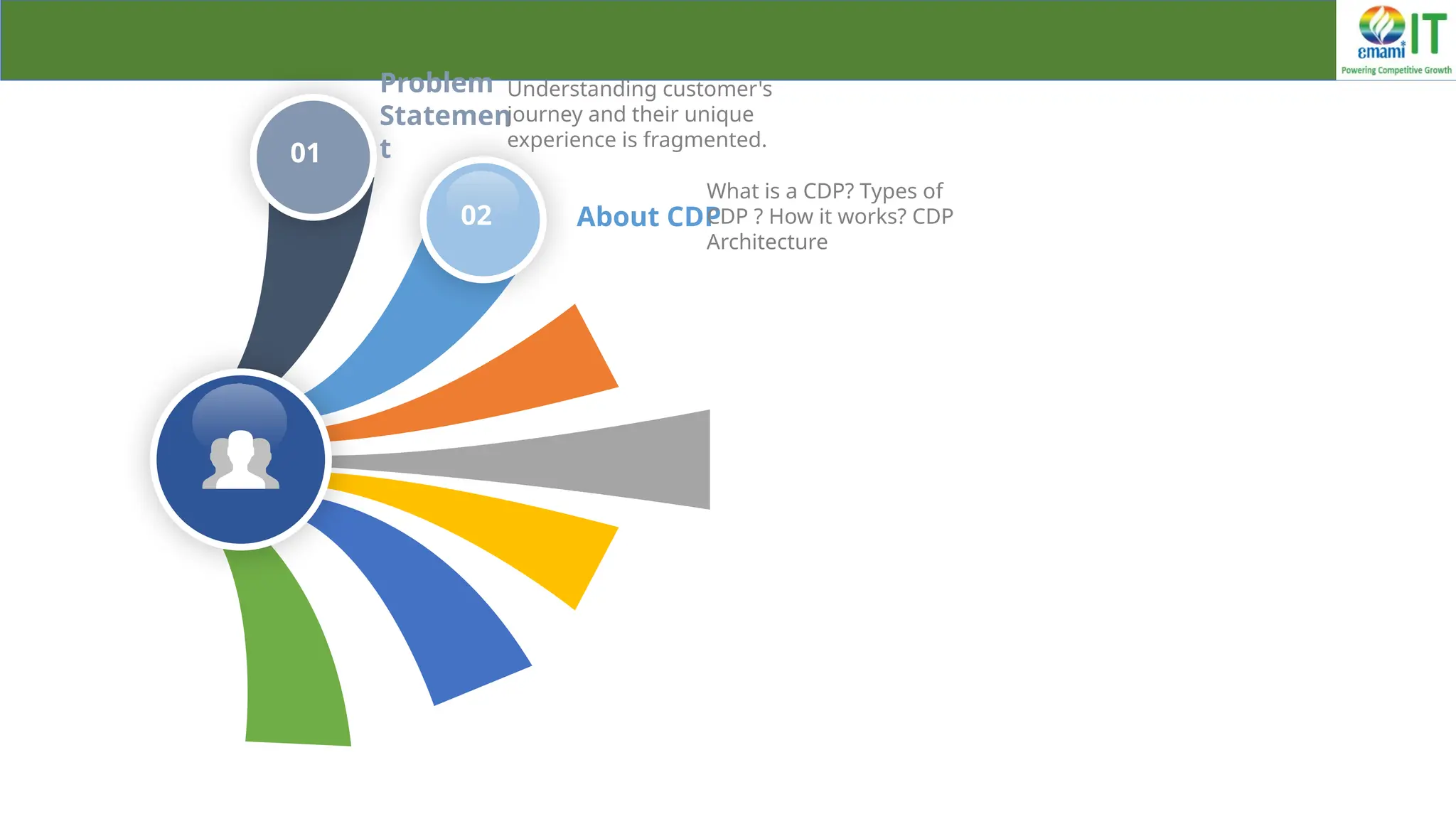
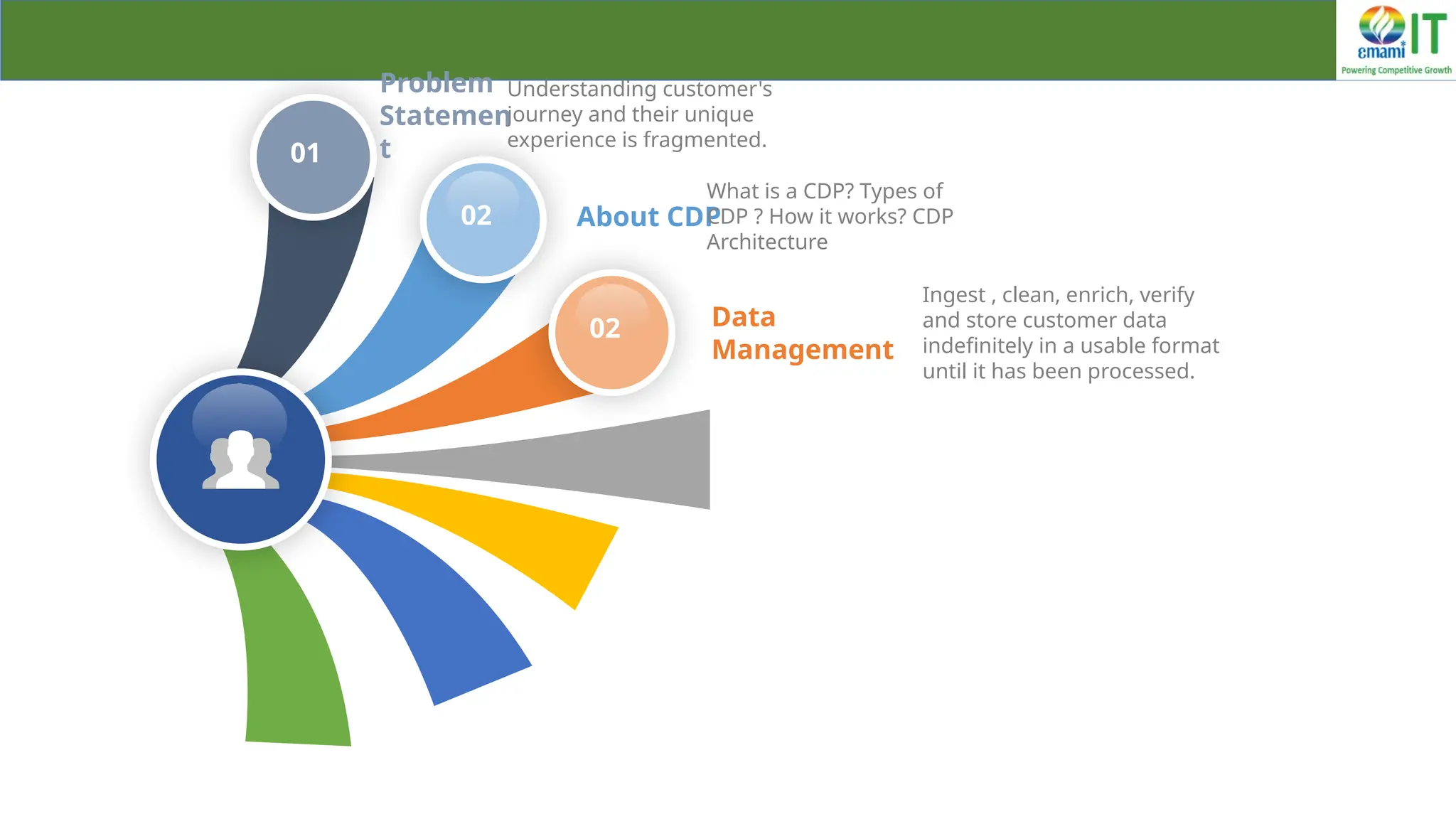
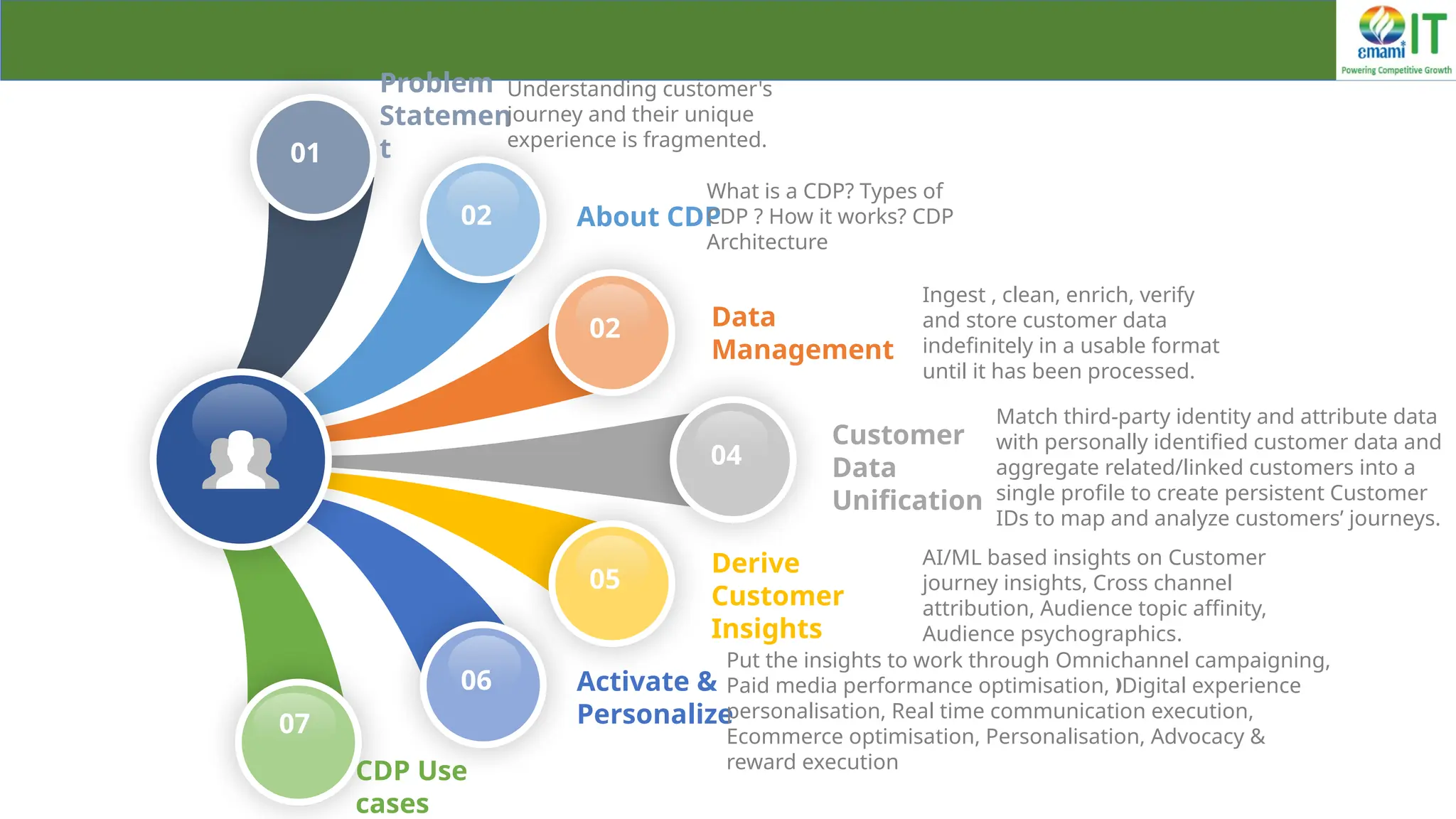
About CDP
Data
Management
Customer
Data
Unification
Derive
Customer
Insights
Activate &
Personalize
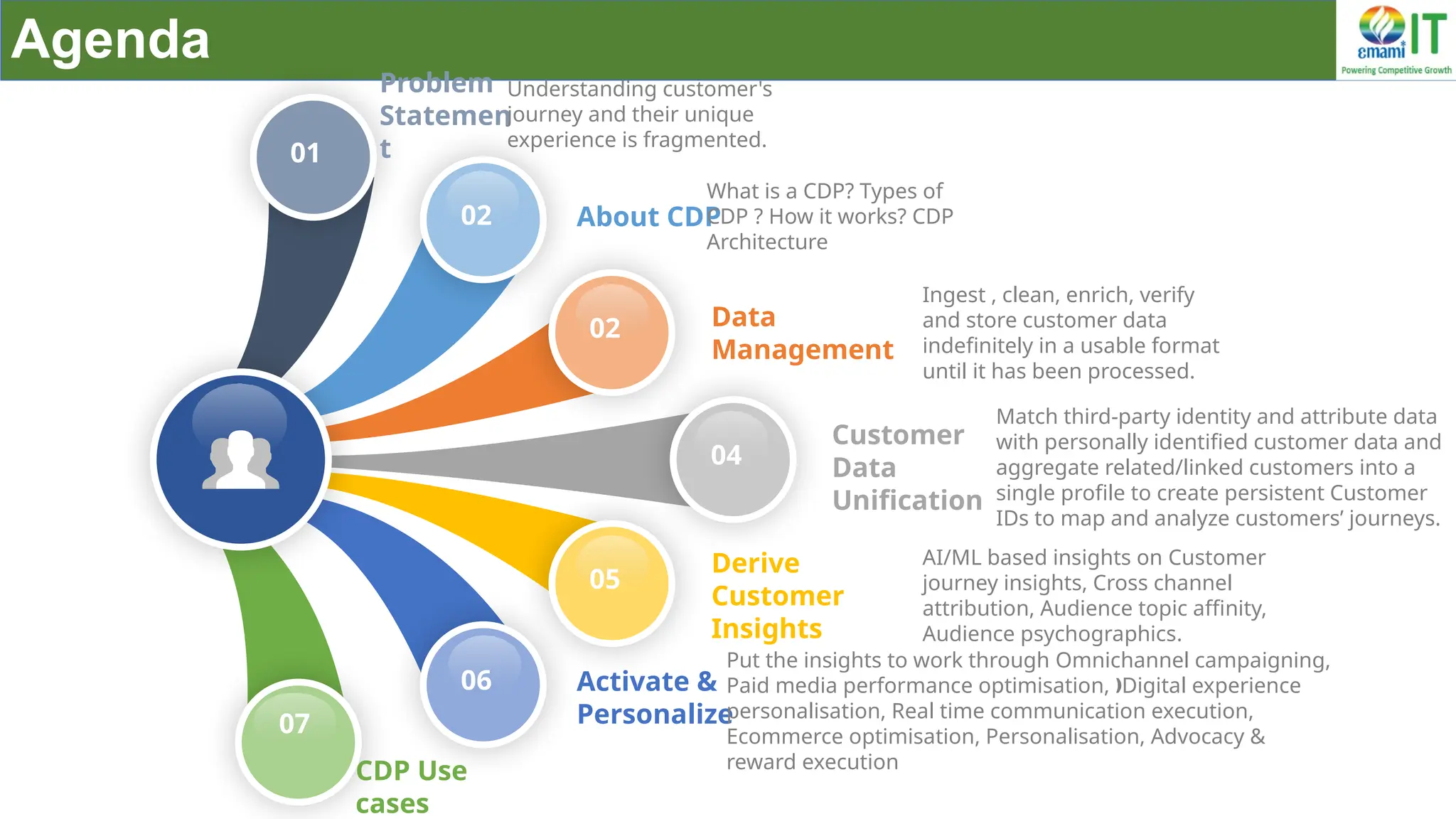
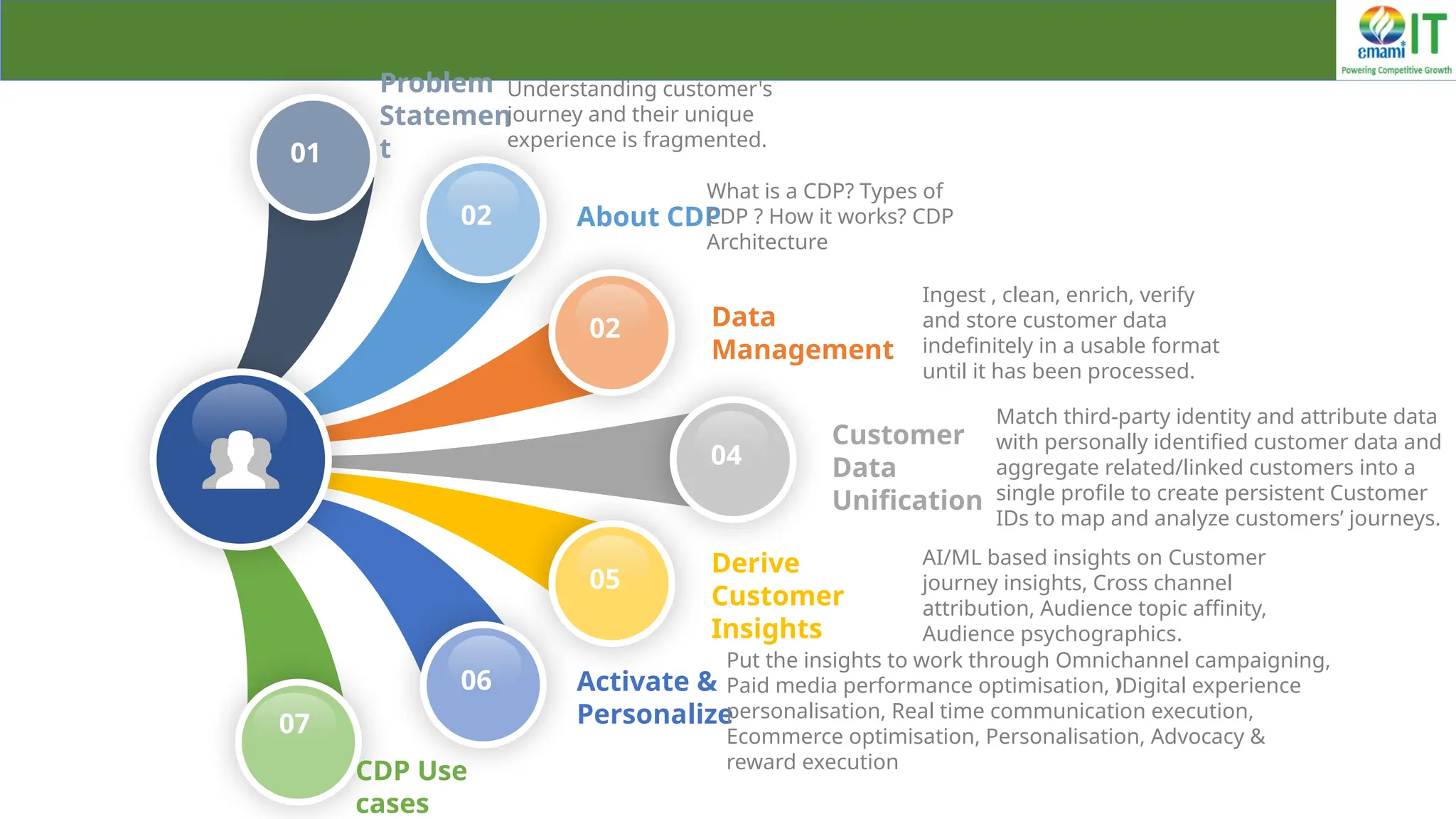
What is a CDP? Types of
CDP ? How it works? CDP
Architecture
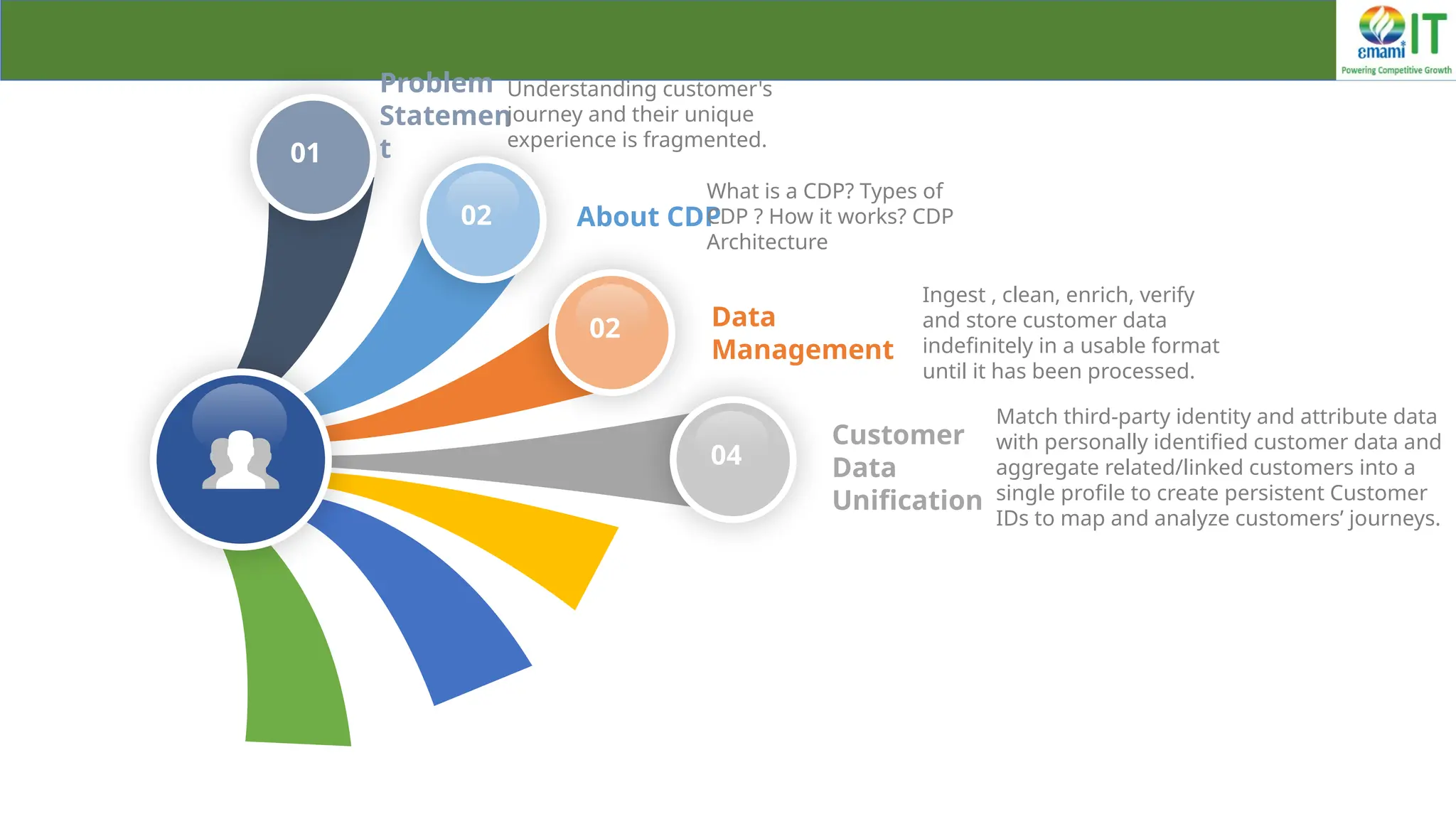
Ingest , clean, enrich, verify
and store customer data
indefinitely in a usable format
until it has been processed.
Match third-party identity and attribute data
with personally identified customer data and
aggregate related/linked customers into a
single profile to create persistent Customer
IDs to map and analyze customers’ journeys.
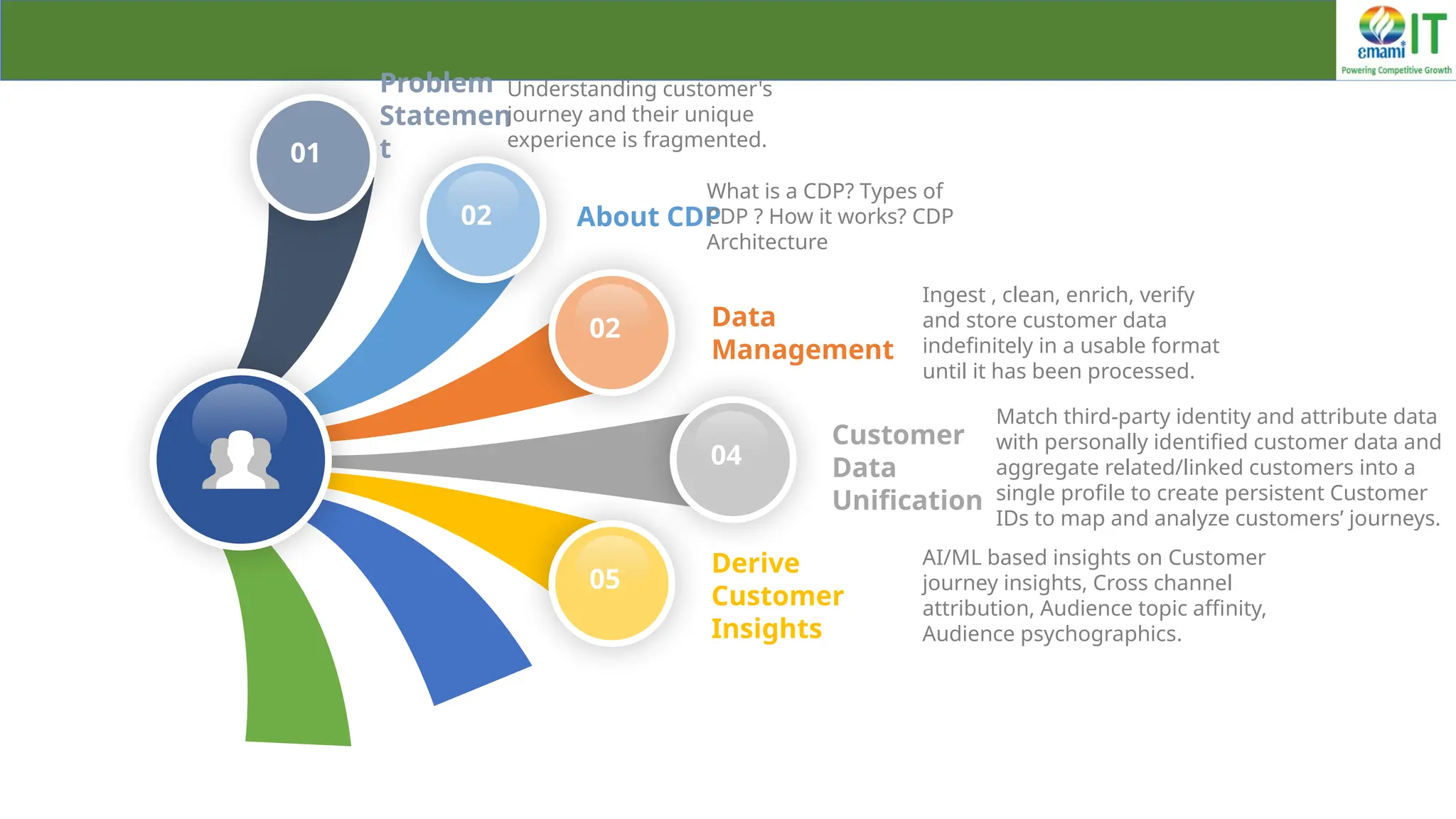
AI/ML based insights on Customer
journey insights, Cross channel
attribution, Audience topic affinity,
Audience psychographics.
Put the insights to work through Omnichannel campaigning,
Paid media performance optimisation, Digital experience
ƒ
personalisation, Real time communication execution,
Ecommerce optimisation, Personalisation, Advocacy &
reward execution
02
06
05
04
02
Agenda
07
CDP Use
cases
01
Problem
Statemen
t
Understanding customer's
journey and their unique
experience is fragmented.
01
Problem
Statemen
t
Understanding customer's
journey and their unique
experience is fragmented.
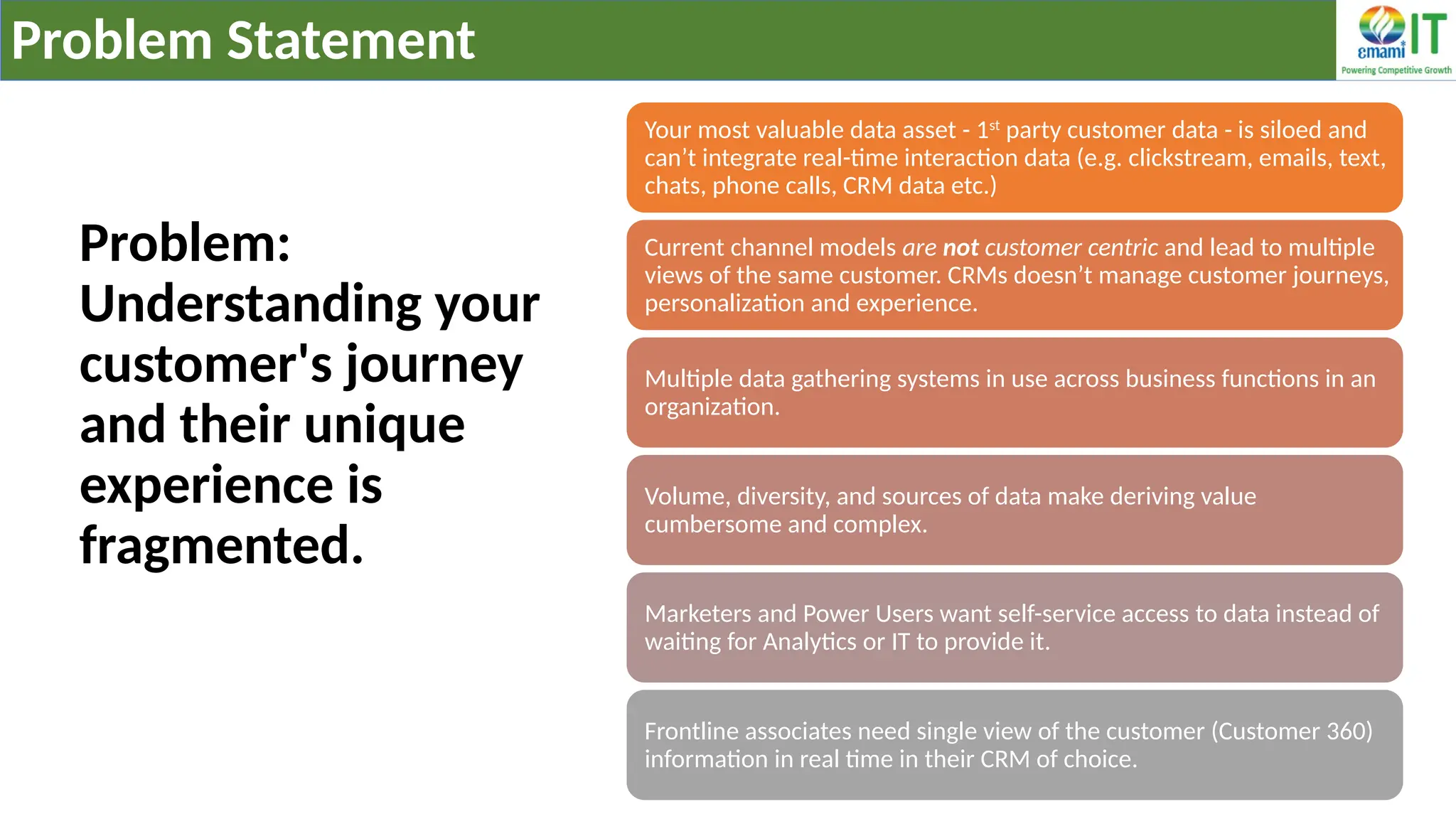
Problem:
Understanding your
customer's journey
and their unique
experience is
fragmented.
4
Your most valuable data asset - 1st
party customer data - is siloed and
can’t integrate real-time interaction data (e.g. clickstream, emails, text,
chats, phone calls, CRM data etc.)
Current channel models are not customer centric and lead to multiple
views of the same customer. CRMs doesn’t manage customer journeys,
personalization and experience.
Multiple data gathering systems in use across business functions in an
organization.
Volume, diversity, and sources of data make deriving value
cumbersome and complex.
Marketers and Power Users want self-service access to data instead of
waiting for Analytics or IT to provide it.
Frontline associates need single view of the customer (Customer 360)
information in real time in their CRM of choice.
Problem Statement
About CDP
What is a CDP? Types of
CDP ? How it works? CDP
Architecture
02
01
Problem
Statemen
t
Understanding customer's
journey and their unique
experience is fragmented.
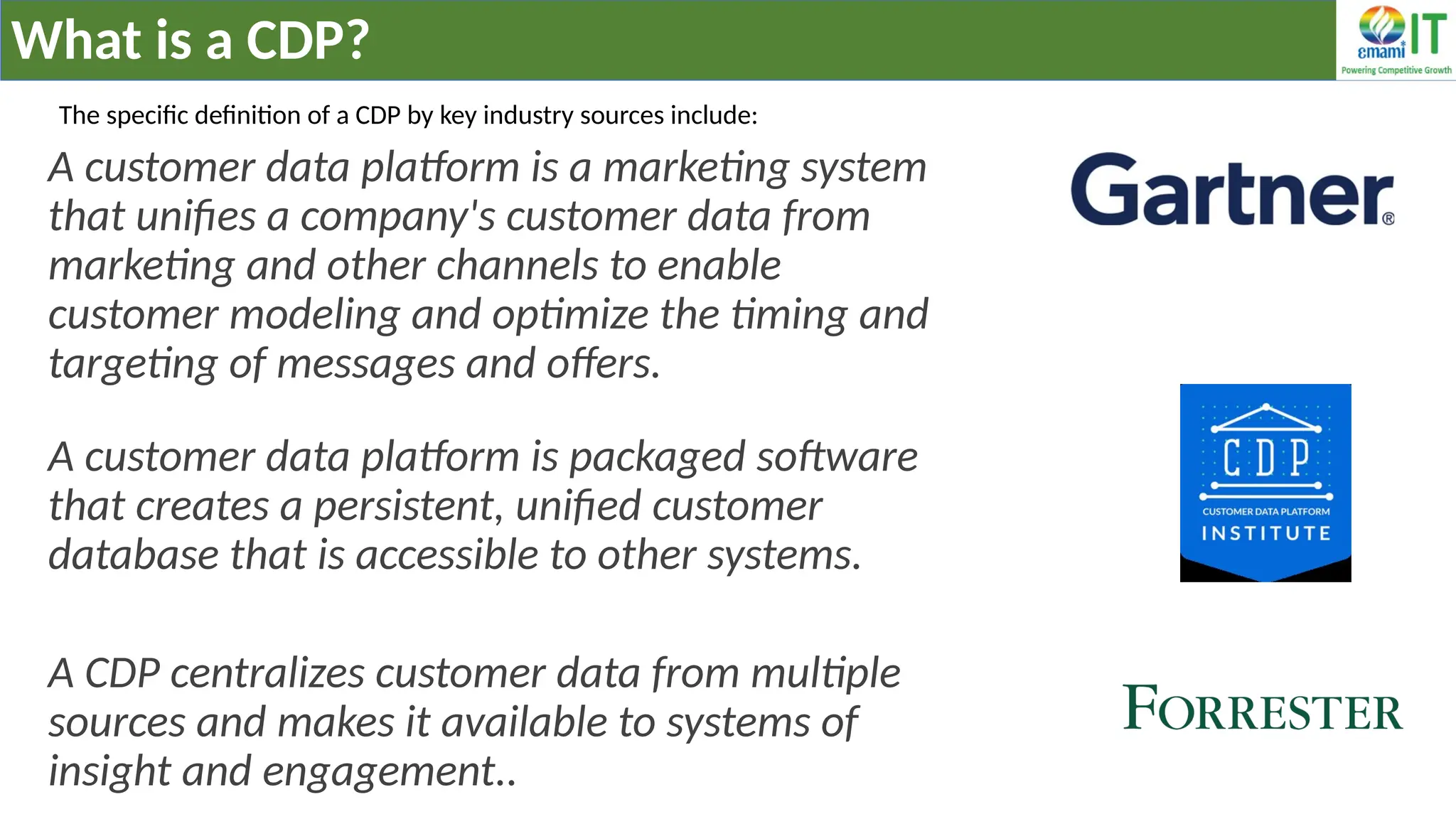
What is a CDP?
A customer data platform is a marketing system
that unifies a company's customer data from
marketing and other channels to enable
customer modeling and optimize the timing and
targeting of messages and offers.
The specific definition of a CDP by key industry sources include:
A customer data platform is packaged software
that creates a persistent, unified customer
database that is accessible to other systems.
A CDP centralizes customer data from multiple
sources and makes it available to systems of
insight and engagement..
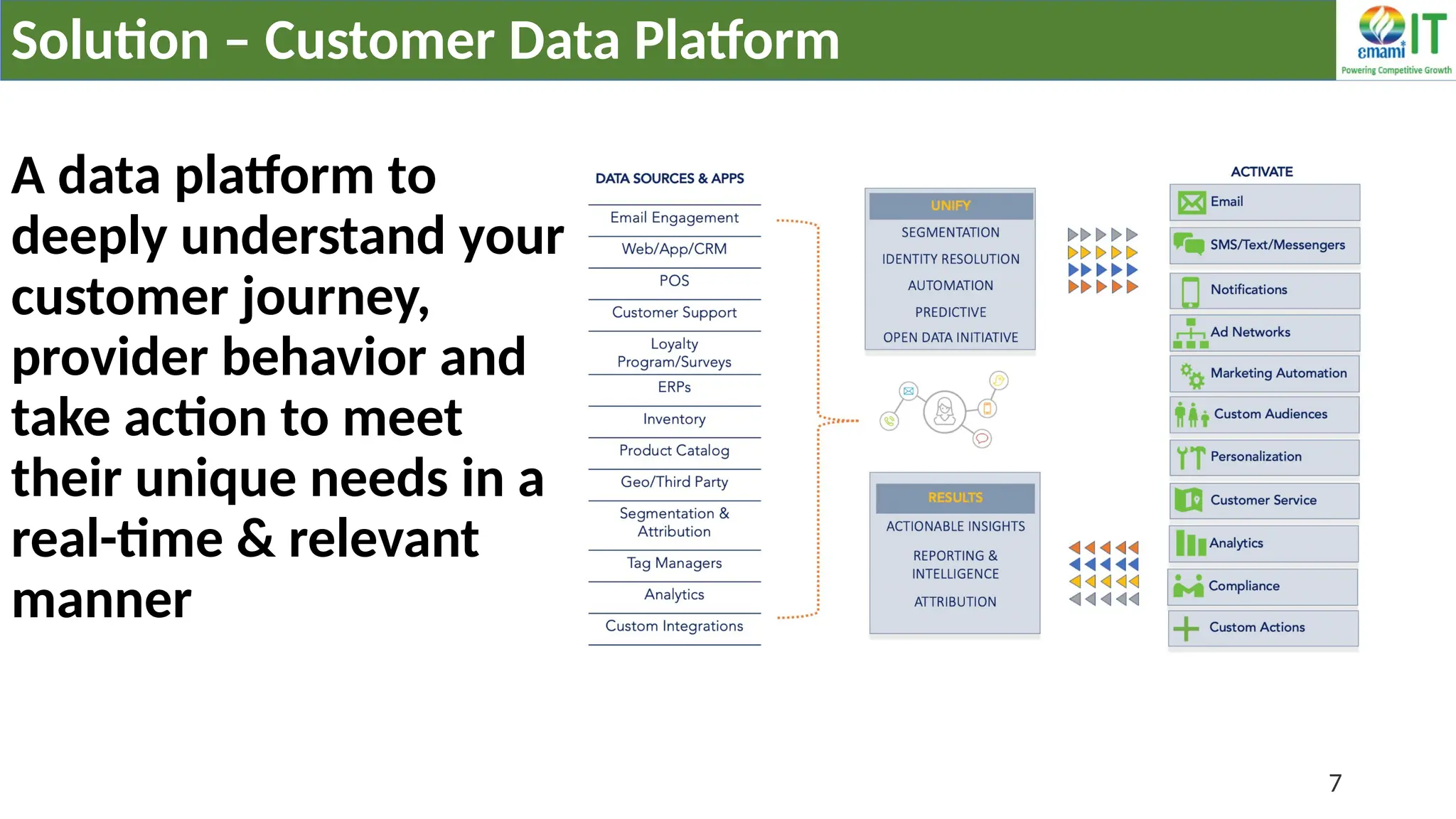
A data platform to
deeply understand your
customer journey,
provider behavior and
take action to meet
their unique needs in a
real-time & relevant
manner
7
Solution – Customer Data Platform
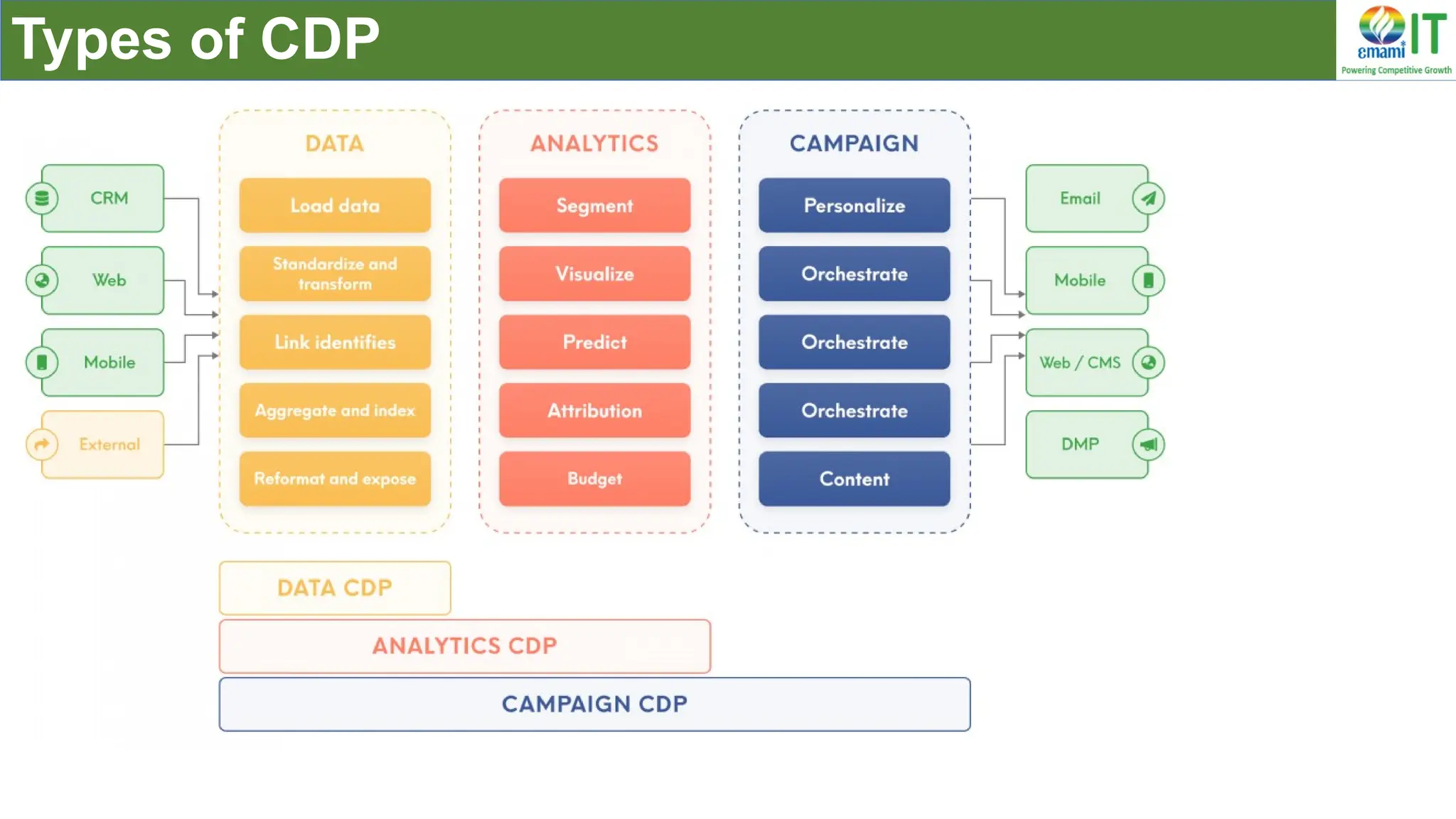
Types of CDP
04 01
03 02
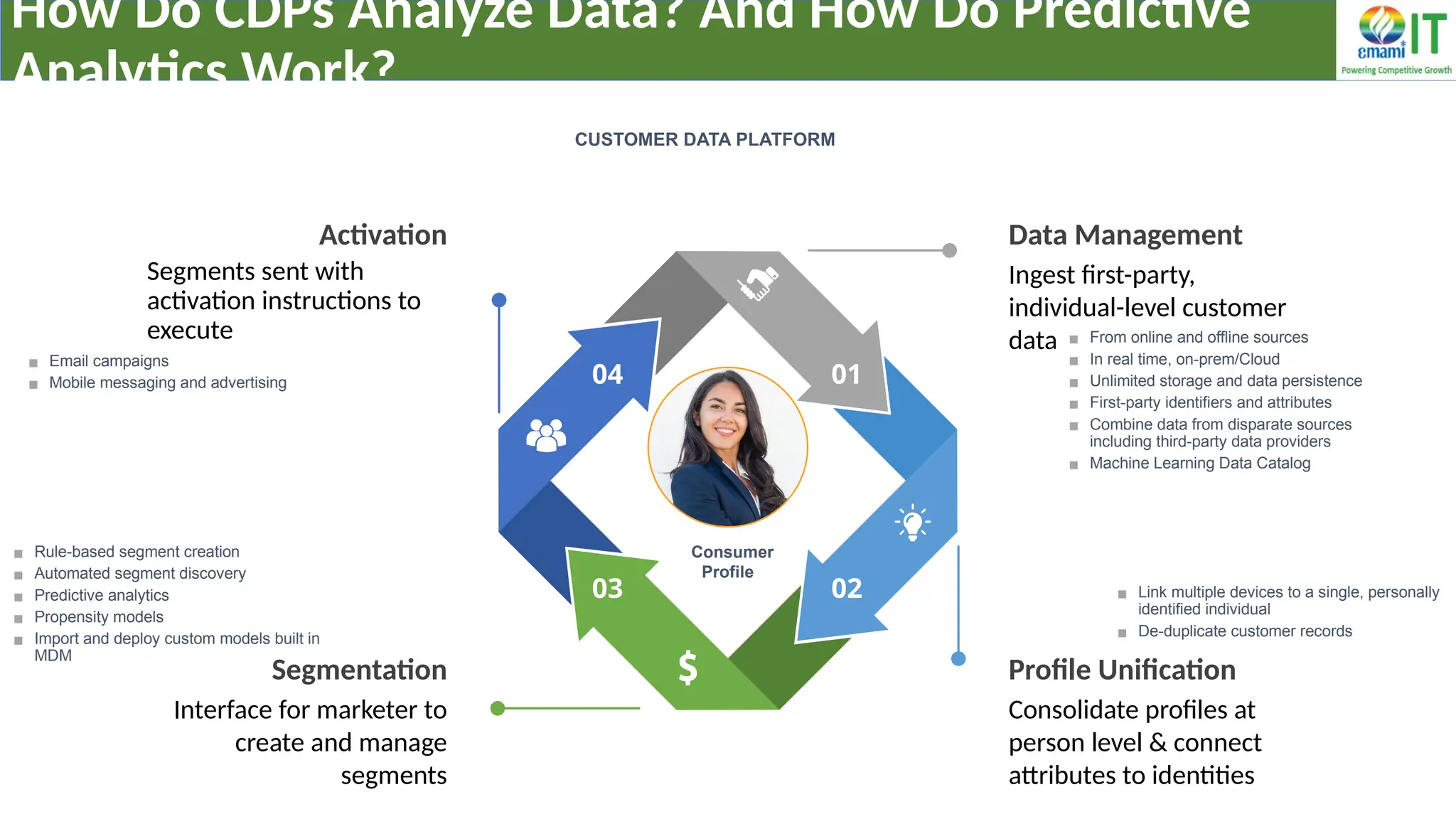
Ingest first-party,
individual-level customer
data
Data Management
Segments sent with
activation instructions to
execute
Activation
Consolidate profiles at
person level & connect
attributes to identities
Profile Unification
Interface for marketer to
create and manage
segments
Segmentation
How Do CDPs Analyze Data? And How Do Predictive
Analytics Work?
▪ Link multiple devices to a single, personally
identified individual
▪ De-duplicate customer records
▪ From online and offline sources
▪ In real time, on-prem/Cloud
▪ Unlimited storage and data persistence
▪ First-party identifiers and attributes
▪ Combine data from disparate sources
including third-party data providers
▪ Machine Learning Data Catalog
▪ Email campaigns
▪ Mobile messaging and advertising
▪ Rule-based segment creation
▪ Automated segment discovery
▪ Predictive analytics
▪ Propensity models
▪ Import and deploy custom models built in
MDM
Consumer
Profile
CUSTOMER DATA PLATFORM
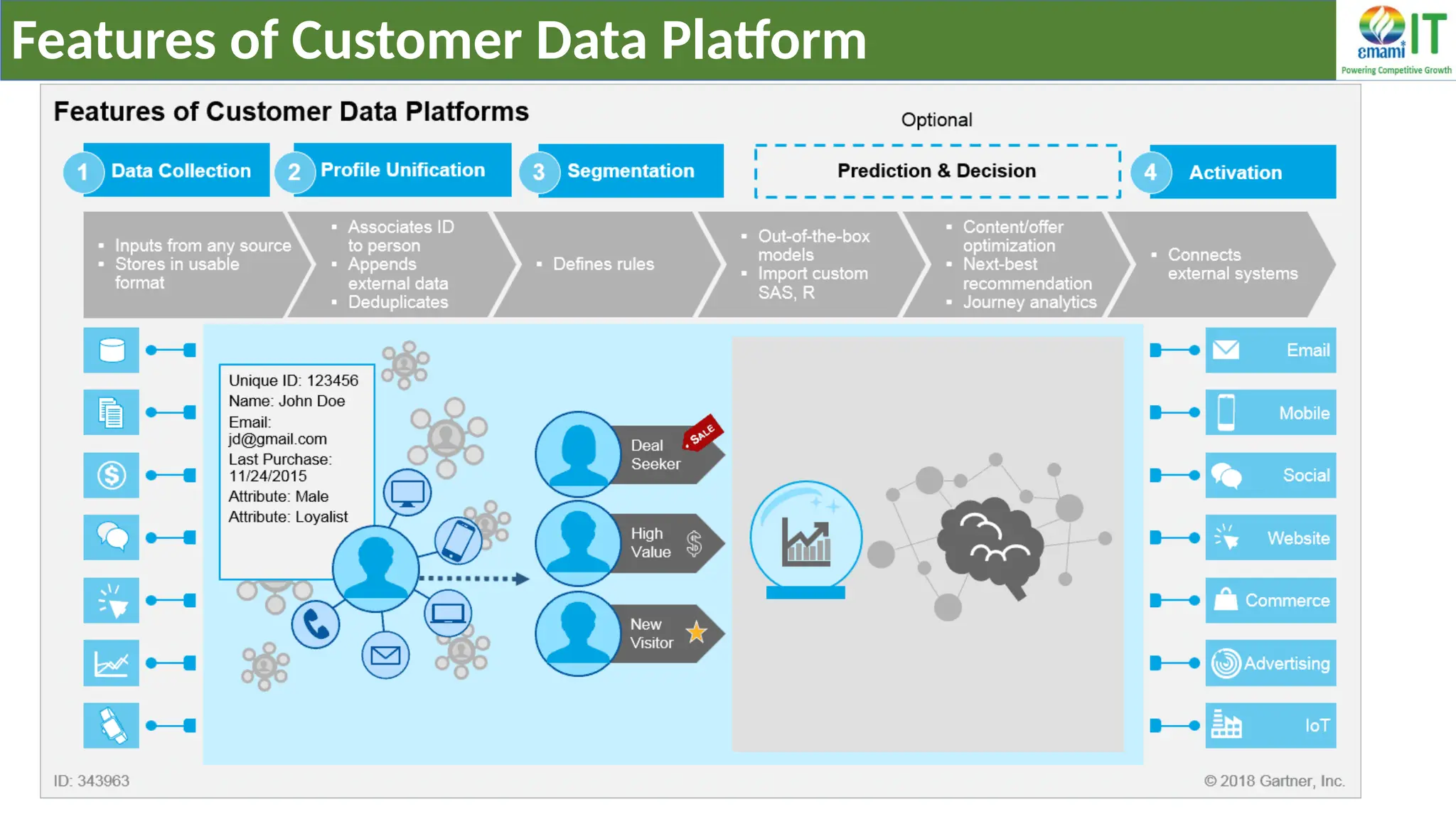
Features of Customer Data Platform
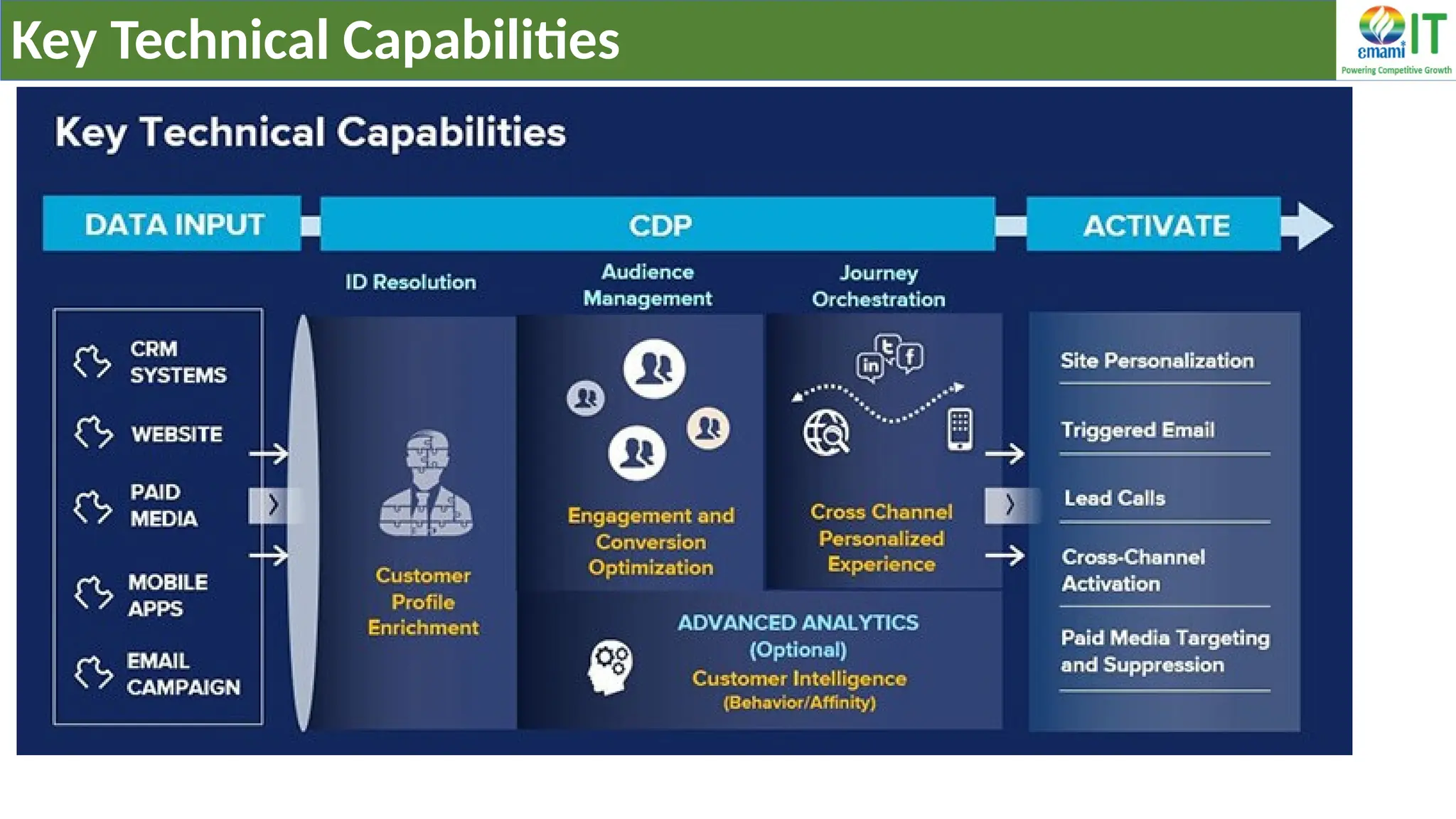
Key Technical Capabilities
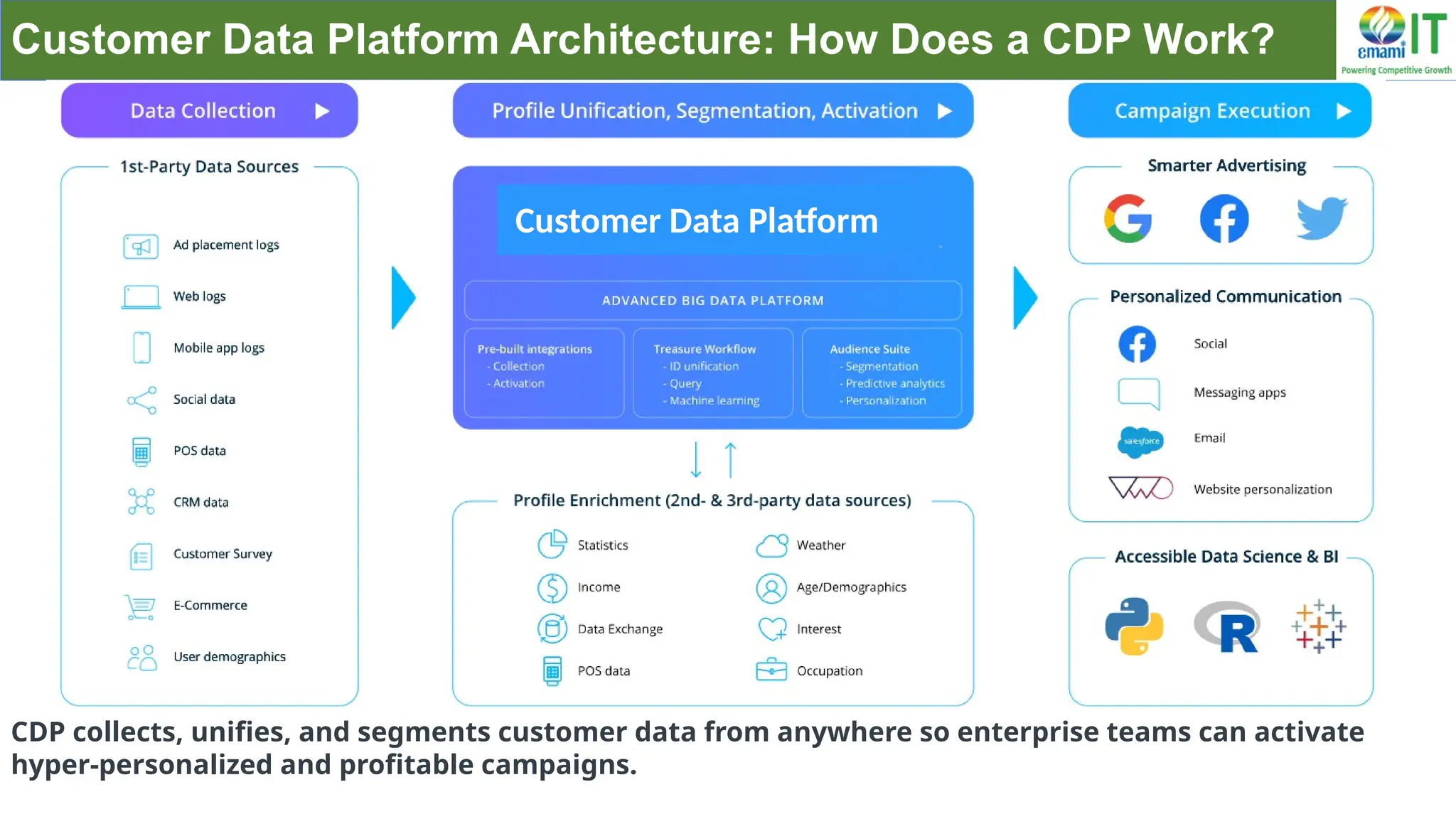
Customer Data Platform Architecture: How Does a CDP Work?
CDP collects, unifies, and segments customer data from anywhere so enterprise teams can activate
hyper-personalized and profitable campaigns.
Customer Data Platform
About CDP
Data
Management
What is a CDP? Types of
CDP ? How it works? CDP
Architecture
Ingest , clean, enrich, verify
and store customer data
indefinitely in a usable format
until it has been processed.
02
02
01
Problem
Statemen
t
Understanding customer's
journey and their unique
experience is fragmented.
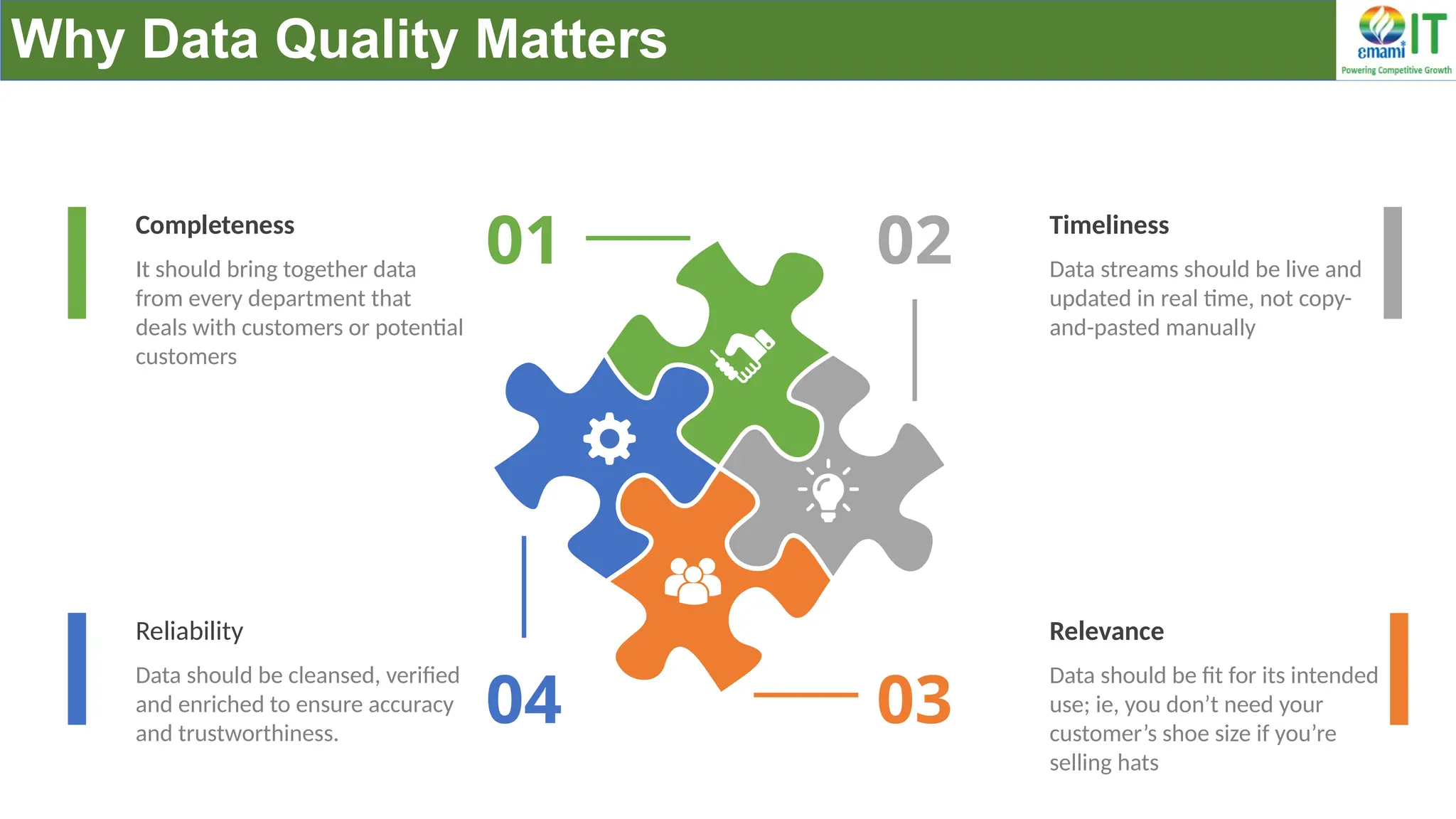
Why Data Quality Matters
01 02
04 03
Data streams should be live and
updated in real time, not copy-
and-pasted manually
Timeliness
Data should be fit for its intended
use; ie, you don’t need your
customer’s shoe size if you’re
selling hats
Relevance
Data should be cleansed, verified
and enriched to ensure accuracy
and trustworthiness.
Reliability
It should bring together data
from every department that
deals with customers or potential
customers
Completeness
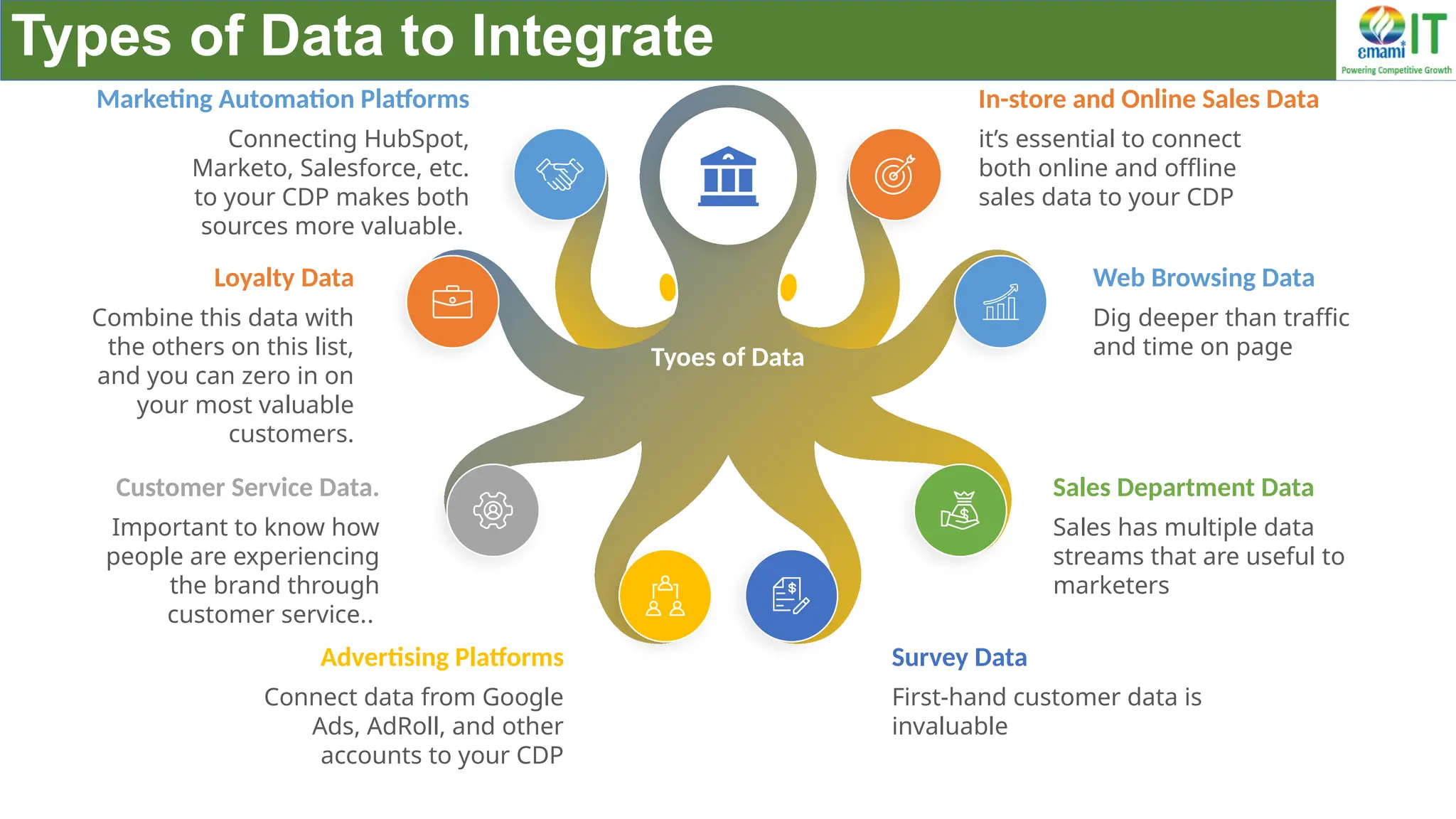
Tyoes of Data
Dig deeper than traffic
and time on page
Web Browsing Data
Combine this data with
the others on this list,
and you can zero in on
your most valuable
customers.
Loyalty Data
Sales has multiple data
streams that are useful to
marketers
Sales Department Data
Important to know how
people are experiencing
the brand through
customer service..
Customer Service Data.
Connect data from Google
Ads, AdRoll, and other
accounts to your CDP
Advertising Platforms
First-hand customer data is
invaluable
Survey Data
it’s essential to connect
both online and offline
sales data to your CDP
In-store and Online Sales Data
Connecting HubSpot,
Marketo, Salesforce, etc.
to your CDP makes both
sources more valuable.
Marketing Automation Platforms
Types of Data to Integrate
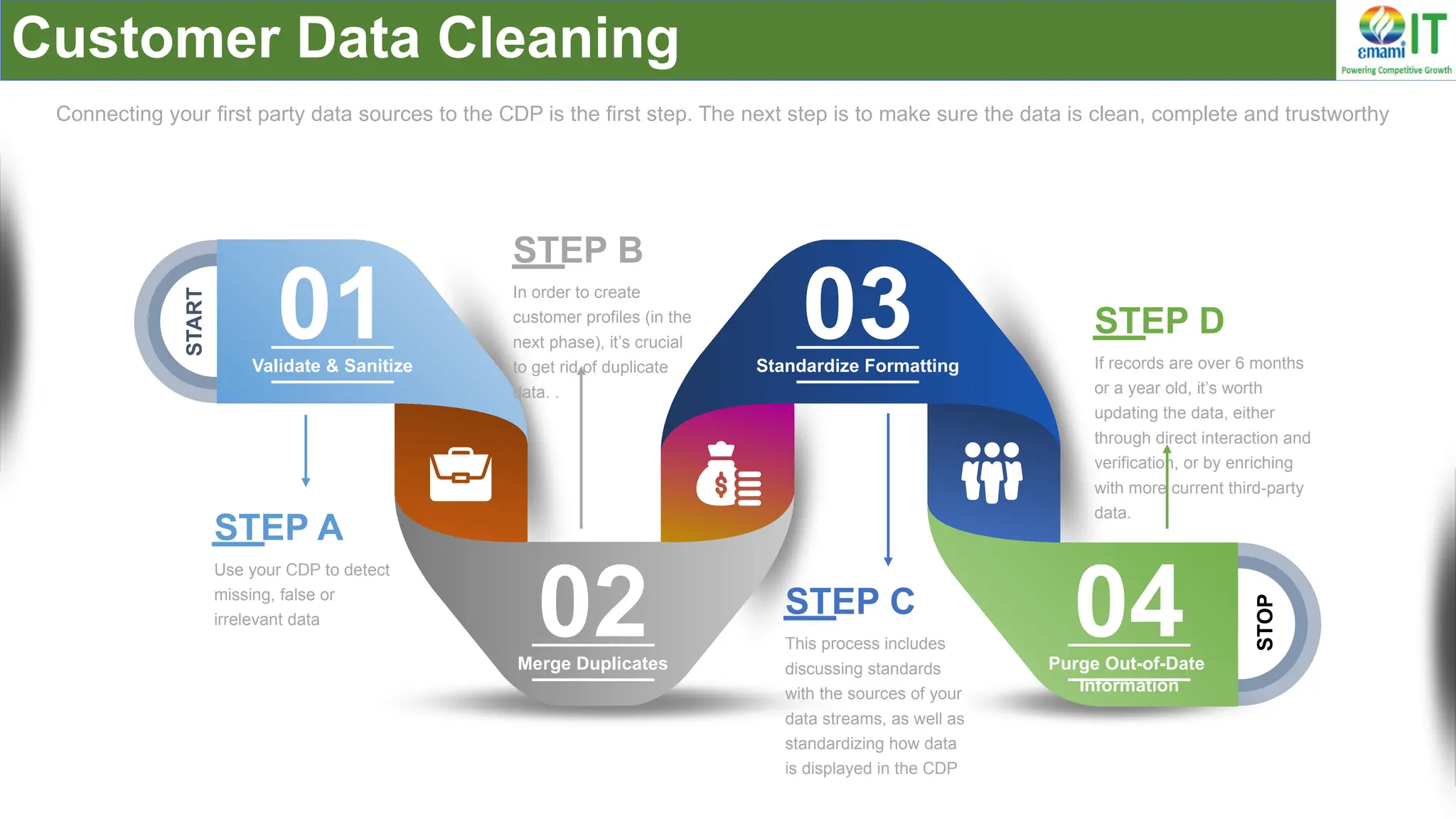
Customer Data Cleaning
Connecting your first party data sources to the CDP is the first step. The next step is to make sure the data is clean, complete and trustworthy
START
STOP
01
Validate & Sanitize
02
Merge Duplicates
03
Standardize Formatting
04
Purge Out-of-Date
Information
STEP B
In order to create
customer profiles (in the
next phase), it’s crucial
to get rid of duplicate
data. .
STEP D
If records are over 6 months
or a year old, it’s worth
updating the data, either
through direct interaction and
verification, or by enriching
with more current third-party
data.
STEP A
Use your CDP to detect
missing, false or
irrelevant data
STEP C
This process includes
discussing standards
with the sources of your
data streams, as well as
standardizing how data
is displayed in the CDP
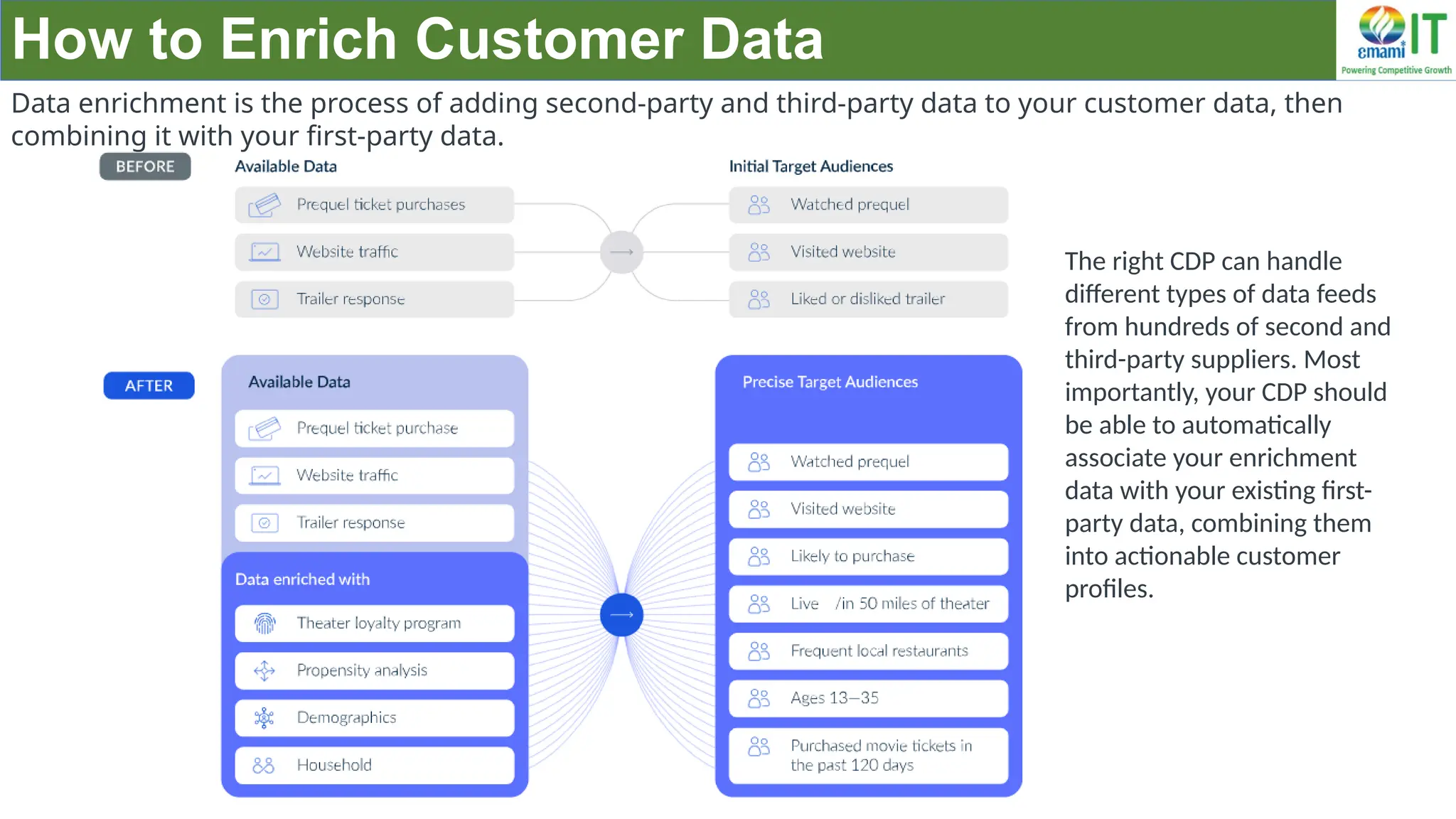
How to Enrich Customer Data
The right CDP can handle
different types of data feeds
from hundreds of second and
third-party suppliers. Most
importantly, your CDP should
be able to automatically
associate your enrichment
data with your existing first-
party data, combining them
into actionable customer
profiles.
Data enrichment is the process of adding second-party and third-party data to your customer data, then
combining it with your first-party data.
About CDP
Data
Management
Customer
Data
Unification
What is a CDP? Types of
CDP ? How it works? CDP
Architecture
Ingest , clean, enrich, verify
and store customer data
indefinitely in a usable format
until it has been processed.
Match third-party identity and attribute data
with personally identified customer data and
aggregate related/linked customers into a
single profile to create persistent Customer
IDs to map and analyze customers’ journeys.
02
04
02
01
Problem
Statemen
t
Understanding customer's
journey and their unique
experience is fragmented.
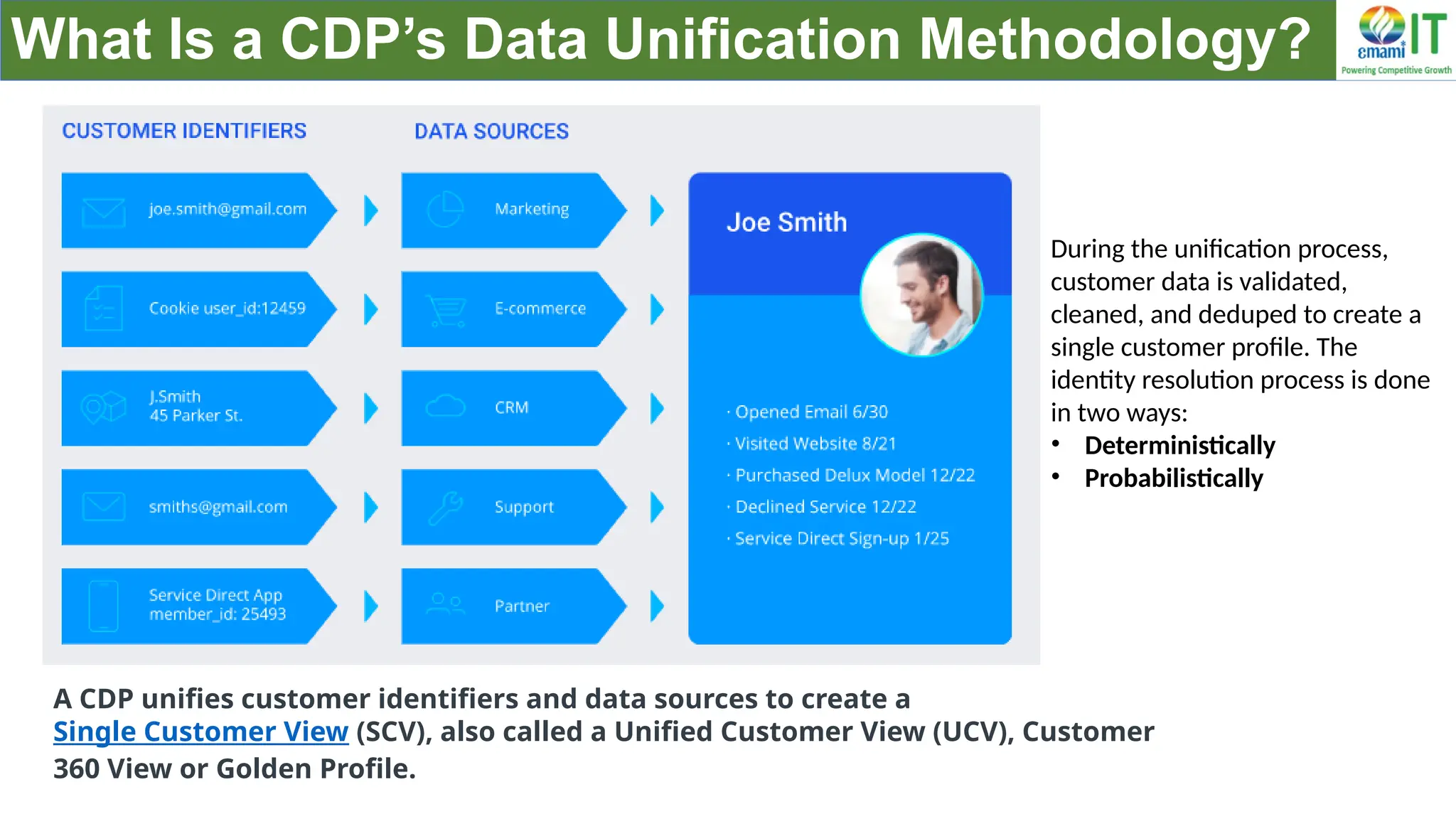
What Is a CDP’s Data Unification Methodology?
A CDP unifies customer identifiers and data sources to create a
Single Customer View (SCV), also called a Unified Customer View (UCV), Customer
360 View or Golden Profile.
During the unification process,
customer data is validated,
cleaned, and deduped to create a
single customer profile. The
identity resolution process is done
in two ways:
• Deterministically
• Probabilistically
About CDP
Data
Management
Customer
Data
Unification
Derive
Customer
Insights
What is a CDP? Types of
CDP ? How it works? CDP
Architecture
Ingest , clean, enrich, verify
and store customer data
indefinitely in a usable format
until it has been processed.
Match third-party identity and attribute data
with personally identified customer data and
aggregate related/linked customers into a
single profile to create persistent Customer
IDs to map and analyze customers’ journeys.
AI/ML based insights on Customer
journey insights, Cross channel
attribution, Audience topic affinity,
Audience psychographics.
02
05
04
02
01
Problem
Statemen
t
Understanding customer's
journey and their unique
experience is fragmented.
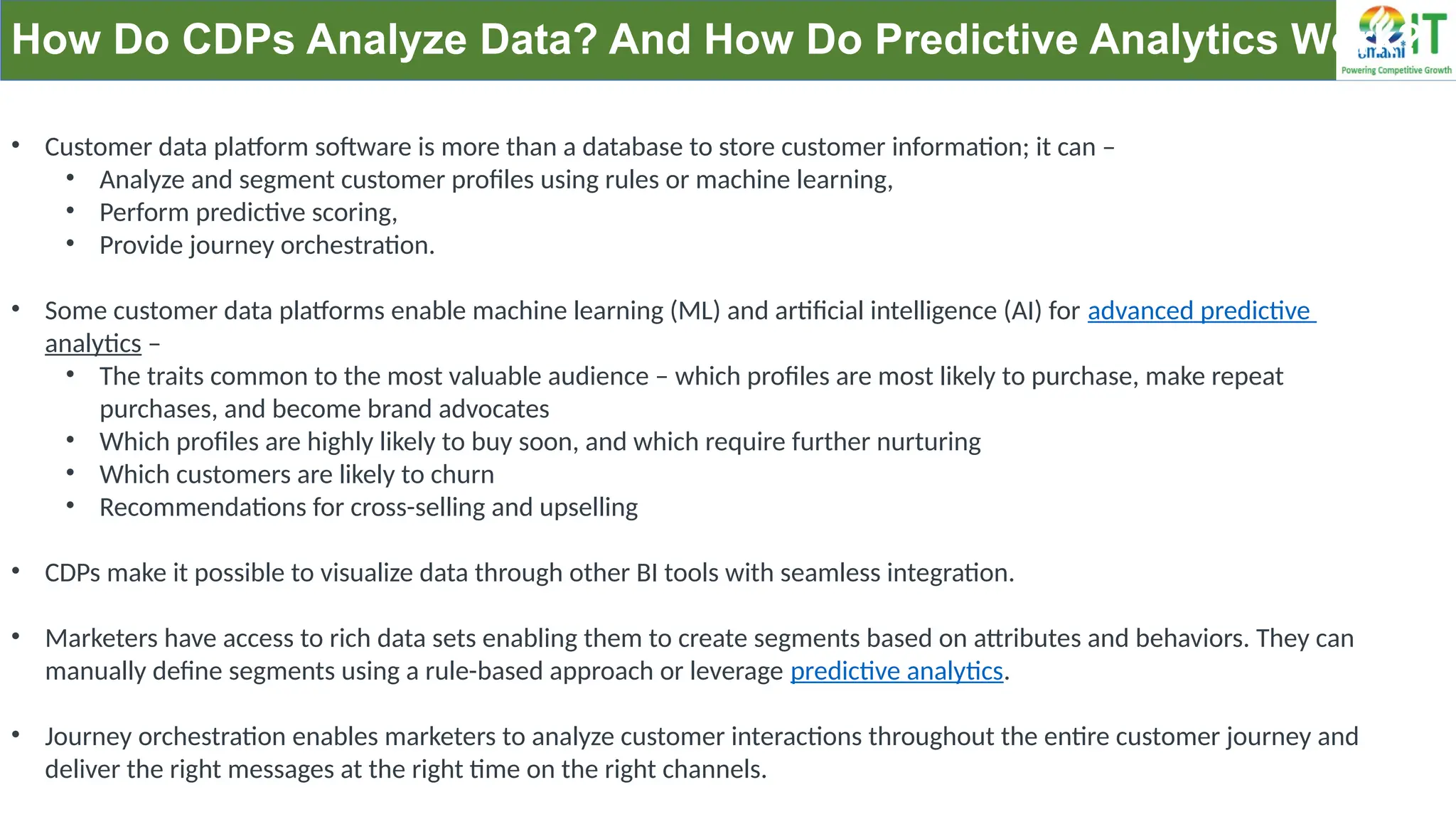
How Do CDPs Analyze Data? And How Do Predictive Analytics Work?
• Customer data platform software is more than a database to store customer information; it can –
• Analyze and segment customer profiles using rules or machine learning,
• Perform predictive scoring,
• Provide journey orchestration.
• Some customer data platforms enable machine learning (ML) and artificial intelligence (AI) for advanced predictive
analytics –
• The traits common to the most valuable audience – which profiles are most likely to purchase, make repeat
purchases, and become brand advocates
• Which profiles are highly likely to buy soon, and which require further nurturing
• Which customers are likely to churn
• Recommendations for cross-selling and upselling
• CDPs make it possible to visualize data through other BI tools with seamless integration.
• Marketers have access to rich data sets enabling them to create segments based on attributes and behaviors. They can
manually define segments using a rule-based approach or leverage predictive analytics.
• Journey orchestration enables marketers to analyze customer interactions throughout the entire customer journey and
deliver the right messages at the right time on the right channels.
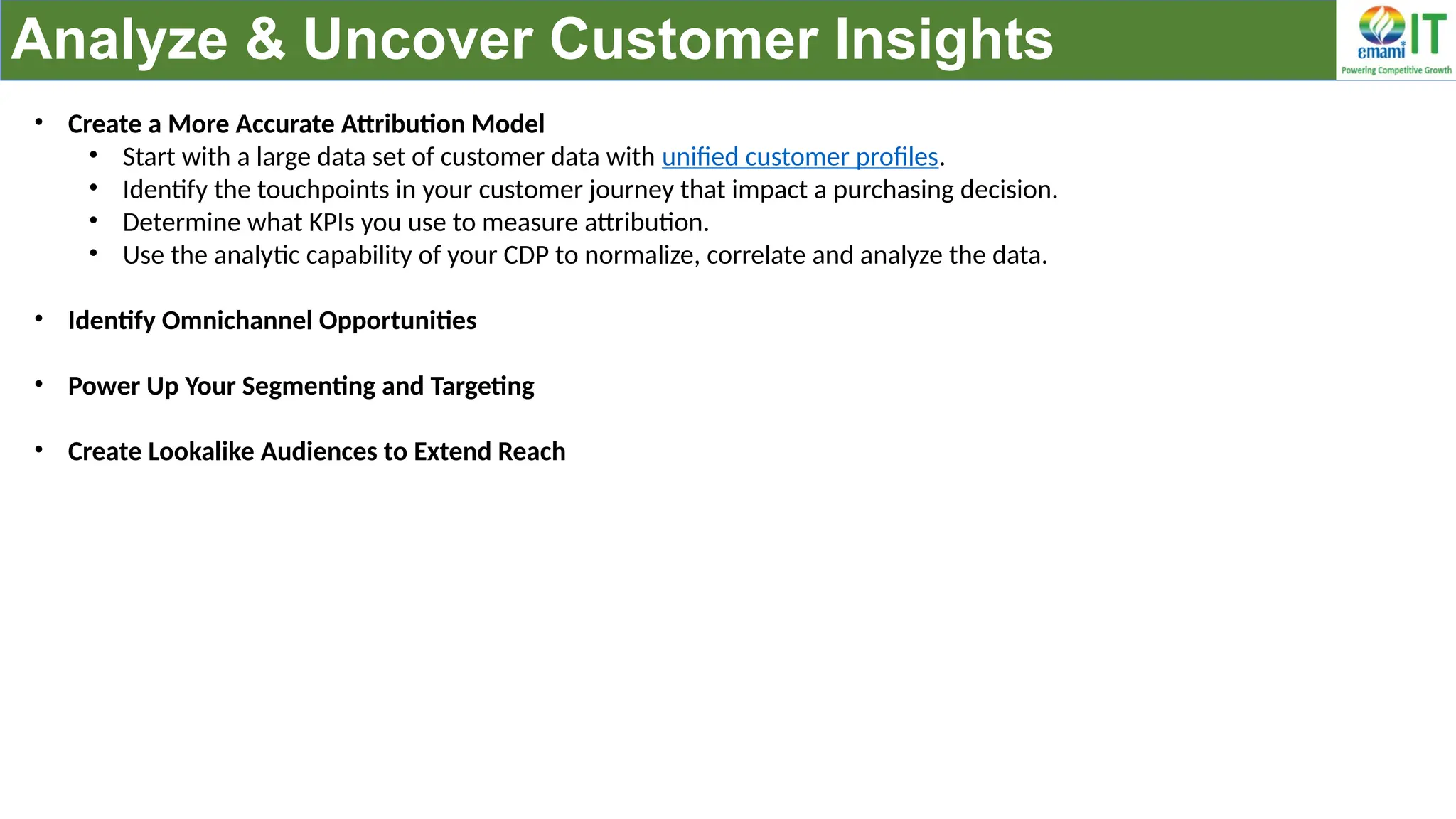
Analyze & Uncover Customer Insights
• Create a More Accurate Attribution Model
• Start with a large data set of customer data with unified customer profiles.
• Identify the touchpoints in your customer journey that impact a purchasing decision.
• Determine what KPIs you use to measure attribution.
• Use the analytic capability of your CDP to normalize, correlate and analyze the data.
• Identify Omnichannel Opportunities
• Power Up Your Segmenting and Targeting
• Create Lookalike Audiences to Extend Reach
About CDP
Data
Management
Customer
Data
Unification
Derive
Customer
Insights
Activate &
Personalize
What is a CDP? Types of
CDP ? How it works? CDP
Architecture
Ingest , clean, enrich, verify
and store customer data
indefinitely in a usable format
until it has been processed.
Match third-party identity and attribute data
with personally identified customer data and
aggregate related/linked customers into a
single profile to create persistent Customer
IDs to map and analyze customers’ journeys.
AI/ML based insights on Customer
journey insights, Cross channel
attribution, Audience topic affinity,
Audience psychographics.
Put the insights to work through Omnichannel campaigning,
Paid media performance optimisation, Digital experience
ƒ
personalisation, Real time communication execution,
Ecommerce optimisation, Personalisation, Advocacy &
reward execution
02
06
05
04
02
07
CDP Use
cases
01
Problem
Statemen
t
Understanding customer's
journey and their unique
experience is fragmented.
What Is a CDP’s Data Activation Capability?
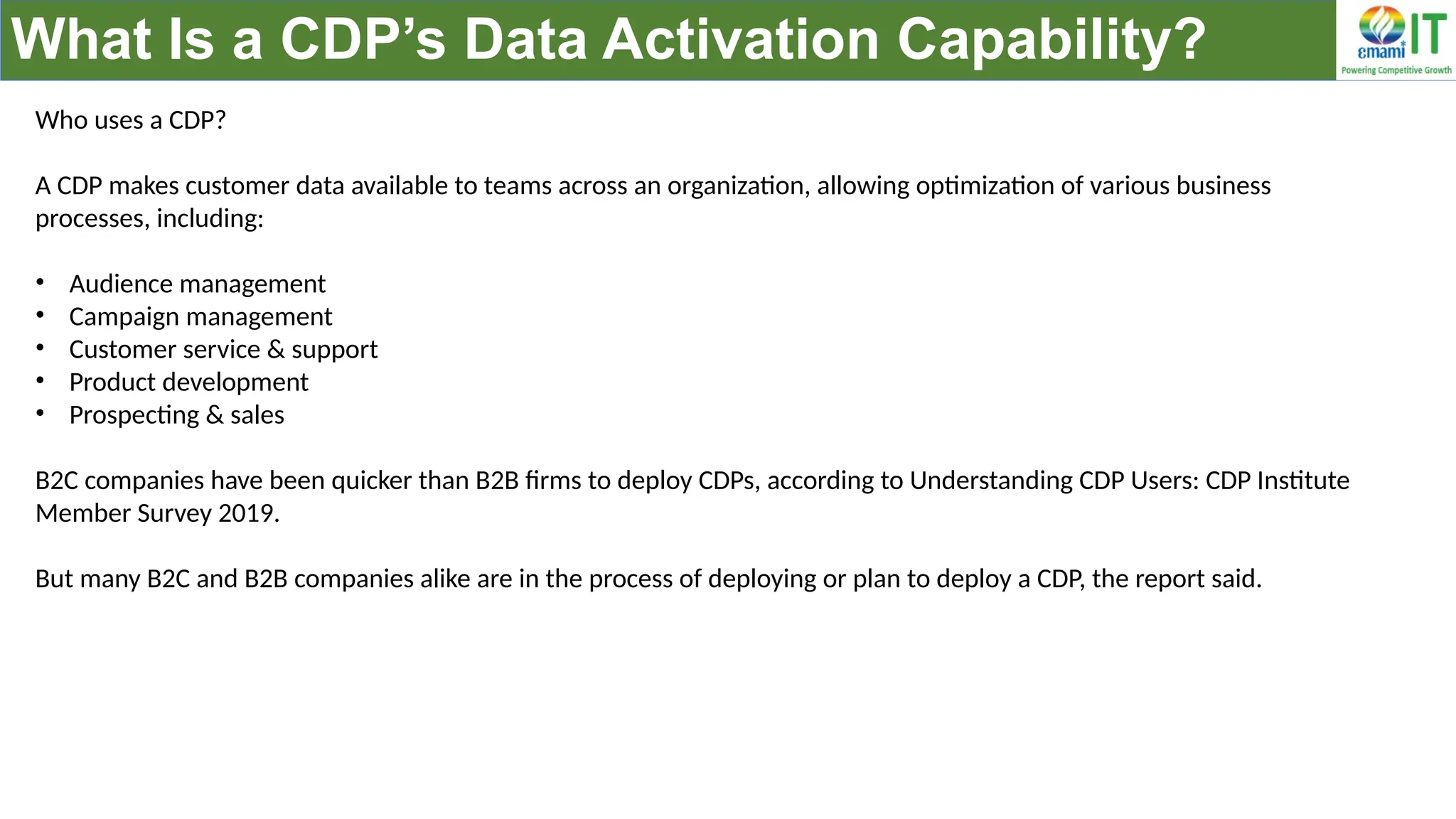
Who uses a CDP?
A CDP makes customer data available to teams across an organization, allowing optimization of various business
processes, including:
• Audience management
• Campaign management
• Customer service & support
• Product development
• Prospecting & sales
B2C companies have been quicker than B2B firms to deploy CDPs, according to Understanding CDP Users: CDP Institute
Member Survey 2019.
But many B2C and B2B companies alike are in the process of deploying or plan to deploy a CDP, the report said.
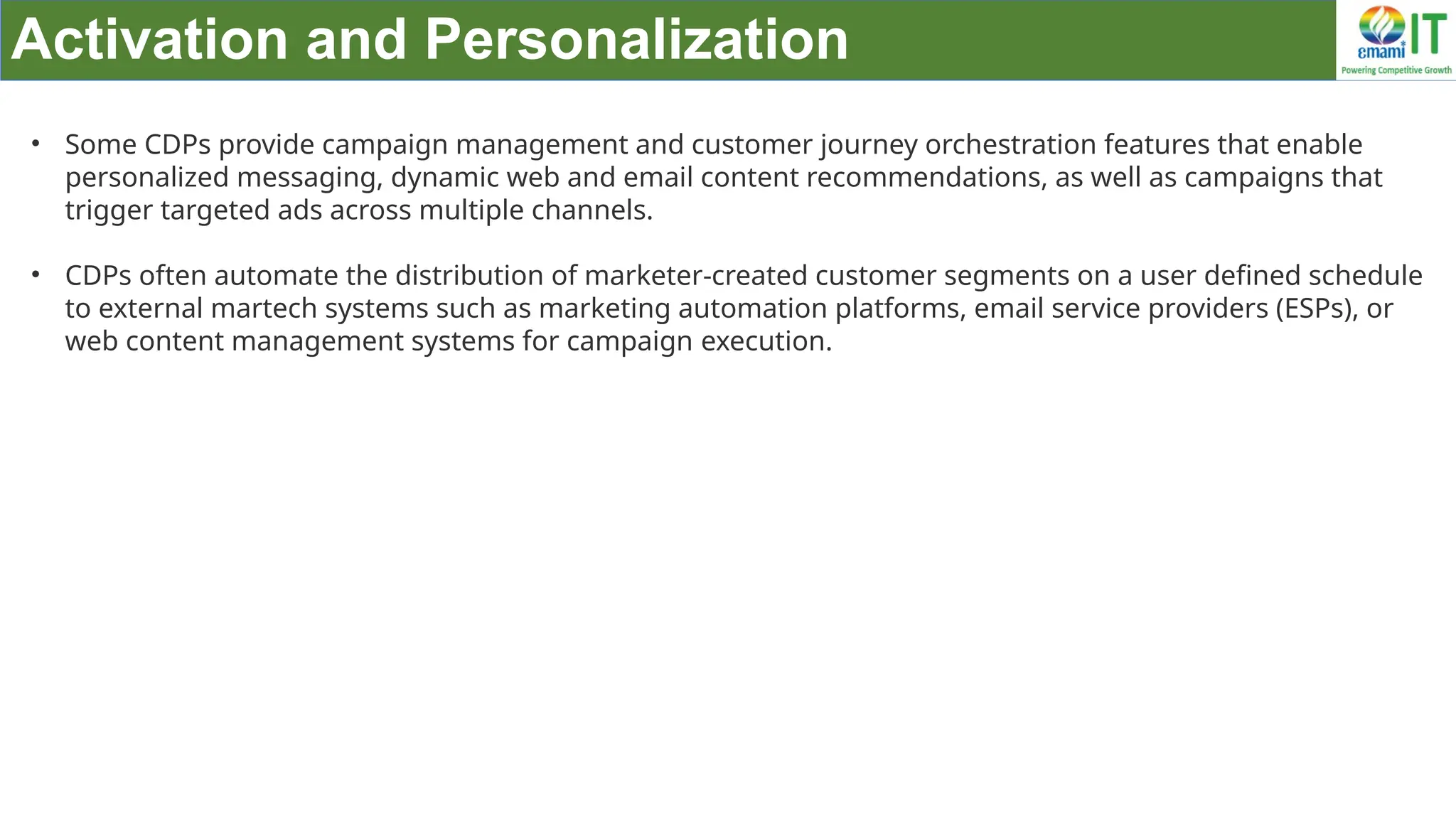
Activation and Personalization
• Some CDPs provide campaign management and customer journey orchestration features that enable
personalized messaging, dynamic web and email content recommendations, as well as campaigns that
trigger targeted ads across multiple channels.
• CDPs often automate the distribution of marketer-created customer segments on a user defined schedule
to external martech systems such as marketing automation platforms, email service providers (ESPs), or
web content management systems for campaign execution.
About CDP
Data
Management
Customer
Data
Unification
Derive
Customer
Insights
Activate &
Personalize
What is a CDP? Types of
CDP ? How it works? CDP
Architecture
Ingest , clean, enrich, verify
and store customer data
indefinitely in a usable format
until it has been processed.
Match third-party identity and attribute data
with personally identified customer data and
aggregate related/linked customers into a
single profile to create persistent Customer
IDs to map and analyze customers’ journeys.
AI/ML based insights on Customer
journey insights, Cross channel
attribution, Audience topic affinity,
Audience psychographics.
Put the insights to work through Omnichannel campaigning,
Paid media performance optimisation, Digital experience
ƒ
personalisation, Real time communication execution,
Ecommerce optimisation, Personalisation, Advocacy &
reward execution
02
06
05
04
02
07
CDP Use
cases
01
Problem
Statemen
t
Understanding customer's
journey and their unique
experience is fragmented.
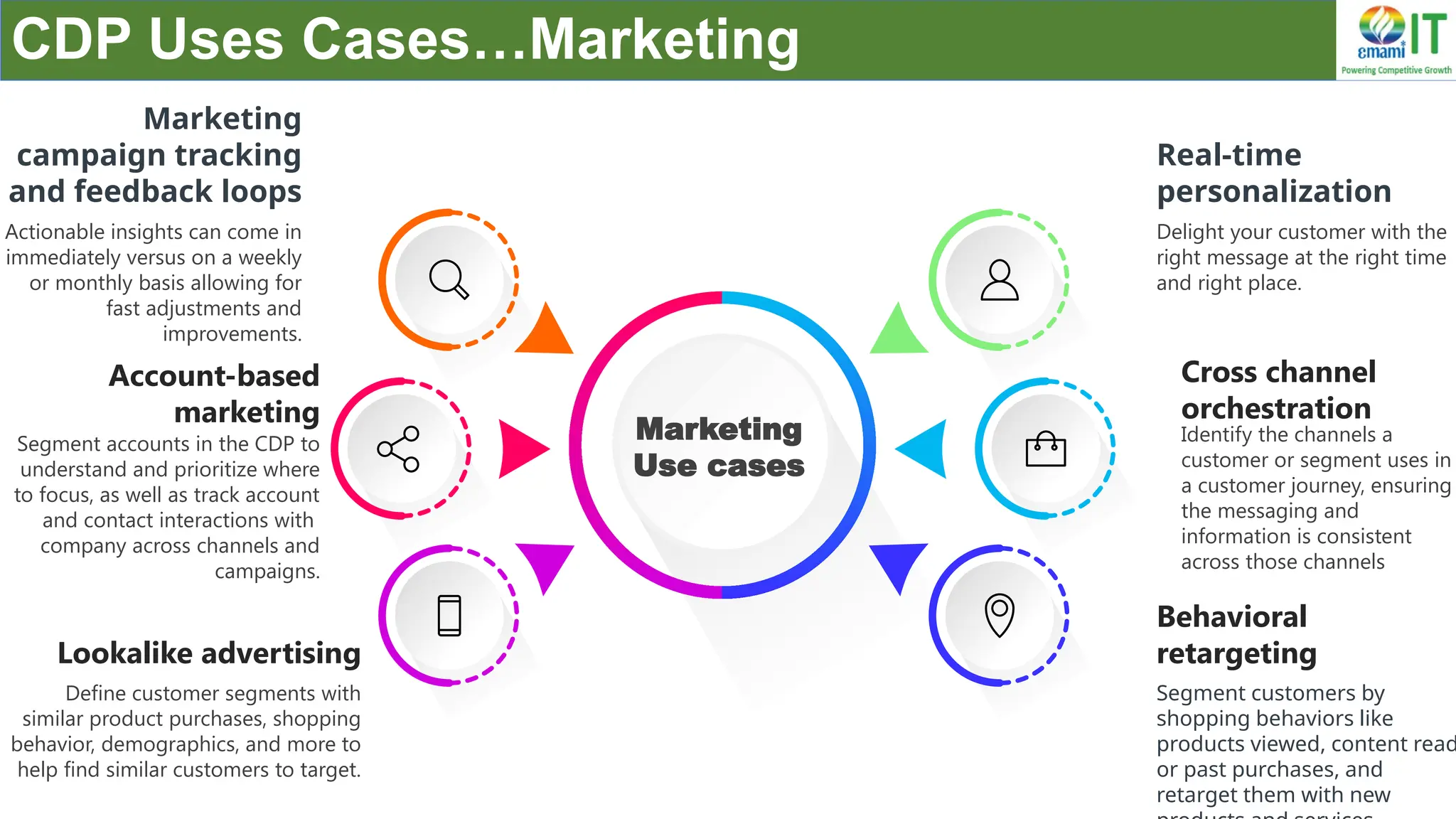
CDP Uses Cases…Marketing
Delight your customer with the
right message at the right time
and right place.
Real-time
personalization
Segment customers by
shopping behaviors like
products viewed, content read
or past purchases, and
retarget them with new
Behavioral
retargeting
Actionable insights can come in
immediately versus on a weekly
or monthly basis allowing for
fast adjustments and
improvements.
Marketing
campaign tracking
and feedback loops
Define customer segments with
similar product purchases, shopping
behavior, demographics, and more to
help find similar customers to target.
Lookalike advertising
Segment accounts in the CDP to
understand and prioritize where
to focus, as well as track account
and contact interactions with
company across channels and
campaigns.
Account-based
marketing
Identify the channels a
customer or segment uses in
a customer journey, ensuring
the messaging and
information is consistent
across those channels
Cross channel
orchestration
Marketing
Use cases
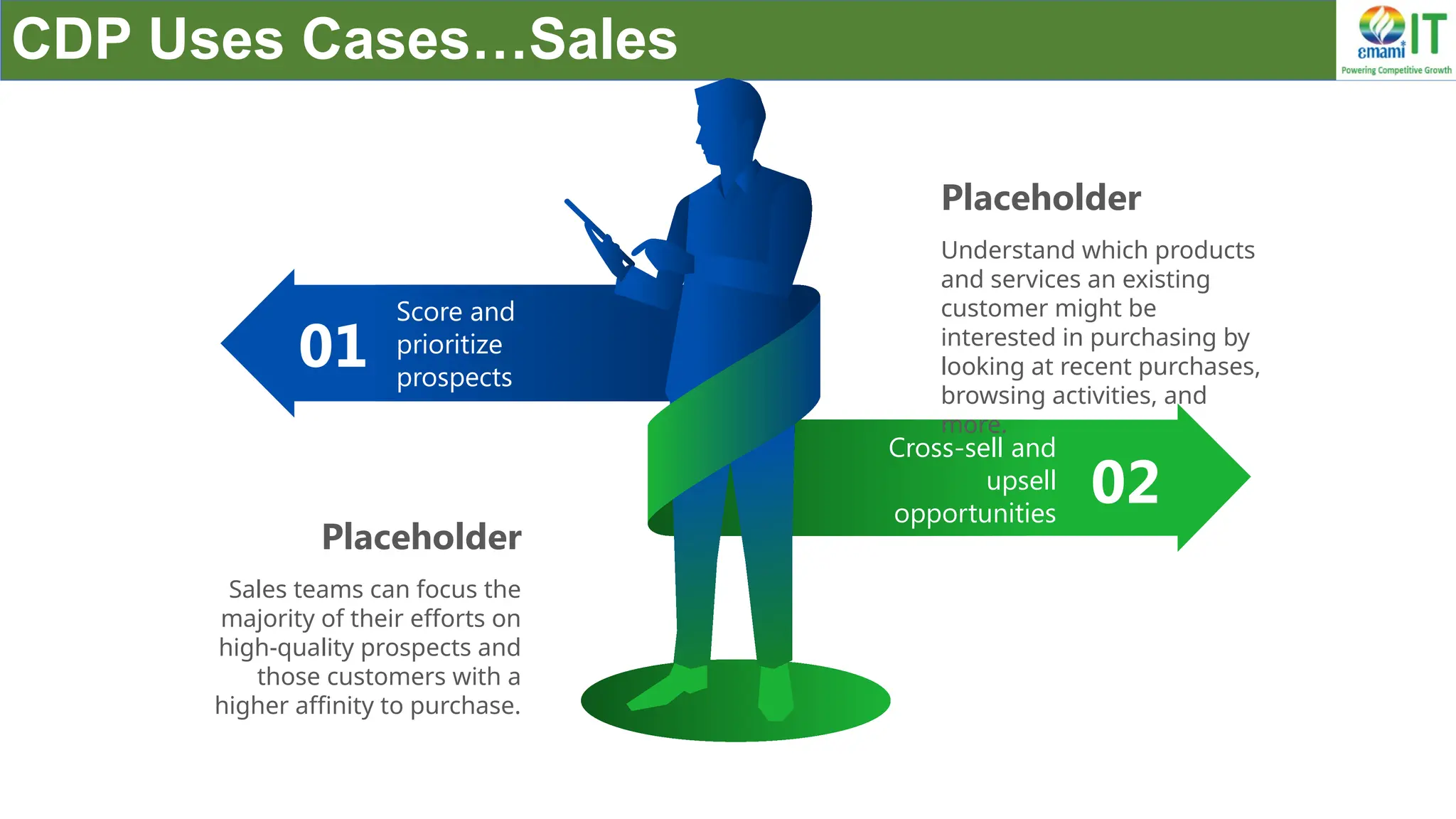
CDP Uses Cases…Sales
01
Score and
prioritize
prospects
02
Cross-sell and
upsell
opportunities
Sales teams can focus the
majority of their efforts on
high-quality prospects and
those customers with a
higher affinity to purchase.
Placeholder
Understand which products
and services an existing
customer might be
interested in purchasing by
looking at recent purchases,
browsing activities, and
more.
Placeholder
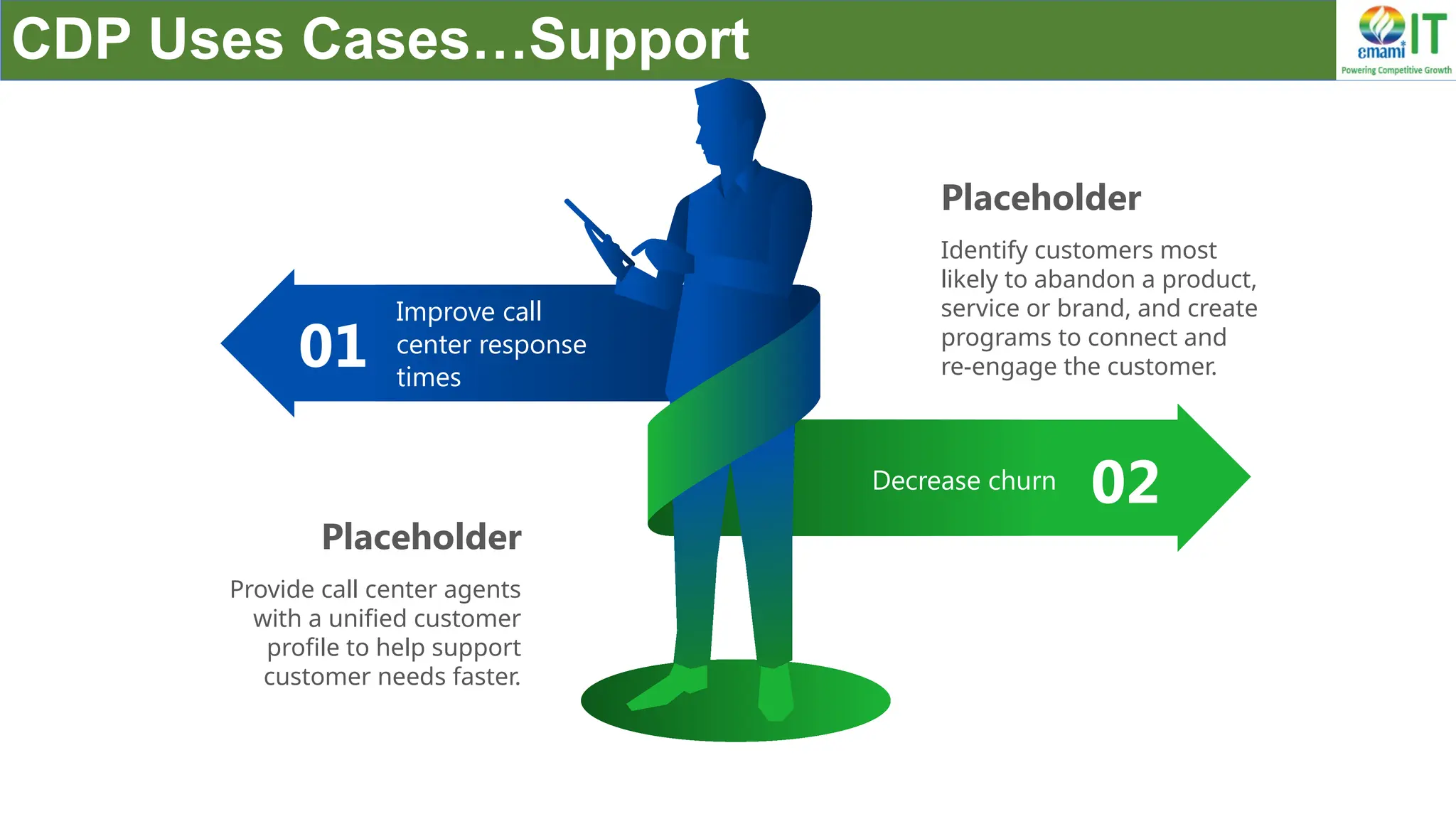
CDP Uses Cases…Support
01
Improve call
center response
times
02
Decrease churn
Provide call center agents
with a unified customer
profile to help support
customer needs faster.
Placeholder
Identify customers most
likely to abandon a product,
service or brand, and create
programs to connect and
re-engage the customer.
Placeholder
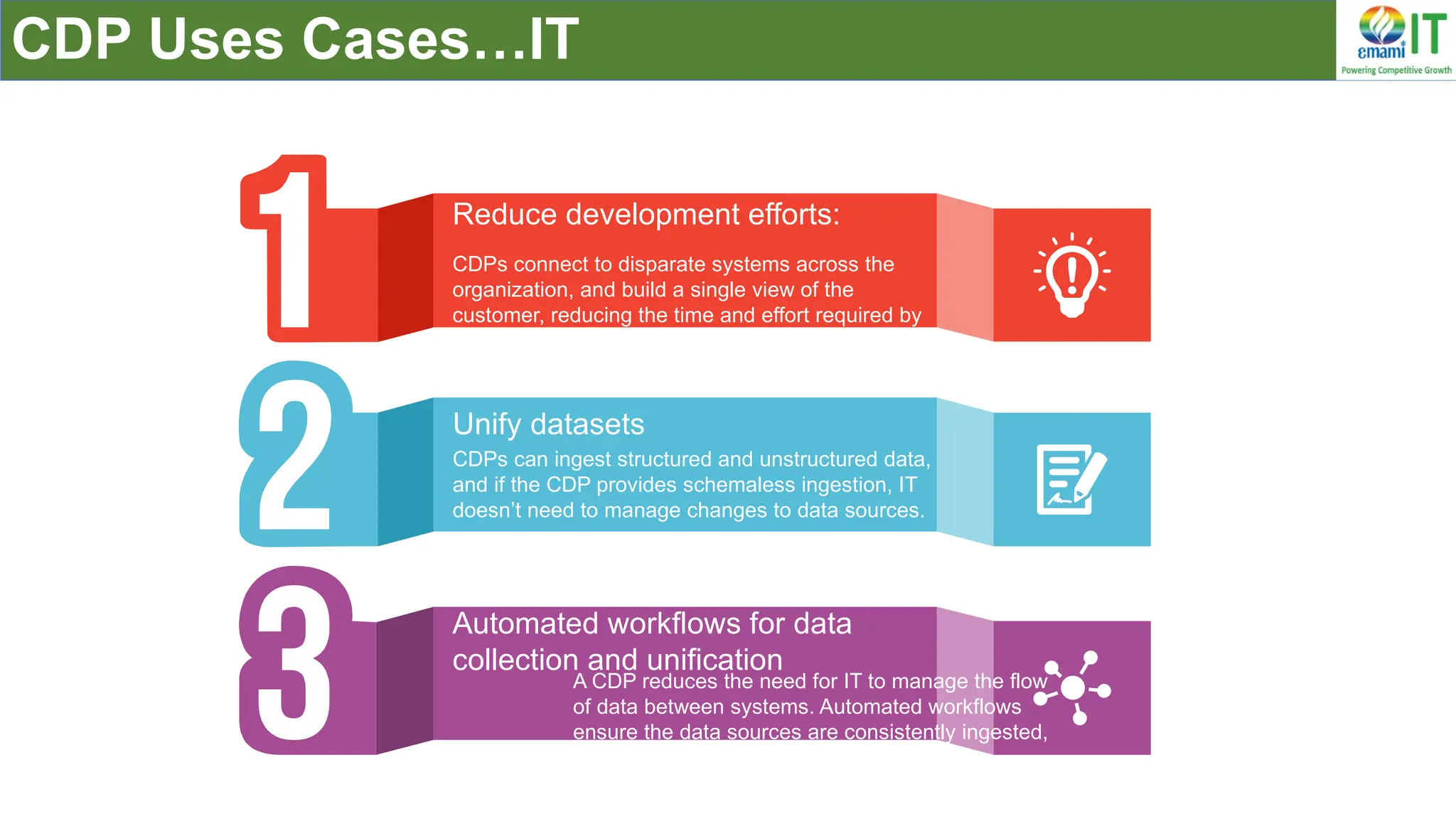
CDP Uses Cases…IT
CDPs connect to disparate systems across the
organization, and build a single view of the
customer, reducing the time and effort required by
IT to develop custom integrations.
Reduce development efforts:
CDPs can ingest structured and unstructured data,
and if the CDP provides schemaless ingestion, IT
doesn’t need to manage changes to data sources.
Unify datasets
A CDP reduces the need for IT to manage the flow
of data between systems. Automated workflows
ensure the data sources are consistently ingested,
cleaned, and validated
.
Automated workflows for data
collection and unification
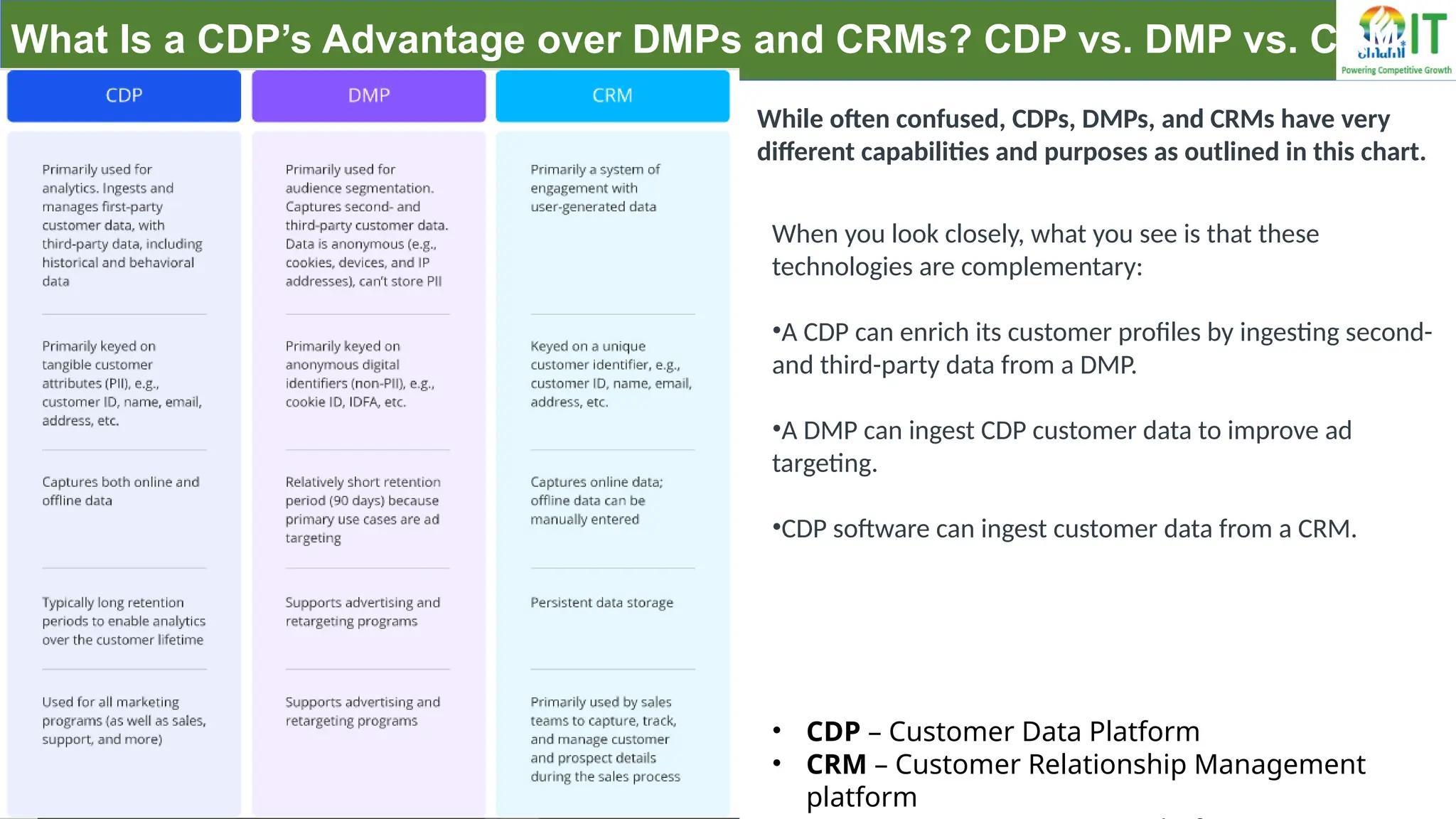
What Is a CDP’s Advantage over DMPs and CRMs? CDP vs. DMP vs. CRM
While often confused, CDPs, DMPs, and CRMs have very
different capabilities and purposes as outlined in this chart.
When you look closely, what you see is that these
technologies are complementary:
•A CDP can enrich its customer profiles by ingesting second-
and third-party data from a DMP.
•A DMP can ingest CDP customer data to improve ad
targeting.
•CDP software can ingest customer data from a CRM.
• CDP – Customer Data Platform
• CRM – Customer Relationship Management
platform
Collect & Cleanse Customer Data
There’s a common saying among marketing
evangelists and consultants: “Data is the new oil.” The
idea is that data has become a business asset, valuable
in its own right, to be collected, stored and traded.
The challenge is to bring your marketing data sources
(as well as other customer-related data sources)
together to create a single source of truth, a virtual
refinery where you can cleanse, enrich, and analyze
your data. This is the process that turns crude data
into jet fuel for your business.
What is a CDP
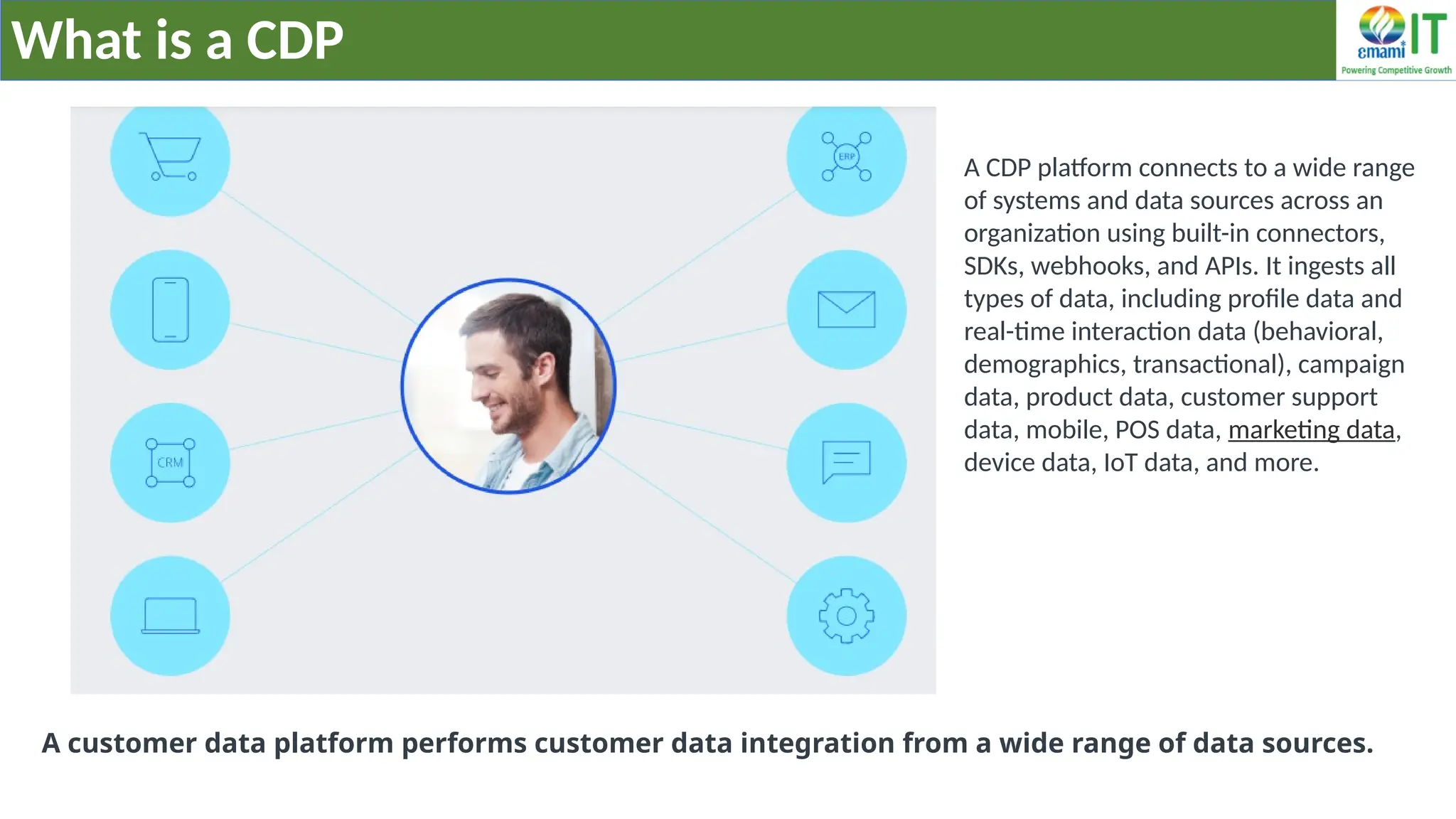
A customer data platform performs customer data integration from a wide range of data sources.
A CDP platform connects to a wide range
of systems and data sources across an
organization using built-in connectors,
SDKs, webhooks, and APIs. It ingests all
types of data, including profile data and
real-time interaction data (behavioral,
demographics, transactional), campaign
data, product data, customer support
data, mobile, POS data, marketing data,
device data, IoT data, and more.

Everything you need to know about CDP.pptx

  • 1.
    Customer Data Platform(CDP) Overview
  • 2.
    About CDP Data Management Customer Data Unification Derive Customer Insights Activate & Personalize Whatis a CDP? Types of CDP ? How it works? CDP Architecture Ingest , clean, enrich, verify and store customer data indefinitely in a usable format until it has been processed. Match third-party identity and attribute data with personally identified customer data and aggregate related/linked customers into a single profile to create persistent Customer IDs to map and analyze customers’ journeys. AI/ML based insights on Customer journey insights, Cross channel attribution, Audience topic affinity, Audience psychographics. Put the insights to work through Omnichannel campaigning, Paid media performance optimisation, Digital experience ƒ personalisation, Real time communication execution, Ecommerce optimisation, Personalisation, Advocacy & reward execution 02 06 05 04 02 Agenda 07 CDP Use cases 01 Problem Statemen t Understanding customer's journey and their unique experience is fragmented.
  • 3.
    01 Problem Statemen t Understanding customer's journey andtheir unique experience is fragmented.
  • 4.
    Problem: Understanding your customer's journey andtheir unique experience is fragmented. 4 Your most valuable data asset - 1st party customer data - is siloed and can’t integrate real-time interaction data (e.g. clickstream, emails, text, chats, phone calls, CRM data etc.) Current channel models are not customer centric and lead to multiple views of the same customer. CRMs doesn’t manage customer journeys, personalization and experience. Multiple data gathering systems in use across business functions in an organization. Volume, diversity, and sources of data make deriving value cumbersome and complex. Marketers and Power Users want self-service access to data instead of waiting for Analytics or IT to provide it. Frontline associates need single view of the customer (Customer 360) information in real time in their CRM of choice. Problem Statement
  • 5.
    About CDP What isa CDP? Types of CDP ? How it works? CDP Architecture 02 01 Problem Statemen t Understanding customer's journey and their unique experience is fragmented.
  • 6.
    What is aCDP? A customer data platform is a marketing system that unifies a company's customer data from marketing and other channels to enable customer modeling and optimize the timing and targeting of messages and offers. The specific definition of a CDP by key industry sources include: A customer data platform is packaged software that creates a persistent, unified customer database that is accessible to other systems. A CDP centralizes customer data from multiple sources and makes it available to systems of insight and engagement..
  • 7.
    A data platformto deeply understand your customer journey, provider behavior and take action to meet their unique needs in a real-time & relevant manner 7 Solution – Customer Data Platform
  • 8.
  • 9.
    04 01 03 02 Ingestfirst-party, individual-level customer data Data Management Segments sent with activation instructions to execute Activation Consolidate profiles at person level & connect attributes to identities Profile Unification Interface for marketer to create and manage segments Segmentation How Do CDPs Analyze Data? And How Do Predictive Analytics Work? ▪ Link multiple devices to a single, personally identified individual ▪ De-duplicate customer records ▪ From online and offline sources ▪ In real time, on-prem/Cloud ▪ Unlimited storage and data persistence ▪ First-party identifiers and attributes ▪ Combine data from disparate sources including third-party data providers ▪ Machine Learning Data Catalog ▪ Email campaigns ▪ Mobile messaging and advertising ▪ Rule-based segment creation ▪ Automated segment discovery ▪ Predictive analytics ▪ Propensity models ▪ Import and deploy custom models built in MDM Consumer Profile CUSTOMER DATA PLATFORM
  • 10.
    Features of CustomerData Platform
  • 11.
  • 12.
    Customer Data PlatformArchitecture: How Does a CDP Work? CDP collects, unifies, and segments customer data from anywhere so enterprise teams can activate hyper-personalized and profitable campaigns. Customer Data Platform
  • 13.
    About CDP Data Management What isa CDP? Types of CDP ? How it works? CDP Architecture Ingest , clean, enrich, verify and store customer data indefinitely in a usable format until it has been processed. 02 02 01 Problem Statemen t Understanding customer's journey and their unique experience is fragmented.
  • 14.
    Why Data QualityMatters 01 02 04 03 Data streams should be live and updated in real time, not copy- and-pasted manually Timeliness Data should be fit for its intended use; ie, you don’t need your customer’s shoe size if you’re selling hats Relevance Data should be cleansed, verified and enriched to ensure accuracy and trustworthiness. Reliability It should bring together data from every department that deals with customers or potential customers Completeness
  • 15.
    Tyoes of Data Digdeeper than traffic and time on page Web Browsing Data Combine this data with the others on this list, and you can zero in on your most valuable customers. Loyalty Data Sales has multiple data streams that are useful to marketers Sales Department Data Important to know how people are experiencing the brand through customer service.. Customer Service Data. Connect data from Google Ads, AdRoll, and other accounts to your CDP Advertising Platforms First-hand customer data is invaluable Survey Data it’s essential to connect both online and offline sales data to your CDP In-store and Online Sales Data Connecting HubSpot, Marketo, Salesforce, etc. to your CDP makes both sources more valuable. Marketing Automation Platforms Types of Data to Integrate
  • 16.
    Customer Data Cleaning Connectingyour first party data sources to the CDP is the first step. The next step is to make sure the data is clean, complete and trustworthy START STOP 01 Validate & Sanitize 02 Merge Duplicates 03 Standardize Formatting 04 Purge Out-of-Date Information STEP B In order to create customer profiles (in the next phase), it’s crucial to get rid of duplicate data. . STEP D If records are over 6 months or a year old, it’s worth updating the data, either through direct interaction and verification, or by enriching with more current third-party data. STEP A Use your CDP to detect missing, false or irrelevant data STEP C This process includes discussing standards with the sources of your data streams, as well as standardizing how data is displayed in the CDP
  • 17.
    How to EnrichCustomer Data The right CDP can handle different types of data feeds from hundreds of second and third-party suppliers. Most importantly, your CDP should be able to automatically associate your enrichment data with your existing first- party data, combining them into actionable customer profiles. Data enrichment is the process of adding second-party and third-party data to your customer data, then combining it with your first-party data.
  • 18.
    About CDP Data Management Customer Data Unification What isa CDP? Types of CDP ? How it works? CDP Architecture Ingest , clean, enrich, verify and store customer data indefinitely in a usable format until it has been processed. Match third-party identity and attribute data with personally identified customer data and aggregate related/linked customers into a single profile to create persistent Customer IDs to map and analyze customers’ journeys. 02 04 02 01 Problem Statemen t Understanding customer's journey and their unique experience is fragmented.
  • 19.
    What Is aCDP’s Data Unification Methodology? A CDP unifies customer identifiers and data sources to create a Single Customer View (SCV), also called a Unified Customer View (UCV), Customer 360 View or Golden Profile. During the unification process, customer data is validated, cleaned, and deduped to create a single customer profile. The identity resolution process is done in two ways: • Deterministically • Probabilistically
  • 20.
    About CDP Data Management Customer Data Unification Derive Customer Insights What isa CDP? Types of CDP ? How it works? CDP Architecture Ingest , clean, enrich, verify and store customer data indefinitely in a usable format until it has been processed. Match third-party identity and attribute data with personally identified customer data and aggregate related/linked customers into a single profile to create persistent Customer IDs to map and analyze customers’ journeys. AI/ML based insights on Customer journey insights, Cross channel attribution, Audience topic affinity, Audience psychographics. 02 05 04 02 01 Problem Statemen t Understanding customer's journey and their unique experience is fragmented.
  • 21.
    How Do CDPsAnalyze Data? And How Do Predictive Analytics Work? • Customer data platform software is more than a database to store customer information; it can – • Analyze and segment customer profiles using rules or machine learning, • Perform predictive scoring, • Provide journey orchestration. • Some customer data platforms enable machine learning (ML) and artificial intelligence (AI) for advanced predictive analytics – • The traits common to the most valuable audience – which profiles are most likely to purchase, make repeat purchases, and become brand advocates • Which profiles are highly likely to buy soon, and which require further nurturing • Which customers are likely to churn • Recommendations for cross-selling and upselling • CDPs make it possible to visualize data through other BI tools with seamless integration. • Marketers have access to rich data sets enabling them to create segments based on attributes and behaviors. They can manually define segments using a rule-based approach or leverage predictive analytics. • Journey orchestration enables marketers to analyze customer interactions throughout the entire customer journey and deliver the right messages at the right time on the right channels.
  • 22.
    Analyze & UncoverCustomer Insights • Create a More Accurate Attribution Model • Start with a large data set of customer data with unified customer profiles. • Identify the touchpoints in your customer journey that impact a purchasing decision. • Determine what KPIs you use to measure attribution. • Use the analytic capability of your CDP to normalize, correlate and analyze the data. • Identify Omnichannel Opportunities • Power Up Your Segmenting and Targeting • Create Lookalike Audiences to Extend Reach
  • 23.
    About CDP Data Management Customer Data Unification Derive Customer Insights Activate & Personalize Whatis a CDP? Types of CDP ? How it works? CDP Architecture Ingest , clean, enrich, verify and store customer data indefinitely in a usable format until it has been processed. Match third-party identity and attribute data with personally identified customer data and aggregate related/linked customers into a single profile to create persistent Customer IDs to map and analyze customers’ journeys. AI/ML based insights on Customer journey insights, Cross channel attribution, Audience topic affinity, Audience psychographics. Put the insights to work through Omnichannel campaigning, Paid media performance optimisation, Digital experience ƒ personalisation, Real time communication execution, Ecommerce optimisation, Personalisation, Advocacy & reward execution 02 06 05 04 02 07 CDP Use cases 01 Problem Statemen t Understanding customer's journey and their unique experience is fragmented.
  • 24.
    What Is aCDP’s Data Activation Capability? Who uses a CDP? A CDP makes customer data available to teams across an organization, allowing optimization of various business processes, including: • Audience management • Campaign management • Customer service & support • Product development • Prospecting & sales B2C companies have been quicker than B2B firms to deploy CDPs, according to Understanding CDP Users: CDP Institute Member Survey 2019. But many B2C and B2B companies alike are in the process of deploying or plan to deploy a CDP, the report said.
  • 25.
    Activation and Personalization •Some CDPs provide campaign management and customer journey orchestration features that enable personalized messaging, dynamic web and email content recommendations, as well as campaigns that trigger targeted ads across multiple channels. • CDPs often automate the distribution of marketer-created customer segments on a user defined schedule to external martech systems such as marketing automation platforms, email service providers (ESPs), or web content management systems for campaign execution.
  • 26.
    About CDP Data Management Customer Data Unification Derive Customer Insights Activate & Personalize Whatis a CDP? Types of CDP ? How it works? CDP Architecture Ingest , clean, enrich, verify and store customer data indefinitely in a usable format until it has been processed. Match third-party identity and attribute data with personally identified customer data and aggregate related/linked customers into a single profile to create persistent Customer IDs to map and analyze customers’ journeys. AI/ML based insights on Customer journey insights, Cross channel attribution, Audience topic affinity, Audience psychographics. Put the insights to work through Omnichannel campaigning, Paid media performance optimisation, Digital experience ƒ personalisation, Real time communication execution, Ecommerce optimisation, Personalisation, Advocacy & reward execution 02 06 05 04 02 07 CDP Use cases 01 Problem Statemen t Understanding customer's journey and their unique experience is fragmented.
  • 27.
    CDP Uses Cases…Marketing Delightyour customer with the right message at the right time and right place. Real-time personalization Segment customers by shopping behaviors like products viewed, content read or past purchases, and retarget them with new Behavioral retargeting Actionable insights can come in immediately versus on a weekly or monthly basis allowing for fast adjustments and improvements. Marketing campaign tracking and feedback loops Define customer segments with similar product purchases, shopping behavior, demographics, and more to help find similar customers to target. Lookalike advertising Segment accounts in the CDP to understand and prioritize where to focus, as well as track account and contact interactions with company across channels and campaigns. Account-based marketing Identify the channels a customer or segment uses in a customer journey, ensuring the messaging and information is consistent across those channels Cross channel orchestration Marketing Use cases
  • 28.
    CDP Uses Cases…Sales 01 Scoreand prioritize prospects 02 Cross-sell and upsell opportunities Sales teams can focus the majority of their efforts on high-quality prospects and those customers with a higher affinity to purchase. Placeholder Understand which products and services an existing customer might be interested in purchasing by looking at recent purchases, browsing activities, and more. Placeholder
  • 29.
    CDP Uses Cases…Support 01 Improvecall center response times 02 Decrease churn Provide call center agents with a unified customer profile to help support customer needs faster. Placeholder Identify customers most likely to abandon a product, service or brand, and create programs to connect and re-engage the customer. Placeholder
  • 30.
    CDP Uses Cases…IT CDPsconnect to disparate systems across the organization, and build a single view of the customer, reducing the time and effort required by IT to develop custom integrations. Reduce development efforts: CDPs can ingest structured and unstructured data, and if the CDP provides schemaless ingestion, IT doesn’t need to manage changes to data sources. Unify datasets A CDP reduces the need for IT to manage the flow of data between systems. Automated workflows ensure the data sources are consistently ingested, cleaned, and validated . Automated workflows for data collection and unification
  • 31.
    What Is aCDP’s Advantage over DMPs and CRMs? CDP vs. DMP vs. CRM While often confused, CDPs, DMPs, and CRMs have very different capabilities and purposes as outlined in this chart. When you look closely, what you see is that these technologies are complementary: •A CDP can enrich its customer profiles by ingesting second- and third-party data from a DMP. •A DMP can ingest CDP customer data to improve ad targeting. •CDP software can ingest customer data from a CRM. • CDP – Customer Data Platform • CRM – Customer Relationship Management platform
  • 33.
    Collect & CleanseCustomer Data There’s a common saying among marketing evangelists and consultants: “Data is the new oil.” The idea is that data has become a business asset, valuable in its own right, to be collected, stored and traded. The challenge is to bring your marketing data sources (as well as other customer-related data sources) together to create a single source of truth, a virtual refinery where you can cleanse, enrich, and analyze your data. This is the process that turns crude data into jet fuel for your business.
  • 34.
    What is aCDP A customer data platform performs customer data integration from a wide range of data sources. A CDP platform connects to a wide range of systems and data sources across an organization using built-in connectors, SDKs, webhooks, and APIs. It ingests all types of data, including profile data and real-time interaction data (behavioral, demographics, transactional), campaign data, product data, customer support data, mobile, POS data, marketing data, device data, IoT data, and more.

Editor's Notes

  • #6 Packaged software. The CDP is packaged software, usually bought and controlled by business users, most often in marketing. This distinguishes it from a data warehouse or data lake which is usually custom-built by the corporate IT department. The packaged nature of the system makes it much easier to deploy and change as new needs arise. Corporate IT must cooperate to set up and maintain the CDP but most technical resources are usually provided by the vendor or an agency hired by marketing.   Persistent, unified customer database. The CDP creates a comprehensive view of each customer by capturing data from multiple systems, linking information related to the same customer, and storing the information to track behavior over time. The CDP contains personal identifiers used to target marketing messages and track individual-level marketing results. CDPs work primarily with data gathered by a company’s own systems about identified individuals. They may also include data from external sources and about anonymous individuals. The CDP is able to retain all details of input data indefinitely, although users may restrict what is stored and how long it is kept.   Accessible to other systems. Data stored in the CDP can be used by other systems for analysis and to manage customer interactions. The CDP restructures the data, adds calculated values such as trends and model scores, and shares the results in formats that other systems can accept. Access methods typically include APIs, database queries, and file extracts.
  • #7 Customer Data Platforms (CDPs) brings together customer data that is spread among many systems, build a complete profile of information about each customer, and make those profiles available to any system that needs them.  Ingest data from any source Capture full detail of ingested data Store ingested data indefinitely (subject to privacy constraints) Create unified profiles of identified individuals (built-in open data initiative support) Share data with any system that needs it Uses customer centric model to look at data and identify individual customers across the entire customer journey by identifying them over the different touch points. Builds the customer profile based on all the touch points to allow AI driven algorithm to give customer insights and build identifiable customer segments for businesses as per their requirements. Native support for Open Data Initiative (ODI) Experience Data Model (XDM) Common Data Model
  • #8 The CDP Institute groups CDP vendors into four categories based on the functions provided by their systems. Each category includes functions provided by the previous categories. There are great variations among vendors within each category. Categories are:   Data CDPs. These systems gather customer data from source systems, link data to customer identities, and store the results in a database available to external systems. This is the minimum set of functions required to meet the definition of a CDP. In practice, these systems also can extract audience segments and send them to external systems. Systems in this category often employ specialized technologies for data management and access. Some began as tag management or Web analytics systems and retain considerable legacy business in those areas.   Analytics CDPs. These systems provide data assembly plus analytical applications. The applications always include customer segmentation and sometimes extend to machine learning, predictive modeling, revenue attribution, and journey mapping. These systems often automate the distribution of data to other systems.   Campaign CDPs. These systems provide data assembly, analytics, and customer treatments. What distinguishes them from segmentation is they can specify different treatments for different individuals within a segment. Treatments may be personalized messages, outbound marketing campaigns, real time interactions, or product or content recommendations. They often include orchestrating customer treatments across channels.   Delivery CDPs. These systems provide data assembly, analytics, customer treatments, and message delivery. Delivery may be through email, Web site, mobile apps, CRM, advertising, or several of these. Products in this category often started as delivery systems and added CDP functions later.
  • #10 1. Data collection What it is: CDPs take in customer data from a variety of sources—including browser cookies, names, emails, device IDs, pages visited, demographic information, purchase history, campaign engagement, and loyalty status—and store that data indefinitely in a usable format until it has been processed. 2. Profile unification What it is: This part of a CDP creates a profile for every individual you interact with, tracks them across various devices, and eliminates redundant customer records (for example, when the same customer uses multiple email addresses). It may also match third-party identity and attribute data with personally identified customer data and aggregate related/linked customers (such as those who share a household) into a single profile. 3. Segmentation What it is: One of the core features of CDPs is their ability to take all that customer data you’ve collected and automatically create segments—that is, linked groups of people who share one or more common characteristics. All CDPs contain rule-based segment creation, but some may also offer automated segment discovery, predictive analytics, and the ability to import and deploy custom models built in external advanced analytics platforms. 4. Activation What it is: Once your CDP has captured customer data, turned it into profiles, and then segmented those profiles, it needs to actually do something with the segmented lists. Activation tools send the segments, along with explicit activity instructions, to outside execution systems (such as email marketing software) in order to launch campaigns, advertisements, and so forth.
  • #11 1. Identity Resolution CDP collects both online and offline data sources, with some examples as shown in the above graph, and provides persistent data storage. It then leverages identity resolution to set up a holistic view of each individual customer across channels and devices. This functionality is fundamental to enable connected experience as it stiches together PII identities and first-party cookies and device IDs to generate a real-time customer profile. Without the unified real-time profile, audience management, e.g., cross-channel activations would be impossible. 2. Audience Management Audience management is one of the core capabilities CDPs offer. Leveraging the unified profile, a CDP provides flexible business rule-based, or even AI-based audience creation (see advanced analytics for more details) with frequency and recency application. Some CDPs even provide calculation capabilities in audience creation. Audiences are then used to activate across touchpoints and channels. 3. Journey Orchestration (optional capability) Some CDPs provide journey orchestration capability so that marketers can easily develop customer journey experience and realize cross-channel orchestration to serve each audience with the right offering at right time and place (channel). Be aware that CDP providers usually use “journey orchestration” as a selling point, but not all of them have this capability. 4. Advanced Analytics (optional capability) Some CDPs are embedded with data science environment for propensity model development and user behavior prediction. Marketers can use machine learning and artificial intelligence to enrich customer profiles and empower decisioning. 5. Activate audiences across channels After data is cooked by the CDP “magic”, real business value will be delivered when the CDP activates audience in real-time cross channels such as email, site personalization, app, and paid media. 6. Real-Life Application: CDP Drives Customer Experience Change It is proven that a CDP can drive marketing ROI, but the value could only be shown if marketers have a clear understanding to how the CDP fits into an organization’s current tech stack and is adopted with a thoughtful approach. We recently supported a global B2B technology company to overcome the obstacles of CDP implementation to fully realize the true value of a CDP. Before Merkle’s engagement, our client had the CDP implemented for years while only using it as a site personalization tool. We helped transform the strategy from campaign-focused optimization to audience-first digital experience through enhancement in audience development, campaign activation, and identity strategy especially preparing for the “cookieless” future.
  • #12 Let’s go under the hood of a customer data platform and look at its architecture and key capabilities. Data Collection & Integration The first step is getting first-party customer data into the CDP, including basic profile data, engagement data, and transaction data. First-party data comes from systems and channels such as web and mobile, email and marketing automation, CRM, surveys, ecommerce systems, and more. The data comes in many formats, structured and unstructured. Most CDPs will offer pre-defined integrations to common data sources and systems from marketing, sales, and support. The data is ingested in real-time or batches, continually feeding the CDP with current customer data. Customer Data Cleansing/Transformation Collecting data is the first part. Once ingested, some CDPs have the capability to clean the data, ensuring it’s consistent and correct. Data cleansing includes resolving identities, deduplicating profiles, discarding inaccurate data (including fake profiles), and resolving discrepancies. Some CDPs also include extract, transform, and load (ETL) capabilities that can be used to build data pipelines for these activities. Customer Profile Enrichment Once the profile is complete, a CDP can enrich the profile by integrating second- and third-party data sources. This type of data comes from organizations like Bombora and Dun & Bradstreet (business data), Acxiom and Neilsen (demographics data), weather, interest data, and other sources. Enriching the profile with this type of data helps fill in missing or inaccurate attributes and remove duplicate information. It also helps with building a richer set of seed segments for advertising platforms—enhancing prospecting activities with higher match rates and market reach. Customer Segmentation A CDP provides tools for marketers to define audience segments based on attributes and behaviors. You use segments to improve targeting and personalization. Segments are rules-based, or they are built using machine learning and AI. Predictive scoring is one example of a machine learning algorithm. With predictive scores, marketers can enrich their profiles with data they wouldn’t be able to tabulate on their own and create more robust target audiences. Using the customer segmentation capabilities of a customer data platform, you can do things like: Identify advocates Predict customer churn Identify potential upsell and cross-sell opportunities Identify top-performing customers Deliver relevant recommendations based on a profile’s purchase history There are many different ways to analyze and segment profile data. Look for a CDP that provides out of the box components, prebuilt code, and visualizations for faster deployment. Customer Journey Orchestration Some CDPs also provide customer journey orchestration capabilities. Through the creation of customer journey stages, marketers can visualize the engagement consumers have with their brand, giving them deeper insights into the channels used, and the messages and information that work best to engage and convert at each stage in their customer journey maps. What Is CDP Data Activation and Execution? Data activation and execution are all about making the data available to external systems through prebuilt connectors or via a REST API. The CDP makes individual profile data, segments, or all customer data available to social media, website and mobile apps, email marketing systems, advertising systems, business intelligence tools, and others. The data can be pushed to these systems on a schedule or pulled from your website, social, advertising, and A/B testing tools in real-time. What Is a CDP Dashboard? Some CDPs provide reporting and dashboards to identify KPIs, trends, and other relevant information. Most will enable reporting through BI integrations and include embedded reporting such as audience management and segmentation dashboards. These types of embedded visualizations help marketers make faster decisions as they work to create segments and activate them. If advanced reporting is needed for executive briefings or campaign status updates, look for a CDP that empowers you to create customizable reports and dashboards, including data visualizations and drill-down reports. What Is a CDP’s Underlying Architecture? A customer data platform can store petabytes and more of data, so the platform needs to be flexible. Cloud-based solutions are a popular choice for CDPs due to the inherent scalability of the cloud, as well as data lake technology that provides the ability to support the volume, velocity, and variety of data marketers need. Not only does the CDP store a lot of data, but that data is in different formats, which means your CDP must be flexible enough to support many data types, including unstructured data. Look for a CDP that provides schemaless ingestion, which means you store the raw, event-level data without the need to organize it into tables before it is available to your marketers. Schemaless ingestion ensures that your data is always available even if there are changes in the source systems. And, you save time ensuring access to the customer data regardless of when it was created
  • #15 Mapping the data landscape in your organization can feel like a daunting task. It’s important to focus on customer data that will be relevant to improving customer experience, driving personalization, and developing relationships with customers. In-store and Online Sales Data. If your organization has brick-and-mortar locations, it’s essential to connect both online and offline sales data to your CDP. You’re certain to uncover opportunities to influence online behavior through offline promotions, and vice versa. how traffic is referred to your site, Web Browsing Data. Dig deeper than traffic and time on page – your CDP data should include how deep the average browser clicks into the site, and what their next steps are. Survey Data. First-hand customer data is invaluable. If you’re tracking Net Promoter Score, product satisfaction, or customer experience data, make sure that goes into the CDP. Customer Service Data. Marketers are still on the hook for nurturing customers after they make a purchase. So it’s important to know how people are experiencing the brand through customer service. Sales Department Data. Sales has multiple data streams that are useful to marketers. There’s simple sales data — purchases made or deals closed. But there’s also potential prospect lists, which can guide content creation, and missed opportunities data you can use to refine messaging. Advertising Platforms. Connect data from Google Ads, AdRoll, and other accounts to your CDP. Combined with your other data streams, you can get a more accurate picture of which ads are inspiring what next steps. Marketing Automation Platforms. Your automation platform is a treasure trove of data already, but it gains far more value when placed in context with the other streams on this list. Connecting HubSpot, Marketo, Salesforce, etc. to your CDP makes both sources more valuable. Loyalty Data. If you have a loyalty program, it’s generating plenty of data on what customers are buying, when and where. Combine this data with the others on this list, and you can zero in on your most valuable customers. Legacy Data. It’s likely you have historical customer data in offline formats, whether it’s on hard drives or in filing cabinets. This old data can be useful in forming a picture of the evolving customer journey. For example, one Treasure Data client used 80 years of collected data to drive exceptional results. Wearables and IoT Data. These sources are still in their infancy, but marketers should be keeping an eye on their potential. Smart watches, connected appliances, and home automation devices are generating a wealth of data that can be useful for marketers.
  • #16 Connecting your first party data sources to the CDP is the first step. The next step is to make sure the data is clean, complete and trustworthy. The process of customer data cleaning helps identify data that is incomplete, corrupt, or redundant. Since you’re combining data from multiple sources, it’s important to standardize all of it before you start analysis. Follow these steps: Validate and Sanitize. Use your CDP to detect missing, false or irrelevant data — for example, form fills from “Mickey Mouse,” or people who work at “/./aqh;laweb” or email addresses like “Idontwanttogiveyoumyemail.com.” Merge Duplicates. In order to create customer profiles (in the next phase), it’s crucial to get rid of duplicate data. You don’t want one entry for J. Smith who lives in NE Melody Dr, and one for John Smith who lives on Melody Dr. NE. Your CDP can do much of this work automatically and continuously as new data is added. Standardize Formatting. Does your zip code field take five digits or nine? Is gender relevant to your offering, and if so, what type of input will you accept? This process includes discussing standards with the sources of your data streams, as well as standardizing how data is displayed in the CDP. Purge Out-of-Date Information. Email addresses, job titles, and addresses all change over time. If you have records that are over 6 months or a year old, it’s worth updating the data, either through direct interaction and verification, or by enriching with more current third-party data.
  • #17 Data enrichment is the process of adding second-party and third-party data to your customer data, then combining it with your first-party data. First-party data is proprietary data that your brand has collected directly from customers. Second-party data refers to another company’s first-party data, bought directly or through a data marketplace. Third-party data is data aggregated by companies that have no direct relationship to the consumer. Each of these types of data is a necessary part of a complete customer profile. The right CDP can handle different types of data feeds from hundreds of second and third-party suppliers. Most importantly, your CDP should be able to automatically associate your enrichment data with your existing first-party data, combining them into actionable customer profiles.
  • #19 How does CDP software unify data? Once in a CDP, customer data must be unified into a single customer profile using a process known as customer identity resolution or data unification. Customer identity resolution includes sophisticated algorithms to stitch identifiers from multiple systems. Identity stitching automates identity graph creation and continuously unifies data into profiles as your customers continue to engage. During the unification process, customer data is validated, cleaned, and deduped to create a single customer profile. The identity resolution process is done in two ways: Deterministically: Unique IDs for customer records in each system are matched using common information, such as an email address or name. This high confidence approach works best when first-party data is readily available. Probabilistically: This approach analyzes a variety of customer data points to estimate the statistical likelihood that two identities are the same customer. While statistical connections aren’t as definitive as authenticated IDs, they can be extremely helpful when first-party data is limited. Profiles are then enriched with second- and third-party data sources that fill in missing attributes and update other attributes with more recent information. In the last phase, you brought together data sources from across your organization to create a single, live, trusted source of truth. Now you can use this data to create 360-degree, omnichannel profiles of your customers. When you have complete customer profiles, you have a deeper understanding of the customer’s journey. For example, before customer data unification, you might identify five contact points: A person read your blog A person browsed your product pages A person visited your brick-and-mortar store A person made a purchase online With omnichannel customer data, you can confirm that these five interactions were from the same person. You can then correctly attribute what led to the conversion, and deploy more relevant follow-up to continue the relationship. In the next phase, we’ll use these unified customer views to derive insight and create a closed loop of feedback and nurturing. Here’s how to get started with customer data unification. Stat: 40% of brands say better identity recognition capabilities would advance their organization’s multichannel marketing.
  • #21 Once you have a single source of data truth for your customers, the real work can begin. But don’t worry; your CDP will be doing most of the heavy lifting. This type of task is perfectly suited for artificial intelligence and machine learning. It’s all about processing massive amounts of data to identify trends, spot patterns, and ultimately recommend next steps. This process will give you a clearer view of the customer journey than you would ever get by manually processing data. Customer data analysis on a CDP can uncover: The traits common to your most valuable audience – which profiles are most likely to purchase, make repeat purchases, and become brand advocates Which profiles are highly likely to buy soon, and which require further nurturing Which customers are likely to churn Recommendations for cross-selling and upselling Here’s an example of the results of this type of analysis. In this case, an algorithm identifies the profiles that are most likely to make a purchase, creating segments based on its predictions. Marketers can then fine-tune the segments manually before automating a follow-up plan (as we’ll cover in the next phase).
  • #22 In the early days of digital marketing, the “last-touch” attribution model was the most prevalent. If a customer looked at four blog posts, visited a retail store, then clicked a banner ad, then the banner ad got all the credit for the sale. It’s easy to see how misleading that type of attribution can be. Based on a last-touch model, you might increase your ad budget and dial back on blog content, when it was the blog that started your customer’s journey. And a first-touch model isn’t any more accurate — it wasn’t just the blog that sparked the eventual sale. Modern marketers are still searching for the perfect attribution model. It’s a worthwhile quest: When you have a clear idea of which touchpoints are contributing to success, you can optimize what works and jettison what doesn’t. With your data united on a CDP, you can create a customized multi-touch attribution model based on your unique customers and their journeys (learn how we can help using Shapley Value Attribution). It breaks down to these four steps: Start with a large data set of customer data with unified customer profiles. Identify the touchpoints in your customer journey that impact a purchasing decision. Determine what KPIs you use to measure attribution. Use the analytic capability of your CDP to normalize, correlate and analyze the data. Identify Omnichannel Opportunities Analyzing your customer data can give you a clearer understanding of your customer journey across channels. The analysis is likely to uncover trends and correlations you wouldn’t have seen otherwise. For example, your brick-and-mortar customers might be more likely to open an email from your brand right after a store visit. Or the customers that interact with your chatbot on Facebook are less likely to abandon their eCommerce cart. In short, your analysis can follow each thread in the complex web of interactions that leads to a purchase. With these insights in hand, you can create smarter marketing triggers to respond to these cross-channel interactions. Imagine if a customer to your brick-and-mortar store got a follow-up email with a “how to use your new product” guide, rather than a generic promotional offer. Or if a customer with a customer service complaint pending didn’t see retargeting ads for your brand everywhere, but instead got a personalized follow up email. Each of these small tweaks to personalize your marketing can drive purchase decisions, lead to deeper relationships, and ultimately create lifelong customers. And all of these optimizations can be deployed at scale through your CDP (more about that in the next step). Power Up Your Segmenting and Targeting One major benefit of analyzing customer data on a CDP is increasing the focus and granularity of your audience segments. You can zero in on the profiles most likely to purchase in the next few weeks, next few months, or those who are just casually doing preliminary research. For example, Subaru uses ongoing customer data analysis to find which profiles are ready to make a purchase, which are “just looking,” and even which ones are only “fantasizing” about getting a new car. Customers from each of these segments may eventually make a purchase, but they need drastically different messaging and next steps. By identifying these segments and personalizing their approach, Subaru has seen a 14% increase in closing rates, 38% cost reduction per acquisition, and a 250% increase in conversion rate for their most valuable audience. CDP analysis can identify the trends and behaviors that indicate a customer’s current progress in their journey. Then it can identify which next steps have helped customers at that stage move closer to a purchase decision. You can use this analysis to set rules for automated, personalized follow-up. Create Lookalike Audiences to Extend Reach Marketers rely on demographics to target customers. But demographic data alone can miss the mark: Not every 42-year-old male from Houston, Texas has the same wants and needs. Even if you get incredibly specific — 20-25-year-old single mothers with an annual income of $40,000 — it’s still hard to predict individual behavior within the demographic. That’s where lookalike audiences come in. This tactic targets a potential new audience based on the analysis of your existing customers. It uses machine learning to identify commonalities within your customer base, and use these trends to model which prospects you should be targeting. Machine learning is crucial here, as it can parse thousands of customer attributes to find the behaviors that signal a high possibility of conversion. These behaviors tend to be very specific and occur at a low frequency, so it requires both a great deal of data and processing power to identify them.
  • #24 Finally, a CDP makes customer data available to other systems for activation, the execution of campaigns, and communications that improve customer experiences. Marketers can use the data to personalize website experiences, send targeted emails, provide relevant recommendations, implement retargeting, and much more.
  • #25 By now, you have: Connected data streams to your CDP Cleansed, enriched and consolidated the data Performed AI/ML-assisted analysis to identify insights The final step is to put these insights to work. There isn’t one right way to activate your customer insights — this isn’t a single next step all business should take. CDP software is, by design, a flexible tool with a wide variety of possible CDP use cases. In general, CDPs can automate your next steps by using rule-based algorithms to act on your customer insight. What form that action takes depends on you: Your goals, your resources, and your imagination. In this section, we’ll explore some of the many possible ways that CDPs can use your data to improve the quality of your marketing, boost the customer experience, and even shape the future of your business.
  • #27 In the backdrop of digital channel proliferation, marketers often find themselves amidst a perfect storm. How do you increase the customer lifetime value (CLV) with very minimum investments while justifying the spend? Driven by data, a successful CDP solution must always work with the existing marketing stack to increase customer loyalty while maximizing marketing ROI. A CDP, when implemented well, often pays for itself within a short time after deployment. A unified customer view is at the heart of a CDP. A unified customer view derived from noisy duplicate profiles is what powers granular customer segmentations that drive a wide range of campaigns and marketing programs. Add in advanced machine learning capabilities and what you have is a modern-day equivalent of a “crystal ball.”
  • #28 Sales can improve margins and profitability by using a CDP to obtain greater insights on prospects and existing customers. A CDP integrates data from CRM, ERP, sales enablement software, and support and customer service interactions, enriching the customer profile with additional attributes from marketing systems and other third-party data providers. A few uses cases where the CDP supports sales teams: Score and prioritize prospects: Sales teams can focus the majority of their efforts on high-quality prospects and those customers with a higher affinity to purchase. Cross-sell and upsell opportunities: Understand which products and services an existing customer might be interested in purchasing by looking at recent purchases, browsing activities, and more.
  • #29 Support teams can leverage unified customer profiles—that include insights from sales and marketing—and start conversations with a deeper understanding of customer needs. This allows customer service teams to be proactive and specific with the offers and service they provide. Improve call center response times: Provide call center agents with a unified customer profile to help support customer needs faster. Decrease churn: Identify customers most likely to abandon a product, service or brand, and create programs to connect and re-engage the customer.
  • #30  Even the IT group benefits from a customer data platform: Reduce development efforts: CDPs connect to disparate systems across the organization, and build a single view of the customer, reducing the time and effort required by IT to develop custom integrations. Unify datasets: CDPs can ingest structured and unstructured data, and if the CDP provides schemaless ingestion, IT doesn’t need to manage changes to data sources. Automated workflows for data collection and unification: A CDP reduces the need for IT to manage the flow of data between systems. Automated workflows ensure the data sources are consistently ingested, cleaned, and validated
  • #31 What Is a CDP’s Greatest Advantage over CRMs and DMPs? There is often confusion between a customer data platform (CDP) and other marketing and sales technology, specifically other customer databases like CRMs (customer relationship management systems) and DMPs (data management platforms). Before we talk more about CDPs, let’s clear up any confusion. A CRM is technology for managing a company’s relationships and interactions with customers and potential customers by helping with contact management, sales management, and sales productivity. The big difference from a CDP is that a CRM manages relationships already in existence. A DMP collects anonymous data from different sources, including from outside the business, and classifies and segments it for advertising platforms, so ads can be served to audience segments. A DMP mainly deals in third party data – that is data collected from external sources such as clicks and cookies, not PII (personally identifiable information) data. Privacy concerns circulate this type of data, with large platforms increasingly cracking down on the old cookie and privacy regulations coming into place globally. A CDP, however, works with first party data – that is data collected from a business’ actual real live customers. A CRM does this too, but not for marketing purposes, it is more for relational purposes. When used properly, alongside data gathered with consent CDPs deal in real information on real people linked to an identifier, such as an email address. CDPs can combine online and offline data to create targeted marketing campaigns, as well as customise web content and personalise content and offers.
  • #33 There’s a common saying among marketing evangelists and consultants: “Data is the new oil.” The idea is that data has become a business asset, valuable in its own right, to be collected, stored and traded. However, just like oil, data doesn’t do you any good if it’s buried out of your reach. You have to dig it up, refine and deploy it before you can realize the value within it. Right now, many businesses are sitting on top of a wealth of data, but it’s buried treasure instead of useful fuel. Different departments collect customer data and store it in isolated systems. Customer service doesn’t share data with the marketing department. Marketing keeps its database separate from the sales team. The challenge is to bring your marketing data sources (as well as other customer-related data sources) together to create a single source of truth, a virtual refinery where you can cleanse, enrich, and analyze your data. This is the process that turns crude data into jet fuel for your business. In this section, we’ll talk about why high-quality data matters, what types of data you should be collecting, and how to clean and enrich that data to get it ready for analysis.
  • #34 A CDP platform connects to a wide range of systems and data sources across an organization using built-in connectors, SDKs, webhooks, and APIs. It ingests all types of data, including profile data and real-time interaction data (behavioral, demographics, transactional), campaign data, product data, customer support data, mobile, POS data, marketing data, device data, IoT data, and more. This customer data comes in many formats—structured, unstructured, semi-structured—and a CDP must integrate these sources to build a single customer profile. By using schemaless ingestion, the CDP can collect raw, event-level data without needing to create predefined tables. This speeds up the collection process as well as conforms to changes made at the data source. Customer data is collected in several ways. It is collected in batches for a period of time and then loaded into the system in a single batch. Batch processing is automated through workflows as a part of a data pipeline. You can also set up incremental batch processing to only bring in the last set of data since the previous load. Data can also be streamed into the CDP as it’s recorded in web logs and mobile applications, giving marketers real-time access to changes in customer profiles. By the way, a customer data platform can also be called a consumer data platform or audience data platform depending on who you talk to!