North America World Geography text supplement  Chap. 5 (to accompany “Glossary” worksheet) Copyright, Concept & Creation: Geetesh Bajaj
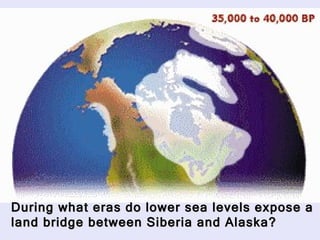
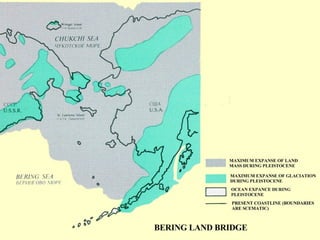
During what eras do lower sea levels expose a land bridge between Siberia and Alaska?
 
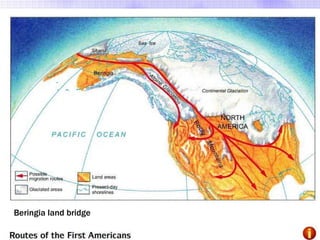
Beringia land bridge
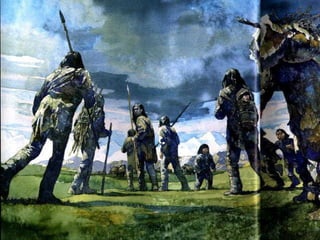
Fish, birds, animals and insects migrated back and forth across this bridge into the ice-free area of the Yukon known as eastern Beringia.  Nomadic  humans migrated across the land bridge following animal herds and entered the Yukon about 24,000 years ago.
 
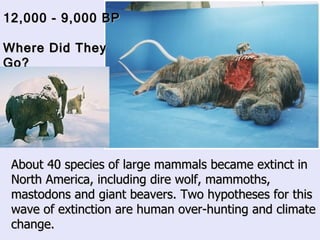
About 40 species of large mammals became extinct in North America, including dire wolf, mammoths, mastodons and giant beavers. Two hypotheses for this wave of extinction are human over-hunting and climate change.  12,000 - 9,000 BP  Where Did They Go?
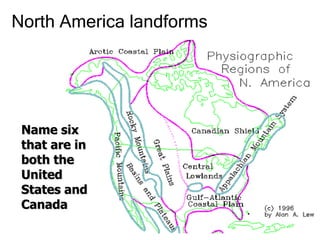
North America landforms Name six that are in both the United States and Canada
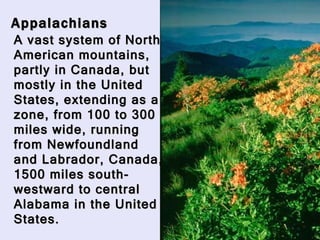
Appalachians A vast system of North American mountains, partly in Canada, but mostly in the United States, extending as a zone, from 100 to 300 miles wide, running from Newfoundland and Labrador, Canada, 1500 miles south-westward to central Alabama in the United States.
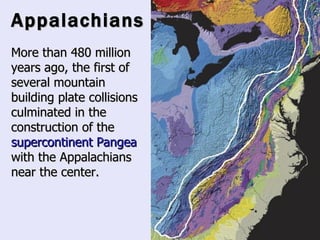
Appalachians More than 480 million years ago, the first of several mountain building plate collisions culminated in the construction of the  supercontinent   Pangea  with the Appalachians near the center.
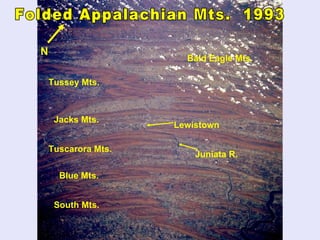
Folded Appalachian Mts.  1993  N Blue Mts.  Tuscarora Mts.  Jacks Mts. Tussey Mts. Bald Eagle Mts.  Lewistown South Mts. Juniata R.
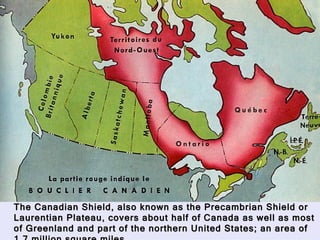
Canadian Shield The Canadian Shield, also known as the Precambrian Shield or Laurentian Plateau, covers about half of Canada as well as most of Greenland and part of the northern United States; an area of 1.7 million square miles.
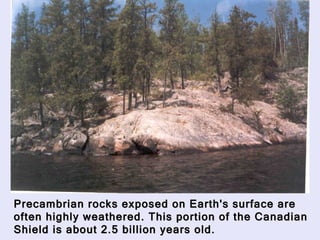
Precambrian rocks exposed on Earth's surface are often highly weathered. This portion of the Canadian Shield is about 2.5 billion years old.
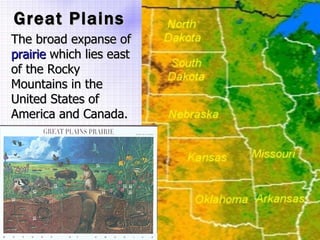
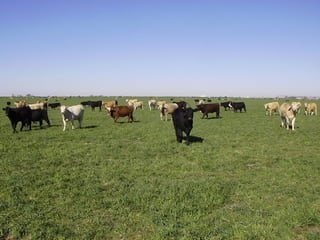
Great Plains The broad expanse of  prairie  which lies east of the Rocky Mountains in the United States of America and Canada.
 
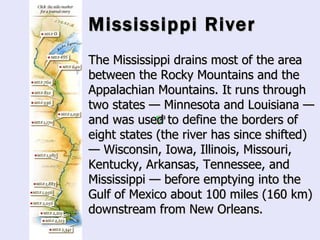
Mississippi River The Mississippi drains most of the area between the Rocky Mountains and the Appalachian Mountains. It runs through two states — Minnesota and Louisiana — and was used to define the borders of eight states (the river has since shifted) — Wisconsin, Iowa, Illinois, Missouri, Kentucky, Arkansas, Tennessee, and Mississippi — before emptying into the Gulf of Mexico about 100 miles (160 km) downstream from New Orleans.
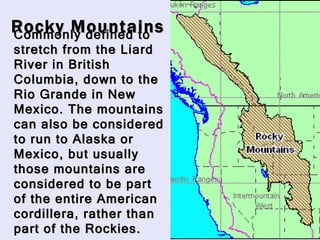
Rocky Mountains Commonly defined to stretch from the Liard River in British Columbia, down to the Rio Grande in New Mexico. The mountains can also be considered to run to Alaska or Mexico, but usually those mountains are considered to be part of the entire American cordillera, rather than part of the Rockies.
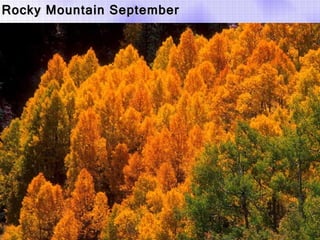
Rocky Mountain September
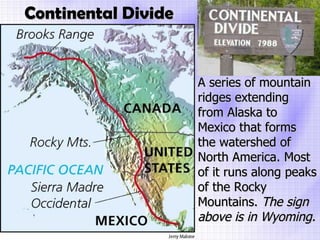
Continental Divide A series of mountain ridges extending from Alaska to Mexico that forms the watershed of North America. Most of it runs along peaks of the Rocky Mountains.  The sign above is in Wyoming.
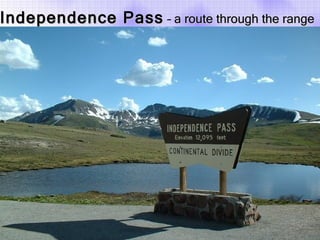
Independence Pass  –  a route through the range
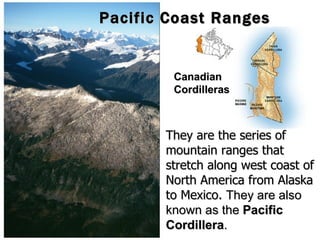
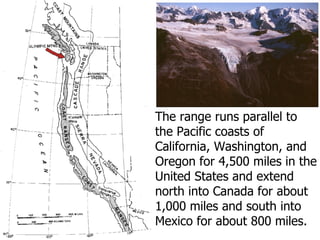
They are the series of mountain ranges that stretch along west coast of North America from Alaska to Mexico.  They are also known as the  Pacific Cordillera . Pacific Coast Ranges Canadian Cordilleras
The range runs parallel to the Pacific coasts of California, Washington, and Oregon for 4,500 miles in the United States and extend north into Canada for about 1,000 miles and south into Mexico for about 800 miles.
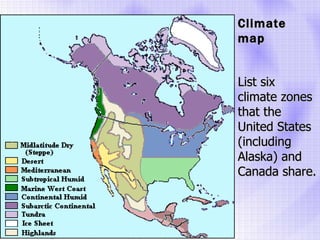
Climate map List six climate zones that the United States (including Alaska) and Canada share.
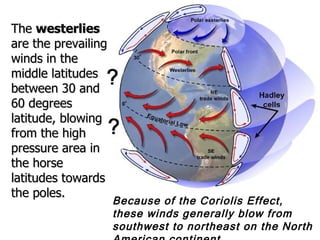
Because of the Coriolis Effect, these winds generally blow from southwest to northeast on the North American continent The  westerlies  are the prevailing winds in the middle latitudes between 30 and 60 degrees latitude, blowing from the high pressure area in the horse latitudes towards the poles.
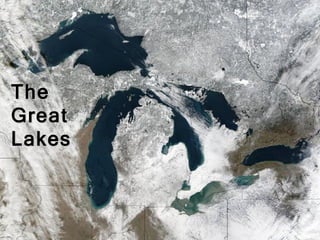
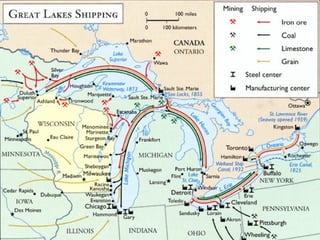
Great Lakes The Great Lakes
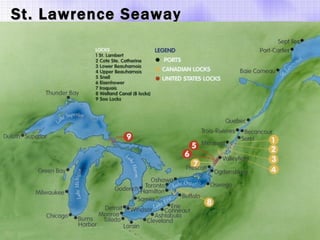
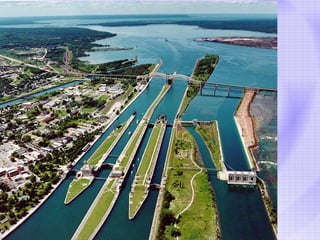
St. Lawrence Seaway
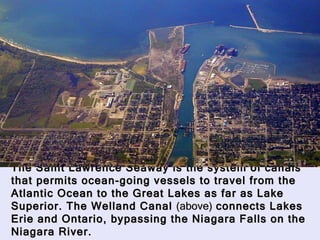
The Saint Lawrence Seaway is the system of canals that permits ocean-going vessels to travel from the Atlantic Ocean to the Great Lakes as far as Lake Superior. The Welland Canal  (above)  connects Lakes Erie and Ontario, bypassing the Niagara Falls on the Niagara River.
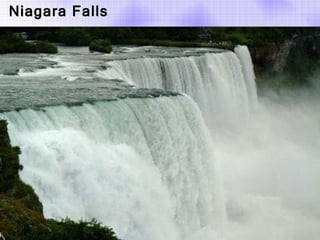
Niagara Falls
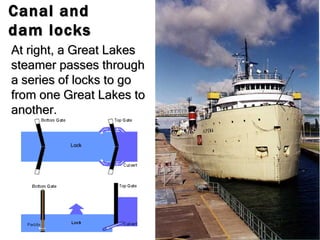
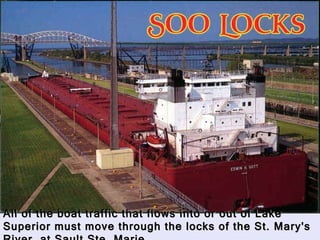
Canal and dam locks At right, a Great Lakes steamer passes through a series of locks to go from one Great Lakes to another.
 
All of the boat traffic that flows into or out of Lake Superior must move through the locks of the St. Mary's River, at Sault Ste. Marie.
 
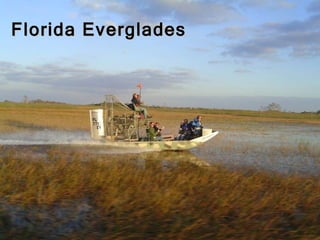
Everglades Florida Everglades
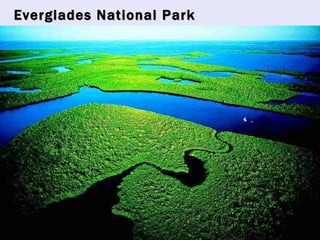
Everglades National Park
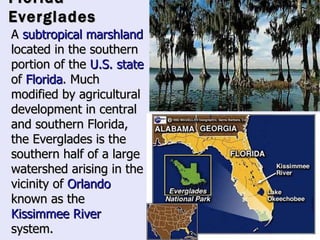
Florida Everglades A  subtropical   marshland  located in the southern portion of the  U.S. state  of  Florida . Much modified by agricultural development in central and southern Florida, the Everglades is the southern half of a large watershed arising in the vicinity of  Orlando  known as the  Kissimmee River  system.
Links http://www.worldatlas.com/webimage/countrys/nalnd.htm http://www.taiga.net/yukonsoe/time1.html http://www.cloudwall.com/wind/images/world5.gif http://www.boatnerd.com/pictures/fleet/alpena.htm http://www.pbase.com/image/36852524 http://www.rivernen.ca/fn_home.htm http://csern.laurentian.ca/Canadian_Shield.htm http://www.nationalgeographic.com/wildworld/profiles/terrestrial/na/na0612.html http://talmud.epsb.ca/regions/north/lz/csi/csi.html http://nationalatlas.gov/articles/geology/features/valleyridge.html http://www.geo.msu.edu/geo333/SooLock.html

North America Geog

  • 1.
    North America WorldGeography text supplement Chap. 5 (to accompany “Glossary” worksheet) Copyright, Concept & Creation: Geetesh Bajaj
  • 2.
    During what erasdo lower sea levels expose a land bridge between Siberia and Alaska?
  • 3.
  • 4.
  • 5.
    Fish, birds, animalsand insects migrated back and forth across this bridge into the ice-free area of the Yukon known as eastern Beringia. Nomadic humans migrated across the land bridge following animal herds and entered the Yukon about 24,000 years ago.
  • 6.
  • 7.
    About 40 speciesof large mammals became extinct in North America, including dire wolf, mammoths, mastodons and giant beavers. Two hypotheses for this wave of extinction are human over-hunting and climate change. 12,000 - 9,000 BP Where Did They Go?
  • 8.
    North America landformsName six that are in both the United States and Canada
  • 9.
    Appalachians A vastsystem of North American mountains, partly in Canada, but mostly in the United States, extending as a zone, from 100 to 300 miles wide, running from Newfoundland and Labrador, Canada, 1500 miles south-westward to central Alabama in the United States.
  • 10.
    Appalachians More than480 million years ago, the first of several mountain building plate collisions culminated in the construction of the supercontinent Pangea with the Appalachians near the center.
  • 11.
    Folded Appalachian Mts. 1993 N Blue Mts. Tuscarora Mts. Jacks Mts. Tussey Mts. Bald Eagle Mts. Lewistown South Mts. Juniata R.
  • 12.
    Canadian Shield TheCanadian Shield, also known as the Precambrian Shield or Laurentian Plateau, covers about half of Canada as well as most of Greenland and part of the northern United States; an area of 1.7 million square miles.
  • 13.
    Precambrian rocks exposedon Earth's surface are often highly weathered. This portion of the Canadian Shield is about 2.5 billion years old.
  • 14.
    Great Plains Thebroad expanse of prairie which lies east of the Rocky Mountains in the United States of America and Canada.
  • 15.
  • 16.
    Mississippi River TheMississippi drains most of the area between the Rocky Mountains and the Appalachian Mountains. It runs through two states — Minnesota and Louisiana — and was used to define the borders of eight states (the river has since shifted) — Wisconsin, Iowa, Illinois, Missouri, Kentucky, Arkansas, Tennessee, and Mississippi — before emptying into the Gulf of Mexico about 100 miles (160 km) downstream from New Orleans.
  • 17.
    Rocky Mountains Commonlydefined to stretch from the Liard River in British Columbia, down to the Rio Grande in New Mexico. The mountains can also be considered to run to Alaska or Mexico, but usually those mountains are considered to be part of the entire American cordillera, rather than part of the Rockies.
  • 18.
  • 19.
    Continental Divide Aseries of mountain ridges extending from Alaska to Mexico that forms the watershed of North America. Most of it runs along peaks of the Rocky Mountains. The sign above is in Wyoming.
  • 20.
    Independence Pass – a route through the range
  • 21.
    They are theseries of mountain ranges that stretch along west coast of North America from Alaska to Mexico. They are also known as the Pacific Cordillera . Pacific Coast Ranges Canadian Cordilleras
  • 22.
    The range runsparallel to the Pacific coasts of California, Washington, and Oregon for 4,500 miles in the United States and extend north into Canada for about 1,000 miles and south into Mexico for about 800 miles.
  • 23.
    Climate map Listsix climate zones that the United States (including Alaska) and Canada share.
  • 24.
    Because of theCoriolis Effect, these winds generally blow from southwest to northeast on the North American continent The westerlies are the prevailing winds in the middle latitudes between 30 and 60 degrees latitude, blowing from the high pressure area in the horse latitudes towards the poles.
  • 25.
    Great Lakes TheGreat Lakes
  • 26.
  • 27.
    The Saint LawrenceSeaway is the system of canals that permits ocean-going vessels to travel from the Atlantic Ocean to the Great Lakes as far as Lake Superior. The Welland Canal (above) connects Lakes Erie and Ontario, bypassing the Niagara Falls on the Niagara River.
  • 28.
  • 29.
    Canal and damlocks At right, a Great Lakes steamer passes through a series of locks to go from one Great Lakes to another.
  • 30.
  • 31.
    All of theboat traffic that flows into or out of Lake Superior must move through the locks of the St. Mary's River, at Sault Ste. Marie.
  • 32.
  • 33.
  • 34.
  • 35.
    Florida Everglades A subtropical marshland located in the southern portion of the U.S. state of Florida . Much modified by agricultural development in central and southern Florida, the Everglades is the southern half of a large watershed arising in the vicinity of Orlando known as the Kissimmee River system.
  • 36.
    Links http://www.worldatlas.com/webimage/countrys/nalnd.htm http://www.taiga.net/yukonsoe/time1.htmlhttp://www.cloudwall.com/wind/images/world5.gif http://www.boatnerd.com/pictures/fleet/alpena.htm http://www.pbase.com/image/36852524 http://www.rivernen.ca/fn_home.htm http://csern.laurentian.ca/Canadian_Shield.htm http://www.nationalgeographic.com/wildworld/profiles/terrestrial/na/na0612.html http://talmud.epsb.ca/regions/north/lz/csi/csi.html http://nationalatlas.gov/articles/geology/features/valleyridge.html http://www.geo.msu.edu/geo333/SooLock.html