The Land And Physical
Geography Of North
America
BY: ENAMUL H
1
Geography of North America
 There are ten countries on the continent of North America, and about 13
different nations and territorial islands in the Caribbean Sea. This lesson
focuses on the three largest continental nations: Canada, the United States
and Mexico. There are four other countries on the North American
continent to the south of Mexico: Belize, Honduras, Guatemala, El Salvador,
Nicaragua, Costa Rica and Panama. These are often referred to as Central
America. The Panama Canal was constructed and opened in 1914 and
allows ships to pass from the Caribbean Sea on the Atlantic Ocean side of
the continent and to cross the narrow isthmus into the Pacific Ocean.
Panama is the end point of the North America and where South America
begins.
2
The Arctic North
 The northernmost parts of North America include Canada and the US State
of Alaska. Some parts of Canada lie within the Arctic circle at 66°34 North
latitude.
 This area of the Arctic where all land remains in polar darkness during the
winter months peaking on the 22nd of December, the winter solstice.
 The same areas remain in sunlight during six months peaking during on
the 21st of June, the summer solstice
 This is because of the tilt of the earth’s axis toward and away from the sun.
To the north of Canada lies he frozen Arctic Ocean and the North Pole that
is at 90° North.
3
The Axial Tilt of The Earth 4
Land below the Arctic Circle
 Most of the population of Eastern Canada lives below this area in Southern
Ontario and Quebec along the great Lakes and St. Lawrence Rivers.
 In this region the winter is shorter, the climate is warmer, and the topsoil is
deeper making the land more fertile for farming.
5
Appalachian Mountain
 The Appalachian Mountains, often called the Appalachians, are a system of
mountains in eastern to northeastern North America. The Appalachians
first formed roughly 480 million years ago during the Ordovician Period
 The Appalachian Mountains are a system of mountain ranges
running along the eastern coast of North America from Newfoundland
and Labrador, Canada, in the north to Alabama, USA, in the south.
6
The Appalachian Mountain 7
Gulf of Mexico
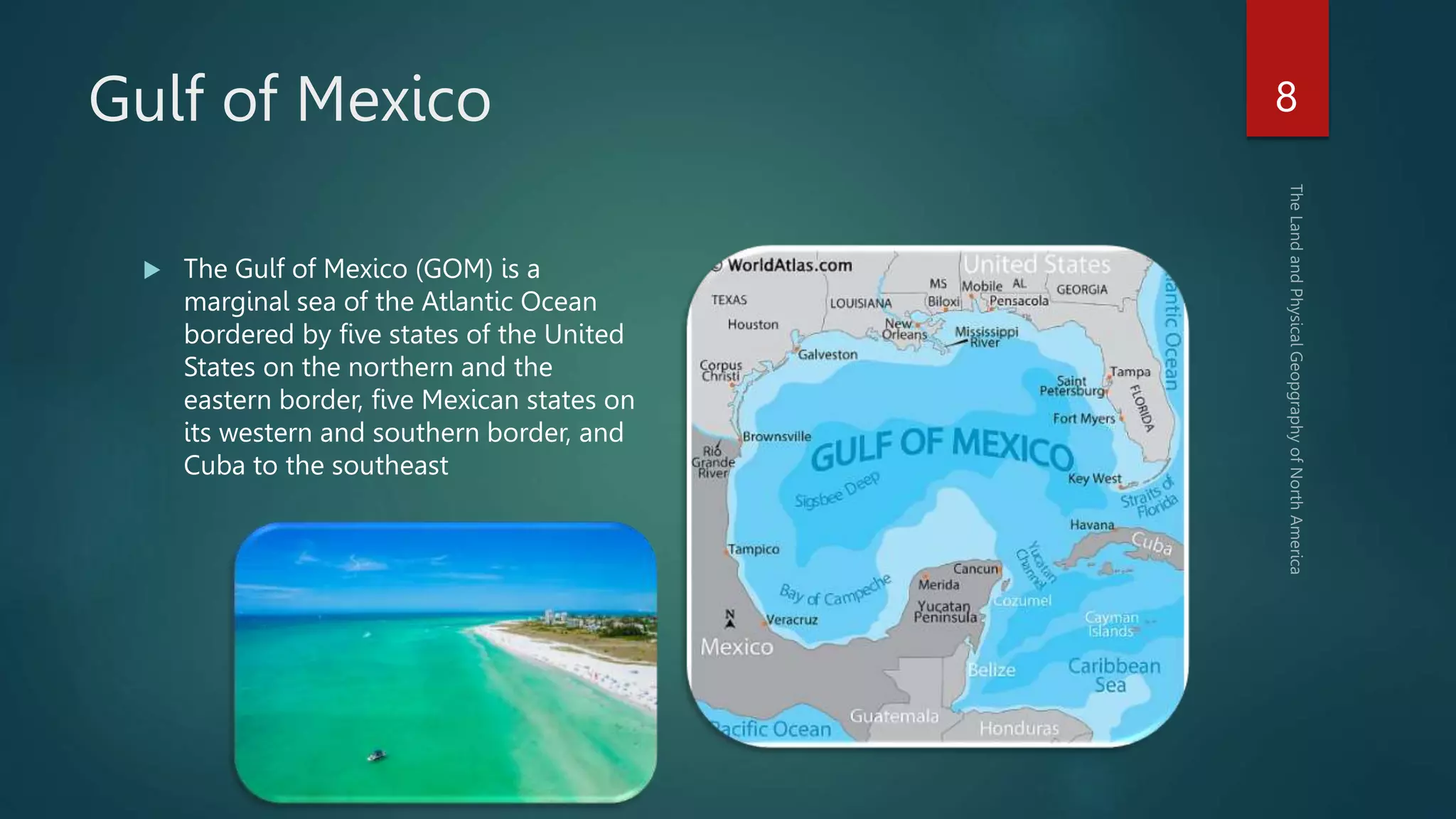
 The Gulf of Mexico (GOM) is a
marginal sea of the Atlantic Ocean
bordered by five states of the United
States on the northern and the
eastern border, five Mexican states on
its western and southern border, and
Cuba to the southeast
8
Rocky mountains
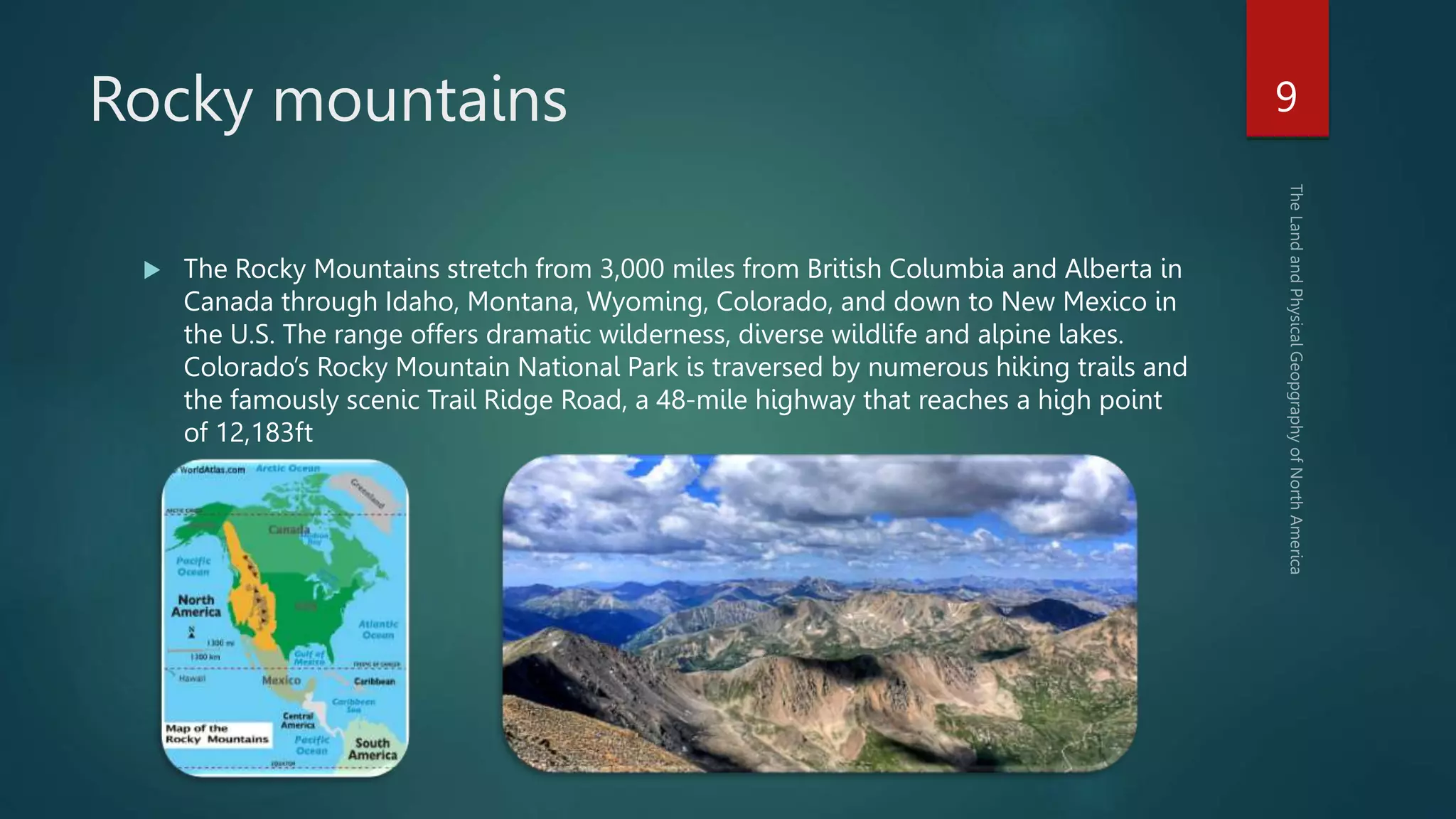
 The Rocky Mountains stretch from 3,000 miles from British Columbia and Alberta in
Canada through Idaho, Montana, Wyoming, Colorado, and down to New Mexico in
the U.S. The range offers dramatic wilderness, diverse wildlife and alpine lakes.
Colorado’s Rocky Mountain National Park is traversed by numerous hiking trails and
the famously scenic Trail Ridge Road, a 48-mile highway that reaches a high point
of 12,183ft
9
Cascade Mountain range
 The Cascade Range or Cascades is a major mountain range of western
North America, extending from southern British Columbia through
Washington and Oregon to Northern California. It includes both non-
volcanic mountains, such as the North Cascades, and the notable
volcanoes known as the High Cascades.
10
Central Mexican Plateau
 The Central Mexican Plateau, also known as the Mexican Altiplano, is a
large arid-to-semiarid plateau that occupies much of northern and central
Mexico.
 One of the world's alpha cities, it is located in the Valley of Mexico
within the high Mexican central plateau, at an altitude of 2,240 meters
(7,350 ft).
11
The Central Mexican Plateau 12
Sierra Madre occidental mountain
range
 The Sierra Madre Occidental is a massive system of mountain ranges that
runs down the west coast of Mexico. It starts in Sonora and Chihuahua
before heading south through the states of Sinaloa, Zacatecas, Durango,
Jalisco, Nayarit, Aguascalientes, and Guanajuanto.
 The Sierra Madre Occidental is a major mountain range system of the
North American Cordillera, that runs northwest–southeast through
northwestern and western Mexico, and along the Gulf of California.
13
Sierra Madre occidental mountain
range
14
The Yucatan Peninsula
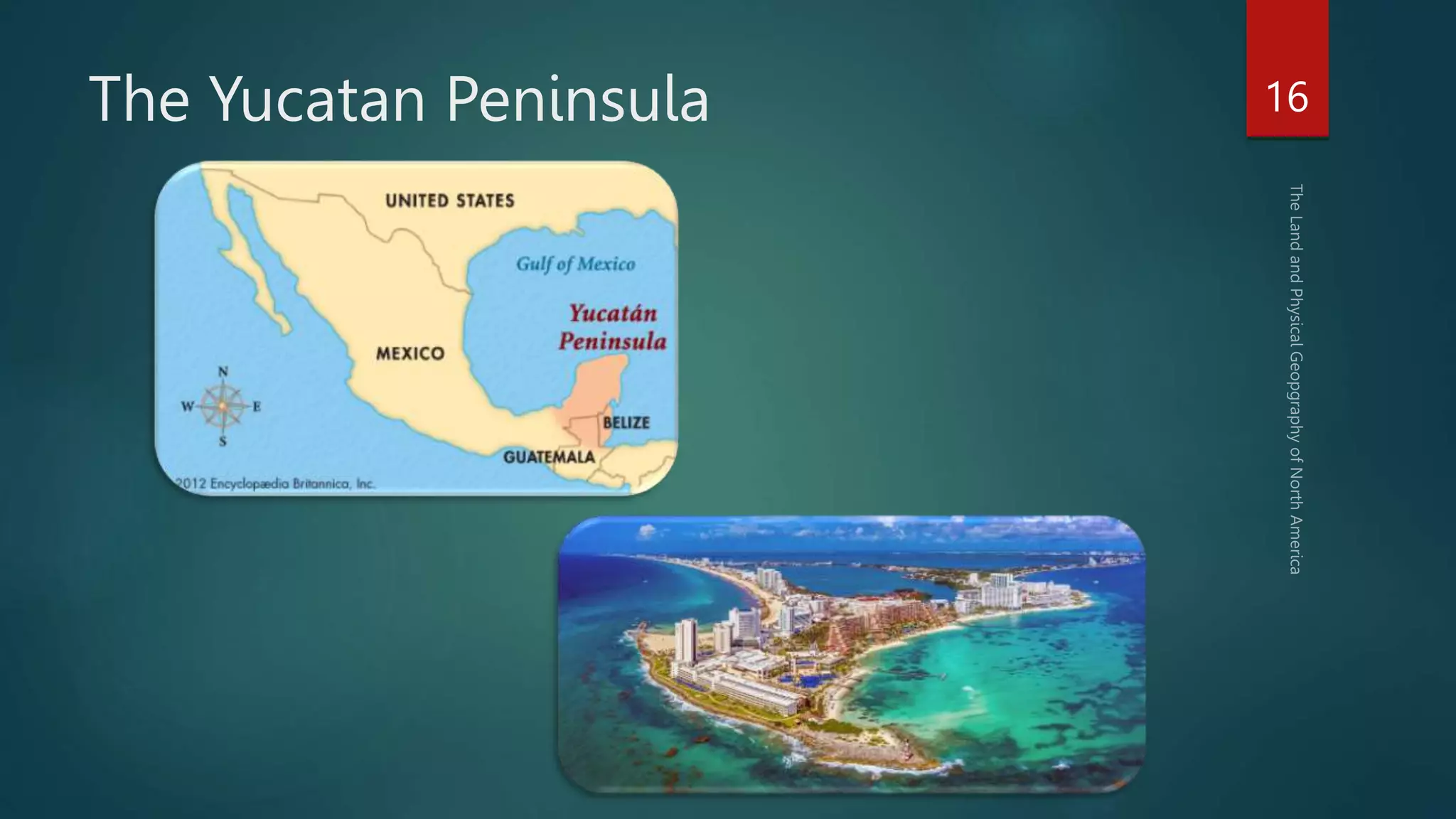
 The Yucatán Peninsula separates the Gulf of Mexico from the Caribbean
Sea, encompassing 3 Mexican states, plus portions of Belize and
Guatemala. On the Caribbean, Mexico's Riviera Maya resort strip is
bookended by 2 popular destinations: Cancún, with its high-rise hotels and
nightlife, and, down the coast, quieter Tulum, a rare seaside example of the
Mayan ruins found throughout the peninsula's interior.
15
The Yucatan Peninsula 16
The Panama Canal
 The Panama Canal is an artificial 82 km waterway in Panama that connects
the Atlantic Ocean with the Pacific Ocean and divides North and South
America. The canal cuts across the Isthmus of Panama and is a conduit for
maritime trade.
 President Theodore Roosevelt oversaw the realization of a long-term
United States goal—a trans-isthmian canal. Throughout the 1800s,
American and British leaders and businessmen wanted to ship goods
quickly and cheaply between the Atlantic and Pacific coasts.
17
The Panama Canal 18
19
THANK YOU
THAT WAS ALL

The Land And Physical Geography Of North America

  • 1.
    The Land AndPhysical Geography Of North America BY: ENAMUL H 1
  • 2.
    Geography of NorthAmerica  There are ten countries on the continent of North America, and about 13 different nations and territorial islands in the Caribbean Sea. This lesson focuses on the three largest continental nations: Canada, the United States and Mexico. There are four other countries on the North American continent to the south of Mexico: Belize, Honduras, Guatemala, El Salvador, Nicaragua, Costa Rica and Panama. These are often referred to as Central America. The Panama Canal was constructed and opened in 1914 and allows ships to pass from the Caribbean Sea on the Atlantic Ocean side of the continent and to cross the narrow isthmus into the Pacific Ocean. Panama is the end point of the North America and where South America begins. 2
  • 3.
    The Arctic North The northernmost parts of North America include Canada and the US State of Alaska. Some parts of Canada lie within the Arctic circle at 66°34 North latitude.  This area of the Arctic where all land remains in polar darkness during the winter months peaking on the 22nd of December, the winter solstice.  The same areas remain in sunlight during six months peaking during on the 21st of June, the summer solstice  This is because of the tilt of the earth’s axis toward and away from the sun. To the north of Canada lies he frozen Arctic Ocean and the North Pole that is at 90° North. 3
  • 4.
    The Axial Tiltof The Earth 4
  • 5.
    Land below theArctic Circle  Most of the population of Eastern Canada lives below this area in Southern Ontario and Quebec along the great Lakes and St. Lawrence Rivers.  In this region the winter is shorter, the climate is warmer, and the topsoil is deeper making the land more fertile for farming. 5
  • 6.
    Appalachian Mountain  TheAppalachian Mountains, often called the Appalachians, are a system of mountains in eastern to northeastern North America. The Appalachians first formed roughly 480 million years ago during the Ordovician Period  The Appalachian Mountains are a system of mountain ranges running along the eastern coast of North America from Newfoundland and Labrador, Canada, in the north to Alabama, USA, in the south. 6
  • 7.
  • 8.
    Gulf of Mexico The Gulf of Mexico (GOM) is a marginal sea of the Atlantic Ocean bordered by five states of the United States on the northern and the eastern border, five Mexican states on its western and southern border, and Cuba to the southeast 8
  • 9.
    Rocky mountains  TheRocky Mountains stretch from 3,000 miles from British Columbia and Alberta in Canada through Idaho, Montana, Wyoming, Colorado, and down to New Mexico in the U.S. The range offers dramatic wilderness, diverse wildlife and alpine lakes. Colorado’s Rocky Mountain National Park is traversed by numerous hiking trails and the famously scenic Trail Ridge Road, a 48-mile highway that reaches a high point of 12,183ft 9
  • 10.
    Cascade Mountain range The Cascade Range or Cascades is a major mountain range of western North America, extending from southern British Columbia through Washington and Oregon to Northern California. It includes both non- volcanic mountains, such as the North Cascades, and the notable volcanoes known as the High Cascades. 10
  • 11.
    Central Mexican Plateau The Central Mexican Plateau, also known as the Mexican Altiplano, is a large arid-to-semiarid plateau that occupies much of northern and central Mexico.  One of the world's alpha cities, it is located in the Valley of Mexico within the high Mexican central plateau, at an altitude of 2,240 meters (7,350 ft). 11
  • 12.
  • 13.
    Sierra Madre occidentalmountain range  The Sierra Madre Occidental is a massive system of mountain ranges that runs down the west coast of Mexico. It starts in Sonora and Chihuahua before heading south through the states of Sinaloa, Zacatecas, Durango, Jalisco, Nayarit, Aguascalientes, and Guanajuanto.  The Sierra Madre Occidental is a major mountain range system of the North American Cordillera, that runs northwest–southeast through northwestern and western Mexico, and along the Gulf of California. 13
  • 14.
    Sierra Madre occidentalmountain range 14
  • 15.
    The Yucatan Peninsula The Yucatán Peninsula separates the Gulf of Mexico from the Caribbean Sea, encompassing 3 Mexican states, plus portions of Belize and Guatemala. On the Caribbean, Mexico's Riviera Maya resort strip is bookended by 2 popular destinations: Cancún, with its high-rise hotels and nightlife, and, down the coast, quieter Tulum, a rare seaside example of the Mayan ruins found throughout the peninsula's interior. 15
  • 16.
  • 17.
    The Panama Canal The Panama Canal is an artificial 82 km waterway in Panama that connects the Atlantic Ocean with the Pacific Ocean and divides North and South America. The canal cuts across the Isthmus of Panama and is a conduit for maritime trade.  President Theodore Roosevelt oversaw the realization of a long-term United States goal—a trans-isthmian canal. Throughout the 1800s, American and British leaders and businessmen wanted to ship goods quickly and cheaply between the Atlantic and Pacific coasts. 17
  • 18.
  • 19.