Geography – The Fundas
1. XXXX is a seasonal shift in the prevailing wind direction,
that usually brings with it a different kind of weather. The
persistent wind flow is driven by a warm air mass with low
pressure at the surface that forms over the continent as it
    is warmed by the sun. Air from the relatively higher
  pressure air mass over the ocean flows toward the low
                    pressure over land.


                        Monsoon
2. What are El Nino and La Nina commonly
      associated with, besides natural disasters?


El Nino is associated with warming of surface waters in
Eastern Pacific and La Nina is associated with cooling of
            surface waters in Eastern Pacific.
3. What are Tropics of Cancer and Capricorn?


   The tropics are the two imaginary lines where the sun is directly
 overhead at noon on the two solstices - near June and December 21.
The sun is directly overhead at noon on the Tropic of Cancer on June 21
    (the beginning of summer in the Northern Hemisphere and the
beginning of winter in the Southern Hemisphere) and the sun is directly
  overhead at noon on the Tropic of Capricorn on December 21 (the
 beginning of winter in the Northern Hemisphere and the beginning of
                 summer in the Southern Hemisphere).
4. What is a peninsula?


A peninsula is a land mass that juts out into the sea, or is
          surrounded by water on three sides.
5. This soil is formed from the deposition of silt carried by
rivers and is found e.g., in the Great Northern plains from
         Punjab to the Assam valley. Name the soil.


                       Alluvial Soil
6. What is an Isthmus?


 An isthmus is a narrow strip of land connecting two larger
                        land areas.
 The Isthmus of Panama connects the continents of North
and South America (the Americas), and the Isthmus of Suez
       in Egypt connects Africa and Asia (or Eurasia).
7. What are Trade Winds?


The trade winds (also called trades) are the prevailing pattern of easterly surface winds
 found in the tropics, within the lower portion of the Earth's atmosphere, in the lower
                  section of the troposphere near the Earth's equator.
 The trade winds blow predominantly from the northeast in the Northern Hemisphere
 and from the southeast in the Southern Hemisphere, strengthening during the winter
 and when the Arctic oscillation is in its warm phase. Historically, the trade winds have
  been used by captains of sailing ships to cross the world's oceans for centuries; and
  enabled European empire expansion into the Americas, and trade routes to become
                   established across the Atlantic and Pacific oceans.
Geography – India
8. India is supposed to have been formed after
  separation from which prehistoric super continent?


 India is entirely contained on the Indian Plate, a major
tectonic plate that was formed when it split off from the
            ancient continent Gondwanaland.
9. Deccan plateau is typically made of which rock?


         Igneous rock – Basalt / Granite
10. How is the southernmost point in the Indian
     main land, Kanyakumari , also known as?


Cape Comorin, Tamil Nadu, 8.06890°N 77.55230°E
11. Which is the highest fully contained mountain in
                       India?


         Nanda Devi, 7816 m, Uttaranchal
12. Which river is known as Yarlung Zangbo too?


                 Brahmaputra
13. Which imaginary line passes through India?
    Tropic of Cancer or Tropic of Capricorn.


               Tropic of Cancer
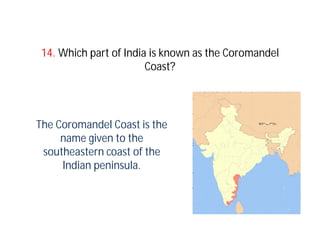
14. Which part of India is known as the Coromandel
                        Coast?


The Coromandel Coast is the
     name given to the
 southeastern coast of the
     Indian peninsula.
15. Which is largest river island in India?


   Majuli Island in Assam is the largest river Island in India.
    Majuli is in the Brahmaputra River, and is about 200
kilometres east from Guwahati, the capital of Assam. Majuli
was formed due to course changes by the river Brahmaputra
  and its tributaries, mainly the Lohit. The total area of the
island was 1250 sq.km but due to erosion its present area is
                          557 sq km.
16. What is Chilka lake?


  Chilka Lake (Chilika Lake) is a brackish water lagoon, spread over the Puri,
 Khurda and Ganjam districts of Orissa state on the east coast of India, at the
mouth of the Daya River, flowing into the Bay of Bengal. It is the largest coastal
          lagoon in India and the second largest lagoon in the World.

 A lagoon is a body of comparatively shallow salt or brackish water separated
   from the deeper sea by a shallow or exposed barrier beach, sandbank of
                  marine origin, coral reef, or similar feature.
17. Which river is called the Sorrow of Bihar?


                    Kosi
18. What connects Bay of Bengal to Gulf of Mannar?


The Palk Strait is a 40-85 mi (64-137 km) wide strait that
  lies between India's Tamil Nadu state and the island
nation of Sri Lanka. It connects the Bay of Bengal to the
  northeast with the Gulf of Mannar to the south. The
  strait receives several rivers, most notably the Vaigai
                    River of Tamil Nadu.
Geography – The World
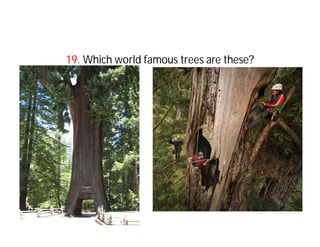
19. Which world famous trees are these?
20. Which is the highest mountain in South
                 America?


      Aconcagua, 6962 m, Argentina
21. Which ocean has the deepest place on earth,
Challenger Deep - Mariana Trench at 10,923 m?


                 Pacific Ocean
22. Which is the world's highest volcano?


Ojos del Salado, 6893 m, Catamarca, Argentina -
                 Atacama, Chile
23. Which is the largest land locked country in the
                      world?


           Kazakhstan, 2727300 sq km
24. Which is the largest inland sea / lake in the
                    world?


          Caspian Sea, 371000 sq km
25. Which is the largest sea in the world?


    South China Sea, 2974600 sq km
26. Which is the world's largest peninsula?


 Arabian Peninsula. Saudi Arabia, Kuwait, Qatar, United
 Arab Emirates, Oman and Yemen and is surrounded by
the Red Sea, the Arabian Sea, the Gulf of Oman and the
                      Persian Gulf
27. Which is the longest line of latitude on the
                    earth?


                   Equator
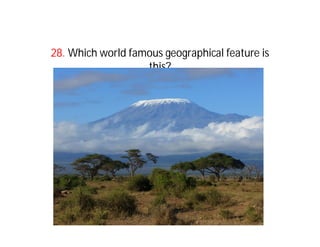
28. Which world famous geographical feature is
                   this?
29. Which is the world's largest glacier outside polar
                and sub polar regions?


Siachen Glacier has the distinction of being the largest
glacier outside the polar and the sub-polar regions. It is
 also the largest glacier in India. Siachen glacier is 75.6
               km long and 2.8 km wide.
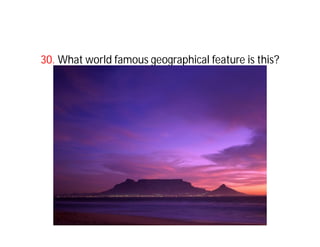
30. What world famous geographical feature is this?


                 Tropic of Cancer
Extra
31. What is an estuary?


An estuary is a partly enclosed coastal body of water with one or more rivers or
      streams flowing into it, and with a free connection to the open sea.

   Estuaries form a transition zone between river environments and ocean
environments and are subject to both marine influences, such as tides, waves,
 and the influx of saline water; and riverine influences, such as flows of fresh
water and sediment. The inflow of both seawater and freshwater provide high
 levels of nutrients in both the water column and sediment, making estuaries
            among the most productive natural habitats in the world

Answers Geography Quiz

  • 1.
  • 2.
    1. XXXX isa seasonal shift in the prevailing wind direction, that usually brings with it a different kind of weather. The persistent wind flow is driven by a warm air mass with low pressure at the surface that forms over the continent as it is warmed by the sun. Air from the relatively higher pressure air mass over the ocean flows toward the low pressure over land. Monsoon
  • 3.
    2. What areEl Nino and La Nina commonly associated with, besides natural disasters? El Nino is associated with warming of surface waters in Eastern Pacific and La Nina is associated with cooling of surface waters in Eastern Pacific.
  • 4.
    3. What areTropics of Cancer and Capricorn? The tropics are the two imaginary lines where the sun is directly overhead at noon on the two solstices - near June and December 21. The sun is directly overhead at noon on the Tropic of Cancer on June 21 (the beginning of summer in the Northern Hemisphere and the beginning of winter in the Southern Hemisphere) and the sun is directly overhead at noon on the Tropic of Capricorn on December 21 (the beginning of winter in the Northern Hemisphere and the beginning of summer in the Southern Hemisphere).
  • 5.
    4. What isa peninsula? A peninsula is a land mass that juts out into the sea, or is surrounded by water on three sides.
  • 6.
    5. This soilis formed from the deposition of silt carried by rivers and is found e.g., in the Great Northern plains from Punjab to the Assam valley. Name the soil. Alluvial Soil
  • 7.
    6. What isan Isthmus? An isthmus is a narrow strip of land connecting two larger land areas. The Isthmus of Panama connects the continents of North and South America (the Americas), and the Isthmus of Suez in Egypt connects Africa and Asia (or Eurasia).
  • 8.
    7. What areTrade Winds? The trade winds (also called trades) are the prevailing pattern of easterly surface winds found in the tropics, within the lower portion of the Earth's atmosphere, in the lower section of the troposphere near the Earth's equator. The trade winds blow predominantly from the northeast in the Northern Hemisphere and from the southeast in the Southern Hemisphere, strengthening during the winter and when the Arctic oscillation is in its warm phase. Historically, the trade winds have been used by captains of sailing ships to cross the world's oceans for centuries; and enabled European empire expansion into the Americas, and trade routes to become established across the Atlantic and Pacific oceans.
  • 9.
  • 10.
    8. India issupposed to have been formed after separation from which prehistoric super continent? India is entirely contained on the Indian Plate, a major tectonic plate that was formed when it split off from the ancient continent Gondwanaland.
  • 11.
    9. Deccan plateauis typically made of which rock? Igneous rock – Basalt / Granite
  • 12.
    10. How isthe southernmost point in the Indian main land, Kanyakumari , also known as? Cape Comorin, Tamil Nadu, 8.06890°N 77.55230°E
  • 13.
    11. Which isthe highest fully contained mountain in India? Nanda Devi, 7816 m, Uttaranchal
  • 14.
    12. Which riveris known as Yarlung Zangbo too? Brahmaputra
  • 15.
    13. Which imaginaryline passes through India? Tropic of Cancer or Tropic of Capricorn. Tropic of Cancer
  • 16.
    14. Which partof India is known as the Coromandel Coast? The Coromandel Coast is the name given to the southeastern coast of the Indian peninsula.
  • 17.
    15. Which islargest river island in India? Majuli Island in Assam is the largest river Island in India. Majuli is in the Brahmaputra River, and is about 200 kilometres east from Guwahati, the capital of Assam. Majuli was formed due to course changes by the river Brahmaputra and its tributaries, mainly the Lohit. The total area of the island was 1250 sq.km but due to erosion its present area is 557 sq km.
  • 18.
    16. What isChilka lake? Chilka Lake (Chilika Lake) is a brackish water lagoon, spread over the Puri, Khurda and Ganjam districts of Orissa state on the east coast of India, at the mouth of the Daya River, flowing into the Bay of Bengal. It is the largest coastal lagoon in India and the second largest lagoon in the World. A lagoon is a body of comparatively shallow salt or brackish water separated from the deeper sea by a shallow or exposed barrier beach, sandbank of marine origin, coral reef, or similar feature.
  • 19.
    17. Which riveris called the Sorrow of Bihar? Kosi
  • 20.
    18. What connectsBay of Bengal to Gulf of Mannar? The Palk Strait is a 40-85 mi (64-137 km) wide strait that lies between India's Tamil Nadu state and the island nation of Sri Lanka. It connects the Bay of Bengal to the northeast with the Gulf of Mannar to the south. The strait receives several rivers, most notably the Vaigai River of Tamil Nadu.
  • 21.
  • 22.
    19. Which worldfamous trees are these?
  • 23.
    20. Which isthe highest mountain in South America? Aconcagua, 6962 m, Argentina
  • 24.
    21. Which oceanhas the deepest place on earth, Challenger Deep - Mariana Trench at 10,923 m? Pacific Ocean
  • 25.
    22. Which isthe world's highest volcano? Ojos del Salado, 6893 m, Catamarca, Argentina - Atacama, Chile
  • 26.
    23. Which isthe largest land locked country in the world? Kazakhstan, 2727300 sq km
  • 27.
    24. Which isthe largest inland sea / lake in the world? Caspian Sea, 371000 sq km
  • 28.
    25. Which isthe largest sea in the world? South China Sea, 2974600 sq km
  • 29.
    26. Which isthe world's largest peninsula? Arabian Peninsula. Saudi Arabia, Kuwait, Qatar, United Arab Emirates, Oman and Yemen and is surrounded by the Red Sea, the Arabian Sea, the Gulf of Oman and the Persian Gulf
  • 30.
    27. Which isthe longest line of latitude on the earth? Equator
  • 31.
    28. Which worldfamous geographical feature is this?
  • 32.
    29. Which isthe world's largest glacier outside polar and sub polar regions? Siachen Glacier has the distinction of being the largest glacier outside the polar and the sub-polar regions. It is also the largest glacier in India. Siachen glacier is 75.6 km long and 2.8 km wide.
  • 33.
    30. What worldfamous geographical feature is this? Tropic of Cancer
  • 34.
  • 35.
    31. What isan estuary? An estuary is a partly enclosed coastal body of water with one or more rivers or streams flowing into it, and with a free connection to the open sea. Estuaries form a transition zone between river environments and ocean environments and are subject to both marine influences, such as tides, waves, and the influx of saline water; and riverine influences, such as flows of fresh water and sediment. The inflow of both seawater and freshwater provide high levels of nutrients in both the water column and sediment, making estuaries among the most productive natural habitats in the world