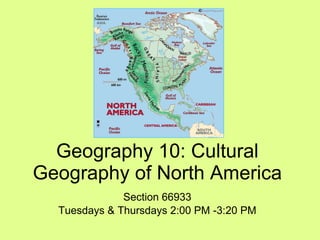
Geography 10: Cultural Geography of North America Section 66933 Tuesdays & Thursdays 2:00 PM -3:20 PM
What is Geography? The scientific study of the Earth's surface and its various climates, countries, peoples, and natural resources.
Fields of Geography Human or Cultural Geography Deals with social, economic, and behavioral processes Physical Geography Examines the natural processes occurring at Earth’s surface that provide the physical setting for human activities
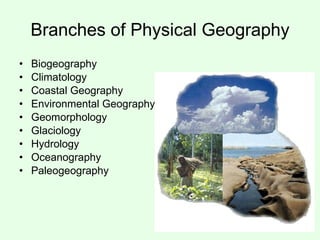
Branches of Physical Geography Biogeography Climatology Coastal Geography Environmental Geography Geomorphology Glaciology Hydrology Oceanography Paleogeography
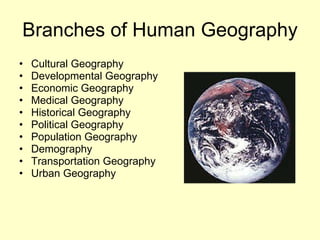
Branches of Human Geography Cultural Geography Developmental Geography Economic Geography Medical Geography Historical Geography Political Geography Population Geography Demography Transportation Geography Urban Geography
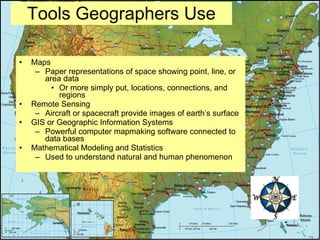
Tools Geographers Use Maps Paper representations of space showing point, line, or area data Or more simply put, locations, connections, and regions Remote Sensing Aircraft or spacecraft provide images of earth’s surface GIS or Geographic Information Systems Powerful computer mapmaking software connected to data bases Mathematical Modeling and Statistics Used to understand natural and human phenomenon
Course Description This course is about cultural geography of North America through time and space.  The dynamics and ethnicity of North American culture will be traced through discovery, exploration, settlement patterns, aboriginal patterns, national interests, economic exploitation, agriculture, commerce, ethnicity, demography, and changing attitudes.  Emphasis is on the origin and diffusion of North American cultural traditions.
Course Objectives Once you have completed this course you should be able to: Define the cultural influences which make up North America. Identify settlement patterns, economic systems, transportation patterns, the structure of American cities and demographics for the continent. Distinguish the aboriginal cultural which make up the American character in time and space. Recognize North American ethnicity in time and as a part of national character. Define the American cultural landscape in relationship to the biophysical world. Identify important cultural sites, political, economic, and commercial sites on the continent. Analyze the structural elements of cities and other cultural features in time and ethnic influences. Recognize ethnic and national purpose in relationship to land values and historical happening.
Required Text Regional Landscapes of the US and Canada 7 th  Edition Birdsall, Palka, Malinowski, and Price ISBN  978-0470098264
Materials Required Pens Pencils Paper Internet Access Recommended: Colored Pens/Pencils
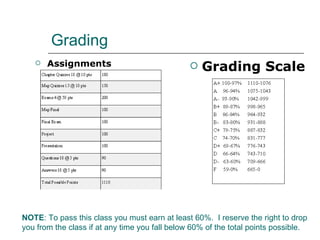
Grading Assignments Grading Scale NOTE : To pass this class you must earn at least 60%.  I reserve the right to drop  you from the class if at any time you fall below 60% of the total points possible.
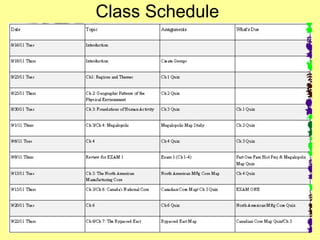
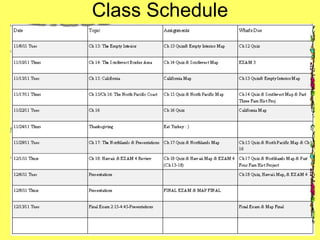
Class Schedule
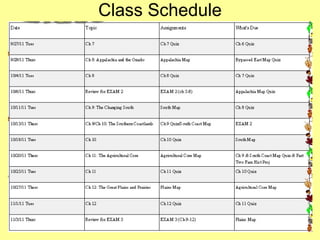
Class Schedule
Class Schedule
Chapter Quizzes There will be 18 chapter quizzes.  These will be given using Moodle.  You will have one week to complete quizzes. Quizzes will close at 1:30 PM on their due dates.  Quizzes will be multiple choice, true and false, matching, and/or short paragraphs.
Map Quizzes and Tests There will be a total of 15 map quizzes and tests. These will be based on map studies we do in class.  Map Tests/Quizzes will be given using Moodle. You will have one week to complete these assignments, they will close at 1:30 PM on their due dates.
Exams There will be 4 exams. Exams will be based on chapter quizzes. Tests will be given using Moodle. You will have one week to complete exams. They will close at 1:30 PM on their due dates.
Final Exams There will be a cumulative final exam based on chapter quizzes and there will be a cumulative map final exam. That means it will cover all the chapters and maps we have studied through the semester. Please note the time for the final exam, which is different from our regular meeting time.  2:15 PM to 4:45 PM December 13, 2010.
Family History Project and Presentation You are required to complete a project for this class. It can be a paper, web presentation, or video. A map component is included. You are required to give a presentation in this class. Presentations will be in groups and will be about projects.
Late Work and Missed Exams Late work will not be accepted.  Do not ask for quizzes or exams to be reopened if you miss them.
Absences and Tardiness I reserve the right to drop students who miss class twice.  If you have to miss class, you should stay in contact with me if you do not wish to be dropped.  I also reserve the right to drop students for excessive tardiness.  Excessive tardiness is being late more than three times.  If you are going to be late, come in quietly and take a seat WITHOUT interrupting lecture.
Academic Honesty Cheating of any kind will not be tolerated.  Any incidences of cheating or plagiarism will be reported to the dean’s office.  Please refer to Chaffey College’s policy on academic honesty
Cell Phones and Texting Use of cell phones for talking or texting during class is inappropriate.  You may be asked to leave the classroom if you are talking or texting on your phone during lecture.  Phones should be set to silent mode when in class.
Extra Credit Extra credit may be offered throughout the course. You need to be present to take advantage it.
E-mailing Assignments/My Mailbox Assignments will NOT be accepted by e-mail.  I have a mailbox on the campus.  You may leave assignments at my mailbox which is located in Zimmerman Hall.
Graded Work It is your responsibility to pick up your graded work.  Graded work will be held for 30 days after the last day of class and then recycled.  It is highly recommended that you keep your graded work until final grades have been posted. Not just for this class, for all of your classes!
Dropping If you wish to drop this course, you must do so formally.  Not dropping the course may result in an F.
Moodle Moodle will be used during this course.  You will find course documents, quizzes, tests and grades.  You can access Moodle at:  http://moodle.chaffey.edu/
Disabilities If you have, or think you have a disability which may interfere with your ability to perform in this class, please speak with me immediately and please contact the Disability Service Programs office at (909) 652-6398.  If you need accommodations, you must contact them immediately.
Contacting Me The best way to reach me is by e-mail at  [email_address] .  I do not have an office or office hours.  If you need to speak to me, it can be done before class, after class, or by appointment. My telephone number is (909) 652-7090 but I check the e-mail address much more frequently.

Geography 10 intro

  • 1.
    Geography 10: CulturalGeography of North America Section 66933 Tuesdays & Thursdays 2:00 PM -3:20 PM
  • 2.
    What is Geography?The scientific study of the Earth's surface and its various climates, countries, peoples, and natural resources.
  • 3.
    Fields of GeographyHuman or Cultural Geography Deals with social, economic, and behavioral processes Physical Geography Examines the natural processes occurring at Earth’s surface that provide the physical setting for human activities
  • 4.
    Branches of PhysicalGeography Biogeography Climatology Coastal Geography Environmental Geography Geomorphology Glaciology Hydrology Oceanography Paleogeography
  • 5.
    Branches of HumanGeography Cultural Geography Developmental Geography Economic Geography Medical Geography Historical Geography Political Geography Population Geography Demography Transportation Geography Urban Geography
  • 6.
    Tools Geographers UseMaps Paper representations of space showing point, line, or area data Or more simply put, locations, connections, and regions Remote Sensing Aircraft or spacecraft provide images of earth’s surface GIS or Geographic Information Systems Powerful computer mapmaking software connected to data bases Mathematical Modeling and Statistics Used to understand natural and human phenomenon
  • 7.
    Course Description Thiscourse is about cultural geography of North America through time and space. The dynamics and ethnicity of North American culture will be traced through discovery, exploration, settlement patterns, aboriginal patterns, national interests, economic exploitation, agriculture, commerce, ethnicity, demography, and changing attitudes. Emphasis is on the origin and diffusion of North American cultural traditions.
  • 8.
    Course Objectives Onceyou have completed this course you should be able to: Define the cultural influences which make up North America. Identify settlement patterns, economic systems, transportation patterns, the structure of American cities and demographics for the continent. Distinguish the aboriginal cultural which make up the American character in time and space. Recognize North American ethnicity in time and as a part of national character. Define the American cultural landscape in relationship to the biophysical world. Identify important cultural sites, political, economic, and commercial sites on the continent. Analyze the structural elements of cities and other cultural features in time and ethnic influences. Recognize ethnic and national purpose in relationship to land values and historical happening.
  • 9.
    Required Text RegionalLandscapes of the US and Canada 7 th Edition Birdsall, Palka, Malinowski, and Price ISBN 978-0470098264
  • 10.
    Materials Required PensPencils Paper Internet Access Recommended: Colored Pens/Pencils
  • 11.
    Grading Assignments GradingScale NOTE : To pass this class you must earn at least 60%. I reserve the right to drop you from the class if at any time you fall below 60% of the total points possible.
  • 12.
  • 13.
  • 14.
  • 15.
    Chapter Quizzes Therewill be 18 chapter quizzes. These will be given using Moodle. You will have one week to complete quizzes. Quizzes will close at 1:30 PM on their due dates. Quizzes will be multiple choice, true and false, matching, and/or short paragraphs.
  • 16.
    Map Quizzes andTests There will be a total of 15 map quizzes and tests. These will be based on map studies we do in class. Map Tests/Quizzes will be given using Moodle. You will have one week to complete these assignments, they will close at 1:30 PM on their due dates.
  • 17.
    Exams There willbe 4 exams. Exams will be based on chapter quizzes. Tests will be given using Moodle. You will have one week to complete exams. They will close at 1:30 PM on their due dates.
  • 18.
    Final Exams Therewill be a cumulative final exam based on chapter quizzes and there will be a cumulative map final exam. That means it will cover all the chapters and maps we have studied through the semester. Please note the time for the final exam, which is different from our regular meeting time. 2:15 PM to 4:45 PM December 13, 2010.
  • 19.
    Family History Projectand Presentation You are required to complete a project for this class. It can be a paper, web presentation, or video. A map component is included. You are required to give a presentation in this class. Presentations will be in groups and will be about projects.
  • 20.
    Late Work andMissed Exams Late work will not be accepted. Do not ask for quizzes or exams to be reopened if you miss them.
  • 21.
    Absences and TardinessI reserve the right to drop students who miss class twice. If you have to miss class, you should stay in contact with me if you do not wish to be dropped. I also reserve the right to drop students for excessive tardiness. Excessive tardiness is being late more than three times. If you are going to be late, come in quietly and take a seat WITHOUT interrupting lecture.
  • 22.
    Academic Honesty Cheatingof any kind will not be tolerated. Any incidences of cheating or plagiarism will be reported to the dean’s office. Please refer to Chaffey College’s policy on academic honesty
  • 23.
    Cell Phones andTexting Use of cell phones for talking or texting during class is inappropriate. You may be asked to leave the classroom if you are talking or texting on your phone during lecture. Phones should be set to silent mode when in class.
  • 24.
    Extra Credit Extracredit may be offered throughout the course. You need to be present to take advantage it.
  • 25.
    E-mailing Assignments/My MailboxAssignments will NOT be accepted by e-mail. I have a mailbox on the campus. You may leave assignments at my mailbox which is located in Zimmerman Hall.
  • 26.
    Graded Work Itis your responsibility to pick up your graded work. Graded work will be held for 30 days after the last day of class and then recycled. It is highly recommended that you keep your graded work until final grades have been posted. Not just for this class, for all of your classes!
  • 27.
    Dropping If youwish to drop this course, you must do so formally. Not dropping the course may result in an F.
  • 28.
    Moodle Moodle willbe used during this course. You will find course documents, quizzes, tests and grades. You can access Moodle at: http://moodle.chaffey.edu/
  • 29.
    Disabilities If youhave, or think you have a disability which may interfere with your ability to perform in this class, please speak with me immediately and please contact the Disability Service Programs office at (909) 652-6398. If you need accommodations, you must contact them immediately.
  • 30.
    Contacting Me Thebest way to reach me is by e-mail at [email_address] . I do not have an office or office hours. If you need to speak to me, it can be done before class, after class, or by appointment. My telephone number is (909) 652-7090 but I check the e-mail address much more frequently.