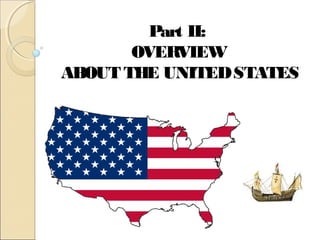
Part II:
OVERVIEW
ABOUT THE UNITEDSTATES
CONTENTSCONTENTS
1. Some facts about the USA
2. E PLURIBUS UNUM
3. Geography
4. History
5. People
6. Culture
7. Economy
8. Government
The factfile of the USAThe factfile of the USA
Washington: the capital city
New York: the biggest city.
Official language: American English.
Current president: Barack Obama.
Surface: 9.8 million km
2
(3rd
biggest)
Number of States: 50
Population: 307.000.000 (3rd
biggest)
Independence Day: July 4th
Anthem:
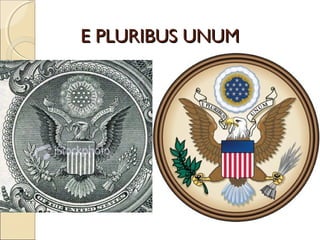
E PLURIBUS UNUME PLURIBUS UNUM
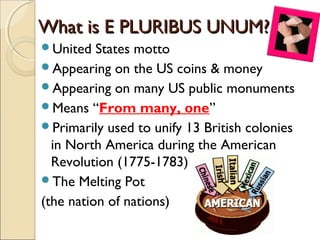
What is E PLURIBUS UNUM?What is E PLURIBUS UNUM?
United States motto
Appearing on the US coins & money
Appearing on many US public monuments
Means “From many, one”
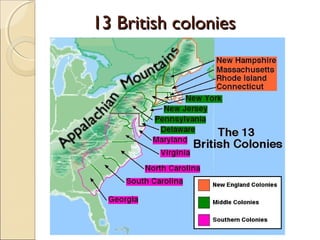
Primarily used to unify 13 British colonies
in North America during the American
Revolution (1775-1783)
The Melting Pot
(the nation of nations)
13 British colonies13 British colonies
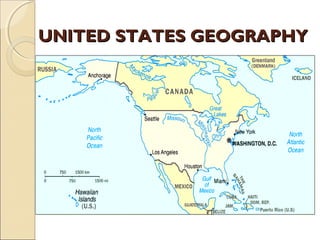
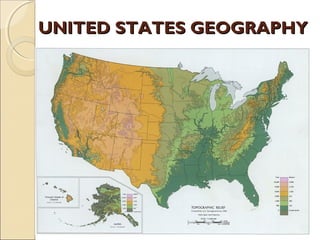
UNITED STATES GEOGRAPHYUNITED STATES GEOGRAPHY
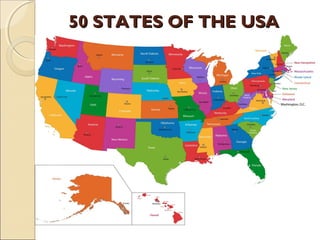
50 STATES OF THE USA50 STATES OF THE USA
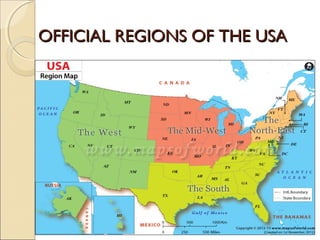
OFFICIAL REGIONS OF THE USAOFFICIAL REGIONS OF THE USA
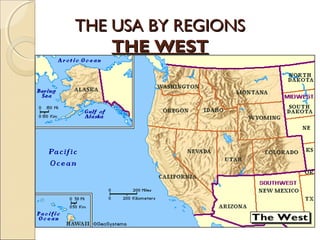
THE USA BY REGIONSTHE USA BY REGIONS
THE WESTTHE WEST
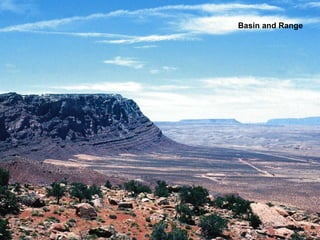
Basin and Range
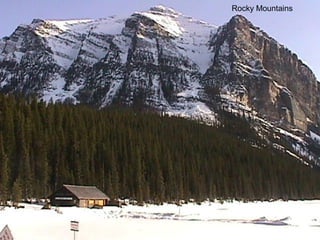
Rocky Mountains
 Rocky Mountains -extends more than 3,000
miles across the western part of North America
 Great Basin - a large desert that covers 200,000
sq. miles in California, Idaho, Nevada, Utah,
Wyoming
 Mt. Ranier - 14,410 ft., 4,392 meters, Cascade in
Washington, Highest peak in Washington
 Mt. McKinley - 20,320 ft. 6,194 meters, Alaska
Range in Alaska, Highest peak in North America
 Mt Hood -11,239 ft, 3,426 Meters, Cascade in
Oregon, Inactive volcano with many glaciers
 Great Plains - vast, dry   land in North America
Geographical FeaturesGeographical Features
 Abundance or scarcity of water affects natural
vegetation, economic activity, and population density.
 Much of the West has a semiarid or arid climate, with
short grasses, shrubs, sagebrush, and cactuses for
vegetation.
 The western side of the cordillera receives much
more rainfall, and it contains deciduous and coniferous
forests at lower elevations.
 Hawaii has a wet tropical climate and dense tropical
vegetation.
 The tundra of Alaska is a dry, treeless plain that
sprouts grasses and mosses only when the top layer of
soil thaws in the summer.
4
parts of the West get extremely high
amounts of rain and/or snow
other parts are true desert and get less
than 5 inches of rain per year.
seasonal temperatures vary greatly
throughout the West.
Low elevations on the West Coast have
warm to very hot summers and get little to
no snow.
The Desert Southwest has very hot
summers and mild winters.
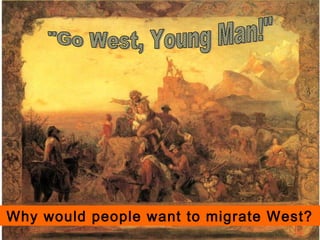
““Go West, Young Man”Go West, Young Man”
Why did people go West?
Why would people want to migrate West?
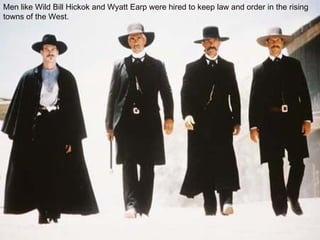
Men like Wild Bill Hickok and Wyatt Earp were hired to keep law and order in the rising
towns of the West.
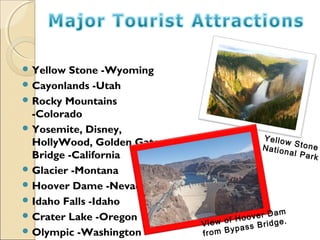
 Yellow Stone -Wyoming
 Cayonlands -Utah
 Rocky Mountains
-Colorado
 Yosemite, Disney,
HollyWood, Golden Gate
Bridge -California
 Glacier -Montana
 Hoover Dame -Nevada
 Idaho Falls -Idaho
 Crater Lake -Oregon
 Olympic -Washington
Yellow StoneNational Park
View of Hoover Dam
from Bypass Bridge.
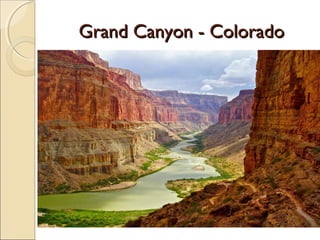
Grand Canyon - ColoradoGrand Canyon - Colorado
THE USA BY REGIONSTHE USA BY REGIONS
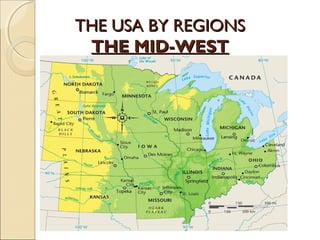
THE MID-WESTTHE MID-WEST
3
Geographical FeaturesGeographical Features
 The Midwest is relatively flat and contains fertile soil that
is rich in a dark-colored organic material called humus.
 The Midwestern climate favors agriculture with its long,
hot summers.
 There are many regional variations, such as precipitation,
growing season, and quality of soil, that affect the type of
agriculture possible.
 Midwestern farms, the most productive in the world,
have earned the Midwest the nickname “the nation’s
breadbasket.”
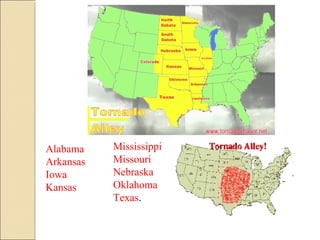
Alabama
Arkansas
Iowa
Kansas
Mississippi
Missouri
Nebraska
Oklahoma
Texas.
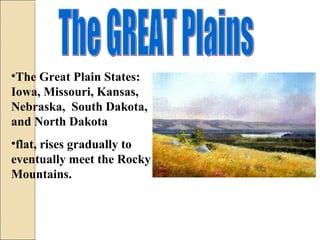
•The Great Plain States:
Iowa, Missouri, Kansas,
Nebraska, South Dakota,
and North Dakota
•flat, rises gradually to
eventually meet the Rocky
Mountains.
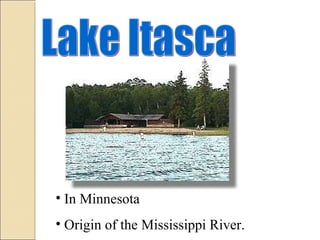
• In Minnesota
• Origin of the Mississippi River.
THE USA BY REGIONSTHE USA BY REGIONS
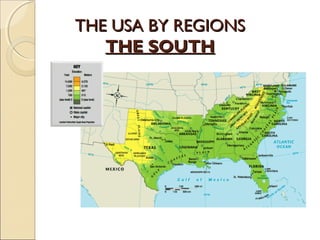
THE SOUTHTHE SOUTH
2
Geographical FeaturesGeographical Features
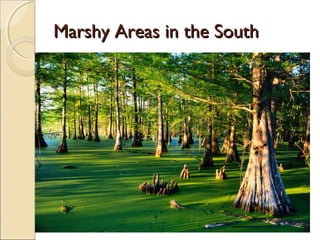
The South’s warm, wet climate produces thick
mixed forests and stands of mangrove trees.
Marshy inlets of lakes and rivers in Louisiana are
called bayous.
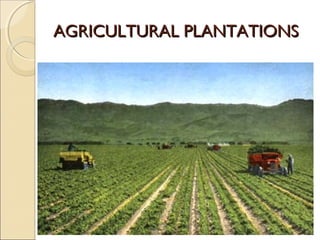
Rich soils, ideal for agriculture, attracted
Europeans, some of whom built large
plantations.
Farming is still important to the South’s
economy.
Some parts of the South, such as Appalachia, are
deeply impoverished.
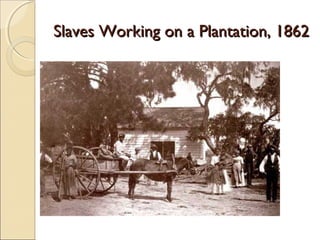
Slaves Working on a Plantation, 1862Slaves Working on a Plantation, 1862
Marshy Areas in the SouthMarshy Areas in the South
AGRICULTURAL PLANTATIONSAGRICULTURAL PLANTATIONS
THE USA BY REGIONSTHE USA BY REGIONS
THE NORTHEASTTHE NORTHEAST
1
Geographical FeaturesGeographical Features
relatively few natural resources
The Appalachian Mountains make some
areas quite rugged.
Apart from coal in Pennsylvania, the
Northeast has few mineral resources
a center of commerce and fishing since
Colonial times
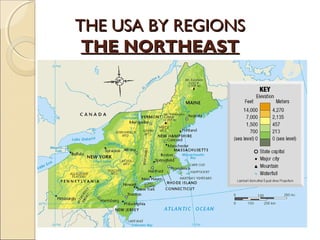
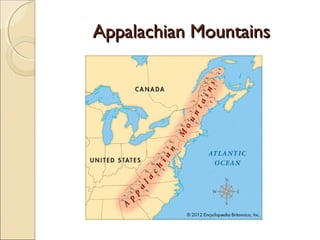
Appalachian MountainsAppalachian Mountains
made of several other ranges.
◦ The Green Mountains
◦ The White Mountains
◦ The Catskill Mountains
◦ The Poconos Mountains
◦ The Adirondack Mountains
the oldest mountain range in North
America.
begins in Canada and extends south to
Alabama
Land and Water in the NortheastLand and Water in the Northeast
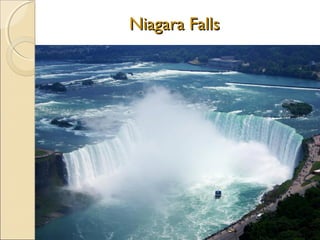
The Northeast Region has many areas of
incredible scenery and natural formations.
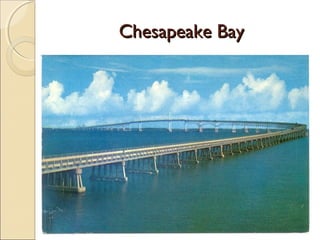
The Chesapeake Bay and other bays in the
region provide seafood for many people.
Niagara FallsNiagara Falls
Chesapeake BayChesapeake Bay
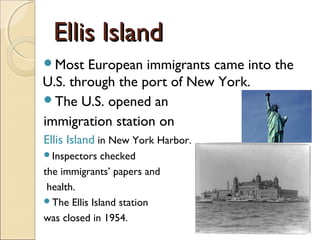
Ellis IslandEllis Island
Most European immigrants came into the
U.S. through the port of New York.
The U.S. opened an
immigration station on
Ellis Island in New York Harbor.
Inspectors checked
the immigrants’ papers and
health.
The Ellis Island station
was closed in 1954.
WHITE HOUSEWHITE HOUSE
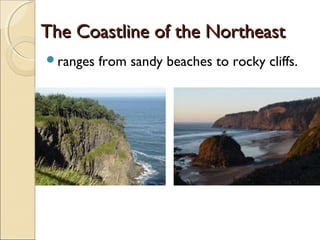
The Coastline of the NortheastThe Coastline of the Northeast
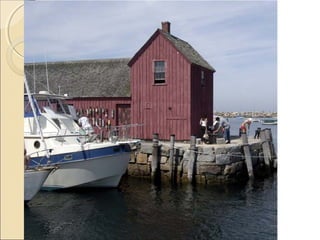
ranges from sandy beaches to rocky cliffs.
Resources of the NortheastResources of the Northeast
 The climate and geography of the Northeast Region
make it excellent for growing grapes and
cranberries.
 A lot of maple trees grow in the Northeast.
The sap from these trees is harvested to make
maple syrup.
 Minerals are an important resource to this area. Minerals such
as granite and marble are minerals that are mined here.
 Chesapeake Bay got its name from the Native American word
for “Great Shell Fish Bay”. It is very rich in fish and
shellfish allowing the fishermen to make a living.
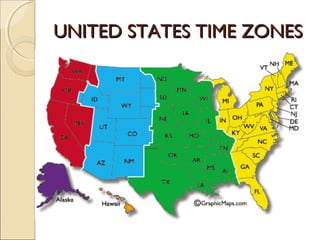
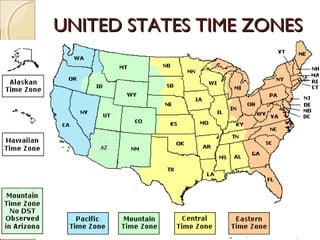
UNITED STATES TIME ZONESUNITED STATES TIME ZONES
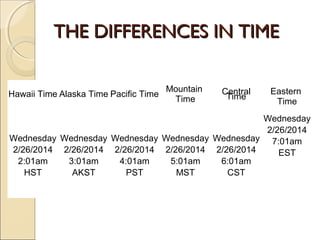
THE DIFFERENCES IN TIMETHE DIFFERENCES IN TIME
Hawaii Time Alaska Time Pacific Time
Mountain
Time
Central
Time
Eastern
Time
Wednesday
2/26/2014
2:01am
HST
Wednesday
2/26/2014
3:01am
AKST
Wednesday
2/26/2014
4:01am
PST
Wednesday
2/26/2014
5:01am
MST
Wednesday
2/26/2014
6:01am
CST
Wednesday
2/26/2014
7:01am
EST

American studies & culture.pptx

  • 1.
  • 2.
    CONTENTSCONTENTS 1. Some factsabout the USA 2. E PLURIBUS UNUM 3. Geography 4. History 5. People 6. Culture 7. Economy 8. Government
  • 3.
    The factfile ofthe USAThe factfile of the USA Washington: the capital city New York: the biggest city. Official language: American English. Current president: Barack Obama. Surface: 9.8 million km 2 (3rd biggest) Number of States: 50 Population: 307.000.000 (3rd biggest) Independence Day: July 4th Anthem:
  • 4.
    E PLURIBUS UNUMEPLURIBUS UNUM
  • 5.
    E PLURIBUS UNUMEPLURIBUS UNUM
  • 6.
    What is EPLURIBUS UNUM?What is E PLURIBUS UNUM? United States motto Appearing on the US coins & money Appearing on many US public monuments Means “From many, one” Primarily used to unify 13 British colonies in North America during the American Revolution (1775-1783) The Melting Pot (the nation of nations)
  • 7.
    13 British colonies13British colonies
  • 8.
  • 9.
  • 10.
    50 STATES OFTHE USA50 STATES OF THE USA
  • 11.
    OFFICIAL REGIONS OFTHE USAOFFICIAL REGIONS OF THE USA
  • 12.
    THE USA BYREGIONSTHE USA BY REGIONS THE WESTTHE WEST
  • 14.
  • 15.
  • 16.
     Rocky Mountains-extends more than 3,000 miles across the western part of North America  Great Basin - a large desert that covers 200,000 sq. miles in California, Idaho, Nevada, Utah, Wyoming  Mt. Ranier - 14,410 ft., 4,392 meters, Cascade in Washington, Highest peak in Washington  Mt. McKinley - 20,320 ft. 6,194 meters, Alaska Range in Alaska, Highest peak in North America  Mt Hood -11,239 ft, 3,426 Meters, Cascade in Oregon, Inactive volcano with many glaciers  Great Plains - vast, dry   land in North America Geographical FeaturesGeographical Features
  • 17.
    Geographical FeaturesGeographical Features Abundance or scarcity of water affects natural vegetation, economic activity, and population density.  Much of the West has a semiarid or arid climate, with short grasses, shrubs, sagebrush, and cactuses for vegetation.  The western side of the cordillera receives much more rainfall, and it contains deciduous and coniferous forests at lower elevations.  Hawaii has a wet tropical climate and dense tropical vegetation.  The tundra of Alaska is a dry, treeless plain that sprouts grasses and mosses only when the top layer of soil thaws in the summer. 4
  • 18.
    parts of theWest get extremely high amounts of rain and/or snow other parts are true desert and get less than 5 inches of rain per year. seasonal temperatures vary greatly throughout the West. Low elevations on the West Coast have warm to very hot summers and get little to no snow. The Desert Southwest has very hot summers and mild winters.
  • 19.
    ““Go West, YoungMan”Go West, Young Man” Why did people go West? Why would people want to migrate West?
  • 20.
    Men like WildBill Hickok and Wyatt Earp were hired to keep law and order in the rising towns of the West.
  • 21.
     Yellow Stone-Wyoming  Cayonlands -Utah  Rocky Mountains -Colorado  Yosemite, Disney, HollyWood, Golden Gate Bridge -California  Glacier -Montana  Hoover Dame -Nevada  Idaho Falls -Idaho  Crater Lake -Oregon  Olympic -Washington Yellow StoneNational Park View of Hoover Dam from Bypass Bridge.
  • 22.
    Grand Canyon -ColoradoGrand Canyon - Colorado
  • 23.
    THE USA BYREGIONSTHE USA BY REGIONS THE MID-WESTTHE MID-WEST
  • 24.
    3 Geographical FeaturesGeographical Features The Midwest is relatively flat and contains fertile soil that is rich in a dark-colored organic material called humus.  The Midwestern climate favors agriculture with its long, hot summers.  There are many regional variations, such as precipitation, growing season, and quality of soil, that affect the type of agriculture possible.  Midwestern farms, the most productive in the world, have earned the Midwest the nickname “the nation’s breadbasket.”
  • 25.
  • 26.
    •The Great PlainStates: Iowa, Missouri, Kansas, Nebraska, South Dakota, and North Dakota •flat, rises gradually to eventually meet the Rocky Mountains.
  • 27.
    • In Minnesota •Origin of the Mississippi River.
  • 29.
    THE USA BYREGIONSTHE USA BY REGIONS THE SOUTHTHE SOUTH
  • 30.
    2 Geographical FeaturesGeographical Features TheSouth’s warm, wet climate produces thick mixed forests and stands of mangrove trees. Marshy inlets of lakes and rivers in Louisiana are called bayous. Rich soils, ideal for agriculture, attracted Europeans, some of whom built large plantations. Farming is still important to the South’s economy. Some parts of the South, such as Appalachia, are deeply impoverished.
  • 31.
    Slaves Working ona Plantation, 1862Slaves Working on a Plantation, 1862
  • 32.
    Marshy Areas inthe SouthMarshy Areas in the South
  • 33.
  • 34.
    THE USA BYREGIONSTHE USA BY REGIONS THE NORTHEASTTHE NORTHEAST
  • 35.
    1 Geographical FeaturesGeographical Features relativelyfew natural resources The Appalachian Mountains make some areas quite rugged. Apart from coal in Pennsylvania, the Northeast has few mineral resources a center of commerce and fishing since Colonial times
  • 36.
  • 37.
    Appalachian MountainsAppalachian Mountains madeof several other ranges. ◦ The Green Mountains ◦ The White Mountains ◦ The Catskill Mountains ◦ The Poconos Mountains ◦ The Adirondack Mountains the oldest mountain range in North America. begins in Canada and extends south to Alabama
  • 38.
    Land and Waterin the NortheastLand and Water in the Northeast The Northeast Region has many areas of incredible scenery and natural formations. The Chesapeake Bay and other bays in the region provide seafood for many people.
  • 39.
  • 40.
  • 42.
    Ellis IslandEllis Island MostEuropean immigrants came into the U.S. through the port of New York. The U.S. opened an immigration station on Ellis Island in New York Harbor. Inspectors checked the immigrants’ papers and health. The Ellis Island station was closed in 1954.
  • 43.
  • 44.
    The Coastline ofthe NortheastThe Coastline of the Northeast ranges from sandy beaches to rocky cliffs.
  • 45.
    Resources of theNortheastResources of the Northeast  The climate and geography of the Northeast Region make it excellent for growing grapes and cranberries.  A lot of maple trees grow in the Northeast. The sap from these trees is harvested to make maple syrup.  Minerals are an important resource to this area. Minerals such as granite and marble are minerals that are mined here.  Chesapeake Bay got its name from the Native American word for “Great Shell Fish Bay”. It is very rich in fish and shellfish allowing the fishermen to make a living.
  • 46.
    UNITED STATES TIMEZONESUNITED STATES TIME ZONES
  • 47.
    UNITED STATES TIMEZONESUNITED STATES TIME ZONES
  • 48.
    THE DIFFERENCES INTIMETHE DIFFERENCES IN TIME Hawaii Time Alaska Time Pacific Time Mountain Time Central Time Eastern Time Wednesday 2/26/2014 2:01am HST Wednesday 2/26/2014 3:01am AKST Wednesday 2/26/2014 4:01am PST Wednesday 2/26/2014 5:01am MST Wednesday 2/26/2014 6:01am CST Wednesday 2/26/2014 7:01am EST

Editor's Notes

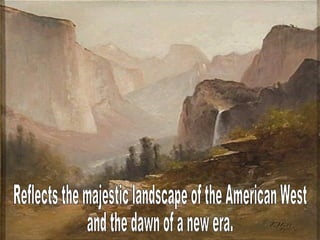
  • #14 This painting by Thomas Hill is titled A View of Yosemite Valley. The painting was selected to hang behind the First Couple during the Inaugural luncheon on January 20th, 2009. It commemorates the 200th anniversary of Abraham Lincoln and recognizes a pivotal event in his presidency, the signing of Yosemite Valley and the Mariposa Sequoia Park Act designating these lands as natural beauties that are to be saved. Question to students: As you listen to Woodie Guthrie’s This Land is Your Land, look at the painting and predict why this painting would be selected for the Inaugural Luncheon.