Unit 2Unit 2
U.S. and CanadaU.S. and Canada
A Vast LandmassA Vast Landmass
►Where am I
located?
Answer…
►We are on the
Continent of North
America.
What Hemisphere are we in?What Hemisphere are we in?
Northern & Western HemisphereNorthern & Western Hemisphere
►U.S.A and Canada take up 4/5th
of the land.
(meaning North America) Mexico takes up last
1/5.
► Rank in the World (Size of land)
Canada—2nd
USA—3rd
►Together, they fill one eighth of the land
surface of the earth.
Natural ResourcesNatural Resources
► In addition to their huge
landmass, the United States
and Canada are rich in
natural resources. Both
have fertile soils, ample
supplies of water, vast
forests, and large deposits
of a variety of minerals. This
geographic richness has for
centuries attracted
immigrants from around the
world and has enabled both
countries to develop into
global economic powers.
►Agriculture—Big for both CountriesAgriculture—Big for both Countries
 USA—World Leader in Food ExporterUSA—World Leader in Food Exporter
►EnergyEnergy
 USA—World’s biggest consumer of EnergyUSA—World’s biggest consumer of Energy
The Eastern LowlandsThe Eastern Lowlands
► A flat, coastal plain runs along the
Atlantic Ocean and the Gulf of
Mexico. One section, called the
Atlantic Coastal Plain, begins as
narrow lowland in the
northeastern United States and
widens as it extends southward
into Florida. This area features
many excellent harbors. A
broader section of the plain—the
Gulf Coastal Plain—stretches
along the Gulf of Mexico from
Florida into Texas. The
Mississippi River empties into the
Gulf from this region. Between
these plains and the nearby
Appalachian Highlands is a low
plateau called the Piedmont. This
area of rolling hills contains many
fast-flowing rivers and streams.
Appalachian MountainsAppalachian Mountains
► They are one of the two
major mountain chains in
the United States and
Canada. Both chains run
north to south. The
Appalachian Mountains
extend some 1,600 miles
from Newfoundland in
Canada to Alabama. There
are several mountain
ranges in the Appalachian
system. Among them are
them Green and the
Catskill mountains in the
north and the Blue Ridge
and the Great Smoky
mountains in the south.
Appalachian MountainsAppalachian Mountains
►The Appalachians are very old—more than
400 million years old, they have been
eroded by the elements. Many peaks are
only between 1,200 and 2,400 feet high.
Interior LowlandsInterior Lowlands
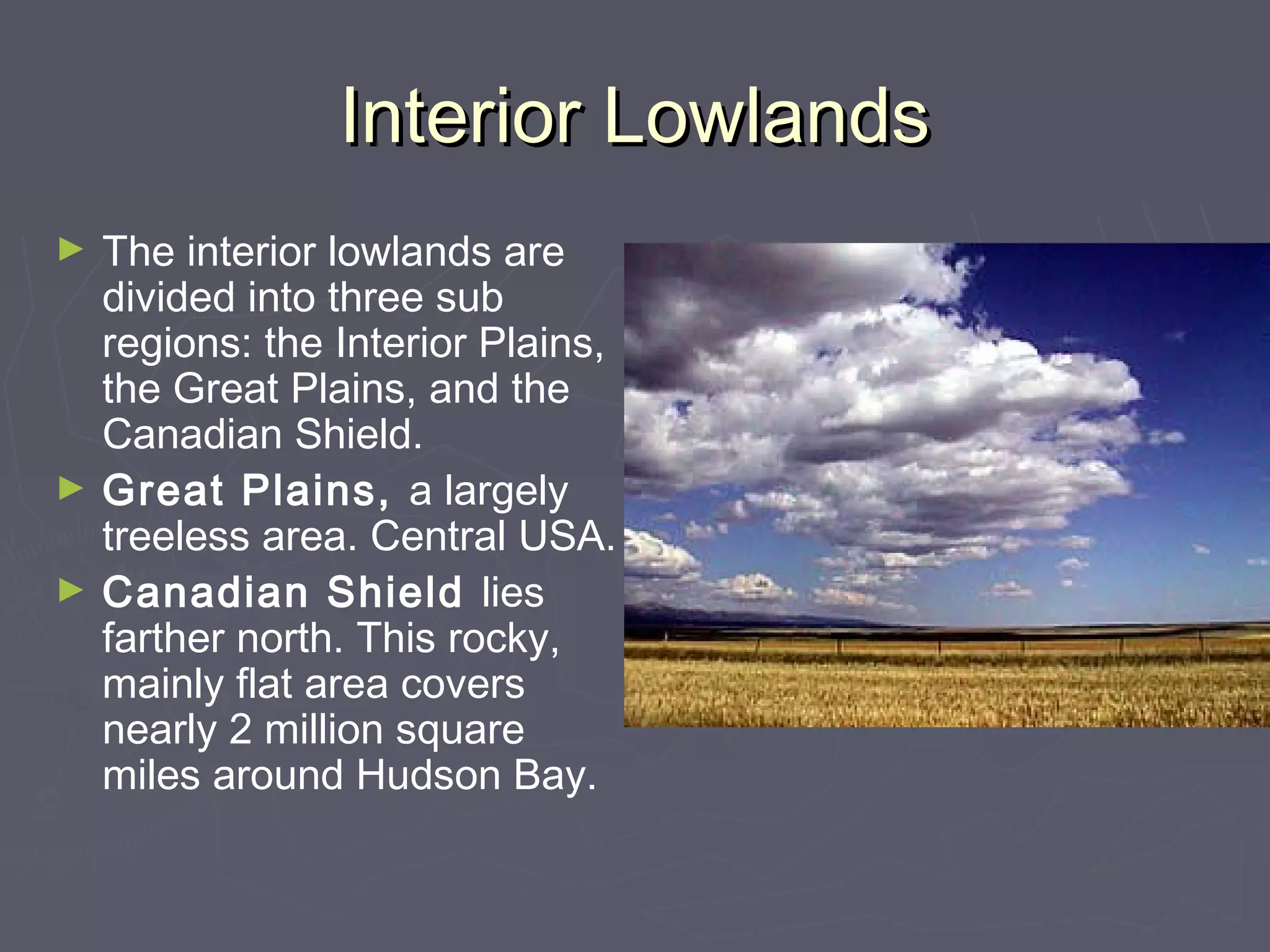
► The interior lowlands are
divided into three sub
regions: the Interior Plains,
the Great Plains, and the
Canadian Shield.
► Great Plains, a largely
treeless area. Central USA.
► Canadian Shield lies
farther north. This rocky,
mainly flat area covers
nearly 2 million square
miles around Hudson Bay.
Rocky MountainsRocky Mountains
► The Rockies are a series of
ranges that extend about
3,000 miles from Alaska south
to New Mexico.
► Relatively young—about 80
million years old—the Rockies
have not been eroded like the
Appalachians. Many of their
jagged, snow-covered peaks
are more than 12,000 feet
high.
► Continental Divide-- line of
highest points in the Rockies
that marks the separation
between rivers flowing
eastward and westward.
► North America’s highest peak
—Mt. McKinley—is in Alaska,
towering 20,320 feet above
sea level.
Other landformsOther landforms
►Great Lakes—Huron, Ontario, Michigan,Great Lakes—Huron, Ontario, Michigan,
Erie, Superior. (Connects intoErie, Superior. (Connects into St. LawrenceSt. Lawrence
RiverRiver))
►Mississippi River—USA longest RiverMississippi River—USA longest River
►Mackenzie River—Canada’s longest RiverMackenzie River—Canada’s longest River
►Everglades--SwamplandsEverglades--Swamplands
Natural ResourcesNatural Resources
► The abundance ofThe abundance of
resources that theseresources that these
countries poses has ledcountries poses has led
to their development asto their development as
world economicworld economic
powers.powers.
► Resources include:Resources include:
 Vast Waterways:Vast Waterways:
oceans, lakes, riversoceans, lakes, rivers
 ForestsForests
 Fertile SoilFertile Soil
 MineralsMinerals
 Fossil FuelsFossil Fuels
Climate & VegetationClimate & Vegetation
►Who is colder ? ? ?Who is colder ? ? ?
Canada or the U.S.ACanada or the U.S.A
Answer…Answer…
►Canada has a colder climate than the USA.Canada has a colder climate than the USA.
Human-Environment InteractionHuman-Environment Interaction
►First People to reach North America wereFirst People to reach North America were
the Nomads. (Native Americans)the Nomads. (Native Americans)
►Crossed ice/land bridge, Beringia, located inCrossed ice/land bridge, Beringia, located in
Siberia/AlaskaSiberia/Alaska
►St. Lawrence Seaway—Completed inSt. Lawrence Seaway—Completed in
1950’s… Series of locks on the St.1950’s… Series of locks on the St.
Lawrence River.Lawrence River.
Cont.Cont.
►Railroads… First Transcontinental RailroadRailroads… First Transcontinental Railroad
in the U.S.A. (1in the U.S.A. (1stst
in the World) was inin the World) was in
1869….1869….
 Canada…(Monteral to British Columbia) was inCanada…(Monteral to British Columbia) was in
1885. 31885. 3rdrd
in the World.in the World.
►Highways… Both have vast highwayHighways… Both have vast highway
systems.systems.
USA—4 million miles Canada—560,000USA—4 million miles Canada—560,000
miles Chart on pg. 131miles Chart on pg. 131
► https://www.youtube.com/watch?v=_E2CNZIlVIghttps://www.youtube.com/watch?v=_E2CNZIlVIg
► (50 States Song)(50 States Song)
► https://www.youtube.com/watch?v=WhDrGnjacvAhttps://www.youtube.com/watch?v=WhDrGnjacvA
► https://www.youtube.com/watch?https://www.youtube.com/watch?
v=MSvJ9SN8THEv=MSvJ9SN8THE
► http://www.youtube.com/watch?v=lYLT7qwHo4khttp://www.youtube.com/watch?v=lYLT7qwHo4k

W geo unit 2 landforms and resources us, canada

  • 1.
    Unit 2Unit 2 U.S.and CanadaU.S. and Canada
  • 2.
    A Vast LandmassAVast Landmass ►Where am I located? Answer… ►We are on the Continent of North America.
  • 3.
    What Hemisphere arewe in?What Hemisphere are we in?
  • 4.
    Northern & WesternHemisphereNorthern & Western Hemisphere
  • 5.
    ►U.S.A and Canadatake up 4/5th of the land. (meaning North America) Mexico takes up last 1/5. ► Rank in the World (Size of land) Canada—2nd USA—3rd ►Together, they fill one eighth of the land surface of the earth.
  • 6.
    Natural ResourcesNatural Resources ►In addition to their huge landmass, the United States and Canada are rich in natural resources. Both have fertile soils, ample supplies of water, vast forests, and large deposits of a variety of minerals. This geographic richness has for centuries attracted immigrants from around the world and has enabled both countries to develop into global economic powers.
  • 7.
    ►Agriculture—Big for bothCountriesAgriculture—Big for both Countries  USA—World Leader in Food ExporterUSA—World Leader in Food Exporter ►EnergyEnergy  USA—World’s biggest consumer of EnergyUSA—World’s biggest consumer of Energy
  • 9.
    The Eastern LowlandsTheEastern Lowlands ► A flat, coastal plain runs along the Atlantic Ocean and the Gulf of Mexico. One section, called the Atlantic Coastal Plain, begins as narrow lowland in the northeastern United States and widens as it extends southward into Florida. This area features many excellent harbors. A broader section of the plain—the Gulf Coastal Plain—stretches along the Gulf of Mexico from Florida into Texas. The Mississippi River empties into the Gulf from this region. Between these plains and the nearby Appalachian Highlands is a low plateau called the Piedmont. This area of rolling hills contains many fast-flowing rivers and streams.
  • 10.
    Appalachian MountainsAppalachian Mountains ►They are one of the two major mountain chains in the United States and Canada. Both chains run north to south. The Appalachian Mountains extend some 1,600 miles from Newfoundland in Canada to Alabama. There are several mountain ranges in the Appalachian system. Among them are them Green and the Catskill mountains in the north and the Blue Ridge and the Great Smoky mountains in the south.
  • 11.
    Appalachian MountainsAppalachian Mountains ►TheAppalachians are very old—more than 400 million years old, they have been eroded by the elements. Many peaks are only between 1,200 and 2,400 feet high.
  • 12.
    Interior LowlandsInterior Lowlands ►The interior lowlands are divided into three sub regions: the Interior Plains, the Great Plains, and the Canadian Shield. ► Great Plains, a largely treeless area. Central USA. ► Canadian Shield lies farther north. This rocky, mainly flat area covers nearly 2 million square miles around Hudson Bay.
  • 13.
    Rocky MountainsRocky Mountains ►The Rockies are a series of ranges that extend about 3,000 miles from Alaska south to New Mexico. ► Relatively young—about 80 million years old—the Rockies have not been eroded like the Appalachians. Many of their jagged, snow-covered peaks are more than 12,000 feet high. ► Continental Divide-- line of highest points in the Rockies that marks the separation between rivers flowing eastward and westward. ► North America’s highest peak —Mt. McKinley—is in Alaska, towering 20,320 feet above sea level.
  • 14.
    Other landformsOther landforms ►GreatLakes—Huron, Ontario, Michigan,Great Lakes—Huron, Ontario, Michigan, Erie, Superior. (Connects intoErie, Superior. (Connects into St. LawrenceSt. Lawrence RiverRiver)) ►Mississippi River—USA longest RiverMississippi River—USA longest River ►Mackenzie River—Canada’s longest RiverMackenzie River—Canada’s longest River ►Everglades--SwamplandsEverglades--Swamplands
  • 15.
    Natural ResourcesNatural Resources ►The abundance ofThe abundance of resources that theseresources that these countries poses has ledcountries poses has led to their development asto their development as world economicworld economic powers.powers. ► Resources include:Resources include:  Vast Waterways:Vast Waterways: oceans, lakes, riversoceans, lakes, rivers  ForestsForests  Fertile SoilFertile Soil  MineralsMinerals  Fossil FuelsFossil Fuels
  • 16.
    Climate & VegetationClimate& Vegetation ►Who is colder ? ? ?Who is colder ? ? ? Canada or the U.S.ACanada or the U.S.A Answer…Answer… ►Canada has a colder climate than the USA.Canada has a colder climate than the USA.
  • 17.
    Human-Environment InteractionHuman-Environment Interaction ►FirstPeople to reach North America wereFirst People to reach North America were the Nomads. (Native Americans)the Nomads. (Native Americans) ►Crossed ice/land bridge, Beringia, located inCrossed ice/land bridge, Beringia, located in Siberia/AlaskaSiberia/Alaska ►St. Lawrence Seaway—Completed inSt. Lawrence Seaway—Completed in 1950’s… Series of locks on the St.1950’s… Series of locks on the St. Lawrence River.Lawrence River.
  • 18.
    Cont.Cont. ►Railroads… First TranscontinentalRailroadRailroads… First Transcontinental Railroad in the U.S.A. (1in the U.S.A. (1stst in the World) was inin the World) was in 1869….1869….  Canada…(Monteral to British Columbia) was inCanada…(Monteral to British Columbia) was in 1885. 31885. 3rdrd in the World.in the World. ►Highways… Both have vast highwayHighways… Both have vast highway systems.systems. USA—4 million miles Canada—560,000USA—4 million miles Canada—560,000 miles Chart on pg. 131miles Chart on pg. 131
  • 19.
    ► https://www.youtube.com/watch?v=_E2CNZIlVIghttps://www.youtube.com/watch?v=_E2CNZIlVIg ► (50States Song)(50 States Song) ► https://www.youtube.com/watch?v=WhDrGnjacvAhttps://www.youtube.com/watch?v=WhDrGnjacvA ► https://www.youtube.com/watch?https://www.youtube.com/watch? v=MSvJ9SN8THEv=MSvJ9SN8THE ► http://www.youtube.com/watch?v=lYLT7qwHo4khttp://www.youtube.com/watch?v=lYLT7qwHo4k