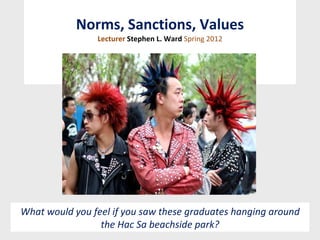
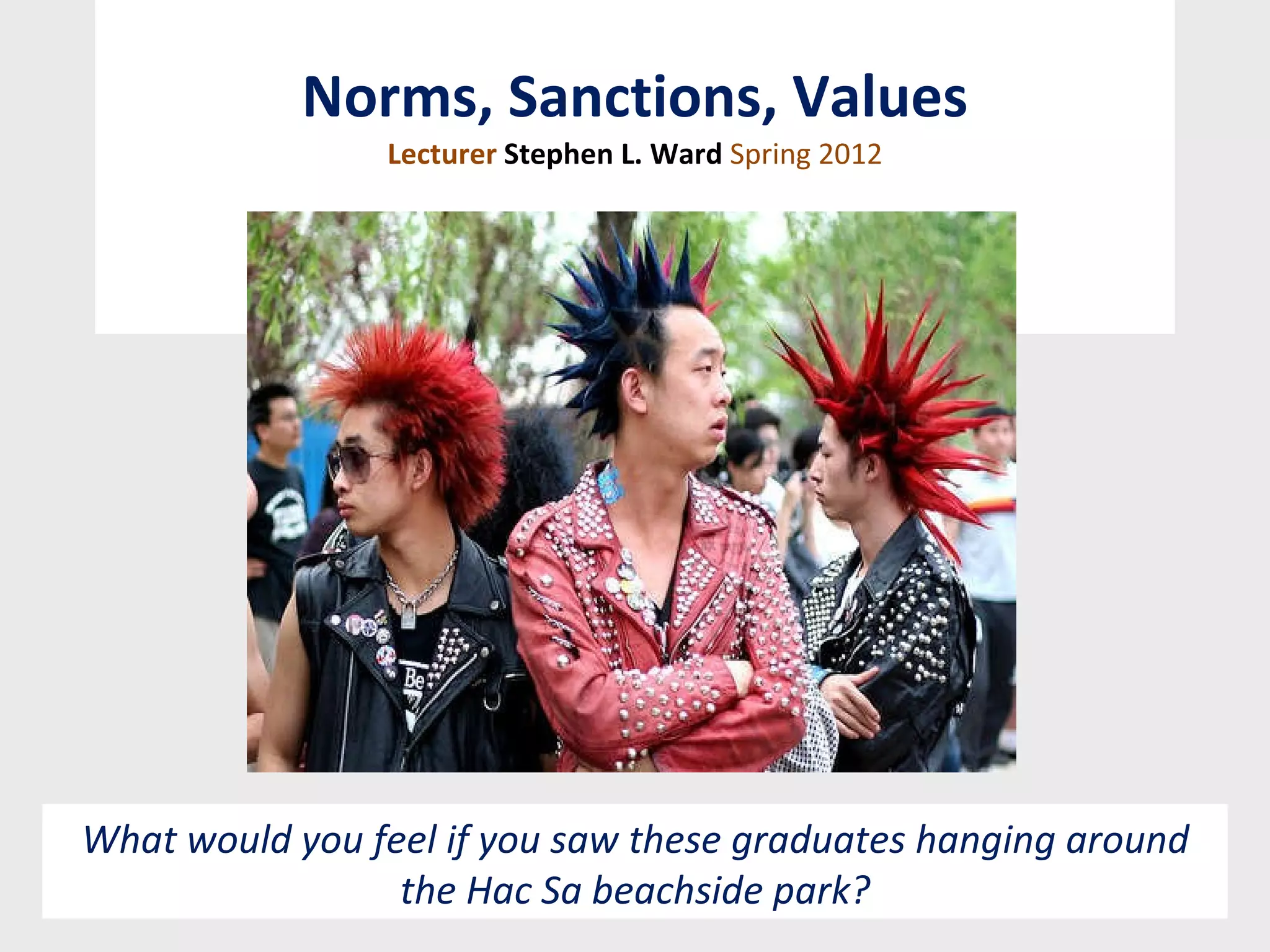
Norms, Sanctions, Values Lecturer  Stephen L. Ward  Spring 2012 What would you feel if you saw these graduates hanging around the Hac Sa beachside park?
Objectives To gain a deeper understanding of how norms, sanctions and values maintain behavior within a society. Degrees of seriousness: mores vs folkways A deeper understanding of societal change.
Preview Cultural Norms  Formal (Mores) & Informal (Folkways) Acceptance of Norms Norms in conflict / exceptions / change Sanctions and Rewards  (informal/formal) Values
Norms Deeply established standards of behavior maintained by a society. N. America – Young people make life decisions (study / career path) Japan – Respect for the elderly. China – Criticizing the gov’t is rare. The intricacies of norms are widely shared and understood by all members of a society. N. America – People are expected to remain quiet in a theatre. Therefore an Usher can enforce this and are expected to. Depends on film and audience though (not in Rocky Horror!) Serious films and plays this norm is insisted upon.
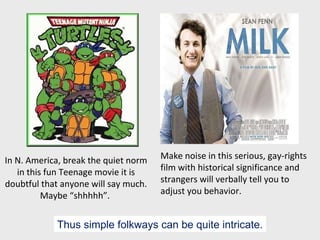
In N. America, break the quiet norm in this fun Teenage movie it is doubtful that anyone will say much. Maybe “shhhhh”.  Make noise in this serious, gay-rights film with historical significance and strangers will verbally tell you to adjust you behavior. Thus simple folkways can be quite intricate.
Classification of Norms:  Formal vs. Informal 1. Formal Norms Norms that have been formally written down and offenders face strict punishment. Formalized norms in many countries become law and have very precise definitions of what is considered proper and improper behavior. ex. Guidelines for meeting a Major at university and rules for card games are other examples of formalized norms. They are written down with precise regulations.
Classification of Norms:  Formal vs. Informal 2. Informal Norms Generally understood norms, but not precisely recorded. Standards of proper dress Taboo subject matter Attitude towards being late Deviating from these norms will not get you thrown in jail, but may lead a to a bad reputation or in being talked about by others.   Social Norms & Impression Management
Classification of Norms:  Mores vs. Folkways 3. Mores  Mores are norms that are regarded as being highly necessary to the well being of the overall society. They are the most cherished principles of a people. They demand obedience and breaking them will result in severe penalties. murder, treason, theft, fraud, corruption, abuse Mores are most likely to be formalized and become laws.
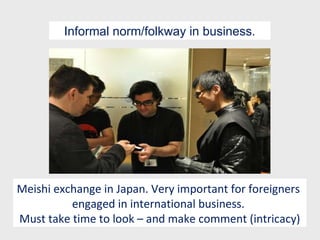
Classification of Norms:  Mores vs. Folkways 4. Folkways Norms that govern everyday behavior amongst members of a society. They shape daily life of a culture's people. Japan: ‘Meishi’ is central to the introduction process and essential in business. Recipient is expected to take time to examine the info and make a comment proves this examination has occurred. Given out even in social situations A breach – stuffing it in the pocket quickly, or not concluding with ‘meishi’ is insulting. Folkways are synonymous with behavior etiquette
Meishi exchange in Japan. Very important for foreigners  engaged in international business.  Must take time to look – and make comment (intricacy) Informal norm/folkway in business.
Can you/your group think of any serious informal norms (i.e. ‘folkways’) from your culture? Stuck!  Think of norms associated around group dinning, communication and age, in business, at people’s homes, in public amongst other members of society, conversation topics, within certain spots/activities (etc./etc).
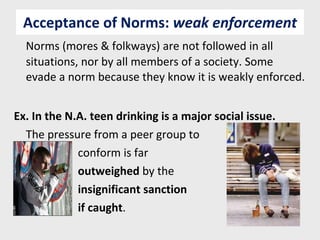
Acceptance of Norms:  weak enforcement Norms (mores & folkways) are not followed in all situations, nor by all members of a society. Some evade a norm because they know it is weakly enforced. Ex. In the N.A. teen drinking is a major social issue.  The pressure from a peer group to  conform is far  outweighed  by the  insignificant sanction  if caught .
Can you/your group think mores (i.e.  written laws ) that are not enforced well enough in your native society with the result being a social concern?
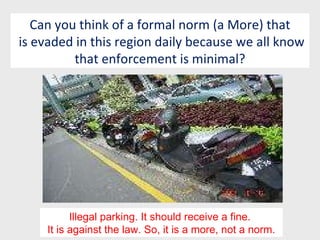
Can you think of a formal norm (a More) that is evaded in this region daily because we all know that enforcement is minimal? Illegal parking. It should receive a fine.  It is against the law. So, it is a more, not a norm.
Acceptance of Norms:  conflict Norms are often violated when they conflict. Situation :  You hear a screams of panic coming from you  neighbors' flat. Someone is being assaulted. Norm #1  – The norm of privacy and minding one’s own  business. Norm #2  – Assisting a victim of violence by intervening or  calling the police. What would you do?  Either way you are evading one norm and accepting the other.
Acceptance of Norms:  exceptions Regardless of a norm’s enforcement, sanctions or presence of conflict there can be an acceptable exception. This means under differing circumstances, the same action can make someone a hero or a villain.  In clip – is 69 yr old Herlan McQuearry a hero or a villain for murdering someone? http://www.youtube.com/watch?v=KfQc8-NyXZw&feature=related
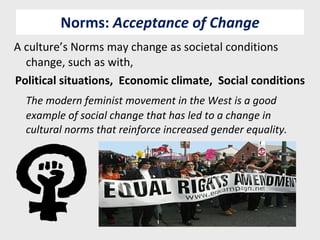
Norms:  Acceptance of Change A culture’s Norms may change as societal conditions change, such as with, Political situations,  Economic climate,  Social conditions The modern feminist movement in the West is a good example of social change that has led to a change in cultural norms that reinforce increased gender equality.
Norms:  Acceptance of Change As support for a culture’s traditional norms weakens, people start to feel free to violate them and when identified as doing so, these people are less likely to receive serious negative sanctions, which in turn creates a ‘catch 22’, or in other words, momentum for change.
Sanctions:  Negative  Penalties for your conduct regarding a social norm Sanctions  are what happens when people are  detected  of violating a culture’s shared norms.  Such penalties as: Fines Threats Imprisonment Stares of Contempt
Sanctions:  Positive (Rewards)  Rewards for conforming to a social norm The label ‘sanction’ has highly negative connotations and therefore positive sanctions has its own word –  rewards Rewards for being  detected  of conforming to a social norm may include: A pay raise A promotion A medal or an award Words of praise A pat on the back
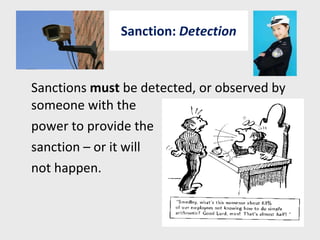
Sanction:  Detection Sanctions  must  be detected, or observed by someone with the  power to provide the  sanction – or it will  not happen.
Sanction and Norms:  a connection Norm infraction : You show up to a job interview in jeans Sanction : You do not get the job. (and a funny look) Norm infraction : You don’t put coins in your parking meter. Sanction :  You get a parking ticket (fine). The Correlation Sanctions associated with formal norms (written down / codified) tend to be formalized and informal norms tend to receive informal sanctions.
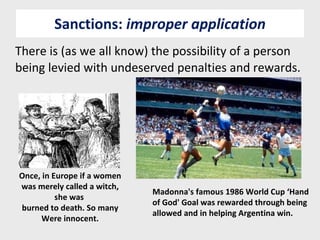
Sanctions:  improper application There is (as we all know) the possibility of a person being levied with undeserved penalties and rewards. Once, in Europe if a women was merely called a witch, she was  burned to death. So many Were innocent. Madonna's famous 1986 World Cup ‘Hand of God' Goal was rewarded through being allowed and in helping Argentina win.
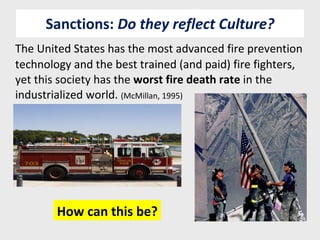
Sanctions:  Do they reflect Culture? The United States has the most advanced fire prevention technology and the best trained (and paid) fire fighters, yet this society has the  worst fire death rate  in the industrialized world.  (McMillan, 1995)  How can this be?
Sanctions:  Do they reflect Culture? In the US sanctions on unintentional negligence causing fire/death is extremely low. ‘Accidents’ get almost nothing in the way of sanctions! 2,000,000 unintentional severe burns per year (US) 5,000 deaths from unintentional fire per year (US) All ‘accidents’ with little to no sanctions. In Japan and Europe, sanctions for unintentional fire-death are  severe.  Up to life for smoking in bed, for leaving a pan on the stove or for overloading electrical circuits if you cause fire and mortally wound someone. Why are sanctions so low for such serious cases of negligence ?
Sanctions:  Do they reflect Culture? US (and Western culture) has strong norms surrounding  privacy in the home  – especially in the US which was founded on liberty and freedom and with  high value on private property . Sanctions regarding what is done in the privacy of one’s home seems to be held in high regard even when one's actions in private, (such as smoking in bed) endangers or kills others. YES! The entire fabric of norms and sanctions in a culture reflects the culture’s values and priorities. The most cherished values will have the strongest sanctions where less critical values will have light and informal sanctions.
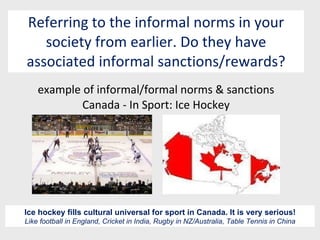
Referring to the informal norms in your society from earlier. Do they have associated informal sanctions/rewards? example of informal/formal norms & sanctions Canada - In Sport: Ice Hockey Ice hockey fills cultural universal for sport in Canada. It is very serious! Like football in England, Cricket in India, Rugby in NZ/Australia, Table Tennis in China
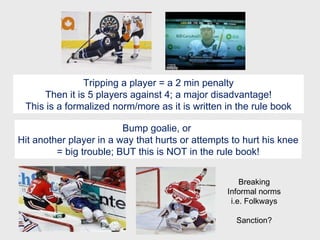
Tripping a player = a 2 min penalty Then it is 5 players against 4; a major disadvantage! This is a formalized norm/more as it is written in the rule book Bump goalie, or  Hit another player in a way that hurts or attempts to hurt his knee = big trouble; BUT this is NOT in the rule book! Breaking Informal norms i.e. Folkways Sanction?
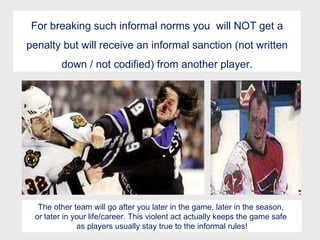
For breaking such informal norms you  will NOT get a penalty but will receive an informal sanction (not written down / not codified) from another player. The other team will go after you later in the game, later in the season,  or later in your life/career. This violent act actually keeps the game safe  as players usually stay true to the informal rules!
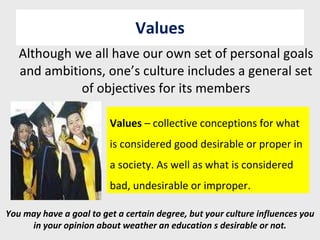
Values Although we all have our own set of personal goals and ambitions, one’s culture includes a general set of objectives for its members Values  – collective conceptions for what  is considered good desirable or proper in  a society. As well as what is considered  bad, undesirable or improper. You may have a goal to get a certain degree, but your culture influences you in your opinion about weather an education s desirable or not.
Can you think of how informal norms (folkways) in particular and how their associated sanctions or rewards shape your society?
Values Values can be  specific honoring one’s parents,  owning a home Values can be  general health,  democracy,  love Values influence our behavior and serve as criteria for evaluating the actions of others. Health – unhealthy, educated - uneducated (etc.)
Norms – Sanctions - Values There is usually a direct relationship between a culture’s norms, sanctions and their values. Example A culture that places high value on marriage Will have norms and high sanctions on adultery A culture that places high value on private property Will have norms and high sanctions against  Theft and vandalism
Values: Do they change? A culture’s values may change, but tend to remain relatively stable during a person’s lifetime. As previously mentioned – a society's non-material culture is difficult to change and change in this area is far slower than with material culture. A sway in a culture’s core values can be seen over time, but the change is hard to  observe while it is in progress due to the slow pace of change.
Values:  making similar societies unique Lipset (1990)  Continental Divide  looked into value differences between Canada and the US. – two seeming very similar societies. US more religious than Canadians US more moralistic and conservative towards sex and marriage. Canada greater concern for older society Canada favor a stronger role of government US more suspicious of ‘big’ business (& big gov’t) These differing values of course lead to differing norms and sanctions Are their any values in Macau culture that distinguish it from  Mainland China or Hong Kong?
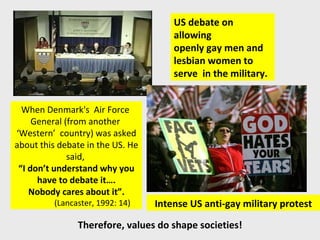
Values differences lead to unique US norms/sanctions regarding gay people in the military. In 993 Bill Clinton lifted this ban in the US Army to strong opposition both inside and outside the military. Today only concealed gays can serve – not open One year earlier (1992) Canada lifted this ban with national applause and support. Out of all the US allies only three have such a ban; Great Britain, Portugal and Greece.
US debate on allowing  openly gay men and  lesbian women to serve  in the military. Intense US anti-gay military protest When Denmark's  Air Force  General (from another  ‘ Western’  country) was asked  about this debate in the US. He said,  “ I don’t understand why you have to debate it…. Nobody cares about it”. (Lancaster, 1992: 14) Therefore, values do shape societies!
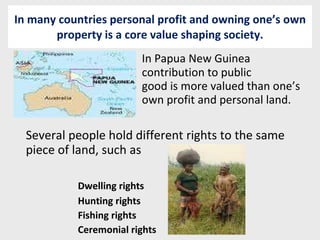
In many countries personal profit and owning one’s own property is a core value shaping society. In Papua New Guinea  contribution to public  good is more valued than one’s  own profit and personal land. Several people hold different rights to the same piece of land, such as Dwelling rights Hunting rights Fishing rights Ceremonial rights
“ The Chinese value the  importance of the family ; the  hierarchical structure of social life ; the cultivation of morality and  self-restraint  and the  emphasis on hard work  and  achievement . Various researchers also stress the pride which Chinese people take in their culture as well as the fact that Chinese culture and society can be defined as ‘collectivist’”. (unanimous, N.D) .  Traditional (and rather stereotypical) Chinese Values Are they changing? If so, how? And is there evidence? How about in Macau? http://www.irespect.net/Untold%20Stories/Chinese/Chinese%20Values.htm
Have any particular values helped shape today’s society throughout history?

Norms, sanctions and values

  • 1.
    Norms, Sanctions, ValuesLecturer Stephen L. Ward Spring 2012 What would you feel if you saw these graduates hanging around the Hac Sa beachside park?
  • 2.
    Objectives To gaina deeper understanding of how norms, sanctions and values maintain behavior within a society. Degrees of seriousness: mores vs folkways A deeper understanding of societal change.
  • 3.
    Preview Cultural Norms Formal (Mores) & Informal (Folkways) Acceptance of Norms Norms in conflict / exceptions / change Sanctions and Rewards (informal/formal) Values
  • 4.
    Norms Deeply establishedstandards of behavior maintained by a society. N. America – Young people make life decisions (study / career path) Japan – Respect for the elderly. China – Criticizing the gov’t is rare. The intricacies of norms are widely shared and understood by all members of a society. N. America – People are expected to remain quiet in a theatre. Therefore an Usher can enforce this and are expected to. Depends on film and audience though (not in Rocky Horror!) Serious films and plays this norm is insisted upon.
  • 5.
    In N. America,break the quiet norm in this fun Teenage movie it is doubtful that anyone will say much. Maybe “shhhhh”. Make noise in this serious, gay-rights film with historical significance and strangers will verbally tell you to adjust you behavior. Thus simple folkways can be quite intricate.
  • 6.
    Classification of Norms: Formal vs. Informal 1. Formal Norms Norms that have been formally written down and offenders face strict punishment. Formalized norms in many countries become law and have very precise definitions of what is considered proper and improper behavior. ex. Guidelines for meeting a Major at university and rules for card games are other examples of formalized norms. They are written down with precise regulations.
  • 7.
    Classification of Norms: Formal vs. Informal 2. Informal Norms Generally understood norms, but not precisely recorded. Standards of proper dress Taboo subject matter Attitude towards being late Deviating from these norms will not get you thrown in jail, but may lead a to a bad reputation or in being talked about by others. Social Norms & Impression Management
  • 8.
    Classification of Norms: Mores vs. Folkways 3. Mores Mores are norms that are regarded as being highly necessary to the well being of the overall society. They are the most cherished principles of a people. They demand obedience and breaking them will result in severe penalties. murder, treason, theft, fraud, corruption, abuse Mores are most likely to be formalized and become laws.
  • 9.
    Classification of Norms: Mores vs. Folkways 4. Folkways Norms that govern everyday behavior amongst members of a society. They shape daily life of a culture's people. Japan: ‘Meishi’ is central to the introduction process and essential in business. Recipient is expected to take time to examine the info and make a comment proves this examination has occurred. Given out even in social situations A breach – stuffing it in the pocket quickly, or not concluding with ‘meishi’ is insulting. Folkways are synonymous with behavior etiquette
  • 10.
    Meishi exchange inJapan. Very important for foreigners engaged in international business. Must take time to look – and make comment (intricacy) Informal norm/folkway in business.
  • 11.
    Can you/your groupthink of any serious informal norms (i.e. ‘folkways’) from your culture? Stuck! Think of norms associated around group dinning, communication and age, in business, at people’s homes, in public amongst other members of society, conversation topics, within certain spots/activities (etc./etc).
  • 12.
    Acceptance of Norms: weak enforcement Norms (mores & folkways) are not followed in all situations, nor by all members of a society. Some evade a norm because they know it is weakly enforced. Ex. In the N.A. teen drinking is a major social issue. The pressure from a peer group to conform is far outweighed by the insignificant sanction if caught .
  • 13.
    Can you/your groupthink mores (i.e. written laws ) that are not enforced well enough in your native society with the result being a social concern?
  • 14.
    Can you thinkof a formal norm (a More) that is evaded in this region daily because we all know that enforcement is minimal? Illegal parking. It should receive a fine. It is against the law. So, it is a more, not a norm.
  • 15.
    Acceptance of Norms: conflict Norms are often violated when they conflict. Situation : You hear a screams of panic coming from you neighbors' flat. Someone is being assaulted. Norm #1 – The norm of privacy and minding one’s own business. Norm #2 – Assisting a victim of violence by intervening or calling the police. What would you do? Either way you are evading one norm and accepting the other.
  • 16.
    Acceptance of Norms: exceptions Regardless of a norm’s enforcement, sanctions or presence of conflict there can be an acceptable exception. This means under differing circumstances, the same action can make someone a hero or a villain. In clip – is 69 yr old Herlan McQuearry a hero or a villain for murdering someone? http://www.youtube.com/watch?v=KfQc8-NyXZw&feature=related
  • 17.
    Norms: Acceptanceof Change A culture’s Norms may change as societal conditions change, such as with, Political situations, Economic climate, Social conditions The modern feminist movement in the West is a good example of social change that has led to a change in cultural norms that reinforce increased gender equality.
  • 18.
    Norms: Acceptanceof Change As support for a culture’s traditional norms weakens, people start to feel free to violate them and when identified as doing so, these people are less likely to receive serious negative sanctions, which in turn creates a ‘catch 22’, or in other words, momentum for change.
  • 19.
    Sanctions: Negative Penalties for your conduct regarding a social norm Sanctions are what happens when people are detected of violating a culture’s shared norms. Such penalties as: Fines Threats Imprisonment Stares of Contempt
  • 20.
    Sanctions: Positive(Rewards) Rewards for conforming to a social norm The label ‘sanction’ has highly negative connotations and therefore positive sanctions has its own word – rewards Rewards for being detected of conforming to a social norm may include: A pay raise A promotion A medal or an award Words of praise A pat on the back
  • 21.
    Sanction: DetectionSanctions must be detected, or observed by someone with the power to provide the sanction – or it will not happen.
  • 22.
    Sanction and Norms: a connection Norm infraction : You show up to a job interview in jeans Sanction : You do not get the job. (and a funny look) Norm infraction : You don’t put coins in your parking meter. Sanction : You get a parking ticket (fine). The Correlation Sanctions associated with formal norms (written down / codified) tend to be formalized and informal norms tend to receive informal sanctions.
  • 23.
    Sanctions: improperapplication There is (as we all know) the possibility of a person being levied with undeserved penalties and rewards. Once, in Europe if a women was merely called a witch, she was burned to death. So many Were innocent. Madonna's famous 1986 World Cup ‘Hand of God' Goal was rewarded through being allowed and in helping Argentina win.
  • 24.
    Sanctions: Dothey reflect Culture? The United States has the most advanced fire prevention technology and the best trained (and paid) fire fighters, yet this society has the worst fire death rate in the industrialized world. (McMillan, 1995) How can this be?
  • 25.
    Sanctions: Dothey reflect Culture? In the US sanctions on unintentional negligence causing fire/death is extremely low. ‘Accidents’ get almost nothing in the way of sanctions! 2,000,000 unintentional severe burns per year (US) 5,000 deaths from unintentional fire per year (US) All ‘accidents’ with little to no sanctions. In Japan and Europe, sanctions for unintentional fire-death are severe. Up to life for smoking in bed, for leaving a pan on the stove or for overloading electrical circuits if you cause fire and mortally wound someone. Why are sanctions so low for such serious cases of negligence ?
  • 26.
    Sanctions: Dothey reflect Culture? US (and Western culture) has strong norms surrounding privacy in the home – especially in the US which was founded on liberty and freedom and with high value on private property . Sanctions regarding what is done in the privacy of one’s home seems to be held in high regard even when one's actions in private, (such as smoking in bed) endangers or kills others. YES! The entire fabric of norms and sanctions in a culture reflects the culture’s values and priorities. The most cherished values will have the strongest sanctions where less critical values will have light and informal sanctions.
  • 27.
    Referring to theinformal norms in your society from earlier. Do they have associated informal sanctions/rewards? example of informal/formal norms & sanctions Canada - In Sport: Ice Hockey Ice hockey fills cultural universal for sport in Canada. It is very serious! Like football in England, Cricket in India, Rugby in NZ/Australia, Table Tennis in China
  • 28.
    Tripping a player= a 2 min penalty Then it is 5 players against 4; a major disadvantage! This is a formalized norm/more as it is written in the rule book Bump goalie, or Hit another player in a way that hurts or attempts to hurt his knee = big trouble; BUT this is NOT in the rule book! Breaking Informal norms i.e. Folkways Sanction?
  • 29.
    For breaking suchinformal norms you will NOT get a penalty but will receive an informal sanction (not written down / not codified) from another player. The other team will go after you later in the game, later in the season, or later in your life/career. This violent act actually keeps the game safe as players usually stay true to the informal rules!
  • 30.
    Values Although weall have our own set of personal goals and ambitions, one’s culture includes a general set of objectives for its members Values – collective conceptions for what is considered good desirable or proper in a society. As well as what is considered bad, undesirable or improper. You may have a goal to get a certain degree, but your culture influences you in your opinion about weather an education s desirable or not.
  • 31.
    Can you thinkof how informal norms (folkways) in particular and how their associated sanctions or rewards shape your society?
  • 32.
    Values Values canbe specific honoring one’s parents, owning a home Values can be general health, democracy, love Values influence our behavior and serve as criteria for evaluating the actions of others. Health – unhealthy, educated - uneducated (etc.)
  • 33.
    Norms – Sanctions- Values There is usually a direct relationship between a culture’s norms, sanctions and their values. Example A culture that places high value on marriage Will have norms and high sanctions on adultery A culture that places high value on private property Will have norms and high sanctions against Theft and vandalism
  • 34.
    Values: Do theychange? A culture’s values may change, but tend to remain relatively stable during a person’s lifetime. As previously mentioned – a society's non-material culture is difficult to change and change in this area is far slower than with material culture. A sway in a culture’s core values can be seen over time, but the change is hard to observe while it is in progress due to the slow pace of change.
  • 35.
    Values: makingsimilar societies unique Lipset (1990) Continental Divide looked into value differences between Canada and the US. – two seeming very similar societies. US more religious than Canadians US more moralistic and conservative towards sex and marriage. Canada greater concern for older society Canada favor a stronger role of government US more suspicious of ‘big’ business (& big gov’t) These differing values of course lead to differing norms and sanctions Are their any values in Macau culture that distinguish it from Mainland China or Hong Kong?
  • 36.
    Values differences leadto unique US norms/sanctions regarding gay people in the military. In 993 Bill Clinton lifted this ban in the US Army to strong opposition both inside and outside the military. Today only concealed gays can serve – not open One year earlier (1992) Canada lifted this ban with national applause and support. Out of all the US allies only three have such a ban; Great Britain, Portugal and Greece.
  • 37.
    US debate onallowing openly gay men and lesbian women to serve in the military. Intense US anti-gay military protest When Denmark's Air Force General (from another ‘ Western’ country) was asked about this debate in the US. He said, “ I don’t understand why you have to debate it…. Nobody cares about it”. (Lancaster, 1992: 14) Therefore, values do shape societies!
  • 38.
    In many countriespersonal profit and owning one’s own property is a core value shaping society. In Papua New Guinea contribution to public good is more valued than one’s own profit and personal land. Several people hold different rights to the same piece of land, such as Dwelling rights Hunting rights Fishing rights Ceremonial rights
  • 39.
    “ The Chinesevalue the importance of the family ; the hierarchical structure of social life ; the cultivation of morality and self-restraint and the emphasis on hard work and achievement . Various researchers also stress the pride which Chinese people take in their culture as well as the fact that Chinese culture and society can be defined as ‘collectivist’”. (unanimous, N.D) . Traditional (and rather stereotypical) Chinese Values Are they changing? If so, how? And is there evidence? How about in Macau? http://www.irespect.net/Untold%20Stories/Chinese/Chinese%20Values.htm
  • 40.
    Have any particularvalues helped shape today’s society throughout history?