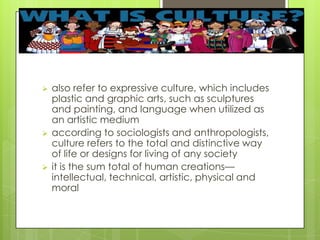
 also refer to expressive culture, which includes
plastic and graphic arts, such as sculptures
and painting, and language when utilized as
an artistic medium
 according to sociologists and anthropologists,
culture refers to the total and distinctive way
of life or designs for living of any society
 it is the sum total of human creations—
intellectual, technical, artistic, physical and
moral
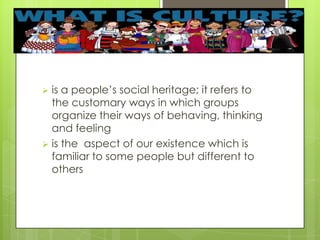
 is a people’s social heritage; it refers to
the customary ways in which groups
organize their ways of behaving, thinking
and feeling
 is the aspect of our existence which is
familiar to some people but different to
others
Forms of Culture
 Material Culture
--refers to the concrete and tangible
objects that humans create, use and share
serving as buffers against the various
elements in the environment
o Nonmaterial Culture
-- consists of knowledge, social norms,
beliefs and sanctions which are abstract
and intangible creations that influence
human behavior
Components of Culture
 Norms
 Sanctions
 Values
 Symbols
 Language
Norms
 Norms are established standards of behavior
maintained by a society
 Formal norms have been written down and involve
strict rules or punishment
of violators
Norms
 Informal norms are generally understood
but are not precisely recorded
 Examples: standards of proper dress or
proper behavior at school
Types of Norms (according to
their relative importance to
society)
 Folkways are norms governing everyday
behavior whose violation might cause a
dirty look, rolled eyes, or disapproving
comment
 Example: Walking up a “down” escalator
in a department store challenges our
standards of appropriate behavior
Types of Norms (according to
their relative importance to
society)
 Mores are norms deemed highly
necessary to the welfare of a society,
often because they embody the most
cherished principles of people
 Each society demands obedience to its
mores (violation can lead to severe
penalties
 Examples: murder, child abuse
Types of Norms (according to
their relative importance to
society)
 Taboos are norms that are so deeply held
that even the thought of violating them
upset people
 In the U.S. There is a taboo against eating
human flesh
Sanctions
 Sanctions are penalties and rewards for
conduct concerning a social norm
 Conformity to a norm can lead to positive
sanctions such as pay raise, a medal, a
word of gratitude, or a pat on a back
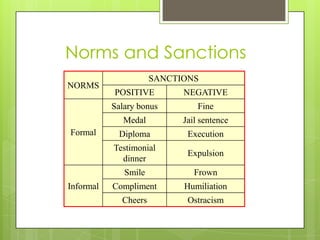
Norms and Sanctions
NORMS
SANCTIONS
POSITIVE NEGATIVE
Formal
Salary bonus Fine
Medal Jail sentence
Diploma Execution
Testimonial
dinner
Expulsion
Informal
Smile Frown
Compliment Humiliation
Cheers Ostracism
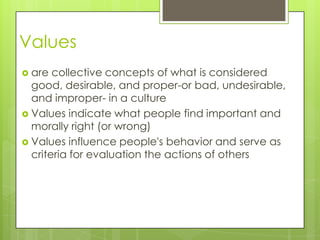
Values
 are collective concepts of what is considered
good, desirable, and proper-or bad, undesirable,
and improper- in a culture
 Values indicate what people find important and
morally right (or wrong)
 Values influence people's behavior and serve as
criteria for evaluation the actions of others
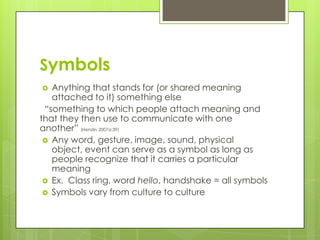
Symbols
 Anything that stands for (or shared meaning
attached to it) something else
“something to which people attach meaning and
that they then use to communicate with one
another” (Henslin 2007a:39)
 Any word, gesture, image, sound, physical
object, event can serve as a symbol as long as
people recognize that it carries a particular
meaning
 Ex. Class ring, word hello, handshake = all symbols
 Symbols vary from culture to culture
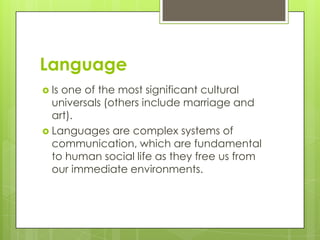
Language
 Is one of the most significant cultural
universals (others include marriage and
art).
 Languages are complex systems of
communication, which are fundamental
to human social life as they free us from
our immediate environments.
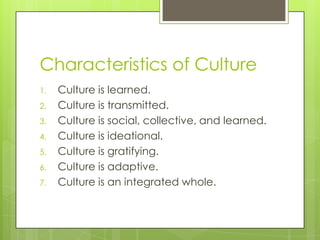
Characteristics of Culture
1. Culture is learned.
2. Culture is transmitted.
3. Culture is social, collective, and learned.
4. Culture is ideational.
5. Culture is gratifying.
6. Culture is adaptive.
7. Culture is an integrated whole.
Culture

Culture

  • 2.
     also referto expressive culture, which includes plastic and graphic arts, such as sculptures and painting, and language when utilized as an artistic medium  according to sociologists and anthropologists, culture refers to the total and distinctive way of life or designs for living of any society  it is the sum total of human creations— intellectual, technical, artistic, physical and moral
  • 3.
     is apeople’s social heritage; it refers to the customary ways in which groups organize their ways of behaving, thinking and feeling  is the aspect of our existence which is familiar to some people but different to others
  • 4.
    Forms of Culture Material Culture --refers to the concrete and tangible objects that humans create, use and share serving as buffers against the various elements in the environment o Nonmaterial Culture -- consists of knowledge, social norms, beliefs and sanctions which are abstract and intangible creations that influence human behavior
  • 5.
    Components of Culture Norms  Sanctions  Values  Symbols  Language
  • 6.
    Norms  Norms areestablished standards of behavior maintained by a society  Formal norms have been written down and involve strict rules or punishment of violators
  • 7.
    Norms  Informal normsare generally understood but are not precisely recorded  Examples: standards of proper dress or proper behavior at school
  • 8.
    Types of Norms(according to their relative importance to society)  Folkways are norms governing everyday behavior whose violation might cause a dirty look, rolled eyes, or disapproving comment  Example: Walking up a “down” escalator in a department store challenges our standards of appropriate behavior
  • 9.
    Types of Norms(according to their relative importance to society)  Mores are norms deemed highly necessary to the welfare of a society, often because they embody the most cherished principles of people  Each society demands obedience to its mores (violation can lead to severe penalties  Examples: murder, child abuse
  • 10.
    Types of Norms(according to their relative importance to society)  Taboos are norms that are so deeply held that even the thought of violating them upset people  In the U.S. There is a taboo against eating human flesh
  • 11.
    Sanctions  Sanctions arepenalties and rewards for conduct concerning a social norm  Conformity to a norm can lead to positive sanctions such as pay raise, a medal, a word of gratitude, or a pat on a back
  • 12.
    Norms and Sanctions NORMS SANCTIONS POSITIVENEGATIVE Formal Salary bonus Fine Medal Jail sentence Diploma Execution Testimonial dinner Expulsion Informal Smile Frown Compliment Humiliation Cheers Ostracism
  • 13.
    Values  are collectiveconcepts of what is considered good, desirable, and proper-or bad, undesirable, and improper- in a culture  Values indicate what people find important and morally right (or wrong)  Values influence people's behavior and serve as criteria for evaluation the actions of others
  • 14.
    Symbols  Anything thatstands for (or shared meaning attached to it) something else “something to which people attach meaning and that they then use to communicate with one another” (Henslin 2007a:39)  Any word, gesture, image, sound, physical object, event can serve as a symbol as long as people recognize that it carries a particular meaning  Ex. Class ring, word hello, handshake = all symbols  Symbols vary from culture to culture
  • 15.
    Language  Is oneof the most significant cultural universals (others include marriage and art).  Languages are complex systems of communication, which are fundamental to human social life as they free us from our immediate environments.
  • 16.
    Characteristics of Culture 1.Culture is learned. 2. Culture is transmitted. 3. Culture is social, collective, and learned. 4. Culture is ideational. 5. Culture is gratifying. 6. Culture is adaptive. 7. Culture is an integrated whole.