WMSU
1
Elements of
Culture
OVERVIEW
• Understand how values and beliefs differ
from norms
• Explain the significance of symbols and
language to a culture
• Explain the Sapir-Whorf hypothesis
• Discuss the role of social control within
culture
2
Values and Beliefs
The first, and perhaps most crucial,
elements of culture we will discuss are its
values and beliefs. Values are a culture’s
standard for discerning what is good and
just in society. Values are deeply embedded
and critical for transmitting and teaching a
culture’s beliefs.
3
Beliefs are the tenets or convictions that
people hold to be true. Individuals in a
society have specific beliefs, but they also
share collective values. To illustrate the
difference, Americans commonly believe in
the American Dream—that anyone who
works hard enough will be successful and
wealthy. Underlying this belief is the
American value that wealth is good and
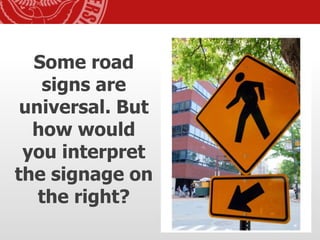
important.
4
5
Values help shape a society by suggesting what is good and
bad, beautiful and ugly, sought or avoided. Consider the
value that the United States places upon youth. Children
represent innocence and purity, while a youthful adult
appearance signifies sexuality. Shaped by this value,
individuals spend millions of dollars each year on cosmetic
products and surgeries to look young and beautiful. The
United States also has an individualistic culture, meaning
people place a high value on individuality and independence.
In contrast, many other cultures are collectivist, meaning the
welfare of the group and group relationships are a primary
value.
Values often suggest how people should
behave, but they don’t accurately reflect how
people do behave. Values portray an ideal
culture, the standards society would like to
embrace and live up to. But ideal culture
differs from real culture, the way society
actually is, based on what occurs and exists.
In an ideal culture, there would be no traffic
accidents, murders, poverty, or racial
tension.
6
But in real culture, police officers, lawmakers, educators,
and social workers constantly strive to prevent or repair
those accidents, crimes, and injustices. American
teenagers are encouraged to value celibacy. However, the
number of unplanned pregnancies among teens reveals
that not only is the ideal hard to live up to, but the value
alone is not enough to spare teenagers the potential
consequences of having sex.
7
8
One way societies strive to put values into action is
through rewards, sanctions, and punishments. When
people observe the norms of society and uphold its
values, they are often rewarded. A boy who helps an
elderly woman board a bus may receive a smile and a
“thank you.” A business manager who raises profit
margins may receive a quarterly bonus. People sanction
certain behaviors by giving their support, approval, or
permission, or by instilling formal actions of disapproval
and nonsupport
9
.Sanctions are a form of social control, a way to encourage
conformity to cultural norms. Sometimes people conform to
norms in anticipation or expectation of positive sanctions:
good grades, for instance, may mean praise from parents
and teachers. From a criminal justice perspective, properly
used social control is also inexpensive crime control.
Utilizing social control approaches pushes most people to
conform to societal rules, regardless of whether authority
figures (such as law enforcement) are present.
When people go against a society’s values,
they are punished. A boy who shoves an
elderly woman aside to board the bus first
may receive frowns or even a scolding from
other passengers. A business manager who
drives away customers will likely be fired.
Breaking norms and rejecting values can
lead to cultural sanctions such as earning a
negative label—lazy, no-good bum—or to
legal sanctions, such as traffic tickets, fines,
or imprisonment.
10
Values are not static; they vary across time
and between groups as people evaluate,
debate, and change collective societal
beliefs. Values also vary from culture to
culture. For example, cultures differ in their
values about what kinds of physical
closeness are appropriate in public. It’s rare
to see two male friends or coworkers holding
hands in the United States where that
behavior often symbolizes romantic feelings.
11
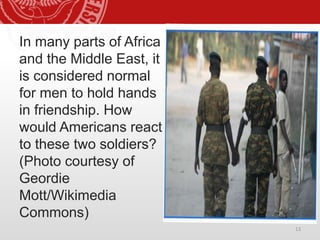
But in many nations, masculine physical
intimacy is considered natural in public. This
difference in cultural values came to light
when people reacted to photos of former
president George W. Bush holding hands
with the Crown Prince of Saudi Arabia in
2005. A simple gesture, such as hand-
holding, carries great symbolic differences
across cultures.
12
In many parts of Africa
and the Middle East, it
is considered normal
for men to hold hands
in friendship. How
would Americans react
to these two soldiers?
(Photo courtesy of
Geordie
Mott/Wikimedia
Commons)
13
NORMS
So far, the examples in this chapter have often
described how people are expected to behave in
certain situations—for example, when buying food
or boarding a bus. These examples describe the
visible and invisible rules of conduct through which
societies are structured, or what sociologists call
norms. Norms define how to behave in accordance
with what a society has defined as good, right, and
14
Formal norms are established, written rules. They
are behaviors worked out and agreed upon in order
to suit and serve the most people. Laws are formal
norms, but so are employee manuals, college
entrance exam requirements, and “no running”
signs at swimming pools. Formal norms are the
most specific and clearly stated of the various types
of norms, and they are the most strictly enforced.
But even formal norms are enforced to varying
degrees and are reflected in cultural values
15
For example, money is highly valued in the United States,
so monetary crimes are punished. It’s against the law to
rob a bank, and banks go to great lengths to prevent such
crimes. People safeguard valuable possessions and install
antitheft devices to protect homes and cars. A less strictly
enforced social norm is driving while intoxicated. While it’s
against the law to drive drunk, drinking is for the most
part an acceptable social behavior.
16
And though there are laws to
punish drunk driving, there
are few systems in place to
prevent the crime. These
examples show a range of
enforcement in formal norms.
17
There are plenty of formal norms, but the list
of informal norms—casual behaviors that are
generally and widely conformed to—is longer.
People learn informal norms by observation,
imitation, and general socialization. Some
informal norms are taught directly—“Kiss your
Aunt Edna” or “Use your napkin”—while others
are learned by observation, including
observations of the consequences when
someone else violates a norm. 18
But although informal norms define personal
interactions, they extend into other systems as
well. In the United States, there are informal
norms regarding behavior at fast food
restaurants. Customers line up to order their
food and leave when they are done. They don’t
sit down at a table with strangers, sing loudly as
they prepare their condiments, or nap in a
booth. Most people don’t commit even benign
breaches of informal norms. Informal norms
dictate appropriate behaviors without the need
19
Breaching Experiments
Sociologist Harold Garfinkel (1917–2011)
studied people’s customs in order to find
out how societal rules and norms not only
influenced behavior but also shaped
social order. He believed that members of
society together create a social order
(Weber 2011). His resulting book, Studies
in Ethnomethodology, published in 1967,
discusses people’s assumptions about the
social makeup of their communities.
20
One of Garfinkel's research methods was known
as a “breaching experiment,” in which the
researcher behaves in a socially awkward
manner in order to test the sociological concepts
of social norms and conformity. The participants
are not aware an experiment is in progress. If
the breach is successful, however, these
“innocent bystanders” will respond in some way
For example, if the experimenter is, say, a man i
a business suit, and he skips down the sidewalk
or hops on one foot, the passersby are likely to
stare at him with surprised expressions on their
faces. But the experimenter does not simply “act
weird” in public.
21
Rather, the point is to deviate
from a specific social norm in
a small way, to subtly break
some form of social etiquette,
and see what happens.
22
ethnomethodology, Garfinkel
deliberately imposed strange
behaviors on unknowing
people. Then he observed
their responses. He suspected
that odd behaviors would
shatter conventional
expectations, but he wasn’t
sure how. For example, he set
up a simple game of tic-tac-
23
One player was asked
beforehand to mark Xs and
Os not in the boxes but on
the lines dividing the spaces
instead. The other player, in
the dark about the study, was
flabbergasted and did not
know how to continue.
24
of outrage, anger,
puzzlement, or other
emotions illustrated the
existence of cultural norms
that constitute social life.
These cultural norms play an
important role. They let us
know how to behave around
each other and how to feel
comfortable in our 25
There are many rules about
speaking with strangers in
public. It’s OK to tell a woman
you like her shoes. It’s not OK to
ask if you can try them on. It’s
OK to stand in line behind
someone at the ATM. It’s not OK
to look over his shoulder as he
makes his transaction. It’s OK to
sit beside someone on a
26
Humans, consciously and
subconsciously, are always
striving to make sense of their
surrounding world. Symbols—
such as gestures, signs,
objects, signals, and words—
help people understand that
world. They provide clues to
understanding experiences by
conveying recognizable
27
symbols. Sports uniforms,
company logos, and traffic
signs are symbols. In some
cultures, a gold ring is a
symbol of marriage. Some
symbols are highly functional;
stop signs, for instance,
provide useful instruction. As
physical objects, they belong
to material culture, but
because they function as 28
Some symbols are valuable
only in what they represent.
Trophies, blue ribbons, or
gold medals, for example,
serve no other purpose than
to represent
accomplishments. But many
objects have both material
and nonmaterial symbolic 29
A police officer’s badge and
uniform are symbols of
authority and law
enforcement. The sight of an
officer in uniform or a squad
car triggers reassurance in
some citizens, and
annoyance, fear, or anger in
others.
30
granted. Few people challenge
or even think about stick figure
signs on the doors of public
bathrooms. But those figures
are more than just symbols
that tell men and women which
bathrooms to use. They also
uphold the value, in the United
States, that public restrooms
should be gender exclusive.
Even though stalls are 31
Some road
signs are
universal. But
how would
you interpret
the signage on
the right?
32
(Westcott 2008). Today, some
college students have taken to
wearing pajamas and bedroom
slippers to class, clothing that
was formerly associated only
with privacy and bedtime.
Though students might deny it,
the outfit defies traditional
cultural norms and makes a
statement. 33
Language is a symbolic system
through which people
communicate and through
which culture is transmitted.
Some languages contain a
system of symbols used for
written communication, while
others rely on only spoken
communication and nonverbal
actions.
34
language, and many languages
contain the same basic elements.
An alphabet is a written system
made of symbolic shapes that
refer to spoken sound. Taken
together, these symbols convey
specific meanings. The English
alphabet uses a combination of
twenty-six letters to create
words; these twenty-six letters
make up over 600,000 35
Rules for speaking and writing
vary even within cultures,
most notably by region. Do
you refer to a can of
carbonated liquid as “soda,”
pop,” or “Coke”? Is a
household entertainment room
a “family room,” “rec room,” or
“den”? When leaving a
restaurant, do you ask your
server for a “check,” the 36
evolving as societies create
new ideas. In this age of
technology, people have
adapted almost instantly to
new nouns such as “e-mail”
and “Internet,” and verbs
such as “downloading,”
“texting,” and “blogging.”
Twenty years ago, the
general public would have
37
Even while it constantly
evolves, language continues
to shape our reality. This
insight was established in the
1920s by two linguists,
Edward Sapir and Benjamin
Whorf. They believed that
reality is culturally
determined, and that any
interpretation of reality is 38
To prove this point, the
sociologists argued that every
language has words or
expressions specific to that
language. In the United
States, for example, the
number thirteen is associated
with bad luck. In Japan,
however, the number four is
considered unlucky, since it is
39
In addition to using language,
people communicate without
words. Nonverbal
communication is symbolic,
and, as in the case of language,
much of it is learned through
one’s culture. Some gestures
are nearly universal: smiles
often represent joy, and crying
often represents sadness.
Other nonverbal symbols vary40
A thumbs-up, for example, indicates positive
reinforcement in the United States, whereas in
Russia and Australia, it is an offensive curse
(Passero 2002). Other gestures vary in meaning
depending on the situation and the person. A
wave of the hand can mean many things,
depending on how it’s done and for whom. It
may mean “hello,” “goodbye,” “no thank you,”
or “I’m royalty.” Winks convey a variety of
messages, including “We have a secret,” “I’m 41
From a distance, a person can
understand the emotional gist
of two people in conversation
just by watching their body
language and facial
expressions. Furrowed brows
and folded arms indicate a
serious topic, possibly an
argument. Smiles, with heads
lifted and arms open, suggest42
Summary
A culture consists of many
elements, such as the values
and beliefs of its society.
Culture is also governed by
norms, including laws, mores,
and folkways. The symbols and
language of a society are key
to developing and conveying
culture. 43

ELEMENTOFCULTURE.pptx

  • 1.
  • 2.
    OVERVIEW • Understand howvalues and beliefs differ from norms • Explain the significance of symbols and language to a culture • Explain the Sapir-Whorf hypothesis • Discuss the role of social control within culture 2
  • 3.
    Values and Beliefs Thefirst, and perhaps most crucial, elements of culture we will discuss are its values and beliefs. Values are a culture’s standard for discerning what is good and just in society. Values are deeply embedded and critical for transmitting and teaching a culture’s beliefs. 3
  • 4.
    Beliefs are thetenets or convictions that people hold to be true. Individuals in a society have specific beliefs, but they also share collective values. To illustrate the difference, Americans commonly believe in the American Dream—that anyone who works hard enough will be successful and wealthy. Underlying this belief is the American value that wealth is good and important. 4
  • 5.
    5 Values help shapea society by suggesting what is good and bad, beautiful and ugly, sought or avoided. Consider the value that the United States places upon youth. Children represent innocence and purity, while a youthful adult appearance signifies sexuality. Shaped by this value, individuals spend millions of dollars each year on cosmetic products and surgeries to look young and beautiful. The United States also has an individualistic culture, meaning people place a high value on individuality and independence. In contrast, many other cultures are collectivist, meaning the welfare of the group and group relationships are a primary value.
  • 6.
    Values often suggesthow people should behave, but they don’t accurately reflect how people do behave. Values portray an ideal culture, the standards society would like to embrace and live up to. But ideal culture differs from real culture, the way society actually is, based on what occurs and exists. In an ideal culture, there would be no traffic accidents, murders, poverty, or racial tension. 6
  • 7.
    But in realculture, police officers, lawmakers, educators, and social workers constantly strive to prevent or repair those accidents, crimes, and injustices. American teenagers are encouraged to value celibacy. However, the number of unplanned pregnancies among teens reveals that not only is the ideal hard to live up to, but the value alone is not enough to spare teenagers the potential consequences of having sex. 7
  • 8.
    8 One way societiesstrive to put values into action is through rewards, sanctions, and punishments. When people observe the norms of society and uphold its values, they are often rewarded. A boy who helps an elderly woman board a bus may receive a smile and a “thank you.” A business manager who raises profit margins may receive a quarterly bonus. People sanction certain behaviors by giving their support, approval, or permission, or by instilling formal actions of disapproval and nonsupport
  • 9.
    9 .Sanctions are aform of social control, a way to encourage conformity to cultural norms. Sometimes people conform to norms in anticipation or expectation of positive sanctions: good grades, for instance, may mean praise from parents and teachers. From a criminal justice perspective, properly used social control is also inexpensive crime control. Utilizing social control approaches pushes most people to conform to societal rules, regardless of whether authority figures (such as law enforcement) are present.
  • 10.
    When people goagainst a society’s values, they are punished. A boy who shoves an elderly woman aside to board the bus first may receive frowns or even a scolding from other passengers. A business manager who drives away customers will likely be fired. Breaking norms and rejecting values can lead to cultural sanctions such as earning a negative label—lazy, no-good bum—or to legal sanctions, such as traffic tickets, fines, or imprisonment. 10
  • 11.
    Values are notstatic; they vary across time and between groups as people evaluate, debate, and change collective societal beliefs. Values also vary from culture to culture. For example, cultures differ in their values about what kinds of physical closeness are appropriate in public. It’s rare to see two male friends or coworkers holding hands in the United States where that behavior often symbolizes romantic feelings. 11
  • 12.
    But in manynations, masculine physical intimacy is considered natural in public. This difference in cultural values came to light when people reacted to photos of former president George W. Bush holding hands with the Crown Prince of Saudi Arabia in 2005. A simple gesture, such as hand- holding, carries great symbolic differences across cultures. 12
  • 13.
    In many partsof Africa and the Middle East, it is considered normal for men to hold hands in friendship. How would Americans react to these two soldiers? (Photo courtesy of Geordie Mott/Wikimedia Commons) 13
  • 14.
    NORMS So far, theexamples in this chapter have often described how people are expected to behave in certain situations—for example, when buying food or boarding a bus. These examples describe the visible and invisible rules of conduct through which societies are structured, or what sociologists call norms. Norms define how to behave in accordance with what a society has defined as good, right, and 14
  • 15.
    Formal norms areestablished, written rules. They are behaviors worked out and agreed upon in order to suit and serve the most people. Laws are formal norms, but so are employee manuals, college entrance exam requirements, and “no running” signs at swimming pools. Formal norms are the most specific and clearly stated of the various types of norms, and they are the most strictly enforced. But even formal norms are enforced to varying degrees and are reflected in cultural values 15
  • 16.
    For example, moneyis highly valued in the United States, so monetary crimes are punished. It’s against the law to rob a bank, and banks go to great lengths to prevent such crimes. People safeguard valuable possessions and install antitheft devices to protect homes and cars. A less strictly enforced social norm is driving while intoxicated. While it’s against the law to drive drunk, drinking is for the most part an acceptable social behavior. 16
  • 17.
    And though thereare laws to punish drunk driving, there are few systems in place to prevent the crime. These examples show a range of enforcement in formal norms. 17
  • 18.
    There are plentyof formal norms, but the list of informal norms—casual behaviors that are generally and widely conformed to—is longer. People learn informal norms by observation, imitation, and general socialization. Some informal norms are taught directly—“Kiss your Aunt Edna” or “Use your napkin”—while others are learned by observation, including observations of the consequences when someone else violates a norm. 18
  • 19.
    But although informalnorms define personal interactions, they extend into other systems as well. In the United States, there are informal norms regarding behavior at fast food restaurants. Customers line up to order their food and leave when they are done. They don’t sit down at a table with strangers, sing loudly as they prepare their condiments, or nap in a booth. Most people don’t commit even benign breaches of informal norms. Informal norms dictate appropriate behaviors without the need 19
  • 20.
    Breaching Experiments Sociologist HaroldGarfinkel (1917–2011) studied people’s customs in order to find out how societal rules and norms not only influenced behavior but also shaped social order. He believed that members of society together create a social order (Weber 2011). His resulting book, Studies in Ethnomethodology, published in 1967, discusses people’s assumptions about the social makeup of their communities. 20
  • 21.
    One of Garfinkel'sresearch methods was known as a “breaching experiment,” in which the researcher behaves in a socially awkward manner in order to test the sociological concepts of social norms and conformity. The participants are not aware an experiment is in progress. If the breach is successful, however, these “innocent bystanders” will respond in some way For example, if the experimenter is, say, a man i a business suit, and he skips down the sidewalk or hops on one foot, the passersby are likely to stare at him with surprised expressions on their faces. But the experimenter does not simply “act weird” in public. 21
  • 22.
    Rather, the pointis to deviate from a specific social norm in a small way, to subtly break some form of social etiquette, and see what happens. 22
  • 23.
    ethnomethodology, Garfinkel deliberately imposedstrange behaviors on unknowing people. Then he observed their responses. He suspected that odd behaviors would shatter conventional expectations, but he wasn’t sure how. For example, he set up a simple game of tic-tac- 23
  • 24.
    One player wasasked beforehand to mark Xs and Os not in the boxes but on the lines dividing the spaces instead. The other player, in the dark about the study, was flabbergasted and did not know how to continue. 24
  • 25.
    of outrage, anger, puzzlement,or other emotions illustrated the existence of cultural norms that constitute social life. These cultural norms play an important role. They let us know how to behave around each other and how to feel comfortable in our 25
  • 26.
    There are manyrules about speaking with strangers in public. It’s OK to tell a woman you like her shoes. It’s not OK to ask if you can try them on. It’s OK to stand in line behind someone at the ATM. It’s not OK to look over his shoulder as he makes his transaction. It’s OK to sit beside someone on a 26
  • 27.
    Humans, consciously and subconsciously,are always striving to make sense of their surrounding world. Symbols— such as gestures, signs, objects, signals, and words— help people understand that world. They provide clues to understanding experiences by conveying recognizable 27
  • 28.
    symbols. Sports uniforms, companylogos, and traffic signs are symbols. In some cultures, a gold ring is a symbol of marriage. Some symbols are highly functional; stop signs, for instance, provide useful instruction. As physical objects, they belong to material culture, but because they function as 28
  • 29.
    Some symbols arevaluable only in what they represent. Trophies, blue ribbons, or gold medals, for example, serve no other purpose than to represent accomplishments. But many objects have both material and nonmaterial symbolic 29
  • 30.
    A police officer’sbadge and uniform are symbols of authority and law enforcement. The sight of an officer in uniform or a squad car triggers reassurance in some citizens, and annoyance, fear, or anger in others. 30
  • 31.
    granted. Few peoplechallenge or even think about stick figure signs on the doors of public bathrooms. But those figures are more than just symbols that tell men and women which bathrooms to use. They also uphold the value, in the United States, that public restrooms should be gender exclusive. Even though stalls are 31

  • 32.
    Some road signs are universal.But how would you interpret the signage on the right? 32
  • 33.
    (Westcott 2008). Today,some college students have taken to wearing pajamas and bedroom slippers to class, clothing that was formerly associated only with privacy and bedtime. Though students might deny it, the outfit defies traditional cultural norms and makes a statement. 33
  • 34.
    Language is asymbolic system through which people communicate and through which culture is transmitted. Some languages contain a system of symbols used for written communication, while others rely on only spoken communication and nonverbal actions. 34

  • 35.

    language, and manylanguages contain the same basic elements. An alphabet is a written system made of symbolic shapes that refer to spoken sound. Taken together, these symbols convey specific meanings. The English alphabet uses a combination of twenty-six letters to create words; these twenty-six letters make up over 600,000 35
  • 36.
    Rules for speakingand writing vary even within cultures, most notably by region. Do you refer to a can of carbonated liquid as “soda,” pop,” or “Coke”? Is a household entertainment room a “family room,” “rec room,” or “den”? When leaving a restaurant, do you ask your server for a “check,” the 36
  • 37.
    evolving as societiescreate new ideas. In this age of technology, people have adapted almost instantly to new nouns such as “e-mail” and “Internet,” and verbs such as “downloading,” “texting,” and “blogging.” Twenty years ago, the general public would have 37
  • 38.
    Even while itconstantly evolves, language continues to shape our reality. This insight was established in the 1920s by two linguists, Edward Sapir and Benjamin Whorf. They believed that reality is culturally determined, and that any interpretation of reality is 38
  • 39.
    To prove thispoint, the sociologists argued that every language has words or expressions specific to that language. In the United States, for example, the number thirteen is associated with bad luck. In Japan, however, the number four is considered unlucky, since it is 39
  • 40.
    In addition tousing language, people communicate without words. Nonverbal communication is symbolic, and, as in the case of language, much of it is learned through one’s culture. Some gestures are nearly universal: smiles often represent joy, and crying often represents sadness. Other nonverbal symbols vary40
  • 41.
    A thumbs-up, forexample, indicates positive reinforcement in the United States, whereas in Russia and Australia, it is an offensive curse (Passero 2002). Other gestures vary in meaning depending on the situation and the person. A wave of the hand can mean many things, depending on how it’s done and for whom. It may mean “hello,” “goodbye,” “no thank you,” or “I’m royalty.” Winks convey a variety of messages, including “We have a secret,” “I’m 41
  • 42.
    From a distance,a person can understand the emotional gist of two people in conversation just by watching their body language and facial expressions. Furrowed brows and folded arms indicate a serious topic, possibly an argument. Smiles, with heads lifted and arms open, suggest42
  • 43.
    Summary A culture consistsof many elements, such as the values and beliefs of its society. Culture is also governed by norms, including laws, mores, and folkways. The symbols and language of a society are key to developing and conveying culture. 43