Disclaimer: This presentation is prepared by trainees of
baabtra as a part of mentoring program. This is not official
document of baabtra –Mentoring Partner
Baabtra-Mentoring Partner is the mentoring division of baabte System Technologies Pvt .
Ltd
Title of the presentation
Shajeer pk
shajeer31@gmail.com
www.facebook.com/shajeer
twitter.com/shajeer_pk
in.linkedin.com/in/shajeerp
k2@gmail.com
9544559642
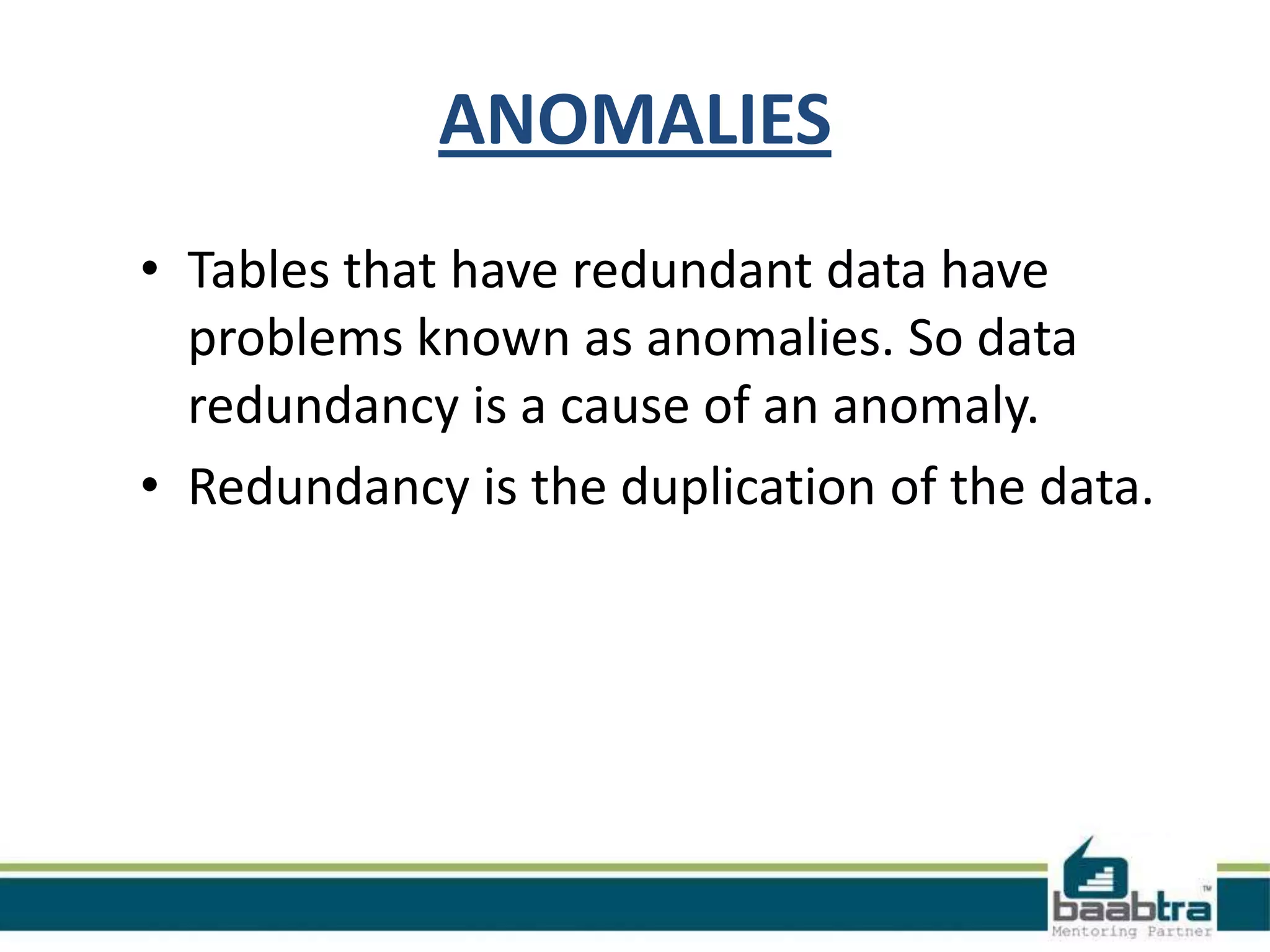
ANOMALIES
• Tables that have redundant data have
problems known as anomalies. So data
redundancy is a cause of an anomaly.
• Redundancy is the duplication of the data.
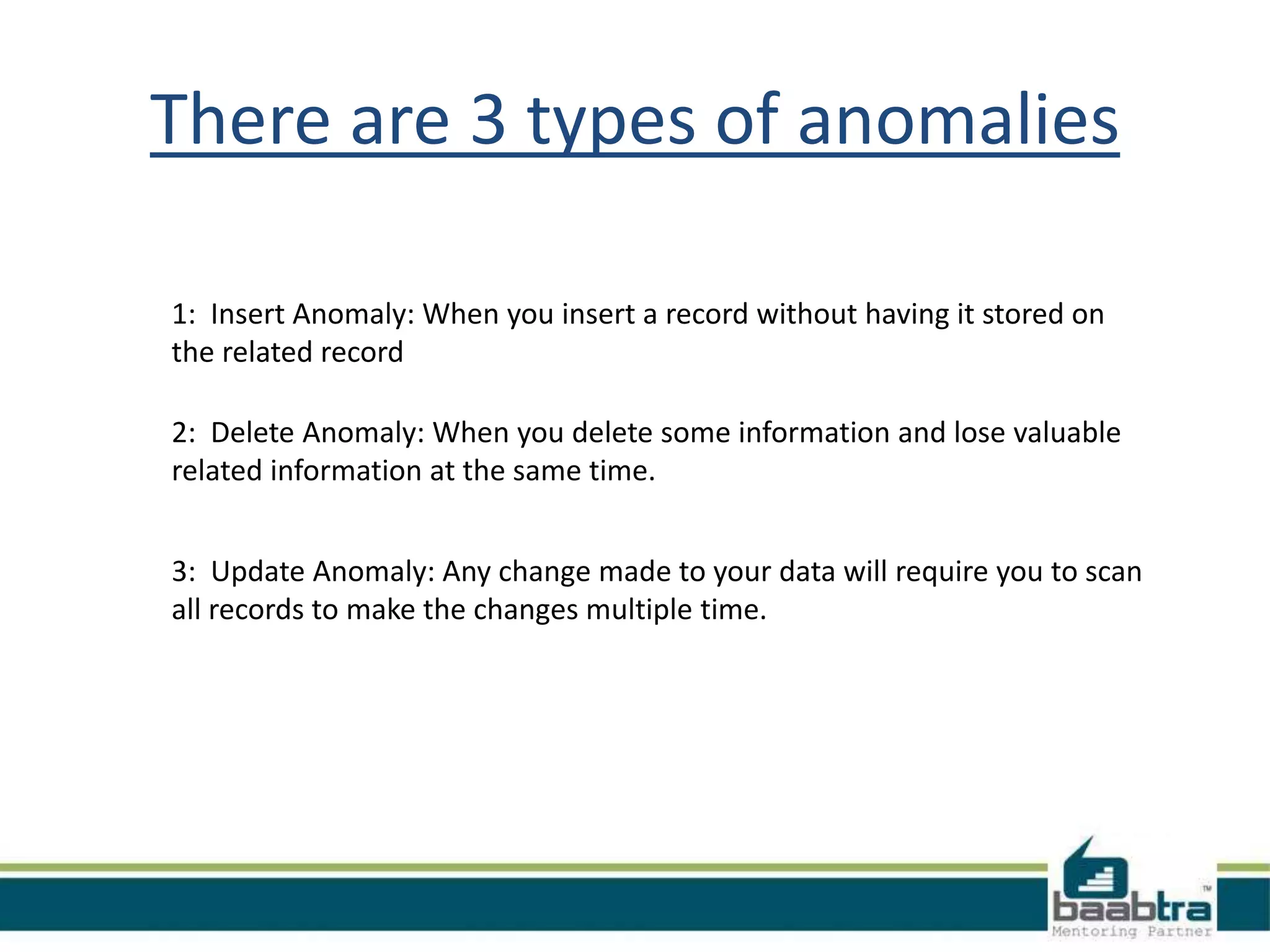
There are 3 types of anomalies
1: Insert Anomaly: When you insert a record without having it stored on
the related record
2: Delete Anomaly: When you delete some information and lose valuable
related information at the same time.
3: Update Anomaly: Any change made to your data will require you to scan
all records to make the changes multiple time.
Insert anomaly
• An Insert Anomaly occurs when certain
attributes cannot be inserted into the
database without the presence of other
attribute
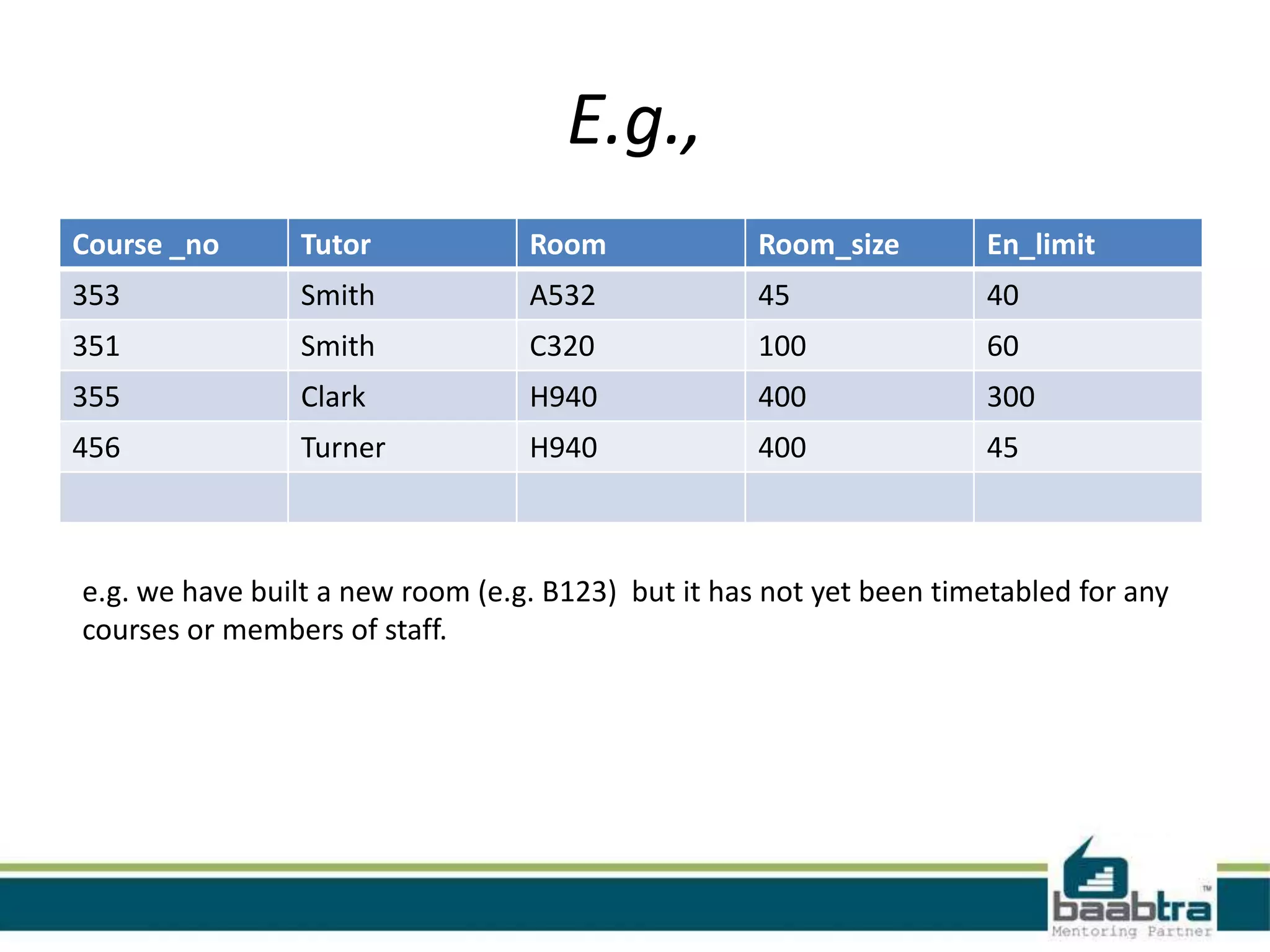
E.g.,
Course _no Tutor Room Room_size En_limit
353 Smith A532 45 40
351 Smith C320 100 60
355 Clark H940 400 300
456 Turner H940 400 45
e.g. we have built a new room (e.g. B123) but it has not yet been timetabled for any
courses or members of staff.
Delete Anomaly
• A Delete Anomaly exists when certain
attributes are lost because of the
deletion of other attributes.
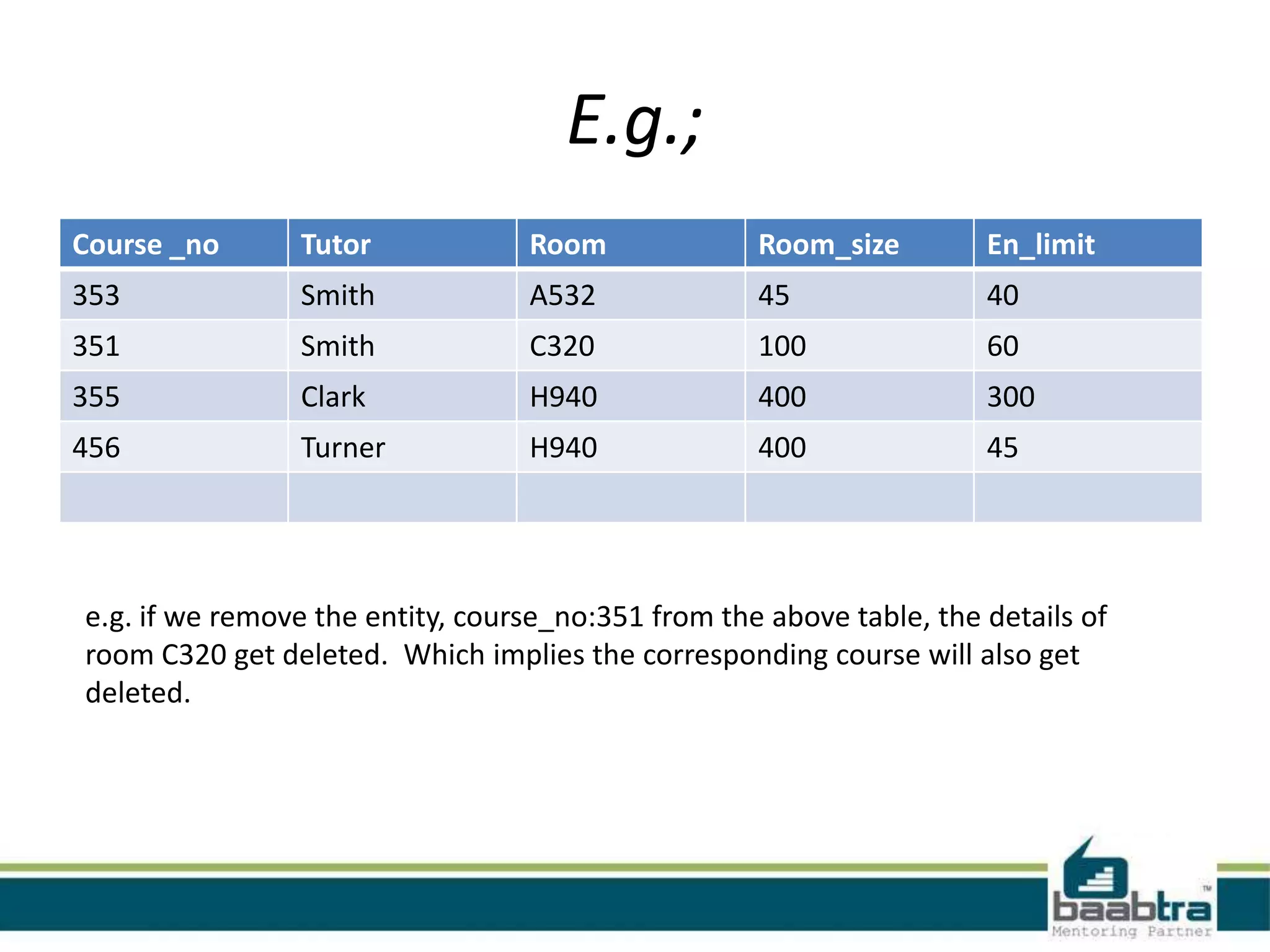
E.g.;
Course _no Tutor Room Room_size En_limit
353 Smith A532 45 40
351 Smith C320 100 60
355 Clark H940 400 300
456 Turner H940 400 45
e.g. if we remove the entity, course_no:351 from the above table, the details of
room C320 get deleted. Which implies the corresponding course will also get
deleted.
Update Anomaly
• An Update Anomaly exists when one or
more instances of duplicated data is
updated, but not all.
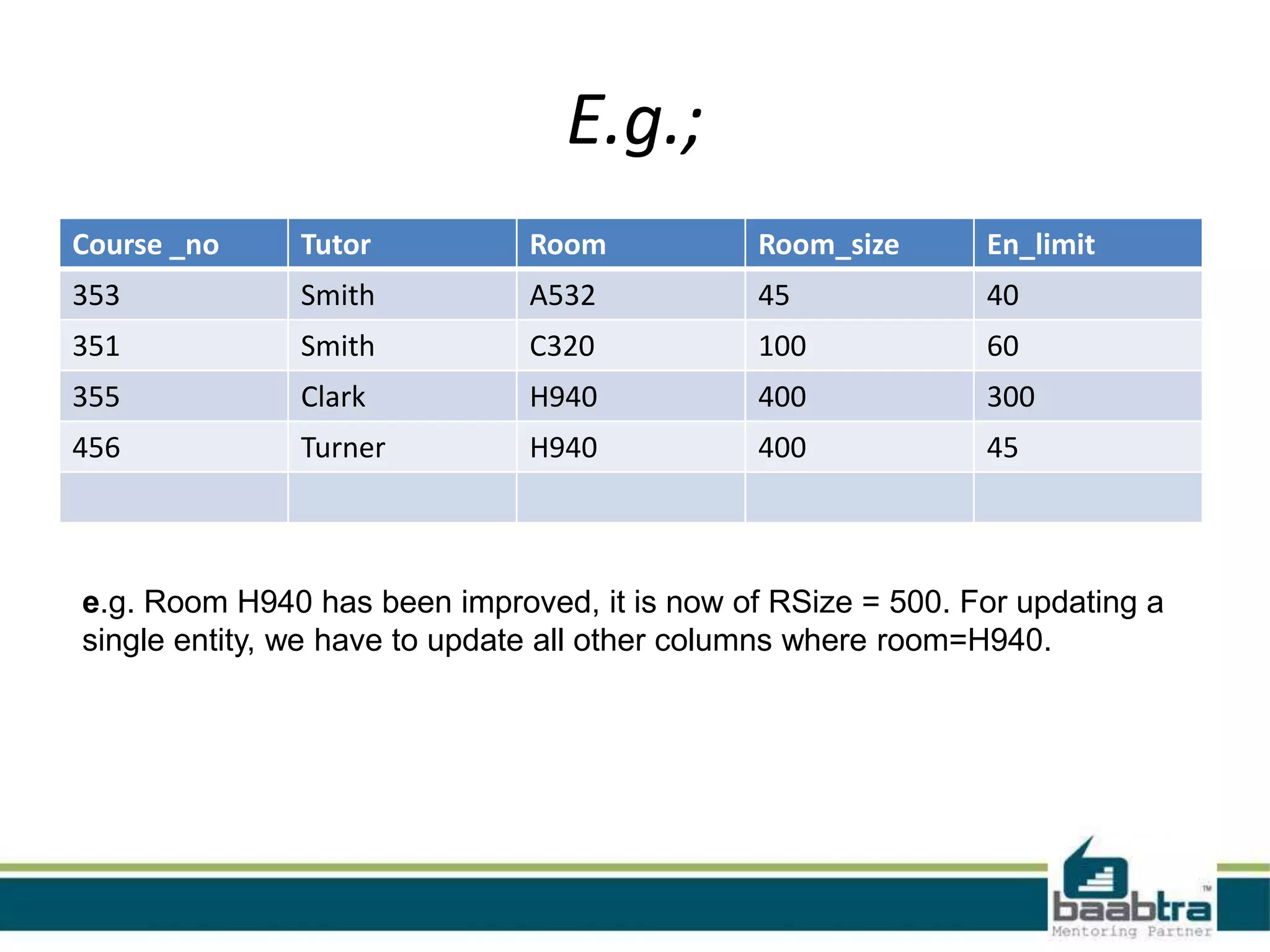
E.g.;
Course _no Tutor Room Room_size En_limit
353 Smith A532 45 40
351 Smith C320 100 60
355 Clark H940 400 300
456 Turner H940 400 45
e.g. Room H940 has been improved, it is now of RSize = 500. For updating a
single entity, we have to update all other columns where room=H940.
Normalization will help us to remove
the Anomaly and create good database
Normalization
• Normalization is the process of putting things right, making them
normal. In a relational database the term has a specific
mathematical meaning having to do with separating elements of
data - names, addresses - into affinity groups, and defining the
normal or right relationships between them.
• This is database design technique which organizes tables in a
manner that reduces redundancy and dependency of data(That
means avoid anomaly)
• Normalization is ‘standardized’ rule for making database
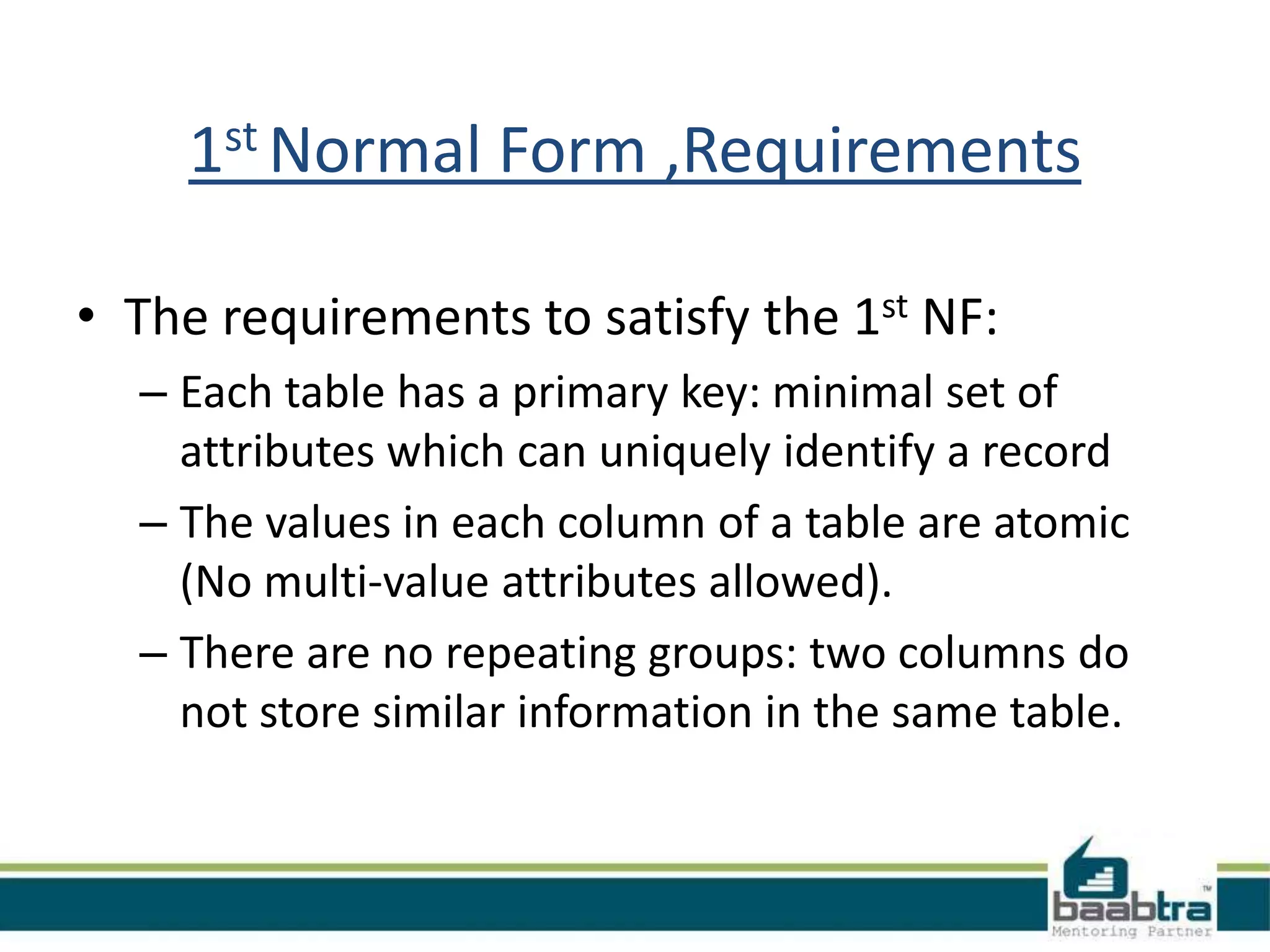
1st Normal Form ,Requirements
• The requirements to satisfy the 1st NF:
– Each table has a primary key: minimal set of
attributes which can uniquely identify a record
– The values in each column of a table are atomic
(No multi-value attributes allowed).
– There are no repeating groups: two columns do
not store similar information in the same table.
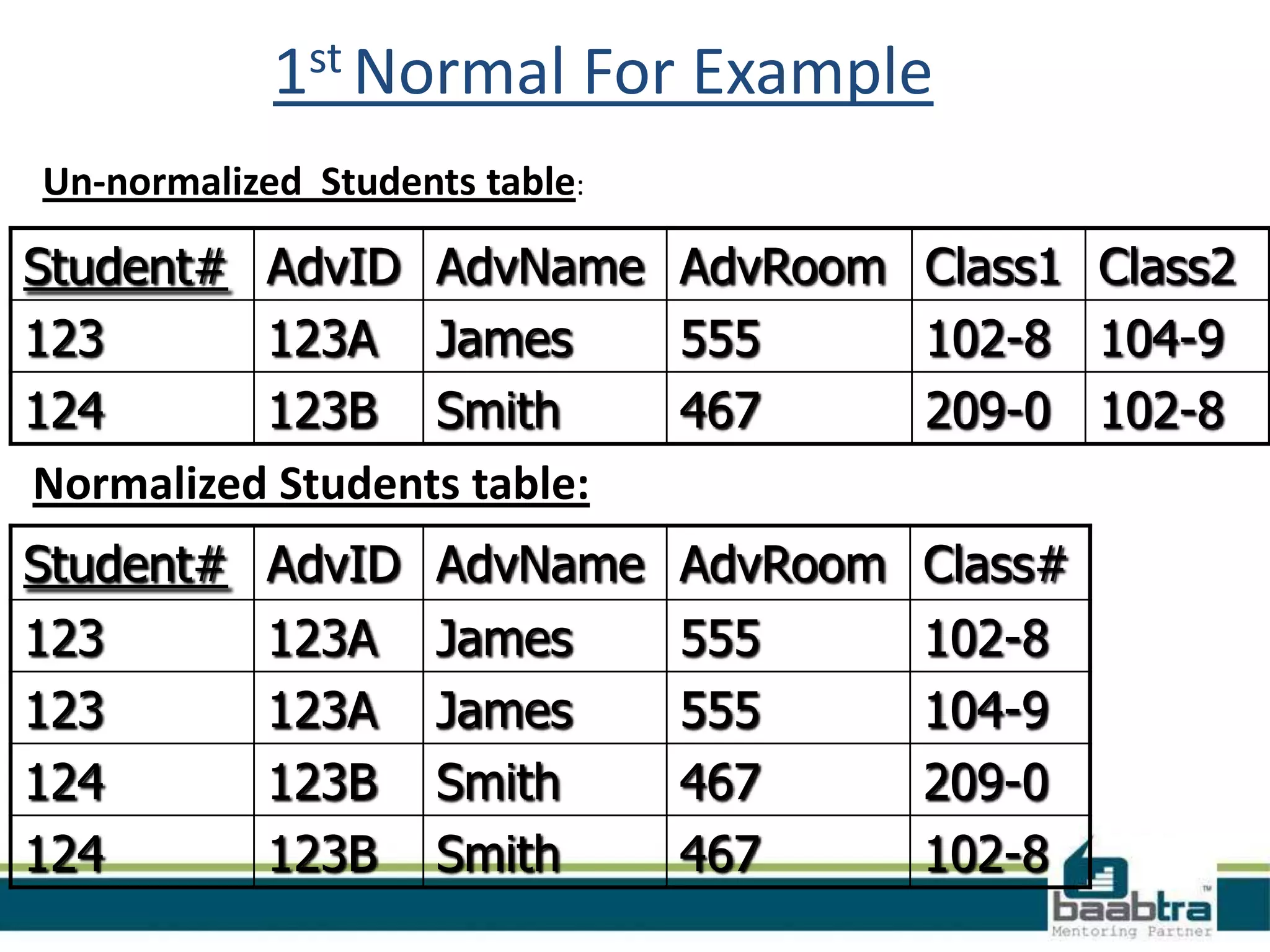
1st Normal For Example
Un-normalized Students table:
Student# AdvID AdvName AdvRoom Class1 Class2
123 123A James 555 102-8 104-9
124 123B Smith 467 209-0 102-8
Normalized Students table:
Student# AdvID AdvName AdvRoom Class#
123 123A James 555 102-8
123 123A James 555 104-9
124 123B Smith 467 209-0
124 123B Smith 467 102-8
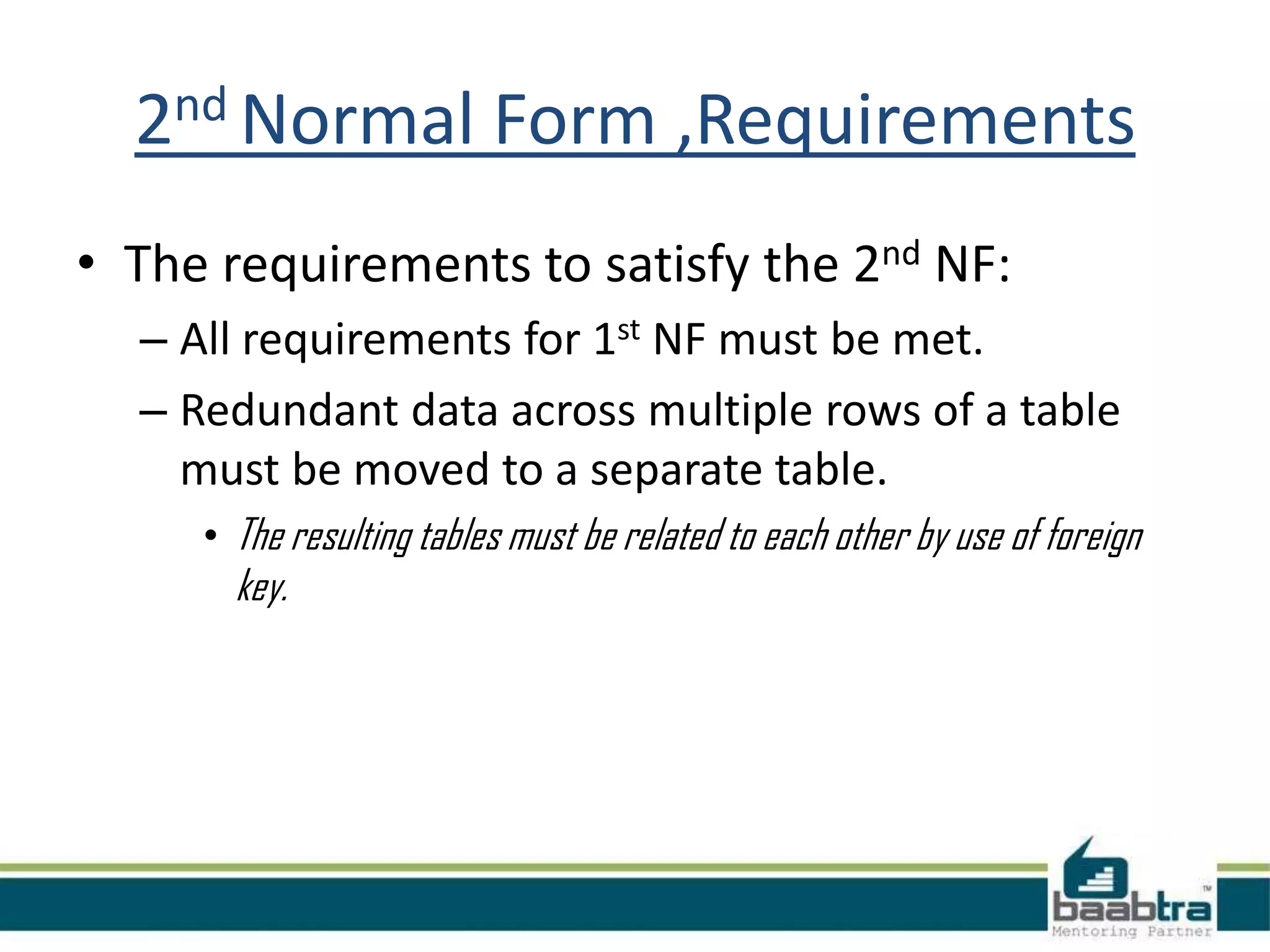
2nd Normal Form ,Requirements
• The requirements to satisfy the 2nd NF:
– All requirements for 1st NF must be met.
– Redundant data across multiple rows of a table
must be moved to a separate table.
• The resulting tables must be related to each other by use of foreign
key.
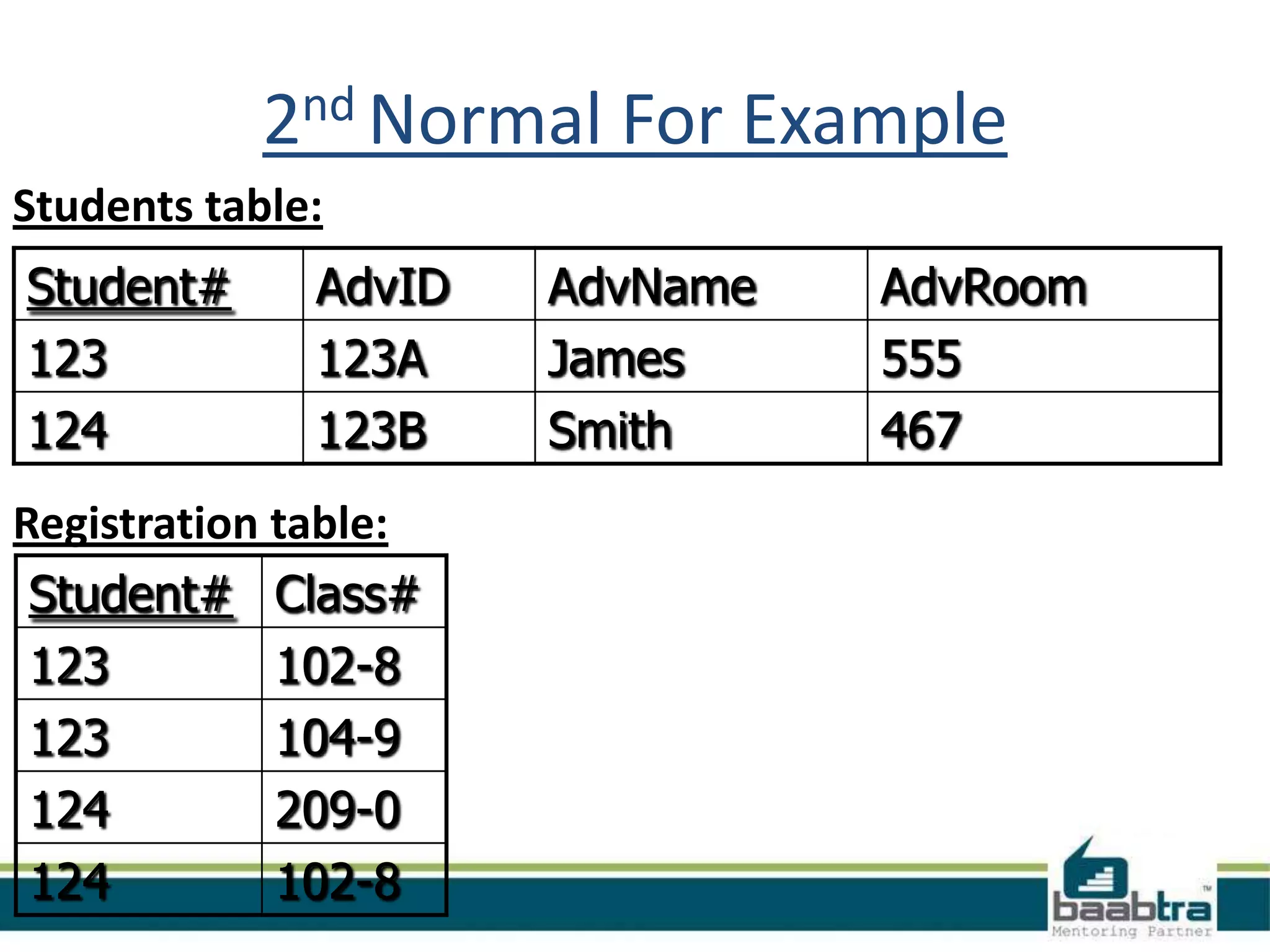
2nd Normal For Example
Students table:
Student# AdvID AdvName AdvRoom
123 123A James 555
124 123B Smith 467
Registration table:
Student# Class#
123 102-8
123 104-9
124 209-0
124 102-8
3rd Normal Form ,Requirements
• The requirements to satisfy the 3rd NF:
– All requirements for 2nd NF must be met.
– Eliminate fields that do not depend on the
primary key;
• That is, any field that is dependent not only on the primary key but also
on another field must be moved to another table.
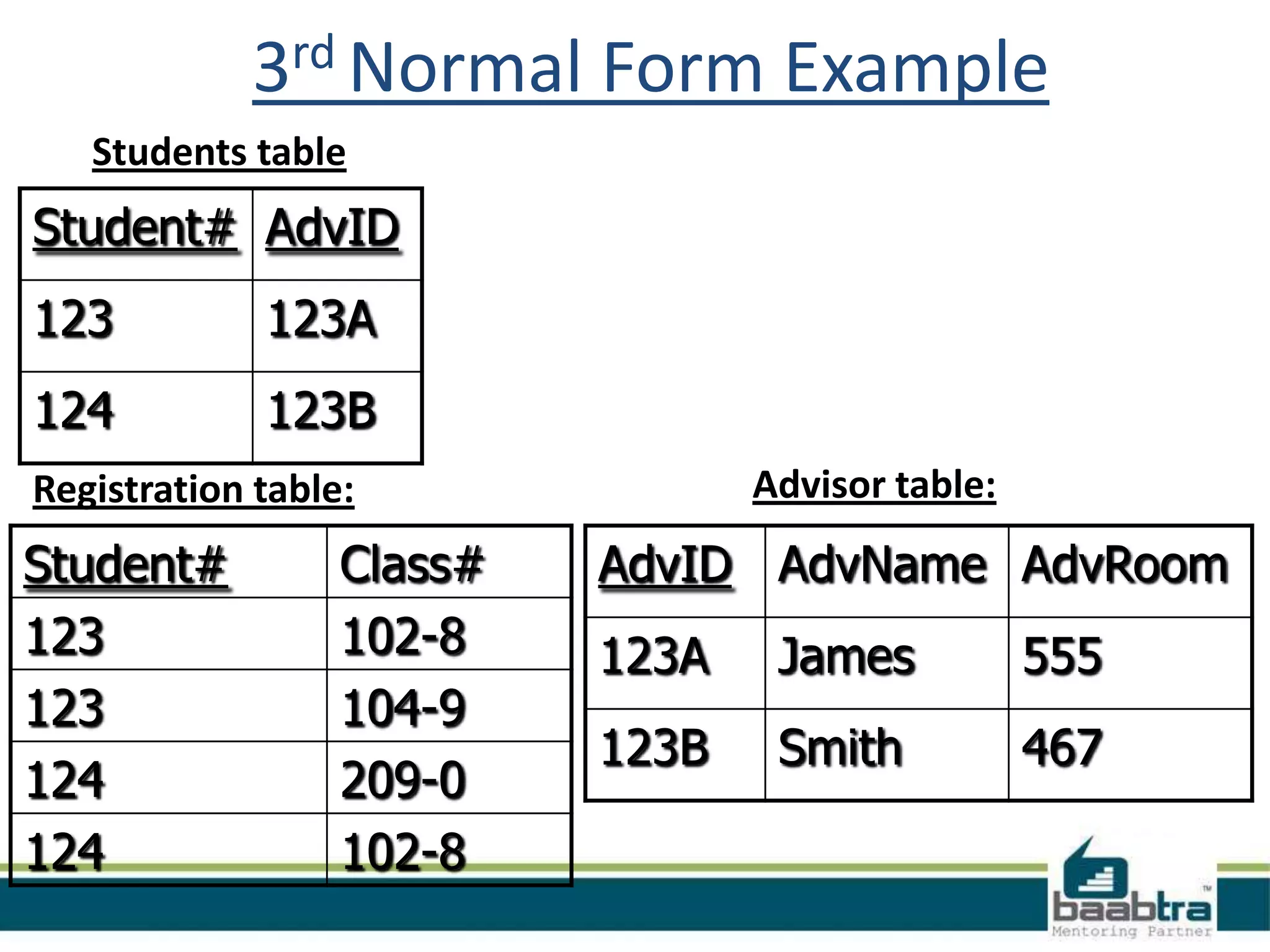
3rd Normal Form Example
Students table
Advisor table:
AdvID AdvName AdvRoom
123A James 555
123B Smith 467
Student# AdvID
123 123A
124 123B
Student# Class#
123 102-8
123 104-9
124 209-0
124 102-8
Registration table:
Conclusion
• We have seen how Database Normalization
can decrease redundancy, increase efficiency
and reduce anomalies by implementing three
of seven different levels of normalization
called Normal Forms. The first three NF’s are
usually sufficient for most small to medium
size applications.
Thanks
Contact Us
Emarald Mall (Big Bazar Building)
Mavoor Road, Kozhikode,
Kerala, India.
Ph: + 91 – 495 40 25 550
NC Complex, Near Bus Stand
Mukkam, Kozhikode,
Kerala, India.
Ph: + 91 – 495 40 25 550
Start up Village
Eranakulam,
Kerala, India.
Email: info@baabtra.com
If this presentation helped you, please visit our
page facebook.com/baabtra and like it.
Thanks in advance.
www.baabtra.com | www.massbaab.com |www.baabte.com

Normalisation and anomalies

  • 2.
    Disclaimer: This presentationis prepared by trainees of baabtra as a part of mentoring program. This is not official document of baabtra –Mentoring Partner Baabtra-Mentoring Partner is the mentoring division of baabte System Technologies Pvt . Ltd
  • 3.
    Title of thepresentation Shajeer pk shajeer31@gmail.com www.facebook.com/shajeer twitter.com/shajeer_pk in.linkedin.com/in/shajeerp k2@gmail.com 9544559642
  • 5.
    ANOMALIES • Tables thathave redundant data have problems known as anomalies. So data redundancy is a cause of an anomaly. • Redundancy is the duplication of the data.
  • 6.
    There are 3types of anomalies 1: Insert Anomaly: When you insert a record without having it stored on the related record 2: Delete Anomaly: When you delete some information and lose valuable related information at the same time. 3: Update Anomaly: Any change made to your data will require you to scan all records to make the changes multiple time.
  • 7.
    Insert anomaly • AnInsert Anomaly occurs when certain attributes cannot be inserted into the database without the presence of other attribute
  • 8.
    E.g., Course _no TutorRoom Room_size En_limit 353 Smith A532 45 40 351 Smith C320 100 60 355 Clark H940 400 300 456 Turner H940 400 45 e.g. we have built a new room (e.g. B123) but it has not yet been timetabled for any courses or members of staff.
  • 9.
    Delete Anomaly • ADelete Anomaly exists when certain attributes are lost because of the deletion of other attributes.
  • 10.
    E.g.; Course _no TutorRoom Room_size En_limit 353 Smith A532 45 40 351 Smith C320 100 60 355 Clark H940 400 300 456 Turner H940 400 45 e.g. if we remove the entity, course_no:351 from the above table, the details of room C320 get deleted. Which implies the corresponding course will also get deleted.
  • 11.
    Update Anomaly • AnUpdate Anomaly exists when one or more instances of duplicated data is updated, but not all.
  • 12.
    E.g.; Course _no TutorRoom Room_size En_limit 353 Smith A532 45 40 351 Smith C320 100 60 355 Clark H940 400 300 456 Turner H940 400 45 e.g. Room H940 has been improved, it is now of RSize = 500. For updating a single entity, we have to update all other columns where room=H940.
  • 13.
    Normalization will helpus to remove the Anomaly and create good database
  • 14.
    Normalization • Normalization isthe process of putting things right, making them normal. In a relational database the term has a specific mathematical meaning having to do with separating elements of data - names, addresses - into affinity groups, and defining the normal or right relationships between them. • This is database design technique which organizes tables in a manner that reduces redundancy and dependency of data(That means avoid anomaly) • Normalization is ‘standardized’ rule for making database
  • 15.
    1st Normal Form,Requirements • The requirements to satisfy the 1st NF: – Each table has a primary key: minimal set of attributes which can uniquely identify a record – The values in each column of a table are atomic (No multi-value attributes allowed). – There are no repeating groups: two columns do not store similar information in the same table.
  • 16.
    1st Normal ForExample Un-normalized Students table: Student# AdvID AdvName AdvRoom Class1 Class2 123 123A James 555 102-8 104-9 124 123B Smith 467 209-0 102-8 Normalized Students table: Student# AdvID AdvName AdvRoom Class# 123 123A James 555 102-8 123 123A James 555 104-9 124 123B Smith 467 209-0 124 123B Smith 467 102-8
  • 17.
    2nd Normal Form,Requirements • The requirements to satisfy the 2nd NF: – All requirements for 1st NF must be met. – Redundant data across multiple rows of a table must be moved to a separate table. • The resulting tables must be related to each other by use of foreign key.
  • 18.
    2nd Normal ForExample Students table: Student# AdvID AdvName AdvRoom 123 123A James 555 124 123B Smith 467 Registration table: Student# Class# 123 102-8 123 104-9 124 209-0 124 102-8
  • 19.
    3rd Normal Form,Requirements • The requirements to satisfy the 3rd NF: – All requirements for 2nd NF must be met. – Eliminate fields that do not depend on the primary key; • That is, any field that is dependent not only on the primary key but also on another field must be moved to another table.
  • 20.
    3rd Normal FormExample Students table Advisor table: AdvID AdvName AdvRoom 123A James 555 123B Smith 467 Student# AdvID 123 123A 124 123B Student# Class# 123 102-8 123 104-9 124 209-0 124 102-8 Registration table:
  • 21.
    Conclusion • We haveseen how Database Normalization can decrease redundancy, increase efficiency and reduce anomalies by implementing three of seven different levels of normalization called Normal Forms. The first three NF’s are usually sufficient for most small to medium size applications.
  • 22.
  • 23.
    Contact Us Emarald Mall(Big Bazar Building) Mavoor Road, Kozhikode, Kerala, India. Ph: + 91 – 495 40 25 550 NC Complex, Near Bus Stand Mukkam, Kozhikode, Kerala, India. Ph: + 91 – 495 40 25 550 Start up Village Eranakulam, Kerala, India. Email: info@baabtra.com
  • 24.
    If this presentationhelped you, please visit our page facebook.com/baabtra and like it. Thanks in advance. www.baabtra.com | www.massbaab.com |www.baabte.com