7th semester
Radiology
Normal anatomy
By Dr Gihan Omar 1Dr Gihan Omar
A, Enamel; B, Dentin; and C, Cemento-
enamel junction. 2Dr Gihan Omar
The pulp cavity
3Dr Gihan Omar
Teeth are composed of pulp (arrow on the second molar),
enamel (arrow on the first molar), dentin (arrow on the
second premolar), and cementum (usually not visible
radiographically). 4Dr Gihan Omar
A developing root shown by a divergent apex, around the
dental papilla (arrow), which is enclosed by an opaque bony
crypt. 5Dr Gihan Omar
A developing root
6Dr Gihan Omar
Hypercementosis of the roots of a mandibular molar
may occurs in Paget’s disease.
7Dr Gihan Omar
Lamina dura
8Dr Gihan Omar
Periodontal membrane space
9Dr Gihan Omar
Alveolar crest is pointed at the anterior teeth.
10Dr Gihan Omar
Alveolar crest is flattened at the posterior
teeth and parallel to the cemento-enamel
junction of adjacent teeth.
11Dr Gihan Omar
Intermaxillary suture (arrows) appears as a radiolucency in
the midline of the maxilla surrounded by two radiopaque
borders. 12Dr Gihan Omar
The anterior nasal spine is seen as an opaque V-
shaped projection from the floor of the nasal fossa
in the midline (arrow). 13Dr Gihan Omar
The nasal septum appears as a radiopaque partition
that divides the nasal cavity.
14Dr Gihan Omar
The anterior floor of the nasal fossa (arrows)
appears as opaque lines extending laterally from the
anterior nasal spine. 15Dr Gihan Omar
The inferior nasal conchae appear as diffuse radiopacities
within the nasal cavity. 16Dr Gihan Omar
The incisive foramen appears radiolucent.
17Dr Gihan Omar
The superior foramina of the incisive canal appear as small
rounded radiolucency above the root apices of the maxillary
central incisors. 18Dr Gihan Omar
Lateral fossa is a diffuse radiolucency (arrows) in the region
of the apex of the lateral incisor. It is formed by a depression
in the maxilla at this location.
19Dr Gihan Omar
The soft tissue outline of the nose (arrows) is
superimposed on the anterior maxilla.
20Dr Gihan Omar
The nasolacimal canals are commonly seen as ovoid
radiolucencies (arrow) on maxillary occlusal projections.
21Dr Gihan Omar
The naso-lacrimal canals (arrow) is occasionally seen near
the apex of the canine when steep vertical angulation is used.
Note the mesiodens (supernumerary tooth) superior to the
central incisor. 22Dr Gihan Omar
The inverted Y appears as a radiopaque upside-
down Y. 23Dr Gihan Omar
The maxillary sinus inferior border.
24Dr Gihan Omar
Septa within the maxillary sinus appear as radiopaque lines.
25Dr Gihan Omar
The zygomatic process of the maxilla (arrows) extends
posteriorly from the inferior portion of the zygomatic process
of the maxilla. 26Dr Gihan Omar
The maxillary tuberosity appears as a radiopaque bulge
distal to third molar region.
27Dr Gihan Omar
Pterygoid plates (arrows) located posterior to the
maxillary tuberosity.
28Dr Gihan Omar
Mandibular symphysis (arrows) in a newborn infant. Note the
bilateral supernumerary primary incisors adjacent to it.
29Dr Gihan Omar
Genial tubercles (arrow) on the lingual surface of the
mandible in this cross-sectional mandibular
occlusal view. 30Dr Gihan Omar
The mental ridge appears as a radiopaque band in the
premolar and incisor region.
31Dr Gihan Omar
The mental fossa appears as a radiolucent area above the
mental ridge. 32Dr Gihan Omar
The mental foramen (arrow, over the apex of the second
premolar) may simulate periapical disease. Continuity of the
lamina dura around the apex, however, indicates the absence
of periapical abnormality.
33Dr Gihan Omar
The mylohoid ridge appears as a radiopaque band
or line above the submandibular gland fossa.
34Dr Gihan Omar
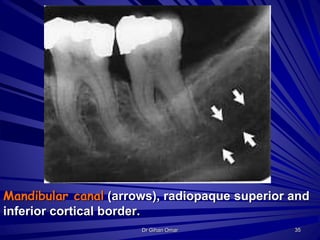
Mandibular canal (arrows), radiopaque superior and
inferior cortical border.
35Dr Gihan Omar
Submandibular gland fossa (arrows) indicated by a poorly
defined radiolucency and sparse trabecular bone below the
mandibular molars.
36Dr Gihan Omar
The external oblique ridge appears as a radiopaque
band. 37Dr Gihan Omar
The inferior border of the mandible (arrows) is seen as a
dense, broad radiopaque band.
38Dr Gihan Omar
Left, the coronoid process appears as a triangular-shaped
radiopacity. Right, superimposition of the coronoid process
on the tuberosity area resemble root fragment (white arrow).
39Dr Gihan Omar
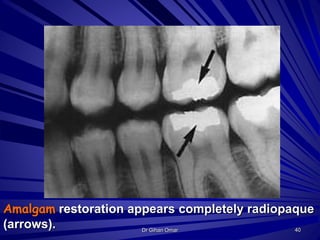
Amalgam restoration appears completely radiopaque
(arrows). 40Dr Gihan Omar
Stainless steel pins (arrows) provide retention for amalgam
restoration. 41Dr Gihan Omar
A cast gold crown, appearing completely radiopaque (arrow),
serves as the terminal abutment of a bridge.
42Dr Gihan Omar
Gutta-percha (arrows) is a radiopaque rubber-like material
used in endodontic therapy.
43Dr Gihan Omar
Silver points (arrow) were used to fill the root canals in this
patient. 44Dr Gihan Omar
Porcelain appears radiolucent (arrow) over a coping.
45Dr Gihan Omar
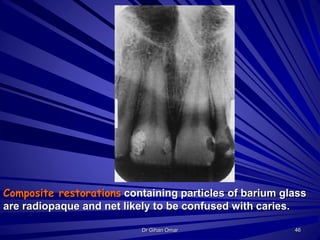
Composite restorations containing particles of barium glass
are radiopaque and net likely to be confused with caries.
46Dr Gihan Omar
Orthodontic appliances have a characteristic radiopaque
appearance.
47Dr Gihan Omar
48Dr Gihan Omar

Normal radiographic landmarks

  • 1.
    7th semester Radiology Normal anatomy ByDr Gihan Omar 1Dr Gihan Omar
  • 2.
    A, Enamel; B,Dentin; and C, Cemento- enamel junction. 2Dr Gihan Omar
  • 3.
  • 4.
    Teeth are composedof pulp (arrow on the second molar), enamel (arrow on the first molar), dentin (arrow on the second premolar), and cementum (usually not visible radiographically). 4Dr Gihan Omar
  • 5.
    A developing rootshown by a divergent apex, around the dental papilla (arrow), which is enclosed by an opaque bony crypt. 5Dr Gihan Omar
  • 6.
  • 7.
    Hypercementosis of theroots of a mandibular molar may occurs in Paget’s disease. 7Dr Gihan Omar
  • 8.
  • 9.
  • 10.
    Alveolar crest ispointed at the anterior teeth. 10Dr Gihan Omar
  • 11.
    Alveolar crest isflattened at the posterior teeth and parallel to the cemento-enamel junction of adjacent teeth. 11Dr Gihan Omar
  • 12.
    Intermaxillary suture (arrows)appears as a radiolucency in the midline of the maxilla surrounded by two radiopaque borders. 12Dr Gihan Omar
  • 13.
    The anterior nasalspine is seen as an opaque V- shaped projection from the floor of the nasal fossa in the midline (arrow). 13Dr Gihan Omar
  • 14.
    The nasal septumappears as a radiopaque partition that divides the nasal cavity. 14Dr Gihan Omar
  • 15.
    The anterior floorof the nasal fossa (arrows) appears as opaque lines extending laterally from the anterior nasal spine. 15Dr Gihan Omar
  • 16.
    The inferior nasalconchae appear as diffuse radiopacities within the nasal cavity. 16Dr Gihan Omar
  • 17.
    The incisive foramenappears radiolucent. 17Dr Gihan Omar
  • 18.
    The superior foraminaof the incisive canal appear as small rounded radiolucency above the root apices of the maxillary central incisors. 18Dr Gihan Omar
  • 19.
    Lateral fossa isa diffuse radiolucency (arrows) in the region of the apex of the lateral incisor. It is formed by a depression in the maxilla at this location. 19Dr Gihan Omar
  • 20.
    The soft tissueoutline of the nose (arrows) is superimposed on the anterior maxilla. 20Dr Gihan Omar
  • 21.
    The nasolacimal canalsare commonly seen as ovoid radiolucencies (arrow) on maxillary occlusal projections. 21Dr Gihan Omar
  • 22.
    The naso-lacrimal canals(arrow) is occasionally seen near the apex of the canine when steep vertical angulation is used. Note the mesiodens (supernumerary tooth) superior to the central incisor. 22Dr Gihan Omar
  • 23.
    The inverted Yappears as a radiopaque upside- down Y. 23Dr Gihan Omar
  • 24.
    The maxillary sinusinferior border. 24Dr Gihan Omar
  • 25.
    Septa within themaxillary sinus appear as radiopaque lines. 25Dr Gihan Omar
  • 26.
    The zygomatic processof the maxilla (arrows) extends posteriorly from the inferior portion of the zygomatic process of the maxilla. 26Dr Gihan Omar
  • 27.
    The maxillary tuberosityappears as a radiopaque bulge distal to third molar region. 27Dr Gihan Omar
  • 28.
    Pterygoid plates (arrows)located posterior to the maxillary tuberosity. 28Dr Gihan Omar
  • 29.
    Mandibular symphysis (arrows)in a newborn infant. Note the bilateral supernumerary primary incisors adjacent to it. 29Dr Gihan Omar
  • 30.
    Genial tubercles (arrow)on the lingual surface of the mandible in this cross-sectional mandibular occlusal view. 30Dr Gihan Omar
  • 31.
    The mental ridgeappears as a radiopaque band in the premolar and incisor region. 31Dr Gihan Omar
  • 32.
    The mental fossaappears as a radiolucent area above the mental ridge. 32Dr Gihan Omar
  • 33.
    The mental foramen(arrow, over the apex of the second premolar) may simulate periapical disease. Continuity of the lamina dura around the apex, however, indicates the absence of periapical abnormality. 33Dr Gihan Omar
  • 34.
    The mylohoid ridgeappears as a radiopaque band or line above the submandibular gland fossa. 34Dr Gihan Omar
  • 35.
    Mandibular canal (arrows),radiopaque superior and inferior cortical border. 35Dr Gihan Omar
  • 36.
    Submandibular gland fossa(arrows) indicated by a poorly defined radiolucency and sparse trabecular bone below the mandibular molars. 36Dr Gihan Omar
  • 37.
    The external obliqueridge appears as a radiopaque band. 37Dr Gihan Omar
  • 38.
    The inferior borderof the mandible (arrows) is seen as a dense, broad radiopaque band. 38Dr Gihan Omar
  • 39.
    Left, the coronoidprocess appears as a triangular-shaped radiopacity. Right, superimposition of the coronoid process on the tuberosity area resemble root fragment (white arrow). 39Dr Gihan Omar
  • 40.
    Amalgam restoration appearscompletely radiopaque (arrows). 40Dr Gihan Omar
  • 41.
    Stainless steel pins(arrows) provide retention for amalgam restoration. 41Dr Gihan Omar
  • 42.
    A cast goldcrown, appearing completely radiopaque (arrow), serves as the terminal abutment of a bridge. 42Dr Gihan Omar
  • 43.
    Gutta-percha (arrows) isa radiopaque rubber-like material used in endodontic therapy. 43Dr Gihan Omar
  • 44.
    Silver points (arrow)were used to fill the root canals in this patient. 44Dr Gihan Omar
  • 45.
    Porcelain appears radiolucent(arrow) over a coping. 45Dr Gihan Omar
  • 46.
    Composite restorations containingparticles of barium glass are radiopaque and net likely to be confused with caries. 46Dr Gihan Omar
  • 47.
    Orthodontic appliances havea characteristic radiopaque appearance. 47Dr Gihan Omar
  • 48.