05/19/1605/19/16 OelshallOelshall 11
Dental RadiographicDental Radiographic anatomy
& interpretation
Part I
Dr. Ossama EL-Shall
Professor & Chairman, Faculty of DentalProfessor & Chairman, Faculty of Dental
Medicine for girls, Al-Azhar University,Medicine for girls, Al-Azhar University,
Cairo Egypt.Cairo Egypt.
E.mail address: oelshall@hotmail.comE.mail address: oelshall@hotmail.com
05/19/1605/19/16 OelshallOelshall 22
Dental radiographic
interpretation
05/19/1605/19/16 OelshallOelshall 33
Dental radiographic interpretationDental radiographic interpretation
Radiographic interpretation, is a
reading of a radiograph and
commenting on it to draw a diagnosis
Reading a radiograph includes
recording any deviation from the
normal appearance.
05/19/1605/19/16 OelshallOelshall 44
Rules of radiographic interpretationRules of radiographic interpretation
1-1- The area to be examined must be completelyThe area to be examined must be completely
shown at optimal angulationsshown at optimal angulations
2-2- All the boundaries of the area of interest must beAll the boundaries of the area of interest must be
shown with normal structures around it.shown with normal structures around it.
3-3- Knowing and familiarity with all normalKnowing and familiarity with all normal
anatomical landmarks as well as all variousanatomical landmarks as well as all various
pathological conditions that may affect the area ofpathological conditions that may affect the area of
interest.interest.
05/19/1605/19/16 OelshallOelshall 55
Principles of radiographicPrinciples of radiographic
interpretationinterpretation
Interpretation of a radiograph is not aInterpretation of a radiograph is not a
diagnosis by itself, but it is an diagnostic aiddiagnosis by itself, but it is an diagnostic aid
or mean help to reach a final diagnosis.or mean help to reach a final diagnosis.
Final diagnosis can be reached byFinal diagnosis can be reached by
performing a full case history, clinicalperforming a full case history, clinical
examination, special investigations andexamination, special investigations and
differential diagnosis.differential diagnosis.
05/19/1605/19/16 OelshallOelshall 66
Methods of interpretationMethods of interpretation
LLocalization.ocalization.
OObservation.bservation.
GGeneral consideration.eneral consideration.
IInterpretation.nterpretation.
CCorrelation.orrelation.
05/19/1605/19/16 OelshallOelshall 77
LocalizationLocalization
It is the identification and recognitionIt is the identification and recognition
of the area which the view shows, forof the area which the view shows, for
example: Upper anterior area, TMJexample: Upper anterior area, TMJ
area, Lower molar area………………..area, Lower molar area………………..
05/19/1605/19/16 OelshallOelshall 88
ObservationObservation
All shadows, other than the localizedAll shadows, other than the localized
shadows of the normal landmarks must beshadows of the normal landmarks must be
observed.observed.
For example: shadows in crowns, cervicalFor example: shadows in crowns, cervical
area, roots, restorations, size of rootarea, roots, restorations, size of root
canals, periodontal membrane space,canals, periodontal membrane space,
periapical area, alveolar crest, foreignperiapical area, alveolar crest, foreign
bodies, integrity of bone …………bodies, integrity of bone …………
05/19/1605/19/16 OelshallOelshall 99
General considerationGeneral consideration
A radiograph shows only 2 dimensions of a 3A radiograph shows only 2 dimensions of a 3
dimensional object (width and height but notdimensional object (width and height but not
the depth)the depth)
Cervical burnout: usually appears as cervicalCervical burnout: usually appears as cervical
RL and misinterpreted by caries; this occursRL and misinterpreted by caries; this occurs
due to less density and more penetration ofdue to less density and more penetration of
rays.rays.
Pulp exposure never to be determined fromPulp exposure never to be determined from
radiograph but only the proximity to the pulp.radiograph but only the proximity to the pulp.
05/19/1605/19/16 OelshallOelshall 1010
InterpretationInterpretation
Studying the features ofStudying the features of teethteeth andand bonebone
TeethTeeth
Study the whole tooth, (crown, rootStudy the whole tooth, (crown, root
enamel, pulp….), number of teeth andenamel, pulp….), number of teeth and
finally supporting structures,finally supporting structures,
(Periodontal membrane space, lamina(Periodontal membrane space, lamina
dura, alveolar crest)dura, alveolar crest)
05/19/1605/19/16 OelshallOelshall 1111
BoneBone
Changes in bone may include:Changes in bone may include:
1- Changes in density.1- Changes in density.
2- Changes in the margin2- Changes in the margin
3- Changes inside the lesion.3- Changes inside the lesion.
4- Effect on surrounding tissues.4- Effect on surrounding tissues.
5- Changes in structure5- Changes in structure
05/19/1605/19/16 OelshallOelshall 1212
1- Changes in density.1- Changes in density.
Three bone density pattern may found:Three bone density pattern may found:
1-decrease in density resulting in RL1-decrease in density resulting in RL
2-Increase in density resulting in RO2-Increase in density resulting in RO
3- Combination of above.3- Combination of above.
05/19/1605/19/16 OelshallOelshall 1313
2-Changes in the lesion margin2-Changes in the lesion margin
1- Well-defined margin with or without1- Well-defined margin with or without
sclerotic border denoting a slowlysclerotic border denoting a slowly
growing or chronic condition such asgrowing or chronic condition such as
cyst and granuloma.cyst and granuloma.
2- ill-defined margin, denoting acute2- ill-defined margin, denoting acute
active condition destroying bone in allactive condition destroying bone in all
directions, such as abscess, ordirections, such as abscess, or
malignancy.malignancy.
05/19/1605/19/16 OelshallOelshall 1414
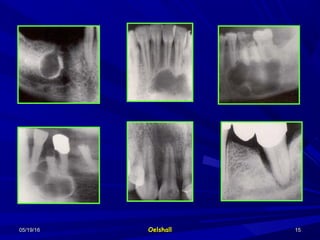
3- Changes inside the lesion.3- Changes inside the lesion.
1- Unilocular.1- Unilocular.
2-Multilocular.2-Multilocular.
3-Multiple and separate.3-Multiple and separate.
05/19/1605/19/16 OelshallOelshall 1515
05/19/1605/19/16 OelshallOelshall 1616
4-Effects on surrounding tissues.4-Effects on surrounding tissues.
1-May cause expansion, resorption,1-May cause expansion, resorption,
destruction or thinning of bone.destruction or thinning of bone.
2-Compressed adjacent tissues as max.2-Compressed adjacent tissues as max.
sinus or nasal cavitysinus or nasal cavity
3-Displacement of teeth, divergence or3-Displacement of teeth, divergence or
resorption.resorption.
4-Affection of lamina dura.4-Affection of lamina dura.
05/19/1605/19/16 OelshallOelshall 1717
5- Changes in structure5- Changes in structure
1-Ground glass appearance; fine granules1-Ground glass appearance; fine granules
of bony trabeculation.of bony trabeculation.
2-Cotton wool appearance; irregular ill-2-Cotton wool appearance; irregular ill-
defined RO areas within area of moredefined RO areas within area of more
RLRL
3-Honeycomb; multilocular lesion with3-Honeycomb; multilocular lesion with
small compartments.small compartments.
4-Granular appearance: homogenous due4-Granular appearance: homogenous due
to loss of contrast between RL & ROto loss of contrast between RL & RO
05/19/1605/19/16 OelshallOelshall 1818
CorrelationCorrelation
The final step is to correlate all ofThe final step is to correlate all of
the radiographic features to reach athe radiographic features to reach a
radiographic differential diagnosis.radiographic differential diagnosis.
Then to draw a final diagnosis, weThen to draw a final diagnosis, we
have to correlate other data as casehave to correlate other data as case
history, clinical examination, andhistory, clinical examination, and
other diagnostic aids with theother diagnostic aids with the
radiographic differential diagnosis.radiographic differential diagnosis.
05/19/1605/19/16 OelshallOelshall 1919
Teeth and supporting tissues
Landmarks of maxilla
Landmarks of Mandible
Normal anatomical landmarksNormal anatomical landmarks
05/19/1605/19/16 OelshallOelshall 2020
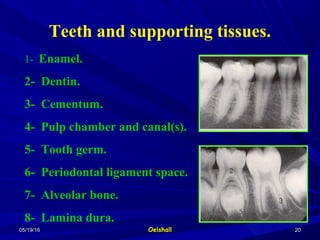
1-  Enamel.
2- Dentin.
3- Cementum.
4- Pulp chamber and canal(s).
5- Tooth germ.
6- Periodontal ligament space.
7- Alveolar bone.
8- Lamina dura.
Teeth and supporting tissues.
05/19/1605/19/16 OelshallOelshall 2121
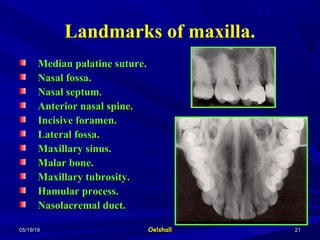
Landmarks of maxilla.
Median palatine suture.Median palatine suture.
Nasal fossa.Nasal fossa.
Nasal septum.Nasal septum.
Anterior nasal spine.Anterior nasal spine.
Incisive foramen.Incisive foramen.
Lateral fossa.Lateral fossa.
Maxillary sinus.Maxillary sinus.
Malar bone.Malar bone.
Maxillary tubrosity.Maxillary tubrosity.
Hamular process.Hamular process.
Nasolacremal duct.Nasolacremal duct.
05/19/1605/19/16 OelshallOelshall 2222
Landmarks of Mandible.Landmarks of Mandible.
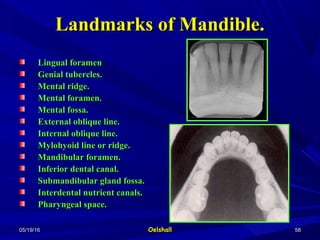
Lingual foramenLingual foramen
Genial tubercles.Genial tubercles.
Mental ridge.Mental ridge.
Mental foramen.Mental foramen.
Mental fossa.Mental fossa.
External oblique line.External oblique line.
Internal oblique line.Internal oblique line.
Mylohyoid line or ridge.Mylohyoid line or ridge.
Mandibular foramen.Mandibular foramen.
Inferior dental canal.Inferior dental canal.
Submandibular gland fossa.Submandibular gland fossa.
Interdental nutrient canals.Interdental nutrient canals.
Pharyngeal space.Pharyngeal space.
05/19/1605/19/16 OelshallOelshall 2323
Landmarks of maxilla.
Median palatine suture.Median palatine suture.
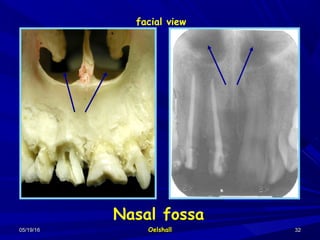
Nasal fossa.Nasal fossa.
Nasal septum.Nasal septum.
Anterior nasal spine.Anterior nasal spine.
Incisive foramen.Incisive foramen.
Lateral fossa.Lateral fossa.
Maxillary sinus.Maxillary sinus.
Malar bone.Malar bone.
Maxillary tubrosity.Maxillary tubrosity.
Hamular process.Hamular process.
Nasolacremal duct.Nasolacremal duct.
05/19/1605/19/16 OelshallOelshall 2424
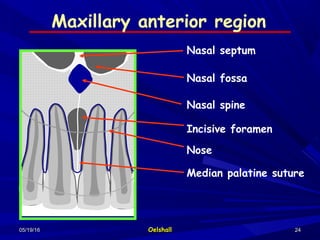
Maxillary anterior region
Nasal septum
Nasal fossa
Nasal spine
Incisive foramen
Nose
Median palatine suture
05/19/1605/19/16 OelshallOelshall 2525
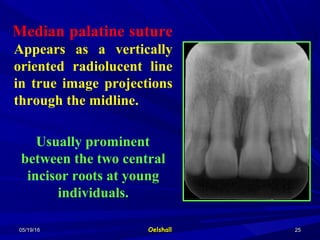
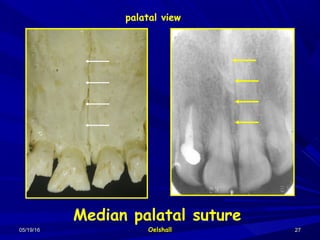
Median palatine suture
Appears as a vertically
oriented radiolucent line
in true image projections
through the midline.
Usually prominent
between the two central
incisor roots at young
individuals.
05/19/1605/19/16 OelshallOelshall 2626
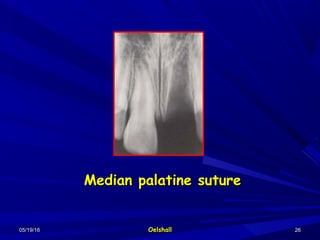
Median palatine sutureMedian palatine suture
05/19/1605/19/16 OelshallOelshall 2727
Median palatal suture
palatal view
05/19/1605/19/16 OelshallOelshall 2828
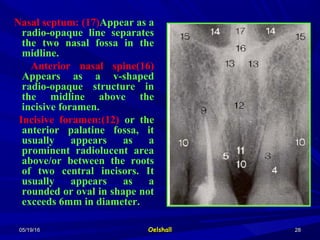
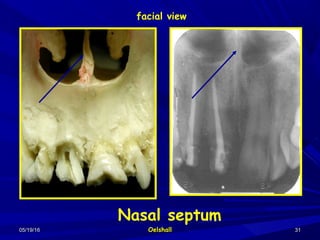
Nasal septum: (17)Appear as a
radio-opaque line separates
the two nasal fossa in the
midline.
Anterior nasal spine(16)
Appears as a v-shaped
radio-opaque structure in
the midline above the
incisive foramen.
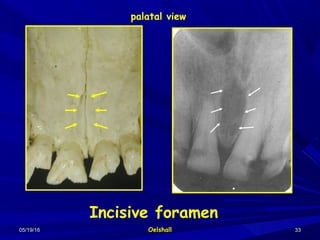
Incisive foramen:(12) or the
anterior palatine fossa, it
usually appears as a
prominent radiolucent area
above/or between the roots
of two central incisors. It
usually appears as a
rounded or oval in shape not
exceeds 6mm in diameter.
05/19/1605/19/16 OelshallOelshall 2929
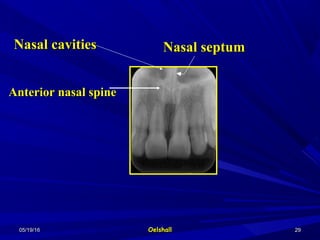
Anterior nasal spineAnterior nasal spine
Nasal cavitiesNasal cavities Nasal septumNasal septum
05/19/1605/19/16 OelshallOelshall 3030
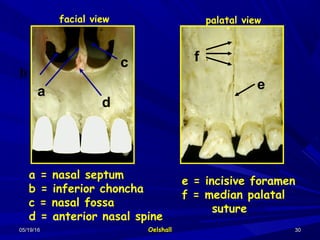
e
f
a = nasal septum
b = inferior choncha
c = nasal fossa
d = anterior nasal spine
e = incisive foramen
f = median palatal
suture
a
d
c
facial view palatal view
b
05/19/1605/19/16 OelshallOelshall 3131
Nasal septum
facial view
05/19/1605/19/16 OelshallOelshall 3232
Nasal fossa
facial view
05/19/1605/19/16 OelshallOelshall 3333
Incisive foramen
palatal view
05/19/1605/19/16 OelshallOelshall 3434
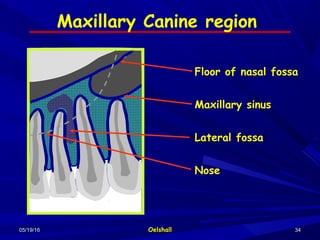
Maxillary Canine region
Floor of nasal fossa
Maxillary sinus
Lateral fossa
Nose
05/19/1605/19/16 OelshallOelshall 3535
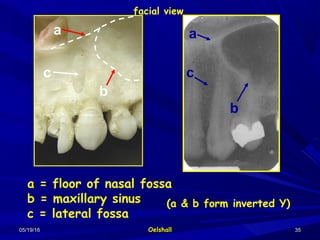
a = floor of nasal fossa
b = maxillary sinus
c = lateral fossa
(a & b form inverted Y)
a
c
b
a
c
b
facial view
05/19/1605/19/16 OelshallOelshall 3636
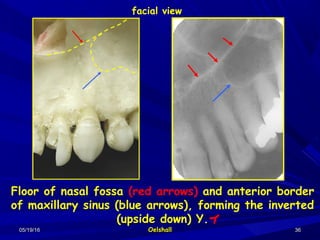
Floor of nasal fossa (red arrows) and anterior border
of maxillary sinus (blue arrows), forming the inverted
(upside down) Y.Y
facial view
05/19/1605/19/16 OelshallOelshall 3737
The maxillary sinus
surrounds the root of the
canine, which may be
misinterpreted as
pathology.
The white arrows indicate
the floor of the nasal fossa.
The maxillary sinus (red
arrows) has pneumatized
between the 2nd
premolar and
first molar
05/19/1605/19/16 OelshallOelshall 3838
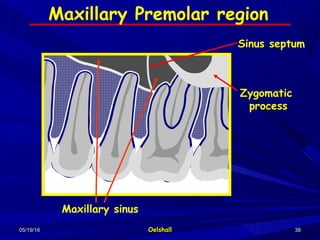
Zygomatic
process
Sinus septum
Maxillary sinus
Maxillary Premolar region
05/19/1605/19/16 OelshallOelshall 3939
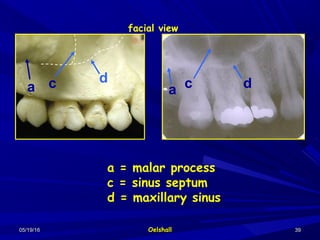
a = malar process
c = sinus septum
d = maxillary sinus
a c d dca
facial view
05/19/1605/19/16 OelshallOelshall 4040
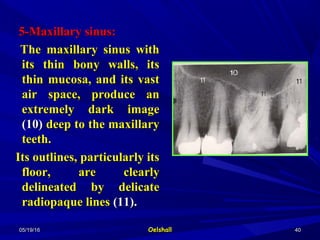
5-Maxillary sinus:5-Maxillary sinus:
The maxillary sinus withThe maxillary sinus with
its thin bony walls, itsits thin bony walls, its
thin mucosa, and its vastthin mucosa, and its vast
air space, produce anair space, produce an
extremely dark imageextremely dark image
(10)(10) deep to the maxillarydeep to the maxillary
teeth.teeth.
Its outlines, particularly itsIts outlines, particularly its
floor, are clearlyfloor, are clearly
delineated by delicatedelineated by delicate
radiopaque linesradiopaque lines (11).(11).
05/19/1605/19/16 OelshallOelshall 4141
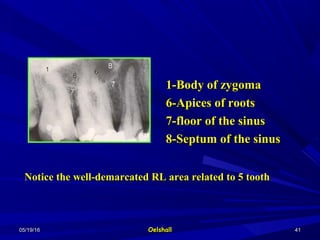
1-Body of zygoma1-Body of zygoma
6-Apices of roots6-Apices of roots
7-floor of the sinus7-floor of the sinus
8-Septum of the sinus8-Septum of the sinus
Notice the well-demarcated RL area related to 5 toothNotice the well-demarcated RL area related to 5 tooth
05/19/1605/19/16 OelshallOelshall 4242
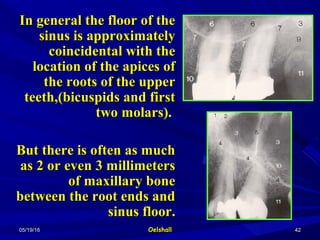
In general the floor of theIn general the floor of the
sinus is approximatelysinus is approximately
coincidental with thecoincidental with the
location of the apices oflocation of the apices of
the roots of the upperthe roots of the upper
teeth,(bicuspids and firstteeth,(bicuspids and first
two molars).two molars).
But there is often as muchBut there is often as much
as 2 or even 3 millimetersas 2 or even 3 millimeters
of maxillary boneof maxillary bone
between the root ends andbetween the root ends and
sinus floor.sinus floor.
05/19/1605/19/16 OelshallOelshall 4343
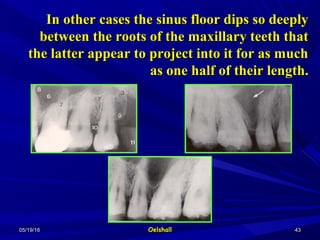
In other cases the sinus floor dips so deeplyIn other cases the sinus floor dips so deeply
between the roots of the maxillary teeth thatbetween the roots of the maxillary teeth that
the latter appear to project into it for as muchthe latter appear to project into it for as much
as one half of their length.as one half of their length.
05/19/1605/19/16 OelshallOelshall 4444
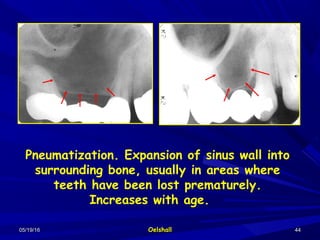
Pneumatization. Expansion of sinus wall into
surrounding bone, usually in areas where
teeth have been lost prematurely.
Increases with age.
05/19/1605/19/16 OelshallOelshall 4545
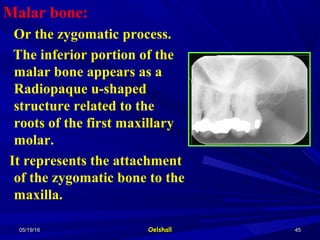
Malar bone:
Or the zygomatic process.
The inferior portion of the
malar bone appears as a
Radiopaque u-shaped
structure related to the
roots of the first maxillary
molar.
It represents the attachment
of the zygomatic bone to the
maxilla.
05/19/1605/19/16 OelshallOelshall 4646
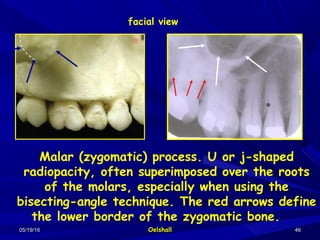
Malar (zygomatic) process. U or j-shaped
radiopacity, often superimposed over the roots
of the molars, especially when using the
bisecting-angle technique. The red arrows define
the lower border of the zygomatic bone.
facial view
05/19/1605/19/16 OelshallOelshall 4747
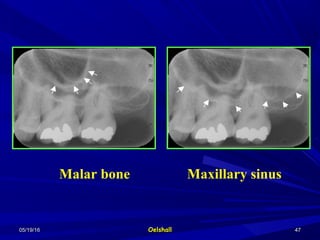
Malar bone Maxillary sinus
05/19/1605/19/16 OelshallOelshall 4848
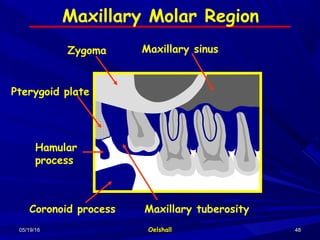
Maxillary Molar Region
Maxillary sinusZygoma
Pterygoid plate
Hamular
process
Coronoid process Maxillary tuberosity
05/19/1605/19/16 OelshallOelshall 4949
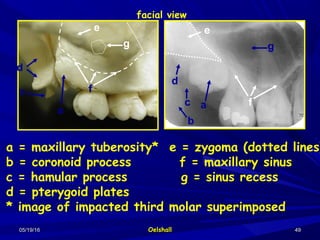
g
d
a
e
f
a = maxillary tuberosity* e = zygoma (dotted lines)
b = coronoid process f = maxillary sinus
c = hamular process g = sinus recess
d = pterygoid plates
* image of impacted third molar superimposed
c
facial view
d
b
a
e
c f
g
05/19/1605/19/16 OelshallOelshall 5050
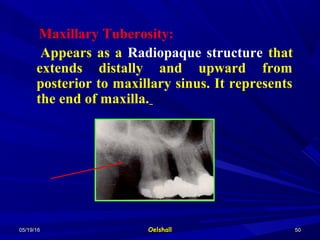
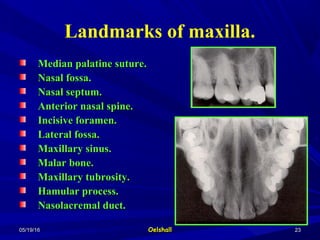
Maxillary Tuberosity:
Appears as a Radiopaque structure that
extends distally and upward from
posterior to maxillary sinus. It represents
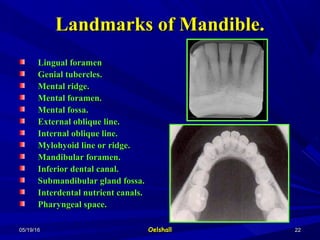
the end of maxilla.
05/19/1605/19/16 OelshallOelshall 5151
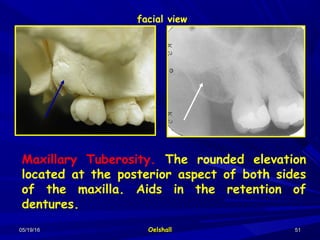
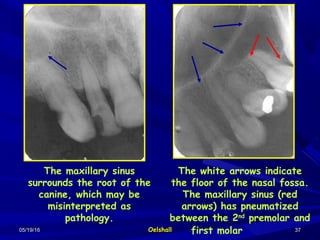
Maxillary Tuberosity. The rounded elevation
located at the posterior aspect of both sides
of the maxilla. Aids in the retention of
dentures.
facial view
05/19/1605/19/16 OelshallOelshall 5252
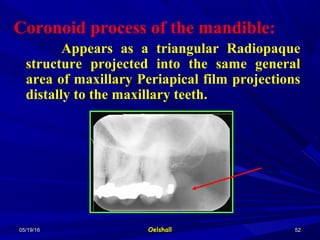
Coronoid process of the mandible:
Appears as a triangular Radiopaque
structure projected into the same general
area of maxillary Periapical film projections
distally to the maxillary teeth.
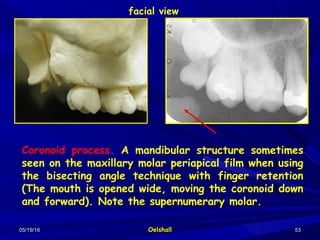
05/19/1605/19/16 OelshallOelshall 5353
Coronoid process. A mandibular structure sometimes
seen on the maxillary molar periapical film when using
the bisecting angle technique with finger retention
(The mouth is opened wide, moving the coronoid down
and forward). Note the supernumerary molar.
facial view
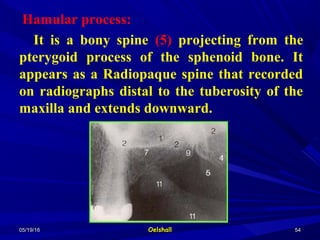
05/19/1605/19/16 OelshallOelshall 5454
Hamular process:
It is a bony spine (5) projecting from the
pterygoid process of the sphenoid bone. It
appears as a Radiopaque spine that recorded
on radiographs distal to the tuberosity of the
maxilla and extends downward.
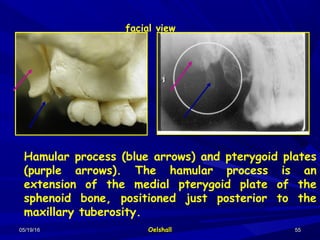
05/19/1605/19/16 OelshallOelshall 5555
Hamular process (blue arrows) and pterygoid plates
(purple arrows). The hamular process is an
extension of the medial pterygoid plate of the
sphenoid bone, positioned just posterior to the
maxillary tuberosity.
facial view
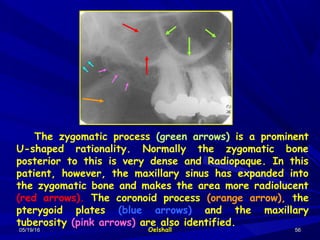
05/19/1605/19/16 OelshallOelshall 5656
The zygomatic process (green arrows) is a prominent
U-shaped rationality. Normally the zygomatic bone
posterior to this is very dense and Radiopaque. In this
patient, however, the maxillary sinus has expanded into
the zygomatic bone and makes the area more radiolucent
(red arrows). The coronoid process (orange arrow), the
pterygoid plates (blue arrows) and the maxillary
tuberosity (pink arrows) are also identified.
05/19/1605/19/16 OelshallOelshall 5757
Landmarks of Mandible.Landmarks of Mandible.
05/19/1605/19/16 OelshallOelshall 5858
Landmarks of Mandible.Landmarks of Mandible.
Lingual foramenLingual foramen
Genial tubercles.Genial tubercles.
Mental ridge.Mental ridge.
Mental foramen.Mental foramen.
Mental fossa.Mental fossa.
External oblique line.External oblique line.
Internal oblique line.Internal oblique line.
Mylohyoid line or ridge.Mylohyoid line or ridge.
Mandibular foramen.Mandibular foramen.
Inferior dental canal.Inferior dental canal.
Submandibular gland fossa.Submandibular gland fossa.
Interdental nutrient canals.Interdental nutrient canals.
Pharyngeal space.Pharyngeal space.
05/19/1605/19/16 OelshallOelshall 5959
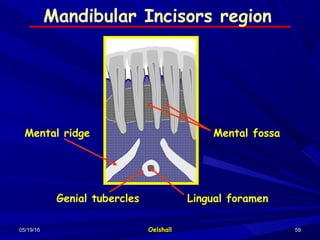
Mandibular Incisors region
Mental ridge
Genial tubercles Lingual foramen
Mental fossa
05/19/1605/19/16 OelshallOelshall 6060
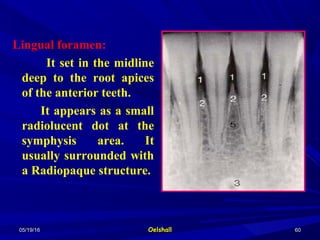
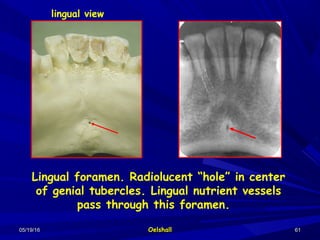
Lingual foramen:
It set in the midline
deep to the root apices
of the anterior teeth.
It appears as a small
radiolucent dot at the
symphysis area. It
usually surrounded with
a Radiopaque structure.
05/19/1605/19/16 OelshallOelshall 6161
Lingual foramen. Radiolucent “hole” in center
of genial tubercles. Lingual nutrient vessels
pass through this foramen.
lingual view
05/19/1605/19/16 OelshallOelshall 6262
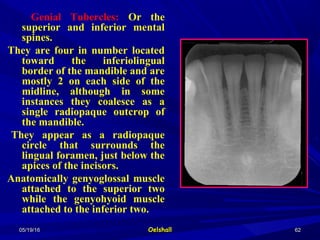
Genial Tubercles: Or the
superior and inferior mental
spines.
They are four in number located
toward the inferiolingual
border of the mandible and are
mostly 2 on each side of the
midline, although in some
instances they coalesce as a
single radiopaque outcrop of
the mandible.
They appear as a radiopaque
circle that surrounds the
lingual foramen, just below the
apices of the incisors.
Anatomically genyoglossal muscle
attached to the superior two
while the genyohyoid muscle
attached to the inferior two.
05/19/1605/19/16 OelshallOelshall 6363
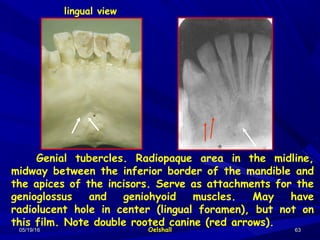
Genial tubercles. Radiopaque area in the midline,
midway between the inferior border of the mandible and
the apices of the incisors. Serve as attachments for the
genioglossus and geniohyoid muscles. May have
radiolucent hole in center (lingual foramen), but not on
this film. Note double rooted canine (red arrows).
lingual view
05/19/1605/19/16 OelshallOelshall 6464
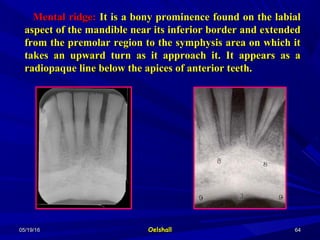
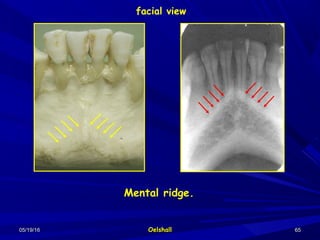
Mental ridge:Mental ridge: It is a bony prominence found on the labialIt is a bony prominence found on the labial
aspect of the mandible near its inferior border and extendedaspect of the mandible near its inferior border and extended
from the premolar region to the symphysis area on which itfrom the premolar region to the symphysis area on which it
takes an upward turn as it approach it. It appears as atakes an upward turn as it approach it. It appears as a
radiopaque line below the apices of anterior teeth.radiopaque line below the apices of anterior teeth.
05/19/1605/19/16 OelshallOelshall 6565
Mental ridge.
facial view
05/19/1605/19/16 OelshallOelshall 6666
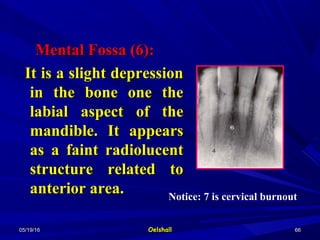
Mental Fossa (6):Mental Fossa (6):
It is a slight depressionIt is a slight depression
in the bone one thein the bone one the
labial aspect of thelabial aspect of the
mandible. It appearsmandible. It appears
as a faint radiolucentas a faint radiolucent
structure related tostructure related to
anterior area.anterior area. Notice: 7 is cervical burnout
05/19/1605/19/16 OelshallOelshall 6767
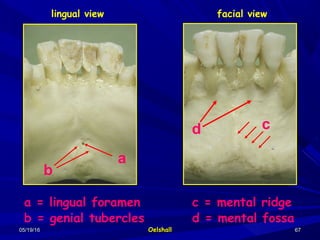
b = genial tubercles
a = lingual foramen c = mental ridge
d = mental fossa
a
b
cd
facial viewlingual view
05/19/1605/19/16 OelshallOelshall 6868
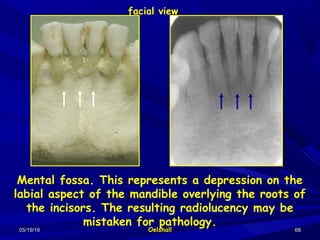
Mental fossa. This represents a depression on the
labial aspect of the mandible overlying the roots of
the incisors. The resulting radiolucency may be
mistaken for pathology.
facial view
05/19/1605/19/16 OelshallOelshall 6969
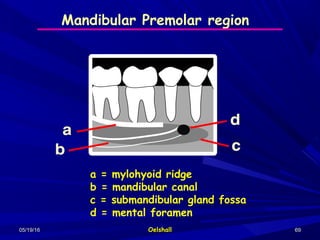
Mandibular Premolar region
a = mylohyoid ridge
b = mandibular canal
c = submandibular gland fossa
d = mental foramen
05/19/1605/19/16 OelshallOelshall 7070
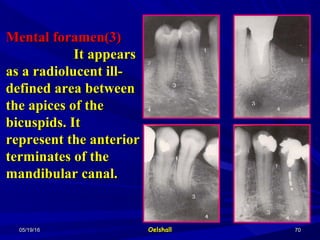
Mental foramen(3)Mental foramen(3)
It appearsIt appears
as a radiolucent ill-as a radiolucent ill-
defined area betweendefined area between
the apices of thethe apices of the
bicuspids. Itbicuspids. It
represent the anteriorrepresent the anterior
terminates of theterminates of the
mandibular canal.mandibular canal.
05/19/1605/19/16 OelshallOelshall 7171
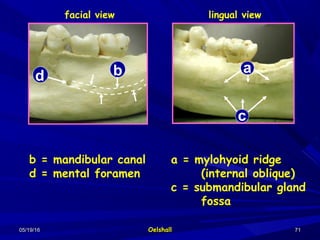
c
b = mandibular canal
d = mental foramen
a = mylohyoid ridge
(internal oblique)
c = submandibular gland
fossa
facial view lingual view
c
a
dd b
05/19/1605/19/16 OelshallOelshall 7272
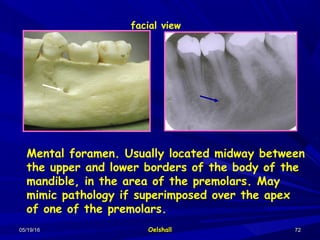
Mental foramen. Usually located midway between
the upper and lower borders of the body of the
mandible, in the area of the premolars. May
mimic pathology if superimposed over the apex
of one of the premolars.
facial view
05/19/1605/19/16 OelshallOelshall 7373
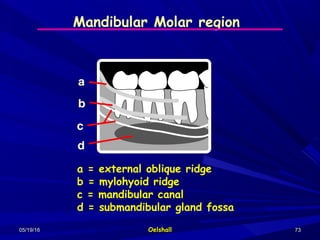
Mandibular Molar region
a = external oblique ridge
b = mylohyoid ridge
c = mandibular canal
d = submandibular gland fossa
05/19/1605/19/16 OelshallOelshall 7474
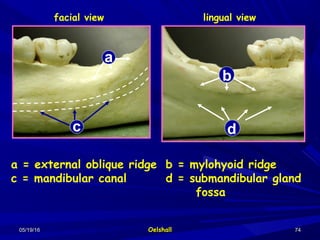
facial view lingual view
b
c
a
b
a = external oblique ridge
c = mandibular canal
b = mylohyoid ridge
d = submandibular gland
fossa
dd
05/19/1605/19/16 OelshallOelshall 7575
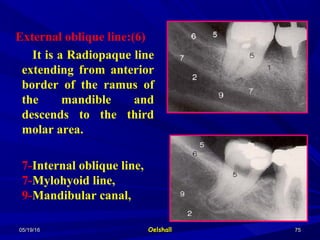
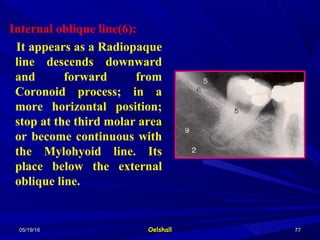
External oblique line:(6)
It is a Radiopaque line
extending from anterior
border of the ramus of
the mandible and
descends to the third
molar area.
7-Internal oblique line,
7-Mylohyoid line,
9-Mandibular canal,
05/19/1605/19/16 OelshallOelshall 7676
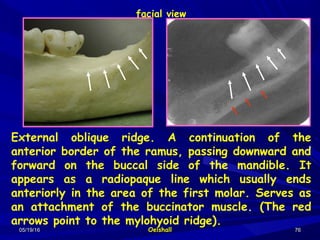
External oblique ridge. A continuation of the
anterior border of the ramus, passing downward and
forward on the buccal side of the mandible. It
appears as a radiopaque line which usually ends
anteriorly in the area of the first molar. Serves as
an attachment of the buccinator muscle. (The red
arrows point to the mylohyoid ridge).
facial view
05/19/1605/19/16 OelshallOelshall 7777
Internal oblique line(6):
It appears as a Radiopaque
line descends downward
and forward from
Coronoid process; in a
more horizontal position;
stop at the third molar area
or become continuous with
the Mylohyoid line. Its
place below the external
oblique line.
05/19/1605/19/16 OelshallOelshall 7878
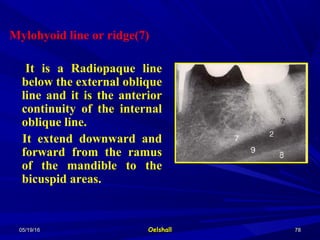
Mylohyoid line or ridge(7)
It is a Radiopaque line
below the external oblique
line and it is the anterior
continuity of the internal
oblique line.
It extend downward and
forward from the ramus
of the mandible to the
bicuspid areas.
05/19/1605/19/16 OelshallOelshall 7979
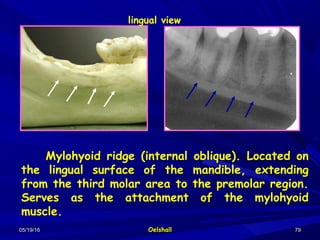
Mylohyoid ridge (internal oblique). Located on
the lingual surface of the mandible, extending
from the third molar area to the premolar region.
Serves as the attachment of the mylohyoid
muscle.
lingual view
05/19/1605/19/16 OelshallOelshall 8080
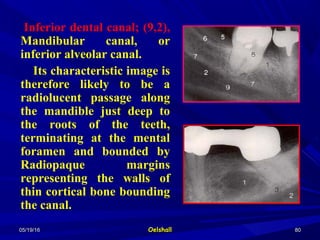
Inferior dental canal; (9,2),
Mandibular canal, or
inferior alveolar canal.
Its characteristic image is
therefore likely to be a
radiolucent passage along
the mandible just deep to
the roots of the teeth,
terminating at the mental
foramen and bounded by
Radiopaque margins
representing the walls of
thin cortical bone bounding
the canal.
05/19/1605/19/16 OelshallOelshall 8181
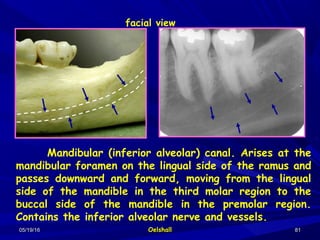
facial view
Mandibular (inferior alveolar) canal. Arises at the
mandibular foramen on the lingual side of the ramus and
passes downward and forward, moving from the lingual
side of the mandible in the third molar region to the
buccal side of the mandible in the premolar region.
Contains the inferior alveolar nerve and vessels.
05/19/1605/19/16 OelshallOelshall 8282
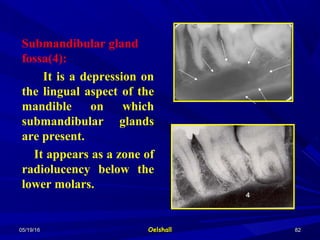
Submandibular gland
fossa(4):
It is a depression on
the lingual aspect of the
mandible on which
submandibular glands
are present.
It appears as a zone of
radiolucency below the
lower molars.
05/19/1605/19/16 OelshallOelshall 8383
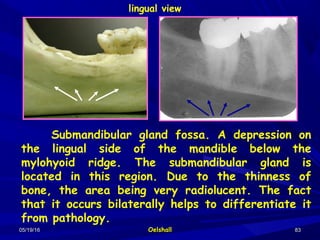
lingual view
Submandibular gland fossa. A depression on
the lingual side of the mandible below the
mylohyoid ridge. The submandibular gland is
located in this region. Due to the thinness of
bone, the area being very radiolucent. The fact
that it occurs bilaterally helps to differentiate it
from pathology.
05/19/1605/19/16 OelshallOelshall 8484
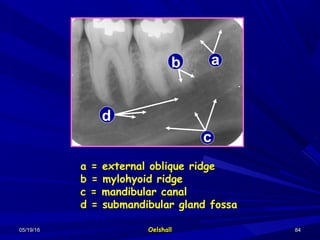
ab
c
dd
a = external oblique ridge
b = mylohyoid ridge
c = mandibular canal
d = submandibular gland fossa
05/19/1605/19/16 OelshallOelshall 8585
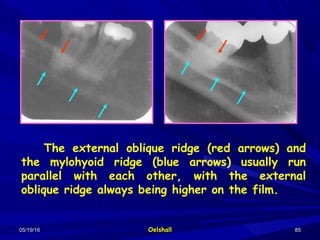
The external oblique ridge (red arrows) and
the mylohyoid ridge (blue arrows) usually run
parallel with each other, with the external
oblique ridge always being higher on the film.
05/19/1605/19/16 OelshallOelshall 8686
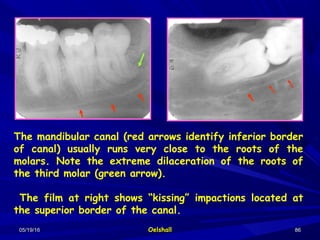
The mandibular canal (red arrows identify inferior border
of canal) usually runs very close to the roots of the
molars. Note the extreme dilaceration of the roots of
the third molar (green arrow).
The film at right shows “kissing” impactions located at
the superior border of the canal.
05/19/1605/19/16 OelshallOelshall 8787
Normal anatomical landmarksNormal anatomical landmarks
as seen in occlusal filmsas seen in occlusal films
05/19/1605/19/16 OelshallOelshall 8888
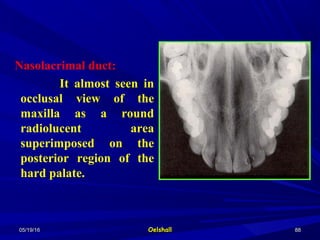
Nasolacrimal duct:
It almost seen in
occlusal view of the
maxilla as a round
radiolucent area
superimposed on the
posterior region of the
hard palate.
05/19/1605/19/16 OelshallOelshall 8989
Normal anatomical landmarksNormal anatomical landmarks
as seen in panoramic viewsas seen in panoramic views
05/19/1605/19/16 OelshallOelshall 9090
Misinterpretation of normalMisinterpretation of normal
radiographic anatomicalradiographic anatomical
landmarks with pathologicallandmarks with pathological
lesionslesions
05/19/1605/19/16 OelshallOelshall 9191
Median palatine sutureMedian palatine suture
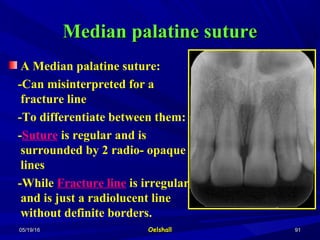
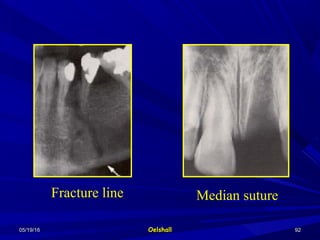
A Median palatine suture:
-Can misinterpreted for a
fracture line
-To differentiate between them:
-Suture is regular and is
surrounded by 2 radio- opaque
lines
-While Fracture line is irregular
and is just a radiolucent line
without definite borders.
05/19/1605/19/16 OelshallOelshall 9292
Fracture line Median suture
05/19/1605/19/16 OelshallOelshall 9393
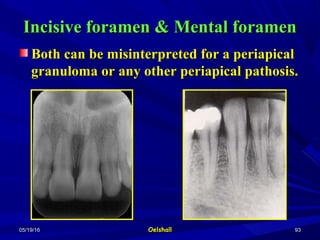
Incisive foramen & Mental foramenIncisive foramen & Mental foramen
Both can be misinterpreted for a periapicalBoth can be misinterpreted for a periapical
granuloma or any other periapical pathosis.granuloma or any other periapical pathosis.
05/19/1605/19/16 OelshallOelshall 9494
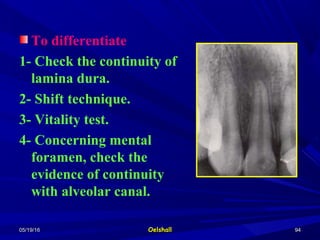
To differentiate
1- Check the continuity of
lamina dura.
2- Shift technique.
3- Vitality test.
4- Concerning mental
foramen, check the
evidence of continuity
with alveolar canal.
05/19/1605/19/16 OelshallOelshall 9595
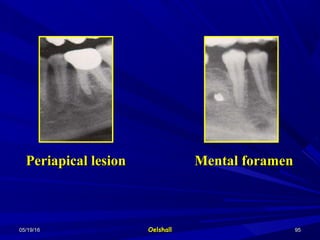
Periapical lesionPeriapical lesion Mental foramenMental foramen
05/19/1605/19/16 OelshallOelshall 9696
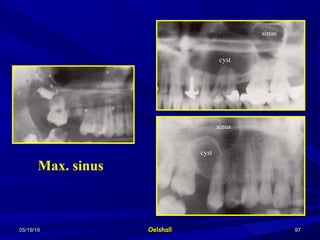
Maxillary sinusMaxillary sinus
Can be misinterpreted for a cystCan be misinterpreted for a cyst
To differentiate:To differentiate:
Check the normal radiographic appearanceCheck the normal radiographic appearance
of the sinus with its septae.of the sinus with its septae.
Take a radiograph of the other sinus toTake a radiograph of the other sinus to
compare.compare.
The radiolucency of the sinus (air filled) isThe radiolucency of the sinus (air filled) is
more than that of cyst (fluid filled)more than that of cyst (fluid filled)
Vitality test.Vitality test.
05/19/1605/19/16 OelshallOelshall 9797
Max. sinus
cyst
cyst
sinus
sinus
05/19/1605/19/16 OelshallOelshall 9898
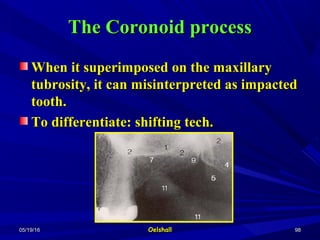
The Coronoid processThe Coronoid process
When it superimposed on the maxillaryWhen it superimposed on the maxillary
tubrosity, it can misinterpreted as impactedtubrosity, it can misinterpreted as impacted
tooth.tooth.
To differentiate: shifting tech.To differentiate: shifting tech.
05/19/1605/19/16 OelshallOelshall 9999
Which is a depression on the labial aspectWhich is a depression on the labial aspect
of the mandible above the mentalof the mandible above the mental
protuberance.protuberance.
It can misinterpreted for a PeriapicalIt can misinterpreted for a Periapical
lesion affecting lower incisors.lesion affecting lower incisors.
It can differentiate by shifting tech. orIt can differentiate by shifting tech. or
vitality test.vitality test.
The mental fossaThe mental fossa

3 radio. anatomy.&interpert i

  • 1.
    05/19/1605/19/16 OelshallOelshall 11 DentalRadiographicDental Radiographic anatomy & interpretation Part I Dr. Ossama EL-Shall Professor & Chairman, Faculty of DentalProfessor & Chairman, Faculty of Dental Medicine for girls, Al-Azhar University,Medicine for girls, Al-Azhar University, Cairo Egypt.Cairo Egypt. E.mail address: oelshall@hotmail.comE.mail address: oelshall@hotmail.com
  • 2.
  • 3.
    05/19/1605/19/16 OelshallOelshall 33 Dentalradiographic interpretationDental radiographic interpretation Radiographic interpretation, is a reading of a radiograph and commenting on it to draw a diagnosis Reading a radiograph includes recording any deviation from the normal appearance.
  • 4.
    05/19/1605/19/16 OelshallOelshall 44 Rulesof radiographic interpretationRules of radiographic interpretation 1-1- The area to be examined must be completelyThe area to be examined must be completely shown at optimal angulationsshown at optimal angulations 2-2- All the boundaries of the area of interest must beAll the boundaries of the area of interest must be shown with normal structures around it.shown with normal structures around it. 3-3- Knowing and familiarity with all normalKnowing and familiarity with all normal anatomical landmarks as well as all variousanatomical landmarks as well as all various pathological conditions that may affect the area ofpathological conditions that may affect the area of interest.interest.
  • 5.
    05/19/1605/19/16 OelshallOelshall 55 Principlesof radiographicPrinciples of radiographic interpretationinterpretation Interpretation of a radiograph is not aInterpretation of a radiograph is not a diagnosis by itself, but it is an diagnostic aiddiagnosis by itself, but it is an diagnostic aid or mean help to reach a final diagnosis.or mean help to reach a final diagnosis. Final diagnosis can be reached byFinal diagnosis can be reached by performing a full case history, clinicalperforming a full case history, clinical examination, special investigations andexamination, special investigations and differential diagnosis.differential diagnosis.
  • 6.
    05/19/1605/19/16 OelshallOelshall 66 Methodsof interpretationMethods of interpretation LLocalization.ocalization. OObservation.bservation. GGeneral consideration.eneral consideration. IInterpretation.nterpretation. CCorrelation.orrelation.
  • 7.
    05/19/1605/19/16 OelshallOelshall 77 LocalizationLocalization Itis the identification and recognitionIt is the identification and recognition of the area which the view shows, forof the area which the view shows, for example: Upper anterior area, TMJexample: Upper anterior area, TMJ area, Lower molar area………………..area, Lower molar area………………..
  • 8.
    05/19/1605/19/16 OelshallOelshall 88 ObservationObservation Allshadows, other than the localizedAll shadows, other than the localized shadows of the normal landmarks must beshadows of the normal landmarks must be observed.observed. For example: shadows in crowns, cervicalFor example: shadows in crowns, cervical area, roots, restorations, size of rootarea, roots, restorations, size of root canals, periodontal membrane space,canals, periodontal membrane space, periapical area, alveolar crest, foreignperiapical area, alveolar crest, foreign bodies, integrity of bone …………bodies, integrity of bone …………
  • 9.
    05/19/1605/19/16 OelshallOelshall 99 GeneralconsiderationGeneral consideration A radiograph shows only 2 dimensions of a 3A radiograph shows only 2 dimensions of a 3 dimensional object (width and height but notdimensional object (width and height but not the depth)the depth) Cervical burnout: usually appears as cervicalCervical burnout: usually appears as cervical RL and misinterpreted by caries; this occursRL and misinterpreted by caries; this occurs due to less density and more penetration ofdue to less density and more penetration of rays.rays. Pulp exposure never to be determined fromPulp exposure never to be determined from radiograph but only the proximity to the pulp.radiograph but only the proximity to the pulp.
  • 10.
    05/19/1605/19/16 OelshallOelshall 1010 InterpretationInterpretation Studyingthe features ofStudying the features of teethteeth andand bonebone TeethTeeth Study the whole tooth, (crown, rootStudy the whole tooth, (crown, root enamel, pulp….), number of teeth andenamel, pulp….), number of teeth and finally supporting structures,finally supporting structures, (Periodontal membrane space, lamina(Periodontal membrane space, lamina dura, alveolar crest)dura, alveolar crest)
  • 11.
    05/19/1605/19/16 OelshallOelshall 1111 BoneBone Changesin bone may include:Changes in bone may include: 1- Changes in density.1- Changes in density. 2- Changes in the margin2- Changes in the margin 3- Changes inside the lesion.3- Changes inside the lesion. 4- Effect on surrounding tissues.4- Effect on surrounding tissues. 5- Changes in structure5- Changes in structure
  • 12.
    05/19/1605/19/16 OelshallOelshall 1212 1-Changes in density.1- Changes in density. Three bone density pattern may found:Three bone density pattern may found: 1-decrease in density resulting in RL1-decrease in density resulting in RL 2-Increase in density resulting in RO2-Increase in density resulting in RO 3- Combination of above.3- Combination of above.
  • 13.
    05/19/1605/19/16 OelshallOelshall 1313 2-Changesin the lesion margin2-Changes in the lesion margin 1- Well-defined margin with or without1- Well-defined margin with or without sclerotic border denoting a slowlysclerotic border denoting a slowly growing or chronic condition such asgrowing or chronic condition such as cyst and granuloma.cyst and granuloma. 2- ill-defined margin, denoting acute2- ill-defined margin, denoting acute active condition destroying bone in allactive condition destroying bone in all directions, such as abscess, ordirections, such as abscess, or malignancy.malignancy.
  • 14.
    05/19/1605/19/16 OelshallOelshall 1414 3-Changes inside the lesion.3- Changes inside the lesion. 1- Unilocular.1- Unilocular. 2-Multilocular.2-Multilocular. 3-Multiple and separate.3-Multiple and separate.
  • 15.
  • 16.
    05/19/1605/19/16 OelshallOelshall 1616 4-Effectson surrounding tissues.4-Effects on surrounding tissues. 1-May cause expansion, resorption,1-May cause expansion, resorption, destruction or thinning of bone.destruction or thinning of bone. 2-Compressed adjacent tissues as max.2-Compressed adjacent tissues as max. sinus or nasal cavitysinus or nasal cavity 3-Displacement of teeth, divergence or3-Displacement of teeth, divergence or resorption.resorption. 4-Affection of lamina dura.4-Affection of lamina dura.
  • 17.
    05/19/1605/19/16 OelshallOelshall 1717 5-Changes in structure5- Changes in structure 1-Ground glass appearance; fine granules1-Ground glass appearance; fine granules of bony trabeculation.of bony trabeculation. 2-Cotton wool appearance; irregular ill-2-Cotton wool appearance; irregular ill- defined RO areas within area of moredefined RO areas within area of more RLRL 3-Honeycomb; multilocular lesion with3-Honeycomb; multilocular lesion with small compartments.small compartments. 4-Granular appearance: homogenous due4-Granular appearance: homogenous due to loss of contrast between RL & ROto loss of contrast between RL & RO
  • 18.
    05/19/1605/19/16 OelshallOelshall 1818 CorrelationCorrelation Thefinal step is to correlate all ofThe final step is to correlate all of the radiographic features to reach athe radiographic features to reach a radiographic differential diagnosis.radiographic differential diagnosis. Then to draw a final diagnosis, weThen to draw a final diagnosis, we have to correlate other data as casehave to correlate other data as case history, clinical examination, andhistory, clinical examination, and other diagnostic aids with theother diagnostic aids with the radiographic differential diagnosis.radiographic differential diagnosis.
  • 19.
    05/19/1605/19/16 OelshallOelshall 1919 Teethand supporting tissues Landmarks of maxilla Landmarks of Mandible Normal anatomical landmarksNormal anatomical landmarks
  • 20.
    05/19/1605/19/16 OelshallOelshall 2020 1-  Enamel. 2-Dentin. 3- Cementum. 4- Pulp chamber and canal(s). 5- Tooth germ. 6- Periodontal ligament space. 7- Alveolar bone. 8- Lamina dura. Teeth and supporting tissues.
  • 21.
    05/19/1605/19/16 OelshallOelshall 2121 Landmarksof maxilla. Median palatine suture.Median palatine suture. Nasal fossa.Nasal fossa. Nasal septum.Nasal septum. Anterior nasal spine.Anterior nasal spine. Incisive foramen.Incisive foramen. Lateral fossa.Lateral fossa. Maxillary sinus.Maxillary sinus. Malar bone.Malar bone. Maxillary tubrosity.Maxillary tubrosity. Hamular process.Hamular process. Nasolacremal duct.Nasolacremal duct.
  • 22.
    05/19/1605/19/16 OelshallOelshall 2222 Landmarksof Mandible.Landmarks of Mandible. Lingual foramenLingual foramen Genial tubercles.Genial tubercles. Mental ridge.Mental ridge. Mental foramen.Mental foramen. Mental fossa.Mental fossa. External oblique line.External oblique line. Internal oblique line.Internal oblique line. Mylohyoid line or ridge.Mylohyoid line or ridge. Mandibular foramen.Mandibular foramen. Inferior dental canal.Inferior dental canal. Submandibular gland fossa.Submandibular gland fossa. Interdental nutrient canals.Interdental nutrient canals. Pharyngeal space.Pharyngeal space.
  • 23.
    05/19/1605/19/16 OelshallOelshall 2323 Landmarksof maxilla. Median palatine suture.Median palatine suture. Nasal fossa.Nasal fossa. Nasal septum.Nasal septum. Anterior nasal spine.Anterior nasal spine. Incisive foramen.Incisive foramen. Lateral fossa.Lateral fossa. Maxillary sinus.Maxillary sinus. Malar bone.Malar bone. Maxillary tubrosity.Maxillary tubrosity. Hamular process.Hamular process. Nasolacremal duct.Nasolacremal duct.
  • 24.
    05/19/1605/19/16 OelshallOelshall 2424 Maxillaryanterior region Nasal septum Nasal fossa Nasal spine Incisive foramen Nose Median palatine suture
  • 25.
    05/19/1605/19/16 OelshallOelshall 2525 Medianpalatine suture Appears as a vertically oriented radiolucent line in true image projections through the midline. Usually prominent between the two central incisor roots at young individuals.
  • 26.
    05/19/1605/19/16 OelshallOelshall 2626 Medianpalatine sutureMedian palatine suture
  • 27.
  • 28.
    05/19/1605/19/16 OelshallOelshall 2828 Nasalseptum: (17)Appear as a radio-opaque line separates the two nasal fossa in the midline. Anterior nasal spine(16) Appears as a v-shaped radio-opaque structure in the midline above the incisive foramen. Incisive foramen:(12) or the anterior palatine fossa, it usually appears as a prominent radiolucent area above/or between the roots of two central incisors. It usually appears as a rounded or oval in shape not exceeds 6mm in diameter.
  • 29.
    05/19/1605/19/16 OelshallOelshall 2929 Anteriornasal spineAnterior nasal spine Nasal cavitiesNasal cavities Nasal septumNasal septum
  • 30.
    05/19/1605/19/16 OelshallOelshall 3030 e f a= nasal septum b = inferior choncha c = nasal fossa d = anterior nasal spine e = incisive foramen f = median palatal suture a d c facial view palatal view b
  • 31.
  • 32.
  • 33.
  • 34.
    05/19/1605/19/16 OelshallOelshall 3434 MaxillaryCanine region Floor of nasal fossa Maxillary sinus Lateral fossa Nose
  • 35.
    05/19/1605/19/16 OelshallOelshall 3535 a= floor of nasal fossa b = maxillary sinus c = lateral fossa (a & b form inverted Y) a c b a c b facial view
  • 36.
    05/19/1605/19/16 OelshallOelshall 3636 Floorof nasal fossa (red arrows) and anterior border of maxillary sinus (blue arrows), forming the inverted (upside down) Y.Y facial view
  • 37.
    05/19/1605/19/16 OelshallOelshall 3737 Themaxillary sinus surrounds the root of the canine, which may be misinterpreted as pathology. The white arrows indicate the floor of the nasal fossa. The maxillary sinus (red arrows) has pneumatized between the 2nd premolar and first molar
  • 38.
    05/19/1605/19/16 OelshallOelshall 3838 Zygomatic process Sinusseptum Maxillary sinus Maxillary Premolar region
  • 39.
    05/19/1605/19/16 OelshallOelshall 3939 a= malar process c = sinus septum d = maxillary sinus a c d dca facial view
  • 40.
    05/19/1605/19/16 OelshallOelshall 4040 5-Maxillarysinus:5-Maxillary sinus: The maxillary sinus withThe maxillary sinus with its thin bony walls, itsits thin bony walls, its thin mucosa, and its vastthin mucosa, and its vast air space, produce anair space, produce an extremely dark imageextremely dark image (10)(10) deep to the maxillarydeep to the maxillary teeth.teeth. Its outlines, particularly itsIts outlines, particularly its floor, are clearlyfloor, are clearly delineated by delicatedelineated by delicate radiopaque linesradiopaque lines (11).(11).
  • 41.
    05/19/1605/19/16 OelshallOelshall 4141 1-Bodyof zygoma1-Body of zygoma 6-Apices of roots6-Apices of roots 7-floor of the sinus7-floor of the sinus 8-Septum of the sinus8-Septum of the sinus Notice the well-demarcated RL area related to 5 toothNotice the well-demarcated RL area related to 5 tooth
  • 42.
    05/19/1605/19/16 OelshallOelshall 4242 Ingeneral the floor of theIn general the floor of the sinus is approximatelysinus is approximately coincidental with thecoincidental with the location of the apices oflocation of the apices of the roots of the upperthe roots of the upper teeth,(bicuspids and firstteeth,(bicuspids and first two molars).two molars). But there is often as muchBut there is often as much as 2 or even 3 millimetersas 2 or even 3 millimeters of maxillary boneof maxillary bone between the root ends andbetween the root ends and sinus floor.sinus floor.
  • 43.
    05/19/1605/19/16 OelshallOelshall 4343 Inother cases the sinus floor dips so deeplyIn other cases the sinus floor dips so deeply between the roots of the maxillary teeth thatbetween the roots of the maxillary teeth that the latter appear to project into it for as muchthe latter appear to project into it for as much as one half of their length.as one half of their length.
  • 44.
    05/19/1605/19/16 OelshallOelshall 4444 Pneumatization.Expansion of sinus wall into surrounding bone, usually in areas where teeth have been lost prematurely. Increases with age.
  • 45.
    05/19/1605/19/16 OelshallOelshall 4545 Malarbone: Or the zygomatic process. The inferior portion of the malar bone appears as a Radiopaque u-shaped structure related to the roots of the first maxillary molar. It represents the attachment of the zygomatic bone to the maxilla.
  • 46.
    05/19/1605/19/16 OelshallOelshall 4646 Malar(zygomatic) process. U or j-shaped radiopacity, often superimposed over the roots of the molars, especially when using the bisecting-angle technique. The red arrows define the lower border of the zygomatic bone. facial view
  • 47.
  • 48.
    05/19/1605/19/16 OelshallOelshall 4848 MaxillaryMolar Region Maxillary sinusZygoma Pterygoid plate Hamular process Coronoid process Maxillary tuberosity
  • 49.
    05/19/1605/19/16 OelshallOelshall 4949 g d a e f a= maxillary tuberosity* e = zygoma (dotted lines) b = coronoid process f = maxillary sinus c = hamular process g = sinus recess d = pterygoid plates * image of impacted third molar superimposed c facial view d b a e c f g
  • 50.
    05/19/1605/19/16 OelshallOelshall 5050 MaxillaryTuberosity: Appears as a Radiopaque structure that extends distally and upward from posterior to maxillary sinus. It represents the end of maxilla.
  • 51.
    05/19/1605/19/16 OelshallOelshall 5151 MaxillaryTuberosity. The rounded elevation located at the posterior aspect of both sides of the maxilla. Aids in the retention of dentures. facial view
  • 52.
    05/19/1605/19/16 OelshallOelshall 5252 Coronoidprocess of the mandible: Appears as a triangular Radiopaque structure projected into the same general area of maxillary Periapical film projections distally to the maxillary teeth.
  • 53.
    05/19/1605/19/16 OelshallOelshall 5353 Coronoidprocess. A mandibular structure sometimes seen on the maxillary molar periapical film when using the bisecting angle technique with finger retention (The mouth is opened wide, moving the coronoid down and forward). Note the supernumerary molar. facial view
  • 54.
    05/19/1605/19/16 OelshallOelshall 5454 Hamularprocess: It is a bony spine (5) projecting from the pterygoid process of the sphenoid bone. It appears as a Radiopaque spine that recorded on radiographs distal to the tuberosity of the maxilla and extends downward.
  • 55.
    05/19/1605/19/16 OelshallOelshall 5555 Hamularprocess (blue arrows) and pterygoid plates (purple arrows). The hamular process is an extension of the medial pterygoid plate of the sphenoid bone, positioned just posterior to the maxillary tuberosity. facial view
  • 56.
    05/19/1605/19/16 OelshallOelshall 5656 Thezygomatic process (green arrows) is a prominent U-shaped rationality. Normally the zygomatic bone posterior to this is very dense and Radiopaque. In this patient, however, the maxillary sinus has expanded into the zygomatic bone and makes the area more radiolucent (red arrows). The coronoid process (orange arrow), the pterygoid plates (blue arrows) and the maxillary tuberosity (pink arrows) are also identified.
  • 57.
    05/19/1605/19/16 OelshallOelshall 5757 Landmarksof Mandible.Landmarks of Mandible.
  • 58.
    05/19/1605/19/16 OelshallOelshall 5858 Landmarksof Mandible.Landmarks of Mandible. Lingual foramenLingual foramen Genial tubercles.Genial tubercles. Mental ridge.Mental ridge. Mental foramen.Mental foramen. Mental fossa.Mental fossa. External oblique line.External oblique line. Internal oblique line.Internal oblique line. Mylohyoid line or ridge.Mylohyoid line or ridge. Mandibular foramen.Mandibular foramen. Inferior dental canal.Inferior dental canal. Submandibular gland fossa.Submandibular gland fossa. Interdental nutrient canals.Interdental nutrient canals. Pharyngeal space.Pharyngeal space.
  • 59.
    05/19/1605/19/16 OelshallOelshall 5959 MandibularIncisors region Mental ridge Genial tubercles Lingual foramen Mental fossa
  • 60.
    05/19/1605/19/16 OelshallOelshall 6060 Lingualforamen: It set in the midline deep to the root apices of the anterior teeth. It appears as a small radiolucent dot at the symphysis area. It usually surrounded with a Radiopaque structure.
  • 61.
    05/19/1605/19/16 OelshallOelshall 6161 Lingualforamen. Radiolucent “hole” in center of genial tubercles. Lingual nutrient vessels pass through this foramen. lingual view
  • 62.
    05/19/1605/19/16 OelshallOelshall 6262 GenialTubercles: Or the superior and inferior mental spines. They are four in number located toward the inferiolingual border of the mandible and are mostly 2 on each side of the midline, although in some instances they coalesce as a single radiopaque outcrop of the mandible. They appear as a radiopaque circle that surrounds the lingual foramen, just below the apices of the incisors. Anatomically genyoglossal muscle attached to the superior two while the genyohyoid muscle attached to the inferior two.
  • 63.
    05/19/1605/19/16 OelshallOelshall 6363 Genialtubercles. Radiopaque area in the midline, midway between the inferior border of the mandible and the apices of the incisors. Serve as attachments for the genioglossus and geniohyoid muscles. May have radiolucent hole in center (lingual foramen), but not on this film. Note double rooted canine (red arrows). lingual view
  • 64.
    05/19/1605/19/16 OelshallOelshall 6464 Mentalridge:Mental ridge: It is a bony prominence found on the labialIt is a bony prominence found on the labial aspect of the mandible near its inferior border and extendedaspect of the mandible near its inferior border and extended from the premolar region to the symphysis area on which itfrom the premolar region to the symphysis area on which it takes an upward turn as it approach it. It appears as atakes an upward turn as it approach it. It appears as a radiopaque line below the apices of anterior teeth.radiopaque line below the apices of anterior teeth.
  • 65.
  • 66.
    05/19/1605/19/16 OelshallOelshall 6666 MentalFossa (6):Mental Fossa (6): It is a slight depressionIt is a slight depression in the bone one thein the bone one the labial aspect of thelabial aspect of the mandible. It appearsmandible. It appears as a faint radiolucentas a faint radiolucent structure related tostructure related to anterior area.anterior area. Notice: 7 is cervical burnout
  • 67.
    05/19/1605/19/16 OelshallOelshall 6767 b= genial tubercles a = lingual foramen c = mental ridge d = mental fossa a b cd facial viewlingual view
  • 68.
    05/19/1605/19/16 OelshallOelshall 6868 Mentalfossa. This represents a depression on the labial aspect of the mandible overlying the roots of the incisors. The resulting radiolucency may be mistaken for pathology. facial view
  • 69.
    05/19/1605/19/16 OelshallOelshall 6969 MandibularPremolar region a = mylohyoid ridge b = mandibular canal c = submandibular gland fossa d = mental foramen
  • 70.
    05/19/1605/19/16 OelshallOelshall 7070 Mentalforamen(3)Mental foramen(3) It appearsIt appears as a radiolucent ill-as a radiolucent ill- defined area betweendefined area between the apices of thethe apices of the bicuspids. Itbicuspids. It represent the anteriorrepresent the anterior terminates of theterminates of the mandibular canal.mandibular canal.
  • 71.
    05/19/1605/19/16 OelshallOelshall 7171 c b= mandibular canal d = mental foramen a = mylohyoid ridge (internal oblique) c = submandibular gland fossa facial view lingual view c a dd b
  • 72.
    05/19/1605/19/16 OelshallOelshall 7272 Mentalforamen. Usually located midway between the upper and lower borders of the body of the mandible, in the area of the premolars. May mimic pathology if superimposed over the apex of one of the premolars. facial view
  • 73.
    05/19/1605/19/16 OelshallOelshall 7373 MandibularMolar region a = external oblique ridge b = mylohyoid ridge c = mandibular canal d = submandibular gland fossa
  • 74.
    05/19/1605/19/16 OelshallOelshall 7474 facialview lingual view b c a b a = external oblique ridge c = mandibular canal b = mylohyoid ridge d = submandibular gland fossa dd
  • 75.
    05/19/1605/19/16 OelshallOelshall 7575 Externaloblique line:(6) It is a Radiopaque line extending from anterior border of the ramus of the mandible and descends to the third molar area. 7-Internal oblique line, 7-Mylohyoid line, 9-Mandibular canal,
  • 76.
    05/19/1605/19/16 OelshallOelshall 7676 Externaloblique ridge. A continuation of the anterior border of the ramus, passing downward and forward on the buccal side of the mandible. It appears as a radiopaque line which usually ends anteriorly in the area of the first molar. Serves as an attachment of the buccinator muscle. (The red arrows point to the mylohyoid ridge). facial view
  • 77.
    05/19/1605/19/16 OelshallOelshall 7777 Internaloblique line(6): It appears as a Radiopaque line descends downward and forward from Coronoid process; in a more horizontal position; stop at the third molar area or become continuous with the Mylohyoid line. Its place below the external oblique line.
  • 78.
    05/19/1605/19/16 OelshallOelshall 7878 Mylohyoidline or ridge(7) It is a Radiopaque line below the external oblique line and it is the anterior continuity of the internal oblique line. It extend downward and forward from the ramus of the mandible to the bicuspid areas.
  • 79.
    05/19/1605/19/16 OelshallOelshall 7979 Mylohyoidridge (internal oblique). Located on the lingual surface of the mandible, extending from the third molar area to the premolar region. Serves as the attachment of the mylohyoid muscle. lingual view
  • 80.
    05/19/1605/19/16 OelshallOelshall 8080 Inferiordental canal; (9,2), Mandibular canal, or inferior alveolar canal. Its characteristic image is therefore likely to be a radiolucent passage along the mandible just deep to the roots of the teeth, terminating at the mental foramen and bounded by Radiopaque margins representing the walls of thin cortical bone bounding the canal.
  • 81.
    05/19/1605/19/16 OelshallOelshall 8181 facialview Mandibular (inferior alveolar) canal. Arises at the mandibular foramen on the lingual side of the ramus and passes downward and forward, moving from the lingual side of the mandible in the third molar region to the buccal side of the mandible in the premolar region. Contains the inferior alveolar nerve and vessels.
  • 82.
    05/19/1605/19/16 OelshallOelshall 8282 Submandibulargland fossa(4): It is a depression on the lingual aspect of the mandible on which submandibular glands are present. It appears as a zone of radiolucency below the lower molars.
  • 83.
    05/19/1605/19/16 OelshallOelshall 8383 lingualview Submandibular gland fossa. A depression on the lingual side of the mandible below the mylohyoid ridge. The submandibular gland is located in this region. Due to the thinness of bone, the area being very radiolucent. The fact that it occurs bilaterally helps to differentiate it from pathology.
  • 84.
    05/19/1605/19/16 OelshallOelshall 8484 ab c dd a= external oblique ridge b = mylohyoid ridge c = mandibular canal d = submandibular gland fossa
  • 85.
    05/19/1605/19/16 OelshallOelshall 8585 Theexternal oblique ridge (red arrows) and the mylohyoid ridge (blue arrows) usually run parallel with each other, with the external oblique ridge always being higher on the film.
  • 86.
    05/19/1605/19/16 OelshallOelshall 8686 Themandibular canal (red arrows identify inferior border of canal) usually runs very close to the roots of the molars. Note the extreme dilaceration of the roots of the third molar (green arrow). The film at right shows “kissing” impactions located at the superior border of the canal.
  • 87.
    05/19/1605/19/16 OelshallOelshall 8787 Normalanatomical landmarksNormal anatomical landmarks as seen in occlusal filmsas seen in occlusal films
  • 88.
    05/19/1605/19/16 OelshallOelshall 8888 Nasolacrimalduct: It almost seen in occlusal view of the maxilla as a round radiolucent area superimposed on the posterior region of the hard palate.
  • 89.
    05/19/1605/19/16 OelshallOelshall 8989 Normalanatomical landmarksNormal anatomical landmarks as seen in panoramic viewsas seen in panoramic views
  • 90.
    05/19/1605/19/16 OelshallOelshall 9090 Misinterpretationof normalMisinterpretation of normal radiographic anatomicalradiographic anatomical landmarks with pathologicallandmarks with pathological lesionslesions
  • 91.
    05/19/1605/19/16 OelshallOelshall 9191 Medianpalatine sutureMedian palatine suture A Median palatine suture: -Can misinterpreted for a fracture line -To differentiate between them: -Suture is regular and is surrounded by 2 radio- opaque lines -While Fracture line is irregular and is just a radiolucent line without definite borders.
  • 92.
  • 93.
    05/19/1605/19/16 OelshallOelshall 9393 Incisiveforamen & Mental foramenIncisive foramen & Mental foramen Both can be misinterpreted for a periapicalBoth can be misinterpreted for a periapical granuloma or any other periapical pathosis.granuloma or any other periapical pathosis.
  • 94.
    05/19/1605/19/16 OelshallOelshall 9494 Todifferentiate 1- Check the continuity of lamina dura. 2- Shift technique. 3- Vitality test. 4- Concerning mental foramen, check the evidence of continuity with alveolar canal.
  • 95.
    05/19/1605/19/16 OelshallOelshall 9595 PeriapicallesionPeriapical lesion Mental foramenMental foramen
  • 96.
    05/19/1605/19/16 OelshallOelshall 9696 MaxillarysinusMaxillary sinus Can be misinterpreted for a cystCan be misinterpreted for a cyst To differentiate:To differentiate: Check the normal radiographic appearanceCheck the normal radiographic appearance of the sinus with its septae.of the sinus with its septae. Take a radiograph of the other sinus toTake a radiograph of the other sinus to compare.compare. The radiolucency of the sinus (air filled) isThe radiolucency of the sinus (air filled) is more than that of cyst (fluid filled)more than that of cyst (fluid filled) Vitality test.Vitality test.
  • 97.
  • 98.
    05/19/1605/19/16 OelshallOelshall 9898 TheCoronoid processThe Coronoid process When it superimposed on the maxillaryWhen it superimposed on the maxillary tubrosity, it can misinterpreted as impactedtubrosity, it can misinterpreted as impacted tooth.tooth. To differentiate: shifting tech.To differentiate: shifting tech.
  • 99.
    05/19/1605/19/16 OelshallOelshall 9999 Whichis a depression on the labial aspectWhich is a depression on the labial aspect of the mandible above the mentalof the mandible above the mental protuberance.protuberance. It can misinterpreted for a PeriapicalIt can misinterpreted for a Periapical lesion affecting lower incisors.lesion affecting lower incisors. It can differentiate by shifting tech. orIt can differentiate by shifting tech. or vitality test.vitality test. The mental fossaThe mental fossa