SUBJECT – DBMS
TOPIC – FOURTH NORMAL FORM(4NF) &
FIFTH NORMAL FORM(5NF)
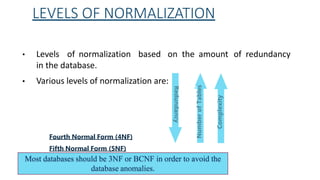
LEVELS OF NORMALIZATION
• Levels of normalization based on the amount of redundancy
in the database.
• Various levels of normalization are:
1. First Normal Form (1NF)
2. Second Normal Form (2NF)
3. Third Normal Form (3NF)
4. Boyce-Codd Normal Form (BCNF)
5. Fourth Normal Form (4NF)
6. Fifth Normal Form (5NF)
Number
of
Tables
Most databases should be 3NF or BCNF in order to avoid the
database anomalies.
FOURTH NORMAL FORM(4NF)
Fourth normal form (4NF) is a level of database normalization where there are
no non-trivial multivalued dependencies other than a candidate key.
It builds on the first three normal forms (1NF, 2NF and 3NF) and the Boyce-
Codd Normal Form (BCNF).
It states that, in addition to a database meeting the requirements of BCNF, it
must not contain more than one multivalued dependency.
Properties – A relation R is in 4NF if and only if the following conditions are
satisfied:
1.It should be in the Boyce-Codd Normal Form (BCNF).
2.the table should not have any Multi-valued Dependency.
A table with a multivalued dependency violates the normalization
standard of Fourth Normal Form (4NK) because it creates unnecessary
redundancies and can contribute to inconsistent data. To bring this up to
4NF, it is necessary to break this information into two tables.
To relation R be in Fourth Normal Form,
a relation must first be in Boyce-Codd Normal Form.
a given relation may not contain more than one multi- valued attribute.
The multi-valued dependency X→Y holds in a relation R, if whenever
we have two tuples of R that same in all the attributes of X, then we can
swap their Y components and get two new tuples that are also in R.
 Example 1
• Primary key→{Student_ID , Subject , Activity }
• Many Student_ID have same Subject.
• Many Student_ID have same Activity.
• Thus violates 4NF.
Student_ID Subject Activity
100 Music Swimming
100 Accounting Swimming
100 Music Tennis
100 Accounting Tennis
150 Math Jogging
Student_ID Subject
100 Music
100 Accounting
150 Math
6
Student_ID Activity
100 Swimming
100 Tennis
150 jogging
Example 1(convert to 4NF)
Old Scheme→{Student_ID , Subject , Activity}
New Scheme →{Student_ID , Subject}
New Scheme →{Student_ID , Activity}
 Example 2
7
• Primary key→{Manager , Child , Employee }
• Each manager can have more than one child.
• Each manager can supervise more than one employee.
• Thus violates 4NF.
Manager Child Employee
Jim Beth Alice
Mary Bob Jane
Mary NULL Adam
Manager Child
Jim Beth
Mary Bob
8
Manager Employee
Jim Alice
Mary Jane
Mary Adam
Example 2(convert to 4NF)
Old Scheme→{Manager , Child , Employee }
New Scheme →{Manager , Child}
New Scheme →{Manager , Employee}
FIFTH NORMAL FORM(5NF)
9
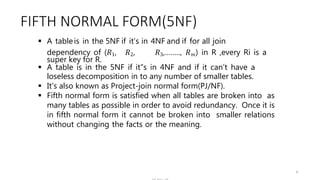
 A tableis in the 5NF if it’s in 4NF and if for all join
dependency of (𝑅1, 𝑅2, 𝑅3,…….., 𝑅𝑚) in R ,every Ri is a
super key for R.
 A table is in the 5NF if it”s in 4NF and if it can’t have a
loseless decomposition in to any number of smaller tables.
 It’s also known as Project-join normal form(PJ/NF).
 Fifth normal form is satisfied when all tables are broken into as
many tables as possible in order to avoid redundancy. Once it is
in fifth normal form it cannot be broken into smaller relations
without changing the facts or the meaning.
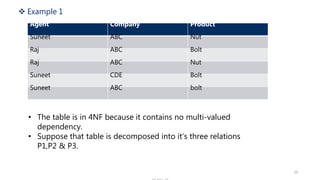
 Example 1
10
Agent Company Product
Suneet ABC Nut
Raj ABC Bolt
Raj ABC Nut
Suneet CDE Bolt
Suneet ABC bolt
• The table is in 4NF because it contains no multi-valued
dependency.
• Suppose that table is decomposed into it’s three relations
P1,P2 & P3.
Agent Company
Suneet ABC
Suneet CDE
Raj ABC
 P1
Agent Product
Suneet Nut
Suneet Bolt
Raj Bolt
Raj Nut
 P2
Company Product
ABC Nut
ABC Bolt
CDE Bolt
 P3
• From above tables or relations if we perform natural join
between any of two above relations i.e P1⋈P2 , P2⋈P3
or P1⋈P3 then extra rows are added so this
decomposition is called lossy decomposition.
• But if we perform natural join between the above three
relation then no extra rows are added so this
decomposition is called loseless decomoposition.
• So, above three tables P1,P2 and P3 are in 5NF.

Normal forms fourth and fifth.pptx

  • 1.
    SUBJECT – DBMS TOPIC– FOURTH NORMAL FORM(4NF) & FIFTH NORMAL FORM(5NF)
  • 2.
    LEVELS OF NORMALIZATION •Levels of normalization based on the amount of redundancy in the database. • Various levels of normalization are: 1. First Normal Form (1NF) 2. Second Normal Form (2NF) 3. Third Normal Form (3NF) 4. Boyce-Codd Normal Form (BCNF) 5. Fourth Normal Form (4NF) 6. Fifth Normal Form (5NF) Number of Tables Most databases should be 3NF or BCNF in order to avoid the database anomalies.
  • 3.
    FOURTH NORMAL FORM(4NF) Fourthnormal form (4NF) is a level of database normalization where there are no non-trivial multivalued dependencies other than a candidate key. It builds on the first three normal forms (1NF, 2NF and 3NF) and the Boyce- Codd Normal Form (BCNF). It states that, in addition to a database meeting the requirements of BCNF, it must not contain more than one multivalued dependency. Properties – A relation R is in 4NF if and only if the following conditions are satisfied: 1.It should be in the Boyce-Codd Normal Form (BCNF). 2.the table should not have any Multi-valued Dependency.
  • 4.
    A table witha multivalued dependency violates the normalization standard of Fourth Normal Form (4NK) because it creates unnecessary redundancies and can contribute to inconsistent data. To bring this up to 4NF, it is necessary to break this information into two tables. To relation R be in Fourth Normal Form, a relation must first be in Boyce-Codd Normal Form. a given relation may not contain more than one multi- valued attribute. The multi-valued dependency X→Y holds in a relation R, if whenever we have two tuples of R that same in all the attributes of X, then we can swap their Y components and get two new tuples that are also in R.
  • 5.
     Example 1 •Primary key→{Student_ID , Subject , Activity } • Many Student_ID have same Subject. • Many Student_ID have same Activity. • Thus violates 4NF. Student_ID Subject Activity 100 Music Swimming 100 Accounting Swimming 100 Music Tennis 100 Accounting Tennis 150 Math Jogging
  • 6.
    Student_ID Subject 100 Music 100Accounting 150 Math 6 Student_ID Activity 100 Swimming 100 Tennis 150 jogging Example 1(convert to 4NF) Old Scheme→{Student_ID , Subject , Activity} New Scheme →{Student_ID , Subject} New Scheme →{Student_ID , Activity}
  • 7.
     Example 2 7 •Primary key→{Manager , Child , Employee } • Each manager can have more than one child. • Each manager can supervise more than one employee. • Thus violates 4NF. Manager Child Employee Jim Beth Alice Mary Bob Jane Mary NULL Adam
  • 8.
    Manager Child Jim Beth MaryBob 8 Manager Employee Jim Alice Mary Jane Mary Adam Example 2(convert to 4NF) Old Scheme→{Manager , Child , Employee } New Scheme →{Manager , Child} New Scheme →{Manager , Employee}
  • 9.
    FIFTH NORMAL FORM(5NF) 9 A tableis in the 5NF if it’s in 4NF and if for all join dependency of (𝑅1, 𝑅2, 𝑅3,…….., 𝑅𝑚) in R ,every Ri is a super key for R.  A table is in the 5NF if it”s in 4NF and if it can’t have a loseless decomposition in to any number of smaller tables.  It’s also known as Project-join normal form(PJ/NF).  Fifth normal form is satisfied when all tables are broken into as many tables as possible in order to avoid redundancy. Once it is in fifth normal form it cannot be broken into smaller relations without changing the facts or the meaning.
  • 10.
     Example 1 10 AgentCompany Product Suneet ABC Nut Raj ABC Bolt Raj ABC Nut Suneet CDE Bolt Suneet ABC bolt • The table is in 4NF because it contains no multi-valued dependency. • Suppose that table is decomposed into it’s three relations P1,P2 & P3.
  • 11.
    Agent Company Suneet ABC SuneetCDE Raj ABC  P1 Agent Product Suneet Nut Suneet Bolt Raj Bolt Raj Nut  P2 Company Product ABC Nut ABC Bolt CDE Bolt  P3
  • 12.
    • From abovetables or relations if we perform natural join between any of two above relations i.e P1⋈P2 , P2⋈P3 or P1⋈P3 then extra rows are added so this decomposition is called lossy decomposition. • But if we perform natural join between the above three relation then no extra rows are added so this decomposition is called loseless decomoposition. • So, above three tables P1,P2 and P3 are in 5NF.