PRESENTED BY
ASHIT SAXENA (BBE/4540/13)
SIDDHARTH BHUSHAN (BBE/4537/13)
 Non-store retailing is a form of retailing in
which sales are made to consumers without
using physical stores.
 The non-store retailers are known by medium
they use to communicate with their
customers, such as direct marketing, direct
selling and vending machines or e-tailing.
 Non store retailing is patronized to time
conscious consumers and consumers who
can't easily go to stores, or compulsive buyers.
 Most non-store retailers offer consumers the
convenience of buying 24 hours a day seven
days a week and delivery at location and time
of their choice.
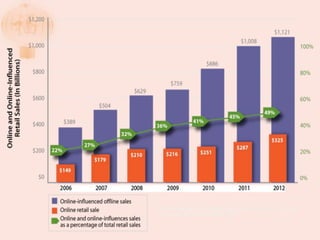
 Non-store sales are now growing at a higher
rate than sales in retail stores.
 Non-store retailing now accounts for more
than 15% of all consumer purchases, and it
may account for over 1/3 of all sales by the
end of the century.
TELEMARKETING
METHOD OF DIRECT
MARKETING IN WHICH
A SALESPERSON SOLICITS TO
PROSPECTIVE CUSTOMERS TO
BUY PRODUCTS OR SERVICES,
EITHER OVER THE PHONE OR WEB
CONFERENCING APPOINTMENT
SCHEDULED DURING THE CALL.
Direct selling method in
which merchandise from
several vendors, or
several items from the
same vendor, are
presented
to prospective buyers via
mail or internet.
 In this form of direct marketing the product is
advertised on television, details about the
product features, price and things like
guarantee/warranty are explained.
 Phone numbers are provided for each city,
where the buyer can call in a place the order
for the product. The products are then home
delivered.
E-MAIL MARKETING.
E-mail marketing is a form
of direct marketing which
uses electronic mail as a
means of communicating
commercial or fundraising
messages to an audience. In
its broadest sense, every e-
mail sent to a potential or
current customer could be
considered e-mail marketing.
•Cost Savings
•Quick Response Cycles
•Generates Revenues
•Popular Medium
•Effective Medium
•Results are Measurable
•Builds Customer Relations
 It is a is a machine that dispenses
merchandise when a customer
deposits money, validated by a
currency detector, sufficient to
purchase the desired item .
VENDING MACHINE.
THE INFORMATION KIOSK
It is the first kiosk platform for a variety of
functions offered on many kiosks in the
marketplace today. By the touch of a finger
users can gain access to product information,
company services, forms and printouts for
retail stores, schools, churches, city
government, tourist locations and more.
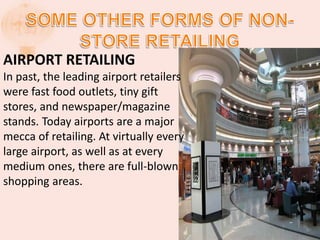
AIRPORT RETAILING
In past, the leading airport retailers
were fast food outlets, tiny gift
stores, and newspaper/magazine
stands. Today airports are a major
mecca of retailing. At virtually every
large airport, as well as at every
medium ones, there are full-blown
shopping areas.
 Its freedom from a physical retail presence.
 The high fixed costs of operating retail outlets are
eliminated.
 The breadth of customer coverage is considerably
wider than is possible with an individual retail
location.
 Companies do not have to spend large sums or
dilute stock building new locations, or acquiring
them.
 This truly gives the non-store retailer a global
market from a cheap, centralized location.
 There is also the fear of credit card abuse and
mail fraud, both related to the sense of
detachment that not holding a prospective
purchase brings.
 And since most of us do not have the luxury of
a pricey T1 Internet connection, we must still
deal with painfully slow connections.
NON-STORE RETAILING
DIRECT SELLING
DIRECT MARKETING
DIRECT-RESPONSE MARKETING
The marketing of products to ultimate
consumers through face-to-face sales
presentations at home or in the workplace
 Party plans: Hosting groups to view a product
demonstration and encouraging participants to
purchase the products.
 Example: Eureka Forbes.
 Benefits
 Personal attention to customer.
 Convenience of time and place of presentation.
 Limitations
 High costs make it the most expensive form of
selling.
 Negative consumer view of direct selling.
•In direct-response marketing,
marketers use broadcast media to get
customers to contact them directly.
•It is direct-response marketing
because the communications from the
customer to the marketer are direct,
this differentiates it from simple direct
marketing in which the
communications from the marketer to
the customer are direct, but do not
allow for instant feedback.
 An interactive system of marketing which uses
one or more advertising media to effect a
measurable response at any location, forming
a basis for creating and further developing an
ongoing relationship between an organisation
and its customers.
MATERIAL
DISTRIBUTED VIA
THE POSTAL SERVICE
TO A RECIPIENT’S
HOME OR BUSINESS
TO PROMOTE A
PRODUCT/SERVICE.
• Targeting - for example using the post code,
targeted campaigns can be developed using
geographical / demographical criteria.
• Personalisation - large numbers of personalised
mailings can be undertaken regularly.
• Response rates can be high.
• Flexibility of creative scope.
• Can hold attention of reader/recipient.
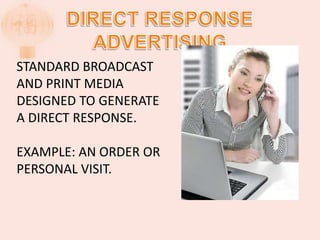
STANDARD BROADCAST
AND PRINT MEDIA
DESIGNED TO GENERATE
A DIRECT RESPONSE.
EXAMPLE: AN ORDER OR
PERSONAL VISIT.
• The focus should always be on what sells.
• Not always necessary to reinvent the wheel when designing
campaigns.
• Make the ‘offer’ the central theme of the designing campaign.
• Long copy can sell if the reader is engaged.
• Select creativity that sells, not that which just looks good.
• Always test and measure response.
• Select and retain media not on their ratings, but on their
ability to sell for you.
• Always ask for the order or for further action.
Non store retailing

Non store retailing

  • 1.
    PRESENTED BY ASHIT SAXENA(BBE/4540/13) SIDDHARTH BHUSHAN (BBE/4537/13)
  • 2.
     Non-store retailingis a form of retailing in which sales are made to consumers without using physical stores.  The non-store retailers are known by medium they use to communicate with their customers, such as direct marketing, direct selling and vending machines or e-tailing.
  • 3.
     Non storeretailing is patronized to time conscious consumers and consumers who can't easily go to stores, or compulsive buyers.  Most non-store retailers offer consumers the convenience of buying 24 hours a day seven days a week and delivery at location and time of their choice.
  • 4.
     Non-store salesare now growing at a higher rate than sales in retail stores.  Non-store retailing now accounts for more than 15% of all consumer purchases, and it may account for over 1/3 of all sales by the end of the century.
  • 6.
  • 7.
    METHOD OF DIRECT MARKETINGIN WHICH A SALESPERSON SOLICITS TO PROSPECTIVE CUSTOMERS TO BUY PRODUCTS OR SERVICES, EITHER OVER THE PHONE OR WEB CONFERENCING APPOINTMENT SCHEDULED DURING THE CALL.
  • 8.
    Direct selling methodin which merchandise from several vendors, or several items from the same vendor, are presented to prospective buyers via mail or internet.
  • 9.
     In thisform of direct marketing the product is advertised on television, details about the product features, price and things like guarantee/warranty are explained.  Phone numbers are provided for each city, where the buyer can call in a place the order for the product. The products are then home delivered.
  • 10.
  • 11.
    E-mail marketing isa form of direct marketing which uses electronic mail as a means of communicating commercial or fundraising messages to an audience. In its broadest sense, every e- mail sent to a potential or current customer could be considered e-mail marketing.
  • 12.
    •Cost Savings •Quick ResponseCycles •Generates Revenues •Popular Medium •Effective Medium •Results are Measurable •Builds Customer Relations
  • 13.
     It isa is a machine that dispenses merchandise when a customer deposits money, validated by a currency detector, sufficient to purchase the desired item . VENDING MACHINE.
  • 14.
    THE INFORMATION KIOSK Itis the first kiosk platform for a variety of functions offered on many kiosks in the marketplace today. By the touch of a finger users can gain access to product information, company services, forms and printouts for retail stores, schools, churches, city government, tourist locations and more.
  • 15.
    AIRPORT RETAILING In past,the leading airport retailers were fast food outlets, tiny gift stores, and newspaper/magazine stands. Today airports are a major mecca of retailing. At virtually every large airport, as well as at every medium ones, there are full-blown shopping areas.
  • 16.
     Its freedomfrom a physical retail presence.  The high fixed costs of operating retail outlets are eliminated.  The breadth of customer coverage is considerably wider than is possible with an individual retail location.  Companies do not have to spend large sums or dilute stock building new locations, or acquiring them.  This truly gives the non-store retailer a global market from a cheap, centralized location.
  • 17.
     There isalso the fear of credit card abuse and mail fraud, both related to the sense of detachment that not holding a prospective purchase brings.  And since most of us do not have the luxury of a pricey T1 Internet connection, we must still deal with painfully slow connections.
  • 18.
    NON-STORE RETAILING DIRECT SELLING DIRECTMARKETING DIRECT-RESPONSE MARKETING
  • 19.
    The marketing ofproducts to ultimate consumers through face-to-face sales presentations at home or in the workplace  Party plans: Hosting groups to view a product demonstration and encouraging participants to purchase the products.  Example: Eureka Forbes.
  • 20.
     Benefits  Personalattention to customer.  Convenience of time and place of presentation.  Limitations  High costs make it the most expensive form of selling.  Negative consumer view of direct selling.
  • 21.
    •In direct-response marketing, marketersuse broadcast media to get customers to contact them directly. •It is direct-response marketing because the communications from the customer to the marketer are direct, this differentiates it from simple direct marketing in which the communications from the marketer to the customer are direct, but do not allow for instant feedback.
  • 23.
     An interactivesystem of marketing which uses one or more advertising media to effect a measurable response at any location, forming a basis for creating and further developing an ongoing relationship between an organisation and its customers.
  • 26.
    MATERIAL DISTRIBUTED VIA THE POSTALSERVICE TO A RECIPIENT’S HOME OR BUSINESS TO PROMOTE A PRODUCT/SERVICE.
  • 27.
    • Targeting -for example using the post code, targeted campaigns can be developed using geographical / demographical criteria. • Personalisation - large numbers of personalised mailings can be undertaken regularly. • Response rates can be high. • Flexibility of creative scope. • Can hold attention of reader/recipient.
  • 28.
    STANDARD BROADCAST AND PRINTMEDIA DESIGNED TO GENERATE A DIRECT RESPONSE. EXAMPLE: AN ORDER OR PERSONAL VISIT.
  • 29.
    • The focusshould always be on what sells. • Not always necessary to reinvent the wheel when designing campaigns. • Make the ‘offer’ the central theme of the designing campaign. • Long copy can sell if the reader is engaged. • Select creativity that sells, not that which just looks good. • Always test and measure response. • Select and retain media not on their ratings, but on their ability to sell for you. • Always ask for the order or for further action.