#MKTOGUIDE
TABLE OF CONTENTS
Introduction
What is Digital Advertising and Why Is It Important?
Digital Ad Strategy
Digital Ad Types and Ad Design
Digital Ad Landing Pages
Ad Targeting
Digital Ad Pricing
Digital Ad Technologies
Ad Testing and Optimization
Ad Measurement
Conclusion
About The Guide
03
04
12
32
70
77
89
95
101
106
113
114
#MKTOGUIDE
It doesn’t matter who you are marketing to—businesses or consumers—today’s buyers are interacting
with your brand across multiple channels and devices. Plus, they have more expectations than any
other buyer generation in history. Modern buyers want personalized, one-on-one conversations with
brands at the right place and at the right time.
Your buyer expects a conversation to
take place seamlessly from your
website, to her cellphone, on social
media, and on all of the other
websites that she visits in any given
day, week, or month. Your buyer
expects a continuous experience.
While this is certainly a challenge for
marketers and advertisers, new ad
technology and innovations
continue to advance at break-neck
speeds. New ad technology
platforms, types of ads, methods of
tracking, dynamic ad content, and
advances such as the Internet of
Things, now provide endless
opportunities for marketers and
advertisers to engage in a cross-
channel way. But, all of these new
engagement opportunities can be
confusing! And executed poorly,
they can lead to low engagement
and irritated buyers.
The goal of our Definitive Guide to
Digital Advertising is to provide a
thorough overview of the digital
advertising landscape and help you
create a framework for engaging
your audience within these
channels as part of a seamless
conversation. There is a lot of noise
generated about digital channels
and we want to help you navigate!
INTRODUCTION
WHY SHOULD I READ THE DEFINITIVE
GUIDE TO DIGITAL ADVERTISING?
This guide was created for all
marketers who use, or are considering
using, advertising in their campaigns
(which should be all of you!). The
guide provides answers to these
critical questions:
•	What is digital advertising?
•		How should you create your digital ad strategy?
•		Which different types of ads do you have at your disposal?
•		Which pricing structure can you expect?
•		How do you target your digital ads?
•		How do you design your digital ads?
•		Which type of ad technology is available?
•	How do you test and measure your ads?
LET’S GET STARTED!
3
PART I:
WHAT IS DIGITAL ADVERTISING AND
WHY IS IT IMPORTANT?
#MKTOGUIDE
Digital advertising is the tactic of leveraging the internet and its properties to
deliver promotional ads to consumers on various channels.
PART I: WHAT IS DIGITAL ADVERTISING AND WHY IS IT IMPORTANT?
Like it’s predecessor—traditional
advertising—a digital ad can help tell
the story of your brand. Unlike
traditional advertising, digital
advertising is more universal and
flexible, enabling you to tell your
brand story on the channels that
your buyers frequent—through text,
images, video, and more.
Digital advertising has evolved
considerably since the first clickable
ad hit the internet in 1994. Today,
instead of advertising creating noise
that distracts from the content your
buyers want to read, digital
advertising can be part of an
ongoing conversation that your
brand has with its customers.
Digital ads are everywhere. They
can be seen on the websites your
buyer visits, on her mobile phone,
on social media channels, and on
her smart watch. Because
DEFINING DIGITAL ADVERTISING
advertising proliferates across so
many channels, including very
personal channels, you need to be
more cognizant than ever before
about providing useful, engaging
content. Luckily, due to behavioral
targeting technologies and platforms
like marketing automation, these
continuous conversations are
possible. And by leveraging these
technologies at scale, you can
nurture your buyers in a very
personalized way until they are ready
to become customers.
As marketers, we may feel like we
have come a long way with digital
advertising, but we are still in the early
stages. With digital advertising
continuing to gain momentum, it is
more vital than ever before to make it
an integral part of your holistic
marketing mix.
Digital advertising creates powerful opportunities to tell brand stories at scale and in context.
Through ads on various devices and channels, marketers can reach larger audiences in a way that is
real-time and increasingly personal.
PART I: WHAT IS DIGITAL ADVERTISING AND WHY IS IT IMPORTANT?
Three Reasons for a
Digital Focus
There are three reasons why digital
advertising is critical in today’s
multi-channel, multi-device
buyer landscape:
WHY IS DIGITAL ADVERTISING IMPORTANT?
1.	Your Buyers Are Constantly
on Digital Channels
Your buyers spend a lot of time
online. Gone are the days when
newspapers and magazines
dominated your buyer’s attention.
We are firmly entrenched in the
digital era. In fact, a recent study
by Media Dynamics states that
since 1985 a typical adult’s digital
media consumption has grown
40% to 9.8 hours per day in 2014.
A similar 2014 study by Nielsen
found that the average American
spends an astonishing 11 hours
per day with electronic media
– which was defined as TV, radio,
internet, smartphone, gaming
and other multi-media devices.
With your buyers constantly
switching channels and devices,
how can you reach them?
Digital advertising is a fantastic
way for your brand to live
across channels.
2.	Marketers Have Greater
Targeting Capabilities
When you put an advertisement
in a magazine you have very little
control, if any, over who sees
and interacts with it. With today’s
advancements in digital
advertising, marketers can now
target the exact audience that’s
mostly likely to purchase your
product. By combining the
power of marketing automation
and an advertising network or
platform, you can avoid sending
messages to people who aren’t
a great fit for your product or
service. Targeting your ads on
digital media isn’t only limited to
the demographic or
firmographic characteristics of
your audience. You can also
deliver messages that are
uniquely created to resonate
with your audience as
individuals, based on who they
are and what they do.
3.	The Availability of
Customer Intent Data Enables
Personalization and Seamless
Conversation
With today’s powerful marketing
and advertising tools, there is so
much data available about your
customers. By leveraging the
latest and greatest tools, like
Marketo’s Ad Bridge, you can
leverage customer profile and
intent data from many different
channels to have one seamless
view of the customer. You can
personalize your ads based on
who the individual is from her
behavior, her demographics,
where she is in the buying cycle,
her level of engagement with
your brand, and the content or
offers she has viewed. With this
advanced personalization, you
can have more relevant
conversations with buyers across
all channels—which is truly the
holy grail for marketers!
PART I: WHAT IS DIGITAL ADVERTISING AND WHY IS IT IMPORTANT?
Today’s Noisy
Buyer Landscape
Of course, where the people go, so
go the marketers. Marketers have
found ways to advertise and insert
their messages into as many digital
channels as possible. All of this leads
to an onslaught of ads targeting
consumers on digital media.
In fact, according to the Media
Dynamics Study, the average adult is
exposed to 5,000+ brands and their
advertisements throughout the day.
How many of these are ads? 362.
And how many of these ads
actually make an impression? 12.
Clearly it is challenging to grab a
buyer’s attention.
In today’s noisy, hyperactive world,
your audience can’t give a ton of
attention to any one brand in
particular. In fact, the abundance of
information that’s out there equals
attention scarcity and a greater
demand for relevance—so how can
your brand break through all of that
noise and be one of the 12 ads that
actually makes an impression on
your audience?
WHY IS DIGITAL ADVERTISING IMPORTANT?
The more relevant, interesting,
creative, and non-intrusive your ads
are, the more likely they will be seen
and engaged with by your coveted
audience. Through effective digital
advertising you can listen to your
audience’s behavior and respond
with relevant content.
As you consider the journey that
your customer takes, digital
advertising is an integral part of that
journey—so it’s important to include
a variety of digital advertising tactics
in your overall marketing strategy.
Relevant digital ads help nurture
your buyers until they become
customers—enabling you to
continue a one-on-one
conversation on all channels.
But, digital advertising evolves
quickly, and as a marketer, you have
to keep up. The ubiquity of online
interactions in today’s modern
culture demonstrates why digital
advertising has become, and will
continue to be, indispensable to
marketers. Marketing through these
ad channels is key to unlocking the
potential of a huge, expanding, and
captive audience.
Meet today’s buyer. She has the upper hand when it comes to making purchase decisions. Tech
savvy and brand sophisticated, she is wise to the ways of marketing, and she expects a lot. She
believes you should inform her and even entertain her, but never bore, or worse, irritate her. And
she’s fickle—you need to keep your communications interesting and to keep her engaged.
PART I: WHAT IS DIGITAL ADVERTISING AND WHY IS IT IMPORTANT?
There are two major trends that have
emerged out of the recent—and
rapid—evolution of digital buyer
behaviors across all channels. And
these trends have shaped how
marketers need to interact with
buyers through digital ads.
Buyers Are More Informed
Thanks to the abundance of
information, combined with
better search and sharing
technology, product
information is now pervasive.
The internet provides
consumers with instant
gratification, and mobile devices
add a wherever/whenever
dimension to every aspect of
their online experience.
Consumers today can quickly
access information about
products and pricing, and they
do their own research when it
comes to making purchase
THE NEW DIGITAL BUYER
decisions. In fact, today’s buyers
often form an opinion of a brand
before they ever interact with
you directly. By the time buyers
come to you, they have already
made the decision to purchase.
So your consumers’ online
perception of you is important,
and your advertising must be
relevant to your buyers’ journey.
1.	Consumers Have High
Expectations
Today’s buyers expect
companies to keep seamless
track of their purchase history,
communications preferences,
and desires. If your system isn’t a
well-oiled data machine, you’re
set up to lose brand loyalty fast.
Your buyers look for a unified
and personalized experience
across all of your various touch-
points. They want to find the
information they need in the
medium that is most convenient
for them in that moment.
Whether they are surfing the web
on their computer at work, or
waiting in line to purchase a pair
of pants at their favorite clothing
store—they expect the experience
to be flawless and consistent.
It’s an exciting—yet challenging—
time to be a marketer. It’s no
longer sufficient to simply push
static information to buyers in a
mass advertising model.
As a marketer, you must
fundamentally shift the way you
engage with customers across
online channels throughout the
customer lifecycle. And to do
this, you must learn to engage
each and every customer
individually and personally with
your digital advertising.
Digital advertising has evolved considerably since we saw the first banner ad in 1994. Now we see
advertising everywhere—on websites across the internet, on mobile devices, on smart watches, and
on other items that we wear. We see them on social media, and we can now even see connected
billboards that change based on traffic conditions.
PART I: WHAT IS DIGITAL ADVERTISING AND WHY IS IT IMPORTANT?
Just think about how quickly digital
advertising has progressed! Do you
remember surfing the web with
Netscape? Do you remember how
slowly the pages loaded? Do you
remember how much slower the
pages loaded when there was a
banner ad to display?
HOW HAS DIGITAL ADVERTISING EVOLVED?
First Banner Ad: AT&T
A Brief History of
Digital Ads
In 1994, the banner ad took over the
web. According to Wired Magazine,
the company HotWired launched
banner ads from 14 companies.
Each banner ad was 468 pixels wide
by 60 pixels deep. And legend has it
that the very first one of these ads
was from AT&T. The ad asked, “Have
you ever clicked your mouse right
HERE? You will”. And they were right.
From there we saw the first ad server
NetGravity in 1996, the first Google
AdWord in 2002, the first YouTube
ad in 2005, and the first Facebook
ad in 2007.
The Rapid Evolution
of Digital Ads
We may joke and reminisce about
the early days of Netscape and
banner ads, but digital advertising has
experienced a rapid transformation in
the past two decades. Why? Well,
people love content and they love to
consume it at a rapid pace.
Consider how you consume content.
TV is no longer the primary screen
that you or your audience uses to
consume media—now you spend
almost six hours online vs. four and a
half hours in front of the TV. You are
constantly moving from screen to
screen, media to media. You click on
one BuzzFeed article and quickly
click on other articles on the page
that interest you.
So how have ads evolved alongside
today’s buyers’ insatiable appetite for
online content? Let’s take a look at a
few advancements:
PART I: WHAT IS DIGITAL ADVERTISING AND WHY IS IT IMPORTANT?
HOW HAS DIGITAL ADVERTISING EVOLVED?
Data and Targeting
An advancement that has truly
enhanced the world of digital
advertising is the inclusion of data
and targeting. Through advanced
data, behavioral tracking, targeting
capabilities of digital ad platforms,
marketing automation tools, and
social media sites, marketers can
now get even more personalized
with their digital ad creation.
While in the past digital ad targeting
was based heavily on traditional
demographic information, through
data, marketers can now get even
more specific. Today you can target
based on location, behavior, content
viewed, industry, segment/persona,
browser, device, and more. This
enables more personalized
advertising than ever before.
And you can leverage this data across
all of your channels. You can
determine with more accuracy than
ever before that the person who
views a product on your website is
the same person who liked a post on
your Facebook page.
Rich Media
There are so many different types of
ad formats. While in the past ads
were simply text, today ads come in a
variety of forms. You can use video,
multiple images, and you can even
create ads that are interactive for your
users. By creating ad content that is
much more dynamic, your audience
is more likely to engage.
Programmatic
According to Business2Community,
programmatic refers to a wide range
of technologies that seek to
automate the buying, placement,
and optimization of advertising.
Programmatic advertising combines
rich advertisements with the ability to
resonate with the right audience,
using the right ads, in the right places.
Programmatic ad buying equates to
more efficiency in the space. No
longer are advertisers relying solely
on humans, who can be expensive
and can make mistakes.
Programmatic ad buying is less
expensive and simply more efficient
so that marketers can scale and focus
on what matters—creating amazing
ad campaigns!
Native Advertising
In the past, digital ads have been
thought of as intrusive and noisy.
They have appeared in the middle of
your screen while reading an article,
having no relation to the content you
were engaging with. And what do
you do? You feel irritated and quickly
click out of the ad to get the intrusive
content off of your screen.
In contrast, native advertising is
contextual—this type of advertising is
designed to look and feel like the
content that exists on the page.
Native ads are much less intrusive,
offering that seamless experience
that buyers are looking for. Native ads
are often seen on social media or
news sites. In fact, a recent survey by
IPG Media Labs cited that native ads
give a 52% lift in purchase intent and a
32% lift in brand favorability.
Cross-Channel Interactivity
By leveraging data on multiple
channels, your marketing can
actually interact across channels,
leveraging data on one channel
to inform another. It is this
interactivity between channels
that is improving how marketers
interact with customers across
the customer journey for a more
seamless, integrated experience.
Don’t think about digital
advertising in a bubble. Back
when digital advertising began
there were no cross-channel
efforts. In fact, it was rare that an
advertiser and a marketer would
even be in the same room to
discuss a cohesive campaign!
Today your ads must be part of
your overall brand story. Your
online and offline tactics must
speak to one another and
support each other in order to
provide a cohesive experience
for your audience.
10
Before we jump into the nitty-gritty details of digital ads, let’s first discuss how they
work. What does a digital advertising lifecycle look like?
PART I: WHAT IS DIGITAL ADVERTISING AND WHY IS IT IMPORTANT?
Get excited! We are going to take you
on a digital advertising journey
throughout your customer lifeycle.
Meet Ellen (Hi Ellen!)
Ellen is a potential customer who
comes to your website. She looks
around your site, clicks through to a
few pages, but ultimately doesn’t
purchase. However, you do know—
based on her behavior—that she likes
your social media product. She is
cookied before she leaves.
HOW DO DIGITAL ADS WORK?
After Ellen leaves your website, she
goes to another website to read
some current event content from her
local news site. Ellen starts to see
your ads on each page that she visits.
Ellen then goes to her Facebook
page to post a new status update.
She sees another one of your ads—
this time, the ad is personalized to
her preferences. The ad shows her
an offer to download your latest
social media ebook. Ellen is
interested and clicks on the ad.
She fills out your form, you get her
information, and Ellen is then sent
back to your website where she
makes a purchase. Ellen receives a
welcome email and she gets
started using her new purchase.
Ellen is a happy customer!
After a couple of days, Ellen has
come back to your website to
explore more of what you have to
offer. On your website you ask her
to complete a survey about her
experience with your product.
Once she leaves your website you
target her with ads related to a
complimentary product to the one
that she already purchased.
...And the cycle begins again!
What Is a Cookie?
No, a cookie isn’t a tasty
morsel you eat. A cookie is
a small message given to a
web browser by a web
server. The cookie is used
to identify a user and create
customized web
experiences (like a
customized ad on other
websites once a person
has left your page.)
Ellen Ellen visits your site... Ellen is cookied.
Your potential customers turn into
your happy, loyal customers.
Your ad recaptures her interest,
bringing her back to make a purchase.
Later, she surfs the web and starts
seeing your ads across the web.
...but leaves without checking out.
11
PART II:
DIGITAL AD STRATEGY
#MKTOGUIDE
Whether you’re working in a B2B or B2C company, before you move forward with developing and
placing digital ads, you must first come up with a viable ad strategy.
PART II: DIGITAL AD STRATEGY
According to Demand Media, an ad
strategy is the blueprint of how you
sell your product or service to
consumers. But, since your
company likely has multiple
products and audiences, you might
have multiple ad strategies.
But don’t fret if that sounds like a lot
of work! Most ad strategies follow a
handful of common guidelines that
we’ll cover in the following sections.
DEVELOPING YOUR
ADVERTISING FOUNDATION
Determine the State of
the Market
Before you set out on your
advertising journey, take a close
look at your current market.
Ask yourself:
•	Who is most likely to purchase
your product?
•	How much of that market is
interested in your product?
•	Are there other companies
selling similar products?
•	What do your competitors’
advertising strategies look like?
In this step it’s also important to
consider the current economic
climate and understand its impact
on your business—not all
businesses or products are
recession-proof. Make sure to
investigate the history and the
major trends in the market that
surround your product or service,
as well as the correlating risks
and opportunities.
Finally, do a full review of what the
future predictions are for your
product or service in the
marketplace. Depending on the
state of the market, you could
choose to go in a completely
different direction with your ad
strategy—or even nix advertising of
the product or service altogether
until conditions improve.
By having an overview of your
marketing state—buyer profiles,
economic climate, trends, and
risks, you are in a much better
place to create an ad strategy that
reflects these elements and is
positioned to succeed.
13
PART II: DIGITAL AD STRATEGY
Ask the Right Questions
Once you’ve determined that the
market conditions are right, it’s time
to start creating your advertising
strategy. And the key to designing
an effective digital ad strategy is to
determine what you are doing
currently and where you want to go.
Ask yourself and your team some
important questions to map out
your plan. Be sure to invite key
stakeholders into the room for this
initial discovery process.
1.	What are you currently doing
for digital advertising?
This question helps you define
your baseline. Some
companies may already be
running large-scale campaigns
on various online channels,
while others may not have
many ad activities (yet).
DEVELOPING YOUR
ADVERTISING FOUNDATION
2.	Who is running your digital
advertising strategy?
And is your digital ad strategy
aligned? Are you running your
advertising out of many
functions independently—such
as social, demand gen, and
web? Are they talking to one
another? It is critical to
understand your own
organizational structure.
3.	If you are doing digital ads
today, how are they
performing?
Now is the time to set your
initial baseline so you can
measure the performance of
different campaigns over time.
Decide on your key
performance indicators (KPIs).
How are you measuring
success? Which channels
need improvement?
To define your advertising goals, you need to settle on a specific set of objectives, whether it’s
increasing sales by a certain amount, establishing greater brand awareness, gaining a new
demographic in your customer base, or any combination of these. Having goals clearly defined on
paper establishes measurements for success.
PART II: DIGITAL AD STRATEGY
Once you have your success
metrics you can determine what’s
working and what’s not. If an ad is
failing, the ad strategy can be
reexamined for flaws, and certain
aspects can be avoided or adjusted
for future campaigns. Or, if an ad is
doing well, you will be able to
pinpoint which aspects of the
strategy are correlated with this
success and then mirror them in
other campaigns down the road.
In digital advertising, your ad goals
can generally be summed up by
four unique categories:
•	Customer Acquisition
•	Nurturing
•	Customer Loyalty
•	Branding
DEFINING YOUR ADVERTISING GOALS
Goal 1:
Customer Acquisition
Regardless of the type of
organization—B2B or B2C—a great
measurement of success is
customer acquisition, or an
increase in potential customers.
You can easily track conversion
success with your ads through
various types of measurements.
Let’s look at an example of
customer acquisition in a B2B
company, such as a SaaS software
company. For that organization, an
ad is deemed successful if it helps
the brand to acquire new leads.
Whereas companies that sell to
consumers view their ads as
effective if they drive buyers to
purchase or sign up for their
product or service, such as
clothing or television cable service.
Goal 2:
Customer Nurturing
Not everyone who sees your ad will
immediately purchase your product,
and that’s why you need to nurture
your customers throughout their
buying journey. Digital advertising is a
fantastic way to do this.
Nurturing, the process of building
relationships with potential
customers before they are ready to
buy, is a fairly new concept to reach
the online advertising space, but it is
one that is important for companies
to master in order to drive customer
acquisition and ROI with their digital
advertising efforts.
By using technologies like marketing
automation and retargeting, which is
the process of digitally targeting
customers based on their previous
online behaviors, and marketing
automation, marketers can now use
ads to nurture buyers across the
channels and websites that your
buyers visit.
Just like the practice of email
nurturing has breathed new life into
email, retargeting, as a form of
nurturing, has breathed new life into
online ads. The digital landscape is
expanding and evolving, continually
giving marketers new ways to
engage with potential customers.
Nurturing with digital ads is an
ongoing process that must continue
before and after a prospective
customer has interacted with your
company’s website.
15
PART II: DIGITAL AD STRATEGY
Goal 3:
Customer Loyalty,
Cross-Sell, and Upsell
Your nurturing shouldn’t stop once
someone becomes a customer.
You can use nurturing in digital
advertising to maintain
relationships and create loyalty
with someone who has already
become a customer.
Using the same technologies
mentioned previously, you can
nurture current customers based
on their behaviors to increase their
likelihood of making a repeat
purchase. You can also work to
increase customer loyalty
over time.
Don’t forget that even with digital
advertising, you must think about
the entire lifecycle of a customer—
from acquisition, to purchase,
to advocacy.
DEFINING YOUR ADVERTISING GOALS
Goal 4:
Branding
Your brand is what makes you
unique. Your brand is often
comprised of product
differentiators, messaging, and a
distinct look and feel. Because
digital ads are ubiquitous across
the web, they can make or break
your brand identity.
According to Marketing Land,
more and more companies are
investing in digital advertising for
the sake of building brand
awareness with a vast audience–
with large conglomerates like
Unilever and Procter & Gamble
allocating a whopping one-third
of their advertising budgets to
digital efforts.
Digital advertising is a worthy
component of your branding
strategy. It garners a new desire and
demand for your product or service
and catapults customer engagement
and loyalty to a whole new level—
surpassing traditional media.
When creating your digital ad strategy, you must consider your audience—who are you
creating your ads for? Your identified audience dictates every aspect of your ads.
PART II: DIGITAL AD STRATEGY
Most businesses have many
audiences and will therefore need to
develop personas in order to create
effective ads that resonate with each
audience. A persona is a detailed
description of an audience,
highlighting their behaviors, goals,
skills, and attitudes. Persona creation
is an important baseline for all
marketing efforts, especially with
today’s digital buyers.
AUDIENCE DEVELOPMENT
AND PERSONAS
Creating Buyer Personas
To create your buyer personas, you
should conduct interviews with
customers, prospects, and
members of your sales team (if you
have one.) You can also send out
surveys and do your own research
with your target audience.
When thinking about your digital ad
strategy, there are various questions
that you need answered. Focus on
the following topics when creating
each persona for digital advertising:
•	Background: Basic details about
your ideal customer—her likes,
dislikes, and demographic
attributes.
•	Main Sources of Information:
Where does your customer like
to go to research buying
decisions? Which websites?
•	Main Online Channel
Preference: Which channels
does your customer spend her
time on? Does she like news
sites? Is she often on social
channels?
•	Pain Points: What are your
customer’s major pain points?
•	Preferred Content Medium:
How does your customer like to
consume content? Does she like
to read it? Does she prefer to
watch a video?
Once you have your personas
mapped—and you likely will have
many—you can create various ad
strategies that map to each persona.
This will dramatically increase your
chances of success!
Make sure you are testing your
personas over time. Doing so will
enable you to continue refining them.
17
PART II: DIGITAL AD STRATEGY
Where and When to
Reach Your Audiences
Once you have identified your
audience, you now need to identify
where to reach them. In digital
advertising, “where” signifies which
websites your audience segments
are most likely to frequent. If your
audience segment is B2B marketing
practitioners, they may be on
marketing blogs or sites offering
marketing best practice tips. Or if
your audience is made up of
individual consumers, they may be
on large ecommerce sites.
As a marketer, you need to
determine, based on your
audiences’ online tendencies,
where your money is best spent,
whether that’s in display, retargeted,
AUDIENCE DEVELOPMENT
AND PERSONAS
or social ads, and on which type of
sites to place these ads. For
instance, if your audience is known
to spend time on Facebook and
Twitter, there’s no question that you
should be leveraging these two
channels by inserting ads into these
respective sites.
In some cases, timing matters for ad
placement. For example, if you
identified your audience as working
professionals, you might assume
that they use LinkedIn. From here,
you can identify the best time to
target them. In this case, you may
have identified weekdays during the
lunch break hour as the best time to
capture more of your specified
audience members’ attention.
Wanted: Digital Advertisers
A 2014 study from Mondo found that because digital
advertising is a growing space with a limited pool of
experienced workers, advertisers are in high demand.
The top skill sets companies are hiring for include:
Part of your ad strategy is structuring your digital advertising team.
Forming a strong, quality team is crucial to proper implementation of your strategy.
PART II: DIGITAL AD STRATEGY
Your team will dictate which digital
advertising areas you’ll have the
bandwidth and expertise to
explore. Depending on your
company’s resources and needs,
the size and composition of your
digital advertising team will vary.
You may even require outsourcing
some responsibilities to an agency.
But know that whether small or
large, your digital advertising team
can get the job done, and done
well. Let’s explore some best
practices on how to structure your
team for success given the
resources you have.
Small Team
With a small digital advertising
team, you’ll need to be clever
about how to cover as much
ground as possible without
stretching your team too thin. With
a small team, you are forced to
focus on which tasks matter the
most in carrying out your digital ad
strategy and meeting your goals.
YOUR DIGITAL ADVERTISING TEAM
With limited resources, you should
focus on fulfilling the following roles:
•	Online Campaign Management:
You need to have someone on
staff who knows online campaign
management inside and out. This
person should be familiar with
paid search and other forms of
digital advertising. She should also
be able to create some sparkling
ad copy. Nowadays, in the digital-
heavy job market, it is common to
find all of these qualities in the
same person.
•	Creative Services:
You need to have someone on
staff who can run the creative side
of your advertising, including
designing banners and landing
pages, and understanding
important campaign elements like
what to do with a tracking pixel or
code snippet. Therefore, this
person should be a blend of
developer and artist.
54%
30%
44%
24%
33%
22%
Social
Mobile Strategy
Content Creation
Creative Services
Data & Analytics
Product & Brand
Expertise
Digital Advertising Dream Team
According to The Candidate UK, a solid digital advertising team can be
broken down into the following categories:
PART II: DIGITAL AD STRATEGY
Large Team
With a large team, you naturally have
more time, talent, and brain power to
work with, meaning you have the
ability and flexibility to test and
explore more avenues, learning what
works best for your company. Certain
responsibilities, like the ones
described above, are critical to a
sound digital advertising strategy and
should be a part of every team, but
since you have the ability to invest in
additional people, it’s a good idea to
make sure that the following
responsibilities are covered:
•	Data Analysis:
Data is always there for the
taking, but there’s not always
someone to devote time to it.
With a large team, someone can
take on this role full-time,
assessing the effectiveness of
various ads and then making
recommendations for future ads
accordingly. This eliminates the
guesswork and injects higher
ROI into your digital
advertising efforts.
YOUR DIGITAL ADVERTISING TEAM
•	Social Media Advertising:
If you will be creating and
paying for social ads, you need
someone who understands
the nuances of various social
media channels, such as
Facebook, Twitter, and
LinkedIn, and has background
in social media best practices
and trends.
•	Video Production:
If you will be creating video
ads, you need someone who
specializes in video production,
editing, and formatting.
The Hipsters:
These roles provide design
and content and add an
element of cool and trend
to your brand. These
positions encompass
content creation and
editing, creative services,
and ad design.
The Hackers:
These roles ensure that
digital ad technology
smoothly integrates with
your company’s other
systems and is also well
received by the intended
audiences. These roles
focus on digital and web
development, data, and
analytics.
The Hustlers:
These roles ensure that not
only are your digital
advertising goals met, but
also that they happen on
time and on budget. These
roles oversee paid search,
PPC, and display ads and
assume overall project
management duties.
20
PART II: DIGITAL AD STRATEGY
In-House vs.
Outsourced Talent
Whether small or large, some
teams may need to outsource
some of their responsibilities to
an outside agency, either to
alleviate internal personnel
pressures or to explore more
possibilities in their work.
For many companies, video
production and creative services
are outsourced, since these tasks
may require the collaboration of
a handful of people, for which a
company may not have
headcount. And on small teams,
even common tasks like paid
search may get outsourced. In
fact, a company may outsource
more tasks than it does in-house!
Whichever direction it takes, it’s
important for a company to
always have at least one person
on the digital advertising staff
in-house who knows the
business and can serve as the
liaison for the agency and for
other teams and departments
inside the company. This ensures
that the company’s brand,
YOUR DIGITAL ADVERTISING TEAM
messaging, and goals are carried
throughout all of the digital
advertising campaigns, as well as
ensures that good communication
remains intact across the board.
Sourcing an Agency
If you are going to go the
outsourced route, you need to first
determine which responsibilities
your team needs to outsource.
What would your team do if there
were more hours in the day?
Perhaps explore the use of video
ads, or expand your paid social
reach? Bringing an agency
onboard can breathe new life into
your digital ad strategy, equipping
your company with a digital plan
that’s more comprehensive and
robust and that can become a
more integral part of your entire
marketing strategy. This can lead to
higher ROI overall for your digital
advertising efforts.
Qualities of a Good Agency
In your search, make sure that your
agency not only has the skills to
get the job done, but that the
agency also meshes well with your
company and your team. A strong
working relationship is a crucial
foundation to ensure that
communication and collaboration
will flow with ease.
Other important traits to consider
when you’re interviewing potential
agencies include:
•		Industry Expertise:
It goes without saying that your
agency should have talented staff
with background in both digital
and traditional advertising. Assess
the various strengths and
weaknesses of each agency, and
determine where your needs are
met, and where they’re not.
•	Shared Vision:
To ensure that your team and the
agency are on the same page, it’s
important for the agency to
understand your company’s
brand and messaging, and how
these translate into the digital
atmosphere. Only after the
agency truly grasps your
company’s brand will it be able to
deliver ads that hit the mark every
time without a need for revision.
•	Similar Background:
It’s a good idea for the agency to
have worked with similar
companies so that they already
have a background in your
industry. This helps you and the
agency hit the ground running
much faster.
•	Proven Track Record:
Not only request and check
references, but also request that
agencies provide you with case
studies of successful work they
have completed for other
companies. It’s a good idea to
review previous work as a way to
gauge how well they will perform
for you.
21
Budgeting Tip—
Monthly vs. Daily Views
If you want to view your budget in a
monthly view versus daily, calculate it
by multiplying your average daily
budget by 30.4—the average number
of days per month.
As you start preparing to run ads, you need to be clear about your budget and then decide which ads
and channels support your strategy. Your budget determines the spending limits for your digital
advertising and individual campaigns.
PART II: DIGITAL AD STRATEGY
Your budget should represent the
amount that you are comfortable
spending each day or month (based
on how the advertising platform
charges you.) You may choose to
allocate funds differently across
channels, depending on which
advertising channels you select.
Your budget allocation also
depends on the pricing models for
each channel, which we will discuss
in more detail later in this guide.
BUDGET STRATEGY
You will likely have multiple levels
of budgets, starting with your
highest-level overall digital
advertising budget, and working
down into each of the different ad
platforms and campaigns.
You want to arrange your budget
tracking so you can quickly see
how you are tracking against your
total budget.
As you start preparing to run ads, you need to be clear about your budget and then decide which ads
and channels support your strategy. Your budget determines the spending limits for your digital
advertising and individual campaigns.
PART II: DIGITAL AD STRATEGY
A Digital Advertising
Budgeting Worksheet
Use this worksheet as a way to
get started planning your digital
advertising budget. Keep in mind
that you may need to complete
more than one of these
worksheets based on how you
split your advertising budget.
At Marketo, we complete one for
advertising that supports brand
building and one that supports
demand generation, since both
programs are supported by
advertising but come from
different budget sources. Let’s
take a look at the worksheet that
has example data filled-in so you
can see how it works:
BUDGET STRATEGY
Channel 1
(e.g. Google)
Channel 2
(e.g. Facebook)
Channel 3
(e.g. LInkedIn)
Channel 4
(e.g. Bing)
Month Total Budget Budget Budget Budget Budget
January $10,000 $4,000 $2,000 $3,000 $1,000
Display $1,000 $1,000 $1,000 $500
Retargeting $2,000 $1,000 $2,000 ­—
Search $1,000 — — $500
February
March
23
@
ADV
O
CATE
ENGA
G
E
When you think about your ad strategy, it is critical to think about it in a holistic, cross-channel way.
You can’t advertise in a vacuum, so make sure that your digital advertising campaigns are integrated
with your larger marketing plan.
PART II: DIGITAL AD STRATEGY
Which messages are your
consumers hearing from you as
they rapidly navigate across
channels? And, is that cross-channel
message continuous and relevant
for the consumer?
As a marketer, you need to think
across channels in your digital
advertising. Through advanced
digital advertising and marketing
automation technology, like
Marketo’s Ad Bridge, Real-Time
Personalization, and more, you can
easily listen and react from a variety
of channels.
•	 On Facebook
•	 On Twitter
•	 On Instagram
•	 On Pinterest
•	 Targeted Web CTAs
•	 Subscribe to Email
Newsletter
•	 Download the app
•	 Click on targeted ads
•	 Visit Your Website
•	 Read Personalized Emails
•	 On your website looking at
other products
•	 Read reviews
•	 Comparison shopping
•	 Write a review
•	 Share with a friend
•	 Participate in a
rewards program
•	 Social sharing
ADVERTISING AND YOUR
CROSS-CHANNEL MARKETING STRATEGY
Cross-channel marketers need tools
to help them:
•	Listen: Pay close attention to
buyer behavior across all
channels to create a single,
integrated view of the buyer
persona
•	Learn: Process all of your buyer’s
digital signals for a better
understanding of your customer
•	Speak: Manage, personalize, and
act on conversations with buyers
across channels.
PART II: DIGITAL AD STRATEGY
Listen
Imagine you had a great phone
conversation yesterday with one of
your best customers about a new
service offering. Now imagine that
after you read this, you go out for a
cup of coffee and run into him on
the street. “Hi! So glad we bumped
into one another,” you say. “I want
to talk to you about a great service
we’re offering!” Your customer
responds with a puzzled look. He
thinks you have a terrible memory
or that you’re confused. The same
thing happens when a customer
receives dueling messages from
you on different marketing
channels. If you’re not listening to
him across different channels,
you’re not delivering an integrated
experience. To create relevant
interactions with a buyer over any
channel, you need to understand
his behaviors across all channels—
you need a single, cross-channel
view of the customer.
ADVERTISING AND YOUR
CROSS-CHANNEL MARKETING STRATEGY
Learn
Once you have listened to your
buyers’ behavior across all of your
marketing channels, you need to
process these signals before you
act. You likely have a lot of data—
what your buyers like, dislike,
interact with, and ignore. By
analyzing the data you have
captured, you can learn more
about your audience’s needs and
interests, so that when you do
have a conversation with them, it
is more contextual.
Speak
Engaging conversations with
buyers should be maintained
seamlessly as they move from
one channel to the next. A
conversation you start on your
website must continue when the
buyer navigates to your Facebook
page and shouldn’t skip a beat
when he jumps over to LinkedIn.
Instead of competing against
each other with disconnected
messaging, or repeating
information your buyer has already
absorbed, all of your marketing
channels should work together to
coordinate the customer’s
experience. Let’s take a look at how
to integrate a multi-channel
approach into your acquisition and
nurturing efforts.
Cross-Channel Ads and
Marketing Automation
Your marketing automation platform
can make it much easier for you to
create a cross-channel marketing
strategy—both when it comes to
different ad platforms and how you
think about all of your cross-channel
campaigns across email, social, ads,
nurturing, mobile, web, and so on.
If you are using a marketing
automation platform like Marketo,
you can build customer profiles
based on demographic and
behavioral data gathered across
many channels. Marketo Ad Bridge
gives you the ability to leverage this
data in your advertising campaigns to
create highly targeted and
personalized display and retargeting
campaigns. And because these ads
are informed by segmentations
you’re using to power campaigns via
email, mobile, web and more in your
marketing automation platform, they
become a cohesive part of your
overall marketing strategy.
Then, you can include these targeted
ads in the rest of your marketing
campaigns, making your buyer’s
experience much more interesting
and cohesive!
25
PART II: DIGITAL AD STRATEGY
ADVERTISING AND YOUR
CROSS-CHANNEL MARKETING STRATEGY
Cross-Channel
Ads in Action
Whichever type of programs you
run as part of your marketing plan,
digital advertising can and should
support them. Often digital
advertising can complement your
program objectives, expand the
reach, and ultimately contribute to
the success of the program.
But remember, marketers must
always consider who they are
targeting, not just what they are
targeting customers with, so it’s
important to tailor your message
instead of blasting the same one
across channels.
Let’s take a look at a cross-channel
acquisition campaign that
includes advertising.
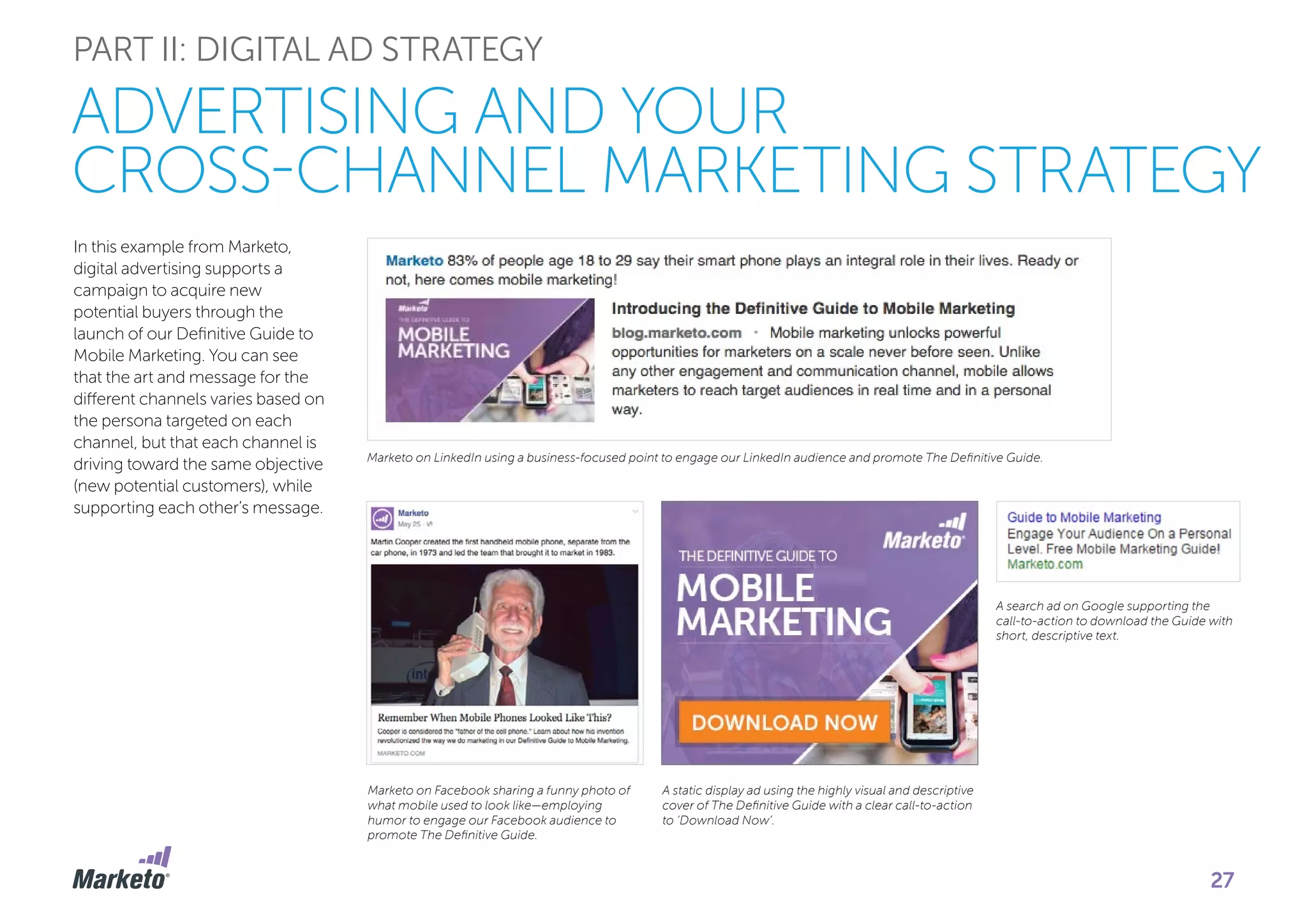
Marketo on Twitter promoting the Definitive Guide to Mobile Marketing with a quick stat
and a webinar replay.
Marketo on Twitter promoting the Definitive Guide to Mobile Marketing
with information that resonates with our Twitter audience.
PART II: DIGITAL AD STRATEGY
ADVERTISING AND YOUR
CROSS-CHANNEL MARKETING STRATEGY
Marketo on Facebook sharing a funny photo of
what mobile used to look like—employing
humor to engage our Facebook audience to
promote The Definitive Guide.
A search ad on Google supporting the
call-to-action to download the Guide with
short, descriptive text.
Marketo on LinkedIn using a business-focused point to engage our LinkedIn audience and promote The Definitive Guide.
A static display ad using the highly visual and descriptive
cover of The Definitive Guide with a clear call-to-action
to ‘Download Now’.
In this example from Marketo,
digital advertising supports a
campaign to acquire new
potential buyers through the
launch of our Definitive Guide to
Mobile Marketing. You can see
that the art and message for the
different channels varies based on
the persona targeted on each
channel, but that each channel is
driving toward the same objective
(new potential customers), while
supporting each other’s message.
27
PART II: DIGITAL AD STRATEGY
ADVERTISING AND YOUR
CROSS-CHANNEL MARKETING STRATEGY
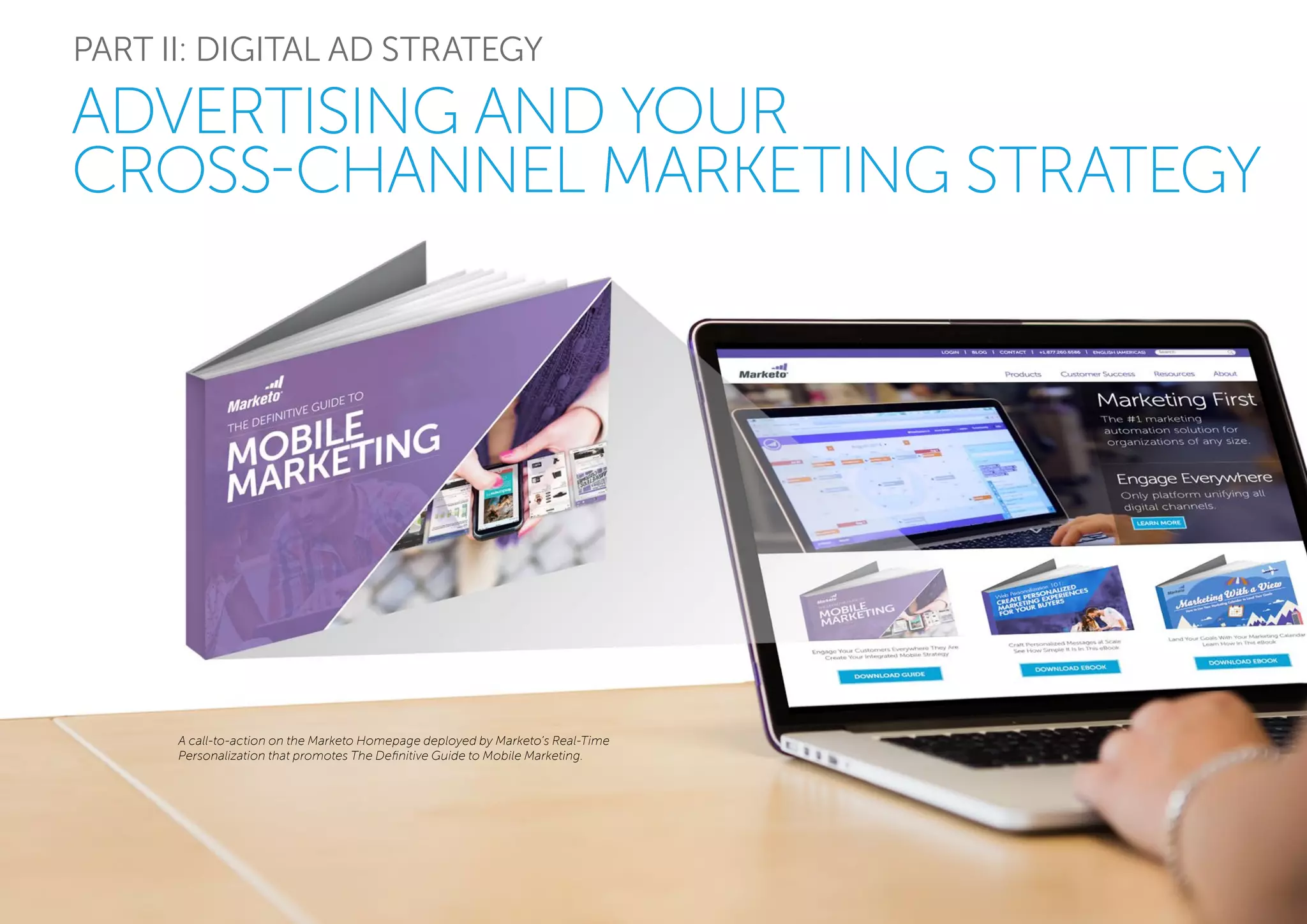
A call-to-action on the Marketo Homepage deployed by Marketo’s Real-Time
Personalization that promotes The Definitive Guide to Mobile Marketing.
PART II: DIGITAL AD STRATEGY
ADVERTISING AND YOUR
CROSS-CHANNEL MARKETING STRATEGY
Your Cross-Channel
Digital Advertising
Planning Worksheet
Use this worksheet to help you and
your team brainstorm how to
incorporate digital advertising into
the activities that you do for each of
the marketing channels listed below.
It’s OK to not use all of the channels,
or to have multiple rows for some
channels. It’s important that the ad
type supports both your goal and
your messages, and coordinates
tightly with the messages on the
supporting channels.
Marketing Channel Goal Ad Types Messages
Supporting
Channels
Budget
Television
Event
Print
In-Store Experience
Blog
Email
Website
Mobile
Review Sites
LinkedIn
Pinterest
Facebook
Twitter
Instagram
SlideShare
Paid Search
Retargeting
MIKE STOCKER
THOUGHT LEADERSHIP INSIGHTS
Director of Business Development, Marketo
MKTO: How do you see the role of
digital advertising changing as a
part of the overall marketing mix?
MS: Digital Advertising is changing
because it will be the dominant force
in driving customer acquisition for
marketers. Let’s face it, TV, Print
media and the traditional marketing
methods are declining and digital
advertising on the web, mobile,
social and now IoT will be the main
area for marketing efforts.
MKTO: How do you see the Internet
of Things (IoT) changing how
marketers advertise today? How is
that similar or different from the
rise of mobile devices?
MS: Remember back to 2007—nearly
10 years ago—and little product
called the iPhone hit the market?
Think of the vast amount of change,
disruption and opportunity that
device has brought to us by making
mobile the primary channel. Now
we are nearing 2016 and IoT has the
potential to be just as disruptive. As
Apple Watch, and other wearable
devices begin to gain mass market
adoption, it will present many of the
same huge changes, disruption and
opportunity we’ve seen over the
past 10 years with iPhone.
MKTO: What is one mistake you
see marketers often make when it
comes to digital advertising?
MS: In my opinion, the biggest area
for improvement for marketers
doing digital advertising is not taking
all the rich data available on their
customers into account to better
target and personalize their
marketing to prospects or
customers. Companies that are
doing it well are driving hugely
positive results—Nordstrom, for
example, is doing it right—if I look at a
pair of shoes, their digital advertising
“listens” and takes that into account as
I browse around the web. Other
companies where I’ve always
purchased men’s clothes—could do
better. All their emails and ads still
show me mostly female products,
which I’m unlikely to purchase.
Marketers need to make sure to use all
that rich intent, interest, prior
purchase, time and proximity
information and more to better target
and personalize their marketing.
@MichaelStocker
MIKE STOCKER
THOUGHT LEADERSHIP INSIGHTS (CONTINUED)
Director of Business Development, Marketo
MKTO: How has testing and
optimization of digital advertising
changed and how do you see it
changing in the future?
MS: The beauty of digital advertising
is that it is inherently measurable and
trackable if a marketer is using the
right tools. Anything that can be
measured can be tested and
optimized, and now there are
increasingly better tools that can
drive testing and optimization—the
whole rise of programmatic media
buying and the vast systems to
support them—from Google,
Facebook and Linkedin, to AppNexus,
PubMatic, Turn, MediaMath,
RocketFuel, and many more—there is
a whole group of technology
companies focused on making digital
marketing more efficient and
optimized for marketers.
I think the market is continuing to
move into more automated
optimization and testing in digital
advertising (display, email, mobile
etc.) and then the next frontier really
is predictive optimization. Predictive
will allow for all the data collected to
drive models that predict the best
ads to show when and where and in
what medium that is most likely to
drive the desired outcome. I see
predictive digital marketing
technologies in their early days, and
think that they will truly blossom in
the next 3-5 years.
PART III:
DIGITAL AD TYPES AND AD DESIGN
#MKTOGUIDE
With pay-per-click (PPC) search ads, your ad is placed as a “sponsored result” on the top or side of
your search engine results, and you pay for each received click. You can tailor your PPC ads to
appear when specific search terms are entered, creating highly targeted ads.
PART III: DIGITAL AD TYPES AND AD DESIGN
For many organizations, PPC ads
make up the majority of their
advertising spend. In fact, according
to an Interactive Advertising Bureau
report, in 2014, search ads
accounted for $9.1 billion, or 39%,
of the total internet ad revenue.
PAY-PER-CLICK (PPC) SEARCH ADS
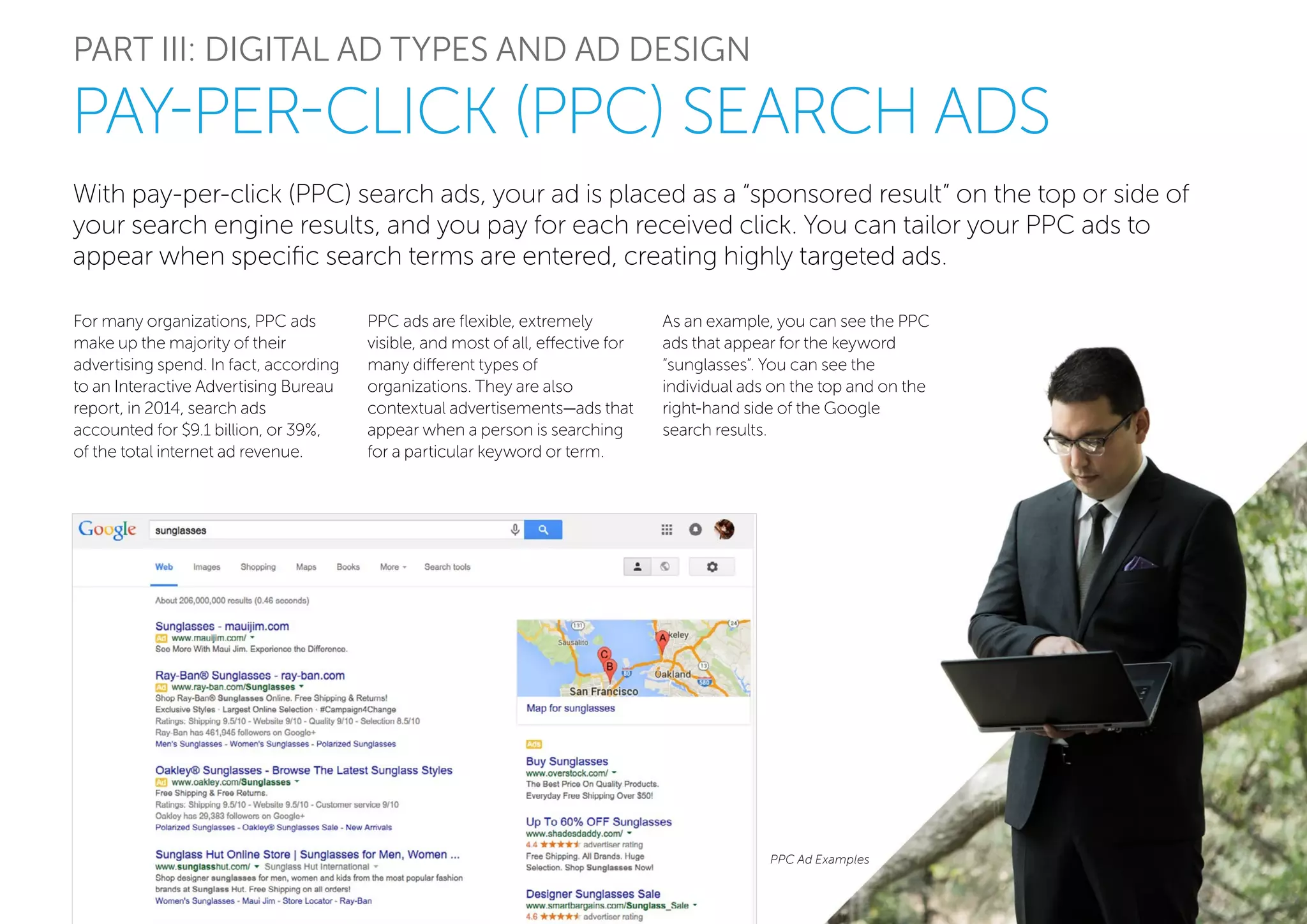
PPC Ad Examples
PPC ads are flexible, extremely
visible, and most of all, effective for
many different types of
organizations. They are also
contextual advertisements—ads that
appear when a person is searching
for a particular keyword or term.
As an example, you can see the PPC
ads that appear for the keyword
“sunglasses”. You can see the
individual ads on the top and on the
right-hand side of the Google
search results.
PART III: DIGITAL AD TYPES AND AD DESIGN
PPC Keywords
When creating your PPC strategy,
first determine your keywords (i.e.
what you want to rank highly for)
and then optimize and create ads
for those terms.
This means when someone
searches for those terms, your ad
has a better chance of coming up.
Keywords should be chosen
based on:
•		Relevant business goals
•		Traffic opportunity
•		Competition
PAY-PER-CLICK (PPC) SEARCH ADS
Keyword Research
To help you determine which
keywords you should select, try
Google AdWords Keyword
Planner to identify core search
and related terms.
When researching and choosing
keywords, ask yourself:
•	How relevant is this keyword
to my website, product,
service, and content?
•	If someone searches for this
keyword, will she find my
offerings useful?
•	Do we have content to offer
for this keyword, or will we
have to create content?
•	Will traffic to this keyword
deliver new business to our
company?
Consider scheduling a keyword
brainstorming session with your
team and key stakeholders. Make
sure to include key executives from
across the business. After you
brainstorm you should have a solid
list of keywords. Depending on
your goals, you could have 10, 50,
or even hundreds of words.
Additionally, think about the
distinction between early and late
stage keywords. You want your
offers and copy to resonate with
buyers at the right place in their
buying journey.
PPC Strategy Tip
You also want to take into
consideration your cross-channel
campaign strategy. What other
marketing messages are you sending
to your customers, and where are they
viewing these messages?
PART III: DIGITAL AD TYPES AND AD DESIGN
PAY-PER-CLICK (PPC) SEARCH ADS
Once you have chosen your
keywords, take a moment to see
which ads your competitors are
serving up. The more ads, the harder
it is to rise above the noise and the
more money your ads will cost.
As an example, take a look at our
search for “running shoes”. You can
see that this keyword grouping
turned up ads from multiple
companies including, Road Runner
Sports, Zappos, and ASICS.
Keyword Search for Term “Running Shoes”
As you can see, there are two
different types of ads that Google
shows: text-based PPC ads listed in
the search results and Product Listing
Ads selected from Google Shopping.
The Product Listing Ads show
individual images and products from
around the web.
What Is RLSA?
RLSA stands for Remarketing Lists for
Search Ads. This is a feature in Google
AdWords that enables you to
customize your ad campaign for
people who have already been to your
website. You can select keywords and
formulate your ads with this in mind.
PART III: DIGITAL AD TYPES AND AD DESIGN
PAY-PER-CLICK (PPC) SEARCH ADS
PPC Ad Copy
A great PPC ad has compelling
copy and an engaging headline.
However, you only have 70
characters for your copy and 25
characters for your headline. So
you have to say a lot in a very small
amount of space. Tricky indeed!
According to Search Engine Watch,
there are five golden rules of PPC
ad writing:
1.	Use clear, easy to
understand language
2.	Use vivid and
emotional language
3.	Focus on keywords and
the intent behind them
4.	Having a compelling offer
and call-to-action (CTA)
5.	Don’t go overboard with
abbreviations and
truncated phrases
Relevancy
To really resonate with the needs of
your audience, your copy should
directly address a customer pain
point or need. You want your
audience to immediately see the
value in clicking your ad.
Using our running shoes example,
take a look at the ASICS ad. The
headline says: “Go Run It” and the ad
itself says, “Find the running footwear
for your training needs”. The headline
is action-oriented, and the ad itself
makes the buyer want to click to find
running shoes right away.
Negative Keyword Campaigns
We highly recommend using
negative PPC keywords—keywords
that will cause your ad to not trigger.
For example, if you sell high-end
jewelry and are bidding on the word
“watches”, you might exclude any
search that has the word “cheap”.
Remember your PPC campaigns are
budgeted by cost-per-click, so every
click counts!
Excluding specific words and
phrases that aren’t relevant to your
product or service can help you
reach your ideal prospects.
PPC Headlines
PPC headlines have to pop! And they
have to do it quickly. Don’t be afraid to
use strong language to create a sense
of urgency. You also want your
headline to convey authority. Your ad
will likely be competing against other
PPC ads, so make yours stand out by
reviewing other ads that show up for
your keywords.
ASICS PPC Ad Copy
36
PART III: DIGITAL AD TYPES AND AD DESIGN
PAY-PER-CLICK (PPC) SEARCH ADS
Call-to-Action Strategy
PPC ads are a great place to
showcase your content and
products, but keep in mind that
people who search for your
keywords may be unfamiliar with
your company. This means that it
often doesn’t make sense for your
CTA to always be a sales pitch.
Instead, offer them a piece of
content that is applicable to their
search query.
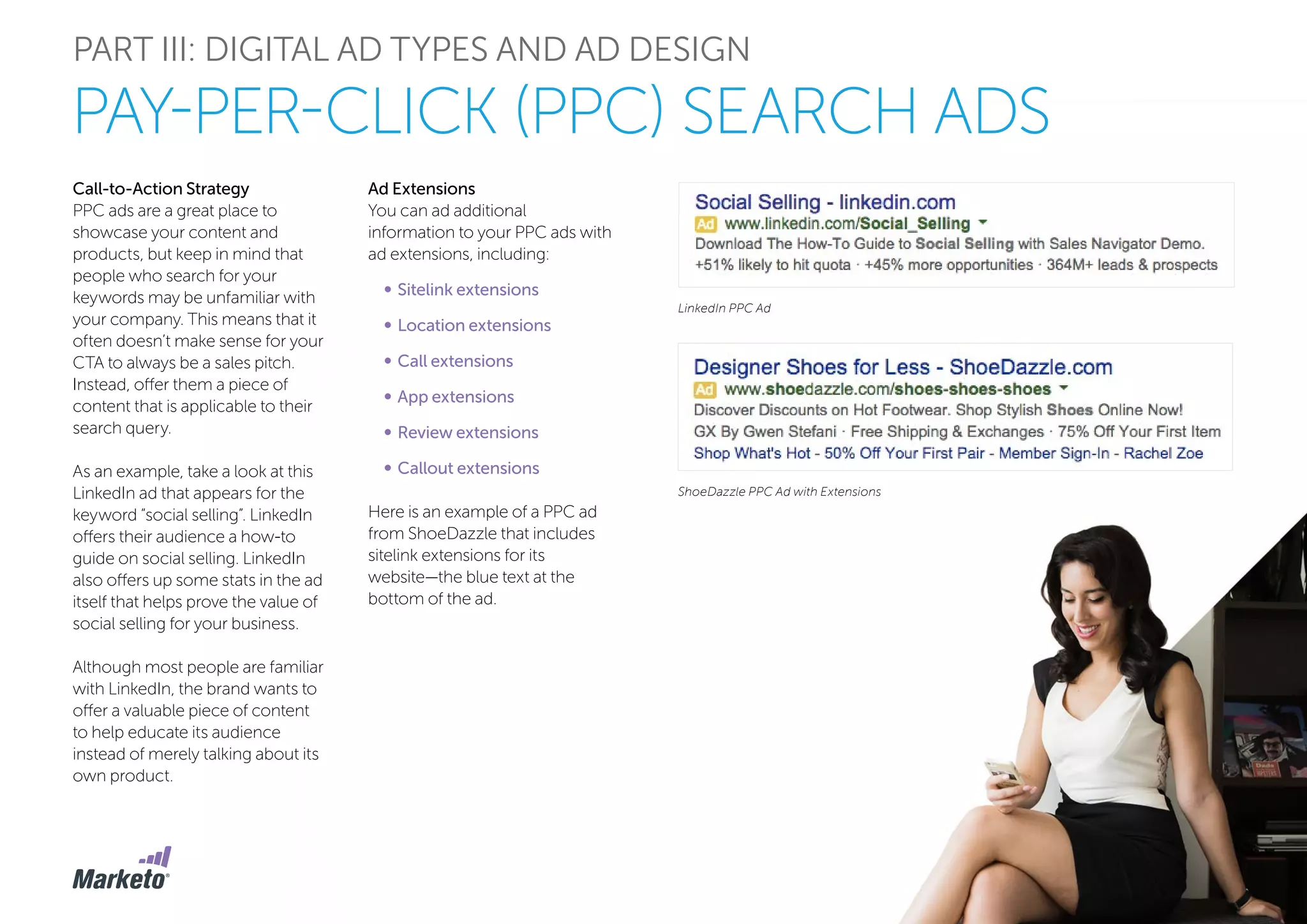
As an example, take a look at this
LinkedIn ad that appears for the
keyword “social selling”. LinkedIn
offers their audience a how-to
guide on social selling. LinkedIn
also offers up some stats in the ad
itself that helps prove the value of
social selling for your business.
Although most people are familiar
with LinkedIn, the brand wants to
offer a valuable piece of content
to help educate its audience
instead of merely talking about its
own product.
LinkedIn PPC Ad
ShoeDazzle PPC Ad with Extensions
Ad Extensions
You can ad additional
information to your PPC ads with
ad extensions, including:
•	Sitelink extensions
•	Location extensions
•	Call extensions
•	App extensions
•	Review extensions
•	Callout extensions
Here is an example of a PPC ad
from ShoeDazzle that includes
sitelink extensions for its
website—the blue text at the
bottom of the ad.
PART III: DIGITAL AD TYPES AND AD DESIGN
PAY-PER-CLICK (PPC) SEARCH ADS
Google Quality Score
According to Google, your PPC ad’s
quality score is “the estimate of how
relevant your ads, keywords, and
landing pages are to the person
seeing your ad”. If you have a high
Quality Score, Google thinks your
ad and landing page are relevant to
searchers—so you can rank higher
for the same bid amount!
Google tabulates Quality Score
based on the following criteria:
•	Your keyword’s expected
click-through rate (CTR):
This is calculated based on past
CTRs and how the keyword has
historically performed.
•	Your display URL’s past CTR:
How often your display URL
receives clicks.
•		Your account history:
Your overall CTR on all ads
and keywords.
•		Landing page quality:
The relevancy of your landing
page and how easy it is to view
and navigate.
Google’s Text Display Ads
Google’s Text Display ads, otherwise
known as Magazine Ads, enable
traditional text-only PPC ads to be
displayed as more traditional banner
ads on their display network sites.
This helps conversion rates and
allows text-only ads to compete in a
visual-heavy ad world.
•	Your keyword/ad relevance:
How relevant your keyword is
to what the customer
searches for.
•	Geographic performance:
How successful you have
been in the regions you are
targeting.
•	Ad performance on a site:
How your ads are performing
on Google and partner sites.
•	Targeted devices:
How well your ads perform on
mobile and tablet devices.
Your Quality Score affects your ad
position, your eligibility for ad
extensions and other formats, and
your actual cost-per-click (CPC). In
other words, your Quality Score is
a big deal!
38
PART III: DIGITAL AD TYPES AND AD DESIGN
PAY-PER-CLICK (PPC) SEARCH ADS
PPC Ads and
Marketing Automation
If you are reading this section and
jotting everything down in earnest,
a lot of your ad budget is probably
allocated to PPC ads. But do you
know if your investment is
actually working?
When a purchase is made online,
Google has made it fairly easy for
marketers to tie revenue back to
the ad. However, the system begins
to break when a purchase is made
offline, such as when a buyer works
directly with a salesperson. So how
do you know that your PPC ad
influenced a purchase like that?
Tracking ROI
By using marketing automation,
you can actually start tracking all of
these interactions. Through a tool
like Marketo’s Ad Bridge, you can
associate offline purchases with the
ads that initiated them. Armed with
this information, marketers can
create more intelligent PPC
campaigns by focusing their bids
on keywords that generate the
most revenue.
Additionally, through Marketo’s Ad
Bridge you can track important back
end metrics such as the amount of
leads, MQLs (Marketing Qualified
Leads), SQLs (Sales Qualified Leads),
and pipeline. Particularly for a B2B
company, analyzing this type of data
shows true ROI for your PPC
campaigns. We will go into much
more detail on ROI later in this guide,
but it is good to note this
feature here.
Personalized Experiences
One of the most important
elements of integrating with your
marketing automation platform is
personalization. By tying behavior in
search with behavior on other
channels, marketers can now
nurture buyers seamlessly across
multiple platforms and channels.
This helps you, as a marketer, have a
continuous conversation. As an
example, by using a tool like
Marketo’s Real-Time Personalization,
if someone comes to your website
from the higher education industry,
you can begin to target them with
ads specifically relating to higher
education, making their experience
more relevant.
Display ads are visual advertisements that can be placed on a variety of online media. Display ads
come in a wide array of formats such as text, images, video, flash, and more.
PART III: DIGITAL AD TYPES AND AD DESIGN
Aside from PPC, for many
marketers, display advertising is
another very large piece of the
advertising pie. The great part
about display ads is their diversity!
You can use pretty much any type
of media to get your message
across to your audience. And you
can target your audience across
multiple devices and channels.
You can choose individual websites
for your banner ads to be displayed,
or you can create banner ads as part
of a retargeting campaign—more on
that later in the guide. But for your
reference, a retargeting ad campaign
tracks your website visitors and
serves them your ads on multiple
channels using a simple JavaScript
code or a cookie that is placed on
the viewer’s browser.
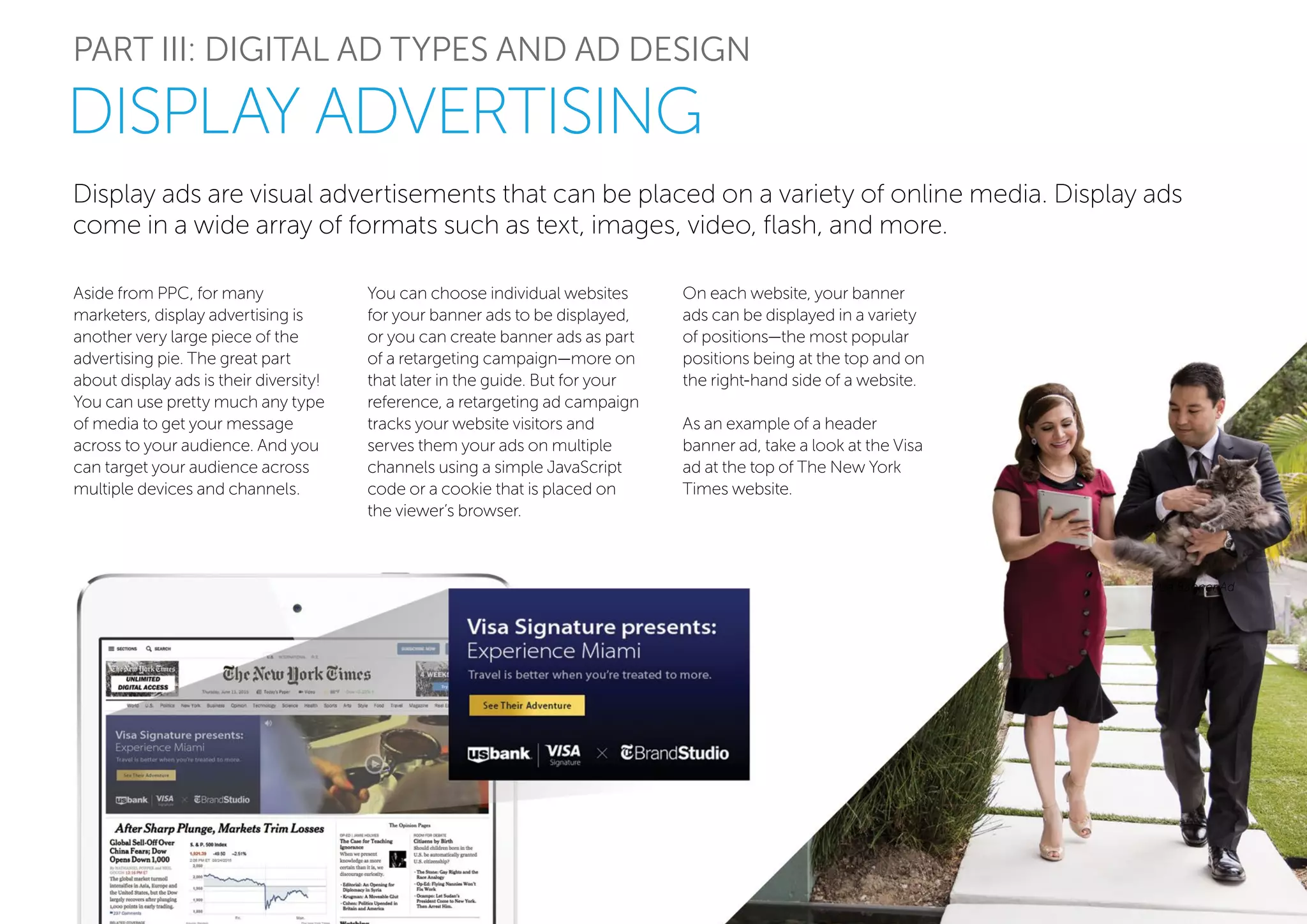
Visa Banner Ad
DISPLAY ADVERTISING
On each website, your banner
ads can be displayed in a variety
of positions—the most popular
positions being at the top and on
the right-hand side of a website.
As an example of a header
banner ad, take a look at the Visa
ad at the top of The New York
Times website.
PART III: DIGITAL AD TYPES AND AD DESIGN
Economist Banner Ad
Here you can see another example of
a banner ad placement on the
website sfist.com. The Economist has
a banner ad in the upper right-hand
side of the website.
There are many types of display ads.
We will go over some of the most
popular types of display ads in the
upcoming sections.
DISPLAY ADVERTISING
41
PART III: DIGITAL AD TYPES AND AD DESIGN
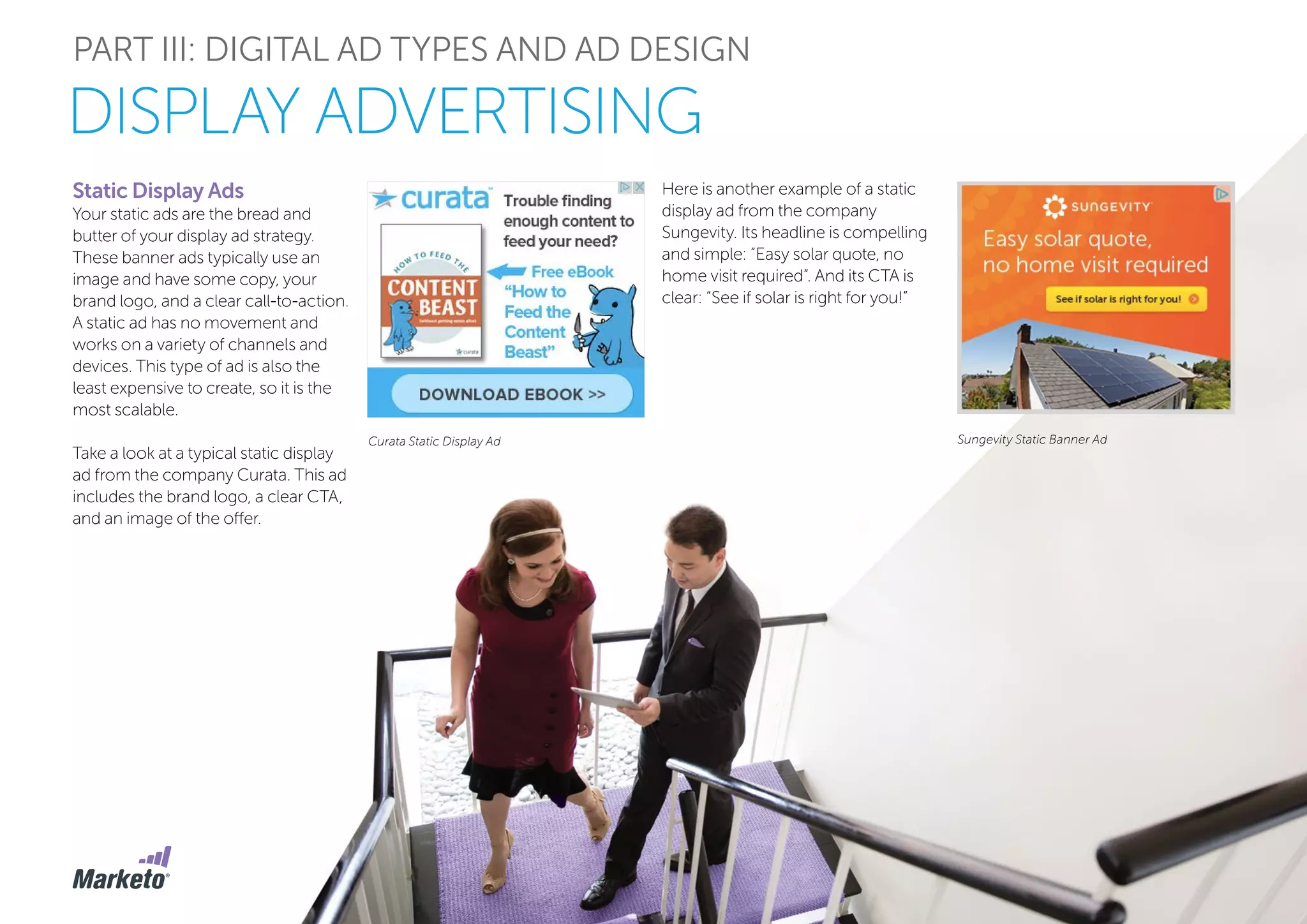
Curata Static Display Ad Sungevity Static Banner Ad
Static Display Ads
Your static ads are the bread and
butter of your display ad strategy.
These banner ads typically use an
image and have some copy, your
brand logo, and a clear call-to-action.
A static ad has no movement and
works on a variety of channels and
devices. This type of ad is also the
least expensive to create, so it is the
most scalable.
Take a look at a typical static display
ad from the company Curata. This ad
includes the brand logo, a clear CTA,
and an image of the offer.
Here is another example of a static
display ad from the company
Sungevity. Its headline is compelling
and simple: “Easy solar quote, no
home visit required”. And its CTA is
clear: “See if solar is right for you!”
DISPLAY ADVERTISING
PART III: DIGITAL AD TYPES AND AD DESIGN
Best Practices for Static Display Ads
According to SwellPath, there are 10
best practices when it comes to
static display ads:
1.	Have a clear CTA:
This is the most important best
practice when it comes to your
advertising. You are paying
good money for your banner
ads so you want to ensure that
the people who click on your ad
do exactly what you want them
to do. Keep your CTA short, and
if possible, action-oriented.
Some great examples are
“Download Now”, “Shop Now”,
“Buy Now”, “Learn More”,
and so on.
2.	Have a great hero image:
You need an image that is
essentially the hero of your ad.
Websites can be extremely
noisy. Your buyers might even
be surrounded by a variety of
other banner ads. So make sure
your image stands out from the
crowd. Make it eye-catching,
have high contrast imagery, and
consider using lifestyle imagery,
as studies show this tends to
perform better.
3.	Have great branding:
Make sure that your ad branding
is consistent with your website
and other collateral. Your ad
should have your brand colors,
brand fonts, and other elements
so people know that the ad is
from you!
4.	Company logo:
This seems pretty simple, but be
sure to include your brand logo!
You can test placement, but
according to data from
SwellPath, logos work best in
the top left or right corners or
the bottom left or right corners.
5.	Include a promotion:
By including some type of
promotion in your ad, you
could yield a higher click-
through rate (CTR). Consider
offering a discount, free
shipping, or other offer.
6.	Include a sense of urgency:
You can include a sense of
urgency by saying that your
promotion “Ends Today” or
that this is a buyer’s “Last
Chance”. People are much
more likely to click on ads
that include this sort of
verbiage.
7.	Include a headline:
Be sure to add a text headline,
in addition to your image, so
your audience knows exactly
how to think and feel as well
as what to do.
8.	Match your landing page
to your ad:
We have said this a few times,
but it begs being repeated. Make
sure that your landing page
matches your ad! If your ad
promotes a pair of red shoes and
your landing page promotes a
pair of blue shoes, you are
risking drop-off. We will go into
more detail on landing page
optimization in the next section.
9.	Size correctly:
There are definitely banner ad
sizes that outperform, so make
sure you are focusing time on
the following sizes:
	 a. 300x250
	 b. 160x600
	 c. 728x90
	 d. 600x315 (Facebook)
10.	Always be testing:
You can test various elements of
your banner ads, so make sure
you are proactively testing! We
will go into much more detail on
testing later on in this guide.
DISPLAY ADVERTISING
43
PART III: DIGITAL AD TYPES AND AD DESIGN
Video Display Ads
Video display ads take banner ads to
the next level by adding video—
making your ads much more
interesting and interactive for your
viewer. Your video ads are similar to
your static display ads in that there is
typically an engaging image, a
headline, and a brand logo.
But video ads have, well, video! So
the CTA for your video ads will
typically be “Watch the Video” or
“Discover the Video”, and so on.
Video ads have extremely high
engagement rates. According to
comScore, video ad impressions
surpassed 20 billion in June 2013,
and video ads reached nearly 54%
of the population an average of 121
times per month.
And marketers agree. According to
a BrightRoll survey of top ad
executives, 91% believe online video
ads are equally or more effective
than display advertising, 75% believe
they are more effective than TV,
and 68% believe they are more
effective than social media.
Take a look at an example of a video
ad from Dior. The ad features the
musician Rihanna, which immediately
catches a viewer’s attention due to
her pop icon status. The Dior ad uses
eye-catching imagery and includes
the CTA to watch the video.
What Do Certain Colors Mean
in Digital Advertising?
According to Stream Companies, color is a
powerful element in digital advertising. Here
are some best practices to keep in mind:
Red is a powerful color in digital ads,
stimulating consumers’ minds and
encouraging them to make impulse
purchases.
Orange is known to increase oxygen supply
to the brain and stimulate mental activity.
Green represents confidence and safety,
reassuring buyers that they’re making the
right, safe choice.
Blue has a calming effect in consumers as
well as varied connotations including
smoothness, cleanliness, and nature.
Yellow encourages consumers to see a
product as conjuring playfulness and youth.
Black tends to be associated with luxury,
attitude, and power.
Dior Video Display Ad
CNN “The Seventies” Video Display Ad
Here is another example of a video
ad from a new CNN original
content video series, The Seventies:
One Nation Under Change. Not
only does CNN have a video display
ad to promote its show, but it also
has special branding across the
header of the website.
DISPLAY ADVERTISING
PART III: DIGITAL AD TYPES AND AD DESIGN
Best Practices for
Video Display Ads
Like static display ads, there are best
practices that you can utilize to make
your video ads a success. According
to Entrepreneur Magazine, there are
six best practices to keep in mind
when creating your video ads:
1.	Define your audience
before creating your video:
Instead of creating one video
that spans all of your ads, make
sure that you are creating videos
that speak to the target audience
you have in mind. A video that
resonates with one audience
may not resonate with another.
So keep that in mind during
creation and filming.
2.	Get to the point:
People have short attention
spans, especially for advertising.
According to Entrepreneur, “the
first five seconds will make or
break your video ads”. And we
believe that! Put your main point
and even your CTA in the
beginning of the video so you
can ensure that people actually
get the point, even if they don’t
watch until the end.
3.	Keep it short:
In the same vein as above, keep
your video short. Your audience
is easily distracted; make it
simple for them to pay attention.
Keep your video short—no
longer than 30 seconds for
optimal appeal.
4.	Create an obvious storyline:
Some people may view your
video ad on silent as they work,
so make sure that you have an
obvious storyline that works
even when the video is silent.
5.	Test different video
components:
Make sure to create multiple
versions of a video so you can
test. Consider testing where you
put your CTA in the video, if you
use voiceover, dialogue, or text
subtitles, what music you may
use, and what you include in the
first five seconds.
6.	Capitalize on
blockbuster concepts:
Assess pop culture and trends to
find out what’s hot. What is
everyone talking about? Which
stories and themes do everyone
recognize? Take advantage of
these bits of common
knowledge and incorporate
them into your video so that it’s
relatable for your viewer.
Native Video on Social
Video ads are starting to pop up
all over social. And instead of
having your video hosted on an
outside channel, such as
YouTube or Vimeo, most social
channels now allow you to host
your video ads directly on that
channel so your audience
doesn’t have to click out.
Another benefit of native video
ads is that they will automatically
play once your audience scrolls
over them, meaning fewer
clicks for the viewer and more
opportunity for you to pull them
into the action immediately.
DISPLAY ADVERTISING
45
PART III: DIGITAL AD TYPES AND AD DESIGN
Cinemagraphic Display Ads
Cinemagraphs use a mix of static
imagery and video to grab the
attention of an audience. These
types of ads are typically seen on
websites, but they are now
becoming more common on
social media sites like Facebook
and Instagram.
A cinemagraph uses mostly
photography, but with very specific
added movement to catch the eye
of the viewer, encouraging them to
interact with your brand.
Here is a series of cinemagraphic
display ads created by the shoe
brand Stuart Weitzman and shown
on Facebook and Instagram. While
the best way to get the point of a
cinemagraph is to view it yourself,
we will try and describe the
movement to the best of our ability!
The first ad shows movement in the
shoe’s fringe and in the feathers of
the model’s hat. By adding
movement to the fringe, the eye is
drawn to the shoes.
The next ad in the series shows a
woman tapping her foot and
listening to a record. In the ad you
can see the foot moving and the
record spinning. As you can see
(or imagine) in both ads, the
movement draws the viewers
attention to the branded item—in
this case, it’s all about the shoes.
Best Practices for
Cinemagraphic Display Ads
While there are elements of static
and video display ads in a
cinemagraphic ad, they do come
with their own sets of rules and
best practices. Here are some tips
to keep in mind:
1.	Select the right images:
With cinemagraphic ads, take
time to choose the right
image. Your image should be
on-brand, but it should also
be creative and journalistic—
something that can be the
center of your ad. While you
will be drawing attention to
various details, the ad in its
entirety will catch the
viewer’s attention.
Stuart Weitzman Cinemagraphic Ad 1 Stuart Weitzman Cinemagraphic Ad 2
2.	Choose the right
elements for movement:
The moving elements that you
choose for your ads will be
critical for engagement. The
movement is where your
viewer’s eyes will go first, so
make sure that your movement
gets your message across. The
Stuart Weitzman ad is a great
example of this, as the main
points of movement are the
shoes—drawing your attention
to the product. Other ideas
might be to add movement to
your brand logo or CTA.
3.	Highlight the
movement with color:
Make the movement stand out
even more by using vibrant colors
that contrast with the background
image. Consider a black and
white image with a bright pop of
moving color.
4.	Test your movement:
There is a lot of testing you can
do in cinemagraphic ads. You can
test various places of movement
to see what engages the
audience the most. You can also
test different color schemes and
different types of movement.
DISPLAY ADVERTISING
PART III: DIGITAL AD TYPES AND AD DESIGN
Flash Display Ads
Flash display ads use motion and
animation to increase the
engagement of your ad. Typically,
these ads are 15-30 seconds and can
either be looped or end with a CTA.
The key to a great flash display ad is
to make sure you have just the right
amount of movement—too much
can be distracting (and annoying) for
your audience. And not enough
movement will fail to attract the
viewer’s eye.
Hot Pockets Flash Banner Ad
Flash banner ads can also be
interactive—you can ask the viewer
to click on an element to customize
the user experience further.
Here is an example of a flash
banner ad from Hot Pockets. Each
element illustrates a separate piece
of animation in the ad. Notice that
the ad isn’t too busy and has a clear
CTA at the end—to learn more
about the new SideShots product.
DISPLAY ADVERTISING
PART III: DIGITAL AD TYPES AND AD DESIGN
Best Practices for
Flash Banner Ads
Flash banner ads are a great way to
attract the attention of your audience
on busy website pages. Here are
some best practices to keep in mind
when considering this format:
1.	Technical concerns:
Since most rich media banner
ads contain flash, there may be
technical concerns. Flash is
plug-in reliant and does not
show up on an iPhone, so take
this into consideration when you
choose flash ads. Consider a
universally complaint solution
whenever possible.
2.	Keep your eye on file size:
As you add more and more
animations, the file size of your
ad increases, which can become
problematic for ad submission
and page load time.
3.	Don’t distract from
your overall message:
As mentioned above, it can be
really easy to get carried away
when it comes to animation
choices. But remember that more
is not necessarily better in the land
of display ads. Instead, make sure
the animations you choose
complement your CTA and
message—not detract from them.
4.	Make sure your CTA is
clear and eye-catching:
While this, of course, can be said
for all of your banner ads, when
dealing with flash ads it is critical
that your CTA stand out from the
rest of the animation. Our
suggestion is to put your CTA at
the end of your ad, using a high-
contrast button and obvious copy.
It’s critical that your audience
actually makes it to the end! So
make sure that your animation is
short, sweet, and compels a
person to continue watching.
DISPLAY ADVERTISING
PART III: DIGITAL AD TYPES AND AD DESIGN
DISPLAY ADVERTISING
Pop-Up Ads
Pop-up ads are controversial. This is
primarily because they can be
annoying—if you do them
incorrectly. Back when pop-up ads
began in 2004, they typically opened
in a new window. However, due to
the advent of pop-up ad blockers,
advertisers have found new and
innovative ways to use pop-ups in
their advertising.
Today, pop-up ads occur mainly on
an in-window overlay. Sometimes
these ads appear right away,
sometimes they are delayed, and
sometimes you even have to
perform a certain action to get back
to reading your content.
When considering pop-up ads,
these types are the most popular:
•	Time-Based:
This type of pop-up shows
your ad after a visitor has
spent a certain amount of
time on your website. These
work well because someone
who is on your website for a
certain amount of time is
likely more engaged.
•	Scroll:
A scroll pop-up shows your
ad after the visitor has
scrolled to a particular place
on your website.
Take a look at some of these
compelling pop-up ad stats from
the site WebMeUp:
•	70% of Americans say they
get annoyed by irrelevant
pop-up ads.
•	Pop-ups are the #1 reason
people block a website or
never come back to your site.
But…
•	Pop-ups can double your
subscription rate.
•	Enterpreneur.com increased
their sales by 162%, thanks to
pop-ups.
Clearly, pop-up ads can work for or
against you depending on how you
use them.
But before we go into more detail
regarding best practices, take a look at
an example of a pop-up ad in action.
This example is from the barefoot
running shoe company, Xero Shoes.
This ad is an in-window overlay where
the viewer can easily click out, or they
can sign up for Xero’s newsletter.
Xero Shoes Pop-Up Inlay Ad
49
PART III: DIGITAL AD TYPES AND AD DESIGN
DISPLAY ADVERTISING
Best Practices for Pop-Up Ads
Pop-up ads can be considered
interruption marketing, and they are
known to annoy customers, so be
very careful with your ad and offer.
Here are some best practices to
keep in mind:
1.	Keep your CTA high value:
This is probably one of the
most important best practices
for pop-up ad success.
Because you are interrupting
your site visitor’s actions, make
sure your CTA is for something
that is meaningful. If you ask for
an email address, consider
offering an incentive like a
promotion or discount.
2.	Make your exit simple:
Have you ever received a
pop-up ad only to have trouble
closing it? Make sure your ad
has a good user experience
and offer a simple and easy
way for your site visitors to
close your ad.
3.	Timing is critical:
Think long and hard about
when you want your pop-up ad
to display. Do you want your ad
to pop up right when a person
enters your site? Or do you
want a delay? And if you want a
delay, how long should that
delay be? According to
e-Strategy Blog, best practice is
a one-minute delay.
4.	Always test:
A pop-up ad is one of the most
critical types of display ads to
test. You should be testing
length of time on site before
your ad pops-up, CTA, copy,
headline, color, exit strategy,
and placement. By constantly
testing you can be in a much
better place to determine what
works and what doesn’t for
your audience.
PART III: DIGITAL AD TYPES AND AD DESIGN
DISPLAY ADVERTISING
Mobile Ads
Since the introduction of the
iPhone in 2007, mobile devices
have permeated all aspects of
our lives. And of course, because
these devices are tied to our hips,
marketers have created different
ways to advertise to mobile
device users, both in-app and on
the web. In fact, mobile
advertising is growing quicker
than any other ad space. Data
from BI Intelligence points out
that in the U.S., mobile ad spend
will top $42 billion in 2018.
Many of the ad types described
in the prior pages can be shown
on mobile. But here is a simple
chart to help you break down
mobile ads:
Mobile Ad Locations & Types
In-Browser
•	Text Ads
•	 Static Banner Ads
•	 Video Ads
•	 Cinemagraphic Ads
•	 Pop-up Ads
•	 Social Ads
In-App
•	 Push Notification
•	 In-App Messaging
•	 Image Ads
•	 Text Ads
•	 Video Ads
Opt-In Text Messaging
•	 SMS and MMS Messaging
In-Browser Banner Ad Mobile Landing Page for Banner Ad Push Notification Opt-In SMS Text Message
PART III: DIGITAL AD TYPES AND AD DESIGN
Through social advertising you
can target the right buyers and
deliver your message on the
channels that your buyers spend
time on—like Facebook, Twitter,
LinkedIn, YouTube, and
Instagram—to name a few.
Social advertising is big for
marketers. In fact, according to
Adweek, marketers intend on
increasing their social media ad
spend by 70% in the next year.
And which platforms do your
peers use? Socialbakers did a
recent study and learned that
marketers are looking towards
Facebook as their main
advertising platform—92% of
marketers surveyed use
Facebook as their primary social
advertising platform.
SOCIAL ADVERTISING
92%
Advertising works best when you can be everywhere your buyers are. Your buyers spend time on
social media, and by advertising on these channels in an engaging and relevant way, you can
continue to nurture your buyers cross-channel.
35%
24% 23%
Social Advertising Power Tips
1.	 Don’t take yourself too seriously.
2.	Focus on valuable content and
solid offers.
3.	Utilize platform targeting for the
biggest impact.
4.	Always add value.
5.	Always test your ads and content
on each platform.
What Platforms Do Marketers Use To Advertise?
Socialbakers 52
PART III: DIGITAL AD TYPES AND AD DESIGN
SOCIAL ADVERTISING
Let’s dig into each platform to get a
better idea of which types of ads
you might be able to create.
Facebook
Facebook continues to rise as a
powerful social network with a very
large and active user base. It is built
on the idea of connecting people
and their ideas and provides a place
for users to connect with each other
and the brands they care about.
Facebook has officially created a
space for brands on its social
network and has continued to
evolve the ways that marketers can
engage with their audiences.
With Facebook’s unique targeting
abilities, advertising on the social
platform can yield some of
the biggest bang for your
marketing buck.
Contagious Facebook Advertising
So what works on Facebook for
advertising? The key is to strike a
balance between offering content
that is valuable for brand positioning
and offering content that is fun and
shareable on social channels.
You want your audience to interact
with your ads. If you can show
value to your followers, your
advertising efforts can have a true
network effect.
At Marketo, we are always
experimenting with different types
of ads and content. Over the years,
we have learned that to
successfully advertise on
Facebook you need the following:
1.	Compelling messages
2.	Eye-catching visuals
3.	Shareability
4.	A clear CTA
5.	Personality!
Promoted Posts
Your promoted post is the bread
and butter of your Facebook ad
strategy. Amplify your organic
posts and engage your followers
(and their networks) by putting
paid efforts behind some of your
top posts. Remember, when using
promoted posts for advertising
purposes, there should always be
a strong CTA—ask your followers
Uber Promoted Post
to do something. You want
people to have something to
click on. You also might consider
having your promoted posts go
directly to a form, if you want to
collect buyer information.
How do promoted posts work? You
can promote a post (including status
update, video, blog posts, and offers)
directly from your News Feed.
Here is an example of a promoted
post from Uber. This post shows up
in a user’s News Feed and is clear and
concise, and has an obvious CTA.
PART III: DIGITAL AD TYPES AND AD DESIGN
SOCIAL ADVERTISING
Facebook Ads
Facebook ads provide highly
targeted opportunities to reach
your audience. They appear on the
right-hand side of a user’s screen
and are similar to PPC ads—you
place a bid on how much you
want to pay per click, or you can
pay per thousand people who will
see your ad.
Facebook ads can help you drive:
•	Website conversions
•		Page post engagements
•	Page likes
•	App installs
•	App engagement
•	Offer claims
•		Local awareness
•	Event registration
•	Video reviews
Here is an example of a Facebook ad
from Extended Stay America. It has a
large image and a CTA to book the
best rates.
Facebook ads can be further targeted
and personalized through a
connection with your marketing
automation platform. For example,
Marketo can send lists of qualified
names to Facebook to be used as a
Custom Audience or to create a
Lookalike Audience.
Consider “Dark Posts”
Both Facebook and LinkedIn offer you
the ability to do dark posts. Facebook
calls these dark posts and LinkedIn
calls them Direct Sponsored Content.
These are ads you can create and
promote without publishing directly to
your News Feed.
Using dark posts has the
following benefits:
•	You can create dark posts for
promoting a product or service to
a specific audience.
•	You can adjust the messaging on
your ad based on the segment
you are targeting.
•	Dark posts are great for local
event promotions.
•	Dark posts are great for A/B
testing different ads.
Extended Stay America Facebook Ad
54
PART III: DIGITAL AD TYPES AND AD DESIGN
SOCIAL ADVERTISING
Twitter
Twitter has proven to be a critical part
of any marketing mix. Companies
that lack a strategy and customer
acquisition plan for their Twitter
presence are missing out on access
to a huge user base. They are also
missing out on an opportunity to
showcase themselves in a socially
savvy, relevant way.
Because of its large global user base,
Twitter is able to offer marketers
advertising options that are highly
customizable and targeted.
Promoted Tweets
Promoted Tweets are a form of paid
advertising that appear in a user’s
News Feed, targeted to followers and
users who fit your criteria. Promoted
Tweets are the ideal form of
advertising to include timely and
engaging offers, like contests and
links to relevant thought leadership.
A Promoted Tweet looks very much
like a standard tweet, but it sits at the
top of a user’s stream. You are
charged on a cost-per-click
basis, which Twitter calls
cost-per-engagement.
Your Promoted Tweets should
include an image and a strong CTA.
Here is an example of a Twitter
Promoted Tweet from Twitter Small
Biz. It has a 140-character headline,
an image, and a CTA of “Visit Now”.
You can see this ad is promoted by
the appearance of “Promoted” with
an arrow at the bottom.
Twitter Website Cards
Website cards allow you to cut
through the noise by using
interesting and engaging images,
along with your tweet, to promote
your product or message. When a
user clicks on the ad, she is taken to
your website, further showcasing
your website content.
As an example, here is a website
card from the site The Barista Bar.
Notice that the tweet itself includes
a CTA to visit the website, and the
button CTA says “Read More”. Once
a user clicks on this ad, she goes to
the brand’s website.
Twitter Small Biz Promoted Tweet
The Barista Bar Website Card
55
PART III: DIGITAL AD TYPES AND AD DESIGN
SOCIAL ADVERTISING
Lead Gen Cards
This type of ad is similar to website
cards, but includes a one-click offer
feature, which provides you with the
user’s contact information (from his
Twitter account), without requiring a
form completion or navigating away
from Twitter.
Brands can use Lead Gen Cards to
offer a free trail, ask users to enter a
contest, sign up for a content asset,
and so on.
On the right, you’ll see an example
from Marketo to download our
Definitive Guide to Engaging Email
Marketing. It includes a tweet and a
CTA to “Get the Ebook”. And then
Twitter auto-populates the user’s
contact information—in this case,
name and email address.
Promoted Accounts and Trends
Twitter also offers two additional
promoted ad options—Promoted
Accounts and Promoted Trends. With
Promoted Account ads, businesses
can make their Twitter accounts
show up under the “Who to Follow”
list on their Twitter pages.
Marketo Lead Gen Card
Spreadfast Promoted Account Crocs Shoes Promoted Trends
This can be targeted based on who
a user typically follows—whether it
is a similar advertiser or an industry
thought leader.
Promoted Accounts can also be
placed in search results when
someone searches for a
particular hashtag.
Take a look at an example of a
Promoted Account. The company
Spredfast has promoted its account
as a brand that this particular user
should follow.
Promoted Trends enable a business
to promote a particular trend or
hashtag, which appears on the
left-hand side of the user’s screen
under “Trends”. By leveraging
Promoted Trends you can prompt
more people to share your hashtag
and engage with your brand.
To the right is an example of a
Promoted Trend from the
company Crocs–#FindYourFun.
The Promoted Trend appears at the
top of the organic trends in a
person’s News Feed.
56
PART III: DIGITAL AD TYPES AND AD DESIGN
SOCIAL ADVERTISING
LinkedIn
LinkedIn has experienced explosive
growth in recent years by adding
capabilities to entice marketers from
virtually every industry, connecting
them with a multitude of audiences.
LinkedIn has expanded its solution
way beyond a hiring and networking
platform to include company pages,
a highly targeted advertising
solution, and a publishing platform.
With these additions, LinkedIn is
now the way to reach an audience
with a business mindset.
LinkedIn Sponsored Updates
enables companies to put paid
promotions behind their status
updates. These promoted updates
are seen by your followers and
targeted users outside of your
follower network. Like all other
social ads, LinkedIn updates should
include a visual and then a link to a
gated landing page. Because these
ads appear in a user’s News Feed,
these feel like a natural part of the
user experience, leading to
higher engagement.
Here is an example of a Sponsored
Update from the company Bizable.
It includes an introductory
sentence, a CTA link, and an image,
making it much more click-worthy.
LinkedIn Ads
LinkedIn Ads appear in various
places across the platform, like the
side, bottom, and top of the
homepage. These ads are highly
targeted and can be customized to
include images, video, or only text.
However, according to LinkedIn,
adding an image to your ad can
bring you 20% more clicks!
LinkedIn also has premium ads that
offer more options for how the ads
are served and the size of the ad.
This gives marketers much more
flexibility with their message
and creative.
These types of ads include textlinks
that sit on the home profile,
company, group, and message
pages, footer banners, and
larger- sized navigation banners.
Bizible Sponsored Update
PART III: DIGITAL AD TYPES AND AD DESIGN
SOCIAL ADVERTISING
LinkedIn Lead Accelerator
As LinkedIn continues to expand its
advertising efforts, LinkedIn Lead
Accelerator fuels the effort to help
companies attract and nurture the
right people, with the right content,
at the right time. Additionally,
through LinkedIn Network Display,
its ad display network, companies
can target their audience both on
and off the LinkedIn platform.
What makes this capability even
better? Its integration with marketing
automation platforms like Marketo
to further enable marketers to target
and engage buyers with a plethora
of information.
According to LinkedIn, key benefits of
this integration include:
•	Nurturing known contacts with
sequenced ads that align with
your existing digital nurturing
strategies
•	Nurturing anonymous prospects
based on their profile and online
behaviors
•	Optimizing ad creative and
nurture stream design through
platform-supported A/B testing
•	Measuring program impact at
every stage of the buying process
through built-in reporting within
LinkedIn and Marketo
Sponsored InMail
A Sponsored InMail gives advertisers
the ability to send a type of email
message that appears in a user’s
LinkedIn inbox. This is a great way to
send very specific, targeted, and
detailed messages to an explicit set of
users. Think of Sponsored InMails just
like emails—they need to have an
eye-catching headline and make your
content short and sweet!
PART III: DIGITAL AD TYPES AND AD DESIGN
SOCIAL ADVERTISING
Instagram
Instagram focuses on capturing the
attention of your audience through
rich imagery and photography. This
can be a fantastic social channel for
brands looking to solidify brand
look and feel, and create and inspire
relationships. Through Instagram,
brands can advertise through a
wide variety of photographs and
video imagery.
The key to Instagram ads is for
brands to make them appear like a
seamless addition to the user’s
News Feed. They must be highly
visual in an engaging way.
Instagram also offers the ability to
showcase video ads, in addition to
traditional photography.
Single Photo Ads
Single Photo Ads on Instagram are
Instagram’s most popular ad
format. These ads include a single
image created by the brand, a brief
description, and typically a variety
of hashtags, which are an important
part of the Instagram experience.
When you use hashtags in your ads
they will appear when a user
searches for that particular hashtag
or topic.
Take a look at a single image ad
from Levi’s. It includes a photo that
has an editorial quality, and the
copy includes various hashtags.
Instagram Single Photo Ad
Pencils of Promise Carousel Ad
Multiple Photo Carousel Ads
By using the carousel ad feature on
Instagram, brands are now able to
show even more images to their
target audience. Viewers can swipe
through a variety of photos—
enabling brands to tell longer and
more engaging visual stories.
Instagram considers these ads as
“bringing the potential of multi-page
print campaigns to mobile phones—
with the added benefit of taking people
to a website to learn more”.
Here is an example of a carousel ad
from Pencils of Promise. They give their
viewers a selection of photos that helps
to tell their brand story. As the user
swipes, a new photo appears.
59
PART III: DIGITAL AD TYPES AND AD DESIGN
SOCIAL ADVERTISING
YouTube Ads
Video is becoming an
increasingly important content
marketing tactic. Attention spans
are shorter, and today’s buyer
loves interacting with videos. In
fact, according to the marketing
agency Insivia, viewers of
marketing videos are proven to
retain over 95% of the information
expressed through video.
YouTube is a key channel for
watching videos online. Whether
your buyers are looking at funny
cat videos or watching
explanatory marketing videos,
there are various types of ads you
can show to targeted audiences
based on content.
In-Stream Ad
A YouTube In-Stream ad is shown to
a viewer before the video begins.
The In-Stream ad requires the
viewer to watch your ad for the first
few seconds before they have the
option to skip to the main video
they are watching. These ads are
charged on a cost-per-view basis,
and you can target your audience
through behavior or content.
Here is an example of an In-Stream
ad from Xfinity that appears before
the video “Grumpy Cat in the
Sky?!?”. After a few seconds, you
can skip directly to the video.
The key here is to put your most
important information in the
beginning, and then try to make
your video ad compelling enough
for a person to not want to skip
through it.
In-Stream Xfinity Ad
60
PART III: DIGITAL AD TYPES AND AD DESIGN
SOCIAL ADVERTISING
In-Search and In-Display Ads
In-Search ads on YouTube appear
when you search. The ad is shown as
“recommended” based on either the
content you are watching, your
YouTube search, or your browsing
activity across the web.
Here is an example of an In-Search
ad on YouTube. There are two
In-Search ads here—one for a Friends
Furever video based on the viewer’s
YouTube history, and one from Digital
Marketer based on the viewer’s
search history on Google.
In-Display Ads are similar, but they
show up on the right-hand side of
your screen as recommended while
you watch content. Here is an
example of an ad from PopFoam that
appears during a funny dogs
compilation video.
In-Search Ad on YouTube
In-Display Ad
61
PART III: DIGITAL AD TYPES AND AD DESIGN
SOCIAL ADVERTISING
In-Video Overlay Ads
Banner ads can also show up on
YouTube. This is called In-Video
Overlay. These are part of the Google
display ad network. These banner
ads appear on top of the video a
viewer is watching. A viewer can click
on the call-to-action and go to your
website, or they can easily click out.
These are very similar to standard
banner ads.
PART III: DIGITAL AD TYPES AND AD DESIGN
SOCIAL ADVERTISING
Social Advertising and
Marketing Automation
One of the unique attributes of
using social networks for
advertising is the ability to target
based on behavioral and
demographic attributes. Using your
marketing automation platform,
including a personalization product
like Marketo’s Real-Time
Personalization, you can actually
leverage this data on social
channels to enhance and
personalize your advertising.
Cross-Channel Case Study: 3 Day Blinds
By connecting your marketing
automation with Facebook,
LinkedIn, and Twitter, you can
target the right potential
customers with meaningful,
relevant ads. With this connection,
you can reach the right individuals
through your ad channel with
personalized messages based on
product interests, past purchases,
buying intent, overall engagement,
and more. You can even target
anonymous buyers who have
visited your site and then visited a
social network afterwards.
Challenge: 3 Day Blinds,
a custom window
treatment retailer and
manufacturer, wanted to
connect with and nurture
its customers with
relevant advertising on
the right channels that its
customers spent time on.
Solution: 3 Day Blinds
used Marketo’s Ad Bridge
solution and online
advertising platform Turn
to deliver targeted and
personalized ads across
channels, including web,
mobile, and social media.
Outcome: 3 Day Blinds
currently has 28 ad
campaigns running. It has
seen an 850% increase in
leads per click, a 140%
increase in appointments
per lead, and an 80%
reduction in cost per action.
Each company’s needs differ when it comes to digital ads. Some companies require the creation of a
lot of ads, while others might have just a few. Some companies dabble primarily in video ads, while
others only find value in static ads. Whatever your company’s situation, it’s a good idea to follow
some common best practices when it comes to ad design.
PART III: DIGITAL AD TYPES AND AD DESIGN
Follow Border
Requirements
The IAB asserts that display ads
should be clearly distinguishable
from normal webpage content and
must also have defined borders,
thus not to be confused with other
web content.
Ad networks also often implement
this guideline, so it is important for
marketers to follow it in order for
their ad to get approved.
EFFECTIVE AD DESIGN
Avoid Computer
Simulations
Do not include fake computer-like
sounds in your animated digital ads
that people may confuse with being
a computer notification. This is not
only a best practice, but it also
protects your brand’s image from
being associated with malicious
advertisers and viruses.
Find Text/Image Balance
Ensure you have a good balance
between use of text and images.
Some ad networks, like Facebook,
require that the ad only consist of up
to 20% text, and for good reason.
Viewers are more receptive to ads that
are short and simple, versus those that
take too long to consume, whether
that’s reading the text itself or
understanding the hidden message.
When in doubt, avoid complexity and
stick to simplicity. If it takes you more
than one second to “get it”, that’s
probably too long.
PART III: DIGITAL AD TYPES AND AD DESIGN
Use Images That
Are Worth It
While using imagery to attract
customers to your digital ads is a
must, the selected images must be
worth it. Google found that an image
load time increase from 0.4 to 0.9
seconds decreased interest and
traffic by 20%. So, first and foremost
you need to ensure that the images
used in your ads will load
immediately. Otherwise, impatience
will drive customers to ignore your
ads or click to a new page altogether.
EFFECTIVE AD DESIGN
Here are additional image guidelines
to follow, courtesy of Kissmetrics:
•	High-resolution Imagery:
Use only high-resolution photos
that are properly sized. Avoid low
resolution and overstretched
photos that will have your
customers squinting or
turning away.
•	People Photos:
It’s fine to include images of
people, but try to focus on just
one or two people at the most.
Injecting crowds or even just a
small group of people into your
ad can be a turn off. Why? There
can be a lack of focus, which can
overwhelm the viewer, making
the image (and your ad) less
memorable. In addition, images
of people should show them at a
comfortable distance away from
the camera; avoid super close-up
shots that will have your viewer
scrolling away.
•	Stock Photography:
Avoid using stock photos that are
obviously stock photos. As much
as they try to be, your customers
don’t see these as real life
because they’re too perfect and
posed. Your customers want to
see something that’s relatable,
and as a result, they will perceive
your brand as relatable.
Therefore, include photos that
breathe a sense of reality.
•	Relevance:
Images need to be relevant to the
company, to the brand, to the
message, and to the text. To
ensure relevance, make sure to
use images that either:
›› 	Demonstrate the messaging:
This can be either implied or
blatantly written in the text and
should help the viewer to make
a connection, or
›› Provide story appeal: Ignite
enough curiosity in the viewer
to click on the ad to obtain the
rest of the story.
Create Fallback Images
Some ad networks require that you
create and provide fallback images,
which are simplified versions of
your more complex display ad,
such as a static version. This is in
case the original ad cannot be
viewed on certain screens.
This is more than just a best
practice—it’s also a problem-solver
for your company. You wouldn’t
want to put the effort into creating
an awesome digital ad only to find
that it’s not viewable by all
audiences on all devices. With
fallback images, customers will at
least be able to see some version
of your ad and be exposed to your
company’s message.
65
PART III: DIGITAL AD TYPES AND AD DESIGN
Vary the Brand Visuals
It’s a good idea to create more than
one variation of your company’s
logo. This enables variation in your
digital ads, which supports branding
efforts. The more ways that a
customer can identify you, the
further reach you have and the
stronger your brand becomes.
For instance, Google’s brand is
identifiable as the typical Google
logo, but it’s also identifiable as just
the branded “G” logo.
Having a smaller version of your logo
also frees up more space for
inclusion of other content. In
addition, having a smaller version of
your logo will enable you to fit into
parameters set by some ad networks.
EFFECTIVE AD DESIGN
Consistency
If there’s only one rule that all digital
advertisers can follow in their design
of digital ads, it should be to stay
consistent. What does this mean?
Consistency means that all of your ads
have a similar look and feel and always
relay your brand message to your
audience. This is one of those rules
that is easily forgotten, as digital
advertisers unleash their creative side.
So, make sure to check your work on
a regular basis to be sure it doesn’t
stray too far.
What are the consequences of going
too far? Your branding will be
negatively affected since customers
will not easily be able to make
connections from one ad to another.
Making these connections is key to
developing your brand and company’s
story, which is something you
definitely want relayed and told well.
Digital advertisers go through ad networks, such as Google, Facebook, and LinkedIn, in order to get
their ads placed online. In order to be accepted by certain ad networks and placed on certain
websites, digital ads must adhere to certain parameters and specifications in their design.
PART III: DIGITAL AD TYPES AND AD DESIGN
Ad Network Specifications
What works for one ad network
may not work for another; each ad
network specifies its own
parameters, so digital advertisers
need to listen and follow through
accordingly to make sure
they’re compliant.
It’s definitely a good idea to confirm
your understanding of the
parameters prior to creating a digital
ad that’s intended for a certain
network, otherwise, you may end
up having to redo it completely—a
task that no one wants added to
their already overflowing plate.
Save yourself the energy and
money by researching ad network
parameters ahead of time. In doing
so, you’ll also find out which specs
work to carry out your vision, and
which don’t. For instance, if video
ads are crucial to your company’s
digital advertising strategy, but the
DESIGN WITHIN SPECIFICATIONS
parameters for video ads of a certain
ad network do not mesh well with
your company’s needs, you may
choose to avoid that ad network
altogether. Clearly, it’s smart to
discover these things ahead of time
before putting in the work.
Device Optimization
Your digital ads must be optimized
for every platform, whether that’s
desktop, mobile, tablet, or even IoT
devices. Ads can’t be too large or
else the image or the video inside
the ad will not properly load, or will
take too long to load. This situation
deters your audiences from the ad
and, ultimately, from your brand.
The guideline is simple: don’t
exceed the recommended
megabytes (or kilobytes) for your
ad’s image or video.
Ad Network Specifications for Design
Whether you want to place your ad on social media or
another ad network, you need to be familiar with the specs:
Social media ad networks:
•	Twitter paid promotion banners—800x320 in size
(for website cards)
•	Facebook—600x315 in size
For paid ads, only up to 20% of the ad can be text.
•	LinkedIn banners—W180x110
•	LinkedIn Lead Accelerator—360x220 in size
Here are common sizes for PPC ads mandated by Google,
a dominant ad network in the online space:
•	300x250 (medium rectangle)
•	300x600 (half page)
•	320x100 (large mobile banner)
•	336x280 (large rectangle)
•	728x90 (leaderboard)
•	160x600
67
ALISON ENGEL
THOUGHT LEADERSHIP INSIGHTS
Vice President, Global Marketing, LinkedIn
MKTO: How do you see the role of
digital advertising changing as a
part of the overall marketing mix?
AE: When it comes to digital
advertising, it’s no longer a question
of if you’re going to use online
channels in your marketing mix, but
to what extent you’re going to use
and explore the available
opportunities. Marketers will
continue to invest in online channels
because that is where their target
audiences are. The beauty of digital
advertising is that it is evolving into a
channel that offers relevancy at
scale—you no longer need massive
budgets to get your brand in front of
the right people at the right time, and
across multiple channels.
What’s more, we’re now able to
measure and track the impact of our
digital advertising efforts at any stage
along the buying process like never
before. Because of this, more
marketers will gravitate towards all
the benefits that digital advertising
provides—from brand awareness to
engagement to conversion—and will
increasingly be able to obtain an
accurate picture of their ROI every
step of the way.
MKTO: What is one mistake you see
marketers often make when it
comes to digital advertising?
AE: Many marketers fall into the trap
of applying the same success metrics
to every tactic or channel they’re
utilizing, when the truth is that every
marketing program has its own
specific role to play and should be
measured accordingly. For example,
in the B2B world, demand generation
marketers may be tempted to focus
solely on bottom-funnel conversions
such as leads or cost per lead (CPL)
as their primary success metrics.
However, in doing so, they risk
undervaluing any top-funnel
activities that were responsible for
driving prospects into the funnel in
the first place.
Remember that just because
something is easy to measure
doesn’t mean it’s the right success
metric. Instead, first consider your
marketing objectives, the channels
you’re using to achieve these goals,
and the impact you’re looking to
make on the marketing funnel. For
example, if you’re using display
advertising to increase brand
awareness, you would use top-
funnel metrics such as brand recall,
share of voice, or increase in
targeted website traffic to measure
success—not bottom-funnel
metrics such as leads or cost per
@ALangeEngel
ALISON ENGEL
THOUGHT LEADERSHIP INSIGHTS (CONTINUED)
Vice President, Global Marketing, LinkedIn
lead (CPL). Once you start
measuring success based on
objective and channel, you’ll have a
better idea of how each of your
marketing programs is contributing
to your overall mix.
MKTO: How has testing and
optimization of digital advertising
changed, and how do you see it
changing in the future?
AE: Every marketing organization
that invests in digital advertising
needs to be testing—period.
Deploying smart testing practices
as an integral part of how you run
programs is directly correlated to
the size of the return you’ll get on
the marketing budget you invested
in them. However, with all the
different systems and specialized
teams in place to drive different
programs, it can sometimes be
paralyzing to come up with a
comprehensive testing and
optimization strategy.
As a rule of thumb, don’t try to test
everything. Determine the lowest-
hanging fruit and focus testing
energies on where you think you can
move the needle most. For example,
it’s fairly easy to test two different
calls-to-action on a display ad, which
can deliver enormous insight into
what drives the most conversions for
your campaign.
And if you’ve been testing for a while,
there are tremendous opportunities
to get really savvy with your testing.
Test different types of content against
different target audiences or levels of
engagement. For example, are you
certain that case studies will resonate
only with people who are highly
engaged on your website or further
along in the purchasing decision?
This may not always be the case, so
it’s important to test these
assumptions, no matter how
ingrained they may be.
PART IV:
DIGITAL AD LANDING PAGES
#MKTOGUIDE
Landing pages are customized pages that your buyers are directed to from one of your digital
ads. No matter how much time or money you spend on a digital advertising campaign, if your
landing page doesn’t resonate with your audience, they will bounce (leave your page)—
potentially never to return.
PART IV: DIGITAL AD LANDING PAGES
The goal of your landing page is to
keep prospective customers
interested enough to continue
reading, fill out your form, and
perform your desired action.
Most landing page visitors only
take a few seconds to decide
whether they’ll read a page or
bounce. Does the page make
sense immediately, or is it too hard
to understand? Is it relevant to the
ad that your buyer clicked on, or
does it seem out of place?
LANDING PAGES FOR DIGITAL ADVERTISING
Be Campaign Specific
Your landing page should be specific
to your advertising campaign.
Although creating a new landing
page for every ad or campaign isn’t
easy, it is a critical part of
conversation and optimization
when it comes to advertising.
Take a look at an example for a PPC
ad. For the search term “Marketing
Automation” we get the following ad
from Marketo.
When you click on the ad, you go to
a landing page. As you can see, the
landing page matches up with the ad.
From the headline “Marketing
Automation 101”, we get a landing
page that prompts the download of
The Definitive Guide to Marketing
Automation—everything you need to
know about marketing automation.
Marketo PPC Ad
Marketo Landing Page
Let’s look at an example from a
banner ad. This banner ad
appeared on www.sfgate.com
for MarketingProf’s Everybody
Writes University.
LANDING PAGES FOR DIGITAL ADVERTISING
MarketingProf’s Banner Ad
MarketingProf’s Everybody Writes Landing Page
The link brings you to a landing
page where you can sign up for
the course.
Both examples provide a seamless
experience for the user. Once they
click on your ad, they go to a landing
that contains content that matches
the ad they clicked on.
PART IV: DIGITAL AD LANDING PAGES
72
Err on the side of simplicity with your landing page design. Use your design layout carefully—the
wrong design for your audience can immediately detract from the offer and the conversion. Simply
put: design can have a polarizing effect!
Consider including the following
design elements in your
landing pages:
•	Company name and logo
•	Banner image or heading
•	A “hero” shot of the offer
•	A clear CTA
•	Social sharing buttons (optional)
LANDING PAGE DESIGN
DoorDash Landing Page Design
Take a look at the landing page
from the company DoorDash. This
landing page appears after you click
on one of its Facebook ads. The
landing page is highly visual, it
includes the company name and
logo, it has a heading that states
“Your favorite local restaurants
delivered to you”, and it has a very
clear CTA—“Enter your address to
find restaurants near you”.
Removing Navigation
It may be tempting to include your
main navigation links on your landing
pages. You might think to yourself, “If
they don’t like this offer, they’ll be
able to find something else on my
website”. However, navigation links
often add too many choices that can
actually distract from your main CTA.
In eye-tracking studies, it’s been
found that navigation panels draw
attention away from your offer.
Remember that your main goal
might not be to have your buyers
visit your website. Instead, you want
them to convert for a particular ad
and campaign. After they convert,
feel free to send your buyers
additional information—just don’t
muddy the waters when it comes to
your initial interaction.
PART IV: DIGITAL AD LANDING PAGES
73
Your landing page copy and CTAs should be clear and direct and should give your buyers
a good reason to provide their information or make a purchase.
As you write your landing page copy,
use these four steps as guidance:
•	Step 1: Set up the problem
•	Step 2: Talk about the solution
•	Step 3: Point out the WIIFM
(What’s In It For Me)
•	Step 4: Deliver the goods!
Scannable Content
People don’t read full landing pages;
they scan. Studies have shown that,
at most, people read three pieces of
your landing page:
1.	Headline
2.	Bullet points
3.	Bio (if applicable)
LANDING PAGE COPY
Always keep the content on your
landing page short and sweet with
a bold headline and some light
copy. Your copy length will likely
vary based on what sort of
company you are and who your
buyer personas are.
It is a good practice to use the main
keywords from your ad in your
landing page headline. This helps
to maintain consistency, shows
your audience that your landing
page directly correlates with your
ad, and also helps with your
Google Quality Score.
Also consider using interactive
content elements like a short video
or audio clips. Your landing page
doesn’t need to sell your company
right then and there, but it does
need to have a clear offer. Focus
your landing page around a single
CTA, which must be relevant to the
ad your buyer clicked through.
Take a look at this Marketo
example. It includes a bold
headline, an eye-catching header
image, bullet points for
scannability, and a clear CTA of
“Download Today!”
Marketo Landing Page Copy
PART IV: DIGITAL AD LANDING PAGES
74
JULIE REZEK & KEITH JOHNSON
THOUGHT LEADERSHIP INSIGHTS
President, Wunderman Seattle General Manager/Interactive, Wunderman’s KBM Group
MKTO: How do you see the role of
digital advertising changing as a
part of the overall marketing mix?
Wunderman: Digital advertising is
poised to be an overwhelming
portion of the marketing mix in the
very near future. As evidence for this,
five years ago digital media was
planned in silos apart from other
types of media, and new ad agencies
that called themselves “digital”
appeared on the scene. Those
approaches are already outdated. In
our work with publishers and media
agencies by virtue of our data
management platform, Zipline, we
have observed a shift where leading
advertisers now plan digital media
alongside analog media with a
unified data and creative team at the
core. The focus today is on the
audience first, media second, and
measurement third. When done
properly, it becomes a closed loop
cycle from which we continually
learn and improve our
communication with consumers.
In addition, we live in an era where
new forms of media like mobile and
IoT are inherently digital. These new
digital medias are being joined by
bastions of analog media such as
social (aka word of mouth) and TV
as they become digitized in part or
in whole. Media will continue to
evolve change, and grow in
unexpected ways. But, one thing is
clear: Until we have the next
disruptive change in computing or
technology, the gravitational pull of
digital media will continue to
strengthen. This leads to the
conclusion that we must stop
thinking that “Digital” is a media
channel or even that it stands as a
synonym for a small collection of
types of media like banner ads. We
must recognize digital for what it is:
a technology and method by
which we communicate with
consumers. Once we adapt our
thinking to this current reality, we
are compelled to change the way
we think plan, and act in response
to the consumer’s needs.
MKTO: How do you see IoT
changing how marketers
advertise today? How is that
similar or different from the rise
of mobile devices?
Wunderman: IoT is one of the
most exciting things to come our
way since the advent of the
telephone. We are just barely
beginning to scratch the surface of
what will be possible. Can you
envision a world where your
refrigerator automatically re-orders
@WUNSeattle
@KBM_Group
THOUGHT LEADERSHIP INSIGHTS (CONTINUED)
the O.J. from Amazon Pantry and is
delivered via drone? Or when you
land at London Heathrow and your
mobile phone tells your Google-
enabled, driverless car to pick you up
at the international terminal in 17
minutes? This is the clear direction
we are headed. As a company with
experience in collecting and—most
importantly —connecting data
(thanks to our Zipline Data
Management Platform) we
understand how an integrated data
infrastructure makes it all possible,
virtually instantaneously.
What’s different between IOT and
mobile is that mobile is inherently
personal and relates to “me”. IoT
relates to things, which may or may
not interact with people. IoT will
create a societal transformation in
ways we don’t yet even understand.
By default, it will create
transformational advertising
opportunities for the way in which
we engage consumers. Data will
be at the hub of all this, in a largely
digital context.
The extent to which advertising
will change as a result of IoT will be
dictated by the bounds of
technology. However, a more
overriding factor determining the
extent of change will be society,
as our collective views on the
inalienable right, or not, for privacy
and the new boundaries that need
to be considered come into focus.
Based on the current state of
attitudes toward privacy, this will
be a global phenomenon with
different countries drawing the
lines in different areas, creating
increased complexity for global
marketers. We must rise above this as
an industry, and adopt clear and
compelling guidelines for data use
with IoT, which can be adopted by
most nations. A common set of
standards will not only accelerate
technology advancement, but more
importantly, it will ease consumer
adoption if done correctly.
JULIE REZEK & KEITH JOHNSON
President, Wunderman Seattle General Manager/Interactive, Wunderman’s KBM Group
PART V:
AD TARGETING
#MKTOGUIDE
Targeting audiences is one of the most critical aspects to any marketing campaign, but especially
digital marketing. Without targeting, advertisers would not be able to specifically use advertising to
communicate with the right audience, at the right time, with the right message.
PART V: AD TARGETING
Targeting allows for a level of
personalization and relevancy that
customers have grown to expect.
And for marketers, it provides a way
to segment audiences, test, and
optimize for improved metrics.
This section will explore the ways to
target—audience-oriented targeting
and content-oriented targeting. It will
also explore the variety of targeting
methods that support them.
WHAT IS AD TARGETING?
D
emographi
c
Behavioral
Retargeting
Device Content
Carrier
Geographi
c
Types of Targeting
78
Audience targeting is designed to match ads to groups of people interested in the products
and services of the advertiser. It includes various methods of segmentation that enable
advertisers to find and target specific audiences.
Let’s explore the various types of
audience-focused ad segmentations
that you can choose:
Demographic Targeting
Demographic targeting is one of
the oldest kinds of targeting; it
shows ads to your customers
based on a various set of
demographic information.
This often includes age and
gender, but can also include
location—depending upon the
advertising platform and their
targeting dashboard.
For example, the targeting
dashboard on the Facebook
advertising platform includes
targeting capabilities that span
different targeting strategies, so an
advertiser on the platform will see
age, gender, and location in the
same targeting module.
Facebook Demographic Categories
If you know that your business or
product tends to appeal to a specific
age group, or if your objective is to
build awareness in a specific age
group, demographic targeting would
be a good way to target audiences to
support your objective.
Demographic targeting is even more
successful when used to augment
another type of targeting, for
example, placement targeting. When
demographic targeting and
placement targeting are combined,
they allow you to deliver an ad to the
right age group of people who had
also visited sites that your customers
typically visit.
In this example you can see that
demographic targeting is also
combined with behavioral targeting,
allowing an advertiser to be
extremely specific about who sees
their advertisements.
PART V: AD TARGETING
AUDIENCE-FOCUSED TARGETING
79
Placement Targeting
As a type of audience targeting,
placement targeting shows your ads
on specific websites that you choose.
This type of targeting is particularly
helpful if you know which websites
your customers visit.
Websites like The New York Times
often offer placement targeting
options since they have an active and
loyal user base.
With placement targeting, you can
put your ad anywhere, like on certain
pages. Or, you can have the ad be
contextual (using the content of the
page to determine if your ad is a
good fit and on the same topic.)
Behavioral Targeting
Behavioral targeting serves ads
based on the interests of a visitor.
The visitor’s interests can be overtly
declared—via a form fill or
registration process—or they can be
inferred based on browser history,
like sites visited, searches, etc.
With behavioral targeting, a
customer’s previous online behavior
determines the ads they are served.
Geographic and
Language Targeting
Geographic and language targeting
means that your ads are targeted
based on the geographic location or
local language of a customer. This
can get surprisingly granular on
some advertising platforms.
For geography, advertisers can be as
broad as region and country and as
specific as neighborhood or zip code
in a particular city.
Geo-targeting is especially important
for businesses that operate in many
regions and want their ads to be
relevant and personal for audiences
in every region.
In this example you see the
geo-targeting capabilities of
Facebook’s advertising platform,
which allow the marketer to drill
down to a specific location and
distance radius.
Facebook Ad Targeting for Geography and Language
PART V: AD TARGETING
AUDIENCE-FOCUSED TARGETING
80
Lookalike Targeting
Lookalike targeting is based on
your existing marketing list and
targeted group of customers.
Many advertising platforms offer
this targeting method, which
essentially takes a pre-existing list
of customers or contacts from
you. Then the platforms find
matching audiences who “look
like” the users you provided.
What do we mean by “look like”?
Let’s say your largest customers are
women under 35 who live in
Connecticut and are interested in
tennis. Additionally, lookalike
audiences can be created based on
the types of sites people visit. By
creating a lookalike audience, the
advertising platform will find people
with the same attributes and display
your ad to those people.
This gives you the benefit of
displaying your ad to more
customers who share similar
attributes with your best
customers or best performing
targeted segment.
This type of targeting can run into
issues with scale if the initial
targeted audience is very specific
or niche because the lookalike
pool may be small.
Marketo neatly explains lookalike
targeting in this image:
PART V: AD TARGETING
AUDIENCE-FOCUSED TARGETING
Music
Buyer
Aged
21-24
Female
Student
Marketo users are segmented based
on specific attributes & behaviors.
Users sharing common attributes and
behaviors are found in Marketo’s database.
These profiled users are placed in
custom lookalike audience segments.
Marketing automation systems like
Marketo give you the ability to send
lists of qualified names, targets,
segments, or the best customers
directly to your ad targeting platform
for lookalike modeling.
PART V: AD TARGETING
Retargeting
Targeting via retargeting means
that your ads display to
customers who have already
visited your site. This differs from
remarketing, because the
customer has not gotten as far in
the consideration or purchase
process as a customer with
something in their shopping cart.
Instead of marketing something
you know they are interested in,
you might try numerous offers to
drive them back to your site.
A customer that you retarget
continues to other sites across
the internet, and your ads display
to them.
In this example, the retargeting ad
directs the customer back to the
site with a call-to-action to shop,
a promotion, and an image.
AUDIENCE-FOCUSED TARGETING
Retargeting on Facebook
Retargeting ads remind customers
not only of the products they
looked at, but also of your brand.
The goal is to drive them back to
your site to complete an action,
such as a purchase. It’s a very
powerful way for advertisers to
deliver the right message to the
right person at the right time.
PART V: AD TARGETING
AUDIENCE-FOCUSED TARGETING
Interest Targeting
Interest targeting is based on the
interest categories of customers.
This type of targeting targets
customers whose online behavior
shows they are interested in a
specific category. Those
customers are then served
relevant ads as they travel across
the internet.
This differs than behavioral
targeting because the user does
not select or self-identify their
interest; they are inferred by the
platform based on their behavior,
like browsing history. Often ad
platforms let customers tailor their
interests so they can see ads they
want, while also helping the
advertiser reach audiences
more effectively.
Interest Targeting Category Examples from Google
Interest Targeting Categories from Twitter
Here are two examples from different
advertising platforms—Google and
Twitter, respectively—that show
snippets of the different interest
categories that the platform uses to
categorize their audiences. As you
can see, the different interest
categories go from very broad to
more specific.
83
PART V: AD TARGETING
AUDIENCE-FOCUSED TARGETING
Topic Targeting
Topic targeting is advertising based
on sites that fit into a category
grouping, such as marketing,
entertainment, or fitness. It’s a type
of targeting that is done primarily on
Google, and a marketer using this
type of targeting wants to target
audiences based on the type of
website they go to, rather than
specific sites.
Topic targeting is a good way for
advertisers to get exposure on a
wide variety of sites that are
relevant, which has the benefit of
introducing them to new audiences
and building awareness.
Keyword Targeting
Keyword targeting is advertising
targeted around specific keywords.
With this type of targeting, you select
a keyword or group of keywords that
you want your ad to display for.
Google is the most well known for
keyword targeting-based advertising,
but most platforms offer it.
In the example, you’ll see Twitter’s
advertising platform for promoted
tweets includes keyword targeting.
Twitter Advertising Keyword Targeting Dashboard
Content oriented ad targeting considers the content on the page as a part of the targeting method—
delivering ads that are more relevant to the experience a customer has on a website. This type of
targeting often does well in combination with the audience-targeting methods described previously.
Contextual Targeting
Contextual targeting delivers
relevant messages to users based on
the type of content they consume—
whether that is an article or a
content asset like an ebook or blog.
Contextual targeting enables
advertisers to deliver their ads in the
moments that the customer is
engaged and interested in a similar
topic. This way, the ad is relevant.
For example, a gym might use
contextual targeting when
customers read an article on “Top
Fitness Trends”. The gym’s
advertisement for a free trial
membership would match the
content on the page. This type of ad
has the added benefit of keeping
your brand safe and preventing your
ads from appearing next to content
that is undesirable.
PART V: AD TARGETING
CONTENT-ORIENTED AD TARGETING
About Reach
Reach for digital advertising is defined as
the total number of people you are able
to reach with a specific ad. There are two
main types of reach that your ads can
have, as you target on different social
platforms and websites.
As defined by Facebook, these types are:
1.	 Targeted Reach: This is determined
by your targeting parameters (age,
gender, likes, etc.)
2.		Effective Reach: This is determined
by the bid type’s refinement of your
target audience.
PART V: AD TARGETING
CONTENT-ORIENTED AD TARGETING
Device Targeting
Device targeting delivers ads to
customers based on their device,
including manufacturer, model,
operating system, and form factor.
Today’s buyer interacts with you on
multiple devices, so device targeting
can be a great way to grab the
attention of your buyer on-the-go.
This type of targeting is especially
important as the number of devices
that advertisers can deliver a
message on proliferates.
For example, device targeting is
especially critical for advertisements
that occur on extremely personal
devices, or devices with limited
screen-space, such as the Apple
Watch. It’s important that marketers
stay apprised of the different devices
they can advertise on and
understand how their advertisement
changes in that medium.
STEVE JONES
THOUGHT LEADERSHIP INSIGHTS
President, International DWA Media
MKTO: How do you see the role of
digital advertising changing as a
part of the overall marketing mix?
SJ: Digital has been the focal or
starting point of most campaigns for
a while now, and that extends
beyond advertising to the full digital
customer journey. Digital
advertising’s early measurability has
helped raise the table stakes for all
advertising channels. As
measurement and analytics
capabilities continue to develop at an
increasing pace, it’s likely that digital
advertising’s capabilities will become
even more clearly defined. At the
same time, the connection and
digitalisation of more traditional
offline media will continue as the
number of consumer screens
increases, ultimately resulting in a
broader set of digital opportunities.
Meanwhile, the tactics deployed will
move towards increased
personalisation, more video, more
finely tuned UX. Digital advertising’s
role amongst all this will continue to
be to trigger interest or action–the
development will be towards more
seamless and timely delivery of
those triggers to an almost infinite
set of actions.
MKTO: How do you see the
Internet of Things (IoT) changing
how marketers advertise today?
How is that similar or different
from the rise of mobile devices?
SJ: The IoT has the potential to
bypass humans as the “need
qualifier”. Connected devices
deliver insights that marketers can
act on, which shifts advertising yet
further from the traditional
interruptive model. With devices
pumping out many types of data
(usage, location, biometric, etc.),
there is an increasing opportunity
around both real-time and predictive
advertising—programmatic would
seem the obvious method to
capitalise on this.
Mobile has already been a significant
part of the early charge of the IoT,
because smartphones and
wearables remain with individuals at
all times, constantly communicating
online. Beyond mobile, the IoT
provides the opportunity for
advertisers to use device data to shift
the balance from advertising to
something closer to a customer
service tool, e.g. renewals or re-
stocking. Where advertising is still in
play, IoT will help the messaging be
more tailored and informed as needs
and preferences have already been
qualified, but I don’t think it will be a
complete substitute for human
decision-making.
STEVE JONES
THOUGHT LEADERSHIP INSIGHTS (CONTINUED)
President, International DWA Media
MKTO: What is one mistake you
see marketers often make when it
comes to digital advertising?
SJ: In the current climate of rapid
technological development, there is
a tendency to overlook the
importance of communication
basics. Targeting and delivery
technologies are not a substitute for
effective communication; they are
an aid—the story still needs to be
told, it still needs to be interesting
and informative and the audience
still needs to be listening. By
focusing mainly on the
technological capabilities of tactics
and their measurement, digital
advertising is often deployed in
isolation, making it harder to
interpret campaign exhaust data
correctly. This can lead to an over-
optimised and over-simplified
channel/tactic mix. Activity is often
deployed in a hurry through a desire
to be at the industry cutting edge,
which can lead to missing important
data feeds or clues to performance.
MKTO: How would you advise
someone new to digital
advertising–what are some key
elements they should focus on/
master first?
First and foremost it’s to keep the
individuals and their journey options
in mind—both online and offline. This
will help to prevent the wasted
opportunities and will keep every
activity working towards a master
goal. The next piece of advice would
be get a framework in place that
allows a coordinated approach. All
too often, activities operate in silos.
It’s better to spend time working out
the user journey and how to measure
the things that impact it than to rush
headlong into the latest thing just
because it is the latest thing. It is also
best not to assume that everything
will work, or will work from the start.
It is smart to commit to testing and it
is also smart to know when to switch
something off.
PART VI:
DIGITAL AD PRICING
#MKTOGUIDE
Digital advertisements have some common pricing structures that run across the various types of ads.
While ads have different objectives, the prices are often based on the same models. In this section, we
are going to take a look at some of these models and what they mean.
Bidding
Many ad units are sold in an auction,
which to most people brings up the
image of a high-stakes bidding war
with a fast-talking auctioneer or the
feeling you get when you win a
brand new Apple Watch from eBay.
Most digital advertising ad auctions
don’t operate this way. They use a
unique formula to determine your
ad’s position—where your ad places
on the page.
According to Google, its ad auction
“uses both quality and bid to
determine an ad’s position”. Bidding
models, like Google’s, allow you to
have a competitive bid, even if you
offer a lower bid amount, because
part of its formula is based on
content–relevant keywords and
quality images.
In an auction environment, you can
pay less than your maximum bid
because you only pay what is
minimally required to hold your ad
position and ad format. The price you
pay will increase up to your
maximum bid in order to hold your
position and format. Because of this
structure, you can sometimes come
in under budget. When this happens,
what you pay is called your actual
cost-per-X—where ‘X’ could be actual
cost-per-lead or actual cost-per-click,
etc. based on your pricing model.
PART VI: DIGITAL AD PRICING
DIGITAL ADVERTISING PRICING STRUCTURES
Types of Bidding
•	Manual:
Manual bidding is exactly like it
sounds, done manually by you or
the member of your team who
manages digital advertising. This
person manages the maximum
bids manually for campaigns and
individual keywords.
•	Automatic:
Automatic bidding is less hands-
on, as it relies on a daily average
maximum budget. Then, the ad
platform does the bidding for
you. The goal of the automatic
bidding is to bring you the most
clicks possible in your budget,
within your maximum.
Programmatic ad buying, which
we will discuss in more depth
later in this guide, is an automatic
type of bidding done in
milliseconds by software.
Performance
Advertising Models
Performance advertising consists of
four main pricing strategies, which
share the characteristic that the
advertiser only pays when there are
measureable results. These pricing
models help marketers new to digital
advertising minimize their risk
because they only pay for results.
You can’t argue with that!
Cost Per Click (CPC)
Cost per click (CPC) charges
advertisers each time someone
clicks on their advertisement. It is an
effective pricing model for ad units
that marketers are using to drive
traffic toward a specific site, but is
generally less effective for brands
looking to run digital advertising as a
brand-building, name recognition
campaign. CPC is the dominant
method of advertising pricing on the
market today.
PART VI: DIGITAL AD PRICING
DIGITAL ADVERTISING PRICING STRUCTURES
In this example we can see
Facebook’s ad platform and its CPC
bidding dashboard. It suggests a
competitive price for your bid.
Cost Per Thousand (CPM)
Cost per mille (CPM), also known
more commonly as cost per
thousand, is a pricing model that
charges advertisers for every
thousand impressions, or every
time a thousand people see the
advertisement. The downside to
CPM is that an advertiser is charged
for a “view” and not for a “click”, so
it’s less action-based than some of
the other performance advertising
pricing models.
In this example you can see the
dashboard for CPM bidding on the
Facebook Ad Platform. You can see
that it describes the type of bidding
and suggests a price that will make
it competitive.
Facebook Ad Platform CPC Bidding Dashboard
Facebook Ad Platform CPM Bidding Dashboard
91
Dynamic Cost
Per Thousand (dCPM)
Dynamic cost per thousand or
dCPM is a pricing structure that
works basically the same as a
traditional CPM campaign, but the
key difference is that each bid is not
limited to the exact bid amount.
dCPM uses real-time bidding to
optimize the overall spend. For
example, if an advertiser sets their
dCPM bid at $5, their DSP—an ad
technology that enables marketers
to purchase all types of ads in an
automated fashion—can use Real-
Time Bidding (RTB) to pick up some
ads for $0.50 and others for $6.50.
The dCPM pricing model relies on
the DSP’s ability to analyze the value
of each ad and pay exactly what it’s
worth. The overall price of the
campaign is kept at or near the bid
amount, but delivers more value
than a traditional CPM campaign.
PART VI: DIGITAL AD PRICING
DIGITAL ADVERTISING PRICING STRUCTURES
Cost Per Lead (CPL)
Cost per lead (CPL) is more
action-oriented than some of the
other pricing models. With CPL,
advertisers only pay for leads or
contacts that are qualified. CPL is a
good model for marketers looking
to obtain the contact information
of interested customers to then
nurture them through other
channels toward action.
Traditionally, CPL campaigns are
higher volume campaigns that ask
consumers for basic information
on a landing page.
Optimized for Objective (oCPM)
This pricing structure, used on Facebook,
optimizes your pricing model based on
objective. The options to optimize for are:
•	Clicks to website
•	Website conversions
•	Page post engagement
•	Page likes
•	Mobile app installs
•	Mobile app engagement
•	Desktop app installs
•	Desktop app engagement
•	Offer claims
•	Event responses
•	Video views
•	Local awareness
Cost Per Acquisition (CPA)
Cost per acquisition, also known as
cost per order (CPO), is a model
that charges advertisers every time
an acquisition or order is placed.
This is often determined by credit
card transactions. A CPA focuses
on driving a customer to buy
immediately.
In contrast to CPL campaigns, CPA
campaigns are typically lower
volume, but require a consumer to
submit more information, often
personal details like a credit card
on a website, landing page, or
sometimes within the ad itself.
92
Buying is the actual act of going into a platform and placing your bids. How you purchase your ads
can affect the price you pay for them and the amount of work that you, personally, have to do. It’s
important to understand the different ways that you, as an advertiser, can purchase ads and then the
advantages and disadvantages of each type of buying.
1. Manual Buying
Manual buying relies on digital
advertisers to source, bid, create,
manage, and optimize their
advertising. This process takes time
and often involves logging into
different advertising platforms to
bid on and optimize ads.
For larger purchases of
impressions, advertisers may have
to contact the advertising platform,
request a proposal (RFP), then
request an Insertion Order (IO) to
get started. Once you have started,
you must regularly check in on
your ads to make sure that the bids
are competitive.
PART VI: DIGITAL AD PRICING
TWO TYPES OF BUYING
One advantage of manual buying via
the RFP and IO process is that you
are essentially reserving your ad units.
The platform that you purchase the
ads on sets inventory aside so that
you don’t have to compete in an
open-auction. This is compared to
programmatic buying, where there
are no guarantees of inventory and
you bid on what’s available from
remnant ads—the ads that are not
pre-reserved and are considered
left-over ad inventory.
Another advantage of this method is
the amount of control you can have
over your ads. This becomes
especially important if you have a
small team or budget. With manual
buying you can move and adjust
budgets frequently between
campaigns and ad units as needed.
2. Programmatic Buying
Programmatic advertising, in its
simplest definition, means automatic.
It is the automatic buying, placement,
and optimization of media inventory,
done by software, replacing the
traditional human-based methods.
With programmatic buying, the
manual processes are substituted by
machines and software. You define
your goals, and your programmatic
buying tries to optimize your
campaigns for those goals.
Some marketers may raise red flags,
saying that programmatic buying is
technology replacing what they do
on a day-to-day basis, but
programmatic technology usually
means those same marketers are
relieved of the tedious aspects of
their jobs and can spend more time
planning sophisticated, customized
campaigns. Which is much more fun
than sitting around staring at a
computer and bidding on ads
(in our opinion.)
Even though programmatic buying
is a non-manual process, make sure
you are keeping a close eye on your
campaigns and making
adjustments as needed. A good
rule of thumb, and one we practice
at Marketo, is to let your campaigns
run for two weeks before making
any major changes.
Real-Time Bidding
Real-Time Bidding (RTB) allows
Demand Side Platforms (DSPs) to
participate in real-time auctions for
remnant inventory. RTB is a big part
of programmatic buying.It occurs
when a DSP sees a remnant ad hit
auction and it automatically
analyzes the surrounding data
points to decide where to bid on
the ad unit and at what price.
SEAN BLACK
THOUGHT LEADERSHIP INSIGHTS
Director, North America Media Services Lead, SapientNitro
MKTO: How do you see the role of
digital advertising changing as a
part of the overall marketing mix?
SB: With recent developments in
technology creating new touchpoints
to engage with consumers, the role
of digital advertising seems to change
daily. To understand its role, we have
to understand that digital has evolved
past “internet” advertising and that it
now encompasses many more
environments, like mobile, social,
and digital out-of-home
(e.g. digital billboards.)
Yes, some people argue that we still
exist in a “traditional” world, but do
we really? Broadcast television drives
linear and non-linear watching, and
print has transitioned into a digital
format. This evolution of looking at
digital in a bigger way has changed
how we see it. Now, I ask, how are
you going to take your brand and
evangelize it within this new
marketing ecosystem? We need to
move past the questions about the
role digital plays and the best way to
reach consumers and instead move
toward your ultimate goal, which is
building a proper story around your
brand that can span across all digital
channels. With this core focus, your
will find that you have answered the
questions you raised at the start.
MKTO: What is one mistake you see
marketers often make when it comes
to digital advertising?
SB: I would like to admit there is only
one mistake often made when it
comes to digital marketing, but, in
reality, there are many. To simplify and
make this easy, here are two: 1) the
ability to truly understand your
consumers and their consumption
patterns, and 2) the ability to properly
align KPIs that set clear measurements
of success upfront.
We all recognize that media
fragmentation continues to make it
difficult to reach people. So it’s
important to identify how your
consumer will engage with your brand
and then create a thoughtful content
strategy to help you build as much
@creativemynd1
reach and frequency as possible. The
best approach is to connect all of your
touchpoints, making for a successful
holistic campaign.
The second mistake is around setting
up the proper KPIs. This goes hand-in-
hand with recognizing the issue of
fragmentation and knowing that one
KPI does not fit everything. But
defining each of your touchpoints and
then aligning them with proper KPIs
will keep your campaign in check.
Even when looking at opportunities
within social, you shouldn’t assume
you are going to align all those
platforms under one KPI. For example,
perhaps Twitter is about engagement
and retweets and Facebook, reach and
effective CPM (Cost Per Thousand.)
Ask yourself these questions upfront,
otherwise trying to reverse this
process at the end of a campaign will
make your work that much harder.
PART VII:
DIGITAL AD TECHNOLOGIES
#MKTOGUIDE
Identifying and segmenting audiences and managing the ad publishing process
is central to your digital advertising strategy. Advertising technology, aka adtech,
has taken this process to a whole new level.
There is a lot to think about when it
comes to digital advertising! And we
know you are thinking, “How can I
possibly get this all done?” Luckily,
there are multiple pieces of
technology built specifically around
optimizing and automating your
digital advertising.
Advertising technology, by definition,
encompasses all the technical
sofware solutions and services that
are used for the delivery, display,
targeting, and control of digital ads.
Why is adtech so important? Using
this technology, marketers can get
the right ad, with the right message,
to the right person—driving brand
awareness and sales for
their company.
PART VII: DIGITAL AD TECHNOLOGIES
THE AD TECHNOLOGY LANDSCAPE
Because digital advertising has
evolved into such a complex space,
there are now several different types
of ad technologies (and many
different ad technology companies
around the globe) that comprise the
digital advertising ecosystem. These
companies range from ad agencies,
to media buying platforms, to ad
networks, to publishers, and
everything in between.
To get a clearer idea of what this
landscape looks like, here is an
illustration, courtesy of
LUMA Partners:
In the LUMAscape, the digital ad
process is shown as an ad being
created by the marketer, then
being sent through a maze of
adtech companies where it is
bought and sold. It then settles
in the hands of the publisher,
who publishes the ad. Finally,
the magic happens as the
targeted consumer interfaces
with the ad online.
This may seem complex, so to
help simplify, we will go through
some of the main types of ad
technologies in this section.
PART VII: DIGITAL AD TECHNOLOGIES
THE AD TECHNOLOGY LANDSCAPE
The Advertising LUMAscape
The maze of adtech companies is where things can get complicated, but they don’t have to be.
Let’s break it down by examining the major players.
Data Management
Platforms (DMPs)
A data management platform
(DMP) is a centralized computing
system where large amounts of
data are collected, integrated,
and managed.
A DMP is a huge data warehouse
that brings in data, sorts it, and then
releases it in a way that’s useful for
marketers, helping them to make
better decisions about how and
when they should engage with
individual customers. For the goal
of audience segmentation, this
is crucial.
PART VII: DIGITAL AD TECHNOLOGIES
MAIN TYPES OF AD TECHNOLOGIES
To simplify even further, according
to Infinitive, DMPs are often
described as:
•	Digital data warehouses
•		Customer/audience
repositories
•		Digital marketing hubs
DMPs and Audience Segmentation
DMPs are much more than just a
database. They house and manage
all types of information and can do
lots with that information—mainly
they can generate audience
segmentations.
Since segmenting your audience is
the starting point of forming your
digital ad strategy, this capability of
DMPs is highly significant. Audience
segmentation enables digital
advertisers to target specific
customers with their digital ads,
which helps to spread their
message and brand.
DMPs tie together the entire digital
advertising process, merging
together into one centralized
location the marketer’s campaign,
audience data, and the act of
buying media. Marketers find DMPs
valuable in executing their digital
advertising agenda.
DMPs satisfy various marketing
needs, and audience segmentation
is one of them. Let’s explore a
few others:
Data Integration Capabilities
DMPs can handle all sizes and
types of data from different
sources. When dealing with today’s
multi-channel buyer this is
particularly important, as marketers
often have data from multiple
places—both online and offline. A
DMP can integrate all of your data,
making it actionable.
Cookie Pool
As we have discussed, cookies are a
key element for digital advertising.
The more cookied users you have on
the internet, the higher the chances
of matching cookies to other data
sources as more information is
integrated into a DMP.
A solid DMP will have access to a
large pool of cookies. It will also
feature a standard process for
“refreshing” the cookies and cleaning
out old or irrelevant cookies over
time. This helps marketers ensure
their information does not become
outdated over time.
98
PART VII: DIGITAL AD TECHNOLOGIES
MAIN TYPES OF AD TECHNOLOGIES
Marketing Ecosystem Functionality
DMPs are central to the broad digital
advertising ecosystem. DMPs are
able to extend and integrate into
marketing automation and
technology tools to provide a more
comprehensive and complete digital
ad solution. Thus, marketers are able
to support campaigns and
customers, regardless of channel.
DMPs can enable a better use of
audience data in the following areas:
•	Demand-side platforms (DSPs)
•		Website personalization tools
•		Marketing automation tools
•		Enhanced customer
ecommerce experiences
Data is needed in order to automate
various marketing functionalities.
The more robust and actionable
data you can capture, the more
likely your future efforts will
generate positive ROI.
Demand-Side
Platforms (DSPs)
A demand-side platform (DSP) is an
ad technology that enables
marketers to purchase all types of ads
in an automated fashion. It is
revolutionizing the way digital
advertising is being bought and sold.
How Do DSPs Work?
DSP technology has changed the
digital advertising landscape. The ad
buying process used to be manual
and more prone to error. Now, DSPs
assist with the ad buying process in
an automated way, which is not only
efficient, but also cheaper.
DSPs allow advertisers to buy
impressions from various publisher
sites, and these impressions are
targeted to specific individual users
based on their browsing history.
The DSP Process
Publishers make their ad
impressions available through ad
exchanges, which are, in a sense,
like big ad marketplaces. DSPs, in
an automated fashion, determine
which of these impressions an
advertiser should purchase.
The cool part of this equation is
that people (and human error) can
be removed from the ad buying
process. How? The price of the
impressions is often determined by
an auction in real-time, where
automated ad bidding takes place.
In mere milliseconds, impressions
are automatically auctioned off to
the highest bidder, whether that’s
you or another marketer.
Now instead of worrying about
bidding and buying ads, marketers
can focus their time where it
matters—creating ad strategies and
creative campaigns.
Ad Networks
In a nutshell, online ad networks
connect digital advertisers with
websites that want to publish
digital ads.
Marketers sign up with ad
networks and supply them with
digital ads to run across various
online publishers. Once published,
consumers can view the ads on a
variety of websites.
According to comScore, Google is
the highest-ranking ad network,
reaching over 90% of internet
sites. Other ad networks, like
Specific Media, Vibrant Media,
AOL Advertising, and AT&T
AdWorks each maintain over an
80% reach. Clearly, you can’t go
wrong in selecting one of the top
ad networks.
99
PART VII: DIGITAL AD TECHNOLOGIES
MAIN TYPES OF AD TECHNOLOGIES
Supply-Side
Platforms (SSPs)
A supply-side platform is ad
technology that enables the selling
of digital ads in an automated
fashion. SSPs are often used by
publishers for this purpose.
SSPs enable publishers to connect
their inventory to multiple ad
exchanges, DSPs, and networks all
in one swoop. As a result, a large
range of potential buyers can
purchase ad space, and publishers
can get the highest possible rates.
When an SSP offers impressions
through ad exchanges, DSPs
analyze and purchase them on
behalf of marketers based on the
specific users the ads are served to.
By opening up impressions to as
many buyers as possible, publishers
can maximize revenue received for
their ad inventory.
Ad Exchanges
Ad exchanges are digital
marketplaces that enable digital
advertisers and publishers to buy and
sell advertising space. This occurs
through real-time auctions.
An ad exchange is, in a sense, a large
pool of ad impressions. Publishers
insert their ad impressions into the
pool in hopes that they will be
purchased. Buyers then select which
impressions they want using ad
technologies such as DSPs. These
decisions are made in real-time,
based on information such as the
previous behavior of the user, time of
day, and ad position.
Ad exchanges enable digital
advertisers to purchase ads across a
range of sites all at once, instead of
having to negotiate ad buys with
publishers. Therefore, ad exchanges
present a more efficient way to buy
and sell digital ads.
PART VIII:
AD TESTING AND OPTIMIZATION
#MKTOGUIDE
Testing is an extremely important element of creating a successful advertising strategy and
campaign. By using various testing methodologies you can determine what is working and
what isn’t, making it easier to optimize your ads for greater ROI.
The two most common types of
tests for digital advertising are A/B
and multivariate; you can run
either (or both) on your digital
advertising campaigns.
A/B Testing
A/B testing compares two
elements of your ad. An example
would be two different images or
two different CTA button colors.
Many advertising platforms
enable you to automatically
perform your ad A/B testing.
A/B testing is created to be
inherently simple—you are only
testing one single variable at a
time. This makes it easier to form
actionable conclusions.
PART VIII: AD TESTING AND OPTIMIZATION
TESTING TYPES
Multivariate Testing
Multivariate testing compares a
much larger number of variables at
the same time and produces more
complex information. With
multivariate testing, you can
compare a combination of multiple
designs, headers, CTAs, imagery,
and copy.
To run a conclusive multivariate test
you need to show a statistically
significant number of conversions
for your different combinations.
How Long Should You Run an A/B Test?
At Marketo, we run our digital ad tests for
about 3-4 weeks to reach statistical
significance. For us, this equals out to
about 1,000 clicks. But remember,
different company sizes will have
different benchmarks, so be sure to keep
this in mind.
PART VIII: AD TESTING AND OPTIMIZATION
TESTING TYPES
How to Test Your
Digital Ads
Just like the scientific method,
A/B testing begins with a
hypothesis. All marketers should
develop a strong hypothesis as to
what they think might happen
when they administer the test.
Here are 7 steps that we recommend
when beginning a test:
1.	Write a hypothesis:
What do you think will happen?
Which version do you think
customers will prefer and why?
2.	Choose one variable to test:
Pick one variable you feel will
have an impact on the
customer’s behavior. This could
be your image, your CTA, your
headline, and so on.
3.	Decide on a sample group
number and type:
Which demographic or industry
will you focus on for this
A/B test?
4.	Define what success looks like:
Success can include opens,
clicks, conversions, and more.
5.	Set up automated A/B testing:
Schedule when you’ll administer
the test and how long it will run.
6.	Look at test results
from all channels:
After the chosen amount of time,
analyze data sets, examining
results based on the success
factors you decided on earlier.
Make sure you look at all of the
different channels you are
administering the test on to
ensure completeness.
7.	Determine the
winning combination:
Which version performed better?
Did it perform significantly better
or just marginally?
PART VIII: AD TESTING AND OPTIMIZATION
TESTING TYPES
Checklist: What to Test
in Your Digital Ads
There are a ton of fantastic A/B and
multivariate tests you can do for
your digital ads. Here is a list of
what you should consider testing
for each digital ad type and for
your ad landing pages.
Landing Pages
Headline: How eye-catching is
your headline?
Call-to-Action: The copy of
your CTA says it all. Also
consider testing CTA location
and button color.
Copy: Test different copy. What
works better: bullet points, a
numbered list, or paragraphs?
Images: Test different images
and image location.
Offer: Test different offers—
what works best? A content
asset? A contest? A discount or
promotion?
Pay-Per-Click Ads
Landing Pages: Which landing
page works best for which ad?
This way you can work to
increase your Google Quality
Score.
Ad Headline: Your headline is
extremely important for
conversion in PPC. Test multiple
headlines.
Ad Copy: You don’t have much
room to convert your buyer.
Test different ad copy to see
what engages your audience
the most.
Ad Extensions: Do ad
extensions work for you? Play
around with different URLs or
CTAs.
Ad CTA: Make sure to test your
ad CTA. What works better, a
CTA for a contest? Promotion?
Content asset? Video?
Forms: Test different form
lengths and locations.
Site Navigation: Test adding or
deleting site navigation from
your landing page.
Colors and Design: Determine
which colors and design works
best to attract your audience.
Page Length: Should your
landing page be long or short?
Should it scroll?
Responsive Design: Mobile is
important. Test how different
responsive design templates
look on different devices.
104
PART VIII: AD TESTING AND OPTIMIZATION
TESTING TYPES
Display Ads
Ad Design: Make sure to test
different ad designs. What
colors work best? What images
work best?
Ad Types: Test your message
using various forms of rich
media. Try out video, flash, and
cinemagraphic ads.
Ad Delivery: What sort of
delivery works best for your
display ads? Try different
overlays and pop-ups.
Copy: Test different copy to see
what resonates the best.
Social Ads
Ad Design: See which designs
work best for each social
network. You may find that
different images and design
styles work best for one social
network and not another.
Ad Type: Many social networks
today have the option for native
video ads. Test those out to see
if your audience resonates.
Ad Headline and Copy: Most
social networks enable you to
add headlines and copy to your
ad. Test out different tones and
even hashtags to see what
engages your audience.
Ad CTA: Try out different CTAs,
CTA copy, and locations to see
what combination works best
for your ads.
Websites and Ad Networks:
Test out different websites and
ad networks to see where your
audience engages with your
ads the most.
Ad Targeting: Try out different
ways to target your banner ads.
Test out behavioral vs.
demographic vs. location, and
so on.
Ad CTA: Make sure to have a CTA
for your social ads. Test different
CTAs and offers for each social
network to see if you find
a pattern.
Ad Targeting: Ad targeting is a
critical part of advertising on
social channels. Test out different
audiences and targeting options
to see what works best.
Dark Posts: Want to test an ad
but don’t want your audience to
see it? Test your ads using dark
posts, which are ads that are only
shown to those outside of your
network based on targeting.
105
PART IX:
AD MEASUREMENT
#MKTOGUIDE
Measuring your digital advertising efforts is critical to your success. If you don’t know what has
worked in the past, how can you move forward? Since digital advertising’s success and
optimization is based on reoccurring metrics, we want to start by reviewing some of the most
common metrics digital advertisers track.
Front End Metrics
Front end metrics are most
commonly associated with
tracking the performance of
digital advertising. These metrics
are frequently provided by
advertising platforms, so they
don’t require any additional
software or work to understand.
In some cases, these metrics
might be considered vanity
metrics—metrics without
actionable meaning—unless you
tie the metric to some type of
performance tracking or goal.
Look at these metrics for both
trends and the big picture.
Additionally, you should combine
them with back end metrics,
which we will review later, so that
you have a holistic view of ad
performance across channels.
PART IX: MEASUREMENT
METRICS
The following sections outline what
you should be measuring when it
comes to front end metrics.
Impressions
Impressions are the number of times
your ad is displayed, whether it is
clicked on or not. Based on your
targeting, customers may see
multiple impressions of the same ad.
Reach
Reach is the number of people who
received impressions of an ad. In
many cases, your reach number
might be less than your number of
impressions, because one person
may see your ad multiple times.
Clicks
This is simply the number of times
your ad gets clicked. It is a very
standard goal for many
advertising campaigns.
Click-Through-Rate (CTR)
Click-through-rate is a measure of
the efficiency of an ad. It is the
percentage of clicks to impressions.
It is one metric that advertisers can
use to compare ad performance on
different sites, even if they are not
the same size. For example, if a
marketer advertises on Platform 1 to
a pool of 5,000 people and on
Platform 2 to a pool of 200,000
people, the CTR of each of these
campaigns is a metric that the
marketer can compare to identify
which platform performed better.
So if your ad was seen 100,000
times (impressions), and 100 users
clicked it, your CTR is
100/100,000 = 0.01 or 1%.
CTR = Clicks/Impressions
107
Engagement Rate
The engagement rate is a measure of
the level of engagement an ad
received. It is the percentage of
people who engaged with an ad. On
Facebook this would be likes, clicks,
shares, and comments. While click-
through-rate measures the efficiency
of an ad, it doesn’t measure the
engagement if that engagement is
not a direct click.
Conversions
Conversions is the metric that tracks
how many actions or acquisitions
were completed based on an ad. This
metric is specifically important in
campaigns that are based on a
cost-per-action or cost-per-
download. With those types of ads,
each action or download is
considered an acquisition.
PART IX: MEASUREMENT
METRICS
Cost-Per-Lead (CPL)
The cost-per-lead (for B2B
companies), is also known as the
cost-per-target, and cost-per-MQL
(Marketing Qualified Lead),
depending on how your
organization’s path to purchase is
mapped. This metric measures
how cost effective your
advertising campaigns are when it
comes to generating new leads
for your sales team.
This metric is closely tied to other
key business metrics, such as the
cost to acquire new customers
(which spans all marketing and
sales programs). It is used to give
you a base to understand how
much money is appropriate to
spend on acquiring new leads.
Effective Cost-Per-Thousand (eCPM)
The effective cost-per-thousand is
calculated by dividing total earnings
from the ad by total number of
impressions in thousands. It was
developed as a measurement tool
because CPM can sometimes be
misleading—there are often
exceptions that make the actual cost
per thousand different than the
set price.
Let’s look at an example where eCPM
would be an important metric to
track: an organization that’s
advertising to an extremely targeted,
niche segment may get less than
1,000 impressions but will pay for the
full unit of 1,000. A larger brand may
only pay for 1,000 impressions when
they actually get 1,500.
The eCPM is a measurement
developed to help advertisers
account for these types of
discrepancies as a way for them to
see the true return on investment.
Basically, did they get what they
paid for. Did they get more, or less?
This is an important measurement
because it helps advertisers
determine the success of their ad
programs so they can make
decisions about future ad buys.
To reiterate, CPM is what an
advertiser pays, while eCPM is a
metric that helps marketers
make decisions.
eCRM = X 1,000
Total Earnings
Total Impressions
108
Back End Metrics
Back end metrics are generally more
complex than the front end metrics
because they track your
advertisement’s impact on revenue.
Often back end metrics are tracked
with the help of a marketing
automation platform, which enables
marketers to take the front end
metrics and track that activity all the
way through the customer lifecycle
to determine ROI.
Marketing automation allows
marketers to directly connect their
advertising activity and data to their
marketing automation platform. This
connection enables marketers to
effectively track customers from
awareness to engagement with your
advertisement all the way through
the sales funnel—from MQL and SQL
to pipeline and ultimately, revenue.
PART IX: MEASUREMENT
METRICS
These metrics are important to
understand at both a digital
advertising program level and for the
individual advertising platforms.
This section goes into more detail on
what back end metrics you should
be tracking.
Return on Investment (ROI) and
Return on Ad Spend (ROAS):
Return on investment (ROI) and
return on ad spend (ROAS) are
essentially the same metric despite
the difference in terminology (this is
based on whether you are a B2B
(ROI) or B2C (ROAS) organization.)
These metrics measure how much
your advertising campaign generates
compared to the cost of running the
campaign. Essentially it’s the go-to
metric to measure effectiveness.
It’s usually shown as a percentage.
This simple measurement helps
advertisers calculate and adjust
their advertising in real-time, and in
the case of programmatic
advertising, this metric is used to
help optimize bids.
Pipeline Created: With First Touch
and Multi Touch Attribution
To become more strategic about
measuring financial metrics from
digital advertising, start by
recognizing that your buyer rarely
makes a purchase as a result of a
single campaign.
Conventional marketing wisdom
proposes that at least seven
successful cross-channel touches
(forms of engagement) are needed
in order to convert a cold prospect
into a buyer.
Sometimes companies attempt to tie
revenue to either a customer’s first
touch or his last. But, it’s important to
determine which strategy works best
for your organization. We’ll cover the
different attribution strategies in the
next section.
Lifetime Value of a Customer (LCV)
The lifetime value of a customer is a
prediction of the new profit attributed
to the entire future relationship with
the customer. In businesses where
the customer lifecycle is cyclical, with
repeat purchases, advocacy, and
referrals as a large part of revenue,
the LCV of customers coming in
from different advertising programs is
an important part of proving your
digital advertising’s value.
The formula is:
Revenue – Cost/Cost
109
Often marketers feel that it’s hard to demonstrate the impact that their marketing program has
on revenue—particularly with digital ads. With the right combination of metrics and an
attribution model that makes sense for your business and stakeholders, you will easily be able
to share insights into your various digital advertising programs’ levels of effectiveness.
Attribution models offer marketers a
set of guidelines that help determine
which activities get credit for sales
and conversions. Different models
will impact the valuation of your
marketing activities and channels.
Google offers marketers a
convenient Model Comparison Tool
that allows you to input an example
and view the various results,
illustrating the impact that different
models have on attribution. Let’s
explore the various methods of
program attribution with this
example from Google:
PART IX: MEASUREMENT
ATTRIBUTION
A customer finds your site by
clicking one of your Facebook
display ads. He returns a few days
later by clicking over from Google
Display Ad. Later, he arrives via an
email from a campaign you sent.
And then later that same day he
comes back and makes a purchase
from your website.
Now let’s take a look at how we
can think about measuring
these touches:
First Touch Attribution:
In this model the first
touch-point—in this case
the Facebook display ad—would
receive 100% of the credit for the
sale. This model works best if your
top goal for running ads is to create
initial awareness.
Last Touch Attribution:
In this model the last touch-
point—in this case the direct
channel (your website)—would
receive 100% of the credit for the
sale. This model works best if your
ads are designed to attract people at
the moment of action (often
purchase), or if your business has a
mostly transactional sales cycle.
Multi Touch Attribution:
In this model every touch-
point in the conversion
path—in this case, Facebook, Google,
email marketing, and your website—
share equal credit for the sale (25%
each.) This model works best if your
ad campaigns are designed to
maintain interest, awareness, and
contact throughout the sales cycle.
Time Decay
Attribution: In this
model the touch-points
that are closest in time (most
recent) to the sale get more of the
credit. For this example, the direct
and email channels would get the
most credit because the
customer interacted with them
within hours of purchase, and
Facebook and Google would
receive less credit, since the
interaction occurred almost a
week prior. This model works
best if your sales cycle has a very
short consideration phase, or if
you are running short promotion
type campaigns.
110
Last Non-Direct Click
Attribution: In this
attribution model, direct
traffic is disregarded and 100% of the
credit goes to the channel that the
customer engaged with before the
sale. In this case the email channel
would get 100% of the attribution.
This model is helpful to marketers
looking to see where traffic is
coming from before conversion.
Last AdWords Click
Attribution: This is a model
that is specific to Google
AdWords, but you could adapt it for
other advertising platforms. The last
AdWords click—in this case the only
click from Google—would receive
100% of the credit for the sale. This
model helps marketers identify and
credit their AdWords ads that closed
the most conversions.
PART IX: MEASUREMENT
ATTRIBUTION
At Marketo, we allocate the value of
every engagement across all of the
marketing efforts that a customer
touched. Here’s how:
1.	Count all the
successful touches
In a multi-channel scenario,
successful touches can happen
across numerous channels.
Perhaps the customer’s last
touch-point was a digital ad, but
prior to purchasing, he spent
time in an email, on your
Facebook page, and on your
Twitter feed. When collecting all
of your touches, be sure to only
count those that occurred
before the action was taken—
those that led to the action.
PART IX: MEASUREMENT
ATTRIBUTION
2.	Assign value to the final action
You might use a transactional
system, or marketing
automation as the system of
record for how much the action
is worth. A marketing
automation tool can make this
easy for you, by allowing you to
predefine the values for each
type of activity.
3.	Distribute that value across
your successful touches
In a multi-touch attribution
scenario (multiple marketing
activities with a buyer over time),
you assign a value to each
successful touch. Often, this is
best done with simple
distribution: if a buyer touched
five marketing programs, each
touch point gets one-fifth of the
credit for the ultimate value.
As simple as that seems, it’s often
easier said than done, because
most platforms don’t support
such sophisticated analysis of
digital advertisements. But
modern marketing automation
solutions can do this right out of
the box. With Marketo’s
Opportunity Influence Analyzer,
you can track how all of your
programs affected a closed deal
throughout a customer’s
entire lifecycle.
Today’s buyers interact with your
brand on multiple channels and
devices. Advances in digital
advertising have provided
marketers with a way to create
personalized experiences
everywhere their customers are.
Digital advertising is much more
than a customer acquisition
channel. By using new ad
technology, methods of tracking,
CONCLUSION
dynamic ad content, and
innovative ways to target your
audience, digital advertising has
become a way to nurture your
buyers before and after they
become customers. By including
digital advertising as a holistic part
of your advertising strategy, you
can create a cohesive experience
for your marketing across
platforms, channels, and devices.
As you consider the journey that
your customer takes, digital
advertising should be an integral
part of that journey—meaning that
it’s vital to include a variety of digital
advertising tactics in your overall
marketing strategy. Relevant digital
ads help to nurture your buyers so
that you can have that one-to-one
conversation on all channels.
Digital advertising evolves quickly,
and as a marketer, you have to keep
up. The ubiquity of online
interactions in today’s modern
culture demonstrates why digital
advertising has become, and will
continue to be, indispensable to
marketers. Marketing through these
ad channels is key to unlocking the
potential of a huge, expanding, and
captive audience.
ABOUT THE GUIDE
Written By:
Ellen Gomes
Content Marketing Specialist,
Marketo
@egomes1019
Sesame Mish
Content Marketing Specialist,
Marketo
@sesamemm
Dayna Rothman
@dayroth
Design & Photography By:
Davis Lee
Creative Director,
Marketo
@designsbydavis
Lynn-Kai Chao
Senior Graphic Designer,
Marketo
@kaitanium
Thought Leaders:
Steve Jones
President,
International DWA Media
Alison Engel
Vice President of Global Marketing,
LinkedIn
@ALangeEngel
Keith Johnson
General Manager/ Interactive,
Wunderman KBM Group
@KBM_Group
Julie Rezek
President,
Wunderman Seattle
@WUNSeattle
Mike Stocker
Director, Business Development,
Marketo
@michaelstocker
Sean Black
North America Media Services Lead,
SapientNitro
@creativemynd1
Special Thanks To:
David Cain
Group Vice President of Global
Marketing and Operations,
Marketo
@DavidCain
Heidi Bullock
Vice President of Demand Generation,
Marketo
@HeidiBullock
Mike Tomita
Senior Manager, Web Marketing,
Marketo
Divya Dutt
Senior Program Manager,
PPC and Paid Social,
Marketo
@dkap_11
Travis Kaufman
Director, Platform & Ecosystems,
Marketo
@TravisKaufmanLW
Mike Stocker
Director, Business Development,
Marketo
@MichaelStocker
Brian Glover
Senior Product Marketing Manager,
Marketo
@brianjglover
Vidya Chadaga
Director, Product Marketing,
Marketo
@vidyapc
Emir Lindo
Vice President of Alliances,
Marketo
@EmirLindo
Appearances By: (alphabetical first name):
Alyssa Retallick
Brian Glover
David Cain
Divya Dutt
Ellen Gomes
Emir Lindo
Graham Gallivan
Heidi Bullock
Johnny Cheng
Lauren Moskowitz
Liz Courter
Lizzy Funk
Marissa Lyman
Mike Brown
Mike Madden
Mike Stocker
Mike Tomita
Renata Bell
Rick Siegfried
Russell Branzon
Scott Minor
Sesame Mish
Shanna Cook
Stacey Thornberry
Tanya Chu
Travis Kaufman
Vidya Chadaga
Vyoma Kapur
© 2015 Marketo, Inc. All Rights Reserved.
info@marketo.com
www.marketo.com
#MKTOGUIDE

Marketo - The definitive guide to digital advertising

  • 1.
  • 2.
    TABLE OF CONTENTS Introduction Whatis Digital Advertising and Why Is It Important? Digital Ad Strategy Digital Ad Types and Ad Design Digital Ad Landing Pages Ad Targeting Digital Ad Pricing Digital Ad Technologies Ad Testing and Optimization Ad Measurement Conclusion About The Guide 03 04 12 32 70 77 89 95 101 106 113 114 #MKTOGUIDE
  • 3.
    It doesn’t matterwho you are marketing to—businesses or consumers—today’s buyers are interacting with your brand across multiple channels and devices. Plus, they have more expectations than any other buyer generation in history. Modern buyers want personalized, one-on-one conversations with brands at the right place and at the right time. Your buyer expects a conversation to take place seamlessly from your website, to her cellphone, on social media, and on all of the other websites that she visits in any given day, week, or month. Your buyer expects a continuous experience. While this is certainly a challenge for marketers and advertisers, new ad technology and innovations continue to advance at break-neck speeds. New ad technology platforms, types of ads, methods of tracking, dynamic ad content, and advances such as the Internet of Things, now provide endless opportunities for marketers and advertisers to engage in a cross- channel way. But, all of these new engagement opportunities can be confusing! And executed poorly, they can lead to low engagement and irritated buyers. The goal of our Definitive Guide to Digital Advertising is to provide a thorough overview of the digital advertising landscape and help you create a framework for engaging your audience within these channels as part of a seamless conversation. There is a lot of noise generated about digital channels and we want to help you navigate! INTRODUCTION WHY SHOULD I READ THE DEFINITIVE GUIDE TO DIGITAL ADVERTISING? This guide was created for all marketers who use, or are considering using, advertising in their campaigns (which should be all of you!). The guide provides answers to these critical questions: • What is digital advertising? • How should you create your digital ad strategy? • Which different types of ads do you have at your disposal? • Which pricing structure can you expect? • How do you target your digital ads? • How do you design your digital ads? • Which type of ad technology is available? • How do you test and measure your ads? LET’S GET STARTED! 3
  • 4.
    PART I: WHAT ISDIGITAL ADVERTISING AND WHY IS IT IMPORTANT? #MKTOGUIDE
  • 5.
    Digital advertising isthe tactic of leveraging the internet and its properties to deliver promotional ads to consumers on various channels. PART I: WHAT IS DIGITAL ADVERTISING AND WHY IS IT IMPORTANT? Like it’s predecessor—traditional advertising—a digital ad can help tell the story of your brand. Unlike traditional advertising, digital advertising is more universal and flexible, enabling you to tell your brand story on the channels that your buyers frequent—through text, images, video, and more. Digital advertising has evolved considerably since the first clickable ad hit the internet in 1994. Today, instead of advertising creating noise that distracts from the content your buyers want to read, digital advertising can be part of an ongoing conversation that your brand has with its customers. Digital ads are everywhere. They can be seen on the websites your buyer visits, on her mobile phone, on social media channels, and on her smart watch. Because DEFINING DIGITAL ADVERTISING advertising proliferates across so many channels, including very personal channels, you need to be more cognizant than ever before about providing useful, engaging content. Luckily, due to behavioral targeting technologies and platforms like marketing automation, these continuous conversations are possible. And by leveraging these technologies at scale, you can nurture your buyers in a very personalized way until they are ready to become customers. As marketers, we may feel like we have come a long way with digital advertising, but we are still in the early stages. With digital advertising continuing to gain momentum, it is more vital than ever before to make it an integral part of your holistic marketing mix.
  • 6.
    Digital advertising createspowerful opportunities to tell brand stories at scale and in context. Through ads on various devices and channels, marketers can reach larger audiences in a way that is real-time and increasingly personal. PART I: WHAT IS DIGITAL ADVERTISING AND WHY IS IT IMPORTANT? Three Reasons for a Digital Focus There are three reasons why digital advertising is critical in today’s multi-channel, multi-device buyer landscape: WHY IS DIGITAL ADVERTISING IMPORTANT? 1. Your Buyers Are Constantly on Digital Channels Your buyers spend a lot of time online. Gone are the days when newspapers and magazines dominated your buyer’s attention. We are firmly entrenched in the digital era. In fact, a recent study by Media Dynamics states that since 1985 a typical adult’s digital media consumption has grown 40% to 9.8 hours per day in 2014. A similar 2014 study by Nielsen found that the average American spends an astonishing 11 hours per day with electronic media – which was defined as TV, radio, internet, smartphone, gaming and other multi-media devices. With your buyers constantly switching channels and devices, how can you reach them? Digital advertising is a fantastic way for your brand to live across channels. 2. Marketers Have Greater Targeting Capabilities When you put an advertisement in a magazine you have very little control, if any, over who sees and interacts with it. With today’s advancements in digital advertising, marketers can now target the exact audience that’s mostly likely to purchase your product. By combining the power of marketing automation and an advertising network or platform, you can avoid sending messages to people who aren’t a great fit for your product or service. Targeting your ads on digital media isn’t only limited to the demographic or firmographic characteristics of your audience. You can also deliver messages that are uniquely created to resonate with your audience as individuals, based on who they are and what they do. 3. The Availability of Customer Intent Data Enables Personalization and Seamless Conversation With today’s powerful marketing and advertising tools, there is so much data available about your customers. By leveraging the latest and greatest tools, like Marketo’s Ad Bridge, you can leverage customer profile and intent data from many different channels to have one seamless view of the customer. You can personalize your ads based on who the individual is from her behavior, her demographics, where she is in the buying cycle, her level of engagement with your brand, and the content or offers she has viewed. With this advanced personalization, you can have more relevant conversations with buyers across all channels—which is truly the holy grail for marketers!
  • 7.
    PART I: WHATIS DIGITAL ADVERTISING AND WHY IS IT IMPORTANT? Today’s Noisy Buyer Landscape Of course, where the people go, so go the marketers. Marketers have found ways to advertise and insert their messages into as many digital channels as possible. All of this leads to an onslaught of ads targeting consumers on digital media. In fact, according to the Media Dynamics Study, the average adult is exposed to 5,000+ brands and their advertisements throughout the day. How many of these are ads? 362. And how many of these ads actually make an impression? 12. Clearly it is challenging to grab a buyer’s attention. In today’s noisy, hyperactive world, your audience can’t give a ton of attention to any one brand in particular. In fact, the abundance of information that’s out there equals attention scarcity and a greater demand for relevance—so how can your brand break through all of that noise and be one of the 12 ads that actually makes an impression on your audience? WHY IS DIGITAL ADVERTISING IMPORTANT? The more relevant, interesting, creative, and non-intrusive your ads are, the more likely they will be seen and engaged with by your coveted audience. Through effective digital advertising you can listen to your audience’s behavior and respond with relevant content. As you consider the journey that your customer takes, digital advertising is an integral part of that journey—so it’s important to include a variety of digital advertising tactics in your overall marketing strategy. Relevant digital ads help nurture your buyers until they become customers—enabling you to continue a one-on-one conversation on all channels. But, digital advertising evolves quickly, and as a marketer, you have to keep up. The ubiquity of online interactions in today’s modern culture demonstrates why digital advertising has become, and will continue to be, indispensable to marketers. Marketing through these ad channels is key to unlocking the potential of a huge, expanding, and captive audience.
  • 8.
    Meet today’s buyer.She has the upper hand when it comes to making purchase decisions. Tech savvy and brand sophisticated, she is wise to the ways of marketing, and she expects a lot. She believes you should inform her and even entertain her, but never bore, or worse, irritate her. And she’s fickle—you need to keep your communications interesting and to keep her engaged. PART I: WHAT IS DIGITAL ADVERTISING AND WHY IS IT IMPORTANT? There are two major trends that have emerged out of the recent—and rapid—evolution of digital buyer behaviors across all channels. And these trends have shaped how marketers need to interact with buyers through digital ads. Buyers Are More Informed Thanks to the abundance of information, combined with better search and sharing technology, product information is now pervasive. The internet provides consumers with instant gratification, and mobile devices add a wherever/whenever dimension to every aspect of their online experience. Consumers today can quickly access information about products and pricing, and they do their own research when it comes to making purchase THE NEW DIGITAL BUYER decisions. In fact, today’s buyers often form an opinion of a brand before they ever interact with you directly. By the time buyers come to you, they have already made the decision to purchase. So your consumers’ online perception of you is important, and your advertising must be relevant to your buyers’ journey. 1. Consumers Have High Expectations Today’s buyers expect companies to keep seamless track of their purchase history, communications preferences, and desires. If your system isn’t a well-oiled data machine, you’re set up to lose brand loyalty fast. Your buyers look for a unified and personalized experience across all of your various touch- points. They want to find the information they need in the medium that is most convenient for them in that moment. Whether they are surfing the web on their computer at work, or waiting in line to purchase a pair of pants at their favorite clothing store—they expect the experience to be flawless and consistent. It’s an exciting—yet challenging— time to be a marketer. It’s no longer sufficient to simply push static information to buyers in a mass advertising model. As a marketer, you must fundamentally shift the way you engage with customers across online channels throughout the customer lifecycle. And to do this, you must learn to engage each and every customer individually and personally with your digital advertising.
  • 9.
    Digital advertising hasevolved considerably since we saw the first banner ad in 1994. Now we see advertising everywhere—on websites across the internet, on mobile devices, on smart watches, and on other items that we wear. We see them on social media, and we can now even see connected billboards that change based on traffic conditions. PART I: WHAT IS DIGITAL ADVERTISING AND WHY IS IT IMPORTANT? Just think about how quickly digital advertising has progressed! Do you remember surfing the web with Netscape? Do you remember how slowly the pages loaded? Do you remember how much slower the pages loaded when there was a banner ad to display? HOW HAS DIGITAL ADVERTISING EVOLVED? First Banner Ad: AT&T A Brief History of Digital Ads In 1994, the banner ad took over the web. According to Wired Magazine, the company HotWired launched banner ads from 14 companies. Each banner ad was 468 pixels wide by 60 pixels deep. And legend has it that the very first one of these ads was from AT&T. The ad asked, “Have you ever clicked your mouse right HERE? You will”. And they were right. From there we saw the first ad server NetGravity in 1996, the first Google AdWord in 2002, the first YouTube ad in 2005, and the first Facebook ad in 2007. The Rapid Evolution of Digital Ads We may joke and reminisce about the early days of Netscape and banner ads, but digital advertising has experienced a rapid transformation in the past two decades. Why? Well, people love content and they love to consume it at a rapid pace. Consider how you consume content. TV is no longer the primary screen that you or your audience uses to consume media—now you spend almost six hours online vs. four and a half hours in front of the TV. You are constantly moving from screen to screen, media to media. You click on one BuzzFeed article and quickly click on other articles on the page that interest you. So how have ads evolved alongside today’s buyers’ insatiable appetite for online content? Let’s take a look at a few advancements:
  • 10.
    PART I: WHATIS DIGITAL ADVERTISING AND WHY IS IT IMPORTANT? HOW HAS DIGITAL ADVERTISING EVOLVED? Data and Targeting An advancement that has truly enhanced the world of digital advertising is the inclusion of data and targeting. Through advanced data, behavioral tracking, targeting capabilities of digital ad platforms, marketing automation tools, and social media sites, marketers can now get even more personalized with their digital ad creation. While in the past digital ad targeting was based heavily on traditional demographic information, through data, marketers can now get even more specific. Today you can target based on location, behavior, content viewed, industry, segment/persona, browser, device, and more. This enables more personalized advertising than ever before. And you can leverage this data across all of your channels. You can determine with more accuracy than ever before that the person who views a product on your website is the same person who liked a post on your Facebook page. Rich Media There are so many different types of ad formats. While in the past ads were simply text, today ads come in a variety of forms. You can use video, multiple images, and you can even create ads that are interactive for your users. By creating ad content that is much more dynamic, your audience is more likely to engage. Programmatic According to Business2Community, programmatic refers to a wide range of technologies that seek to automate the buying, placement, and optimization of advertising. Programmatic advertising combines rich advertisements with the ability to resonate with the right audience, using the right ads, in the right places. Programmatic ad buying equates to more efficiency in the space. No longer are advertisers relying solely on humans, who can be expensive and can make mistakes. Programmatic ad buying is less expensive and simply more efficient so that marketers can scale and focus on what matters—creating amazing ad campaigns! Native Advertising In the past, digital ads have been thought of as intrusive and noisy. They have appeared in the middle of your screen while reading an article, having no relation to the content you were engaging with. And what do you do? You feel irritated and quickly click out of the ad to get the intrusive content off of your screen. In contrast, native advertising is contextual—this type of advertising is designed to look and feel like the content that exists on the page. Native ads are much less intrusive, offering that seamless experience that buyers are looking for. Native ads are often seen on social media or news sites. In fact, a recent survey by IPG Media Labs cited that native ads give a 52% lift in purchase intent and a 32% lift in brand favorability. Cross-Channel Interactivity By leveraging data on multiple channels, your marketing can actually interact across channels, leveraging data on one channel to inform another. It is this interactivity between channels that is improving how marketers interact with customers across the customer journey for a more seamless, integrated experience. Don’t think about digital advertising in a bubble. Back when digital advertising began there were no cross-channel efforts. In fact, it was rare that an advertiser and a marketer would even be in the same room to discuss a cohesive campaign! Today your ads must be part of your overall brand story. Your online and offline tactics must speak to one another and support each other in order to provide a cohesive experience for your audience. 10
  • 11.
    Before we jumpinto the nitty-gritty details of digital ads, let’s first discuss how they work. What does a digital advertising lifecycle look like? PART I: WHAT IS DIGITAL ADVERTISING AND WHY IS IT IMPORTANT? Get excited! We are going to take you on a digital advertising journey throughout your customer lifeycle. Meet Ellen (Hi Ellen!) Ellen is a potential customer who comes to your website. She looks around your site, clicks through to a few pages, but ultimately doesn’t purchase. However, you do know— based on her behavior—that she likes your social media product. She is cookied before she leaves. HOW DO DIGITAL ADS WORK? After Ellen leaves your website, she goes to another website to read some current event content from her local news site. Ellen starts to see your ads on each page that she visits. Ellen then goes to her Facebook page to post a new status update. She sees another one of your ads— this time, the ad is personalized to her preferences. The ad shows her an offer to download your latest social media ebook. Ellen is interested and clicks on the ad. She fills out your form, you get her information, and Ellen is then sent back to your website where she makes a purchase. Ellen receives a welcome email and she gets started using her new purchase. Ellen is a happy customer! After a couple of days, Ellen has come back to your website to explore more of what you have to offer. On your website you ask her to complete a survey about her experience with your product. Once she leaves your website you target her with ads related to a complimentary product to the one that she already purchased. ...And the cycle begins again! What Is a Cookie? No, a cookie isn’t a tasty morsel you eat. A cookie is a small message given to a web browser by a web server. The cookie is used to identify a user and create customized web experiences (like a customized ad on other websites once a person has left your page.) Ellen Ellen visits your site... Ellen is cookied. Your potential customers turn into your happy, loyal customers. Your ad recaptures her interest, bringing her back to make a purchase. Later, she surfs the web and starts seeing your ads across the web. ...but leaves without checking out. 11
  • 12.
    PART II: DIGITAL ADSTRATEGY #MKTOGUIDE
  • 13.
    Whether you’re workingin a B2B or B2C company, before you move forward with developing and placing digital ads, you must first come up with a viable ad strategy. PART II: DIGITAL AD STRATEGY According to Demand Media, an ad strategy is the blueprint of how you sell your product or service to consumers. But, since your company likely has multiple products and audiences, you might have multiple ad strategies. But don’t fret if that sounds like a lot of work! Most ad strategies follow a handful of common guidelines that we’ll cover in the following sections. DEVELOPING YOUR ADVERTISING FOUNDATION Determine the State of the Market Before you set out on your advertising journey, take a close look at your current market. Ask yourself: • Who is most likely to purchase your product? • How much of that market is interested in your product? • Are there other companies selling similar products? • What do your competitors’ advertising strategies look like? In this step it’s also important to consider the current economic climate and understand its impact on your business—not all businesses or products are recession-proof. Make sure to investigate the history and the major trends in the market that surround your product or service, as well as the correlating risks and opportunities. Finally, do a full review of what the future predictions are for your product or service in the marketplace. Depending on the state of the market, you could choose to go in a completely different direction with your ad strategy—or even nix advertising of the product or service altogether until conditions improve. By having an overview of your marketing state—buyer profiles, economic climate, trends, and risks, you are in a much better place to create an ad strategy that reflects these elements and is positioned to succeed. 13
  • 14.
    PART II: DIGITALAD STRATEGY Ask the Right Questions Once you’ve determined that the market conditions are right, it’s time to start creating your advertising strategy. And the key to designing an effective digital ad strategy is to determine what you are doing currently and where you want to go. Ask yourself and your team some important questions to map out your plan. Be sure to invite key stakeholders into the room for this initial discovery process. 1. What are you currently doing for digital advertising? This question helps you define your baseline. Some companies may already be running large-scale campaigns on various online channels, while others may not have many ad activities (yet). DEVELOPING YOUR ADVERTISING FOUNDATION 2. Who is running your digital advertising strategy? And is your digital ad strategy aligned? Are you running your advertising out of many functions independently—such as social, demand gen, and web? Are they talking to one another? It is critical to understand your own organizational structure. 3. If you are doing digital ads today, how are they performing? Now is the time to set your initial baseline so you can measure the performance of different campaigns over time. Decide on your key performance indicators (KPIs). How are you measuring success? Which channels need improvement?
  • 15.
    To define youradvertising goals, you need to settle on a specific set of objectives, whether it’s increasing sales by a certain amount, establishing greater brand awareness, gaining a new demographic in your customer base, or any combination of these. Having goals clearly defined on paper establishes measurements for success. PART II: DIGITAL AD STRATEGY Once you have your success metrics you can determine what’s working and what’s not. If an ad is failing, the ad strategy can be reexamined for flaws, and certain aspects can be avoided or adjusted for future campaigns. Or, if an ad is doing well, you will be able to pinpoint which aspects of the strategy are correlated with this success and then mirror them in other campaigns down the road. In digital advertising, your ad goals can generally be summed up by four unique categories: • Customer Acquisition • Nurturing • Customer Loyalty • Branding DEFINING YOUR ADVERTISING GOALS Goal 1: Customer Acquisition Regardless of the type of organization—B2B or B2C—a great measurement of success is customer acquisition, or an increase in potential customers. You can easily track conversion success with your ads through various types of measurements. Let’s look at an example of customer acquisition in a B2B company, such as a SaaS software company. For that organization, an ad is deemed successful if it helps the brand to acquire new leads. Whereas companies that sell to consumers view their ads as effective if they drive buyers to purchase or sign up for their product or service, such as clothing or television cable service. Goal 2: Customer Nurturing Not everyone who sees your ad will immediately purchase your product, and that’s why you need to nurture your customers throughout their buying journey. Digital advertising is a fantastic way to do this. Nurturing, the process of building relationships with potential customers before they are ready to buy, is a fairly new concept to reach the online advertising space, but it is one that is important for companies to master in order to drive customer acquisition and ROI with their digital advertising efforts. By using technologies like marketing automation and retargeting, which is the process of digitally targeting customers based on their previous online behaviors, and marketing automation, marketers can now use ads to nurture buyers across the channels and websites that your buyers visit. Just like the practice of email nurturing has breathed new life into email, retargeting, as a form of nurturing, has breathed new life into online ads. The digital landscape is expanding and evolving, continually giving marketers new ways to engage with potential customers. Nurturing with digital ads is an ongoing process that must continue before and after a prospective customer has interacted with your company’s website. 15
  • 16.
    PART II: DIGITALAD STRATEGY Goal 3: Customer Loyalty, Cross-Sell, and Upsell Your nurturing shouldn’t stop once someone becomes a customer. You can use nurturing in digital advertising to maintain relationships and create loyalty with someone who has already become a customer. Using the same technologies mentioned previously, you can nurture current customers based on their behaviors to increase their likelihood of making a repeat purchase. You can also work to increase customer loyalty over time. Don’t forget that even with digital advertising, you must think about the entire lifecycle of a customer— from acquisition, to purchase, to advocacy. DEFINING YOUR ADVERTISING GOALS Goal 4: Branding Your brand is what makes you unique. Your brand is often comprised of product differentiators, messaging, and a distinct look and feel. Because digital ads are ubiquitous across the web, they can make or break your brand identity. According to Marketing Land, more and more companies are investing in digital advertising for the sake of building brand awareness with a vast audience– with large conglomerates like Unilever and Procter & Gamble allocating a whopping one-third of their advertising budgets to digital efforts. Digital advertising is a worthy component of your branding strategy. It garners a new desire and demand for your product or service and catapults customer engagement and loyalty to a whole new level— surpassing traditional media.
  • 17.
    When creating yourdigital ad strategy, you must consider your audience—who are you creating your ads for? Your identified audience dictates every aspect of your ads. PART II: DIGITAL AD STRATEGY Most businesses have many audiences and will therefore need to develop personas in order to create effective ads that resonate with each audience. A persona is a detailed description of an audience, highlighting their behaviors, goals, skills, and attitudes. Persona creation is an important baseline for all marketing efforts, especially with today’s digital buyers. AUDIENCE DEVELOPMENT AND PERSONAS Creating Buyer Personas To create your buyer personas, you should conduct interviews with customers, prospects, and members of your sales team (if you have one.) You can also send out surveys and do your own research with your target audience. When thinking about your digital ad strategy, there are various questions that you need answered. Focus on the following topics when creating each persona for digital advertising: • Background: Basic details about your ideal customer—her likes, dislikes, and demographic attributes. • Main Sources of Information: Where does your customer like to go to research buying decisions? Which websites? • Main Online Channel Preference: Which channels does your customer spend her time on? Does she like news sites? Is she often on social channels? • Pain Points: What are your customer’s major pain points? • Preferred Content Medium: How does your customer like to consume content? Does she like to read it? Does she prefer to watch a video? Once you have your personas mapped—and you likely will have many—you can create various ad strategies that map to each persona. This will dramatically increase your chances of success! Make sure you are testing your personas over time. Doing so will enable you to continue refining them. 17
  • 18.
    PART II: DIGITALAD STRATEGY Where and When to Reach Your Audiences Once you have identified your audience, you now need to identify where to reach them. In digital advertising, “where” signifies which websites your audience segments are most likely to frequent. If your audience segment is B2B marketing practitioners, they may be on marketing blogs or sites offering marketing best practice tips. Or if your audience is made up of individual consumers, they may be on large ecommerce sites. As a marketer, you need to determine, based on your audiences’ online tendencies, where your money is best spent, whether that’s in display, retargeted, AUDIENCE DEVELOPMENT AND PERSONAS or social ads, and on which type of sites to place these ads. For instance, if your audience is known to spend time on Facebook and Twitter, there’s no question that you should be leveraging these two channels by inserting ads into these respective sites. In some cases, timing matters for ad placement. For example, if you identified your audience as working professionals, you might assume that they use LinkedIn. From here, you can identify the best time to target them. In this case, you may have identified weekdays during the lunch break hour as the best time to capture more of your specified audience members’ attention.
  • 19.
    Wanted: Digital Advertisers A2014 study from Mondo found that because digital advertising is a growing space with a limited pool of experienced workers, advertisers are in high demand. The top skill sets companies are hiring for include: Part of your ad strategy is structuring your digital advertising team. Forming a strong, quality team is crucial to proper implementation of your strategy. PART II: DIGITAL AD STRATEGY Your team will dictate which digital advertising areas you’ll have the bandwidth and expertise to explore. Depending on your company’s resources and needs, the size and composition of your digital advertising team will vary. You may even require outsourcing some responsibilities to an agency. But know that whether small or large, your digital advertising team can get the job done, and done well. Let’s explore some best practices on how to structure your team for success given the resources you have. Small Team With a small digital advertising team, you’ll need to be clever about how to cover as much ground as possible without stretching your team too thin. With a small team, you are forced to focus on which tasks matter the most in carrying out your digital ad strategy and meeting your goals. YOUR DIGITAL ADVERTISING TEAM With limited resources, you should focus on fulfilling the following roles: • Online Campaign Management: You need to have someone on staff who knows online campaign management inside and out. This person should be familiar with paid search and other forms of digital advertising. She should also be able to create some sparkling ad copy. Nowadays, in the digital- heavy job market, it is common to find all of these qualities in the same person. • Creative Services: You need to have someone on staff who can run the creative side of your advertising, including designing banners and landing pages, and understanding important campaign elements like what to do with a tracking pixel or code snippet. Therefore, this person should be a blend of developer and artist. 54% 30% 44% 24% 33% 22% Social Mobile Strategy Content Creation Creative Services Data & Analytics Product & Brand Expertise
  • 20.
    Digital Advertising DreamTeam According to The Candidate UK, a solid digital advertising team can be broken down into the following categories: PART II: DIGITAL AD STRATEGY Large Team With a large team, you naturally have more time, talent, and brain power to work with, meaning you have the ability and flexibility to test and explore more avenues, learning what works best for your company. Certain responsibilities, like the ones described above, are critical to a sound digital advertising strategy and should be a part of every team, but since you have the ability to invest in additional people, it’s a good idea to make sure that the following responsibilities are covered: • Data Analysis: Data is always there for the taking, but there’s not always someone to devote time to it. With a large team, someone can take on this role full-time, assessing the effectiveness of various ads and then making recommendations for future ads accordingly. This eliminates the guesswork and injects higher ROI into your digital advertising efforts. YOUR DIGITAL ADVERTISING TEAM • Social Media Advertising: If you will be creating and paying for social ads, you need someone who understands the nuances of various social media channels, such as Facebook, Twitter, and LinkedIn, and has background in social media best practices and trends. • Video Production: If you will be creating video ads, you need someone who specializes in video production, editing, and formatting. The Hipsters: These roles provide design and content and add an element of cool and trend to your brand. These positions encompass content creation and editing, creative services, and ad design. The Hackers: These roles ensure that digital ad technology smoothly integrates with your company’s other systems and is also well received by the intended audiences. These roles focus on digital and web development, data, and analytics. The Hustlers: These roles ensure that not only are your digital advertising goals met, but also that they happen on time and on budget. These roles oversee paid search, PPC, and display ads and assume overall project management duties. 20
  • 21.
    PART II: DIGITALAD STRATEGY In-House vs. Outsourced Talent Whether small or large, some teams may need to outsource some of their responsibilities to an outside agency, either to alleviate internal personnel pressures or to explore more possibilities in their work. For many companies, video production and creative services are outsourced, since these tasks may require the collaboration of a handful of people, for which a company may not have headcount. And on small teams, even common tasks like paid search may get outsourced. In fact, a company may outsource more tasks than it does in-house! Whichever direction it takes, it’s important for a company to always have at least one person on the digital advertising staff in-house who knows the business and can serve as the liaison for the agency and for other teams and departments inside the company. This ensures that the company’s brand, YOUR DIGITAL ADVERTISING TEAM messaging, and goals are carried throughout all of the digital advertising campaigns, as well as ensures that good communication remains intact across the board. Sourcing an Agency If you are going to go the outsourced route, you need to first determine which responsibilities your team needs to outsource. What would your team do if there were more hours in the day? Perhaps explore the use of video ads, or expand your paid social reach? Bringing an agency onboard can breathe new life into your digital ad strategy, equipping your company with a digital plan that’s more comprehensive and robust and that can become a more integral part of your entire marketing strategy. This can lead to higher ROI overall for your digital advertising efforts. Qualities of a Good Agency In your search, make sure that your agency not only has the skills to get the job done, but that the agency also meshes well with your company and your team. A strong working relationship is a crucial foundation to ensure that communication and collaboration will flow with ease. Other important traits to consider when you’re interviewing potential agencies include: • Industry Expertise: It goes without saying that your agency should have talented staff with background in both digital and traditional advertising. Assess the various strengths and weaknesses of each agency, and determine where your needs are met, and where they’re not. • Shared Vision: To ensure that your team and the agency are on the same page, it’s important for the agency to understand your company’s brand and messaging, and how these translate into the digital atmosphere. Only after the agency truly grasps your company’s brand will it be able to deliver ads that hit the mark every time without a need for revision. • Similar Background: It’s a good idea for the agency to have worked with similar companies so that they already have a background in your industry. This helps you and the agency hit the ground running much faster. • Proven Track Record: Not only request and check references, but also request that agencies provide you with case studies of successful work they have completed for other companies. It’s a good idea to review previous work as a way to gauge how well they will perform for you. 21
  • 22.
    Budgeting Tip— Monthly vs.Daily Views If you want to view your budget in a monthly view versus daily, calculate it by multiplying your average daily budget by 30.4—the average number of days per month. As you start preparing to run ads, you need to be clear about your budget and then decide which ads and channels support your strategy. Your budget determines the spending limits for your digital advertising and individual campaigns. PART II: DIGITAL AD STRATEGY Your budget should represent the amount that you are comfortable spending each day or month (based on how the advertising platform charges you.) You may choose to allocate funds differently across channels, depending on which advertising channels you select. Your budget allocation also depends on the pricing models for each channel, which we will discuss in more detail later in this guide. BUDGET STRATEGY You will likely have multiple levels of budgets, starting with your highest-level overall digital advertising budget, and working down into each of the different ad platforms and campaigns. You want to arrange your budget tracking so you can quickly see how you are tracking against your total budget.
  • 23.
    As you startpreparing to run ads, you need to be clear about your budget and then decide which ads and channels support your strategy. Your budget determines the spending limits for your digital advertising and individual campaigns. PART II: DIGITAL AD STRATEGY A Digital Advertising Budgeting Worksheet Use this worksheet as a way to get started planning your digital advertising budget. Keep in mind that you may need to complete more than one of these worksheets based on how you split your advertising budget. At Marketo, we complete one for advertising that supports brand building and one that supports demand generation, since both programs are supported by advertising but come from different budget sources. Let’s take a look at the worksheet that has example data filled-in so you can see how it works: BUDGET STRATEGY Channel 1 (e.g. Google) Channel 2 (e.g. Facebook) Channel 3 (e.g. LInkedIn) Channel 4 (e.g. Bing) Month Total Budget Budget Budget Budget Budget January $10,000 $4,000 $2,000 $3,000 $1,000 Display $1,000 $1,000 $1,000 $500 Retargeting $2,000 $1,000 $2,000 ­— Search $1,000 — — $500 February March 23
  • 24.
    @ ADV O CATE ENGA G E When you thinkabout your ad strategy, it is critical to think about it in a holistic, cross-channel way. You can’t advertise in a vacuum, so make sure that your digital advertising campaigns are integrated with your larger marketing plan. PART II: DIGITAL AD STRATEGY Which messages are your consumers hearing from you as they rapidly navigate across channels? And, is that cross-channel message continuous and relevant for the consumer? As a marketer, you need to think across channels in your digital advertising. Through advanced digital advertising and marketing automation technology, like Marketo’s Ad Bridge, Real-Time Personalization, and more, you can easily listen and react from a variety of channels. • On Facebook • On Twitter • On Instagram • On Pinterest • Targeted Web CTAs • Subscribe to Email Newsletter • Download the app • Click on targeted ads • Visit Your Website • Read Personalized Emails • On your website looking at other products • Read reviews • Comparison shopping • Write a review • Share with a friend • Participate in a rewards program • Social sharing ADVERTISING AND YOUR CROSS-CHANNEL MARKETING STRATEGY Cross-channel marketers need tools to help them: • Listen: Pay close attention to buyer behavior across all channels to create a single, integrated view of the buyer persona • Learn: Process all of your buyer’s digital signals for a better understanding of your customer • Speak: Manage, personalize, and act on conversations with buyers across channels.
  • 25.
    PART II: DIGITALAD STRATEGY Listen Imagine you had a great phone conversation yesterday with one of your best customers about a new service offering. Now imagine that after you read this, you go out for a cup of coffee and run into him on the street. “Hi! So glad we bumped into one another,” you say. “I want to talk to you about a great service we’re offering!” Your customer responds with a puzzled look. He thinks you have a terrible memory or that you’re confused. The same thing happens when a customer receives dueling messages from you on different marketing channels. If you’re not listening to him across different channels, you’re not delivering an integrated experience. To create relevant interactions with a buyer over any channel, you need to understand his behaviors across all channels— you need a single, cross-channel view of the customer. ADVERTISING AND YOUR CROSS-CHANNEL MARKETING STRATEGY Learn Once you have listened to your buyers’ behavior across all of your marketing channels, you need to process these signals before you act. You likely have a lot of data— what your buyers like, dislike, interact with, and ignore. By analyzing the data you have captured, you can learn more about your audience’s needs and interests, so that when you do have a conversation with them, it is more contextual. Speak Engaging conversations with buyers should be maintained seamlessly as they move from one channel to the next. A conversation you start on your website must continue when the buyer navigates to your Facebook page and shouldn’t skip a beat when he jumps over to LinkedIn. Instead of competing against each other with disconnected messaging, or repeating information your buyer has already absorbed, all of your marketing channels should work together to coordinate the customer’s experience. Let’s take a look at how to integrate a multi-channel approach into your acquisition and nurturing efforts. Cross-Channel Ads and Marketing Automation Your marketing automation platform can make it much easier for you to create a cross-channel marketing strategy—both when it comes to different ad platforms and how you think about all of your cross-channel campaigns across email, social, ads, nurturing, mobile, web, and so on. If you are using a marketing automation platform like Marketo, you can build customer profiles based on demographic and behavioral data gathered across many channels. Marketo Ad Bridge gives you the ability to leverage this data in your advertising campaigns to create highly targeted and personalized display and retargeting campaigns. And because these ads are informed by segmentations you’re using to power campaigns via email, mobile, web and more in your marketing automation platform, they become a cohesive part of your overall marketing strategy. Then, you can include these targeted ads in the rest of your marketing campaigns, making your buyer’s experience much more interesting and cohesive! 25
  • 26.
    PART II: DIGITALAD STRATEGY ADVERTISING AND YOUR CROSS-CHANNEL MARKETING STRATEGY Cross-Channel Ads in Action Whichever type of programs you run as part of your marketing plan, digital advertising can and should support them. Often digital advertising can complement your program objectives, expand the reach, and ultimately contribute to the success of the program. But remember, marketers must always consider who they are targeting, not just what they are targeting customers with, so it’s important to tailor your message instead of blasting the same one across channels. Let’s take a look at a cross-channel acquisition campaign that includes advertising. Marketo on Twitter promoting the Definitive Guide to Mobile Marketing with a quick stat and a webinar replay. Marketo on Twitter promoting the Definitive Guide to Mobile Marketing with information that resonates with our Twitter audience.
  • 27.
    PART II: DIGITALAD STRATEGY ADVERTISING AND YOUR CROSS-CHANNEL MARKETING STRATEGY Marketo on Facebook sharing a funny photo of what mobile used to look like—employing humor to engage our Facebook audience to promote The Definitive Guide. A search ad on Google supporting the call-to-action to download the Guide with short, descriptive text. Marketo on LinkedIn using a business-focused point to engage our LinkedIn audience and promote The Definitive Guide. A static display ad using the highly visual and descriptive cover of The Definitive Guide with a clear call-to-action to ‘Download Now’. In this example from Marketo, digital advertising supports a campaign to acquire new potential buyers through the launch of our Definitive Guide to Mobile Marketing. You can see that the art and message for the different channels varies based on the persona targeted on each channel, but that each channel is driving toward the same objective (new potential customers), while supporting each other’s message. 27
  • 28.
    PART II: DIGITALAD STRATEGY ADVERTISING AND YOUR CROSS-CHANNEL MARKETING STRATEGY A call-to-action on the Marketo Homepage deployed by Marketo’s Real-Time Personalization that promotes The Definitive Guide to Mobile Marketing.
  • 29.
    PART II: DIGITALAD STRATEGY ADVERTISING AND YOUR CROSS-CHANNEL MARKETING STRATEGY Your Cross-Channel Digital Advertising Planning Worksheet Use this worksheet to help you and your team brainstorm how to incorporate digital advertising into the activities that you do for each of the marketing channels listed below. It’s OK to not use all of the channels, or to have multiple rows for some channels. It’s important that the ad type supports both your goal and your messages, and coordinates tightly with the messages on the supporting channels. Marketing Channel Goal Ad Types Messages Supporting Channels Budget Television Event Print In-Store Experience Blog Email Website Mobile Review Sites LinkedIn Pinterest Facebook Twitter Instagram SlideShare Paid Search Retargeting
  • 30.
    MIKE STOCKER THOUGHT LEADERSHIPINSIGHTS Director of Business Development, Marketo MKTO: How do you see the role of digital advertising changing as a part of the overall marketing mix? MS: Digital Advertising is changing because it will be the dominant force in driving customer acquisition for marketers. Let’s face it, TV, Print media and the traditional marketing methods are declining and digital advertising on the web, mobile, social and now IoT will be the main area for marketing efforts. MKTO: How do you see the Internet of Things (IoT) changing how marketers advertise today? How is that similar or different from the rise of mobile devices? MS: Remember back to 2007—nearly 10 years ago—and little product called the iPhone hit the market? Think of the vast amount of change, disruption and opportunity that device has brought to us by making mobile the primary channel. Now we are nearing 2016 and IoT has the potential to be just as disruptive. As Apple Watch, and other wearable devices begin to gain mass market adoption, it will present many of the same huge changes, disruption and opportunity we’ve seen over the past 10 years with iPhone. MKTO: What is one mistake you see marketers often make when it comes to digital advertising? MS: In my opinion, the biggest area for improvement for marketers doing digital advertising is not taking all the rich data available on their customers into account to better target and personalize their marketing to prospects or customers. Companies that are doing it well are driving hugely positive results—Nordstrom, for example, is doing it right—if I look at a pair of shoes, their digital advertising “listens” and takes that into account as I browse around the web. Other companies where I’ve always purchased men’s clothes—could do better. All their emails and ads still show me mostly female products, which I’m unlikely to purchase. Marketers need to make sure to use all that rich intent, interest, prior purchase, time and proximity information and more to better target and personalize their marketing. @MichaelStocker
  • 31.
    MIKE STOCKER THOUGHT LEADERSHIPINSIGHTS (CONTINUED) Director of Business Development, Marketo MKTO: How has testing and optimization of digital advertising changed and how do you see it changing in the future? MS: The beauty of digital advertising is that it is inherently measurable and trackable if a marketer is using the right tools. Anything that can be measured can be tested and optimized, and now there are increasingly better tools that can drive testing and optimization—the whole rise of programmatic media buying and the vast systems to support them—from Google, Facebook and Linkedin, to AppNexus, PubMatic, Turn, MediaMath, RocketFuel, and many more—there is a whole group of technology companies focused on making digital marketing more efficient and optimized for marketers. I think the market is continuing to move into more automated optimization and testing in digital advertising (display, email, mobile etc.) and then the next frontier really is predictive optimization. Predictive will allow for all the data collected to drive models that predict the best ads to show when and where and in what medium that is most likely to drive the desired outcome. I see predictive digital marketing technologies in their early days, and think that they will truly blossom in the next 3-5 years.
  • 32.
    PART III: DIGITAL ADTYPES AND AD DESIGN #MKTOGUIDE
  • 33.
    With pay-per-click (PPC)search ads, your ad is placed as a “sponsored result” on the top or side of your search engine results, and you pay for each received click. You can tailor your PPC ads to appear when specific search terms are entered, creating highly targeted ads. PART III: DIGITAL AD TYPES AND AD DESIGN For many organizations, PPC ads make up the majority of their advertising spend. In fact, according to an Interactive Advertising Bureau report, in 2014, search ads accounted for $9.1 billion, or 39%, of the total internet ad revenue. PAY-PER-CLICK (PPC) SEARCH ADS PPC Ad Examples PPC ads are flexible, extremely visible, and most of all, effective for many different types of organizations. They are also contextual advertisements—ads that appear when a person is searching for a particular keyword or term. As an example, you can see the PPC ads that appear for the keyword “sunglasses”. You can see the individual ads on the top and on the right-hand side of the Google search results.
  • 34.
    PART III: DIGITALAD TYPES AND AD DESIGN PPC Keywords When creating your PPC strategy, first determine your keywords (i.e. what you want to rank highly for) and then optimize and create ads for those terms. This means when someone searches for those terms, your ad has a better chance of coming up. Keywords should be chosen based on: • Relevant business goals • Traffic opportunity • Competition PAY-PER-CLICK (PPC) SEARCH ADS Keyword Research To help you determine which keywords you should select, try Google AdWords Keyword Planner to identify core search and related terms. When researching and choosing keywords, ask yourself: • How relevant is this keyword to my website, product, service, and content? • If someone searches for this keyword, will she find my offerings useful? • Do we have content to offer for this keyword, or will we have to create content? • Will traffic to this keyword deliver new business to our company? Consider scheduling a keyword brainstorming session with your team and key stakeholders. Make sure to include key executives from across the business. After you brainstorm you should have a solid list of keywords. Depending on your goals, you could have 10, 50, or even hundreds of words. Additionally, think about the distinction between early and late stage keywords. You want your offers and copy to resonate with buyers at the right place in their buying journey. PPC Strategy Tip You also want to take into consideration your cross-channel campaign strategy. What other marketing messages are you sending to your customers, and where are they viewing these messages?
  • 35.
    PART III: DIGITALAD TYPES AND AD DESIGN PAY-PER-CLICK (PPC) SEARCH ADS Once you have chosen your keywords, take a moment to see which ads your competitors are serving up. The more ads, the harder it is to rise above the noise and the more money your ads will cost. As an example, take a look at our search for “running shoes”. You can see that this keyword grouping turned up ads from multiple companies including, Road Runner Sports, Zappos, and ASICS. Keyword Search for Term “Running Shoes” As you can see, there are two different types of ads that Google shows: text-based PPC ads listed in the search results and Product Listing Ads selected from Google Shopping. The Product Listing Ads show individual images and products from around the web. What Is RLSA? RLSA stands for Remarketing Lists for Search Ads. This is a feature in Google AdWords that enables you to customize your ad campaign for people who have already been to your website. You can select keywords and formulate your ads with this in mind.
  • 36.
    PART III: DIGITALAD TYPES AND AD DESIGN PAY-PER-CLICK (PPC) SEARCH ADS PPC Ad Copy A great PPC ad has compelling copy and an engaging headline. However, you only have 70 characters for your copy and 25 characters for your headline. So you have to say a lot in a very small amount of space. Tricky indeed! According to Search Engine Watch, there are five golden rules of PPC ad writing: 1. Use clear, easy to understand language 2. Use vivid and emotional language 3. Focus on keywords and the intent behind them 4. Having a compelling offer and call-to-action (CTA) 5. Don’t go overboard with abbreviations and truncated phrases Relevancy To really resonate with the needs of your audience, your copy should directly address a customer pain point or need. You want your audience to immediately see the value in clicking your ad. Using our running shoes example, take a look at the ASICS ad. The headline says: “Go Run It” and the ad itself says, “Find the running footwear for your training needs”. The headline is action-oriented, and the ad itself makes the buyer want to click to find running shoes right away. Negative Keyword Campaigns We highly recommend using negative PPC keywords—keywords that will cause your ad to not trigger. For example, if you sell high-end jewelry and are bidding on the word “watches”, you might exclude any search that has the word “cheap”. Remember your PPC campaigns are budgeted by cost-per-click, so every click counts! Excluding specific words and phrases that aren’t relevant to your product or service can help you reach your ideal prospects. PPC Headlines PPC headlines have to pop! And they have to do it quickly. Don’t be afraid to use strong language to create a sense of urgency. You also want your headline to convey authority. Your ad will likely be competing against other PPC ads, so make yours stand out by reviewing other ads that show up for your keywords. ASICS PPC Ad Copy 36
  • 37.
    PART III: DIGITALAD TYPES AND AD DESIGN PAY-PER-CLICK (PPC) SEARCH ADS Call-to-Action Strategy PPC ads are a great place to showcase your content and products, but keep in mind that people who search for your keywords may be unfamiliar with your company. This means that it often doesn’t make sense for your CTA to always be a sales pitch. Instead, offer them a piece of content that is applicable to their search query. As an example, take a look at this LinkedIn ad that appears for the keyword “social selling”. LinkedIn offers their audience a how-to guide on social selling. LinkedIn also offers up some stats in the ad itself that helps prove the value of social selling for your business. Although most people are familiar with LinkedIn, the brand wants to offer a valuable piece of content to help educate its audience instead of merely talking about its own product. LinkedIn PPC Ad ShoeDazzle PPC Ad with Extensions Ad Extensions You can ad additional information to your PPC ads with ad extensions, including: • Sitelink extensions • Location extensions • Call extensions • App extensions • Review extensions • Callout extensions Here is an example of a PPC ad from ShoeDazzle that includes sitelink extensions for its website—the blue text at the bottom of the ad.
  • 38.
    PART III: DIGITALAD TYPES AND AD DESIGN PAY-PER-CLICK (PPC) SEARCH ADS Google Quality Score According to Google, your PPC ad’s quality score is “the estimate of how relevant your ads, keywords, and landing pages are to the person seeing your ad”. If you have a high Quality Score, Google thinks your ad and landing page are relevant to searchers—so you can rank higher for the same bid amount! Google tabulates Quality Score based on the following criteria: • Your keyword’s expected click-through rate (CTR): This is calculated based on past CTRs and how the keyword has historically performed. • Your display URL’s past CTR: How often your display URL receives clicks. • Your account history: Your overall CTR on all ads and keywords. • Landing page quality: The relevancy of your landing page and how easy it is to view and navigate. Google’s Text Display Ads Google’s Text Display ads, otherwise known as Magazine Ads, enable traditional text-only PPC ads to be displayed as more traditional banner ads on their display network sites. This helps conversion rates and allows text-only ads to compete in a visual-heavy ad world. • Your keyword/ad relevance: How relevant your keyword is to what the customer searches for. • Geographic performance: How successful you have been in the regions you are targeting. • Ad performance on a site: How your ads are performing on Google and partner sites. • Targeted devices: How well your ads perform on mobile and tablet devices. Your Quality Score affects your ad position, your eligibility for ad extensions and other formats, and your actual cost-per-click (CPC). In other words, your Quality Score is a big deal! 38
  • 39.
    PART III: DIGITALAD TYPES AND AD DESIGN PAY-PER-CLICK (PPC) SEARCH ADS PPC Ads and Marketing Automation If you are reading this section and jotting everything down in earnest, a lot of your ad budget is probably allocated to PPC ads. But do you know if your investment is actually working? When a purchase is made online, Google has made it fairly easy for marketers to tie revenue back to the ad. However, the system begins to break when a purchase is made offline, such as when a buyer works directly with a salesperson. So how do you know that your PPC ad influenced a purchase like that? Tracking ROI By using marketing automation, you can actually start tracking all of these interactions. Through a tool like Marketo’s Ad Bridge, you can associate offline purchases with the ads that initiated them. Armed with this information, marketers can create more intelligent PPC campaigns by focusing their bids on keywords that generate the most revenue. Additionally, through Marketo’s Ad Bridge you can track important back end metrics such as the amount of leads, MQLs (Marketing Qualified Leads), SQLs (Sales Qualified Leads), and pipeline. Particularly for a B2B company, analyzing this type of data shows true ROI for your PPC campaigns. We will go into much more detail on ROI later in this guide, but it is good to note this feature here. Personalized Experiences One of the most important elements of integrating with your marketing automation platform is personalization. By tying behavior in search with behavior on other channels, marketers can now nurture buyers seamlessly across multiple platforms and channels. This helps you, as a marketer, have a continuous conversation. As an example, by using a tool like Marketo’s Real-Time Personalization, if someone comes to your website from the higher education industry, you can begin to target them with ads specifically relating to higher education, making their experience more relevant.
  • 40.
    Display ads arevisual advertisements that can be placed on a variety of online media. Display ads come in a wide array of formats such as text, images, video, flash, and more. PART III: DIGITAL AD TYPES AND AD DESIGN Aside from PPC, for many marketers, display advertising is another very large piece of the advertising pie. The great part about display ads is their diversity! You can use pretty much any type of media to get your message across to your audience. And you can target your audience across multiple devices and channels. You can choose individual websites for your banner ads to be displayed, or you can create banner ads as part of a retargeting campaign—more on that later in the guide. But for your reference, a retargeting ad campaign tracks your website visitors and serves them your ads on multiple channels using a simple JavaScript code or a cookie that is placed on the viewer’s browser. Visa Banner Ad DISPLAY ADVERTISING On each website, your banner ads can be displayed in a variety of positions—the most popular positions being at the top and on the right-hand side of a website. As an example of a header banner ad, take a look at the Visa ad at the top of The New York Times website.
  • 41.
    PART III: DIGITALAD TYPES AND AD DESIGN Economist Banner Ad Here you can see another example of a banner ad placement on the website sfist.com. The Economist has a banner ad in the upper right-hand side of the website. There are many types of display ads. We will go over some of the most popular types of display ads in the upcoming sections. DISPLAY ADVERTISING 41
  • 42.
    PART III: DIGITALAD TYPES AND AD DESIGN Curata Static Display Ad Sungevity Static Banner Ad Static Display Ads Your static ads are the bread and butter of your display ad strategy. These banner ads typically use an image and have some copy, your brand logo, and a clear call-to-action. A static ad has no movement and works on a variety of channels and devices. This type of ad is also the least expensive to create, so it is the most scalable. Take a look at a typical static display ad from the company Curata. This ad includes the brand logo, a clear CTA, and an image of the offer. Here is another example of a static display ad from the company Sungevity. Its headline is compelling and simple: “Easy solar quote, no home visit required”. And its CTA is clear: “See if solar is right for you!” DISPLAY ADVERTISING
  • 43.
    PART III: DIGITALAD TYPES AND AD DESIGN Best Practices for Static Display Ads According to SwellPath, there are 10 best practices when it comes to static display ads: 1. Have a clear CTA: This is the most important best practice when it comes to your advertising. You are paying good money for your banner ads so you want to ensure that the people who click on your ad do exactly what you want them to do. Keep your CTA short, and if possible, action-oriented. Some great examples are “Download Now”, “Shop Now”, “Buy Now”, “Learn More”, and so on. 2. Have a great hero image: You need an image that is essentially the hero of your ad. Websites can be extremely noisy. Your buyers might even be surrounded by a variety of other banner ads. So make sure your image stands out from the crowd. Make it eye-catching, have high contrast imagery, and consider using lifestyle imagery, as studies show this tends to perform better. 3. Have great branding: Make sure that your ad branding is consistent with your website and other collateral. Your ad should have your brand colors, brand fonts, and other elements so people know that the ad is from you! 4. Company logo: This seems pretty simple, but be sure to include your brand logo! You can test placement, but according to data from SwellPath, logos work best in the top left or right corners or the bottom left or right corners. 5. Include a promotion: By including some type of promotion in your ad, you could yield a higher click- through rate (CTR). Consider offering a discount, free shipping, or other offer. 6. Include a sense of urgency: You can include a sense of urgency by saying that your promotion “Ends Today” or that this is a buyer’s “Last Chance”. People are much more likely to click on ads that include this sort of verbiage. 7. Include a headline: Be sure to add a text headline, in addition to your image, so your audience knows exactly how to think and feel as well as what to do. 8. Match your landing page to your ad: We have said this a few times, but it begs being repeated. Make sure that your landing page matches your ad! If your ad promotes a pair of red shoes and your landing page promotes a pair of blue shoes, you are risking drop-off. We will go into more detail on landing page optimization in the next section. 9. Size correctly: There are definitely banner ad sizes that outperform, so make sure you are focusing time on the following sizes: a. 300x250 b. 160x600 c. 728x90 d. 600x315 (Facebook) 10. Always be testing: You can test various elements of your banner ads, so make sure you are proactively testing! We will go into much more detail on testing later on in this guide. DISPLAY ADVERTISING 43
  • 44.
    PART III: DIGITALAD TYPES AND AD DESIGN Video Display Ads Video display ads take banner ads to the next level by adding video— making your ads much more interesting and interactive for your viewer. Your video ads are similar to your static display ads in that there is typically an engaging image, a headline, and a brand logo. But video ads have, well, video! So the CTA for your video ads will typically be “Watch the Video” or “Discover the Video”, and so on. Video ads have extremely high engagement rates. According to comScore, video ad impressions surpassed 20 billion in June 2013, and video ads reached nearly 54% of the population an average of 121 times per month. And marketers agree. According to a BrightRoll survey of top ad executives, 91% believe online video ads are equally or more effective than display advertising, 75% believe they are more effective than TV, and 68% believe they are more effective than social media. Take a look at an example of a video ad from Dior. The ad features the musician Rihanna, which immediately catches a viewer’s attention due to her pop icon status. The Dior ad uses eye-catching imagery and includes the CTA to watch the video. What Do Certain Colors Mean in Digital Advertising? According to Stream Companies, color is a powerful element in digital advertising. Here are some best practices to keep in mind: Red is a powerful color in digital ads, stimulating consumers’ minds and encouraging them to make impulse purchases. Orange is known to increase oxygen supply to the brain and stimulate mental activity. Green represents confidence and safety, reassuring buyers that they’re making the right, safe choice. Blue has a calming effect in consumers as well as varied connotations including smoothness, cleanliness, and nature. Yellow encourages consumers to see a product as conjuring playfulness and youth. Black tends to be associated with luxury, attitude, and power. Dior Video Display Ad CNN “The Seventies” Video Display Ad Here is another example of a video ad from a new CNN original content video series, The Seventies: One Nation Under Change. Not only does CNN have a video display ad to promote its show, but it also has special branding across the header of the website. DISPLAY ADVERTISING
  • 45.
    PART III: DIGITALAD TYPES AND AD DESIGN Best Practices for Video Display Ads Like static display ads, there are best practices that you can utilize to make your video ads a success. According to Entrepreneur Magazine, there are six best practices to keep in mind when creating your video ads: 1. Define your audience before creating your video: Instead of creating one video that spans all of your ads, make sure that you are creating videos that speak to the target audience you have in mind. A video that resonates with one audience may not resonate with another. So keep that in mind during creation and filming. 2. Get to the point: People have short attention spans, especially for advertising. According to Entrepreneur, “the first five seconds will make or break your video ads”. And we believe that! Put your main point and even your CTA in the beginning of the video so you can ensure that people actually get the point, even if they don’t watch until the end. 3. Keep it short: In the same vein as above, keep your video short. Your audience is easily distracted; make it simple for them to pay attention. Keep your video short—no longer than 30 seconds for optimal appeal. 4. Create an obvious storyline: Some people may view your video ad on silent as they work, so make sure that you have an obvious storyline that works even when the video is silent. 5. Test different video components: Make sure to create multiple versions of a video so you can test. Consider testing where you put your CTA in the video, if you use voiceover, dialogue, or text subtitles, what music you may use, and what you include in the first five seconds. 6. Capitalize on blockbuster concepts: Assess pop culture and trends to find out what’s hot. What is everyone talking about? Which stories and themes do everyone recognize? Take advantage of these bits of common knowledge and incorporate them into your video so that it’s relatable for your viewer. Native Video on Social Video ads are starting to pop up all over social. And instead of having your video hosted on an outside channel, such as YouTube or Vimeo, most social channels now allow you to host your video ads directly on that channel so your audience doesn’t have to click out. Another benefit of native video ads is that they will automatically play once your audience scrolls over them, meaning fewer clicks for the viewer and more opportunity for you to pull them into the action immediately. DISPLAY ADVERTISING 45
  • 46.
    PART III: DIGITALAD TYPES AND AD DESIGN Cinemagraphic Display Ads Cinemagraphs use a mix of static imagery and video to grab the attention of an audience. These types of ads are typically seen on websites, but they are now becoming more common on social media sites like Facebook and Instagram. A cinemagraph uses mostly photography, but with very specific added movement to catch the eye of the viewer, encouraging them to interact with your brand. Here is a series of cinemagraphic display ads created by the shoe brand Stuart Weitzman and shown on Facebook and Instagram. While the best way to get the point of a cinemagraph is to view it yourself, we will try and describe the movement to the best of our ability! The first ad shows movement in the shoe’s fringe and in the feathers of the model’s hat. By adding movement to the fringe, the eye is drawn to the shoes. The next ad in the series shows a woman tapping her foot and listening to a record. In the ad you can see the foot moving and the record spinning. As you can see (or imagine) in both ads, the movement draws the viewers attention to the branded item—in this case, it’s all about the shoes. Best Practices for Cinemagraphic Display Ads While there are elements of static and video display ads in a cinemagraphic ad, they do come with their own sets of rules and best practices. Here are some tips to keep in mind: 1. Select the right images: With cinemagraphic ads, take time to choose the right image. Your image should be on-brand, but it should also be creative and journalistic— something that can be the center of your ad. While you will be drawing attention to various details, the ad in its entirety will catch the viewer’s attention. Stuart Weitzman Cinemagraphic Ad 1 Stuart Weitzman Cinemagraphic Ad 2 2. Choose the right elements for movement: The moving elements that you choose for your ads will be critical for engagement. The movement is where your viewer’s eyes will go first, so make sure that your movement gets your message across. The Stuart Weitzman ad is a great example of this, as the main points of movement are the shoes—drawing your attention to the product. Other ideas might be to add movement to your brand logo or CTA. 3. Highlight the movement with color: Make the movement stand out even more by using vibrant colors that contrast with the background image. Consider a black and white image with a bright pop of moving color. 4. Test your movement: There is a lot of testing you can do in cinemagraphic ads. You can test various places of movement to see what engages the audience the most. You can also test different color schemes and different types of movement. DISPLAY ADVERTISING
  • 47.
    PART III: DIGITALAD TYPES AND AD DESIGN Flash Display Ads Flash display ads use motion and animation to increase the engagement of your ad. Typically, these ads are 15-30 seconds and can either be looped or end with a CTA. The key to a great flash display ad is to make sure you have just the right amount of movement—too much can be distracting (and annoying) for your audience. And not enough movement will fail to attract the viewer’s eye. Hot Pockets Flash Banner Ad Flash banner ads can also be interactive—you can ask the viewer to click on an element to customize the user experience further. Here is an example of a flash banner ad from Hot Pockets. Each element illustrates a separate piece of animation in the ad. Notice that the ad isn’t too busy and has a clear CTA at the end—to learn more about the new SideShots product. DISPLAY ADVERTISING
  • 48.
    PART III: DIGITALAD TYPES AND AD DESIGN Best Practices for Flash Banner Ads Flash banner ads are a great way to attract the attention of your audience on busy website pages. Here are some best practices to keep in mind when considering this format: 1. Technical concerns: Since most rich media banner ads contain flash, there may be technical concerns. Flash is plug-in reliant and does not show up on an iPhone, so take this into consideration when you choose flash ads. Consider a universally complaint solution whenever possible. 2. Keep your eye on file size: As you add more and more animations, the file size of your ad increases, which can become problematic for ad submission and page load time. 3. Don’t distract from your overall message: As mentioned above, it can be really easy to get carried away when it comes to animation choices. But remember that more is not necessarily better in the land of display ads. Instead, make sure the animations you choose complement your CTA and message—not detract from them. 4. Make sure your CTA is clear and eye-catching: While this, of course, can be said for all of your banner ads, when dealing with flash ads it is critical that your CTA stand out from the rest of the animation. Our suggestion is to put your CTA at the end of your ad, using a high- contrast button and obvious copy. It’s critical that your audience actually makes it to the end! So make sure that your animation is short, sweet, and compels a person to continue watching. DISPLAY ADVERTISING
  • 49.
    PART III: DIGITALAD TYPES AND AD DESIGN DISPLAY ADVERTISING Pop-Up Ads Pop-up ads are controversial. This is primarily because they can be annoying—if you do them incorrectly. Back when pop-up ads began in 2004, they typically opened in a new window. However, due to the advent of pop-up ad blockers, advertisers have found new and innovative ways to use pop-ups in their advertising. Today, pop-up ads occur mainly on an in-window overlay. Sometimes these ads appear right away, sometimes they are delayed, and sometimes you even have to perform a certain action to get back to reading your content. When considering pop-up ads, these types are the most popular: • Time-Based: This type of pop-up shows your ad after a visitor has spent a certain amount of time on your website. These work well because someone who is on your website for a certain amount of time is likely more engaged. • Scroll: A scroll pop-up shows your ad after the visitor has scrolled to a particular place on your website. Take a look at some of these compelling pop-up ad stats from the site WebMeUp: • 70% of Americans say they get annoyed by irrelevant pop-up ads. • Pop-ups are the #1 reason people block a website or never come back to your site. But… • Pop-ups can double your subscription rate. • Enterpreneur.com increased their sales by 162%, thanks to pop-ups. Clearly, pop-up ads can work for or against you depending on how you use them. But before we go into more detail regarding best practices, take a look at an example of a pop-up ad in action. This example is from the barefoot running shoe company, Xero Shoes. This ad is an in-window overlay where the viewer can easily click out, or they can sign up for Xero’s newsletter. Xero Shoes Pop-Up Inlay Ad 49
  • 50.
    PART III: DIGITALAD TYPES AND AD DESIGN DISPLAY ADVERTISING Best Practices for Pop-Up Ads Pop-up ads can be considered interruption marketing, and they are known to annoy customers, so be very careful with your ad and offer. Here are some best practices to keep in mind: 1. Keep your CTA high value: This is probably one of the most important best practices for pop-up ad success. Because you are interrupting your site visitor’s actions, make sure your CTA is for something that is meaningful. If you ask for an email address, consider offering an incentive like a promotion or discount. 2. Make your exit simple: Have you ever received a pop-up ad only to have trouble closing it? Make sure your ad has a good user experience and offer a simple and easy way for your site visitors to close your ad. 3. Timing is critical: Think long and hard about when you want your pop-up ad to display. Do you want your ad to pop up right when a person enters your site? Or do you want a delay? And if you want a delay, how long should that delay be? According to e-Strategy Blog, best practice is a one-minute delay. 4. Always test: A pop-up ad is one of the most critical types of display ads to test. You should be testing length of time on site before your ad pops-up, CTA, copy, headline, color, exit strategy, and placement. By constantly testing you can be in a much better place to determine what works and what doesn’t for your audience.
  • 51.
    PART III: DIGITALAD TYPES AND AD DESIGN DISPLAY ADVERTISING Mobile Ads Since the introduction of the iPhone in 2007, mobile devices have permeated all aspects of our lives. And of course, because these devices are tied to our hips, marketers have created different ways to advertise to mobile device users, both in-app and on the web. In fact, mobile advertising is growing quicker than any other ad space. Data from BI Intelligence points out that in the U.S., mobile ad spend will top $42 billion in 2018. Many of the ad types described in the prior pages can be shown on mobile. But here is a simple chart to help you break down mobile ads: Mobile Ad Locations & Types In-Browser • Text Ads • Static Banner Ads • Video Ads • Cinemagraphic Ads • Pop-up Ads • Social Ads In-App • Push Notification • In-App Messaging • Image Ads • Text Ads • Video Ads Opt-In Text Messaging • SMS and MMS Messaging In-Browser Banner Ad Mobile Landing Page for Banner Ad Push Notification Opt-In SMS Text Message
  • 52.
    PART III: DIGITALAD TYPES AND AD DESIGN Through social advertising you can target the right buyers and deliver your message on the channels that your buyers spend time on—like Facebook, Twitter, LinkedIn, YouTube, and Instagram—to name a few. Social advertising is big for marketers. In fact, according to Adweek, marketers intend on increasing their social media ad spend by 70% in the next year. And which platforms do your peers use? Socialbakers did a recent study and learned that marketers are looking towards Facebook as their main advertising platform—92% of marketers surveyed use Facebook as their primary social advertising platform. SOCIAL ADVERTISING 92% Advertising works best when you can be everywhere your buyers are. Your buyers spend time on social media, and by advertising on these channels in an engaging and relevant way, you can continue to nurture your buyers cross-channel. 35% 24% 23% Social Advertising Power Tips 1. Don’t take yourself too seriously. 2. Focus on valuable content and solid offers. 3. Utilize platform targeting for the biggest impact. 4. Always add value. 5. Always test your ads and content on each platform. What Platforms Do Marketers Use To Advertise? Socialbakers 52
  • 53.
    PART III: DIGITALAD TYPES AND AD DESIGN SOCIAL ADVERTISING Let’s dig into each platform to get a better idea of which types of ads you might be able to create. Facebook Facebook continues to rise as a powerful social network with a very large and active user base. It is built on the idea of connecting people and their ideas and provides a place for users to connect with each other and the brands they care about. Facebook has officially created a space for brands on its social network and has continued to evolve the ways that marketers can engage with their audiences. With Facebook’s unique targeting abilities, advertising on the social platform can yield some of the biggest bang for your marketing buck. Contagious Facebook Advertising So what works on Facebook for advertising? The key is to strike a balance between offering content that is valuable for brand positioning and offering content that is fun and shareable on social channels. You want your audience to interact with your ads. If you can show value to your followers, your advertising efforts can have a true network effect. At Marketo, we are always experimenting with different types of ads and content. Over the years, we have learned that to successfully advertise on Facebook you need the following: 1. Compelling messages 2. Eye-catching visuals 3. Shareability 4. A clear CTA 5. Personality! Promoted Posts Your promoted post is the bread and butter of your Facebook ad strategy. Amplify your organic posts and engage your followers (and their networks) by putting paid efforts behind some of your top posts. Remember, when using promoted posts for advertising purposes, there should always be a strong CTA—ask your followers Uber Promoted Post to do something. You want people to have something to click on. You also might consider having your promoted posts go directly to a form, if you want to collect buyer information. How do promoted posts work? You can promote a post (including status update, video, blog posts, and offers) directly from your News Feed. Here is an example of a promoted post from Uber. This post shows up in a user’s News Feed and is clear and concise, and has an obvious CTA.
  • 54.
    PART III: DIGITALAD TYPES AND AD DESIGN SOCIAL ADVERTISING Facebook Ads Facebook ads provide highly targeted opportunities to reach your audience. They appear on the right-hand side of a user’s screen and are similar to PPC ads—you place a bid on how much you want to pay per click, or you can pay per thousand people who will see your ad. Facebook ads can help you drive: • Website conversions • Page post engagements • Page likes • App installs • App engagement • Offer claims • Local awareness • Event registration • Video reviews Here is an example of a Facebook ad from Extended Stay America. It has a large image and a CTA to book the best rates. Facebook ads can be further targeted and personalized through a connection with your marketing automation platform. For example, Marketo can send lists of qualified names to Facebook to be used as a Custom Audience or to create a Lookalike Audience. Consider “Dark Posts” Both Facebook and LinkedIn offer you the ability to do dark posts. Facebook calls these dark posts and LinkedIn calls them Direct Sponsored Content. These are ads you can create and promote without publishing directly to your News Feed. Using dark posts has the following benefits: • You can create dark posts for promoting a product or service to a specific audience. • You can adjust the messaging on your ad based on the segment you are targeting. • Dark posts are great for local event promotions. • Dark posts are great for A/B testing different ads. Extended Stay America Facebook Ad 54
  • 55.
    PART III: DIGITALAD TYPES AND AD DESIGN SOCIAL ADVERTISING Twitter Twitter has proven to be a critical part of any marketing mix. Companies that lack a strategy and customer acquisition plan for their Twitter presence are missing out on access to a huge user base. They are also missing out on an opportunity to showcase themselves in a socially savvy, relevant way. Because of its large global user base, Twitter is able to offer marketers advertising options that are highly customizable and targeted. Promoted Tweets Promoted Tweets are a form of paid advertising that appear in a user’s News Feed, targeted to followers and users who fit your criteria. Promoted Tweets are the ideal form of advertising to include timely and engaging offers, like contests and links to relevant thought leadership. A Promoted Tweet looks very much like a standard tweet, but it sits at the top of a user’s stream. You are charged on a cost-per-click basis, which Twitter calls cost-per-engagement. Your Promoted Tweets should include an image and a strong CTA. Here is an example of a Twitter Promoted Tweet from Twitter Small Biz. It has a 140-character headline, an image, and a CTA of “Visit Now”. You can see this ad is promoted by the appearance of “Promoted” with an arrow at the bottom. Twitter Website Cards Website cards allow you to cut through the noise by using interesting and engaging images, along with your tweet, to promote your product or message. When a user clicks on the ad, she is taken to your website, further showcasing your website content. As an example, here is a website card from the site The Barista Bar. Notice that the tweet itself includes a CTA to visit the website, and the button CTA says “Read More”. Once a user clicks on this ad, she goes to the brand’s website. Twitter Small Biz Promoted Tweet The Barista Bar Website Card 55
  • 56.
    PART III: DIGITALAD TYPES AND AD DESIGN SOCIAL ADVERTISING Lead Gen Cards This type of ad is similar to website cards, but includes a one-click offer feature, which provides you with the user’s contact information (from his Twitter account), without requiring a form completion or navigating away from Twitter. Brands can use Lead Gen Cards to offer a free trail, ask users to enter a contest, sign up for a content asset, and so on. On the right, you’ll see an example from Marketo to download our Definitive Guide to Engaging Email Marketing. It includes a tweet and a CTA to “Get the Ebook”. And then Twitter auto-populates the user’s contact information—in this case, name and email address. Promoted Accounts and Trends Twitter also offers two additional promoted ad options—Promoted Accounts and Promoted Trends. With Promoted Account ads, businesses can make their Twitter accounts show up under the “Who to Follow” list on their Twitter pages. Marketo Lead Gen Card Spreadfast Promoted Account Crocs Shoes Promoted Trends This can be targeted based on who a user typically follows—whether it is a similar advertiser or an industry thought leader. Promoted Accounts can also be placed in search results when someone searches for a particular hashtag. Take a look at an example of a Promoted Account. The company Spredfast has promoted its account as a brand that this particular user should follow. Promoted Trends enable a business to promote a particular trend or hashtag, which appears on the left-hand side of the user’s screen under “Trends”. By leveraging Promoted Trends you can prompt more people to share your hashtag and engage with your brand. To the right is an example of a Promoted Trend from the company Crocs–#FindYourFun. The Promoted Trend appears at the top of the organic trends in a person’s News Feed. 56
  • 57.
    PART III: DIGITALAD TYPES AND AD DESIGN SOCIAL ADVERTISING LinkedIn LinkedIn has experienced explosive growth in recent years by adding capabilities to entice marketers from virtually every industry, connecting them with a multitude of audiences. LinkedIn has expanded its solution way beyond a hiring and networking platform to include company pages, a highly targeted advertising solution, and a publishing platform. With these additions, LinkedIn is now the way to reach an audience with a business mindset. LinkedIn Sponsored Updates LinkedIn Sponsored Updates enables companies to put paid promotions behind their status updates. These promoted updates are seen by your followers and targeted users outside of your follower network. Like all other social ads, LinkedIn updates should include a visual and then a link to a gated landing page. Because these ads appear in a user’s News Feed, these feel like a natural part of the user experience, leading to higher engagement. Here is an example of a Sponsored Update from the company Bizable. It includes an introductory sentence, a CTA link, and an image, making it much more click-worthy. LinkedIn Ads LinkedIn Ads appear in various places across the platform, like the side, bottom, and top of the homepage. These ads are highly targeted and can be customized to include images, video, or only text. However, according to LinkedIn, adding an image to your ad can bring you 20% more clicks! LinkedIn also has premium ads that offer more options for how the ads are served and the size of the ad. This gives marketers much more flexibility with their message and creative. These types of ads include textlinks that sit on the home profile, company, group, and message pages, footer banners, and larger- sized navigation banners. Bizible Sponsored Update
  • 58.
    PART III: DIGITALAD TYPES AND AD DESIGN SOCIAL ADVERTISING LinkedIn Lead Accelerator As LinkedIn continues to expand its advertising efforts, LinkedIn Lead Accelerator fuels the effort to help companies attract and nurture the right people, with the right content, at the right time. Additionally, through LinkedIn Network Display, its ad display network, companies can target their audience both on and off the LinkedIn platform. What makes this capability even better? Its integration with marketing automation platforms like Marketo to further enable marketers to target and engage buyers with a plethora of information. According to LinkedIn, key benefits of this integration include: • Nurturing known contacts with sequenced ads that align with your existing digital nurturing strategies • Nurturing anonymous prospects based on their profile and online behaviors • Optimizing ad creative and nurture stream design through platform-supported A/B testing • Measuring program impact at every stage of the buying process through built-in reporting within LinkedIn and Marketo Sponsored InMail A Sponsored InMail gives advertisers the ability to send a type of email message that appears in a user’s LinkedIn inbox. This is a great way to send very specific, targeted, and detailed messages to an explicit set of users. Think of Sponsored InMails just like emails—they need to have an eye-catching headline and make your content short and sweet!
  • 59.
    PART III: DIGITALAD TYPES AND AD DESIGN SOCIAL ADVERTISING Instagram Instagram focuses on capturing the attention of your audience through rich imagery and photography. This can be a fantastic social channel for brands looking to solidify brand look and feel, and create and inspire relationships. Through Instagram, brands can advertise through a wide variety of photographs and video imagery. The key to Instagram ads is for brands to make them appear like a seamless addition to the user’s News Feed. They must be highly visual in an engaging way. Instagram also offers the ability to showcase video ads, in addition to traditional photography. Single Photo Ads Single Photo Ads on Instagram are Instagram’s most popular ad format. These ads include a single image created by the brand, a brief description, and typically a variety of hashtags, which are an important part of the Instagram experience. When you use hashtags in your ads they will appear when a user searches for that particular hashtag or topic. Take a look at a single image ad from Levi’s. It includes a photo that has an editorial quality, and the copy includes various hashtags. Instagram Single Photo Ad Pencils of Promise Carousel Ad Multiple Photo Carousel Ads By using the carousel ad feature on Instagram, brands are now able to show even more images to their target audience. Viewers can swipe through a variety of photos— enabling brands to tell longer and more engaging visual stories. Instagram considers these ads as “bringing the potential of multi-page print campaigns to mobile phones— with the added benefit of taking people to a website to learn more”. Here is an example of a carousel ad from Pencils of Promise. They give their viewers a selection of photos that helps to tell their brand story. As the user swipes, a new photo appears. 59
  • 60.
    PART III: DIGITALAD TYPES AND AD DESIGN SOCIAL ADVERTISING YouTube Ads Video is becoming an increasingly important content marketing tactic. Attention spans are shorter, and today’s buyer loves interacting with videos. In fact, according to the marketing agency Insivia, viewers of marketing videos are proven to retain over 95% of the information expressed through video. YouTube is a key channel for watching videos online. Whether your buyers are looking at funny cat videos or watching explanatory marketing videos, there are various types of ads you can show to targeted audiences based on content. In-Stream Ad A YouTube In-Stream ad is shown to a viewer before the video begins. The In-Stream ad requires the viewer to watch your ad for the first few seconds before they have the option to skip to the main video they are watching. These ads are charged on a cost-per-view basis, and you can target your audience through behavior or content. Here is an example of an In-Stream ad from Xfinity that appears before the video “Grumpy Cat in the Sky?!?”. After a few seconds, you can skip directly to the video. The key here is to put your most important information in the beginning, and then try to make your video ad compelling enough for a person to not want to skip through it. In-Stream Xfinity Ad 60
  • 61.
    PART III: DIGITALAD TYPES AND AD DESIGN SOCIAL ADVERTISING In-Search and In-Display Ads In-Search ads on YouTube appear when you search. The ad is shown as “recommended” based on either the content you are watching, your YouTube search, or your browsing activity across the web. Here is an example of an In-Search ad on YouTube. There are two In-Search ads here—one for a Friends Furever video based on the viewer’s YouTube history, and one from Digital Marketer based on the viewer’s search history on Google. In-Display Ads are similar, but they show up on the right-hand side of your screen as recommended while you watch content. Here is an example of an ad from PopFoam that appears during a funny dogs compilation video. In-Search Ad on YouTube In-Display Ad 61
  • 62.
    PART III: DIGITALAD TYPES AND AD DESIGN SOCIAL ADVERTISING In-Video Overlay Ads Banner ads can also show up on YouTube. This is called In-Video Overlay. These are part of the Google display ad network. These banner ads appear on top of the video a viewer is watching. A viewer can click on the call-to-action and go to your website, or they can easily click out. These are very similar to standard banner ads.
  • 63.
    PART III: DIGITALAD TYPES AND AD DESIGN SOCIAL ADVERTISING Social Advertising and Marketing Automation One of the unique attributes of using social networks for advertising is the ability to target based on behavioral and demographic attributes. Using your marketing automation platform, including a personalization product like Marketo’s Real-Time Personalization, you can actually leverage this data on social channels to enhance and personalize your advertising. Cross-Channel Case Study: 3 Day Blinds By connecting your marketing automation with Facebook, LinkedIn, and Twitter, you can target the right potential customers with meaningful, relevant ads. With this connection, you can reach the right individuals through your ad channel with personalized messages based on product interests, past purchases, buying intent, overall engagement, and more. You can even target anonymous buyers who have visited your site and then visited a social network afterwards. Challenge: 3 Day Blinds, a custom window treatment retailer and manufacturer, wanted to connect with and nurture its customers with relevant advertising on the right channels that its customers spent time on. Solution: 3 Day Blinds used Marketo’s Ad Bridge solution and online advertising platform Turn to deliver targeted and personalized ads across channels, including web, mobile, and social media. Outcome: 3 Day Blinds currently has 28 ad campaigns running. It has seen an 850% increase in leads per click, a 140% increase in appointments per lead, and an 80% reduction in cost per action.
  • 64.
    Each company’s needsdiffer when it comes to digital ads. Some companies require the creation of a lot of ads, while others might have just a few. Some companies dabble primarily in video ads, while others only find value in static ads. Whatever your company’s situation, it’s a good idea to follow some common best practices when it comes to ad design. PART III: DIGITAL AD TYPES AND AD DESIGN Follow Border Requirements The IAB asserts that display ads should be clearly distinguishable from normal webpage content and must also have defined borders, thus not to be confused with other web content. Ad networks also often implement this guideline, so it is important for marketers to follow it in order for their ad to get approved. EFFECTIVE AD DESIGN Avoid Computer Simulations Do not include fake computer-like sounds in your animated digital ads that people may confuse with being a computer notification. This is not only a best practice, but it also protects your brand’s image from being associated with malicious advertisers and viruses. Find Text/Image Balance Ensure you have a good balance between use of text and images. Some ad networks, like Facebook, require that the ad only consist of up to 20% text, and for good reason. Viewers are more receptive to ads that are short and simple, versus those that take too long to consume, whether that’s reading the text itself or understanding the hidden message. When in doubt, avoid complexity and stick to simplicity. If it takes you more than one second to “get it”, that’s probably too long.
  • 65.
    PART III: DIGITALAD TYPES AND AD DESIGN Use Images That Are Worth It While using imagery to attract customers to your digital ads is a must, the selected images must be worth it. Google found that an image load time increase from 0.4 to 0.9 seconds decreased interest and traffic by 20%. So, first and foremost you need to ensure that the images used in your ads will load immediately. Otherwise, impatience will drive customers to ignore your ads or click to a new page altogether. EFFECTIVE AD DESIGN Here are additional image guidelines to follow, courtesy of Kissmetrics: • High-resolution Imagery: Use only high-resolution photos that are properly sized. Avoid low resolution and overstretched photos that will have your customers squinting or turning away. • People Photos: It’s fine to include images of people, but try to focus on just one or two people at the most. Injecting crowds or even just a small group of people into your ad can be a turn off. Why? There can be a lack of focus, which can overwhelm the viewer, making the image (and your ad) less memorable. In addition, images of people should show them at a comfortable distance away from the camera; avoid super close-up shots that will have your viewer scrolling away. • Stock Photography: Avoid using stock photos that are obviously stock photos. As much as they try to be, your customers don’t see these as real life because they’re too perfect and posed. Your customers want to see something that’s relatable, and as a result, they will perceive your brand as relatable. Therefore, include photos that breathe a sense of reality. • Relevance: Images need to be relevant to the company, to the brand, to the message, and to the text. To ensure relevance, make sure to use images that either: ›› Demonstrate the messaging: This can be either implied or blatantly written in the text and should help the viewer to make a connection, or ›› Provide story appeal: Ignite enough curiosity in the viewer to click on the ad to obtain the rest of the story. Create Fallback Images Some ad networks require that you create and provide fallback images, which are simplified versions of your more complex display ad, such as a static version. This is in case the original ad cannot be viewed on certain screens. This is more than just a best practice—it’s also a problem-solver for your company. You wouldn’t want to put the effort into creating an awesome digital ad only to find that it’s not viewable by all audiences on all devices. With fallback images, customers will at least be able to see some version of your ad and be exposed to your company’s message. 65
  • 66.
    PART III: DIGITALAD TYPES AND AD DESIGN Vary the Brand Visuals It’s a good idea to create more than one variation of your company’s logo. This enables variation in your digital ads, which supports branding efforts. The more ways that a customer can identify you, the further reach you have and the stronger your brand becomes. For instance, Google’s brand is identifiable as the typical Google logo, but it’s also identifiable as just the branded “G” logo. Having a smaller version of your logo also frees up more space for inclusion of other content. In addition, having a smaller version of your logo will enable you to fit into parameters set by some ad networks. EFFECTIVE AD DESIGN Consistency If there’s only one rule that all digital advertisers can follow in their design of digital ads, it should be to stay consistent. What does this mean? Consistency means that all of your ads have a similar look and feel and always relay your brand message to your audience. This is one of those rules that is easily forgotten, as digital advertisers unleash their creative side. So, make sure to check your work on a regular basis to be sure it doesn’t stray too far. What are the consequences of going too far? Your branding will be negatively affected since customers will not easily be able to make connections from one ad to another. Making these connections is key to developing your brand and company’s story, which is something you definitely want relayed and told well.
  • 67.
    Digital advertisers gothrough ad networks, such as Google, Facebook, and LinkedIn, in order to get their ads placed online. In order to be accepted by certain ad networks and placed on certain websites, digital ads must adhere to certain parameters and specifications in their design. PART III: DIGITAL AD TYPES AND AD DESIGN Ad Network Specifications What works for one ad network may not work for another; each ad network specifies its own parameters, so digital advertisers need to listen and follow through accordingly to make sure they’re compliant. It’s definitely a good idea to confirm your understanding of the parameters prior to creating a digital ad that’s intended for a certain network, otherwise, you may end up having to redo it completely—a task that no one wants added to their already overflowing plate. Save yourself the energy and money by researching ad network parameters ahead of time. In doing so, you’ll also find out which specs work to carry out your vision, and which don’t. For instance, if video ads are crucial to your company’s digital advertising strategy, but the DESIGN WITHIN SPECIFICATIONS parameters for video ads of a certain ad network do not mesh well with your company’s needs, you may choose to avoid that ad network altogether. Clearly, it’s smart to discover these things ahead of time before putting in the work. Device Optimization Your digital ads must be optimized for every platform, whether that’s desktop, mobile, tablet, or even IoT devices. Ads can’t be too large or else the image or the video inside the ad will not properly load, or will take too long to load. This situation deters your audiences from the ad and, ultimately, from your brand. The guideline is simple: don’t exceed the recommended megabytes (or kilobytes) for your ad’s image or video. Ad Network Specifications for Design Whether you want to place your ad on social media or another ad network, you need to be familiar with the specs: Social media ad networks: • Twitter paid promotion banners—800x320 in size (for website cards) • Facebook—600x315 in size For paid ads, only up to 20% of the ad can be text. • LinkedIn banners—W180x110 • LinkedIn Lead Accelerator—360x220 in size Here are common sizes for PPC ads mandated by Google, a dominant ad network in the online space: • 300x250 (medium rectangle) • 300x600 (half page) • 320x100 (large mobile banner) • 336x280 (large rectangle) • 728x90 (leaderboard) • 160x600 67
  • 68.
    ALISON ENGEL THOUGHT LEADERSHIPINSIGHTS Vice President, Global Marketing, LinkedIn MKTO: How do you see the role of digital advertising changing as a part of the overall marketing mix? AE: When it comes to digital advertising, it’s no longer a question of if you’re going to use online channels in your marketing mix, but to what extent you’re going to use and explore the available opportunities. Marketers will continue to invest in online channels because that is where their target audiences are. The beauty of digital advertising is that it is evolving into a channel that offers relevancy at scale—you no longer need massive budgets to get your brand in front of the right people at the right time, and across multiple channels. What’s more, we’re now able to measure and track the impact of our digital advertising efforts at any stage along the buying process like never before. Because of this, more marketers will gravitate towards all the benefits that digital advertising provides—from brand awareness to engagement to conversion—and will increasingly be able to obtain an accurate picture of their ROI every step of the way. MKTO: What is one mistake you see marketers often make when it comes to digital advertising? AE: Many marketers fall into the trap of applying the same success metrics to every tactic or channel they’re utilizing, when the truth is that every marketing program has its own specific role to play and should be measured accordingly. For example, in the B2B world, demand generation marketers may be tempted to focus solely on bottom-funnel conversions such as leads or cost per lead (CPL) as their primary success metrics. However, in doing so, they risk undervaluing any top-funnel activities that were responsible for driving prospects into the funnel in the first place. Remember that just because something is easy to measure doesn’t mean it’s the right success metric. Instead, first consider your marketing objectives, the channels you’re using to achieve these goals, and the impact you’re looking to make on the marketing funnel. For example, if you’re using display advertising to increase brand awareness, you would use top- funnel metrics such as brand recall, share of voice, or increase in targeted website traffic to measure success—not bottom-funnel metrics such as leads or cost per @ALangeEngel
  • 69.
    ALISON ENGEL THOUGHT LEADERSHIPINSIGHTS (CONTINUED) Vice President, Global Marketing, LinkedIn lead (CPL). Once you start measuring success based on objective and channel, you’ll have a better idea of how each of your marketing programs is contributing to your overall mix. MKTO: How has testing and optimization of digital advertising changed, and how do you see it changing in the future? AE: Every marketing organization that invests in digital advertising needs to be testing—period. Deploying smart testing practices as an integral part of how you run programs is directly correlated to the size of the return you’ll get on the marketing budget you invested in them. However, with all the different systems and specialized teams in place to drive different programs, it can sometimes be paralyzing to come up with a comprehensive testing and optimization strategy. As a rule of thumb, don’t try to test everything. Determine the lowest- hanging fruit and focus testing energies on where you think you can move the needle most. For example, it’s fairly easy to test two different calls-to-action on a display ad, which can deliver enormous insight into what drives the most conversions for your campaign. And if you’ve been testing for a while, there are tremendous opportunities to get really savvy with your testing. Test different types of content against different target audiences or levels of engagement. For example, are you certain that case studies will resonate only with people who are highly engaged on your website or further along in the purchasing decision? This may not always be the case, so it’s important to test these assumptions, no matter how ingrained they may be.
  • 70.
    PART IV: DIGITAL ADLANDING PAGES #MKTOGUIDE
  • 71.
    Landing pages arecustomized pages that your buyers are directed to from one of your digital ads. No matter how much time or money you spend on a digital advertising campaign, if your landing page doesn’t resonate with your audience, they will bounce (leave your page)— potentially never to return. PART IV: DIGITAL AD LANDING PAGES The goal of your landing page is to keep prospective customers interested enough to continue reading, fill out your form, and perform your desired action. Most landing page visitors only take a few seconds to decide whether they’ll read a page or bounce. Does the page make sense immediately, or is it too hard to understand? Is it relevant to the ad that your buyer clicked on, or does it seem out of place? LANDING PAGES FOR DIGITAL ADVERTISING Be Campaign Specific Your landing page should be specific to your advertising campaign. Although creating a new landing page for every ad or campaign isn’t easy, it is a critical part of conversation and optimization when it comes to advertising. Take a look at an example for a PPC ad. For the search term “Marketing Automation” we get the following ad from Marketo. When you click on the ad, you go to a landing page. As you can see, the landing page matches up with the ad. From the headline “Marketing Automation 101”, we get a landing page that prompts the download of The Definitive Guide to Marketing Automation—everything you need to know about marketing automation. Marketo PPC Ad Marketo Landing Page
  • 72.
    Let’s look atan example from a banner ad. This banner ad appeared on www.sfgate.com for MarketingProf’s Everybody Writes University. LANDING PAGES FOR DIGITAL ADVERTISING MarketingProf’s Banner Ad MarketingProf’s Everybody Writes Landing Page The link brings you to a landing page where you can sign up for the course. Both examples provide a seamless experience for the user. Once they click on your ad, they go to a landing that contains content that matches the ad they clicked on. PART IV: DIGITAL AD LANDING PAGES 72
  • 73.
    Err on theside of simplicity with your landing page design. Use your design layout carefully—the wrong design for your audience can immediately detract from the offer and the conversion. Simply put: design can have a polarizing effect! Consider including the following design elements in your landing pages: • Company name and logo • Banner image or heading • A “hero” shot of the offer • A clear CTA • Social sharing buttons (optional) LANDING PAGE DESIGN DoorDash Landing Page Design Take a look at the landing page from the company DoorDash. This landing page appears after you click on one of its Facebook ads. The landing page is highly visual, it includes the company name and logo, it has a heading that states “Your favorite local restaurants delivered to you”, and it has a very clear CTA—“Enter your address to find restaurants near you”. Removing Navigation It may be tempting to include your main navigation links on your landing pages. You might think to yourself, “If they don’t like this offer, they’ll be able to find something else on my website”. However, navigation links often add too many choices that can actually distract from your main CTA. In eye-tracking studies, it’s been found that navigation panels draw attention away from your offer. Remember that your main goal might not be to have your buyers visit your website. Instead, you want them to convert for a particular ad and campaign. After they convert, feel free to send your buyers additional information—just don’t muddy the waters when it comes to your initial interaction. PART IV: DIGITAL AD LANDING PAGES 73
  • 74.
    Your landing pagecopy and CTAs should be clear and direct and should give your buyers a good reason to provide their information or make a purchase. As you write your landing page copy, use these four steps as guidance: • Step 1: Set up the problem • Step 2: Talk about the solution • Step 3: Point out the WIIFM (What’s In It For Me) • Step 4: Deliver the goods! Scannable Content People don’t read full landing pages; they scan. Studies have shown that, at most, people read three pieces of your landing page: 1. Headline 2. Bullet points 3. Bio (if applicable) LANDING PAGE COPY Always keep the content on your landing page short and sweet with a bold headline and some light copy. Your copy length will likely vary based on what sort of company you are and who your buyer personas are. It is a good practice to use the main keywords from your ad in your landing page headline. This helps to maintain consistency, shows your audience that your landing page directly correlates with your ad, and also helps with your Google Quality Score. Also consider using interactive content elements like a short video or audio clips. Your landing page doesn’t need to sell your company right then and there, but it does need to have a clear offer. Focus your landing page around a single CTA, which must be relevant to the ad your buyer clicked through. Take a look at this Marketo example. It includes a bold headline, an eye-catching header image, bullet points for scannability, and a clear CTA of “Download Today!” Marketo Landing Page Copy PART IV: DIGITAL AD LANDING PAGES 74
  • 75.
    JULIE REZEK &KEITH JOHNSON THOUGHT LEADERSHIP INSIGHTS President, Wunderman Seattle General Manager/Interactive, Wunderman’s KBM Group MKTO: How do you see the role of digital advertising changing as a part of the overall marketing mix? Wunderman: Digital advertising is poised to be an overwhelming portion of the marketing mix in the very near future. As evidence for this, five years ago digital media was planned in silos apart from other types of media, and new ad agencies that called themselves “digital” appeared on the scene. Those approaches are already outdated. In our work with publishers and media agencies by virtue of our data management platform, Zipline, we have observed a shift where leading advertisers now plan digital media alongside analog media with a unified data and creative team at the core. The focus today is on the audience first, media second, and measurement third. When done properly, it becomes a closed loop cycle from which we continually learn and improve our communication with consumers. In addition, we live in an era where new forms of media like mobile and IoT are inherently digital. These new digital medias are being joined by bastions of analog media such as social (aka word of mouth) and TV as they become digitized in part or in whole. Media will continue to evolve change, and grow in unexpected ways. But, one thing is clear: Until we have the next disruptive change in computing or technology, the gravitational pull of digital media will continue to strengthen. This leads to the conclusion that we must stop thinking that “Digital” is a media channel or even that it stands as a synonym for a small collection of types of media like banner ads. We must recognize digital for what it is: a technology and method by which we communicate with consumers. Once we adapt our thinking to this current reality, we are compelled to change the way we think plan, and act in response to the consumer’s needs. MKTO: How do you see IoT changing how marketers advertise today? How is that similar or different from the rise of mobile devices? Wunderman: IoT is one of the most exciting things to come our way since the advent of the telephone. We are just barely beginning to scratch the surface of what will be possible. Can you envision a world where your refrigerator automatically re-orders @WUNSeattle @KBM_Group
  • 76.
    THOUGHT LEADERSHIP INSIGHTS(CONTINUED) the O.J. from Amazon Pantry and is delivered via drone? Or when you land at London Heathrow and your mobile phone tells your Google- enabled, driverless car to pick you up at the international terminal in 17 minutes? This is the clear direction we are headed. As a company with experience in collecting and—most importantly —connecting data (thanks to our Zipline Data Management Platform) we understand how an integrated data infrastructure makes it all possible, virtually instantaneously. What’s different between IOT and mobile is that mobile is inherently personal and relates to “me”. IoT relates to things, which may or may not interact with people. IoT will create a societal transformation in ways we don’t yet even understand. By default, it will create transformational advertising opportunities for the way in which we engage consumers. Data will be at the hub of all this, in a largely digital context. The extent to which advertising will change as a result of IoT will be dictated by the bounds of technology. However, a more overriding factor determining the extent of change will be society, as our collective views on the inalienable right, or not, for privacy and the new boundaries that need to be considered come into focus. Based on the current state of attitudes toward privacy, this will be a global phenomenon with different countries drawing the lines in different areas, creating increased complexity for global marketers. We must rise above this as an industry, and adopt clear and compelling guidelines for data use with IoT, which can be adopted by most nations. A common set of standards will not only accelerate technology advancement, but more importantly, it will ease consumer adoption if done correctly. JULIE REZEK & KEITH JOHNSON President, Wunderman Seattle General Manager/Interactive, Wunderman’s KBM Group
  • 77.
  • 78.
    Targeting audiences isone of the most critical aspects to any marketing campaign, but especially digital marketing. Without targeting, advertisers would not be able to specifically use advertising to communicate with the right audience, at the right time, with the right message. PART V: AD TARGETING Targeting allows for a level of personalization and relevancy that customers have grown to expect. And for marketers, it provides a way to segment audiences, test, and optimize for improved metrics. This section will explore the ways to target—audience-oriented targeting and content-oriented targeting. It will also explore the variety of targeting methods that support them. WHAT IS AD TARGETING? D emographi c Behavioral Retargeting Device Content Carrier Geographi c Types of Targeting 78
  • 79.
    Audience targeting isdesigned to match ads to groups of people interested in the products and services of the advertiser. It includes various methods of segmentation that enable advertisers to find and target specific audiences. Let’s explore the various types of audience-focused ad segmentations that you can choose: Demographic Targeting Demographic targeting is one of the oldest kinds of targeting; it shows ads to your customers based on a various set of demographic information. This often includes age and gender, but can also include location—depending upon the advertising platform and their targeting dashboard. For example, the targeting dashboard on the Facebook advertising platform includes targeting capabilities that span different targeting strategies, so an advertiser on the platform will see age, gender, and location in the same targeting module. Facebook Demographic Categories If you know that your business or product tends to appeal to a specific age group, or if your objective is to build awareness in a specific age group, demographic targeting would be a good way to target audiences to support your objective. Demographic targeting is even more successful when used to augment another type of targeting, for example, placement targeting. When demographic targeting and placement targeting are combined, they allow you to deliver an ad to the right age group of people who had also visited sites that your customers typically visit. In this example you can see that demographic targeting is also combined with behavioral targeting, allowing an advertiser to be extremely specific about who sees their advertisements. PART V: AD TARGETING AUDIENCE-FOCUSED TARGETING 79
  • 80.
    Placement Targeting As atype of audience targeting, placement targeting shows your ads on specific websites that you choose. This type of targeting is particularly helpful if you know which websites your customers visit. Websites like The New York Times often offer placement targeting options since they have an active and loyal user base. With placement targeting, you can put your ad anywhere, like on certain pages. Or, you can have the ad be contextual (using the content of the page to determine if your ad is a good fit and on the same topic.) Behavioral Targeting Behavioral targeting serves ads based on the interests of a visitor. The visitor’s interests can be overtly declared—via a form fill or registration process—or they can be inferred based on browser history, like sites visited, searches, etc. With behavioral targeting, a customer’s previous online behavior determines the ads they are served. Geographic and Language Targeting Geographic and language targeting means that your ads are targeted based on the geographic location or local language of a customer. This can get surprisingly granular on some advertising platforms. For geography, advertisers can be as broad as region and country and as specific as neighborhood or zip code in a particular city. Geo-targeting is especially important for businesses that operate in many regions and want their ads to be relevant and personal for audiences in every region. In this example you see the geo-targeting capabilities of Facebook’s advertising platform, which allow the marketer to drill down to a specific location and distance radius. Facebook Ad Targeting for Geography and Language PART V: AD TARGETING AUDIENCE-FOCUSED TARGETING 80
  • 81.
    Lookalike Targeting Lookalike targetingis based on your existing marketing list and targeted group of customers. Many advertising platforms offer this targeting method, which essentially takes a pre-existing list of customers or contacts from you. Then the platforms find matching audiences who “look like” the users you provided. What do we mean by “look like”? Let’s say your largest customers are women under 35 who live in Connecticut and are interested in tennis. Additionally, lookalike audiences can be created based on the types of sites people visit. By creating a lookalike audience, the advertising platform will find people with the same attributes and display your ad to those people. This gives you the benefit of displaying your ad to more customers who share similar attributes with your best customers or best performing targeted segment. This type of targeting can run into issues with scale if the initial targeted audience is very specific or niche because the lookalike pool may be small. Marketo neatly explains lookalike targeting in this image: PART V: AD TARGETING AUDIENCE-FOCUSED TARGETING Music Buyer Aged 21-24 Female Student Marketo users are segmented based on specific attributes & behaviors. Users sharing common attributes and behaviors are found in Marketo’s database. These profiled users are placed in custom lookalike audience segments. Marketing automation systems like Marketo give you the ability to send lists of qualified names, targets, segments, or the best customers directly to your ad targeting platform for lookalike modeling.
  • 82.
    PART V: ADTARGETING Retargeting Targeting via retargeting means that your ads display to customers who have already visited your site. This differs from remarketing, because the customer has not gotten as far in the consideration or purchase process as a customer with something in their shopping cart. Instead of marketing something you know they are interested in, you might try numerous offers to drive them back to your site. A customer that you retarget continues to other sites across the internet, and your ads display to them. In this example, the retargeting ad directs the customer back to the site with a call-to-action to shop, a promotion, and an image. AUDIENCE-FOCUSED TARGETING Retargeting on Facebook Retargeting ads remind customers not only of the products they looked at, but also of your brand. The goal is to drive them back to your site to complete an action, such as a purchase. It’s a very powerful way for advertisers to deliver the right message to the right person at the right time.
  • 83.
    PART V: ADTARGETING AUDIENCE-FOCUSED TARGETING Interest Targeting Interest targeting is based on the interest categories of customers. This type of targeting targets customers whose online behavior shows they are interested in a specific category. Those customers are then served relevant ads as they travel across the internet. This differs than behavioral targeting because the user does not select or self-identify their interest; they are inferred by the platform based on their behavior, like browsing history. Often ad platforms let customers tailor their interests so they can see ads they want, while also helping the advertiser reach audiences more effectively. Interest Targeting Category Examples from Google Interest Targeting Categories from Twitter Here are two examples from different advertising platforms—Google and Twitter, respectively—that show snippets of the different interest categories that the platform uses to categorize their audiences. As you can see, the different interest categories go from very broad to more specific. 83
  • 84.
    PART V: ADTARGETING AUDIENCE-FOCUSED TARGETING Topic Targeting Topic targeting is advertising based on sites that fit into a category grouping, such as marketing, entertainment, or fitness. It’s a type of targeting that is done primarily on Google, and a marketer using this type of targeting wants to target audiences based on the type of website they go to, rather than specific sites. Topic targeting is a good way for advertisers to get exposure on a wide variety of sites that are relevant, which has the benefit of introducing them to new audiences and building awareness. Keyword Targeting Keyword targeting is advertising targeted around specific keywords. With this type of targeting, you select a keyword or group of keywords that you want your ad to display for. Google is the most well known for keyword targeting-based advertising, but most platforms offer it. In the example, you’ll see Twitter’s advertising platform for promoted tweets includes keyword targeting. Twitter Advertising Keyword Targeting Dashboard
  • 85.
    Content oriented adtargeting considers the content on the page as a part of the targeting method— delivering ads that are more relevant to the experience a customer has on a website. This type of targeting often does well in combination with the audience-targeting methods described previously. Contextual Targeting Contextual targeting delivers relevant messages to users based on the type of content they consume— whether that is an article or a content asset like an ebook or blog. Contextual targeting enables advertisers to deliver their ads in the moments that the customer is engaged and interested in a similar topic. This way, the ad is relevant. For example, a gym might use contextual targeting when customers read an article on “Top Fitness Trends”. The gym’s advertisement for a free trial membership would match the content on the page. This type of ad has the added benefit of keeping your brand safe and preventing your ads from appearing next to content that is undesirable. PART V: AD TARGETING CONTENT-ORIENTED AD TARGETING About Reach Reach for digital advertising is defined as the total number of people you are able to reach with a specific ad. There are two main types of reach that your ads can have, as you target on different social platforms and websites. As defined by Facebook, these types are: 1. Targeted Reach: This is determined by your targeting parameters (age, gender, likes, etc.) 2. Effective Reach: This is determined by the bid type’s refinement of your target audience.
  • 86.
    PART V: ADTARGETING CONTENT-ORIENTED AD TARGETING Device Targeting Device targeting delivers ads to customers based on their device, including manufacturer, model, operating system, and form factor. Today’s buyer interacts with you on multiple devices, so device targeting can be a great way to grab the attention of your buyer on-the-go. This type of targeting is especially important as the number of devices that advertisers can deliver a message on proliferates. For example, device targeting is especially critical for advertisements that occur on extremely personal devices, or devices with limited screen-space, such as the Apple Watch. It’s important that marketers stay apprised of the different devices they can advertise on and understand how their advertisement changes in that medium.
  • 87.
    STEVE JONES THOUGHT LEADERSHIPINSIGHTS President, International DWA Media MKTO: How do you see the role of digital advertising changing as a part of the overall marketing mix? SJ: Digital has been the focal or starting point of most campaigns for a while now, and that extends beyond advertising to the full digital customer journey. Digital advertising’s early measurability has helped raise the table stakes for all advertising channels. As measurement and analytics capabilities continue to develop at an increasing pace, it’s likely that digital advertising’s capabilities will become even more clearly defined. At the same time, the connection and digitalisation of more traditional offline media will continue as the number of consumer screens increases, ultimately resulting in a broader set of digital opportunities. Meanwhile, the tactics deployed will move towards increased personalisation, more video, more finely tuned UX. Digital advertising’s role amongst all this will continue to be to trigger interest or action–the development will be towards more seamless and timely delivery of those triggers to an almost infinite set of actions. MKTO: How do you see the Internet of Things (IoT) changing how marketers advertise today? How is that similar or different from the rise of mobile devices? SJ: The IoT has the potential to bypass humans as the “need qualifier”. Connected devices deliver insights that marketers can act on, which shifts advertising yet further from the traditional interruptive model. With devices pumping out many types of data (usage, location, biometric, etc.), there is an increasing opportunity around both real-time and predictive advertising—programmatic would seem the obvious method to capitalise on this. Mobile has already been a significant part of the early charge of the IoT, because smartphones and wearables remain with individuals at all times, constantly communicating online. Beyond mobile, the IoT provides the opportunity for advertisers to use device data to shift the balance from advertising to something closer to a customer service tool, e.g. renewals or re- stocking. Where advertising is still in play, IoT will help the messaging be more tailored and informed as needs and preferences have already been qualified, but I don’t think it will be a complete substitute for human decision-making.
  • 88.
    STEVE JONES THOUGHT LEADERSHIPINSIGHTS (CONTINUED) President, International DWA Media MKTO: What is one mistake you see marketers often make when it comes to digital advertising? SJ: In the current climate of rapid technological development, there is a tendency to overlook the importance of communication basics. Targeting and delivery technologies are not a substitute for effective communication; they are an aid—the story still needs to be told, it still needs to be interesting and informative and the audience still needs to be listening. By focusing mainly on the technological capabilities of tactics and their measurement, digital advertising is often deployed in isolation, making it harder to interpret campaign exhaust data correctly. This can lead to an over- optimised and over-simplified channel/tactic mix. Activity is often deployed in a hurry through a desire to be at the industry cutting edge, which can lead to missing important data feeds or clues to performance. MKTO: How would you advise someone new to digital advertising–what are some key elements they should focus on/ master first? First and foremost it’s to keep the individuals and their journey options in mind—both online and offline. This will help to prevent the wasted opportunities and will keep every activity working towards a master goal. The next piece of advice would be get a framework in place that allows a coordinated approach. All too often, activities operate in silos. It’s better to spend time working out the user journey and how to measure the things that impact it than to rush headlong into the latest thing just because it is the latest thing. It is also best not to assume that everything will work, or will work from the start. It is smart to commit to testing and it is also smart to know when to switch something off.
  • 89.
    PART VI: DIGITAL ADPRICING #MKTOGUIDE
  • 90.
    Digital advertisements havesome common pricing structures that run across the various types of ads. While ads have different objectives, the prices are often based on the same models. In this section, we are going to take a look at some of these models and what they mean. Bidding Many ad units are sold in an auction, which to most people brings up the image of a high-stakes bidding war with a fast-talking auctioneer or the feeling you get when you win a brand new Apple Watch from eBay. Most digital advertising ad auctions don’t operate this way. They use a unique formula to determine your ad’s position—where your ad places on the page. According to Google, its ad auction “uses both quality and bid to determine an ad’s position”. Bidding models, like Google’s, allow you to have a competitive bid, even if you offer a lower bid amount, because part of its formula is based on content–relevant keywords and quality images. In an auction environment, you can pay less than your maximum bid because you only pay what is minimally required to hold your ad position and ad format. The price you pay will increase up to your maximum bid in order to hold your position and format. Because of this structure, you can sometimes come in under budget. When this happens, what you pay is called your actual cost-per-X—where ‘X’ could be actual cost-per-lead or actual cost-per-click, etc. based on your pricing model. PART VI: DIGITAL AD PRICING DIGITAL ADVERTISING PRICING STRUCTURES Types of Bidding • Manual: Manual bidding is exactly like it sounds, done manually by you or the member of your team who manages digital advertising. This person manages the maximum bids manually for campaigns and individual keywords. • Automatic: Automatic bidding is less hands- on, as it relies on a daily average maximum budget. Then, the ad platform does the bidding for you. The goal of the automatic bidding is to bring you the most clicks possible in your budget, within your maximum. Programmatic ad buying, which we will discuss in more depth later in this guide, is an automatic type of bidding done in milliseconds by software.
  • 91.
    Performance Advertising Models Performance advertisingconsists of four main pricing strategies, which share the characteristic that the advertiser only pays when there are measureable results. These pricing models help marketers new to digital advertising minimize their risk because they only pay for results. You can’t argue with that! Cost Per Click (CPC) Cost per click (CPC) charges advertisers each time someone clicks on their advertisement. It is an effective pricing model for ad units that marketers are using to drive traffic toward a specific site, but is generally less effective for brands looking to run digital advertising as a brand-building, name recognition campaign. CPC is the dominant method of advertising pricing on the market today. PART VI: DIGITAL AD PRICING DIGITAL ADVERTISING PRICING STRUCTURES In this example we can see Facebook’s ad platform and its CPC bidding dashboard. It suggests a competitive price for your bid. Cost Per Thousand (CPM) Cost per mille (CPM), also known more commonly as cost per thousand, is a pricing model that charges advertisers for every thousand impressions, or every time a thousand people see the advertisement. The downside to CPM is that an advertiser is charged for a “view” and not for a “click”, so it’s less action-based than some of the other performance advertising pricing models. In this example you can see the dashboard for CPM bidding on the Facebook Ad Platform. You can see that it describes the type of bidding and suggests a price that will make it competitive. Facebook Ad Platform CPC Bidding Dashboard Facebook Ad Platform CPM Bidding Dashboard 91
  • 92.
    Dynamic Cost Per Thousand(dCPM) Dynamic cost per thousand or dCPM is a pricing structure that works basically the same as a traditional CPM campaign, but the key difference is that each bid is not limited to the exact bid amount. dCPM uses real-time bidding to optimize the overall spend. For example, if an advertiser sets their dCPM bid at $5, their DSP—an ad technology that enables marketers to purchase all types of ads in an automated fashion—can use Real- Time Bidding (RTB) to pick up some ads for $0.50 and others for $6.50. The dCPM pricing model relies on the DSP’s ability to analyze the value of each ad and pay exactly what it’s worth. The overall price of the campaign is kept at or near the bid amount, but delivers more value than a traditional CPM campaign. PART VI: DIGITAL AD PRICING DIGITAL ADVERTISING PRICING STRUCTURES Cost Per Lead (CPL) Cost per lead (CPL) is more action-oriented than some of the other pricing models. With CPL, advertisers only pay for leads or contacts that are qualified. CPL is a good model for marketers looking to obtain the contact information of interested customers to then nurture them through other channels toward action. Traditionally, CPL campaigns are higher volume campaigns that ask consumers for basic information on a landing page. Optimized for Objective (oCPM) This pricing structure, used on Facebook, optimizes your pricing model based on objective. The options to optimize for are: • Clicks to website • Website conversions • Page post engagement • Page likes • Mobile app installs • Mobile app engagement • Desktop app installs • Desktop app engagement • Offer claims • Event responses • Video views • Local awareness Cost Per Acquisition (CPA) Cost per acquisition, also known as cost per order (CPO), is a model that charges advertisers every time an acquisition or order is placed. This is often determined by credit card transactions. A CPA focuses on driving a customer to buy immediately. In contrast to CPL campaigns, CPA campaigns are typically lower volume, but require a consumer to submit more information, often personal details like a credit card on a website, landing page, or sometimes within the ad itself. 92
  • 93.
    Buying is theactual act of going into a platform and placing your bids. How you purchase your ads can affect the price you pay for them and the amount of work that you, personally, have to do. It’s important to understand the different ways that you, as an advertiser, can purchase ads and then the advantages and disadvantages of each type of buying. 1. Manual Buying Manual buying relies on digital advertisers to source, bid, create, manage, and optimize their advertising. This process takes time and often involves logging into different advertising platforms to bid on and optimize ads. For larger purchases of impressions, advertisers may have to contact the advertising platform, request a proposal (RFP), then request an Insertion Order (IO) to get started. Once you have started, you must regularly check in on your ads to make sure that the bids are competitive. PART VI: DIGITAL AD PRICING TWO TYPES OF BUYING One advantage of manual buying via the RFP and IO process is that you are essentially reserving your ad units. The platform that you purchase the ads on sets inventory aside so that you don’t have to compete in an open-auction. This is compared to programmatic buying, where there are no guarantees of inventory and you bid on what’s available from remnant ads—the ads that are not pre-reserved and are considered left-over ad inventory. Another advantage of this method is the amount of control you can have over your ads. This becomes especially important if you have a small team or budget. With manual buying you can move and adjust budgets frequently between campaigns and ad units as needed. 2. Programmatic Buying Programmatic advertising, in its simplest definition, means automatic. It is the automatic buying, placement, and optimization of media inventory, done by software, replacing the traditional human-based methods. With programmatic buying, the manual processes are substituted by machines and software. You define your goals, and your programmatic buying tries to optimize your campaigns for those goals. Some marketers may raise red flags, saying that programmatic buying is technology replacing what they do on a day-to-day basis, but programmatic technology usually means those same marketers are relieved of the tedious aspects of their jobs and can spend more time planning sophisticated, customized campaigns. Which is much more fun than sitting around staring at a computer and bidding on ads (in our opinion.) Even though programmatic buying is a non-manual process, make sure you are keeping a close eye on your campaigns and making adjustments as needed. A good rule of thumb, and one we practice at Marketo, is to let your campaigns run for two weeks before making any major changes. Real-Time Bidding Real-Time Bidding (RTB) allows Demand Side Platforms (DSPs) to participate in real-time auctions for remnant inventory. RTB is a big part of programmatic buying.It occurs when a DSP sees a remnant ad hit auction and it automatically analyzes the surrounding data points to decide where to bid on the ad unit and at what price.
  • 94.
    SEAN BLACK THOUGHT LEADERSHIPINSIGHTS Director, North America Media Services Lead, SapientNitro MKTO: How do you see the role of digital advertising changing as a part of the overall marketing mix? SB: With recent developments in technology creating new touchpoints to engage with consumers, the role of digital advertising seems to change daily. To understand its role, we have to understand that digital has evolved past “internet” advertising and that it now encompasses many more environments, like mobile, social, and digital out-of-home (e.g. digital billboards.) Yes, some people argue that we still exist in a “traditional” world, but do we really? Broadcast television drives linear and non-linear watching, and print has transitioned into a digital format. This evolution of looking at digital in a bigger way has changed how we see it. Now, I ask, how are you going to take your brand and evangelize it within this new marketing ecosystem? We need to move past the questions about the role digital plays and the best way to reach consumers and instead move toward your ultimate goal, which is building a proper story around your brand that can span across all digital channels. With this core focus, your will find that you have answered the questions you raised at the start. MKTO: What is one mistake you see marketers often make when it comes to digital advertising? SB: I would like to admit there is only one mistake often made when it comes to digital marketing, but, in reality, there are many. To simplify and make this easy, here are two: 1) the ability to truly understand your consumers and their consumption patterns, and 2) the ability to properly align KPIs that set clear measurements of success upfront. We all recognize that media fragmentation continues to make it difficult to reach people. So it’s important to identify how your consumer will engage with your brand and then create a thoughtful content strategy to help you build as much @creativemynd1 reach and frequency as possible. The best approach is to connect all of your touchpoints, making for a successful holistic campaign. The second mistake is around setting up the proper KPIs. This goes hand-in- hand with recognizing the issue of fragmentation and knowing that one KPI does not fit everything. But defining each of your touchpoints and then aligning them with proper KPIs will keep your campaign in check. Even when looking at opportunities within social, you shouldn’t assume you are going to align all those platforms under one KPI. For example, perhaps Twitter is about engagement and retweets and Facebook, reach and effective CPM (Cost Per Thousand.) Ask yourself these questions upfront, otherwise trying to reverse this process at the end of a campaign will make your work that much harder.
  • 95.
    PART VII: DIGITAL ADTECHNOLOGIES #MKTOGUIDE
  • 96.
    Identifying and segmentingaudiences and managing the ad publishing process is central to your digital advertising strategy. Advertising technology, aka adtech, has taken this process to a whole new level. There is a lot to think about when it comes to digital advertising! And we know you are thinking, “How can I possibly get this all done?” Luckily, there are multiple pieces of technology built specifically around optimizing and automating your digital advertising. Advertising technology, by definition, encompasses all the technical sofware solutions and services that are used for the delivery, display, targeting, and control of digital ads. Why is adtech so important? Using this technology, marketers can get the right ad, with the right message, to the right person—driving brand awareness and sales for their company. PART VII: DIGITAL AD TECHNOLOGIES THE AD TECHNOLOGY LANDSCAPE Because digital advertising has evolved into such a complex space, there are now several different types of ad technologies (and many different ad technology companies around the globe) that comprise the digital advertising ecosystem. These companies range from ad agencies, to media buying platforms, to ad networks, to publishers, and everything in between.
  • 97.
    To get aclearer idea of what this landscape looks like, here is an illustration, courtesy of LUMA Partners: In the LUMAscape, the digital ad process is shown as an ad being created by the marketer, then being sent through a maze of adtech companies where it is bought and sold. It then settles in the hands of the publisher, who publishes the ad. Finally, the magic happens as the targeted consumer interfaces with the ad online. This may seem complex, so to help simplify, we will go through some of the main types of ad technologies in this section. PART VII: DIGITAL AD TECHNOLOGIES THE AD TECHNOLOGY LANDSCAPE The Advertising LUMAscape
  • 98.
    The maze ofadtech companies is where things can get complicated, but they don’t have to be. Let’s break it down by examining the major players. Data Management Platforms (DMPs) A data management platform (DMP) is a centralized computing system where large amounts of data are collected, integrated, and managed. A DMP is a huge data warehouse that brings in data, sorts it, and then releases it in a way that’s useful for marketers, helping them to make better decisions about how and when they should engage with individual customers. For the goal of audience segmentation, this is crucial. PART VII: DIGITAL AD TECHNOLOGIES MAIN TYPES OF AD TECHNOLOGIES To simplify even further, according to Infinitive, DMPs are often described as: • Digital data warehouses • Customer/audience repositories • Digital marketing hubs DMPs and Audience Segmentation DMPs are much more than just a database. They house and manage all types of information and can do lots with that information—mainly they can generate audience segmentations. Since segmenting your audience is the starting point of forming your digital ad strategy, this capability of DMPs is highly significant. Audience segmentation enables digital advertisers to target specific customers with their digital ads, which helps to spread their message and brand. DMPs tie together the entire digital advertising process, merging together into one centralized location the marketer’s campaign, audience data, and the act of buying media. Marketers find DMPs valuable in executing their digital advertising agenda. DMPs satisfy various marketing needs, and audience segmentation is one of them. Let’s explore a few others: Data Integration Capabilities DMPs can handle all sizes and types of data from different sources. When dealing with today’s multi-channel buyer this is particularly important, as marketers often have data from multiple places—both online and offline. A DMP can integrate all of your data, making it actionable. Cookie Pool As we have discussed, cookies are a key element for digital advertising. The more cookied users you have on the internet, the higher the chances of matching cookies to other data sources as more information is integrated into a DMP. A solid DMP will have access to a large pool of cookies. It will also feature a standard process for “refreshing” the cookies and cleaning out old or irrelevant cookies over time. This helps marketers ensure their information does not become outdated over time. 98
  • 99.
    PART VII: DIGITALAD TECHNOLOGIES MAIN TYPES OF AD TECHNOLOGIES Marketing Ecosystem Functionality DMPs are central to the broad digital advertising ecosystem. DMPs are able to extend and integrate into marketing automation and technology tools to provide a more comprehensive and complete digital ad solution. Thus, marketers are able to support campaigns and customers, regardless of channel. DMPs can enable a better use of audience data in the following areas: • Demand-side platforms (DSPs) • Website personalization tools • Marketing automation tools • Enhanced customer ecommerce experiences Data is needed in order to automate various marketing functionalities. The more robust and actionable data you can capture, the more likely your future efforts will generate positive ROI. Demand-Side Platforms (DSPs) A demand-side platform (DSP) is an ad technology that enables marketers to purchase all types of ads in an automated fashion. It is revolutionizing the way digital advertising is being bought and sold. How Do DSPs Work? DSP technology has changed the digital advertising landscape. The ad buying process used to be manual and more prone to error. Now, DSPs assist with the ad buying process in an automated way, which is not only efficient, but also cheaper. DSPs allow advertisers to buy impressions from various publisher sites, and these impressions are targeted to specific individual users based on their browsing history. The DSP Process Publishers make their ad impressions available through ad exchanges, which are, in a sense, like big ad marketplaces. DSPs, in an automated fashion, determine which of these impressions an advertiser should purchase. The cool part of this equation is that people (and human error) can be removed from the ad buying process. How? The price of the impressions is often determined by an auction in real-time, where automated ad bidding takes place. In mere milliseconds, impressions are automatically auctioned off to the highest bidder, whether that’s you or another marketer. Now instead of worrying about bidding and buying ads, marketers can focus their time where it matters—creating ad strategies and creative campaigns. Ad Networks In a nutshell, online ad networks connect digital advertisers with websites that want to publish digital ads. Marketers sign up with ad networks and supply them with digital ads to run across various online publishers. Once published, consumers can view the ads on a variety of websites. According to comScore, Google is the highest-ranking ad network, reaching over 90% of internet sites. Other ad networks, like Specific Media, Vibrant Media, AOL Advertising, and AT&T AdWorks each maintain over an 80% reach. Clearly, you can’t go wrong in selecting one of the top ad networks. 99
  • 100.
    PART VII: DIGITALAD TECHNOLOGIES MAIN TYPES OF AD TECHNOLOGIES Supply-Side Platforms (SSPs) A supply-side platform is ad technology that enables the selling of digital ads in an automated fashion. SSPs are often used by publishers for this purpose. SSPs enable publishers to connect their inventory to multiple ad exchanges, DSPs, and networks all in one swoop. As a result, a large range of potential buyers can purchase ad space, and publishers can get the highest possible rates. When an SSP offers impressions through ad exchanges, DSPs analyze and purchase them on behalf of marketers based on the specific users the ads are served to. By opening up impressions to as many buyers as possible, publishers can maximize revenue received for their ad inventory. Ad Exchanges Ad exchanges are digital marketplaces that enable digital advertisers and publishers to buy and sell advertising space. This occurs through real-time auctions. An ad exchange is, in a sense, a large pool of ad impressions. Publishers insert their ad impressions into the pool in hopes that they will be purchased. Buyers then select which impressions they want using ad technologies such as DSPs. These decisions are made in real-time, based on information such as the previous behavior of the user, time of day, and ad position. Ad exchanges enable digital advertisers to purchase ads across a range of sites all at once, instead of having to negotiate ad buys with publishers. Therefore, ad exchanges present a more efficient way to buy and sell digital ads.
  • 101.
    PART VIII: AD TESTINGAND OPTIMIZATION #MKTOGUIDE
  • 102.
    Testing is anextremely important element of creating a successful advertising strategy and campaign. By using various testing methodologies you can determine what is working and what isn’t, making it easier to optimize your ads for greater ROI. The two most common types of tests for digital advertising are A/B and multivariate; you can run either (or both) on your digital advertising campaigns. A/B Testing A/B testing compares two elements of your ad. An example would be two different images or two different CTA button colors. Many advertising platforms enable you to automatically perform your ad A/B testing. A/B testing is created to be inherently simple—you are only testing one single variable at a time. This makes it easier to form actionable conclusions. PART VIII: AD TESTING AND OPTIMIZATION TESTING TYPES Multivariate Testing Multivariate testing compares a much larger number of variables at the same time and produces more complex information. With multivariate testing, you can compare a combination of multiple designs, headers, CTAs, imagery, and copy. To run a conclusive multivariate test you need to show a statistically significant number of conversions for your different combinations. How Long Should You Run an A/B Test? At Marketo, we run our digital ad tests for about 3-4 weeks to reach statistical significance. For us, this equals out to about 1,000 clicks. But remember, different company sizes will have different benchmarks, so be sure to keep this in mind.
  • 103.
    PART VIII: ADTESTING AND OPTIMIZATION TESTING TYPES How to Test Your Digital Ads Just like the scientific method, A/B testing begins with a hypothesis. All marketers should develop a strong hypothesis as to what they think might happen when they administer the test. Here are 7 steps that we recommend when beginning a test: 1. Write a hypothesis: What do you think will happen? Which version do you think customers will prefer and why? 2. Choose one variable to test: Pick one variable you feel will have an impact on the customer’s behavior. This could be your image, your CTA, your headline, and so on. 3. Decide on a sample group number and type: Which demographic or industry will you focus on for this A/B test? 4. Define what success looks like: Success can include opens, clicks, conversions, and more. 5. Set up automated A/B testing: Schedule when you’ll administer the test and how long it will run. 6. Look at test results from all channels: After the chosen amount of time, analyze data sets, examining results based on the success factors you decided on earlier. Make sure you look at all of the different channels you are administering the test on to ensure completeness. 7. Determine the winning combination: Which version performed better? Did it perform significantly better or just marginally?
  • 104.
    PART VIII: ADTESTING AND OPTIMIZATION TESTING TYPES Checklist: What to Test in Your Digital Ads There are a ton of fantastic A/B and multivariate tests you can do for your digital ads. Here is a list of what you should consider testing for each digital ad type and for your ad landing pages. Landing Pages Headline: How eye-catching is your headline? Call-to-Action: The copy of your CTA says it all. Also consider testing CTA location and button color. Copy: Test different copy. What works better: bullet points, a numbered list, or paragraphs? Images: Test different images and image location. Offer: Test different offers— what works best? A content asset? A contest? A discount or promotion? Pay-Per-Click Ads Landing Pages: Which landing page works best for which ad? This way you can work to increase your Google Quality Score. Ad Headline: Your headline is extremely important for conversion in PPC. Test multiple headlines. Ad Copy: You don’t have much room to convert your buyer. Test different ad copy to see what engages your audience the most. Ad Extensions: Do ad extensions work for you? Play around with different URLs or CTAs. Ad CTA: Make sure to test your ad CTA. What works better, a CTA for a contest? Promotion? Content asset? Video? Forms: Test different form lengths and locations. Site Navigation: Test adding or deleting site navigation from your landing page. Colors and Design: Determine which colors and design works best to attract your audience. Page Length: Should your landing page be long or short? Should it scroll? Responsive Design: Mobile is important. Test how different responsive design templates look on different devices. 104
  • 105.
    PART VIII: ADTESTING AND OPTIMIZATION TESTING TYPES Display Ads Ad Design: Make sure to test different ad designs. What colors work best? What images work best? Ad Types: Test your message using various forms of rich media. Try out video, flash, and cinemagraphic ads. Ad Delivery: What sort of delivery works best for your display ads? Try different overlays and pop-ups. Copy: Test different copy to see what resonates the best. Social Ads Ad Design: See which designs work best for each social network. You may find that different images and design styles work best for one social network and not another. Ad Type: Many social networks today have the option for native video ads. Test those out to see if your audience resonates. Ad Headline and Copy: Most social networks enable you to add headlines and copy to your ad. Test out different tones and even hashtags to see what engages your audience. Ad CTA: Try out different CTAs, CTA copy, and locations to see what combination works best for your ads. Websites and Ad Networks: Test out different websites and ad networks to see where your audience engages with your ads the most. Ad Targeting: Try out different ways to target your banner ads. Test out behavioral vs. demographic vs. location, and so on. Ad CTA: Make sure to have a CTA for your social ads. Test different CTAs and offers for each social network to see if you find a pattern. Ad Targeting: Ad targeting is a critical part of advertising on social channels. Test out different audiences and targeting options to see what works best. Dark Posts: Want to test an ad but don’t want your audience to see it? Test your ads using dark posts, which are ads that are only shown to those outside of your network based on targeting. 105
  • 106.
  • 107.
    Measuring your digitaladvertising efforts is critical to your success. If you don’t know what has worked in the past, how can you move forward? Since digital advertising’s success and optimization is based on reoccurring metrics, we want to start by reviewing some of the most common metrics digital advertisers track. Front End Metrics Front end metrics are most commonly associated with tracking the performance of digital advertising. These metrics are frequently provided by advertising platforms, so they don’t require any additional software or work to understand. In some cases, these metrics might be considered vanity metrics—metrics without actionable meaning—unless you tie the metric to some type of performance tracking or goal. Look at these metrics for both trends and the big picture. Additionally, you should combine them with back end metrics, which we will review later, so that you have a holistic view of ad performance across channels. PART IX: MEASUREMENT METRICS The following sections outline what you should be measuring when it comes to front end metrics. Impressions Impressions are the number of times your ad is displayed, whether it is clicked on or not. Based on your targeting, customers may see multiple impressions of the same ad. Reach Reach is the number of people who received impressions of an ad. In many cases, your reach number might be less than your number of impressions, because one person may see your ad multiple times. Clicks This is simply the number of times your ad gets clicked. It is a very standard goal for many advertising campaigns. Click-Through-Rate (CTR) Click-through-rate is a measure of the efficiency of an ad. It is the percentage of clicks to impressions. It is one metric that advertisers can use to compare ad performance on different sites, even if they are not the same size. For example, if a marketer advertises on Platform 1 to a pool of 5,000 people and on Platform 2 to a pool of 200,000 people, the CTR of each of these campaigns is a metric that the marketer can compare to identify which platform performed better. So if your ad was seen 100,000 times (impressions), and 100 users clicked it, your CTR is 100/100,000 = 0.01 or 1%. CTR = Clicks/Impressions 107
  • 108.
    Engagement Rate The engagementrate is a measure of the level of engagement an ad received. It is the percentage of people who engaged with an ad. On Facebook this would be likes, clicks, shares, and comments. While click- through-rate measures the efficiency of an ad, it doesn’t measure the engagement if that engagement is not a direct click. Conversions Conversions is the metric that tracks how many actions or acquisitions were completed based on an ad. This metric is specifically important in campaigns that are based on a cost-per-action or cost-per- download. With those types of ads, each action or download is considered an acquisition. PART IX: MEASUREMENT METRICS Cost-Per-Lead (CPL) The cost-per-lead (for B2B companies), is also known as the cost-per-target, and cost-per-MQL (Marketing Qualified Lead), depending on how your organization’s path to purchase is mapped. This metric measures how cost effective your advertising campaigns are when it comes to generating new leads for your sales team. This metric is closely tied to other key business metrics, such as the cost to acquire new customers (which spans all marketing and sales programs). It is used to give you a base to understand how much money is appropriate to spend on acquiring new leads. Effective Cost-Per-Thousand (eCPM) The effective cost-per-thousand is calculated by dividing total earnings from the ad by total number of impressions in thousands. It was developed as a measurement tool because CPM can sometimes be misleading—there are often exceptions that make the actual cost per thousand different than the set price. Let’s look at an example where eCPM would be an important metric to track: an organization that’s advertising to an extremely targeted, niche segment may get less than 1,000 impressions but will pay for the full unit of 1,000. A larger brand may only pay for 1,000 impressions when they actually get 1,500. The eCPM is a measurement developed to help advertisers account for these types of discrepancies as a way for them to see the true return on investment. Basically, did they get what they paid for. Did they get more, or less? This is an important measurement because it helps advertisers determine the success of their ad programs so they can make decisions about future ad buys. To reiterate, CPM is what an advertiser pays, while eCPM is a metric that helps marketers make decisions. eCRM = X 1,000 Total Earnings Total Impressions 108
  • 109.
    Back End Metrics Backend metrics are generally more complex than the front end metrics because they track your advertisement’s impact on revenue. Often back end metrics are tracked with the help of a marketing automation platform, which enables marketers to take the front end metrics and track that activity all the way through the customer lifecycle to determine ROI. Marketing automation allows marketers to directly connect their advertising activity and data to their marketing automation platform. This connection enables marketers to effectively track customers from awareness to engagement with your advertisement all the way through the sales funnel—from MQL and SQL to pipeline and ultimately, revenue. PART IX: MEASUREMENT METRICS These metrics are important to understand at both a digital advertising program level and for the individual advertising platforms. This section goes into more detail on what back end metrics you should be tracking. Return on Investment (ROI) and Return on Ad Spend (ROAS): Return on investment (ROI) and return on ad spend (ROAS) are essentially the same metric despite the difference in terminology (this is based on whether you are a B2B (ROI) or B2C (ROAS) organization.) These metrics measure how much your advertising campaign generates compared to the cost of running the campaign. Essentially it’s the go-to metric to measure effectiveness. It’s usually shown as a percentage. This simple measurement helps advertisers calculate and adjust their advertising in real-time, and in the case of programmatic advertising, this metric is used to help optimize bids. Pipeline Created: With First Touch and Multi Touch Attribution To become more strategic about measuring financial metrics from digital advertising, start by recognizing that your buyer rarely makes a purchase as a result of a single campaign. Conventional marketing wisdom proposes that at least seven successful cross-channel touches (forms of engagement) are needed in order to convert a cold prospect into a buyer. Sometimes companies attempt to tie revenue to either a customer’s first touch or his last. But, it’s important to determine which strategy works best for your organization. We’ll cover the different attribution strategies in the next section. Lifetime Value of a Customer (LCV) The lifetime value of a customer is a prediction of the new profit attributed to the entire future relationship with the customer. In businesses where the customer lifecycle is cyclical, with repeat purchases, advocacy, and referrals as a large part of revenue, the LCV of customers coming in from different advertising programs is an important part of proving your digital advertising’s value. The formula is: Revenue – Cost/Cost 109
  • 110.
    Often marketers feelthat it’s hard to demonstrate the impact that their marketing program has on revenue—particularly with digital ads. With the right combination of metrics and an attribution model that makes sense for your business and stakeholders, you will easily be able to share insights into your various digital advertising programs’ levels of effectiveness. Attribution models offer marketers a set of guidelines that help determine which activities get credit for sales and conversions. Different models will impact the valuation of your marketing activities and channels. Google offers marketers a convenient Model Comparison Tool that allows you to input an example and view the various results, illustrating the impact that different models have on attribution. Let’s explore the various methods of program attribution with this example from Google: PART IX: MEASUREMENT ATTRIBUTION A customer finds your site by clicking one of your Facebook display ads. He returns a few days later by clicking over from Google Display Ad. Later, he arrives via an email from a campaign you sent. And then later that same day he comes back and makes a purchase from your website. Now let’s take a look at how we can think about measuring these touches: First Touch Attribution: In this model the first touch-point—in this case the Facebook display ad—would receive 100% of the credit for the sale. This model works best if your top goal for running ads is to create initial awareness. Last Touch Attribution: In this model the last touch- point—in this case the direct channel (your website)—would receive 100% of the credit for the sale. This model works best if your ads are designed to attract people at the moment of action (often purchase), or if your business has a mostly transactional sales cycle. Multi Touch Attribution: In this model every touch- point in the conversion path—in this case, Facebook, Google, email marketing, and your website— share equal credit for the sale (25% each.) This model works best if your ad campaigns are designed to maintain interest, awareness, and contact throughout the sales cycle. Time Decay Attribution: In this model the touch-points that are closest in time (most recent) to the sale get more of the credit. For this example, the direct and email channels would get the most credit because the customer interacted with them within hours of purchase, and Facebook and Google would receive less credit, since the interaction occurred almost a week prior. This model works best if your sales cycle has a very short consideration phase, or if you are running short promotion type campaigns. 110
  • 111.
    Last Non-Direct Click Attribution:In this attribution model, direct traffic is disregarded and 100% of the credit goes to the channel that the customer engaged with before the sale. In this case the email channel would get 100% of the attribution. This model is helpful to marketers looking to see where traffic is coming from before conversion. Last AdWords Click Attribution: This is a model that is specific to Google AdWords, but you could adapt it for other advertising platforms. The last AdWords click—in this case the only click from Google—would receive 100% of the credit for the sale. This model helps marketers identify and credit their AdWords ads that closed the most conversions. PART IX: MEASUREMENT ATTRIBUTION
  • 112.
    At Marketo, weallocate the value of every engagement across all of the marketing efforts that a customer touched. Here’s how: 1. Count all the successful touches In a multi-channel scenario, successful touches can happen across numerous channels. Perhaps the customer’s last touch-point was a digital ad, but prior to purchasing, he spent time in an email, on your Facebook page, and on your Twitter feed. When collecting all of your touches, be sure to only count those that occurred before the action was taken— those that led to the action. PART IX: MEASUREMENT ATTRIBUTION 2. Assign value to the final action You might use a transactional system, or marketing automation as the system of record for how much the action is worth. A marketing automation tool can make this easy for you, by allowing you to predefine the values for each type of activity. 3. Distribute that value across your successful touches In a multi-touch attribution scenario (multiple marketing activities with a buyer over time), you assign a value to each successful touch. Often, this is best done with simple distribution: if a buyer touched five marketing programs, each touch point gets one-fifth of the credit for the ultimate value. As simple as that seems, it’s often easier said than done, because most platforms don’t support such sophisticated analysis of digital advertisements. But modern marketing automation solutions can do this right out of the box. With Marketo’s Opportunity Influence Analyzer, you can track how all of your programs affected a closed deal throughout a customer’s entire lifecycle.
  • 113.
    Today’s buyers interactwith your brand on multiple channels and devices. Advances in digital advertising have provided marketers with a way to create personalized experiences everywhere their customers are. Digital advertising is much more than a customer acquisition channel. By using new ad technology, methods of tracking, CONCLUSION dynamic ad content, and innovative ways to target your audience, digital advertising has become a way to nurture your buyers before and after they become customers. By including digital advertising as a holistic part of your advertising strategy, you can create a cohesive experience for your marketing across platforms, channels, and devices. As you consider the journey that your customer takes, digital advertising should be an integral part of that journey—meaning that it’s vital to include a variety of digital advertising tactics in your overall marketing strategy. Relevant digital ads help to nurture your buyers so that you can have that one-to-one conversation on all channels. Digital advertising evolves quickly, and as a marketer, you have to keep up. The ubiquity of online interactions in today’s modern culture demonstrates why digital advertising has become, and will continue to be, indispensable to marketers. Marketing through these ad channels is key to unlocking the potential of a huge, expanding, and captive audience.
  • 114.
    ABOUT THE GUIDE WrittenBy: Ellen Gomes Content Marketing Specialist, Marketo @egomes1019 Sesame Mish Content Marketing Specialist, Marketo @sesamemm Dayna Rothman @dayroth Design & Photography By: Davis Lee Creative Director, Marketo @designsbydavis Lynn-Kai Chao Senior Graphic Designer, Marketo @kaitanium Thought Leaders: Steve Jones President, International DWA Media Alison Engel Vice President of Global Marketing, LinkedIn @ALangeEngel Keith Johnson General Manager/ Interactive, Wunderman KBM Group @KBM_Group Julie Rezek President, Wunderman Seattle @WUNSeattle Mike Stocker Director, Business Development, Marketo @michaelstocker Sean Black North America Media Services Lead, SapientNitro @creativemynd1 Special Thanks To: David Cain Group Vice President of Global Marketing and Operations, Marketo @DavidCain Heidi Bullock Vice President of Demand Generation, Marketo @HeidiBullock Mike Tomita Senior Manager, Web Marketing, Marketo Divya Dutt Senior Program Manager, PPC and Paid Social, Marketo @dkap_11 Travis Kaufman Director, Platform & Ecosystems, Marketo @TravisKaufmanLW Mike Stocker Director, Business Development, Marketo @MichaelStocker Brian Glover Senior Product Marketing Manager, Marketo @brianjglover Vidya Chadaga Director, Product Marketing, Marketo @vidyapc Emir Lindo Vice President of Alliances, Marketo @EmirLindo Appearances By: (alphabetical first name): Alyssa Retallick Brian Glover David Cain Divya Dutt Ellen Gomes Emir Lindo Graham Gallivan Heidi Bullock Johnny Cheng Lauren Moskowitz Liz Courter Lizzy Funk Marissa Lyman Mike Brown Mike Madden Mike Stocker Mike Tomita Renata Bell Rick Siegfried Russell Branzon Scott Minor Sesame Mish Shanna Cook Stacey Thornberry Tanya Chu Travis Kaufman Vidya Chadaga Vyoma Kapur
  • 116.
    © 2015 Marketo,Inc. All Rights Reserved. info@marketo.com www.marketo.com #MKTOGUIDE