INDIAN BANKING SYSTEM
PRESENTED BY :
Dr. MANPREET KAUR
Roadmap for Presentation
Introduction
Need of the Banks
Structure of Indian Banking system
Functions of Bank
What is Bank ?
A bank is a financial institution that
provides banking and other financial
services to their customers such as
accepting deposits and providing
loans.
What is Banking system ?
A banking system also referred as a
system provided by the bank which
offers cash management services for
Indian Banking System customers,
reporting the transactions of their
accounts and portfolios, through out
the day.
Need of the Banks
To provide the security to the
savings of customers.
 To control the supply of money and
credit.
To set equal norms and conditions
(i.e. rate of interest, period of
lending etc.) to all types of
customers.
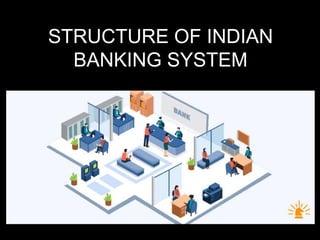
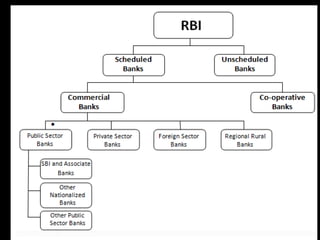
STRUCTURE OF INDIAN
BANKING SYSTEM
RBI- Reserve Bank Of India
 Reserve Bank of India is the
Central Bank of our country. It was
established on 1st April 1935
 RBI performs various
developmental and promotional
functions.
 It has given wide powers to
supervise and control the banking
structure.
Scheduled banks
 Banks that are included in the
second schedule of the Reserve
Bank of India Act,
o Such a bank becomes eligible for
debts/loans on bank rate from the
RBI
Non-scheduled banks
All banks which are not included in
the second section of the Reserve
Bank of India Act, 1934 are Non-
scheduled Banks
Commercial Banks
 Commercial bank is an institution
that accepts deposit, makes
business loans and offer other
financial services to the customers
 These institutions run to make
profit.
Public Sector Banks:
 In Public Sector Banks the
majority stake is held by the
government.
 After the recent amalgamation of
smaller banks with larger banks,
there are 12 public sector banks in
India as of now.
 An example of Public Sector Bank
is State Bank of India.
Private Sector Banks
 Private Sector Banks are banks
where the major stakes in the
equity are owned by private
stakeholders or business houses.
 A few major private sector banks in
India are HDFC Bank, Kotak
Mahindra Bank, ICICI Bank etc.
Foreign Bank
 A Foreign Bank is a bank that has
its headquarters outside the country
but runs its offices as a private
entity at any other location outside
the country.
 An example of Foreign Bank in
India is Citi Bank.
Regional Rural Banks
 The aim of ensuring sufficient
institutional credit for agriculture
and other rural sectors.
 RRBs are owned jointly by the
Government of India, the State
Government and Sponsor Banks.
 An example of RRB in India is
Arunachal Pradesh Rural Bank.
Cooperative Bank
 A Cooperative Bank is a financial
entity that belongs to its members,
who are also the owners as well as
the customers of their bank.
 Cooperative banks are the primary
supporters of agricultural activities,
some small-scale industries and
self-employed workers.
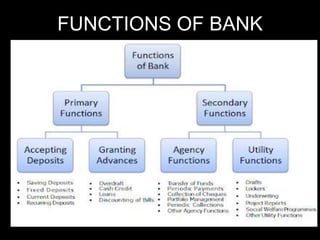
FUNCTIONS OF BANK
Primary Functions of Banks
Accepting Deposits
The bank collects deposits from the
public. These deposits can be of
different types, such as :-
 Saving Deposits
 Fixed Deposits
 Current Deposits
 Recurring Deposits
Saving Deposits
• This type of deposits encourages saving
habit among the public.
• The rate of interest is low.
• Withdrawals of deposits are allowed
subject to certain restrictions.
• This account is suitable to salary and
wage earners.
Fixed Deposits
• Lump sum amount is deposited at
one time for a specific period.
• Higher rate of interest is paid, which
varies with the period of deposit.
• Withdrawals are not allowed before
the expiry of the period.
Current Deposits
• This type of account is operated by
businessmen.
• Withdrawals are freely allowed.
• No interest is paid.
• The account holders can get the
benefit of overdraft facility.
Recurring Deposits
• This type of account is operated by
salaried persons and petty traders.
• A certain sum of money is
periodically deposited into the bank.
• Withdrawals are permitted only
after the expiry of certain period.
• A higher rate of interest is paid.
Granting of Loans and Advances
The bank advances loans to the
business community and other
members of the public. The rate
charged is higher than what it pays on
deposits. The types of bank loans and
advances are :-
 Overdraft
 Cash Credits
 Loans
Secondary Functions of Banks
Agency Functions
The bank acts as an agent of its
customers. The bank performs a
number of agency functions which
includes :-
 Transfer of Funds
 Collection of Cheques
 Periodic Payments
 Portfolio Management
General Utility Functions
The bank also performs general utility
functions, such as :-
 Locker Facility
 Underwriting of Shares
 Dealing in Foreign Exchange
 Project Reports
 Social Welfare Programmes
THANK YOU

Indian banking system

  • 1.
    INDIAN BANKING SYSTEM PRESENTEDBY : Dr. MANPREET KAUR
  • 2.
    Roadmap for Presentation Introduction Needof the Banks Structure of Indian Banking system Functions of Bank
  • 3.
    What is Bank? A bank is a financial institution that provides banking and other financial services to their customers such as accepting deposits and providing loans.
  • 4.
    What is Bankingsystem ? A banking system also referred as a system provided by the bank which offers cash management services for Indian Banking System customers, reporting the transactions of their accounts and portfolios, through out the day.
  • 5.
    Need of theBanks To provide the security to the savings of customers.  To control the supply of money and credit. To set equal norms and conditions (i.e. rate of interest, period of lending etc.) to all types of customers.
  • 6.
  • 8.
    RBI- Reserve BankOf India  Reserve Bank of India is the Central Bank of our country. It was established on 1st April 1935  RBI performs various developmental and promotional functions.  It has given wide powers to supervise and control the banking structure.
  • 9.
    Scheduled banks  Banksthat are included in the second schedule of the Reserve Bank of India Act, o Such a bank becomes eligible for debts/loans on bank rate from the RBI
  • 10.
    Non-scheduled banks All bankswhich are not included in the second section of the Reserve Bank of India Act, 1934 are Non- scheduled Banks
  • 11.
    Commercial Banks  Commercialbank is an institution that accepts deposit, makes business loans and offer other financial services to the customers  These institutions run to make profit.
  • 12.
    Public Sector Banks: In Public Sector Banks the majority stake is held by the government.  After the recent amalgamation of smaller banks with larger banks, there are 12 public sector banks in India as of now.  An example of Public Sector Bank is State Bank of India.
  • 13.
    Private Sector Banks Private Sector Banks are banks where the major stakes in the equity are owned by private stakeholders or business houses.  A few major private sector banks in India are HDFC Bank, Kotak Mahindra Bank, ICICI Bank etc.
  • 14.
    Foreign Bank  AForeign Bank is a bank that has its headquarters outside the country but runs its offices as a private entity at any other location outside the country.  An example of Foreign Bank in India is Citi Bank.
  • 15.
    Regional Rural Banks The aim of ensuring sufficient institutional credit for agriculture and other rural sectors.  RRBs are owned jointly by the Government of India, the State Government and Sponsor Banks.  An example of RRB in India is Arunachal Pradesh Rural Bank.
  • 16.
    Cooperative Bank  ACooperative Bank is a financial entity that belongs to its members, who are also the owners as well as the customers of their bank.  Cooperative banks are the primary supporters of agricultural activities, some small-scale industries and self-employed workers.
  • 17.
  • 18.
    Primary Functions ofBanks Accepting Deposits The bank collects deposits from the public. These deposits can be of different types, such as :-  Saving Deposits  Fixed Deposits  Current Deposits  Recurring Deposits
  • 19.
    Saving Deposits • Thistype of deposits encourages saving habit among the public. • The rate of interest is low. • Withdrawals of deposits are allowed subject to certain restrictions. • This account is suitable to salary and wage earners.
  • 20.
    Fixed Deposits • Lumpsum amount is deposited at one time for a specific period. • Higher rate of interest is paid, which varies with the period of deposit. • Withdrawals are not allowed before the expiry of the period.
  • 21.
    Current Deposits • Thistype of account is operated by businessmen. • Withdrawals are freely allowed. • No interest is paid. • The account holders can get the benefit of overdraft facility.
  • 22.
    Recurring Deposits • Thistype of account is operated by salaried persons and petty traders. • A certain sum of money is periodically deposited into the bank. • Withdrawals are permitted only after the expiry of certain period. • A higher rate of interest is paid.
  • 23.
    Granting of Loansand Advances The bank advances loans to the business community and other members of the public. The rate charged is higher than what it pays on deposits. The types of bank loans and advances are :-  Overdraft  Cash Credits  Loans
  • 24.
    Secondary Functions ofBanks Agency Functions The bank acts as an agent of its customers. The bank performs a number of agency functions which includes :-  Transfer of Funds  Collection of Cheques  Periodic Payments  Portfolio Management
  • 25.
    General Utility Functions Thebank also performs general utility functions, such as :-  Locker Facility  Underwriting of Shares  Dealing in Foreign Exchange  Project Reports  Social Welfare Programmes
  • 26.