NON NARCOTIC ANALGESICS
PRESENTED BY
PRAVEEN KUMAR.S
M.PHARM 1ST SEMESTER
DEPARTMENT OF PHARMACOLOGY
PSG COLLEGE OF PHARMACY
1
CONTENTS
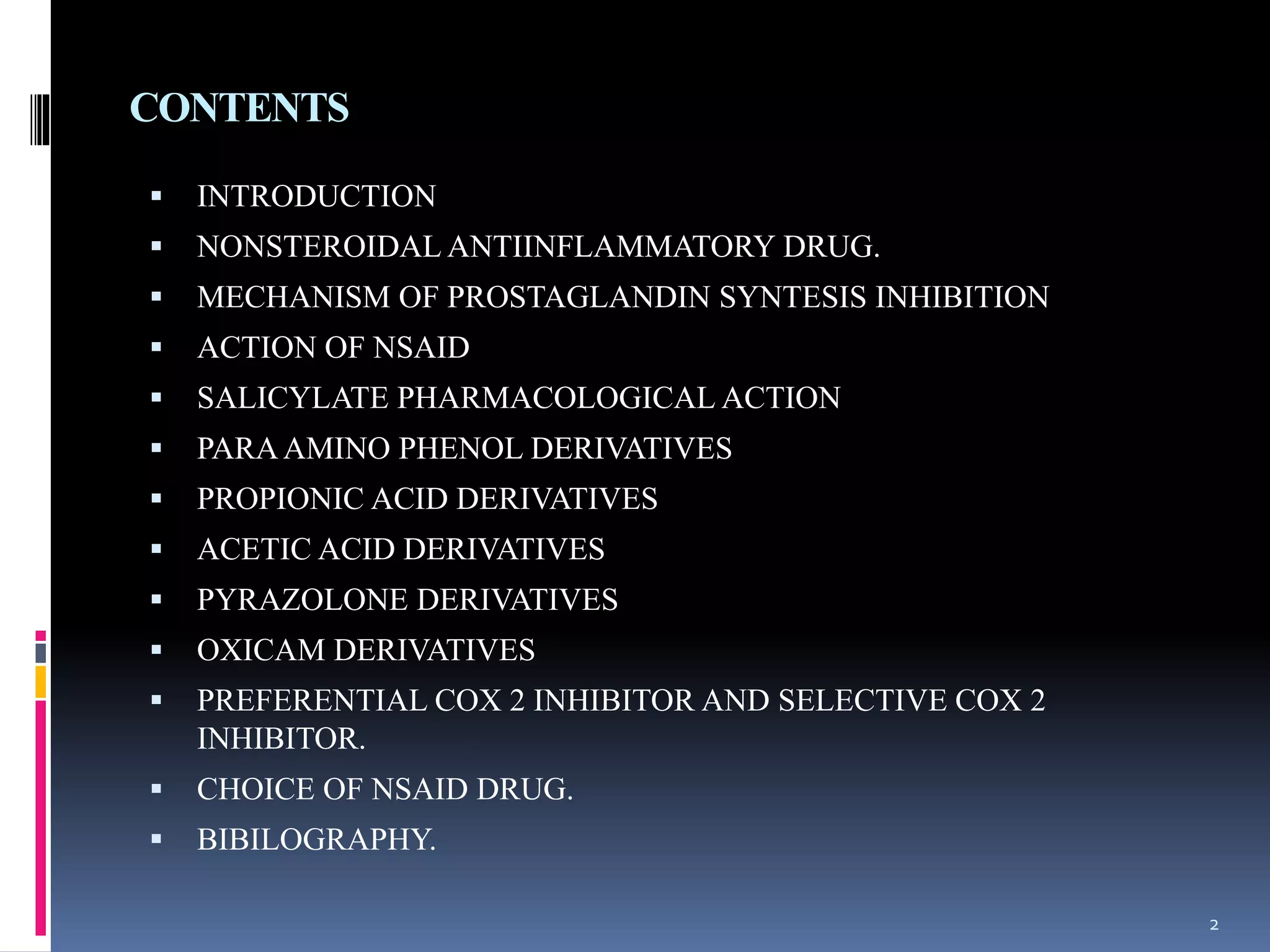
 INTRODUCTION
 NONSTEROIDAL ANTIINFLAMMATORY DRUG.
 MECHANISM OF PROSTAGLANDIN SYNTESIS INHIBITION
 ACTION OF NSAID
 SALICYLATE PHARMACOLOGICAL ACTION
 PARAAMINO PHENOL DERIVATIVES
 PROPIONIC ACID DERIVATIVES
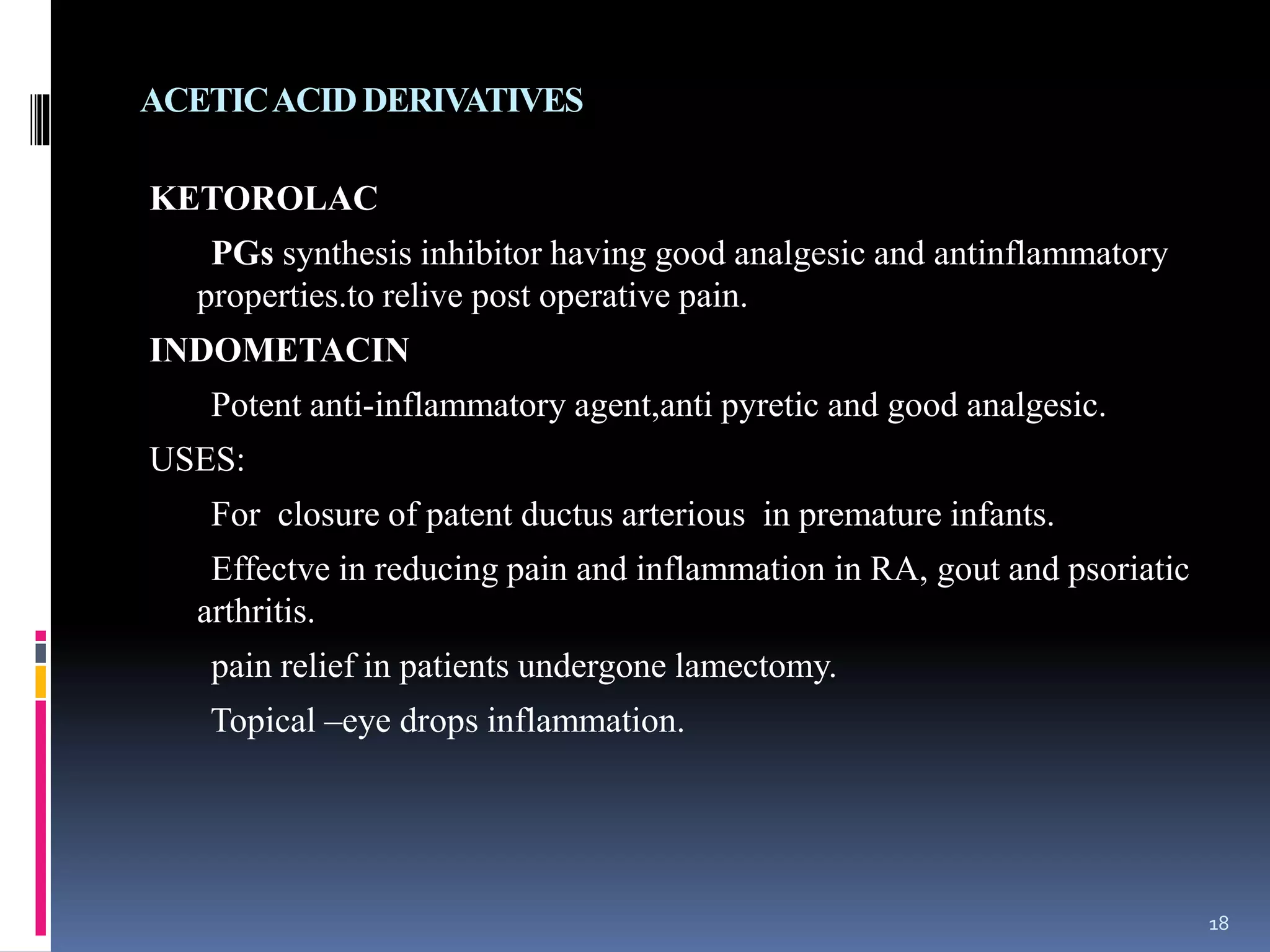
 ACETIC ACID DERIVATIVES
 PYRAZOLONE DERIVATIVES
 OXICAM DERIVATIVES
 PREFERENTIAL COX 2 INHIBITOR AND SELECTIVE COX 2
INHIBITOR.
 CHOICE OF NSAID DRUG.
 BIBILOGRAPHY.
2
INTRODUCTION
 The Nonsteroidal antiinflammatory drugs (NSAIDs) and
antipyretic analegsics are a class of drugs that have
analegsic,antipyretic and antiinflammatory action.
 In contrast to morphine they do not depress CNS, and do not
produce physical depandence, have no abuse liability and are
particularly effective in inflammatory pain.
 They also called nonnarcotic , nonopoid or aspirin –like
analegesics.
 They act primarily on peripheral pain mechanisms.
 They are more commonly employed and many are the over-the-
counter Or non prescription drugs.
3
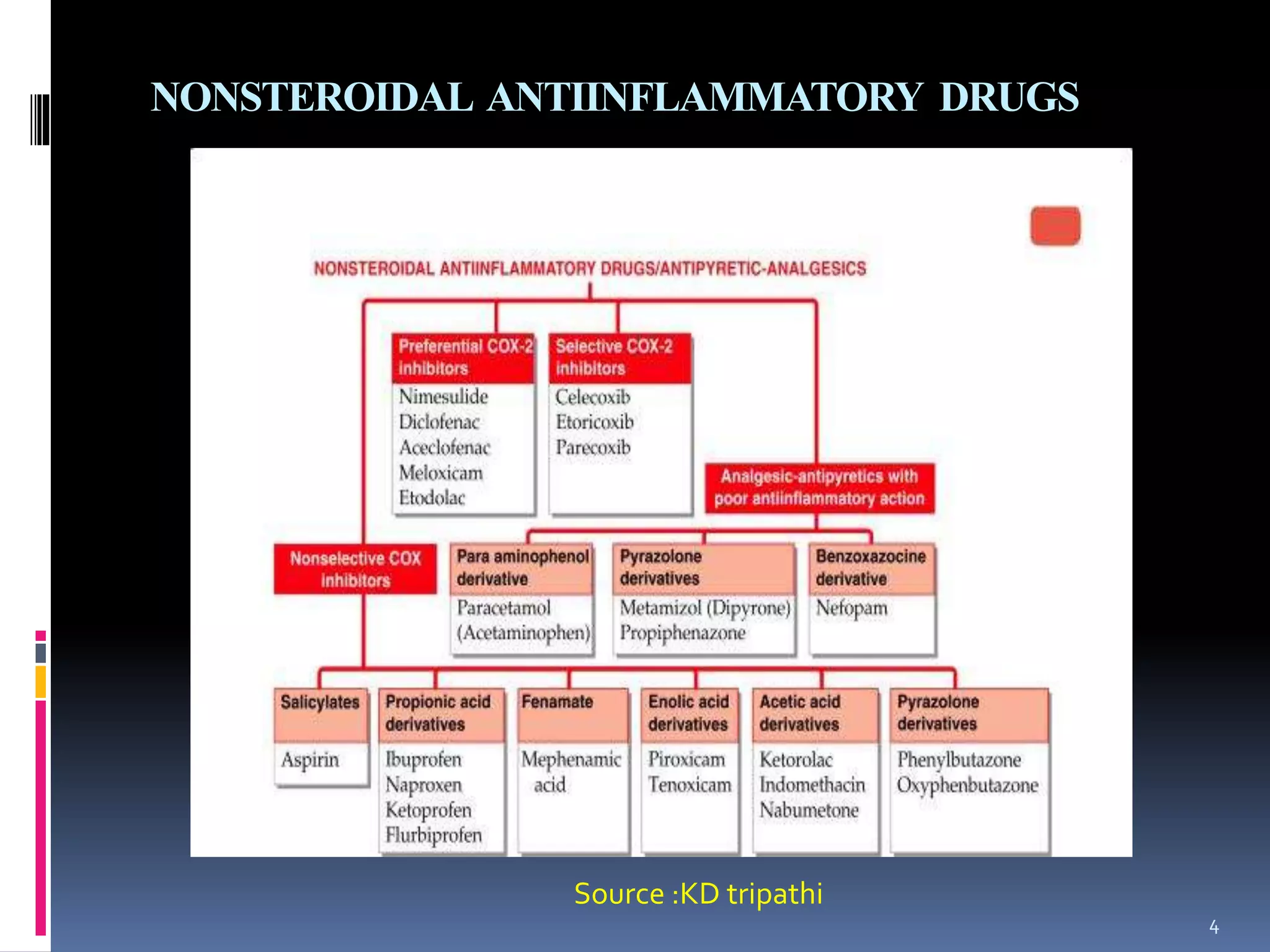
NONSTEROIDAL ANTIINFLAMMATORY DRUGS
Source :KD tripathi
4
MECHANISM OF ACTION OF PROSTAGLANDIN
SYNTHESIS INHIBITOR:
SOURCE : SCIENCE DIRECT.COM 5
Action of NSAID
 ANALGESIA
PGs induce hyperalgesia by affecting the transducing property of
free nerve endings so that stimuli that normally do not elict pain are able
to do so
NSAID block the pain sensitizing mechanism induced by bradykinin
TNFalpha, interleukin (Ils) and other algesic substance primarily by
inhibiting COX -2.
 ANTIPYRESIS
NSAID lower body temperature in fever ,but do not cause
hypothermia in normothermic individuals.
NSAID block the action of pyrogens but not that PGE2 injected into
hypothalamus.
Fever can occur through non PG mediated mechanism as well.
6
 ANTIINFLAMMATORY
Most important mechanism of antiinflammatory action of NSAIDs
is considered to be inhibition of COX 2 mediated enhanced PG synthesis
at site of injury.
PGs are only one of the mediator of inflammation and inhibition
of COX does not depress the production of other mediators like LTs,
PAF, cytokinins,etc..
Activated endothelial cells express adhesion molecules (ELAM-1,
ICAM -1) on their surface and play a key role in directing circulating
leukocytes to the site of inflammation(chemotaxis)
 DYSMENORRHOEA
Level of PGs in menstrual flow ,endometrial biopsy and that
PGF2alpha metabolite in circulation are raised in dysmennorhea women.
Intermittent ischemia and myometrium is probably responsible for
menstrual cramps.
NSAIDs lower uterine PGs levels – afford excellent relief 60-70%
7
 ANTIPLATELET
NSAIDs inhibit synthesis of both proaggregatory (TXA2) and
antiaggregatory (PGI2) Therapeutic doses of most NSAIDs inhibit platelet
aggregation and prolong bleeding time.
Aspirin is highly active ,because it acetylate platelet COX irreversiably
in portal circulation before getting deacetylated by first pass metabolism in
liver.
8
OTHER ACTION…
 GASTRIC MUCOSAL DAMAGE
 RENAL EFFECTS
 ANAPHYLATED REACTIONS
9
1. SALICYLATES
Are the salt of salicylic acid ,
Eg; methyl salicylate ,sodium salicylate, acetyl salicylic acid(aspirin)
Aspirin is taken as prototype.
PHARMACOLOGICAL ACTIONS:
1.ANALEGSIA:
IS good analgesic and relive pain of inflammatory origin.
aspirin relieve pain in connective tissue but in visceral pain aspirin
ineffective.
2.ANTIPYRETIC ACTION:
In presence of fever , salicylate bring down the temperature to normal
level.
Aspirin inhibits PG synthesis in the hypothalamus and reset the
thermostat at the normal level bringing down the temperature.
10
ANTI-INFLAMMATORYACTION
Higher doses 4-6 g/ day signs of inflammation like tenderness ,
swelling, erythma and pain are all reduced.
PG synthesis inhibition – PGs present in inflammatory tissues are
responsible for oedema,erythma and pain.
RESPIRATION:
Salicylate increase consumption of oxygen by skeletal muscle. As
result increased co2 production .
Salicylate also directly stimulate the medullary respiratory centre.
Both increase rate and depth of respiration.
ACID-BASE ELECTROLYTE BALANCE:
In anti-inflammatory doses ,salicylate produce significant respiratory
stimulation –more co2 is washed out result respiratory alkalosis;PH
become alkaline,compensated by increased excretion of HCO3- in
urine accompained by Na+,k+ and water. PH return to normal.is
known as respiratory alkaosis.
11
OTHERACTION…
 GI Tract – gastric irritation ,epigastric distress
 Immunological effects- Higher doses supress antigen antibody
reaction and antibody production.
 Blood – platelet aggregation.
 Local effect- keratolytic and mild antiseptic and fungistatic property.
Health atoz.in
12
ADVERSEEFFECTS:
 Nausea ,vomiting,epigastric distress,peptic ulcer.
 Nephrotoxicity
 Headche
 Rashes,urticaria
 Haemolysis
 Hepatotoxicity
 Reye’s syndrome
 Pregnancy – delay on set of labor
13
2.PARA-AMINOPHENOLDERIVATIVES
 PARACETAMOL (ACETOAMINOPHEN)
Is an metabolite of phenacetin found to be safer and effective.
ACTION:
 It has analgesic and good antipyretic and weak antiinflammatory
properties.
 Paracetamol iss active on cyclooxygenase in the brain which accounts
for antipyretic action.in presence of peroxide present at the site of
inflammation ,poor ability to inhibit cyclooxygenase.
MECHANISM OFACTION:
A small portion of paracetamol is metabolised to highly reactive
intermediate –N-acetyl-benzoquinone –imnine is detoxified
generally by conjugation with glutathione.
14
Source: sccience direcct.com
15
ADVERSEEFFECTS
 Large doses taken –acute paracetamol poisoning results.
 Nausea,vomiting,anorexia, abdominal pain.
 I s hepatotoxic &cause severe hepatic damage.
 Nephrotoxicity may result in acute renal failure.
Indian mart.in
16
3.PROPIONICACIDDERIVATIVES
IBUPROFEN
Is better tolerated than aspirin .
Analgesic, antipyretic and antiinflammatory efficacy is slight lower
than aspirin.
Is avaliable for oral ,parentral,and topical use.
FLUBIPROFEN
Is used on eye for its anti-inflammatory properties.
USES:
 As an analgesic in painful conditions.
 In fever.
 soft tissue injuries, fractures,tooth extraction,to relieve post
operative pain,dysmenorrhoea and osteoarthritis
 Gout.
17
ACETICACIDDERIVATIVES
KETOROLAC
PGs synthesis inhibitor having good analgesic and antinflammatory
properties.to relive post operative pain.
INDOMETACIN
Potent anti-inflammatory agent,anti pyretic and good analgesic.
USES:
For closure of patent ductus arterious in premature infants.
Effectve in reducing pain and inflammation in RA, gout and psoriatic
arthritis.
pain relief in patients undergone lamectomy.
Topical –eye drops inflammation.
18
5.PYRAZOLONEDERIVATIVES
PHENYLBUTAZONE has good anti-inflammatory activity, and more
potent but has poorer analgesic , antipyretic effects.
Adverse effects:
phenylbutazone is more toxic than aspirin and poorly tolerated; and
cause gastrointestinal side effects , salt and water retention
hypothyrodism.
Haematological toxicity including agranulocytosis.
AZAPRAZONE is structurally related to phenylbutazone but is less
likely to cause agranulocytosis.
other drugs ..
Metamizol and Propiphenazone.
NOVALGIN,ANALGIN 500mg tab.
300-600 mg 3-4 times a day SARIDON.
19
OXICAMS(ENOLOICACIDDERIVATIVES)
 Piroxicam is an oxicam derivative ,has good anti-inflammatory
,analgesic and antipyretic activity.
Is used for rheumatoid arthritis ,osteoarthritis ,ankylosing spondylitis,
acute musculoskeletalpain and postoperative pain, painful dental
lesions.
Dose :UGESIC 20mg tab,DOLONEX 20mg cap,20mg/ml inj.
Tenoxicam is simliar to piroxicam.
Many other oxicam being developed with idea obtaining one which is
non –ulcerogenic.
20
PREFERENTIALCOX-2 INHIBITORS
DICLOFENAC is an analgesic, antipyretic and antiinflammatory agent .
It almost selectively inhibits COX-2 as result is more ‘gastric –friendly’
And also has poor antiplatelet activity.
Gel is avaliable for topical application. Is used for postoperative pain ,
Rectal suppository and mouthwashes are also avaliable.
DICLOFENAC AND ACECLOFENAC are the most commonly used
NSAIDs.
 Treatment of chronic inflammatory condition like rheumatoid arthritis and
osteoarthritis.
 Acute musculoskeletal pain, painful dental lesions.
 Postoperatively for relief of pain and inflammation.
 Eye : to reduce ocular inflammation.
21
 NEBUMETONE
Is an antiihflammatory agent with significant efficacy in
rheumatoid arthritis and osteoarthritis. It shows low incidence of side
effects ,and comparatively less ulcerogenic.
Is an prodrug and also preferentially inhibit COX-2.
DOSE:NABUFLAM 500mg tab ,NILTIS 500,750 mg tab.
 NIMESULIDE
A sulfonamide compound ,has higher affinity for COX-2 than
COX-1 and in addition has antihistaminic and antiallergic property.
has analgesic,antipyretic and anti-inflammatory action like other
NSAIDs.
ADR: Nausea, epigastric pain,rashes,drowsiness, dizziness and
nephrotoxicity.
22
SELECTIVECOX–2 INHIBITORS
COXibs
NSAIDs are extremely useful drugs ,are poorly tolerated particularly
they are used for long periods .gastric irritation is common side effect.
Gastric irritation is the common side effect .
Seleective inhibition of COX-2 was found to be advantageous
because cox2 involved inflammation and COX 1 which protect on
gastrodueodenal mucosa is spared.
such as,
 celecoxib
 parececoxib
 etoricoxib
These drugs have analgesic, antiinflammatory and antipyretic effects
like nonselective NSAIDs but less gastric ulcerogenic effects.
Do not inhibit platelet aggregation because cox -1 involved platelet
function.
23
CHOICEOFNONSTEROIDALANTIINFLAMMATORYDRUG
 Mild –to-moderate pain with little inflammation : paractamol or low dose
inflammation.
 Postoperative or simliar acute but short lasting pain :inj ketoroloc,
diclofenac.
 A parentral NSAID may be employed for renal colic, acute gout , dental
pain, fractures.
 Exacerbation of rheumatoid arthritis ,ankylosing spondylitis,acute gout,
acute rheumatic fever: indomethacin, naproxen.
 Gastric intierance to NSAIDs ; a selective COX-2 inhibitor and have
developed peptic ulcer must receive proton pump inhibitor.
 Patient with hypertension or other risk factor for heartattack/stoke:avoid
COX-2 inhibitor.
 In children risk of Reye’s syndrome ,aspirin should avoided.
 Pregnancy : paracetamol is safest .
24
25
BIBILOGRAPHY
 ESSENTIALS OF MEDICAL PHARMACOLOGY 8TH EDITION
KD TRIPATHI.
 MEDICAL PHARMACOLOGY 5TH EDITION PADMAJA UDAY
KUMAR.
 WWW.GOOGLE.COM.
26
YOU
27

Non narcotic analgesics .pptx

  • 1.
    NON NARCOTIC ANALGESICS PRESENTEDBY PRAVEEN KUMAR.S M.PHARM 1ST SEMESTER DEPARTMENT OF PHARMACOLOGY PSG COLLEGE OF PHARMACY 1
  • 2.
    CONTENTS  INTRODUCTION  NONSTEROIDALANTIINFLAMMATORY DRUG.  MECHANISM OF PROSTAGLANDIN SYNTESIS INHIBITION  ACTION OF NSAID  SALICYLATE PHARMACOLOGICAL ACTION  PARAAMINO PHENOL DERIVATIVES  PROPIONIC ACID DERIVATIVES  ACETIC ACID DERIVATIVES  PYRAZOLONE DERIVATIVES  OXICAM DERIVATIVES  PREFERENTIAL COX 2 INHIBITOR AND SELECTIVE COX 2 INHIBITOR.  CHOICE OF NSAID DRUG.  BIBILOGRAPHY. 2
  • 3.
    INTRODUCTION  The Nonsteroidalantiinflammatory drugs (NSAIDs) and antipyretic analegsics are a class of drugs that have analegsic,antipyretic and antiinflammatory action.  In contrast to morphine they do not depress CNS, and do not produce physical depandence, have no abuse liability and are particularly effective in inflammatory pain.  They also called nonnarcotic , nonopoid or aspirin –like analegesics.  They act primarily on peripheral pain mechanisms.  They are more commonly employed and many are the over-the- counter Or non prescription drugs. 3
  • 4.
  • 5.
    MECHANISM OF ACTIONOF PROSTAGLANDIN SYNTHESIS INHIBITOR: SOURCE : SCIENCE DIRECT.COM 5
  • 6.
    Action of NSAID ANALGESIA PGs induce hyperalgesia by affecting the transducing property of free nerve endings so that stimuli that normally do not elict pain are able to do so NSAID block the pain sensitizing mechanism induced by bradykinin TNFalpha, interleukin (Ils) and other algesic substance primarily by inhibiting COX -2.  ANTIPYRESIS NSAID lower body temperature in fever ,but do not cause hypothermia in normothermic individuals. NSAID block the action of pyrogens but not that PGE2 injected into hypothalamus. Fever can occur through non PG mediated mechanism as well. 6
  • 7.
     ANTIINFLAMMATORY Most importantmechanism of antiinflammatory action of NSAIDs is considered to be inhibition of COX 2 mediated enhanced PG synthesis at site of injury. PGs are only one of the mediator of inflammation and inhibition of COX does not depress the production of other mediators like LTs, PAF, cytokinins,etc.. Activated endothelial cells express adhesion molecules (ELAM-1, ICAM -1) on their surface and play a key role in directing circulating leukocytes to the site of inflammation(chemotaxis)  DYSMENORRHOEA Level of PGs in menstrual flow ,endometrial biopsy and that PGF2alpha metabolite in circulation are raised in dysmennorhea women. Intermittent ischemia and myometrium is probably responsible for menstrual cramps. NSAIDs lower uterine PGs levels – afford excellent relief 60-70% 7
  • 8.
     ANTIPLATELET NSAIDs inhibitsynthesis of both proaggregatory (TXA2) and antiaggregatory (PGI2) Therapeutic doses of most NSAIDs inhibit platelet aggregation and prolong bleeding time. Aspirin is highly active ,because it acetylate platelet COX irreversiably in portal circulation before getting deacetylated by first pass metabolism in liver. 8
  • 9.
    OTHER ACTION…  GASTRICMUCOSAL DAMAGE  RENAL EFFECTS  ANAPHYLATED REACTIONS 9
  • 10.
    1. SALICYLATES Are thesalt of salicylic acid , Eg; methyl salicylate ,sodium salicylate, acetyl salicylic acid(aspirin) Aspirin is taken as prototype. PHARMACOLOGICAL ACTIONS: 1.ANALEGSIA: IS good analgesic and relive pain of inflammatory origin. aspirin relieve pain in connective tissue but in visceral pain aspirin ineffective. 2.ANTIPYRETIC ACTION: In presence of fever , salicylate bring down the temperature to normal level. Aspirin inhibits PG synthesis in the hypothalamus and reset the thermostat at the normal level bringing down the temperature. 10
  • 11.
    ANTI-INFLAMMATORYACTION Higher doses 4-6g/ day signs of inflammation like tenderness , swelling, erythma and pain are all reduced. PG synthesis inhibition – PGs present in inflammatory tissues are responsible for oedema,erythma and pain. RESPIRATION: Salicylate increase consumption of oxygen by skeletal muscle. As result increased co2 production . Salicylate also directly stimulate the medullary respiratory centre. Both increase rate and depth of respiration. ACID-BASE ELECTROLYTE BALANCE: In anti-inflammatory doses ,salicylate produce significant respiratory stimulation –more co2 is washed out result respiratory alkalosis;PH become alkaline,compensated by increased excretion of HCO3- in urine accompained by Na+,k+ and water. PH return to normal.is known as respiratory alkaosis. 11
  • 12.
    OTHERACTION…  GI Tract– gastric irritation ,epigastric distress  Immunological effects- Higher doses supress antigen antibody reaction and antibody production.  Blood – platelet aggregation.  Local effect- keratolytic and mild antiseptic and fungistatic property. Health atoz.in 12
  • 13.
    ADVERSEEFFECTS:  Nausea ,vomiting,epigastricdistress,peptic ulcer.  Nephrotoxicity  Headche  Rashes,urticaria  Haemolysis  Hepatotoxicity  Reye’s syndrome  Pregnancy – delay on set of labor 13
  • 14.
    2.PARA-AMINOPHENOLDERIVATIVES  PARACETAMOL (ACETOAMINOPHEN) Isan metabolite of phenacetin found to be safer and effective. ACTION:  It has analgesic and good antipyretic and weak antiinflammatory properties.  Paracetamol iss active on cyclooxygenase in the brain which accounts for antipyretic action.in presence of peroxide present at the site of inflammation ,poor ability to inhibit cyclooxygenase. MECHANISM OFACTION: A small portion of paracetamol is metabolised to highly reactive intermediate –N-acetyl-benzoquinone –imnine is detoxified generally by conjugation with glutathione. 14
  • 15.
  • 16.
    ADVERSEEFFECTS  Large dosestaken –acute paracetamol poisoning results.  Nausea,vomiting,anorexia, abdominal pain.  I s hepatotoxic &cause severe hepatic damage.  Nephrotoxicity may result in acute renal failure. Indian mart.in 16
  • 17.
    3.PROPIONICACIDDERIVATIVES IBUPROFEN Is better toleratedthan aspirin . Analgesic, antipyretic and antiinflammatory efficacy is slight lower than aspirin. Is avaliable for oral ,parentral,and topical use. FLUBIPROFEN Is used on eye for its anti-inflammatory properties. USES:  As an analgesic in painful conditions.  In fever.  soft tissue injuries, fractures,tooth extraction,to relieve post operative pain,dysmenorrhoea and osteoarthritis  Gout. 17
  • 18.
    ACETICACIDDERIVATIVES KETOROLAC PGs synthesis inhibitorhaving good analgesic and antinflammatory properties.to relive post operative pain. INDOMETACIN Potent anti-inflammatory agent,anti pyretic and good analgesic. USES: For closure of patent ductus arterious in premature infants. Effectve in reducing pain and inflammation in RA, gout and psoriatic arthritis. pain relief in patients undergone lamectomy. Topical –eye drops inflammation. 18
  • 19.
    5.PYRAZOLONEDERIVATIVES PHENYLBUTAZONE has goodanti-inflammatory activity, and more potent but has poorer analgesic , antipyretic effects. Adverse effects: phenylbutazone is more toxic than aspirin and poorly tolerated; and cause gastrointestinal side effects , salt and water retention hypothyrodism. Haematological toxicity including agranulocytosis. AZAPRAZONE is structurally related to phenylbutazone but is less likely to cause agranulocytosis. other drugs .. Metamizol and Propiphenazone. NOVALGIN,ANALGIN 500mg tab. 300-600 mg 3-4 times a day SARIDON. 19
  • 20.
    OXICAMS(ENOLOICACIDDERIVATIVES)  Piroxicam isan oxicam derivative ,has good anti-inflammatory ,analgesic and antipyretic activity. Is used for rheumatoid arthritis ,osteoarthritis ,ankylosing spondylitis, acute musculoskeletalpain and postoperative pain, painful dental lesions. Dose :UGESIC 20mg tab,DOLONEX 20mg cap,20mg/ml inj. Tenoxicam is simliar to piroxicam. Many other oxicam being developed with idea obtaining one which is non –ulcerogenic. 20
  • 21.
    PREFERENTIALCOX-2 INHIBITORS DICLOFENAC isan analgesic, antipyretic and antiinflammatory agent . It almost selectively inhibits COX-2 as result is more ‘gastric –friendly’ And also has poor antiplatelet activity. Gel is avaliable for topical application. Is used for postoperative pain , Rectal suppository and mouthwashes are also avaliable. DICLOFENAC AND ACECLOFENAC are the most commonly used NSAIDs.  Treatment of chronic inflammatory condition like rheumatoid arthritis and osteoarthritis.  Acute musculoskeletal pain, painful dental lesions.  Postoperatively for relief of pain and inflammation.  Eye : to reduce ocular inflammation. 21
  • 22.
     NEBUMETONE Is anantiihflammatory agent with significant efficacy in rheumatoid arthritis and osteoarthritis. It shows low incidence of side effects ,and comparatively less ulcerogenic. Is an prodrug and also preferentially inhibit COX-2. DOSE:NABUFLAM 500mg tab ,NILTIS 500,750 mg tab.  NIMESULIDE A sulfonamide compound ,has higher affinity for COX-2 than COX-1 and in addition has antihistaminic and antiallergic property. has analgesic,antipyretic and anti-inflammatory action like other NSAIDs. ADR: Nausea, epigastric pain,rashes,drowsiness, dizziness and nephrotoxicity. 22
  • 23.
    SELECTIVECOX–2 INHIBITORS COXibs NSAIDs areextremely useful drugs ,are poorly tolerated particularly they are used for long periods .gastric irritation is common side effect. Gastric irritation is the common side effect . Seleective inhibition of COX-2 was found to be advantageous because cox2 involved inflammation and COX 1 which protect on gastrodueodenal mucosa is spared. such as,  celecoxib  parececoxib  etoricoxib These drugs have analgesic, antiinflammatory and antipyretic effects like nonselective NSAIDs but less gastric ulcerogenic effects. Do not inhibit platelet aggregation because cox -1 involved platelet function. 23
  • 24.
    CHOICEOFNONSTEROIDALANTIINFLAMMATORYDRUG  Mild –to-moderatepain with little inflammation : paractamol or low dose inflammation.  Postoperative or simliar acute but short lasting pain :inj ketoroloc, diclofenac.  A parentral NSAID may be employed for renal colic, acute gout , dental pain, fractures.  Exacerbation of rheumatoid arthritis ,ankylosing spondylitis,acute gout, acute rheumatic fever: indomethacin, naproxen.  Gastric intierance to NSAIDs ; a selective COX-2 inhibitor and have developed peptic ulcer must receive proton pump inhibitor.  Patient with hypertension or other risk factor for heartattack/stoke:avoid COX-2 inhibitor.  In children risk of Reye’s syndrome ,aspirin should avoided.  Pregnancy : paracetamol is safest . 24
  • 25.
  • 26.
    BIBILOGRAPHY  ESSENTIALS OFMEDICAL PHARMACOLOGY 8TH EDITION KD TRIPATHI.  MEDICAL PHARMACOLOGY 5TH EDITION PADMAJA UDAY KUMAR.  WWW.GOOGLE.COM. 26
  • 27.