NonsteroidalNonsteroidal
Antiinflammatory DrugsAntiinflammatory Drugs
(NSAIDs)(NSAIDs)
Under The Guidance Of – Presented By -Under The Guidance Of – Presented By -
Mr. Sudhakar Singh Mohd Asad FarooquiMr. Sudhakar Singh Mohd Asad Farooqui
(ASST.PROFESSOR ) B.Pharm 3(ASST.PROFESSOR ) B.Pharm 3rdrd
yearyear
CHANDRA SHEKHAR SINGH COLLEGE OF PHARMACYCHANDRA SHEKHAR SINGH COLLEGE OF PHARMACY
ALLAHABADALLAHABAD
What are NSAIDs and how do theyWhat are NSAIDs and how do they
work?work?
 Drug with analgesic( without impairingDrug with analgesic( without impairing
consciousness ), antipyretic, and anti-consciousness ), antipyretic, and anti-
inflamammatory effectsinflamammatory effects
 weak acids, PH 3-5, well absorbedweak acids, PH 3-5, well absorbed
from stomach and intestinal mucosafrom stomach and intestinal mucosa
 protein-bound in plasma ( albumin),protein-bound in plasma ( albumin),
 metabolised in the livermetabolised in the liver
ProstaglandinsProstaglandins
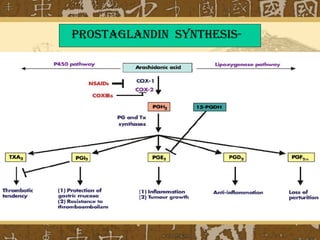
 Prostaglandins : produced by the cells,Prostaglandins : produced by the cells,
promote inflammation, pain, and fever; bloodpromote inflammation, pain, and fever; blood
clotting function of platelets; protect the liningclotting function of platelets; protect the lining
of the stomach from damaging effects of acid.of the stomach from damaging effects of acid.
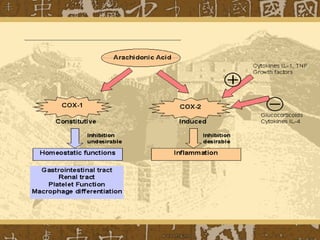
 two COX enzymes, COX-1 and COX-2.two COX enzymes, COX-1 and COX-2.
produce prostaglandins that promoteproduce prostaglandins that promote
inflammation, pain, and feverinflammation, pain, and fever
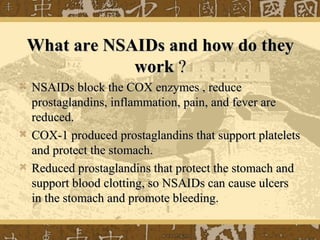
What are NSAIDs and how do theyWhat are NSAIDs and how do they
workwork ??
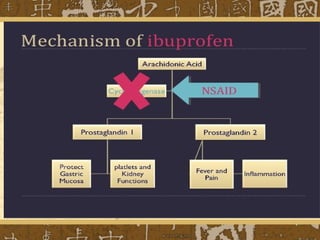
 NSAIDs block the COX enzymes , reduceNSAIDs block the COX enzymes , reduce
prostaglandins, inflammation, pain, and fever areprostaglandins, inflammation, pain, and fever are
reduced.reduced.
 COX-1 produced prostaglandins that support plateletsCOX-1 produced prostaglandins that support platelets
and protect the stomach.and protect the stomach.
 Reduced prostaglandins that protect the stomach andReduced prostaglandins that protect the stomach and
support blood clotting, so NSAIDs can cause ulcerssupport blood clotting, so NSAIDs can cause ulcers
in the stomach and promote bleeding.in the stomach and promote bleeding.
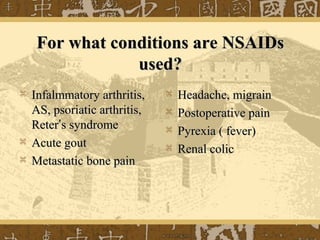
For what conditions are NSAIDsFor what conditions are NSAIDs
used?used?
 Infalmmatory arthritis,Infalmmatory arthritis,
AS, psoriatic arthritis,AS, psoriatic arthritis,
ReterReter’’s syndromes syndrome
 Acute goutAcute gout
 Metastatic bone painMetastatic bone pain
 Headache, migrainHeadache, migrain
 Postoperative painPostoperative pain
 Pyrexia ( fever)Pyrexia ( fever)
 Renal colicRenal colic
For what conditions are NSAIDsFor what conditions are NSAIDs
used?used?
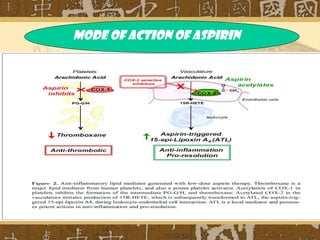
 AspirinAspirin (also an NSAID) : inhibit the clotting(also an NSAID) : inhibit the clotting
of blood( platelet aggregation ) ,preventof blood( platelet aggregation ) ,prevent
strokes and cardiovascular attacksstrokes and cardiovascular attacks
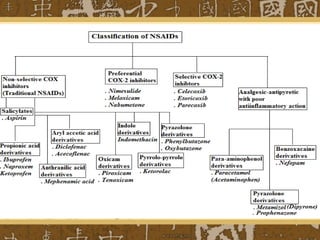
Classification of NSAIDClassification of NSAID
Mode of action of NSAIDMode of action of NSAID
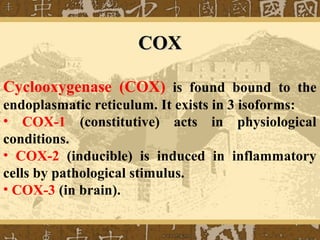
COXCOX
Cyclooxygenase (COX) is found bound to the
endoplasmatic reticulum. It exists in 3 isoforms:
• COX-1 (constitutive) acts in physiological
conditions.
• COX-2 (inducible) is induced in inflammatory
cells by pathological stimulus.
• COX-3 (in brain).
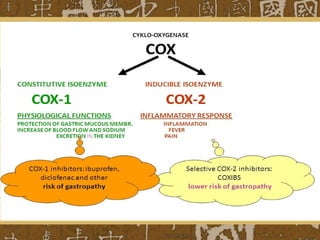
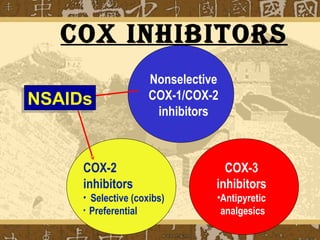
COX-2
inhibitors
• Selective (coxibs)
• Preferential
COX-3
inhibitors
•Antipyretic
analgesics
Nonselective
COX-1/COX-2
inhibitors
NSAIDsNSAIDs
COX inhibitOrs
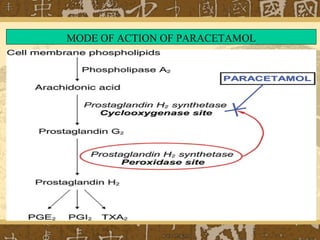
MODE OF ACTION OF PARACETAMOL
Mode Of Action Of Aspirin
Prostaglandin synthesis-
SIDE EFFECTSSIDE EFFECTS
Side effects of NSAIDsSide effects of NSAIDs
GastrointestinalGastrointestinal
 Direct irritation : acidic moleculesDirect irritation : acidic molecules
 Indirect irritation: inhibit COX-1, reduceIndirect irritation: inhibit COX-1, reduce
protective prostaglandinsprotective prostaglandins
 nausea, vomiting, dyspepsia, gastricnausea, vomiting, dyspepsia, gastric
ulcer/bleeding, diarrheaulcer/bleeding, diarrhea
 Duration of therapy, doseDuration of therapy, dose
Side effects of NSAIDsSide effects of NSAIDs
CardiovascularCardiovascular
 80% increase risk with newer COX-2 and high80% increase risk with newer COX-2 and high
dose traditional NSAIDdose traditional NSAID
 Heart failure riskHeart failure risk
Side effects of NSAIDsSide effects of NSAIDs
RenalRenal
 Decrease prostaglandinsDecrease prostaglandins→→ constriction ofconstriction of
afferent arterioleafferent arteriole →→ decreased renal perfusiondecreased renal perfusion
→→alter renal functionalter renal function
 : salt and fluid retension, hypertension: salt and fluid retension, hypertension
 Caution: NSAID with ACE inhibitor, diureticCaution: NSAID with ACE inhibitor, diuretic
 Rare: ARF, ATN, nephrotic syn.Rare: ARF, ATN, nephrotic syn.
Side effects of NSAIDsSide effects of NSAIDs
OthersOthers
 Allergy: shortness of breathAllergy: shortness of breath
 Asthma : a higher risk for serious allergicAsthma : a higher risk for serious allergic
reactionreaction
 with a serious allergy to one NSAID are likelywith a serious allergy to one NSAID are likely
to have similar reaction to a different NSAIDto have similar reaction to a different NSAID
 photosensitivityphotosensitivity
Combinational RiskCombinational Risk
 If COX-2 inhibitor taken, should not use aIf COX-2 inhibitor taken, should not use a
traditional NSAID concomitantlytraditional NSAID concomitantly
 With daily aspirin therapy, should use otherWith daily aspirin therapy, should use other
NSAID carefully, they may block theNSAID carefully, they may block the
cardioprotective effect of aspirincardioprotective effect of aspirin
During pregnancyDuring pregnancy
 Not recommended during pregnancy,Not recommended during pregnancy,
particular 3rd trimesterparticular 3rd trimester
 Cause early closure of fetal ductus arteriosus,Cause early closure of fetal ductus arteriosus,
and fetal renal toxicity, premature birthand fetal renal toxicity, premature birth
 Acetaminophen ia more safe during pregnancyAcetaminophen ia more safe during pregnancy
 In France, NSAID and aspirin is contra-In France, NSAID and aspirin is contra-
indicated after 6 months of pregnancyindicated after 6 months of pregnancy
REFERENCEREFERENCE
https://www.google.com/https://www.google.com/
https://en.wikipedia.org/wiki/Arachidonic_acidhttps://en.wikipedia.org/wiki/Arachidonic_acid
Nsaid ppt

Nsaid ppt

  • 1.
    NonsteroidalNonsteroidal Antiinflammatory DrugsAntiinflammatory Drugs (NSAIDs)(NSAIDs) UnderThe Guidance Of – Presented By -Under The Guidance Of – Presented By - Mr. Sudhakar Singh Mohd Asad FarooquiMr. Sudhakar Singh Mohd Asad Farooqui (ASST.PROFESSOR ) B.Pharm 3(ASST.PROFESSOR ) B.Pharm 3rdrd yearyear CHANDRA SHEKHAR SINGH COLLEGE OF PHARMACYCHANDRA SHEKHAR SINGH COLLEGE OF PHARMACY ALLAHABADALLAHABAD
  • 2.
    What are NSAIDsand how do theyWhat are NSAIDs and how do they work?work?  Drug with analgesic( without impairingDrug with analgesic( without impairing consciousness ), antipyretic, and anti-consciousness ), antipyretic, and anti- inflamammatory effectsinflamammatory effects  weak acids, PH 3-5, well absorbedweak acids, PH 3-5, well absorbed from stomach and intestinal mucosafrom stomach and intestinal mucosa  protein-bound in plasma ( albumin),protein-bound in plasma ( albumin),  metabolised in the livermetabolised in the liver
  • 3.
    ProstaglandinsProstaglandins  Prostaglandins :produced by the cells,Prostaglandins : produced by the cells, promote inflammation, pain, and fever; bloodpromote inflammation, pain, and fever; blood clotting function of platelets; protect the liningclotting function of platelets; protect the lining of the stomach from damaging effects of acid.of the stomach from damaging effects of acid.  two COX enzymes, COX-1 and COX-2.two COX enzymes, COX-1 and COX-2. produce prostaglandins that promoteproduce prostaglandins that promote inflammation, pain, and feverinflammation, pain, and fever
  • 4.
    What are NSAIDsand how do theyWhat are NSAIDs and how do they workwork ??  NSAIDs block the COX enzymes , reduceNSAIDs block the COX enzymes , reduce prostaglandins, inflammation, pain, and fever areprostaglandins, inflammation, pain, and fever are reduced.reduced.  COX-1 produced prostaglandins that support plateletsCOX-1 produced prostaglandins that support platelets and protect the stomach.and protect the stomach.  Reduced prostaglandins that protect the stomach andReduced prostaglandins that protect the stomach and support blood clotting, so NSAIDs can cause ulcerssupport blood clotting, so NSAIDs can cause ulcers in the stomach and promote bleeding.in the stomach and promote bleeding.
  • 6.
    For what conditionsare NSAIDsFor what conditions are NSAIDs used?used?  Infalmmatory arthritis,Infalmmatory arthritis, AS, psoriatic arthritis,AS, psoriatic arthritis, ReterReter’’s syndromes syndrome  Acute goutAcute gout  Metastatic bone painMetastatic bone pain  Headache, migrainHeadache, migrain  Postoperative painPostoperative pain  Pyrexia ( fever)Pyrexia ( fever)  Renal colicRenal colic
  • 7.
    For what conditionsare NSAIDsFor what conditions are NSAIDs used?used?  AspirinAspirin (also an NSAID) : inhibit the clotting(also an NSAID) : inhibit the clotting of blood( platelet aggregation ) ,preventof blood( platelet aggregation ) ,prevent strokes and cardiovascular attacksstrokes and cardiovascular attacks
  • 8.
  • 10.
    Mode of actionof NSAIDMode of action of NSAID
  • 11.
    COXCOX Cyclooxygenase (COX) isfound bound to the endoplasmatic reticulum. It exists in 3 isoforms: • COX-1 (constitutive) acts in physiological conditions. • COX-2 (inducible) is induced in inflammatory cells by pathological stimulus. • COX-3 (in brain).
  • 13.
    COX-2 inhibitors • Selective (coxibs) •Preferential COX-3 inhibitors •Antipyretic analgesics Nonselective COX-1/COX-2 inhibitors NSAIDsNSAIDs COX inhibitOrs
  • 15.
    MODE OF ACTIONOF PARACETAMOL
  • 16.
    Mode Of ActionOf Aspirin
  • 17.
  • 19.
  • 20.
    Side effects ofNSAIDsSide effects of NSAIDs GastrointestinalGastrointestinal  Direct irritation : acidic moleculesDirect irritation : acidic molecules  Indirect irritation: inhibit COX-1, reduceIndirect irritation: inhibit COX-1, reduce protective prostaglandinsprotective prostaglandins  nausea, vomiting, dyspepsia, gastricnausea, vomiting, dyspepsia, gastric ulcer/bleeding, diarrheaulcer/bleeding, diarrhea  Duration of therapy, doseDuration of therapy, dose
  • 21.
    Side effects ofNSAIDsSide effects of NSAIDs CardiovascularCardiovascular  80% increase risk with newer COX-2 and high80% increase risk with newer COX-2 and high dose traditional NSAIDdose traditional NSAID  Heart failure riskHeart failure risk
  • 22.
    Side effects ofNSAIDsSide effects of NSAIDs RenalRenal  Decrease prostaglandinsDecrease prostaglandins→→ constriction ofconstriction of afferent arterioleafferent arteriole →→ decreased renal perfusiondecreased renal perfusion →→alter renal functionalter renal function  : salt and fluid retension, hypertension: salt and fluid retension, hypertension  Caution: NSAID with ACE inhibitor, diureticCaution: NSAID with ACE inhibitor, diuretic  Rare: ARF, ATN, nephrotic syn.Rare: ARF, ATN, nephrotic syn.
  • 23.
    Side effects ofNSAIDsSide effects of NSAIDs OthersOthers  Allergy: shortness of breathAllergy: shortness of breath  Asthma : a higher risk for serious allergicAsthma : a higher risk for serious allergic reactionreaction  with a serious allergy to one NSAID are likelywith a serious allergy to one NSAID are likely to have similar reaction to a different NSAIDto have similar reaction to a different NSAID  photosensitivityphotosensitivity
  • 24.
    Combinational RiskCombinational Risk If COX-2 inhibitor taken, should not use aIf COX-2 inhibitor taken, should not use a traditional NSAID concomitantlytraditional NSAID concomitantly  With daily aspirin therapy, should use otherWith daily aspirin therapy, should use other NSAID carefully, they may block theNSAID carefully, they may block the cardioprotective effect of aspirincardioprotective effect of aspirin
  • 25.
    During pregnancyDuring pregnancy Not recommended during pregnancy,Not recommended during pregnancy, particular 3rd trimesterparticular 3rd trimester  Cause early closure of fetal ductus arteriosus,Cause early closure of fetal ductus arteriosus, and fetal renal toxicity, premature birthand fetal renal toxicity, premature birth  Acetaminophen ia more safe during pregnancyAcetaminophen ia more safe during pregnancy  In France, NSAID and aspirin is contra-In France, NSAID and aspirin is contra- indicated after 6 months of pregnancyindicated after 6 months of pregnancy
  • 27.