NON-INVASIVE METHODS OF VENTILATION
OVERVIEW:
 INTRODUCTION
 TYPES OF NIV
 NEGATIVE PRESSURE VENTILATION
 POSITIVE PRESSURE VENTILATION
 CPAP
 BIPAP
 COMMON INTERFACES BETWEEN CPAP AND BIPAP
 ADVANTAGES AND DISADVANTAGES
INTRODUCTION
• Non–Invasive Ventilation (NIV) is the administration of ventilator support without using
an invasive artificial airway (endotracheal tube or tracheostomy tube)
• works by creating a positive airway pressure
• lessens respiratory effort and work of breathing
RESPIRATORY FAILURE
• a state of reduced oxygenation such that PaO2 is less than 60 mmHg.
• divided into
• Type I respiratory failure – the primary problem is one of oxygenation, PaO2 < 60 mmHg
and PaCO2 is low or normal.
• Type II respiratory failure - fails to adequately clear CO2, causing a raised PaCO2.
TYPES OF NIV
• NON-INVASIVE NEGATIVE AIRWAY PRESSURE VENTILATION
• NON-INVASIVE POSITIVE AIRWAY PRESSURE VENTILATION
NEGATIVE PRESSURE VENTILATION
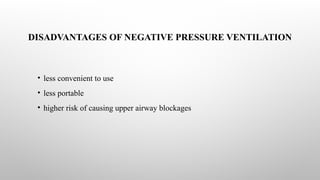
• provides ventilator support using a device such as iron lung
• was popular in first half of twentieth century
• works by lowering pressure surrounding the thorax  creates
sub-atmospheric pressure which passively expands the chest a.
wall and inflates lungs.
• exhalation occurs via passive recoil of chest wall
a. tank ventilator (iron lung)
b. cuirass ventilator b.
DISADVANTAGES OF NEGATIVE PRESSURE VENTILATION
• less convenient to use
• less portable
• higher risk of causing upper airway blockages
TYPES OF NON-INVASIVE POSITIVE PRESSURE
VENTILATION
1. CONTINUOUS POSITIVE AIRWAY PRESSURE (CPAP)
2. BILEVEL POSITIVE AIRWAY PRESSURE (BIPAP)
CONTINUOUS POSITIVE AIRWAY PRESSURE (CPAP)
• CPAP is one of the methods of NIV which provides a fixed pressure during both inspiration and
expiration
• fixed pressure set between 5-10 cm of H2O
• primarily helps oxygenation as it prevents alveolar collapse, recruits/splints alveoli decreases
work of breathing, and increases functional residual capacity
• useful in hypoxemic respiratory failure
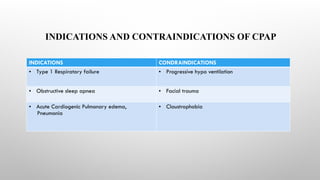
INDICATIONS AND CONTRAINDICATIONS OF CPAP
INDICATIONS CONDRAINDICATIONS
• Type 1 Respiratory failure • Progressive hypo ventilation
• Obstructive sleep apnea • Facial trauma
• Acute Cardiogenic Pulmonary edema,
Pneumonia
• Claustrophobia
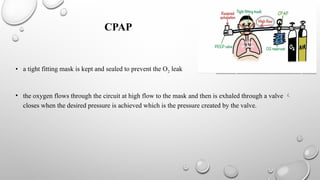
CPAP
• a tight fitting mask is kept and sealed to prevent the O2 leak
• the oxygen flows through the circuit at high flow to the mask and then is exhaled through a valve 
closes when the desired pressure is achieved which is the pressure created by the valve.
BI-LEVEL POSITIVE AIRWAY PRESSURE (BIPAP)
• positive pressure is maintained throughout the respiratory cycle, with a higher pressure
during inspiration
• results in reduced work of breathing and an improvement in tidal volume and CO2 removal
• it is therefore particularly useful in the treatment of Type II respiratory failure.
•
RESPIRATORY EFFECTS OF BI-PAP
• EPAP
• provides PEEP
• increases functional residual capacity
• IPAP
• decreases work of breathing + oxygen demand
• increases spontaneous tidal volume
• decreases spontaneous respiratory rate
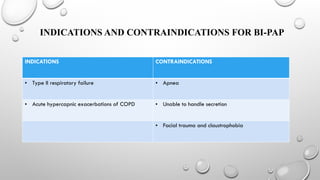
INDICATIONS AND CONTRAINDICATIONS FOR BI-PAP
INDICATIONS CONTRAINDICATIONS
• Type II respiratory failure • Apnea
• Acute hypercapnic exacerbations of COPD • Unable to handle secretion
• Facial trauma and claustrophobia
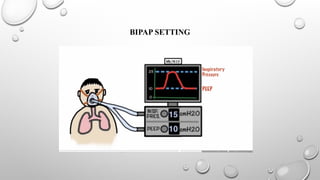
BIPAP SETTING
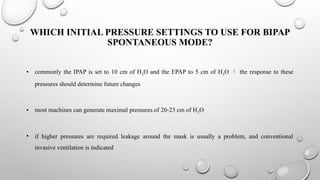
WHICH INITIAL PRESSURE SETTINGS TO USE FOR BIPAP
SPONTANEOUS MODE?
• commonly the IPAP is set to 10 cm of H2O and the EPAP to 5 cm of H2O  the response to these
pressures should determine future changes
• most machines can generate maximal pressures of 20-23 cm of H2O
• if higher pressures are required leakage around the mask is usually a problem, and conventional
invasive ventilation is indicated
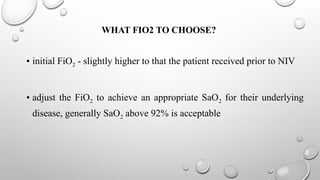
WHAT FIO2 TO CHOOSE?
• initial FiO2 - slightly higher to that the patient received prior to NIV
• adjust the FiO2 to achieve an appropriate SaO2 for their underlying
disease, generally SaO2 above 92% is acceptable
HOW TO MONITOR THE PATIENT’S RESPONSE TO NIV?
• the most useful indicator is how the patient feels.
• they should be able to tell you if they feel better or worse.
• where available arterial blood gases (ABG) are useful to assess changes in oxygenation and CO2 clearance.
• monitoring physiological response
• continuous oximetry and ETCO2
• exhaled tidal volume
• ABG - initial, 1, 2-6 hrs
• OBJECTIVE
• RESPIRATORY RATE
• CHEST WALL MOVEMENT
• COORDINATION OF RESPIRATORY EFFORT WITH NIV
• ACCESSORY MUSCLE USE
• HR AND BP
• MENTAL STATE
• SUBJECTIVE
• DYSPNOEA
• COMFORT
DOCUMENTATION
• MODE OF VENTILATION
• FLOW RATE OF OXYGEN
• PERCENTAGE OF OXYGEN
• HR AND BP
• RESPIRATORY ASSESSMENT
• CONSCIOUS LEVEL (GCS)
• OBSERVE - 15 MINUTELY FOR FIRST HOUR, THEN HOURLY IF CONDITION STABLE
HOW TO TELL IF NIV IS NOT EFFECTIVE?
• largely based on how the patient feels and ABG results.
• if the patient is getting increasingly tired, or their ABG deteriorating despite optimal settings,
then they will probably need tracheal intubation and mechanical ventilation.
• it is important to recognize this as soon as possible so that management may be planned before
the patient collapses.
TREATMENT FAILURE
• deterioration in condition
• worsening or non improving ABG
• intolerance or failure to coordinate with machine
• treatment failure
• back to the patient- ABC
• medical therapy optimized
• treatment of complications
CRITERIA TO DISCONTINUE NIV
• inability to tolerate the mask
• inability to improve gas exchange or dyspnoea
• need for endotracheal intubation
• hemodynamic instability
• ECG – ischaemia/arrhythmia
WITHDRAWAL OF NIV
• CLINICAL IMPROVEMENT
• AIM FOR
• RR <24
• HR <110
• PH >7.35
• SATS >90% ON <40% FIO2
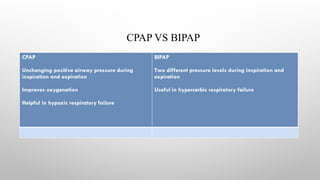
CPAP VS BIPAP
CPAP
Unchanging positive airway pressure during
inspiration and expiration
Improves oxygenation
Helpful in hypoxic respiratory failure
BIPAP
Two different pressure levels during inspiration and
expiration
Useful in hypercarbic respiratory failure
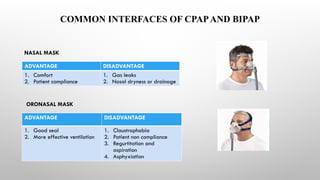
COMMON INTERFACES OF CPAPAND BIPAP
ADVANTAGE DISADVANTAGE
1. Comfort
2. Patient compliance
1. Gas leaks
2. Nasal dryness or drainage
ADVANTAGE DISADVANTAGE
1. Good seal
2. More effective ventilation
1. Claustrophobia
2. Patient non compliance
3. Regurtitation and
aspiration
4. Asphyxiation
NASAL MASK
ORONASAL MASK
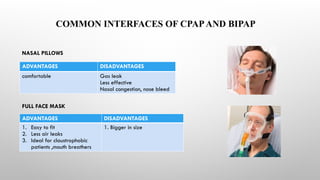
COMMON INTERFACES OF CPAPAND BIPAP
ADVANTAGES DISADVANTAGES
comfortable Gas leak
Less effective
Nasal congestion, nose bleed
ADVANTAGES DISADVANTAGES
1. Easy to fit
2. Less air leaks
3. Ideal for claustrophobic
patients ,mouth breathers
1. Bigger in size
NASAL PILLOWS
FULL FACE MASK
ADVANTAGES OF NIV
• avoids trauma
• avoids need for sedation
• can communicate
• allows intermittent eating/ talking /drinking
• easier application
• patient comfort
• easy to teach paramedics and nurses
DISADVANTAGES OF NIV
• claustrophobia
• facial pressure sores
• airway not protected
• gas leaks
• gastric distension
REFERENCES
• MECHANICAL VENTILATION- DAVID W. CHANG
• MARINO’S- THE ICU BOOK
THANK YOU !!!

NON-INVASIVE VENTILATION anesthesia.pptx

  • 1.
  • 2.
    OVERVIEW:  INTRODUCTION  TYPESOF NIV  NEGATIVE PRESSURE VENTILATION  POSITIVE PRESSURE VENTILATION  CPAP  BIPAP  COMMON INTERFACES BETWEEN CPAP AND BIPAP  ADVANTAGES AND DISADVANTAGES
  • 3.
    INTRODUCTION • Non–Invasive Ventilation(NIV) is the administration of ventilator support without using an invasive artificial airway (endotracheal tube or tracheostomy tube) • works by creating a positive airway pressure • lessens respiratory effort and work of breathing
  • 4.
    RESPIRATORY FAILURE • astate of reduced oxygenation such that PaO2 is less than 60 mmHg. • divided into • Type I respiratory failure – the primary problem is one of oxygenation, PaO2 < 60 mmHg and PaCO2 is low or normal. • Type II respiratory failure - fails to adequately clear CO2, causing a raised PaCO2.
  • 5.
    TYPES OF NIV •NON-INVASIVE NEGATIVE AIRWAY PRESSURE VENTILATION • NON-INVASIVE POSITIVE AIRWAY PRESSURE VENTILATION
  • 6.
    NEGATIVE PRESSURE VENTILATION •provides ventilator support using a device such as iron lung • was popular in first half of twentieth century • works by lowering pressure surrounding the thorax  creates sub-atmospheric pressure which passively expands the chest a. wall and inflates lungs. • exhalation occurs via passive recoil of chest wall a. tank ventilator (iron lung) b. cuirass ventilator b.
  • 7.
    DISADVANTAGES OF NEGATIVEPRESSURE VENTILATION • less convenient to use • less portable • higher risk of causing upper airway blockages
  • 8.
    TYPES OF NON-INVASIVEPOSITIVE PRESSURE VENTILATION 1. CONTINUOUS POSITIVE AIRWAY PRESSURE (CPAP) 2. BILEVEL POSITIVE AIRWAY PRESSURE (BIPAP)
  • 9.
    CONTINUOUS POSITIVE AIRWAYPRESSURE (CPAP) • CPAP is one of the methods of NIV which provides a fixed pressure during both inspiration and expiration • fixed pressure set between 5-10 cm of H2O • primarily helps oxygenation as it prevents alveolar collapse, recruits/splints alveoli decreases work of breathing, and increases functional residual capacity • useful in hypoxemic respiratory failure
  • 10.
    INDICATIONS AND CONTRAINDICATIONSOF CPAP INDICATIONS CONDRAINDICATIONS • Type 1 Respiratory failure • Progressive hypo ventilation • Obstructive sleep apnea • Facial trauma • Acute Cardiogenic Pulmonary edema, Pneumonia • Claustrophobia
  • 11.
    CPAP • a tightfitting mask is kept and sealed to prevent the O2 leak • the oxygen flows through the circuit at high flow to the mask and then is exhaled through a valve  closes when the desired pressure is achieved which is the pressure created by the valve.
  • 12.
    BI-LEVEL POSITIVE AIRWAYPRESSURE (BIPAP) • positive pressure is maintained throughout the respiratory cycle, with a higher pressure during inspiration • results in reduced work of breathing and an improvement in tidal volume and CO2 removal • it is therefore particularly useful in the treatment of Type II respiratory failure. •
  • 13.
    RESPIRATORY EFFECTS OFBI-PAP • EPAP • provides PEEP • increases functional residual capacity • IPAP • decreases work of breathing + oxygen demand • increases spontaneous tidal volume • decreases spontaneous respiratory rate
  • 14.
    INDICATIONS AND CONTRAINDICATIONSFOR BI-PAP INDICATIONS CONTRAINDICATIONS • Type II respiratory failure • Apnea • Acute hypercapnic exacerbations of COPD • Unable to handle secretion • Facial trauma and claustrophobia
  • 15.
  • 16.
    WHICH INITIAL PRESSURESETTINGS TO USE FOR BIPAP SPONTANEOUS MODE? • commonly the IPAP is set to 10 cm of H2O and the EPAP to 5 cm of H2O  the response to these pressures should determine future changes • most machines can generate maximal pressures of 20-23 cm of H2O • if higher pressures are required leakage around the mask is usually a problem, and conventional invasive ventilation is indicated
  • 17.
    WHAT FIO2 TOCHOOSE? • initial FiO2 - slightly higher to that the patient received prior to NIV • adjust the FiO2 to achieve an appropriate SaO2 for their underlying disease, generally SaO2 above 92% is acceptable
  • 18.
    HOW TO MONITORTHE PATIENT’S RESPONSE TO NIV? • the most useful indicator is how the patient feels. • they should be able to tell you if they feel better or worse. • where available arterial blood gases (ABG) are useful to assess changes in oxygenation and CO2 clearance. • monitoring physiological response • continuous oximetry and ETCO2 • exhaled tidal volume • ABG - initial, 1, 2-6 hrs
  • 19.
    • OBJECTIVE • RESPIRATORYRATE • CHEST WALL MOVEMENT • COORDINATION OF RESPIRATORY EFFORT WITH NIV • ACCESSORY MUSCLE USE • HR AND BP • MENTAL STATE • SUBJECTIVE • DYSPNOEA • COMFORT
  • 20.
    DOCUMENTATION • MODE OFVENTILATION • FLOW RATE OF OXYGEN • PERCENTAGE OF OXYGEN • HR AND BP • RESPIRATORY ASSESSMENT • CONSCIOUS LEVEL (GCS) • OBSERVE - 15 MINUTELY FOR FIRST HOUR, THEN HOURLY IF CONDITION STABLE
  • 21.
    HOW TO TELLIF NIV IS NOT EFFECTIVE? • largely based on how the patient feels and ABG results. • if the patient is getting increasingly tired, or their ABG deteriorating despite optimal settings, then they will probably need tracheal intubation and mechanical ventilation. • it is important to recognize this as soon as possible so that management may be planned before the patient collapses.
  • 22.
    TREATMENT FAILURE • deteriorationin condition • worsening or non improving ABG • intolerance or failure to coordinate with machine • treatment failure • back to the patient- ABC • medical therapy optimized • treatment of complications
  • 23.
    CRITERIA TO DISCONTINUENIV • inability to tolerate the mask • inability to improve gas exchange or dyspnoea • need for endotracheal intubation • hemodynamic instability • ECG – ischaemia/arrhythmia
  • 24.
    WITHDRAWAL OF NIV •CLINICAL IMPROVEMENT • AIM FOR • RR <24 • HR <110 • PH >7.35 • SATS >90% ON <40% FIO2
  • 25.
    CPAP VS BIPAP CPAP Unchangingpositive airway pressure during inspiration and expiration Improves oxygenation Helpful in hypoxic respiratory failure BIPAP Two different pressure levels during inspiration and expiration Useful in hypercarbic respiratory failure
  • 26.
    COMMON INTERFACES OFCPAPAND BIPAP ADVANTAGE DISADVANTAGE 1. Comfort 2. Patient compliance 1. Gas leaks 2. Nasal dryness or drainage ADVANTAGE DISADVANTAGE 1. Good seal 2. More effective ventilation 1. Claustrophobia 2. Patient non compliance 3. Regurtitation and aspiration 4. Asphyxiation NASAL MASK ORONASAL MASK
  • 27.
    COMMON INTERFACES OFCPAPAND BIPAP ADVANTAGES DISADVANTAGES comfortable Gas leak Less effective Nasal congestion, nose bleed ADVANTAGES DISADVANTAGES 1. Easy to fit 2. Less air leaks 3. Ideal for claustrophobic patients ,mouth breathers 1. Bigger in size NASAL PILLOWS FULL FACE MASK
  • 28.
    ADVANTAGES OF NIV •avoids trauma • avoids need for sedation • can communicate • allows intermittent eating/ talking /drinking • easier application • patient comfort • easy to teach paramedics and nurses
  • 29.
    DISADVANTAGES OF NIV •claustrophobia • facial pressure sores • airway not protected • gas leaks • gastric distension
  • 30.
    REFERENCES • MECHANICAL VENTILATION-DAVID W. CHANG • MARINO’S- THE ICU BOOK
  • 31.