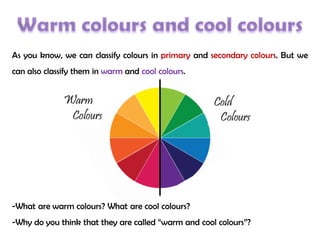
As you know, we can classify colours in primary and secondary colours. But we
can also classify them in warm and cool colours.
-What are warm colours? What are cool colours?
-Why do you think that they are called “warm and cool colours”?
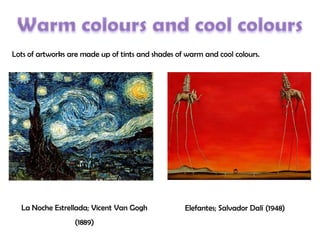
Lots of artworks are made up of tints and shades of warm and cool colours.
Elefantes; Salvador Dalí (1948)La Noche Estrellada; Vicent Van Gogh
(1889)
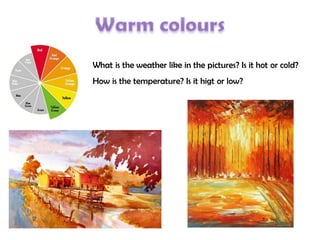
What is the weather like in the pictures? Is it hot or cold?
How is the temperature? Is it higt or low?
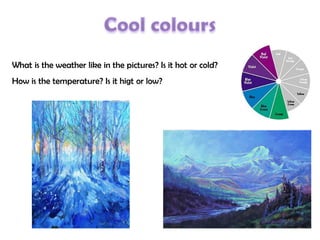
What is the weather like in the pictures? Is it hot or cold?
How is the temperature? Is it higt or low?
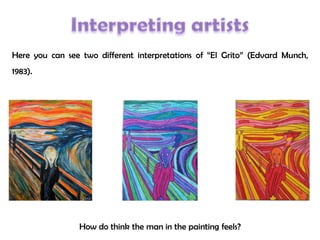
Here you can see two different interpretations of “El Grito” (Edvard Munch,
1983).
How do think the man in the painting feels?
Now, it’s
your turn
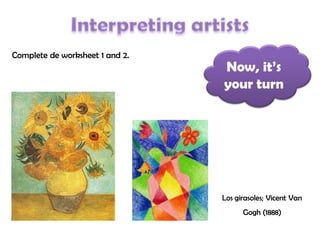
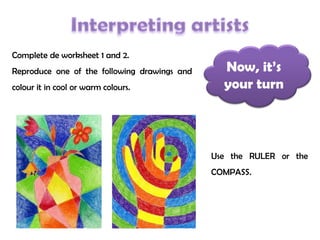
Complete de worksheet 1 and 2.
Los girasoles; Vicent Van
Gogh (1888)
Complete de worksheet 1 and 2.
Reproduce one of the following drawings and
colour it in cool or warm colours.
Use the RULER or the
COMPASS.
Now, it’s
your turn
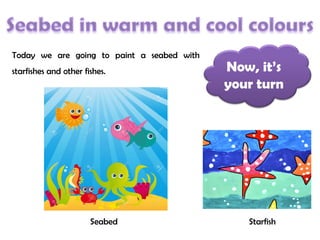
Today we are going to paint a seabed with
starfishes and other fishes. Now, it’s
your turn
Seabed Starfish
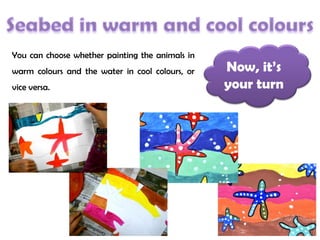
You can choose whether painting the animals in
warm colours and the water in cool colours, or
vice versa.
Now, it’s
your turn
Now, it’s
your turn
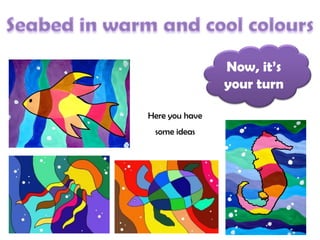
Here you have
some ideas
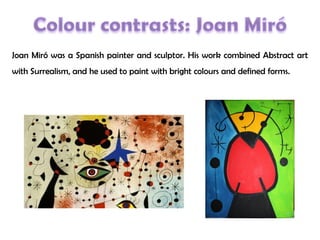
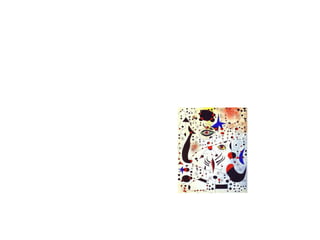
Joan Miró was a Spanish painter and sculptor. His work combined Abstract art
with Surrealism, and he used to paint with bright colours and defined forms.
Now, it’s
your turn
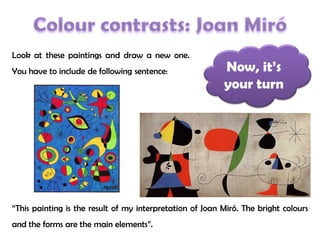
Look at these paintings and draw a new one.
You have to include de following sentence:
“This painting is the result of my interpretation of Joan Miró. The bright colours
and the forms are the main elements”.
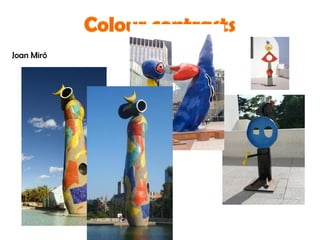
Joan Miró
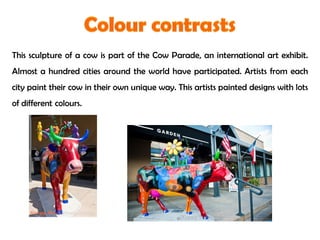
This sculpture of a cow is part of the Cow Parade, an international art exhibit.
Almost a hundred cities around the world have participated. Artists from each
city paint their cow in their own unique way. This artists painted designs with lots
of different colours.
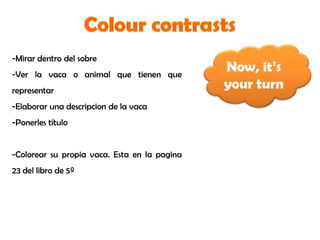
Now, it’s
your turn
-Mirar dentro del sobre
-Ver la vaca o animal que tienen que
representar
-Elaborar una descripcion de la vaca
-Ponerles título
-Colorear su propia vaca. Esta en la pagina
23 del libro de 5º
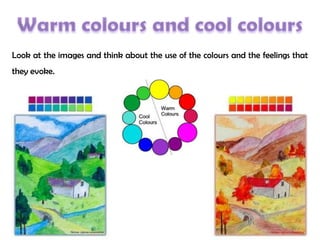
Look at the images and think about the use of the colours and the feelings that
they evoke.

4. cool colours and warm colours

  • 2.
    As you know,we can classify colours in primary and secondary colours. But we can also classify them in warm and cool colours. -What are warm colours? What are cool colours? -Why do you think that they are called “warm and cool colours”?
  • 3.
    Lots of artworksare made up of tints and shades of warm and cool colours. Elefantes; Salvador Dalí (1948)La Noche Estrellada; Vicent Van Gogh (1889)
  • 4.
    What is theweather like in the pictures? Is it hot or cold? How is the temperature? Is it higt or low?
  • 5.
    What is theweather like in the pictures? Is it hot or cold? How is the temperature? Is it higt or low?
  • 6.
    Here you cansee two different interpretations of “El Grito” (Edvard Munch, 1983). How do think the man in the painting feels?
  • 7.
    Now, it’s your turn Completede worksheet 1 and 2. Los girasoles; Vicent Van Gogh (1888)
  • 8.
    Complete de worksheet1 and 2. Reproduce one of the following drawings and colour it in cool or warm colours. Use the RULER or the COMPASS. Now, it’s your turn
  • 9.
    Today we aregoing to paint a seabed with starfishes and other fishes. Now, it’s your turn Seabed Starfish
  • 10.
    You can choosewhether painting the animals in warm colours and the water in cool colours, or vice versa. Now, it’s your turn
  • 11.
    Now, it’s your turn Hereyou have some ideas
  • 12.
    Joan Miró wasa Spanish painter and sculptor. His work combined Abstract art with Surrealism, and he used to paint with bright colours and defined forms.
  • 13.
    Now, it’s your turn Lookat these paintings and draw a new one. You have to include de following sentence: “This painting is the result of my interpretation of Joan Miró. The bright colours and the forms are the main elements”.
  • 15.
  • 16.
    This sculpture ofa cow is part of the Cow Parade, an international art exhibit. Almost a hundred cities around the world have participated. Artists from each city paint their cow in their own unique way. This artists painted designs with lots of different colours.
  • 17.
    Now, it’s your turn -Mirardentro del sobre -Ver la vaca o animal que tienen que representar -Elaborar una descripcion de la vaca -Ponerles título -Colorear su propia vaca. Esta en la pagina 23 del libro de 5º
  • 18.
    Look at theimages and think about the use of the colours and the feelings that they evoke.