IMAGING APPROACH TO PORTAL
HYPERTENSION
MODERATOR- DR.RAMAKANTH
ASSISTANT PROFESSOR
PRESENTOR-DR.K.SHREENATH
DEFINITION
• Portal hypertension (PHT) is defined as increase in portal venous
pressure due to increase in vascular resistance or increased blood
flow or both, resulting in hepatic venous pressure gradient (HVPG) >5
mm Hg.
• HVPG >10 mm Hg is associated with ascites, portosystemic collaterals,
varices, and risk of hepatocellular carcinoma (HCC) and HVPG >12
mm Hg, with increased risk of variceal bleed.
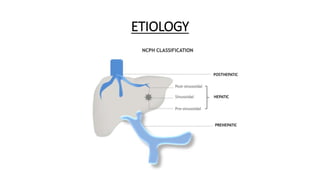
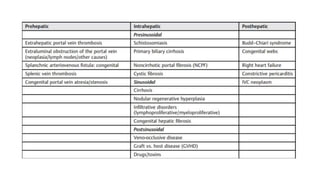
ETIOLOGY
Intrahepatic Causes
• Cirrhosis-
• It is advanced stage of liver disease, with histological fibrosis,
necrosis, inflammation, and regenerative nodules (RNs) resulting in
altered liver morphology.
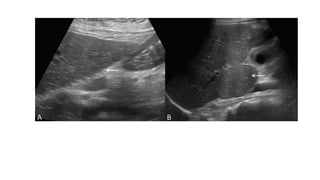
• Ultrasound and Doppler-
• coarse echotexture, small-sized liver with irregular nodular surface,
blunt edge, and volume redistribution. Typically, caudate and lateral
liver segments undergo hypertrophy, while the medial segment and
right lobe undergo atrophy.
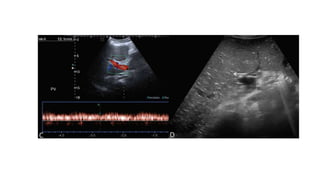
• Extrahepatic manifestations on Doppler include features like-
• enlarged portal vein diameter > 12 mm
• decreased portal vein velocity of less than 16 cm/s (normal velocity is
between 20 and 40 cm/s)
• hepatofugal flow,
• enlarged and tortuous hepatic artery
• splenomegaly, and portosystemic collaterals
• Portal vein thrombosis can occur in cirrhosis
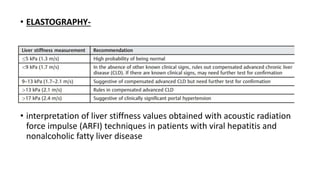
• ELASTOGRAPHY-
• interpretation of liver stiffness values obtained with acoustic radiation
force impulse (ARFI) techniques in patients with viral hepatitis and
nonalcoholic fatty liver disease
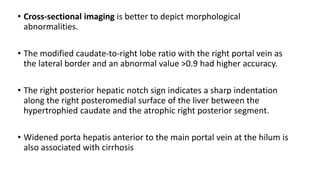
• Cross-sectional imaging is better to depict morphological
abnormalities.
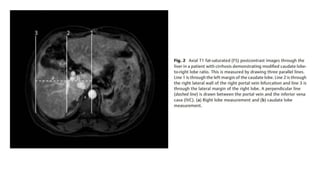
• The modified caudate-to-right lobe ratio with the right portal vein as
the lateral border and an abnormal value >0.9 had higher accuracy.
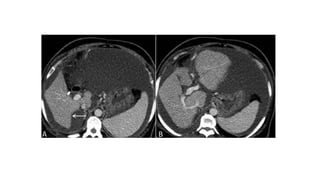
• The right posterior hepatic notch sign indicates a sharp indentation
along the right posteromedial surface of the liver between the
hypertrophied caudate and the atrophic right posterior segment.
• Widened porta hepatis anterior to the main portal vein at the hilum is
also associated with cirrhosis
• MRI is the best imaging modality to evaluate cirrhosis associated
nodules.
• RNs are isointense on T1W and T2W sequences. They have
predominant vascular supply from the portal vein and hence are
indistinguishable on the arterial phase and isointense on the other
phases
• Other extrahepatic findings associated with cirrhosis include ascites,
bowel wall thickening, diffuse edema, and gallbladder wall thickening.
Gamna–Gandy bodiesare seen as echogenic the foci on US and T2
hypointense on MRI
Noncirrhotic portal hypertension (NCPH)
• a presinusoidal, intrahepatic cause of PHT.
• characterized by sclerosis and obliteration of medium and small
branches of the portal vein with periportal fibrosis resulting in PHT.
But features of cirrhosis is typically absent.
• NCPH is called noncirrhotic portal fibrosis (NCPF) in India
• ETIOLOGY-
• The exact etiology is unknown in up to 50% of patients with NCPF.
• Some known etiologies include umbilical sepsis, portal pyemia, and
diarrheal and bacterial infections in infancy
• CLINICAL FEATURES-
• GI bleed, abdominal mass from massive splenomegaly, and anemia
from hypersplenism.
• Jaundice, ascites, and hepatic encephalopathy are uncommon.
• Liver function test is normal.
• There are no features of cirrhosis on liver biopsy.
• Portal vein thrombosis is more common in NCPF than in cirrhosis and
is associated with poor prognosis
Imaging Findings
• Ultrasound and Doppler-
• Liver is either normal, enlarged, or small and shrunken.
• Unlike cirrhosis, the liver surface is smooth in patients with NCPF.
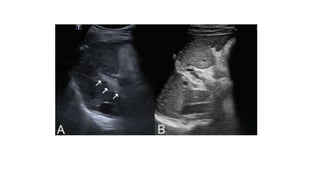
• Portal venous axis and intrahepatic portal tracts have echogenic wall
thickening often >3mm from periportal fibrosis .
• Periportal fibrosis can also have a layered appearance with alternative
echogenicity and hypoechogenicity .
• Massive splenomegaly and normal splenoportal axis are hallmarks of
NCPF.
• Doppler examination can reveal portal vein thrombosis, a known
complication of NCPF.
• Elastography-helps differentiate cirrhosis from NCPF.
• In NCPF, liver stiffness is normal or near normal compared with
increased stiffness in cirrhosis.
• Cross-Sectional Imaging-
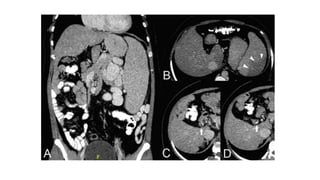
• No volume redistribution like cirrhosis.
• In the late stage, liver is shrunken, and its surface becomes nodular.
• Features of thrombosis of intra- and extrahepatic portal vein can be
seen as filling defects, wall thickening, calcification or portal
cavernoma.
• CT will also show massive splenomegaly and splenic infarcts.
Esophageal (85–90%) and anorectal varices (89%) are common in NCPF.
• Gastric varices are less common (25%) but often present with GI bleed.
• Hemodynamic Studies
• In late stages of NCPF, it is hard to differentiate NCPF from cirrhosis
based only on imaging findings,hemodynamic studies are useful.
• HVPG, intrahepatic pressure, and hepatic venous pressure are normal
or near normal in NCPF.
• Magnetic Resonance Imaging
• Periportal fibrosis is seen as hyperintense periportal cuffing on T2W
images.
Extrahepatic Portal Vein Obstruction
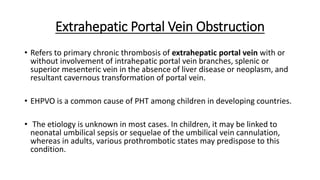
• Refers to primary chronic thrombosis of extrahepatic portal vein with or
without involvement of intrahepatic portal vein branches, splenic or
superior mesenteric vein in the absence of liver disease or neoplasm, and
resultant cavernous transformation of portal vein.
• EHPVO is a common cause of PHT among children in developing countries.
• The etiology is unknown in most cases. In children, it may be linked to
neonatal umbilical sepsis or sequelae of the umbilical vein cannulation,
whereas in adults, various prothrombotic states may predispose to this
condition.
• Portal vein thrombosis results in the formation of portoportal collaterals
as alternate pathways to shunt blood to the liver.
• Splenomegaly and portosystemic collaterals develop as portal pressures
increase further.
• Abnormalities in the extrahepatic biliary tract occur in patients with
EHPVO due to either extrinsic compression of the bile duct by collaterals
or biliary stricture due to prolonged ischemia and is termed portal
cavernoma cholangiopathy (PCC).
• It may be irreversible if there is fibrotic stricture or mass like cavernoma
with predominant fibrotic soft tissue compressing the duct.
• Imaging Findings
• Ultrasound and Color Doppler-
• The portal vein is replaced by multiple tortuous venous channels at the
porta and peripancreatic regions.
• The pericholecystic vessels also frequently enlarge and become
tortuous.
• The liver surface is smooth and there is no volume redistribution;
however, these can be seen in late stages of disease.
• As PHT develops, there is moderate to gross splenomegaly and
portosystemic collaterals .
• Doppler demonstrates absent flow in the main portal vein and
decreased monophasic flow toward the liver in the portoportal
collaterals
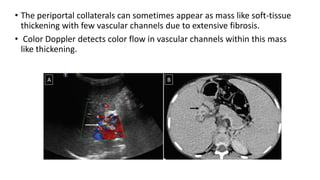
• The periportal collaterals can sometimes appear as mass like soft-tissue
thickening with few vascular channels due to extensive fibrosis.
• Color Doppler detects color flow in vascular channels within this mass
like thickening.
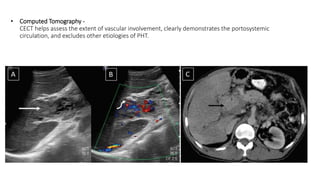
• Computed Tomography -
CECT helps assess the extent of vascular involvement, clearly demonstrates the portosystemic
circulation, and excludes other etiologies of PHT.
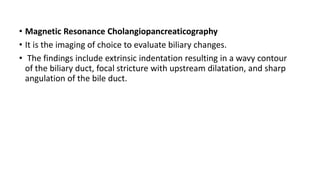
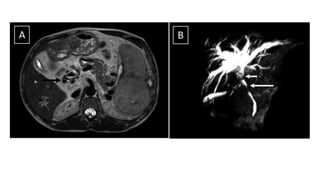
• Magnetic Resonance Cholangiopancreaticography
• It is the imaging of choice to evaluate biliary changes.
• The findings include extrinsic indentation resulting in a wavy contour
of the biliary duct, focal stricture with upstream dilatation, and sharp
angulation of the bile duct.
Budd–Chiari syndrome
• Refers to disorders resulting from partial or complete hepatic venous
outflow obstruction in the hepatic veins or IVC up to the cavoatrial
junction.
• It occurs more commonly in young adults and in women and is an
important posthepatic cause of PHT.
• 2 TYPES-PRIMARY AND SECONDARY
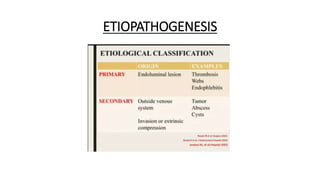
ETIOPATHOGENESIS
• The hepatic venous outflow obstruction leads to increased hepatic
sinusoidal pressure and decreased portal perfusion.
• There is hepatic congestion, which can progress to ischemic injury,
hepatocyte necrosis, fibrosis, and ultimately cirrhosis.
• Imaging-
• Imaging findings reflect the duration of BCS with varying changes in
acute, subacute, and chronic stages.
• Subacute-difficult to differentiate.
ACUTE BCS
• US and Doppler-
• will show hepatomegaly, ascites, and enlarged caudate lobe, which
may compress the IVC.
• An enlarged caudate vein (3 mm) may suggest BCS.
• Distended hepatic veins with hypoechoic thrombus may be seen,
which evolves over time to echogenic thrombus with reduction in
caliber of the vein.
• On Doppler, there may be loss of phasic variation of the waveform,
absent flow, or reversed flow.
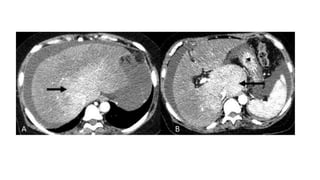
• Computed Tomography and Magnetic Resonance Imaging –
• The acute changes of increased sinusoidal pressure and hepatic
congestion due to outflow obstruction cause hepatomegaly with
patchy reduced enhancement in the peripheral portions of the liver on
the early phase of CECT and MRI with relatively increased
enhancement in the caudate lobe, which is enlarged.
• Reversal of enhancement with increased enhancement in the
peripheral portions of the liver and relative decreased enhancement in
the caudate lobe on the venous phase is termed the “flip flop”
phenomenon
CHRONIC BCS
• morphologic changes in the liver are those of chronic liver disease with
volume redistribution.
• The parenchymal edema seen in acute BCS is now replaced by fibrosis with
delayed enhancement on CECT or MRI.
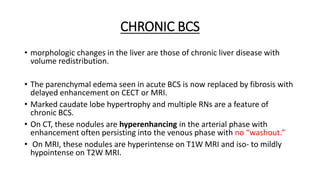
• Marked caudate lobe hypertrophy and multiple RNs are a feature of
chronic BCS.
• On CT, these nodules are hyperenhancing in the arterial phase with
enhancement often persisting into the venous phase with no “washout.”
• On MRI, these nodules are hyperintense on T1W MRI and iso- to mildly
hypointense on T2W MRI.
DIAGNOSIS
• Direct signs include-
• dilated splenoportal axis (main portal vein diameter >13 mm and
splenic vein diameter >10 mm)
• reduced to reversed portal vein flow and presence of collaterals.
• The important associated findings include splenomegaly (length >12
cm) and ascites.
• US and Doppler-
• It helps identify patency and direction of flow in relevant vessels and
frequently identifies collaterals.
• The normal portal vein flow on Doppler is always hepatopetal with a
fairly uniform flow and slight undulation/phasicity due to respiration
and cardiac activity.
• The normal mean flow velocity is 12 to 18 cm/s (or peak velocity from
20 to 40 cm/s).
• As PHT starts to develops, the flow in the portal vein decreases and
loses normal undulation and becomes monophasic.
• With more severe PHT, there will be reverse/hepatofugal flow.
• The portal vein diameter should be measured at the point it crosses
anterior to the IVC.
• For Doppler evaluation, the most important technical requirement is
the need to keep the angle of insonation less than 60 degrees.
• Scanning should be done in gentle respiration.
• Performing scan in arrested or deep inspiration can increase the
portal vein caliber and halt or even reverse the flow, and hence should
be avoided.
INTERVENTIONAL RADIOLOGY TECHNIQUES
• Transjugular intrahepatic portosystemic shunts (TIPS)
• Balloon-occluded retrograde obliteration (BRTO) of gastric varices
• Recanalization of occluded IVC or hepatic veins
• Stenting.
THANK YOU!!!

IMAGING IN PORTAL HYPERTENSION.pptx

  • 1.
    IMAGING APPROACH TOPORTAL HYPERTENSION MODERATOR- DR.RAMAKANTH ASSISTANT PROFESSOR PRESENTOR-DR.K.SHREENATH
  • 2.
    DEFINITION • Portal hypertension(PHT) is defined as increase in portal venous pressure due to increase in vascular resistance or increased blood flow or both, resulting in hepatic venous pressure gradient (HVPG) >5 mm Hg. • HVPG >10 mm Hg is associated with ascites, portosystemic collaterals, varices, and risk of hepatocellular carcinoma (HCC) and HVPG >12 mm Hg, with increased risk of variceal bleed.
  • 3.
  • 5.
    Intrahepatic Causes • Cirrhosis- •It is advanced stage of liver disease, with histological fibrosis, necrosis, inflammation, and regenerative nodules (RNs) resulting in altered liver morphology. • Ultrasound and Doppler- • coarse echotexture, small-sized liver with irregular nodular surface, blunt edge, and volume redistribution. Typically, caudate and lateral liver segments undergo hypertrophy, while the medial segment and right lobe undergo atrophy.
  • 8.
    • Extrahepatic manifestationson Doppler include features like- • enlarged portal vein diameter > 12 mm • decreased portal vein velocity of less than 16 cm/s (normal velocity is between 20 and 40 cm/s) • hepatofugal flow, • enlarged and tortuous hepatic artery • splenomegaly, and portosystemic collaterals • Portal vein thrombosis can occur in cirrhosis
  • 9.
    • ELASTOGRAPHY- • interpretationof liver stiffness values obtained with acoustic radiation force impulse (ARFI) techniques in patients with viral hepatitis and nonalcoholic fatty liver disease
  • 10.
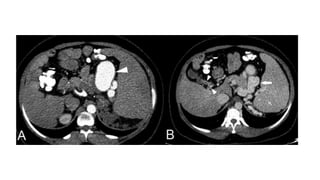
    • Cross-sectional imagingis better to depict morphological abnormalities. • The modified caudate-to-right lobe ratio with the right portal vein as the lateral border and an abnormal value >0.9 had higher accuracy. • The right posterior hepatic notch sign indicates a sharp indentation along the right posteromedial surface of the liver between the hypertrophied caudate and the atrophic right posterior segment. • Widened porta hepatis anterior to the main portal vein at the hilum is also associated with cirrhosis
  • 13.
    • MRI isthe best imaging modality to evaluate cirrhosis associated nodules. • RNs are isointense on T1W and T2W sequences. They have predominant vascular supply from the portal vein and hence are indistinguishable on the arterial phase and isointense on the other phases • Other extrahepatic findings associated with cirrhosis include ascites, bowel wall thickening, diffuse edema, and gallbladder wall thickening. Gamna–Gandy bodiesare seen as echogenic the foci on US and T2 hypointense on MRI
  • 14.
    Noncirrhotic portal hypertension(NCPH) • a presinusoidal, intrahepatic cause of PHT. • characterized by sclerosis and obliteration of medium and small branches of the portal vein with periportal fibrosis resulting in PHT. But features of cirrhosis is typically absent. • NCPH is called noncirrhotic portal fibrosis (NCPF) in India
  • 15.
    • ETIOLOGY- • Theexact etiology is unknown in up to 50% of patients with NCPF. • Some known etiologies include umbilical sepsis, portal pyemia, and diarrheal and bacterial infections in infancy • CLINICAL FEATURES- • GI bleed, abdominal mass from massive splenomegaly, and anemia from hypersplenism. • Jaundice, ascites, and hepatic encephalopathy are uncommon. • Liver function test is normal. • There are no features of cirrhosis on liver biopsy. • Portal vein thrombosis is more common in NCPF than in cirrhosis and is associated with poor prognosis
  • 16.
    Imaging Findings • Ultrasoundand Doppler- • Liver is either normal, enlarged, or small and shrunken. • Unlike cirrhosis, the liver surface is smooth in patients with NCPF. • Portal venous axis and intrahepatic portal tracts have echogenic wall thickening often >3mm from periportal fibrosis . • Periportal fibrosis can also have a layered appearance with alternative echogenicity and hypoechogenicity . • Massive splenomegaly and normal splenoportal axis are hallmarks of NCPF. • Doppler examination can reveal portal vein thrombosis, a known complication of NCPF.
  • 18.
    • Elastography-helps differentiatecirrhosis from NCPF. • In NCPF, liver stiffness is normal or near normal compared with increased stiffness in cirrhosis. • Cross-Sectional Imaging- • No volume redistribution like cirrhosis. • In the late stage, liver is shrunken, and its surface becomes nodular. • Features of thrombosis of intra- and extrahepatic portal vein can be seen as filling defects, wall thickening, calcification or portal cavernoma.
  • 19.
    • CT willalso show massive splenomegaly and splenic infarcts. Esophageal (85–90%) and anorectal varices (89%) are common in NCPF. • Gastric varices are less common (25%) but often present with GI bleed. • Hemodynamic Studies • In late stages of NCPF, it is hard to differentiate NCPF from cirrhosis based only on imaging findings,hemodynamic studies are useful. • HVPG, intrahepatic pressure, and hepatic venous pressure are normal or near normal in NCPF. • Magnetic Resonance Imaging • Periportal fibrosis is seen as hyperintense periportal cuffing on T2W images.
  • 22.
    Extrahepatic Portal VeinObstruction • Refers to primary chronic thrombosis of extrahepatic portal vein with or without involvement of intrahepatic portal vein branches, splenic or superior mesenteric vein in the absence of liver disease or neoplasm, and resultant cavernous transformation of portal vein. • EHPVO is a common cause of PHT among children in developing countries. • The etiology is unknown in most cases. In children, it may be linked to neonatal umbilical sepsis or sequelae of the umbilical vein cannulation, whereas in adults, various prothrombotic states may predispose to this condition.
  • 23.
    • Portal veinthrombosis results in the formation of portoportal collaterals as alternate pathways to shunt blood to the liver. • Splenomegaly and portosystemic collaterals develop as portal pressures increase further. • Abnormalities in the extrahepatic biliary tract occur in patients with EHPVO due to either extrinsic compression of the bile duct by collaterals or biliary stricture due to prolonged ischemia and is termed portal cavernoma cholangiopathy (PCC). • It may be irreversible if there is fibrotic stricture or mass like cavernoma with predominant fibrotic soft tissue compressing the duct.
  • 24.
    • Imaging Findings •Ultrasound and Color Doppler- • The portal vein is replaced by multiple tortuous venous channels at the porta and peripancreatic regions. • The pericholecystic vessels also frequently enlarge and become tortuous. • The liver surface is smooth and there is no volume redistribution; however, these can be seen in late stages of disease. • As PHT develops, there is moderate to gross splenomegaly and portosystemic collaterals . • Doppler demonstrates absent flow in the main portal vein and decreased monophasic flow toward the liver in the portoportal collaterals
  • 25.
    • The periportalcollaterals can sometimes appear as mass like soft-tissue thickening with few vascular channels due to extensive fibrosis. • Color Doppler detects color flow in vascular channels within this mass like thickening.
  • 26.
    • Computed Tomography- CECT helps assess the extent of vascular involvement, clearly demonstrates the portosystemic circulation, and excludes other etiologies of PHT.
  • 27.
    • Magnetic ResonanceCholangiopancreaticography • It is the imaging of choice to evaluate biliary changes. • The findings include extrinsic indentation resulting in a wavy contour of the biliary duct, focal stricture with upstream dilatation, and sharp angulation of the bile duct.
  • 29.
    Budd–Chiari syndrome • Refersto disorders resulting from partial or complete hepatic venous outflow obstruction in the hepatic veins or IVC up to the cavoatrial junction. • It occurs more commonly in young adults and in women and is an important posthepatic cause of PHT. • 2 TYPES-PRIMARY AND SECONDARY
  • 30.
  • 31.
    • The hepaticvenous outflow obstruction leads to increased hepatic sinusoidal pressure and decreased portal perfusion. • There is hepatic congestion, which can progress to ischemic injury, hepatocyte necrosis, fibrosis, and ultimately cirrhosis. • Imaging- • Imaging findings reflect the duration of BCS with varying changes in acute, subacute, and chronic stages. • Subacute-difficult to differentiate.
  • 32.
    ACUTE BCS • USand Doppler- • will show hepatomegaly, ascites, and enlarged caudate lobe, which may compress the IVC. • An enlarged caudate vein (3 mm) may suggest BCS. • Distended hepatic veins with hypoechoic thrombus may be seen, which evolves over time to echogenic thrombus with reduction in caliber of the vein. • On Doppler, there may be loss of phasic variation of the waveform, absent flow, or reversed flow.
  • 33.
    • Computed Tomographyand Magnetic Resonance Imaging – • The acute changes of increased sinusoidal pressure and hepatic congestion due to outflow obstruction cause hepatomegaly with patchy reduced enhancement in the peripheral portions of the liver on the early phase of CECT and MRI with relatively increased enhancement in the caudate lobe, which is enlarged. • Reversal of enhancement with increased enhancement in the peripheral portions of the liver and relative decreased enhancement in the caudate lobe on the venous phase is termed the “flip flop” phenomenon
  • 35.
    CHRONIC BCS • morphologicchanges in the liver are those of chronic liver disease with volume redistribution. • The parenchymal edema seen in acute BCS is now replaced by fibrosis with delayed enhancement on CECT or MRI. • Marked caudate lobe hypertrophy and multiple RNs are a feature of chronic BCS. • On CT, these nodules are hyperenhancing in the arterial phase with enhancement often persisting into the venous phase with no “washout.” • On MRI, these nodules are hyperintense on T1W MRI and iso- to mildly hypointense on T2W MRI.
  • 37.
    DIAGNOSIS • Direct signsinclude- • dilated splenoportal axis (main portal vein diameter >13 mm and splenic vein diameter >10 mm) • reduced to reversed portal vein flow and presence of collaterals. • The important associated findings include splenomegaly (length >12 cm) and ascites. • US and Doppler- • It helps identify patency and direction of flow in relevant vessels and frequently identifies collaterals.
  • 38.
    • The normalportal vein flow on Doppler is always hepatopetal with a fairly uniform flow and slight undulation/phasicity due to respiration and cardiac activity. • The normal mean flow velocity is 12 to 18 cm/s (or peak velocity from 20 to 40 cm/s). • As PHT starts to develops, the flow in the portal vein decreases and loses normal undulation and becomes monophasic. • With more severe PHT, there will be reverse/hepatofugal flow.
  • 39.
    • The portalvein diameter should be measured at the point it crosses anterior to the IVC. • For Doppler evaluation, the most important technical requirement is the need to keep the angle of insonation less than 60 degrees. • Scanning should be done in gentle respiration. • Performing scan in arrested or deep inspiration can increase the portal vein caliber and halt or even reverse the flow, and hence should be avoided.
  • 40.
    INTERVENTIONAL RADIOLOGY TECHNIQUES •Transjugular intrahepatic portosystemic shunts (TIPS) • Balloon-occluded retrograde obliteration (BRTO) of gastric varices • Recanalization of occluded IVC or hepatic veins • Stenting.
  • 41.

Editor's Notes

  • #7 nodular surface (arrow) in the left lobe of liver. Volume redistribution in the form of caudate lobe hypertrophy
  • #8 Gamma gandy bodies-spleen-siderotic nodules due to tiny hemorrhagic foci causing iron and calcium deposition.
  • #13 Axial venous phase images of contrast enhanced CT (A) right posterior hepatic notch sign and (B) volume redistribution with widened porta hepatis.
  • #17 SPLENOPORTAL AXIS-COLOR DOPPLER STUDY
  • #18 echogenic wall thickening of the attenuated portal vein (arrow) layered appearance of periportal fibrosis
  • #21 Axial and coronal contrast-enhanced Ct (A,B) a small liver with smooth margins and massive splenomegaly. Note the infarcts in the upper pole of spleen . But there is no ascites. (C,D) Hypodense filling defects and calcifications in the portal vein due to portal vein thrombosis.
  • #22 CECT of the same patient in (A) shows a splenic artery aneurysm (arrowhead) from long-standing massive splenomegaly. (B) Portal vein thrombosis (arrowheads) and multiple dilated perigastric collaterals (arrow).
  • #26 Color Doppler image shows nonvisualized main portal vein replaced by multiple tortuous collaterals at the porta CECT axial section of the same patient shows portal cavernoma (black arrow) splenomegaly and relatively smooth liver surface.
  • #27 Ultrasonography shows masslike soft-tissue thickening at the porta due to extensive fibrosis. (B) Color Doppler shows few vascular channels within the masslike soft-tissue thickening. (C) Contrast-enhanced computed tomography (CECT) axial section shows enhancement of small vascular channels in the masslike cavernoma at the porta.
  • #29 T2-weighted axial section shows multiple tortuous vascular flow voids at the porta surrounding the biliary duct causing narrowing of lumen (black arrow). (B) Mrcp image shows short segments of narrowing in the extrahepatic bile duct and resultant bilobar symmetric intrahepatic bile duct
  • #35 (CECT) axial shows hypoenhancement of the peripheral portions of the liver with a relatively increased enhancement in the caudate lobe (arrow), which is enlarged. There is ascites and nonvisualized hepatic veins.
  • #37 (CECT) axial images with a markedly enlarged caudate lobe (arrow), irregular liver margins, and the presence of intrahepatic collaterals (arrow).