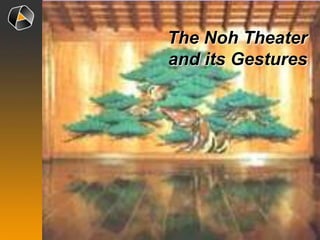
The Noh Theater
and its Gestures
Noh


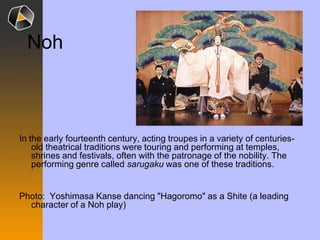
In the early fourteenth century, acting troupes in a variety of centuries-
    old theatrical traditions were touring and performing at temples,
    shrines and festivals, often with the patronage of the nobility. The
    performing genre called sarugaku was one of these traditions.


Photo: Yoshimasa Kanse dancing "Hagoromo" as a Shite (a leading
  character of a Noh play)
ROOTS OF NOH
The roots of noh go back around 1,300
 years, when a performing art called
 sangaku was brought over from China.
 It merged with Japanese comic theater
 and became a new form of
 entertainment called sarugaku about a
 thousand years ago. Sarugaku featured
 short dances and skits, consisting of
 impersonations and plays on words.
Noh and Kyogen
• Noh, which in its broadest sense includes the
  comic theater kyogen, developed as a
  distinctive theatrical form in the fourteenth
  century, making it the oldest extant
  professional theater in the world.
• Although noh and kyogen developed together
  and are inseparable, they are in many ways
  exact opposites. Noh is fundamentally a
  symbolic theater with primary importance
  attached to ritual and suggestion in a rarefied
  aesthetic atmosphere. In kyogen, on the
  other hand, primary importance is attached to
Kan’ami
• Kan'ami (1333–1384) transformed
  sarugaku into noh basically in the same
  way as it is still performed today.
  Kan'ami introduced the music and
  dance elements of the popular
  entertainment kuse-mai into sarugaku,
  and he attracted the attention and
  patronage of Muromachi shogun
  Ashikaga Yoshimitsu (1358–1408).
Zeami
• (1363–1443)
• Son of Kan’ami
• Continued his father’s work
Zeami
• After Kan'ami's death, Zeami became head of
  the Kanze troupe. The continued patronage
  of Yoshimitsu gave him the chance to further
  refine the noh aesthetic principles of:
  monomane (the imitation of things) and
  yugen, a Zen-influenced aesthetic ideal
   emphasizing the suggestion of mystery and depth.
 In addition to writing some of the best-known
  plays in the noh repertoire, Zeami wrote a
  series of essays which defined the standards
  for noh performance in the centuries that
  followed.
Noh


In the early fourteenth century, acting troupes in a variety of centuries-
    old theatrical traditions were touring and performing at temples,
    shrines and festivals, often with the patronage of the nobility. The
    performing genre called sarugaku was one of these traditions.


Photo: Yoshimasa Kanse dancing "Hagoromo" as a Shite (a leading
  character of a Noh play)
ROOTS OF NOH
The roots of noh go back around 1,300
 years, when a performing art called
 sangaku was brought over from China.
 It merged with Japanese comic theater
 and became a new form of
 entertainment called sarugaku about a
 thousand years ago. Sarugaku featured
 short dances and skits, consisting of
 impersonations and plays on words.
Noh and Kyogen
• Noh, which in its broadest sense includes the
  comic theater kyogen, developed as a
  distinctive theatrical form in the fourteenth
  century, making it the oldest extant
  professional theater in the world.
• Although noh and kyogen developed together
  and are inseparable, they are in many ways
  exact opposites. Noh is fundamentally a
  symbolic theater with primary importance
  attached to ritual and suggestion in a rarefied
  aesthetic atmosphere. In kyogen, on the
  other hand, primary importance is attached to
Kan’ami
• Kan'ami (1333–1384) transformed
  sarugaku into noh basically in the same
  way as it is still performed today.
  Kan'ami introduced the music and
  dance elements of the popular
  entertainment kuse-mai into sarugaku,
  and he attracted the attention and
  patronage of Muromachi shogun
  Ashikaga Yoshimitsu (1358–1408).
Zeami
• (1363–1443)
• Son of Kan’ami
• Continued his father’s work
Zeami
• After Kan'ami's death, Zeami became head of
  the Kanze troupe. The continued patronage
  of Yoshimitsu gave him the chance to further
  refine the noh aesthetic principles of:
  monomane (the imitation of things) and
  yugen, a Zen-influenced aesthetic ideal
   emphasizing the suggestion of mystery and depth.
 In addition to writing some of the best-known
  plays in the noh repertoire, Zeami wrote a
  series of essays which defined the standards
  for noh performance in the centuries that
  followed.
• Muromachi period 1336-1568
• Nohgaku = Noh + Kyogen
          = accomplished entertainment

• Vocal music = utai
• Instrumental music = hayashi (1 flute + 3
drums)
• Acting technique = kata (dance poses +
action)
• Dance elements = mai (dance + utai +
hayashi)
• Fine arts, crafts = masks, robes, instruments
• Architecture = Noh stage
• Art of time-space continuum,
  perfection —> stylization/formalization
• Comparable to avant-garde music
  including improvisation and chance
• Utai-bon (= chant book) contains
  script, score, rules for performance
  => conductor superfluous
• Architectural space concept is
  - modular
  - universal/multi-purpose
• Negative space = ma = stillness/emptyness
  before and after performance
• Positive space = stage properties and
                    dramatic activities
• These spaces are connected by time, no
Types of time and space:

•   Condensed time
•   Slippage of time
•   Vanishing time
•   Reversed time
•   Split time

•   Shift of space
•   Oscillating space
•   Floating space
•   Expanding and contracting space
•   Space that brings the audience „onstage―
Noh =     experience, responsibility,
       not appreciation!
Like tea ceremony,
unique in lifetime,
not reproducible!

There are no Noh stars...
„Never forget the beginner‘s mind!“

A Noh program lasts whole day
5 Noh plays + Kyogen are performed
There are five Noh principles:

1. Sancticity & magic
2. Stages of beauty
3. Actor and audience
4. Aesthetic of discord
5. Five element theory
1. Sancticity & magic

Sancticity of space:
          Space of „sacred dialog with the
  gods“

Magic in technique (from mimes):
          Acrobatics, mystical forces
          will power, autosuggestion:
          Merging self and other
          mask + mirror

   „...the mind‘s eye is opened and the soul grasped;
   the true Noh, hithertoo invisible, comes alive...“
2. Three stages of beauty

• Hana = appearant beauty: blossom/flower
• Yugen = invisible beauty: performed
  sublimity
• Rojaku(old quiet) = quiet beauty
3. Actor and audience

• Self and other, active fusion
1.Curtain 2.Third Pine 3.Bridge 4.Second Pine 5.First Pine 6.Shite pillar
7.Eye-fixing pillar 8.Flute pillar 9.Waki pillar 10.Cut-through door
11.Back panel 12.Main Stage 13.Moat Steps 14.Pebble Moat 15.Side Stage
16.Rear Stage 17.Mirror Room
4. Aesthetic of discord

• Odd number important in Japan; against
   symmetry
• Center of shape ≠ center of space:
   Dynamic balance
Jo-Ha-Kyu = most important aesthetic
   principle:
   Jo = „beginning― position = spatial element
   Ha = „break/ruin― = destruction, disorder
   Kyu = „rapid― speed, time element

Production principle for Noh program:
Everything is dominated by Jo-Ha-Kyu.
5. Five element theory
   (odd number!)
Elements: wood, fire, earth, metal, water
          ~ 5 breaths, 5 tones, 5 organs, etc.

Five Noh play categories:
     god, warrior, woman, madness, demon

Have two time categories:
    present time
    dream time

=> 10 categories in plays:
    two time categories x five play categories
Masks:


woman       demon   mad   god   warrior

Clothes &
Craft:
demon   god       woman


              warrior
Every Noh play is one cross section of The waki is a
the life of one person, the shite.     kind of co-sub-
                                       ject and mirror
The shite has an appearance (demon, etc.)
                                        person to the
and subject = one of the five elements           shite.
Instruments of hayashi
Utai‘s fushi units
kata: movement patterns
Why are gestures dominant in Noh?
Have three languages of human expression:
• Vocal
• Facial
• Gestural

• Facial is impossible because of masks
• Vocal is ambiguous in Japanese, bad for expressio
  of will, reserved to lyrical evocation

Noh is dance drama, no opera or ballet
All characters are choreographed
All movements consist of
              units of movement = kata (patterns)
              chant unit = phrase (12-syllabe line)
              music unit = melodic + rhythmic units
              space unit = za (hierarchy of places!)
Noh gestures are reduced to unit patterns (kat
  and made symbolic.

This enables much richer communication
  to audience than by eveyday gestures.

Very important for us:

• „Shite waves a web of fantasy in curves.

• „Waki draws reality in straight lines.“
Classification of katas

Three types:
• Realistic, e.g., hold a book in your hand,
                   jump into bell
• Symbolic, e.g.,        weep = hand to face and

• Abstract, e.g., zig-zag = beginning of end of
                  many dances, or
                  extended fan
Three categories:
• Pure dance
• Descriptive
• Dramatic
Have the gliding walk,

      transports characters horizontally through space
      —> white socks!

      One could understand Noh by observing feet!

                              Interesting performance
                              only in upper
                              half of body!
katachi = more than kata:
chi = deity, i.e., katachi = form/shape =
                       exterior form of kata +
                       characteristic usage
                       (mask, clothes, character)

Dance =       „text― built from kata-units
              by enchaînment
              plus syntactical rules

mai = performed kata „text― plus music
      Classification of mai according to elements
      (music, dance etc.)

Noh = enchaînment of 100 types of shodan segments
      basically 4 types: spoken/chant/instrumental/silen

Noh (lecture)

  • 1.
    The Noh Theater andits Gestures
  • 2.
    Noh In the earlyfourteenth century, acting troupes in a variety of centuries- old theatrical traditions were touring and performing at temples, shrines and festivals, often with the patronage of the nobility. The performing genre called sarugaku was one of these traditions. Photo: Yoshimasa Kanse dancing "Hagoromo" as a Shite (a leading character of a Noh play)
  • 3.
    ROOTS OF NOH Theroots of noh go back around 1,300 years, when a performing art called sangaku was brought over from China. It merged with Japanese comic theater and became a new form of entertainment called sarugaku about a thousand years ago. Sarugaku featured short dances and skits, consisting of impersonations and plays on words.
  • 4.
    Noh and Kyogen •Noh, which in its broadest sense includes the comic theater kyogen, developed as a distinctive theatrical form in the fourteenth century, making it the oldest extant professional theater in the world. • Although noh and kyogen developed together and are inseparable, they are in many ways exact opposites. Noh is fundamentally a symbolic theater with primary importance attached to ritual and suggestion in a rarefied aesthetic atmosphere. In kyogen, on the other hand, primary importance is attached to
  • 5.
    Kan’ami • Kan'ami (1333–1384)transformed sarugaku into noh basically in the same way as it is still performed today. Kan'ami introduced the music and dance elements of the popular entertainment kuse-mai into sarugaku, and he attracted the attention and patronage of Muromachi shogun Ashikaga Yoshimitsu (1358–1408).
  • 6.
    Zeami • (1363–1443) • Sonof Kan’ami • Continued his father’s work
  • 7.
    Zeami • After Kan'ami'sdeath, Zeami became head of the Kanze troupe. The continued patronage of Yoshimitsu gave him the chance to further refine the noh aesthetic principles of: monomane (the imitation of things) and yugen, a Zen-influenced aesthetic ideal emphasizing the suggestion of mystery and depth.  In addition to writing some of the best-known plays in the noh repertoire, Zeami wrote a series of essays which defined the standards for noh performance in the centuries that followed.
  • 8.
    Noh In the earlyfourteenth century, acting troupes in a variety of centuries- old theatrical traditions were touring and performing at temples, shrines and festivals, often with the patronage of the nobility. The performing genre called sarugaku was one of these traditions. Photo: Yoshimasa Kanse dancing "Hagoromo" as a Shite (a leading character of a Noh play)
  • 9.
    ROOTS OF NOH Theroots of noh go back around 1,300 years, when a performing art called sangaku was brought over from China. It merged with Japanese comic theater and became a new form of entertainment called sarugaku about a thousand years ago. Sarugaku featured short dances and skits, consisting of impersonations and plays on words.
  • 10.
    Noh and Kyogen •Noh, which in its broadest sense includes the comic theater kyogen, developed as a distinctive theatrical form in the fourteenth century, making it the oldest extant professional theater in the world. • Although noh and kyogen developed together and are inseparable, they are in many ways exact opposites. Noh is fundamentally a symbolic theater with primary importance attached to ritual and suggestion in a rarefied aesthetic atmosphere. In kyogen, on the other hand, primary importance is attached to
  • 11.
    Kan’ami • Kan'ami (1333–1384)transformed sarugaku into noh basically in the same way as it is still performed today. Kan'ami introduced the music and dance elements of the popular entertainment kuse-mai into sarugaku, and he attracted the attention and patronage of Muromachi shogun Ashikaga Yoshimitsu (1358–1408).
  • 12.
    Zeami • (1363–1443) • Sonof Kan’ami • Continued his father’s work
  • 13.
    Zeami • After Kan'ami'sdeath, Zeami became head of the Kanze troupe. The continued patronage of Yoshimitsu gave him the chance to further refine the noh aesthetic principles of: monomane (the imitation of things) and yugen, a Zen-influenced aesthetic ideal emphasizing the suggestion of mystery and depth.  In addition to writing some of the best-known plays in the noh repertoire, Zeami wrote a series of essays which defined the standards for noh performance in the centuries that followed.
  • 14.
    • Muromachi period1336-1568 • Nohgaku = Noh + Kyogen = accomplished entertainment • Vocal music = utai • Instrumental music = hayashi (1 flute + 3 drums) • Acting technique = kata (dance poses + action) • Dance elements = mai (dance + utai + hayashi) • Fine arts, crafts = masks, robes, instruments • Architecture = Noh stage
  • 15.
    • Art oftime-space continuum, perfection —> stylization/formalization • Comparable to avant-garde music including improvisation and chance • Utai-bon (= chant book) contains script, score, rules for performance => conductor superfluous • Architectural space concept is - modular - universal/multi-purpose • Negative space = ma = stillness/emptyness before and after performance • Positive space = stage properties and dramatic activities • These spaces are connected by time, no
  • 16.
    Types of timeand space: • Condensed time • Slippage of time • Vanishing time • Reversed time • Split time • Shift of space • Oscillating space • Floating space • Expanding and contracting space • Space that brings the audience „onstage―
  • 17.
    Noh = experience, responsibility, not appreciation! Like tea ceremony, unique in lifetime, not reproducible! There are no Noh stars... „Never forget the beginner‘s mind!“ A Noh program lasts whole day 5 Noh plays + Kyogen are performed
  • 18.
    There are fiveNoh principles: 1. Sancticity & magic 2. Stages of beauty 3. Actor and audience 4. Aesthetic of discord 5. Five element theory
  • 19.
    1. Sancticity &magic Sancticity of space: Space of „sacred dialog with the gods“ Magic in technique (from mimes): Acrobatics, mystical forces will power, autosuggestion: Merging self and other mask + mirror „...the mind‘s eye is opened and the soul grasped; the true Noh, hithertoo invisible, comes alive...“
  • 20.
    2. Three stagesof beauty • Hana = appearant beauty: blossom/flower • Yugen = invisible beauty: performed sublimity • Rojaku(old quiet) = quiet beauty
  • 21.
    3. Actor andaudience • Self and other, active fusion
  • 22.
    1.Curtain 2.Third Pine3.Bridge 4.Second Pine 5.First Pine 6.Shite pillar 7.Eye-fixing pillar 8.Flute pillar 9.Waki pillar 10.Cut-through door 11.Back panel 12.Main Stage 13.Moat Steps 14.Pebble Moat 15.Side Stage 16.Rear Stage 17.Mirror Room
  • 24.
    4. Aesthetic ofdiscord • Odd number important in Japan; against symmetry • Center of shape ≠ center of space: Dynamic balance Jo-Ha-Kyu = most important aesthetic principle: Jo = „beginning― position = spatial element Ha = „break/ruin― = destruction, disorder Kyu = „rapid― speed, time element Production principle for Noh program: Everything is dominated by Jo-Ha-Kyu.
  • 25.
    5. Five elementtheory (odd number!) Elements: wood, fire, earth, metal, water ~ 5 breaths, 5 tones, 5 organs, etc. Five Noh play categories: god, warrior, woman, madness, demon Have two time categories: present time dream time => 10 categories in plays: two time categories x five play categories
  • 26.
    Masks: woman demon mad god warrior Clothes & Craft:
  • 27.
    demon god woman warrior
  • 28.
    Every Noh playis one cross section of The waki is a the life of one person, the shite. kind of co-sub- ject and mirror The shite has an appearance (demon, etc.) person to the and subject = one of the five elements shite.
  • 29.
  • 34.
  • 35.
  • 36.
    Why are gesturesdominant in Noh? Have three languages of human expression: • Vocal • Facial • Gestural • Facial is impossible because of masks • Vocal is ambiguous in Japanese, bad for expressio of will, reserved to lyrical evocation Noh is dance drama, no opera or ballet All characters are choreographed All movements consist of units of movement = kata (patterns) chant unit = phrase (12-syllabe line) music unit = melodic + rhythmic units space unit = za (hierarchy of places!)
  • 37.
    Noh gestures arereduced to unit patterns (kat and made symbolic. This enables much richer communication to audience than by eveyday gestures. Very important for us: • „Shite waves a web of fantasy in curves. • „Waki draws reality in straight lines.“
  • 38.
    Classification of katas Threetypes: • Realistic, e.g., hold a book in your hand, jump into bell • Symbolic, e.g., weep = hand to face and • Abstract, e.g., zig-zag = beginning of end of many dances, or extended fan Three categories: • Pure dance • Descriptive • Dramatic
  • 39.
    Have the glidingwalk, transports characters horizontally through space —> white socks! One could understand Noh by observing feet! Interesting performance only in upper half of body!
  • 40.
    katachi = morethan kata: chi = deity, i.e., katachi = form/shape = exterior form of kata + characteristic usage (mask, clothes, character) Dance = „text― built from kata-units by enchaînment plus syntactical rules mai = performed kata „text― plus music Classification of mai according to elements (music, dance etc.) Noh = enchaînment of 100 types of shodan segments basically 4 types: spoken/chant/instrumental/silen