 Originated in ancient shamanistic rituals
thousands of years ago
 It benefited from regular support of:
–royal court 로얄 법원
–numerous academies 수많은 아카데미
–an official ministry of the government 정부의
공식적인 사역
In modern Korea, there are at least six different kinds of dance:
–Court, Folk, Shamanistic, Confucian, Buddhist, Modern concert dance.
Today, these classifications usually refer to the style of dance
rather than the occupation, class, or religion of the dancers.
National dance academies teach these forms.
 Dances and dance styles formerly restricted to royal audiences (the
court) have become Korean classical dances. They are performed
regularly in public concerts.
 Many uniquely Korean gestures and body
movements characterize all traditional
Korean dances.
 These characteristics include:
 –the sliding each foot forward on the floor
to end in an upturning of the toes
(echoing the shape of the dancers’
slippers)
 –the lifting and lowering of the shoulders.
 Fan Dance 부채춤 (ritual dance / folk dance)
 Salpuri 살풀이 (ritual dance / folk dance)
 Kanggangsuwollae 강강술래 (folk dance)
 Mask Dance 마스크 댄스 (folk dance)
 Sword Dance 검무 (folk dance)
 Drum Dance 장구춤(folk dance)
Fan Dance부채춤
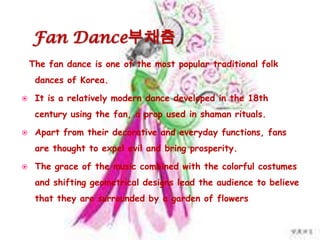
The fan dance is one of the most popular traditional folk
dances of Korea.
 It is a relatively modern dance developed in the 18th
century using the fan, a prop used in shaman rituals.
 Apart from their decorative and everyday functions, fans
are thought to expel evil and bring prosperity.
 The grace of the music combined with the colorful costumes
and shifting geometrical designs lead the audience to believe
that they are surrounded by a garden of flowers
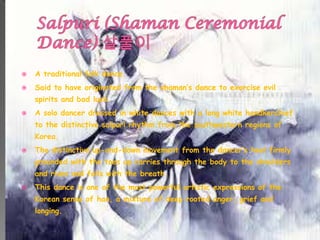
 A traditional folk dance.
 Said to have originated from the shaman’s dance to exorcise evil
spirits and bad luck.
 A solo dancer dressed in white dances with a long white handkerchief
to the distinctive salpuri rhythm from the southwestern regions of
Korea.
 The distinctive up-and-down movement from the dancer’s heel firmly
grounded with the toes up carries through the body to the shoulders
and rises and falls with the breath.
 This dance is one of the most powerful artistic expressions of the
Korean sense of han, a mixture of deep rooted anger, grief and
longing.
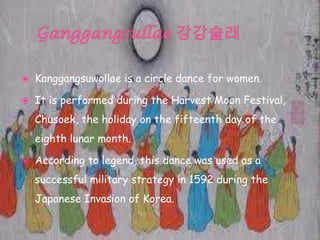
 Kanggangsuwollae is a circle dance for women.
 It is performed during the Harvest Moon Festival,
Chusoek, the holiday on the fifteenth day of the
eighth lunar month.
 According to legend, this dance was used as a
successful military strategy in 1592 during the
Japanese Invasion of Korea.
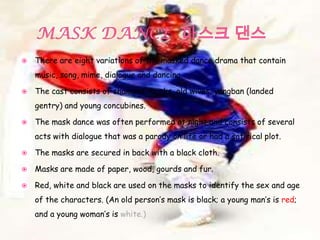
 There are eight variations of the masked dance drama that contain
music, song, mime, dialogue and dancing.
 The cast consists of shamans, monks, old wives, yangban (landed
gentry) and young concubines.
 The mask dance was often performed at night and consists of several
acts with dialogue that was a parody on life or had a satirical plot.
 The masks are secured in back with a black cloth.
 Masks are made of paper, wood, gourds and fur.
 Red, white and black are used on the masks to identify the sex and age
of the characters. (An old person’s mask is black; a young man’s is red;
and a young woman’s is white.)
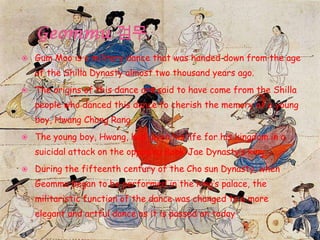
 Gum Moo is a military dance that was handed down from the age
of the Shilla Dynasty almost two thousand years ago.
 The origins of this dance are said to have come from the Shilla
people who danced this dance to cherish the memory of a young
boy, Hwang Chang Rang.
 The young boy, Hwang, had given his life for his kingdom in a
suicidal attack on the opposing Baek-Jae Dynasty’s king.
 During the fifteenth century of the Cho sun Dynasty, when
Geommu began to be performed in the king’s palace, the
militaristic function of the dance was changed to a more
elegant and artful dance as it is passed on today.
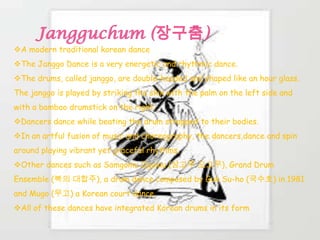
A modern traditional korean dance
The Janggo Dance is a very energetic and rhythmic dance.
The drums, called janggo, are double-headed and shaped like an hour glass.
The janggo is played by striking the skin with the palm on the left side and
with a bamboo drumstick on the right.
Dancers dance while beating the drum strapped to their bodies.
In an artful fusion of music and choreography, the dancers,dance and spin
around playing vibrant yet graceful rhythms.
Other dances such as Samgomu Ogomu (삼고무 오고무), Grand Drum
Ensemble (북의 대합주), a drum dance composed by Guk Su-ho (국수호) in 1981
and Mugo (무고) a Korean court dance.
All of these dances have integrated Korean drums in its form
 http://youtu.be/rcLldAHQtAA SALPURI
 http://youtu.be/H1I_Mt3xGyM MASK DANCE N DRUM
DANCE
 http://www.youtube.com/watch?feature=player_embedd
ed&v=BumtnHdtLU4 SWORD DANCE
 http://youtu.be/GWdwizX9LDg FAN DANCE
들어수셔서 고맙습니다!

Traditional korean dance

  • 2.
     Originated inancient shamanistic rituals thousands of years ago  It benefited from regular support of: –royal court 로얄 법원 –numerous academies 수많은 아카데미 –an official ministry of the government 정부의 공식적인 사역
  • 3.
    In modern Korea,there are at least six different kinds of dance: –Court, Folk, Shamanistic, Confucian, Buddhist, Modern concert dance. Today, these classifications usually refer to the style of dance rather than the occupation, class, or religion of the dancers. National dance academies teach these forms.  Dances and dance styles formerly restricted to royal audiences (the court) have become Korean classical dances. They are performed regularly in public concerts.
  • 4.
     Many uniquelyKorean gestures and body movements characterize all traditional Korean dances.  These characteristics include:  –the sliding each foot forward on the floor to end in an upturning of the toes (echoing the shape of the dancers’ slippers)  –the lifting and lowering of the shoulders.
  • 5.
     Fan Dance부채춤 (ritual dance / folk dance)  Salpuri 살풀이 (ritual dance / folk dance)  Kanggangsuwollae 강강술래 (folk dance)  Mask Dance 마스크 댄스 (folk dance)  Sword Dance 검무 (folk dance)  Drum Dance 장구춤(folk dance)
  • 6.
    Fan Dance부채춤 The fandance is one of the most popular traditional folk dances of Korea.  It is a relatively modern dance developed in the 18th century using the fan, a prop used in shaman rituals.  Apart from their decorative and everyday functions, fans are thought to expel evil and bring prosperity.  The grace of the music combined with the colorful costumes and shifting geometrical designs lead the audience to believe that they are surrounded by a garden of flowers
  • 7.
     A traditionalfolk dance.  Said to have originated from the shaman’s dance to exorcise evil spirits and bad luck.  A solo dancer dressed in white dances with a long white handkerchief to the distinctive salpuri rhythm from the southwestern regions of Korea.  The distinctive up-and-down movement from the dancer’s heel firmly grounded with the toes up carries through the body to the shoulders and rises and falls with the breath.  This dance is one of the most powerful artistic expressions of the Korean sense of han, a mixture of deep rooted anger, grief and longing.
  • 8.
     Kanggangsuwollae isa circle dance for women.  It is performed during the Harvest Moon Festival, Chusoek, the holiday on the fifteenth day of the eighth lunar month.  According to legend, this dance was used as a successful military strategy in 1592 during the Japanese Invasion of Korea.
  • 9.
     There areeight variations of the masked dance drama that contain music, song, mime, dialogue and dancing.  The cast consists of shamans, monks, old wives, yangban (landed gentry) and young concubines.  The mask dance was often performed at night and consists of several acts with dialogue that was a parody on life or had a satirical plot.  The masks are secured in back with a black cloth.  Masks are made of paper, wood, gourds and fur.  Red, white and black are used on the masks to identify the sex and age of the characters. (An old person’s mask is black; a young man’s is red; and a young woman’s is white.)
  • 10.
     Gum Moois a military dance that was handed down from the age of the Shilla Dynasty almost two thousand years ago.  The origins of this dance are said to have come from the Shilla people who danced this dance to cherish the memory of a young boy, Hwang Chang Rang.  The young boy, Hwang, had given his life for his kingdom in a suicidal attack on the opposing Baek-Jae Dynasty’s king.  During the fifteenth century of the Cho sun Dynasty, when Geommu began to be performed in the king’s palace, the militaristic function of the dance was changed to a more elegant and artful dance as it is passed on today.
  • 11.
    A modern traditionalkorean dance The Janggo Dance is a very energetic and rhythmic dance. The drums, called janggo, are double-headed and shaped like an hour glass. The janggo is played by striking the skin with the palm on the left side and with a bamboo drumstick on the right. Dancers dance while beating the drum strapped to their bodies. In an artful fusion of music and choreography, the dancers,dance and spin around playing vibrant yet graceful rhythms. Other dances such as Samgomu Ogomu (삼고무 오고무), Grand Drum Ensemble (북의 대합주), a drum dance composed by Guk Su-ho (국수호) in 1981 and Mugo (무고) a Korean court dance. All of these dances have integrated Korean drums in its form
  • 12.
     http://youtu.be/rcLldAHQtAA SALPURI http://youtu.be/H1I_Mt3xGyM MASK DANCE N DRUM DANCE  http://www.youtube.com/watch?feature=player_embedd ed&v=BumtnHdtLU4 SWORD DANCE  http://youtu.be/GWdwizX9LDg FAN DANCE
  • 13.