Ms. Aixa B. Rodriguez
World Cultures Theme
Mythology Unit
ESL L5 and Art in Literature Class
High School for World Cultures Bronx, NY
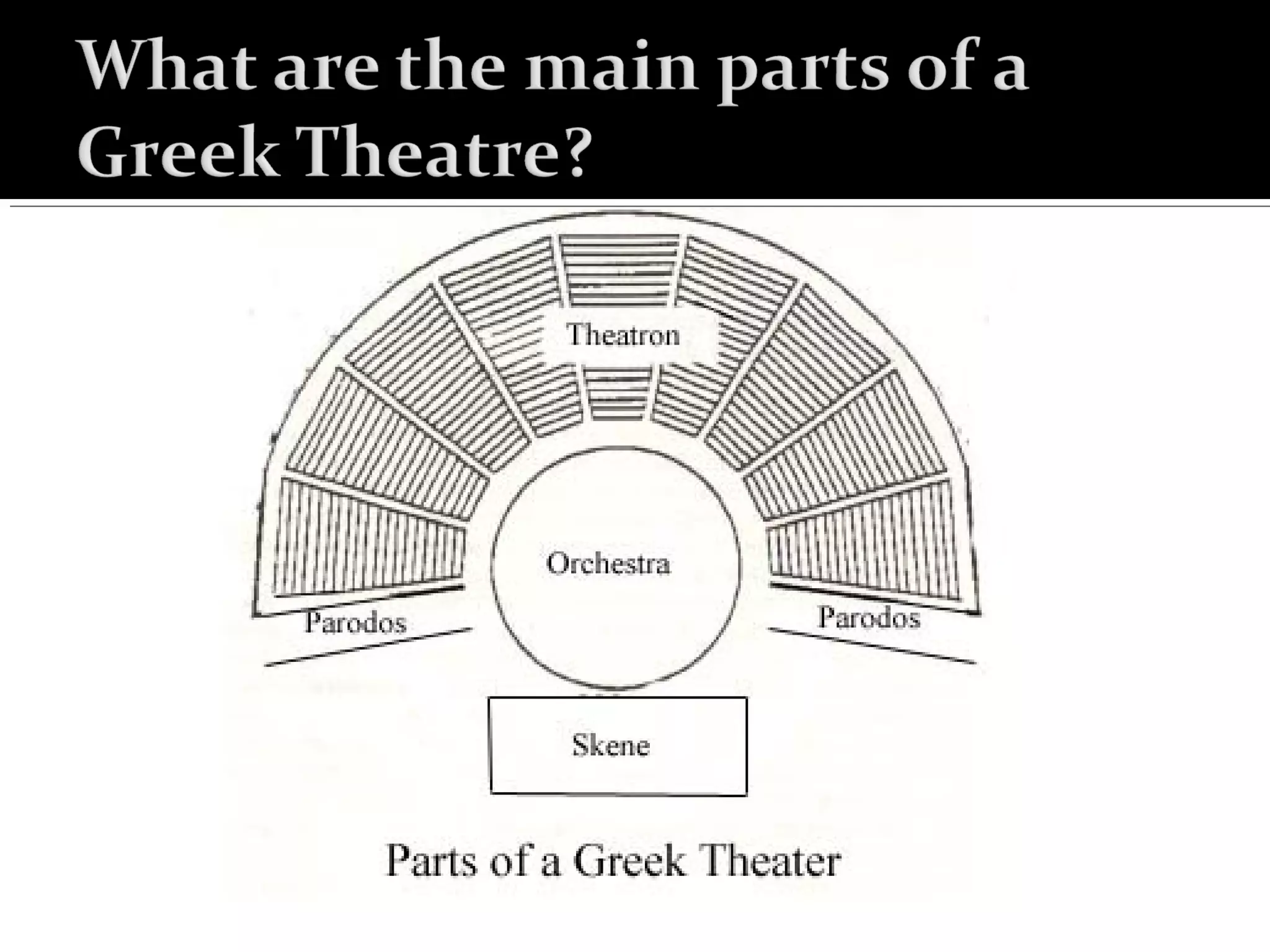
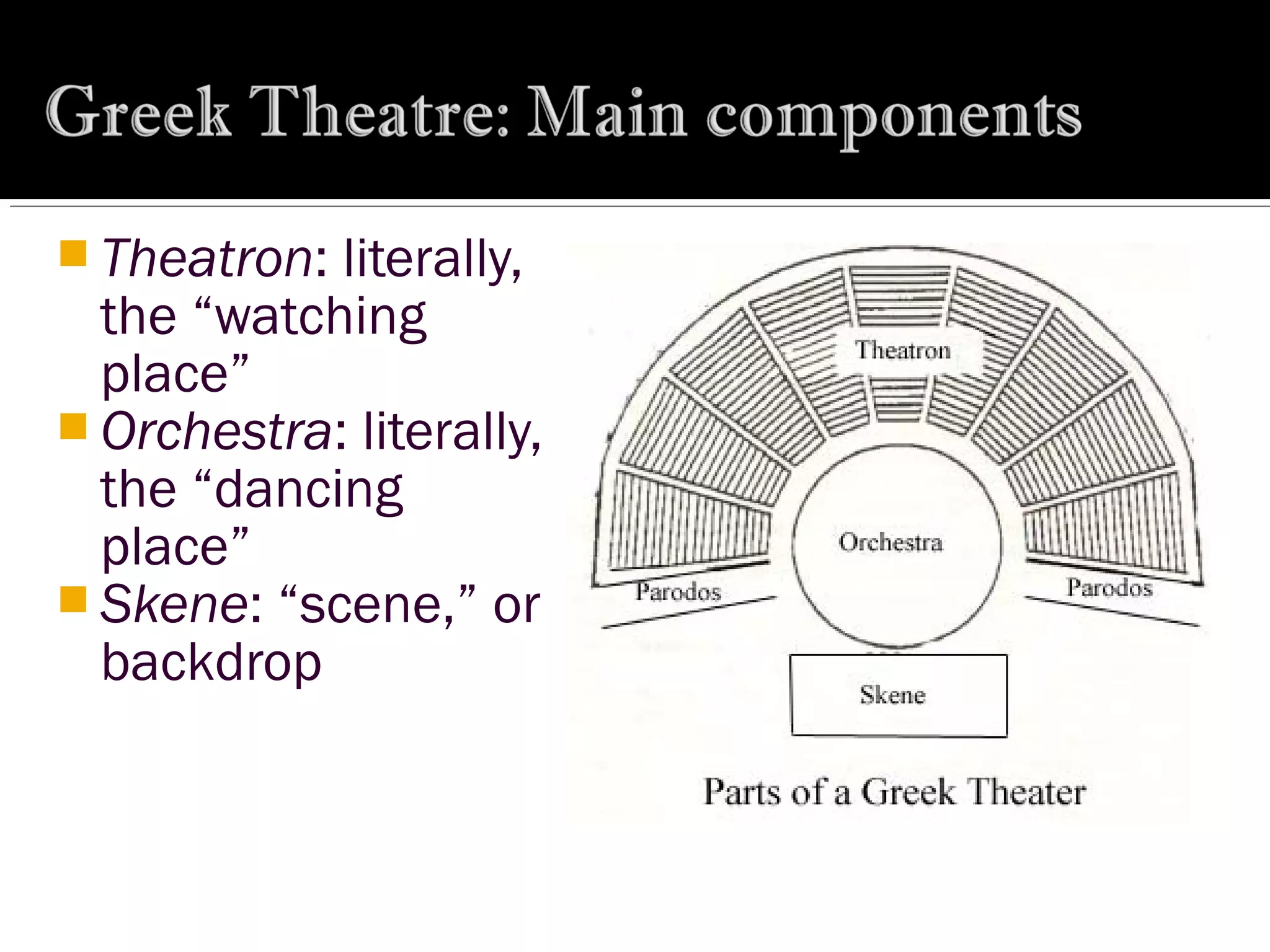
 Theatron: literally,
the “watching
place”
 Orchestra: literally,
the “dancing
place”
 Skene: “scene,” or
backdrop
Daylight
Class issues
Women
Comfort
Sound effects
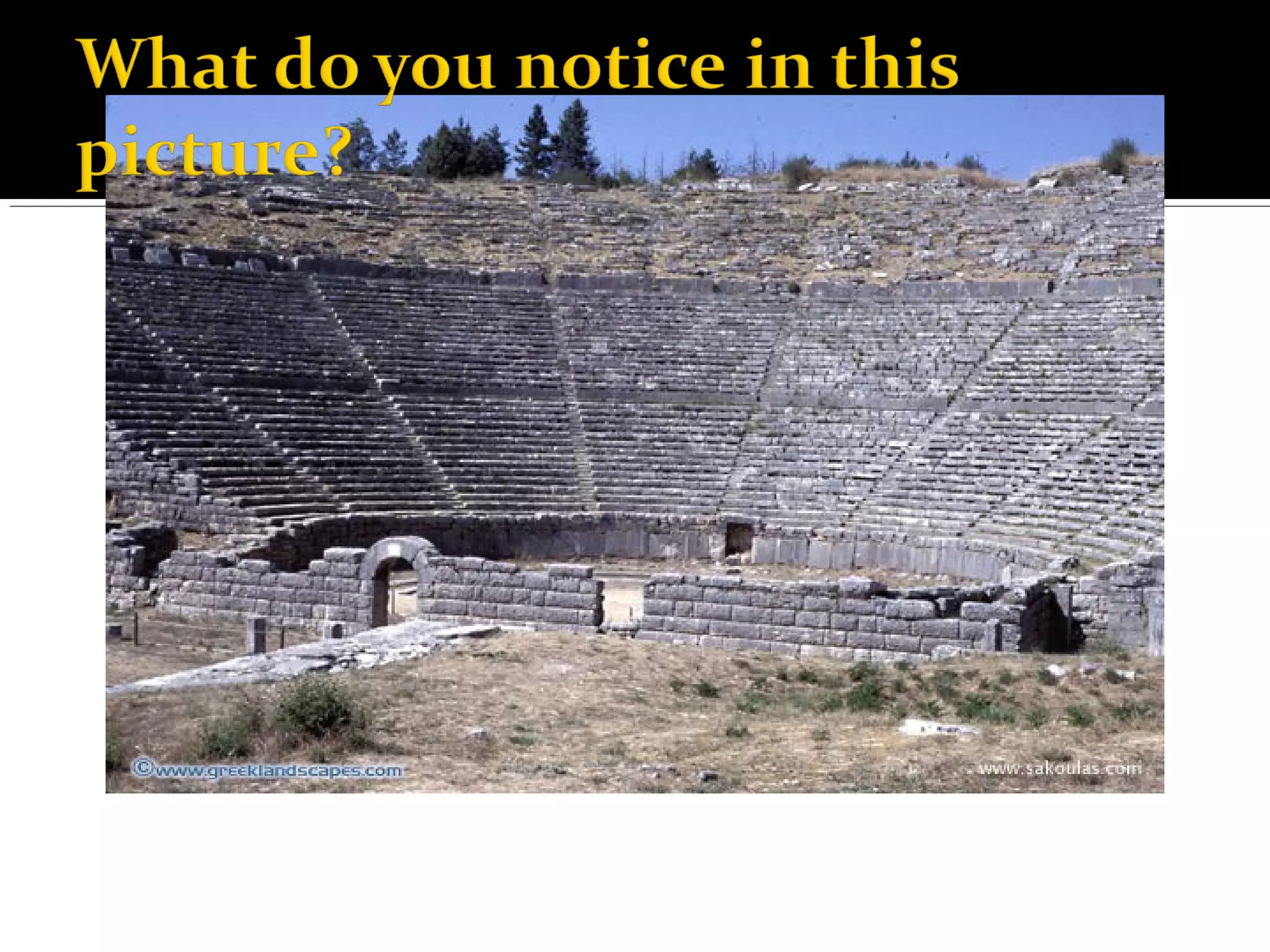
The modern word
“theater” comes from
the Greek word
theatron meaning
"seeing place"
Challenges:
Size
Distance from
audience
Holding interest
Behind orchestra
Served as
backdrop, house
Decorative in
later years
Holds mechane
Parodos:Parodos: passageways (pl.paradoi)passageways (pl.paradoi)
Ekkykleme:Ekkykleme: “the thing that rolls”“the thing that rolls”
the small wagon platform, was wheeled inthe small wagon platform, was wheeled in
to show a corpse to the audience.to show a corpse to the audience.
All killing had to occur off stage and beAll killing had to occur off stage and be
reported to the audience by the chorus or areported to the audience by the chorus or a
messenger.messenger.
MechaneMechane: crane used for special effect: crane used for special effect
Staging was accomplished simply with
the use of pinakes, or scenery painted
on boards and placed against the
skene.
Also periaktois, triangular prisms, that
could be revolved for scenery changes.
Properties were also used.
Drums were sounded for thunder.
…In an
amphitheatre
…With a
chorus who
described
most of the
action.
…With masks
• The theater of ancient Greece, flourished between c. 550 andThe theater of ancient Greece, flourished between c. 550 and
c. 220 BCE.c. 220 BCE.
• The city-state of Athens, was it’s centre.The city-state of Athens, was it’s centre.
• It was part of a festival called the Dionysia, which honored theIt was part of a festival called the Dionysia, which honored the
god Dionysus, the Greek god of wine and revelry with altarsgod Dionysus, the Greek god of wine and revelry with altars
generally on stage.generally on stage.
• Banks would shut down for days, people would travel from allBanks would shut down for days, people would travel from all
around to see the drama competitions—even prisoners werearound to see the drama competitions—even prisoners were
temporarily released to see the playstemporarily released to see the plays
• TragedyTragedy means “goat song” (relates to Dionysian sacrificialmeans “goat song” (relates to Dionysian sacrificial
rituals)rituals)
 The chorus was
trained and
costumed at state
expense through a
choregos (a
wealthy citizen)
who chose this job
as his way of
paying taxes and
raising his
standing in the
community.
 Members of the chorus
were chosen from the
general population.
 Chorus members were
unpaid volunteers
doing their civic duty.
 The rehearsal period
for a chorus was likely
four months or more.
• DRAMA: a literary composition
written to be performed by actors
• central character called a tragic
protagonist or hero suffers some
serious misfortune
• the misfortune is logically connected
with the hero's actions.
The modern word “drama”
comes from the Greek word
drandran meaning "to do”
 The Greeks understood the
role of action in plays.
 Comedy
 Tragedy
 Satyr
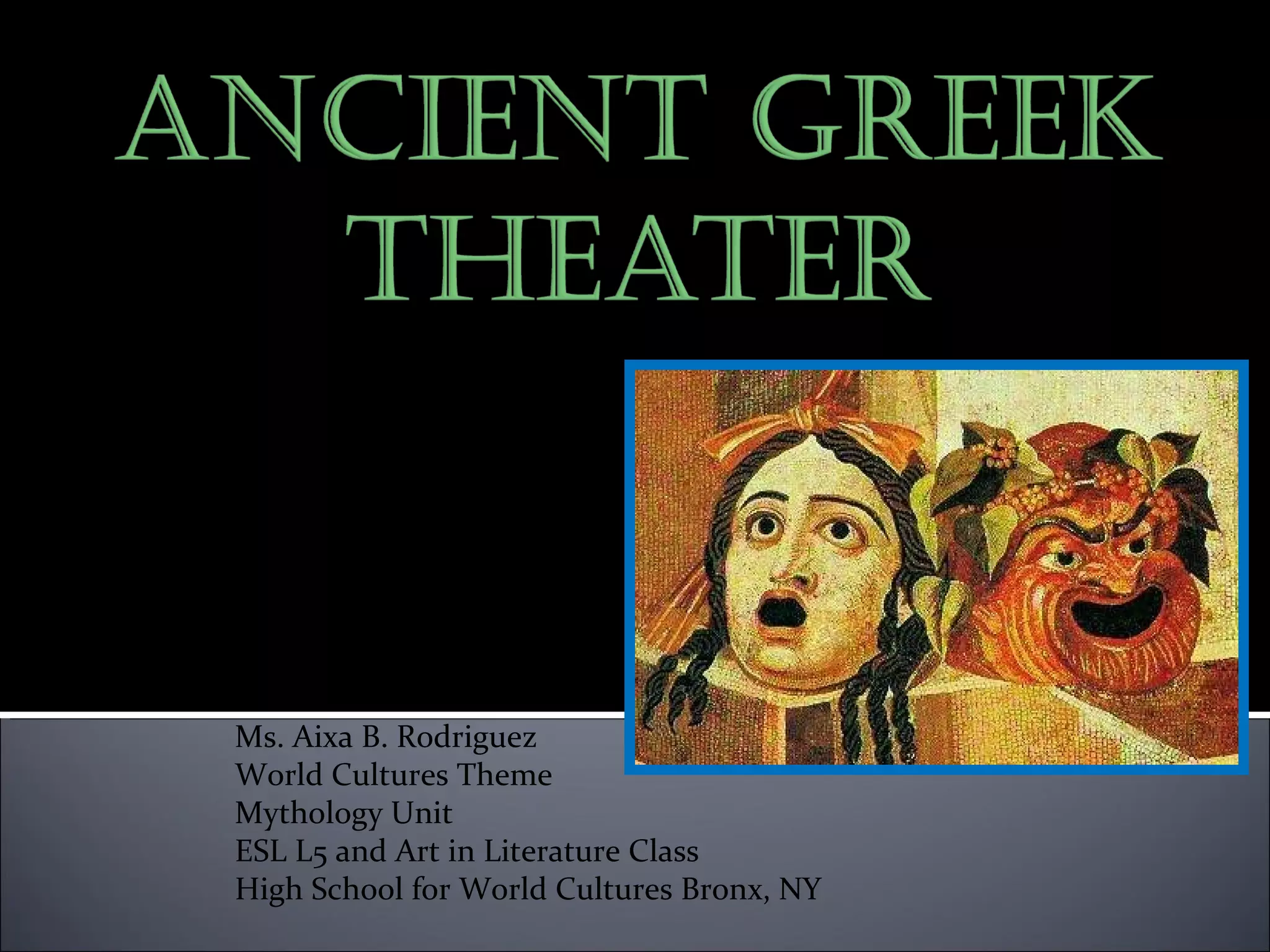
 Comedy and tragedy were the
most popular types of plays in
ancient Greece. Hence, the
modern popularity of the
comedy and tragedy masks to
symbolize theatre.
 The word “comedy” comes from the Greek
word “komos” which means “band of
revelers.”
 These were short plays
performed between the
acts of tragedies. They
made fun of the plight of
the tragedy's characters.
 The satyrs were mythical
half-human, half-goat
servants of Dionysus.
 They served the function
of comic relief.
The Satyr and the
Satyr plays
spawned the
modern word
“satire”.
 used a chorus
 The choric dithyrambs (choral
songs) were originally about
the death and resurrection of
Dionysus (the god of wine and
revelry).
 Chorus reflects what the
audience is thinking
▪ “color commentary”
▪ Provides background and
spectacle
 The first function of the chorus was
as narrator (telling stories, providing
information).
 to bridge the gap between the audience and the
players by making responses and asking
questions
 to intensify the emotion and establish a lyric
mood through rhythmic chanting and dance
 to maintain a sense of ceremony and ritual
 The chorus could punctuateThe chorus could punctuate
the action of a play with burststhe action of a play with bursts
of song and dance, whichof song and dance, which
enlarged the dramatic actionenlarged the dramatic action
and relieved tension.and relieved tension.
 Instruments used toInstruments used to
accompany choric songs andaccompany choric songs and
dances included flutes, lyres,dances included flutes, lyres,
horns, drums, and bells.horns, drums, and bells.
 TheThe ‘‘ParadosParados’’ (chorus(chorus
entrance) marks the beginningentrance) marks the beginning
of the play, and theof the play, and the exodusexodus (its(its
exit) the ending.exit) the ending.
 SingingSinging
 DancingDancing
 StropheStrophe
 AntistropheAntistrophe
 As the number of
actors increased
from one to
three, the size of
the chorus, which
originally
numbered 50,
was reduced.
 12-15 men
The Chorus could play the
worshipers of a God, or as
in Oedipus, the villagers and
Theban elders (town
leaders).
 The modern word
“thespian” comes from the
name Thespis, the first actor
credited with separating
from the chorus to hold a
call and response with
them.
 Choruses did not rehearse in the
theatres, they probably rehearsed in a
closed room so that the spectators
would not see the drama before the
performance.
 Early dramatists (Aeschylus and
probably Sophocles and Euripides)
taught their own choruses.
 Consisted of standard Greek attire
 Chiton: a sleeveless tunic belted below the
breast
 the himation: draped around the right shoulder
 the chlamys, or short cloak, worn over the left
shoulder
 elaborately embroidered patterns
 Masks were used.
 If playing a female role, the male actor in want
of a female appearance wore the prosternida
before the chest and the progastrida before the
belly
3 Actors, all men
Elaborate gestures,
“over-acting”
Women were not
allowed to
participate.
 to masks bring the characters' face closer to
the audience.
 to enable an actor to play in several different
roles,
 to help the audience to distinguish sex, age,
and social status, in addition to revealing a
change in a particular character’s emotions
and appearance.
 a mask—called a “persona”
 Masks contained “megaphone” to amplify their
voices
 Another adaptation that the Greeks'
developed for their theatre masks were
special mouths that acted like megaphones
to amplify their voice for everyone in the
huge theatre to hear.
Actors wore masks with exaggerated facial features
and expressions to make it easy for all viewers to identify a
particular character because theatres were very large.
 Greek actors originally started wearing
masks that were very human like that just
covered part of the face
 Eventually with the increase in theatre size
the mask changed as well
 The mask then began to cover the whole
head and resembled legends from Greek
mythology not humans
usually made by the people that whousually made by the people that who
wore them in the playwore them in the play
 from consisted of cloth, leather, andfrom consisted of cloth, leather, and
wood with animal hair and painted orwood with animal hair and painted or
died different colors with flowers anddied different colors with flowers and
other plants attached to them.other plants attached to them.
Famous actors in bigger plays mayFamous actors in bigger plays may
have had jewels and other ornatehave had jewels and other ornate
items placed on their masksitems placed on their masks
Aeschylus
Sophocles
Euripides
Aristophanes
Menander
Medea is a princess from Colchis. She marries Jason, who is
on a quest for the Golden Fleece. Medea betrays her father
and murders her brother for her love of Jason. Medea has
magical powers. Jason takes Medea back to his homeland
Iolcus. They are rejected for fear of Medea’s power and move
to Corinth, where they have children.
Jason takes another wife, the king of Corinth’s daughter
Glauce. Medea, betrayed, sends a bewitched gown to
Princess Glauce, Jason’s new bride, it kills her and her father.
Jason returns to find Medea has killed their sons. Medea
leaves with the bodies of her children in a dragon led
chariot. Jason, a shadow of a man, no longer protected by
Hera, dies when a timber from the Argo crushes him in his
sleep.
 Son of wealthy Athenian
merchant
 Lived during golden age
of Athens
 Center of democracy
 Important figure in
society
 Becomes cultural
spokesperson
 Noted playwright
 Wrote primarily tragedies
 Witnessed decline of
Athens
 495 B.C.E. :Born in
Colonus, in Attica
 441: Writes Antigone
 431-404:
Peloponnesian War
(Athens v. Sparta)
 429: Writes Oedipus
Rex
 406: Sophocles dies
Oedipus:
 “Aye, 'tis no secret. Apollo once foretold That I
should mate with mine own mother, and shed With
my own hands the blood of my own sire. Hence
Corinth was for many a year to me. A home distant;
and I trove abroad, But missed the sweetest sight,
my parents' face. ”
Jocasta:
1. “An oracle Once came to Laius, I will not say 'Twas
from the Delphic god himself, but from His
ministers, declaring he was doomed to perish by
the hand of his own son, A child that should be
born to him by me.
 Delphic Oracle,
prophecy
 Corinth and Thebes
 Sphinx riddle
 Self-punishment
 Children: Eteocles,
Polyneices, Ismene,
Antigone
• Sphinx's riddle: "What is the creature that walks on four legs in
the morning, two legs at noon and three in the evening?"
• To this Oedipus answered "Man”.
• Oedipus's name means "swollen foot”. His ankles were pinned
as a baby. Here is the baby of which the Sphinx speaks,
crawling on four feet.
• Oedipus the adult man, standing on his own two feet.
• Oedipus will leave Thebes an old blind man, using a cane.
• Oedipus himself proves to be that same man, an embodiment
of the Sphinx's riddle.
• Oedipus is solver of the Sphinx's riddle, and the answer.
1.1. The play begins years after Oedipus is givenThe play begins years after Oedipus is given
the throne of Thebes.the throne of Thebes.
2.2. The chorus of Thebans cries out to OedipusThe chorus of Thebans cries out to Oedipus
for salvation from the plague sent by thefor salvation from the plague sent by the
gods in response to Laius' murder.gods in response to Laius' murder.
3.3. The blind prophet, Teiresias, is called to aidThe blind prophet, Teiresias, is called to aid
Oedipus in his search; He warns OedipusOedipus in his search; He warns Oedipus
not to follow through with the investigation.not to follow through with the investigation.
4.4. Oedipus accuses him of being the murderer,Oedipus accuses him of being the murderer,
even though Teiresias is blind and aged.even though Teiresias is blind and aged.
5.5. Oedipus promises to exile the manOedipus promises to exile the man
responsible for it.responsible for it.
6.6. Oedipus accuses Teiresias of conspiringOedipus accuses Teiresias of conspiring
with Creon, Jocasta's brother, to overthrowwith Creon, Jocasta's brother, to overthrow
him.him.
7.7. Oedipus calls for one of Laius' formerOedipus calls for one of Laius' former
servants, the only surviving witness of theservants, the only surviving witness of the
murder, who fled the city when Oedipusmurder, who fled the city when Oedipus
became king to avoid being the one to revealbecame king to avoid being the one to reveal
the truth.the truth.
1.1. A messenger from Corinth alsoA messenger from Corinth also
arrives to inform Oedipus of thearrives to inform Oedipus of the
death of Polybus, whomdeath of Polybus, whom Oedipus stillOedipus still
believes is his real father.believes is his real father.
2.2. The messenger informs him that heThe messenger informs him that he
was in fact adopted and his realwas in fact adopted and his real
parentage is unknown.parentage is unknown.
3.3. In the subsequent discussions JocastaIn the subsequent discussions Jocasta
guesses the truth and runs away.guesses the truth and runs away.
4.4. Oedipus is stubbornOedipus is stubborn
5.5. A 2A 2ndnd
messenger arrives and revealsmessenger arrives and reveals
that Jocasta has hanged herselfthat Jocasta has hanged herself
6.6. Oedipus, upon discovering herOedipus, upon discovering her
body, blinds himself with the goldenbody, blinds himself with the golden
brooches on her dress.brooches on her dress.
7.7. The play ends with OedipusThe play ends with Oedipus
entrusting his children to Creon andentrusting his children to Creon and
leaving in exile, as he promisedleaving in exile, as he promised
would be the fate of Laius' murderer.would be the fate of Laius' murderer.
1. Story revolves around two different
unsuccessful attempts to change the
course of fate:
1. Jocasta and Laius's killing of Oedipus at birth and
2. Oedipus's flight from Corinth later on.
2. Jocasta kills her son only to find him
married to her.
3. Oedipus leaves Corinth only to find that
he has carried out the oracle's words.
Oedipus counts on his own ability
not the gods.
The irony is, of course, that the
oracles and Oedipus's reasoning lead
to the same outcome.
Oedipus is a thinker. His
intelligence is what makes him great,
yet it is also what makes him tragic.
Marriage to Jocasta and ruling
Thebes was the prize for ridding
Thebes of the Sphinx. Oedipus's
intelligence, a trait that brings him
closer to the gods, is what causes him
to commit the most terrible of all
sins.
In killing the Sphinx, Oedipus is the
city's savior, but in killing Laius (and
marrying Jocasta), he is cause of the
plague that has struck the city at the
play's opening.
Sight here means two different things.
Oedipus is blessed with perception. But
he is blind to the truth, for all he seeks it.
Oedipus is human and we recognize this
in his agonizing reaction to his sin.
 Watching this, the audience is moved
to both pity and fear: pity for this broken
man, and fear that his tragedy could be
our own. Watching this tragedy gives us
the audience a sense of purging. This is
the catharsis which Aristotle spoke of.
The Six Aspects of TragedyThe Six Aspects of Tragedy
1.1. PLOTPLOT
2.2. CHARACTERCHARACTER
3.3. SPECTACLESPECTACLE
4.4. SONGSONG
5.5. DICTIONDICTION
6.6. THOUGHTTHOUGHT
From Aristotle’sFrom Aristotle’s PoeticsPoetics
**
1. PLOT: Plot is the way the incidents are presented
to the audience
• Must be “whole” –beginning/ middle and end
• Incentive moment- begins cause and effect
• Climax
• resolution
• Must be complete and have “unity of action”
• No “deus ex machina”
• No “episodic plots”
• Plot can be simple or complex
• Catastrophe (cata/strophe): change in fortune
• Perepetia: a reversal
• Anagnorisis: recognition
Plot Diagram/Plot Diagram/
Freytag’s PyramiDFreytag’s PyramiD
2. CHARACTER
• Personal motivations connected to cause/ effect aspect of
plot
• Protagonist should be renowned and prosperous
change from good to bad
• Hubris – arrogance, overconfidence
• Hamartia: a tragic flaw
• Characters should have the following qualities:
• Good or fine
• Fitness of character
• True to life
• Consistency
• Necessary or probable
• Idealized/ ennobled
1. He must be a man who is superior to the average man in
some way.
1. Oedipus is smart he is the only person who could solve the Sphinx's riddle.
2. Must evoke both pity and fear, must be a character with a
mixture of good and evil. Oedipus is a hero with a violent
streak, clever man, but is blind to the truth.
3. Hamartia, often translated as "tragic flaw" but really
means "error in judgement.”
4. Dramatic irony The audience knows the outcome of the
story already, but the hero does not, making his actions
seem ignorant or inappropriate in the face of what is to
come.
3. THOUGHT
• Reference to theme
4. DICTION
• Word choice is proper and appropriate
• Emphasis on style and use of literary devices (metaphor)
5. SONG
• Musical element of the play
• Use of the chorus
6. SPECTACLE
* Production for effect
Dionysia
Sophocles
Oedipus Rex
Cast of
characters
 Set in Thebes (a city in ancient Greece)
 Antigone is the daughter of Oedipus and
Jocasta
 Antigone’s brothers, Eteokles and
Polyneces, took opposite sides in a war
 Eteokles and Polyneces killed each other in
battle
 Antigone’s uncle, Kreon, became king of
Thebes
Antigone
• Antigone, had the
better judgment, and
Ismene with all the
good intentions.
• They were both two
extraordinary women
that went through a
lot together despite
their differences.
 Eteocles and
Polyneices
The princes who had
refused to share their
inheritance shared
death instead

Ancient Greek Theatre

  • 1.
    Ms. Aixa B.Rodriguez World Cultures Theme Mythology Unit ESL L5 and Art in Literature Class High School for World Cultures Bronx, NY
  • 6.
     Theatron: literally, the“watching place”  Orchestra: literally, the “dancing place”  Skene: “scene,” or backdrop
  • 8.
  • 10.
    The modern word “theater”comes from the Greek word theatron meaning "seeing place"
  • 11.
  • 13.
    Behind orchestra Served as backdrop,house Decorative in later years Holds mechane
  • 14.
    Parodos:Parodos: passageways (pl.paradoi)passageways(pl.paradoi) Ekkykleme:Ekkykleme: “the thing that rolls”“the thing that rolls” the small wagon platform, was wheeled inthe small wagon platform, was wheeled in to show a corpse to the audience.to show a corpse to the audience. All killing had to occur off stage and beAll killing had to occur off stage and be reported to the audience by the chorus or areported to the audience by the chorus or a messenger.messenger. MechaneMechane: crane used for special effect: crane used for special effect
  • 16.
    Staging was accomplishedsimply with the use of pinakes, or scenery painted on boards and placed against the skene. Also periaktois, triangular prisms, that could be revolved for scenery changes. Properties were also used. Drums were sounded for thunder.
  • 17.
    …In an amphitheatre …With a choruswho described most of the action. …With masks
  • 18.
    • The theaterof ancient Greece, flourished between c. 550 andThe theater of ancient Greece, flourished between c. 550 and c. 220 BCE.c. 220 BCE. • The city-state of Athens, was it’s centre.The city-state of Athens, was it’s centre. • It was part of a festival called the Dionysia, which honored theIt was part of a festival called the Dionysia, which honored the god Dionysus, the Greek god of wine and revelry with altarsgod Dionysus, the Greek god of wine and revelry with altars generally on stage.generally on stage. • Banks would shut down for days, people would travel from allBanks would shut down for days, people would travel from all around to see the drama competitions—even prisoners werearound to see the drama competitions—even prisoners were temporarily released to see the playstemporarily released to see the plays • TragedyTragedy means “goat song” (relates to Dionysian sacrificialmeans “goat song” (relates to Dionysian sacrificial rituals)rituals)
  • 21.
     The choruswas trained and costumed at state expense through a choregos (a wealthy citizen) who chose this job as his way of paying taxes and raising his standing in the community.
  • 22.
     Members ofthe chorus were chosen from the general population.  Chorus members were unpaid volunteers doing their civic duty.  The rehearsal period for a chorus was likely four months or more.
  • 23.
    • DRAMA: aliterary composition written to be performed by actors • central character called a tragic protagonist or hero suffers some serious misfortune • the misfortune is logically connected with the hero's actions.
  • 24.
    The modern word“drama” comes from the Greek word drandran meaning "to do”  The Greeks understood the role of action in plays.
  • 25.
     Comedy  Tragedy Satyr  Comedy and tragedy were the most popular types of plays in ancient Greece. Hence, the modern popularity of the comedy and tragedy masks to symbolize theatre.
  • 26.
     The word“comedy” comes from the Greek word “komos” which means “band of revelers.”
  • 27.
     These wereshort plays performed between the acts of tragedies. They made fun of the plight of the tragedy's characters.  The satyrs were mythical half-human, half-goat servants of Dionysus.  They served the function of comic relief.
  • 28.
    The Satyr andthe Satyr plays spawned the modern word “satire”.
  • 30.
     used achorus  The choric dithyrambs (choral songs) were originally about the death and resurrection of Dionysus (the god of wine and revelry).  Chorus reflects what the audience is thinking ▪ “color commentary” ▪ Provides background and spectacle
  • 31.
     The firstfunction of the chorus was as narrator (telling stories, providing information).  to bridge the gap between the audience and the players by making responses and asking questions  to intensify the emotion and establish a lyric mood through rhythmic chanting and dance  to maintain a sense of ceremony and ritual
  • 32.
     The choruscould punctuateThe chorus could punctuate the action of a play with burststhe action of a play with bursts of song and dance, whichof song and dance, which enlarged the dramatic actionenlarged the dramatic action and relieved tension.and relieved tension.  Instruments used toInstruments used to accompany choric songs andaccompany choric songs and dances included flutes, lyres,dances included flutes, lyres, horns, drums, and bells.horns, drums, and bells.  TheThe ‘‘ParadosParados’’ (chorus(chorus entrance) marks the beginningentrance) marks the beginning of the play, and theof the play, and the exodusexodus (its(its exit) the ending.exit) the ending.  SingingSinging  DancingDancing  StropheStrophe  AntistropheAntistrophe
  • 33.
     As thenumber of actors increased from one to three, the size of the chorus, which originally numbered 50, was reduced.  12-15 men
  • 34.
    The Chorus couldplay the worshipers of a God, or as in Oedipus, the villagers and Theban elders (town leaders).
  • 35.
     The modernword “thespian” comes from the name Thespis, the first actor credited with separating from the chorus to hold a call and response with them.
  • 36.
     Choruses didnot rehearse in the theatres, they probably rehearsed in a closed room so that the spectators would not see the drama before the performance.  Early dramatists (Aeschylus and probably Sophocles and Euripides) taught their own choruses.
  • 37.
     Consisted ofstandard Greek attire  Chiton: a sleeveless tunic belted below the breast  the himation: draped around the right shoulder  the chlamys, or short cloak, worn over the left shoulder  elaborately embroidered patterns  Masks were used.  If playing a female role, the male actor in want of a female appearance wore the prosternida before the chest and the progastrida before the belly
  • 38.
    3 Actors, allmen Elaborate gestures, “over-acting” Women were not allowed to participate.
  • 40.
     to masksbring the characters' face closer to the audience.  to enable an actor to play in several different roles,  to help the audience to distinguish sex, age, and social status, in addition to revealing a change in a particular character’s emotions and appearance.  a mask—called a “persona”  Masks contained “megaphone” to amplify their voices
  • 41.
     Another adaptationthat the Greeks' developed for their theatre masks were special mouths that acted like megaphones to amplify their voice for everyone in the huge theatre to hear.
  • 42.
    Actors wore maskswith exaggerated facial features and expressions to make it easy for all viewers to identify a particular character because theatres were very large.
  • 43.
     Greek actorsoriginally started wearing masks that were very human like that just covered part of the face  Eventually with the increase in theatre size the mask changed as well  The mask then began to cover the whole head and resembled legends from Greek mythology not humans
  • 44.
    usually made bythe people that whousually made by the people that who wore them in the playwore them in the play  from consisted of cloth, leather, andfrom consisted of cloth, leather, and wood with animal hair and painted orwood with animal hair and painted or died different colors with flowers anddied different colors with flowers and other plants attached to them.other plants attached to them. Famous actors in bigger plays mayFamous actors in bigger plays may have had jewels and other ornatehave had jewels and other ornate items placed on their masksitems placed on their masks
  • 45.
  • 46.
    Medea is aprincess from Colchis. She marries Jason, who is on a quest for the Golden Fleece. Medea betrays her father and murders her brother for her love of Jason. Medea has magical powers. Jason takes Medea back to his homeland Iolcus. They are rejected for fear of Medea’s power and move to Corinth, where they have children. Jason takes another wife, the king of Corinth’s daughter Glauce. Medea, betrayed, sends a bewitched gown to Princess Glauce, Jason’s new bride, it kills her and her father. Jason returns to find Medea has killed their sons. Medea leaves with the bodies of her children in a dragon led chariot. Jason, a shadow of a man, no longer protected by Hera, dies when a timber from the Argo crushes him in his sleep.
  • 47.
     Son ofwealthy Athenian merchant  Lived during golden age of Athens  Center of democracy  Important figure in society  Becomes cultural spokesperson  Noted playwright  Wrote primarily tragedies  Witnessed decline of Athens  495 B.C.E. :Born in Colonus, in Attica  441: Writes Antigone  431-404: Peloponnesian War (Athens v. Sparta)  429: Writes Oedipus Rex  406: Sophocles dies
  • 48.
    Oedipus:  “Aye, 'tisno secret. Apollo once foretold That I should mate with mine own mother, and shed With my own hands the blood of my own sire. Hence Corinth was for many a year to me. A home distant; and I trove abroad, But missed the sweetest sight, my parents' face. ” Jocasta: 1. “An oracle Once came to Laius, I will not say 'Twas from the Delphic god himself, but from His ministers, declaring he was doomed to perish by the hand of his own son, A child that should be born to him by me.
  • 49.
     Delphic Oracle, prophecy Corinth and Thebes  Sphinx riddle  Self-punishment  Children: Eteocles, Polyneices, Ismene, Antigone
  • 50.
    • Sphinx's riddle:"What is the creature that walks on four legs in the morning, two legs at noon and three in the evening?" • To this Oedipus answered "Man”. • Oedipus's name means "swollen foot”. His ankles were pinned as a baby. Here is the baby of which the Sphinx speaks, crawling on four feet. • Oedipus the adult man, standing on his own two feet. • Oedipus will leave Thebes an old blind man, using a cane. • Oedipus himself proves to be that same man, an embodiment of the Sphinx's riddle. • Oedipus is solver of the Sphinx's riddle, and the answer.
  • 52.
    1.1. The playbegins years after Oedipus is givenThe play begins years after Oedipus is given the throne of Thebes.the throne of Thebes. 2.2. The chorus of Thebans cries out to OedipusThe chorus of Thebans cries out to Oedipus for salvation from the plague sent by thefor salvation from the plague sent by the gods in response to Laius' murder.gods in response to Laius' murder. 3.3. The blind prophet, Teiresias, is called to aidThe blind prophet, Teiresias, is called to aid Oedipus in his search; He warns OedipusOedipus in his search; He warns Oedipus not to follow through with the investigation.not to follow through with the investigation. 4.4. Oedipus accuses him of being the murderer,Oedipus accuses him of being the murderer, even though Teiresias is blind and aged.even though Teiresias is blind and aged. 5.5. Oedipus promises to exile the manOedipus promises to exile the man responsible for it.responsible for it. 6.6. Oedipus accuses Teiresias of conspiringOedipus accuses Teiresias of conspiring with Creon, Jocasta's brother, to overthrowwith Creon, Jocasta's brother, to overthrow him.him. 7.7. Oedipus calls for one of Laius' formerOedipus calls for one of Laius' former servants, the only surviving witness of theservants, the only surviving witness of the murder, who fled the city when Oedipusmurder, who fled the city when Oedipus became king to avoid being the one to revealbecame king to avoid being the one to reveal the truth.the truth. 1.1. A messenger from Corinth alsoA messenger from Corinth also arrives to inform Oedipus of thearrives to inform Oedipus of the death of Polybus, whomdeath of Polybus, whom Oedipus stillOedipus still believes is his real father.believes is his real father. 2.2. The messenger informs him that heThe messenger informs him that he was in fact adopted and his realwas in fact adopted and his real parentage is unknown.parentage is unknown. 3.3. In the subsequent discussions JocastaIn the subsequent discussions Jocasta guesses the truth and runs away.guesses the truth and runs away. 4.4. Oedipus is stubbornOedipus is stubborn 5.5. A 2A 2ndnd messenger arrives and revealsmessenger arrives and reveals that Jocasta has hanged herselfthat Jocasta has hanged herself 6.6. Oedipus, upon discovering herOedipus, upon discovering her body, blinds himself with the goldenbody, blinds himself with the golden brooches on her dress.brooches on her dress. 7.7. The play ends with OedipusThe play ends with Oedipus entrusting his children to Creon andentrusting his children to Creon and leaving in exile, as he promisedleaving in exile, as he promised would be the fate of Laius' murderer.would be the fate of Laius' murderer.
  • 54.
    1. Story revolvesaround two different unsuccessful attempts to change the course of fate: 1. Jocasta and Laius's killing of Oedipus at birth and 2. Oedipus's flight from Corinth later on. 2. Jocasta kills her son only to find him married to her. 3. Oedipus leaves Corinth only to find that he has carried out the oracle's words.
  • 55.
    Oedipus counts onhis own ability not the gods. The irony is, of course, that the oracles and Oedipus's reasoning lead to the same outcome. Oedipus is a thinker. His intelligence is what makes him great, yet it is also what makes him tragic. Marriage to Jocasta and ruling Thebes was the prize for ridding Thebes of the Sphinx. Oedipus's intelligence, a trait that brings him closer to the gods, is what causes him to commit the most terrible of all sins. In killing the Sphinx, Oedipus is the city's savior, but in killing Laius (and marrying Jocasta), he is cause of the plague that has struck the city at the play's opening. Sight here means two different things. Oedipus is blessed with perception. But he is blind to the truth, for all he seeks it. Oedipus is human and we recognize this in his agonizing reaction to his sin.  Watching this, the audience is moved to both pity and fear: pity for this broken man, and fear that his tragedy could be our own. Watching this tragedy gives us the audience a sense of purging. This is the catharsis which Aristotle spoke of.
  • 56.
    The Six Aspectsof TragedyThe Six Aspects of Tragedy 1.1. PLOTPLOT 2.2. CHARACTERCHARACTER 3.3. SPECTACLESPECTACLE 4.4. SONGSONG 5.5. DICTIONDICTION 6.6. THOUGHTTHOUGHT From Aristotle’sFrom Aristotle’s PoeticsPoetics **
  • 57.
    1. PLOT: Plotis the way the incidents are presented to the audience • Must be “whole” –beginning/ middle and end • Incentive moment- begins cause and effect • Climax • resolution • Must be complete and have “unity of action” • No “deus ex machina” • No “episodic plots” • Plot can be simple or complex • Catastrophe (cata/strophe): change in fortune • Perepetia: a reversal • Anagnorisis: recognition
  • 58.
    Plot Diagram/Plot Diagram/ Freytag’sPyramiDFreytag’s PyramiD
  • 59.
    2. CHARACTER • Personalmotivations connected to cause/ effect aspect of plot • Protagonist should be renowned and prosperous change from good to bad • Hubris – arrogance, overconfidence • Hamartia: a tragic flaw • Characters should have the following qualities: • Good or fine • Fitness of character • True to life • Consistency • Necessary or probable • Idealized/ ennobled
  • 60.
    1. He mustbe a man who is superior to the average man in some way. 1. Oedipus is smart he is the only person who could solve the Sphinx's riddle. 2. Must evoke both pity and fear, must be a character with a mixture of good and evil. Oedipus is a hero with a violent streak, clever man, but is blind to the truth. 3. Hamartia, often translated as "tragic flaw" but really means "error in judgement.” 4. Dramatic irony The audience knows the outcome of the story already, but the hero does not, making his actions seem ignorant or inappropriate in the face of what is to come.
  • 61.
    3. THOUGHT • Referenceto theme 4. DICTION • Word choice is proper and appropriate • Emphasis on style and use of literary devices (metaphor) 5. SONG • Musical element of the play • Use of the chorus 6. SPECTACLE * Production for effect
  • 62.
  • 63.
     Set inThebes (a city in ancient Greece)  Antigone is the daughter of Oedipus and Jocasta  Antigone’s brothers, Eteokles and Polyneces, took opposite sides in a war  Eteokles and Polyneces killed each other in battle  Antigone’s uncle, Kreon, became king of Thebes
  • 64.
    Antigone • Antigone, hadthe better judgment, and Ismene with all the good intentions. • They were both two extraordinary women that went through a lot together despite their differences.
  • 65.
     Eteocles and Polyneices Theprinces who had refused to share their inheritance shared death instead

Editor's Notes

  • #13 Nosebleed Seats The core of any Greek theater is the orchestra, the “dancing place” of the chorus and the chief performance space. Almost nothing remains from the fifth-century structure of the Theater of Dionysus in Athens, but later theaters suggest that the original orchestras were full circles; see, for example, this aerial view of the theater at Epidaurus. This is the best-preserved of all extant Greek theaters; the ancient plays are still being performed here, …. Although this theater was built at the end of the fourth century BCE and rebuilt and enlarged in the second century, it does enable us to visualize what the ancient theaters must have been like. The orchestra is approximately 66 feet in diameter; this photo shows the orchestra at Epidaurus with a modern set for a production of Aeschylus’ Prometheus Bound. An altar of Dionysus was usually located in the center of the orchestra. The audience sat in the theatron, the “seeing place,” on semi-circular terraced rows of benches (in the earliest theaters these were wooden; they were later built of stone). The Greeks often built these in a natural hollow (a koilon), though the sides were increasingly reinforced with stone, as can be seen in this overhead view of Epidaurus. Scholars often use the Latin word for hollow, cavea, to designate the seating in an ancient theater. Stairs mounting to the highest levels divide the sections of seats into wedges; at Epidaurus there are 55 semi-circular rows, providing an estimated seating capacity of 12,000-14,000. Although the name theatron suggests an emphasis on sight, in reality actors and chorus would look rather small even from seats only part-way up, and from the top rows one would see mostly colors and patterns of movement rather any details of costuming or masks. The acoustics in this theater, however, are magnificent, and words spoken very softly in the orchestra can be heard in the top rows (as long as your neighbors are quiet). http://www.cnr.edu/home/bmcmanus/tragedy_theater.html
  • #16 #6 SPECTACLE: Staging The mechane was a large crane which could swing a platform containing one or more actors from behind the stage building up over the heads of the actors and chorus, creating the illusion of flying. The earliest known use of this device was in Euripdes’ Medea (431 BCE), when Medea flew off with the bodies of her children in a dragon-chariot supplied by the sun-god. The Latin expression deus ex machina (“the god from the crane”) refers to inferior playwrights’ practice of suddenly having a god fly in to resolve all the difficulties of the plot, but clever dramatists could use the crane very effectively without marring the unity of their plays, as indeed Euripides did in Medea. Note: Gods who intervene in fifth century tragedies probably appeared through a trap-door on the roof of the skene to address mortals from a higher level. http://depthome.brooklyn.cuny.edu/classics/dunkle/comedy/intro19.htm
  • #50 In this tragedy a prophecy told by the Delphic Oracle comes true even though the protagonists try to avoid it. The main character, the tragic hero Oedipus leaves his home to avoid a terrible fate, runs into some men at a crossroads, kills them. Arrives in a town beleaguered by a mythical violent beast the Sphinx and correctly answers her riddle and slays it. The prophecy comes true and Oedipus ends up punishing himself to save his people/city. His children Eteocles and Polyneices, Ismene and Antigone also suffer in future plays.
  • #57 Aristotle's Poetics and Oedipus His favorite play and the one he used as a model for the POETICS is OEDIPUS, so the following should apply: 1. CATHARSIS: Pity and fear Pity alone is not enough to make a play a tragedy. The kind of drama that depends solely on its capacity to provoke pity are likely to be "tear-jerkers." Pathos requires humour, irony, or something more disturbing, which we may call fear (or "admiration"), to prevent it from lapsing into sentimentality. Fear alone is similarly inadequate. An average suspense-thriller may hold attention, but if we know the ending or have seen it already we rapidly become aware that the thriller is simply melodramatic. Melodrama is to tragedy what farce is to comedy: the plot is all-important, and the characters tend to be stereotyped, fitting into prearranged roles (goodies and baddies). 2. HAMARTIA: Good men ought NOT to be shown passing from prosperity to misfortune, for this does not inspire either inspire pity or fear, but only revulsion; NOR evil men rising from ill fortune to prosperity.. neither should a wicked man be seen falling from prosperity into misfortune.. We are left with the man whose place is between these extremes. Such is the man who on the one hand is not preeminent in virtue and justice, and yet on the other hand does not fall into misfortune through vice or depravity. He falls because of some mistake or imbalance in his character:'[often mistranslated as a tragic (moral) flaw] and Anagnorisis (an-ag-nor-ee-sis) Protagonist BECOMES AWARE OF HIS ERROR (therein lies the tragedy itself– memory) In Aristotelian definition of tragedy it was the discovery of one's own identity or true character 3) Universality: Tragedy is BASED in history (real events, settings, circumstances) HOWEVER, dramatic poetry's function is.. not to report things that have happened, but rather to tell of such things that might happen.. .to express the universal." CAPITAL “T” truth privileged over little “t” truth.
  • #59 Plot Diagram: Aristotle’s Poetics influenced the concept of more modern plot structure. Gustav Freytag was a Nineteenth Century German novelist who saw common patterns in the plots of stories and novels and developed a diagram to analyze them. He diagrammed a story's plot using a pyramid like the one shown here: In his book Technique of the Drama (1863), The German critic Gustav Freytag proposed a method of analyzing plots derived from Aristotle's concept of unity of action that came to be known as Freytag's Triangle or Freytag's Pyramid. In the illustration above, I have borrowed from both critics to present a graphic that can be employed to analyze the structure and unity of a narrative's plot. http://www.wolfcreek.ab.ca/mg/plot_diagram_files/plot_dia.JPG http://oak.cats.ohiou.edu/~hartleyg/250/freytag.html