China, Japan, Indonesia, and
Thailand Theater Arts and
Festival
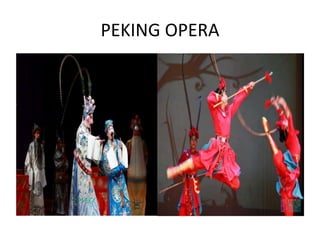
PEKING OPERA
-China’s known traditional theater art
form, which combines music, vocal
performance, pantomime, dance,
and acrobatics.
–It started in the late 18th century
and became fully developed and
recognized by the mid-19th century
-it became extremely popular and
came to be regarded as one of the
cultural treasures of China (Qing
Dynasty)
Peking Opera Training:
Pupils were often handpicked at a young age by
a teacher and trained for seven years on
contract from the child's parents. After 1911,
training took place in more formally organized
schools. Students at these schools rose as
early as five o'clock in the morning for
exercises. Daytime was spent learning the
skills of acting and combat, and senior
students performed in outside theaters in the
evening.
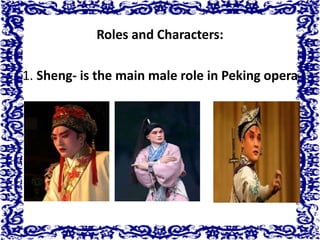
Roles and Characters:
1. Sheng- is the main male role in Peking opera
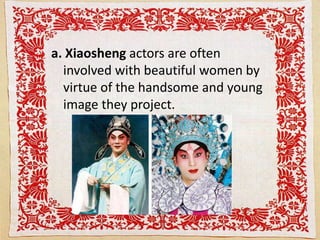
a. Xiaosheng actors are often
involved with beautiful women by
virtue of the handsome and young
image they project.
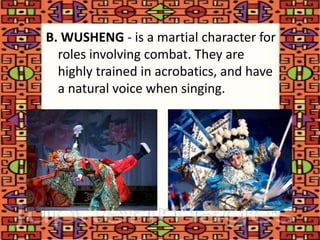
B. WUSHENG - is a martial character for
roles involving combat. They are
highly trained in acrobatics, and have
a natural voice when singing.
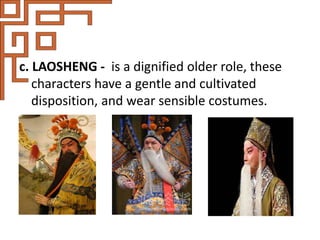
c. LAOSHENG - is a dignified older role, these
characters have a gentle and cultivated
disposition, and wear sensible costumes.
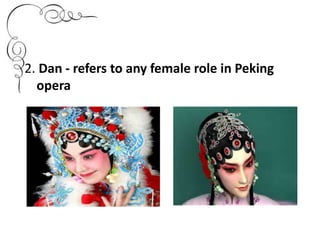
2. Dan - refers to any female role in Peking
opera
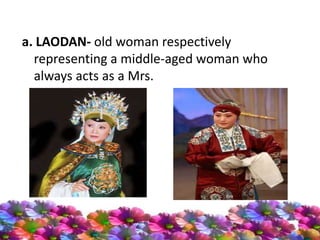
a. LAODAN- old woman respectively
representing a middle-aged woman who
always acts as a Mrs.
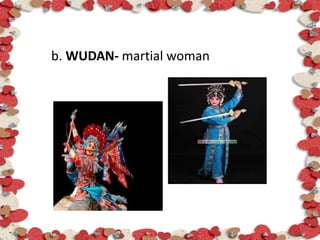
b. WUDAN- martial woman
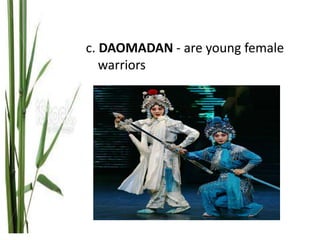
c. DAOMADAN - are young female
warriors
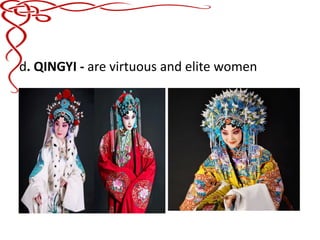
d. QINGYI - are virtuous and elite women
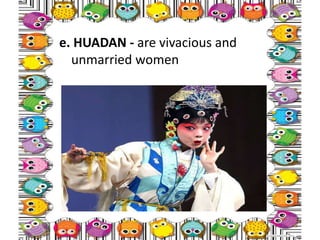
e. HUADAN - are vivacious and
unmarried women
• 3. JING -is a painted face
male role who plays either
primary or secondary roles,
entails a forceful character,
-must have a strong voice and
be able to exaggerate
gestures.
• The red color denotes loyalty
and goodness, white
denotes evil, and black
denotes integrity.
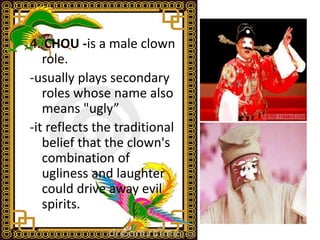
4. CHOU -is a male clown
role.
-usually plays secondary
roles whose name also
means "ugly”
-it reflects the traditional
belief that the clown's
combination of
ugliness and laughter
could drive away evil
spirits.
• Visual Performance Elements:
Peking-opera performers utilize
four main skills
1. Song
2. Speech
3. Dance-acting - This includes
pure dance, pantomime, and all
other types of dance.
4. Combat - includes both
acrobatics and fighting with all
manner of weaponry.
The meaning of colors
in Peking Opera
Masks/Make-ups
Red - devotion,
courage, bravery,
uprightness and
loyalty.
Black - roughness
and fierceness
Yellow - fierceness,
ambition and cool-
headedness
Purple - uprightness,
sophistication and
cool-headedness
Reddish purple - just
and noble character
Blue - loyalty,
fierceness and
sharpness
• White - dangerousness,
suspiciousness and
craftiness. Commonly seen
on the stage is the white
face for the powerful
villain
• Green - impulsive and
violent and stubbornness
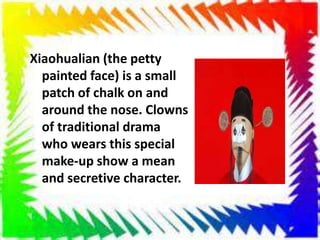
Xiaohualian (the petty
painted face) is a small
patch of chalk on and
around the nose. Clowns
of traditional drama
who wears this special
make-up show a mean
and secretive character.
Aesthetic Aims and Principles of
Movement:
• The highest aim of performers in
Peking Opera is to put beauty into
every motion.
• The art form, gestures, settings,
music, and character types are
determined by long held conventions
• Conventions of movement
-Walking in a large circle always
symbolizes traveling a long distance
- Character straightening his or her
costume and headdress symbolizes that
an important character is about to speak
-Pantomimic opening and closing of
doors and mounting and descending of
stairs
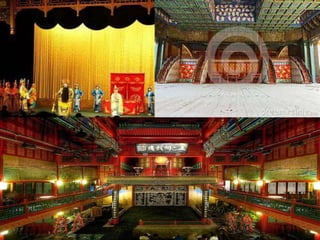
Stages:
• square platforms, the action on
stage is usually visible from at least
three sides
• were built above the line of sight of
the viewers, but some modern stages
have been constructed with higher
audience seating
• divided into two parts by an
embroidered curtain called a shoujiu.
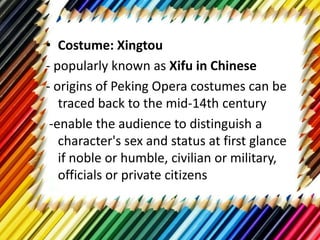
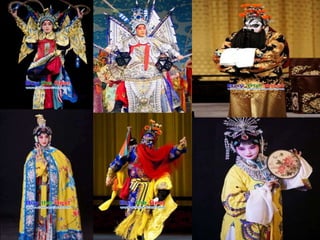
• Costume: Xingtou
- popularly known as Xifu in Chinese
- origins of Peking Opera costumes can be
traced back to the mid-14th century
-enable the audience to distinguish a
character's sex and status at first glance
if noble or humble, civilian or military,
officials or private citizens
• Props:
• utilizes very few props
• will almost always have a table
and at least one chair, which can
be turned through convention
into such diverse objects as a city
wall, a mountain, or a bed
• Musicians:
- are visible to the
audience on the front
part of the stage
• Viewers:
- always seated south of
the stage, therefore,
north is the most
important direction
• Performers:
-immediately move to center
north upon entering the
stage. All characters enter
from the east and exit from
the west

PEKING OPERA

  • 2.
    China, Japan, Indonesia,and Thailand Theater Arts and Festival
  • 3.
  • 4.
    -China’s known traditionaltheater art form, which combines music, vocal performance, pantomime, dance, and acrobatics. –It started in the late 18th century and became fully developed and recognized by the mid-19th century -it became extremely popular and came to be regarded as one of the cultural treasures of China (Qing Dynasty)
  • 5.
    Peking Opera Training: Pupilswere often handpicked at a young age by a teacher and trained for seven years on contract from the child's parents. After 1911, training took place in more formally organized schools. Students at these schools rose as early as five o'clock in the morning for exercises. Daytime was spent learning the skills of acting and combat, and senior students performed in outside theaters in the evening.
  • 6.
    Roles and Characters: 1.Sheng- is the main male role in Peking opera
  • 7.
    a. Xiaosheng actorsare often involved with beautiful women by virtue of the handsome and young image they project.
  • 8.
    B. WUSHENG -is a martial character for roles involving combat. They are highly trained in acrobatics, and have a natural voice when singing.
  • 9.
    c. LAOSHENG -is a dignified older role, these characters have a gentle and cultivated disposition, and wear sensible costumes.
  • 10.
    2. Dan -refers to any female role in Peking opera
  • 11.
    a. LAODAN- oldwoman respectively representing a middle-aged woman who always acts as a Mrs.
  • 12.
  • 13.
    c. DAOMADAN -are young female warriors
  • 14.
    d. QINGYI -are virtuous and elite women
  • 15.
    e. HUADAN -are vivacious and unmarried women
  • 16.
    • 3. JING-is a painted face male role who plays either primary or secondary roles, entails a forceful character, -must have a strong voice and be able to exaggerate gestures. • The red color denotes loyalty and goodness, white denotes evil, and black denotes integrity.
  • 17.
    4. CHOU -isa male clown role. -usually plays secondary roles whose name also means "ugly” -it reflects the traditional belief that the clown's combination of ugliness and laughter could drive away evil spirits.
  • 18.
    • Visual PerformanceElements: Peking-opera performers utilize four main skills 1. Song 2. Speech 3. Dance-acting - This includes pure dance, pantomime, and all other types of dance. 4. Combat - includes both acrobatics and fighting with all manner of weaponry.
  • 19.
    The meaning ofcolors in Peking Opera Masks/Make-ups Red - devotion, courage, bravery, uprightness and loyalty. Black - roughness and fierceness Yellow - fierceness, ambition and cool- headedness
  • 20.
    Purple - uprightness, sophisticationand cool-headedness Reddish purple - just and noble character Blue - loyalty, fierceness and sharpness
  • 21.
    • White -dangerousness, suspiciousness and craftiness. Commonly seen on the stage is the white face for the powerful villain • Green - impulsive and violent and stubbornness
  • 22.
    Xiaohualian (the petty paintedface) is a small patch of chalk on and around the nose. Clowns of traditional drama who wears this special make-up show a mean and secretive character.
  • 23.
    Aesthetic Aims andPrinciples of Movement: • The highest aim of performers in Peking Opera is to put beauty into every motion. • The art form, gestures, settings, music, and character types are determined by long held conventions
  • 24.
    • Conventions ofmovement -Walking in a large circle always symbolizes traveling a long distance - Character straightening his or her costume and headdress symbolizes that an important character is about to speak -Pantomimic opening and closing of doors and mounting and descending of stairs
  • 25.
    Stages: • square platforms,the action on stage is usually visible from at least three sides • were built above the line of sight of the viewers, but some modern stages have been constructed with higher audience seating • divided into two parts by an embroidered curtain called a shoujiu.
  • 27.
    • Costume: Xingtou -popularly known as Xifu in Chinese - origins of Peking Opera costumes can be traced back to the mid-14th century -enable the audience to distinguish a character's sex and status at first glance if noble or humble, civilian or military, officials or private citizens
  • 29.
    • Props: • utilizesvery few props • will almost always have a table and at least one chair, which can be turned through convention into such diverse objects as a city wall, a mountain, or a bed
  • 30.
    • Musicians: - arevisible to the audience on the front part of the stage
  • 31.
    • Viewers: - alwaysseated south of the stage, therefore, north is the most important direction
  • 32.
    • Performers: -immediately moveto center north upon entering the stage. All characters enter from the east and exit from the west