Kabuki
Theater
Alyssa DeFonte, Phil
Giannino, Imani Suber,
Valerie Baglay
What is
Kabuki?
It’s not Shapoopi, it’s KABUKI!
Kabuki Theater




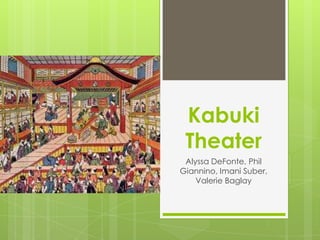
Kabuki is a
Japanese dance
and drama play
involving elaborate
costumes, eyecatching makeup,
and outrageous
wigs to convey the
audience.
Known as “the art of
singing and
dancing”
History
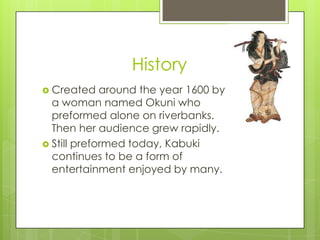
 Created

around the year 1600 by
a woman named Okuni who
preformed alone on riverbanks.
Then her audience grew rapidly.
 Still preformed today, Kabuki
continues to be a form of
entertainment enjoyed by many.
Anatomy of Kabuki





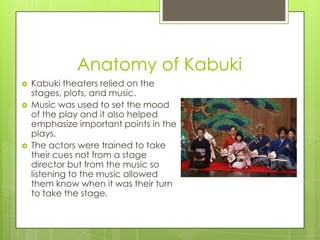
Kabuki theaters relied on the
stages, plots, and music.
Music was used to set the mood
of the play and it also helped
emphasize important points in the
plays.
The actors were trained to take
their cues not from a stage
director but from the music so
listening to the music allowed
them know when it was their turn
to take the stage.
Concepts




Sergei Eisenstein
discusses how Kabuki is
related to cinema
through the usage of
conveying emotions.
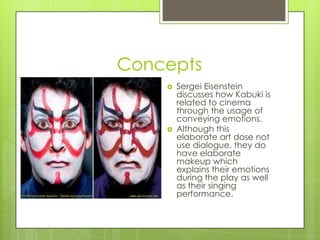
Although this
elaborate art dose not
use dialogue, they do
have elaborate
makeup which
explains their emotions
during the play as well
as their singing
performance.
Makeup




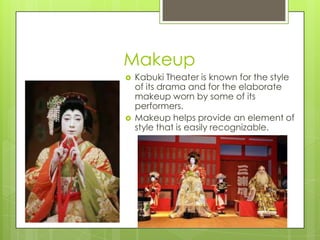
Kabuki Theater is known for the style
of its drama and for the elaborate
makeup worn by some of its
performers.
Makeup helps provide an element of
style that is easily recognizable.
Application Process







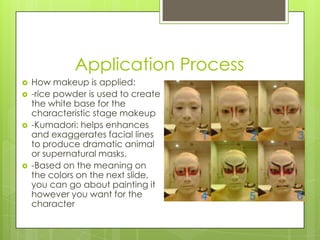
How makeup is applied:
-rice powder is used to create
the white base for the
characteristic stage makeup
-Kumadori: helps enhances
and exaggerates facial lines
to produce dramatic animal
or supernatural masks.
-Based on the meaning on
the colors on the next slide,
you can go about painting it
however you want for the
character
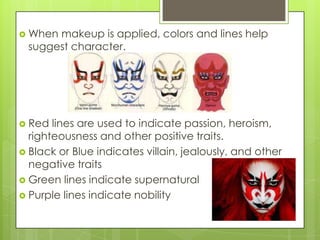
 When

makeup is applied, colors and lines help
suggest character.

 Red

lines are used to indicate passion, heroism,
righteousness and other positive traits.
 Black or Blue indicates villain, jealously, and other
negative traits
 Green lines indicate supernatural
 Purple lines indicate nobility
Costumes






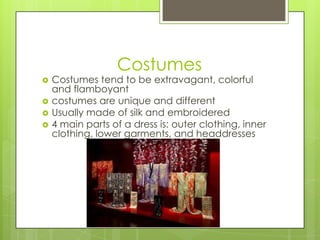
Costumes tend to be extravagant, colorful
and flamboyant
costumes are unique and different
Usually made of silk and embroidered
4 main parts of a dress is: outer clothing, inner
clothing, lower garments, and headdresses
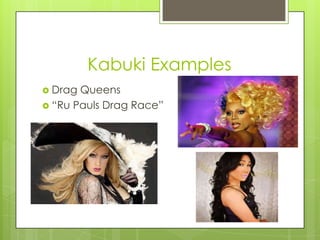
Kabuki Examples
 Drag

Queens
 “Ru Pauls Drag Race”
Examples
 http://www.logotv.com/video/misc/98483

0/meet-the-queens-giagunn.jhtml#id=1718643

 The

hit comedy TV show, “Everybody
Loves Raymond”
 http://www.youtube.com/watch?v=fG2lY
4QDWNE
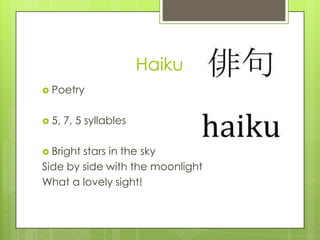
Haiku
 Poetry
 5,

7, 5 syllables

 Bright

stars in the sky
Side by side with the moonlight
What a lovely sight!
Refrences









"Edutainment Kabuki Theater." Kabuki Theater.
N.p., n.d. Web. 03 Mar. 2014.
"Japanese Culture - Entertainment - Kabuki
Theater." Japanese Culture - Entertainment Kabuki Theater. N.p., n.d. Web. 02 Mar. 2014.
"Kabuki." Kabuki. N.p., n.d. Web. 01 Mar. 2014.
"The Story behind the Faces." The Story behind the
Faces. N.p., n.d. Web. 02 Mar. 2014.
LogoTV.com/Rupaul’s Drag Race Season 6/Meet
the Queens
Youtube.com/Everybody Loves Raymond-Frank’s
Tribute

Kabuki theatre

  • 1.
  • 2.
  • 3.
    It’s not Shapoopi,it’s KABUKI!
  • 4.
    Kabuki Theater   Kabuki isa Japanese dance and drama play involving elaborate costumes, eyecatching makeup, and outrageous wigs to convey the audience. Known as “the art of singing and dancing”
  • 5.
    History  Created around theyear 1600 by a woman named Okuni who preformed alone on riverbanks. Then her audience grew rapidly.  Still preformed today, Kabuki continues to be a form of entertainment enjoyed by many.
  • 6.
    Anatomy of Kabuki    Kabukitheaters relied on the stages, plots, and music. Music was used to set the mood of the play and it also helped emphasize important points in the plays. The actors were trained to take their cues not from a stage director but from the music so listening to the music allowed them know when it was their turn to take the stage.
  • 7.
    Concepts   Sergei Eisenstein discusses howKabuki is related to cinema through the usage of conveying emotions. Although this elaborate art dose not use dialogue, they do have elaborate makeup which explains their emotions during the play as well as their singing performance.
  • 8.
    Makeup   Kabuki Theater isknown for the style of its drama and for the elaborate makeup worn by some of its performers. Makeup helps provide an element of style that is easily recognizable.
  • 9.
    Application Process     How makeupis applied: -rice powder is used to create the white base for the characteristic stage makeup -Kumadori: helps enhances and exaggerates facial lines to produce dramatic animal or supernatural masks. -Based on the meaning on the colors on the next slide, you can go about painting it however you want for the character
  • 10.
     When makeup isapplied, colors and lines help suggest character.  Red lines are used to indicate passion, heroism, righteousness and other positive traits.  Black or Blue indicates villain, jealously, and other negative traits  Green lines indicate supernatural  Purple lines indicate nobility
  • 11.
    Costumes     Costumes tend tobe extravagant, colorful and flamboyant costumes are unique and different Usually made of silk and embroidered 4 main parts of a dress is: outer clothing, inner clothing, lower garments, and headdresses
  • 12.
    Kabuki Examples  Drag Queens “Ru Pauls Drag Race”
  • 13.
    Examples  http://www.logotv.com/video/misc/98483 0/meet-the-queens-giagunn.jhtml#id=1718643  The hitcomedy TV show, “Everybody Loves Raymond”  http://www.youtube.com/watch?v=fG2lY 4QDWNE
  • 14.
    Haiku  Poetry  5, 7,5 syllables  Bright stars in the sky Side by side with the moonlight What a lovely sight!
  • 15.
    Refrences       "Edutainment Kabuki Theater."Kabuki Theater. N.p., n.d. Web. 03 Mar. 2014. "Japanese Culture - Entertainment - Kabuki Theater." Japanese Culture - Entertainment Kabuki Theater. N.p., n.d. Web. 02 Mar. 2014. "Kabuki." Kabuki. N.p., n.d. Web. 01 Mar. 2014. "The Story behind the Faces." The Story behind the Faces. N.p., n.d. Web. 02 Mar. 2014. LogoTV.com/Rupaul’s Drag Race Season 6/Meet the Queens Youtube.com/Everybody Loves Raymond-Frank’s Tribute