SUA- KU-SUA
SUA- KU- SUA
Dance Researcher
Meaning
Dance Culture
Place of Origin
Country of Influence
Ethno- linguistic Group
Classification
: Ramon A. Obusan
: My Pomelo Tree
: Muslim- lowland (Coastal)
: Jolo, Sulu
: China, Malaysia and Indonesia
: Tausug
: Courtship
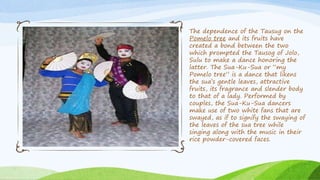
The dependence of the Tausug on the
Pomelo tree and its fruits have
created a bond between the two
which prompted the Tausog of Jolo,
Sulu to make a dance honoring the
latter. The Sua-Ku-Sua or “my
Pomelo tree” is a dance that likens
the sua’s gentle leaves, attractive
fruits, its fragrance and slender body
to that of a lady. Performed by
couples, the Sua-Ku-Sua dancers
make use of two white fans that are
swayed, as if to signify the swaying of
the leaves of the sua tree while
singing along with the music in their
rice powder-covered faces.
Background
Aside from being known as fierce warriors, the Tausug of
Jolo, Sulu are also remarkable as seafarers and farmers.
In Sulu, extensive orchards are planted with coconut and
Pomelo and the field with stables like rice and root crops.
Pomelo fruit serve as an important source of income of the
people of Sulu. Their dependence on Pomelo fruits for their
livelihood inspired them to create Sua- Ku- Sua dance.
The movements of the dance compare sua’s gentle leaves,
slender branches, attractive fruits, and fragrant flowers to a
lady. During the performance, the couples sing while flapping
two white fans which represent the leaves rustling in the wind.
The performers, especially women, dance with faces
thickly covered with finely ground rice powder. Their eyebrows
and sideburns are enhanced with soot for aesthetic purposes.
Movements/ Steps Particular to Dance
Creative Imagery: Fans transform
into tiny sails, face mirrors,
butterflies, shields, and leaves.
Sua-Ku- Sua’s traditional steps
are with Chinese influence.
Dance Properties
Costume:
• Female
Top (Barawasi): Traditional loose blouse, long sleeves with deep,
plunging key hole neckline; extra panels attached to the right
and left chest decorated with many tiny brass buttons.
 Material: Printed or plain Chinese silk or cotton.
Pants (Sawal or Kantiu): Loose Chinese pants with a 10 inch
soft white band (coco curdo) attached to a wide waist. To tuck
the pants in, the white band is overlapped in front , one side
on top of the other and rolled out to form a tight belt.
 Material: Chinese silk or any silky material preferably in
navy blue, sunshine yellow, grass green, red, or orange
colors.
Shoulder Band (Siyag): A separate wrap- around malong of
rich material strung over the right shoulder crossing the chest
and hanging on the left side.
Headpiece: There are three choices:
1. Gold or brass filigree called tusuk
2. Paper bills pasted on slender sticks;
3. Pasteboard cut-outs in the front tip 8- 10 inches high ,
similar to Chinese crowns covered with gold foil.
Accessories: Gold or imitation gold earrings, necklace, bracelets,
and brooches.
Suggested Footwear : Dancers are barefoot.
Male
Top (Bajo): Short waist collarless shirt; open front with the
right panel overlapping the left, studded with many tiny brass
buttons and is not intended to close the front but used as an
additional shirt decoration. The shirt is allowed to drop on the
right side
Material: Printed or plain Chinese silk or cotton.
Pants (Sawal or Kantiu): Similar to the pants of females but in
darker colors and bolder design.
Accessories: Money belt, Sarok hat, Pis siyabit (rectangular
hand-woven scarf tied on the head or hung loosely over one
shoulder) , Kris (wavy knife) or barong (leaf- knife)
Suggested Footwear: Dancers are barefoot
Music
• 2/4 and 4/4; composed of three parts- A, B, . Gabbang
bamboo xylophone are shaped- like a small boat. Bamboo
slats are thinned and cut to graduated sizes to produce
three octaves of pentatonic scale.
Count: One, two to a measure in 2/4 time signature; 1, 2, 3,
4 to a measure in 4/4 time signature.
• Ayessa Mae Abana
• Chester Tungcul
• Kim Andrei Ginez
• Krisha Malupeng
• Jona Marie Fernandez
• Jeremy Escobar
• Irene Antonio
• Zyrenn Irigayen
Members:

Sua ku-sua

  • 1.
  • 2.
    SUA- KU- SUA DanceResearcher Meaning Dance Culture Place of Origin Country of Influence Ethno- linguistic Group Classification : Ramon A. Obusan : My Pomelo Tree : Muslim- lowland (Coastal) : Jolo, Sulu : China, Malaysia and Indonesia : Tausug : Courtship
  • 3.
    The dependence ofthe Tausug on the Pomelo tree and its fruits have created a bond between the two which prompted the Tausog of Jolo, Sulu to make a dance honoring the latter. The Sua-Ku-Sua or “my Pomelo tree” is a dance that likens the sua’s gentle leaves, attractive fruits, its fragrance and slender body to that of a lady. Performed by couples, the Sua-Ku-Sua dancers make use of two white fans that are swayed, as if to signify the swaying of the leaves of the sua tree while singing along with the music in their rice powder-covered faces.
  • 5.
    Background Aside from beingknown as fierce warriors, the Tausug of Jolo, Sulu are also remarkable as seafarers and farmers. In Sulu, extensive orchards are planted with coconut and Pomelo and the field with stables like rice and root crops. Pomelo fruit serve as an important source of income of the people of Sulu. Their dependence on Pomelo fruits for their livelihood inspired them to create Sua- Ku- Sua dance.
  • 6.
    The movements ofthe dance compare sua’s gentle leaves, slender branches, attractive fruits, and fragrant flowers to a lady. During the performance, the couples sing while flapping two white fans which represent the leaves rustling in the wind. The performers, especially women, dance with faces thickly covered with finely ground rice powder. Their eyebrows and sideburns are enhanced with soot for aesthetic purposes.
  • 7.
    Movements/ Steps Particularto Dance Creative Imagery: Fans transform into tiny sails, face mirrors, butterflies, shields, and leaves. Sua-Ku- Sua’s traditional steps are with Chinese influence.
  • 8.
    Dance Properties Costume: • Female Top(Barawasi): Traditional loose blouse, long sleeves with deep, plunging key hole neckline; extra panels attached to the right and left chest decorated with many tiny brass buttons.  Material: Printed or plain Chinese silk or cotton.
  • 9.
    Pants (Sawal orKantiu): Loose Chinese pants with a 10 inch soft white band (coco curdo) attached to a wide waist. To tuck the pants in, the white band is overlapped in front , one side on top of the other and rolled out to form a tight belt.  Material: Chinese silk or any silky material preferably in navy blue, sunshine yellow, grass green, red, or orange colors.
  • 10.
    Shoulder Band (Siyag):A separate wrap- around malong of rich material strung over the right shoulder crossing the chest and hanging on the left side.
  • 11.
    Headpiece: There arethree choices: 1. Gold or brass filigree called tusuk 2. Paper bills pasted on slender sticks; 3. Pasteboard cut-outs in the front tip 8- 10 inches high , similar to Chinese crowns covered with gold foil.
  • 12.
    Accessories: Gold orimitation gold earrings, necklace, bracelets, and brooches.
  • 13.
    Suggested Footwear :Dancers are barefoot.
  • 14.
    Male Top (Bajo): Shortwaist collarless shirt; open front with the right panel overlapping the left, studded with many tiny brass buttons and is not intended to close the front but used as an additional shirt decoration. The shirt is allowed to drop on the right side Material: Printed or plain Chinese silk or cotton.
  • 15.
    Pants (Sawal orKantiu): Similar to the pants of females but in darker colors and bolder design.
  • 16.
    Accessories: Money belt,Sarok hat, Pis siyabit (rectangular hand-woven scarf tied on the head or hung loosely over one shoulder) , Kris (wavy knife) or barong (leaf- knife)
  • 17.
  • 18.
    Music • 2/4 and4/4; composed of three parts- A, B, . Gabbang bamboo xylophone are shaped- like a small boat. Bamboo slats are thinned and cut to graduated sizes to produce three octaves of pentatonic scale.
  • 19.
    Count: One, twoto a measure in 2/4 time signature; 1, 2, 3, 4 to a measure in 4/4 time signature.
  • 20.
    • Ayessa MaeAbana • Chester Tungcul • Kim Andrei Ginez • Krisha Malupeng • Jona Marie Fernandez • Jeremy Escobar • Irene Antonio • Zyrenn Irigayen Members: