Greek Drama An Introduction English 2
Origins Where? The Eastern Mediterranean When? The 6 th  and 5 th  centuries, B.C.
The Dionysus Cult Greek drama originates from the Greek god  Dionysus   the god of the vine (and of wine, theater, and dance) Every fall, with the coming of the cold, Dionysus died… But he was resurrected again each spring! This cycle assured the Greeks that death does not end it all: his death and rebirth showed them that the soul lives on forever
The Festival of Dionysia The most famous and popular public  festival  of the time 4-5 days long business was suspended prisoners were let out of jail on bail foreign heads of state were honored When: End of March/early April
Drama Began as choral songs about the death and resurrection of Dionysus Evolved into a  theatrical contest 3 dramatists competed over a 3-day duration Judged by a panel of 10 elected judges Subject of plays: ancient myth and heroes, stories the audience knew
Thespis His  Chorus  of fifty told the entire story Credited with “inventing” the art of acting Someone from the Chorus would step out and become a mythical character or messenger. Introduced  dialogue  and the dramatic narrative. Fused dancing with dialogue The inventor of  tragedy plays concentrated on the mythical grandeur of the stories
Aeschylus The first great  dramatist Introduced the second actor, thus allowing for dramatic  conflict , several points of view, and dialogue. Wrote trilogies on unified themes.
Sophocles His plays concentrated on characters Focused on heroes on the grand scale with grand possessions or deeds – BIG! Added a third actor and reduced the chorus to fifteen Master of  tragic irony His trilogies were separated plays  Won the contest 18-24 times. Died at age 90; seven of his 123 plays survived
Euripides The first “modern” dramatist His characters tended to speak and act like his contemporaries and seemed more modern Known for his portrayal of women
Role of Women: Marriage  Women were controlled by the men in their lives.  Father controlled them before they were married; husband controlled them once they were married.  Married in their teens, often to a man in his thirties.  Father chose her husband. The young bride only became a full member of the new household when she produced her first child.  Women had very little influence, or power in Greek society and were not highly regarded until they could produce a child.  Once a woman was married, her husband controlled all property.  She had no rights to wander about the town without a just cause; any respectable woman would not be seen in public.  Greek women had virtually no political rights of any kind, and custom dictated that women should limit her time outside the home.
Role of Women: The Home As girls, spent most of time in the household with other women Learned important household skills: spinning, weaving, sewing, cooking, and other household joys.  … as well as reading; women were well-versed in simple mythology, religion, and occasionally, music. Because men spent most of their time away from their houses, women dominated Greek home life.  The wife was in charge of raising the children and making clothing for the family.  In the Greeks’ slave-based economy, numerous female slaves were available to cook, clean, and carry water; only in the poorest homes was the wife expected to do these duties herself.
Role of Women: Public Life Left the house only to perform religious duties. As part of a woman’s public duties, she would be expected to play an important role at funerals.  Athenian women were neither allowed to cry (crying was too weak and “womanly”), nor to bury more than three garments with the body, which they prepared for burial.  In a funeral procession, the females carried the libations at the front of the group followed by the male relatives.  This was probably the only time a woman was allowed to be ahead of the males! In addition, on the third and ninth days of the funeral, women were expected to deliver food and libations to the gravesite.
Conventions of the Greek Theater Plays were performed only during the daytime. Props and verbal references became a very large part of “setting the scene” for performances The large outdoor theaters could seat 14,000 to 15,000 spectators!
Conventions of Greek Theater Most of the play’s action was set outdoors There were NO: Curtains Lights Intermissions The Chorus was always on stage with the actors
The Chorus Originally, told the entire story Made up the story’s background characters (e.g., town elders, maidens, war captives) Sophocles reduced from 50 to 15 members in  Antigone Despite reduced numbers, was still an important part of the play
Functions of the Chorus Comment on the action/offer approval or criticism Ask questions Give advice or warnings Supply background information Provide lyrical relief (perhaps relieve the tension of a highly emotional scene) Guide the audience’s emotions (like a movie soundtrack) Maintain a sense of ceremony and ritual Serve as an emotional bridge between audience and actors Unite the music, dance, and speech components Separate the scenes/divide the action into episodes
Choral Terminology Prologue: the part before the Chorus enters; presents background information to situate the conflict Parodos: the entrance songs of the Chorus Ode: a song sung by the Chorus between episodes (scenes) Epode: the final stanza in some odes Paean: the concluding song, a song of thanksgiving to Dionysus Exodus: the final exiting scene Chorages: the Choral Leader; might dialogue with the Chorus but technically wasn’t a 4 th  actor
Actors and Acting All roles were played by men Originally, the playwright was the actor Leading role:  protagonist Second actor:  deuteragonist Third actor:  triagonist Rule of Three : the play is limited to three actors (each played multiple roles) The number of extras allowed was unlimited and didn’t break the rule of Three
The Messenger Reported off-stage evens and violence not able to be seen – Why? Violence was too large-scale to reproduce on stage No one could die because the actor was needed for a later role Often, the Messenger’s speeches contained the play’s best writing – did the poets prefer writing to staging?
Costumes Long, flowing robes High boots, often with raised soles Larger-than-life masks made of linen, wood, or cork Masks identified age, gender, and emotion Masks had exaggerated features so the audience could see more easily
The Three Unities Unity of Action The events of the play center around one single action. There are no subplots. Unity of Place The events of the play are set in one unchanging scene. Unity of Time The timeframe of the events of the play is limited to a 24-hour period.  Previous events or background information has to be recounted on the stage.
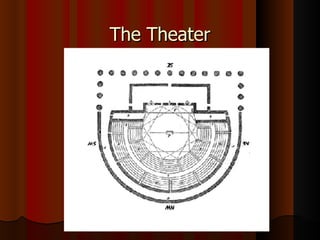
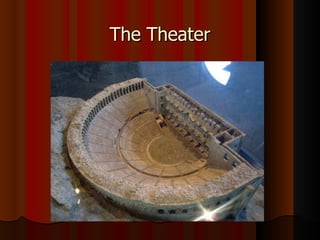
The Theater Theatron Where the audience sat; consisted of wooden seats and stone benches Orchestra A circular dancing area where the actors and Chorus performed.  Later, this became a semi-circle as the Chorus lost its importance. Thymele An altar to Dionysus set in the center of the orchestra Originally, this was where a goat was sacrificed.
The Theater
The Theater
The Oedipus Trilogy Antigone  written in 442 BC Oedipus Rex  written in 430 BC Oedipus at Colonus  written 401 BC (produced after Sophocles’ death) This Theban Cycle contains 3 stories about the House of Laius. Chronologically,  Antigone  is the last of the cycle.
What is Tragedy? “ Any serious and dignified drama that describes a conflict between the hero (the protagonist) and a superior force (destiny, chance, society, gods) and reaches a sorrowful conclusion that arouses pity and fear in the audience” -- Aristotle, Greek philosopher

Greek Drama

  • 1.
    Greek Drama AnIntroduction English 2
  • 2.
    Origins Where? TheEastern Mediterranean When? The 6 th and 5 th centuries, B.C.
  • 3.
    The Dionysus CultGreek drama originates from the Greek god Dionysus the god of the vine (and of wine, theater, and dance) Every fall, with the coming of the cold, Dionysus died… But he was resurrected again each spring! This cycle assured the Greeks that death does not end it all: his death and rebirth showed them that the soul lives on forever
  • 4.
    The Festival ofDionysia The most famous and popular public festival of the time 4-5 days long business was suspended prisoners were let out of jail on bail foreign heads of state were honored When: End of March/early April
  • 5.
    Drama Began aschoral songs about the death and resurrection of Dionysus Evolved into a theatrical contest 3 dramatists competed over a 3-day duration Judged by a panel of 10 elected judges Subject of plays: ancient myth and heroes, stories the audience knew
  • 6.
    Thespis His Chorus of fifty told the entire story Credited with “inventing” the art of acting Someone from the Chorus would step out and become a mythical character or messenger. Introduced dialogue and the dramatic narrative. Fused dancing with dialogue The inventor of tragedy plays concentrated on the mythical grandeur of the stories
  • 7.
    Aeschylus The firstgreat dramatist Introduced the second actor, thus allowing for dramatic conflict , several points of view, and dialogue. Wrote trilogies on unified themes.
  • 8.
    Sophocles His playsconcentrated on characters Focused on heroes on the grand scale with grand possessions or deeds – BIG! Added a third actor and reduced the chorus to fifteen Master of tragic irony His trilogies were separated plays Won the contest 18-24 times. Died at age 90; seven of his 123 plays survived
  • 9.
    Euripides The first“modern” dramatist His characters tended to speak and act like his contemporaries and seemed more modern Known for his portrayal of women
  • 10.
    Role of Women:Marriage Women were controlled by the men in their lives. Father controlled them before they were married; husband controlled them once they were married. Married in their teens, often to a man in his thirties. Father chose her husband. The young bride only became a full member of the new household when she produced her first child. Women had very little influence, or power in Greek society and were not highly regarded until they could produce a child. Once a woman was married, her husband controlled all property. She had no rights to wander about the town without a just cause; any respectable woman would not be seen in public. Greek women had virtually no political rights of any kind, and custom dictated that women should limit her time outside the home.
  • 11.
    Role of Women:The Home As girls, spent most of time in the household with other women Learned important household skills: spinning, weaving, sewing, cooking, and other household joys. … as well as reading; women were well-versed in simple mythology, religion, and occasionally, music. Because men spent most of their time away from their houses, women dominated Greek home life. The wife was in charge of raising the children and making clothing for the family. In the Greeks’ slave-based economy, numerous female slaves were available to cook, clean, and carry water; only in the poorest homes was the wife expected to do these duties herself.
  • 12.
    Role of Women:Public Life Left the house only to perform religious duties. As part of a woman’s public duties, she would be expected to play an important role at funerals. Athenian women were neither allowed to cry (crying was too weak and “womanly”), nor to bury more than three garments with the body, which they prepared for burial. In a funeral procession, the females carried the libations at the front of the group followed by the male relatives. This was probably the only time a woman was allowed to be ahead of the males! In addition, on the third and ninth days of the funeral, women were expected to deliver food and libations to the gravesite.
  • 13.
    Conventions of theGreek Theater Plays were performed only during the daytime. Props and verbal references became a very large part of “setting the scene” for performances The large outdoor theaters could seat 14,000 to 15,000 spectators!
  • 14.
    Conventions of GreekTheater Most of the play’s action was set outdoors There were NO: Curtains Lights Intermissions The Chorus was always on stage with the actors
  • 15.
    The Chorus Originally,told the entire story Made up the story’s background characters (e.g., town elders, maidens, war captives) Sophocles reduced from 50 to 15 members in Antigone Despite reduced numbers, was still an important part of the play
  • 16.
    Functions of theChorus Comment on the action/offer approval or criticism Ask questions Give advice or warnings Supply background information Provide lyrical relief (perhaps relieve the tension of a highly emotional scene) Guide the audience’s emotions (like a movie soundtrack) Maintain a sense of ceremony and ritual Serve as an emotional bridge between audience and actors Unite the music, dance, and speech components Separate the scenes/divide the action into episodes
  • 17.
    Choral Terminology Prologue:the part before the Chorus enters; presents background information to situate the conflict Parodos: the entrance songs of the Chorus Ode: a song sung by the Chorus between episodes (scenes) Epode: the final stanza in some odes Paean: the concluding song, a song of thanksgiving to Dionysus Exodus: the final exiting scene Chorages: the Choral Leader; might dialogue with the Chorus but technically wasn’t a 4 th actor
  • 18.
    Actors and ActingAll roles were played by men Originally, the playwright was the actor Leading role: protagonist Second actor: deuteragonist Third actor: triagonist Rule of Three : the play is limited to three actors (each played multiple roles) The number of extras allowed was unlimited and didn’t break the rule of Three
  • 19.
    The Messenger Reportedoff-stage evens and violence not able to be seen – Why? Violence was too large-scale to reproduce on stage No one could die because the actor was needed for a later role Often, the Messenger’s speeches contained the play’s best writing – did the poets prefer writing to staging?
  • 20.
    Costumes Long, flowingrobes High boots, often with raised soles Larger-than-life masks made of linen, wood, or cork Masks identified age, gender, and emotion Masks had exaggerated features so the audience could see more easily
  • 21.
    The Three UnitiesUnity of Action The events of the play center around one single action. There are no subplots. Unity of Place The events of the play are set in one unchanging scene. Unity of Time The timeframe of the events of the play is limited to a 24-hour period. Previous events or background information has to be recounted on the stage.
  • 22.
    The Theater TheatronWhere the audience sat; consisted of wooden seats and stone benches Orchestra A circular dancing area where the actors and Chorus performed. Later, this became a semi-circle as the Chorus lost its importance. Thymele An altar to Dionysus set in the center of the orchestra Originally, this was where a goat was sacrificed.
  • 23.
  • 24.
  • 25.
    The Oedipus TrilogyAntigone written in 442 BC Oedipus Rex written in 430 BC Oedipus at Colonus written 401 BC (produced after Sophocles’ death) This Theban Cycle contains 3 stories about the House of Laius. Chronologically, Antigone is the last of the cycle.
  • 26.
    What is Tragedy?“ Any serious and dignified drama that describes a conflict between the hero (the protagonist) and a superior force (destiny, chance, society, gods) and reaches a sorrowful conclusion that arouses pity and fear in the audience” -- Aristotle, Greek philosopher