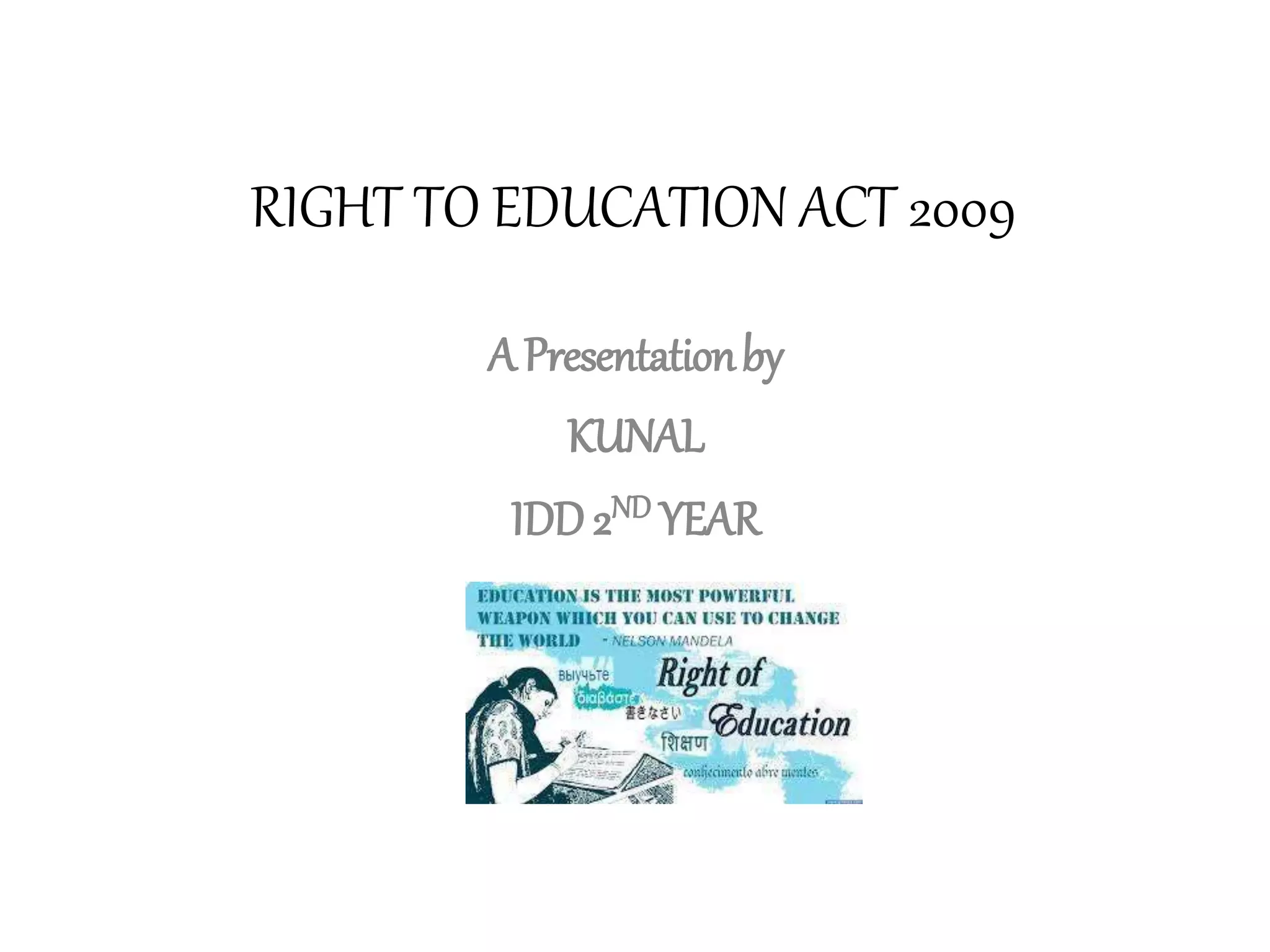
RIGHT TO EDUCATION ACT 2009
APresentationby
KUNAL
IDD 2ND YEAR
Background
• The Constitution (Eighty-sixth Amendment) Act, 2002
inserted Article 21-A in the Constitution of India to provide
free and compulsory education of all children in the age group
of six to fourteen years as a Fundamental Right
• The Right of Children to Free and Compulsory Education
(RTE) Act, 2009, which represents the consequential
legislation envisaged under Article 21-A, means that every
child has a right to full time elementary education of
satisfactory and equitable quality in a formal school which
satisfies certain essential norms and standards.
Details
• Article 21-A and the RTE Act came into effect on 1 April
2010. The title of the RTE Act incorporates the words ‘free
and compulsory.
• ‘Free education’ means child doesnot require to pay any fee
for his or her education.
• ‘Compulsory education’ casts an obligation on the appropriate
Government and local authorities to provide and ensure
admission, attendance and completion of elementary education
by all children in the 6-14 age group.
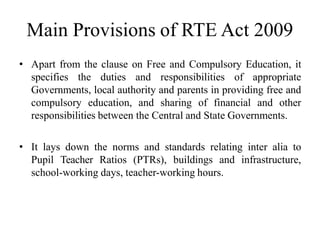
Main Provisions of RTE Act 2009
• Apart from the clause on Free and Compulsory Education, it
specifies the duties and responsibilities of appropriate
Governments, local authority and parents in providing free and
compulsory education, and sharing of financial and other
responsibilities between the Central and State Governments.
• It lays down the norms and standards relating inter alia to
Pupil Teacher Ratios (PTRs), buildings and infrastructure,
school-working days, teacher-working hours.
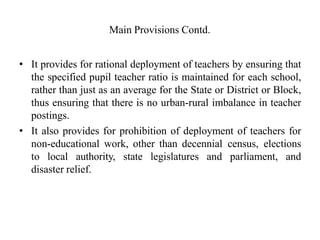
Main Provisions Contd.
• It provides for rational deployment of teachers by ensuring that
the specified pupil teacher ratio is maintained for each school,
rather than just as an average for the State or District or Block,
thus ensuring that there is no urban-rural imbalance in teacher
postings.
• It also provides for prohibition of deployment of teachers for
non-educational work, other than decennial census, elections
to local authority, state legislatures and parliament, and
disaster relief.
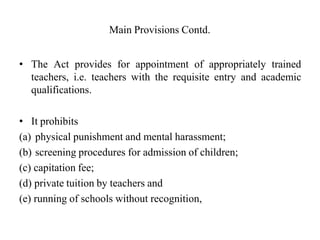
Main Provisions Contd.
• The Act provides for appointment of appropriately trained
teachers, i.e. teachers with the requisite entry and academic
qualifications.
• It prohibits
(a) physical punishment and mental harassment;
(b) screening procedures for admission of children;
(c) capitation fee;
(d) private tuition by teachers and
(e) running of schools without recognition,
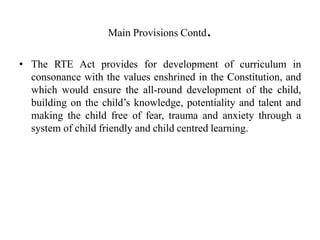
Main Provisions Contd.
• The RTE Act provides for development of curriculum in
consonance with the values enshrined in the Constitution, and
which would ensure the all-round development of the child,
building on the child’s knowledge, potentiality and talent and
making the child free of fear, trauma and anxiety through a
system of child friendly and child centred learning.
Challenges in Implementation
• The states are expected to respond to the situation arising out
of the implementation of theAct.
• States and UTs are required to pay special attention to cope
with the situation in terms of appointment of qualified
teachers, development of special training programmes for out-
of-school children admitted to age appropriate classes and
preparation of relevant teaching learning materials for them.
Challenges in Implementation Contd.
• Similarly, there is an urgent need of taking appropriate steps
for inclusive education of children with disabilities by
providing teaching-learning materials, aids and appliances in
accordance with nature and needs of each disability, suitable
infrastructural modifications, training of regular teachers and
school-based appointment of special teacher.
• There is also a need for organising programmes for community
awareness and attitude change in order to make school for all
children. Home-based education has to be given to children
suffering from multi-disabilities, severe and profound
disability conditions.
Challenges in Implementation Contd.
• Shortage of teachers, alarming pupil-teacher ratio, other
official duties assigned to teachers, busyness in training
programmes, duties in block level office, making Aadhar cards
and voter ID Cards etc, no training of regular teachers in
education of children with disabilities and non-availability of
special teacher support on daily basis are challenges in the
implementation of RTE
Present Status
Even after Seven years of passing the Bill, an internal Delhi
Govt. report says
• Poor presence of students
• Ignorance among teachers and guardians about the provisions
of theAct
• Poor condition of training regarding RTE
• Acute shortage of teachers
• Malaise of absence of teachers from the schools
• No atmosphere of quality teaching and meaningful teaching-
learning process
Way Forward
• RTE Act is a landmark Act that promises free and
compulsory Education to Child below 14 years of
age.
• The Central, State and the local Govt have to work in
unison to achieve the desired end state.
• The Govt at the apex level is aware of the challenges
and many effective steps have been taken to realise
the dreams.
ThankYou

KUNAL RTE ACT 2009 PPT.pptx

  • 1.
    RIGHT TO EDUCATIONACT 2009 APresentationby KUNAL IDD 2ND YEAR
  • 2.
    Background • The Constitution(Eighty-sixth Amendment) Act, 2002 inserted Article 21-A in the Constitution of India to provide free and compulsory education of all children in the age group of six to fourteen years as a Fundamental Right • The Right of Children to Free and Compulsory Education (RTE) Act, 2009, which represents the consequential legislation envisaged under Article 21-A, means that every child has a right to full time elementary education of satisfactory and equitable quality in a formal school which satisfies certain essential norms and standards.
  • 3.
    Details • Article 21-Aand the RTE Act came into effect on 1 April 2010. The title of the RTE Act incorporates the words ‘free and compulsory. • ‘Free education’ means child doesnot require to pay any fee for his or her education. • ‘Compulsory education’ casts an obligation on the appropriate Government and local authorities to provide and ensure admission, attendance and completion of elementary education by all children in the 6-14 age group.
  • 4.
    Main Provisions ofRTE Act 2009 • Apart from the clause on Free and Compulsory Education, it specifies the duties and responsibilities of appropriate Governments, local authority and parents in providing free and compulsory education, and sharing of financial and other responsibilities between the Central and State Governments. • It lays down the norms and standards relating inter alia to Pupil Teacher Ratios (PTRs), buildings and infrastructure, school-working days, teacher-working hours.
  • 5.
    Main Provisions Contd. •It provides for rational deployment of teachers by ensuring that the specified pupil teacher ratio is maintained for each school, rather than just as an average for the State or District or Block, thus ensuring that there is no urban-rural imbalance in teacher postings. • It also provides for prohibition of deployment of teachers for non-educational work, other than decennial census, elections to local authority, state legislatures and parliament, and disaster relief.
  • 6.
    Main Provisions Contd. •The Act provides for appointment of appropriately trained teachers, i.e. teachers with the requisite entry and academic qualifications. • It prohibits (a) physical punishment and mental harassment; (b) screening procedures for admission of children; (c) capitation fee; (d) private tuition by teachers and (e) running of schools without recognition,
  • 7.
    Main Provisions Contd. •The RTE Act provides for development of curriculum in consonance with the values enshrined in the Constitution, and which would ensure the all-round development of the child, building on the child’s knowledge, potentiality and talent and making the child free of fear, trauma and anxiety through a system of child friendly and child centred learning.
  • 8.
    Challenges in Implementation •The states are expected to respond to the situation arising out of the implementation of theAct. • States and UTs are required to pay special attention to cope with the situation in terms of appointment of qualified teachers, development of special training programmes for out- of-school children admitted to age appropriate classes and preparation of relevant teaching learning materials for them.
  • 9.
    Challenges in ImplementationContd. • Similarly, there is an urgent need of taking appropriate steps for inclusive education of children with disabilities by providing teaching-learning materials, aids and appliances in accordance with nature and needs of each disability, suitable infrastructural modifications, training of regular teachers and school-based appointment of special teacher. • There is also a need for organising programmes for community awareness and attitude change in order to make school for all children. Home-based education has to be given to children suffering from multi-disabilities, severe and profound disability conditions.
  • 10.
    Challenges in ImplementationContd. • Shortage of teachers, alarming pupil-teacher ratio, other official duties assigned to teachers, busyness in training programmes, duties in block level office, making Aadhar cards and voter ID Cards etc, no training of regular teachers in education of children with disabilities and non-availability of special teacher support on daily basis are challenges in the implementation of RTE
  • 11.
    Present Status Even afterSeven years of passing the Bill, an internal Delhi Govt. report says • Poor presence of students • Ignorance among teachers and guardians about the provisions of theAct • Poor condition of training regarding RTE • Acute shortage of teachers • Malaise of absence of teachers from the schools • No atmosphere of quality teaching and meaningful teaching- learning process
  • 12.
    Way Forward • RTEAct is a landmark Act that promises free and compulsory Education to Child below 14 years of age. • The Central, State and the local Govt have to work in unison to achieve the desired end state. • The Govt at the apex level is aware of the challenges and many effective steps have been taken to realise the dreams.
  • 13.