
EXCELLENCE AND COMPETENCY TRAINING CENTER INC.
!
!
NMLC-EF4-Module 1
Function 4:
Controlling the operation of
the ship and care for
persons onboard at the
management level.
EXCELLENCE AND COMPETENCY TRAINING CENTER INC.
1
EXCELLENCE AND COMPETENCY TRAINING CENTER INC.
!
!
NMLC-EF4-Module 1
2
Watertight Integrity and
Weather tight
EXCELLENCE AND COMPETENCY TRAINING CENTER INC.
!
!
NMLC-EF4-Module 1
3
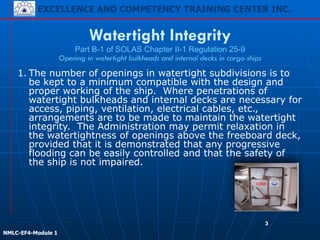
1. The number of openings in watertight subdivisions is to
be kept to a minimum compatible with the design and
proper working of the ship. Where penetrations of
watertight bulkheads and internal decks are necessary for
access, piping, ventilation, electrical cables, etc.,
arrangements are to be made to maintain the watertight
integrity. The Administration may permit relaxation in
the watertightness of openings above the freeboard deck,
provided that it is demonstrated that any progressive
flooding can be easily controlled and that the safety of
the ship is not impaired.
Watertight Integrity

Part B-1 of SOLAS Chapter II-1 Regulation 25-9

Opening in watertight bulkheads and internal decks in cargo ships

EXCELLENCE AND COMPETENCY TRAINING CENTER INC.
!
!
NMLC-EF4-Module 1
4
2. Doors provided to ensure the watertight integrity of
internal openings which are used while at sea are to be
sliding watertight doors capable of being remotely closed
from the bridge and are also to be operable locally from
each side of the bulkhead. Indicators are to be provided
at the control position showing whether the doors are
open or closed, and an audible alarm is to be provided at
the door closure. The power, control and indicators are to
be operable in the event of main power failure. Particular
attention is to be paid to minimizing the effect of control
system failure. Each power-operated sliding watertight
door shall be provided with an individual hand-operated
mechanism. It shall be possible to open and close the
door by hand at the door itself from both sides.
EXCELLENCE AND COMPETENCY TRAINING CENTER INC.
!
!
NMLC-EF4-Module 1
5
3. Access doors and access hatch covers normally closed
at sea, intended to ensure the watertight integrity of
internal openings, shall be provided with means of
indication locally and on the bridge showing whether
these doors or hatch covers are open or closed. A
notice is to be affixed to each such door or hatch cover
to the effect that it is not to be left open. The use of
such doors and hatch covers shall be authorized by the
officer of the watch.
EXCELLENCE AND COMPETENCY TRAINING CENTER INC.
!
!
NMLC-EF4-Module 1
6
4. Watertight doors or ramps of satisfactory construction
may be fitted to internally subdivide large cargo spaces,
provided that the Administration is satisfied that such
doors or ramps are essential. These doors or ramps may
be hinged, rolling or sliding doors or ramps, but shall not
be remotely controlled*. Such doors or ramps shall be
closed before the voyage commences and shall be kept
closed during navigation; the time of opening such doors
or ramps in port and of closing them before the ship
leaves port shall be entered in the logbook. Should any of
the doors or ramps be accessible during the voyage, they
shall be fitted with a device which prevents unauthorized
opening.
EXCELLENCE AND COMPETENCY TRAINING CENTER INC.
!
!
NMLC-EF4-Module 1
7
5. Other closing appliances which are kept permanently
closed at sea to ensure the watertight integrity of internal
openings shall be provided with a notice which is to be
affixed to each closing appliance to the effect that it is to
be kept closed. Manholes fitted with closely bolted covers
need not be so marked.
EXCELLENCE AND COMPETENCY TRAINING CENTER INC.
!
!
NMLC-EF4-Module 1
8
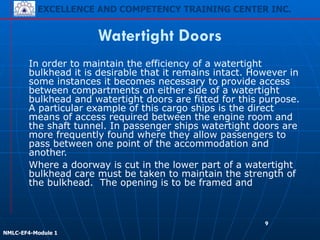
*refer MSC/Circ.651
MSC/Circular.651 - International Convention for the
Safety of Life at Sea, 1974, as amended - (adopted on 8
June 1994) - The Maritime Safety Committee
The need for the provision of position indicators to certain
doors which lead to main cargo spaces - (regulation 25-9,
paragraph 4)
. Those hinged, rolling and sliding watertight doors and
ramps which are fitted to subdivide large cargo spaces,
and are not required to be remotely controlled but are to
be secured closed whilst the ship is at sea and are
recorded as such in the ship’s log, should not be required
to be fitted with a position indicator display at the bridge
control position.
EXCELLENCE AND COMPETENCY TRAINING CENTER INC.
!
!
NMLC-EF4-Module 1
9
In order to maintain the efficiency of a watertight
bulkhead it is desirable that it remains intact. However in
some instances it becomes necessary to provide access
between compartments on either side of a watertight
bulkhead and watertight doors are fitted for this purpose.
A particular example of this cargo ships is the direct
means of access required between the engine room and
the shaft tunnel. In passenger ships watertight doors are
more frequently found where they allow passengers to
pass between one point of the accommodation and
another.
Where a doorway is cut in the lower part of a watertight
bulkhead care must be taken to maintain the strength of
the bulkhead. The opening is to be framed and
Watertight Doors

EXCELLENCE AND COMPETENCY TRAINING CENTER INC.
!
!
NMLC-EF4-Module 1
10
The opening is to be framed and reinforced, if the
vertical stiffeners are cut in way of the opening. If the
stiffener spacing is increased to accommodate the
opening, the scantlings of the stiffeners on either side of
the opening are increased to give an equivalent strength
to that of an unpierced bulkhead. The actual opening is
kept as small as possible, the access to the shaft tunnel
being about 1000 to 1250 mm high and about 700 mm
wide. In passenger accommodation the openings would
be somewhat larger.
Watertight doors shall be power-operated sliding doors
complying with the requirements capable of being closed
simultaneously from the central operating console at the
navigation bridge in not more than 60 s with the ship in
the upright position.
EXCELLENCE AND COMPETENCY TRAINING CENTER INC.
!
!
NMLC-EF4-Module 1
11
The means of operation whether by power or by hand of
any power-operated sliding watertight door shall be
capable of closing the door with the ship listed to 15º
either way. Consideration shall also be given to the forces
which may act on either side of the door as may be
experienced when water is flowing through the opening
applying a static head equivalent to a water height of at
least 1 m above the sill on the centreline of the door.
Mild steel or cast steel watertight doors fitted below the
water line are either of the vertical or horizontal sliding
type. A swinging hinged type of door could prove
impossible to close in the event of flooding and is not
permitted. The sliding door must be capable of operation
when the ship is listed 15º, and be opened or closed from
the vicinity of the door as well as from a position above
the bulkhead deck.
EXCELLENCE AND COMPETENCY TRAINING CENTER INC.
!
!
NMLC-EF4-Module 1
12
At this remote control position an indicator must be
provided to show whether the door is open or closed.
Vertical sliding doors may be closed by a vertical screw
thread which is turned by a shaft extending above the
bulkhead and fitted with a crank handle. This screw
thread turns in a gunmetal nut attached to the top of the
door, and a crank handle is also provided at the door to
allow it to be closed from this position. Often horizontal
sliding doors are fitted, and these may have a vertical
shaft extending above the bulkhead deck, which may be
operated by hand from above the deck or at the door.
This can also be power driven by an electric motor and
worn gear, the vertical shaft working through bevel
wheels, and horizontal screwed shafts turning in bronze
nuts on the door.
EXCELLENCE AND COMPETENCY TRAINING CENTER INC.
!
!
NMLC-EF4-Module 1
13
The horizontal sliding door may also be opened and
closed by a hydraulic ram with a hydraulic hand pump
and with control at the door and above the bulkhead deck
with the larger number of watertight doors fitted in
passenger ships the doors may be closed by means of
hydraulic power actuated by remote control from a
central position above the bulkhead deck.
When in place all watertight doors are given a hose test,
but those in a passenger ship are required to be tested
under a head of water extending to the bulkhead deck.
This may be done before the door is fitted in the ship.
In approved positions in the upper tween decks well
above the waterline, hinged watertight doors are
permitted. These may be similar to the weathertight
doors fitted in superstructures, but are to have gunmetal
pins in the hinges.

Nmlc ef4 module1 day02 watertight integrity

  • 1.
    EXCELLENCE AND COMPETENCYTRAINING CENTER INC. ! ! NMLC-EF4-Module 1 Function 4: Controlling the operation of the ship and care for persons onboard at the management level. EXCELLENCE AND COMPETENCY TRAINING CENTER INC. 1
  • 2.
    EXCELLENCE AND COMPETENCYTRAINING CENTER INC. ! ! NMLC-EF4-Module 1 2 Watertight Integrity and Weather tight
  • 3.
    EXCELLENCE AND COMPETENCYTRAINING CENTER INC. ! ! NMLC-EF4-Module 1 3 1. The number of openings in watertight subdivisions is to be kept to a minimum compatible with the design and proper working of the ship. Where penetrations of watertight bulkheads and internal decks are necessary for access, piping, ventilation, electrical cables, etc., arrangements are to be made to maintain the watertight integrity. The Administration may permit relaxation in the watertightness of openings above the freeboard deck, provided that it is demonstrated that any progressive flooding can be easily controlled and that the safety of the ship is not impaired. Watertight Integrity
 Part B-1 of SOLAS Chapter II-1 Regulation 25-9
 Opening in watertight bulkheads and internal decks in cargo ships

  • 4.
    EXCELLENCE AND COMPETENCYTRAINING CENTER INC. ! ! NMLC-EF4-Module 1 4 2. Doors provided to ensure the watertight integrity of internal openings which are used while at sea are to be sliding watertight doors capable of being remotely closed from the bridge and are also to be operable locally from each side of the bulkhead. Indicators are to be provided at the control position showing whether the doors are open or closed, and an audible alarm is to be provided at the door closure. The power, control and indicators are to be operable in the event of main power failure. Particular attention is to be paid to minimizing the effect of control system failure. Each power-operated sliding watertight door shall be provided with an individual hand-operated mechanism. It shall be possible to open and close the door by hand at the door itself from both sides.
  • 5.
    EXCELLENCE AND COMPETENCYTRAINING CENTER INC. ! ! NMLC-EF4-Module 1 5 3. Access doors and access hatch covers normally closed at sea, intended to ensure the watertight integrity of internal openings, shall be provided with means of indication locally and on the bridge showing whether these doors or hatch covers are open or closed. A notice is to be affixed to each such door or hatch cover to the effect that it is not to be left open. The use of such doors and hatch covers shall be authorized by the officer of the watch.
  • 6.
    EXCELLENCE AND COMPETENCYTRAINING CENTER INC. ! ! NMLC-EF4-Module 1 6 4. Watertight doors or ramps of satisfactory construction may be fitted to internally subdivide large cargo spaces, provided that the Administration is satisfied that such doors or ramps are essential. These doors or ramps may be hinged, rolling or sliding doors or ramps, but shall not be remotely controlled*. Such doors or ramps shall be closed before the voyage commences and shall be kept closed during navigation; the time of opening such doors or ramps in port and of closing them before the ship leaves port shall be entered in the logbook. Should any of the doors or ramps be accessible during the voyage, they shall be fitted with a device which prevents unauthorized opening.
  • 7.
    EXCELLENCE AND COMPETENCYTRAINING CENTER INC. ! ! NMLC-EF4-Module 1 7 5. Other closing appliances which are kept permanently closed at sea to ensure the watertight integrity of internal openings shall be provided with a notice which is to be affixed to each closing appliance to the effect that it is to be kept closed. Manholes fitted with closely bolted covers need not be so marked.
  • 8.
    EXCELLENCE AND COMPETENCYTRAINING CENTER INC. ! ! NMLC-EF4-Module 1 8 *refer MSC/Circ.651 MSC/Circular.651 - International Convention for the Safety of Life at Sea, 1974, as amended - (adopted on 8 June 1994) - The Maritime Safety Committee The need for the provision of position indicators to certain doors which lead to main cargo spaces - (regulation 25-9, paragraph 4) . Those hinged, rolling and sliding watertight doors and ramps which are fitted to subdivide large cargo spaces, and are not required to be remotely controlled but are to be secured closed whilst the ship is at sea and are recorded as such in the ship’s log, should not be required to be fitted with a position indicator display at the bridge control position.
  • 9.
    EXCELLENCE AND COMPETENCYTRAINING CENTER INC. ! ! NMLC-EF4-Module 1 9 In order to maintain the efficiency of a watertight bulkhead it is desirable that it remains intact. However in some instances it becomes necessary to provide access between compartments on either side of a watertight bulkhead and watertight doors are fitted for this purpose. A particular example of this cargo ships is the direct means of access required between the engine room and the shaft tunnel. In passenger ships watertight doors are more frequently found where they allow passengers to pass between one point of the accommodation and another. Where a doorway is cut in the lower part of a watertight bulkhead care must be taken to maintain the strength of the bulkhead. The opening is to be framed and Watertight Doors

  • 10.
    EXCELLENCE AND COMPETENCYTRAINING CENTER INC. ! ! NMLC-EF4-Module 1 10 The opening is to be framed and reinforced, if the vertical stiffeners are cut in way of the opening. If the stiffener spacing is increased to accommodate the opening, the scantlings of the stiffeners on either side of the opening are increased to give an equivalent strength to that of an unpierced bulkhead. The actual opening is kept as small as possible, the access to the shaft tunnel being about 1000 to 1250 mm high and about 700 mm wide. In passenger accommodation the openings would be somewhat larger. Watertight doors shall be power-operated sliding doors complying with the requirements capable of being closed simultaneously from the central operating console at the navigation bridge in not more than 60 s with the ship in the upright position.
  • 11.
    EXCELLENCE AND COMPETENCYTRAINING CENTER INC. ! ! NMLC-EF4-Module 1 11 The means of operation whether by power or by hand of any power-operated sliding watertight door shall be capable of closing the door with the ship listed to 15º either way. Consideration shall also be given to the forces which may act on either side of the door as may be experienced when water is flowing through the opening applying a static head equivalent to a water height of at least 1 m above the sill on the centreline of the door. Mild steel or cast steel watertight doors fitted below the water line are either of the vertical or horizontal sliding type. A swinging hinged type of door could prove impossible to close in the event of flooding and is not permitted. The sliding door must be capable of operation when the ship is listed 15º, and be opened or closed from the vicinity of the door as well as from a position above the bulkhead deck.
  • 12.
    EXCELLENCE AND COMPETENCYTRAINING CENTER INC. ! ! NMLC-EF4-Module 1 12 At this remote control position an indicator must be provided to show whether the door is open or closed. Vertical sliding doors may be closed by a vertical screw thread which is turned by a shaft extending above the bulkhead and fitted with a crank handle. This screw thread turns in a gunmetal nut attached to the top of the door, and a crank handle is also provided at the door to allow it to be closed from this position. Often horizontal sliding doors are fitted, and these may have a vertical shaft extending above the bulkhead deck, which may be operated by hand from above the deck or at the door. This can also be power driven by an electric motor and worn gear, the vertical shaft working through bevel wheels, and horizontal screwed shafts turning in bronze nuts on the door.
  • 13.
    EXCELLENCE AND COMPETENCYTRAINING CENTER INC. ! ! NMLC-EF4-Module 1 13 The horizontal sliding door may also be opened and closed by a hydraulic ram with a hydraulic hand pump and with control at the door and above the bulkhead deck with the larger number of watertight doors fitted in passenger ships the doors may be closed by means of hydraulic power actuated by remote control from a central position above the bulkhead deck. When in place all watertight doors are given a hose test, but those in a passenger ship are required to be tested under a head of water extending to the bulkhead deck. This may be done before the door is fitted in the ship. In approved positions in the upper tween decks well above the waterline, hinged watertight doors are permitted. These may be similar to the weathertight doors fitted in superstructures, but are to have gunmetal pins in the hinges.