The IMPORTANCE of DYNAMIC POSITIONING of The FPSO   Graduation Project; Mustafa Çay 130050097
SUMMARY The most common method of taking off oil out of ocean bottom is using FPSOs. FPSOs drilling can be possiple ultra deep water to very shallow water.  The oil consumption is increasing day by day, so this consumption towards oil companies to research oil more deep water. Searching oil in more deep water brings more problem like fixing of vessel position and fixing equipment that used for drilling. FPSOs operated in less deep water don’t use Dynamic Positioning(DP). Technology of DP firstly were not supported by Satellite System. Using satellite system has been brought DP system more accuracy. There is no way like anchoring area water depth is 1000m. Dynamic Positioning is used for today’s FPSOs as a methods of fixing position. By this method FPSOs can be operated in ultra deep water easily.
ÖZET Petrolun deniz dibinden cıkarılmasında ilk zamanlarda Platformlar kullanılırken platformların maliyeti cok y ü ksek olduğu icin daha sonraki zamanlarda eski VLCC ya da Super Tankerler donusturulerek FPSO’lar olusturulmaya baslanmıstır. FPSO’lara ilk ornek; Shell Petrolium Co.’ya ait Castellon FPSO’dur (1971). FPSO’ların tercih edilmesindeki en buyuk sebep kullanımlarının ve yapımlarının kolay ve maliyetlerinin dusuk olmasıdır. İlk zamanlarında FPSO’lar demirlenebilecek derinliklerde kullanılırken teknolojik gelismelerle birlikte kullanım alanları cok daha fazla gelismis ozellikle “Dinamik Pozisyonlama (DP)”metoduyla petrol cıkarılabilen derinlikler 2.500m’ye kadar varmıstır. Dinamik Pozisyonlama metodu FPSO’lar icin cok onemlidir. DP yardımıyla Petrol arama islemleri inanılmaz derinliklere doğru yol almaktadır.
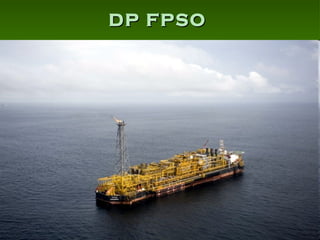
DP FPSO
CONTENTS of THESIS Introduction Floating, Production and Storage Offloading Vessels (FPSO) Hisrorical Development of FPSO Types of FPSO Positioning System of FPSO Dynamic Positioning System (DP) Why we need DP for FPSO?  Description of DP FPSO   Methods of DP Sattellite System in DP Todays DP FPSO  Importance of DP for Riser Future of DP FPSO Conclusion
Inroduction The Floating Production Storage and Offloading (Offtake) unit (FPSO) special report analyses where the industry has come from since its infancy in the 1970s, where it is now and what the future holds. The Floating Production Storage and Offloading (Offtake) unit (FPSO) special report analyses where the industry has come from since its infancy in the 1970s, where it is now and what the future holds. The message couldn’t be better the market is set for growth.
Increasing oil and gas exploration and development work, World offshore oil production forecast to increase by 43% by 2008, World offshore gas production set to soar by 83% by 2008, Demand for newbuild FPSOs increasing.
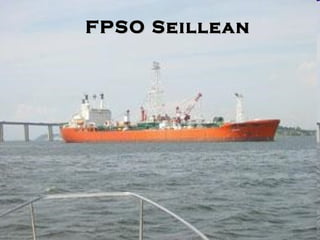
FPSO Seillean
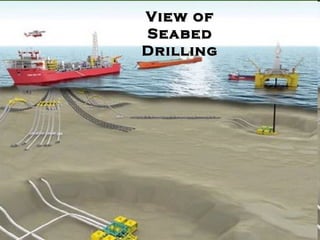
View of Seabed Drilling
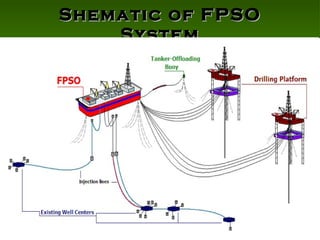
Floating, Production and Storage Offloading Vessels (FPSO) A floating production, storage and offloading (FPSO) unit is a floating vessel used by the offshore industry for the processing and storage of oil and gas.  A FPSO vessel is designed to receive oil or gas produced from nearby platforms or subsea template, process it, and store it until oil or gas can be offloaded onto a tanker or transported through a pipeline. FPSOs can be a conversion of an oil tanker or can be a vessel built specially for the application.
Shematic of FPSO System
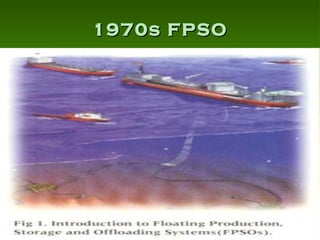
Historical Development of FPSO Oil has been produced from offshore locations since the 1950s. Originally, all oil platforms sat on the seabed, but as exploration moved to deeper waters and more distant locations in the 1970s, floating production systems came to be used.  The first oil FPSO was the Shell Castellon, built in Spain in 1971. There are so far no LNG FPSOs.
1970s FPSO
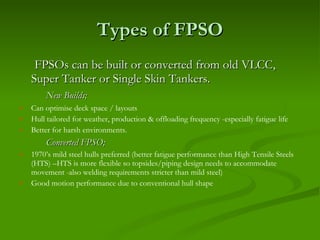
Types of FPSO FPSOs can be built or converted from old VLCC, Super Tanker or Single Skin Tankers. New Builds;   Can optimise deck space / layouts Hull tailored for weather, production & offloading frequency -especially fatigue life Better for harsh environments. Converted FPSO; 1970’s mild steel hulls preferred (better fatigue performance than High Tensile Steels (HTS) –HTS is more flexible so topsides/piping design needs to accommodate movement -also welding requirements stricter than mild steel) Good motion performance due to conventional hull shape
Converted Types; Convertion of existing tanker into Floating Production Storage/Offloading Systems (FPSOs) is old method of building FPSO. The cost of converted FPSO is less than building as FPSO.
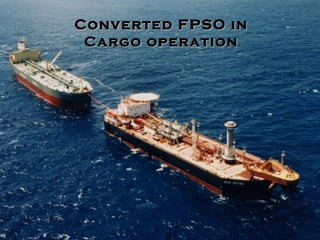
Converted FPSO in Cargo operation
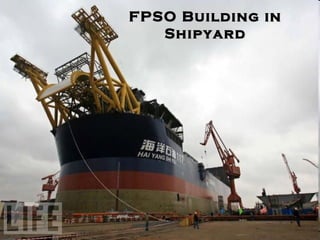
Built as FPSO; All FPSO are not converted from old single hull super tanker. Some of FPSO directly are built as FPSO. The cost of building is more than converting, also building takes more time. Building a new FPSO is not prefered nowadays. FPSO is leading offshore technology. This is especially the case for the development of oilfields offshore Brazil and West Africa.
FPSO Building in Shipyard
Positioning System of FPSO Turret Mooring System, Dynamic Positioning(DP) System.
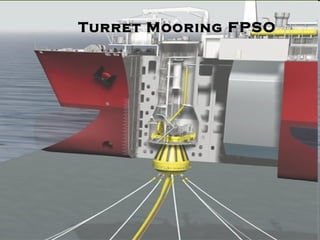
Turret Mooring System The turret system performs four main functions in a typical FPSO: Maintaining the vessel on station through single mooring. Allowing weathervaning or rotation of the vessel to adjust to climate conditions. Fluid transfer from the risers to the process plant. Providing transfer of electrical, hydraulic and other control signals.
Turret Mooring FPSO
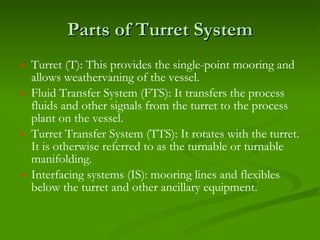
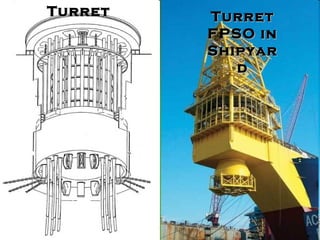
Parts of Turret System Turret (T): This provides the single-point mooring and allows weathervaning of the vessel. Fluid Transfer System (FTS): It transfers the process fluids and other signals from the turret to the process plant on the vessel. Turret Transfer System (TTS): It rotates with the turret. It is otherwise referred to as the turnable or turnable manifolding. Interfacing systems (IS): mooring lines and flexibles below the turret and other ancillary equipment.
Turret Turret FPSO in Shipyard
Dynamic Positioning(DP) System The dynamic positioning systems are not new by any means, several decades of use can be accounted, but in the last couple of decades, with the fast development of computers and satellite communications, these systems have been greatly developed.
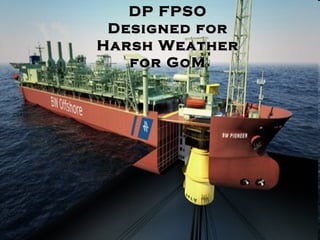
DP FPSO Designed for Harsh Weather for GoM
Parts of DP System Computer :  The brain of the positioning system is a computer that receives information from reference systems which feed three main data. Reference systems :  The information to determine position, direction and motions are input to the computer by several devices Propulsion units :  Once the computer has established the information for the vessel, based on the variations interpreted, signals are sent in the power management system and to the rudder controls. - Satellite systems: This is most useful system, mainly because it is not site dependent or water depth sensitive. The new differential systems obtain the information from more than one satellite simultaneously to determine the exact position.
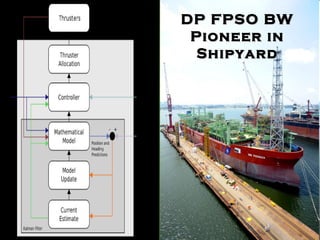
DP FPSO BW Pioneer in Shipyard
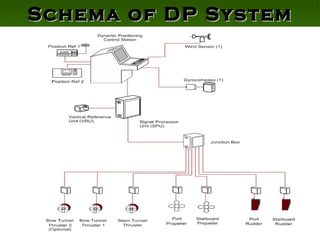
Dynamic Positioning(DP) System Dynamic positioning (DP)  is a computer controlled system to automatically maintain a vessel's position and heading by using her own propellers and thrusters. Position reference sensors, combined with wind sensors, motion sensors and gyro compasses, provide information to the computer pertaining to the vessel's position and the magnitude and direction of environmental forces affecting its position.
Schema of DP System
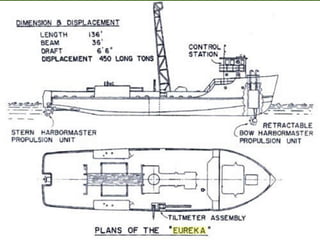
The principle of using thrusters to stabilize the position of a floating vessel was undoubtedly conceiving for the first time by Jules Verne around 1895.  In 1961, United States, the coring vessel Eureka, was launched. The Eureka thus performed coring in more than 1300 m of water, with 6 m waves and 40 knot winds. Eureka that had an analogue control system interfaced with a taut wire, making it the first true DP ship.
 
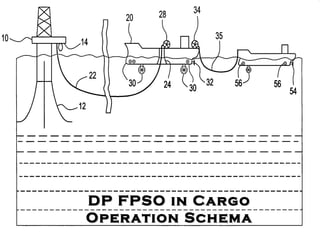
Why We Need DP for FPSO? FPSO with a combination of Dynamic Positioning. This alternative, less costly in installations may provide a flexible solution for future use of FPSO in deep or marginal fields. Risers can be disconnected very easily, no underwater pipelines are required which can be costly in the case of deep water or where the distance to shore is relatively large, the vessel may be moved out of the station in the event of environmental hazards, and it may, in particular cases where the distance to a discharge terminal is relatively close, be no need for shuttle tankers.
DP FPSO in Cargo Operation Schema
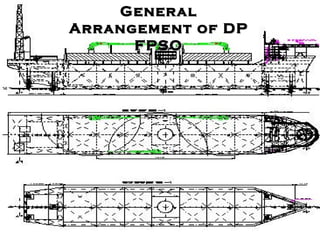
Description of DP FPSO DP FPSO: The FPSO has a DP-thruster stationkeeping system and offloads to a shuttle tanker connected in tandem. For transfer of fluids between the riser system and the vessel.  The riser system provides transfer of product from the wellheads to the FPSO, and is specifically designed for use in this concept with the disconnectable turret system developed.
General Arrangement of DP FPSO
Methods of Dynamic Positioning(DP) System Offshore operations and corresponding geographic area help to determine the appropriate type of floating vessels. Careful choice must be made among the various alternatives concerning DP and existing equipment. Different techniques have been used since early times of DP history. Important ones are ;
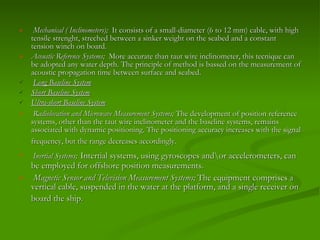
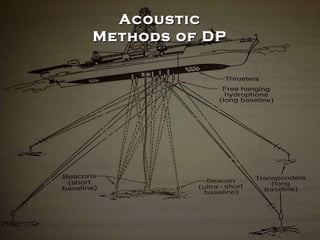
Mechanical ( Inclinometers);   It consists of a small-diameter (6 to 12 mm) cable, with high tensile strenght, streched between a sinker weight on the seabed and a constant tension winch on board.  Acoustic Reference Systems ;  More accurate than taut wire inclinometer, this tecnique can be adopted any water depth. The principle of method is bassed on the measurement of acoustic propagation time between surface and seabed.  Long Baseline System   Short Baseline System   Ultra-short Baseline System   Radiolocation and Microwave Measurement Systems;  The development of position reference systems, other than the taut wire inclinometer and the baseline systems, remains associated with dynamic positioning. The positioning accuracy increases with the signal frequency, but the range decreases accordingly.   Inertial Systems ;   Intertial systems, using gyroscopes and\or accelerometers, can be employed for offshore position measurements. Magnetic Sensor and Television Measurement Systems ;  The equipment comprises a vertical cable, suspended in the water at the platform, and a single receiver on board the ship.
Acoustic Methods of DP
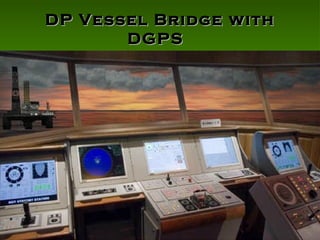
Satellite System in DP On deepwater drilling it is important to keep the riser connecting the vessel to the well as close to vertical as possible, so precise positioning is required. DGPS services are used on many mobile offshore drilling units along with our hardware products and software applications. This provides the accurate and reliable position required for the dynamic positioning system and allows the operator to monitor quality of the position ensuring that the vessel stays precisely over the well.
DP Vessel Bridge with DGPS
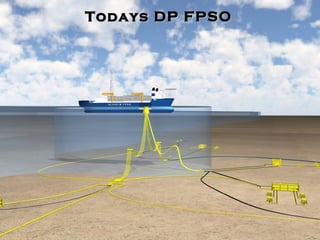
Todays DP FPSO The dynamic positioning systems are not new by any means,several decades of use can be accounted, but in the last couple of decades, with the fast development of computers and satellite communications, these systems have been greatly developed. This new technology also point towards the possibility for non site-dependent alternatives to explore deep water, accuracy in position
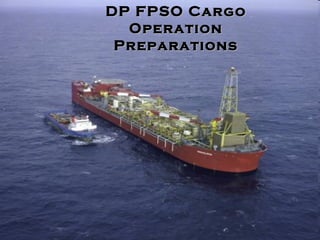
DP FPSO Cargo Operation Preparations
Todays DP FPSO
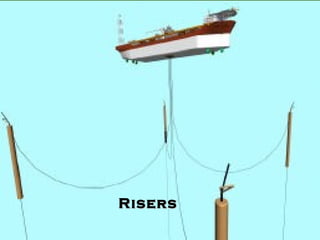
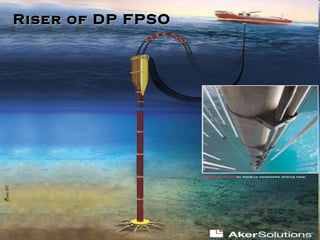
Importance of DP for RISER A  riser  is a conduit that provides a temporary extension of a subsea oil well to a surface drilling facility. On drillships, riser angle monitoring can be fed into the DP system. It may be an electrical inclinometer or based on USBL, where a riser angle monitoring transponder is fitted to the riser and a remote inclinometer unit.
Risers
Riser of DP FPSO
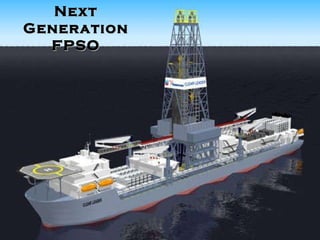
Future of DP FPSO FPSO’s use acoustic method for fixing our riser. If  riser acoustic system is developed FPSO’s can work in ultra deep water every part of world.  Moving now towards 2010 & beyond, DP is an integral part of the offshore oilfield.  Advances in technology & reference systems make the systems more reliable & greatly increase the Mean Time Between Failure (MTBF).  Today we are drilling in deeper water; farther offshore then could be imagined back on the Eureka.  Chevrons newest Enterprise Class drill ship, to work in 3650m of water, drilling to a total depth of 12,200m.
Next Generation FPSO
Conclusion Since early 1970s FPSOs have been built and converted. Today number of FPSO are more than a hundred. New generation FPSOs with DP System are still on built. FPSO with DP System is still future of Oil technology like being future in 1970s. Figure about FPSO role in the worldwide oil market is down lines.  To date there have been 108 installations of FPSOs worldwide. For many of these projects the oil field has now been depleted and the vessel has been moved on to another location.
THANK YOU

FPSO Dynamic positioning

  • 1.
    The IMPORTANCE ofDYNAMIC POSITIONING of The FPSO Graduation Project; Mustafa Çay 130050097
  • 2.
    SUMMARY The mostcommon method of taking off oil out of ocean bottom is using FPSOs. FPSOs drilling can be possiple ultra deep water to very shallow water. The oil consumption is increasing day by day, so this consumption towards oil companies to research oil more deep water. Searching oil in more deep water brings more problem like fixing of vessel position and fixing equipment that used for drilling. FPSOs operated in less deep water don’t use Dynamic Positioning(DP). Technology of DP firstly were not supported by Satellite System. Using satellite system has been brought DP system more accuracy. There is no way like anchoring area water depth is 1000m. Dynamic Positioning is used for today’s FPSOs as a methods of fixing position. By this method FPSOs can be operated in ultra deep water easily.
  • 3.
    ÖZET Petrolun denizdibinden cıkarılmasında ilk zamanlarda Platformlar kullanılırken platformların maliyeti cok y ü ksek olduğu icin daha sonraki zamanlarda eski VLCC ya da Super Tankerler donusturulerek FPSO’lar olusturulmaya baslanmıstır. FPSO’lara ilk ornek; Shell Petrolium Co.’ya ait Castellon FPSO’dur (1971). FPSO’ların tercih edilmesindeki en buyuk sebep kullanımlarının ve yapımlarının kolay ve maliyetlerinin dusuk olmasıdır. İlk zamanlarında FPSO’lar demirlenebilecek derinliklerde kullanılırken teknolojik gelismelerle birlikte kullanım alanları cok daha fazla gelismis ozellikle “Dinamik Pozisyonlama (DP)”metoduyla petrol cıkarılabilen derinlikler 2.500m’ye kadar varmıstır. Dinamik Pozisyonlama metodu FPSO’lar icin cok onemlidir. DP yardımıyla Petrol arama islemleri inanılmaz derinliklere doğru yol almaktadır.
  • 4.
  • 5.
    CONTENTS of THESISIntroduction Floating, Production and Storage Offloading Vessels (FPSO) Hisrorical Development of FPSO Types of FPSO Positioning System of FPSO Dynamic Positioning System (DP) Why we need DP for FPSO? Description of DP FPSO Methods of DP Sattellite System in DP Todays DP FPSO Importance of DP for Riser Future of DP FPSO Conclusion
  • 6.
    Inroduction The FloatingProduction Storage and Offloading (Offtake) unit (FPSO) special report analyses where the industry has come from since its infancy in the 1970s, where it is now and what the future holds. The Floating Production Storage and Offloading (Offtake) unit (FPSO) special report analyses where the industry has come from since its infancy in the 1970s, where it is now and what the future holds. The message couldn’t be better the market is set for growth.
  • 7.
    Increasing oil andgas exploration and development work, World offshore oil production forecast to increase by 43% by 2008, World offshore gas production set to soar by 83% by 2008, Demand for newbuild FPSOs increasing.
  • 8.
  • 9.
  • 10.
    Floating, Production andStorage Offloading Vessels (FPSO) A floating production, storage and offloading (FPSO) unit is a floating vessel used by the offshore industry for the processing and storage of oil and gas. A FPSO vessel is designed to receive oil or gas produced from nearby platforms or subsea template, process it, and store it until oil or gas can be offloaded onto a tanker or transported through a pipeline. FPSOs can be a conversion of an oil tanker or can be a vessel built specially for the application.
  • 11.
  • 12.
    Historical Development ofFPSO Oil has been produced from offshore locations since the 1950s. Originally, all oil platforms sat on the seabed, but as exploration moved to deeper waters and more distant locations in the 1970s, floating production systems came to be used. The first oil FPSO was the Shell Castellon, built in Spain in 1971. There are so far no LNG FPSOs.
  • 13.
  • 14.
    Types of FPSOFPSOs can be built or converted from old VLCC, Super Tanker or Single Skin Tankers. New Builds; Can optimise deck space / layouts Hull tailored for weather, production & offloading frequency -especially fatigue life Better for harsh environments. Converted FPSO; 1970’s mild steel hulls preferred (better fatigue performance than High Tensile Steels (HTS) –HTS is more flexible so topsides/piping design needs to accommodate movement -also welding requirements stricter than mild steel) Good motion performance due to conventional hull shape
  • 15.
    Converted Types; Convertionof existing tanker into Floating Production Storage/Offloading Systems (FPSOs) is old method of building FPSO. The cost of converted FPSO is less than building as FPSO.
  • 16.
    Converted FPSO inCargo operation
  • 17.
    Built as FPSO;All FPSO are not converted from old single hull super tanker. Some of FPSO directly are built as FPSO. The cost of building is more than converting, also building takes more time. Building a new FPSO is not prefered nowadays. FPSO is leading offshore technology. This is especially the case for the development of oilfields offshore Brazil and West Africa.
  • 18.
  • 19.
    Positioning System ofFPSO Turret Mooring System, Dynamic Positioning(DP) System.
  • 20.
    Turret Mooring SystemThe turret system performs four main functions in a typical FPSO: Maintaining the vessel on station through single mooring. Allowing weathervaning or rotation of the vessel to adjust to climate conditions. Fluid transfer from the risers to the process plant. Providing transfer of electrical, hydraulic and other control signals.
  • 21.
  • 22.
    Parts of TurretSystem Turret (T): This provides the single-point mooring and allows weathervaning of the vessel. Fluid Transfer System (FTS): It transfers the process fluids and other signals from the turret to the process plant on the vessel. Turret Transfer System (TTS): It rotates with the turret. It is otherwise referred to as the turnable or turnable manifolding. Interfacing systems (IS): mooring lines and flexibles below the turret and other ancillary equipment.
  • 23.
    Turret Turret FPSOin Shipyard
  • 24.
    Dynamic Positioning(DP) SystemThe dynamic positioning systems are not new by any means, several decades of use can be accounted, but in the last couple of decades, with the fast development of computers and satellite communications, these systems have been greatly developed.
  • 25.
    DP FPSO Designedfor Harsh Weather for GoM
  • 26.
    Parts of DPSystem Computer : The brain of the positioning system is a computer that receives information from reference systems which feed three main data. Reference systems : The information to determine position, direction and motions are input to the computer by several devices Propulsion units : Once the computer has established the information for the vessel, based on the variations interpreted, signals are sent in the power management system and to the rudder controls. - Satellite systems: This is most useful system, mainly because it is not site dependent or water depth sensitive. The new differential systems obtain the information from more than one satellite simultaneously to determine the exact position.
  • 27.
    DP FPSO BWPioneer in Shipyard
  • 28.
    Dynamic Positioning(DP) SystemDynamic positioning (DP) is a computer controlled system to automatically maintain a vessel's position and heading by using her own propellers and thrusters. Position reference sensors, combined with wind sensors, motion sensors and gyro compasses, provide information to the computer pertaining to the vessel's position and the magnitude and direction of environmental forces affecting its position.
  • 29.
  • 30.
    The principle ofusing thrusters to stabilize the position of a floating vessel was undoubtedly conceiving for the first time by Jules Verne around 1895. In 1961, United States, the coring vessel Eureka, was launched. The Eureka thus performed coring in more than 1300 m of water, with 6 m waves and 40 knot winds. Eureka that had an analogue control system interfaced with a taut wire, making it the first true DP ship.
  • 31.
  • 32.
    Why We NeedDP for FPSO? FPSO with a combination of Dynamic Positioning. This alternative, less costly in installations may provide a flexible solution for future use of FPSO in deep or marginal fields. Risers can be disconnected very easily, no underwater pipelines are required which can be costly in the case of deep water or where the distance to shore is relatively large, the vessel may be moved out of the station in the event of environmental hazards, and it may, in particular cases where the distance to a discharge terminal is relatively close, be no need for shuttle tankers.
  • 33.
    DP FPSO inCargo Operation Schema
  • 34.
    Description of DPFPSO DP FPSO: The FPSO has a DP-thruster stationkeeping system and offloads to a shuttle tanker connected in tandem. For transfer of fluids between the riser system and the vessel. The riser system provides transfer of product from the wellheads to the FPSO, and is specifically designed for use in this concept with the disconnectable turret system developed.
  • 35.
  • 36.
    Methods of DynamicPositioning(DP) System Offshore operations and corresponding geographic area help to determine the appropriate type of floating vessels. Careful choice must be made among the various alternatives concerning DP and existing equipment. Different techniques have been used since early times of DP history. Important ones are ;
  • 37.
    Mechanical ( Inclinometers); It consists of a small-diameter (6 to 12 mm) cable, with high tensile strenght, streched between a sinker weight on the seabed and a constant tension winch on board. Acoustic Reference Systems ; More accurate than taut wire inclinometer, this tecnique can be adopted any water depth. The principle of method is bassed on the measurement of acoustic propagation time between surface and seabed. Long Baseline System Short Baseline System Ultra-short Baseline System Radiolocation and Microwave Measurement Systems; The development of position reference systems, other than the taut wire inclinometer and the baseline systems, remains associated with dynamic positioning. The positioning accuracy increases with the signal frequency, but the range decreases accordingly. Inertial Systems ; Intertial systems, using gyroscopes and\or accelerometers, can be employed for offshore position measurements. Magnetic Sensor and Television Measurement Systems ; The equipment comprises a vertical cable, suspended in the water at the platform, and a single receiver on board the ship.
  • 38.
  • 39.
    Satellite System inDP On deepwater drilling it is important to keep the riser connecting the vessel to the well as close to vertical as possible, so precise positioning is required. DGPS services are used on many mobile offshore drilling units along with our hardware products and software applications. This provides the accurate and reliable position required for the dynamic positioning system and allows the operator to monitor quality of the position ensuring that the vessel stays precisely over the well.
  • 40.
  • 41.
    Todays DP FPSOThe dynamic positioning systems are not new by any means,several decades of use can be accounted, but in the last couple of decades, with the fast development of computers and satellite communications, these systems have been greatly developed. This new technology also point towards the possibility for non site-dependent alternatives to explore deep water, accuracy in position
  • 42.
    DP FPSO CargoOperation Preparations
  • 43.
  • 44.
    Importance of DPfor RISER A riser is a conduit that provides a temporary extension of a subsea oil well to a surface drilling facility. On drillships, riser angle monitoring can be fed into the DP system. It may be an electrical inclinometer or based on USBL, where a riser angle monitoring transponder is fitted to the riser and a remote inclinometer unit.
  • 45.
  • 46.
  • 47.
    Future of DPFPSO FPSO’s use acoustic method for fixing our riser. If riser acoustic system is developed FPSO’s can work in ultra deep water every part of world. Moving now towards 2010 & beyond, DP is an integral part of the offshore oilfield.  Advances in technology & reference systems make the systems more reliable & greatly increase the Mean Time Between Failure (MTBF). Today we are drilling in deeper water; farther offshore then could be imagined back on the Eureka. Chevrons newest Enterprise Class drill ship, to work in 3650m of water, drilling to a total depth of 12,200m.
  • 48.
  • 49.
    Conclusion Since early1970s FPSOs have been built and converted. Today number of FPSO are more than a hundred. New generation FPSOs with DP System are still on built. FPSO with DP System is still future of Oil technology like being future in 1970s. Figure about FPSO role in the worldwide oil market is down lines. To date there have been 108 installations of FPSOs worldwide. For many of these projects the oil field has now been depleted and the vessel has been moved on to another location.
  • 50.