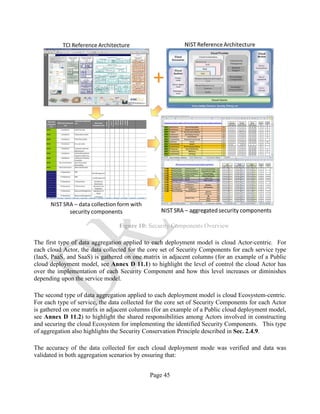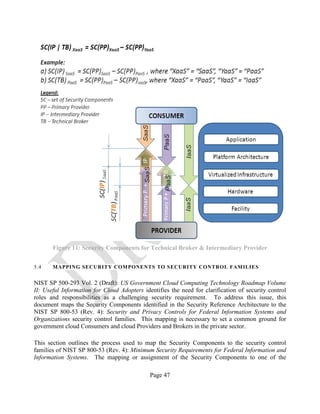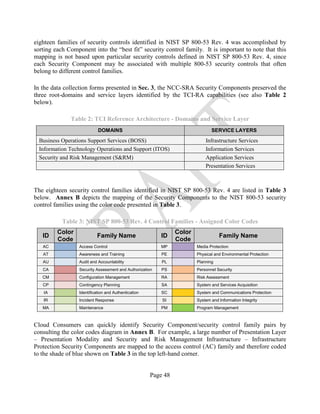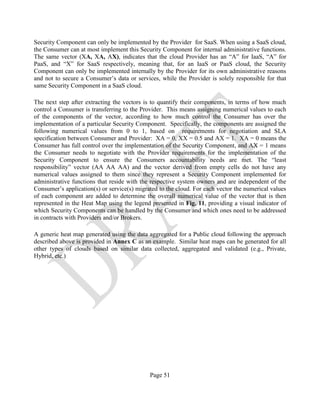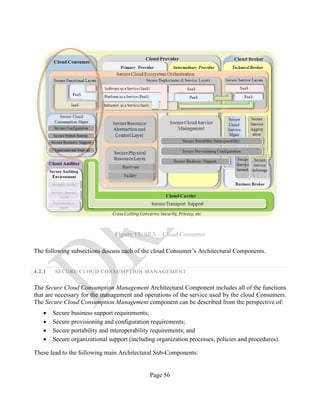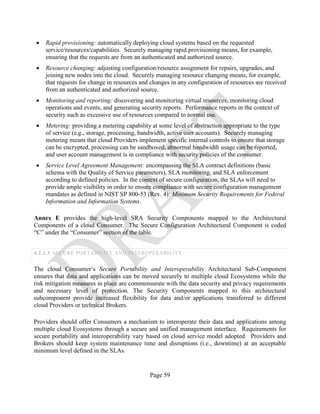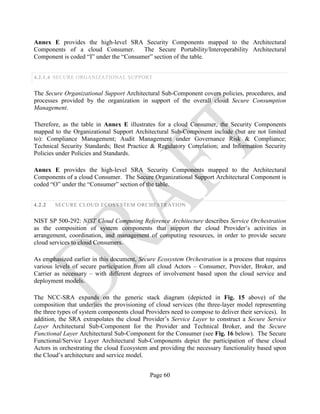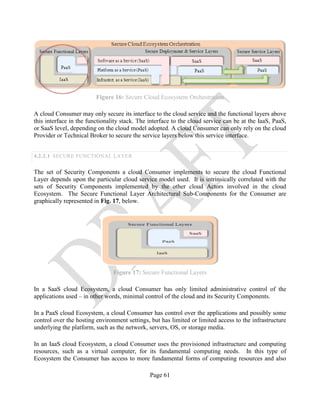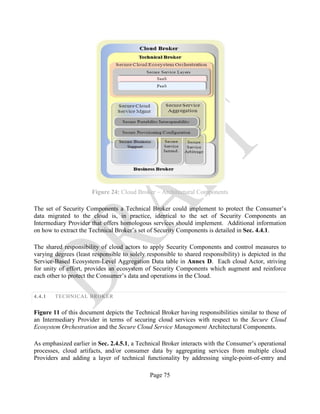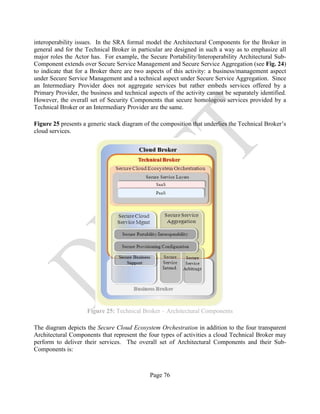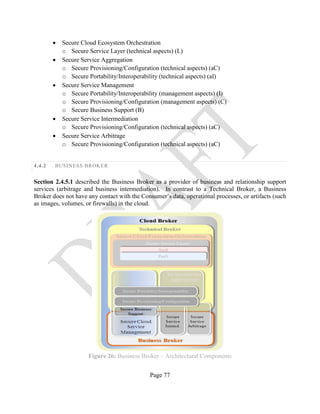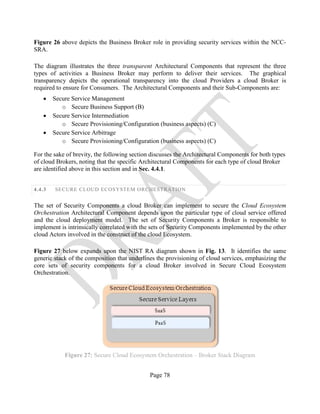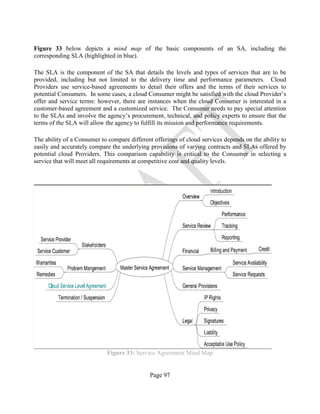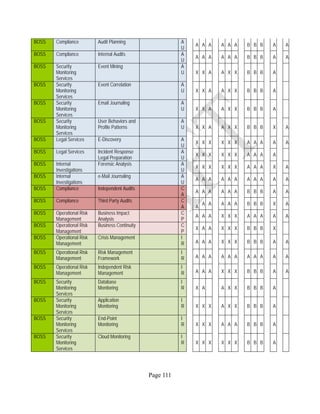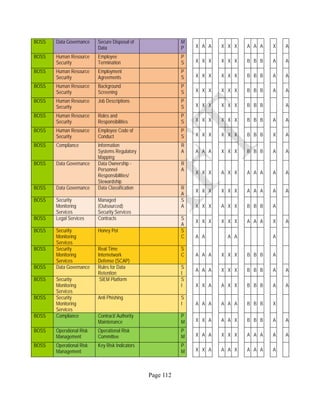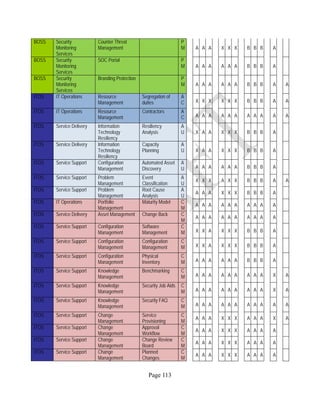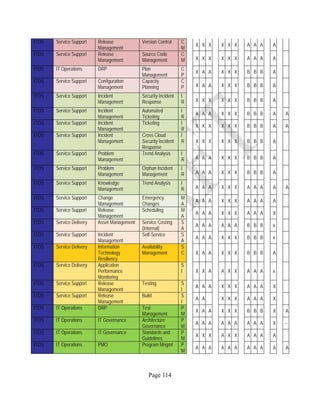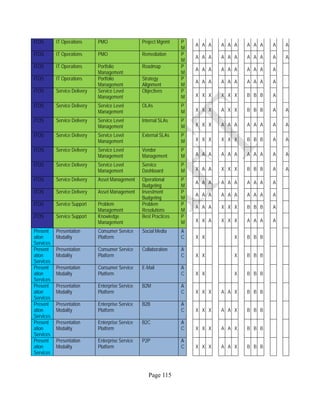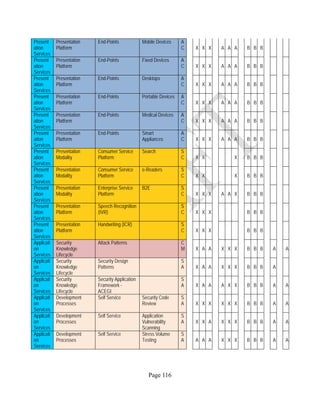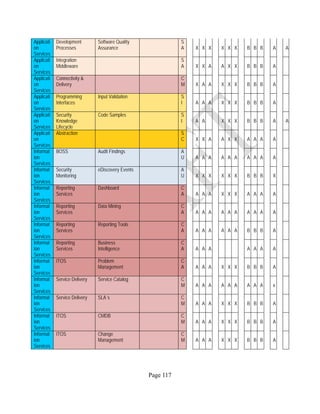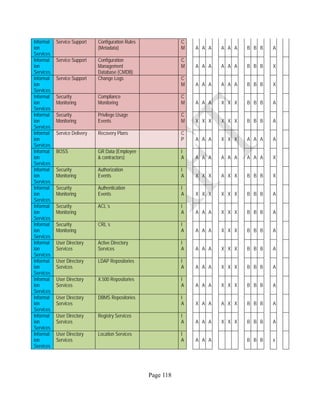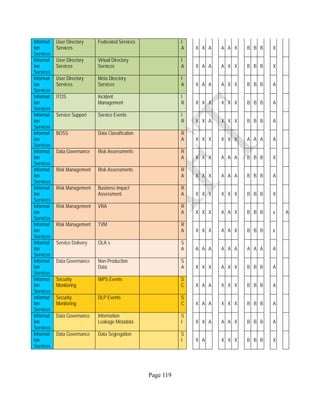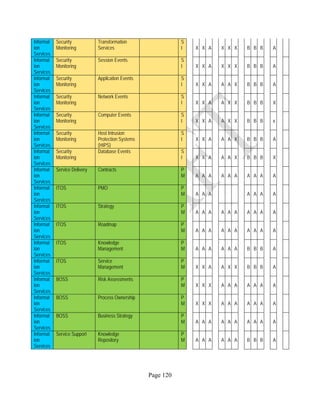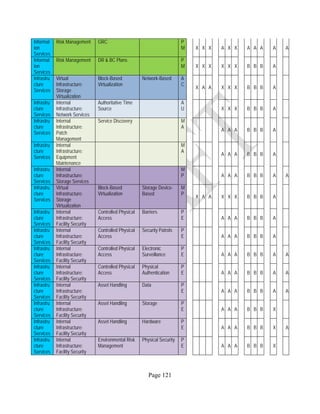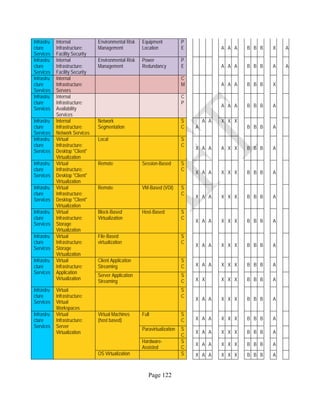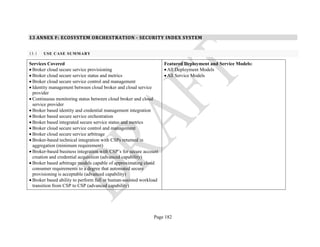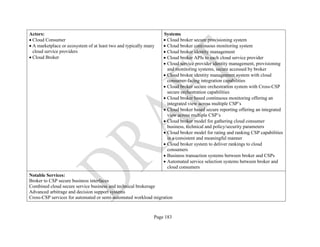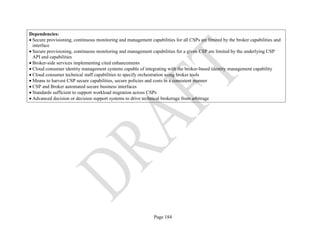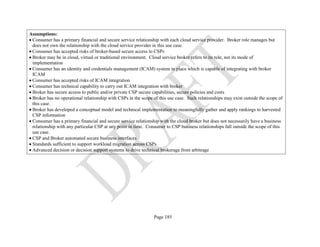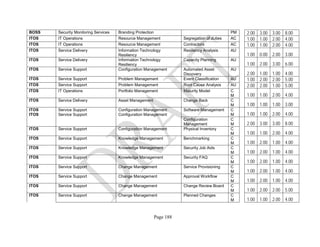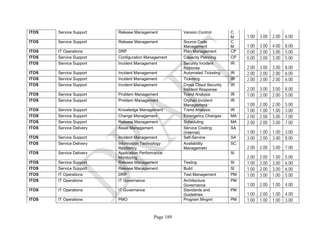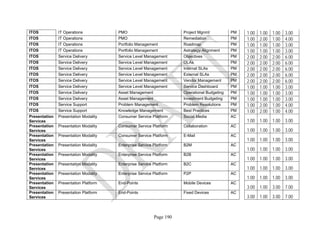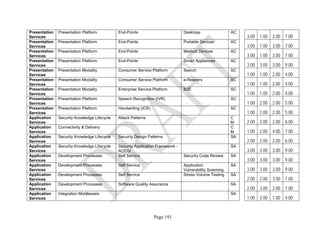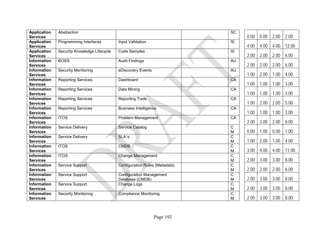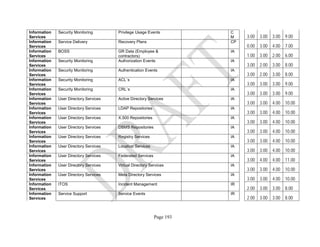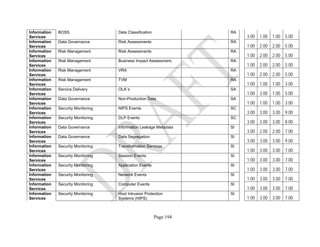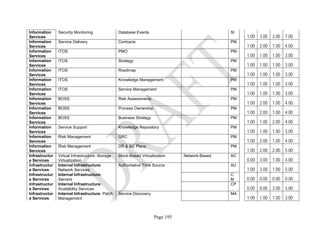


1
NIST Special Publication 500-2991
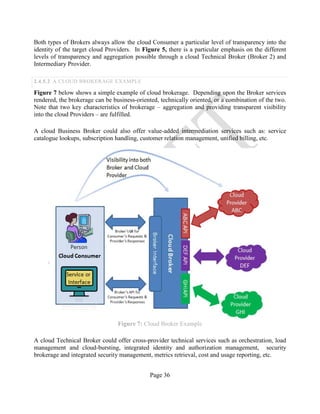
2
3
4
NISTCloudComputing5
SecurityReferenceArchitecture6
7
8
9
10
11
NIST Cloud Computing Security Working Group12
NIST Cloud Computing Program13
Information Technology Laboratory14
15
16
17
18
19
2
This page left intentionally blank20
21
Page 3
Reports on Computer Systems Technology
The Information Technology Laboratory (ITL) at the National Institute of Standards and
Technology (NIST) promotes the U.S. economy and public welfare by providing technical
leadership for the nation’s measurement and standards infrastructure. ITL develops tests, test
methods, reference data, proof of concept implementations, and technical analysis to advance the
development and productive use of information technology. ITL’s responsibilities include the
development of technical, physical, administrative, and management standards and guidelines for
the cost-effective security and privacy of sensitive unclassified information in Federal computer
systems. This document reports on ITL’s research, guidance, and outreach efforts in Information
Technology and its collaborative activities with industry, government, and academic organizations.
DISCLAIMER
This document has been prepared by the National Institute of Standards and Technology
(NIST) and describes standards research in support of the NIST Cloud Computing Program.
Certain commercial entities, equipment, or material may be identified in this document in
order to describe a concept adequately. Such identification is not intended to imply
recommendation or endorsement by the National Institute of Standards and Technology,
nor is it intended to imply that these entities, materials, or equipment are necessarily the
best available for the purpose.
Page 4
Acknowledgements
NIST gratefully acknowledges the broad contributions of the NIST Cloud Computing Security
Working Group (NCC SWG), chaired by Dr. Michaela Iorga. Dr. Iorga was principal editor for this
document with assistance in editing and formatting from Hannah Wald, Technical Writer, Booz
Allen Hamilton, Inc.
The following list (in alphabetical order by last name) includes contributors1
and internal reviewers
who previously agreed to be acknowledged in this document. The list will be updated when we
receive more confirmations from our members.
CONTRIBUTORS:
Wayne W. Armour, Independent Consultant
Nadeem Bukhari, Kinamik Data Integrity
William Butler, PhD., Capitol College – Graduate School of Information Assurance
Alvaro A. Cardenas, Fujitsu Laboratories of America
Pw Carey, Compliance Partners, LLC
Kyle Coble, Department of Homeland Security
Vince Grimaldi, Independent Consultant
Muhammad F. Islam, PhD candidate, George Washington Univ. & Booz Allen Hamilton, Inc.
Jerry Kickenson, SWIFT
Juanita Koilpillai, Electrosoft Services, Inc.
Prabha Kumar, PhD., Department of Defense – Chief Information Office
Nancy M. Landreville, PhD., EmeSec (under-contract Dep. of Veteran Affairs) & UMD
Anne L. Lee, PhD., U.S. Air Force - Space and Missile Systems Center
Cheng-Yin Lee, Independent Consultant
Chan Lim, IBM
Ketan Mehta, Booz Allen Hamilton, Inc.
Keyun Ruan, PhD., University College Dublin & EADS N.V., XENSIX Inc.
Arnab Roy, Fujitsu Laboratories of America
Michael A. Salim, American Data Technology, Inc.
Ken E. Stavinoha, PhD., Cisco Systems
INTERNAL REVIEWERS:
Wayne W. Armour, Independent Consultant
Jerry Kickenson, SWIFT
Juanita Koilpillai, Electrosoft Services, Inc.
Michael A. Salim, American Data Technology, Inc.
1
“Contributors” are members of the NCC SWG who dedicated substantial time on a regular basis to research and
development in support of this document.
Page 5
Ken E. Stavinoha, PhD., Cisco Systems
Steven Woodward, Cloud Perspectives
OTHER ACTIVE MEMBERS:
Richard J Blake, General Services Administration
Ron Martin, Open Security Exchange
Sundararajan Ramanathan, Capgemini
NOTE: All views expressed in this document by our contributors are their personal opinions and
not those of the organizations with which they are affiliated.
Page 6
Table of Contents
EXECUTIVE SUMMARY.............................................................................................................................................10
1 INTRODUCTION ..................................................................................................................................................12
1.1 AUDIENCE............................................................................................................................................................12
1.2 OBJECTIVES .........................................................................................................................................................13
1.3 SCOPE ..................................................................................................................................................................14
1.4 STRUCTURE OF THE DOCUMENT ..........................................................................................................................15
1.5 USING THE DOCUMENT........................................................................................................................................16
2 BACKGROUND.....................................................................................................................................................18
2.1 REVIEW OF THE FEDERAL CLOUD COMPUTING STRATEGY ..................................................................................18
2.2 APPROACH ...........................................................................................................................................................19
2.3 RISK MANAGEMENT ............................................................................................................................................22
2.3.1 The Risk Management Framework............................................................................................................22
2.3.2 Managing the Risk Inherent in Cloud Services..........................................................................................26
2.4 ASSUMPTIONS, CLARIFICATIONS AND DEFINITIONS.............................................................................................28
2.4.1 Cloud Computing Service and Deployment Models ..................................................................................28
2.4.1.1 Service Models...................................................................................................................................................... 28
2.4.1.2 Deployment Models .............................................................................................................................................. 29
2.4.2 Cloud Ecosystem........................................................................................................................................30
2.4.3 Cloud Consumer........................................................................................................................................32
2.4.4 Cloud Provider ..........................................................................................................................................32
2.4.4.1 Primary Cloud Provider Example.......................................................................................................................... 33
2.4.4.2 Intermediary Cloud Provider Example.................................................................................................................. 33
2.4.5 Cloud Broker .............................................................................................................................................34
2.4.5.1 Differentiating Business and Technical Broker Services....................................................................................... 35
2.4.5.2 A Cloud Brokerage Example................................................................................................................................. 36
2.4.6 Cloud Carrier ............................................................................................................................................37
2.4.7 Cloud Auditor ............................................................................................................................................37
2.4.8 Business Models and NIST Reference Architecture...................................................................................38
2.4.9 Security Conservation Principle................................................................................................................39
3 SECURITY REFERENCE ARCHITECTURE: DATA ANALYSIS METHODOLOGY..............................42
3.1 DATA COLLECTION..............................................................................................................................................43
3.2 DATA AGGREGATION AND VALIDATION..............................................................................................................44
3.3 DERIVING THE SECURITY RESPONSIBILITIES FOR THE INTERMEDIARY PROVIDER AND TECHNICAL BROKER ......46
3.4 MAPPING SECURITY COMPONENTS TO SECURITY CONTROL FAMILIES................................................................47
3.5 EMPIRICAL DATA ANALYSIS AND THE GENERIC HEAT MAP ................................................................................49
4 SECURITY REFERENCE ARCHITECTURE: FORMAL MODEL...............................................................52
4.1 OVERVIEW OF THE FORMAL MODEL....................................................................................................................52
4.2 CONSUMER - ARCHITECTURAL COMPONENTS......................................................................................................55
4.2.1 Secure Cloud Consumption Management..................................................................................................56
4.2.1.1 Secure Business Support ....................................................................................................................................... 58
4.2.1.2 Secure Configuration............................................................................................................................................. 58
4.2.1.3 Secure Portability and Interoperability.................................................................................................................. 59
4.2.1.4 Secure Organizational Support.............................................................................................................................. 60
4.2.2 Secure Cloud Ecosystem Orchestration.....................................................................................................60
4.2.2.1 Secure Functional Layer........................................................................................................................................ 61
4.3 PROVIDER – ARCHITECTURAL COMPONENTS.......................................................................................................62
4.3.1 Secure Cloud Ecosystem Orchestration.....................................................................................................63
4.3.1.1 Secure Deployment and Service Layer.................................................................................................................. 65
Page 7
4.3.1.2 Secure Resource Abstraction and Control Layer................................................................................................... 66
4.3.1.3 Secure Physical Resource Layer............................................................................................................................ 68
4.3.2 Secure Cloud Service Management ...........................................................................................................68
4.3.2.1 Secure Provisioning and Configuration................................................................................................................. 69
4.3.2.2 Secure Portability and Interoperability.................................................................................................................. 71
4.3.2.3 Secure Business Support ....................................................................................................................................... 72
4.4 BROKER – ARCHITECTURAL COMPONENTS..........................................................................................................72
4.4.1 Technical Broker .......................................................................................................................................75
4.4.2 Business Broker .........................................................................................................................................77
4.4.3 Secure Cloud Ecosystem Orchestration.....................................................................................................78
4.4.3.1 Secure Service Layers ........................................................................................................................................... 79
4.4.4 Secure Service Aggregation.......................................................................................................................79
4.4.5 Secure Cloud Service Management ...........................................................................................................80
4.4.5.1 Secure Portability and Interoperability.................................................................................................................. 81
4.4.5.2 Secure Provisioning and Configuration................................................................................................................. 82
4.4.5.3 Secure Business Support ....................................................................................................................................... 82
4.4.6 Secure Service Intermediation...................................................................................................................83
4.4.7 Secure Service Arbitrage...........................................................................................................................84
4.5 CARRIER – ARCHITECTURAL COMPONENTS.........................................................................................................84
4.6 AUDITOR – ARCHITECTURAL COMPONENTS ........................................................................................................85
5 SECURITY REFERENCE ARCHITECTURE: A METHODOLOGY OF ORCHESTRATING A CLOUD
ECOSYSTEM.........................................................................................................................................................88
5.1 ORCHESTRATION METHODOLOGY OVERVIEW .....................................................................................................88
5.2 CLOUD ECOSYSTEM ORCHESTRATION USE CASE ................................................................................................89
5.2.1 Step 1 – Categorize the System - Consumer’s Service Description...........................................................89
5.2.2 Step 2 – Identify Security Requirements - a Cloud Solution Analysis........................................................90
5.2.2.1 The Security Index System.................................................................................................................................... 91
5.2.2.2 Security Controls Overview .................................................................................................................................. 93
5.2.3 Step 3 – Select the Cloud Ecosystem Architecture.....................................................................................93
5.2.4 Step 4 – Assess Cloud Services..................................................................................................................94
5.2.5 Step 5 – Authorize Cloud Services.............................................................................................................98
5.2.6 Step 6 – Monitor Cloud Services ...............................................................................................................98
6 GLOSSARY AND ACRONYMS........................................................................................................................100
7 REFERENCES .....................................................................................................................................................105
8 ANNEX A: TRUSTED COMPUTING INITIATIVE REFERENCE ARCHITECTURE ............................107
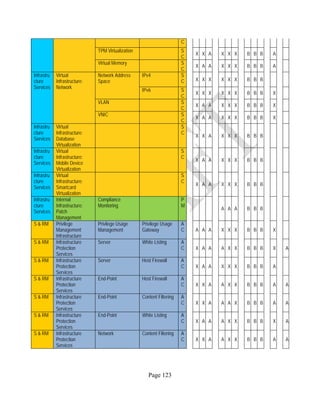
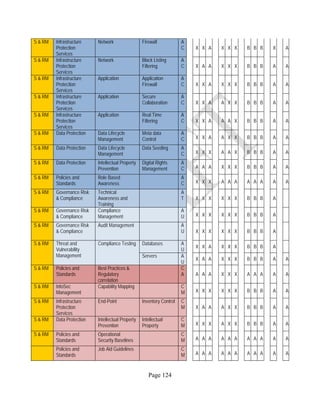
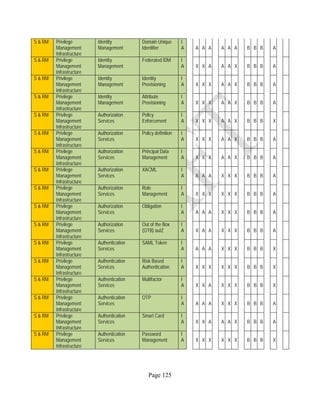
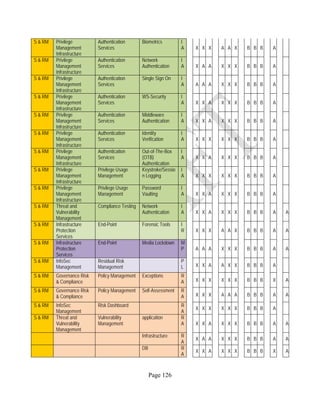
9 ANNEX B: MAPPING TO SP 800-53 SECURITY CONTROL FAMILIES.................................................108
10 ANNEX C: GENERIC HEAT MAP...................................................................................................................109
11 ANNEX D: AGGREGATED DATA...................................................................................................................110
11.1 ACTORS-BASED DATA AGGREGATION..........................................................................................................110
11.2 SERVICE-BASED ECOSYSTEM-LEVEL DATA AGGREGATION..........................................................................130
12 ANNEX E: MAPPING OF THE ARCHITECTURAL COMPONENTS .......................................................158
13 ANNEX F: ECOSYSTEM ORCHESTRATION - SECURITY INDEX SYSTEM........................................182
13.1 USE CASE SUMMARY ....................................................................................................................................182
13.2 SECURITY INDEX SYSTEM .............................................................................................................................186
13.3 ASIS HEAT MAP...........................................................................................................................................204
Page 8
List of Figures
FIGURE 1: NIST CLOUD COMPUTING SECURITY REFERENCE ARCHITECTURE APPROACH ..................19
FIGURE 2: SECURITY REFERENCE ARCHITECTURE CONSTRUCTS AND INSTANCES ..............................21
FIGURE 3: RISK MANAGEMENT FRAMEWORK (NIST SPECIAL PUBLICATION 800-37 REV 1.).............23
FIGURE 4: EXAMPLE OF SERVICES AVAILABLE TO A CLOUD CONSUMER (NIST SP 500-292) ............29
FIGURE 5: COMPOSITE CLOUD ECOSYSTEM SECURITY ARCHITECTURE ..............................................30
FIGURE 6: INTERMEDIARY CLOUD PROVIDER EXAMPLE .....................................................................34
FIGURE 7: CLOUD BROKER EXAMPLE .................................................................................................36
FIGURE 8: BUSINESS MODELS VS. NIST REFERENCE ARCHITECTURE.................................................39
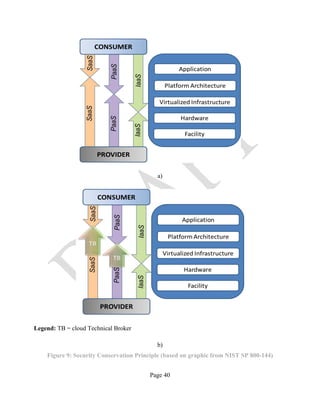
FIGURE 9: SECURITY CONSERVATION PRINCIPLE (BASED ON GRAPHIC FROM NIST SP 800-144) .......40
FIGURE 10: SECURITY COMPONENTS OVERVIEW ................................................................................45
FIGURE 11: SECURITY COMPONENTS FOR TECHNICAL BROKER & INTERMEDIARY PROVIDER ............47
FIGURE 12: LEGEND OF THE GENERIC HEAT MAP ...............................................................................49
FIGURE 13: NIST CLOUD COMPUTING REFERENCE ARCHITECTURE (UPDATED).................................52
FIGURE 14: FORMAL MODEL - SECURITY REFERENCE ARCHITECTURE ...............................................53
FIGURE 15: SRA – CLOUD CONSUMER................................................................................................56
FIGURE 16: SECURE CLOUD ECOSYSTEM ORCHESTRATION.................................................................61
FIGURE 17: SECURE FUNCTIONAL LAYERS..........................................................................................61
FIGURE 18: SRA – CLOUD PROVIDER .................................................................................................63
FIGURE 19: SECURE SERVICE ORCHESTRATION – STACK DIAGRAM....................................................65
FIGURE 20: SECURE DEPLOYMENT AND SERVICE LAYERS ..................................................................65
FIGURE 21: SECURE RESOURCE ABSTRACTION AND PHYSICAL RESOURCE LAYERS ...........................67
FIGURE 22: SECURE CLOUD SERVICE MANAGEMENT – STACK DIAGRAM...........................................69
FIGURE 23: SRA – CLOUD BROKER ....................................................................................................73
FIGURE 24: CLOUD BROKER – ARCHITECTURAL COMPONENTS ..........................................................75
FIGURE 25: TECHNICAL BROKER – ARCHITECTURAL COMPONENTS ...................................................76
FIGURE 26: BUSINESS BROKER – ARCHITECTURAL COMPONENTS ......................................................77
FIGURE 27: SECURE CLOUD ECOSYSTEM ORCHESTRATION – BROKER STACK DIAGRAM ...................78
FIGURE 28: SECURE CLOUD SERVICE MANAGEMENT – BROKER STACK DIAGRAM ............................81
FIGURE 29: SRA – CLOUD CARRIER ...................................................................................................85
FIGURE 30: SRA – CLOUD AUDITOR...................................................................................................86
FIGURE 31: SECURE CLOUD ECOSYSTEM ORCHESTRATION – ACTORS INTERACTIONS........................88
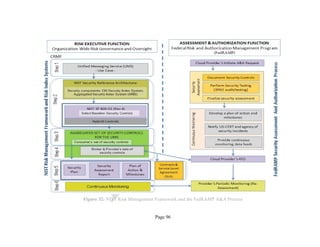
FIGURE 32: NIST RISK MANAGEMENT FRAMEWORK AND THE FEDRAMP A&A PROCESS................96
FIGURE 33: SERVICE AGREEMENT MIND MAP ....................................................................................97
Page 9
List of Tables
TABLE 1: SRA DATA COLLECTION FORM WITH THE SET OF SECURITY COMPONENTS........................42
TABLE 2: TCI REFERENCE ARCHITECTURE - DOMAINS AND SERVICE LAYER.....................................48
TABLE 3: NIST SP 800-53 REV. 4 CONTROL FAMILIES - ASSIGNED COLOR CODES............................48
TABLE 4: SECURITY COMPONENT - VECTOR GENERATION..................................................................50
TABLE 5: SECURITY INDEXES SYSTEM ................................................................................................91
TABLE 6: CLOUD ACTORS’ ARCHITECTURAL COMPONENTS .............................................................158
Page 10
EXECUTIVE SUMMARY
The National Institute of Standards and Technology (NIST), along with other agencies, was tasked
by the U.S. Chief Information Officer with specific activities aimed at accelerating the adoption of
cloud computing [11]. These include the delivery of a US Government Cloud Computing
Technology Roadmap and the creation of other NIST Special Publications (NIST SPs) that address
the definitions, security aspects, and reference architecture of Cloud Computing. In furtherance of
its statutory responsibilities, NIST has developed a series of Special Publications aimed at
accelerating the Cloud Computing adoption by Federal agencies:
• NIST SP 500-291: Cloud Computing Standards Roadmap
• NIST SP 500-292: NIST Cloud Computing Reference Architecture
• NIST SP 500-293: US Government Cloud Computing Technology Roadmap Volume 1,
High-Priority requirements to Further USG Agency Cloud Computing Adoption
• NIST SP 500-293: US Government Cloud Computing Technology Roadmap Volume II,
Useful Information for Cloud Adopters (Draft)
• NIST SP 500-293: US Government Cloud Computing Technology Roadmap Volume III,
Technical Considerations for USG Cloud Computing Deployment Decisions (Draft)
• NIST SP 800-144: Guidelines on Security and Privacy in Public Cloud Computing,
• NIST SP 800-145: The NIST Definition of Cloud Computing
• NIST SP 800-146: Cloud Computing Synopsis and Recommendations (Draft)
This document was developed as part of a collective effort by the NIST Cloud Computing Public
Security Working Group in response to the priority action plans for the early USG cloud computing
adoption identified in NIST SP 500-293: US Government Cloud Computing Technology Roadmap
Volume 1, High-Priority Requirements to Further USG Agency Cloud Computing Adoption. NIST
SP 500-293 highlights concerns around the protection and control of cloud Consumer data. This
document introduces the NIST Cloud Computing Security Reference Architecture (NCC-SRA or,
for the sake of brevity, SRA), providing a comprehensive formal model to serve as security overlay
to the architecture described in NIST SP 500-292: NIST Cloud Computing Reference Architecture.
This document also describes a methodology for applying a Cloud-adapted Risk Management
Framework (CRMF) using the formal model and an associated set of Security Components (derived
from the capabilities identified in the Cloud Security Alliance’s Trusted Cloud Initiative –
Reference Architecture [TCI-RA]) to orchestrate a secure cloud Ecosystem by applying the Risk
Management Framework described in NIST SP 800-37 (Rev. 1): Guide for Applying the Risk
Management Framework to Federal Information Systems: A Security Life Cycle Approach.
The study upon which the NCC-SRA is based collected, aggregated, and validated data for a Public
cloud, considering all three cloud service models – Software as a Service (SaaS), Platform as a
Service (PaaS), and Infrastructure as a Service (IaaS) – and all cloud Actors (i.e., Consumer,
Provider, Broker, Carrier, and Auditor).While this document focuses on a Public cloud deployment
model because it best supports illustrative examples of all of the NCC-SRA Security Components
Page 11
and security considerations, the NCC-SRA (the formal model, the set of Security Components and
the methodology for applying the CRMF) is agnostic with respect to cloud deployment model, and
its methodology can easily be applied to Private, Community, or Hybrid clouds.
The NCC-SRA introduces a risk-based approach to determine each cloud Actor’s responsibility for
implementing specific controls throughout the life cycle of the cloud Ecosystem. Specifically, for
each instance of the cloud Ecosystem, the security components are analyzed to identify the level of
involvement of each cloud Actor in implementing those components. The ultimate objective of this
document is to demystify the process of describing, identifying, categorizing, analyzing, and
selecting cloud-based services for the cloud Consumer seeking to determine which cloud service
offering most effectively addresses their cloud computing requirement(s) and supports their
business and mission-critical processes and services in the most secure and efficient manner.
Page 12
1 INTRODUCTION
The National Institute of Standards and Technology (NIST) has been tasked by the U.S. Chief
Information Officer to provide technical leadership for US government (USG) agency efforts
related to the adoption and development of cloud computing standards [11]. The goal is to
accelerate the Federal government’s adoption of secure and effective cloud computing solutions to
reduce costs and improve services. The NIST strategy consists of two parts: (1) build a USG Cloud
Computing Technology Roadmap that focuses on the highest priority USG cloud computing
security, interoperability, and portability requirements; and (2) lead efforts to develop standards and
guidelines in close consultation and collaboration with standards bodies, the private sector, and
other stakeholders.
The NIST Cloud Computing Security Working group was created to achieve broad collaboration
between Federal and private stakeholders in efforts to address the security-related concerns
expressed by Federal managers. One of the tasks of the NIST Cloud Computing Working Group is
to design a Cloud Computing Security Reference Architecture that supplements SP 500-292: NIST
Cloud Computing Reference Architecture (RA) with a formal model and identifies the core set of
Security Components recommended for building a successful and secure cloud computing
Ecosystem. The document provides for an understanding of the security interdependencies of cloud
services, Actors, and requirements that USG agency technical planning and implementation teams
and agency procurement offices should identify and address in order to acquire cloud services with
security levels that meets agency needs.
1.1 AUDIENCE
This document is designed to serve as a guide for USG agency technical planning and
implementation teams. The intended audience for this document includes the following categories
of individuals:
• System managers, executives, and information officers making decisions about cloud
computing initiatives;
• Security professionals, including security officers, security administrators, auditors, and
others with responsibility for information technology security;
• Information technology program managers concerned with security measures for cloud
computing;
• Procurement officers responsible for acquisition of cloud computing resources and/or
resources for cloud computing projects; and
• Users of Public cloud computing services.
The document presumes that readers possess a fundamental understanding of the NIST Risk
Management Framework (RMF) described in NIST SP 800-37 (Rev. 1), risk-based assessment for
IT systems, and cloud computing. Because of the evolving nature of security considerations in a
Page 13
cloud computing environment, readers are encouraged to take advantage of the other resources
referenced in this document, the majority of which are available on-line.
1.2 OBJECTIVES
In contrast, a primary focus of the cloud computing model is on the economic benefits of shared use
that can provide higher-quality and faster services at a lower cost to users. In the traditional,
enterprise IT service delivery model, there is a significant emphasis on procuring, maintaining, and
operating the necessary hardware and related infrastructure to support a given service. However, the
migration of an agency’s operations to a cloud computing environment does not inherently provide
for the same level of security and compliance with USG mandates that were achieved in the
traditional IT model. A Consumer’s ability to comply with any business, regulatory, operational, or
security requirements in a cloud computing environment is a direct result of the service and
deployment model adopted by the agency, the cloud architecture, and the deployment and
management of the resources in the cloud environment.
Understanding the relationships and interdependencies between the different cloud computing
deployment models and service models is critical to understanding the security risks involved in
cloud computing. The differences in methods and responsibilities for securing different
combinations of service and deployment models present a significant challenge for Consumers who
need to perform a thorough risk assessment and accurately identify the security controls necessary
to preserve the security level of their environment, operations, and data after migrating to the cloud.
The purpose of this document is to define a NIST Cloud Computing Security Reference
Architecture (NCC-SRA) – a framework that:
• identifies a core set of Security Components that can be implemented in a Cloud Ecosystem
to secure the environment, the operations, and the data migrated to the cloud;
• provides, for each Cloud Actor, the core set of Security Components that fall under their
responsibilities depending on the deployment and service models;
• defines a security-centric formal architectural model that adds a security layer to the current
NIST SP 500-292: NIST Cloud Computing Reference Architecture; and
• provides several approaches for analyzing the collected and aggregated data.
The document concludes with an illustrative example of securely orchestrating a Cloud Ecosystem
for a Unified Messaging System (UMS) migrated to a Public Software as a Service (SaaS) cloud by
introducing a Security Index System (SIS) for the confidentiality, integrity, and availability of each
component in the process of prioritizing the implementation of the core set of Security Components.
The NCC-SRA is intended to be an elastic, dynamic framework that is layered over the NIST
Reference Architecture and takes into account:
• The cloud computing service models: Software as a Service (SaaS), Platform as a Service
(PaaS), and Infrastructure as a Service (IaaS);
Page 14
• The cloud deployment models: Public, Private, Community, and Hybrid;2
• The NIST RA’s defined Actors: Consumer, Provider, Broker, Carrier, and Auditor.
The five Actors are the collaborating parties engaged in building a fully functional and secure cloud
Ecosystem. The cloud Consumer performs a security and risk assessment for each use case of data
migrated to the cloud. By electing the cloud deployment model and the service model, the
Consumer identifies the cloud Ecosystem model and the corresponding instance of the NCC-SRA
model that best suits its needs in terms of functionality, cost, and security capabilities.
The information provided in this document is presented in a manner that is familiar to Federal
stakeholders (i.e., referencing NIST SP 800-37 (Rev. 1): Guide for Applying the Risk Management
Framework to Federal Information Systems: A Security Life Cycle Approach, and NIST SP 800-53
(Rev. 4): Security and Privacy Controls for Federal Information Systems and Organizations) and to
private sector organizations that offer cloud services (i.e., leveraging the Cloud Security Alliance’s
Trusted Cloud Initiative – Reference Architecture [CSA TCI-RA]).3
In addition, this document
supports a consistent, repeatable process for selecting and implementing the appropriate Security
Components for different combinations of cloud service models and deployment methods, which
can help agencies, avoid duplication of efforts and reduce costs.
The NCC-SRA document is not a comprehensive guide to security requirements for all possible
instances of cloud type, data, and service model. Rather, the NIST document aims to identify only a
core set of Security Components that should be implemented by each Cloud Actor defined in the
NIST RA specification.
1.3 SCOPE
This document describes the components of the NCC-SRA, specifically:
• A formal model;
• A set of Security Components that leverages the CSA TCI-RA; and
2
See NIST SP 800-145: The NIST Definition of Cloud Computing for detailed explanations of service and deployment
models [14]. The illustrative examples in this document assume a Public cloud, but the framework described can be
used for Private, Community, and Hybrid clouds as well.
3
Available at https://research.cloudsecurityalliance.org/tci/
Page 15
• A methodology for applying, from the Consumer’s perspective, a Cloud-adapted Risk
Management Framework (CRMF) for securing a cloud-based service. The CRMF is derived
from the NIST Risk Management Framework as described in NIST SP 800-37 (Rev. 1):
Guide for Applying the Risk Management Framework to Federal Information Systems: A
Security Life Cycle Approach.
This document collects, aggregates, and validates data for a Public cloud deployment model, with
all three service models (SaaS, PaaS, and IaaS) and all cloud Actors. This focus on a Public cloud
deployment model is for purposes of example only as it best supports illustrative examples of all of
the NCC-SRA Security Components and security considerations. The NCC-SRA (the formal model,
the set of Security Components, and the methodology for applying CRMF) is agnostic with respect
to cloud deployment model, and its methodology can easily be applied to data and operations hosted
in Public, Private, Community, or Hybrid clouds.
1.4 STRUCTURE OF THE DOCUMENT
This document is organized into four sections supported by six annexes that present the reader with
a logical (and, when necessary, step-by-step) methodology for evaluating cloud-based services
using a Risk Management Framework (RMF) approach.
Section 2 presents a comprehensive overview of the NCC-SRA, of the RMF as outlined in NIST SP
800-37 (Rev. 1): Guide for Applying the Risk Management Framework to Federal Information
Systems: A Security Life Cycle Approach, and the assumptions and clarifications regarding the
responsibilities and roles of cloud Actors for the purposes of this document.
Section 3 outlines the data analysis methodology used to populate the responsibility matrix (shown
in Annex D), which assigns accountability for implementing each Security Component to a
particular Actor or set of Actors for a Public cloud in all three service models. The core set of
Security Components is derived from the Cloud Security Alliance’s TCI-RA. This section also
discusses data collection, aggregation, and validation as initial steps in the data analysis
methodology, and maps the derived Security Components from the matrix to the NIST SP 800-53
(Rev. 4): Security and Privacy Controls for Federal Information Systems and Organizations
security control families. The data analysis methodology is completed by illustrating the generation
of a heat map with a cloud Actor-centric view (e.g. Consumer, Provider) based upon the data
aggregated for a Public cloud and all service models (IaaS, PaaS, and SaaS). The Heat map
highlights the level of control exerted by each of the cloud Actors.
Section 4 introduces the NIST Security Architecture formal model and discusses the Architectural
Components of the model for each cloud Actor.
Section 5 describes the orchestration of a secure cloud Ecosystem as defined by interactions
between the cloud Actors for implementing and integrating the Security Components. To better
illustrate the interactions among cloud Actors and their roles and responsibilities in orchestrating a
Page 16
cloud Ecosystem, the section provides a use case example – a generic USG agency service migrated
to the cloud – and highlights the necessary steps to secure the cloud Ecosystem and to determine the
high-level cloud architecture that meets the cloud Consumer’s security requirements. This section
concludes with the negotiation of the contractual terms and agreements in Service Level
Agreements (SLAs).
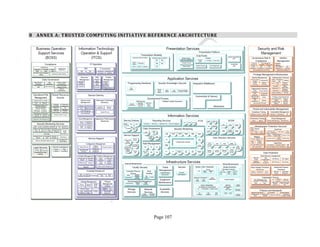
Annex A depicts the core set of Security Components and how to use it for a particular cloud
deployment model (Public cloud in this case), described in detail in Sec. 5.
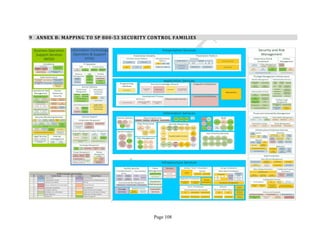
Annex B depicts how the Security Components are mapped or paired to the NIST SP 800-53 (Rev.
4): Minimum Security Requirements for Federal Information and Information Systems security
control families using the color code presented in Table 3.
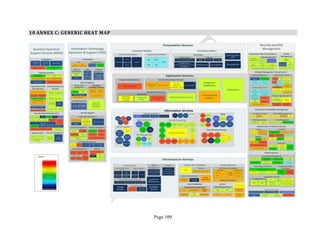
Annex C is the Generic Heat Map of cloud Actor responsibilities for implementing Security
Components and associated security controls in a cloud Ecosystem.
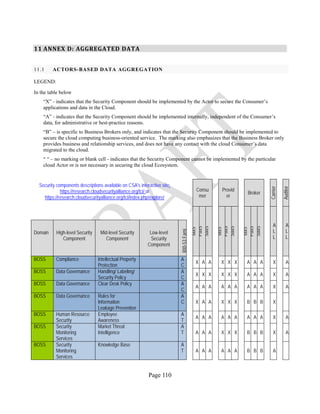
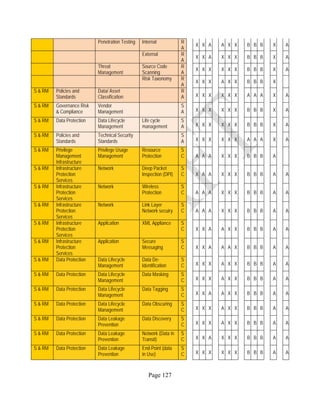
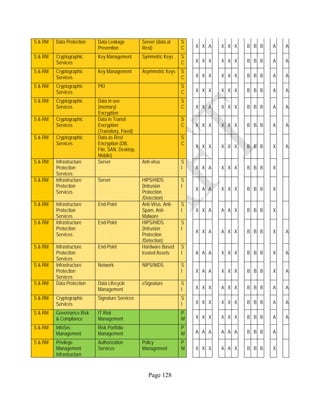
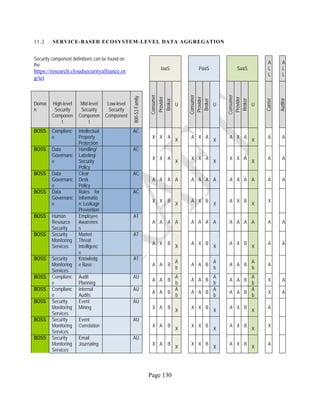
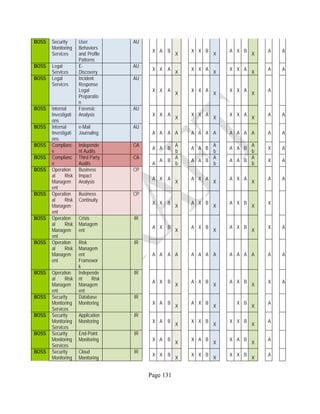
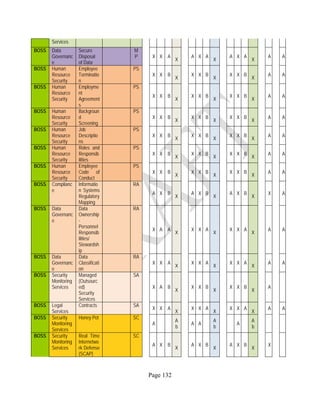
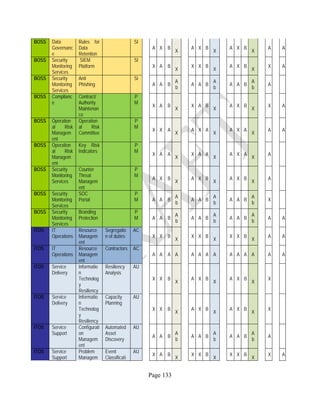
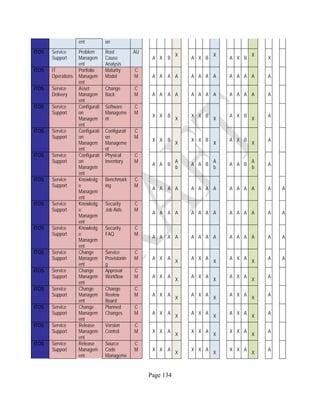
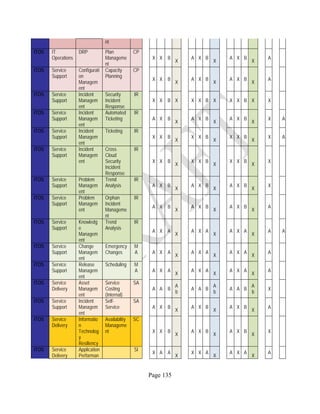
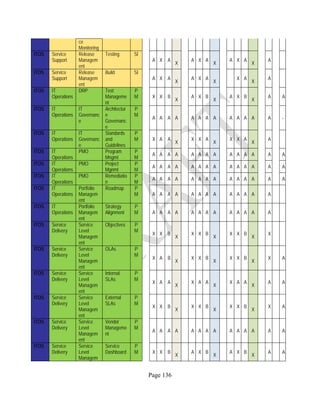
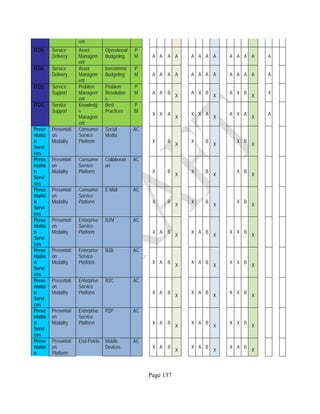
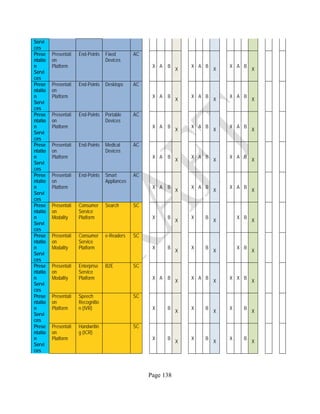
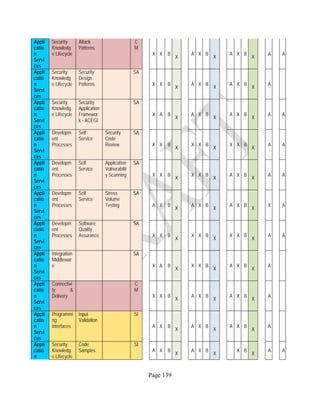
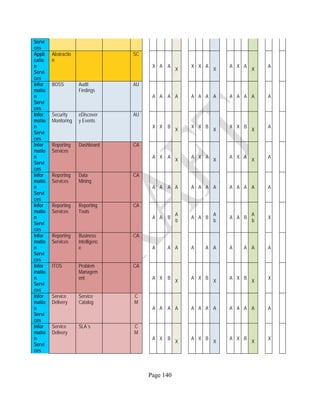
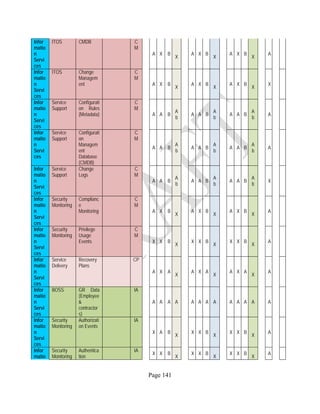
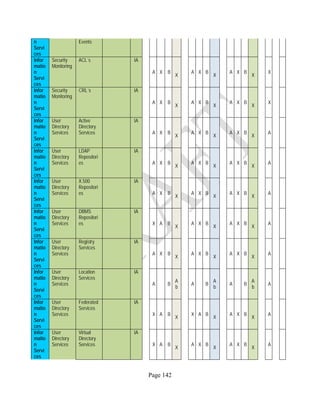
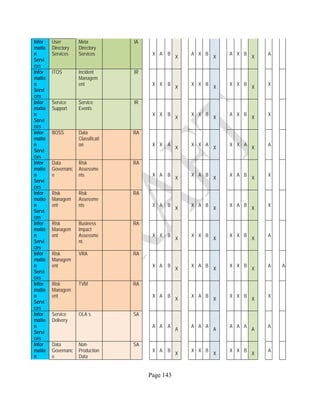
Annex D presents the Data Aggregation table, which indicates the shared responsibility of cloud
Actors to apply Security Components and control measures to varying degrees (i.e., least
responsible, solely responsible, shared responsibility) at the Service-based Ecosystem level.
Annex E presents a matrix that maps the high-level security components, and with them the NIST
SP 800-53 (Rev. 4): Security and Privacy Controls for Federal Information Systems and
Organizations security control families, to the Architectural Components and Sub-Components
defined for each cloud Actor.
Annex F presents the Security Index System (SIS) for the Confidentiality, Integrity, and
Availability (C/I/A) security triad and the Aggregated Security Index System (ASIS) used to
prioritize the Security Components for the Unified Messaging System (UMS) use case. The SIS
example given in this document is merely illustrative: it should not be considered guidance for any
UMS migration to the cloud.
1.5 USING THE DOCUMENT
Federal agencies may use the information presented in this document to help them follow the steps
presented below when migrating a service to the cloud.
• Describe the service that should be migrated to the cloud
• Identify the necessary capabilities of the service
• Categorize the Information System to determine the impact levels and the Security
Components and associated security control baselines (three sets of baseline controls
corresponding to low-impact, moderate-impact, and high-impact information systems).
Page 17
Baseline controls are chosen based on the security category and associated impact level of
information systems determined in accordance with Federal Information Processing
Standard (FIPS) 199: Standards for Security Categorization of Federal Information and
Information Systems and FIPS 200: Minimum Security Requirements for Federal
Information and Information Systems, respectively [16][17].
• Analyze and select the most appropriate instance of a cloud Ecosystem by identifying the
cloud composite architecture, such as the cloud deployment and service models:
o Public IaaS, Public PaaS, Public SaaS;
o Private IaaS, Private PaaS, Private SaaS;
o Hybrid IaaS, Hybrid PaaS, Hybrid SaaS;
o Community IaaS, Community PaaS, and Community SaaS.
• Identify the cloud Actors involved in orchestrating the Cloud Ecosystem (e.g., type of
Provider and Broker)
• Tailor the baseline Security Components to fulfill the security requirements for the
particular use case (i.e., system migrated to the cloud) by:
o Identifying and customizing the core set of Security Components to the assessed
impact level of the system migrated to the cloud by applying a SIS as described in
Sec. 5.2.2.1;
o Identifying the NIST SP 800-53 (Rev. 4): Security and Privacy Controls for Federal
Information Systems and Organizations security controls necessary for each Security
Component;
o Applying scoping considerations to the remaining baseline Security Components and
associated controls;
o Identifying, when necessary, additional compensating Security Components and
security controls;
o Assigning specific values to organization-defined security parameters via explicit
assignment and selection statements;
o Supplementing baselines with additional Security Components and control
enhancements, if needed; and
o Providing additional specification information for Security Components
implementation.
Sec. 5.2 provides a more concrete example of how a new cloud Ecosystem for a UMS can be
orchestrated by leveraging the information presented in this document.
Page 18
2 BACKGROUND
This document presents the NIST Cloud Computing Security Reference Architecture formal model
derived from NIST SP 500-292: NIST Cloud Computing Reference Architecture, an associated set
of Security Components derived from the CSA TCI-RA, and a methodology for using the formal
model and the security components to orchestrate a secure cloud Ecosystem.
2.1 REVIEW OF THE FEDERAL CLOUD COMPUTING STRATEGY
In the Federal Cloud Computing Strategy published in 2011, U.S. Chief Information Officer Vivek
Kundra advises that Federal agencies “should make risk-based decisions which carefully consider
the readiness of commercial or government providers to fulfill their Federal needs. These can be
wide-ranging, but likely will include: security requirements, service and marketplace characteristics,
application readiness, government readiness, and program’s stage in the technology lifecycle” [12].
The approach to securing a cloud Ecosystem is intrinsically related to the cloud computing service
model (SaaS, PaaS, or IaaS) and to the deployment model (Public, Private, Hybrid, or Community)
that best fits the Consumer’s business missions and security requirements. As previously stated, for
each use case of data migrated to the cloud, it is necessary for the Consumer to evaluate the
particular security requirements in the specific cloud architectural context, and to map them to
proper security controls and practices in technical, operational, and management classes. Even
though the Cloud Security Reference Architecture inherits a rich body of knowledge of general
network security and information security, both in theory and in practice, it also addresses the
cloud-specific security requirements triggered by characteristics unique to the cloud, such as:
• Broad network access,
• Decreased visibility and control by consumers,
• Dynamic system boundaries and comingled roles/responsibilities between consumer and
provider,
• Multi-tenancy,
• Data residency,
• Measured service, and
• Significant increase in scale (on demand), dynamics (elasticity, cost optimization), and
complexity (automation, virtualization).
The above-listed cloud computing characteristics often present an agency with security risks that are
different from those in traditional information technology solutions. To preserve the pre-migration
security level of their data once it has been moved to the Cloud, agencies need the ability to identify
all cloud-specific risk-adjusted security controls or components in advance and request from the
cloud Providers through contractual means and SLAs that all Security Components are identified
and controls fully and accurately implemented.
Page 19
2.2 APPROACH
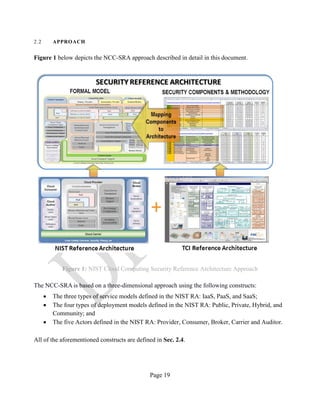
Figure 1 below depicts the NCC-SRA approach described in detail in this document.
Figure 1: NIST Cloud Computing Security Reference Architecture Approach
The NCC-SRA is based on a three-dimensional approach using the following constructs:
• The three types of service models defined in the NIST RA: IaaS, PaaS, and SaaS;
• The four types of deployment models defined in the NIST RA: Public, Private, Hybrid, and
Community; and
• The five Actors defined in the NIST RA: Provider, Consumer, Broker, Carrier and Auditor.
All of the aforementioned constructs are defined in Sec. 2.4.
Page 20
As introduced in Fig. 1 above, the NCC-SRA provides a formal model, a set of Security
Components, and a methodology for using this information to orchestrate a secure cloud Ecosystem.
The NCC-SRA formal model was derived from the NIST SP 500-292: NIST Cloud Computing
Reference Architecture, and is described in detail in Sec. 3.
The NCC-SRA also provides a set of Security Components deemed important in securing the data
and operations of a Cloud Computing Ecosystem. In defining this set, the document leverages the
CSA TCI-RA shown in Annex A. The set of Security Components and guidance on how to use
them for a particular cloud model is introduced in detail in Sec. 3.
The NCC-SRA is presented using a cloud Ecosystem that can be constructed employing all possible
combinations of the four deployment models with the three service models. These combinations
result in the following twelve instances of cloud architectures:
• Public IaaS, Public PaaS, Public SaaS;
• Private IaaS, Private PaaS, Private SaaS;
• Hybrid IaaS, Hybrid PaaS, Hybrid SaaS;
• Community IaaS, Community PaaS, and Community SaaS.
The NCC-SRA (the formal model, the set of Security Components and the methodology for
applying cloud-adapted Risk Management Framework) is agnostic with respect to cloud
deployment model, and its methodology can easily be applied to data pertaining to Private,
Community, or Hybrid clouds. For purposes of example, this document describes the approach
using a Public cloud deployment model because it best supports illustrative examples of all of the
NCC-SRA Security Components and security considerations.
The NCC-SRA introduces a risk-based approach to determine each cloud Actor’s responsibility for
implementing specific controls throughout the life cycle of the cloud Ecosystem. Specifically, for
each instance of the cloud Ecosystem, the Security Components are analyzed to identify the level of
involvement of each cloud Actor in implementing those components. The ultimate objective of this
document is to demystify the process of describing, identifying, categorizing, analyzing, and
selecting cloud-based services for the cloud Consumer seeking to determine which cloud service
offering most effectively addresses their cloud computing requirement(s) and supports their
business and mission-critical processes and services in the most secure and efficient manner.
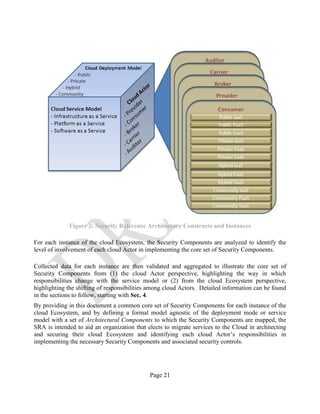
Figure 2, below provides a graphical representation of the NCC-SRA three-dimensional approach
that leads to the twelve cloud instances for which data is collected, aggregated, and analyzed for
each cloud type.
Page 21
Figure 2: Security Reference Architecture Constructs and Instances
For each instance of the cloud Ecosystem, the Security Components are analyzed to identify the
level of involvement of each cloud Actor in implementing the core set of Security Components.
Collected data for each instance are then validated and aggregated to illustrate the core set of
Security Components from (1) the cloud Actor perspective, highlighting the way in which
responsibilities change with the service model or (2) from the cloud Ecosystem perspective,
highlighting the shifting of responsibilities among cloud Actors. Detailed information can be found
in the sections to follow, starting with Sec. 4.
By providing in this document a common core set of Security Components for each instance of the
cloud Ecosystem, and by defining a formal model agnostic of the deployment mode or service
model with a set of Architectural Components to which the Security Components are mapped, the
SRA is intended to aid an organization that elects to migrate services to the Cloud in architecting
and securing their cloud Ecosystem and identifying each cloud Actor’s responsibilities in
implementing the necessary Security Components and associated security controls.
Page 22
2.3 RISK MANAGEMENT
All Federal information systems must undergo an Assessment and Authorization (A&A) process to
determine whether they comply with FISMA and Office of Management and Budget (OMB)
Circular A-130, Section 8b (3), Securing Agency Information Systems requirements in addition to
any other applicable requirements [6][18]. FISMA and OMB Circular A-130 also require any
entities operating systems on behalf of the Federal government – including cloud Providers – to
meet the same security and privacy requirements as Federal agencies. Security and privacy
requirements for cloud Providers, including the security and privacy controls for information
systems processing, storing, or transmitting Federal information, are expressed in appropriate
contracts or other formal agreements using the RMF and associated NIST security standards,
special publications, and guidelines.
NIST SP 500-293 (Vol. 1): U.S Government Cloud Computing Technology Roadmap identifies in
Requirement 2 “the need to demonstrate that the required level of protection of Federal data can be
provided in the cloud environment in order to inspire confidence and trust to a level where security
is not perceived to be an impediment to the adoption of cloud computing.” The document also
emphasizes that the “cloud Provider and the cloud Consumer have differing degrees of control over
the computing resources in a cloud system.” Therefore the implementation of the security
requirements becomes a shared or split responsibility among cloud Actors [1].
The assurance or confidence that the risk presented by using cloud services is at an acceptable level
depends on the trust that the organization places in the external cloud Provider and Broker, when
involved in the orchestration of the cloud Ecosystem.
This Risk Management process ensures that issues are identified and mitigated early in the
investment cycle with routine and periodic reviews. In addition, the CIO Council maintains a
library4
of helpful online documentation for agencies, including a best practices guide for Creating
Effective Cloud Computing Contracts for the Federal Government.
2.3.1 THE RISK MANAGEMENT FRAMEWORK
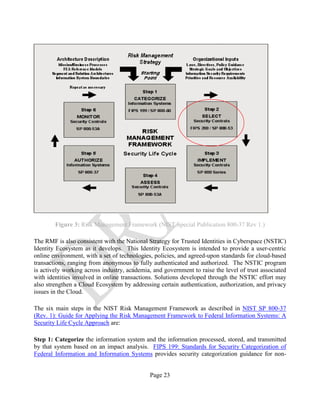
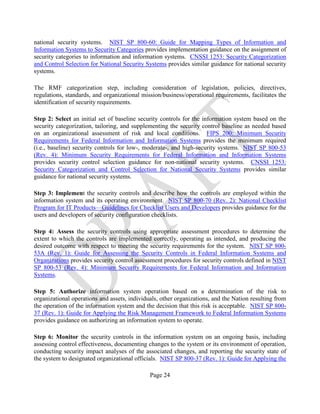
The Risk Management Framework (or RMF), illustrated in Fig. 3 below, provides a disciplined and
structured process that integrates information security and risk management activities into the
system development life cycle. For each identified Step, there is at least one standard that provides
guidance: these are also identified in the graphic.
4
https://cio.gov/resources/document-library/
Page 23
Figure 3: Risk Management Framework (NIST Special Publication 800-37 Rev 1.)
The RMF is also consistent with the National Strategy for Trusted Identities in Cyberspace (NSTIC)
Identity Ecosystem as it develops. This Identity Ecosystem is intended to provide a user-centric
online environment, with a set of technologies, policies, and agreed-upon standards for cloud-based
transactions, ranging from anonymous to fully authenticated and authorized. The NSTIC program
is actively working across industry, academia, and government to raise the level of trust associated
with identities involved in online transactions. Solutions developed through the NSTIC effort may
also strengthen a Cloud Ecosystem by addressing certain authentication, authorization, and privacy
issues in the Cloud.
The six main steps in the NIST Risk Management Framework as described in NIST SP 800-37
(Rev. 1): Guide for Applying the Risk Management Framework to Federal Information Systems: A
Security Life Cycle Approach are:
Step 1: Categorize the information system and the information processed, stored, and transmitted
by that system based on an impact analysis. FIPS 199: Standards for Security Categorization of
Federal Information and Information Systems provides security categorization guidance for non-
Page 24
national security systems. NIST SP 800-60: Guide for Mapping Types of Information and
Information Systems to Security Categories provides implementation guidance on the assignment of
security categories to information and information systems. CNSSI 1253: Security Categorization
and Control Selection for National Security Systems provides similar guidance for national security
systems.
The RMF categorization step, including consideration of legislation, policies, directives,
regulations, standards, and organizational mission/business/operational requirements, facilitates the
identification of security requirements.
Step 2: Select an initial set of baseline security controls for the information system based on the
security categorization, tailoring, and supplementing the security control baseline as needed based
on an organizational assessment of risk and local conditions. FIPS 200: Minimum Security
Requirements for Federal Information and Information Systems provides the minimum required
(i.e., baseline) security controls for low-, moderate-, and high-security systems. NIST SP 800-53
(Rev. 4): Minimum Security Requirements for Federal Information and Information Systems
provides security control selection guidance for non-national security systems. CNSSI 1253:
Security Categorization and Control Selection for National Security Systems provides similar
guidance for national security systems.
Step 3: Implement the security controls and describe how the controls are employed within the
information system and its operating environment. NIST SP 800-70 (Rev. 2): National Checklist
Program for IT Products—Guidelines for Checklist Users and Developers provides guidance for the
users and developers of security configuration checklists.
Step 4: Assess the security controls using appropriate assessment procedures to determine the
extent to which the controls are implemented correctly, operating as intended, and producing the
desired outcome with respect to meeting the security requirements for the system. NIST SP 800-
53A (Rev. 1): Guide for Assessing the Security Controls in Federal Information Systems and
Organizations provides security control assessment procedures for security controls defined in NIST
SP 800-53 (Rev. 4): Minimum Security Requirements for Federal Information and Information
Systems.
Step 5: Authorize information system operation based on a determination of the risk to
organizational operations and assets, individuals, other organizations, and the Nation resulting from
the operation of the information system and the decision that this risk is acceptable. NIST SP 800-
37 (Rev. 1): Guide for Applying the Risk Management Framework to Federal Information Systems
provides guidance on authorizing an information system to operate.
Step 6: Monitor the security controls in the information system on an ongoing basis, including
assessing control effectiveness, documenting changes to the system or its environment of operation,
conducting security impact analyses of the associated changes, and reporting the security state of
the system to designated organizational officials. NIST SP 800-37 (Rev. 1): Guide for Applying the
Page 25
Risk Management Framework to Federal Information Systems provides guidance on monitoring the
security controls in the environment of operation, the ongoing risk determination and acceptance,
and the approved information system authorization to operate status. NIST SP 800-53A (Rev. 1):
Guide for Assessing the Security Controls in Federal Information Systems and Organizations
provides continuous monitoring guidance for the security controls defined in NIST SP 800-53 (Rev.
4): Minimum Security Requirements for Federal Information and Information Systems.
The risk-based approach to security control selection and specification considers effectiveness,
efficiency, and constraints due to applicable laws, directives, Executive Orders, policies, standards,
or regulations. While the framework is flexible and easily adaptable in most cases, it assumes a
traditional IT environment, and requires some customization to address the unique characteristics of
cloud-based services. The “Cloud-adapted RMF,” or CRMF, which closely parallels the original
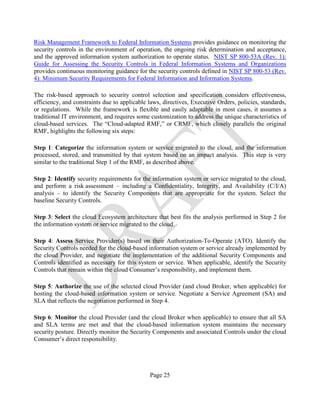
RMF, highlights the following six steps:
Step 1: Categorize the information system or service migrated to the cloud, and the information
processed, stored, and transmitted by that system based on an impact analysis. This step is very
similar to the traditional Step 1 of the RMF, as described above.
Step 2: Identify security requirements for the information system or service migrated to the cloud,
and perform a risk assessment – including a Confidentiality, Integrity, and Availability (C/I/A)
analysis – to identify the Security Components that are appropriate for the system. Select the
baseline Security Controls.
Step 3: Select the cloud Ecosystem architecture that best fits the analysis performed in Step 2 for
the information system or service migrated to the cloud.
Step 4: Assess Service Provider(s) based on their Authorization-To-Operate (ATO). Identify the
Security Controls needed for the cloud-based information system or service already implemented by
the cloud Provider, and negotiate the implementation of the additional Security Components and
Controls identified as necessary for this system or service. When applicable, identify the Security
Controls that remain within the cloud Consumer’s responsibility, and implement them.
Step 5: Authorize the use of the selected cloud Provider (and cloud Broker, when applicable) for
hosting the cloud-based information system or service. Negotiate a Service Agreement (SA) and
SLA that reflects the negotiation performed in Step 4.
Step 6: Monitor the cloud Provider (and the cloud Broker when applicable) to ensure that all SA
and SLA terms are met and that the cloud-based information system maintains the necessary
security posture. Directly monitor the Security Components and associated Controls under the cloud
Consumer’s direct responsibility.
Page 26
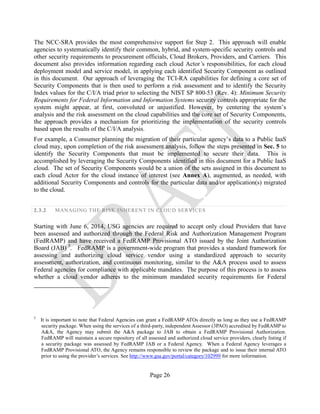
The NCC-SRA provides the most comprehensive support for Step 2. This approach will enable
agencies to systematically identify their common, hybrid, and system-specific security controls and
other security requirements to procurement officials, Cloud Brokers, Providers, and Carriers. This
document also provides information regarding each cloud Actor’s responsibilities, for each cloud
deployment model and service model, in applying each identified Security Component as outlined
in this document. Our approach of leveraging the TCI-RA capabilities for defining a core set of
Security Components that is then used to perform a risk assessment and to identify the Security
Index values for the C/I/A triad prior to selecting the NIST SP 800-53 (Rev. 4): Minimum Security
Requirements for Federal Information and Information Systems security controls appropriate for the
system might appear, at first, convoluted or unjustified. However, by centering the system’s
analysis and the risk assessment on the cloud capabilities and the core set of Security Components,
the approach provides a mechanism for prioritizing the implementation of the security controls
based upon the results of the C/I/A analysis.
For example, a Consumer planning the migration of their particular agency’s data to a Public IaaS
cloud may, upon completion of the risk assessment analysis, follow the steps presented in Sec. 5 to
identify the Security Components that must be implemented to secure their data. This is
accomplished by leveraging the Security Components identified in this document for a Public IaaS
cloud. The set of Security Components would be a union of the sets assigned in this document to
each cloud Actor for the cloud instance of interest (see Annex A), augmented, as needed, with
additional Security Components and controls for the particular data and/or application(s) migrated
to the cloud.
2.3.2 MANAGING THE RISK INHERENT IN CLOUD SERVICES
Starting with June 6, 2014, USG agencies are required to accept only cloud Providers that have
been assessed and authorized through the Federal Risk and Authorization Management Program
(FedRAMP) and have received a FedRAMP Provisional ATO issued by the Joint Authorization
Board (JAB) 5
. FedRAMP is a government-wide program that provides a standard framework for
assessing and authorizing cloud service vendor using a standardized approach to security
assessment, authorization, and continuous monitoring, similar to the A&A process used to assess
Federal agencies for compliance with applicable mandates. The purpose of this process is to assess
whether a cloud vendor adheres to the minimum mandated security requirements for Federal
5
It is important to note that Federal Agencies can grant a FedRAMP ATOs directly as long as they use a FedRAMP
security package. When using the services of a third-party, independent Assessor (3PAO) accredited by FedRAMP to
A&A, the Agency may submit the A&A package to JAB to obtain a FedRAMP Provisional Authorization.
FedRAMP will maintain a secure repository of all assessed and authorized cloud service providers, clearly listing if
a security package was assessed by FedRAMP JAB or a Federal Agency. When a Federal Agency leverages a
FedRAMP Provisional ATO, the Agency remains responsible to review the package and to issue their internal ATO
prior to using the provider’s services. See http://www.gsa.gov/portal/category/102999 for more information.
Page 27
agencies and implements the identified security controls for low- and moderate-impact systems as
described in FIPS 199: Standards for Security Categorization of Federal Information and
Information Systems and FIPS 200: Minimum Security Requirements for Federal Information and
Information Systems [16][17].
FedRAMP authorizes third parties to conduct these assessments, which are conducted against
criteria for baseline and specifically-defined security controls defined in NIST SP 800-53 (Rev. 4):
Security and Privacy Controls for Federal Information Systems and Organizations. FedRAMP’s
set of security controls are also aligned with NIST SP 800-37: Guide for Applying the Risk
Management Framework to Federal Information Systems: A Security Life Cycle Approach.
FedRAMP itself issues ATO to Providers once the assessment has been completed. Cloud
Consumers may consider the ATO proof of proper implementation of the security controls assessed
by FedRAMP, and negotiate only the implementation of the additional Security Components that
are deemed necessary for the specific cloud-based service.
FedRAMP maintains an online site with requirements, templates, and supporting materials for
agencies and cloud vendors at http://www.FedRAMP.gov.
Federal agencies are responsible and accountable for the information security risk incurred by the
use of information system services offered by external suppliers, including cloud Providers and
cloud Brokers. The CRMF provides a structured, yet flexible approach for managing the portion of
risk resulting from the incorporation of cloud-based information systems into the mission and
business processes of the organization. Consumers can require cloud Providers to implement all
steps in the RMF process. The only exception is the security authorization step, as that remains an
inherent Federal responsibility that is directly linked to the management of risk related to the use of
cloud services.
The CRMF can be used to address the security risks associated with cloud systems by incorporating
it into the terms and conditions of the contracts with external cloud Providers and cloud Brokers.
Performance aspects of these terms and conditions are also incorporated into the SLA, which is an
intrinsic part of the SA between the cloud Consumer and cloud Provider and/or Broker. Contractual
terms should include, for example, guarantees of the Consumer’s timely access to or Provider’s
timely delivery of cloud audit logs, continuous monitoring logs, and any user access logs. More
information will be provided in Sec. 5.2.4 of this document.
Based upon the deployment model and the service type elected, the agency would retain and take it
upon themselves to implement the set of the Security Components identified for the Consumer,
augmented with the supplemental set specific to the Consumer’s use case. For example, the agency
may require in the SLA (and other appropriate contractual documents) that a Public IaaS Provider
implement the associated Security Components identified in the NCC-SRA, augmented with use-
case specific supplemental Security Components and controls.
Page 28
USG cloud Consumers should also require cloud Providers and Brokers to present appropriate
evidence that demonstrates their compliance with the RMF in protecting Federal information. It is
important to emphasize that, while the six steps of the CRMF listed in Sec. 2.3.1 cover the entire
Life Cycle of cloud-based information systems, this document is primarily focused on Step 2 and
only provides pointers for the other steps.
2.4 ASSUMPTIONS, CLARIFICATIONS AND DEFINITIONS
This section clarifies the roles and responsibilities of the cloud Actors described in NIST SP 500-
292: NIST Cloud Computing Reference Architecture, and lists the assumptions made regarding their
core operational responsibilities with associated security requirements.
2.4.1 CLOUD COMPUTING SERVICE AND DEPLOYMENT MODELS
The definitions of service models and deployment models below come from NIST SP 800-145: The
NIST Definition of Cloud Computing [14].
2.4.1.1 SERVICE MODELS
Service models describe, broadly, what type of service the cloud provides to Consumers: an
application, a programming platform, or raw computing resources. In the cloud computing
Ecosystem, the cloud Consumer has three different service models to choose from: SaaS, PaaS, and
IaaS.
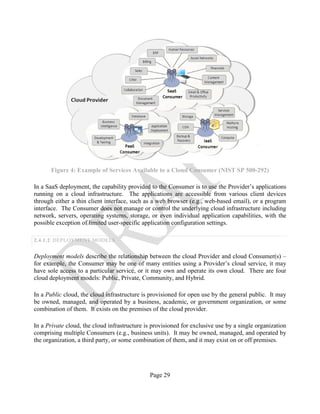
Figure 4 below presents some examples of cloud services available to a cloud Consumer (For more
details, see NIST SP 500-292: NIST Cloud Computing Reference Architecture, Appendix B).
In an IaaS deployment, the capability provided to the consumer is to provision processing, storage,
networks, and other fundamental computing resources where the consumer is able to deploy and run
arbitrary software, which can include operating systems and applications. The consumer does not
manage or control the underlying cloud infrastructure but has control over operating systems,
storage, and deployed applications; and possibly limited control of select networking components
(e.g., host firewalls).
In a PaaS deployment, the capability provided to the Consumer is to deploy onto the cloud
infrastructure consumer-created or acquired applications created using programming, libraries,
services, and tools supported by the Provider. The consumer does not manage or control the
underlying cloud infrastructure including network, servers, operating systems, or storage, but has
control over the deployed applications and possibly configuration settings for the application-
hosting environment.
Page 29
Figure 4: Example of Services Available to a Cloud Consumer (NIST SP 500-292)
In a SaaS deployment, the capability provided to the Consumer is to use the Provider’s applications
running on a cloud infrastructure. The applications are accessible from various client devices
through either a thin client interface, such as a web browser (e.g., web-based email), or a program
interface. The Consumer does not manage or control the underlying cloud infrastructure including
network, servers, operating systems, storage, or even individual application capabilities, with the
possible exception of limited user-specific application configuration settings.
2.4.1.2 DEPLOYMENT MODELS
Deployment models describe the relationship between the cloud Provider and cloud Consumer(s) –
for example, the Consumer may be one of many entities using a Provider’s cloud service, it may
have sole access to a particular service, or it may own and operate its own cloud. There are four
cloud deployment models: Public, Private, Community, and Hybrid.
In a Public cloud, the cloud infrastructure is provisioned for open use by the general public. It may
be owned, managed, and operated by a business, academic, or government organization, or some
combination of them. It exists on the premises of the cloud provider.
In a Private cloud, the cloud infrastructure is provisioned for exclusive use by a single organization
comprising multiple Consumers (e.g., business units). It may be owned, managed, and operated by
the organization, a third party, or some combination of them, and it may exist on or off premises.
Page 30
In a Community cloud, the cloud infrastructure is provisioned for exclusive use by a specific
community of Consumers from organizations that have shared concerns (e.g., mission, security
requirements, policy, and compliance considerations). It may be owned, managed, and operated by
one or more of the organizations in the community, a third party, or some combination of them, and
it may exist on or off premises.
In a Hybrid cloud, the cloud infrastructure is a composite of two or more distinct cloud
infrastructures (Private, Community, or Public) that remain unique entities, but are bound together
by standardized or proprietary technology that enables data and application portability (e.g., cloud
bursting for load balancing between clouds).
2.4.2 CLOUD ECOSYSTEM
When cloud services are procured by Federal agencies (acting in the role of Consumer), it is the
cloud Consumer’s responsibility to determine the set of Security Components and associated
controls required to protect data migrated to the cloud and to determine and/or approve the manner
in which selected Components and controls are implemented. If the Consumer cannot directly
implement selected security controls, then the responsibility for implementation is shared with other
Actors in the Ecosystem, most notably the cloud Provider and cloud Broker. While the
responsibility for implementation may not rest solely with the Consumer, it is ultimately the
Consumer’s responsibility to specify what controls must be put in place and to provide oversight
and accountability for the security of the cloud Ecosystem.
Figure 5: Composite Cloud Ecosystem Security Architecture
Page 31
Figure 5 presents an illustration of a composite cloud Ecosystem Security Architecture that
graphically depicts the cloud Actors involved in orchestrating a cloud Ecosystem. The graphic also
presents different possible compositions for each cloud service model.
The diagram illustrates the two types of Providers and two types of Brokers based on the roles
played by these cloud Actors in the cloud orchestration. The role of transporting data within the
cloud is assigned by NIST SP 500-292: NIST Cloud Computing Reference Architecture to the cloud
Provider, leaving the cloud Carrier with the role and responsibility of securely transporting the data
in transit between the end-user and the Cloud. Additional assumptions and clarifications are
provided in the following sub-sections for each cloud Actor.
It is important to note that the cloud Carrier involved in the cloud Ecosystem is not represented in
the diagram because the service provided by the Carrier (i.e., data transport) can be accomplished
using different vehicles from dedicated communication channels to the open Internet that involve
multiple Internet Service Providers and the backbone network operators. This complexity makes it
difficult to illustrate the cloud Carrier in the composite cloud Ecosystem architecture in a single
location in the diagram, or using only one graphical form, without misleading the audience or
misrepresenting the cloud Carrier’s role. However, it is important to highlight that the cloud Carrier
role is critical to the functioning of the cloud Ecosystem. In a cloud Ecosystem that serves the
needs of USG organizations, it is the Consumer’s (i.e., agency’s) responsibility to identify, based
upon the risk analysis performed, the full set of security controls that must be mandated and
implemented to secure the operations and data migrated to the cloud, and implement those security
controls that fall directly under its area of responsibility. It is also the Consumer’s responsibility to
determine/identify the subset of security controls that fall under Broker, Carrier and Provider
responsibilities, based on the type of cloud Ecosystem used. The union of all subsets of security
controls must result in a combined set that can fully secure the cloud Ecosystem.
It is the responsibility of all cloud Actors involved in orchestrating a cloud Ecosystem, and in
providing technical services, to ensure they address the cloud Consumers’ areas of concern
regarding:
• Risk Management
o Risk Analysis
o Risk Assessments
o Vulnerability Assessments
o Incident Reporting and Response
• Business Continuity
o Disaster recovery plans
o Restoration plan incorporating and quantifying the Recovery Point Objective (RPO)
and Recovery Time Objective (RTO) for services
• Physical Security
o Physical and Environmental Security Policy
Page 32
o Contingency Plan
o Emergency Response Plan
o Facility Layout
o Security Infrastructure
o Human Resources
o Environmental Security
o Visual inspection of the facility
• User Account Termination Procedures
• Compliance with National and International/Industry Standards on Security
• Transparent view of the security posture of the cloud Providers, Brokers, and Carriers.
2.4.3 CLOUD CONSUMER
A Cloud Consumer is the entity that maintains a business relationship with, and uses services from,
cloud Providers, cloud Brokers, and cloud Carriers.
A cloud Consumer browses the service catalog from a cloud Provider or cloud Broker, requests the
appropriate service(s), and sets up service contracts with the cloud Provider (either directly or
through a cloud Broker) before effectively using the service. The Consumer may set up Carrier
services separately, or use the Carrier services integrated into the offering of the cloud
Provider/Broker.
The cloud Consumer may be billed for the service provisioned, and needs to arrange payments
accordingly. Cloud Consumers use SLAs to specify the technical performance requirements that
must be fulfilled by a cloud Provider and/or cloud Broker.
As previously described, if the cloud Consumer is a USG agency, it is ultimately accountable for
the security of data and/or applications held by the cloud Provider on the Consumer’s behalf. The
migration of any operations to the Cloud does not void the mandate of compliance with FISMA and
OMB directives. Therefore, it behooves any USG agency using cloud services to identify the set of
security controls required to protect its assets in the cloud. The security controls should then be
implemented by the cloud Consumer, cloud Provider, cloud Carrier, and cloud Broker as applicable.
Any cloud Provider, Carrier, or Broker handling Federal information or operating information
systems on behalf of the Federal government must meet the same security requirements as the
source Federal agency. The security requirements also apply to external subsystems storing,
processing, or transmitting Federal information and any services provided by, or associated with,
the subsystem.
2.4.4 CLOUD PROVIDER
A cloud Provider is the entity responsible for making a service available to cloud Consumers (either
directly or indirectly via a Broker). A cloud Provider acquires and manages the computing
Page 33
infrastructure required for providing the services, runs the cloud software that provides the services
(at least for SaaS and PaaS service deployments), and makes arrangements to deliver the cloud
services to the cloud Consumers through network access.
A cloud Provider’s activities can be sorted into five major categories:
• Service deployment
• Service orchestration
• Service management
• Security
• Privacy
From a strictly technical perspective, Providers could offer their services directly to Consumers or
to Technical Brokers that extend or enhance the Provider’s services by adding an additional layer of
functionality in a transparent way (see Sec. 2.4.5 for more information). Figure 5 above depicts the
two major types of Providers, discussed below:
1. Primary Provider (labeled “Provider 1” in the Cloud Composite Architecture); and
2. Intermediary Provider (labeled “Provider 2” in the Cloud Composite Architecture).
2.4.4.1 PRIMARY CLOUD PROVIDER EXAMPLE
A Primary Provider offers services hosted on infrastructure that it owns. It may make these services
available to Consumers through a third party (such as a Broker or Intermediary Provider), but the
defining characteristic of a Primary Provider is that it does not source its service offerings from
other Providers.
2.4.4.2 INTERMEDIARY CLOUD PROVIDER EXAMPLE
An Intermediary Provider has the capability to interact with other cloud Providers without offering
visibility or transparency into the Primary Provider(s). An Intermediary Provider uses services
offered by a Primary Provider(s) as invisible components of its own service, which it presents to the
customer as an integrated offering (as shown in the simple illustrated example provided by Fig. 6
below). From a security perspective, all security services and components required of a Primary
Provider are also required of an Intermediary Provider.
Page 34
Figure 6: Intermediary Cloud Provider Example
2.4.5 CLOUD BROKER
NIST SP 500-292: NIST Cloud Computing Reference Architecture defines a cloud Broker as an
entity that manages the use, performance and delivery of cloud services, and negotiates
relationships between cloud Providers and cloud Consumers [13].
The purpose of this section is to elaborate on the description of the cloud Broker provided in NIST
SP 500-292: NIST Cloud Computing Reference Architecture, to provide a better description of the
roles and types of services that a cloud Broker may offer to cloud Consumers, and to emphasize the
differences between a cloud Broker and a cloud Provider.
As cloud computing evolves, the integration of cloud services may be too complex for cloud
Consumers to manage alone. In such cases, a cloud Consumer may request cloud services from a
cloud Broker, instead of contacting a cloud Provider directly. Cloud Brokers provide a single point
of entry to manage multiple cloud services. The two key defining features of a cloud Broker,
distinct from an Intermediary Provider, are the ability to offer a single consistent interface (for
business or technical purposes) to multiple differing Providers, and the transparent visibility the
Broker allows into who is providing the services in the background – recall from Sec. 2.4.4.2 that
Intermediary Providers do not offer such transparency.
Page 35
It is important to note that in the majority of the graphical representations of a cloud Broker, the
transparency shown in the images does not imply a cloud Broker is modifying the functional layers
provided by a cloud Provider. Rather, such transparency indicates that the cloud Broker, in addition
to providing extra functionality, allows the cloud Consumer to have a particular level of visibility
into and information about the cloud Provider services. Also, when necessary, the Broker facilitates
direct communication with the Provider in the orchestration of the cloud Ecosystem and during
operational processes. Herein, this is referred to as the “transparent visibility into the primary
service Providers,” as noted above.
In general, cloud Brokers provide services in three categories [13]:
• Aggregation: A cloud Broker combines and integrates multiple services into one or more
new services. The Broker provides data integration and ensures the security of data in
transition between the cloud Consumer and multiple cloud Providers.
• Arbitrage: Service arbitrage is similar to service aggregation, except that the services being
aggregated are not fixed. Service arbitrage means a Broker has the flexibility to choose
services from multiple Providers, depending upon the characteristics of the data or the
context of the service.
• Intermediation: A cloud Broker enhances a given service by improving some specific
capability and providing value-added services to cloud Consumers. The improvement can
be managing access to cloud services, identity management, performance reporting,
enhanced security, etc.
2.4.5.1 DIFFERENTIATING BUSINESS AND TECHNICAL BROKER SERVICES
An organization that acts as a cloud Broker may provide one or both of the following services:
• Business and relationship support services (business support such as billing and contractual
intermediation, arbitrage and aggregation);
• Technical support service (service aggregation, arbitrage, and technical intermediation),
with a key focus on handling interoperability issues among multiple cloud Providers.
A Business Broker only provides business and relationship services, and does not have any contact
with the cloud Consumer’s data, operations, or artifacts (e.g., images, volumes, firewalls) in the
cloud. Conversely, a Technical Broker does interact with a Consumer’s assets: the Technical
Broker aggregates services from multiple cloud Providers and adds a layer of technical functionality
by addressing single-point-of-entry and interoperability issues. These Broker roles are not mutually
exclusive. For example, a given entity might serve as a Business Broker in one context, a Technical
Broker in another, and both in a third context.
Page 36
Both types of Brokers always allow the cloud Consumer a particular level of transparency into the
identity of the target cloud Providers. In Figure 5, there is a particular emphasis on the different
levels of transparency and aggregation possible through a cloud Technical Broker (Broker 2) and
Intermediary Provider.
2.4.5.2 A CLOUD BROKERAGE EXAMPLE
Figure 7 below shows a simple example of cloud brokerage. Depending upon the Broker services
rendered, the brokerage can be business-oriented, technically oriented, or a combination of the two.
Note that two key characteristics of brokerage – aggregation and providing transparent visibility
into the cloud Providers – are fulfilled.
A cloud Business Broker could also offer value-added intermediation services such as: service
catalogue lookups, subscription handling, customer relation management, unified billing, etc.
Figure 7: Cloud Broker Example
A cloud Technical Broker could offer cross-provider technical services such as orchestration, load
management and cloud-bursting, integrated identity and authorization management, security
brokerage and integrated security management, metrics retrieval, cost and usage reporting, etc.
Page 37
2.4.6 CLOUD CARRIER
A cloud Carrier acts as an intermediary that provides connectivity and transport of cloud services
between cloud Consumers and cloud Providers through network, telecommunications, and other
access devices. For example, cloud Consumers can obtain cloud services through networked
devices, such as computers, laptops, mobile phones, mobile Internet devices (MIDs), etc. The
distribution of cloud services is normally provided by network and telecommunication Carriers or a
transport agent: a transport agent refers to a business organization that provides physical transport
of storage media such as high-capacity hard drives. Note that a cloud Provider will set up SLAs
with a cloud Carrier to provide a level of service consistent with the levels established in SLAs
offered to cloud Consumers. The Provider may require the cloud Carrier to provide dedicated and
secure connections between it and its Consumer(s).
The security concerns of the Carrier role include consideration for the exposures and threats that
would be present in the transmission of data to and from a cloud structure. Due to the evolutionary
nature of the Internet and the development over time of new methods for signal transmission, there
are inherent vulnerabilities in the channels that transmit data to and from cloud structures. Security
breaches at juncture and insertion points present a challenging security problem for Carriers in both
cloud and non-cloud transmissions. For these reasons, the Carrier is responsible for maintaining
security control points that span the systems they manage, as well as security testing, risk
management, and preventative tasks that would be expected to reduce vulnerabilities in
transmission channels. Carriers can offer dedicated lines of communication between endpoints,
including interstate and international dedicated lines.
The security responsibilities of the cloud Carrier – unlike those of other roles in the cloud
Ecosystem – are always the same, regardless of the cloud service of deployment model.
2.4.7 CLOUD AUDITOR
A cloud Auditor is a party that can conduct an independent assessment of cloud services, with the
intent to express an opinion thereon. A cloud Auditor can evaluate the services provided by a cloud
Provider in terms of security controls, privacy impact, performance, etc. Audits can be used to
verify conformance to standards (set forth in mandates, the service contract, industry best practices,
or other sources) through review of objective evidence.
Security controls are the management, operational, and technical safeguards or countermeasures
employed within an organizational information system to protect the C/I/A of the system and its
information. A cloud Auditor can make an assessment of the security controls in the information
system, in accordance with generally accepted auditing standards, to determine the extent to which
the controls are implemented correctly, operating as intended, and producing the desired outcome
with respect to the security requirements for the system. The security auditing should also include
the verification of compliance with regulation and security policy. For example, an Auditor can be
Page 38
tasked with ensuring that the correct policies are applied to data retention according to relevant rules
for the applicable jurisdictions providing legislative and regulatory data compliance oversight. The
Auditor may ensure that fixed content has not been modified and that the legal and business data
archival requirements have been satisfied.
The NCC-SRA document acknowledges the importance of the auditing process, the complexity of
an audit, and the wide variation among the audited targets. However, the document limits its
analysis of the Auditor – from a security perspective – to its responsibilities for security components
designed to protect the data accessed and collected during an audit, the evaluation process, and the
report findings.
The underlying service model used by the systems being audited plays a secondary role from the
viewpoint of the cloud Auditor. What is relevant is that the Security Components available and
accessible to the Auditor enable the collection of objective evidence from the responsible parties
required for the audit. It is assumed that an Auditor would also have some persistent and sensitive
information regarding their client files as well, and that their report findings are stored in the cloud.
Therefore, the Auditor will need to be cognizant of the Security Components available to support
this function by using widely accepted industry best practices, such as those addressed in GAO-12-
331G Government Auditing Standards.
2.4.8 BUSINESS MODELS AND NIST REFERENCE ARCHITECTURE
The NIST RA and the overarching Security Reference Architecture provides a flexible formal
model in terms of the cloud Actors that allows vendors of different cloud services to easily map
their business model to the NIST architecture. The key concept that supports this flexibility is the
fact that an organization that offers cloud services may engage in different business functionalities
with different partners and customers, taking on different roles and assuming different cloud
Actors’ responsibilities. These functionalities can be thought of as a separate cloud Ecosystem with
its own context – based on service, contractual, technical, and other characteristics – and the
particular role of the organization depends upon this context. This means that a given organization
can be a Provider of some cloud services to a particular cloud Consumer and at the same time serve
as a Broker of other or of a subset of services to another Consumer.
Consider the relationships of the entities in Figure 8 below – three agencies and two cloud service
vendors. Agency 1 uses the PaaS cloud services from Vendor A, while implementing in house their
end-users’ business management. In this business relationship, Agency 1 is a Consumer of the PaaS
cloud services offered by Vendor A as a Primary Provider. Agency 2 also uses the PaaS cloud
services offered by Vendor A. In this case, Vendor A also implements the business management
functions (authorization contract management) of Agency 2’s end-users. Agency 2 is a Consumer of
the cloud services offered by Vendor A as a Primary Provider. It is important to note that Vendor A,
in its role of cloud Provider, offers different cloud service packages to different Consumers. In the
last scenario depicted in Figure 8 below, Agency 3 consumes Vendor B’s SaaS cloud services
Page 39
while it contracts with Vendor A the business management functions of its end-users. In this
business scenario, a particular level of trust must exist or be established between Vendor B and
Vendor A. In this case, Agency 3 is a Consumer of SaaS cloud services offered by Vendor B as a
Provider while Vendor A is a Broker for Agency 3, since it is providing value-added business
management functionality.
Figure 8: Business Models vs. NIST Reference Architecture
In sum, it is important to keep in mind that the NIST RA and NCC-SRA do not constitute a
comprehensive, one-to-one translation of all organizations’ business models, but rather allow for
flexible mapping of the business models employed by all cloud service vendors. The architecture
described in these two documents defines cloud Actors based upon the roles they play in relation to
their business partners and customers in the context of cloud services.
2.4.9 SECURITY CONSERVATION PRINCIPLE
The core concept of the Security Conservation Principle is that, for a particular service migrated to
the cloud, the full set of necessary Security Components and controls that must be implemented to
secure the cloud Ecosystem is always the same; however, the division of responsibility for those
Components and controls changes based upon the characteristics of the cloud, particularly the
service deployment. Figure 9 below depicts the Security Conservation Principle for the cloud
Ecosystem.
Page 40
a)
Legend: TB = cloud Technical Broker
b)
Figure 9: Security Conservation Principle (based on graphic from NIST SP 800-144)
Page 41
For the sake of brevity, diagram a) in Figure 9 identifies only the major cloud Actors: Consumer
and Provider. The diagram highlights the shifting of the responsibility for implementing particular
Security Components between the Consumer and Provider, depending upon the cloud service
deployment model. Essentially, the level of responsibility for either Actor correlates to the Actor’s
level of control over certain “layers” of the cloud. In a SaaS cloud, where the Consumer controls
only the application layer, the Provider assumes most of the responsibility for Security Components.
Conversely, in an IaaS cloud – where the Consumer may control everything except the hardware the
service runs on and the facility in which that hardware is kept – the Consumer assumes most of the
responsibility for Security Components.
Since a Technical Broker may be involved in a cloud Ecosystem providing additional functionality
– and with that, adequate embedded security and privacy – diagram b) in Figure 9 illustrates the
same concept with generic technical Broker functionality added.
Page 42
3 SECURITY REFERENCE ARCHITECTURE: DATA ANALYSIS METHODOLOGY
This Security Reference Architecture leverages the Trusted Cloud Initiative – Reference
Architecture6
shown in Annex A. To accomplish this, the team that authored this document
extracted all of the capabilities described in the TCI-RA while preserving the path to the three root-
domains (Business Operation Support Service [BOSS], Information Technology Operation Support
[ITOS], and Security and Risk Management [S&RM]) and generated a total set of 346 Security
Components. An example of the resulting data collection form can be seen in Table 1 below.
Table 1: SRA Data Collection Form with the Set of Security Components
6
See https://research.cloudsecurityalliance.org/tci/explore/
Page 43
For a particular deployment model (Public cloud in the example presented in this document), the
collected data was aggregated, validated, and processed as part of the data analysis methodology
presented in the next section.
3.1 DATA COLLECTION
The data collection effort was focused on populating the NCC-SRA formal model by assessing the
applicability of each Security Component for a given cloud instance. Accordingly, each blank cell
under each cloud Actor heading (note the Cloud Consumer, Cloud Provider, etc. columns in Table
1) was marked with one of the following:
• “X” to indicate that the Security Component should be implemented by the Actor to secure
the Consumer’s applications and data in the Cloud.
• “A” to indicate that the Security Component should be implemented internally, independent
of the Consumer’s data, for administrative or best-practice reasons.
• “B,” specific to Business Brokers only, to indicate a Security Component that is
implemented to secure the cloud computing business-oriented service. The marking also
emphasizes that the Business Broker only provides business and relationship services, and
does not have any contact with the cloud Consumer’s data migrated to the cloud.
• A blank cell indicates that the Security Component cannot be implemented by the particular
cloud Actor or is not necessary in securing the cloud Ecosystem.
In the process of collecting data, the definitions provided by CSA for the capabilities identified in
the TCI-RA were used to better determine the applicability of the Security Component to the given
cloud instance for each cloud Actor.
The purpose of the markings is to provide cloud Consumers with a reference they can use to
identify the Security Components that are applicable for a particular cloud service model. The
markings also indicate which Actor(s) in the cloud Ecosystem – Consumer, Provider, or Broker, in
most cases – is responsible for a particular Security Component based on the use case or type of
cloud service offered.7
As indicated by the data sets, there are areas in which the responsibility for
a particular Security Component may reside with multiple cloud Actors depending on the specifics
of the Component and the particular use case.
It is important to distinguish between responsibility for identifying and setting Security Components
requirements and responsibility for their implementation. The cloud Consumer is always
7
Many of the Security Components are common and should be considered by all cloud Actors (organizations) for
implementation in their internal operations as well as in cloud-based service offering operations.
Page 44
accountable for ensuring that all appropriate provisions for an effective security control
environment are identified and implementation requirements are in place. This accountability
cannot be relinquished.
For some Security Components in certain cloud service models, the cloud Consumer is both
accountable and responsible for implementation. For example, “Security Monitoring - End-point
Monitoring” is a Security Component that, regardless of the service model, can only be
implemented by the Consumer.
Even when responsibility for implementation is outsourced to another cloud Actor, if a Security
Component is applicable, the Consumer remains accountable for identifying that Security
Component and for requiring implementation through contractual means. For example, “Data
Governance – Secure Disposal of Data” is a Security Component that the Consumer may be able to
implement for a IaaS cloud service model but needs to be implemented by Provider(s) for all other
service models. The Consumer needs to ensure through contractual means that the Component is
properly implemented by the Provider(s) of the cloud services.
3.2 DATA AGGREGATION AND VALIDATION
The data collected for a Public cloud (as described in Sec. 3.1) is aggregated for all cloud Actors in
a service-centric way, to facilitate data validation using the Security Conservation Principle defined
above in Sec. 2.4.9. The same data was then also aggregated for all cloud service models in an
Actor-centric way to allow for a better understanding of the dynamics as the responsibilities for
implementing the full set of Security Components shift among cloud Actors with changes in the
service model (SaaS, PaaS, IaaS).
Figure 10 captures graphically the derivation of the Security Components, the data collection
process, and the two types of data aggregation used to analyze the set of Security Components for
each cloud service model (i.e., SaaS, PaaS, IaaS).
Page 45
Figure 10: Security Components Overview
The first type of data aggregation applied to each deployment model is cloud Actor-centric. For
each cloud Actor, the data collected for the core set of Security Components for each service type
(IaaS, PaaS, and SaaS) is gathered on one matrix in adjacent columns (for an example of a Public
cloud deployment model, see Annex D 11.1) to highlight the level of control the cloud Actor has
over the implementation of each Security Component and how this level increases or diminishes
depending upon the service model.
The second type of data aggregation applied to each deployment model is cloud Ecosystem-centric.
For each type of service, the data collected for the core set of Security Components for each Actor
is gathered on one matrix in adjacent columns (for an example of a Public cloud deployment model,
see Annex D 11.2) to highlight the shared responsibilities among Actors involved in constructing
and securing the cloud Ecosystem for implementing the identified Security Components. This type
of aggregation also highlights the Security Conservation Principle described in Sec. 2.4.9.
The accuracy of the data collected for each cloud deployment mode was verified and data was
validated in both aggregation scenarios by ensuring that:
Page 46
1. In the Actor-centric aggregation type, the cloud Consumer’s responsibility for implementing
Security Components is higher for an IaaS service deployment and decreases for a PaaS
service deployment, reaching minimum for a SaaS service deployment. Conversely, the
combined responsibility for the cloud Provider and Technical Broker increases significantly
from an IaaS service deployment to a PaaS deployment to a SaaS deployment, where it
reaches the maximum.
2. In the Ecosystem-centric aggregation type, the cumulative set of Security Components
implemented by all Actors involved in the cloud Ecosystem remains the same regardless of
the service deployment (IaaS, PaaS, or SaaS).
It is important to note that based on NIST SP 500-292: NIST Cloud Computing Reference
Architecture definitions of the cloud Carrier, the data collected for this Actor and its security
responsibilities do not vary with the cloud deployment or service model. This is due to the Carrier’s
unique role of securing the data in transit between the Consumer and the cloud. All other transport
roles and responsibilities within the cloud are attributed to the cloud Provider.
The data collected for and responsibilities attributed to the cloud Auditor also do not change with
the cloud deployment or service model, since the NCC-SRA only addresses the core set of Security
Components necessary to be implemented to secure the Actor’s auditing environment.
3.3 DERIVING THE SECURITY RESPONSIBILITIES FOR THE INTERMEDIARY
PROVIDER AND TECHNICAL BROKER
The overall core set of Security Components that a Technical Broker or an Intermediary Provider
should analyze and implement (in addition to the baseline set of Security Components all cloud
Actors should implement) to secure the cloud Ecosystem were determined using the following
steps:
1. Identify the “floor” or lowest service layer of the Technical Broker or Intermediary Provider
(e.g., “Infrastructure” layer if the Broker builds its services supplementing an IaaS
Provider);
2. Identify the “ceiling” or highest service layer of the Technical Broker or Intermediary
Provider (e.g., “Platform” layer if the Broker offers PaaS services);
3. Extract from the data sets provided in Annex D the Primary Provider set of Security
Components corresponding to the [floor]aaS and the one corresponding to the [ceiling]aaS
4. Perform a logical subtraction of the [floor]aaS from the [ceiling]aaS.
Figure 11 below illustrates the approach described above.
Page 47
Figure 11: Security Components for Technical Broker & Intermediary Provider
3.4 MAPPING SECURITY COMPONENTS TO SECURITY CONTROL FAMILIES
NIST SP 500-293 Vol. 2 (Draft): US Government Cloud Computing Technology Roadmap Volume
II: Useful Information for Cloud Adopters identifies the need for clarification of security control
roles and responsibilities as a challenging security requirement. To address this issue, this
document maps the Security Components identified in the Security Reference Architecture to the
NIST SP 800-53 (Rev. 4): Security and Privacy Controls for Federal Information Systems and
Organizations security control families. This mapping is necessary to set a common ground for
government cloud Consumers and cloud Providers and Brokers in the private sector.
This section outlines the process used to map the Security Components to the security control
families of NIST SP 800-53 (Rev. 4): Minimum Security Requirements for Federal Information and
Information Systems. The mapping or assignment of the Security Components to one of the
Page 48
eighteen families of security controls identified in NIST SP 800-53 Rev. 4 was accomplished by
sorting each Component into the “best fit” security control family. It is important to note that this
mapping is not based upon particular security controls defined in NIST SP 800-53 Rev. 4, since
each Security Component may be associated with multiple 800-53 security controls that often
belong to different control families.
In the data collection forms presented in Sec. 3, the NCC-SRA Security Components preserved the
three root-domains and service layers identified by the TCI-RA capabilities (see also Table 2
below).
Table 2: TCI Reference Architecture - Domains and Service Layer
DOMAINS SERVICE LAYERS
Business Operations Support Services (BOSS) Infrastructure Services
Information Technology Operations and Support (ITOS) Information Services
Security and Risk Management (S&RM) Application Services
Presentation Services
The eighteen security control families identified in NIST SP 800-53 Rev. 4 are listed in Table 3
below. Annex B depicts the mapping of the Security Components to the NIST 800-53 security
control families using the color code presented in Table 3.
Table 3: NIST SP 800-53 Rev. 4 Control Families - Assigned Color Codes
ID
Color
Code
Family Name ID
Color
Code
Family Name
AC Access Control MP Media Protection
AT Awareness and Training PE Physical and Environmental Protection
AU Audit and Accountability PL Planning
CA Security Assessment and Authorization PS Personnel Security
CM Configuration Management RA Risk Assessment
CP Contingency Planning SA System and Services Acquisition
IA Identification and Authentication SC System and Communications Protection
IR Incident Response SI System and Information Integrity
MA Maintenance PM Program Management
Cloud Consumers can quickly identify Security Component/security control family pairs by
consulting the color codes diagram in Annex B. For example, a large number of Presentation Layer
– Presentation Modality and Security and Risk Management Infrastructure – Infrastructure
Protection Security Components are mapped to the access control (AC) family and therefore coded
to the shade of blue shown on Table 3 in the top left-hand corner.
Page 49
3.5 EMPIRICAL DATA ANALYSIS AND THE GENERIC HEAT MAP
When the Consumer migrates a service to the Cloud, (e.g., to a Public cloud), the Consumer may
review and customize the data set presented in this document for their particular use case. The
customized Ecosystem-centric aggregated data of all three types of services (IaaS, PaaS, and SaaS)
for the cloud deployment model that best fits the Consumer’s needs (e.g., Annex D 11.2 for a
Public cloud data set) can be used to generate an overall heat map that identifies, in a unified view,
the Security Components that require special attention for a particular cloud deployment model,
regardless of the service model elected by the Consumer.
Even though Consumers remain responsible for identifying all Security Components and controls
that need to be implemented to secure their application or service migrated to the cloud, they can
use such a heat map as a means for visualizing the distribution of responsibilities for implementing
these Security Components between Consumers and Providers and/or Brokers. Consumers can use
the heat map to identify the Security Components that, for a particular deployment mode and
regardless of the service model, fall under the Provider(s) and/or Broker’s responsibility for
implementation as opposed to the Security Components that fall under their own responsibility.
[AX AX AX] => 3.0
[XX AX AX] => 2.5
[XA AX AX] => 2.0
[XX XX AX] => 2.0
[XA XX AX] => 1.5
[XX XX XX] => 1.5
[XA XA AX] => 1.0
[XA XX XX] => 1.0
[XA XA XX] => 0.5
[XA XA XA] => 0.0
AA AA AA => admin only
Null cells
Figure 12: Legend of the Generic Heat Map
Page 50
The heat map represents in “hot” colors the Security Components where the cloud Consumer loses
the ability to implement and manage the Security Component and associated security controls. The
“warm” colors are used to represent the Security Components where both Consumer and Provider
share responsibility (depending on the service type). The “cool” colors represent the Security
Components where the Consumer keeps control of (and is responsible for) implementing the
security mechanisms in the cloud Ecosystem. The Heat Map can then be used to identify those
Security Components (i.e., the “hot” and “warm” components) and the security controls that need to
be specified in SLAs and contracts with cloud Providers, Brokers and Carriers. The legend for the
colors used in the Heat Map is shown in Fig. 12 above.
To generate a heat map for a particular cloud deployment model (e.g., Public cloud), the data for the
Consumer and the Provider is extracted from each row of the Ecosystem-centric data form (e.g.,
Annex D for a Public cloud), for all three service models (see the columns labeled IaaS, PaaS, and
SaaS in Table 4 below). The data is then formatted as a vector.
Table 4: Security Component - Vector Generation
IaaS PaaS SaaS
A
L
L
A
L
L
Consumer
Provider
Broker
Consumer
Provider
Broker
Consumer
Provider
Broker
Carrier
Auditor
Domain
High-level
Security
Component
Mid-level Security
Component
Low-level
Security
Component
800-53Family
BOSS
Compliance Contract/ Authority
Maintenance
PM
X A B X A B A X B X A
| | | | | |
EXTRACTED VECTOR: [X A, X A, A X]
The definitions of the designations “X,” “A,” and “B,” are provided in section 3.1 above. As
applied here, if the Consumer has an X for a Security Component and the Provider has an A, then
this combination is interpreted as a case where the Consumer has the most responsibility for
implementing the controls associated with this Security Component. If both the Consumer and the
Provider have an X, it means that both Actors share the responsibility to implement that particular
Component for the service type being discussed. However, if the Provider has an X while the
Consumer has an A for a Security Component, it means that the Provider is fully responsible for
implementing the security controls associated with the Security Component, for securing the data
migrated to the cloud.
In the example in Table 4 above, the vector (XA, XA, AX) shown means that for this Security
Component, the Consumer has an “X” for IaaS, “X” for PaaS, and “A” for SaaS, meaning that it is
the Consumer’s responsibility to implement that Component in an IaaS or PaaS cloud and that the
Page 51
Security Component can only be implemented by the Provider for SaaS. When using a SaaS cloud,
the Consumer can at most implement this Security Component for internal administrative functions.
The same vector (XA, XA, AX), indicates that the cloud Provider has an “A” for IaaS, “A” for
PaaS, and “X” for SaaS respectively, meaning that, for an IaaS or PaaS cloud, the Security
Component can only be implemented internally by the Provider for its own administrative reasons
and not to secure a Consumer’s data or services, while the Provider is solely responsible for that
same Security Component in a SaaS cloud.
The next step after extracting the vectors is to quantify their components, in terms of how much
control a Consumer is transferring to the Provider. This means assigning numerical values to each
of the components of the vector, according to how much control the Consumer has over the
implementation of a particular Security Component. Specifically, the components are assigned the
following numerical values from 0 to 1, based on requirements for negotiation and SLA
specification between Consumer and Provider: XA = 0, XX = 0.5 and AX = 1. XA = 0 means the
Consumer has full control over the implementation of the Security Component, and AX = 1 means
the Consumer needs to negotiate with the Provider requirements for the implementation of the
Security Component to ensure the Consumers accountability needs are met. The “least
responsibility” vector (AA AA AA) and the vector derived from empty cells do not have any
numerical values assigned to them since they represent a Security Component implemented for
administrative functions that reside with the respective system owners and are independent of the
Consumer’s application(s) or service(s) migrated to the cloud. For each vector the numerical values
of each component are added to determine the overall numerical value of the vector that is then
represented in the Heat Map using the legend presented in Fig. 11, providing a visual indicator of
which Security Components can be handled by the Consumer and which ones need to be addressed
in contracts with Providers and/or Brokers.
A generic heat map generated using the data aggregated for a Public cloud following the approach
described above is provided in Annex C as an example. Similar heat maps can be generated for all
other types of clouds based on similar data collected, aggregated and validated (e.g., Private,
Hybrid, etc.)
Page 52
4 SECURITY REFERENCE ARCHITECTURE: FORMAL MODEL
4.1 OVERVIEW OF THE FORMAL MODEL
The Cloud Computing Security Reference Architecture formal model is derived from the NIST
Reference Architecture (NIST RA) described in NIST SP 500-292: NIST Cloud Computing
Reference Architecture, which is illustrated in Fig. 13 below with the latest updates included. The
SRA formal model indicates that each of the Architectural Components identified in the NIST RA
should be secured by implementing the appropriate SRA Security Components and associated NIST
SP 800-53 (Rev. 4): Security and Privacy Controls for Federal Information Systems and
Organizations security controls, as necessary. It is important to reiterate that even though the SRA
only maps the Security Components to NIST SP 800-53 Rev. 4 security control families in this
document, the final goal for a cloud Consumer is to identify the precise set of security controls that
best address the security needs and FISMA compliance for their specific cloud computing use case.
Figure 13: NIST Cloud Computing Reference Architecture (updated)
The SRA formal model presented in Fig. 13 below depicts, in a layered representation, the cloud
Actors on the background and the security Architectural Components defined for each Actor in the
foreground. The Architectural Components and Sub-Components are stretched across multiple
Actors when different Actors could perform similar or identical functions. For example, “Secure
Provisioning and Configuration” is an Architectural Sub-Component indicating a service both
Providers and Technical Brokers could implement as part of “Secure Cloud Service Management.”
Page 53
Additionally, the Technical Broker could offer “Secure Service Aggregation” to its customers. The
technical configuration and provisioning aspects associated with the aggregation are represented in
the diagram by stretching the “Secure Provisioning and Configuration” Architectural Sub-
Component across the graphical representation of the “Secure Service Aggregation” Architectural
Component. It is also important to note that the Consumer could implement “Secure
Configuration” as part of “Secure Cloud Consumption Management” when needed to complement
the services offered by the Provider and/or Technical Broker.
Figure 14: Formal Model - Security Reference Architecture
The hierarchical list of all Architectural Components and Sub-Components is as follows:
Cloud Consumer
• Secure Cloud Consumption Management
o Secure Configuration
o Secure Portability and Interoperability
o Secure Business Support
o Secure Organizational Support
Page 54
• Secure Cloud Ecosystem Orchestration
• Secure Functional Layers
Cloud Provider
• Secure Cloud Service Management
o Secure Provisioning and Configuration
o Secure Portability and Interoperability
o Secure Business Support
• Secure Cloud Ecosystem Orchestration
o Secure Physical Resource Layer (Hardware & Facility) – only for a Primary Provider
o Secure Resource Abstraction and Control Layer (Hardware & Facility) – only for a
Primary Provider
o Secure Deployment & Service Layers
Cloud Carrier
• Secure Transport Support
Cloud Auditor
• Secure Auditing Environment
Cloud Broker
• Secure Cloud Service Management
o Secure Provisioning and Configuration – only for a Technical Broker
o Secure Portability and Interoperability – only for a Technical Broker
o Secure Business Support
• Secure Cloud Ecosystem Orchestration – only for a Technical Broker
o Secure Service Layers
• Secure Service Aggregation
o Secure Provisioning and Configuration (technical aspects of aggregation) – only for
a Technical Broker
o Secure Portability and Interoperability (technical aspects of aggregation) – only for a
Technical Broker
• Secure Service Intermediation
o Secure Provisioning and Configuration
• Secure Service Arbitrage
o Secure Provisioning and Configuration
Page 55
The Architectural Components and Sub-Components are introduced and discussed for each cloud
Actor in the subsections below.
Annex B of this document presents a matrix that maps the high-level Security Components, and
with them the NIST SP 800-53 (Rev. 4): Minimum Security Requirements for Federal Information
and Information Systems security control families, to the Architectural Components and Sub-
Components defined for each cloud Actor.
For instance, the “Policy and Standards – Role-based Awareness” Security Component is mapped
to the Consumer’s “Secure Cloud Consumption Management” Architectural Component, in
particular the “Secure Consumption/Configuration” Architectural Sub-Components, indicating that
the Consumer is required to address the secure processes and policies.
4.2 CONSUMER - ARCHITECTURAL COMPONENTS
NIST SP 500-292: NIST Cloud Computing Reference Architecture identifies the Provider’s and
Broker’s services based on the areas in which the cloud Actors conduct their activities. Our
document leverages the services described for each Actor in NIST SP 500-292 to define the
Architectural Components of the NCC-SRA. Since NIST RA lacks an introduction to and analysis
of the Consumer’s responsibilities and functions, our document contains the first introduction and
description of the Consumer’s Architectural Components. These Components are derived from the
Consumer’s responsibilities and functions in orchestrating a cloud Ecosystem and have no
equivalent components in the NIST RA. The Consumer’s Architectural Components complement
the Provider’s and Broker’s Architectural Components as derived from the NIST RA.
Figure 15 below highlights the cloud Consumer Actor on the SRA formal model diagram.
The Consumer’s Architectural Components are:
• Secure Cloud Consumption Management
o Secure Configuration
o Secure Portability/Interoperability
o Secure Business Support
o Secure Organizational Support
• Secure Cloud Ecosystem Orchestration
o Functional layer
Page 56
Figure 15: SRA – Cloud Consumer
The following subsections discuss each of the cloud Consumer’s Architectural Components.
4.2.1 SECURE CLOUD CONSUMPTION MANAGEMENT
The Secure Cloud Consumption Management Architectural Component includes all of the functions
that are necessary for the management and operations of the service used by the cloud Consumers.
The Secure Cloud Consumption Management component can be described from the perspective of:
• Secure business support requirements;
• Secure provisioning and configuration requirements;
• Secure portability and interoperability requirements; and
• Secure organizational support (including organization processes, policies and procedures).
These lead to the following main Architectural Sub-Components:
Page 57
• Secure Business Support (B)
• Secure Configuration (C)
• Secure Portability/Interoperability (I)
• Secure Organizational Support (O)
These four Architectural Sub-Components are discussed in detail later in this section.
One of the challenges cloud Consumers face when moving applications and data to the cloud is
ensuring that the NIST RMF (or the CRMF) is applied properly and the near real-time management
and ongoing information system authorization meets the agency’s needs through a robust
continuous monitoring process (see NIST SP 800-37 [Rev. 1]: Guide for Applying the Risk
Management Framework to Federal Information Systems: A Security Life Cycle Approach for more
details). The responsibility for performing continuous monitoring activities is shared among Actors
involved in the cloud Ecosystem. Without shared agreements and a well-structured, cost-effective
automation process that ensures that the effectiveness of the security controls can be measured in
near real-time, continuous monitoring of security controls is difficult to implement.
One possible solution that can support the continuous monitoring process and ensure that the proper
mechanisms are in place is the adoption of standards such as the Security Content Automation
Protocol (SCAP).8
For example, Operating System (OS) images used by a cloud Provider can
introduce risks to cloud Consumers and their organizations when using pre-owned virtual machines
where the OS images were uploaded with built-in Trojans. Malicious conversion of the cloud
services into “bot-net-in-a-box” or spam servers can wreak havoc on operations. By using
standards such as SCAP, cloud Actors can collaborate on checking security policy compliance,
identifying vulnerabilities in OS images, and measuring deviations from required configuration
settings. Additionally, cloud Consumers can gain measurable data to map to high-level NIST SP
800-53 (Rev. 4): Minimum Security Requirements for Federal Information and Information Systems
requirements and to gain necessary information to make cost-effective, risk-based decisions with
regards to the organizational information systems operating in a cloud Ecosystem.
Annex E presents all the high-level SRA Security Components and their mapping to each of the
Architectural Components and Sub-Components defined for a cloud Consumer, next to similar
mappings for Provider, Broker, Carrier, and Auditor.
8
NIST maintains a list of SCAP-validated products at: http://nvd.nist.gov/scapproducts.cfm.
Page 58
4.2.1.1 SECURE BUSINESS SUPPORT
The cloud Consumer’s Secure Business Support Architectural Component includes services used to
run business operations, including:
• Managing business relationships with the other cloud Actors (Provider, Broker, Carrier and
Auditor), providing points-of-contact in accordance with security best practices such as
authenticating and authorizing interactions between Actors.
• Following up business issues and addressing cloud-related problems with the other cloud
Actors in accordance with security best practices involving secure business process and
continuity of operations.
• Managing service contracts, including setting up, negotiating, and closing/terminating
contracts to ensure security concerns are addressed to satisfy mandates.
• Procuring services only after security concerns have been addressed.
• Managing payment and invoices management to ensure no fraudulent payments are
processed and online security best practices are followed.
The Secure Business Support Architectural Component also includes capabilities such as identity
provisioning and credential management to the organization’s employees and contractors through
access control policies, business continuity plans, and various productivity tracking mechanisms for
use by the Consumer. These are the services that enable the secure daily operations of a business in
a cloud environment.
Annex E provides the high-level SRA Security Components mapped to the Architectural
Components of a cloud Consumer. The Secure Business Support Architectural Component is coded
“B” under the “Consumer” section of the table.
4.2.1.2 SECURE CONFIGURATION
The cloud Consumer Secure Configuration Architectural Component includes any capabilities,
tools, or policies that ensure the secure configuration of cloud resources and compliance with the
applicable security standards, specifications, and mandates (e.g., NIST SP 800-53 [Rev. 4]:
Minimum Security Requirements for Federal Information and Information Systems, NIST SP 800-
37 [Rev. 1]: Guide for Applying the Risk Management Framework to Federal Information Systems:
A Security Life Cycle Approach, FIPS 199: Standards for Security Categorization of Federal
Information and Information Systems) as well as requirements set forth in the SLA. Criteria for
securely configuring cloud resources may also include proprietary measures that have been set forth
between the cloud Consumer and cloud Provider.
Securely managing the configuration of a Consumer’s cloud resources should address the following
areas:
Page 59
• Rapid provisioning: automatically deploying cloud systems based on the requested
service/resources/capabilities. Securely managing rapid provisioning means, for example,
ensuring that the requests are from an authenticated and authorized source.
• Resource changing: adjusting configuration/resource assignment for repairs, upgrades, and
joining new nodes into the cloud. Securely managing resource changing means, for example,
that requests for change in resources and changes in any configuration of resources are received
from an authenticated and authorized source.
• Monitoring and reporting: discovering and monitoring virtual resources, monitoring cloud
operations and events, and generating security reports. Performance reports in the context of
security such as excessive use of resources compared to normal use.
• Metering: providing a metering capability at some level of abstraction appropriate to the type
of service (e.g., storage, processing, bandwidth, active user accounts). Securely managing
metering means that cloud Providers implement specific internal controls to ensure that storage
can be encrypted, processing can be sandboxed, abnormal bandwidth usage can be reported,
and user account management is in compliance with security policies of the consumer.
• Service Level Agreement Management: encompassing the SLA contract definitions (basic
schema with the Quality of Service parameters), SLA monitoring, and SLA enforcement
according to defined policies. In the context of secure configuration, the SLAs will need to
provide ample visibility in order to ensure compliance with secure configuration management
mandates as defined in NIST SP 800-53 (Rev. 4): Minimum Security Requirements for Federal
Information and Information Systems.
Annex E provides the high-level SRA Security Components mapped to the Architectural
Components of a cloud Consumer. The Secure Configuration Architectural Component is coded
“C” under the “Consumer” section of the table.
4.2.1.3 SECURE PORTABILITY AND INTEROPERABILITY
The cloud Consumer’s Secure Portability and Interoperability Architectural Sub-Component
ensures that data and applications can be moved securely to multiple cloud Ecosystems while the
risk mitigation measures in place are commensurate with the data security and privacy requirements
and necessary level of protection. The Security Components mapped to this architectural
subcomponent provide increased flexibility for data and/or applications transferred to different
cloud Providers or technical Brokers.
Providers should offer Consumers a mechanism to interoperate their data and applications among
multiple cloud Ecosystems through a secure and unified management interface. Requirements for
secure portability and interoperability vary based on cloud service model adopted. Providers and
Brokers should keep system maintenance time and disruptions (i.e., downtime) at an acceptable
minimum level defined in the SLAs.
Page 60
Annex E provides the high-level SRA Security Components mapped to the Architectural
Components of a cloud Consumer. The Secure Portability/Interoperability Architectural
Component is coded “I” under the “Consumer” section of the table.
4.2.1.4 SECURE ORGANIZATIONAL SUPPORT
The Secure Organizational Support Architectural Sub-Component covers policies, procedures, and
processes provided by the organization in support of the overall cloud Secure Consumption
Management.
Therefore, as the table in Annex E illustrates for a cloud Consumer, the Security Components
mapped to the Organizational Support Architectural Sub-Component include (but are not limited
to): Compliance Management; Audit Management under Governance Risk & Compliance;
Technical Security Standards; Best Practice & Regulatory Correlation; and Information Security
Policies under Policies and Standards.
Annex E provides the high-level SRA Security Components mapped to the Architectural
Components of a cloud Consumer. The Secure Organizational Support Architectural Component is
coded “O” under the “Consumer” section of the table.
4.2.2 SECURE CLOUD ECOSYSTEM ORCHESTRATION
NIST SP 500-292: NIST Cloud Computing Reference Architecture describes Service Orchestration
as the composition of system components that support the cloud Provider’s activities in
arrangement, coordination, and management of computing resources, in order to provide secure
cloud services to cloud Consumers.
As emphasized earlier in this document, Secure Ecosystem Orchestration is a process that requires
various levels of secure participation from all cloud Actors – Consumer, Provider, Broker, and
Carrier as necessary – with different degrees of involvement based upon the cloud service and
deployment models.
The NCC-SRA expands on the generic stack diagram (depicted in Fig. 15 above) of the
composition that underlies the provisioning of cloud services (the three-layer model representing
the three types of system components cloud Providers need to compose to deliver their services). In
addition, the SRA extrapolates the cloud Provider’s Service Layer to construct a Secure Service
Layer Architectural Sub-Component for the Provider and Technical Broker, and the Secure
Functional Layer Architectural Sub-Component for the Consumer (see Fig. 16 below). The Secure
Functional/Service Layer Architectural Sub-Components depict the participation of these cloud
Actors in orchestrating the cloud Ecosystem and providing the necessary functionality based upon
the Cloud’s architecture and service model.
Page 61
Figure 16: Secure Cloud Ecosystem Orchestration
A cloud Consumer may only secure its interface to the cloud service and the functional layers above
this interface in the functionality stack. The interface to the cloud service can be at the IaaS, PaaS,
or SaaS level, depending on the cloud model adopted. A cloud Consumer can only rely on the cloud
Provider or Technical Broker to secure the service layers below this service interface.
4.2.2.1 SECURE FUNCTIONAL LAYER
The set of Security Components a cloud Consumer implements to secure the cloud Functional
Layer depends upon the particular cloud service model used. It is intrinsically correlated with the
sets of Security Components implemented by the other cloud Actors involved in the cloud
Ecosystem. The Secure Functional Layer Architectural Sub-Components for the Consumer are
graphically represented in Fig. 17, below.
Figure 17: Secure Functional Layers
In a SaaS cloud Ecosystem, a cloud Consumer has only limited administrative control of the
applications used – in other words, minimal control of the cloud and its Security Components.
In a PaaS cloud Ecosystem, a cloud Consumer has control over the applications and possibly some
control over the hosting environment settings, but has limited or limited access to the infrastructure
underlying the platform, such as the network, servers, OS, or storage media.
In an IaaS cloud Ecosystem, a cloud Consumer uses the provisioned infrastructure and computing
resources, such as a virtual computer, for its fundamental computing needs. In this type of
Ecosystem the Consumer has access to more fundamental forms of computing resources and also
Page 62
has more control over the software components in an application stack, including the OS and
network.
For example, in an IaaS cloud Ecosystem, a Consumer may implement the Infrastructure Protection
Service – Endpoint Firewall for all service models. However, a cloud Consumer would be unable
to implement the Infrastructure Protection Service – Server Firewall Security Component for a PaaS
or SaaS cloud. Instead, the cloud Consumer needs to rely on the cloud Provider’s Server Firewall
services, and therefore should make sure the desired level of protection is clearly stipulated in the
SLA.
Annex E provides the high-level SRA Security Components mapped to the Architectural
Components of a cloud Consumer. The Secure Functional Layer Architectural Sub-Component is
coded “L” under the “Consumer” section of the table.
4.3 PROVIDER – ARCHITECTURAL COMPONENTS
NIST SP 500-292: NIST Cloud Computing Reference Architecture identifies the RA’s Architectural
Components based upon the areas in which a cloud Provider conducts its activities, as follows:
service deployment, service orchestration, cloud service management, security, and privacy. Since
security, privacy, data content management, and SLAs are cross-cutting concerns, the Security
Reference Architecture formal model (Fig. 14) interlaces the Provider’s security activities at all
levels across all the Provider’s areas of responsibility, embedding the security in all Architectural
Components pertaining to the cloud Provider. Additionally, the cloud deployment is depicted in the
NCC-SRA as part of the cloud Ecosystem orchestration, being directly correlated with the services
offered by a cloud Provider. Therefore, the NCC-SRA formal model defines, for a cloud Provider,
the following Architectural Components and Sub-Components:
• Secure Cloud Ecosystem Orchestration
o Secure Deployment & Service Layers (L)
o Secure Resource Abstraction and Control Layer (Hardware & Facility) – applicable
only to a Primary Provider (R)
o Secure Physical Resource Layer (Hardware & Facility) – applicable only to a
Primary Provider (P)
• Secure Cloud Service Management
o Secure Provisioning and Configuration (C)
o Secure Portability and Interoperability (I)
o Secure Business Support (B)
Figure 18 below highlights the cloud Provider in the NCC-SRA formal model diagram,
emphasizing the two types of Providers (Primary and Intermediary), and graphically represents the
Architectural Components pertaining to each of them.
Page 63
Figure 18: SRA – Cloud Provider
A primary Provider may deliver services to a cloud Consumer directly, through a Technical Broker,
or through partnering with an Intermediary Provider. An Intermediary Provider delivers services to
the cloud Consumer by integrating services provided by one or more Primary Providers. There is
often a chain of dependency among multiple cloud Providers, and it is often hidden from the cloud
Consumer. To the cloud Consumer, a Primary Provider and an Intermediary Provider deliver
services in exactly the same fashion. An Intermediary Provider is responsible for the same Security
Components and controls as a Primary Provider, and needs to coordinate among multiple Providers
in order to implement the required Security Components and controls.
4.3.1 SECURE CLOUD ECOSYSTEM ORCHESTRATION
NIST SP 500-292: NIST Cloud Computing Reference Architecture describes Service Orchestration
as the composition of system components that support the cloud Provider’s activities in
Page 64
arrangement, coordination and management of computing resources in order to provide cloud
services to cloud Consumers.
The document identifies a three-layer model (as seen in Fig. 18) that represents the three types of
system components cloud Providers need to compose to deliver their services. The three layers are:
1. The service layer that represents the three models of service a Provider can offer – SaaS,
PaaS, and IaaS.
2. The resource abstraction and control layer that contains the system components a cloud
Provider uses to provide and manage access to the physical computing resources through
software abstraction.
3. The physical resource layer that includes all of the physical computing resources such as
hardware resources (CPU and memory), networking equipment and software (routers,
firewalls, switches, network links and interfaces), storage components (hard disks), and any
other physical computing infrastructure elements.
Figure 19 below expands upon the NIST RA diagram in Fig. 13. It identifies the Architectural
Component for Provider-based Secure Cloud Service Orchestration for Providers as Secure Cloud
Ecosystem Orchestration. This Architectural Component has similar generic stack composition that
underlines the provisioning of cloud services for Providers:
• Secure Deployment and Service Layer (L)
• Secure Resource Abstraction and Control Layer (R)
• Secure Physical Resource Layer (P)
All three layers are discussed in more detail in the next three subsections.
Page 65
Figure 19: Secure Service Orchestration – Stack Diagram
4.3.1.1 SECURE DEPLOYMENT AND SERVICE LAYER
The set of Security Components a cloud Provider can implement to secure the Service Layer
depends upon the particular type of cloud service offered (i.e., SaaS, PaaS, or IaaS) and the cloud
deployment model (e.g., Public, Private). For each of the twelve instances of cloud Ecosystems, the
set of Security Components a Provider is responsible for implementing is intrinsically correlated
with the sets of Security Components implemented by the other cloud Actors involved in the cloud
Ecosystem.
Figure 20: Secure Deployment and Service Layers
Page 66
In an IaaS cloud Ecosystem, a cloud Provider owns and maintains the physical computing resources
underlying the service, including the servers, networks, storage, and hosting infrastructure. The
cloud Provider runs the cloud software necessary to make computing resources available to the IaaS
cloud Consumers through a set of service interfaces and computing resource abstractions, such as
virtual machines and virtual network interfaces. Regardless of the cloud Ecosystem offered, a cloud
Provider always has control over the physical hardware and cloud software that makes the
provisioning of these infrastructure services possible (e.g., the physical servers, network equipment,
storage devices, host OS, and hypervisors for virtualization).
In a PaaS cloud Ecosystem, a cloud Provider manages the computing infrastructure for the platform
and runs the cloud software that provides the components of the platform, such as the runtime
software execution stack, databases, and other middleware components. A cloud Provider offering
PaaS cloud Ecosystems also typically provides tools for the cloud Consumer’s development,
deployment, and management processes related to their services in the cloud. Such tools could be
integrated development environments (IDEs), development versions of cloud software, software
development kits (SDKs), or deployment and management tools.
For a SaaS cloud Ecosystem, the cloud Provider deploys, configures, maintains, and updates the
operation of the software applications on the cloud infrastructure so that the services are
provisioned at the expected service levels to cloud Consumers. The Provider of SaaS cloud
Ecosystems assumes most of the responsibilities involved in managing and controlling the cloud
applications and infrastructure.
Annex E provides the high-level SRA Security Components mapped to the Architectural
Components of a cloud Provider. The Secure Service Layer Architectural Component is coded “L”
under the “Provider” section of the table.
4.3.1.2 SECURE RESOURCE ABSTRACTION AND CONTROL LAYER
The Secure Resource Abstraction and Control Layer is the Architectural Component that contains
the Security Components a cloud Provider would implement to provide and manage secure access
to its physical computing resources through software abstraction. Examples of resource abstraction
components include software elements such as hypervisors, virtual machines, and virtual data
storage. The resource abstraction components need to ensure efficient, secure, and reliable usage of
the underlying physical resources. While virtual machine technology is commonly used at this
layer, other means of providing the necessary software abstractions are also possible. The control
aspect of this layer refers to the securing software components that are responsible for resource
allocation, access control, and usage monitoring. This is the software framework that ties together
the numerous underlying physical resources and their software abstractions to enable resource
pooling, dynamic allocation, and measured services.
Page 67
Figure 21: Secure Resource Abstraction and Physical Resource Layers
Figure 21 above expands upon the NIST RA shown in Fig. 13. It identifies a generic stack of the
composition that underlines the Secure Resource Abstraction and Control Layer – the Architectural
Sub-Component discussed in this subsection – staked over the Secure Physical Resource Layer,
discussed in the next subsection.
A cloud Provider should implement appropriate security mechanisms to ensure that only authorized
users have access to systems, services, and data, and that one user or tenant cannot access the
information of another tenant without proper permissions. The system should separate user-related
functionality (including user interface services) from the system management functionality and
should not expose the information system management-related functionality to non-privileged users.
Security functions should be isolated from non-security functions and may be implemented as a
layered structure, ensuring minimal interactions between layers and independence of the lower
layers’ functionality from the functionality of upper layers.
Applying the CRMF on behalf of a USG cloud Consumer and providing continuous monitoring is a
responsibility shared among all cloud Actors involved in the cloud Ecosystem. Cloud Providers
should implement well-structured, cost-effective automation processes for continuous monitoring of
security controls to ensure their effectiveness and to provide near real-time measurements of
security parameters in support of a risk-based decision process with regards to the organizational
information systems operating in a cloud Ecosystem. As discussed earlier in Sec. 4.2.1, one
possible solution that can support the continuous monitoring process and that would ensure proper
security mechanisms are in place is the adoption of standards such as SCAP.
Annex E provides the high-level SRA Security Components mapped to the Architectural
Components of a cloud Provider. The Secure Resource Abstraction and Control Layer
Architectural Component is coded “R” under the “Provider” section of the table.
Page 68
4.3.1.3 SECURE PHYSICAL RESOURCE LAYER
The Secure Physical Resource Layer (shown in Fig. 21) is an architectural subcomponent that
contains the Security Components needed to secure physical computing resources. This layer
includes hardware resources, such as computers (CPU and memory), networks (routers, firewalls,
switches, network links, and interfaces), storage components (hard disks), and other physical
computing infrastructure elements. It also includes facility resources, such as heating, ventilation
and air conditioning (HVAC), power, communications, and other aspects of the physical plant.
Annex E provides the high-level SRA Security Components mapped to the Architectural
Components of a cloud Provider. The Secure Physical Resource Layer Architectural Component is
coded “P” under the “Provider” section of the table.
4.3.2 SECURE CLOUD SERVICE MANAGEMENT
NIST SP 500-292: Cloud Computing Reference Architecture describes cloud Service Management
as the Architectural Component that includes all of the service-related functions necessary for the
management and operation of those services offered to cloud Consumers. Cloud Service
Management can be described from the perspective of:
• Provisioning and configuration requirements;
• Portability and interoperability requirements; and
• Business support requirements.
Figure 22 below expands upon the NIST RA diagram shown in Fig. 13. It identifies the Secure
Cloud Services Management Architectural Component of the SRA formal model, with similar
generic stack composition that underlines the provisioning of cloud management. As the image
depicts by stretching the graphical representation of the Architectural Component over both types of
cloud Providers, secure cloud management is a service that both Primary and Intermediary
Providers offer.
Page 69
Figure 22: Secure Cloud Service Management – Stack Diagram
Moreover, different perspectives of the overall Secure Cloud Service Management can be supported
and implemented by either a cloud Provider or a cloud Broker, depending upon the structure of each
cloud Ecosystem. These services are supplemented by the cloud Consumer’s Secure Cloud
Consumption Management, discussed in Sec. 4.2.1.
The following sub-sections focus on the Architectural Sub-Components corresponding to the Secure
Service Management activities offered by Primary and Intermediary Providers.
4.3.2.1 SECURE PROVISIONING AND CONFIGURATION
The Secure Provisioning and Configuration Architectural Sub-Component includes all Security
Components (such as capabilities, tools, or policies) that ensure the secure configuration and
provisioning of cloud resources, with particular focus on compliance with the applicable security
standards, specifications, and regulations. Criteria for securely configuring cloud resources may
Page 70
also include proprietary measures that have been set forth between the cloud Consumer and cloud
Provider in SLAs.
Securely managing the cloud resources configuration and provisioning should address, but not be
limited to, the following areas:
• Rapid provisioning: Automatically deploying, in a secure manner, cloud systems based on
the requested service, resources, or capabilities. Since availability of services is intrinsically
correlated with the secure, rapid provisioning of cloud capability based on varying needs
and demand levels, measures need to be taken to ensure that the deployment mechanisms
and availability of new resources and capability are not subject to denial of service (DoS)
attacks9
.
• Resource changing: Adjusting configuration/resource assignment for repairs, upgrades, and
joining new nodes into the cloud based upon new and updated security configuration
policies and requirements.
• Monitoring and Reporting: Discovering and monitoring virtual resources, monitoring cloud
operations and events, and generating security reports that include abnormal performance
measures. Reporting should provide enough visibility – preferably in an automated way – to
support the Consumer’s continuous monitoring requirements.
• Metering: Providing a metering capability at some level of abstraction appropriate to the
type of service (e.g., storage, processing, bandwidth, active user accounts). Metering
9
A Denial of Service (DoS) attack or Distributed Denial of Service (DDoS) attack can jeopardize the cloud service by
saturating the limited network bandwidth and interrupting the configuration/routing information. A DoS or DDoS
attack can also cause the computing platform to slow down responses to legitimate requests because it is overloaded
with non-legitimate traffic. Since cloud computing provides the ability to rapidly provision computing resources
and to detect possible bandwidth saturation by constantly probing the cloud applications, cloud availability, and
capability to provide on-demand services (SaaS, PaaS, IaaS) can be disturbed by DoS or DDoS attacks. When
bandwidth degradation is detected, the cloud Provider monitoring agent performs application migration – which may
temporarily stop the services – to relocate the current application to another subnet. Malicious, excessive requests
for cloud capabilities (services, bandwidth, and CPU time) can exhaust resources and impair the quality of service
provided. For example, flooding is one kind of DoS attack that saturates computing resources and also interrupts the
configuration/routing information. In cloud computing, there are two basic types of flooding attacks identified by
Xiao Z. & Xiao Y. (2012) [19]:
• Direct DOS – the attacking target is determined, and the availability of the targeted cloud service is fully lost due to
the attack.
• Indirect DOS – the attack is twofold: 1) all services hosted in the same physical machine with the target victim will be
affected; and 2) the attack is initiated without a specific target.
Page 71
capability needs to be protected from tampering. Sufficient evidence of these protections
will support Consumers in their efforts to meet monitoring requirements and mandates.
• SLA management: Encompassing the SLA contract definition (basic schema with the
Quality of Service parameters), SLA monitoring, and SLA enforcement according to defined
security policies.
Annex E provides the high-level NCC-SRA Security Components mapped to the Architectural
Components of a cloud Provider. The Secure Provisioning and Configuration Sub-Component is
coded “P” under the “Provider” section of the table.
4.3.2.2 SECURE PORTABILITY AND INTEROPERABILITY
The Secure Portability and Interoperability Architectural Sub-Component for cloud Providers
ensures that data and applications can be moved securely to multiple cloud Ecosystems, as
established by cloud Consumer security requirements. System maintenance time and disruptions
(i.e., downtime) should be kept at an acceptable minimum level established in the SLA. Providers
should offer Consumers a mechanism to interoperate their data and applications along multiple
cloud Ecosystems through a secure and unified management interface.
Requirements for secure portability and interoperability vary based on the cloud service model. For
example, SaaS cloud Ecosystems may require data integration between multiple applications
running in different clouds, whereas IaaS cloud Ecosystems require the ability to migrate the data
and applications onto new clouds while ensuring the applications remain operational. The first
example may be as simple as performing data extractions and backing up data in a standard format.
The second example may require first capturing virtual machine images and then migrating them to
one or more new cloud Providers who may use different virtualization technologies.
Configurations based upon the security policies of the Consumer as defined in the SLAs will also
need to be preserved. After migration, any provider-specific extensions to the virtual machine
images need to be removed or recorded. Cloud Providers need to understand and ensure portability
and interoperability requirements set by cloud Consumers and meet them without raising any
security concerns by implementing a rigorous process that maintains the operational status of all
security controls during migration.
Annex E provides the high-level SRA Security Components mapped to the Architectural
Components of a cloud Provider. The Secure Portability and Interoperability Sub-Component is
coded “I” under the “Provider” section of the table.
Page 72
4.3.2.3 SECURE BUSINESS SUPPORT
Secure Business Support entails the set of business-related services dealing with the Provider’s
Customers and supporting security processes. This Architectural Sub-Component includes the
Security Components used to run client-facing business operations that support the Provider’s role
of enabling business support to cloud Consumers, cloud Brokers, and other cloud Providers
involved in the orchestration of the cloud Ecosystem in a secure manner.
An Intermediary Provider needs to ensure that downstream Providers adequately implement the
Security Components and controls that fall under their responsibility, and that risks and liability are
appropriately addressed.
All Primary and Intermediary Providers in a cloud Ecosystem share all business support
responsibilities, once those responsibilities have been identified and captured in the contracts with
the cloud Consumer. Some of the Providers’ business support responsibilities include:
• Customer management: Manage customer accounts, open/close/terminate accounts, manage
user profiles, manage customer relationships by providing points-of-contact and resolving
customer issues based upon security policies of the Consumer.
• Contract management: Manage service contracts, including setup, negotiation, and
close/termination, to include supplying information that supports the Consumer’s security
auditing and reporting requirements.
• Inventory Management: Set up and manage service catalogs, etc. in a secure manner.
• Accounting and Billing: Manage customer billing information, send billing statements,
process received payments, and track invoices to ensure that any fraudulent activities are
identified, tracked, and corrected efficiently.
• Reporting and Auditing: Monitor end-users’ operations, generate reports to support the
Consumer’s security auditing and monitoring requirements.
• Pricing and Rating: Evaluate cloud services and determine prices, handle promotions and
pricing rules based on an end-user's profile without violating Consumer protections as
afforded to them by the law.
Annex E provides the high-level SRA Security Components mapped to the Architectural
Components of a cloud Provider. The Secure Business Support Sub-Component is coded “B” under
the “Provider” section of the table.
4.4 BROKER – ARCHITECTURAL COMPONENTS
Section 2.4.5 clarifies the role of the cloud Broker defined in NIST SP 500-292: NIST Cloud
Computing Reference Architecture. The cloud Broker is defined as an entity that manages the use,
Page 73
performance and delivery of cloud services, and negotiates relationships between cloud Providers
and cloud Consumers.
Figure 23 below highlights the cloud Broker in the Secure Reference Architecture formal model
diagram, emphasizing the two types of Brokers (Technical and Business), and graphically
representing the Architectural Components pertaining to them.
Figure 23: SRA – Cloud Broker
In general, a cloud Broker renders some combination of services that can be divided into five
Architectural Component categories: Secure Service Aggregation, Secure Service Arbitrage, Secure
Service Intermediation, Secure Cloud Service Management, and Secure Cloud Ecosystem
Orchestration. Four of those services correspond to the four Broker services identified in NIST SP
500-292: NIST Cloud Computing Reference Architecture, while the fifth one corresponds to the
Broker’s responsibility to secure the functionality of the offered service as part of the cloud
Ecosystem orchestration. Detailed definitions of these five Architectural Components are listed
below:
Page 74
• Secure Service Aggregation: This Architectural Component includes the Security
Components that support the fusion and integration of multiple isolated services into one or
more new services. The cloud Broker provides data integration and ensures the secure
movement of data between the cloud Consumer and multiple cloud Providers based upon the
security policies of the Consumer. Secure Service Aggregation can be described from the
perspective of the:
o portability and interoperability technical requirements; and
o provisioning and configuration technical requirements.
• Secure Service Arbitrage: This Architectural Component is similar to the Secure Service
Aggregation component, except that the services being aggregated are not fixed. Service
arbitrage means a cloud Broker has the flexibility to choose services from multiple
Providers. The cloud Broker can, for example, use a credit-scoring service to measure and
select a cloud Provider with the best score.
• Secure Service Intermediation: This Architectural Component includes the Security
Components that facilitate the enhancement of a given service by allowing the cloud Broker
to improve some specific capability and offer value-added services to cloud Consumers,
while ensuring the security policies of the Consumer are maintained. The improvement can
be managing access to cloud services, identity management, performance reporting,
enhanced security, etc.
• Secure Cloud Service Management: This Architectural Component includes all Security
Components that support the management of all service-related functions (technical and
business) that are necessary for the operations of the services offered by the cloud Broker.
Secure Cloud Service Management can be described from the perspective of the:
o business support requirements;
o provisioning and configuration business requirements; and
o portability and interoperability business requirements.
• Secure Cloud Ecosystem Orchestration: This Architectural Component includes all Security
Components that a Technical Broker needs to implement to secure the functionality
implemented and the additional services offered based upon the cloud deployment model
(e.g., Private, Public) and service model (SaaS, PaaS, or IaaS).
Page 75
Figure 24: Cloud Broker – Architectural Components
The set of Security Components a Technical Broker could implement to protect the Consumer’s
data migrated to the cloud is, in practice, identical to the set of Security Components an
Intermediary Provider that offers homologous services should implement. Additional information
on how to extract the Technical Broker’s set of Security Components is detailed in Sec. 4.4.1.
The shared responsibility of cloud actors to apply Security Components and control measures to
varying degrees (least responsible to solely responsible to shared responsibility) is depicted in the
Service-Based Ecosystem-Level Aggregation Data table in Annex D. Each cloud Actor, striving
for unity of effort, provides an ecosystem of Security Components which augment and reinforce
each other to protect the Consumer’s data and operations in the Cloud.
4.4.1 TECHNICAL BROKER
Figure 11 of this document depicts the Technical Broker having responsibilities similar to those of
an Intermediary Provider in terms of securing cloud services with respect to the Secure Cloud
Ecosystem Orchestration and the Secure Cloud Service Management Architectural Components.
As emphasized earlier in Sec. 2.4.5.1, a Technical Broker interacts with the Consumer’s operational
processes, cloud artifacts, and/or consumer data by aggregating services from multiple cloud
Providers and adding a layer of technical functionality by addressing single-point-of-entry and
Page 76
interoperability issues. In the SRA formal model the Architectural Components for the Broker in
general and for the Technical Broker in particular are designed in such a way as to emphasize all
major roles the Actor has. For example, the Secure Portability/Interoperability Architectural Sub-
Component extends over Secure Service Management and Secure Service Aggregation (see Fig. 24)
to indicate that for a Broker there are two aspects of this activity: a business/management aspect
under Secure Service Management and a technical aspect under Secure Service Aggregation. Since
an Intermediary Provider does not aggregate services but rather embeds services offered by a
Primary Provider, the business and technical aspects of the activity cannot be separately identified.
However, the overall set of Security Components that secure homologous services provided by a
Technical Broker or an Intermediary Provider are the same.
Figure 25 presents a generic stack diagram of the composition that underlies the Technical Broker’s
cloud services.
Figure 25: Technical Broker – Architectural Components
The diagram depicts the Secure Cloud Ecosystem Orchestration in addition to the four transparent
Architectural Components that represent the four types of activities a cloud Technical Broker may
perform to deliver their services. The overall set of Architectural Components and their Sub-
Components is:
Page 77
• Secure Cloud Ecosystem Orchestration
o Secure Service Layer (technical aspects) (L)
• Secure Service Aggregation
o Secure Provisioning/Configuration (technical aspects) (aC)
o Secure Portability/Interoperability (technical aspects) (aI)
• Secure Service Management
o Secure Portability/Interoperability (management aspects) (I)
o Secure Provisioning/Configuration (management aspects) (C)
o Secure Business Support (B)
• Secure Service Intermediation
o Secure Provisioning/Configuration (technical aspects) (aC)
• Secure Service Arbitrage
o Secure Provisioning/Configuration (technical aspects) (aC)
4.4.2 BUSINESS BROKER
Section 2.4.5.1 described the Business Broker as a provider of business and relationship support
services (arbitrage and business intermediation). In contrast to a Technical Broker, a Business
Broker does not have any contact with the Consumer’s data, operational processes, or artifacts (such
as images, volumes, or firewalls) in the cloud.
Figure 26: Business Broker – Architectural Components
Page 78
Figure 26 above depicts the Business Broker role in providing security services within the NCC-
SRA.
The diagram illustrates the three transparent Architectural Components that represent the three
types of activities a Business Broker may perform to deliver their services. The graphical
transparency depicts the operational transparency into the cloud Providers a cloud Broker is
required to ensure for Consumers. The Architectural Components and their Sub-Components are:
• Secure Service Management
o Secure Business Support (B)
• Secure Service Intermediation
o Secure Provisioning/Configuration (business aspects) (C)
• Secure Service Arbitrage
o Secure Provisioning/Configuration (business aspects) (C)
For the sake of brevity, the following section discusses the Architectural Components for both types
of cloud Brokers, noting that the specific Architectural Components for each type of cloud Broker
are identified above in this section and in Sec. 4.4.1.
4.4.3 SECURE CLOUD ECOSYSTEM ORCHESTRATION
The set of Security Components a cloud Broker can implement to secure the Cloud Ecosystem
Orchestration Architectural Component depends upon the particular type of cloud service offered
and the cloud deployment model. The set of Security Components a Broker is responsible to
implement is intrinsically correlated with the sets of Security Components implemented by the other
cloud Actors involved in the construct of the cloud Ecosystem.
Figure 27 below expands upon the NIST RA diagram shown in Fig. 13. It identifies the same
generic stack of the composition that underlines the provisioning of cloud services, emphasizing the
core sets of security components for a cloud Broker involved in Secure Cloud Ecosystem
Orchestration.
Figure 27: Secure Cloud Ecosystem Orchestration – Broker Stack Diagram
Page 79
The diagram depicts the cloud Broker services at the Platform service layer or the Software service
layer, built upon IaaS or PaaS cloud Providers respectively. A more detailed discussion on the
Secure Service Layers is provided below.
4.4.3.1 SECURE SERVICE LAYERS
The set of Security Components a cloud Broker can implement to secure the Service Layer depends
upon the particular type of service offered (e.g., PaaS or SaaS). It is possible to aggregate SaaS
applications on PaaS components offered by multiple Providers, or to aggregate PaaS components
built on Providers’ IaaS components. However, this is not a necessity and the dependencies are
optional. Each of the services can stand independently and may be offered separately. The security
requirements for the technical Broker implementing additional functionality layers depend on the
type of cloud service layers utilized.
For a SaaS cloud Ecosystem, a cloud Technical Broker could aggregate services offered by multiple
Providers and could configure, maintain, and update the operation of the software applications
deployed on those aggregated services so that they would be provisioned to cloud Consumers at the
expected service levels and meet all identified security requirements. The technical Brokers
offering SaaS cloud Ecosystems assume most of the responsibilities for managing and controlling
the applications securely.
For a PaaS cloud Ecosystem, a cloud Technical Broker could securely aggregate services offered by
multiple Providers and offer tools for the cloud Consumer’s development, deployment, and
management processes of their services in the cloud. Such tools could be IDEs, development
versions of cloud software, SDKs, or deployment and management tools. The Broker could also
offer tools and processes that secure such aggregation.
A Technical Broker does not participate in implementing Security Components and controls for the
Resource Abstraction and Control Layer or the Physical Resource Layer.
Annex E provides the high-level SRA Security Components mapped to the Architectural
Components of a cloud Broker. The Secure Service Layer Sub-Component is coded “L” under the
“Broker” section of the table.
4.4.4 SECURE SERVICE AGGREGATION
A cloud Broker combines and integrates multiple services into one or more new services. The
Broker provides data integration and ensures the secure movement of data between the cloud
Consumer and multiple cloud Providers.
Page 80
The Secure Service Aggregation Architectural Component addresses the Technical Broker’s
responsibilities to ensure that all data, including service requests and responses to and from cloud
Providers, maintain the required levels of C/I/A. This Component also addresses the Broker’s
responsibility to ensure that appropriate levels of availability (for the Consumer to underlying
Providers) are met, as per the Consumer’s security requirements stated in the contract and SLA. As
a service aggregator, the Technical Broker only supports the Consumer’s data in transit: therefore
the security requirements of data at rest are not within the scope of a technical Broker offering
aggregation.
The set of Security Components covered by the Broker’s Secure Service Aggregation Architectural
Component is similar to the set of components an Intermediary Provider offering similar services
would need to implement (see Sec. 4.3). The technical differences consist of the transparency
offered by the cloud Broker into the underlying Providers. Reports, dashboards, and all plans
should expose information on the actual underlying Providers, which is not necessarily the case
with an Intermediary Provider.
The Technical Broker, positioned between cloud Consumers and multiple aggregated cloud
Providers, should offer security services in both directions of the functional stack – upwards
towards cloud Consumers and downwards towards the underlying cloud Providers.
Correspondingly, all reports and plans should consider the Broker-Consumer interface and the
Broker-Provider(s) interface.
Two Architectural Sub-Components are associated with Secure Service Aggregation:
• Secure Provisioning and Configuration
• Secure Portability and Interoperability
For a Technical Broker, the security requirements for provisioning and configuring particular
functionality offered to cloud Consumers are in principle similar to the security requirements a
cloud Provider has for securing equivalent functionality. The same applies to security requirements
intended to ensure secure portability and interoperability (see Sec. 4.3.2.1 and Sec. 4.3.2.2 for
additional information).
Annex E provides the high-level SRA Security Components mapped to the Architectural
Components of a cloud Provider. The Secure Service Aggregation Architectural Component is
basically comprised of the sum of Secure Provisioning and Configuration (“aC”) mapping and
Secure Portability and Interoperability (“aI”) under the “Broker” section of the table.
4.4.5 SECURE CLOUD SERVICE MANAGEMENT
NIST SP 500-292: NIST Cloud Computing Reference Architecture describes cloud Service
Management as the Architectural Component that includes all of the service-related functions that
Page 81
are necessary for the management and operation of those services required by or proposed to cloud
Consumers. Cloud Service Management can be described from the perspective of:
• provisioning and configuration requirements;
• portability and interoperability requirements; and
• business support requirements.
Figure 28 below expands upon the NIST RA diagram shown in Fig. 13. It identifies a generic
stack of the composition that underlines the provisioning of cloud Services Management,
emphasizing the core sets of security aspects of the cloud management.
Different aspects of the overall Secure Cloud Service Management can be supported and
implemented by either a cloud Provider or by a cloud Broker, depending upon the structure of each
cloud Ecosystem. These Architectural Components are supplemented by the cloud Consumer’s
Secure Cloud Consumption Management Architectural Component.
Figure 28: Secure Cloud Service Management – Broker Stack Diagram
The Secure Cloud Service Management Architectural Component has the following Architectural
Sub-Components derived from the types of activities listed above that pertain to the management of
cloud services:
• Secure Portability and Interoperability (I);
• Secure Provisioning and Configuration (C); and
• Secure Business Support (B).
4.4.5.1 SECURE PORTABILITY AND INTEROPERABILITY
The Secure Portability and Interoperability Architectural Sub-Component for cloud Brokers
ensures that data and applications can be moved securely between multiple cloud Ecosystems as
required by the Cloud Consumer. Brokers should keep system maintenance time and disruptions
(i.e., downtime) at an acceptable minimum level defined in the SLAs. They should also offer
Page 82
Consumers a mechanism to interoperate their data and applications among multiple cloud
Ecosystems through a secure and unified management interface. Requirements for secure
portability and interoperability vary based on the cloud service model adopted.
Annex E provides the high-level SRA Security Components mapped to the Architectural
Components of a cloud Broker. The Secure Portability/Interoperability Architectural Sub-
Component is coded “I” under the “Broker” section of the table.
4.4.5.2 SECURE PROVISIONING AND CONFIGURATION
The Secure Provisioning and Configuration Architectural Sub-Component includes all Security
Components, such as capabilities, tools, or policies, that ensure the secure configuration and
provisioning of cloud resources, with particular focus on compliance with the applicable security
standards, specifications, and regulations.
Securely managing the cloud resources provisioning and configuration involves one or more of the
following activities:
• Rapid provisioning: Automatically deploying cloud systems based on the requested
service/resources/capabilities, while ensuring the deployment mechanisms are
authorized and protected from threats such as denial of service.
• Resource changing: Adjusting configuration/resource assignment for repairs, upgrades,
and joining new nodes into the cloud based upon updated security configuration
requirements form the Consumer.
• Monitoring and Reporting: Discovering and monitoring virtual resources, monitoring
cloud operations and events, and generating performance reports to support continuous
monitoring requirements and mandates.
• Metering: Providing a metering capability at some level of abstraction appropriate to the
type of service (e.g., storage, processing, bandwidth, active user accounts) to authorized
users using a mechanism that is protected from tampering.
• SLA management: Encompassing the SLA contract definition (basic schema with the
Quality of Service parameters), SLA monitoring, and SLA enforcement according to
defined security policies.
Annex E provides the high-level SRA Security Components mapped to the Architectural
Components of a cloud Broker. The Secure Provisioning and Configuration Sub-Component is
coded “C” under the “Broker” section of the table.
4.4.5.3 SECURE BUSINESS SUPPORT
A cloud Broker may provide business-related services by improving specific client-facing business
operations and by offering value-added services to cloud Consumers. Such capabilities can be for
example pricing and rating, contract management or accounting and billing.
Page 83
The Secure Business Support architectural Sub-Component entails the set of business-related
services that support Consumers’ cloud consumption. The Sub-Component includes the security
components used to run business operations in support of the Broker´s role as facilitator or agent
supporting cloud Consumers.
Some of the Brokers’ business support responsibilities are:
• Customer management: Manage customer accounts, open/close/terminate accounts, manage
user profiles, manage customer relationships by providing points-of-contact and resolving
customer issues and problems, etc. in accordance with Consumer’s security requirements.
• Contract management: Manage service contracts, setup/negotiate/close/terminate contract,
etc. to include the data and security requirements for continuous monitoring.
• Inventory Management: Set up and manage service catalogs, etc. securely.
• Accounting and Billing: Manage customer billing information, send billing statements,
process received payments, track invoices, etc. that is authorized with the appropriate tools
and processes to protect from fraudulent activities.
• Reporting and Auditing: Monitor users’ operations; generate reports, etc. in accordance with
security audit and reporting requirements of the Consumer.
• Pricing and Rating: Evaluate cloud services and determine prices, handle promotions and
pricing rules based on a user's profile, etc. while protecting Consumer privacy.
Annex E provides the high-level SRA Security Components mapped to the Architectural
Components of a cloud Broker. The Secure Business Support Sub-Component is coded “B” under
the “Broker” section of the table
4.4.6 SECURE SERVICE INTERMEDIATION
A cloud Broker may enhance a given service by improving specific capabilities and offering value-
added services to cloud Consumers. Such improvements can be, for example, managing access to
cloud services, identity management, performance reporting, enhanced security, etc.
The Secure Service Intermediation Architectural Component (cI) addresses the Broker’s
responsibilities for ensuring that all capabilities added to existing cloud services offered by
Providers maintain the required levels of C/I/A, and that the Consumer’s requirements stated in the
contract and/or SLA are met.
The Security Components that a Technical Broker offering service intermediation should implement
are similar to the ones for service aggregation, but with additional emphasis and higher priority
placed on the components and controls, depending on what value-added services are being offered
by the intermediating Technical Broker. For example, a technical Broker offering only Identity
Management (without any service aggregation or arbitrage offerings) operating as a third-party
authenticator for cloud services should demonstrate strong controls in the NIST SP 800-53 (Rev. 4):
Page 84
Minimum Security Requirements for Federal Information and Information Systems Identification
and Authentication control family, while System and Communications Protection may be a lesser
priority, since the Consumer’s data in the cloud is not transiting the Broker’s cloud system.
However, the difference is only one of emphasis, since even for an intermediation service, such as
performance reporting, a Broker should secure the system to ensure the reports are trusted, accurate,
and provided only to authorized users.
Annex E provides the high-level SRA Security Components mapped to the Architectural
Components of a cloud Broker. The Secure Service Intermediation Sub-Component is coded “cI”
under the “Broker” section of the table.
4.4.7 SECURE SERVICE ARBITRAGE
The Secure Service Arbitrage Architectural Component is, in principle, similar to the Secure
Service Aggregation component, with the exception that the services combined and integrated
during arbitrage by the Broker are not fixed. This means that the Broker has the flexibility to
dynamically choose services from multiple Providers and offer them to its cloud Consumers.
The Security Components a technical Broker offering service arbitrage should implement are
similar to the ones for service aggregation, with particular emphasis on the capabilities that ensure
secure service selection without service availability impairment and secure, rapid transition among
the Providers under arbitrage. Also, Service Arbitrage Security Components should ensure that the
levels of C/I/A required by the Consumer in the contract and/or SLA are met.
Annex E provides the high-level SRA Security Components mapped to the Architectural
Components of a cloud Broker. The Secure Service Arbitrage Architectural Component is coded
“cA” under the “Broker” section of the table.
4.5 CARRIER – ARCHITECTURAL COMPONENTS
As noted in Sec. 2.4.6, and depicted in Fig. 29 below, the cloud Carrier is the cloud Actor that
provides connectivity and transport of cloud services.
From the Consumer’s standpoint, the cloud Carrier role is somewhat obscured due to the more
direct relationship that a Consumer may have with a Provider and/or Broker – unless one of these
parties performs the Carrier role as well. As such, the Cloud Carrier is required to provide Secure
Transport Support for the cloud services offered by the Provider and/or Broker in order to meet
contractual obligations and fulfill service requirements designated by them.
Page 85
Figure 29: SRA – Cloud Carrier
The Cloud Carrier will also perform Secure Service Management functions to ensure service
delivery and customer satisfaction; however, these functions are performed for internal purposes
and not directly offered to the cloud Consumer.
Annex E provides the high-level SRA Security Components mapped to the Architectural
Components of a cloud Carrier. The Secure Transport Support Architectural Component is coded
“T” under the “Carrier” section of the table.
4.6 AUDITOR – ARCHITECTURAL COMPONENTS
As noted in Sec. 2.4.7, and depicted in Fig. 30 below, the cloud Auditor is the cloud Actor who
conducts independent assessments of cloud services, information systems operations, performance,
privacy impact, and security of cloud implementations.
Page 86
Figure 30: SRA – Cloud Auditor
Auditors can perform a large variety of audits for any of the other cloud Actors. The cloud Auditor
requires a Secure Auditing Environment to enable the collection of objective evidence from
responsible parties in a secure and trusted fashion. The Security Components and associated
controls available to the cloud Auditor are typically independent of the type of cloud service model
and/or cloud Actor audited.
The Secure Auditing Environment Architectural Component that supports cloud audit processes
requires the following mechanisms (among others) to be in place:
• Security Components and related security controls: Information about the Security
Components and the relevant security controls in place must be available to the Auditors.
• Secure Archival: In support of audit findings for legal and business processes, such as
eDiscovery, archival requirements and implementations are available to the Auditors.
Page 87
• Secure Storage: Objective evidence from responsible parties can be collected and stored in
the cloud in a secure fashion for future reference, and thus encryption and obfuscation
storage information can be made available to the Auditors.
• Data Location: During the assessment process, Auditors may be required to ensure that the
relevant jurisdictional rules can be applied to the data and as such, data location information
should be made available.
• Metering: Performance audits will require information from the metering systems in place
and secure access to this information must be made available to the Auditors.
• SLAs: Service audits will require access to all agreements in place between the parties
requiring the audit and the parties being audited, as well as any mechanisms that support the
implementations of the SLAs in a secure manner.
• Privacy: Privacy Impact Assessments require the availability of system security and
configuration information as well as any mechanisms implemented to protect data in the
cloud Ecosystem.
Annex E provides the high-level SRA Security Components mapped to the Architectural
Components of a cloud Auditor. The Secure Auditing Environment Architectural Component is
coded “E” under the “Auditor” section of the table.
Page 88
5 SECURITY REFERENCE ARCHITECTURE: A METHODOLOGY OF
ORCHESTRATING A CLOUD ECOSYSTEM
5.1 ORCHESTRATION METHODOLOGY OVERVIEW
The cloud Actors involved in providing or consuming cloud service offerings depend upon each
other for securing the cloud Ecosystem. This dependency in orchestrating a secure cloud
Ecosystem is defined by those interactions between the cloud Actors for implementing and
integrating the Security Components that are relevant for each use case, and by the constructs
among these Security Components. Depending on the service model being considered, cloud
Actors may be either solely responsible for fulfilling the security requirements or may share the
responsibility for doing so to some degree.
In any case where the responsibilities for implementing Security Components and protecting the
operations and data in the Cloud are split among the Consumer, the Broker, and Provider,
regulatory and/or other security requirements need to be articulated and orchestrated among the
cloud Actors involved in architecting, building, and operating the cloud Ecosystem. For example,
in the case of implementing Intellectual Property (IP) protections, the cloud Consumer will need to
mark their IP information in transit to/from and at rest in the cloud to clearly indicate that it is not to
be shared with others. In turn, the cloud Provider will assert that the IP is indeed protected and will
secure and maintain it this way.
Figure 31: Secure Cloud Ecosystem Orchestration – Actors Interactions
Page 89
Figure 31 depicts the interactions between the Consumer, the Provider, and the Broker while
orchestrating a secure Cloud Ecosystem. These interactions are defined for each of the Secure
Service Layers described in NIST SP 500-292: Cloud Computing Reference Architecture: SaaS,
PaaS, and IaaS.
5.2 CLOUD ECOSYSTEM ORCHESTRATION USE CASE
To better illustrate the interactions among cloud Actors and their roles and responsibilities in
orchestrating a Secure Cloud Ecosystem, this document includes a use case of a USG agency
service selected for migration to the cloud. The details in this use case are provided for purposes of
illustration only; those in actual implementations will vary. The use case follows all the necessary
steps to orchestrate a Secure Cloud Ecosystem, and identifies the security requirements and the
Security Components that need to be implemented to secure the Ecosystem prior to adding
important data and functionality. The approach presented in this section leverages the data
aggregated for the NCC-SRA. This example follows the CRMF steps introduced in Sec. 2.3.1
The use case illustrates, from the cloud Consumer’s perspective, the approach of applying the
CRMF steps described in Sec. 2.3.1 when tasked with migrating a service or an in-house application
to the cloud Ecosystem. The scope of this exercise is to exemplify the process of securely
orchestrating, in collaboration with the other cloud Actors, a cloud Ecosystem for the migration of
the Consumer’s Unified Messaging Service (UMS) to the cloud. This section provides more details
for Step 1, 2 and 3, highlighting how to leverage the information provided in this document to
complete Step 2. The rest of the steps are reviewed at a high level, with pointers to additional NIST
work, when available. The CRMF steps are summarized below:
• Step 1: Categorize the system,
• Step 2: Identify the security requirements,
• Step 3: Select the cloud Ecosystem architecture,
• Step 4: Assess the other cloud Actors (i.e. Provider, Broker),
• Step 5: Authorize the use of the selected Provider(s) and Broker, and
• Step 6: Monitor the services provided.
5.2.1 STEP 1 – CATEGORIZE THE SYSTEM - CONSUMER’S SERVICE DESCRIPTION
The cloud Consumer aims to reduce the cost of IT services support by implementing a cloud-based
UMS. This service includes e-mail, calendar, synchronization with wireless mobile devices, and
collaboration services. The current e-mail system is classified as a Moderate Impact system based
Page 90
on FIPS 199: Standards for Security Categorization of Federal Information and Information
Systems [16].
In-House Messaging Service Capabilities
The current e-mail system includes multiple platforms for integrated messaging, calendar, and
collaboration, as well as a single sign-on (SSO) capability. The system also supports multiple
clients, including e-mail (e.g., Outlook, Thunderbird, MacMail, Entourage), calendar software (e.g.,
Outlook 2007, Outlook 2010, iCalendar), and common browsers (e.g., Internet Explorer 7.0, 8.0 &
9.0, Chrome, Firefox 3.x, Safari) on operating systems such as Windows, Linux, and Mac OS. The
current system also implements tools for spam filtering, virus and malware protection, screening of
outbound messages, and auto-forwarding restrictions.
Cloud-Based Unified Messaging System Functional Requirements:
The new cloud-based UMS implementation is required to seamlessly support all the capabilities of
the current system. In addition, the Consumer expects to improve the management of the service
and to expand collaboration capabilities through increased use of integrated messaging and
collaboration tools. The new UMS should decrease system maintenance responsibilities for the
Consumer, and provide end-users with new features as they become available within the cloud-
based solution.
The UMS solution must include instant messaging and web conferencing. It must also provide
users with the ability to share and collaborate on documents with both internal users and
authenticated external users through a document repository. All aspects of the UMS must be
accessible through a single unified User Interface (UI) portal.
Continuity and/or portability of services should be supported to enable prompt resumption services
in the event of failures or catastrophes.
Optionally, the Consumer seeks to obtain archival and e-Discovery capabilities. In support of the
data retention and e-Discovery capabilities for the cloud-based UMS, immutable, irrefutable
archives for litigation holds would be created from both archived and active files using enhanced
search capability, without affecting the ability of users to manage their data or files.
The classification of the in-house e-mail system as a Moderate Impact system is also targeted for
the cloud-based UMS.
5.2.2 STEP 2 – IDENTIFY SECURITY REQUIREMENTS - A CLOUD SOLUTION ANALYSIS
After identifying all functional requirements for the system migrated to the cloud, the Consumer
may leverage the SRA to: perform a risk assessment and identify the Security Components that
Page 91
should be implemented to secure the UMS; prioritize them by performing a C/I/A analysis; and
select the necessary security controls that best suits their needs for the UMS.
5.2.2.1 THE SECURITY INDEX SYSTEM
For the sake of building more flexibility into the SRA framework, this section introduces a Security
Index System (SIS). We provide in Table 5: Security Indexes System, below, the definitions for
each index based upon the adverse effects caused by the loss of C/I/A. The definitions leverage
those provided by the Committee on National Security Systems in CNSSI No. 1253: Security
Categorization and Control Selection for National Security Systems [4]. Each index of the SIS has
an associated value that can be interpreted as a priority weight when applied to a Security
Component.
The section shows how the cloud Consumer can assign Security Indexes to each Security
Component (Annex E) considering the UMS service’s need for C/I/A. Additionally, an Aggregated
Security Index System (ASIS) can be obtained for each Security Component by summing the
individual Security Indexes of the C/I/A security triad. The ASIS can be used to prioritize the
implementation of the Security Components. A prioritization heat map, like the one presented in
Annex F for the use case, can be created using the ASIS values. When necessary, heat maps of
each of the C/I/A security triad’s components can be created using the individual values of the
Security Index in the same way demonstrated in the sample ASIS heat map. Annex F presents the
ASIS values and can be used to prioritize the Security Components for the UMS use case. The SIS
example given in this document is not provided as guidance for any UMS migration to the cloud.
To obtain an Actor-centric micro perspective or a more granular evaluation of the Security
Components’ implementation priority, each cloud Actor involved in the orchestration of the cloud
Ecosystem can apply a logical-conjunction operation (logical “AND”) between the Security Index
of each C/I/A triad member and a Boolean applicability-value of 0 or 1 (0 for an empty cell or 1 for
an X, B, or A cell as reflected in the Annex D 11.1 table, for the service model adopted.
Table 5: Security Indexes System
Security
Index
Symbol
Security
Index
Value
Security Index Applicability
SI0 0 SI0 should be applied to a Security Component if the loss of a Confidentiality,
Integrity, or Availability property associated with the Component is expected to
have no adverse effects on the cloud Ecosystem’s security posture.
SI1 1 SI1 should be applied to a Security Component if the loss of a Confidentiality,
Integrity, or Availability property associated with the Component is expected to
have limited* adverse effects on the cloud Ecosystem’s security posture.
Page 92
Security
Index
Symbol
Security
Index
Value
Security Index Applicability
SI2 2 SI2 should be applied to a Security Component if the loss of a Confidentiality,
Integrity, or Availability property associated with the Component is expected to
have serious** adverse effects on the cloud Ecosystem’s security posture.
SI3 3 SI3 should be applied to a Security Component if the loss of a Confidentiality,
Integrity, or Availability property associated with the Component is expected to
have severe*** adverse effects on the cloud Ecosystem’s security posture.
SI4 4 SI4 should be applied to a Security Component if the loss of a Confidentiality,
Integrity, or Availability property associated with the Component is expected to
have critical**** adverse effects on the cloud Ecosystem’s security posture.
The key words (in bold characters) that describe the Security Index Applicability in Table 5 above
are defined as follows:
* A limited adverse effect means that the loss of a C/I/A property might: (i) cause a degradation in
mission capability to an extent and duration that the organization is able to perform its primary
functions, but the effectiveness of those functions is noticeably reduced; (ii) result in minor damage
to organizational, critical infrastructure, or national security assets; (iii) result in minor financial
loss; or (iv) result in minor harm to individuals.
** A serious adverse effect means that the loss of a C/I/A property might: (i) cause a significant
degradation in mission capability to an extent and duration that the organization is able to perform
its primary functions, but the effectiveness of those functions is significantly reduced; (ii) result in
significant damage to organizational, critical infrastructure, or national security assets; (iii) result in
significant financial loss; or (iv) result in significant harm to individuals exceeding mission
expectations.
*** A severe adverse effect means that the loss of a C/I/A property might: (i) cause a severe
degradation in or loss of mission capability to an extent and duration that the organization is not
able to perform one or more of its primary functions; (ii) result in major damage to organizational,
critical infrastructure, or national security assets; (iii) result in major financial loss; or (iv) result in
severe harm to individuals exceeding mission expectations.
**** A critical adverse effect means that the loss of a C/I/A property might: (i) generate
vulnerabilities in system architecture/design or sabotage or subversion of a system's security
functions or critical Security Components, as defined in NIST SP 800-53 (Rev. 4): Minimum
Security Requirements for Federal Information and Information Systems; (ii) cause a catastrophic
Page 93
loss of mission capability to such an extent and duration that the organization is not able to recover
one or more of its system security functions; (iii) result in irrecoverable failure to organizational,
critical infrastructure, or jeopardized national security assets; (iv) result in total financial loss; or (v)
result in catastrophic harm to individuals exceeding mission expectations.
Coupling the prioritized set of Security Components with the data aggregated in the SRA that
indicates cloud Actors’ responsibilities for implementing and integrating the Components for
different service models, the Consumer can make an informed decision regarding the cloud
deployment model and service model that best suits the needs of their UMS.
5.2.2.2 SECURITY CONTROLS OVERVIEW
With the complete set of Security Components identified for the cloud Consumer, cloud Technical
Broker, and cloud Providers, associated with the SIS and ASIS, the Consumer needs to ensure that,
after migration to the cloud, the UMS remains compliant with FISMA and any other applicable
mandates, standards, and requirements.
The cloud Consumer will perform a risk assessment and determine which security controls must be
implemented for each Security Component identified as needed, for each cloud Actor involved in
the Cloud Orchestration for the UMS. The Consumer will transitively apply the SIS for the C/I/A
security triad and the ASIS to the selected security controls. The ASIS may provide a prioritization
of the security controls. The cloud Consumer determines which security controls it is responsible
for implementing in-house and which controls fall under the implementation responsibilities of the
other cloud Actors.
When selecting an initial set of baseline security controls, applying tailoring guidance, and
identifying any supplemental controls determined by the risk assessment, the cloud Consumer
follows the guidance provided in Step 2 of the NIST CRMF, as described in Sec. 2.3.1. Other cloud
Actors involved in supporting the cloud Ecosystem Orchestration should follow all the steps
described in that section as well.
5.2.3 STEP 3 – SELECT THE CLOUD ECOSYSTEM ARCHITECTURE
The information aggregated in Step 2 (see Sec. 5.2.2) aids the cloud Consumer in selecting the
cloud Ecosystem composition that best matches their internal expertise and required assurance
levels. In this use case example, the Consumer selects for the implementation of the cloud-based
UMS a SaaS type of Public cloud. Such a model will allow the Consumer to create, destroy,
archive, and terminate individual user accounts automatically for their employees, without
consuming resources for the underlying cloud infrastructure or individual application capabilities
beyond selecting the application that meets its mission-critical requirements and negotiating, when
necessary, the additional security controls that need to be implemented by the cloud Broker or
Provider to support the necessary security posture for the UMS.
Page 94
The Consumer delegates the responsibilities for installing, patching, upgrading, and backing up
applications and the associated data to the cloud Provider and/or Technical Broker. However, the
Consumer needs to be presented with verifiable proof that these operations are performed correctly
and securely.
To achieve all of the aforementioned capabilities and comply with applicable requirements, the
Consumer seeks advice from a cloud Broker on selecting an optimal mix of cloud Providers who
can provide adequate secure business support and assurance levels. The cloud Consumer also seeks
a full range of Technical Broker-based intermediation and service aggregation capabilities for
aggregating services from multiple cloud Providers to meet its minimum requirements for service
availability and capabilities (such as SSO). The Broker will provide the User Interface (UI) portal
and Application Programing Interface (API) for these services in addition to the business arbitrage,
secure service management, technical cloud service aggregation, and intermediation to provision,
manage, and continuously monitor the cloud service across all selected cloud Providers for secure
performance, recovery or other business purposes.
The cloud Broker, in its technical brokerage role, implements federated identity management and
secures cloud infrastructure service orchestration within and across cloud service Providers. The
Broker also integrates service-level and secure portability/interoperability metrics reporting across
all cloud Providers.
In the interaction with the cloud Broker, the Consumer describes their business, technical, and
secure business/organizational policy requirements. The cloud Broker, operating in a business
brokerage mode, provides options that can meet the Consumer’s needs and manages relationships
with cloud Providers, including ensuring transparent access into cloud Provider services appropriate
to the Consumer’s requirements.
In sum, to increase availability and system resilience, the cloud-based UMS will be hosted by
multiple cloud Providers, all known to the cloud Consumer, and to cross-border entities, third-party
contractors, and subcontractors. A Technical Broker aggregates these services, and also enables
additional functionality by providing a single or integrated suite of UIs and APIs for all the
aggregated services. In this use case, the Technical Broker offers business brokerage arbitrage
capabilities combined with technical brokerage interoperability, provisioning-intermediation, and
aggregation, to provide an automated or semi-automated expert system for Secure Service
Arbitrage, Secure Cloud Service Management, and Secure Service Aggregation (see Sec. 4.4 for
more details).
An overall list of all categorizations and aspects of the secure Cloud Ecosystem Orchestration use
case are summarized in Annex F.
5.2.4 STEP 4 – ASSESS CLOUD SERVICES
Page 95
The sets of security controls identified in Step 2 are translated into service requirements as part of
the SLA negotiation process (described later in this section).
With the sets of security controls identified for each of the Security Components for each cloud
Actor, and with the ASIS transitively inherited by the security controls from the Security
Components, the cloud Consumer may proceed with the SA and SLA negotiation processes.
As described in Sec. 2.3.2, in selecting the cloud Providers and cloud Brokers, a USG cloud
Consumer needs to also ensure that the selected parties have successfully completed the
FedRAMP’s A&A process and have been issued an ATO.
Figure 32 presents in a side-by-side view:
• the steps followed above for applying the CRMF (left side of the diagram) and
• the FedRAMP A&A process (right side diagram).
The diagram emphasizes that a cloud Consumer remains responsible for performing a risk
assessment analysis, identifying all the security requirements for their cloud-based service(s), and
selecting the appropriate security controls before it consults FedRAMP’s secure repository of
authorized cloud suppliers to select the authorized Provider(s) and/or Broker(s) that best meet the
Consumer’s needs (see Section 2.3.2 for more information). Analyzing the cloud suppliers’
Provisional ATOs, identifying remaining security controls that should be implemented to secure the
service or application, and identifying the cloud Actors responsible for implementing them are very
important steps in successful migration of the service or application to the cloud. The set of
remaining security controls need to be addressed in agreements between the Consumer and other
relevant cloud Actors.
Page 96
Figure 32: NIST Risk Management Framework and the FedRAMP A&A Process
Page 97
Figure 33 below depicts a mind map of the basic components of an SA, including the
corresponding SLA (highlighted in blue).
The SLA is the component of the SA that details the levels and types of services that are to be
provided, including but not limited to the delivery time and performance parameters. Cloud
Providers use service-based agreements to detail their offers and the terms of their services to
potential Consumers. In some cases, a cloud Consumer might be satisfied with the cloud Provider’s
offer and service terms: however, there are instances when the cloud Consumer is interested in a
customer-based agreement and a customized service. The Consumer needs to pay special attention
to the SLAs and involve the agency’s procurement, technical, and policy experts to ensure that the
terms of the SLA will allow the agency to fulfill its mission and performance requirements.
The ability of a Consumer to compare different offerings of cloud services depends on the ability to
easily and accurately compare the underlying provisions of varying contracts and SLAs offered by
potential cloud Providers. This comparison capability is critical to the Consumer in selecting a
service that will meet all requirements at competitive cost and quality levels.
Figure 33: Service Agreement Mind Map
Page 98
A further challenge in comparing and selecting service offerings is that cloud Providers may offer a
default contract written from the Provider’s perspective. Such default contracts may not adequately
meet the Consumers needs and may constrain the visibility of the cloud Consumer into the delivery
mechanisms of the service. The thorough risk analysis coupled with secure cloud Ecosystem
orchestration introduced in this document, along with adequate guidance on negotiating SLAs, are
intended to assist the Consumer in managing risk and making informed decisions in adopting cloud
services.
5.2.5 STEP 5 – AUTHORIZE CLOUD SERVICES
Metrics are needed to assess whether the expectations defined in the customer-based SLA have
been met. These metrics define the measures to be used (e.g., availability) and the range of
acceptable results for a particular measurement (e.g., 99.5%). These metrics are a critical piece of
the SLA since they are one of the artifacts the cloud Consumer can use to monitor the cloud service
and to ensure the cloud Provider can be held accountable to the contractual terms. A set of well-
defined and organized metrics for SLAs can also help cloud Consumers have a more consistent way
to compare, manage and negotiate cloud services with multiple cloud Providers.10
Until formal guidance on SLAs and cloud service metrics are available, the set of prioritized
Security Components and associated security controls to be implemented by each cloud Actor in the
secure cloud Ecosystem orchestration process (as derived by the methodology described in this
document) should be incorporated into SLAs and SAs, to ensure that the cloud Consumer’s needs
are met. Additionally, during cloud operations, cloud Providers and cloud Brokers should be
periodically or continuously monitored to ensure compliance with all functional and security
requirements set forth in the SLAs and SAs.
5.2.6 STEP 6 – MONITOR CLOUD SERVICES
NIST SP 800-37 (Rev. 1): Guide for Applying the Risk Management Framework to Federal
Information Systems: A Security Life Cycle Approach describes an effective operational continuous
monitoring program as one that includes:
• Configuration management and control processes for information systems;
10
NIST, in collaboration with other government agencies, is continuously striving to provide useful information on this
topic. NIST’s latest research and development on SLA and cloud service metrics can be found at the collaboration
page of the Cloud Metrics Sub Group of the Reference Architecture Taxonomy working group:
http://collaborate.nist.gov/twiki-cloud-computing/bin/view/CloudComputing/RATax_CloudMetrics
Page 99
• Security impact analyses on proposed or actual changes to information systems and
environments of operation;
• Assessment of selected security controls (including system-specific, hybrid, and common
controls) based on the defined continuous monitoring strategy;
• Security status reporting to appropriate officials; and
• Active involvement by authorizing officials in the ongoing management of information
system-related security risks.
The continuous monitoring required by NIST SP 800-37 Rev. 1 for all information systems refers to
the auditing and continuous monitoring requirements from the operational perspective, and not to
FedRAMP’s ongoing A&A, which is also referred to as continuous monitoring in FedRAMP’s
Concept of Operations (CONOPS)11
document. However, FedRAMP does work in coordination
with the Department of Homeland Security (DHS) to establish a framework for continuous
monitoring, FISMA reporting, incident response, and remediation.
The objective of Step 6 – Continuous Monitoring - is to determine the effectiveness of the security
controls deployed to secure the cloud-based service or application, and to evaluate the need to
change or supplement the control set. For this purpose, cloud Consumers need to develop a
continuous monitoring strategy and ensure that the strategy is implemented by the Provider and
cloud Technical Broker when applicable. The strategy should define how the security and privacy
controls will be monitored over time (e.g., frequency of monitoring activities, rigor and extent of
monitoring activities, and the data feeds provided to the organization from the cloud service
provider). The continuous monitoring data feeds need to be used by the cloud Consumer for
ongoing authorization decisions as part of its enterprise-wide risk management program.
Monitoring the cloud services of the Provider(s) and Broker(s) (when applicable) ensures that all
SA and SLA terms are met and that the cloud-based information system maintains the necessary
security posture.
11
http://www.gsa.gov/portal/category/102371
Page 100
6 GLOSSARY AND ACRONYMS
A&A: Assessment and Authorization
ASIS: Aggregated Security Index System
Assessment: In this context, the process by which a third party assessment organization
generates a security assessment package for review.
Authorization: In this context, the process by which the FedRAMP Joint Authorization
Board (JAB) reviews the security assessment package based on a
prioritized approach and decides on a grant of provisional authorization.
See http://www.gsa.gov/portal/category/102371 for more information.
BOSS: Business Operation Support Service
Business Broker: A Business Broker only provides business and relationship services, and
does not have any contact with the cloud Consumer’s data, operations, or
artifacts (e.g., images, volumes, firewalls) in the cloud.
C&A: Certification and Accreditation – terminology replaced by “Assessment
and Authorization” (A&A).
C/I/A: Confidentiality, Integrity, Availability
CA: Certificate Authority
Chain of custody: The seizure, custody, control, transfer, analysis, and disposition of physical
or electronic evidence.
Cloud Auditor: A cloud Auditor is a party that can conduct an independent assessment of
cloud services, with the intent to express an opinion thereon. A cloud
Auditor can evaluate the services provided by a cloud Provider in terms of
security controls, privacy impact, performance, etc. Audits can be used to
verify conformance to standards (set forth in mandates, the service
contract, industry best practices, or other sources) through review of
objective evidence.
Page 101
Cloud Broker: Broker as an entity that manages the use, performance and delivery of
cloud services, and negotiates relationships between cloud Providers and
cloud Consumers. See also Business Broker and Technical Broker.
Cloud Carrier: A cloud Carrier acts as an intermediary that provides connectivity and
transport of cloud services between cloud Consumers and cloud Providers
through network, telecommunications, and other access devices.
Cloud Consumer: An organization that uses, or consumes, cloud services. Cloud Consumers
are ultimately responsible for ensuring the security and compliance of the
cloud services they use.
Cloud Provider: An entity that provides cloud computing services. Providers may offer its
services directly to Consumers or do so through a third party, such as an
Intermediary Provider or Broker. See also Broker, Intermediary Provider,
and Primary Provider.
Community Cloud: In a Community cloud, the cloud infrastructure is provisioned for exclusive
use by a specific community of consumers from organizations that have
shared concerns (e.g., mission, security requirements, policy, and
compliance considerations). It may be owned, managed, and operated by
one or more of the organizations in the community, a third party, or some
combination of them, and it may exist on or off premises.
CPE: Customer Premises Equipment
CRMF: The NIST Cloud Risk Management Framework, based on the original
RMF and customized for application to cloud-based services.
CSA: The Cloud Security Alliance
DoS or DDoS: Denial of Service or Distributed Denial of Service attack. This type of
attack can jeopardize the cloud service by saturating the limited network
bandwidth and interrupting the configuration/routing information. It can
also cause the computing platform to slow down responses to legitimate
requests because it is overloaded with non-legitimate traffic.
FedRAMP: The Federal Risk and Authorization Management Program – see
http://www.gsa.gov/portal/category/102371 for more information.
Page 102
FIPS: Federal Information Processing Standard – see
http://www.nist.gov/itl/fips.cfm for more information.
FISMA: Federal Information Security Management Act – see
http://www.nist.gov/itl/csd/sma/fisma.cfm for more information.
GSA: General Service Administration – see http://www.gsa.gov for more
information.
Hypervisor: One of many hardware virtualization techniques allowing multiple
operating systems to run concurrently on a host computer. See also Virtual
Machine Manager (VMM).
IaaS: Infrastructure as a Service. In an IaaS deployment, the capability provided
to the consumer is to provision processing, storage, networks, and other
fundamental computing resources where the consumer is able to deploy
and run arbitrary software, which can include operating systems and
applications. The consumer does not manage or control the underlying
cloud infrastructure but has control over operating systems, storage, and
deployed applications; and possibly limited control of select networking
components (e.g., host firewalls).
Intermediary Provider: An Intermediary Provider has the capability to interact with other cloud
Providers without offering visibility or transparency into the Primary
Provider(s). An Intermediary Provider uses services offered by Primary
Provider as invisible components of its own service, which it presents to
the customer as an integrated offering.
ITOS: Information Technology Operation and Support
Multi-tenancy: The concept of Cloud Consumers sharing both virtualized infrastructure
and application servers. In multi-tenant Cloud architectures, database and
application servers are typically shared to reduce the cost to Consumers,
but with sharing resources and co-location of data come risks to data that
must be mitigated.
NCC-SRA: NIST Cloud Computing Security Reference Architecture
Page 103
PaaS: Platform as a Service. In a PaaS deployment, the capability provided to
the Consumer is to deploy onto the cloud infrastructure consumer-created
or acquired applications created using programming, libraries, services,
and tools supported by the Provider. The consumer does not manage or
control the underlying cloud infrastructure including network, servers,
operating systems, or storage, but has control over the deployed
applications and possibly configuration settings for the application-hosting
environment.
Primary Provider: A Primary Provider offers services hosted on infrastructure that it owns. It
may make these services available to Consumers through a third party
(such as a Broker or Intermediary Provider), but the defining characteristic
of a Primary Provider is that it does not source its service offerings from
other Providers.
Private Cloud: In a Private cloud, the cloud infrastructure is provisioned for exclusive use
by a single organization comprising multiple consumers (e.g., business
units). It may be owned, managed, and operated by the organization, a
third party, or some combination of them, and it may exist on or off
premises.
Public Cloud: In a Public cloud, the cloud infrastructure is provisioned for open use by
the general public. It may be owned, managed, and operated by a
business, academic, or government organization, or some combination of
them. It exists on the premises of the cloud provider.
RA: The NIST Cloud Computing Reference Architecture, described in the
document of the same name (NIST SP 500-292). The NCC-SRA builds
upon the RA.
RMF: The NIST Risk Management Framework
S&RM: Security and Risk Management
SA: Service Agreement
Page 104
SaaS: Software as a Service. In a SaaS deployment, the capability provided to
the Consumer is to use the provider’s applications running on a cloud
infrastructure. The applications are accessible from various client devices
through either a thin client interface, such as a web browser (e.g., web-
based email), or a program interface. The Consumer does not manage or
control the underlying cloud infrastructure including network, servers,
operating systems, storage, or even individual application capabilities, with
the possible exception of limited user-specific application configuration
settings.
SIS: Security Index System
SLA: Service Level Agreement
TCI-RA: The Cloud Security Alliance’s (CSA) Trusted Cloud Initiative Reference
Architecture.
Technical Broker: A Technical Broker interacts with the Consumer’s operational processes,
cloud artifacts, and/or consumer data by aggregating services from
multiple cloud Providers and adding a layer of technical functionality by
addressing single-point-of-entry and interoperability issues.
VMM: Virtual Machine Manager. One of many hardware virtualization
techniques allowing multiple operating systems to run concurrently on a
host computer. See also Hypervisor.
Page 105
7 REFERENCES
[1] L. Badger, D. Berstein, R. Bohn, F. de Valux, M. Hogan, J. Mao, J. Messina, K. Mills, A.
Sokol, J. Tong, F. Whiteside, and D. Leaf, US government cloud computing technology
roadmap volume 1: High-priority requirements to further USG agency cloud computing
adoption (NIST SP 500-293, Vol. 1), National Institute of Standards and Technology, U.S.
Department of Commerce (2011).
http://www.nist.gov/itl/cloud/upload/SP_500_293_volumeI-2.pdf
[2] L. Badger, R. Bohn, S. Chu, M. Hogan, F. Liu, V. Kaufmann, J. Mao, J. Messina, K. Mills,
A. Sokol, J. Tong, F. Whiteside, and D. Leaf, US government cloud computing technology
roadmap volume II: Useful information for cloud adopters (NIST SP 500-293, Vol. 2),
National Institute of Standards and Technology, U.S. Department of Commerce (2011).
http://www.nist.gov/itl/cloud/upload/SP_500_293_volumeII.pdf.
[3] L. Badger, T. Grance, R. Patt-Corner, and J. Voas, Cloud computing synopsis and
recommendations (NIST SP 800-146), National Institute of Standards and Technology, U.S.
Department of Commerce (2012). http://csrc.nist.gov/publications/nistpubs/800-146/sp800-
146.pdf
[4] Committee on National Security Systems, Security categorization and control selection for
national security systems (CNSSI No. 1253, Ver. 2) (2012).
http://www.cnss.gov/Assets/pdf/Final_CNSSI_1253.pdf
[5] K. Dempsey, N.S. Chawla, A. Johnson, R. Johnston, A.C. Jones, A. Orebaugh, M. Scholl,
and K. Stine, Information security continuous monitoring (ISCM) for federal information
systems and organizations (NIST SP 800-137), National Institute of Standards and
Technology, U.S. Department of Commerce (2011)
http://csrc.nist.gov/publications/nistpubs/800-137/SP800-137-Final.pdf
[6] Federal Information Security Management Act of 2002, Tit. III, E-Government Act of
2002, Pub. L. No. 107-296 (Tit. X), 116 Stat. 2259; Pub. L. No. 107-347 (Tit. III), 116
Stat. 2946. 44 U.S.C. Ch. 35, Subchapters II and III, codified at 40 U.S.C. §11331, 15
U.S.C. 278g-3 & 4 (2002). http://csrc.nist.gov/drivers/documents/FISMA-final.pdf
[7] M. Hogan, F. Liu, L. Sokol, and J. Tong, NIST Cloud Computing Standards Roadmap
(NIST SP 500-291), National Institute of Standards and Technology, U.S. Department of
Commerce (2011). http://www.nist.gov/customcf/get_pdf.cfm?pub_id=909024
[8] W. Jansen and T. Grance, Guidelines on security and privacy in public cloud computing
(NIST SP 800-144). National Institute of Standards and Technology, U.S. Department of
Commerce (2011). http://csrc.nist.gov/publications/nistpubs/800-144/SP800-144.pdf.
[9] Joint Task Force Transformation Initiative, Guide for applying the risk management
framework to federal information systems: A security life cycle approach (NIST SP 800-37,
Page 106
Rev. 1), National Institute of Standards and Technology, U.S. Department of Commerce
(2010). http://csrc.nist.gov/publications/nistpubs/800-37-rev1/sp800-37-rev1-final.pdf
[10] Joint Task Force Transformation Initiative, Recommended security controls for federal
information systems and organizations (NIST SP 800-53, Rev. 3), National Institute of
Standards and Technology, U.S. Department of Commerce (2010).
http://csrc.nist.gov/publications/nistpubs/800-53-Rev3/sp800-53-rev3-final_updated-
errata_05-01-2010.pdf
[11] V. Kundra, 25 point implementation plan to reform federal information technology
management, The White House, U.S. Chief Information Officer, (2010).
https://cio.gov/wp-content/uploads/downloads/2012/09/25-Point-Implementation-Plan-to-
Reform-Federal-IT.pdf
[12] V. Kundra, Federal cloud computing strategy, The White House, U.S. Chief Information
Officer, (2012).
http://www.whitehouse.gov/sites/default/files/omb/assets/egov_docs/federal-cloud-
computing-strategy.pdf.
[13] F. Liu, J. Tong, J. Mao, R. Bohn, J. Messina, L. Badger, and D. Leaf, NIST Cloud
Computing Reference Architecture (NIST SP 500-292), National Institute of Standards and
Technology, U.S. Department of Commerce (2011).
http://www.nist.gov/customcf/get_pdf.cfm?pub_id=909505
[14] P. Mell and T. Grance, The NIST definition of cloud computing (NIST SP 800-145),
National Institute of Standards and Technology, U.S. Department of Commerce (2011)
http://csrc.nist.gov/publications/nistpubs/800-145/SP800-145.pdf
[15] C. Metz, DDoS attack rains down on Amazon cloud: Code haven tumbles from sky. The
Register (2009, October 5).
http://www.theregister.co.uk/2009/10/05/amazon_bitbucket_outage/
[16] Information Technology Laboratory (ITL), Standards for Security Categorization of Federal
Information Processing Systems (FIPS PUB 199), National Institute of Standards and
Technology, U.S. Department of Commerce (2004).
http://csrc.nist.gov/publications/fips/fips199/FIPS-PUB-199-final.pdf
[17] Information Technology Laboratory (ITL), Minimum Security Requirements for Federal
Information and Information Systems (FIPS PUB 200), National Institute of Standards and
Technology, U.S. Department of Commerce (2006).
http://csrc.nist.gov/publications/fips/fips200/FIPS-200-final-march.pdf
[18] U.S. Office of Management and Budget, Securing agency information systems (Circular A-
130, Section 8b (3)) (2000). http://csrc.nist.gov/drivers/documents/a130trans4.pdf
[19] Z. Xiao and Y. Ziao, Security and Privacy in Cloud Computing, IEEE Communication
Surveys & Tutorials, (in press, 2012).
http://zxiao.students.cs.ua.edu/pub/Xiao_CloudSecurity.pdf
Page 107
8 ANNEX A: TRUSTED COMPUTING INITIATIVE REFERENCE ARCHITECTURE
Page 108
9 ANNEX B: MAPPING TO SP 800-53 SECURITY CONTROL FAMILIES
Page 109
10 ANNEX C: GENERIC HEAT MAP
Page 110
11 ANNEX D: AGGREGATED DATA
11.1 ACTORS-BASED DATA AGGREGATION
LEGEND:
In the table below
“X” - indicates that the Security Component should be implemented by the Actor to secure the Consumer’s
applications and data in the Cloud.
“A” - indicates that the Security Component should be implemented internally, independent of the Consumer’s
data, for administrative or best-practice reasons.
“B” – is specific to Business Brokers only, and indicates that the Security Component should be implemented to
secure the cloud computing business-oriented service. The marking also emphasizes that the Business Broker only
provides business and relationship services, and does not have any contact with the cloud Consumer’s data
migrated to the cloud.
“ “ – no marking or blank cell - indicates that the Security Component cannot be implemented by the particular
cloud Actor or is not necessary in securing the cloud Ecosystem.
Security components descriptions available on CSA's interactive site:
https://research.cloudsecurityalliance.org/tci/ or
https://research.cloudsecurityalliance.org/tci/index.php/explore/
Consu
mer
Provid
er
Broker
Carrier
Auditor
IaaS
PaaS
SaaS
IaaS
PaaS
SaaS
IaaS
PaaS
SaaS
A
L
L
A
L
L
Domain High-level Security
Component
Mid-level Security
Component
Low-level
Security
Component
800-53Fami
BOSS Compliance Intellectual Property
Protection
A
C
X A A X X X A A A X A
BOSS Data Governance Handling/ Labeling/
Security Policy
A
C
X X X X X X A A A X A
BOSS Data Governance Clear Desk Policy A
C
A A A A A A A A A X A
BOSS Data Governance Rules for
Information
Leakage Prevention
A
C X A A X X X B B B X
BOSS Human Resource
Security
Employee
Awareness
A
T
A A A A A A A A A X A
BOSS Security
Monitoring
Services
Market Threat
Intelligence
A
T A A A X X X B B B X A
BOSS Security
Monitoring
Services
Knowledge Base A
T A A A A A A B B B A
Page 111
BOSS Compliance Audit Planning A
U
A A A A A A B B B A A
BOSS Compliance Internal Audits A
U
A A A A A A B B B A A
BOSS Security
Monitoring
Services
Event Mining A
U X X A A X X B B B A
BOSS Security
Monitoring
Services
Event Correlation A
U X X A A X X B B B A
BOSS Security
Monitoring
Services
Email Journaling A
U X X A A X X B B B A
BOSS Security
Monitoring
Services
User Behaviors and
Profile Patterns
A
U X X A A X X B B B X A
BOSS Legal Services E-Discovery A
U
X X X X X X A A A A A
BOSS Legal Services Incident Response
Legal Preparation
A
U
X X X X X X A A A A
BOSS Internal
Investigations
Forensic Analysis A
U
X X X X X X A A A X A
BOSS Internal
Investigations
e-Mail Journaling A
U
A A A A A A A A A A A
BOSS Compliance Independent Audits C
A
A A A A A A B B B A A
BOSS Compliance Third Party Audits C
A A
A A A A A B B B X A
BOSS Operational Risk
Management
Business Impact
Analysis
C
P
A A A X X X A A A A A
BOSS Operational Risk
Management
Business Continuity C
P
X A A X X X B B B X
BOSS Operational Risk
Management
Crisis Management I
R A A A X X X B B B A A
BOSS Operational Risk
Management
Risk Management
Framework
I
R A A A A A A A A A A A
BOSS Operational Risk
Management
Independent Risk
Management
I
R A A A X X X B B B A A
BOSS Security
Monitoring
Services
Database
Monitoring
I
R X A A X X B B B A
BOSS Security
Monitoring
Services
Application
Monitoring
I
R X X X A X X B B B A
BOSS Security
Monitoring
Services
End-Point
Monitoring
I
R X X X A A A B B B A
BOSS Security
Monitoring
Services
Cloud Monitoring I
R X X X X X X B B B A
Page 112
BOSS Data Governance Secure Disposal of
Data
M
P X A A X X X A A A X A
BOSS Human Resource
Security
Employee
Termination
P
S X X X X X X B B B A A
BOSS Human Resource
Security
Employment
Agreements
P
S X X X X X X B B B A A
BOSS Human Resource
Security
Background
Screening
P
S X X X X X X B B B A A
BOSS Human Resource
Security
Job Descriptions P
S X X X X X X B B B A
BOSS Human Resource
Security
Roles and
Responsibilities
P
S X X X X X X B B B A A
BOSS Human Resource
Security
Employee Code of
Conduct
P
S X X X X X X B B B X A
BOSS Compliance Information
Systems Regulatory
Mapping
R
A A A A X X X B B B A A
BOSS Data Governance Data Ownership -
Personnel
Responsibilities/
Stewardship
R
A
X X X A X X A A A A A
BOSS Data Governance Data Classification R
A
X X X X X X A A A A A
BOSS Security
Monitoring
Services
Managed
(Outsourced)
Security Services
S
A X X X A X X B B B A
BOSS Legal Services Contracts S
A
X X X X X X A A A X A
BOSS Security
Monitoring
Services
Honey Pot S
C A A A A A
BOSS Security
Monitoring
Services
Real Time
Internetwork
Defense (SCAP)
S
C A A A X X X B B B A
BOSS Data Governance Rules for Data
Retention
S
I
A A A X X X B B B A A
BOSS Security
Monitoring
Services
SIEM Platform S
I X X A A X X B B B A A
BOSS Security
Monitoring
Services
Anti Phishing S
I A A A A A A B B B X
BOSS Compliance Contract/ Authority
Maintenance
P
M X X A A A X B B B A A
BOSS Operational Risk
Management
Operational Risk
Committee
P
M X A A X X X A A A A A
BOSS Operational Risk
Management
Key Risk Indicators P
M X X A A A X A A A A
Page 113
BOSS Security
Monitoring
Services
Counter Threat
Management
P
M A A A X X X B B B A
BOSS Security
Monitoring
Services
SOC Portal P
M A A A A A A B B B A
BOSS Security
Monitoring
Services
Branding Protection P
M A A A A A A B B B A A
ITOS IT Operations Resource
Management
Segregation of
duties
A
C X X X X X X B B B A A
ITOS IT Operations Resource
Management
Contractors A
C A A A A A A A A A A A
ITOS Service Delivery Information
Technology
Resiliency
Resiliency
Analysis
A
U X A A X X X B B B A
ITOS Service Delivery Information
Technology
Resiliency
Capacity
Planning
A
U X A A X X X B B B A
ITOS Service Support Configuration
Management
Automated Asset
Discovery
A
U A A A A A A B B B A
ITOS Service Support Problem
Management
Event
Classification
A
U
X X X A X X B B B A A
ITOS Service Support Problem
Management
Root Cause
Analysis
A
U
A A A X X X B B B A
ITOS IT Operations Portfolio
Management
Maturity Model C
M
A A A A A A A A A A
ITOS Service Delivery Asset Management Change Back C
M
A A A A A A A A A A
ITOS Service Support Configuration
Management
Software
Management
C
M X X A X X X B B B A
ITOS Service Support Configuration
Management
Configuration
Management
C
M X X A X X X B B B A
ITOS Service Support Configuration
Management
Physical
Inventory
C
M A A A A A A B B B A
ITOS Service Support Knowledge
Management
Benchmarking C
M A A A A A A A A A X A
ITOS Service Support Knowledge
Management
Security Job Aids C
M A A A A A A A A A X A
ITOS Service Support Knowledge
Management
Security FAQ C
M A A A A A A A A A A A
ITOS Service Support Change
Management
Service
Provisioning
C
M
A A A X X X A A A X A
ITOS Service Support Change
Management
Approval
Workflow
C
M
A A A X X X A A A A
ITOS Service Support Change
Management
Change Review
Board
C
M
A A A X X X A A A A
ITOS Service Support Change
Management
Planned
Changes
C
M
A A A X X X A A A A
Page 114
ITOS Service Support Release
Management
Version Control C
M
X X X X X X A A A A
ITOS Service Support Release
Management
Source Code
Management
C
M X X X X X X A A A A
ITOS IT Operations DRP Plan
Management
C
P
X A A X X X B B B A
ITOS Service Support Configuration
Management
Capacity
Planning
C
P X A A X X X B B B A
ITOS Service Support Incident
Management
Security Incident
Response
I
R X X X X X X B B B A
ITOS Service Support Incident
Management
Automated
Ticketing
I
R
A A A X X X B B B A A
ITOS Service Support Incident
Management
Ticketing I
R
X X X X X X B B B A A
ITOS Service Support Incident
Management
Cross Cloud
Security Incident
Response
I
R X X X X X X B B B A
ITOS Service Support Problem
Management
Trend Analysis I
R A A A X X X B B B A
ITOS Service Support Problem
Management
Orphan Incident
Management
I
R A A A X X X B B B A
ITOS Service Support Knowledge
Management
Trend Analysis I
R A A A X X X A A A A A
ITOS Service Support Change
Management
Emergency
Changes
M
A
A A A X X X A A A A
ITOS Service Support Release
Management
Scheduling M
A
A A A X X X A A A X
ITOS Service Delivery Asset Management Service Costing
(Internal)
S
A
A A A A A A B B B x
ITOS Service Support Incident
Management
Self-Service S
A
A A A X X X B B B x
ITOS Service Delivery Information
Technology
Resiliency
Availability
Management
S
C X A A X X X B B B A
ITOS Service Delivery Application
Performance
Monitoring
S
I X X A A X X A A A x
ITOS Service Support Release
Management
Testing S
I
A A A X X X A A A X
ITOS Service Support Release
Management
Build S
I
A A X X X A A A X
ITOS IT Operations DRP Test
Management
P
M
X A A X X X B B B X A
ITOS IT Operations IT Governance Architecture
Governance
P
M
A A A A A A A A A X
ITOS IT Operations IT Governance Standards and
Guidelines
P
M
X X X A X X A A A A
ITOS IT Operations PMO Program Mngmt P
M
A A A A A A A A A A A
Page 115
ITOS IT Operations PMO Project Mgnmt P
M
A A A A A A A A A A A
ITOS IT Operations PMO Remediation P
M
A A A A A A A A A A A
ITOS IT Operations Portfolio
Management
Roadmap P
M
A A A A A A A A A A
ITOS IT Operations Portfolio
Management
Strategy
Alignment
P
M
A A A A A A A A A A
ITOS Service Delivery Service Level
Management
Objectives P
M X X X X X X B B B A
ITOS Service Delivery Service Level
Management
OLAs P
M X X X A X X B B B A A
ITOS Service Delivery Service Level
Management
Internal SLAs P
M X X X A A A A A A A A
ITOS Service Delivery Service Level
Management
External SLAs P
M X X X X X X B B B A A
ITOS Service Delivery Service Level
Management
Vendor
Management
P
M A A A A A A A A A A A
ITOS Service Delivery Service Level
Management
Service
Dashboard
P
M X A A X X X B B B A A
ITOS Service Delivery Asset Management Operational
Budgeting
P
M
A A A A A A A A A A
ITOS Service Delivery Asset Management Investment
Budgeting
P
M
A A A A A A A A A A
ITOS Service Support Problem
Management
Problem
Resolutions
P
M
A A A X X X B B B A
ITOS Service Support Knowledge
Management
Best Practices P
M X X A X X X A A A A
Present
ation
Services
Presentation
Modality
Consumer Service
Platform
Social Media A
C X X X B B B
Present
ation
Services
Presentation
Modality
Consumer Service
Platform
Collaboration A
C X X X B B B
Present
ation
Services
Presentation
Modality
Consumer Service
Platform
E-Mail A
C X X X B B B
Present
ation
Services
Presentation
Modality
Enterprise Service
Platform
B2M A
C X X X A A X B B B
Present
ation
Services
Presentation
Modality
Enterprise Service
Platform
B2B A
C X X X A A X B B B
Present
ation
Services
Presentation
Modality
Enterprise Service
Platform
B2C A
C X X X A A X B B B
Present
ation
Services
Presentation
Modality
Enterprise Service
Platform
P2P A
C X X X A A X B B B
Page 116
Present
ation
Services
Presentation
Platform
End-Points Mobile Devices A
C X X X A A A B B B
Present
ation
Services
Presentation
Platform
End-Points Fixed Devices A
C X X X A A A B B B
Present
ation
Services
Presentation
Platform
End-Points Desktops A
C X X X A A A B B B
Present
ation
Services
Presentation
Platform
End-Points Portable Devices A
C X X X A A A B B B
Present
ation
Services
Presentation
Platform
End-Points Medical Devices A
C X X X A A A B B B
Present
ation
Services
Presentation
Platform
End-Points Smart
Appliances
A
C X X X A A A B B B
Present
ation
Services
Presentation
Modality
Consumer Service
Platform
Search S
C X X X B B B
Present
ation
Services
Presentation
Modality
Consumer Service
Platform
e-Readers S
C X X X B B B
Present
ation
Services
Presentation
Modality
Enterprise Service
Platform
B2E S
C X X X A A X B B B
Present
ation
Services
Presentation
Platform
Speech Recognition
(IVR)
S
C X X X B B B
Present
ation
Services
Presentation
Platform
Handwriting (ICR) S
C X X X B B B
Applicati
on
Services
Security
Knowledge
Lifecycle
Attack Patterns C
M X A A X X X B B B A A
Applicati
on
Services
Security
Knowledge
Lifecycle
Security Design
Patterns
S
A X A A X X X B B B A
Applicati
on
Services
Security
Knowledge
Lifecycle
Security Application
Framework -
ACEGI
S
A X A A A X X B B B A A
Applicati
on
Services
Development
Processes
Self Service Security Code
Review
S
A X X X X X X B B B A A
Applicati
on
Services
Development
Processes
Self Service Application
Vulnerability
Scanning
S
A X X A X X X B B B A A
Applicati
on
Services
Development
Processes
Self Service Stress Volume
Testing
S
A A A A X X X B B B A A
Page 117
Applicati
on
Services
Development
Processes
Software Quality
Assurance
S
A X X X X X X B B B A A
Applicati
on
Services
Integration
Middleware
S
A X X A A X X B B B A
Applicati
on
Services
Connectivity &
Delivery
C
M X A A X X X B B B A
Applicati
on
Services
Programming
Interfaces
Input Validation S
I A A A X X X B B B A
Applicati
on
Services
Security
Knowledge
Lifecycle
Code Samples S
I A A X X X B B B A A
Applicati
on
Services
Abstraction S
C X X A A X X A A A A
Informat
ion
Services
BOSS Audit Findings A
U A A A A A A A A A A
Informat
ion
Services
Security
Monitoring
eDiscovery Events A
U X X X X X X B B B X
Informat
ion
Services
Reporting
Services
Dashboard C
A A A A X X X A A A A
Informat
ion
Services
Reporting
Services
Data Mining C
A A A A A A A A A A A
Informat
ion
Services
Reporting
Services
Reporting Tools C
A A A A A A A B B B A
Informat
ion
Services
Reporting
Services
Business
Intelligence
C
A A A A A A A A
Informat
ion
Services
ITOS Problem
Management
C
A A A A X X X B B B A
Informat
ion
Services
Service Delivery Service Catalog C
M A A A A A A A A A x
Informat
ion
Services
Service Delivery SLA´s C
M A A A X X X B B B A
Informat
ion
Services
ITOS CMDB C
M A A A X X X B B B A
Informat
ion
Services
ITOS Change
Management
C
M A A A X X X B B B A
Page 118
Informat
ion
Services
Service Support Configuration Rules
(Metadata)
C
M A A A A A A B B B A
Informat
ion
Services
Service Support Configuration
Management
Database (CMDB)
C
M A A A A A A B B B X
Informat
ion
Services
Service Support Change Logs C
M A A A A A A B B B X
Informat
ion
Services
Security
Monitoring
Compliance
Monitoring
C
M A A A X X X B B B A
Informat
ion
Services
Security
Monitoring
Privilege Usage
Events
C
M X X X X X X B B B A
Informat
ion
Services
Service Delivery Recovery Plans C
P A A A X X X A A A A
Informat
ion
Services
BOSS GR Data (Employee
& contractors)
I
A A A A A A A A A A X
Informat
ion
Services
Security
Monitoring
Authorization
Events
I
A X X X A X X B B B X
Informat
ion
Services
Security
Monitoring
Authentication
Events
I
A X X X X X X B B B A
Informat
ion
Services
Security
Monitoring
ACL´s I
A A A A X X X B B B A
Informat
ion
Services
Security
Monitoring
CRL´s I
A A A A X X X B B B A
Informat
ion
Services
User Directory
Services
Active Directory
Services
I
A A A A X X X B B B A
Informat
ion
Services
User Directory
Services
LDAP Repositories I
A A A A X X X B B B A
Informat
ion
Services
User Directory
Services
X.500 Repositories I
A A A A X X X B B B A
Informat
ion
Services
User Directory
Services
DBMS Repositories I
A X A A A X X B B B A
Informat
ion
Services
User Directory
Services
Registry Services I
A A A A X X X B B B A
Informat
ion
Services
User Directory
Services
Location Services I
A A A A B B B x
Page 119
Informat
ion
Services
User Directory
Services
Federated Services I
A X X A A A X B B B X
Informat
ion
Services
User Directory
Services
Virtual Directory
Services
I
A X A A A X X B B B X
Informat
ion
Services
User Directory
Services
Meta Directory
Services
I
A X A A A X X B B B A
Informat
ion
Services
ITOS Incident
Management
I
R X X X X X X B B B A
Informat
ion
Services
Service Support Service Events I
R X X A X X X B B B A
Informat
ion
Services
BOSS Data Classification R
A X X X X X X A A A A
Informat
ion
Services
Data Governance Risk Assessments R
A X X X A A A B B B X
Informat
ion
Services
Risk Management Risk Assessments R
A X X X A A A B B B A
Informat
ion
Services
Risk Management Business Impact
Assessment.
R
A X X X X X X B B B X
Informat
ion
Services
Risk Management VRA R
A X X X A A X B B B x A
Informat
ion
Services
Risk Management TVM R
A X X X A A X B B B x
Informat
ion
Services
Service Delivery OLA´s S
A A A A A A A A A A A
Informat
ion
Services
Data Governance Non-Production
Data
S
A X X X A X X B B B A
Informat
ion
Services
Security
Monitoring
NIPS Events S
C X A A X X X B B B A
Informat
ion
Services
Security
Monitoring
DLP Events S
C X A A X X X B B B A
Informat
ion
Services
Data Governance Information
Leakage Metadata
S
I X X A A A X B B B A
Informat
ion
Services
Data Governance Data Segregation S
I X A X X X B B B X
Page 120
Informat
ion
Services
Security
Monitoring
Transformation
Services
S
I X X A X X X B B B A
Informat
ion
Services
Security
Monitoring
Session Events S
I X X A X X X B B B A
Informat
ion
Services
Security
Monitoring
Application Events S
I X X A A A X B B B A
Informat
ion
Services
Security
Monitoring
Network Events S
I X X A A X X B B B X
Informat
ion
Services
Security
Monitoring
Computer Events S
I X X A A X X B B B x
Informat
ion
Services
Security
Monitoring
Host Intrusion
Protection Systems
(HIPS)
S
I X X A A A X B B B A
Informat
ion
Services
Security
Monitoring
Database Events S
I X X A A A X B B B X
Informat
ion
Services
Service Delivery Contracts P
M A A A A A A A A A A
Informat
ion
Services
ITOS PMO P
M A A A A A A A
Informat
ion
Services
ITOS Strategy P
M A A A A A A A A A A
Informat
ion
Services
ITOS Roadmap P
M A A A A A A A A A A
Informat
ion
Services
ITOS Knowledge
Management
P
M A A A A A A B B B A
Informat
ion
Services
ITOS Service
Management
P
M X X A A X X B B B A
Informat
ion
Services
BOSS Risk Assessments P
M X X X A A A A A A A
Informat
ion
Services
BOSS Process Ownership P
M X X X A A A A A A A
Informat
ion
Services
BOSS Business Strategy P
M A A A A A A A A A A
Informat
ion
Services
Service Support Knowledge
Repository
P
M A A A A A A B B B A
Page 121
Informat
ion
Services
Risk Management GRC P
M X X X A X X A A A A A
Informat
ion
Services
Risk Management DR & BC Plans P
M X X X X X X B B B A
Infrastru
cture
Services
Virtual
Infrastructure:
Storage
Virtualization
Block-Based
Virtualization
Network-Based A
C
X A A X X X B B B A
Infrastru
cture
Services
Internal
Infrastructure:
Network Services
Authoritative Time
Source
A
U X X X B B B A
Infrastru
cture
Services
Internal
Infrastructure:
Patch
Management
Service Discovery M
A
A A A B B B A
Infrastru
cture
Services
Internal
Infrastructure:
Equipment
Maintenance
M
A
A A A B B B A
Infrastru
cture
Services
Internal
Infrastructure:
Storage Services
M
P A A A B B B A A
Infrastru
cture
Services
Virtual
Infrastructure:
Storage
Virtualization
Block-Based
Virtualization
Storage Device-
Based
M
P
X A A X X X B B B A
Infrastru
cture
Services
Internal
Infrastructure:
Facility Security
Controlled Physical
Access
Barriers P
E A A A B B B A
Infrastru
cture
Services
Internal
Infrastructure:
Facility Security
Controlled Physical
Access
Security Patrols P
E A A A B B B A
Infrastru
cture
Services
Internal
Infrastructure:
Facility Security
Controlled Physical
Access
Electronic
Surveillance
P
E A A A B B B A A
Infrastru
cture
Services
Internal
Infrastructure:
Facility Security
Controlled Physical
Access
Physical
Authentication
P
E A A A B B B A A
Infrastru
cture
Services
Internal
Infrastructure:
Facility Security
Asset Handling Data P
E A A A B B B A A
Infrastru
cture
Services
Internal
Infrastructure:
Facility Security
Asset Handling Storage P
E A A A B B B X
Infrastru
cture
Services
Internal
Infrastructure:
Facility Security
Asset Handling Hardware P
E A A A B B B X A
Infrastru
cture
Services
Internal
Infrastructure:
Facility Security
Environmental Risk
Management
Physical Security P
E A A A B B B X
Page 122
Infrastru
cture
Services
Internal
Infrastructure:
Facility Security
Environmental Risk
Management
Equipment
Location
P
E A A A B B B X A
Infrastru
cture
Services
Internal
Infrastructure:
Facility Security
Environmental Risk
Management
Power
Redundancy
P
E A A A B B B A A
Infrastru
cture
Services
Internal
Infrastructure:
Servers
C
M A A A B B B X
Infrastru
cture
Services
Internal
Infrastructure:
Availability
Services
C
P
A A A B B B A
Infrastru
cture
Services
Internal
Infrastructure:
Network Services
Network
Segmentation
S
C A
A A X X X
B B B A
Infrastru
cture
Services
Virtual
Infrastructure:
Desktop "Client"
Virtualization
Local S
C
X A A A X X B B B A
Infrastru
cture
Services
Virtual
Infrastructure:
Desktop "Client"
Virtualization
Remote Session-Based S
C
X A A X X X B B B A
Infrastru
cture
Services
Virtual
Infrastructure:
Desktop "Client"
Virtualization
Remote VM-Based (VDI) S
C
X A A X X X B B B A
Infrastru
cture
Services
Virtual
Infrastructure:
Storage
Virtualization
Block-Based
Virtualization
Host-Based S
C
X A A X X X B B B A
Infrastru
cture
Services
Virtual
Infrastructure:
Storage
Virtualization
File-Based
virtualization
S
C
X A A X X X B B B A
Infrastru
cture
Services
Virtual
Infrastructure:
Application
Virtualization
Client Application
Streaming
S
C X A A X X X B B B A
Server Application
Streaming
S
C X X X X X B B B A
Infrastru
cture
Services
Virtual
Infrastructure:
Virtual
Workspaces
S
C
X A A X X X B B B A
Infrastru
cture
Services
Virtual
Infrastructure:
Server
Virtualization
Virtual Machines
(host based)
Full S
C X A A X X X B B B A
Paravirtualization S
C
X A A X X X B B B A
Hardware-
Assisted
S
C
X A A X X X B B B A
OS Virtualization S X A A X X X B B B A
Page 123
C
TPM Virtualization S
C
X X A X X X B B B A
Virtual Memory S
C
X A A X X X B B B A
Infrastru
cture
Services
Virtual
Infrastructure:
Network
Network Address
Space
IPv4 S
C X X X X X X B B B
IPv6 S
C
X X X X X X B B B X
VLAN S
C
X A A X X X B B B X
VNIC S
C
X A A X X X B B B X
Infrastru
cture
Services
Virtual
Infrastructure:
Database
Virtualization
S
C
X X A X X X B B B
Infrastru
cture
Services
Virtual
Infrastructure:
Mobile Device
Virtualization
S
C
X A A X X X B B B
Infrastru
cture
Services
Virtual
Infrastructure:
Smartcard
Virtualization
S
C
X A A X X X B B B
Infrastru
cture
Services
Internal
Infrastructure:
Patch
Management
Compliance
Monitoring
P
M
A A A B B B
S & RM Privilege
Management
Infrastructure
Privilege Usage
Management
Privilege Usage
Gateway
A
C A A A X X X B B B X
S & RM Infrastructure
Protection
Services
Server White Listing A
C X A A A X X B B B X A
S & RM Infrastructure
Protection
Services
Server Host Firewall A
C X A A X X X B B B A
S & RM Infrastructure
Protection
Services
End-Point Host Firewall A
C X X A A X X B B B A A
S & RM Infrastructure
Protection
Services
End-Point Content Filtering A
C X X A A A X B B B A A
S & RM Infrastructure
Protection
Services
End-Point White Listing A
C X A A A X X B B B X A
S & RM Infrastructure
Protection
Services
Network Content Filtering A
C X X A A X X B B B A A
Page 124
S & RM Infrastructure
Protection
Services
Network Firewall A
C X X A X X X B B B X A
S & RM Infrastructure
Protection
Services
Network Black Listing
Filtering
A
C X A A X X X B B B A A
S & RM Infrastructure
Protection
Services
Application Application
Firewall
A
C X X A X X X B B B A A
S & RM Infrastructure
Protection
Services
Application Secure
Collaboration
A
C X X A A X X B B B A A
S & RM Infrastructure
Protection
Services
Application Real Time
Filtering
A
C X X A A A X B B B A A
S & RM Data Protection Data Lifecycle
Management
Meta data
Control
A
C X X A A X X B B B A A
S & RM Data Protection Data Lifecycle
Management
Data Seeding A
C X X X A A X B B B A A
S & RM Data Protection Intellectual Property
Prevention
Digital Rights
Management
A
C A A A X X X B B B A A
S & RM Policies and
Standards
Role Based
Awareness
A
C X X X A A A A A A A A
S & RM Governance Risk
& Compliance
Technical
Awareness and
Training
A
T X X X X X X B B B A
S & RM Governance Risk
& Compliance
Compliance
Management
A
U X X X X X X B B B A
S & RM Governance Risk
& Compliance
Audit Management A
U X X X X X X B B B A
S & RM Threat and
Vulnerability
Management
Compliance Testing Databases A
U
X X A X X X B B B A
Servers A
U
X A A X X X B B B A A
S & RM Policies and
Standards
Best Practices &
Regulatory
correlation
C
A A A A X X X A A A A A
S & RM InfoSec
Management
Capability Mapping C
M X X X X X X B B B A A
S & RM Infrastructure
Protection
Services
End-Point Inventory Control C
M X A A A X X B B B A A
S & RM Data Protection Intellectual Property
Prevention
Intellectual
Property
C
M X X X A X X B B B A A
S & RM Policies and
Standards
Operational
Security Baselines
C
M A A A A A A A A A A A
Policies and
Standards
Job Aid Guidelines C
M A A A A A A A A A A A
Page 125
S & RM Privilege
Management
Infrastructure
Identity
Management
Domain Unique
Identifier
I
A A A A A A A B B B A
S & RM Privilege
Management
Infrastructure
Identity
Management
Federated IDM I
A X X A A A X B B B A
S & RM Privilege
Management
Infrastructure
Identity
Management
Identity
Provisioning
I
A X X X A A X B B B A
S & RM Privilege
Management
Infrastructure
Identity
Management
Attribute
Provisioning
I
A X X X A A X B B B A
S & RM Privilege
Management
Infrastructure
Authorization
Services
Policy
Enforcement
I
A X X X A A X B B B X
S & RM Privilege
Management
Infrastructure
Authorization
Services
Policy definition I
A X X X A A X B B B A
S & RM Privilege
Management
Infrastructure
Authorization
Services
Principal Data
Management
I
A X X X A A X B B B A
S & RM Privilege
Management
Infrastructure
Authorization
Services
XACML I
A A A A X X X B B B A
S & RM Privilege
Management
Infrastructure
Authorization
Services
Role
Management
I
A X X X X X X B B B A
S & RM Privilege
Management
Infrastructure
Authorization
Services
Obligation I
A A A A X X X B B B A
S & RM Privilege
Management
Infrastructure
Authorization
Services
Out of the Box
(OTB) autZ
I
A X A A X X X B B B A
S & RM Privilege
Management
Infrastructure
Authentication
Services
SAML Token I
A A A A X X X B B B X
S & RM Privilege
Management
Infrastructure
Authentication
Services
Risk Based
Authentication
I
A X X X X X X B B B X
S & RM Privilege
Management
Infrastructure
Authentication
Services
Multifactor I
A X X A X X X B B B X
S & RM Privilege
Management
Infrastructure
Authentication
Services
OTP I
A A A A X X X B B B A
S & RM Privilege
Management
Infrastructure
Authentication
Services
Smart Card I
A X X A A A X B B B A
S & RM Privilege
Management
Infrastructure
Authentication
Services
Password
Management
I
A X X X X X X B B B X
Page 126
S & RM Privilege
Management
Infrastructure
Authentication
Services
Biometrics I
A X X X A A X B B B A
S & RM Privilege
Management
Infrastructure
Authentication
Services
Network
Authentication
I
A X A A X X X B B B A
S & RM Privilege
Management
Infrastructure
Authentication
Services
Single Sign On I
A A A A X X X B B B A
S & RM Privilege
Management
Infrastructure
Authentication
Services
WS-Security I
A X X A X X X B B B A
S & RM Privilege
Management
Infrastructure
Authentication
Services
Middleware
Authentication
I
A X X A X X X B B B A
S & RM Privilege
Management
Infrastructure
Authentication
Services
Identity
Verification
I
A X X X X X X B B B A
S & RM Privilege
Management
Infrastructure
Authentication
Services
Out-of-The-Box
(OTB)
Authentication
I
A X X A X X X B B B A
S & RM Privilege
Management
Infrastructure
Privilege Usage
Management
Keystroke/Sessio
n Logging
I
A X X X X X X B B B A
S & RM Privilege
Management
Infrastructure
Privilege Usage
Management
Password
Vaulting
I
A X X A X X X B B B A
S & RM Threat and
Vulnerability
Management
Compliance Testing Network
Authentication
I
A X X A X X X B B B A A
S & RM Infrastructure
Protection
Services
End-Point Forensic Tools I
R X X X A A X B B B A A
S & RM Infrastructure
Protection
Services
End-Point Media Lockdown M
P A A A X X X B B B A A
S & RM InfoSec
Management
Residual Risk
Management
P
L X X A A X X B B B A
S & RM Governance Risk
& Compliance
Policy Management Exceptions R
A X X X X X X B B B X A
S & RM Governance Risk
& Compliance
Policy Management Self-Assessment R
A X X X A A A B B B A A
S & RM InfoSec
Management
Risk Dashboard R
A
X X X X X X B B B A
S & RM Threat and
Vulnerability
Management
Vulnerability
Management
application R
A X X A X X X B B B A A
Infrastructure R
A
X A A X X X B B B A A
DB R
A
X X A X X X B B B X A
Page 127
Penetration Testing Internal R
A
X X A A X X B B B X A
External R
A
X X A X X X B B B X A
Threat
Management
Source Code
Scanning
R
A
X X X X X X B B B X A
Risk Taxonomy R
A
X X X A X X B B B X
S & RM Policies and
Standards
Data/ Asset
Classification
R
A X X X X X X A A A X A
S & RM Governance Risk
& Compliance
Vendor
Management
S
A X X X X X X B B B X A
S & RM Data Protection Data Lifecycle
Management
Life cycle
management
S
A X X X X X X B B B X A
S & RM Policies and
Standards
Technical Security
Standards
S
A X X X X X X A A A X A
S & RM Privilege
Management
Infrastructure
Privilege Usage
Management
Resource
Protection
S
C A A A X X X B B B A
S & RM Infrastructure
Protection
Services
Network Deep Packet
Inspection (DPI)
S
C X A A X X X B B B A A
S & RM Infrastructure
Protection
Services
Network Wireless
Protection
S
C A A A X X X B B B A A
S & RM Infrastructure
Protection
Services
Network Link Layer
Network secuiry
S
C A A A X X X B B B A A
S & RM Infrastructure
Protection
Services
Application XML Appliance S
C X X A A X X B B B A A
S & RM Infrastructure
Protection
Services
Application Secure
Messaging
S
C X X A A A X B B B A A
S & RM Data Protection Data Lifecycle
Management
Data De-
Identification
S
C X X X A X X B B B A A
S & RM Data Protection Data Lifecycle
Management
Data Masking S
C X X X A X X B B B A A
S & RM Data Protection Data Lifecycle
Management
Data Tagging S
C X X A A X X B B B A A
S & RM Data Protection Data Lifecycle
Management
Data Obscuring S
C X X X A X X B B B A A
S & RM Data Protection Data Leakage
Prevention
Data Discovery S
C X X X A X X B B B A A
S & RM Data Protection Data Leakage
Prevention
Network (Data in
Transit)
S
C X X A X X X B B B A A
S & RM Data Protection Data Leakage
Prevention
End-Point (data
in Use)
S
C X X X X X X B B B A A
Page 128
S & RM Data Protection Data Leakage
Prevention
Server (data at
Rest)
S
C X X A X X X B B B A A
S & RM Cryptographic
Services
Key Management Symmetric Keys S
C X X X X X X B B B A A
S & RM Cryptographic
Services
Key Management Asymmetric Keys S
C X X X X X X B B B A A
S & RM Cryptographic
Services
PKI S
C X X X X X X B B B A A
S & RM Cryptographic
Services
Data in use
(memory)
Encryption
S
C X X A X X X B B B A A
S & RM Cryptographic
Services
Data in Transit
Encryption
(Transitory, Fixed)
S
C X X X X X X B B B A A
S & RM Cryptographic
Services
Data as Rest
Encryption (DB,
File, SAN, Desktop,
Mobile)
S
C
X X X X X X B B B X A
S & RM Infrastructure
Protection
Services
Server Anti-virus S
I X X A X X X B B B X
S & RM Infrastructure
Protection
Services
Server HIPS/HIDS
(Intrusion
Protection
/Detection)
S
I
X A A X X X B B B X
S & RM Infrastructure
Protection
Services
End-Point Anti-Virus, Anti-
Spam, Anti-
Malware
S
I X X A A A X B B B X
S & RM Infrastructure
Protection
Services
End-Point HIPS/HIDS
(Intrusion
Protection
/Detection)
S
I
X X A A X X B B B X A
S & RM Infrastructure
Protection
Services
End-Point Hardware Based
trusted Assets
S
I A A A X X X B B B X A
S & RM Infrastructure
Protection
Services
Network NIPS/NIDS S
I X A A X X X B B B X A
S & RM Data Protection Data Lifecycle
Management
eSignature S
I X X X A X X B B B A A
S & RM Cryptographic
Services
Signature Services S
I X X X X X X B B B A A
S & RM Governance Risk
& Compliance
IT Risk
Management
P
M X X X X X X B B B A A
S & RM InfoSec
Management
Risk Portfolio
Management
P
M A A A A A A B B B A
S & RM Privilege
Management
Infrastructure
Authorization
Services
Policy
Management
P
M X X X A A X B B B X
Page 129
S & RM Privilege
Management
Infrastructure
Authorization
Services
Resource Data
management
P
M X X X A A X B B B A
S & RM Policies and
Standards
Information Security
Polices
P
M A A A A A A A A A X A
Page 130
11.2 SERVICE-BASED ECOSYSTEM-LEVEL DATA AGGREGATION
Security component definitions can be found on
the
https://research.cloudsecurityalliance.or
g/tci
IaaS PaaS SaaS
A
L
L
A
L
L
Consumer
Provider
Broker
U
Consumer
Provider
Broker
U
Consumer
Provider
Broker
U
Carrier
Auditor
Domai
n
High-level
Security
Componen
t
Mid-level
Security
Componen
t
Low-level
Security
Component
800-53Family
BOSS Complianc
e
Intellectual
Property
Protection
AC
X X A
X
A X A
X
A X A
X
A A
BOSS Data
Governanc
e
Handling/
Labeling/
Security
Policy
AC
X X A
X
X X A
X
X X A
X
A A
BOSS Data
Governanc
e
Clear
Desk
Policy
AC
A A A A A A A A A A A A A A
BOSS Data
Governanc
e
Rules for
Informatio
n Leakage
Prevention
AC
X X B
X
A X B
X
A X B
X
X
BOSS Human
Resource
Security
Employee
Awarenes
s
AT
A A A A A A A A A A A A A A
BOSS Security
Monitoring
Services
Market
Threat
Intelligenc
e
AT
A X B
X
A X B
X
A X B
X
A A
BOSS Security
Monitoring
Services
Knowledg
e Base
AT
A A B
A
b
A A B
A
b
A A B
A
b
A
BOSS Complianc
e
Audit
Planning
AU
A A B
A
b
A A B
A
b
A A B
A
b
X A
BOSS Complianc
e
Internal
Audits
AU
A A B
A
b
A A B
A
b
A A B
A
b
X A
BOSS Security
Monitoring
Services
Event
Mining
AU
X A B
X
X X B
X
A X B
X
A
BOSS Security
Monitoring
Services
Event
Correlation
AU
X A B
X
X X B
X
A X B
X
X
BOSS Security
Monitoring
Services
Email
Journaling
AU
X A B
X
X X B
X
A X B
X
A
Page 131
BOSS Security
Monitoring
Services
User
Behaviors
and Profile
Patterns
AU
X A B
X
X X B
X
A X B
X
A A
BOSS Legal
Services
E-
Discovery
AU
X X A
X
X X A
X
X X A
X
A A
BOSS Legal
Services
Incident
Response
Legal
Preparatio
n
AU
X X A
X
X X A
X
X X A
X
A
BOSS Internal
Investigati
ons
Forensic
Analysis
AU
X X A
X
X X A
X
X X A
X
A A
BOSS Internal
Investigati
ons
e-Mail
Journaling
AU
A A A A A A A A A A A A A A
BOSS Complianc
e
Independe
nt Audits
CA
A A B
A
b
A A B
A
b
A A B
A
b
X A
BOSS Complianc
e
Third Party
Audits
CA
A
A B
A
b
A A B
A
b
A A B
A
b
X A
BOSS Operation
al Risk
Managem
ent
Business
Impact
Analysis
CP
A X A
X
A X A
X
A X A
X
A A
BOSS Operation
al Risk
Managem
ent
Business
Continuity
CP
X X B
X
A X B
X
A X B
X
X
BOSS Operation
al Risk
Managem
ent
Crisis
Managem
ent
IR
A X B
X
A X B
X
A X B
X
X A
BOSS Operation
al Risk
Managem
ent
Risk
Managem
ent
Framewor
k
IR
A A A A A A A A A A A A A A
BOSS Operation
al Risk
Managem
ent
Independe
nt Risk
Managem
ent
IR
A X B
X
A X B
X
A X B
X
X A
BOSS Security
Monitoring
Services
Database
Monitoring
IR
X A B
X
A X B
X
X B
X
A
BOSS Security
Monitoring
Services
Application
Monitoring
IR
X A B
X
X X B
X
X X B
X
A
BOSS Security
Monitoring
Services
End-Point
Monitoring
IR
X A B
X
X A B
X
X A B
X
A
BOSS Security
Monitoring
Cloud
Monitoring
IR
X X B
X
X X B
X
X X B
X
A
Page 132
Services
BOSS Data
Governanc
e
Secure
Disposal
of Data
M
P X X A
X
A X A
X
A X A
X
A A
BOSS Human
Resource
Security
Employee
Terminatio
n
PS
X X B
X
X X B
X
X X B
X
A A
BOSS Human
Resource
Security
Employme
nt
Agreement
s
PS
X X B
X
X X B
X
X X B
X
A A
BOSS Human
Resource
Security
Backgroun
d
Screening
PS
X X B
X
X X B
X
X X B
X
A A
BOSS Human
Resource
Security
Job
Descriptio
ns
PS
X X B
X
X X B
X
X X B
X
A A
BOSS Human
Resource
Security
Roles and
Responsib
ilities
PS
X X B
X
X X B
X
X X B
X
A A
BOSS Human
Resource
Security
Employee
Code of
Conduct
PS
X X B
X
X X B
X
X X B
X
A A
BOSS Complianc
e
Informatio
n Systems
Regulatory
Mapping
RA
A X B
X
A X B
X
A X B
X
X A
BOSS Data
Governanc
e
Data
Ownership
-
Personnel
Responsib
ilities/
Stewardsh
ip
RA
X A A
X
X X A
X
X X A
X
A A
BOSS Data
Governanc
e
Data
Classificati
on
RA
X X A
X
X X A
X
X X A
X
A A
BOSS Security
Monitoring
Services
Managed
(Outsourc
ed)
Security
Services
SA
X A B
X
X X B
X
X X B
X
A
BOSS Legal
Services
Contracts SA
X X A
X
X X A
X
X X A
X
A A
BOSS Security
Monitoring
Services
Honey Pot SC
A
A
b
A A
A
b
A
A
b
BOSS Security
Monitoring
Services
Real Time
Internetwo
rk Defense
(SCAP)
SC
A X B
X
A X B
X
A X B
X
X
Page 133
BOSS Data
Governanc
e
Rules for
Data
Retention
SI
A X B
X
A X B
X
A X B
X
A A
BOSS Security
Monitoring
Services
SIEM
Platform
SI
X A B
X
X X B
X
A X B
X
X A
BOSS Security
Monitoring
Services
Anti
Phishing
SI
A A B
A
b
A A B
A
b
A A B
A
b
A
BOSS Complianc
e
Contract/
Authority
Maintenan
ce
P
M
X A B
X
X A B
X
A X B
X
X A
BOSS Operation
al Risk
Managem
ent
Operation
al Risk
Committee
P
M
X X A
X
A X A
X
A X A
X
A A
BOSS Operation
al Risk
Managem
ent
Key Risk
Indicators
P
M
X A A
X
X A A
X
A X A
X
A
BOSS Security
Monitoring
Services
Counter
Threat
Managem
ent
P
M
A X B
X
A X B
X
A X B
X
A
BOSS Security
Monitoring
Services
SOC
Portal
P
M A A B
A
b
A A B
A
b
A A B
A
b
X
BOSS Security
Monitoring
Services
Branding
Protection
P
M A A B
A
b
A A B
A
b
A A B
A
b
A A
ITOS IT
Operations
Resource
Managem
ent
Segregatio
n of duties
AC
X X B
X
X X B
X
X X B
X
A A
ITOS IT
Operations
Resource
Managem
ent
Contractors AC
A A A A A A A A A A A A A A
ITOS Service
Delivery
Informatio
n
Technolog
y
Resiliency
Resiliency
Analysis
AU
X X B
X
A X B
X
A X B
X
X
ITOS Service
Delivery
Informatio
n
Technolog
y
Resiliency
Capacity
Planning
AU
X X B
X
A X B
X
A X B
X
X
ITOS Service
Support
Configurati
on
Managem
ent
Automated
Asset
Discovery
AU
A A B
A
b
A A B
A
b
A A B
A
b
A
ITOS Service
Support
Problem
Managem
Event
Classificati
AU
X A B
X
X X B
X
X X B
X
X A
Page 134
ent on
ITOS Service
Support
Problem
Managem
ent
Root
Cause
Analysis
AU
A X B
X
A X B
X
A X B
X
X
ITOS IT
Operations
Portfolio
Managem
ent
Maturity
Model
C
M A A A A A A A A A A A A A
ITOS Service
Delivery
Asset
Managem
ent
Change
Back
C
M A A A A A A A A A A A A A
ITOS Service
Support
Configurati
on
Managem
ent
Software
Manageme
nt
C
M
X X B
X
X X B
X
A X B
X
A
ITOS Service
Support
Configurati
on
Managem
ent
Configurati
on
Manageme
nt
C
M
X X B
X
X X B
X
A X B
X
A
ITOS Service
Support
Configurati
on
Managem
ent
Physical
Inventory
C
M
A A B
A
b
A A B
A
b
A A B
A
b
A
ITOS Service
Support
Knowledg
e
Managem
ent
Benchmark
ing
C
M
A A A A A A A A A A A A A A
ITOS Service
Support
Knowledg
e
Managem
ent
Security
Job Aids
C
M
A A A A A A A A A A A A A A
ITOS Service
Support
Knowledg
e
Managem
ent
Security
FAQ
C
M
A A A A A A A A A A A A A A
ITOS Service
Support
Change
Managem
ent
Service
Provisionin
g
C
M A X A
X
A X A
X
A X A
X
A A
ITOS Service
Support
Change
Managem
ent
Approval
Workflow
C
M A X A
X
A X A
X
A X A
X
A
ITOS Service
Support
Change
Managem
ent
Change
Review
Board
C
M A X A
X
A X A
X
A X A
X
A
ITOS Service
Support
Change
Managem
ent
Planned
Changes
C
M A X A
X
A X A
X
A X A
X
A
ITOS Service
Support
Release
Managem
ent
Version
Control
C
M X X A
X
X X A
X
X X A
X
A
ITOS Service
Support
Release
Managem
ent
Source
Code
Manageme
C
M X X A
X
X X A
X
X X A
X
A
Page 135
nt
ITOS IT
Operations
DRP Plan
Manageme
nt
CP
X X B
X
A X B
X
A X B
X
A
ITOS Service
Support
Configurati
on
Managem
ent
Capacity
Planning
CP
X X B
X
A X B
X
A X B
X
A
ITOS Service
Support
Incident
Managem
ent
Security
Incident
Response
IR
X X B X X X B X X X B X X
ITOS Service
Support
Incident
Managem
ent
Automated
Ticketing
IR
A X B
X
A X B
X
A X B
X
X A
ITOS Service
Support
Incident
Managem
ent
Ticketing IR
X X B
X
X X B
X
X X B
X
X A
ITOS Service
Support
Incident
Managem
ent
Cross
Cloud
Security
Incident
Response
IR
X X B
X
X X B
X
X X B
X
X
ITOS Service
Support
Problem
Managem
ent
Trend
Analysis
IR
A X B
X
A X B
X
A X B
X
X
ITOS Service
Support
Problem
Managem
ent
Orphan
Incident
Manageme
nt
IR
A X B
X
A X B
X
A X B
X
A
ITOS Service
Support
Knowledg
e
Managem
ent
Trend
Analysis
IR
A X A
X
A X A
X
A X A
X
A A
ITOS Service
Support
Change
Managem
ent
Emergency
Changes
M
A A X A
X
A X A
X
A X A
X
A
ITOS Service
Support
Release
Managem
ent
Scheduling M
A A X A
X
A X A
X
A X A
X
A
ITOS Service
Delivery
Asset
Managem
ent
Service
Costing
(Internal)
SA
A A B
A
b
A A B
A
b
A A B
A
b
X
ITOS Service
Support
Incident
Managem
ent
Self-
Service
SA
A X B
X
A X B
X
A X B
X
A
ITOS Service
Delivery
Informatio
n
Technolog
y
Resiliency
Availability
Manageme
nt
SC
X X B
X
A X B
X
A X B
X
X
ITOS Service
Delivery
Application
Performan
SI
X A A
X
X X A
X
A X A
X
A
Page 136
ce
Monitoring
ITOS Service
Support
Release
Managem
ent
Testing SI
A X A
X
A X A
X
A X A
X
A
ITOS Service
Support
Release
Managem
ent
Build SI
A X A
X
A X A
X
X A
X
A
ITOS IT
Operations
DRP Test
Manageme
nt
P
M X X B
X
A X B
X
A X B
X
A A
ITOS IT
Operations
IT
Governanc
e
Architectur
e
Governanc
e
P
M
A A A A A A A A A A A A A
ITOS IT
Operations
IT
Governanc
e
Standards
and
Guidelines
P
M X A A
X
X X A
X
X X A
X
A
ITOS IT
Operations
PMO Program
Mngmt
P
M
A A A A A A A A A A A A A A
ITOS IT
Operations
PMO Project
Mgnmt
P
M
A A A A A A A A A A A A A A
ITOS IT
Operations
PMO Remediatio
n
P
M
A A A A A A A A A A A A A A
ITOS IT
Operations
Portfolio
Managem
ent
Roadmap P
M A A A A A A A A A A A A A
ITOS IT
Operations
Portfolio
Managem
ent
Strategy
Alignment
P
M A A A A A A A A A A A A A
ITOS Service
Delivery
Service
Level
Managem
ent
Objectives P
M
X X B
X
X X B
X
X X B
X
X
ITOS Service
Delivery
Service
Level
Managem
ent
OLAs P
M
X A B
X
X X B
X
X X B
X
X A
ITOS Service
Delivery
Service
Level
Managem
ent
Internal
SLAs
P
M
X A A
X
X A A
X
X A A
X
A A
ITOS Service
Delivery
Service
Level
Managem
ent
External
SLAs
P
M
X X B
X
X X B
X
X X B
X
X A
ITOS Service
Delivery
Service
Level
Managem
ent
Vendor
Manageme
nt
P
M
A A A A A A A A A A A A A A
ITOS Service
Delivery
Service
Level
Managem
Service
Dashboard
P
M X X B
X
A X B
X
A X B
X
A A
Page 137
ent
ITOS Service
Delivery
Asset
Managem
ent
Operational
Budgeting
P
M A A A A A A A A A A A A A
ITOS Service
Delivery
Asset
Managem
ent
Investment
Budgeting
P
M A A A A A A A A A A A A A
ITOS Service
Support
Problem
Managem
ent
Problem
Resolution
s
P
M A X B
X
A X B
X
A X B
X
X
ITOS Service
Support
Knowledg
e
Managem
ent
Best
Practices
P
M
X X A
X
X X A
X
A X A
X
A
Prese
ntatio
n
Servi
ces
Presentati
on
Modality
Consumer
Service
Platform
Social
Media
AC
X B
X
X B
X
X B
X
Prese
ntatio
n
Servi
ces
Presentati
on
Modality
Consumer
Service
Platform
Collaborati
on
AC
X B
X
X B
X
X B
X
Prese
ntatio
n
Servi
ces
Presentati
on
Modality
Consumer
Service
Platform
E-Mail AC
X B
X
X B
X
X B
X
Prese
ntatio
n
Servi
ces
Presentati
on
Modality
Enterprise
Service
Platform
B2M AC
X A B
X
X A B
X
X X B
X
Prese
ntatio
n
Servi
ces
Presentati
on
Modality
Enterprise
Service
Platform
B2B AC
X A B
X
X A B
X
X X B
X
Prese
ntatio
n
Servi
ces
Presentati
on
Modality
Enterprise
Service
Platform
B2C AC
X A B
X
X A B
X
X X B
X
Prese
ntatio
n
Servi
ces
Presentati
on
Modality
Enterprise
Service
Platform
P2P AC
X A B
X
X A B
X
X X B
X
Prese
ntatio
n
Presentati
on
Platform
End-Points Mobile
Devices
AC
X A B
X
X A B
X
X A B
X
Page 138
Servi
ces
Prese
ntatio
n
Servi
ces
Presentati
on
Platform
End-Points Fixed
Devices
AC
X A B
X
X A B
X
X A B
X
Prese
ntatio
n
Servi
ces
Presentati
on
Platform
End-Points Desktops AC
X A B
X
X A B
X
X A B
X
Prese
ntatio
n
Servi
ces
Presentati
on
Platform
End-Points Portable
Devices
AC
X A B
X
X A B
X
X A B
X
Prese
ntatio
n
Servi
ces
Presentati
on
Platform
End-Points Medical
Devices
AC
X A B
X
X A B
X
X A B
X
Prese
ntatio
n
Servi
ces
Presentati
on
Platform
End-Points Smart
Appliances
AC
X A B
X
X A B
X
X A B
X
Prese
ntatio
n
Servi
ces
Presentati
on
Modality
Consumer
Service
Platform
Search SC
X B
X
X B
X
X B
X
Prese
ntatio
n
Servi
ces
Presentati
on
Modality
Consumer
Service
Platform
e-Readers SC
X B
X
X B
X
X B
X
Prese
ntatio
n
Servi
ces
Presentati
on
Modality
Enterprise
Service
Platform
B2E SC
X A B
X
X A B
X
X X B
X
Prese
ntatio
n
Servi
ces
Presentati
on
Platform
Speech
Recognitio
n (IVR)
SC
X B
X
X B
X
X B
X
Prese
ntatio
n
Servi
ces
Presentati
on
Platform
Handwritin
g (ICR)
SC
X B
X
X B
X
X B
X
Page 139
Appli
catio
n
Servi
ces
Security
Knowledg
e Lifecycle
Attack
Patterns
C
M
X X B
X
A X B
X
A X B
X
A A
Appli
catio
n
Servi
ces
Security
Knowledg
e Lifecycle
Security
Design
Patterns
SA
X X B
X
A X B
X
A X B
X
A
Appli
catio
n
Servi
ces
Security
Knowledg
e Lifecycle
Security
Application
Framewor
k - ACEGI
SA
X A B
X
A X B
X
A X B
X
A A
Appli
catio
n
Servi
ces
Developm
ent
Processes
Self
Service
Security
Code
Review
SA
X X B
X
X X B
X
X X B
X
A A
Appli
catio
n
Servi
ces
Developm
ent
Processes
Self
Service
Application
Vulnerabilit
y Scanning
SA
X X B
X
X X B
X
A X B
X
A A
Appli
catio
n
Servi
ces
Developm
ent
Processes
Self
Service
Stress
Volume
Testing
SA
A X B
X
A X B
X
A X B
X
X A
Appli
catio
n
Servi
ces
Developm
ent
Processes
Software
Quality
Assurance
SA
X X B
X
X X B
X
X X B
X
A A
Appli
catio
n
Servi
ces
Integration
Middlewar
e
SA
X A B
X
X X B
X
A X B
X
A
Appli
catio
n
Servi
ces
Connectivi
ty &
Delivery
C
M
X X B
X
A X B
X
A X B
X
A
Appli
catio
n
Servi
ces
Programmi
ng
Interfaces
Input
Validation
SI
A X B
X
A X B
X
A X B
X
A
Appli
catio
n
Security
Knowledg
e Lifecycle
Code
Samples
SI
A X B
X
A X B
X
X B
X
A A
Page 140
Servi
ces
Appli
catio
n
Servi
ces
Abstractio
n
SC
X A A
X
X X A
X
A X A
X
A
Infor
matio
n
Servi
ces
BOSS Audit
Findings
AU
A A A A A A A A A A A A A
Infor
matio
n
Servi
ces
Security
Monitoring
eDiscover
y Events
AU
X X B
X
X X B
X
X X B
X
A
Infor
matio
n
Servi
ces
Reporting
Services
Dashboard CA
A X A
X
A X A
X
A X A
X
A
Infor
matio
n
Servi
ces
Reporting
Services
Data
Mining
CA
A A A A A A A A A A A A A
Infor
matio
n
Servi
ces
Reporting
Services
Reporting
Tools
CA
A A B
A
b
A A B
A
b
A A B
A
b
X
Infor
matio
n
Servi
ces
Reporting
Services
Business
Intelligenc
e
CA
A A A A A A A A A A
Infor
matio
n
Servi
ces
ITOS Problem
Managem
ent
CA
A X B
X
A X B
X
A X B
X
X
Infor
matio
n
Servi
ces
Service
Delivery
Service
Catalog
C
M
A A A A A A A A A A A A A
Infor
matio
n
Servi
ces
Service
Delivery
SLA´s C
M
A X B
X
A X B
X
A X B
X
X
Page 141
Infor
matio
n
Servi
ces
ITOS CMDB C
M
A X B
X
A X B
X
A X B
X
A
Infor
matio
n
Servi
ces
ITOS Change
Managem
ent
C
M
A X B
X
A X B
X
A X B
X
X
Infor
matio
n
Servi
ces
Service
Support
Configurati
on Rules
(Metadata)
C
M
A A B
A
b
A A B
A
b
A A B
A
b
A
Infor
matio
n
Servi
ces
Service
Support
Configurati
on
Managem
ent
Database
(CMDB)
C
M
A A B
A
b
A A B
A
b
A A B
A
b
A
Infor
matio
n
Servi
ces
Service
Support
Change
Logs
C
M
A A B
A
b
A A B
A
b
A A B
A
b
X
Infor
matio
n
Servi
ces
Security
Monitoring
Complianc
e
Monitoring
C
M
A X B
X
A X B
X
A X B
X
A
Infor
matio
n
Servi
ces
Security
Monitoring
Privilege
Usage
Events
C
M
X X B
X
X X B
X
X X B
X
A
Infor
matio
n
Servi
ces
Service
Delivery
Recovery
Plans
CP
A X A
X
A X A
X
A X A
X
A
Infor
matio
n
Servi
ces
BOSS GR Data
(Employee
&
contractor
s)
IA
A A A A A A A A A A A A A
Infor
matio
n
Servi
ces
Security
Monitoring
Authorizati
on Events
IA
X A B
X
X X B
X
X X B
X
A
Infor
matio
Security
Monitoring
Authentica
tion
IA
X X B
X
X X B
X
X X B
X
A
Page 142
n
Servi
ces
Events
Infor
matio
n
Servi
ces
Security
Monitoring
ACL´s IA
A X B
X
A X B
X
A X B
X
X
Infor
matio
n
Servi
ces
Security
Monitoring
CRL´s IA
A X B
X
A X B
X
A X B
X
X
Infor
matio
n
Servi
ces
User
Directory
Services
Active
Directory
Services
IA
A X B
X
A X B
X
A X B
X
A
Infor
matio
n
Servi
ces
User
Directory
Services
LDAP
Repositori
es
IA
A X B
X
A X B
X
A X B
X
A
Infor
matio
n
Servi
ces
User
Directory
Services
X.500
Repositori
es
IA
A X B
X
A X B
X
A X B
X
A
Infor
matio
n
Servi
ces
User
Directory
Services
DBMS
Repositori
es
IA
X A B
X
A X B
X
A X B
X
A
Infor
matio
n
Servi
ces
User
Directory
Services
Registry
Services
IA
A X B
X
A X B
X
A X B
X
A
Infor
matio
n
Servi
ces
User
Directory
Services
Location
Services
IA
A B
A
b
A B
A
b
A B
A
b
A
Infor
matio
n
Servi
ces
User
Directory
Services
Federated
Services
IA
X A B
X
X A B
X
A X B
X
A
Infor
matio
n
Servi
ces
User
Directory
Services
Virtual
Directory
Services
IA
X A B
X
A X B
X
A X B
X
A
Page 143
Infor
matio
n
Servi
ces
User
Directory
Services
Meta
Directory
Services
IA
X A B
X
A X B
X
A X B
X
A
Infor
matio
n
Servi
ces
ITOS Incident
Managem
ent
IR
X X B
X
X X B
X
X X B
X
X
Infor
matio
n
Servi
ces
Service
Support
Service
Events
IR
X X B
X
X X B
X
A X B
X
X
Infor
matio
n
Servi
ces
BOSS Data
Classificati
on
RA
X X A
X
X X A
X
X X A
X
A
Infor
matio
n
Servi
ces
Data
Governanc
e
Risk
Assessme
nts
RA
X A B
X
X A B
X
X A B
X
X
Infor
matio
n
Servi
ces
Risk
Managem
ent
Risk
Assessme
nts
RA
X A B
X
X A B
X
X A B
X
X
Infor
matio
n
Servi
ces
Risk
Managem
ent
Business
Impact
Assessme
nt.
RA
X X B
X
X X B
X
X X B
X
A
Infor
matio
n
Servi
ces
Risk
Managem
ent
VRA RA
X A B
X
X A B
X
X X B
X
A A
Infor
matio
n
Servi
ces
Risk
Managem
ent
TVM RA
X A B
X
X A B
X
X X B
X
X
Infor
matio
n
Servi
ces
Service
Delivery
OLA´s SA
A A A
A
A A A
A
A A A
A
A
Infor
matio
n
Data
Governanc
e
Non-
Production
Data
SA
X A B
X
X X B
X
X X B
X
A
Page 144
Servi
ces
Infor
matio
n
Servi
ces
Security
Monitoring
NIPS
Events
SC
X X B
X
A X B
X
A X B
X
X
Infor
matio
n
Servi
ces
Security
Monitoring
DLP
Events
SC
X X B
X
A X B
X
A X B
X
A
Infor
matio
n
Servi
ces
Data
Governanc
e
Informatio
n Leakage
Metadata
SI
X A B
X
X A B
X
A X B
X
A
Infor
matio
n
Servi
ces
Data
Governanc
e
Data
Segregatio
n
SI
X X B
X
A X B
X
X B
X
A
Infor
matio
n
Servi
ces
Security
Monitoring
Transform
ation
Services
SI
X X B
X
X X B
X
A X B
X
A
Infor
matio
n
Servi
ces
Security
Monitoring
Session
Events
SI
X X B
X
X X B
X
A X B
X
A
Infor
matio
n
Servi
ces
Security
Monitoring
Application
Events
SI
X A B
X
X A B
X
A X B
X
A
Infor
matio
n
Servi
ces
Security
Monitoring
Network
Events
SI
X A B
X
X X B
X
A X B
X
X
Infor
matio
n
Servi
ces
Security
Monitoring
Computer
Events
SI
X A B
X
X X B
X
A X B
X
A
Infor
matio
n
Servi
ces
Security
Monitoring
Host
Intrusion
Protection
Systems
(HIPS)
SI
X A B
X
X A B
X
A X B
X
A
Page 145
Infor
matio
n
Servi
ces
Security
Monitoring
Database
Events
SI
X A B
X
X A B
X
A X B
X
A
Infor
matio
n
Servi
ces
Service
Delivery
Contracts P
M
A A A A A A A A A A A A A
Infor
matio
n
Servi
ces
ITOS PMO P
M
A A A A A A A A A A
Infor
matio
n
Servi
ces
ITOS Strategy P
M
A A A A A A A A A A A A A
Infor
matio
n
Servi
ces
ITOS Roadmap P
M
A A A A A A A A A A A A A
Infor
matio
n
Servi
ces
ITOS Knowledg
e
Managem
ent
P
M
A A B
A
b
A A B
A
b
A A B
A
b
A
Infor
matio
n
Servi
ces
ITOS Service
Managem
ent
P
M
X A B
X
X X B
X
A X B
X
A
Infor
matio
n
Servi
ces
BOSS Risk
Assessme
nts
P
M
X A A
X
X A A
X
X A A
X
X
Infor
matio
n
Servi
ces
BOSS Process
Ownership
P
M
X A A
X
X A A
X
X A A
X
A
Infor
matio
n
Servi
ces
BOSS Business
Strategy
P
M
A A A A A A A A A A A A A
Infor
matio
n
Service
Support
Knowledg
e
Repository
P
M A A B
A
b
A A B
A
b
A A B
A
b
A
Page 146
Servi
ces
Infor
matio
n
Servi
ces
Risk
Managem
ent
GRC P
M
X A A
X
X X A
X
X X A
X
A A
Infor
matio
n
Servi
ces
Risk
Managem
ent
DR & BC
Plans
P
M
X X B
X
X X B
X
X X B
X
X
Infras
tructu
re
Servi
ces
Virtual
Infrastruc
ture:
Storage
Virtualizati
on
Block-
Based
Virtualizati
on
Network-
Based
AC
X X B
X
A X B
X
A X B
X
A
Infras
tructu
re
Servi
ces
Internal
Infrastruc
ture:
Network
Services
Authoritati
ve Time
Source
AU
X B
X
X B
X
X B
X
X
Infras
tructu
re
Servi
ces
Internal
Infrastruc
ture:
Patch
Managem
ent
Service
Discovery
M
A
A B
A
b
A B
A
b
A B
A
b
X
Infras
tructu
re
Servi
ces
Internal
Infrastruc
ture:
Equipment
Maintenan
ce
M
A
A B
A
b
A B
A
b
A B
A
b
X
Infras
tructu
re
Servi
ces
Internal
Infrastruc
ture:
Storage
Services
M
P
A B
A
b
A B
A
b
A B
A
b
A A
Infras
tructu
re
Servi
ces
Virtual
Infrastruc
ture:
Storage
Virtualizati
on
Block-
Based
Virtualizati
on
Storage
Device-
Based
M
P
X X B
X
A X B
X
A X B
X
A
Infras
tructu
re
Servi
ces
Internal
Infrastruc
ture:
Facility
Security
Controlled
Physical
Access
Barrieers PE
A B A
b
A B A
b
A B A
b
A
Infras
tructu
Internal
Infrastruc
Controlled
Physical
Security
Patrols
PE
A B
A
A B
A
A B
A
A
Page 147
re
Servi
ces
ture:
Facility
Security
Access b b b
Infras
tructu
re
Servi
ces
Internal
Infrastruc
ture:
Facility
Security
Controlled
Physical
Access
Electronic
Surveillanc
e
PE
A B A
b
A B A
b
A B A
b
A A
Infras
tructu
re
Servi
ces
Internal
Infrastruc
ture:
Facility
Security
Controlled
Physical
Access
Physical
Authenticat
ion
PE
A B A
b
A B A
b
A B A
b
A A
Infras
tructu
re
Servi
ces
Internal
Infrastruc
ture:
Facility
Security
Asset
Handling
Data PE
A B
A
b
A B
A
b
A B
A
b
A A
Infras
tructu
re
Servi
ces
Internal
Infrastruc
ture:
Facility
Security
Asset
Handling
Storage PE
A B
A
b
A B
A
b
A B
A
b
A
Infras
tructu
re
Servi
ces
Internal
Infrastruc
ture:
Facility
Security
Asset
Handling
Hardware PE
A B A
b
A B A
b
A B A
b
A A
Infras
tructu
re
Servi
ces
Internal
Infrastruc
ture:
Facility
Security
Environme
ntal Risk
Managem
ent
Physical
Security
PE
A B A
b
A B A
b
A B A
b
A
Infras
tructu
re
Servi
ces
Internal
Infrastruc
ture:
Facility
Security
Environme
ntal Risk
Managem
ent
Equipment
Location
PE
A B A
b
A B A
b
A B A
b
A A
Infras
tructu
re
Servi
ces
Internal
Infrastruc
ture:
Facility
Security
Environme
ntal Risk
Managem
ent
Power
Redundanc
y
PE
A B A
b
A B A
b
A B A
b
A A
Infras
tructu
re
Servi
ces
Internal
Infrastruc
ture:
Servers
C
M
A B
A
b
A B
A
b
A B
A
b
A
Infras
tructu
re
Servi
ces
Internal
Infrastruc
ture:
Availability
Services
CP
A B
A
b
A B
A
b
A B
A
b
X
Page 148
Infras
tructu
re
Servi
ces
Internal
Infrastruc
ture:
Network
Services
Network
Segmentat
ion
SC
A X B X A X B X A X B X X
Infras
tructu
re
Servi
ces
Virtual
Infrastruc
ture:
Desktop
"Client"
Virtualizati
on
Local SC
X A B
X
A X B
X
A X B
X
A
Infras
tructu
re
Servi
ces
Virtual
Infrastruc
ture:
Desktop
"Client"
Virtualizati
on
Remote Session-
Based
SC
X X B
X
A X B
X
A X B
X
A
Infras
tructu
re
Servi
ces
Virtual
Infrastruc
ture:
Desktop
"Client"
Virtualizati
on
Remote VM-Based
(VDI)
SC
X X B
X
A X B
X
A X B
X
A
Infras
tructu
re
Servi
ces
Virtual
Infrastruc
ture:
Storage
Virtualizati
on
Block-
Based
Virtualizati
on
Host-
Based
SC
X X B
X
A X B
X
A X B
X
A
Infras
tructu
re
Servi
ces
Virtual
Infrastruc
ture:
Storage
Virtualizati
on
File-Based
virtualizati
on
SC
X X B
X
A X B
X
A X B
X
A
Infras
tructu
re
Servi
ces
Virtual
Infrastruc
ture:
Application
Virtualizati
on
Client
Application
Streaming
SC
X X B
X
A X B
X
A X B
X
A
Server
Application
Streaming
SC
X X B
X
X X B
X
X B
X
A
Infras
tructu
re
Servi
ces
Virtual
Infrastruc
ture:
Virtual
Workspac
es
SC
X X B
X
A X B
X
A X B
X
A
Infras
tructu
Virtual
Infrastruc
Virtual
Machines
Full SC
X X B
X
A X B
X
A X B
X
A
Page 149
re
Servi
ces
ture:
Server
Virtualizati
on
(host
based)
Paravirtuali
zation
SC
X X B
X
A X B
X
A X B
X
A
Hardware-
Assisted
SC
X X B
X
A X B
X
A X B
X
A
OS
Virtualizati
on
SC
X X B
X
A X B
X
A X B
X
A
TPM
Virtualizati
on
SC
X X B
X
X X B
X
A X B
X
A
Virtual
Memory
SC
X X B
X
A X B
X
A X B
X
Infras
tructu
re
Servi
ces
Virtual
Infrastruc
ture:
Network
Network
Address
Space
IPv4 SC
X X B
X
X X B
X
X X B
X
X
IPv6 SC
X X B
X
X X B
X
X X B
X
X
VLAN SC
X X B
X
A X B
X
A X B
X
X
VNIC SC
X X B
X
A X B
X
A X B
X
Infras
tructu
re
Servi
ces
Virtual
Infrastruc
ture:
Database
Virtualizati
on
SC
X X B
X
X X B
X
A X B
X
Infras
tructu
re
Servi
ces
Virtual
Infrastruc
ture:
Mobile
Device
Virtualizati
on
SC
X X B
X
A X B
X
A X B
X
Infras
tructu
re
Servi
ces
Virtual
Infrastruc
ture:
Smartcard
Virtualizati
on
SC
X X B
X
A X B A X B
Infras
tructu
re
Servi
ces
Internal
Infrastruc
ture:
Patch
Managem
ent
Complianc
e
Monitoring
P
M
A B
A
b
A B
A
b
A B
A
b
X
S &
RM
Privilege
Managem
ent
Infrastruct
ure
Privilege
Usage
Managem
ent
Privilege
Usage
Gateway
AC
A X B
X
A X B A X B X
S &
RM
Infrastruct
ure
Protection
Server White
Listing
AC
X A B
X
A X B A X B A A
Page 150
Services
S &
RM
Infrastruct
ure
Protection
Services
Server Host
Firewall
AC
X X B
X
A X B A X B A
S &
RM
Infrastruct
ure
Protection
Services
End-Point Host
Firewall
AC
X A B
X
X X B A X B X A
S &
RM
Infrastruct
ure
Protection
Services
End-Point Content
Filtering
AC
X A B
X
X A B A X B X A
S &
RM
Infrastruct
ure
Protection
Services
End-Point White
Listing
AC
X A B
X
A X B A X B X A
S &
RM
Infrastruct
ure
Protection
Services
Network Content
Filtering
AC
X A B
X
X X B A X B X A
S &
RM
Infrastruct
ure
Protection
Services
Network Firewall AC
X X B
X
X X B A X B X A
S &
RM
Infrastruct
ure
Protection
Services
Network Black
Listing
Filtering
AC
X X B
X
A X B A X B X A
S &
RM
Infrastruct
ure
Protection
Services
Application Application
Firewall
AC
X X B
X
X X B A X B A A
S &
RM
Infrastruct
ure
Protection
Services
Application Secure
Collaborati
on
AC
X A B
X
X X B A X B A A
S &
RM
Infrastruct
ure
Protection
Services
Application Real Time
Filtering
AC
X A B
X
X A B A X B A A
S &
RM
Data
Protection
Data
Lifecycle
Managem
ent
Meta data
Control
AC
X A B
X
X X B A X B A A
S &
RM
Data
Protection
Data
Lifecycle
Managem
ent
Data
Seeding
AC
X A B
X
X A B X X B A A
S &
RM
Data
Protection
Intellectual
Property
Prevention
Digital
Rights
Manageme
AC
A X B
X
A X B A X B A A
Page 151
nt
S &
RM
Policies
and
Standards
Role
Based
Awarenes
s
AC
X A A
X
X A A X A A A A
S &
RM
Governanc
e Risk &
Complianc
e
Technical
Awarenes
s and
Training
AT
X X B
X
X X B X X B A
S &
RM
Governanc
e Risk &
Complianc
e
Complianc
e
Managem
ent
AU
X X B
X
X X B X X B X
S &
RM
Governanc
e Risk &
Complianc
e
Audit
Managem
ent
AU
X X B
X
X X B X X B X
S &
RM
Threat and
Vulnerabili
ty
Managem
ent
Complianc
e Testing
Databases AU
X X B
X
X X B A X B A
Servers AU
X X B
X
A X B A X B A A
S &
RM
Policies
and
Standards
Best
Practices
&
Regulatory
correlation
CA
A X A
X
A X A A X A X A
S &
RM
InfoSec
Managem
ent
Capability
Mapping
C
M X X B
X
X X B X X B X A
S &
RM
Infrastruct
ure
Protection
Services
End-Point Inventory
Control
C
M
X A B
X
A X B A X B A A
S &
RM
Data
Protection
Intellectual
Property
Prevention
Intellectual
Property
C
M X A B
X
X X B A X B A A
S &
RM
Policies
and
Standards
Operation
al Security
Baselines
C
M A A A A A A A A A A A A A A
Policies
and
Standards
Job Aid
Guidelines
C
M A A A A A A A A A A A A A A
S &
RM
Privilege
Managem
ent
Infrastruct
ure
Identity
Managem
ent
Domain
Unique
Identifier
IA
A A B
A
b
A A B
A
b
A A B
A
b
A
S &
RM
Privilege
Managem
ent
Infrastruct
Identity
Managem
ent
Federated
IDM
IA
X A B
X
X A B A X B A
Page 152
ure
S &
RM
Privilege
Managem
ent
Infrastruct
ure
Identity
Managem
ent
Identity
Provisionin
g
IA
X A B
X
X A B X X B A
S &
RM
Privilege
Managem
ent
Infrastruct
ure
Identity
Managem
ent
Attribute
Provisionin
g
IA
X A B
X
X A B X X B A
S &
RM
Privilege
Managem
ent
Infrastruct
ure
Authorizati
on
Services
Policy
Enforceme
nt
IA
X A B
X
X A B X X B A
S &
RM
Privilege
Managem
ent
Infrastruct
ure
Authorizati
on
Services
Policy
definition
IA
X A B
X
X A B X X B A
S &
RM
Privilege
Managem
ent
Infrastruct
ure
Authorizati
on
Services
Principal
Data
Mngmnt
IA
X A B
X
X A B X X B A
S &
RM
Privilege
Managem
ent
Infrastruct
ure
Authorizati
on
Services
XACML IA
A X B
X
A X B A X B A
S &
RM
Privilege
Managem
ent
Infrastruct
ure
Authorizati
on
Services
Role
Manageme
nt
IA
X X B
X
X X B X X B A
S &
RM
Privilege
Managem
ent
Infrastruct
ure
Authorizati
on
Services
Oligation IA
A X B
X
A X B A X B A
S &
RM
Privilege
Managem
ent
Infrastruct
ure
Authorizati
on
Services
Out of the
Box (OTB)
autZ
IA
X X B
X
A X B A X B A
S &
RM
Privilege
Managem
ent
Infrastruct
ure
Authentica
tion
Services
SAML
Token
IA
A X B
X
A X B A X B A
S & Privilege Authentica Risk Based IA X X B X X B X X B A
Page 153
RM Managem
ent
Infrastruct
ure
tion
Services
Auth X
S &
RM
Privilege
Managem
ent
Infrastruct
ure
Authentica
tion
Services
Multifactor IA
X X B
X
X X B A X B A
S &
RM
Privilege
Managem
ent
Infrastruct
ure
Authentica
tion
Services
OTP IA
A X B
X
A X B A X B A
S &
RM
Privilege
Managem
ent
Infrastruct
ure
Authentica
tion
Services
Smart Card IA
X A B
X
X A B A X B A
S &
RM
Privilege
Managem
ent
Infrastruct
ure
Authentica
tion
Services
Password
Manageme
nt
IA
X X B
X
X X B X X B A
S &
RM
Privilege
Managem
ent
Infrastruct
ure
Authentica
tion
Services
Biometrics IA
X A B
X
X A B X X B A
S &
RM
Privilege
Managem
ent
Infrastruct
ure
Authentica
tion
Services
Network
Authenticat
ion
IA
X X B
X
A X B A X B X
S &
RM
Privilege
Managem
ent
Infrastruct
ure
Authentica
tion
Services
Single Sign
On
IA
A X B
X
A X B A X B A
S &
RM
Privilege
Managem
ent
Infrastruct
ure
Authentica
tion
Services
WS-
Security
IA
X X B
X
X X B A X B A
S &
RM
Privilege
Managem
ent
Infrastruct
ure
Authentica
tion
Services
Middleware
Auth
IA
X X B
X
X X B A X B A
S &
RM
Privilege
Managem
ent
Infrastruct
Authentica
tion
Services
Identity
Verification
IA
X X B
X
X X B X X B A
Page 154
ure
S &
RM
Privilege
Managem
ent
Infrastruct
ure
Authentica
tion
Services
Out-of-The-
Box (OTB)
Auth
IA
X X B
X
X X B A X B A
S &
RM
Privilege
Managem
ent
Infrastruct
ure
Privilege
Usage
Managem
ent
Keystroke/
Session
Logging
IA
X X B
X
X X B X X B A
S &
RM
Privilege
Managem
ent
Infrastruct
ure
Privilege
Usage
Managem
ent
Password
Vaulting
IA
X X B
X
X X B A X B X
S &
RM
Threat and
Vulnerabili
ty
Managem
ent
Complianc
e Testing
Network
Autehnticat
ion
IA
X X B
X
X X B A X B X A
S &
RM
Infrastruct
ure
Protection
Services
End-Point Forensic
Tools
IR
X A B
X
X A B X X B A A
S &
RM
Infrastruct
ure
Protection
Services
End-Point Media
Lockdown
M
P
A X B
X
A X B A X B X A
S &
RM
InfoSec
Managem
ent
Residual
Risk
Managem
ent
PL
X A B
X
X X B A X B A
S &
RM
Governanc
e Risk &
Complianc
e
Policy
Managem
ent
Exceptions RA
X X B
X
X X B X X B X A
S &
RM
Governanc
e Risk &
Complianc
e
Policy
Managem
ent
Self
Assessmen
t
RA
X A B
X
X A B X A B X A
S &
RM
InfoSec
Managem
ent
Risk
Dashboard
RA
X X B
X
X X B X X B A
S &
RM
Threat and
Vulnerabili
ty
Managem
ent
Vulnerabili
ty
Managem
ent
application RA
X X B
X
X X B A X B A A
Infrastructu
re
RA
X X B
X
A X B A X B A A
DB RA X X B X X B A X B A A
Page 155
X
Penetratio
n Testing
Inernal RA
X A B
X
X X B A X B A A
External RA
X X B
X
X X B A X B A A
Threat
Managem
ent
Source
Code
Scanning
RA
X X B
X
X X B X X B A A
Risk
Taxonomy
RA
X A B
X
X X B X X B A
S &
RM
Policies
and
Standards
Data/
Asset
Classificati
on
RA
X X A
X
X X A X X A A A
S &
RM
Governanc
e Risk &
Complianc
e
Vendor
Managem
ent
SA
X X B
X
X X B X X B A A
S &
RM
Data
Protection
Data
Lifecycle
Managem
ent
Life cycle
manageme
nt
SA
X X B
X
X X B X X B A A
S &
RM
Policies
and
Standards
Technical
Security
Standards
SA
X X A
X
X X A X X A X A
S &
RM
Privilege
Managem
ent
Infrastruct
ure
Privilege
Usage
Managem
ent
Resource
Protection
SC
A X B
X
A X B A X B X
S &
RM
Infrastruct
ure
Protection
Services
Network Deep
Packet
Inspection
(DPI)
SC
X X B
X
A X B A X B X A
S &
RM
Infrastruct
ure
Protection
Services
Network Wireless
Protection
SC
A X B
X
A X B A X B X A
S &
RM
Infrastruct
ure
Protection
Services
Network Link Layer
Network
secuiry
SC
A X B
X
A X B A X B X A
S &
RM
Infrastruct
ure
Protection
Services
Application XML
Appliance
SC
X A B
X
X X B A X B A A
S &
RM
Infrastruct
ure
Protection
Services
Application Secure
Messaging
SC
X A B
X
X A B A X B A A
S &
RM
Data
Protection
Data
Lifecycle
Data De-
Identificatio
SC
X A B
X
X X B X X B A A
Page 156
Managem
ent
n
S &
RM
Data
Protection
Data
Lifecycle
Managem
ent
Data
Masking
SC
X A B
X
X X B X X B A A
S &
RM
Data
Protection
Data
Lifecycle
Managem
ent
Data
Tagging
SC
X A B
X
X X B A X B A A
S &
RM
Data
Protection
Data
Lifecycle
Managem
ent
Data
Obscuring
SC
X A B
X
X X B X X B A A
S &
RM
Data
Protection
Data
Leakage
Prevention
Data
Discovery
SC
X A B
X
X X B X X B A A
S &
RM
Data
Protection
Data
Leakage
Prevention
Network
(Data in
Transit)
SC
X X B
X
X X B A X B A A
S &
RM
Data
Protection
Data
Leakage
Prevention
End-Point
(data in
Use)
SC
X X B
X
X X B X X B A A
S &
RM
Data
Protection
Data
Leakage
Prevention
Server
(data at
Rest)
SC
X X B
X
X X B A X B A A
S &
RM
Cryptogra
phic
Services
Key
Managem
ent
Symmetric
Keys
SC
X X B
X
X X B X X B X A
S &
RM
Cryptogra
phic
Services
Key
Managem
ent
Asymmetri
c Keys
SC
X X B
X
X X B X X B X A
S &
RM
Cryptogra
phic
Services
PKI SC
X X B
X
X X B X X B X A
S &
RM
Cryptogra
phic
Services
Data in
use
(memory)
Encryption
SC
X X B
X
X X B A X B X A
S &
RM
Cryptogra
phic
Services
Data in
Transit
Encryption
(Transitory
, Fixed)
SC
X X B
X
X X B X X B X A
S &
RM
Cryptogra
phic
Services
Data as
Rest
Encryption
(DB, File,
SAN,
Desktop,
Mobile)
SC
X X B
X
X X B X X B A A
S &
RM
Infrastruct
ure
Server Anti-virus SI
X X B
X
X X B A X B A
Page 157
Protection
Services
S &
RM
Infrastruct
ure
Protection
Services
Server HIPS/HIDS
(Intrusion
Protection
/Detection)
SI
X X B
X
A X B A X B A
S &
RM
Infrastruct
ure
Protection
Services
End-Point Anti-Virus,
Anti-Spam,
Anti-
Malware
SI
X A B
X
X A B A X B A
S &
RM
Infrastruct
ure
Protection
Services
End-Point HIPS/HIDS
(Intrusion
Protection
/Detection)
SI
X A B
X
X X B A X B A A
S &
RM
Infrastruct
ure
Protection
Services
End-Point Hardware
Based
trusted
Assets
SI
A X B
X
A X B A X B X A
S &
RM
Infrastruct
ure
Protection
Services
Network NIPS/NIDS SI
X X B
X
A X B A X B X A
S &
RM
Data
Protection
Data
Lifecycle
Managem
ent
eSignature SI
X A B
X
X X B X X B A A
S &
RM
Cryptogra
phic
Services
Signature
Services
SI
X X B
X
X X B X X B X A
S &
RM
Governanc
e Risk &
Complianc
e
IT Risk
Managem
ent
P
M
X X B
X
X X B X X B X A
S &
RM
InfoSec
Managem
ent
Risk
Portfolio
Managem
ent
P
M
A A B
A
b
A A B
A
b
A A B
A
b
A
S &
RM
Privilege
Managem
ent
Infrastruct
ure
Authorizati
on
Services
Policy
Manageme
nt
P
M
X A B
X
X A B X X B A
S &
RM
Privilege
Managem
ent
Infrastruct
ure
Authorizati
on
Services
Resource
Data
manageme
nt
P
M
X A B
X
X A B X X B A
S &
RM
Policies
and
Standards
Informatio
n Security
Polices
P
M A A A A A A A A A A A A A A
Page 158
12 ANNEX E: MAPPING OF THE ARCHITECTURAL COMPONENTS
CONSUMER PROVIDER BROKER CARRIER AUDITOR
• Secure Cloud Consumption /
Service Management
[=B+C+I+O]
• Secure Cloud Provisioning /
Service Management [=B+C+I]
• Secure Cloud Service Management
[=B+C+I]
• Secure Transport
Support [T]
• Secure Auditing
Environment [E]
o Secure Business /
Payments Support [B]
o Secure Business Support [B] o Secure Business Support [B]
o Secure Consumption /
Configuration [C]
o Secure Provisioning /
Configuration [C]
o Secure Provisioning / Configuration
[C]
o Secure Portability/
Interoperability [I]
o Secure Portability / Interoperability
[I]
o Secure Portability / Interoperability
[I]
o Secure Organizational
Support [O]
• Secure Cloud Ecosystem
Orchestration [=L]
• Secure Cloud Ecosystem
Orchestration [=L]
• Secure Cloud Ecosystem
Orchestration [=L]
o Secure Service Layers [L] o Secure Service Layers [L]
o Secure Functional Layers
[L]
o Secure Resource Abstraction &
Control Layer [R]
• Secure Cloud Aggregation [=C2+I2]
o Secure Physical Resource Layers
[P]
o Secure Provisioning / Configuration
[aC]
o Secure Portability/Interoperability
[aI]
• Secure Cloud Arbitrage [cA]
• Secure Cloud Intermediation [cI]
Table 6: Cloud Actors’ Architectural Components
Page 159
CONSUMER PROVIDER BROKER C
A
R
R
I
E
R
A
U
D
I
T
O
R
B C I O L B C I L R P B C I L aC aI cA cI
BOSS Compliance Intellectual
Property Protection
B B L B
E
BOSS Data
Governance
Handling/ Labeling/
Security Policy
C I L B L B cI
E
BOSS Data
Governance
Clear Desk Policy B B
E
BOSS Data
Governance
Rules for
Information
Leakage
Prevention
B B C L I L aC aI cA cI T
ITOS IT Operations Resource
Management
B B C I L C L aC cA cI
E
B
Presentation
Services
Presentation
Modality
Consumer Service
Platform
O I L
Presentation
Services
Presentation
Modality
Enterprise Service
Platform
L I L
Presentation
Services
Presentation
Services
Presentation
Services
Presentation
Services
Presentation
Platform
End-Points C L I
Presentation
Services
Page 160
CONSUMER PROVIDER BROKER C
A
R
R
I
E
R
A
U
D
I
T
O
R
B C I O L B C I L R P B C I L aC aI cA cI
Presentation
Services
Presentation
Services
Presentation
Services
Presentation
Services
Infrastructur
e Services
Virtual
Infrastructure:
Storage
Virtualization
Block-Based
Virtualization
C L L R P
E
S & RM Privilege
Management
Infrastructure
Privilege Usage
Management
L C L I L aC aI cA cI T
S & RM Infrastructure
Protection
Services
Server C L C L P cA cI
ES & RM
S & RM Infrastructure
Protection
Services
End-Point C C L P T
ES & RM
S & RM
S & RM Infrastructure
Protection
Services
Network C L C L P T
ES & RM
S & RM
S & RM Infrastructure
Protection
Services
Application C L C L P cA cI
ES & RM
S & RM cA cI
S & RM Data Protection Data Lifecycle
Management
I L C I L P C I L aC aI cA cI
E
S & RM
Page 161
CONSUMER PROVIDER BROKER C
A
R
R
I
E
R
A
U
D
I
T
O
R
B C I O L B C I L R P B C I L aC aI cA cI
S & RM Data Protection Intellectual
Property
Prevention
B L C I L P B
E
S & RM Policies and
Standards
Role Based
Awareness
C C P C aC cI
BOSS Human
Resource
Security
Employee
Awareness
B I B P B
E
BOSS Security
Monitoring
Services
Market Threat
Intelligence
L B L L cA cI
BOSS Security
Monitoring
Services
Knowledge Base I L B L cA cI
E
S & RM Governance
Risk &
Compliance
Technical
Awareness and
Training
B C L P L cA cI
E
BOSS Compliance Audit Planning &
Internal Audits
B B C I P L cA cI T
BOSS
BOSS Security
Monitoring
Services
Event Mining C I C I L I L aI cA cI
BOSS Security
Monitoring
Services
Event Correlation C I C I L I L aI cA cI T
E
BOSS Security
Monitoring
Services
Email Journaling L C L
E
Page 162
CONSUMER PROVIDER BROKER C
A
R
R
I
E
R
A
U
D
I
T
O
R
B C I O L B C I L R P B C I L aC aI cA cI
BOSS Security
Monitoring
Services
User Behaviors
and Profile
Patterns
C I C L L cA cI
BOSS Legal Services E-Discovery C I B C I L P B E
BOSS Legal Services Incident Response
Legal Preparation
C I B C I L B
E
BOSS Internal
Investigations
Forensic Analysis C L B C I L I L aI cA cI
BOSS Internal
Investigations
e-Mail Journaling L B R
ITOS Service Delivery Information
Technology
Resiliency
B C I C I L P I L aI cA cI T
EITOS L cA cI
ITOS Service Support Configuration
Management
B C I C I P L cA cI
ITOS Service Support Problem
Management
B C I C I L P I L aI cA cI T
ITOS
Information
Services
BOSS Audit Findings O B L cA cI
Information
Services
Security
Monitoring
eDiscovery Events B I L B C I L P B
Infrastructur
e Services
Internal
Infrastructure:
Network
Services
Authoritative Time
Source
L C I L R P I L aI cA cI T
S & RM Governance
Risk &
Compliance
Compliance
Management
O B C I L P L cA cI T
Page 163
CONSUMER PROVIDER BROKER C
A
R
R
I
E
R
A
U
D
I
T
O
R
B C I O L B C I L R P B C I L aC aI cA cI
S & RM Governance
Risk &
Compliance
Audit Management O B L L cA cI T
E
S & RM Threat and
Vulnerability
Management
Compliance
Testing
O C I L P L cA cI
E
BOSS Compliance Independent
Audits
B L B I P L cA cI T
BOSS Compliance Third Party Audits B L B I P L cA cI T
Information
Services
Reporting
Services
Dashboard I O L B C L P L cA cI
Information
Services
Reporting
Services
Data Mining O B C L P L cA cI
Information
Services
Reporting
Services
Reporting Tools O B L cA cI T
Information
Services
Reporting
Services
Business
Intelligence
B O B B
E
Information
Services
ITOS Problem
Management
B O C I L I L aI cA cI T
S & RM Policies and
Standards
Best Practices &
Regulatory
correlation
O B C L P L cA cI T
ITOS IT Operations Portfolio
Management
C B
ITOS Service Delivery Asset
Management
B C L B C I P L cA cI
ITOS Service Support Configuration
Management
B C I C I L P C L aC cA cI
EITOS
ITOS
ITOS Service Support Knowledge B C L C P L cA cI E
Page 164
CONSUMER PROVIDER BROKER C
A
R
R
I
E
R
A
U
D
I
T
O
R
B C I O L B C I L R P B C I L aC aI cA cI
ITOS Management
ITOS
ITOS Service Support Change
Management
C C I L P C aC
ITOS
ITOS
ITOS
ITOS Service Support Release
Management
C C I L P C aC
ITOS Support Management
Application
Services
Security
Knowledge
Lifecycle
Attack Patterns L C L
E
Application
Services
Connectivity &
Delivery
L I L
Information
Services
Service Delivery Service Catalog B L B I P
Information
Services
Service Delivery SLA´s B B C I L P T
Information
Services
ITOS CMDB C I O L C I L
Information
Services
ITOS Change
Management
O C I L T
Information
Services
Service Support Configuration
Rules (Metadata)
C O C I P
Information
Services
Service Support Configuration
Management
Database (CMDB)
I L C P
Information
Services
Service Support Change Logs C O C I P T
Page 165
CONSUMER PROVIDER BROKER C
A
R
R
I
E
R
A
U
D
I
T
O
R
B C I O L B C I L R P B C I L aC aI cA cI
Information
Services
Security
Monitoring
Compliance
Monitoring
C O C I L P L cA cI
Information
Services
Security
Monitoring
Privilege Usage
Events
C O C L P L cA cI
Infrastructur
e Services
Internal
Infrastructure:
Servers
L P
S & RM InfoSec
Management
Capability Mapping B O B I L P B C T
E
S & RM Infrastructure
Protection
Services
End-Point C O B L P B C T
E
S & RM Data Protection Intellectual
Property
Prevention
(Protection?)
B O B C L P
E
S & RM Policies and
Standards
Operational
Security Baselines
& Job Aid
Guidance
P
E
BOSS Operational
Risk
Management
Business Impact
Analysis &
Business
Continuity
B I L T
E
BOSS
ITOS IT Operations DRP B C C I L P B
ITOS Service Support Configuration
Management
B C C I L
Information
Services
Service Delivery Recovery Plans O L B C I L P
Page 166
CONSUMER PROVIDER BROKER C
A
R
R
I
E
R
A
U
D
I
T
O
R
B C I O L B C I L R P B C I L aC aI cA cI
Infrastructur
e Services
Internal
Infrastructure:
Availability
Services
C I P T
Information
Services
BOSS Human Resources
Data (Employee &
contractors)
B O L C I L P T
Information
Services
Security
Monitoring
Authorization,
Authentication,
ACL & CRL Events
B O L C I L P
Information
Services
User Directory
Services
Directory Services
(Active, LDAP,
Virtual, Meta)
Repositories
(X.500, DBMS),
Registry and
Location Services
O L C I L aC
Information
Services
Information
Services
Information
Services
Information
Services
Information
Services
Information
Services
Information
Services
Page 167
CONSUMER PROVIDER BROKER C
A
R
R
I
E
R
A
U
D
I
T
O
R
B C I O L B C I L R P B C I L aC aI cA cI
Information
Services
S & RM Privilege
Management
Infrastructure
Identity
Management
C L C I L P B aC
S & RM
S & RM
S & RM
S & RM Privilege
Management
Infrastructure
Authorization
Services
C L C I L P B
S & RM
S & RM
S & RM
S & RM
S & RM
S & RM
S & RM
S & RM
S & RM
S & RM
S & RM
S & RM
S & RM
S & RM
S & RM
S & RM
S & RM
S & RM
S & RM
S & RM Privilege
Management
Infrastructure
Privilege Usage
Management
L C I L P L
S & RM
Page 168
CONSUMER PROVIDER BROKER C
A
R
R
I
E
R
A
U
D
I
T
O
R
B C I O L B C I L R P B C I L aC aI cA cI
S & RM Threat and
Vulnerability
Management
Compliance
Testing
L C L P
E
BOSS Operational
Risk
Management
Crisis
Management
B B C I L T
E
BOSS Operational
Risk
Management
Risk Management
Framework
B C I
E
BOSS Operational
Risk
Management
Independent Risk
Management
B B C I L T
E
BOSS Security
Monitoring
Services
Database
Monitoring
I L C I L P
BOSS Security
Monitoring
Services
Application
Monitoring
I L C I L P
BOSS Security
Monitoring
Services
End-Point
Monitoring
I L C I P
BOSS Security
Monitoring
Services
Cloud Monitoring I L B C L P B L
ITOS Service Support Incident
Management
B L B C L P B T
E
ITOS
ITOS
ITOS
ITOS Service Support Problem
Management
B L B C L P T
ITOS B
Page 169
CONSUMER PROVIDER BROKER C
A
R
R
I
E
R
A
U
D
I
T
O
R
B C I O L B C I L R P B C I L aC aI cA cI
ITOS Service Support Knowledge
Management
C L B C L P
E
Information
Services
ITOS Incident
Management
I L B L T
Information
Services
Service Support Service Events L B C L P B T
S & RM Infrastructure
Protection
Services
End-Point C O C L P B T
E
ITOS Service Support Change
Management &
Release
Management
C I C I L P
ITOS
Infrastructur
e Services
Internal
Infrastructure:
Patch
Management
Service Discovery C R P T
Infrastructur
e Services
Internal
Infrastructure:
Equipment
Maintenance
C P T
BOSS Data
Governance
Secure Disposal of
Data
C I L C L
E
Infrastructur
e Services
Internal
Infrastructure:
Storage
Services
C L P
E
Page 170
CONSUMER PROVIDER BROKER C
A
R
R
I
E
R
A
U
D
I
T
O
R
B C I O L B C I L R P B C I L aC aI cA cI
Infrastructur
e Services
Virtual
Infrastructure:
Storage
Virtualization
Block-Based
Virtualization
L L R P
S & RM Infrastructure
Protection
Services
End-Point B C O L P T
E
Infrastructur
e Services
Internal
Infrastructure:
Facility Security
Controlled Physical
Access
L P
E
Infrastructur
e Services
Infrastructur
e Services
Infrastructur
e Services
Infrastructur
e Services
Internal
Infrastructure:
Facility Security
Asset Handling C C P
E
Infrastructur
e Services
Infrastructur
e Services
Infrastructur
e Services
Internal
Infrastructure:
Facility Security
Environmental
Risk Management
C L P
E
Infrastructur
e Services
Infrastructur
e Services
S & RM InfoSec
Management
Residual Risk
Management
C I C L P
Page 171
CONSUMER PROVIDER BROKER C
A
R
R
I
E
R
A
U
D
I
T
O
R
B C I O L B C I L R P B C I L aC aI cA cI
BOSS Human
Resource
Security
Employment
Agreement,
Background
Screening &
Employee
Termination
B L L P B
E
BOSS
BOSS
BOSS Human
Resource
Security
Job Descriptions,
Roles and
Responsibilities &
Employee Code of
Conduct
B L P B
E
BOSS
BOSS
BOSS Compliance Information
Systems
Regulatory
Mapping
B C I L P T
E
BOSS Data
Governance
Data Ownership -
Personnel
Responsibilities/
Stewardship
C I B I L
E
BOSS Data
Governance
Data Classification B C I L B I L
E
Information
Services
BOSS Data Classification B C I L B I L
Information
Services
Data
Governance
Risk Assessments C L B I T
Information
Services
Risk
Management
Risk Assessments C L B L T
Information
Services
Risk
Management
Business Impact
Assessment.
B O L B L L
Page 172
CONSUMER PROVIDER BROKER C
A
R
R
I
E
R
A
U
D
I
T
O
R
B C I O L B C I L R P B C I L aC aI cA cI
Information
Services
Risk
Management
Vendor - Risk
Assessment (VRA)
O B L L
E
Information
Services
Risk
Management
Threats
Vulnerability
Management
Testing (TVM)
C I O B C I L R L T
S & RM Governance
Risk &
Compliance
Policy
Management
O B L T
ES & RM
S & RM InfoSec
Management
Risk Dashboard O B L P
S & RM Threat and
Vulnerability
Management
Vulnerability
Management &
Threat
Management
L C I L P L aC aI
E
Threat and
Vulnerability
Management
Penetration
Testing
L C L P L aC aI
E
S & RM Policies and
Standards
Data/ Asset
Classification
O L P
E
BOSS Security
Monitoring
Services
Managed
(Outsourced)
Security Services
B L C L
BOSS Legal Services Contracts B B I L B E
ITOS Service Delivery Asset
Management
B B C P T
ITOS Service Support Incident
Management
B C I B C L P
Page 173
CONSUMER PROVIDER BROKER C
A
R
R
I
E
R
A
U
D
I
T
O
R
B C I O L B C I L R P B C I L aC aI cA cI
Application
Services
Security
Knowledge
Lifecycle
Security Design
Patterns & Security
Application
Framework -
ACEG
L C I L
EApplication
Services
Application
Services
Development
Processes
Self Service L C L T
E
Application
Services
Application
Services
Application
Services
Development
Processes
Software Quality
Assurance
O L L
E
Application
Services
Integration
Middleware
C I L I L R
Information
Services
Service Delivery OLA´s O L B C P
Information
Services
Data
Governance
Non-Production
Data
I C I L P B
S & RM Governance
Risk &
Compliance
Vendor
Management
B B C I L P B
E
S & RM Data Protection Data Lifecycle
Management
L B C I L P
E
S & RM Policies and
Standards
Technical Security
Standards
O L P T
E
BOSS Security
Monitoring
Services
Honey Pot C L
Page 174
CONSUMER PROVIDER BROKER C
A
R
R
I
E
R
A
U
D
I
T
O
R
B C I O L B C I L R P B C I L aC aI cA cI
BOSS Security
Monitoring
Services
Real Time
Internetwork
Defense (SCAP)
C I L C I L aC aI T
ITOS Service Delivery Information
Technology
Resiliency
B I C I L P aC aI T
Presentation
Services
Presentation
Modality
Consumer Service
Platform
I L B L aC
Presentation
Services
Presentation
Services
Presentation
Modality
Enterprise Service
Platform
Lower Comp: B2E,
B2M, B2B, B2C,
P2P
L I L
Presentation
Services
Presentation
Platform
Speech
Recognition (IVR)
I L I
Presentation
Services
Presentation
Platform
Handwriting (ICR) I L I
Application
Services
Abstraction L I L R
Information
Services
Security
Monitoring
NIPS Events L I L aC aI T
Information
Services
Security
Monitoring
DLP Events I O L C L aC aI
Infrastructur
e Services
Internal
Infrastructure:
Network
Services
Network
Segmentation
L L R P T
Page 175
CONSUMER PROVIDER BROKER C
A
R
R
I
E
R
A
U
D
I
T
O
R
B C I O L B C I L R P B C I L aC aI cA cI
Infrastructur
e Services
Virtual
Infrastructure:
Desktop "Client"
Virtualization
Local C I L C I L R
Infrastructur
e Services
Virtual
Infrastructure:
Desktop "Client"
Virtualization
Remote C I L C I L R B
Infrastructur
e Services
Infrastructur
e Services
Virtual
Infrastructure:
Storage
Virtualization
Block-Based &
File-Base
Virtualization
C I L C I L R P B
Infrastructur
e Services
Infrastructur
e Services
Virtual
Infrastructure:
Application
Virtualization
Client & Server
Application
Streaming
C I I L R P
Infrastructur
e Services
Virtual
Infrastructure:
Virtual
Workspaces
C I L C I L
Infrastructur
e Services
Virtual
Infrastructure:
Server
Virtualization
Virtual Machines
(host based)
C I L C I L R
OS & TPM
Virtualization
C I L C I L R
Virtual Memory C I L C I L R
Infrastructur
e Services
Virtual
Infrastructure:
Network
Network Address
Space
C L C I L R T
VLAN C I L C I L R T
VNIC C I L C I L R T
Page 176
CONSUMER PROVIDER BROKER C
A
R
R
I
E
R
A
U
D
I
T
O
R
B C I O L B C I L R P B C I L aC aI cA cI
Infrastructur
e Services
Virtual
Infrastructure:
Database
Virtualization
C I C I L R
Infrastructur
e Services
Virtual
Infrastructure:
Mobile Device
Virtualization
C I C I L R
Infrastructur
e Services
Virtual
Infrastructure:
Smartcard
Virtualization
C I C I L R
S & RM Privilege
Management
Infrastructure
Privilege Usage
Management
C C I L T
S & RM Infrastructure
Protection
Services
Network L I L C T
ES & RM
S & RM
S & RM Infrastructure
Protection
Services
Application L C I L
ES & RM
S & RM Data Protection Data Lifecycle
Management
L B C I L P
E
S & RM
S & RM
S & RM
S & RM Data Protection Data Leakage
Prevention
L C I L P C
ES & RM
S & RM
S & RM
Page 177
CONSUMER PROVIDER BROKER C
A
R
R
I
E
R
A
U
D
I
T
O
R
B C I O L B C I L R P B C I L aC aI cA cI
S & RM Cryptographic
Services
Key Management
Lower comp:
Synchronous keys,
Asynchronous
keys
C L C I L B T
E
S & RM
S & RM Cryptographic
Services
PKI C O L C I L B T
E
S & RM Cryptographic
Services
Data in use
(memory)
Encryption
L C I L T
E
S & RM Cryptographic
Services
Data in Transit
Encryption
(Transitory, Fixed)
L C I L B T
E
S & RM Cryptographic
Services
Data as Rest
Encryption (DB,
File, SAN,
Desktop, Mobile)
L C I L aC
E
BOSS Data
Governance
Rules for Data
Retention
B C I L B C I L
E
BOSS Security
Monitoring
Services
SIEM Platform C I L C I L T
E
BOSS Security
Monitoring
Services
Anti-Phishing L B C I
ITOS Service Delivery Application
Performance
Monitoring
B L B C I L
ITOS Service Support Release
Management
B C I C L P
ITOS
Page 178
CONSUMER PROVIDER BROKER C
A
R
R
I
E
R
A
U
D
I
T
O
R
B C I O L B C I L R P B C I L aC aI cA cI
Application
Services
Programming
Interfaces
Input Validation L C I L
Application
Services
Security
Knowledge
Lifecycle
Code Samples L C L
Information
Services
Data
Governance
Information
Leakage Metadata
C I L C L
Information
Services
Data
Governance
Data Segregation C I L C L
Information
Services
Security
Monitoring
Transformation
Services
O C L
Information
Services
Security
Monitoring
Session,
Application,
Computer Events
L C L
Information
Services
Information
Services
Information
Services
Security
Monitoring
Network Events L T
Information
Services
Security
Monitoring
Host Intrusion
Protection
Systems (HIPS)
I O L C I L
Information
Services
Security
Monitoring
Database Events O L L
E
S & RM Infrastructure
Protection
Services
Server L C I L P
S & RM
S & RM Infrastructure
Protection
End-Point L C I L P T
E
S & RM
Page 179
CONSUMER PROVIDER BROKER C
A
R
R
I
E
R
A
U
D
I
T
O
R
B C I O L B C I L R P B C I L aC aI cA cI
S & RM Services
S & RM Infrastructure
Protection
Services
Network L C I L P C T
E
S & RM Data Protection Data Lifecycle
Management
L B C I L P
E
S & RM Cryptographic
Services
Signature Services L C I L T
E
BOSS Compliance Contract/ Authority
Maintenance
B L B L P B T
E
BOSS Operational
Risk
Management
Operational Risk
Committee
B C B L
E
BOSS Operational
Risk
Management
Key Risk Indicators B B L
BOSS Security
Monitoring
Services
Counter Threat
Management
L L
BOSS Security
Monitoring
Services
SOC Portal C I L B C T
BOSS Security
Monitoring
Services
Branding
Protection
B L B
E
ITOS IT Operations DRP B I C I L P B C E
ITOS IT Operations IT Governance B C I L C P B
ITOS L
ITOS IT Operations PMO B C I P B
E
ITOS
Page 180
CONSUMER PROVIDER BROKER C
A
R
R
I
E
R
A
U
D
I
T
O
R
B C I O L B C I L R P B C I L aC aI cA cI
ITOS
ITOS IT Operations Portfolio
Management
B C I L C P
ITOS
ITOS Service Delivery Service Level
Management
B B C I L T
E
ITOS
ITOS
ITOS
ITOS
ITOS
ITOS Service Delivery Asset
Management
B C I B C
ITOS
ITOS Service Support Problem
Management &
Knowledge
Management
B C B C L P T
ITOS
Information
Services
Service Delivery Contracts B B C B
Information
Services
ITOS Program
Management
(PMO), Strategy &
Roadmap
O C B
Information
Services
Information
Services
Information
Services
ITOS Knowledge &
Service
Management
O C L B
Information
Services
Information
Services
BOSS Risk Assessments O B B T
Page 181
CONSUMER PROVIDER BROKER C
A
R
R
I
E
R
A
U
D
I
T
O
R
B C I O L B C I L R P B C I L aC aI cA cI
Information
Services
BOSS Process
Ownership
B O B
Information
Services
BOSS Business Strategy B O B
Information
Services
Service Support Knowledge
Repository
C O L P B
Information
Services
Risk
Management
Governance, Risk
management,
Compliance (GRC)
B O L B L
E
Information
Services
Risk
Management
Disaster Recovery
(DR) & Business
Continuity (BC)
Plans
B O L B L B T
Infrastructur
e Services
Internal
Infrastructure:
Patch
Management
Compliance
Monitoring
B C L C R P B T
S & RM Governance
Risk &
Compliance
IT Risk
Management
L P B T
E
S & RM InfoSec
Management
Risk Portfolio
Management
P B
S & RM Privilege
Management
Infrastructure
Authorization
Services
C O C I L C I
S & RM
S & RM Policies and
Standards
Information
Security Polices
O C P
E
Page 182
13 ANNEX F: ECOSYSTEM ORCHESTRATION - SECURITY INDEX SYSTEM
13.1 USE CASE SUMMARY
Services Covered
• Broker cloud secure service provisioning
• Broker cloud secure service status and metrics
• Broker cloud secure service control and management
• Identity management between cloud broker and cloud service
provider
• Continuous monitoring status between cloud broker and cloud
service provider
• Broker based identity and credential management integration
• Broker based secure service orchestration
• Broker based integrated secure service status and metrics
• Broker cloud secure service control and management
• Broker cloud secure service arbitrage
• Broker-based technical integration with CSPs returned in
aggregation (minimum requirement)
• Broker-based business integration with CSP’s for secure account
creation and credential acquisition (advanced capability)
• Broker based arbitrage models capable of approximating cloud
consumer requirements to a degree that automated secure
provisioning is acceptable (advanced capability)
• Broker based ability to perform full or human-assisted workload
transition from CSP to CSP (advanced capability)
Featured Deployment and Service Models:
• All Deployment Models
• All Service Models
Page 183
Actors:
• Cloud Consumer
• A marketplace or ecosystem of at least two and typically many
cloud service providers
• Cloud Broker
Systems
• Cloud broker secure provisioning system
• Cloud broker continuous monitoring system
• Cloud broker identity management
• Cloud broker APIs to each cloud service provider
• Cloud service provider identity management, provisioning
and monitoring systems, secure accessed by broker
• Cloud broker identity management system with cloud
consumer-facing integration capabilities
• Cloud broker secure orchestration system with Cross-CSP
secure orchestration capabilities
• Cloud broker based continuous monitoring offering an
integrated view across multiple CSP’s
• Cloud broker based secure reporting offering an integrated
view across multiple CSP’s
• Cloud broker model for gathering cloud consumer
business, technical and policy/security parameters
• Cloud broker model for rating and ranking CSP capabilities
in a consistent and meaningful manner
• Cloud broker system to deliver rankings to cloud
consumers
• Business transaction systems between broker and CSPs
• Automated service selection systems between broker and
cloud consumers
Notable Services:
Broker to CSP secure business interfaces
Combined cloud secure service business and technical brokerage
Advanced arbitrage and decision support systems
Cross-CSP services for automated or semi-automated workload migration
Page 184
Dependencies:
• Secure provisioning, continuous monitoring and management capabilities for all CSPs are limited by the broker capabilities and
interface
• Secure provisioning, continuous monitoring and management capabilities for a given CSP are limited by the underlying CSP
API and capabilities
• Broker-side services implementing cited enhancements
• Cloud consumer identity management systems capable of integrating with the broker-based identity management capability
• Cloud consumer technical staff capabilities to specify orchestration using broker tools
• Means to harvest CSP secure capabilities, secure policies and costs in a consistent manner
• CSP and Broker automated secure business interfaces
• Standards sufficient to support workload migration across CSPs
• Advanced decision or decision support systems to drive technical brokerage from arbitrage
Page 185
Assumptions:
• Consumer has a primary financial and secure service relationship with each cloud service provider. Broker role manages but
does not own the relationship with the cloud service provider in this use case.
• Consumer has accepted risks of broker-based secure access to CSPs
• Broker may be in cloud, virtual or traditional environment. Cloud service broker refers to its role, not its mode of
implementation
• Consumer has an identity and credentials management (ICAM) system in place which is capable of integrating with broker
ICAM
• Consumer has accepted risks of ICAM integration
• Consumer has technical capability to carry out ICAM integration with broker
• Broker has secure access to public and/or private CSP secure capabilities, secure policies and costs
• Broker has no operational relationship with CSPs in the scope of this use case. Such relationships may exist outside the scope of
this case.
• Broker has developed a conceptual model and technical implementation to meaningfully gather and apply rankings to harvested
CSP information
• Consumer has a primary financial and secure service relationship with the cloud broker but does not necessarily have a business
relationship with any particular CSP at any point in time. Consumer to CSP business relationships fall outside the scope of this
use case.
• CSP and Broker automated secure business interfaces
• Standards sufficient to support workload migration across CSPs
• Advanced decision or decision support systems to drive technical brokerage from arbitrage
Page 186
13.2 SECURITY INDEX SYSTEM
Security Index
C I A Ag
BOSS Compliance Intellectual Property Protection AC 2.00 2.00 2.00 6.00
BOSS Data Governance Handling/ Labeling/ Security
Policy
AC
3.00 2.00 1.00 6.00
BOSS Data Governance Clear Desk Policy AC 1.00 0.00 1.00 2.00
BOSS Data Governance Rules for Information Leakage
Prevention
AC
2.00 3.00 2.00 7.00
BOSS Human Resource Security Employee Awareness AT 2.00 3.00 2.00 7.00
BOSS Security Monitoring Services Market Threat Intelligence AT 1.00 1.00 1.00 3.00
BOSS Security Monitoring Services Knowledge Base AT 1.00 2.00 2.00 5.00
BOSS Compliance Audit Planning AU 2.00 2.00 2.00 6.00
BOSS Compliance Internal Audits AU 2.00 2.00 2.00 6.00
BOSS Security Monitoring Services Event Mining AU 2.00 2.00 2.00 6.00
BOSS Security Monitoring Services Event Correlation AU 2.00 3.00 2.00 7.00
BOSS Security Monitoring Services Email Journaling AU 2.00 3.00 2.00 7.00
BOSS Security Monitoring Services User Behaviors and Profile
Patterns
AU
3.00 2.00 2.00 7.00
BOSS Legal Services E-Discovery AU 1.00 2.00 2.00 5.00
BOSS Legal Services Incident Response Legal
Preparation
AU
1.00 3.00 1.00 5.00
BOSS Internal Investigations Forensic Analysis AU 1.00 1.00 1.00 3.00
BOSS Internal Investigations e-Mail Journaling AU 2.00 3.00 2.00 7.00
BOSS Compliance Independent Audits CA 1.00 2.00 2.00 5.00
BOSS Compliance Third Party Audits CA 1.00 2.00 2.00 5.00
BOSS Operational Risk Management Business Impact Analysis CP 0.00 2.00 4.00 6.00
BOSS Operational Risk Management Business Continuity CP 0.00 1.00 2.00 3.00
BOSS Operational Risk Management Crisis Management IR 1.00 2.00 1.00 4.00
BOSS Operational Risk Management Risk Management Framework IR 1.00 2.00 2.00 5.00
Page 187
BOSS Operational Risk Management Independent Risk Management IR 1.00 2.00 2.00 5.00
BOSS Security Monitoring Services Database Monitoring IR 2.00 3.00 3.00 8.00
BOSS Security Monitoring Services Application Monitoring IR 2.00 3.00 3.00 8.00
BOSS Security Monitoring Services End-Point Monitoring IR 2.00 3.00 3.00 8.00
BOSS Security Monitoring Services Cloud Monitoring IR 2.00 3.00 3.00 8.00
BOSS Data Governance Secure Disposal of Data MP 3.00 3.00 3.00 9.00
BOSS Human Resource Security Employee Termination PS 2.00 3.00 2.00 7.00
BOSS Human Resource Security Employment Agreements PS 2.00 2.00 2.00 6.00
BOSS Human Resource Security Background Screening PS 2.00 2.00 2.00 6.00
BOSS Human Resource Security Job Descriptions PS 1.00 1.00 1.00 3.00
BOSS Human Resource Security Roles and Responsibilities PS 1.00 1.00 1.00 3.00
BOSS Human Resource Security Employee Code of Conduct PS 2.00 2.00 2.00 6.00
BOSS Compliance Information Systems Regulatory
Mapping
RA
1.00 1.00 1.00 3.00
BOSS Data Governance Data Ownership - Personnel
Responsibilities/ Stewardship
RA
3.00 3.00 3.00 9.00
BOSS Data Governance Data Classification RA 3.00 1.00 1.00 5.00
BOSS Security Monitoring Services Managed (Outsourced) Security
Services
SA
1.00 1.00 1.00 3.00
BOSS Legal Services Contracts SA 3.00 3.00 3.00 9.00
BOSS Security Monitoring Services Honey Pot SC 2.00 1.00 2.00 5.00
BOSS Security Monitoring Services Real Time Internetwork Defense
(SCAP)
SC
3.00 3.00 3.00 9.00
BOSS Data Governance Rules for Data Retention SI 1.00 2.00 3.00 6.00
BOSS Security Monitoring Services SIEM Platform SI 3.00 3.00 3.00 9.00
BOSS Security Monitoring Services Anti Phishing SI 2.00 2.00 2.00 6.00
BOSS Compliance Contract/ Authority Maintenance PM 2.00 2.00 2.00 6.00
BOSS Operational Risk Management Operational Risk Committee PM 1.00 2.00 1.00 4.00
BOSS Operational Risk Management Key Risk Indicators PM 1.00 2.00 1.00 4.00
BOSS Security Monitoring Services Counter Threat Management PM 1.00 1.00 1.00 3.00
BOSS Security Monitoring Services SOC Portal PM 1.00 1.00 1.00 3.00
Page 188
BOSS Security Monitoring Services Branding Protection PM 2.00 3.00 3.00 8.00
ITOS IT Operations Resource Management Segregation of duties AC 1.00 1.00 2.00 4.00
ITOS IT Operations Resource Management Contractors AC 1.00 1.00 2.00 4.00
ITOS Service Delivery Information Technology
Resiliency
Resiliency Analysis AU
1.00 0.00 2.00 3.00
ITOS Service Delivery Information Technology
Resiliency
Capacity Planning AU
1.00 2.00 3.00 6.00
ITOS Service Support Configuration Management Automated Asset
Discovery
AU
2.00 1.00 1.00 4.00
ITOS Service Support Problem Management Event Classification AU 1.00 2.00 2.00 5.00
ITOS Service Support Problem Management Root Cause Analysis AU 2.00 2.00 1.00 5.00
ITOS IT Operations Portfolio Management Maturity Model C
M 1.00 1.00 2.00 4.00
ITOS Service Delivery Asset Management Change Back C
M 1.00 1.00 1.00 3.00
ITOS
ITOS
Service Support
Service Support
Configuration Management
Software Management C
M 1.00 1.00 2.00 4.00
Configuration
Management
C
M 2.00 3.00 3.00 8.00
ITOS Service Support Configuration Management Physical Inventory C
M 1.00 1.00 2.00 4.00
ITOS Service Support Knowledge Management Benchmarking C
M 1.00 2.00 1.00 4.00
ITOS Service Support Knowledge Management Security Job Aids C
M 1.00 2.00 1.00 4.00
ITOS Service Support Knowledge Management Security FAQ C
M 1.00 2.00 1.00 4.00
ITOS Service Support Change Management Service Provisioning C
M 1.00 2.00 1.00 4.00
ITOS Service Support Change Management Approval Workflow C
M 1.00 2.00 1.00 4.00
ITOS Service Support Change Management Change Review Board C
M 1.00 2.00 2.00 5.00
ITOS Service Support Change Management Planned Changes C
M 1.00 1.00 2.00 4.00
Page 189
ITOS Service Support Release Management Version Control C
M 1.00 3.00 2.00 6.00
ITOS Service Support Release Management Source Code
Management
C
M 1.00 3.00 4.00 8.00
ITOS IT Operations DRP Plan Management CP 0.00 2.00 3.00 5.00
ITOS Service Support Configuration Management Capacity Planning CP 0.00 2.00 3.00 5.00
ITOS Service Support Incident Management Security Incident
Reponse
IR
2.00 3.00 3.00 8.00
ITOS Service Support Incident Management Automated Ticketing IR 2.00 2.00 2.00 6.00
ITOS Service Support Incident Management Ticketing IR 2.00 2.00 2.00 6.00
ITOS Service Support Incident Management Cross Cloud Security
Incident Response
IR
2.00 3.00 3.00 8.00
ITOS Service Support Problem Management Trend Analysis IR 1.00 2.00 2.00 5.00
ITOS Service Support Problem Management Orphan Incident
Management
IR
1.00 2.00 2.00 5.00
ITOS Service Support Knowledge Management Trend Analysis IR 1.00 1.00 1.00 3.00
ITOS Service Support Change Management Emergency Changes MA 2.00 2.00 3.00 7.00
ITOS Service Support Release Management Scheduling MA 2.00 2.00 3.00 7.00
ITOS Service Delivery Asset Management Service Costing
(Internal)
SA
1.00 1.00 1.00 3.00
ITOS Service Support Incident Management Self-Service SA 3.00 2.00 3.00 8.00
ITOS Service Delivery Information Technology
Resiliency
Availability
Managemetn
SC
2.00 2.00 3.00 7.00
ITOS Service Delivery Application Performance
Monitoring
SI
2.00 2.00 1.00 5.00
ITOS Service Support Release Management Testing SI 1.00 2.00 3.00 6.00
ITOS Service Support Release Management Build SI 1.00 2.00 3.00 6.00
ITOS IT Operations DRP Test Management PM 1.00 3.00 1.00 5.00
ITOS IT Operations IT Governance Architecture
Governance
PM
1.00 2.00 1.00 4.00
ITOS IT Operations IT Governance Standards and
Guidelines
PM
1.00 2.00 1.00 4.00
ITOS IT Operations PMO Program Mngmt PM 1.00 1.00 1.00 3.00
Page 190
ITOS IT Operations PMO Project Mgnmt PM 1.00 1.00 1.00 3.00
ITOS IT Operations PMO Remediation PM 1.00 2.00 1.00 4.00
ITOS IT Operations Portfolio Management Roadmap PM 1.00 1.00 1.00 3.00
ITOS IT Operations Portfolio Management Astrategy Alignment PM 1.00 1.00 1.00 3.00
ITOS Service Delivery Service Level Management Objectives PM 2.00 2.00 2.00 6.00
ITOS Service Delivery Service Level Management OLAs PM 2.00 2.00 2.00 6.00
ITOS Service Delivery Service Level Management Internal SLAs PM 2.00 2.00 2.00 6.00
ITOS Service Delivery Service Level Management External SLAs PM 2.00 2.00 2.00 6.00
ITOS Service Delivery Service Level Management Vendor Management PM 2.00 2.00 2.00 6.00
ITOS Service Delivery Service Level Management Service Dashboard PM 1.00 1.00 1.00 3.00
ITOS Service Delivery Asset Management Operational Budgeting PM 1.00 1.00 1.00 3.00
ITOS Service Delivery Asset Management Investment Budgeting PM 1.00 1.00 1.00 3.00
ITOS Service Support Problem Management Problem Resolutions PM 1.00 2.00 1.00 4.00
ITOS Service Support Knowledge Management Best Practices PM 1.00 2.00 1.00 4.00
Presentation
Services
Presentation Modality Consumer Service Platform Social Media AC
1.00 1.00 1.00 3.00
Presentation
Services
Presentation Modality Consumer Service Platform Collaboration AC
1.00 1.00 1.00 3.00
Presentation
Services
Presentation Modality Consumer Service Platform E-Mail AC
1.00 1.00 1.00 3.00
Presentation
Services
Presentation Modality Enterprise Service Platform B2M AC
1.00 1.00 1.00 3.00
Presentation
Services
Presentation Modality Enterprise Service Platform B2B AC
1.00 1.00 1.00 3.00
Presentation
Services
Presentation Modality Enterprise Service Platform B2C AC
1.00 1.00 1.00 3.00
Presentation
Services
Presentation Modality Enterprise Service Platform P2P AC
1.00 1.00 1.00 3.00
Presentation
Services
Presentation Platform End-Points Mobile Devices AC
3.00 1.00 3.00 7.00
Presentation
Services
Presentation Platform End-Points Fixed Devices AC
3.00 1.00 3.00 7.00
Page 191
Presentation
Services
Presentation Platform End-Points Desktops AC
3.00 1.00 3.00 7.00
Presentation
Services
Presentation Platform End-Points Portable Devices AC
3.00 1.00 3.00 7.00
Presentation
Services
Presentation Platform End-Points Medical Devices AC
3.00 1.00 3.00 7.00
Presentation
Services
Presentation Platform End-Points Smart Appliances AC
3.00 3.00 3.00 9.00
Presentation
Services
Presentation Modality Consumer Service Platform Search SC
1.00 1.00 2.00 4.00
Presentation
Services
Presentation Modality Consumer Service Platform e-Readers SC
1.00 1.00 2.00 4.00
Presentation
Services
Presentation Modality Enterprise Service Platform B2E SC
1.00 1.00 2.00 4.00
Presentation
Services
Presentation Platform Speech Recognition (IVR) SC
1.00 2.00 2.00 5.00
Presentation
Services
Presentation Platform Handwriting (ICR) SC
1.00 2.00 2.00 5.00
Application
Services
Security Knowledge Lifecycle Attack Patterns C
M 2.00 2.00 2.00 6.00
Application
Services
Connectivity & Delivery C
M 1.00 2.00 4.00 7.00
Application
Services
Security Knowledge Lifecycle Secuirty Design Patterns SA
2.00 2.00 2.00 6.00
Application
Services
Security Knowledge Lifecycle Security Application Framework -
ACEGI
SA
3.00 3.00 3.00 9.00
Application
Services
Development Processes Self Service Security Code Review SA
3.00 3.00 3.00 9.00
Application
Services
Development Processes Self Service Application
Vulnerability Scanning
SA
3.00 3.00 3.00 9.00
Application
Services
Development Processes Self Service Stress Volume Testing SA
2.00 2.00 3.00 7.00
Application
Services
Development Processes Software Quality Assurance SA
2.00 3.00 2.00 7.00
Application
Services
Integration Middleware SA
1.00 2.00 1.00 4.00
Page 192
Application
Services
Abstraction SC
0.00 0.00 2.00 2.00
Application
Services
Programming Interfaces Input Validation SI
4.00 4.00 4.00 12.00
Application
Services
Security Knowledge Lifecycle Code Samples SI
2.00 2.00 2.00 6.00
Information
Services
BOSS Audit Findings AU
2.00 2.00 2.00 6.00
Information
Services
Security Monitoring eDiscovery Events AU
1.00 2.00 1.00 4.00
Information
Services
Reporting Services Dashboard CA
1.00 1.00 1.00 3.00
Information
Services
Reporting Services Data Mining CA
1.00 1.00 1.00 3.00
Information
Services
Reporting Services Reporting Tools CA
1.00 2.00 2.00 5.00
Information
Services
Reporting Services Business Intelligence CA
1.00 1.00 1.00 3.00
Information
Services
ITOS Problem Management CA
2.00 2.00 2.00 6.00
Information
Services
Service Delivery Service Catalog C
M 0.00 1.00 0.00 1.00
Information
Services
Service Delivery SLA´s C
M 1.00 2.00 1.00 4.00
Information
Services
ITOS CMDB C
M 3.00 4.00 4.00 11.00
Information
Services
ITOS Change Management C
M 2.00 3.00 3.00 8.00
Information
Services
Service Support Configuration Rules (Metadata) C
M 2.00 2.00 2.00 6.00
Information
Services
Service Support Configuration Management
Database (CMDB)
C
M 2.00 3.00 3.00 8.00
Information
Services
Service Support Change Logs C
M 2.00 3.00 3.00 8.00
Information
Services
Security Monitoring Compliance Monitoring C
M 2.00 3.00 3.00 8.00
Page 193
Information
Services
Security Monitoring Privilege Usage Events C
M 3.00 3.00 3.00 9.00
Information
Services
Service Delivery Recovery Plans CP
0.00 3.00 4.00 7.00
Information
Services
BOSS GR Data (Employee &
contractors)
IA
1.00 3.00 2.00 6.00
Information
Services
Security Monitoring Authorization Events IA
3.00 2.00 3.00 8.00
Information
Services
Security Monitoring Authentication Events IA
3.00 2.00 3.00 8.00
Information
Services
Security Monitoring ACL´s IA
3.00 3.00 3.00 9.00
Information
Services
Security Monitoring CRL´s IA
3.00 3.00 3.00 9.00
Information
Services
User Directory Services Active Directory Services IA
3.00 3.00 4.00 10.00
Information
Services
User Directory Services LDAP Repositories IA
3.00 3.00 4.00 10.00
Information
Services
User Directory Services X.500 Repositories IA
3.00 3.00 4.00 10.00
Information
Services
User Directory Services DBMS Repositories IA
3.00 3.00 4.00 10.00
Information
Services
User Directory Services Registry Services IA
3.00 3.00 4.00 10.00
Information
Services
User Directory Services Location Services IA
3.00 3.00 4.00 10.00
Information
Services
User Directory Services Federated Services IA
3.00 4.00 4.00 11.00
Information
Services
User Directory Services Virtual Directory Services IA
3.00 3.00 4.00 10.00
Information
Services
User Directory Services Meta Directory Services IA
3.00 3.00 4.00 10.00
Information
Services
ITOS Incident Management IR
2.00 3.00 3.00 8.00
Information
Services
Service Support Service Events IR
2.00 3.00 3.00 8.00
Page 194
Information
Services
BOSS Data Classification RA
3.00 1.00 1.00 5.00
Information
Services
Data Governance Risk Assessments RA
1.00 2.00 2.00 5.00
Information
Services
Risk Management Risk Assessments RA
1.00 2.00 2.00 5.00
Information
Services
Risk Management Business Impact Assessment. RA
1.00 2.00 2.00 5.00
Information
Services
Risk Management VRA RA
1.00 2.00 2.00 5.00
Information
Services
Risk Management TVM RA
1.00 1.00 1.00 3.00
Information
Services
Service Delivery OLA´s SA
1.00 3.00 1.00 5.00
Information
Services
Data Governance Non-Production Data SA
1.00 1.00 1.00 3.00
Information
Services
Security Monitoring NIPS Events SC
3.00 3.00 3.00 9.00
Information
Services
Security Monitoring DLP Events SC
3.00 2.00 3.00 8.00
Information
Services
Data Governance Information Leakage Metadata SI
3.00 2.00 2.00 7.00
Information
Services
Data Governance Data Segregation SI
3.00 3.00 3.00 9.00
Information
Services
Security Monitoring Transformation Services SI
1.00 3.00 3.00 7.00
Information
Services
Security Monitoring Session Events SI
1.00 3.00 3.00 7.00
Information
Services
Security Monitoring Application Events SI
1.00 3.00 3.00 7.00
Information
Services
Security Monitoring Network Events SI
1.00 3.00 3.00 7.00
Information
Services
Security Monitoring Computer Events SI
1.00 3.00 3.00 7.00
Information
Services
Security Monitoring Host Intrusion Protection
Systems (HIPS)
SI
1.00 3.00 3.00 7.00
Page 195
Information
Services
Security Monitoring Database Events SI
1.00 3.00 3.00 7.00
Information
Services
Service Delivery Contracts PM
1.00 2.00 1.00 4.00
Information
Services
ITOS PMO PM
1.00 1.00 1.00 3.00
Information
Services
ITOS Strategy PM
1.00 1.00 1.00 3.00
Information
Services
ITOS Roadmap PM
1.00 1.00 1.00 3.00
Information
Services
ITOS Knowledge Management PM
1.00 1.00 1.00 3.00
Information
Services
ITOS Service Management PM
1.00 1.00 1.00 3.00
Information
Services
BOSS Risk Assessments PM
1.00 2.00 1.00 4.00
Information
Services
BOSS Process Ownership PM
1.00 2.00 1.00 4.00
Information
Services
BOSS Business Strategy PM
1.00 1.00 2.00 4.00
Information
Services
Service Support Knowledge Repository PM
1.00 1.00 1.00 3.00
Information
Services
Risk Management GRC PM
1.00 2.00 1.00 4.00
Information
Services
Risk Management DR & BC Plans PM
1.00 2.00 2.00 5.00
Infrastructur
e Services
Virtual Infrastructure: Storage
Virtualization
Block-Based Virtualization Network-Based AC
0.00 3.00 1.00 4.00
Infrastructur
e Services
Internal Infrastructure:
Network Services
Authoritative Time Source AU
1.00 3.00 1.00 5.00
Infrastructur
e Services
Internal Infrastructure:
Servers
C
M 0.00 0.00 0.00 0.00
Infrastructur
e Services
Internal Infrastructure:
Availability Services
CP
0.00 0.00 3.00 3.00
Infrastructur
e Services
Internal Infrastructure: Patch
Management
Service Discovery MA
1.00 1.00 1.00 3.00
Page 196
Infrastructur
e Services
Internal Infrastructure:
Equipment Maintenance
MA
0.00 0.00 0.00 0.00
Infrastructur
e Services
Internal Infrastructure:
Storage Services
MP
0.00 0.00 2.00 2.00
Infrastructur
e Services
Virtual Infrastructure:
Storage Virtualization
Block-Based Virtualization Storage Device-Based MP
0.00 2.00 3.00 5.00
Infrastructur
e Services
Internal Infrastructure:
Facility Security
Controlled Physical Access Barriers PE
1.00 1.00 3.00 5.00
Infrastructur
e Services
Internal Infrastructure:
Facility Security
Controlled Physical Access Security Patrols PE
1.00 1.00 3.00 5.00
Infrastructur
e Services
Internal Infrastructure:
Facility Security
Controlled Physical Access Electronic Surveillance PE
1.00 1.00 3.00 5.00
Infrastructur
e Services
Internal Infrastructure:
Facility Security
Controlled Physical Access Physical Authentication PE
1.00 1.00 3.00 5.00
Infrastructur
e Services
Internal Infrastructure:
Facility Security
Asset Handling Data PE
1.00 2.00 3.00 6.00
Infrastructur
e Services
Internal Infrastructure:
Facility Security
Asset Handling Storage PE
1.00 2.00 3.00 6.00
Infrastructur
e Services
Internal Infrastructure:
Facility Security
Asset Handling Hardware PE
1.00 2.00 3.00 6.00
Infrastructur
e Services
Internal Infrastructure:
Facility Security
Environmental Risk Management Physical Security PE
1.00 1.00 3.00 5.00
Infrastructur
e Services
Internal Infrastructure:
Facility Security
Environmental Risk Management Equipment Location PE
1.00 1.00 3.00 5.00
Infrastructur
e Services
Internal Infrastructure:
Facility Security
Environmental Risk Management Power Redundancy PE
1.00 1.00 3.00 5.00
Infrastructur
e Services
Internal Infrastructure:
Network Services
Network Segmentation SC
1.00 2.00 3.00 6.00
Infrastructur
e Services
Virtual Infrastructure:
Desktop "Client" Virtualization
Local SC
0.00 0.00 2.00 2.00
Infrastructur
e Services
Virtual Infrastructure:
Desktop "Client" Virtualization
Remote Session-Based SC
0.00 0.00 2.00 2.00
Infrastructur
e Services
Virtual Infrastructure:
Desktop "Client" Virtualization
Remote VM-Based (VDI) SC
0.00 0.00 2.00 2.00
Infrastructur
e Services
Virtual Infrastructure:
Storage Virtualization
Block-Based Virtualization Host-Based SC
0.00 0.00 2.00 2.00
Page 197
Infrastructur
e Services
Virtual Infrastructure:
Storage Virtualization
File-Based virtualization SC
0.00 1.00 3.00 4.00
Infrastructur
e Services
Virtual Infrastructure:
Application Virtualization
Client Application Streaming SC
1.00 1.00 3.00 5.00
Infrastructur
e Services
Virtual Infrastructure:
Application Virtualization
Server Application Streaming SC
1.00 1.00 3.00 5.00
Infrastructur
e Services
Virtual Infrastructure: Virtual
Workspaces
SC
0.00 0.00 0.00 0.00
Infrastructur
e Services
Virtual Infrastructure: Server
Virtualization
Virtual Machines (host based) Full SC
0.00 0.00 2.00 2.00
Infrastructur
e Services
Virtual Infrastructure: Server
Virtualization
Virtual Machines (host based) Paravirtualization SC
0.00 0.00 2.00 2.00
Infrastructur
e Services
Virtual Infrastructure: Server
Virtualization
Virtual Machines (host based) Hardware-Assisted SC
0.00 0.00 2.00 2.00
Infrastructur
e Services
Virtual Infrastructure: Server
Virtualization
OS Virtualization SC
0.00 0.00 2.00 2.00
Infrastructur
e Services
Virtual Infrastructure: Server
Virtualization
TPM Virtualization SC
0.00 0.00 2.00 2.00
Infrastructur
e Services
Virtual Infrastructure: Server
Virtualization
Virtual Memory SC
0.00 0.00 2.00 2.00
Infrastructur
e Services
Virtual Infrastructure:
Network
Network Address Space IPv4 SC
0.00 0.00 2.00 2.00
Infrastructur
e Services
Virtual Infrastructure:
Network
Network Address Space IPv6 SC
0.00 0.00 2.00 2.00
Infrastructur
e Services
Virtual Infrastructure:
Network
VLAN SC
0.00 1.00 3.00 4.00
Infrastructur
e Services
Virtual Infrastructure:
Network
VNIC SC
0.00 1.00 3.00 4.00
Infrastructur
e Services
Virtual Infrastructure:
Database Virtualization
SC
0.00 0.00 2.00 2.00
Infrastructur
e Services
Virtual Infrastructure: Mobile
Device Virtualization
SC
0.00 0.00 2.00 2.00
Infrastructur
e Services
Virtual Infrastructure:
Smartcard Virtualization
SC
0.00 0.00 2.00 2.00
Infrastructur
e Services
Internal Infrastructure: Patch
Management
Compliance Monitoring PM
1.00 2.00 1.00 4.00
Page 198
S & RM Privilege Management
Infrastructure
Privilege Usage Management Privilege Usage
Gateway
AC
3.00 3.00 3.00 9.00
S & RM
S & RM
Infrastructure Protection
Services
Infrastructure Protection
Services
Server White Listing AC 3.00 1.00 2.00 6.00
Server Host Firewall AC
3.00 2.00 3.00 8.00
S & RM Infrastructure Protection
Services
End-Point Host Firewall AC
3.00 2.00 3.00 8.00
S & RM
S & RM
S & RM
S & RM
S & RM
S & RM
Infrastructure Protection
Services
Infrastructure Protection
Services
Infrastructure Protection
Services
Infrastructure Protection
Services
Infrastructure Protection
Services
Infrastructure Protection
Services
End-Point
End-Point
Network
Content Filtering AC 3.00 1.00 2.00 6.00
White Listing AC 3.00 2.00 3.00 8.00
Content Filtering AC 3.00 1.00 2.00 6.00
Network Firewall AC 3.00 3.00 4.00 10.00
Network Black Listing Filtering AC 3.00 1.00 2.00 6.00
Application Application Firewall AC
3.00 3.00 4.00 10.00
S & RM
S & RM
S & RM
S & RM
Infrastructure Protection
Services
Infrastructure Protection
Services
Data Protection
Data Protection
Application
Application
Secure Collaboration AC 3.00 2.00 3.00 8.00
Real Time Filtering AC 3.00 2.00 3.00 8.00
Data Lifecycle Management Meta data Control AC 3.00 1.00 1.00 5.00
Data Lifecycle Management Data Seeding AC
2.00 0.00 1.00 3.00
S & RM Data Protection Intellectual Property Prevention Digital Rights
Management
AC
3.00 1.00 2.00 6.00
S & RM Policies and Standards Role Based Awareness AC 2.00 2.00 2.00 6.00
S & RM Governance Risk &
Compliance
Technical Awareness and
Training
AT
2.00 2.00 2.00 6.00
S & RM Governance Risk &
Compliance
Compliance Management AU
1.00 2.00 1.00 4.00
S & RM Governance Risk &
Compliance
Audit Management AU
1.00 1.00 1.00 3.00
S & RM Threat and Vulnerability
Management
Compliance Testing Databases AU
3.00 3.00 3.00 9.00
Page 199
S & RM Threat and Vulnerability
Management
Compliance Testing Servers AU
3.00 3.00 3.00 9.00
S & RM Policies and Standards Best Practices & Regulatory
correlation
CA
2.00 2.00 2.00 6.00
S & RM InfoSec Management Capability Mapping C
M 0.00 2.00 3.00 5.00
S & RM Infrastructure Protection
Services
End-Point Inventory Control C
M 1.00 2.00 1.00 4.00
S & RM Data Protection Intellectual Property Prevention Intellectual Property C
M 1.00 2.00 1.00 4.00
S & RM Policies and Standards Operational Security Baselines C
M 1.00 2.00 2.00 5.00
S & RM Policies and Standards Job Aid Guidelines C
M 1.00 2.00 1.00 4.00
S & RM Privilege Management
Infrastructure
Identity Management Domain Unique
Identifier
IA
3.00 4.00 3.00 10.00
S & RM Privilege Management
Infrastructure
Identity Management Federated IDM IA
3.00 4.00 3.00 10.00
S & RM Privilege Management
Infrastructure
Identity Management Identity Provisioning IA
3.00 4.00 3.00 10.00
S & RM Privilege Management
Infrastructure
Identity Management Attribute Provisioning IA
3.00 3.00 3.00 9.00
S & RM Privilege Management
Infrastructure
Authorization Services Policy Enforcement IA
2.00 3.00 2.00 7.00
S & RM Privilege Management
Infrastructure
Authorization Services Policy definition IA
2.00 3.00 2.00 7.00
S & RM Privilege Management
Infrastructure
Authorization Services Principal Data Mngmnt IA
2.00 3.00 2.00 7.00
S & RM Privilege Management
Infrastructure
Authorization Services XACML IA
2.00 2.00 2.00 6.00
S & RM Privilege Management
Infrastructure
Authorization Services Role Management IA
2.00 3.00 2.00 7.00
S & RM Privilege Management
Infrastructure
Authorization Services Obligation IA
2.00 2.00 2.00 6.00
S & RM Privilege Management
Infrastructure
Authorization Services Out of the Box (OTB)
autZ
IA
3.00 4.00 3.00 10.00
Page 200
S & RM Privilege Management
Infrastructure
Authentication Services SAML Token IA
3.00 3.00 3.00 9.00
S & RM Privilege Management
Infrastructure
Authentication Services Risk Based Auth IA
3.00 3.00 3.00 9.00
S & RM Privilege Management
Infrastructure
Authentication Services Multifactor IA
3.00 3.00 3.00 9.00
S & RM Privilege Management
Infrastructure
Authentication Services OTP IA
3.00 3.00 3.00 9.00
S & RM Privilege Management
Infrastructure
Authentication Services Smart Card IA
3.00 3.00 3.00 9.00
S & RM Privilege Management
Infrastructure
Authentication Services Password
Management
IA
3.00 3.00 3.00 9.00
S & RM Privilege Management
Infrastructure
Authentication Services Biometrics IA
3.00 3.00 3.00 9.00
S & RM Privilege Management
Infrastructure
Authentication Services Network Authentication IA
3.00 3.00 3.00 9.00
S & RM Privilege Management
Infrastructure
Authentication Services Single Sign On IA
3.00 3.00 3.00 9.00
S & RM Privilege Management
Infrastructure
Authentication Services WS-Security IA
3.00 3.00 3.00 9.00
S & RM Privilege Management
Infrastructure
Authentication Services Middleware Auth IA
3.00 3.00 3.00 9.00
S & RM Privilege Management
Infrastructure
Authentication Services Identity Verification IA
3.00 3.00 3.00 9.00
S & RM Privilege Management
Infrastructure
Authentication Services Out-of-The-Box (OTB)
Auth
IA
2.00 2.00 2.00 6.00
S & RM Privilege Management
Infrastructure
Privilege Usage Management Keystroke/Session
Logging
IA
3.00 2.00 3.00 8.00
S & RM Privilege Management
Infrastructure
Privilege Usage Management Password Vaulting IA
4.00 3.00 3.00 10.00
S & RM Threat and Vulnerability
Management
Compliance Testing Network Authentication IA
2.00 3.00 2.00 7.00
S & RM Infrastructure Protection
Services
End-Point Forensic Tools IR
2.00 2.00 2.00 6.00
S & RM Infrastructure Protection
Services
End-Point Media Lockdown MP
1.00 2.00 3.00 6.00
S & RM InfoSec Management Residual Risk Management PL 2.00 2.00 2.00 6.00
Page 201
S & RM Governance Risk &
Compliance
Policy Management Exceptions RA
1.00 2.00 1.00 4.00
S & RM Governance Risk &
Compliance
Policy Management Self-Assessment RA
1.00 2.00 1.00 4.00
S & RM InfoSec Management Risk Dashboard RA 1.00 1.00 1.00 3.00
S & RM Threat and Vulnerability
Management
Vulnerability Management application RA
3.00 3.00 3.00 9.00
S & RM Threat and Vulnerability
Management
Vulnerability Management Infrastructure RA
3.00 3.00 3.00 9.00
S & RM Threat and Vulnerability
Management
Vulnerability Management DB RA
3.00 3.00 3.00 9.00
S & RM Threat and Vulnerability
Management
Penetration Testing Infernal RA
2.00 2.00 2.00 6.00
S & RM Threat and Vulnerability
Management
Penetration Testing External RA
3.00 3.00 3.00 9.00
S & RM Threat and Vulnerability
Management
Threat Management Source Code Scanning RA
2.00 2.00 2.00 6.00
S & RM Threat and Vulnerability
Management
Threat Management Risk Taxonomy RA
2.00 2.00 2.00 6.00
S & RM Policies and Standards Data/ Asset Classification RA 1.00 2.00 2.00 5.00
S & RM Governance Risk &
Compliance
Vendor Management SA
1.00 2.00 1.00 4.00
S & RM Data Protection Data Lifecycle Management Life cycle management SA 1.00 3.00 1.00 5.00
S & RM Policies and Standards Technical Security Standards SA 1.00 1.00 1.00 3.00
S & RM Privilege Management
Infrastructure
Privilege Usage Management Resource Protection SC
4.00 3.00 3.00 10.00
S & RM Infrastructure Protection
Services
Network Deep Packet
Inspection (DPI)
SC
1.00 3.00 2.00 6.00
S & RM Infrastructure Protection
Services
Network Wireless Protection SC
1.00 2.00 3.00 6.00
S & RM Infrastructure Protection
Services
Network Link Layer Network
security
SC
1.00 2.00 3.00 6.00
S & RM Infrastructure Protection
Services
Application XML Appliance SC
1.00 1.00 2.00 4.00
S & RM Infrastructure Protection
Services
Application Secure Messaging SC
4.00 3.00 3.00 10.00
Page 202
S & RM Data Protection Data Lifecycle Management Data De-Identification SC 4.00 1.00 3.00 8.00
S & RM Data Protection Data Lifecycle Management Data Masking SC 4.00 1.00 3.00 8.00
S & RM Data Protection Data Lifecycle Management Data Tagging SC 4.00 1.00 3.00 8.00
S & RM Data Protection Data Lifecycle Management Data Obscuring SC 4.00 1.00 3.00 8.00
S & RM Data Protection Data Leakage Prevention Data Discovery SC 3.00 3.00 3.00 9.00
S & RM Data Protection Data Leakage Prevention Network (Data in
Transit)
SC
3.00 1.00 2.00 6.00
S & RM Data Protection Data Leakage Prevention End-Point (data in Use) SC 3.00 1.00 2.00 6.00
S & RM Data Protection Data Leakage Prevention Server (data at Rest) SC 3.00 1.00 2.00 6.00
S & RM Cryptographic Services Key Management Symmetric Keys SC 2.00 3.00 2.00 7.00
S & RM Cryptographic Services Key Management Asymmetric Keys SC 2.00 3.00 2.00 7.00
S & RM Cryptographic Services PKI SC 3.00 3.00 3.00 9.00
S & RM Cryptographic Services Data in use (memory) Encryption SC 3.00 3.00 3.00 9.00
S & RM Cryptographic Services Data in Transit Encryption
(Transitory, Fixed)
SC
3.00 3.00 3.00 9.00
S & RM Cryptographic Services Data as Rest Encryption (DB,
File, SAN, Desktop, Mobile)
SC
3.00 3.00 3.00 9.00
S & RM Infrastructure Protection
Services
Server Anti-virus SI
3.00 3.00 3.00 9.00
S & RM Infrastructure Protection
Services
Server HIPS/HIDS (Intrusion
Protection /Detection)
SI
3.00 3.00 3.00 9.00
S & RM Infrastructure Protection
Services
End-Point Anti-Virus, Anti-Spam,
Anti-Malware
SI
3.00 3.00 3.00 9.00
S & RM Infrastructure Protection
Services
End-Point HIPS/HIDS (Intrusion
Protection /Detection)
SI
3.00 3.00 3.00 9.00
S & RM Infrastructure Protection
Services
End-Point Hardware Based
trusted Assets
SI
2.00 2.00 1.00 5.00
S & RM Infrastructure Protection
Services
Network NIPS/NIDS SI
1.00 3.00 1.00 5.00
S & RM Data Protection Data Lifecycle Management eSignature SI 3.00 3.00 3.00 9.00
S & RM Cryptographic Services Signature Services SI 3.00 4.00 3.00 10.00
S & RM Governance Risk &
Compliance
IT Risk Management PM
1.00 2.00 1.00 4.00
Page 203
S & RM InfoSec Management Risk Portfolio Management PM 1.00 2.00 1.00 4.00
S & RM Privilege Management
Infrastructure
Authorization Services Policy Management PM
3.00 3.00 3.00 9.00
Page 204
13.3 ASIS HEAT MAP

NIST Cloud Computing Security Reference Architecture 800-299

  • 1.
    1 NIST Special Publication500-2991 2 3 4 NISTCloudComputing5 SecurityReferenceArchitecture6 7 8 9 10 11 NIST Cloud Computing Security Working Group12 NIST Cloud Computing Program13 Information Technology Laboratory14 15 16 17 18 19
  • 2.
    2 This page leftintentionally blank20 21
  • 3.
    Page 3 Reports onComputer Systems Technology The Information Technology Laboratory (ITL) at the National Institute of Standards and Technology (NIST) promotes the U.S. economy and public welfare by providing technical leadership for the nation’s measurement and standards infrastructure. ITL develops tests, test methods, reference data, proof of concept implementations, and technical analysis to advance the development and productive use of information technology. ITL’s responsibilities include the development of technical, physical, administrative, and management standards and guidelines for the cost-effective security and privacy of sensitive unclassified information in Federal computer systems. This document reports on ITL’s research, guidance, and outreach efforts in Information Technology and its collaborative activities with industry, government, and academic organizations. DISCLAIMER This document has been prepared by the National Institute of Standards and Technology (NIST) and describes standards research in support of the NIST Cloud Computing Program. Certain commercial entities, equipment, or material may be identified in this document in order to describe a concept adequately. Such identification is not intended to imply recommendation or endorsement by the National Institute of Standards and Technology, nor is it intended to imply that these entities, materials, or equipment are necessarily the best available for the purpose.
  • 4.
    Page 4 Acknowledgements NIST gratefullyacknowledges the broad contributions of the NIST Cloud Computing Security Working Group (NCC SWG), chaired by Dr. Michaela Iorga. Dr. Iorga was principal editor for this document with assistance in editing and formatting from Hannah Wald, Technical Writer, Booz Allen Hamilton, Inc. The following list (in alphabetical order by last name) includes contributors1 and internal reviewers who previously agreed to be acknowledged in this document. The list will be updated when we receive more confirmations from our members. CONTRIBUTORS: Wayne W. Armour, Independent Consultant Nadeem Bukhari, Kinamik Data Integrity William Butler, PhD., Capitol College – Graduate School of Information Assurance Alvaro A. Cardenas, Fujitsu Laboratories of America Pw Carey, Compliance Partners, LLC Kyle Coble, Department of Homeland Security Vince Grimaldi, Independent Consultant Muhammad F. Islam, PhD candidate, George Washington Univ. & Booz Allen Hamilton, Inc. Jerry Kickenson, SWIFT Juanita Koilpillai, Electrosoft Services, Inc. Prabha Kumar, PhD., Department of Defense – Chief Information Office Nancy M. Landreville, PhD., EmeSec (under-contract Dep. of Veteran Affairs) & UMD Anne L. Lee, PhD., U.S. Air Force - Space and Missile Systems Center Cheng-Yin Lee, Independent Consultant Chan Lim, IBM Ketan Mehta, Booz Allen Hamilton, Inc. Keyun Ruan, PhD., University College Dublin & EADS N.V., XENSIX Inc. Arnab Roy, Fujitsu Laboratories of America Michael A. Salim, American Data Technology, Inc. Ken E. Stavinoha, PhD., Cisco Systems INTERNAL REVIEWERS: Wayne W. Armour, Independent Consultant Jerry Kickenson, SWIFT Juanita Koilpillai, Electrosoft Services, Inc. Michael A. Salim, American Data Technology, Inc. 1 “Contributors” are members of the NCC SWG who dedicated substantial time on a regular basis to research and development in support of this document.
  • 5.
    Page 5 Ken E.Stavinoha, PhD., Cisco Systems Steven Woodward, Cloud Perspectives OTHER ACTIVE MEMBERS: Richard J Blake, General Services Administration Ron Martin, Open Security Exchange Sundararajan Ramanathan, Capgemini NOTE: All views expressed in this document by our contributors are their personal opinions and not those of the organizations with which they are affiliated.
  • 6.
    Page 6 Table ofContents EXECUTIVE SUMMARY.............................................................................................................................................10 1 INTRODUCTION ..................................................................................................................................................12 1.1 AUDIENCE............................................................................................................................................................12 1.2 OBJECTIVES .........................................................................................................................................................13 1.3 SCOPE ..................................................................................................................................................................14 1.4 STRUCTURE OF THE DOCUMENT ..........................................................................................................................15 1.5 USING THE DOCUMENT........................................................................................................................................16 2 BACKGROUND.....................................................................................................................................................18 2.1 REVIEW OF THE FEDERAL CLOUD COMPUTING STRATEGY ..................................................................................18 2.2 APPROACH ...........................................................................................................................................................19 2.3 RISK MANAGEMENT ............................................................................................................................................22 2.3.1 The Risk Management Framework............................................................................................................22 2.3.2 Managing the Risk Inherent in Cloud Services..........................................................................................26 2.4 ASSUMPTIONS, CLARIFICATIONS AND DEFINITIONS.............................................................................................28 2.4.1 Cloud Computing Service and Deployment Models ..................................................................................28 2.4.1.1 Service Models...................................................................................................................................................... 28 2.4.1.2 Deployment Models .............................................................................................................................................. 29 2.4.2 Cloud Ecosystem........................................................................................................................................30 2.4.3 Cloud Consumer........................................................................................................................................32 2.4.4 Cloud Provider ..........................................................................................................................................32 2.4.4.1 Primary Cloud Provider Example.......................................................................................................................... 33 2.4.4.2 Intermediary Cloud Provider Example.................................................................................................................. 33 2.4.5 Cloud Broker .............................................................................................................................................34 2.4.5.1 Differentiating Business and Technical Broker Services....................................................................................... 35 2.4.5.2 A Cloud Brokerage Example................................................................................................................................. 36 2.4.6 Cloud Carrier ............................................................................................................................................37 2.4.7 Cloud Auditor ............................................................................................................................................37 2.4.8 Business Models and NIST Reference Architecture...................................................................................38 2.4.9 Security Conservation Principle................................................................................................................39 3 SECURITY REFERENCE ARCHITECTURE: DATA ANALYSIS METHODOLOGY..............................42 3.1 DATA COLLECTION..............................................................................................................................................43 3.2 DATA AGGREGATION AND VALIDATION..............................................................................................................44 3.3 DERIVING THE SECURITY RESPONSIBILITIES FOR THE INTERMEDIARY PROVIDER AND TECHNICAL BROKER ......46 3.4 MAPPING SECURITY COMPONENTS TO SECURITY CONTROL FAMILIES................................................................47 3.5 EMPIRICAL DATA ANALYSIS AND THE GENERIC HEAT MAP ................................................................................49 4 SECURITY REFERENCE ARCHITECTURE: FORMAL MODEL...............................................................52 4.1 OVERVIEW OF THE FORMAL MODEL....................................................................................................................52 4.2 CONSUMER - ARCHITECTURAL COMPONENTS......................................................................................................55 4.2.1 Secure Cloud Consumption Management..................................................................................................56 4.2.1.1 Secure Business Support ....................................................................................................................................... 58 4.2.1.2 Secure Configuration............................................................................................................................................. 58 4.2.1.3 Secure Portability and Interoperability.................................................................................................................. 59 4.2.1.4 Secure Organizational Support.............................................................................................................................. 60 4.2.2 Secure Cloud Ecosystem Orchestration.....................................................................................................60 4.2.2.1 Secure Functional Layer........................................................................................................................................ 61 4.3 PROVIDER – ARCHITECTURAL COMPONENTS.......................................................................................................62 4.3.1 Secure Cloud Ecosystem Orchestration.....................................................................................................63 4.3.1.1 Secure Deployment and Service Layer.................................................................................................................. 65
  • 7.
    Page 7 4.3.1.2 SecureResource Abstraction and Control Layer................................................................................................... 66 4.3.1.3 Secure Physical Resource Layer............................................................................................................................ 68 4.3.2 Secure Cloud Service Management ...........................................................................................................68 4.3.2.1 Secure Provisioning and Configuration................................................................................................................. 69 4.3.2.2 Secure Portability and Interoperability.................................................................................................................. 71 4.3.2.3 Secure Business Support ....................................................................................................................................... 72 4.4 BROKER – ARCHITECTURAL COMPONENTS..........................................................................................................72 4.4.1 Technical Broker .......................................................................................................................................75 4.4.2 Business Broker .........................................................................................................................................77 4.4.3 Secure Cloud Ecosystem Orchestration.....................................................................................................78 4.4.3.1 Secure Service Layers ........................................................................................................................................... 79 4.4.4 Secure Service Aggregation.......................................................................................................................79 4.4.5 Secure Cloud Service Management ...........................................................................................................80 4.4.5.1 Secure Portability and Interoperability.................................................................................................................. 81 4.4.5.2 Secure Provisioning and Configuration................................................................................................................. 82 4.4.5.3 Secure Business Support ....................................................................................................................................... 82 4.4.6 Secure Service Intermediation...................................................................................................................83 4.4.7 Secure Service Arbitrage...........................................................................................................................84 4.5 CARRIER – ARCHITECTURAL COMPONENTS.........................................................................................................84 4.6 AUDITOR – ARCHITECTURAL COMPONENTS ........................................................................................................85 5 SECURITY REFERENCE ARCHITECTURE: A METHODOLOGY OF ORCHESTRATING A CLOUD ECOSYSTEM.........................................................................................................................................................88 5.1 ORCHESTRATION METHODOLOGY OVERVIEW .....................................................................................................88 5.2 CLOUD ECOSYSTEM ORCHESTRATION USE CASE ................................................................................................89 5.2.1 Step 1 – Categorize the System - Consumer’s Service Description...........................................................89 5.2.2 Step 2 – Identify Security Requirements - a Cloud Solution Analysis........................................................90 5.2.2.1 The Security Index System.................................................................................................................................... 91 5.2.2.2 Security Controls Overview .................................................................................................................................. 93 5.2.3 Step 3 – Select the Cloud Ecosystem Architecture.....................................................................................93 5.2.4 Step 4 – Assess Cloud Services..................................................................................................................94 5.2.5 Step 5 – Authorize Cloud Services.............................................................................................................98 5.2.6 Step 6 – Monitor Cloud Services ...............................................................................................................98 6 GLOSSARY AND ACRONYMS........................................................................................................................100 7 REFERENCES .....................................................................................................................................................105 8 ANNEX A: TRUSTED COMPUTING INITIATIVE REFERENCE ARCHITECTURE ............................107 9 ANNEX B: MAPPING TO SP 800-53 SECURITY CONTROL FAMILIES.................................................108 10 ANNEX C: GENERIC HEAT MAP...................................................................................................................109 11 ANNEX D: AGGREGATED DATA...................................................................................................................110 11.1 ACTORS-BASED DATA AGGREGATION..........................................................................................................110 11.2 SERVICE-BASED ECOSYSTEM-LEVEL DATA AGGREGATION..........................................................................130 12 ANNEX E: MAPPING OF THE ARCHITECTURAL COMPONENTS .......................................................158 13 ANNEX F: ECOSYSTEM ORCHESTRATION - SECURITY INDEX SYSTEM........................................182 13.1 USE CASE SUMMARY ....................................................................................................................................182 13.2 SECURITY INDEX SYSTEM .............................................................................................................................186 13.3 ASIS HEAT MAP...........................................................................................................................................204
  • 8.
    Page 8 List ofFigures FIGURE 1: NIST CLOUD COMPUTING SECURITY REFERENCE ARCHITECTURE APPROACH ..................19 FIGURE 2: SECURITY REFERENCE ARCHITECTURE CONSTRUCTS AND INSTANCES ..............................21 FIGURE 3: RISK MANAGEMENT FRAMEWORK (NIST SPECIAL PUBLICATION 800-37 REV 1.).............23 FIGURE 4: EXAMPLE OF SERVICES AVAILABLE TO A CLOUD CONSUMER (NIST SP 500-292) ............29 FIGURE 5: COMPOSITE CLOUD ECOSYSTEM SECURITY ARCHITECTURE ..............................................30 FIGURE 6: INTERMEDIARY CLOUD PROVIDER EXAMPLE .....................................................................34 FIGURE 7: CLOUD BROKER EXAMPLE .................................................................................................36 FIGURE 8: BUSINESS MODELS VS. NIST REFERENCE ARCHITECTURE.................................................39 FIGURE 9: SECURITY CONSERVATION PRINCIPLE (BASED ON GRAPHIC FROM NIST SP 800-144) .......40 FIGURE 10: SECURITY COMPONENTS OVERVIEW ................................................................................45 FIGURE 11: SECURITY COMPONENTS FOR TECHNICAL BROKER & INTERMEDIARY PROVIDER ............47 FIGURE 12: LEGEND OF THE GENERIC HEAT MAP ...............................................................................49 FIGURE 13: NIST CLOUD COMPUTING REFERENCE ARCHITECTURE (UPDATED).................................52 FIGURE 14: FORMAL MODEL - SECURITY REFERENCE ARCHITECTURE ...............................................53 FIGURE 15: SRA – CLOUD CONSUMER................................................................................................56 FIGURE 16: SECURE CLOUD ECOSYSTEM ORCHESTRATION.................................................................61 FIGURE 17: SECURE FUNCTIONAL LAYERS..........................................................................................61 FIGURE 18: SRA – CLOUD PROVIDER .................................................................................................63 FIGURE 19: SECURE SERVICE ORCHESTRATION – STACK DIAGRAM....................................................65 FIGURE 20: SECURE DEPLOYMENT AND SERVICE LAYERS ..................................................................65 FIGURE 21: SECURE RESOURCE ABSTRACTION AND PHYSICAL RESOURCE LAYERS ...........................67 FIGURE 22: SECURE CLOUD SERVICE MANAGEMENT – STACK DIAGRAM...........................................69 FIGURE 23: SRA – CLOUD BROKER ....................................................................................................73 FIGURE 24: CLOUD BROKER – ARCHITECTURAL COMPONENTS ..........................................................75 FIGURE 25: TECHNICAL BROKER – ARCHITECTURAL COMPONENTS ...................................................76 FIGURE 26: BUSINESS BROKER – ARCHITECTURAL COMPONENTS ......................................................77 FIGURE 27: SECURE CLOUD ECOSYSTEM ORCHESTRATION – BROKER STACK DIAGRAM ...................78 FIGURE 28: SECURE CLOUD SERVICE MANAGEMENT – BROKER STACK DIAGRAM ............................81 FIGURE 29: SRA – CLOUD CARRIER ...................................................................................................85 FIGURE 30: SRA – CLOUD AUDITOR...................................................................................................86 FIGURE 31: SECURE CLOUD ECOSYSTEM ORCHESTRATION – ACTORS INTERACTIONS........................88 FIGURE 32: NIST RISK MANAGEMENT FRAMEWORK AND THE FEDRAMP A&A PROCESS................96 FIGURE 33: SERVICE AGREEMENT MIND MAP ....................................................................................97
  • 9.
    Page 9 List ofTables TABLE 1: SRA DATA COLLECTION FORM WITH THE SET OF SECURITY COMPONENTS........................42 TABLE 2: TCI REFERENCE ARCHITECTURE - DOMAINS AND SERVICE LAYER.....................................48 TABLE 3: NIST SP 800-53 REV. 4 CONTROL FAMILIES - ASSIGNED COLOR CODES............................48 TABLE 4: SECURITY COMPONENT - VECTOR GENERATION..................................................................50 TABLE 5: SECURITY INDEXES SYSTEM ................................................................................................91 TABLE 6: CLOUD ACTORS’ ARCHITECTURAL COMPONENTS .............................................................158
  • 10.
    Page 10 EXECUTIVE SUMMARY TheNational Institute of Standards and Technology (NIST), along with other agencies, was tasked by the U.S. Chief Information Officer with specific activities aimed at accelerating the adoption of cloud computing [11]. These include the delivery of a US Government Cloud Computing Technology Roadmap and the creation of other NIST Special Publications (NIST SPs) that address the definitions, security aspects, and reference architecture of Cloud Computing. In furtherance of its statutory responsibilities, NIST has developed a series of Special Publications aimed at accelerating the Cloud Computing adoption by Federal agencies: • NIST SP 500-291: Cloud Computing Standards Roadmap • NIST SP 500-292: NIST Cloud Computing Reference Architecture • NIST SP 500-293: US Government Cloud Computing Technology Roadmap Volume 1, High-Priority requirements to Further USG Agency Cloud Computing Adoption • NIST SP 500-293: US Government Cloud Computing Technology Roadmap Volume II, Useful Information for Cloud Adopters (Draft) • NIST SP 500-293: US Government Cloud Computing Technology Roadmap Volume III, Technical Considerations for USG Cloud Computing Deployment Decisions (Draft) • NIST SP 800-144: Guidelines on Security and Privacy in Public Cloud Computing, • NIST SP 800-145: The NIST Definition of Cloud Computing • NIST SP 800-146: Cloud Computing Synopsis and Recommendations (Draft) This document was developed as part of a collective effort by the NIST Cloud Computing Public Security Working Group in response to the priority action plans for the early USG cloud computing adoption identified in NIST SP 500-293: US Government Cloud Computing Technology Roadmap Volume 1, High-Priority Requirements to Further USG Agency Cloud Computing Adoption. NIST SP 500-293 highlights concerns around the protection and control of cloud Consumer data. This document introduces the NIST Cloud Computing Security Reference Architecture (NCC-SRA or, for the sake of brevity, SRA), providing a comprehensive formal model to serve as security overlay to the architecture described in NIST SP 500-292: NIST Cloud Computing Reference Architecture. This document also describes a methodology for applying a Cloud-adapted Risk Management Framework (CRMF) using the formal model and an associated set of Security Components (derived from the capabilities identified in the Cloud Security Alliance’s Trusted Cloud Initiative – Reference Architecture [TCI-RA]) to orchestrate a secure cloud Ecosystem by applying the Risk Management Framework described in NIST SP 800-37 (Rev. 1): Guide for Applying the Risk Management Framework to Federal Information Systems: A Security Life Cycle Approach. The study upon which the NCC-SRA is based collected, aggregated, and validated data for a Public cloud, considering all three cloud service models – Software as a Service (SaaS), Platform as a Service (PaaS), and Infrastructure as a Service (IaaS) – and all cloud Actors (i.e., Consumer, Provider, Broker, Carrier, and Auditor).While this document focuses on a Public cloud deployment model because it best supports illustrative examples of all of the NCC-SRA Security Components
  • 11.
    Page 11 and securityconsiderations, the NCC-SRA (the formal model, the set of Security Components and the methodology for applying the CRMF) is agnostic with respect to cloud deployment model, and its methodology can easily be applied to Private, Community, or Hybrid clouds. The NCC-SRA introduces a risk-based approach to determine each cloud Actor’s responsibility for implementing specific controls throughout the life cycle of the cloud Ecosystem. Specifically, for each instance of the cloud Ecosystem, the security components are analyzed to identify the level of involvement of each cloud Actor in implementing those components. The ultimate objective of this document is to demystify the process of describing, identifying, categorizing, analyzing, and selecting cloud-based services for the cloud Consumer seeking to determine which cloud service offering most effectively addresses their cloud computing requirement(s) and supports their business and mission-critical processes and services in the most secure and efficient manner.
  • 12.
    Page 12 1 INTRODUCTION TheNational Institute of Standards and Technology (NIST) has been tasked by the U.S. Chief Information Officer to provide technical leadership for US government (USG) agency efforts related to the adoption and development of cloud computing standards [11]. The goal is to accelerate the Federal government’s adoption of secure and effective cloud computing solutions to reduce costs and improve services. The NIST strategy consists of two parts: (1) build a USG Cloud Computing Technology Roadmap that focuses on the highest priority USG cloud computing security, interoperability, and portability requirements; and (2) lead efforts to develop standards and guidelines in close consultation and collaboration with standards bodies, the private sector, and other stakeholders. The NIST Cloud Computing Security Working group was created to achieve broad collaboration between Federal and private stakeholders in efforts to address the security-related concerns expressed by Federal managers. One of the tasks of the NIST Cloud Computing Working Group is to design a Cloud Computing Security Reference Architecture that supplements SP 500-292: NIST Cloud Computing Reference Architecture (RA) with a formal model and identifies the core set of Security Components recommended for building a successful and secure cloud computing Ecosystem. The document provides for an understanding of the security interdependencies of cloud services, Actors, and requirements that USG agency technical planning and implementation teams and agency procurement offices should identify and address in order to acquire cloud services with security levels that meets agency needs. 1.1 AUDIENCE This document is designed to serve as a guide for USG agency technical planning and implementation teams. The intended audience for this document includes the following categories of individuals: • System managers, executives, and information officers making decisions about cloud computing initiatives; • Security professionals, including security officers, security administrators, auditors, and others with responsibility for information technology security; • Information technology program managers concerned with security measures for cloud computing; • Procurement officers responsible for acquisition of cloud computing resources and/or resources for cloud computing projects; and • Users of Public cloud computing services. The document presumes that readers possess a fundamental understanding of the NIST Risk Management Framework (RMF) described in NIST SP 800-37 (Rev. 1), risk-based assessment for IT systems, and cloud computing. Because of the evolving nature of security considerations in a
  • 13.
    Page 13 cloud computingenvironment, readers are encouraged to take advantage of the other resources referenced in this document, the majority of which are available on-line. 1.2 OBJECTIVES In contrast, a primary focus of the cloud computing model is on the economic benefits of shared use that can provide higher-quality and faster services at a lower cost to users. In the traditional, enterprise IT service delivery model, there is a significant emphasis on procuring, maintaining, and operating the necessary hardware and related infrastructure to support a given service. However, the migration of an agency’s operations to a cloud computing environment does not inherently provide for the same level of security and compliance with USG mandates that were achieved in the traditional IT model. A Consumer’s ability to comply with any business, regulatory, operational, or security requirements in a cloud computing environment is a direct result of the service and deployment model adopted by the agency, the cloud architecture, and the deployment and management of the resources in the cloud environment. Understanding the relationships and interdependencies between the different cloud computing deployment models and service models is critical to understanding the security risks involved in cloud computing. The differences in methods and responsibilities for securing different combinations of service and deployment models present a significant challenge for Consumers who need to perform a thorough risk assessment and accurately identify the security controls necessary to preserve the security level of their environment, operations, and data after migrating to the cloud. The purpose of this document is to define a NIST Cloud Computing Security Reference Architecture (NCC-SRA) – a framework that: • identifies a core set of Security Components that can be implemented in a Cloud Ecosystem to secure the environment, the operations, and the data migrated to the cloud; • provides, for each Cloud Actor, the core set of Security Components that fall under their responsibilities depending on the deployment and service models; • defines a security-centric formal architectural model that adds a security layer to the current NIST SP 500-292: NIST Cloud Computing Reference Architecture; and • provides several approaches for analyzing the collected and aggregated data. The document concludes with an illustrative example of securely orchestrating a Cloud Ecosystem for a Unified Messaging System (UMS) migrated to a Public Software as a Service (SaaS) cloud by introducing a Security Index System (SIS) for the confidentiality, integrity, and availability of each component in the process of prioritizing the implementation of the core set of Security Components. The NCC-SRA is intended to be an elastic, dynamic framework that is layered over the NIST Reference Architecture and takes into account: • The cloud computing service models: Software as a Service (SaaS), Platform as a Service (PaaS), and Infrastructure as a Service (IaaS);
  • 14.
    Page 14 • Thecloud deployment models: Public, Private, Community, and Hybrid;2 • The NIST RA’s defined Actors: Consumer, Provider, Broker, Carrier, and Auditor. The five Actors are the collaborating parties engaged in building a fully functional and secure cloud Ecosystem. The cloud Consumer performs a security and risk assessment for each use case of data migrated to the cloud. By electing the cloud deployment model and the service model, the Consumer identifies the cloud Ecosystem model and the corresponding instance of the NCC-SRA model that best suits its needs in terms of functionality, cost, and security capabilities. The information provided in this document is presented in a manner that is familiar to Federal stakeholders (i.e., referencing NIST SP 800-37 (Rev. 1): Guide for Applying the Risk Management Framework to Federal Information Systems: A Security Life Cycle Approach, and NIST SP 800-53 (Rev. 4): Security and Privacy Controls for Federal Information Systems and Organizations) and to private sector organizations that offer cloud services (i.e., leveraging the Cloud Security Alliance’s Trusted Cloud Initiative – Reference Architecture [CSA TCI-RA]).3 In addition, this document supports a consistent, repeatable process for selecting and implementing the appropriate Security Components for different combinations of cloud service models and deployment methods, which can help agencies, avoid duplication of efforts and reduce costs. The NCC-SRA document is not a comprehensive guide to security requirements for all possible instances of cloud type, data, and service model. Rather, the NIST document aims to identify only a core set of Security Components that should be implemented by each Cloud Actor defined in the NIST RA specification. 1.3 SCOPE This document describes the components of the NCC-SRA, specifically: • A formal model; • A set of Security Components that leverages the CSA TCI-RA; and 2 See NIST SP 800-145: The NIST Definition of Cloud Computing for detailed explanations of service and deployment models [14]. The illustrative examples in this document assume a Public cloud, but the framework described can be used for Private, Community, and Hybrid clouds as well. 3 Available at https://research.cloudsecurityalliance.org/tci/
  • 15.
    Page 15 • Amethodology for applying, from the Consumer’s perspective, a Cloud-adapted Risk Management Framework (CRMF) for securing a cloud-based service. The CRMF is derived from the NIST Risk Management Framework as described in NIST SP 800-37 (Rev. 1): Guide for Applying the Risk Management Framework to Federal Information Systems: A Security Life Cycle Approach. This document collects, aggregates, and validates data for a Public cloud deployment model, with all three service models (SaaS, PaaS, and IaaS) and all cloud Actors. This focus on a Public cloud deployment model is for purposes of example only as it best supports illustrative examples of all of the NCC-SRA Security Components and security considerations. The NCC-SRA (the formal model, the set of Security Components, and the methodology for applying CRMF) is agnostic with respect to cloud deployment model, and its methodology can easily be applied to data and operations hosted in Public, Private, Community, or Hybrid clouds. 1.4 STRUCTURE OF THE DOCUMENT This document is organized into four sections supported by six annexes that present the reader with a logical (and, when necessary, step-by-step) methodology for evaluating cloud-based services using a Risk Management Framework (RMF) approach. Section 2 presents a comprehensive overview of the NCC-SRA, of the RMF as outlined in NIST SP 800-37 (Rev. 1): Guide for Applying the Risk Management Framework to Federal Information Systems: A Security Life Cycle Approach, and the assumptions and clarifications regarding the responsibilities and roles of cloud Actors for the purposes of this document. Section 3 outlines the data analysis methodology used to populate the responsibility matrix (shown in Annex D), which assigns accountability for implementing each Security Component to a particular Actor or set of Actors for a Public cloud in all three service models. The core set of Security Components is derived from the Cloud Security Alliance’s TCI-RA. This section also discusses data collection, aggregation, and validation as initial steps in the data analysis methodology, and maps the derived Security Components from the matrix to the NIST SP 800-53 (Rev. 4): Security and Privacy Controls for Federal Information Systems and Organizations security control families. The data analysis methodology is completed by illustrating the generation of a heat map with a cloud Actor-centric view (e.g. Consumer, Provider) based upon the data aggregated for a Public cloud and all service models (IaaS, PaaS, and SaaS). The Heat map highlights the level of control exerted by each of the cloud Actors. Section 4 introduces the NIST Security Architecture formal model and discusses the Architectural Components of the model for each cloud Actor. Section 5 describes the orchestration of a secure cloud Ecosystem as defined by interactions between the cloud Actors for implementing and integrating the Security Components. To better illustrate the interactions among cloud Actors and their roles and responsibilities in orchestrating a
  • 16.
    Page 16 cloud Ecosystem,the section provides a use case example – a generic USG agency service migrated to the cloud – and highlights the necessary steps to secure the cloud Ecosystem and to determine the high-level cloud architecture that meets the cloud Consumer’s security requirements. This section concludes with the negotiation of the contractual terms and agreements in Service Level Agreements (SLAs). Annex A depicts the core set of Security Components and how to use it for a particular cloud deployment model (Public cloud in this case), described in detail in Sec. 5. Annex B depicts how the Security Components are mapped or paired to the NIST SP 800-53 (Rev. 4): Minimum Security Requirements for Federal Information and Information Systems security control families using the color code presented in Table 3. Annex C is the Generic Heat Map of cloud Actor responsibilities for implementing Security Components and associated security controls in a cloud Ecosystem. Annex D presents the Data Aggregation table, which indicates the shared responsibility of cloud Actors to apply Security Components and control measures to varying degrees (i.e., least responsible, solely responsible, shared responsibility) at the Service-based Ecosystem level. Annex E presents a matrix that maps the high-level security components, and with them the NIST SP 800-53 (Rev. 4): Security and Privacy Controls for Federal Information Systems and Organizations security control families, to the Architectural Components and Sub-Components defined for each cloud Actor. Annex F presents the Security Index System (SIS) for the Confidentiality, Integrity, and Availability (C/I/A) security triad and the Aggregated Security Index System (ASIS) used to prioritize the Security Components for the Unified Messaging System (UMS) use case. The SIS example given in this document is merely illustrative: it should not be considered guidance for any UMS migration to the cloud. 1.5 USING THE DOCUMENT Federal agencies may use the information presented in this document to help them follow the steps presented below when migrating a service to the cloud. • Describe the service that should be migrated to the cloud • Identify the necessary capabilities of the service • Categorize the Information System to determine the impact levels and the Security Components and associated security control baselines (three sets of baseline controls corresponding to low-impact, moderate-impact, and high-impact information systems).
  • 17.
    Page 17 Baseline controlsare chosen based on the security category and associated impact level of information systems determined in accordance with Federal Information Processing Standard (FIPS) 199: Standards for Security Categorization of Federal Information and Information Systems and FIPS 200: Minimum Security Requirements for Federal Information and Information Systems, respectively [16][17]. • Analyze and select the most appropriate instance of a cloud Ecosystem by identifying the cloud composite architecture, such as the cloud deployment and service models: o Public IaaS, Public PaaS, Public SaaS; o Private IaaS, Private PaaS, Private SaaS; o Hybrid IaaS, Hybrid PaaS, Hybrid SaaS; o Community IaaS, Community PaaS, and Community SaaS. • Identify the cloud Actors involved in orchestrating the Cloud Ecosystem (e.g., type of Provider and Broker) • Tailor the baseline Security Components to fulfill the security requirements for the particular use case (i.e., system migrated to the cloud) by: o Identifying and customizing the core set of Security Components to the assessed impact level of the system migrated to the cloud by applying a SIS as described in Sec. 5.2.2.1; o Identifying the NIST SP 800-53 (Rev. 4): Security and Privacy Controls for Federal Information Systems and Organizations security controls necessary for each Security Component; o Applying scoping considerations to the remaining baseline Security Components and associated controls; o Identifying, when necessary, additional compensating Security Components and security controls; o Assigning specific values to organization-defined security parameters via explicit assignment and selection statements; o Supplementing baselines with additional Security Components and control enhancements, if needed; and o Providing additional specification information for Security Components implementation. Sec. 5.2 provides a more concrete example of how a new cloud Ecosystem for a UMS can be orchestrated by leveraging the information presented in this document.
  • 18.
    Page 18 2 BACKGROUND Thisdocument presents the NIST Cloud Computing Security Reference Architecture formal model derived from NIST SP 500-292: NIST Cloud Computing Reference Architecture, an associated set of Security Components derived from the CSA TCI-RA, and a methodology for using the formal model and the security components to orchestrate a secure cloud Ecosystem. 2.1 REVIEW OF THE FEDERAL CLOUD COMPUTING STRATEGY In the Federal Cloud Computing Strategy published in 2011, U.S. Chief Information Officer Vivek Kundra advises that Federal agencies “should make risk-based decisions which carefully consider the readiness of commercial or government providers to fulfill their Federal needs. These can be wide-ranging, but likely will include: security requirements, service and marketplace characteristics, application readiness, government readiness, and program’s stage in the technology lifecycle” [12]. The approach to securing a cloud Ecosystem is intrinsically related to the cloud computing service model (SaaS, PaaS, or IaaS) and to the deployment model (Public, Private, Hybrid, or Community) that best fits the Consumer’s business missions and security requirements. As previously stated, for each use case of data migrated to the cloud, it is necessary for the Consumer to evaluate the particular security requirements in the specific cloud architectural context, and to map them to proper security controls and practices in technical, operational, and management classes. Even though the Cloud Security Reference Architecture inherits a rich body of knowledge of general network security and information security, both in theory and in practice, it also addresses the cloud-specific security requirements triggered by characteristics unique to the cloud, such as: • Broad network access, • Decreased visibility and control by consumers, • Dynamic system boundaries and comingled roles/responsibilities between consumer and provider, • Multi-tenancy, • Data residency, • Measured service, and • Significant increase in scale (on demand), dynamics (elasticity, cost optimization), and complexity (automation, virtualization). The above-listed cloud computing characteristics often present an agency with security risks that are different from those in traditional information technology solutions. To preserve the pre-migration security level of their data once it has been moved to the Cloud, agencies need the ability to identify all cloud-specific risk-adjusted security controls or components in advance and request from the cloud Providers through contractual means and SLAs that all Security Components are identified and controls fully and accurately implemented.
  • 19.
    Page 19 2.2 APPROACH Figure1 below depicts the NCC-SRA approach described in detail in this document. Figure 1: NIST Cloud Computing Security Reference Architecture Approach The NCC-SRA is based on a three-dimensional approach using the following constructs: • The three types of service models defined in the NIST RA: IaaS, PaaS, and SaaS; • The four types of deployment models defined in the NIST RA: Public, Private, Hybrid, and Community; and • The five Actors defined in the NIST RA: Provider, Consumer, Broker, Carrier and Auditor. All of the aforementioned constructs are defined in Sec. 2.4.
  • 20.
    Page 20 As introducedin Fig. 1 above, the NCC-SRA provides a formal model, a set of Security Components, and a methodology for using this information to orchestrate a secure cloud Ecosystem. The NCC-SRA formal model was derived from the NIST SP 500-292: NIST Cloud Computing Reference Architecture, and is described in detail in Sec. 3. The NCC-SRA also provides a set of Security Components deemed important in securing the data and operations of a Cloud Computing Ecosystem. In defining this set, the document leverages the CSA TCI-RA shown in Annex A. The set of Security Components and guidance on how to use them for a particular cloud model is introduced in detail in Sec. 3. The NCC-SRA is presented using a cloud Ecosystem that can be constructed employing all possible combinations of the four deployment models with the three service models. These combinations result in the following twelve instances of cloud architectures: • Public IaaS, Public PaaS, Public SaaS; • Private IaaS, Private PaaS, Private SaaS; • Hybrid IaaS, Hybrid PaaS, Hybrid SaaS; • Community IaaS, Community PaaS, and Community SaaS. The NCC-SRA (the formal model, the set of Security Components and the methodology for applying cloud-adapted Risk Management Framework) is agnostic with respect to cloud deployment model, and its methodology can easily be applied to data pertaining to Private, Community, or Hybrid clouds. For purposes of example, this document describes the approach using a Public cloud deployment model because it best supports illustrative examples of all of the NCC-SRA Security Components and security considerations. The NCC-SRA introduces a risk-based approach to determine each cloud Actor’s responsibility for implementing specific controls throughout the life cycle of the cloud Ecosystem. Specifically, for each instance of the cloud Ecosystem, the Security Components are analyzed to identify the level of involvement of each cloud Actor in implementing those components. The ultimate objective of this document is to demystify the process of describing, identifying, categorizing, analyzing, and selecting cloud-based services for the cloud Consumer seeking to determine which cloud service offering most effectively addresses their cloud computing requirement(s) and supports their business and mission-critical processes and services in the most secure and efficient manner. Figure 2, below provides a graphical representation of the NCC-SRA three-dimensional approach that leads to the twelve cloud instances for which data is collected, aggregated, and analyzed for each cloud type.
  • 21.
    Page 21 Figure 2:Security Reference Architecture Constructs and Instances For each instance of the cloud Ecosystem, the Security Components are analyzed to identify the level of involvement of each cloud Actor in implementing the core set of Security Components. Collected data for each instance are then validated and aggregated to illustrate the core set of Security Components from (1) the cloud Actor perspective, highlighting the way in which responsibilities change with the service model or (2) from the cloud Ecosystem perspective, highlighting the shifting of responsibilities among cloud Actors. Detailed information can be found in the sections to follow, starting with Sec. 4. By providing in this document a common core set of Security Components for each instance of the cloud Ecosystem, and by defining a formal model agnostic of the deployment mode or service model with a set of Architectural Components to which the Security Components are mapped, the SRA is intended to aid an organization that elects to migrate services to the Cloud in architecting and securing their cloud Ecosystem and identifying each cloud Actor’s responsibilities in implementing the necessary Security Components and associated security controls.
  • 22.
    Page 22 2.3 RISKMANAGEMENT All Federal information systems must undergo an Assessment and Authorization (A&A) process to determine whether they comply with FISMA and Office of Management and Budget (OMB) Circular A-130, Section 8b (3), Securing Agency Information Systems requirements in addition to any other applicable requirements [6][18]. FISMA and OMB Circular A-130 also require any entities operating systems on behalf of the Federal government – including cloud Providers – to meet the same security and privacy requirements as Federal agencies. Security and privacy requirements for cloud Providers, including the security and privacy controls for information systems processing, storing, or transmitting Federal information, are expressed in appropriate contracts or other formal agreements using the RMF and associated NIST security standards, special publications, and guidelines. NIST SP 500-293 (Vol. 1): U.S Government Cloud Computing Technology Roadmap identifies in Requirement 2 “the need to demonstrate that the required level of protection of Federal data can be provided in the cloud environment in order to inspire confidence and trust to a level where security is not perceived to be an impediment to the adoption of cloud computing.” The document also emphasizes that the “cloud Provider and the cloud Consumer have differing degrees of control over the computing resources in a cloud system.” Therefore the implementation of the security requirements becomes a shared or split responsibility among cloud Actors [1]. The assurance or confidence that the risk presented by using cloud services is at an acceptable level depends on the trust that the organization places in the external cloud Provider and Broker, when involved in the orchestration of the cloud Ecosystem. This Risk Management process ensures that issues are identified and mitigated early in the investment cycle with routine and periodic reviews. In addition, the CIO Council maintains a library4 of helpful online documentation for agencies, including a best practices guide for Creating Effective Cloud Computing Contracts for the Federal Government. 2.3.1 THE RISK MANAGEMENT FRAMEWORK The Risk Management Framework (or RMF), illustrated in Fig. 3 below, provides a disciplined and structured process that integrates information security and risk management activities into the system development life cycle. For each identified Step, there is at least one standard that provides guidance: these are also identified in the graphic. 4 https://cio.gov/resources/document-library/
  • 23.
    Page 23 Figure 3:Risk Management Framework (NIST Special Publication 800-37 Rev 1.) The RMF is also consistent with the National Strategy for Trusted Identities in Cyberspace (NSTIC) Identity Ecosystem as it develops. This Identity Ecosystem is intended to provide a user-centric online environment, with a set of technologies, policies, and agreed-upon standards for cloud-based transactions, ranging from anonymous to fully authenticated and authorized. The NSTIC program is actively working across industry, academia, and government to raise the level of trust associated with identities involved in online transactions. Solutions developed through the NSTIC effort may also strengthen a Cloud Ecosystem by addressing certain authentication, authorization, and privacy issues in the Cloud. The six main steps in the NIST Risk Management Framework as described in NIST SP 800-37 (Rev. 1): Guide for Applying the Risk Management Framework to Federal Information Systems: A Security Life Cycle Approach are: Step 1: Categorize the information system and the information processed, stored, and transmitted by that system based on an impact analysis. FIPS 199: Standards for Security Categorization of Federal Information and Information Systems provides security categorization guidance for non-
  • 24.
    Page 24 national securitysystems. NIST SP 800-60: Guide for Mapping Types of Information and Information Systems to Security Categories provides implementation guidance on the assignment of security categories to information and information systems. CNSSI 1253: Security Categorization and Control Selection for National Security Systems provides similar guidance for national security systems. The RMF categorization step, including consideration of legislation, policies, directives, regulations, standards, and organizational mission/business/operational requirements, facilitates the identification of security requirements. Step 2: Select an initial set of baseline security controls for the information system based on the security categorization, tailoring, and supplementing the security control baseline as needed based on an organizational assessment of risk and local conditions. FIPS 200: Minimum Security Requirements for Federal Information and Information Systems provides the minimum required (i.e., baseline) security controls for low-, moderate-, and high-security systems. NIST SP 800-53 (Rev. 4): Minimum Security Requirements for Federal Information and Information Systems provides security control selection guidance for non-national security systems. CNSSI 1253: Security Categorization and Control Selection for National Security Systems provides similar guidance for national security systems. Step 3: Implement the security controls and describe how the controls are employed within the information system and its operating environment. NIST SP 800-70 (Rev. 2): National Checklist Program for IT Products—Guidelines for Checklist Users and Developers provides guidance for the users and developers of security configuration checklists. Step 4: Assess the security controls using appropriate assessment procedures to determine the extent to which the controls are implemented correctly, operating as intended, and producing the desired outcome with respect to meeting the security requirements for the system. NIST SP 800- 53A (Rev. 1): Guide for Assessing the Security Controls in Federal Information Systems and Organizations provides security control assessment procedures for security controls defined in NIST SP 800-53 (Rev. 4): Minimum Security Requirements for Federal Information and Information Systems. Step 5: Authorize information system operation based on a determination of the risk to organizational operations and assets, individuals, other organizations, and the Nation resulting from the operation of the information system and the decision that this risk is acceptable. NIST SP 800- 37 (Rev. 1): Guide for Applying the Risk Management Framework to Federal Information Systems provides guidance on authorizing an information system to operate. Step 6: Monitor the security controls in the information system on an ongoing basis, including assessing control effectiveness, documenting changes to the system or its environment of operation, conducting security impact analyses of the associated changes, and reporting the security state of the system to designated organizational officials. NIST SP 800-37 (Rev. 1): Guide for Applying the
  • 25.
    Page 25 Risk ManagementFramework to Federal Information Systems provides guidance on monitoring the security controls in the environment of operation, the ongoing risk determination and acceptance, and the approved information system authorization to operate status. NIST SP 800-53A (Rev. 1): Guide for Assessing the Security Controls in Federal Information Systems and Organizations provides continuous monitoring guidance for the security controls defined in NIST SP 800-53 (Rev. 4): Minimum Security Requirements for Federal Information and Information Systems. The risk-based approach to security control selection and specification considers effectiveness, efficiency, and constraints due to applicable laws, directives, Executive Orders, policies, standards, or regulations. While the framework is flexible and easily adaptable in most cases, it assumes a traditional IT environment, and requires some customization to address the unique characteristics of cloud-based services. The “Cloud-adapted RMF,” or CRMF, which closely parallels the original RMF, highlights the following six steps: Step 1: Categorize the information system or service migrated to the cloud, and the information processed, stored, and transmitted by that system based on an impact analysis. This step is very similar to the traditional Step 1 of the RMF, as described above. Step 2: Identify security requirements for the information system or service migrated to the cloud, and perform a risk assessment – including a Confidentiality, Integrity, and Availability (C/I/A) analysis – to identify the Security Components that are appropriate for the system. Select the baseline Security Controls. Step 3: Select the cloud Ecosystem architecture that best fits the analysis performed in Step 2 for the information system or service migrated to the cloud. Step 4: Assess Service Provider(s) based on their Authorization-To-Operate (ATO). Identify the Security Controls needed for the cloud-based information system or service already implemented by the cloud Provider, and negotiate the implementation of the additional Security Components and Controls identified as necessary for this system or service. When applicable, identify the Security Controls that remain within the cloud Consumer’s responsibility, and implement them. Step 5: Authorize the use of the selected cloud Provider (and cloud Broker, when applicable) for hosting the cloud-based information system or service. Negotiate a Service Agreement (SA) and SLA that reflects the negotiation performed in Step 4. Step 6: Monitor the cloud Provider (and the cloud Broker when applicable) to ensure that all SA and SLA terms are met and that the cloud-based information system maintains the necessary security posture. Directly monitor the Security Components and associated Controls under the cloud Consumer’s direct responsibility.
  • 26.
    Page 26 The NCC-SRAprovides the most comprehensive support for Step 2. This approach will enable agencies to systematically identify their common, hybrid, and system-specific security controls and other security requirements to procurement officials, Cloud Brokers, Providers, and Carriers. This document also provides information regarding each cloud Actor’s responsibilities, for each cloud deployment model and service model, in applying each identified Security Component as outlined in this document. Our approach of leveraging the TCI-RA capabilities for defining a core set of Security Components that is then used to perform a risk assessment and to identify the Security Index values for the C/I/A triad prior to selecting the NIST SP 800-53 (Rev. 4): Minimum Security Requirements for Federal Information and Information Systems security controls appropriate for the system might appear, at first, convoluted or unjustified. However, by centering the system’s analysis and the risk assessment on the cloud capabilities and the core set of Security Components, the approach provides a mechanism for prioritizing the implementation of the security controls based upon the results of the C/I/A analysis. For example, a Consumer planning the migration of their particular agency’s data to a Public IaaS cloud may, upon completion of the risk assessment analysis, follow the steps presented in Sec. 5 to identify the Security Components that must be implemented to secure their data. This is accomplished by leveraging the Security Components identified in this document for a Public IaaS cloud. The set of Security Components would be a union of the sets assigned in this document to each cloud Actor for the cloud instance of interest (see Annex A), augmented, as needed, with additional Security Components and controls for the particular data and/or application(s) migrated to the cloud. 2.3.2 MANAGING THE RISK INHERENT IN CLOUD SERVICES Starting with June 6, 2014, USG agencies are required to accept only cloud Providers that have been assessed and authorized through the Federal Risk and Authorization Management Program (FedRAMP) and have received a FedRAMP Provisional ATO issued by the Joint Authorization Board (JAB) 5 . FedRAMP is a government-wide program that provides a standard framework for assessing and authorizing cloud service vendor using a standardized approach to security assessment, authorization, and continuous monitoring, similar to the A&A process used to assess Federal agencies for compliance with applicable mandates. The purpose of this process is to assess whether a cloud vendor adheres to the minimum mandated security requirements for Federal 5 It is important to note that Federal Agencies can grant a FedRAMP ATOs directly as long as they use a FedRAMP security package. When using the services of a third-party, independent Assessor (3PAO) accredited by FedRAMP to A&A, the Agency may submit the A&A package to JAB to obtain a FedRAMP Provisional Authorization. FedRAMP will maintain a secure repository of all assessed and authorized cloud service providers, clearly listing if a security package was assessed by FedRAMP JAB or a Federal Agency. When a Federal Agency leverages a FedRAMP Provisional ATO, the Agency remains responsible to review the package and to issue their internal ATO prior to using the provider’s services. See http://www.gsa.gov/portal/category/102999 for more information.
  • 27.
    Page 27 agencies andimplements the identified security controls for low- and moderate-impact systems as described in FIPS 199: Standards for Security Categorization of Federal Information and Information Systems and FIPS 200: Minimum Security Requirements for Federal Information and Information Systems [16][17]. FedRAMP authorizes third parties to conduct these assessments, which are conducted against criteria for baseline and specifically-defined security controls defined in NIST SP 800-53 (Rev. 4): Security and Privacy Controls for Federal Information Systems and Organizations. FedRAMP’s set of security controls are also aligned with NIST SP 800-37: Guide for Applying the Risk Management Framework to Federal Information Systems: A Security Life Cycle Approach. FedRAMP itself issues ATO to Providers once the assessment has been completed. Cloud Consumers may consider the ATO proof of proper implementation of the security controls assessed by FedRAMP, and negotiate only the implementation of the additional Security Components that are deemed necessary for the specific cloud-based service. FedRAMP maintains an online site with requirements, templates, and supporting materials for agencies and cloud vendors at http://www.FedRAMP.gov. Federal agencies are responsible and accountable for the information security risk incurred by the use of information system services offered by external suppliers, including cloud Providers and cloud Brokers. The CRMF provides a structured, yet flexible approach for managing the portion of risk resulting from the incorporation of cloud-based information systems into the mission and business processes of the organization. Consumers can require cloud Providers to implement all steps in the RMF process. The only exception is the security authorization step, as that remains an inherent Federal responsibility that is directly linked to the management of risk related to the use of cloud services. The CRMF can be used to address the security risks associated with cloud systems by incorporating it into the terms and conditions of the contracts with external cloud Providers and cloud Brokers. Performance aspects of these terms and conditions are also incorporated into the SLA, which is an intrinsic part of the SA between the cloud Consumer and cloud Provider and/or Broker. Contractual terms should include, for example, guarantees of the Consumer’s timely access to or Provider’s timely delivery of cloud audit logs, continuous monitoring logs, and any user access logs. More information will be provided in Sec. 5.2.4 of this document. Based upon the deployment model and the service type elected, the agency would retain and take it upon themselves to implement the set of the Security Components identified for the Consumer, augmented with the supplemental set specific to the Consumer’s use case. For example, the agency may require in the SLA (and other appropriate contractual documents) that a Public IaaS Provider implement the associated Security Components identified in the NCC-SRA, augmented with use- case specific supplemental Security Components and controls.
  • 28.
    Page 28 USG cloudConsumers should also require cloud Providers and Brokers to present appropriate evidence that demonstrates their compliance with the RMF in protecting Federal information. It is important to emphasize that, while the six steps of the CRMF listed in Sec. 2.3.1 cover the entire Life Cycle of cloud-based information systems, this document is primarily focused on Step 2 and only provides pointers for the other steps. 2.4 ASSUMPTIONS, CLARIFICATIONS AND DEFINITIONS This section clarifies the roles and responsibilities of the cloud Actors described in NIST SP 500- 292: NIST Cloud Computing Reference Architecture, and lists the assumptions made regarding their core operational responsibilities with associated security requirements. 2.4.1 CLOUD COMPUTING SERVICE AND DEPLOYMENT MODELS The definitions of service models and deployment models below come from NIST SP 800-145: The NIST Definition of Cloud Computing [14]. 2.4.1.1 SERVICE MODELS Service models describe, broadly, what type of service the cloud provides to Consumers: an application, a programming platform, or raw computing resources. In the cloud computing Ecosystem, the cloud Consumer has three different service models to choose from: SaaS, PaaS, and IaaS. Figure 4 below presents some examples of cloud services available to a cloud Consumer (For more details, see NIST SP 500-292: NIST Cloud Computing Reference Architecture, Appendix B). In an IaaS deployment, the capability provided to the consumer is to provision processing, storage, networks, and other fundamental computing resources where the consumer is able to deploy and run arbitrary software, which can include operating systems and applications. The consumer does not manage or control the underlying cloud infrastructure but has control over operating systems, storage, and deployed applications; and possibly limited control of select networking components (e.g., host firewalls). In a PaaS deployment, the capability provided to the Consumer is to deploy onto the cloud infrastructure consumer-created or acquired applications created using programming, libraries, services, and tools supported by the Provider. The consumer does not manage or control the underlying cloud infrastructure including network, servers, operating systems, or storage, but has control over the deployed applications and possibly configuration settings for the application- hosting environment.
  • 29.
    Page 29 Figure 4:Example of Services Available to a Cloud Consumer (NIST SP 500-292) In a SaaS deployment, the capability provided to the Consumer is to use the Provider’s applications running on a cloud infrastructure. The applications are accessible from various client devices through either a thin client interface, such as a web browser (e.g., web-based email), or a program interface. The Consumer does not manage or control the underlying cloud infrastructure including network, servers, operating systems, storage, or even individual application capabilities, with the possible exception of limited user-specific application configuration settings. 2.4.1.2 DEPLOYMENT MODELS Deployment models describe the relationship between the cloud Provider and cloud Consumer(s) – for example, the Consumer may be one of many entities using a Provider’s cloud service, it may have sole access to a particular service, or it may own and operate its own cloud. There are four cloud deployment models: Public, Private, Community, and Hybrid. In a Public cloud, the cloud infrastructure is provisioned for open use by the general public. It may be owned, managed, and operated by a business, academic, or government organization, or some combination of them. It exists on the premises of the cloud provider. In a Private cloud, the cloud infrastructure is provisioned for exclusive use by a single organization comprising multiple Consumers (e.g., business units). It may be owned, managed, and operated by the organization, a third party, or some combination of them, and it may exist on or off premises.
  • 30.
    Page 30 In aCommunity cloud, the cloud infrastructure is provisioned for exclusive use by a specific community of Consumers from organizations that have shared concerns (e.g., mission, security requirements, policy, and compliance considerations). It may be owned, managed, and operated by one or more of the organizations in the community, a third party, or some combination of them, and it may exist on or off premises. In a Hybrid cloud, the cloud infrastructure is a composite of two or more distinct cloud infrastructures (Private, Community, or Public) that remain unique entities, but are bound together by standardized or proprietary technology that enables data and application portability (e.g., cloud bursting for load balancing between clouds). 2.4.2 CLOUD ECOSYSTEM When cloud services are procured by Federal agencies (acting in the role of Consumer), it is the cloud Consumer’s responsibility to determine the set of Security Components and associated controls required to protect data migrated to the cloud and to determine and/or approve the manner in which selected Components and controls are implemented. If the Consumer cannot directly implement selected security controls, then the responsibility for implementation is shared with other Actors in the Ecosystem, most notably the cloud Provider and cloud Broker. While the responsibility for implementation may not rest solely with the Consumer, it is ultimately the Consumer’s responsibility to specify what controls must be put in place and to provide oversight and accountability for the security of the cloud Ecosystem. Figure 5: Composite Cloud Ecosystem Security Architecture
  • 31.
    Page 31 Figure 5presents an illustration of a composite cloud Ecosystem Security Architecture that graphically depicts the cloud Actors involved in orchestrating a cloud Ecosystem. The graphic also presents different possible compositions for each cloud service model. The diagram illustrates the two types of Providers and two types of Brokers based on the roles played by these cloud Actors in the cloud orchestration. The role of transporting data within the cloud is assigned by NIST SP 500-292: NIST Cloud Computing Reference Architecture to the cloud Provider, leaving the cloud Carrier with the role and responsibility of securely transporting the data in transit between the end-user and the Cloud. Additional assumptions and clarifications are provided in the following sub-sections for each cloud Actor. It is important to note that the cloud Carrier involved in the cloud Ecosystem is not represented in the diagram because the service provided by the Carrier (i.e., data transport) can be accomplished using different vehicles from dedicated communication channels to the open Internet that involve multiple Internet Service Providers and the backbone network operators. This complexity makes it difficult to illustrate the cloud Carrier in the composite cloud Ecosystem architecture in a single location in the diagram, or using only one graphical form, without misleading the audience or misrepresenting the cloud Carrier’s role. However, it is important to highlight that the cloud Carrier role is critical to the functioning of the cloud Ecosystem. In a cloud Ecosystem that serves the needs of USG organizations, it is the Consumer’s (i.e., agency’s) responsibility to identify, based upon the risk analysis performed, the full set of security controls that must be mandated and implemented to secure the operations and data migrated to the cloud, and implement those security controls that fall directly under its area of responsibility. It is also the Consumer’s responsibility to determine/identify the subset of security controls that fall under Broker, Carrier and Provider responsibilities, based on the type of cloud Ecosystem used. The union of all subsets of security controls must result in a combined set that can fully secure the cloud Ecosystem. It is the responsibility of all cloud Actors involved in orchestrating a cloud Ecosystem, and in providing technical services, to ensure they address the cloud Consumers’ areas of concern regarding: • Risk Management o Risk Analysis o Risk Assessments o Vulnerability Assessments o Incident Reporting and Response • Business Continuity o Disaster recovery plans o Restoration plan incorporating and quantifying the Recovery Point Objective (RPO) and Recovery Time Objective (RTO) for services • Physical Security o Physical and Environmental Security Policy
  • 32.
    Page 32 o ContingencyPlan o Emergency Response Plan o Facility Layout o Security Infrastructure o Human Resources o Environmental Security o Visual inspection of the facility • User Account Termination Procedures • Compliance with National and International/Industry Standards on Security • Transparent view of the security posture of the cloud Providers, Brokers, and Carriers. 2.4.3 CLOUD CONSUMER A Cloud Consumer is the entity that maintains a business relationship with, and uses services from, cloud Providers, cloud Brokers, and cloud Carriers. A cloud Consumer browses the service catalog from a cloud Provider or cloud Broker, requests the appropriate service(s), and sets up service contracts with the cloud Provider (either directly or through a cloud Broker) before effectively using the service. The Consumer may set up Carrier services separately, or use the Carrier services integrated into the offering of the cloud Provider/Broker. The cloud Consumer may be billed for the service provisioned, and needs to arrange payments accordingly. Cloud Consumers use SLAs to specify the technical performance requirements that must be fulfilled by a cloud Provider and/or cloud Broker. As previously described, if the cloud Consumer is a USG agency, it is ultimately accountable for the security of data and/or applications held by the cloud Provider on the Consumer’s behalf. The migration of any operations to the Cloud does not void the mandate of compliance with FISMA and OMB directives. Therefore, it behooves any USG agency using cloud services to identify the set of security controls required to protect its assets in the cloud. The security controls should then be implemented by the cloud Consumer, cloud Provider, cloud Carrier, and cloud Broker as applicable. Any cloud Provider, Carrier, or Broker handling Federal information or operating information systems on behalf of the Federal government must meet the same security requirements as the source Federal agency. The security requirements also apply to external subsystems storing, processing, or transmitting Federal information and any services provided by, or associated with, the subsystem. 2.4.4 CLOUD PROVIDER A cloud Provider is the entity responsible for making a service available to cloud Consumers (either directly or indirectly via a Broker). A cloud Provider acquires and manages the computing
  • 33.
    Page 33 infrastructure requiredfor providing the services, runs the cloud software that provides the services (at least for SaaS and PaaS service deployments), and makes arrangements to deliver the cloud services to the cloud Consumers through network access. A cloud Provider’s activities can be sorted into five major categories: • Service deployment • Service orchestration • Service management • Security • Privacy From a strictly technical perspective, Providers could offer their services directly to Consumers or to Technical Brokers that extend or enhance the Provider’s services by adding an additional layer of functionality in a transparent way (see Sec. 2.4.5 for more information). Figure 5 above depicts the two major types of Providers, discussed below: 1. Primary Provider (labeled “Provider 1” in the Cloud Composite Architecture); and 2. Intermediary Provider (labeled “Provider 2” in the Cloud Composite Architecture). 2.4.4.1 PRIMARY CLOUD PROVIDER EXAMPLE A Primary Provider offers services hosted on infrastructure that it owns. It may make these services available to Consumers through a third party (such as a Broker or Intermediary Provider), but the defining characteristic of a Primary Provider is that it does not source its service offerings from other Providers. 2.4.4.2 INTERMEDIARY CLOUD PROVIDER EXAMPLE An Intermediary Provider has the capability to interact with other cloud Providers without offering visibility or transparency into the Primary Provider(s). An Intermediary Provider uses services offered by a Primary Provider(s) as invisible components of its own service, which it presents to the customer as an integrated offering (as shown in the simple illustrated example provided by Fig. 6 below). From a security perspective, all security services and components required of a Primary Provider are also required of an Intermediary Provider.
  • 34.
    Page 34 Figure 6:Intermediary Cloud Provider Example 2.4.5 CLOUD BROKER NIST SP 500-292: NIST Cloud Computing Reference Architecture defines a cloud Broker as an entity that manages the use, performance and delivery of cloud services, and negotiates relationships between cloud Providers and cloud Consumers [13]. The purpose of this section is to elaborate on the description of the cloud Broker provided in NIST SP 500-292: NIST Cloud Computing Reference Architecture, to provide a better description of the roles and types of services that a cloud Broker may offer to cloud Consumers, and to emphasize the differences between a cloud Broker and a cloud Provider. As cloud computing evolves, the integration of cloud services may be too complex for cloud Consumers to manage alone. In such cases, a cloud Consumer may request cloud services from a cloud Broker, instead of contacting a cloud Provider directly. Cloud Brokers provide a single point of entry to manage multiple cloud services. The two key defining features of a cloud Broker, distinct from an Intermediary Provider, are the ability to offer a single consistent interface (for business or technical purposes) to multiple differing Providers, and the transparent visibility the Broker allows into who is providing the services in the background – recall from Sec. 2.4.4.2 that Intermediary Providers do not offer such transparency.
  • 35.
    Page 35 It isimportant to note that in the majority of the graphical representations of a cloud Broker, the transparency shown in the images does not imply a cloud Broker is modifying the functional layers provided by a cloud Provider. Rather, such transparency indicates that the cloud Broker, in addition to providing extra functionality, allows the cloud Consumer to have a particular level of visibility into and information about the cloud Provider services. Also, when necessary, the Broker facilitates direct communication with the Provider in the orchestration of the cloud Ecosystem and during operational processes. Herein, this is referred to as the “transparent visibility into the primary service Providers,” as noted above. In general, cloud Brokers provide services in three categories [13]: • Aggregation: A cloud Broker combines and integrates multiple services into one or more new services. The Broker provides data integration and ensures the security of data in transition between the cloud Consumer and multiple cloud Providers. • Arbitrage: Service arbitrage is similar to service aggregation, except that the services being aggregated are not fixed. Service arbitrage means a Broker has the flexibility to choose services from multiple Providers, depending upon the characteristics of the data or the context of the service. • Intermediation: A cloud Broker enhances a given service by improving some specific capability and providing value-added services to cloud Consumers. The improvement can be managing access to cloud services, identity management, performance reporting, enhanced security, etc. 2.4.5.1 DIFFERENTIATING BUSINESS AND TECHNICAL BROKER SERVICES An organization that acts as a cloud Broker may provide one or both of the following services: • Business and relationship support services (business support such as billing and contractual intermediation, arbitrage and aggregation); • Technical support service (service aggregation, arbitrage, and technical intermediation), with a key focus on handling interoperability issues among multiple cloud Providers. A Business Broker only provides business and relationship services, and does not have any contact with the cloud Consumer’s data, operations, or artifacts (e.g., images, volumes, firewalls) in the cloud. Conversely, a Technical Broker does interact with a Consumer’s assets: the Technical Broker aggregates services from multiple cloud Providers and adds a layer of technical functionality by addressing single-point-of-entry and interoperability issues. These Broker roles are not mutually exclusive. For example, a given entity might serve as a Business Broker in one context, a Technical Broker in another, and both in a third context.
  • 36.
    Page 36 Both typesof Brokers always allow the cloud Consumer a particular level of transparency into the identity of the target cloud Providers. In Figure 5, there is a particular emphasis on the different levels of transparency and aggregation possible through a cloud Technical Broker (Broker 2) and Intermediary Provider. 2.4.5.2 A CLOUD BROKERAGE EXAMPLE Figure 7 below shows a simple example of cloud brokerage. Depending upon the Broker services rendered, the brokerage can be business-oriented, technically oriented, or a combination of the two. Note that two key characteristics of brokerage – aggregation and providing transparent visibility into the cloud Providers – are fulfilled. A cloud Business Broker could also offer value-added intermediation services such as: service catalogue lookups, subscription handling, customer relation management, unified billing, etc. Figure 7: Cloud Broker Example A cloud Technical Broker could offer cross-provider technical services such as orchestration, load management and cloud-bursting, integrated identity and authorization management, security brokerage and integrated security management, metrics retrieval, cost and usage reporting, etc.
  • 37.
    Page 37 2.4.6 CLOUDCARRIER A cloud Carrier acts as an intermediary that provides connectivity and transport of cloud services between cloud Consumers and cloud Providers through network, telecommunications, and other access devices. For example, cloud Consumers can obtain cloud services through networked devices, such as computers, laptops, mobile phones, mobile Internet devices (MIDs), etc. The distribution of cloud services is normally provided by network and telecommunication Carriers or a transport agent: a transport agent refers to a business organization that provides physical transport of storage media such as high-capacity hard drives. Note that a cloud Provider will set up SLAs with a cloud Carrier to provide a level of service consistent with the levels established in SLAs offered to cloud Consumers. The Provider may require the cloud Carrier to provide dedicated and secure connections between it and its Consumer(s). The security concerns of the Carrier role include consideration for the exposures and threats that would be present in the transmission of data to and from a cloud structure. Due to the evolutionary nature of the Internet and the development over time of new methods for signal transmission, there are inherent vulnerabilities in the channels that transmit data to and from cloud structures. Security breaches at juncture and insertion points present a challenging security problem for Carriers in both cloud and non-cloud transmissions. For these reasons, the Carrier is responsible for maintaining security control points that span the systems they manage, as well as security testing, risk management, and preventative tasks that would be expected to reduce vulnerabilities in transmission channels. Carriers can offer dedicated lines of communication between endpoints, including interstate and international dedicated lines. The security responsibilities of the cloud Carrier – unlike those of other roles in the cloud Ecosystem – are always the same, regardless of the cloud service of deployment model. 2.4.7 CLOUD AUDITOR A cloud Auditor is a party that can conduct an independent assessment of cloud services, with the intent to express an opinion thereon. A cloud Auditor can evaluate the services provided by a cloud Provider in terms of security controls, privacy impact, performance, etc. Audits can be used to verify conformance to standards (set forth in mandates, the service contract, industry best practices, or other sources) through review of objective evidence. Security controls are the management, operational, and technical safeguards or countermeasures employed within an organizational information system to protect the C/I/A of the system and its information. A cloud Auditor can make an assessment of the security controls in the information system, in accordance with generally accepted auditing standards, to determine the extent to which the controls are implemented correctly, operating as intended, and producing the desired outcome with respect to the security requirements for the system. The security auditing should also include the verification of compliance with regulation and security policy. For example, an Auditor can be
  • 38.
    Page 38 tasked withensuring that the correct policies are applied to data retention according to relevant rules for the applicable jurisdictions providing legislative and regulatory data compliance oversight. The Auditor may ensure that fixed content has not been modified and that the legal and business data archival requirements have been satisfied. The NCC-SRA document acknowledges the importance of the auditing process, the complexity of an audit, and the wide variation among the audited targets. However, the document limits its analysis of the Auditor – from a security perspective – to its responsibilities for security components designed to protect the data accessed and collected during an audit, the evaluation process, and the report findings. The underlying service model used by the systems being audited plays a secondary role from the viewpoint of the cloud Auditor. What is relevant is that the Security Components available and accessible to the Auditor enable the collection of objective evidence from the responsible parties required for the audit. It is assumed that an Auditor would also have some persistent and sensitive information regarding their client files as well, and that their report findings are stored in the cloud. Therefore, the Auditor will need to be cognizant of the Security Components available to support this function by using widely accepted industry best practices, such as those addressed in GAO-12- 331G Government Auditing Standards. 2.4.8 BUSINESS MODELS AND NIST REFERENCE ARCHITECTURE The NIST RA and the overarching Security Reference Architecture provides a flexible formal model in terms of the cloud Actors that allows vendors of different cloud services to easily map their business model to the NIST architecture. The key concept that supports this flexibility is the fact that an organization that offers cloud services may engage in different business functionalities with different partners and customers, taking on different roles and assuming different cloud Actors’ responsibilities. These functionalities can be thought of as a separate cloud Ecosystem with its own context – based on service, contractual, technical, and other characteristics – and the particular role of the organization depends upon this context. This means that a given organization can be a Provider of some cloud services to a particular cloud Consumer and at the same time serve as a Broker of other or of a subset of services to another Consumer. Consider the relationships of the entities in Figure 8 below – three agencies and two cloud service vendors. Agency 1 uses the PaaS cloud services from Vendor A, while implementing in house their end-users’ business management. In this business relationship, Agency 1 is a Consumer of the PaaS cloud services offered by Vendor A as a Primary Provider. Agency 2 also uses the PaaS cloud services offered by Vendor A. In this case, Vendor A also implements the business management functions (authorization contract management) of Agency 2’s end-users. Agency 2 is a Consumer of the cloud services offered by Vendor A as a Primary Provider. It is important to note that Vendor A, in its role of cloud Provider, offers different cloud service packages to different Consumers. In the last scenario depicted in Figure 8 below, Agency 3 consumes Vendor B’s SaaS cloud services
  • 39.
    Page 39 while itcontracts with Vendor A the business management functions of its end-users. In this business scenario, a particular level of trust must exist or be established between Vendor B and Vendor A. In this case, Agency 3 is a Consumer of SaaS cloud services offered by Vendor B as a Provider while Vendor A is a Broker for Agency 3, since it is providing value-added business management functionality. Figure 8: Business Models vs. NIST Reference Architecture In sum, it is important to keep in mind that the NIST RA and NCC-SRA do not constitute a comprehensive, one-to-one translation of all organizations’ business models, but rather allow for flexible mapping of the business models employed by all cloud service vendors. The architecture described in these two documents defines cloud Actors based upon the roles they play in relation to their business partners and customers in the context of cloud services. 2.4.9 SECURITY CONSERVATION PRINCIPLE The core concept of the Security Conservation Principle is that, for a particular service migrated to the cloud, the full set of necessary Security Components and controls that must be implemented to secure the cloud Ecosystem is always the same; however, the division of responsibility for those Components and controls changes based upon the characteristics of the cloud, particularly the service deployment. Figure 9 below depicts the Security Conservation Principle for the cloud Ecosystem.
  • 40.
    Page 40 a) Legend: TB= cloud Technical Broker b) Figure 9: Security Conservation Principle (based on graphic from NIST SP 800-144)
  • 41.
    Page 41 For thesake of brevity, diagram a) in Figure 9 identifies only the major cloud Actors: Consumer and Provider. The diagram highlights the shifting of the responsibility for implementing particular Security Components between the Consumer and Provider, depending upon the cloud service deployment model. Essentially, the level of responsibility for either Actor correlates to the Actor’s level of control over certain “layers” of the cloud. In a SaaS cloud, where the Consumer controls only the application layer, the Provider assumes most of the responsibility for Security Components. Conversely, in an IaaS cloud – where the Consumer may control everything except the hardware the service runs on and the facility in which that hardware is kept – the Consumer assumes most of the responsibility for Security Components. Since a Technical Broker may be involved in a cloud Ecosystem providing additional functionality – and with that, adequate embedded security and privacy – diagram b) in Figure 9 illustrates the same concept with generic technical Broker functionality added.
  • 42.
    Page 42 3 SECURITYREFERENCE ARCHITECTURE: DATA ANALYSIS METHODOLOGY This Security Reference Architecture leverages the Trusted Cloud Initiative – Reference Architecture6 shown in Annex A. To accomplish this, the team that authored this document extracted all of the capabilities described in the TCI-RA while preserving the path to the three root- domains (Business Operation Support Service [BOSS], Information Technology Operation Support [ITOS], and Security and Risk Management [S&RM]) and generated a total set of 346 Security Components. An example of the resulting data collection form can be seen in Table 1 below. Table 1: SRA Data Collection Form with the Set of Security Components 6 See https://research.cloudsecurityalliance.org/tci/explore/
  • 43.
    Page 43 For aparticular deployment model (Public cloud in the example presented in this document), the collected data was aggregated, validated, and processed as part of the data analysis methodology presented in the next section. 3.1 DATA COLLECTION The data collection effort was focused on populating the NCC-SRA formal model by assessing the applicability of each Security Component for a given cloud instance. Accordingly, each blank cell under each cloud Actor heading (note the Cloud Consumer, Cloud Provider, etc. columns in Table 1) was marked with one of the following: • “X” to indicate that the Security Component should be implemented by the Actor to secure the Consumer’s applications and data in the Cloud. • “A” to indicate that the Security Component should be implemented internally, independent of the Consumer’s data, for administrative or best-practice reasons. • “B,” specific to Business Brokers only, to indicate a Security Component that is implemented to secure the cloud computing business-oriented service. The marking also emphasizes that the Business Broker only provides business and relationship services, and does not have any contact with the cloud Consumer’s data migrated to the cloud. • A blank cell indicates that the Security Component cannot be implemented by the particular cloud Actor or is not necessary in securing the cloud Ecosystem. In the process of collecting data, the definitions provided by CSA for the capabilities identified in the TCI-RA were used to better determine the applicability of the Security Component to the given cloud instance for each cloud Actor. The purpose of the markings is to provide cloud Consumers with a reference they can use to identify the Security Components that are applicable for a particular cloud service model. The markings also indicate which Actor(s) in the cloud Ecosystem – Consumer, Provider, or Broker, in most cases – is responsible for a particular Security Component based on the use case or type of cloud service offered.7 As indicated by the data sets, there are areas in which the responsibility for a particular Security Component may reside with multiple cloud Actors depending on the specifics of the Component and the particular use case. It is important to distinguish between responsibility for identifying and setting Security Components requirements and responsibility for their implementation. The cloud Consumer is always 7 Many of the Security Components are common and should be considered by all cloud Actors (organizations) for implementation in their internal operations as well as in cloud-based service offering operations.
  • 44.
    Page 44 accountable forensuring that all appropriate provisions for an effective security control environment are identified and implementation requirements are in place. This accountability cannot be relinquished. For some Security Components in certain cloud service models, the cloud Consumer is both accountable and responsible for implementation. For example, “Security Monitoring - End-point Monitoring” is a Security Component that, regardless of the service model, can only be implemented by the Consumer. Even when responsibility for implementation is outsourced to another cloud Actor, if a Security Component is applicable, the Consumer remains accountable for identifying that Security Component and for requiring implementation through contractual means. For example, “Data Governance – Secure Disposal of Data” is a Security Component that the Consumer may be able to implement for a IaaS cloud service model but needs to be implemented by Provider(s) for all other service models. The Consumer needs to ensure through contractual means that the Component is properly implemented by the Provider(s) of the cloud services. 3.2 DATA AGGREGATION AND VALIDATION The data collected for a Public cloud (as described in Sec. 3.1) is aggregated for all cloud Actors in a service-centric way, to facilitate data validation using the Security Conservation Principle defined above in Sec. 2.4.9. The same data was then also aggregated for all cloud service models in an Actor-centric way to allow for a better understanding of the dynamics as the responsibilities for implementing the full set of Security Components shift among cloud Actors with changes in the service model (SaaS, PaaS, IaaS). Figure 10 captures graphically the derivation of the Security Components, the data collection process, and the two types of data aggregation used to analyze the set of Security Components for each cloud service model (i.e., SaaS, PaaS, IaaS).
  • 45.
    Page 45 Figure 10:Security Components Overview The first type of data aggregation applied to each deployment model is cloud Actor-centric. For each cloud Actor, the data collected for the core set of Security Components for each service type (IaaS, PaaS, and SaaS) is gathered on one matrix in adjacent columns (for an example of a Public cloud deployment model, see Annex D 11.1) to highlight the level of control the cloud Actor has over the implementation of each Security Component and how this level increases or diminishes depending upon the service model. The second type of data aggregation applied to each deployment model is cloud Ecosystem-centric. For each type of service, the data collected for the core set of Security Components for each Actor is gathered on one matrix in adjacent columns (for an example of a Public cloud deployment model, see Annex D 11.2) to highlight the shared responsibilities among Actors involved in constructing and securing the cloud Ecosystem for implementing the identified Security Components. This type of aggregation also highlights the Security Conservation Principle described in Sec. 2.4.9. The accuracy of the data collected for each cloud deployment mode was verified and data was validated in both aggregation scenarios by ensuring that:
  • 46.
    Page 46 1. Inthe Actor-centric aggregation type, the cloud Consumer’s responsibility for implementing Security Components is higher for an IaaS service deployment and decreases for a PaaS service deployment, reaching minimum for a SaaS service deployment. Conversely, the combined responsibility for the cloud Provider and Technical Broker increases significantly from an IaaS service deployment to a PaaS deployment to a SaaS deployment, where it reaches the maximum. 2. In the Ecosystem-centric aggregation type, the cumulative set of Security Components implemented by all Actors involved in the cloud Ecosystem remains the same regardless of the service deployment (IaaS, PaaS, or SaaS). It is important to note that based on NIST SP 500-292: NIST Cloud Computing Reference Architecture definitions of the cloud Carrier, the data collected for this Actor and its security responsibilities do not vary with the cloud deployment or service model. This is due to the Carrier’s unique role of securing the data in transit between the Consumer and the cloud. All other transport roles and responsibilities within the cloud are attributed to the cloud Provider. The data collected for and responsibilities attributed to the cloud Auditor also do not change with the cloud deployment or service model, since the NCC-SRA only addresses the core set of Security Components necessary to be implemented to secure the Actor’s auditing environment. 3.3 DERIVING THE SECURITY RESPONSIBILITIES FOR THE INTERMEDIARY PROVIDER AND TECHNICAL BROKER The overall core set of Security Components that a Technical Broker or an Intermediary Provider should analyze and implement (in addition to the baseline set of Security Components all cloud Actors should implement) to secure the cloud Ecosystem were determined using the following steps: 1. Identify the “floor” or lowest service layer of the Technical Broker or Intermediary Provider (e.g., “Infrastructure” layer if the Broker builds its services supplementing an IaaS Provider); 2. Identify the “ceiling” or highest service layer of the Technical Broker or Intermediary Provider (e.g., “Platform” layer if the Broker offers PaaS services); 3. Extract from the data sets provided in Annex D the Primary Provider set of Security Components corresponding to the [floor]aaS and the one corresponding to the [ceiling]aaS 4. Perform a logical subtraction of the [floor]aaS from the [ceiling]aaS. Figure 11 below illustrates the approach described above.
  • 47.
    Page 47 Figure 11:Security Components for Technical Broker & Intermediary Provider 3.4 MAPPING SECURITY COMPONENTS TO SECURITY CONTROL FAMILIES NIST SP 500-293 Vol. 2 (Draft): US Government Cloud Computing Technology Roadmap Volume II: Useful Information for Cloud Adopters identifies the need for clarification of security control roles and responsibilities as a challenging security requirement. To address this issue, this document maps the Security Components identified in the Security Reference Architecture to the NIST SP 800-53 (Rev. 4): Security and Privacy Controls for Federal Information Systems and Organizations security control families. This mapping is necessary to set a common ground for government cloud Consumers and cloud Providers and Brokers in the private sector. This section outlines the process used to map the Security Components to the security control families of NIST SP 800-53 (Rev. 4): Minimum Security Requirements for Federal Information and Information Systems. The mapping or assignment of the Security Components to one of the
  • 48.
    Page 48 eighteen familiesof security controls identified in NIST SP 800-53 Rev. 4 was accomplished by sorting each Component into the “best fit” security control family. It is important to note that this mapping is not based upon particular security controls defined in NIST SP 800-53 Rev. 4, since each Security Component may be associated with multiple 800-53 security controls that often belong to different control families. In the data collection forms presented in Sec. 3, the NCC-SRA Security Components preserved the three root-domains and service layers identified by the TCI-RA capabilities (see also Table 2 below). Table 2: TCI Reference Architecture - Domains and Service Layer DOMAINS SERVICE LAYERS Business Operations Support Services (BOSS) Infrastructure Services Information Technology Operations and Support (ITOS) Information Services Security and Risk Management (S&RM) Application Services Presentation Services The eighteen security control families identified in NIST SP 800-53 Rev. 4 are listed in Table 3 below. Annex B depicts the mapping of the Security Components to the NIST 800-53 security control families using the color code presented in Table 3. Table 3: NIST SP 800-53 Rev. 4 Control Families - Assigned Color Codes ID Color Code Family Name ID Color Code Family Name AC Access Control MP Media Protection AT Awareness and Training PE Physical and Environmental Protection AU Audit and Accountability PL Planning CA Security Assessment and Authorization PS Personnel Security CM Configuration Management RA Risk Assessment CP Contingency Planning SA System and Services Acquisition IA Identification and Authentication SC System and Communications Protection IR Incident Response SI System and Information Integrity MA Maintenance PM Program Management Cloud Consumers can quickly identify Security Component/security control family pairs by consulting the color codes diagram in Annex B. For example, a large number of Presentation Layer – Presentation Modality and Security and Risk Management Infrastructure – Infrastructure Protection Security Components are mapped to the access control (AC) family and therefore coded to the shade of blue shown on Table 3 in the top left-hand corner.
  • 49.
    Page 49 3.5 EMPIRICALDATA ANALYSIS AND THE GENERIC HEAT MAP When the Consumer migrates a service to the Cloud, (e.g., to a Public cloud), the Consumer may review and customize the data set presented in this document for their particular use case. The customized Ecosystem-centric aggregated data of all three types of services (IaaS, PaaS, and SaaS) for the cloud deployment model that best fits the Consumer’s needs (e.g., Annex D 11.2 for a Public cloud data set) can be used to generate an overall heat map that identifies, in a unified view, the Security Components that require special attention for a particular cloud deployment model, regardless of the service model elected by the Consumer. Even though Consumers remain responsible for identifying all Security Components and controls that need to be implemented to secure their application or service migrated to the cloud, they can use such a heat map as a means for visualizing the distribution of responsibilities for implementing these Security Components between Consumers and Providers and/or Brokers. Consumers can use the heat map to identify the Security Components that, for a particular deployment mode and regardless of the service model, fall under the Provider(s) and/or Broker’s responsibility for implementation as opposed to the Security Components that fall under their own responsibility. [AX AX AX] => 3.0 [XX AX AX] => 2.5 [XA AX AX] => 2.0 [XX XX AX] => 2.0 [XA XX AX] => 1.5 [XX XX XX] => 1.5 [XA XA AX] => 1.0 [XA XX XX] => 1.0 [XA XA XX] => 0.5 [XA XA XA] => 0.0 AA AA AA => admin only Null cells Figure 12: Legend of the Generic Heat Map
  • 50.
    Page 50 The heatmap represents in “hot” colors the Security Components where the cloud Consumer loses the ability to implement and manage the Security Component and associated security controls. The “warm” colors are used to represent the Security Components where both Consumer and Provider share responsibility (depending on the service type). The “cool” colors represent the Security Components where the Consumer keeps control of (and is responsible for) implementing the security mechanisms in the cloud Ecosystem. The Heat Map can then be used to identify those Security Components (i.e., the “hot” and “warm” components) and the security controls that need to be specified in SLAs and contracts with cloud Providers, Brokers and Carriers. The legend for the colors used in the Heat Map is shown in Fig. 12 above. To generate a heat map for a particular cloud deployment model (e.g., Public cloud), the data for the Consumer and the Provider is extracted from each row of the Ecosystem-centric data form (e.g., Annex D for a Public cloud), for all three service models (see the columns labeled IaaS, PaaS, and SaaS in Table 4 below). The data is then formatted as a vector. Table 4: Security Component - Vector Generation IaaS PaaS SaaS A L L A L L Consumer Provider Broker Consumer Provider Broker Consumer Provider Broker Carrier Auditor Domain High-level Security Component Mid-level Security Component Low-level Security Component 800-53Family BOSS Compliance Contract/ Authority Maintenance PM X A B X A B A X B X A | | | | | | EXTRACTED VECTOR: [X A, X A, A X] The definitions of the designations “X,” “A,” and “B,” are provided in section 3.1 above. As applied here, if the Consumer has an X for a Security Component and the Provider has an A, then this combination is interpreted as a case where the Consumer has the most responsibility for implementing the controls associated with this Security Component. If both the Consumer and the Provider have an X, it means that both Actors share the responsibility to implement that particular Component for the service type being discussed. However, if the Provider has an X while the Consumer has an A for a Security Component, it means that the Provider is fully responsible for implementing the security controls associated with the Security Component, for securing the data migrated to the cloud. In the example in Table 4 above, the vector (XA, XA, AX) shown means that for this Security Component, the Consumer has an “X” for IaaS, “X” for PaaS, and “A” for SaaS, meaning that it is the Consumer’s responsibility to implement that Component in an IaaS or PaaS cloud and that the
  • 51.
    Page 51 Security Componentcan only be implemented by the Provider for SaaS. When using a SaaS cloud, the Consumer can at most implement this Security Component for internal administrative functions. The same vector (XA, XA, AX), indicates that the cloud Provider has an “A” for IaaS, “A” for PaaS, and “X” for SaaS respectively, meaning that, for an IaaS or PaaS cloud, the Security Component can only be implemented internally by the Provider for its own administrative reasons and not to secure a Consumer’s data or services, while the Provider is solely responsible for that same Security Component in a SaaS cloud. The next step after extracting the vectors is to quantify their components, in terms of how much control a Consumer is transferring to the Provider. This means assigning numerical values to each of the components of the vector, according to how much control the Consumer has over the implementation of a particular Security Component. Specifically, the components are assigned the following numerical values from 0 to 1, based on requirements for negotiation and SLA specification between Consumer and Provider: XA = 0, XX = 0.5 and AX = 1. XA = 0 means the Consumer has full control over the implementation of the Security Component, and AX = 1 means the Consumer needs to negotiate with the Provider requirements for the implementation of the Security Component to ensure the Consumers accountability needs are met. The “least responsibility” vector (AA AA AA) and the vector derived from empty cells do not have any numerical values assigned to them since they represent a Security Component implemented for administrative functions that reside with the respective system owners and are independent of the Consumer’s application(s) or service(s) migrated to the cloud. For each vector the numerical values of each component are added to determine the overall numerical value of the vector that is then represented in the Heat Map using the legend presented in Fig. 11, providing a visual indicator of which Security Components can be handled by the Consumer and which ones need to be addressed in contracts with Providers and/or Brokers. A generic heat map generated using the data aggregated for a Public cloud following the approach described above is provided in Annex C as an example. Similar heat maps can be generated for all other types of clouds based on similar data collected, aggregated and validated (e.g., Private, Hybrid, etc.)
  • 52.
    Page 52 4 SECURITYREFERENCE ARCHITECTURE: FORMAL MODEL 4.1 OVERVIEW OF THE FORMAL MODEL The Cloud Computing Security Reference Architecture formal model is derived from the NIST Reference Architecture (NIST RA) described in NIST SP 500-292: NIST Cloud Computing Reference Architecture, which is illustrated in Fig. 13 below with the latest updates included. The SRA formal model indicates that each of the Architectural Components identified in the NIST RA should be secured by implementing the appropriate SRA Security Components and associated NIST SP 800-53 (Rev. 4): Security and Privacy Controls for Federal Information Systems and Organizations security controls, as necessary. It is important to reiterate that even though the SRA only maps the Security Components to NIST SP 800-53 Rev. 4 security control families in this document, the final goal for a cloud Consumer is to identify the precise set of security controls that best address the security needs and FISMA compliance for their specific cloud computing use case. Figure 13: NIST Cloud Computing Reference Architecture (updated) The SRA formal model presented in Fig. 13 below depicts, in a layered representation, the cloud Actors on the background and the security Architectural Components defined for each Actor in the foreground. The Architectural Components and Sub-Components are stretched across multiple Actors when different Actors could perform similar or identical functions. For example, “Secure Provisioning and Configuration” is an Architectural Sub-Component indicating a service both Providers and Technical Brokers could implement as part of “Secure Cloud Service Management.”
  • 53.
    Page 53 Additionally, theTechnical Broker could offer “Secure Service Aggregation” to its customers. The technical configuration and provisioning aspects associated with the aggregation are represented in the diagram by stretching the “Secure Provisioning and Configuration” Architectural Sub- Component across the graphical representation of the “Secure Service Aggregation” Architectural Component. It is also important to note that the Consumer could implement “Secure Configuration” as part of “Secure Cloud Consumption Management” when needed to complement the services offered by the Provider and/or Technical Broker. Figure 14: Formal Model - Security Reference Architecture The hierarchical list of all Architectural Components and Sub-Components is as follows: Cloud Consumer • Secure Cloud Consumption Management o Secure Configuration o Secure Portability and Interoperability o Secure Business Support o Secure Organizational Support
  • 54.
    Page 54 • SecureCloud Ecosystem Orchestration • Secure Functional Layers Cloud Provider • Secure Cloud Service Management o Secure Provisioning and Configuration o Secure Portability and Interoperability o Secure Business Support • Secure Cloud Ecosystem Orchestration o Secure Physical Resource Layer (Hardware & Facility) – only for a Primary Provider o Secure Resource Abstraction and Control Layer (Hardware & Facility) – only for a Primary Provider o Secure Deployment & Service Layers Cloud Carrier • Secure Transport Support Cloud Auditor • Secure Auditing Environment Cloud Broker • Secure Cloud Service Management o Secure Provisioning and Configuration – only for a Technical Broker o Secure Portability and Interoperability – only for a Technical Broker o Secure Business Support • Secure Cloud Ecosystem Orchestration – only for a Technical Broker o Secure Service Layers • Secure Service Aggregation o Secure Provisioning and Configuration (technical aspects of aggregation) – only for a Technical Broker o Secure Portability and Interoperability (technical aspects of aggregation) – only for a Technical Broker • Secure Service Intermediation o Secure Provisioning and Configuration • Secure Service Arbitrage o Secure Provisioning and Configuration
  • 55.
    Page 55 The ArchitecturalComponents and Sub-Components are introduced and discussed for each cloud Actor in the subsections below. Annex B of this document presents a matrix that maps the high-level Security Components, and with them the NIST SP 800-53 (Rev. 4): Minimum Security Requirements for Federal Information and Information Systems security control families, to the Architectural Components and Sub- Components defined for each cloud Actor. For instance, the “Policy and Standards – Role-based Awareness” Security Component is mapped to the Consumer’s “Secure Cloud Consumption Management” Architectural Component, in particular the “Secure Consumption/Configuration” Architectural Sub-Components, indicating that the Consumer is required to address the secure processes and policies. 4.2 CONSUMER - ARCHITECTURAL COMPONENTS NIST SP 500-292: NIST Cloud Computing Reference Architecture identifies the Provider’s and Broker’s services based on the areas in which the cloud Actors conduct their activities. Our document leverages the services described for each Actor in NIST SP 500-292 to define the Architectural Components of the NCC-SRA. Since NIST RA lacks an introduction to and analysis of the Consumer’s responsibilities and functions, our document contains the first introduction and description of the Consumer’s Architectural Components. These Components are derived from the Consumer’s responsibilities and functions in orchestrating a cloud Ecosystem and have no equivalent components in the NIST RA. The Consumer’s Architectural Components complement the Provider’s and Broker’s Architectural Components as derived from the NIST RA. Figure 15 below highlights the cloud Consumer Actor on the SRA formal model diagram. The Consumer’s Architectural Components are: • Secure Cloud Consumption Management o Secure Configuration o Secure Portability/Interoperability o Secure Business Support o Secure Organizational Support • Secure Cloud Ecosystem Orchestration o Functional layer
  • 56.
    Page 56 Figure 15:SRA – Cloud Consumer The following subsections discuss each of the cloud Consumer’s Architectural Components. 4.2.1 SECURE CLOUD CONSUMPTION MANAGEMENT The Secure Cloud Consumption Management Architectural Component includes all of the functions that are necessary for the management and operations of the service used by the cloud Consumers. The Secure Cloud Consumption Management component can be described from the perspective of: • Secure business support requirements; • Secure provisioning and configuration requirements; • Secure portability and interoperability requirements; and • Secure organizational support (including organization processes, policies and procedures). These lead to the following main Architectural Sub-Components:
  • 57.
    Page 57 • SecureBusiness Support (B) • Secure Configuration (C) • Secure Portability/Interoperability (I) • Secure Organizational Support (O) These four Architectural Sub-Components are discussed in detail later in this section. One of the challenges cloud Consumers face when moving applications and data to the cloud is ensuring that the NIST RMF (or the CRMF) is applied properly and the near real-time management and ongoing information system authorization meets the agency’s needs through a robust continuous monitoring process (see NIST SP 800-37 [Rev. 1]: Guide for Applying the Risk Management Framework to Federal Information Systems: A Security Life Cycle Approach for more details). The responsibility for performing continuous monitoring activities is shared among Actors involved in the cloud Ecosystem. Without shared agreements and a well-structured, cost-effective automation process that ensures that the effectiveness of the security controls can be measured in near real-time, continuous monitoring of security controls is difficult to implement. One possible solution that can support the continuous monitoring process and ensure that the proper mechanisms are in place is the adoption of standards such as the Security Content Automation Protocol (SCAP).8 For example, Operating System (OS) images used by a cloud Provider can introduce risks to cloud Consumers and their organizations when using pre-owned virtual machines where the OS images were uploaded with built-in Trojans. Malicious conversion of the cloud services into “bot-net-in-a-box” or spam servers can wreak havoc on operations. By using standards such as SCAP, cloud Actors can collaborate on checking security policy compliance, identifying vulnerabilities in OS images, and measuring deviations from required configuration settings. Additionally, cloud Consumers can gain measurable data to map to high-level NIST SP 800-53 (Rev. 4): Minimum Security Requirements for Federal Information and Information Systems requirements and to gain necessary information to make cost-effective, risk-based decisions with regards to the organizational information systems operating in a cloud Ecosystem. Annex E presents all the high-level SRA Security Components and their mapping to each of the Architectural Components and Sub-Components defined for a cloud Consumer, next to similar mappings for Provider, Broker, Carrier, and Auditor. 8 NIST maintains a list of SCAP-validated products at: http://nvd.nist.gov/scapproducts.cfm.
  • 58.
    Page 58 4.2.1.1 SECUREBUSINESS SUPPORT The cloud Consumer’s Secure Business Support Architectural Component includes services used to run business operations, including: • Managing business relationships with the other cloud Actors (Provider, Broker, Carrier and Auditor), providing points-of-contact in accordance with security best practices such as authenticating and authorizing interactions between Actors. • Following up business issues and addressing cloud-related problems with the other cloud Actors in accordance with security best practices involving secure business process and continuity of operations. • Managing service contracts, including setting up, negotiating, and closing/terminating contracts to ensure security concerns are addressed to satisfy mandates. • Procuring services only after security concerns have been addressed. • Managing payment and invoices management to ensure no fraudulent payments are processed and online security best practices are followed. The Secure Business Support Architectural Component also includes capabilities such as identity provisioning and credential management to the organization’s employees and contractors through access control policies, business continuity plans, and various productivity tracking mechanisms for use by the Consumer. These are the services that enable the secure daily operations of a business in a cloud environment. Annex E provides the high-level SRA Security Components mapped to the Architectural Components of a cloud Consumer. The Secure Business Support Architectural Component is coded “B” under the “Consumer” section of the table. 4.2.1.2 SECURE CONFIGURATION The cloud Consumer Secure Configuration Architectural Component includes any capabilities, tools, or policies that ensure the secure configuration of cloud resources and compliance with the applicable security standards, specifications, and mandates (e.g., NIST SP 800-53 [Rev. 4]: Minimum Security Requirements for Federal Information and Information Systems, NIST SP 800- 37 [Rev. 1]: Guide for Applying the Risk Management Framework to Federal Information Systems: A Security Life Cycle Approach, FIPS 199: Standards for Security Categorization of Federal Information and Information Systems) as well as requirements set forth in the SLA. Criteria for securely configuring cloud resources may also include proprietary measures that have been set forth between the cloud Consumer and cloud Provider. Securely managing the configuration of a Consumer’s cloud resources should address the following areas:
  • 59.
    Page 59 • Rapidprovisioning: automatically deploying cloud systems based on the requested service/resources/capabilities. Securely managing rapid provisioning means, for example, ensuring that the requests are from an authenticated and authorized source. • Resource changing: adjusting configuration/resource assignment for repairs, upgrades, and joining new nodes into the cloud. Securely managing resource changing means, for example, that requests for change in resources and changes in any configuration of resources are received from an authenticated and authorized source. • Monitoring and reporting: discovering and monitoring virtual resources, monitoring cloud operations and events, and generating security reports. Performance reports in the context of security such as excessive use of resources compared to normal use. • Metering: providing a metering capability at some level of abstraction appropriate to the type of service (e.g., storage, processing, bandwidth, active user accounts). Securely managing metering means that cloud Providers implement specific internal controls to ensure that storage can be encrypted, processing can be sandboxed, abnormal bandwidth usage can be reported, and user account management is in compliance with security policies of the consumer. • Service Level Agreement Management: encompassing the SLA contract definitions (basic schema with the Quality of Service parameters), SLA monitoring, and SLA enforcement according to defined policies. In the context of secure configuration, the SLAs will need to provide ample visibility in order to ensure compliance with secure configuration management mandates as defined in NIST SP 800-53 (Rev. 4): Minimum Security Requirements for Federal Information and Information Systems. Annex E provides the high-level SRA Security Components mapped to the Architectural Components of a cloud Consumer. The Secure Configuration Architectural Component is coded “C” under the “Consumer” section of the table. 4.2.1.3 SECURE PORTABILITY AND INTEROPERABILITY The cloud Consumer’s Secure Portability and Interoperability Architectural Sub-Component ensures that data and applications can be moved securely to multiple cloud Ecosystems while the risk mitigation measures in place are commensurate with the data security and privacy requirements and necessary level of protection. The Security Components mapped to this architectural subcomponent provide increased flexibility for data and/or applications transferred to different cloud Providers or technical Brokers. Providers should offer Consumers a mechanism to interoperate their data and applications among multiple cloud Ecosystems through a secure and unified management interface. Requirements for secure portability and interoperability vary based on cloud service model adopted. Providers and Brokers should keep system maintenance time and disruptions (i.e., downtime) at an acceptable minimum level defined in the SLAs.
  • 60.
    Page 60 Annex Eprovides the high-level SRA Security Components mapped to the Architectural Components of a cloud Consumer. The Secure Portability/Interoperability Architectural Component is coded “I” under the “Consumer” section of the table. 4.2.1.4 SECURE ORGANIZATIONAL SUPPORT The Secure Organizational Support Architectural Sub-Component covers policies, procedures, and processes provided by the organization in support of the overall cloud Secure Consumption Management. Therefore, as the table in Annex E illustrates for a cloud Consumer, the Security Components mapped to the Organizational Support Architectural Sub-Component include (but are not limited to): Compliance Management; Audit Management under Governance Risk & Compliance; Technical Security Standards; Best Practice & Regulatory Correlation; and Information Security Policies under Policies and Standards. Annex E provides the high-level SRA Security Components mapped to the Architectural Components of a cloud Consumer. The Secure Organizational Support Architectural Component is coded “O” under the “Consumer” section of the table. 4.2.2 SECURE CLOUD ECOSYSTEM ORCHESTRATION NIST SP 500-292: NIST Cloud Computing Reference Architecture describes Service Orchestration as the composition of system components that support the cloud Provider’s activities in arrangement, coordination, and management of computing resources, in order to provide secure cloud services to cloud Consumers. As emphasized earlier in this document, Secure Ecosystem Orchestration is a process that requires various levels of secure participation from all cloud Actors – Consumer, Provider, Broker, and Carrier as necessary – with different degrees of involvement based upon the cloud service and deployment models. The NCC-SRA expands on the generic stack diagram (depicted in Fig. 15 above) of the composition that underlies the provisioning of cloud services (the three-layer model representing the three types of system components cloud Providers need to compose to deliver their services). In addition, the SRA extrapolates the cloud Provider’s Service Layer to construct a Secure Service Layer Architectural Sub-Component for the Provider and Technical Broker, and the Secure Functional Layer Architectural Sub-Component for the Consumer (see Fig. 16 below). The Secure Functional/Service Layer Architectural Sub-Components depict the participation of these cloud Actors in orchestrating the cloud Ecosystem and providing the necessary functionality based upon the Cloud’s architecture and service model.
  • 61.
    Page 61 Figure 16:Secure Cloud Ecosystem Orchestration A cloud Consumer may only secure its interface to the cloud service and the functional layers above this interface in the functionality stack. The interface to the cloud service can be at the IaaS, PaaS, or SaaS level, depending on the cloud model adopted. A cloud Consumer can only rely on the cloud Provider or Technical Broker to secure the service layers below this service interface. 4.2.2.1 SECURE FUNCTIONAL LAYER The set of Security Components a cloud Consumer implements to secure the cloud Functional Layer depends upon the particular cloud service model used. It is intrinsically correlated with the sets of Security Components implemented by the other cloud Actors involved in the cloud Ecosystem. The Secure Functional Layer Architectural Sub-Components for the Consumer are graphically represented in Fig. 17, below. Figure 17: Secure Functional Layers In a SaaS cloud Ecosystem, a cloud Consumer has only limited administrative control of the applications used – in other words, minimal control of the cloud and its Security Components. In a PaaS cloud Ecosystem, a cloud Consumer has control over the applications and possibly some control over the hosting environment settings, but has limited or limited access to the infrastructure underlying the platform, such as the network, servers, OS, or storage media. In an IaaS cloud Ecosystem, a cloud Consumer uses the provisioned infrastructure and computing resources, such as a virtual computer, for its fundamental computing needs. In this type of Ecosystem the Consumer has access to more fundamental forms of computing resources and also
  • 62.
    Page 62 has morecontrol over the software components in an application stack, including the OS and network. For example, in an IaaS cloud Ecosystem, a Consumer may implement the Infrastructure Protection Service – Endpoint Firewall for all service models. However, a cloud Consumer would be unable to implement the Infrastructure Protection Service – Server Firewall Security Component for a PaaS or SaaS cloud. Instead, the cloud Consumer needs to rely on the cloud Provider’s Server Firewall services, and therefore should make sure the desired level of protection is clearly stipulated in the SLA. Annex E provides the high-level SRA Security Components mapped to the Architectural Components of a cloud Consumer. The Secure Functional Layer Architectural Sub-Component is coded “L” under the “Consumer” section of the table. 4.3 PROVIDER – ARCHITECTURAL COMPONENTS NIST SP 500-292: NIST Cloud Computing Reference Architecture identifies the RA’s Architectural Components based upon the areas in which a cloud Provider conducts its activities, as follows: service deployment, service orchestration, cloud service management, security, and privacy. Since security, privacy, data content management, and SLAs are cross-cutting concerns, the Security Reference Architecture formal model (Fig. 14) interlaces the Provider’s security activities at all levels across all the Provider’s areas of responsibility, embedding the security in all Architectural Components pertaining to the cloud Provider. Additionally, the cloud deployment is depicted in the NCC-SRA as part of the cloud Ecosystem orchestration, being directly correlated with the services offered by a cloud Provider. Therefore, the NCC-SRA formal model defines, for a cloud Provider, the following Architectural Components and Sub-Components: • Secure Cloud Ecosystem Orchestration o Secure Deployment & Service Layers (L) o Secure Resource Abstraction and Control Layer (Hardware & Facility) – applicable only to a Primary Provider (R) o Secure Physical Resource Layer (Hardware & Facility) – applicable only to a Primary Provider (P) • Secure Cloud Service Management o Secure Provisioning and Configuration (C) o Secure Portability and Interoperability (I) o Secure Business Support (B) Figure 18 below highlights the cloud Provider in the NCC-SRA formal model diagram, emphasizing the two types of Providers (Primary and Intermediary), and graphically represents the Architectural Components pertaining to each of them.
  • 63.
    Page 63 Figure 18:SRA – Cloud Provider A primary Provider may deliver services to a cloud Consumer directly, through a Technical Broker, or through partnering with an Intermediary Provider. An Intermediary Provider delivers services to the cloud Consumer by integrating services provided by one or more Primary Providers. There is often a chain of dependency among multiple cloud Providers, and it is often hidden from the cloud Consumer. To the cloud Consumer, a Primary Provider and an Intermediary Provider deliver services in exactly the same fashion. An Intermediary Provider is responsible for the same Security Components and controls as a Primary Provider, and needs to coordinate among multiple Providers in order to implement the required Security Components and controls. 4.3.1 SECURE CLOUD ECOSYSTEM ORCHESTRATION NIST SP 500-292: NIST Cloud Computing Reference Architecture describes Service Orchestration as the composition of system components that support the cloud Provider’s activities in
  • 64.
    Page 64 arrangement, coordinationand management of computing resources in order to provide cloud services to cloud Consumers. The document identifies a three-layer model (as seen in Fig. 18) that represents the three types of system components cloud Providers need to compose to deliver their services. The three layers are: 1. The service layer that represents the three models of service a Provider can offer – SaaS, PaaS, and IaaS. 2. The resource abstraction and control layer that contains the system components a cloud Provider uses to provide and manage access to the physical computing resources through software abstraction. 3. The physical resource layer that includes all of the physical computing resources such as hardware resources (CPU and memory), networking equipment and software (routers, firewalls, switches, network links and interfaces), storage components (hard disks), and any other physical computing infrastructure elements. Figure 19 below expands upon the NIST RA diagram in Fig. 13. It identifies the Architectural Component for Provider-based Secure Cloud Service Orchestration for Providers as Secure Cloud Ecosystem Orchestration. This Architectural Component has similar generic stack composition that underlines the provisioning of cloud services for Providers: • Secure Deployment and Service Layer (L) • Secure Resource Abstraction and Control Layer (R) • Secure Physical Resource Layer (P) All three layers are discussed in more detail in the next three subsections.
  • 65.
    Page 65 Figure 19:Secure Service Orchestration – Stack Diagram 4.3.1.1 SECURE DEPLOYMENT AND SERVICE LAYER The set of Security Components a cloud Provider can implement to secure the Service Layer depends upon the particular type of cloud service offered (i.e., SaaS, PaaS, or IaaS) and the cloud deployment model (e.g., Public, Private). For each of the twelve instances of cloud Ecosystems, the set of Security Components a Provider is responsible for implementing is intrinsically correlated with the sets of Security Components implemented by the other cloud Actors involved in the cloud Ecosystem. Figure 20: Secure Deployment and Service Layers
  • 66.
    Page 66 In anIaaS cloud Ecosystem, a cloud Provider owns and maintains the physical computing resources underlying the service, including the servers, networks, storage, and hosting infrastructure. The cloud Provider runs the cloud software necessary to make computing resources available to the IaaS cloud Consumers through a set of service interfaces and computing resource abstractions, such as virtual machines and virtual network interfaces. Regardless of the cloud Ecosystem offered, a cloud Provider always has control over the physical hardware and cloud software that makes the provisioning of these infrastructure services possible (e.g., the physical servers, network equipment, storage devices, host OS, and hypervisors for virtualization). In a PaaS cloud Ecosystem, a cloud Provider manages the computing infrastructure for the platform and runs the cloud software that provides the components of the platform, such as the runtime software execution stack, databases, and other middleware components. A cloud Provider offering PaaS cloud Ecosystems also typically provides tools for the cloud Consumer’s development, deployment, and management processes related to their services in the cloud. Such tools could be integrated development environments (IDEs), development versions of cloud software, software development kits (SDKs), or deployment and management tools. For a SaaS cloud Ecosystem, the cloud Provider deploys, configures, maintains, and updates the operation of the software applications on the cloud infrastructure so that the services are provisioned at the expected service levels to cloud Consumers. The Provider of SaaS cloud Ecosystems assumes most of the responsibilities involved in managing and controlling the cloud applications and infrastructure. Annex E provides the high-level SRA Security Components mapped to the Architectural Components of a cloud Provider. The Secure Service Layer Architectural Component is coded “L” under the “Provider” section of the table. 4.3.1.2 SECURE RESOURCE ABSTRACTION AND CONTROL LAYER The Secure Resource Abstraction and Control Layer is the Architectural Component that contains the Security Components a cloud Provider would implement to provide and manage secure access to its physical computing resources through software abstraction. Examples of resource abstraction components include software elements such as hypervisors, virtual machines, and virtual data storage. The resource abstraction components need to ensure efficient, secure, and reliable usage of the underlying physical resources. While virtual machine technology is commonly used at this layer, other means of providing the necessary software abstractions are also possible. The control aspect of this layer refers to the securing software components that are responsible for resource allocation, access control, and usage monitoring. This is the software framework that ties together the numerous underlying physical resources and their software abstractions to enable resource pooling, dynamic allocation, and measured services.
  • 67.
    Page 67 Figure 21:Secure Resource Abstraction and Physical Resource Layers Figure 21 above expands upon the NIST RA shown in Fig. 13. It identifies a generic stack of the composition that underlines the Secure Resource Abstraction and Control Layer – the Architectural Sub-Component discussed in this subsection – staked over the Secure Physical Resource Layer, discussed in the next subsection. A cloud Provider should implement appropriate security mechanisms to ensure that only authorized users have access to systems, services, and data, and that one user or tenant cannot access the information of another tenant without proper permissions. The system should separate user-related functionality (including user interface services) from the system management functionality and should not expose the information system management-related functionality to non-privileged users. Security functions should be isolated from non-security functions and may be implemented as a layered structure, ensuring minimal interactions between layers and independence of the lower layers’ functionality from the functionality of upper layers. Applying the CRMF on behalf of a USG cloud Consumer and providing continuous monitoring is a responsibility shared among all cloud Actors involved in the cloud Ecosystem. Cloud Providers should implement well-structured, cost-effective automation processes for continuous monitoring of security controls to ensure their effectiveness and to provide near real-time measurements of security parameters in support of a risk-based decision process with regards to the organizational information systems operating in a cloud Ecosystem. As discussed earlier in Sec. 4.2.1, one possible solution that can support the continuous monitoring process and that would ensure proper security mechanisms are in place is the adoption of standards such as SCAP. Annex E provides the high-level SRA Security Components mapped to the Architectural Components of a cloud Provider. The Secure Resource Abstraction and Control Layer Architectural Component is coded “R” under the “Provider” section of the table.
  • 68.
    Page 68 4.3.1.3 SECUREPHYSICAL RESOURCE LAYER The Secure Physical Resource Layer (shown in Fig. 21) is an architectural subcomponent that contains the Security Components needed to secure physical computing resources. This layer includes hardware resources, such as computers (CPU and memory), networks (routers, firewalls, switches, network links, and interfaces), storage components (hard disks), and other physical computing infrastructure elements. It also includes facility resources, such as heating, ventilation and air conditioning (HVAC), power, communications, and other aspects of the physical plant. Annex E provides the high-level SRA Security Components mapped to the Architectural Components of a cloud Provider. The Secure Physical Resource Layer Architectural Component is coded “P” under the “Provider” section of the table. 4.3.2 SECURE CLOUD SERVICE MANAGEMENT NIST SP 500-292: Cloud Computing Reference Architecture describes cloud Service Management as the Architectural Component that includes all of the service-related functions necessary for the management and operation of those services offered to cloud Consumers. Cloud Service Management can be described from the perspective of: • Provisioning and configuration requirements; • Portability and interoperability requirements; and • Business support requirements. Figure 22 below expands upon the NIST RA diagram shown in Fig. 13. It identifies the Secure Cloud Services Management Architectural Component of the SRA formal model, with similar generic stack composition that underlines the provisioning of cloud management. As the image depicts by stretching the graphical representation of the Architectural Component over both types of cloud Providers, secure cloud management is a service that both Primary and Intermediary Providers offer.
  • 69.
    Page 69 Figure 22:Secure Cloud Service Management – Stack Diagram Moreover, different perspectives of the overall Secure Cloud Service Management can be supported and implemented by either a cloud Provider or a cloud Broker, depending upon the structure of each cloud Ecosystem. These services are supplemented by the cloud Consumer’s Secure Cloud Consumption Management, discussed in Sec. 4.2.1. The following sub-sections focus on the Architectural Sub-Components corresponding to the Secure Service Management activities offered by Primary and Intermediary Providers. 4.3.2.1 SECURE PROVISIONING AND CONFIGURATION The Secure Provisioning and Configuration Architectural Sub-Component includes all Security Components (such as capabilities, tools, or policies) that ensure the secure configuration and provisioning of cloud resources, with particular focus on compliance with the applicable security standards, specifications, and regulations. Criteria for securely configuring cloud resources may
  • 70.
    Page 70 also includeproprietary measures that have been set forth between the cloud Consumer and cloud Provider in SLAs. Securely managing the cloud resources configuration and provisioning should address, but not be limited to, the following areas: • Rapid provisioning: Automatically deploying, in a secure manner, cloud systems based on the requested service, resources, or capabilities. Since availability of services is intrinsically correlated with the secure, rapid provisioning of cloud capability based on varying needs and demand levels, measures need to be taken to ensure that the deployment mechanisms and availability of new resources and capability are not subject to denial of service (DoS) attacks9 . • Resource changing: Adjusting configuration/resource assignment for repairs, upgrades, and joining new nodes into the cloud based upon new and updated security configuration policies and requirements. • Monitoring and Reporting: Discovering and monitoring virtual resources, monitoring cloud operations and events, and generating security reports that include abnormal performance measures. Reporting should provide enough visibility – preferably in an automated way – to support the Consumer’s continuous monitoring requirements. • Metering: Providing a metering capability at some level of abstraction appropriate to the type of service (e.g., storage, processing, bandwidth, active user accounts). Metering 9 A Denial of Service (DoS) attack or Distributed Denial of Service (DDoS) attack can jeopardize the cloud service by saturating the limited network bandwidth and interrupting the configuration/routing information. A DoS or DDoS attack can also cause the computing platform to slow down responses to legitimate requests because it is overloaded with non-legitimate traffic. Since cloud computing provides the ability to rapidly provision computing resources and to detect possible bandwidth saturation by constantly probing the cloud applications, cloud availability, and capability to provide on-demand services (SaaS, PaaS, IaaS) can be disturbed by DoS or DDoS attacks. When bandwidth degradation is detected, the cloud Provider monitoring agent performs application migration – which may temporarily stop the services – to relocate the current application to another subnet. Malicious, excessive requests for cloud capabilities (services, bandwidth, and CPU time) can exhaust resources and impair the quality of service provided. For example, flooding is one kind of DoS attack that saturates computing resources and also interrupts the configuration/routing information. In cloud computing, there are two basic types of flooding attacks identified by Xiao Z. & Xiao Y. (2012) [19]: • Direct DOS – the attacking target is determined, and the availability of the targeted cloud service is fully lost due to the attack. • Indirect DOS – the attack is twofold: 1) all services hosted in the same physical machine with the target victim will be affected; and 2) the attack is initiated without a specific target.
  • 71.
    Page 71 capability needsto be protected from tampering. Sufficient evidence of these protections will support Consumers in their efforts to meet monitoring requirements and mandates. • SLA management: Encompassing the SLA contract definition (basic schema with the Quality of Service parameters), SLA monitoring, and SLA enforcement according to defined security policies. Annex E provides the high-level NCC-SRA Security Components mapped to the Architectural Components of a cloud Provider. The Secure Provisioning and Configuration Sub-Component is coded “P” under the “Provider” section of the table. 4.3.2.2 SECURE PORTABILITY AND INTEROPERABILITY The Secure Portability and Interoperability Architectural Sub-Component for cloud Providers ensures that data and applications can be moved securely to multiple cloud Ecosystems, as established by cloud Consumer security requirements. System maintenance time and disruptions (i.e., downtime) should be kept at an acceptable minimum level established in the SLA. Providers should offer Consumers a mechanism to interoperate their data and applications along multiple cloud Ecosystems through a secure and unified management interface. Requirements for secure portability and interoperability vary based on the cloud service model. For example, SaaS cloud Ecosystems may require data integration between multiple applications running in different clouds, whereas IaaS cloud Ecosystems require the ability to migrate the data and applications onto new clouds while ensuring the applications remain operational. The first example may be as simple as performing data extractions and backing up data in a standard format. The second example may require first capturing virtual machine images and then migrating them to one or more new cloud Providers who may use different virtualization technologies. Configurations based upon the security policies of the Consumer as defined in the SLAs will also need to be preserved. After migration, any provider-specific extensions to the virtual machine images need to be removed or recorded. Cloud Providers need to understand and ensure portability and interoperability requirements set by cloud Consumers and meet them without raising any security concerns by implementing a rigorous process that maintains the operational status of all security controls during migration. Annex E provides the high-level SRA Security Components mapped to the Architectural Components of a cloud Provider. The Secure Portability and Interoperability Sub-Component is coded “I” under the “Provider” section of the table.
  • 72.
    Page 72 4.3.2.3 SECUREBUSINESS SUPPORT Secure Business Support entails the set of business-related services dealing with the Provider’s Customers and supporting security processes. This Architectural Sub-Component includes the Security Components used to run client-facing business operations that support the Provider’s role of enabling business support to cloud Consumers, cloud Brokers, and other cloud Providers involved in the orchestration of the cloud Ecosystem in a secure manner. An Intermediary Provider needs to ensure that downstream Providers adequately implement the Security Components and controls that fall under their responsibility, and that risks and liability are appropriately addressed. All Primary and Intermediary Providers in a cloud Ecosystem share all business support responsibilities, once those responsibilities have been identified and captured in the contracts with the cloud Consumer. Some of the Providers’ business support responsibilities include: • Customer management: Manage customer accounts, open/close/terminate accounts, manage user profiles, manage customer relationships by providing points-of-contact and resolving customer issues based upon security policies of the Consumer. • Contract management: Manage service contracts, including setup, negotiation, and close/termination, to include supplying information that supports the Consumer’s security auditing and reporting requirements. • Inventory Management: Set up and manage service catalogs, etc. in a secure manner. • Accounting and Billing: Manage customer billing information, send billing statements, process received payments, and track invoices to ensure that any fraudulent activities are identified, tracked, and corrected efficiently. • Reporting and Auditing: Monitor end-users’ operations, generate reports to support the Consumer’s security auditing and monitoring requirements. • Pricing and Rating: Evaluate cloud services and determine prices, handle promotions and pricing rules based on an end-user's profile without violating Consumer protections as afforded to them by the law. Annex E provides the high-level SRA Security Components mapped to the Architectural Components of a cloud Provider. The Secure Business Support Sub-Component is coded “B” under the “Provider” section of the table. 4.4 BROKER – ARCHITECTURAL COMPONENTS Section 2.4.5 clarifies the role of the cloud Broker defined in NIST SP 500-292: NIST Cloud Computing Reference Architecture. The cloud Broker is defined as an entity that manages the use,
  • 73.
    Page 73 performance anddelivery of cloud services, and negotiates relationships between cloud Providers and cloud Consumers. Figure 23 below highlights the cloud Broker in the Secure Reference Architecture formal model diagram, emphasizing the two types of Brokers (Technical and Business), and graphically representing the Architectural Components pertaining to them. Figure 23: SRA – Cloud Broker In general, a cloud Broker renders some combination of services that can be divided into five Architectural Component categories: Secure Service Aggregation, Secure Service Arbitrage, Secure Service Intermediation, Secure Cloud Service Management, and Secure Cloud Ecosystem Orchestration. Four of those services correspond to the four Broker services identified in NIST SP 500-292: NIST Cloud Computing Reference Architecture, while the fifth one corresponds to the Broker’s responsibility to secure the functionality of the offered service as part of the cloud Ecosystem orchestration. Detailed definitions of these five Architectural Components are listed below:
  • 74.
    Page 74 • SecureService Aggregation: This Architectural Component includes the Security Components that support the fusion and integration of multiple isolated services into one or more new services. The cloud Broker provides data integration and ensures the secure movement of data between the cloud Consumer and multiple cloud Providers based upon the security policies of the Consumer. Secure Service Aggregation can be described from the perspective of the: o portability and interoperability technical requirements; and o provisioning and configuration technical requirements. • Secure Service Arbitrage: This Architectural Component is similar to the Secure Service Aggregation component, except that the services being aggregated are not fixed. Service arbitrage means a cloud Broker has the flexibility to choose services from multiple Providers. The cloud Broker can, for example, use a credit-scoring service to measure and select a cloud Provider with the best score. • Secure Service Intermediation: This Architectural Component includes the Security Components that facilitate the enhancement of a given service by allowing the cloud Broker to improve some specific capability and offer value-added services to cloud Consumers, while ensuring the security policies of the Consumer are maintained. The improvement can be managing access to cloud services, identity management, performance reporting, enhanced security, etc. • Secure Cloud Service Management: This Architectural Component includes all Security Components that support the management of all service-related functions (technical and business) that are necessary for the operations of the services offered by the cloud Broker. Secure Cloud Service Management can be described from the perspective of the: o business support requirements; o provisioning and configuration business requirements; and o portability and interoperability business requirements. • Secure Cloud Ecosystem Orchestration: This Architectural Component includes all Security Components that a Technical Broker needs to implement to secure the functionality implemented and the additional services offered based upon the cloud deployment model (e.g., Private, Public) and service model (SaaS, PaaS, or IaaS).
  • 75.
    Page 75 Figure 24:Cloud Broker – Architectural Components The set of Security Components a Technical Broker could implement to protect the Consumer’s data migrated to the cloud is, in practice, identical to the set of Security Components an Intermediary Provider that offers homologous services should implement. Additional information on how to extract the Technical Broker’s set of Security Components is detailed in Sec. 4.4.1. The shared responsibility of cloud actors to apply Security Components and control measures to varying degrees (least responsible to solely responsible to shared responsibility) is depicted in the Service-Based Ecosystem-Level Aggregation Data table in Annex D. Each cloud Actor, striving for unity of effort, provides an ecosystem of Security Components which augment and reinforce each other to protect the Consumer’s data and operations in the Cloud. 4.4.1 TECHNICAL BROKER Figure 11 of this document depicts the Technical Broker having responsibilities similar to those of an Intermediary Provider in terms of securing cloud services with respect to the Secure Cloud Ecosystem Orchestration and the Secure Cloud Service Management Architectural Components. As emphasized earlier in Sec. 2.4.5.1, a Technical Broker interacts with the Consumer’s operational processes, cloud artifacts, and/or consumer data by aggregating services from multiple cloud Providers and adding a layer of technical functionality by addressing single-point-of-entry and
  • 76.
    Page 76 interoperability issues.In the SRA formal model the Architectural Components for the Broker in general and for the Technical Broker in particular are designed in such a way as to emphasize all major roles the Actor has. For example, the Secure Portability/Interoperability Architectural Sub- Component extends over Secure Service Management and Secure Service Aggregation (see Fig. 24) to indicate that for a Broker there are two aspects of this activity: a business/management aspect under Secure Service Management and a technical aspect under Secure Service Aggregation. Since an Intermediary Provider does not aggregate services but rather embeds services offered by a Primary Provider, the business and technical aspects of the activity cannot be separately identified. However, the overall set of Security Components that secure homologous services provided by a Technical Broker or an Intermediary Provider are the same. Figure 25 presents a generic stack diagram of the composition that underlies the Technical Broker’s cloud services. Figure 25: Technical Broker – Architectural Components The diagram depicts the Secure Cloud Ecosystem Orchestration in addition to the four transparent Architectural Components that represent the four types of activities a cloud Technical Broker may perform to deliver their services. The overall set of Architectural Components and their Sub- Components is:
  • 77.
    Page 77 • SecureCloud Ecosystem Orchestration o Secure Service Layer (technical aspects) (L) • Secure Service Aggregation o Secure Provisioning/Configuration (technical aspects) (aC) o Secure Portability/Interoperability (technical aspects) (aI) • Secure Service Management o Secure Portability/Interoperability (management aspects) (I) o Secure Provisioning/Configuration (management aspects) (C) o Secure Business Support (B) • Secure Service Intermediation o Secure Provisioning/Configuration (technical aspects) (aC) • Secure Service Arbitrage o Secure Provisioning/Configuration (technical aspects) (aC) 4.4.2 BUSINESS BROKER Section 2.4.5.1 described the Business Broker as a provider of business and relationship support services (arbitrage and business intermediation). In contrast to a Technical Broker, a Business Broker does not have any contact with the Consumer’s data, operational processes, or artifacts (such as images, volumes, or firewalls) in the cloud. Figure 26: Business Broker – Architectural Components
  • 78.
    Page 78 Figure 26above depicts the Business Broker role in providing security services within the NCC- SRA. The diagram illustrates the three transparent Architectural Components that represent the three types of activities a Business Broker may perform to deliver their services. The graphical transparency depicts the operational transparency into the cloud Providers a cloud Broker is required to ensure for Consumers. The Architectural Components and their Sub-Components are: • Secure Service Management o Secure Business Support (B) • Secure Service Intermediation o Secure Provisioning/Configuration (business aspects) (C) • Secure Service Arbitrage o Secure Provisioning/Configuration (business aspects) (C) For the sake of brevity, the following section discusses the Architectural Components for both types of cloud Brokers, noting that the specific Architectural Components for each type of cloud Broker are identified above in this section and in Sec. 4.4.1. 4.4.3 SECURE CLOUD ECOSYSTEM ORCHESTRATION The set of Security Components a cloud Broker can implement to secure the Cloud Ecosystem Orchestration Architectural Component depends upon the particular type of cloud service offered and the cloud deployment model. The set of Security Components a Broker is responsible to implement is intrinsically correlated with the sets of Security Components implemented by the other cloud Actors involved in the construct of the cloud Ecosystem. Figure 27 below expands upon the NIST RA diagram shown in Fig. 13. It identifies the same generic stack of the composition that underlines the provisioning of cloud services, emphasizing the core sets of security components for a cloud Broker involved in Secure Cloud Ecosystem Orchestration. Figure 27: Secure Cloud Ecosystem Orchestration – Broker Stack Diagram
  • 79.
    Page 79 The diagramdepicts the cloud Broker services at the Platform service layer or the Software service layer, built upon IaaS or PaaS cloud Providers respectively. A more detailed discussion on the Secure Service Layers is provided below. 4.4.3.1 SECURE SERVICE LAYERS The set of Security Components a cloud Broker can implement to secure the Service Layer depends upon the particular type of service offered (e.g., PaaS or SaaS). It is possible to aggregate SaaS applications on PaaS components offered by multiple Providers, or to aggregate PaaS components built on Providers’ IaaS components. However, this is not a necessity and the dependencies are optional. Each of the services can stand independently and may be offered separately. The security requirements for the technical Broker implementing additional functionality layers depend on the type of cloud service layers utilized. For a SaaS cloud Ecosystem, a cloud Technical Broker could aggregate services offered by multiple Providers and could configure, maintain, and update the operation of the software applications deployed on those aggregated services so that they would be provisioned to cloud Consumers at the expected service levels and meet all identified security requirements. The technical Brokers offering SaaS cloud Ecosystems assume most of the responsibilities for managing and controlling the applications securely. For a PaaS cloud Ecosystem, a cloud Technical Broker could securely aggregate services offered by multiple Providers and offer tools for the cloud Consumer’s development, deployment, and management processes of their services in the cloud. Such tools could be IDEs, development versions of cloud software, SDKs, or deployment and management tools. The Broker could also offer tools and processes that secure such aggregation. A Technical Broker does not participate in implementing Security Components and controls for the Resource Abstraction and Control Layer or the Physical Resource Layer. Annex E provides the high-level SRA Security Components mapped to the Architectural Components of a cloud Broker. The Secure Service Layer Sub-Component is coded “L” under the “Broker” section of the table. 4.4.4 SECURE SERVICE AGGREGATION A cloud Broker combines and integrates multiple services into one or more new services. The Broker provides data integration and ensures the secure movement of data between the cloud Consumer and multiple cloud Providers.
  • 80.
    Page 80 The SecureService Aggregation Architectural Component addresses the Technical Broker’s responsibilities to ensure that all data, including service requests and responses to and from cloud Providers, maintain the required levels of C/I/A. This Component also addresses the Broker’s responsibility to ensure that appropriate levels of availability (for the Consumer to underlying Providers) are met, as per the Consumer’s security requirements stated in the contract and SLA. As a service aggregator, the Technical Broker only supports the Consumer’s data in transit: therefore the security requirements of data at rest are not within the scope of a technical Broker offering aggregation. The set of Security Components covered by the Broker’s Secure Service Aggregation Architectural Component is similar to the set of components an Intermediary Provider offering similar services would need to implement (see Sec. 4.3). The technical differences consist of the transparency offered by the cloud Broker into the underlying Providers. Reports, dashboards, and all plans should expose information on the actual underlying Providers, which is not necessarily the case with an Intermediary Provider. The Technical Broker, positioned between cloud Consumers and multiple aggregated cloud Providers, should offer security services in both directions of the functional stack – upwards towards cloud Consumers and downwards towards the underlying cloud Providers. Correspondingly, all reports and plans should consider the Broker-Consumer interface and the Broker-Provider(s) interface. Two Architectural Sub-Components are associated with Secure Service Aggregation: • Secure Provisioning and Configuration • Secure Portability and Interoperability For a Technical Broker, the security requirements for provisioning and configuring particular functionality offered to cloud Consumers are in principle similar to the security requirements a cloud Provider has for securing equivalent functionality. The same applies to security requirements intended to ensure secure portability and interoperability (see Sec. 4.3.2.1 and Sec. 4.3.2.2 for additional information). Annex E provides the high-level SRA Security Components mapped to the Architectural Components of a cloud Provider. The Secure Service Aggregation Architectural Component is basically comprised of the sum of Secure Provisioning and Configuration (“aC”) mapping and Secure Portability and Interoperability (“aI”) under the “Broker” section of the table. 4.4.5 SECURE CLOUD SERVICE MANAGEMENT NIST SP 500-292: NIST Cloud Computing Reference Architecture describes cloud Service Management as the Architectural Component that includes all of the service-related functions that
  • 81.
    Page 81 are necessaryfor the management and operation of those services required by or proposed to cloud Consumers. Cloud Service Management can be described from the perspective of: • provisioning and configuration requirements; • portability and interoperability requirements; and • business support requirements. Figure 28 below expands upon the NIST RA diagram shown in Fig. 13. It identifies a generic stack of the composition that underlines the provisioning of cloud Services Management, emphasizing the core sets of security aspects of the cloud management. Different aspects of the overall Secure Cloud Service Management can be supported and implemented by either a cloud Provider or by a cloud Broker, depending upon the structure of each cloud Ecosystem. These Architectural Components are supplemented by the cloud Consumer’s Secure Cloud Consumption Management Architectural Component. Figure 28: Secure Cloud Service Management – Broker Stack Diagram The Secure Cloud Service Management Architectural Component has the following Architectural Sub-Components derived from the types of activities listed above that pertain to the management of cloud services: • Secure Portability and Interoperability (I); • Secure Provisioning and Configuration (C); and • Secure Business Support (B). 4.4.5.1 SECURE PORTABILITY AND INTEROPERABILITY The Secure Portability and Interoperability Architectural Sub-Component for cloud Brokers ensures that data and applications can be moved securely between multiple cloud Ecosystems as required by the Cloud Consumer. Brokers should keep system maintenance time and disruptions (i.e., downtime) at an acceptable minimum level defined in the SLAs. They should also offer
  • 82.
    Page 82 Consumers amechanism to interoperate their data and applications among multiple cloud Ecosystems through a secure and unified management interface. Requirements for secure portability and interoperability vary based on the cloud service model adopted. Annex E provides the high-level SRA Security Components mapped to the Architectural Components of a cloud Broker. The Secure Portability/Interoperability Architectural Sub- Component is coded “I” under the “Broker” section of the table. 4.4.5.2 SECURE PROVISIONING AND CONFIGURATION The Secure Provisioning and Configuration Architectural Sub-Component includes all Security Components, such as capabilities, tools, or policies, that ensure the secure configuration and provisioning of cloud resources, with particular focus on compliance with the applicable security standards, specifications, and regulations. Securely managing the cloud resources provisioning and configuration involves one or more of the following activities: • Rapid provisioning: Automatically deploying cloud systems based on the requested service/resources/capabilities, while ensuring the deployment mechanisms are authorized and protected from threats such as denial of service. • Resource changing: Adjusting configuration/resource assignment for repairs, upgrades, and joining new nodes into the cloud based upon updated security configuration requirements form the Consumer. • Monitoring and Reporting: Discovering and monitoring virtual resources, monitoring cloud operations and events, and generating performance reports to support continuous monitoring requirements and mandates. • Metering: Providing a metering capability at some level of abstraction appropriate to the type of service (e.g., storage, processing, bandwidth, active user accounts) to authorized users using a mechanism that is protected from tampering. • SLA management: Encompassing the SLA contract definition (basic schema with the Quality of Service parameters), SLA monitoring, and SLA enforcement according to defined security policies. Annex E provides the high-level SRA Security Components mapped to the Architectural Components of a cloud Broker. The Secure Provisioning and Configuration Sub-Component is coded “C” under the “Broker” section of the table. 4.4.5.3 SECURE BUSINESS SUPPORT A cloud Broker may provide business-related services by improving specific client-facing business operations and by offering value-added services to cloud Consumers. Such capabilities can be for example pricing and rating, contract management or accounting and billing.
  • 83.
    Page 83 The SecureBusiness Support architectural Sub-Component entails the set of business-related services that support Consumers’ cloud consumption. The Sub-Component includes the security components used to run business operations in support of the Broker´s role as facilitator or agent supporting cloud Consumers. Some of the Brokers’ business support responsibilities are: • Customer management: Manage customer accounts, open/close/terminate accounts, manage user profiles, manage customer relationships by providing points-of-contact and resolving customer issues and problems, etc. in accordance with Consumer’s security requirements. • Contract management: Manage service contracts, setup/negotiate/close/terminate contract, etc. to include the data and security requirements for continuous monitoring. • Inventory Management: Set up and manage service catalogs, etc. securely. • Accounting and Billing: Manage customer billing information, send billing statements, process received payments, track invoices, etc. that is authorized with the appropriate tools and processes to protect from fraudulent activities. • Reporting and Auditing: Monitor users’ operations; generate reports, etc. in accordance with security audit and reporting requirements of the Consumer. • Pricing and Rating: Evaluate cloud services and determine prices, handle promotions and pricing rules based on a user's profile, etc. while protecting Consumer privacy. Annex E provides the high-level SRA Security Components mapped to the Architectural Components of a cloud Broker. The Secure Business Support Sub-Component is coded “B” under the “Broker” section of the table 4.4.6 SECURE SERVICE INTERMEDIATION A cloud Broker may enhance a given service by improving specific capabilities and offering value- added services to cloud Consumers. Such improvements can be, for example, managing access to cloud services, identity management, performance reporting, enhanced security, etc. The Secure Service Intermediation Architectural Component (cI) addresses the Broker’s responsibilities for ensuring that all capabilities added to existing cloud services offered by Providers maintain the required levels of C/I/A, and that the Consumer’s requirements stated in the contract and/or SLA are met. The Security Components that a Technical Broker offering service intermediation should implement are similar to the ones for service aggregation, but with additional emphasis and higher priority placed on the components and controls, depending on what value-added services are being offered by the intermediating Technical Broker. For example, a technical Broker offering only Identity Management (without any service aggregation or arbitrage offerings) operating as a third-party authenticator for cloud services should demonstrate strong controls in the NIST SP 800-53 (Rev. 4):
  • 84.
    Page 84 Minimum SecurityRequirements for Federal Information and Information Systems Identification and Authentication control family, while System and Communications Protection may be a lesser priority, since the Consumer’s data in the cloud is not transiting the Broker’s cloud system. However, the difference is only one of emphasis, since even for an intermediation service, such as performance reporting, a Broker should secure the system to ensure the reports are trusted, accurate, and provided only to authorized users. Annex E provides the high-level SRA Security Components mapped to the Architectural Components of a cloud Broker. The Secure Service Intermediation Sub-Component is coded “cI” under the “Broker” section of the table. 4.4.7 SECURE SERVICE ARBITRAGE The Secure Service Arbitrage Architectural Component is, in principle, similar to the Secure Service Aggregation component, with the exception that the services combined and integrated during arbitrage by the Broker are not fixed. This means that the Broker has the flexibility to dynamically choose services from multiple Providers and offer them to its cloud Consumers. The Security Components a technical Broker offering service arbitrage should implement are similar to the ones for service aggregation, with particular emphasis on the capabilities that ensure secure service selection without service availability impairment and secure, rapid transition among the Providers under arbitrage. Also, Service Arbitrage Security Components should ensure that the levels of C/I/A required by the Consumer in the contract and/or SLA are met. Annex E provides the high-level SRA Security Components mapped to the Architectural Components of a cloud Broker. The Secure Service Arbitrage Architectural Component is coded “cA” under the “Broker” section of the table. 4.5 CARRIER – ARCHITECTURAL COMPONENTS As noted in Sec. 2.4.6, and depicted in Fig. 29 below, the cloud Carrier is the cloud Actor that provides connectivity and transport of cloud services. From the Consumer’s standpoint, the cloud Carrier role is somewhat obscured due to the more direct relationship that a Consumer may have with a Provider and/or Broker – unless one of these parties performs the Carrier role as well. As such, the Cloud Carrier is required to provide Secure Transport Support for the cloud services offered by the Provider and/or Broker in order to meet contractual obligations and fulfill service requirements designated by them.
  • 85.
    Page 85 Figure 29:SRA – Cloud Carrier The Cloud Carrier will also perform Secure Service Management functions to ensure service delivery and customer satisfaction; however, these functions are performed for internal purposes and not directly offered to the cloud Consumer. Annex E provides the high-level SRA Security Components mapped to the Architectural Components of a cloud Carrier. The Secure Transport Support Architectural Component is coded “T” under the “Carrier” section of the table. 4.6 AUDITOR – ARCHITECTURAL COMPONENTS As noted in Sec. 2.4.7, and depicted in Fig. 30 below, the cloud Auditor is the cloud Actor who conducts independent assessments of cloud services, information systems operations, performance, privacy impact, and security of cloud implementations.
  • 86.
    Page 86 Figure 30:SRA – Cloud Auditor Auditors can perform a large variety of audits for any of the other cloud Actors. The cloud Auditor requires a Secure Auditing Environment to enable the collection of objective evidence from responsible parties in a secure and trusted fashion. The Security Components and associated controls available to the cloud Auditor are typically independent of the type of cloud service model and/or cloud Actor audited. The Secure Auditing Environment Architectural Component that supports cloud audit processes requires the following mechanisms (among others) to be in place: • Security Components and related security controls: Information about the Security Components and the relevant security controls in place must be available to the Auditors. • Secure Archival: In support of audit findings for legal and business processes, such as eDiscovery, archival requirements and implementations are available to the Auditors.
  • 87.
    Page 87 • SecureStorage: Objective evidence from responsible parties can be collected and stored in the cloud in a secure fashion for future reference, and thus encryption and obfuscation storage information can be made available to the Auditors. • Data Location: During the assessment process, Auditors may be required to ensure that the relevant jurisdictional rules can be applied to the data and as such, data location information should be made available. • Metering: Performance audits will require information from the metering systems in place and secure access to this information must be made available to the Auditors. • SLAs: Service audits will require access to all agreements in place between the parties requiring the audit and the parties being audited, as well as any mechanisms that support the implementations of the SLAs in a secure manner. • Privacy: Privacy Impact Assessments require the availability of system security and configuration information as well as any mechanisms implemented to protect data in the cloud Ecosystem. Annex E provides the high-level SRA Security Components mapped to the Architectural Components of a cloud Auditor. The Secure Auditing Environment Architectural Component is coded “E” under the “Auditor” section of the table.
  • 88.
    Page 88 5 SECURITYREFERENCE ARCHITECTURE: A METHODOLOGY OF ORCHESTRATING A CLOUD ECOSYSTEM 5.1 ORCHESTRATION METHODOLOGY OVERVIEW The cloud Actors involved in providing or consuming cloud service offerings depend upon each other for securing the cloud Ecosystem. This dependency in orchestrating a secure cloud Ecosystem is defined by those interactions between the cloud Actors for implementing and integrating the Security Components that are relevant for each use case, and by the constructs among these Security Components. Depending on the service model being considered, cloud Actors may be either solely responsible for fulfilling the security requirements or may share the responsibility for doing so to some degree. In any case where the responsibilities for implementing Security Components and protecting the operations and data in the Cloud are split among the Consumer, the Broker, and Provider, regulatory and/or other security requirements need to be articulated and orchestrated among the cloud Actors involved in architecting, building, and operating the cloud Ecosystem. For example, in the case of implementing Intellectual Property (IP) protections, the cloud Consumer will need to mark their IP information in transit to/from and at rest in the cloud to clearly indicate that it is not to be shared with others. In turn, the cloud Provider will assert that the IP is indeed protected and will secure and maintain it this way. Figure 31: Secure Cloud Ecosystem Orchestration – Actors Interactions
  • 89.
    Page 89 Figure 31depicts the interactions between the Consumer, the Provider, and the Broker while orchestrating a secure Cloud Ecosystem. These interactions are defined for each of the Secure Service Layers described in NIST SP 500-292: Cloud Computing Reference Architecture: SaaS, PaaS, and IaaS. 5.2 CLOUD ECOSYSTEM ORCHESTRATION USE CASE To better illustrate the interactions among cloud Actors and their roles and responsibilities in orchestrating a Secure Cloud Ecosystem, this document includes a use case of a USG agency service selected for migration to the cloud. The details in this use case are provided for purposes of illustration only; those in actual implementations will vary. The use case follows all the necessary steps to orchestrate a Secure Cloud Ecosystem, and identifies the security requirements and the Security Components that need to be implemented to secure the Ecosystem prior to adding important data and functionality. The approach presented in this section leverages the data aggregated for the NCC-SRA. This example follows the CRMF steps introduced in Sec. 2.3.1 The use case illustrates, from the cloud Consumer’s perspective, the approach of applying the CRMF steps described in Sec. 2.3.1 when tasked with migrating a service or an in-house application to the cloud Ecosystem. The scope of this exercise is to exemplify the process of securely orchestrating, in collaboration with the other cloud Actors, a cloud Ecosystem for the migration of the Consumer’s Unified Messaging Service (UMS) to the cloud. This section provides more details for Step 1, 2 and 3, highlighting how to leverage the information provided in this document to complete Step 2. The rest of the steps are reviewed at a high level, with pointers to additional NIST work, when available. The CRMF steps are summarized below: • Step 1: Categorize the system, • Step 2: Identify the security requirements, • Step 3: Select the cloud Ecosystem architecture, • Step 4: Assess the other cloud Actors (i.e. Provider, Broker), • Step 5: Authorize the use of the selected Provider(s) and Broker, and • Step 6: Monitor the services provided. 5.2.1 STEP 1 – CATEGORIZE THE SYSTEM - CONSUMER’S SERVICE DESCRIPTION The cloud Consumer aims to reduce the cost of IT services support by implementing a cloud-based UMS. This service includes e-mail, calendar, synchronization with wireless mobile devices, and collaboration services. The current e-mail system is classified as a Moderate Impact system based
  • 90.
    Page 90 on FIPS199: Standards for Security Categorization of Federal Information and Information Systems [16]. In-House Messaging Service Capabilities The current e-mail system includes multiple platforms for integrated messaging, calendar, and collaboration, as well as a single sign-on (SSO) capability. The system also supports multiple clients, including e-mail (e.g., Outlook, Thunderbird, MacMail, Entourage), calendar software (e.g., Outlook 2007, Outlook 2010, iCalendar), and common browsers (e.g., Internet Explorer 7.0, 8.0 & 9.0, Chrome, Firefox 3.x, Safari) on operating systems such as Windows, Linux, and Mac OS. The current system also implements tools for spam filtering, virus and malware protection, screening of outbound messages, and auto-forwarding restrictions. Cloud-Based Unified Messaging System Functional Requirements: The new cloud-based UMS implementation is required to seamlessly support all the capabilities of the current system. In addition, the Consumer expects to improve the management of the service and to expand collaboration capabilities through increased use of integrated messaging and collaboration tools. The new UMS should decrease system maintenance responsibilities for the Consumer, and provide end-users with new features as they become available within the cloud- based solution. The UMS solution must include instant messaging and web conferencing. It must also provide users with the ability to share and collaborate on documents with both internal users and authenticated external users through a document repository. All aspects of the UMS must be accessible through a single unified User Interface (UI) portal. Continuity and/or portability of services should be supported to enable prompt resumption services in the event of failures or catastrophes. Optionally, the Consumer seeks to obtain archival and e-Discovery capabilities. In support of the data retention and e-Discovery capabilities for the cloud-based UMS, immutable, irrefutable archives for litigation holds would be created from both archived and active files using enhanced search capability, without affecting the ability of users to manage their data or files. The classification of the in-house e-mail system as a Moderate Impact system is also targeted for the cloud-based UMS. 5.2.2 STEP 2 – IDENTIFY SECURITY REQUIREMENTS - A CLOUD SOLUTION ANALYSIS After identifying all functional requirements for the system migrated to the cloud, the Consumer may leverage the SRA to: perform a risk assessment and identify the Security Components that
  • 91.
    Page 91 should beimplemented to secure the UMS; prioritize them by performing a C/I/A analysis; and select the necessary security controls that best suits their needs for the UMS. 5.2.2.1 THE SECURITY INDEX SYSTEM For the sake of building more flexibility into the SRA framework, this section introduces a Security Index System (SIS). We provide in Table 5: Security Indexes System, below, the definitions for each index based upon the adverse effects caused by the loss of C/I/A. The definitions leverage those provided by the Committee on National Security Systems in CNSSI No. 1253: Security Categorization and Control Selection for National Security Systems [4]. Each index of the SIS has an associated value that can be interpreted as a priority weight when applied to a Security Component. The section shows how the cloud Consumer can assign Security Indexes to each Security Component (Annex E) considering the UMS service’s need for C/I/A. Additionally, an Aggregated Security Index System (ASIS) can be obtained for each Security Component by summing the individual Security Indexes of the C/I/A security triad. The ASIS can be used to prioritize the implementation of the Security Components. A prioritization heat map, like the one presented in Annex F for the use case, can be created using the ASIS values. When necessary, heat maps of each of the C/I/A security triad’s components can be created using the individual values of the Security Index in the same way demonstrated in the sample ASIS heat map. Annex F presents the ASIS values and can be used to prioritize the Security Components for the UMS use case. The SIS example given in this document is not provided as guidance for any UMS migration to the cloud. To obtain an Actor-centric micro perspective or a more granular evaluation of the Security Components’ implementation priority, each cloud Actor involved in the orchestration of the cloud Ecosystem can apply a logical-conjunction operation (logical “AND”) between the Security Index of each C/I/A triad member and a Boolean applicability-value of 0 or 1 (0 for an empty cell or 1 for an X, B, or A cell as reflected in the Annex D 11.1 table, for the service model adopted. Table 5: Security Indexes System Security Index Symbol Security Index Value Security Index Applicability SI0 0 SI0 should be applied to a Security Component if the loss of a Confidentiality, Integrity, or Availability property associated with the Component is expected to have no adverse effects on the cloud Ecosystem’s security posture. SI1 1 SI1 should be applied to a Security Component if the loss of a Confidentiality, Integrity, or Availability property associated with the Component is expected to have limited* adverse effects on the cloud Ecosystem’s security posture.
  • 92.
    Page 92 Security Index Symbol Security Index Value Security IndexApplicability SI2 2 SI2 should be applied to a Security Component if the loss of a Confidentiality, Integrity, or Availability property associated with the Component is expected to have serious** adverse effects on the cloud Ecosystem’s security posture. SI3 3 SI3 should be applied to a Security Component if the loss of a Confidentiality, Integrity, or Availability property associated with the Component is expected to have severe*** adverse effects on the cloud Ecosystem’s security posture. SI4 4 SI4 should be applied to a Security Component if the loss of a Confidentiality, Integrity, or Availability property associated with the Component is expected to have critical**** adverse effects on the cloud Ecosystem’s security posture. The key words (in bold characters) that describe the Security Index Applicability in Table 5 above are defined as follows: * A limited adverse effect means that the loss of a C/I/A property might: (i) cause a degradation in mission capability to an extent and duration that the organization is able to perform its primary functions, but the effectiveness of those functions is noticeably reduced; (ii) result in minor damage to organizational, critical infrastructure, or national security assets; (iii) result in minor financial loss; or (iv) result in minor harm to individuals. ** A serious adverse effect means that the loss of a C/I/A property might: (i) cause a significant degradation in mission capability to an extent and duration that the organization is able to perform its primary functions, but the effectiveness of those functions is significantly reduced; (ii) result in significant damage to organizational, critical infrastructure, or national security assets; (iii) result in significant financial loss; or (iv) result in significant harm to individuals exceeding mission expectations. *** A severe adverse effect means that the loss of a C/I/A property might: (i) cause a severe degradation in or loss of mission capability to an extent and duration that the organization is not able to perform one or more of its primary functions; (ii) result in major damage to organizational, critical infrastructure, or national security assets; (iii) result in major financial loss; or (iv) result in severe harm to individuals exceeding mission expectations. **** A critical adverse effect means that the loss of a C/I/A property might: (i) generate vulnerabilities in system architecture/design or sabotage or subversion of a system's security functions or critical Security Components, as defined in NIST SP 800-53 (Rev. 4): Minimum Security Requirements for Federal Information and Information Systems; (ii) cause a catastrophic
  • 93.
    Page 93 loss ofmission capability to such an extent and duration that the organization is not able to recover one or more of its system security functions; (iii) result in irrecoverable failure to organizational, critical infrastructure, or jeopardized national security assets; (iv) result in total financial loss; or (v) result in catastrophic harm to individuals exceeding mission expectations. Coupling the prioritized set of Security Components with the data aggregated in the SRA that indicates cloud Actors’ responsibilities for implementing and integrating the Components for different service models, the Consumer can make an informed decision regarding the cloud deployment model and service model that best suits the needs of their UMS. 5.2.2.2 SECURITY CONTROLS OVERVIEW With the complete set of Security Components identified for the cloud Consumer, cloud Technical Broker, and cloud Providers, associated with the SIS and ASIS, the Consumer needs to ensure that, after migration to the cloud, the UMS remains compliant with FISMA and any other applicable mandates, standards, and requirements. The cloud Consumer will perform a risk assessment and determine which security controls must be implemented for each Security Component identified as needed, for each cloud Actor involved in the Cloud Orchestration for the UMS. The Consumer will transitively apply the SIS for the C/I/A security triad and the ASIS to the selected security controls. The ASIS may provide a prioritization of the security controls. The cloud Consumer determines which security controls it is responsible for implementing in-house and which controls fall under the implementation responsibilities of the other cloud Actors. When selecting an initial set of baseline security controls, applying tailoring guidance, and identifying any supplemental controls determined by the risk assessment, the cloud Consumer follows the guidance provided in Step 2 of the NIST CRMF, as described in Sec. 2.3.1. Other cloud Actors involved in supporting the cloud Ecosystem Orchestration should follow all the steps described in that section as well. 5.2.3 STEP 3 – SELECT THE CLOUD ECOSYSTEM ARCHITECTURE The information aggregated in Step 2 (see Sec. 5.2.2) aids the cloud Consumer in selecting the cloud Ecosystem composition that best matches their internal expertise and required assurance levels. In this use case example, the Consumer selects for the implementation of the cloud-based UMS a SaaS type of Public cloud. Such a model will allow the Consumer to create, destroy, archive, and terminate individual user accounts automatically for their employees, without consuming resources for the underlying cloud infrastructure or individual application capabilities beyond selecting the application that meets its mission-critical requirements and negotiating, when necessary, the additional security controls that need to be implemented by the cloud Broker or Provider to support the necessary security posture for the UMS.
  • 94.
    Page 94 The Consumerdelegates the responsibilities for installing, patching, upgrading, and backing up applications and the associated data to the cloud Provider and/or Technical Broker. However, the Consumer needs to be presented with verifiable proof that these operations are performed correctly and securely. To achieve all of the aforementioned capabilities and comply with applicable requirements, the Consumer seeks advice from a cloud Broker on selecting an optimal mix of cloud Providers who can provide adequate secure business support and assurance levels. The cloud Consumer also seeks a full range of Technical Broker-based intermediation and service aggregation capabilities for aggregating services from multiple cloud Providers to meet its minimum requirements for service availability and capabilities (such as SSO). The Broker will provide the User Interface (UI) portal and Application Programing Interface (API) for these services in addition to the business arbitrage, secure service management, technical cloud service aggregation, and intermediation to provision, manage, and continuously monitor the cloud service across all selected cloud Providers for secure performance, recovery or other business purposes. The cloud Broker, in its technical brokerage role, implements federated identity management and secures cloud infrastructure service orchestration within and across cloud service Providers. The Broker also integrates service-level and secure portability/interoperability metrics reporting across all cloud Providers. In the interaction with the cloud Broker, the Consumer describes their business, technical, and secure business/organizational policy requirements. The cloud Broker, operating in a business brokerage mode, provides options that can meet the Consumer’s needs and manages relationships with cloud Providers, including ensuring transparent access into cloud Provider services appropriate to the Consumer’s requirements. In sum, to increase availability and system resilience, the cloud-based UMS will be hosted by multiple cloud Providers, all known to the cloud Consumer, and to cross-border entities, third-party contractors, and subcontractors. A Technical Broker aggregates these services, and also enables additional functionality by providing a single or integrated suite of UIs and APIs for all the aggregated services. In this use case, the Technical Broker offers business brokerage arbitrage capabilities combined with technical brokerage interoperability, provisioning-intermediation, and aggregation, to provide an automated or semi-automated expert system for Secure Service Arbitrage, Secure Cloud Service Management, and Secure Service Aggregation (see Sec. 4.4 for more details). An overall list of all categorizations and aspects of the secure Cloud Ecosystem Orchestration use case are summarized in Annex F. 5.2.4 STEP 4 – ASSESS CLOUD SERVICES
  • 95.
    Page 95 The setsof security controls identified in Step 2 are translated into service requirements as part of the SLA negotiation process (described later in this section). With the sets of security controls identified for each of the Security Components for each cloud Actor, and with the ASIS transitively inherited by the security controls from the Security Components, the cloud Consumer may proceed with the SA and SLA negotiation processes. As described in Sec. 2.3.2, in selecting the cloud Providers and cloud Brokers, a USG cloud Consumer needs to also ensure that the selected parties have successfully completed the FedRAMP’s A&A process and have been issued an ATO. Figure 32 presents in a side-by-side view: • the steps followed above for applying the CRMF (left side of the diagram) and • the FedRAMP A&A process (right side diagram). The diagram emphasizes that a cloud Consumer remains responsible for performing a risk assessment analysis, identifying all the security requirements for their cloud-based service(s), and selecting the appropriate security controls before it consults FedRAMP’s secure repository of authorized cloud suppliers to select the authorized Provider(s) and/or Broker(s) that best meet the Consumer’s needs (see Section 2.3.2 for more information). Analyzing the cloud suppliers’ Provisional ATOs, identifying remaining security controls that should be implemented to secure the service or application, and identifying the cloud Actors responsible for implementing them are very important steps in successful migration of the service or application to the cloud. The set of remaining security controls need to be addressed in agreements between the Consumer and other relevant cloud Actors.
  • 96.
    Page 96 Figure 32:NIST Risk Management Framework and the FedRAMP A&A Process
  • 97.
    Page 97 Figure 33below depicts a mind map of the basic components of an SA, including the corresponding SLA (highlighted in blue). The SLA is the component of the SA that details the levels and types of services that are to be provided, including but not limited to the delivery time and performance parameters. Cloud Providers use service-based agreements to detail their offers and the terms of their services to potential Consumers. In some cases, a cloud Consumer might be satisfied with the cloud Provider’s offer and service terms: however, there are instances when the cloud Consumer is interested in a customer-based agreement and a customized service. The Consumer needs to pay special attention to the SLAs and involve the agency’s procurement, technical, and policy experts to ensure that the terms of the SLA will allow the agency to fulfill its mission and performance requirements. The ability of a Consumer to compare different offerings of cloud services depends on the ability to easily and accurately compare the underlying provisions of varying contracts and SLAs offered by potential cloud Providers. This comparison capability is critical to the Consumer in selecting a service that will meet all requirements at competitive cost and quality levels. Figure 33: Service Agreement Mind Map
  • 98.
    Page 98 A furtherchallenge in comparing and selecting service offerings is that cloud Providers may offer a default contract written from the Provider’s perspective. Such default contracts may not adequately meet the Consumers needs and may constrain the visibility of the cloud Consumer into the delivery mechanisms of the service. The thorough risk analysis coupled with secure cloud Ecosystem orchestration introduced in this document, along with adequate guidance on negotiating SLAs, are intended to assist the Consumer in managing risk and making informed decisions in adopting cloud services. 5.2.5 STEP 5 – AUTHORIZE CLOUD SERVICES Metrics are needed to assess whether the expectations defined in the customer-based SLA have been met. These metrics define the measures to be used (e.g., availability) and the range of acceptable results for a particular measurement (e.g., 99.5%). These metrics are a critical piece of the SLA since they are one of the artifacts the cloud Consumer can use to monitor the cloud service and to ensure the cloud Provider can be held accountable to the contractual terms. A set of well- defined and organized metrics for SLAs can also help cloud Consumers have a more consistent way to compare, manage and negotiate cloud services with multiple cloud Providers.10 Until formal guidance on SLAs and cloud service metrics are available, the set of prioritized Security Components and associated security controls to be implemented by each cloud Actor in the secure cloud Ecosystem orchestration process (as derived by the methodology described in this document) should be incorporated into SLAs and SAs, to ensure that the cloud Consumer’s needs are met. Additionally, during cloud operations, cloud Providers and cloud Brokers should be periodically or continuously monitored to ensure compliance with all functional and security requirements set forth in the SLAs and SAs. 5.2.6 STEP 6 – MONITOR CLOUD SERVICES NIST SP 800-37 (Rev. 1): Guide for Applying the Risk Management Framework to Federal Information Systems: A Security Life Cycle Approach describes an effective operational continuous monitoring program as one that includes: • Configuration management and control processes for information systems; 10 NIST, in collaboration with other government agencies, is continuously striving to provide useful information on this topic. NIST’s latest research and development on SLA and cloud service metrics can be found at the collaboration page of the Cloud Metrics Sub Group of the Reference Architecture Taxonomy working group: http://collaborate.nist.gov/twiki-cloud-computing/bin/view/CloudComputing/RATax_CloudMetrics
  • 99.
    Page 99 • Securityimpact analyses on proposed or actual changes to information systems and environments of operation; • Assessment of selected security controls (including system-specific, hybrid, and common controls) based on the defined continuous monitoring strategy; • Security status reporting to appropriate officials; and • Active involvement by authorizing officials in the ongoing management of information system-related security risks. The continuous monitoring required by NIST SP 800-37 Rev. 1 for all information systems refers to the auditing and continuous monitoring requirements from the operational perspective, and not to FedRAMP’s ongoing A&A, which is also referred to as continuous monitoring in FedRAMP’s Concept of Operations (CONOPS)11 document. However, FedRAMP does work in coordination with the Department of Homeland Security (DHS) to establish a framework for continuous monitoring, FISMA reporting, incident response, and remediation. The objective of Step 6 – Continuous Monitoring - is to determine the effectiveness of the security controls deployed to secure the cloud-based service or application, and to evaluate the need to change or supplement the control set. For this purpose, cloud Consumers need to develop a continuous monitoring strategy and ensure that the strategy is implemented by the Provider and cloud Technical Broker when applicable. The strategy should define how the security and privacy controls will be monitored over time (e.g., frequency of monitoring activities, rigor and extent of monitoring activities, and the data feeds provided to the organization from the cloud service provider). The continuous monitoring data feeds need to be used by the cloud Consumer for ongoing authorization decisions as part of its enterprise-wide risk management program. Monitoring the cloud services of the Provider(s) and Broker(s) (when applicable) ensures that all SA and SLA terms are met and that the cloud-based information system maintains the necessary security posture. 11 http://www.gsa.gov/portal/category/102371
  • 100.
    Page 100 6 GLOSSARYAND ACRONYMS A&A: Assessment and Authorization ASIS: Aggregated Security Index System Assessment: In this context, the process by which a third party assessment organization generates a security assessment package for review. Authorization: In this context, the process by which the FedRAMP Joint Authorization Board (JAB) reviews the security assessment package based on a prioritized approach and decides on a grant of provisional authorization. See http://www.gsa.gov/portal/category/102371 for more information. BOSS: Business Operation Support Service Business Broker: A Business Broker only provides business and relationship services, and does not have any contact with the cloud Consumer’s data, operations, or artifacts (e.g., images, volumes, firewalls) in the cloud. C&A: Certification and Accreditation – terminology replaced by “Assessment and Authorization” (A&A). C/I/A: Confidentiality, Integrity, Availability CA: Certificate Authority Chain of custody: The seizure, custody, control, transfer, analysis, and disposition of physical or electronic evidence. Cloud Auditor: A cloud Auditor is a party that can conduct an independent assessment of cloud services, with the intent to express an opinion thereon. A cloud Auditor can evaluate the services provided by a cloud Provider in terms of security controls, privacy impact, performance, etc. Audits can be used to verify conformance to standards (set forth in mandates, the service contract, industry best practices, or other sources) through review of objective evidence.
  • 101.
    Page 101 Cloud Broker:Broker as an entity that manages the use, performance and delivery of cloud services, and negotiates relationships between cloud Providers and cloud Consumers. See also Business Broker and Technical Broker. Cloud Carrier: A cloud Carrier acts as an intermediary that provides connectivity and transport of cloud services between cloud Consumers and cloud Providers through network, telecommunications, and other access devices. Cloud Consumer: An organization that uses, or consumes, cloud services. Cloud Consumers are ultimately responsible for ensuring the security and compliance of the cloud services they use. Cloud Provider: An entity that provides cloud computing services. Providers may offer its services directly to Consumers or do so through a third party, such as an Intermediary Provider or Broker. See also Broker, Intermediary Provider, and Primary Provider. Community Cloud: In a Community cloud, the cloud infrastructure is provisioned for exclusive use by a specific community of consumers from organizations that have shared concerns (e.g., mission, security requirements, policy, and compliance considerations). It may be owned, managed, and operated by one or more of the organizations in the community, a third party, or some combination of them, and it may exist on or off premises. CPE: Customer Premises Equipment CRMF: The NIST Cloud Risk Management Framework, based on the original RMF and customized for application to cloud-based services. CSA: The Cloud Security Alliance DoS or DDoS: Denial of Service or Distributed Denial of Service attack. This type of attack can jeopardize the cloud service by saturating the limited network bandwidth and interrupting the configuration/routing information. It can also cause the computing platform to slow down responses to legitimate requests because it is overloaded with non-legitimate traffic. FedRAMP: The Federal Risk and Authorization Management Program – see http://www.gsa.gov/portal/category/102371 for more information.
  • 102.
    Page 102 FIPS: FederalInformation Processing Standard – see http://www.nist.gov/itl/fips.cfm for more information. FISMA: Federal Information Security Management Act – see http://www.nist.gov/itl/csd/sma/fisma.cfm for more information. GSA: General Service Administration – see http://www.gsa.gov for more information. Hypervisor: One of many hardware virtualization techniques allowing multiple operating systems to run concurrently on a host computer. See also Virtual Machine Manager (VMM). IaaS: Infrastructure as a Service. In an IaaS deployment, the capability provided to the consumer is to provision processing, storage, networks, and other fundamental computing resources where the consumer is able to deploy and run arbitrary software, which can include operating systems and applications. The consumer does not manage or control the underlying cloud infrastructure but has control over operating systems, storage, and deployed applications; and possibly limited control of select networking components (e.g., host firewalls). Intermediary Provider: An Intermediary Provider has the capability to interact with other cloud Providers without offering visibility or transparency into the Primary Provider(s). An Intermediary Provider uses services offered by Primary Provider as invisible components of its own service, which it presents to the customer as an integrated offering. ITOS: Information Technology Operation and Support Multi-tenancy: The concept of Cloud Consumers sharing both virtualized infrastructure and application servers. In multi-tenant Cloud architectures, database and application servers are typically shared to reduce the cost to Consumers, but with sharing resources and co-location of data come risks to data that must be mitigated. NCC-SRA: NIST Cloud Computing Security Reference Architecture
  • 103.
    Page 103 PaaS: Platformas a Service. In a PaaS deployment, the capability provided to the Consumer is to deploy onto the cloud infrastructure consumer-created or acquired applications created using programming, libraries, services, and tools supported by the Provider. The consumer does not manage or control the underlying cloud infrastructure including network, servers, operating systems, or storage, but has control over the deployed applications and possibly configuration settings for the application-hosting environment. Primary Provider: A Primary Provider offers services hosted on infrastructure that it owns. It may make these services available to Consumers through a third party (such as a Broker or Intermediary Provider), but the defining characteristic of a Primary Provider is that it does not source its service offerings from other Providers. Private Cloud: In a Private cloud, the cloud infrastructure is provisioned for exclusive use by a single organization comprising multiple consumers (e.g., business units). It may be owned, managed, and operated by the organization, a third party, or some combination of them, and it may exist on or off premises. Public Cloud: In a Public cloud, the cloud infrastructure is provisioned for open use by the general public. It may be owned, managed, and operated by a business, academic, or government organization, or some combination of them. It exists on the premises of the cloud provider. RA: The NIST Cloud Computing Reference Architecture, described in the document of the same name (NIST SP 500-292). The NCC-SRA builds upon the RA. RMF: The NIST Risk Management Framework S&RM: Security and Risk Management SA: Service Agreement
  • 104.
    Page 104 SaaS: Softwareas a Service. In a SaaS deployment, the capability provided to the Consumer is to use the provider’s applications running on a cloud infrastructure. The applications are accessible from various client devices through either a thin client interface, such as a web browser (e.g., web- based email), or a program interface. The Consumer does not manage or control the underlying cloud infrastructure including network, servers, operating systems, storage, or even individual application capabilities, with the possible exception of limited user-specific application configuration settings. SIS: Security Index System SLA: Service Level Agreement TCI-RA: The Cloud Security Alliance’s (CSA) Trusted Cloud Initiative Reference Architecture. Technical Broker: A Technical Broker interacts with the Consumer’s operational processes, cloud artifacts, and/or consumer data by aggregating services from multiple cloud Providers and adding a layer of technical functionality by addressing single-point-of-entry and interoperability issues. VMM: Virtual Machine Manager. One of many hardware virtualization techniques allowing multiple operating systems to run concurrently on a host computer. See also Hypervisor.
  • 105.
    Page 105 7 REFERENCES [1]L. Badger, D. Berstein, R. Bohn, F. de Valux, M. Hogan, J. Mao, J. Messina, K. Mills, A. Sokol, J. Tong, F. Whiteside, and D. Leaf, US government cloud computing technology roadmap volume 1: High-priority requirements to further USG agency cloud computing adoption (NIST SP 500-293, Vol. 1), National Institute of Standards and Technology, U.S. Department of Commerce (2011). http://www.nist.gov/itl/cloud/upload/SP_500_293_volumeI-2.pdf [2] L. Badger, R. Bohn, S. Chu, M. Hogan, F. Liu, V. Kaufmann, J. Mao, J. Messina, K. Mills, A. Sokol, J. Tong, F. Whiteside, and D. Leaf, US government cloud computing technology roadmap volume II: Useful information for cloud adopters (NIST SP 500-293, Vol. 2), National Institute of Standards and Technology, U.S. Department of Commerce (2011). http://www.nist.gov/itl/cloud/upload/SP_500_293_volumeII.pdf. [3] L. Badger, T. Grance, R. Patt-Corner, and J. Voas, Cloud computing synopsis and recommendations (NIST SP 800-146), National Institute of Standards and Technology, U.S. Department of Commerce (2012). http://csrc.nist.gov/publications/nistpubs/800-146/sp800- 146.pdf [4] Committee on National Security Systems, Security categorization and control selection for national security systems (CNSSI No. 1253, Ver. 2) (2012). http://www.cnss.gov/Assets/pdf/Final_CNSSI_1253.pdf [5] K. Dempsey, N.S. Chawla, A. Johnson, R. Johnston, A.C. Jones, A. Orebaugh, M. Scholl, and K. Stine, Information security continuous monitoring (ISCM) for federal information systems and organizations (NIST SP 800-137), National Institute of Standards and Technology, U.S. Department of Commerce (2011) http://csrc.nist.gov/publications/nistpubs/800-137/SP800-137-Final.pdf [6] Federal Information Security Management Act of 2002, Tit. III, E-Government Act of 2002, Pub. L. No. 107-296 (Tit. X), 116 Stat. 2259; Pub. L. No. 107-347 (Tit. III), 116 Stat. 2946. 44 U.S.C. Ch. 35, Subchapters II and III, codified at 40 U.S.C. §11331, 15 U.S.C. 278g-3 & 4 (2002). http://csrc.nist.gov/drivers/documents/FISMA-final.pdf [7] M. Hogan, F. Liu, L. Sokol, and J. Tong, NIST Cloud Computing Standards Roadmap (NIST SP 500-291), National Institute of Standards and Technology, U.S. Department of Commerce (2011). http://www.nist.gov/customcf/get_pdf.cfm?pub_id=909024 [8] W. Jansen and T. Grance, Guidelines on security and privacy in public cloud computing (NIST SP 800-144). National Institute of Standards and Technology, U.S. Department of Commerce (2011). http://csrc.nist.gov/publications/nistpubs/800-144/SP800-144.pdf. [9] Joint Task Force Transformation Initiative, Guide for applying the risk management framework to federal information systems: A security life cycle approach (NIST SP 800-37,
  • 106.
    Page 106 Rev. 1),National Institute of Standards and Technology, U.S. Department of Commerce (2010). http://csrc.nist.gov/publications/nistpubs/800-37-rev1/sp800-37-rev1-final.pdf [10] Joint Task Force Transformation Initiative, Recommended security controls for federal information systems and organizations (NIST SP 800-53, Rev. 3), National Institute of Standards and Technology, U.S. Department of Commerce (2010). http://csrc.nist.gov/publications/nistpubs/800-53-Rev3/sp800-53-rev3-final_updated- errata_05-01-2010.pdf [11] V. Kundra, 25 point implementation plan to reform federal information technology management, The White House, U.S. Chief Information Officer, (2010). https://cio.gov/wp-content/uploads/downloads/2012/09/25-Point-Implementation-Plan-to- Reform-Federal-IT.pdf [12] V. Kundra, Federal cloud computing strategy, The White House, U.S. Chief Information Officer, (2012). http://www.whitehouse.gov/sites/default/files/omb/assets/egov_docs/federal-cloud- computing-strategy.pdf. [13] F. Liu, J. Tong, J. Mao, R. Bohn, J. Messina, L. Badger, and D. Leaf, NIST Cloud Computing Reference Architecture (NIST SP 500-292), National Institute of Standards and Technology, U.S. Department of Commerce (2011). http://www.nist.gov/customcf/get_pdf.cfm?pub_id=909505 [14] P. Mell and T. Grance, The NIST definition of cloud computing (NIST SP 800-145), National Institute of Standards and Technology, U.S. Department of Commerce (2011) http://csrc.nist.gov/publications/nistpubs/800-145/SP800-145.pdf [15] C. Metz, DDoS attack rains down on Amazon cloud: Code haven tumbles from sky. The Register (2009, October 5). http://www.theregister.co.uk/2009/10/05/amazon_bitbucket_outage/ [16] Information Technology Laboratory (ITL), Standards for Security Categorization of Federal Information Processing Systems (FIPS PUB 199), National Institute of Standards and Technology, U.S. Department of Commerce (2004). http://csrc.nist.gov/publications/fips/fips199/FIPS-PUB-199-final.pdf [17] Information Technology Laboratory (ITL), Minimum Security Requirements for Federal Information and Information Systems (FIPS PUB 200), National Institute of Standards and Technology, U.S. Department of Commerce (2006). http://csrc.nist.gov/publications/fips/fips200/FIPS-200-final-march.pdf [18] U.S. Office of Management and Budget, Securing agency information systems (Circular A- 130, Section 8b (3)) (2000). http://csrc.nist.gov/drivers/documents/a130trans4.pdf [19] Z. Xiao and Y. Ziao, Security and Privacy in Cloud Computing, IEEE Communication Surveys & Tutorials, (in press, 2012). http://zxiao.students.cs.ua.edu/pub/Xiao_CloudSecurity.pdf
  • 107.
    Page 107 8 ANNEXA: TRUSTED COMPUTING INITIATIVE REFERENCE ARCHITECTURE
  • 108.
    Page 108 9 ANNEXB: MAPPING TO SP 800-53 SECURITY CONTROL FAMILIES
  • 109.
    Page 109 10 ANNEXC: GENERIC HEAT MAP
  • 110.
    Page 110 11 ANNEXD: AGGREGATED DATA 11.1 ACTORS-BASED DATA AGGREGATION LEGEND: In the table below “X” - indicates that the Security Component should be implemented by the Actor to secure the Consumer’s applications and data in the Cloud. “A” - indicates that the Security Component should be implemented internally, independent of the Consumer’s data, for administrative or best-practice reasons. “B” – is specific to Business Brokers only, and indicates that the Security Component should be implemented to secure the cloud computing business-oriented service. The marking also emphasizes that the Business Broker only provides business and relationship services, and does not have any contact with the cloud Consumer’s data migrated to the cloud. “ “ – no marking or blank cell - indicates that the Security Component cannot be implemented by the particular cloud Actor or is not necessary in securing the cloud Ecosystem. Security components descriptions available on CSA's interactive site: https://research.cloudsecurityalliance.org/tci/ or https://research.cloudsecurityalliance.org/tci/index.php/explore/ Consu mer Provid er Broker Carrier Auditor IaaS PaaS SaaS IaaS PaaS SaaS IaaS PaaS SaaS A L L A L L Domain High-level Security Component Mid-level Security Component Low-level Security Component 800-53Fami BOSS Compliance Intellectual Property Protection A C X A A X X X A A A X A BOSS Data Governance Handling/ Labeling/ Security Policy A C X X X X X X A A A X A BOSS Data Governance Clear Desk Policy A C A A A A A A A A A X A BOSS Data Governance Rules for Information Leakage Prevention A C X A A X X X B B B X BOSS Human Resource Security Employee Awareness A T A A A A A A A A A X A BOSS Security Monitoring Services Market Threat Intelligence A T A A A X X X B B B X A BOSS Security Monitoring Services Knowledge Base A T A A A A A A B B B A
  • 111.
    Page 111 BOSS ComplianceAudit Planning A U A A A A A A B B B A A BOSS Compliance Internal Audits A U A A A A A A B B B A A BOSS Security Monitoring Services Event Mining A U X X A A X X B B B A BOSS Security Monitoring Services Event Correlation A U X X A A X X B B B A BOSS Security Monitoring Services Email Journaling A U X X A A X X B B B A BOSS Security Monitoring Services User Behaviors and Profile Patterns A U X X A A X X B B B X A BOSS Legal Services E-Discovery A U X X X X X X A A A A A BOSS Legal Services Incident Response Legal Preparation A U X X X X X X A A A A BOSS Internal Investigations Forensic Analysis A U X X X X X X A A A X A BOSS Internal Investigations e-Mail Journaling A U A A A A A A A A A A A BOSS Compliance Independent Audits C A A A A A A A B B B A A BOSS Compliance Third Party Audits C A A A A A A A B B B X A BOSS Operational Risk Management Business Impact Analysis C P A A A X X X A A A A A BOSS Operational Risk Management Business Continuity C P X A A X X X B B B X BOSS Operational Risk Management Crisis Management I R A A A X X X B B B A A BOSS Operational Risk Management Risk Management Framework I R A A A A A A A A A A A BOSS Operational Risk Management Independent Risk Management I R A A A X X X B B B A A BOSS Security Monitoring Services Database Monitoring I R X A A X X B B B A BOSS Security Monitoring Services Application Monitoring I R X X X A X X B B B A BOSS Security Monitoring Services End-Point Monitoring I R X X X A A A B B B A BOSS Security Monitoring Services Cloud Monitoring I R X X X X X X B B B A
  • 112.
    Page 112 BOSS DataGovernance Secure Disposal of Data M P X A A X X X A A A X A BOSS Human Resource Security Employee Termination P S X X X X X X B B B A A BOSS Human Resource Security Employment Agreements P S X X X X X X B B B A A BOSS Human Resource Security Background Screening P S X X X X X X B B B A A BOSS Human Resource Security Job Descriptions P S X X X X X X B B B A BOSS Human Resource Security Roles and Responsibilities P S X X X X X X B B B A A BOSS Human Resource Security Employee Code of Conduct P S X X X X X X B B B X A BOSS Compliance Information Systems Regulatory Mapping R A A A A X X X B B B A A BOSS Data Governance Data Ownership - Personnel Responsibilities/ Stewardship R A X X X A X X A A A A A BOSS Data Governance Data Classification R A X X X X X X A A A A A BOSS Security Monitoring Services Managed (Outsourced) Security Services S A X X X A X X B B B A BOSS Legal Services Contracts S A X X X X X X A A A X A BOSS Security Monitoring Services Honey Pot S C A A A A A BOSS Security Monitoring Services Real Time Internetwork Defense (SCAP) S C A A A X X X B B B A BOSS Data Governance Rules for Data Retention S I A A A X X X B B B A A BOSS Security Monitoring Services SIEM Platform S I X X A A X X B B B A A BOSS Security Monitoring Services Anti Phishing S I A A A A A A B B B X BOSS Compliance Contract/ Authority Maintenance P M X X A A A X B B B A A BOSS Operational Risk Management Operational Risk Committee P M X A A X X X A A A A A BOSS Operational Risk Management Key Risk Indicators P M X X A A A X A A A A
  • 113.
    Page 113 BOSS Security Monitoring Services CounterThreat Management P M A A A X X X B B B A BOSS Security Monitoring Services SOC Portal P M A A A A A A B B B A BOSS Security Monitoring Services Branding Protection P M A A A A A A B B B A A ITOS IT Operations Resource Management Segregation of duties A C X X X X X X B B B A A ITOS IT Operations Resource Management Contractors A C A A A A A A A A A A A ITOS Service Delivery Information Technology Resiliency Resiliency Analysis A U X A A X X X B B B A ITOS Service Delivery Information Technology Resiliency Capacity Planning A U X A A X X X B B B A ITOS Service Support Configuration Management Automated Asset Discovery A U A A A A A A B B B A ITOS Service Support Problem Management Event Classification A U X X X A X X B B B A A ITOS Service Support Problem Management Root Cause Analysis A U A A A X X X B B B A ITOS IT Operations Portfolio Management Maturity Model C M A A A A A A A A A A ITOS Service Delivery Asset Management Change Back C M A A A A A A A A A A ITOS Service Support Configuration Management Software Management C M X X A X X X B B B A ITOS Service Support Configuration Management Configuration Management C M X X A X X X B B B A ITOS Service Support Configuration Management Physical Inventory C M A A A A A A B B B A ITOS Service Support Knowledge Management Benchmarking C M A A A A A A A A A X A ITOS Service Support Knowledge Management Security Job Aids C M A A A A A A A A A X A ITOS Service Support Knowledge Management Security FAQ C M A A A A A A A A A A A ITOS Service Support Change Management Service Provisioning C M A A A X X X A A A X A ITOS Service Support Change Management Approval Workflow C M A A A X X X A A A A ITOS Service Support Change Management Change Review Board C M A A A X X X A A A A ITOS Service Support Change Management Planned Changes C M A A A X X X A A A A
  • 114.
    Page 114 ITOS ServiceSupport Release Management Version Control C M X X X X X X A A A A ITOS Service Support Release Management Source Code Management C M X X X X X X A A A A ITOS IT Operations DRP Plan Management C P X A A X X X B B B A ITOS Service Support Configuration Management Capacity Planning C P X A A X X X B B B A ITOS Service Support Incident Management Security Incident Response I R X X X X X X B B B A ITOS Service Support Incident Management Automated Ticketing I R A A A X X X B B B A A ITOS Service Support Incident Management Ticketing I R X X X X X X B B B A A ITOS Service Support Incident Management Cross Cloud Security Incident Response I R X X X X X X B B B A ITOS Service Support Problem Management Trend Analysis I R A A A X X X B B B A ITOS Service Support Problem Management Orphan Incident Management I R A A A X X X B B B A ITOS Service Support Knowledge Management Trend Analysis I R A A A X X X A A A A A ITOS Service Support Change Management Emergency Changes M A A A A X X X A A A A ITOS Service Support Release Management Scheduling M A A A A X X X A A A X ITOS Service Delivery Asset Management Service Costing (Internal) S A A A A A A A B B B x ITOS Service Support Incident Management Self-Service S A A A A X X X B B B x ITOS Service Delivery Information Technology Resiliency Availability Management S C X A A X X X B B B A ITOS Service Delivery Application Performance Monitoring S I X X A A X X A A A x ITOS Service Support Release Management Testing S I A A A X X X A A A X ITOS Service Support Release Management Build S I A A X X X A A A X ITOS IT Operations DRP Test Management P M X A A X X X B B B X A ITOS IT Operations IT Governance Architecture Governance P M A A A A A A A A A X ITOS IT Operations IT Governance Standards and Guidelines P M X X X A X X A A A A ITOS IT Operations PMO Program Mngmt P M A A A A A A A A A A A
  • 115.
    Page 115 ITOS ITOperations PMO Project Mgnmt P M A A A A A A A A A A A ITOS IT Operations PMO Remediation P M A A A A A A A A A A A ITOS IT Operations Portfolio Management Roadmap P M A A A A A A A A A A ITOS IT Operations Portfolio Management Strategy Alignment P M A A A A A A A A A A ITOS Service Delivery Service Level Management Objectives P M X X X X X X B B B A ITOS Service Delivery Service Level Management OLAs P M X X X A X X B B B A A ITOS Service Delivery Service Level Management Internal SLAs P M X X X A A A A A A A A ITOS Service Delivery Service Level Management External SLAs P M X X X X X X B B B A A ITOS Service Delivery Service Level Management Vendor Management P M A A A A A A A A A A A ITOS Service Delivery Service Level Management Service Dashboard P M X A A X X X B B B A A ITOS Service Delivery Asset Management Operational Budgeting P M A A A A A A A A A A ITOS Service Delivery Asset Management Investment Budgeting P M A A A A A A A A A A ITOS Service Support Problem Management Problem Resolutions P M A A A X X X B B B A ITOS Service Support Knowledge Management Best Practices P M X X A X X X A A A A Present ation Services Presentation Modality Consumer Service Platform Social Media A C X X X B B B Present ation Services Presentation Modality Consumer Service Platform Collaboration A C X X X B B B Present ation Services Presentation Modality Consumer Service Platform E-Mail A C X X X B B B Present ation Services Presentation Modality Enterprise Service Platform B2M A C X X X A A X B B B Present ation Services Presentation Modality Enterprise Service Platform B2B A C X X X A A X B B B Present ation Services Presentation Modality Enterprise Service Platform B2C A C X X X A A X B B B Present ation Services Presentation Modality Enterprise Service Platform P2P A C X X X A A X B B B
  • 116.
    Page 116 Present ation Services Presentation Platform End-Points MobileDevices A C X X X A A A B B B Present ation Services Presentation Platform End-Points Fixed Devices A C X X X A A A B B B Present ation Services Presentation Platform End-Points Desktops A C X X X A A A B B B Present ation Services Presentation Platform End-Points Portable Devices A C X X X A A A B B B Present ation Services Presentation Platform End-Points Medical Devices A C X X X A A A B B B Present ation Services Presentation Platform End-Points Smart Appliances A C X X X A A A B B B Present ation Services Presentation Modality Consumer Service Platform Search S C X X X B B B Present ation Services Presentation Modality Consumer Service Platform e-Readers S C X X X B B B Present ation Services Presentation Modality Enterprise Service Platform B2E S C X X X A A X B B B Present ation Services Presentation Platform Speech Recognition (IVR) S C X X X B B B Present ation Services Presentation Platform Handwriting (ICR) S C X X X B B B Applicati on Services Security Knowledge Lifecycle Attack Patterns C M X A A X X X B B B A A Applicati on Services Security Knowledge Lifecycle Security Design Patterns S A X A A X X X B B B A Applicati on Services Security Knowledge Lifecycle Security Application Framework - ACEGI S A X A A A X X B B B A A Applicati on Services Development Processes Self Service Security Code Review S A X X X X X X B B B A A Applicati on Services Development Processes Self Service Application Vulnerability Scanning S A X X A X X X B B B A A Applicati on Services Development Processes Self Service Stress Volume Testing S A A A A X X X B B B A A
  • 117.
    Page 117 Applicati on Services Development Processes Software Quality Assurance S AX X X X X X B B B A A Applicati on Services Integration Middleware S A X X A A X X B B B A Applicati on Services Connectivity & Delivery C M X A A X X X B B B A Applicati on Services Programming Interfaces Input Validation S I A A A X X X B B B A Applicati on Services Security Knowledge Lifecycle Code Samples S I A A X X X B B B A A Applicati on Services Abstraction S C X X A A X X A A A A Informat ion Services BOSS Audit Findings A U A A A A A A A A A A Informat ion Services Security Monitoring eDiscovery Events A U X X X X X X B B B X Informat ion Services Reporting Services Dashboard C A A A A X X X A A A A Informat ion Services Reporting Services Data Mining C A A A A A A A A A A A Informat ion Services Reporting Services Reporting Tools C A A A A A A A B B B A Informat ion Services Reporting Services Business Intelligence C A A A A A A A A Informat ion Services ITOS Problem Management C A A A A X X X B B B A Informat ion Services Service Delivery Service Catalog C M A A A A A A A A A x Informat ion Services Service Delivery SLA´s C M A A A X X X B B B A Informat ion Services ITOS CMDB C M A A A X X X B B B A Informat ion Services ITOS Change Management C M A A A X X X B B B A
  • 118.
    Page 118 Informat ion Services Service SupportConfiguration Rules (Metadata) C M A A A A A A B B B A Informat ion Services Service Support Configuration Management Database (CMDB) C M A A A A A A B B B X Informat ion Services Service Support Change Logs C M A A A A A A B B B X Informat ion Services Security Monitoring Compliance Monitoring C M A A A X X X B B B A Informat ion Services Security Monitoring Privilege Usage Events C M X X X X X X B B B A Informat ion Services Service Delivery Recovery Plans C P A A A X X X A A A A Informat ion Services BOSS GR Data (Employee & contractors) I A A A A A A A A A A X Informat ion Services Security Monitoring Authorization Events I A X X X A X X B B B X Informat ion Services Security Monitoring Authentication Events I A X X X X X X B B B A Informat ion Services Security Monitoring ACL´s I A A A A X X X B B B A Informat ion Services Security Monitoring CRL´s I A A A A X X X B B B A Informat ion Services User Directory Services Active Directory Services I A A A A X X X B B B A Informat ion Services User Directory Services LDAP Repositories I A A A A X X X B B B A Informat ion Services User Directory Services X.500 Repositories I A A A A X X X B B B A Informat ion Services User Directory Services DBMS Repositories I A X A A A X X B B B A Informat ion Services User Directory Services Registry Services I A A A A X X X B B B A Informat ion Services User Directory Services Location Services I A A A A B B B x
  • 119.
    Page 119 Informat ion Services User Directory Services FederatedServices I A X X A A A X B B B X Informat ion Services User Directory Services Virtual Directory Services I A X A A A X X B B B X Informat ion Services User Directory Services Meta Directory Services I A X A A A X X B B B A Informat ion Services ITOS Incident Management I R X X X X X X B B B A Informat ion Services Service Support Service Events I R X X A X X X B B B A Informat ion Services BOSS Data Classification R A X X X X X X A A A A Informat ion Services Data Governance Risk Assessments R A X X X A A A B B B X Informat ion Services Risk Management Risk Assessments R A X X X A A A B B B A Informat ion Services Risk Management Business Impact Assessment. R A X X X X X X B B B X Informat ion Services Risk Management VRA R A X X X A A X B B B x A Informat ion Services Risk Management TVM R A X X X A A X B B B x Informat ion Services Service Delivery OLA´s S A A A A A A A A A A A Informat ion Services Data Governance Non-Production Data S A X X X A X X B B B A Informat ion Services Security Monitoring NIPS Events S C X A A X X X B B B A Informat ion Services Security Monitoring DLP Events S C X A A X X X B B B A Informat ion Services Data Governance Information Leakage Metadata S I X X A A A X B B B A Informat ion Services Data Governance Data Segregation S I X A X X X B B B X
  • 120.
    Page 120 Informat ion Services Security Monitoring Transformation Services S I XX A X X X B B B A Informat ion Services Security Monitoring Session Events S I X X A X X X B B B A Informat ion Services Security Monitoring Application Events S I X X A A A X B B B A Informat ion Services Security Monitoring Network Events S I X X A A X X B B B X Informat ion Services Security Monitoring Computer Events S I X X A A X X B B B x Informat ion Services Security Monitoring Host Intrusion Protection Systems (HIPS) S I X X A A A X B B B A Informat ion Services Security Monitoring Database Events S I X X A A A X B B B X Informat ion Services Service Delivery Contracts P M A A A A A A A A A A Informat ion Services ITOS PMO P M A A A A A A A Informat ion Services ITOS Strategy P M A A A A A A A A A A Informat ion Services ITOS Roadmap P M A A A A A A A A A A Informat ion Services ITOS Knowledge Management P M A A A A A A B B B A Informat ion Services ITOS Service Management P M X X A A X X B B B A Informat ion Services BOSS Risk Assessments P M X X X A A A A A A A Informat ion Services BOSS Process Ownership P M X X X A A A A A A A Informat ion Services BOSS Business Strategy P M A A A A A A A A A A Informat ion Services Service Support Knowledge Repository P M A A A A A A B B B A
  • 121.
    Page 121 Informat ion Services Risk ManagementGRC P M X X X A X X A A A A A Informat ion Services Risk Management DR & BC Plans P M X X X X X X B B B A Infrastru cture Services Virtual Infrastructure: Storage Virtualization Block-Based Virtualization Network-Based A C X A A X X X B B B A Infrastru cture Services Internal Infrastructure: Network Services Authoritative Time Source A U X X X B B B A Infrastru cture Services Internal Infrastructure: Patch Management Service Discovery M A A A A B B B A Infrastru cture Services Internal Infrastructure: Equipment Maintenance M A A A A B B B A Infrastru cture Services Internal Infrastructure: Storage Services M P A A A B B B A A Infrastru cture Services Virtual Infrastructure: Storage Virtualization Block-Based Virtualization Storage Device- Based M P X A A X X X B B B A Infrastru cture Services Internal Infrastructure: Facility Security Controlled Physical Access Barriers P E A A A B B B A Infrastru cture Services Internal Infrastructure: Facility Security Controlled Physical Access Security Patrols P E A A A B B B A Infrastru cture Services Internal Infrastructure: Facility Security Controlled Physical Access Electronic Surveillance P E A A A B B B A A Infrastru cture Services Internal Infrastructure: Facility Security Controlled Physical Access Physical Authentication P E A A A B B B A A Infrastru cture Services Internal Infrastructure: Facility Security Asset Handling Data P E A A A B B B A A Infrastru cture Services Internal Infrastructure: Facility Security Asset Handling Storage P E A A A B B B X Infrastru cture Services Internal Infrastructure: Facility Security Asset Handling Hardware P E A A A B B B X A Infrastru cture Services Internal Infrastructure: Facility Security Environmental Risk Management Physical Security P E A A A B B B X
  • 122.
    Page 122 Infrastru cture Services Internal Infrastructure: Facility Security EnvironmentalRisk Management Equipment Location P E A A A B B B X A Infrastru cture Services Internal Infrastructure: Facility Security Environmental Risk Management Power Redundancy P E A A A B B B A A Infrastru cture Services Internal Infrastructure: Servers C M A A A B B B X Infrastru cture Services Internal Infrastructure: Availability Services C P A A A B B B A Infrastru cture Services Internal Infrastructure: Network Services Network Segmentation S C A A A X X X B B B A Infrastru cture Services Virtual Infrastructure: Desktop "Client" Virtualization Local S C X A A A X X B B B A Infrastru cture Services Virtual Infrastructure: Desktop "Client" Virtualization Remote Session-Based S C X A A X X X B B B A Infrastru cture Services Virtual Infrastructure: Desktop "Client" Virtualization Remote VM-Based (VDI) S C X A A X X X B B B A Infrastru cture Services Virtual Infrastructure: Storage Virtualization Block-Based Virtualization Host-Based S C X A A X X X B B B A Infrastru cture Services Virtual Infrastructure: Storage Virtualization File-Based virtualization S C X A A X X X B B B A Infrastru cture Services Virtual Infrastructure: Application Virtualization Client Application Streaming S C X A A X X X B B B A Server Application Streaming S C X X X X X B B B A Infrastru cture Services Virtual Infrastructure: Virtual Workspaces S C X A A X X X B B B A Infrastru cture Services Virtual Infrastructure: Server Virtualization Virtual Machines (host based) Full S C X A A X X X B B B A Paravirtualization S C X A A X X X B B B A Hardware- Assisted S C X A A X X X B B B A OS Virtualization S X A A X X X B B B A
  • 123.
    Page 123 C TPM VirtualizationS C X X A X X X B B B A Virtual Memory S C X A A X X X B B B A Infrastru cture Services Virtual Infrastructure: Network Network Address Space IPv4 S C X X X X X X B B B IPv6 S C X X X X X X B B B X VLAN S C X A A X X X B B B X VNIC S C X A A X X X B B B X Infrastru cture Services Virtual Infrastructure: Database Virtualization S C X X A X X X B B B Infrastru cture Services Virtual Infrastructure: Mobile Device Virtualization S C X A A X X X B B B Infrastru cture Services Virtual Infrastructure: Smartcard Virtualization S C X A A X X X B B B Infrastru cture Services Internal Infrastructure: Patch Management Compliance Monitoring P M A A A B B B S & RM Privilege Management Infrastructure Privilege Usage Management Privilege Usage Gateway A C A A A X X X B B B X S & RM Infrastructure Protection Services Server White Listing A C X A A A X X B B B X A S & RM Infrastructure Protection Services Server Host Firewall A C X A A X X X B B B A S & RM Infrastructure Protection Services End-Point Host Firewall A C X X A A X X B B B A A S & RM Infrastructure Protection Services End-Point Content Filtering A C X X A A A X B B B A A S & RM Infrastructure Protection Services End-Point White Listing A C X A A A X X B B B X A S & RM Infrastructure Protection Services Network Content Filtering A C X X A A X X B B B A A
  • 124.
    Page 124 S &RM Infrastructure Protection Services Network Firewall A C X X A X X X B B B X A S & RM Infrastructure Protection Services Network Black Listing Filtering A C X A A X X X B B B A A S & RM Infrastructure Protection Services Application Application Firewall A C X X A X X X B B B A A S & RM Infrastructure Protection Services Application Secure Collaboration A C X X A A X X B B B A A S & RM Infrastructure Protection Services Application Real Time Filtering A C X X A A A X B B B A A S & RM Data Protection Data Lifecycle Management Meta data Control A C X X A A X X B B B A A S & RM Data Protection Data Lifecycle Management Data Seeding A C X X X A A X B B B A A S & RM Data Protection Intellectual Property Prevention Digital Rights Management A C A A A X X X B B B A A S & RM Policies and Standards Role Based Awareness A C X X X A A A A A A A A S & RM Governance Risk & Compliance Technical Awareness and Training A T X X X X X X B B B A S & RM Governance Risk & Compliance Compliance Management A U X X X X X X B B B A S & RM Governance Risk & Compliance Audit Management A U X X X X X X B B B A S & RM Threat and Vulnerability Management Compliance Testing Databases A U X X A X X X B B B A Servers A U X A A X X X B B B A A S & RM Policies and Standards Best Practices & Regulatory correlation C A A A A X X X A A A A A S & RM InfoSec Management Capability Mapping C M X X X X X X B B B A A S & RM Infrastructure Protection Services End-Point Inventory Control C M X A A A X X B B B A A S & RM Data Protection Intellectual Property Prevention Intellectual Property C M X X X A X X B B B A A S & RM Policies and Standards Operational Security Baselines C M A A A A A A A A A A A Policies and Standards Job Aid Guidelines C M A A A A A A A A A A A
  • 125.
    Page 125 S &RM Privilege Management Infrastructure Identity Management Domain Unique Identifier I A A A A A A A B B B A S & RM Privilege Management Infrastructure Identity Management Federated IDM I A X X A A A X B B B A S & RM Privilege Management Infrastructure Identity Management Identity Provisioning I A X X X A A X B B B A S & RM Privilege Management Infrastructure Identity Management Attribute Provisioning I A X X X A A X B B B A S & RM Privilege Management Infrastructure Authorization Services Policy Enforcement I A X X X A A X B B B X S & RM Privilege Management Infrastructure Authorization Services Policy definition I A X X X A A X B B B A S & RM Privilege Management Infrastructure Authorization Services Principal Data Management I A X X X A A X B B B A S & RM Privilege Management Infrastructure Authorization Services XACML I A A A A X X X B B B A S & RM Privilege Management Infrastructure Authorization Services Role Management I A X X X X X X B B B A S & RM Privilege Management Infrastructure Authorization Services Obligation I A A A A X X X B B B A S & RM Privilege Management Infrastructure Authorization Services Out of the Box (OTB) autZ I A X A A X X X B B B A S & RM Privilege Management Infrastructure Authentication Services SAML Token I A A A A X X X B B B X S & RM Privilege Management Infrastructure Authentication Services Risk Based Authentication I A X X X X X X B B B X S & RM Privilege Management Infrastructure Authentication Services Multifactor I A X X A X X X B B B X S & RM Privilege Management Infrastructure Authentication Services OTP I A A A A X X X B B B A S & RM Privilege Management Infrastructure Authentication Services Smart Card I A X X A A A X B B B A S & RM Privilege Management Infrastructure Authentication Services Password Management I A X X X X X X B B B X
  • 126.
    Page 126 S &RM Privilege Management Infrastructure Authentication Services Biometrics I A X X X A A X B B B A S & RM Privilege Management Infrastructure Authentication Services Network Authentication I A X A A X X X B B B A S & RM Privilege Management Infrastructure Authentication Services Single Sign On I A A A A X X X B B B A S & RM Privilege Management Infrastructure Authentication Services WS-Security I A X X A X X X B B B A S & RM Privilege Management Infrastructure Authentication Services Middleware Authentication I A X X A X X X B B B A S & RM Privilege Management Infrastructure Authentication Services Identity Verification I A X X X X X X B B B A S & RM Privilege Management Infrastructure Authentication Services Out-of-The-Box (OTB) Authentication I A X X A X X X B B B A S & RM Privilege Management Infrastructure Privilege Usage Management Keystroke/Sessio n Logging I A X X X X X X B B B A S & RM Privilege Management Infrastructure Privilege Usage Management Password Vaulting I A X X A X X X B B B A S & RM Threat and Vulnerability Management Compliance Testing Network Authentication I A X X A X X X B B B A A S & RM Infrastructure Protection Services End-Point Forensic Tools I R X X X A A X B B B A A S & RM Infrastructure Protection Services End-Point Media Lockdown M P A A A X X X B B B A A S & RM InfoSec Management Residual Risk Management P L X X A A X X B B B A S & RM Governance Risk & Compliance Policy Management Exceptions R A X X X X X X B B B X A S & RM Governance Risk & Compliance Policy Management Self-Assessment R A X X X A A A B B B A A S & RM InfoSec Management Risk Dashboard R A X X X X X X B B B A S & RM Threat and Vulnerability Management Vulnerability Management application R A X X A X X X B B B A A Infrastructure R A X A A X X X B B B A A DB R A X X A X X X B B B X A
  • 127.
    Page 127 Penetration TestingInternal R A X X A A X X B B B X A External R A X X A X X X B B B X A Threat Management Source Code Scanning R A X X X X X X B B B X A Risk Taxonomy R A X X X A X X B B B X S & RM Policies and Standards Data/ Asset Classification R A X X X X X X A A A X A S & RM Governance Risk & Compliance Vendor Management S A X X X X X X B B B X A S & RM Data Protection Data Lifecycle Management Life cycle management S A X X X X X X B B B X A S & RM Policies and Standards Technical Security Standards S A X X X X X X A A A X A S & RM Privilege Management Infrastructure Privilege Usage Management Resource Protection S C A A A X X X B B B A S & RM Infrastructure Protection Services Network Deep Packet Inspection (DPI) S C X A A X X X B B B A A S & RM Infrastructure Protection Services Network Wireless Protection S C A A A X X X B B B A A S & RM Infrastructure Protection Services Network Link Layer Network secuiry S C A A A X X X B B B A A S & RM Infrastructure Protection Services Application XML Appliance S C X X A A X X B B B A A S & RM Infrastructure Protection Services Application Secure Messaging S C X X A A A X B B B A A S & RM Data Protection Data Lifecycle Management Data De- Identification S C X X X A X X B B B A A S & RM Data Protection Data Lifecycle Management Data Masking S C X X X A X X B B B A A S & RM Data Protection Data Lifecycle Management Data Tagging S C X X A A X X B B B A A S & RM Data Protection Data Lifecycle Management Data Obscuring S C X X X A X X B B B A A S & RM Data Protection Data Leakage Prevention Data Discovery S C X X X A X X B B B A A S & RM Data Protection Data Leakage Prevention Network (Data in Transit) S C X X A X X X B B B A A S & RM Data Protection Data Leakage Prevention End-Point (data in Use) S C X X X X X X B B B A A
  • 128.
    Page 128 S &RM Data Protection Data Leakage Prevention Server (data at Rest) S C X X A X X X B B B A A S & RM Cryptographic Services Key Management Symmetric Keys S C X X X X X X B B B A A S & RM Cryptographic Services Key Management Asymmetric Keys S C X X X X X X B B B A A S & RM Cryptographic Services PKI S C X X X X X X B B B A A S & RM Cryptographic Services Data in use (memory) Encryption S C X X A X X X B B B A A S & RM Cryptographic Services Data in Transit Encryption (Transitory, Fixed) S C X X X X X X B B B A A S & RM Cryptographic Services Data as Rest Encryption (DB, File, SAN, Desktop, Mobile) S C X X X X X X B B B X A S & RM Infrastructure Protection Services Server Anti-virus S I X X A X X X B B B X S & RM Infrastructure Protection Services Server HIPS/HIDS (Intrusion Protection /Detection) S I X A A X X X B B B X S & RM Infrastructure Protection Services End-Point Anti-Virus, Anti- Spam, Anti- Malware S I X X A A A X B B B X S & RM Infrastructure Protection Services End-Point HIPS/HIDS (Intrusion Protection /Detection) S I X X A A X X B B B X A S & RM Infrastructure Protection Services End-Point Hardware Based trusted Assets S I A A A X X X B B B X A S & RM Infrastructure Protection Services Network NIPS/NIDS S I X A A X X X B B B X A S & RM Data Protection Data Lifecycle Management eSignature S I X X X A X X B B B A A S & RM Cryptographic Services Signature Services S I X X X X X X B B B A A S & RM Governance Risk & Compliance IT Risk Management P M X X X X X X B B B A A S & RM InfoSec Management Risk Portfolio Management P M A A A A A A B B B A S & RM Privilege Management Infrastructure Authorization Services Policy Management P M X X X A A X B B B X
  • 129.
    Page 129 S &RM Privilege Management Infrastructure Authorization Services Resource Data management P M X X X A A X B B B A S & RM Policies and Standards Information Security Polices P M A A A A A A A A A X A
  • 130.
    Page 130 11.2 SERVICE-BASEDECOSYSTEM-LEVEL DATA AGGREGATION Security component definitions can be found on the https://research.cloudsecurityalliance.or g/tci IaaS PaaS SaaS A L L A L L Consumer Provider Broker U Consumer Provider Broker U Consumer Provider Broker U Carrier Auditor Domai n High-level Security Componen t Mid-level Security Componen t Low-level Security Component 800-53Family BOSS Complianc e Intellectual Property Protection AC X X A X A X A X A X A X A A BOSS Data Governanc e Handling/ Labeling/ Security Policy AC X X A X X X A X X X A X A A BOSS Data Governanc e Clear Desk Policy AC A A A A A A A A A A A A A A BOSS Data Governanc e Rules for Informatio n Leakage Prevention AC X X B X A X B X A X B X X BOSS Human Resource Security Employee Awarenes s AT A A A A A A A A A A A A A A BOSS Security Monitoring Services Market Threat Intelligenc e AT A X B X A X B X A X B X A A BOSS Security Monitoring Services Knowledg e Base AT A A B A b A A B A b A A B A b A BOSS Complianc e Audit Planning AU A A B A b A A B A b A A B A b X A BOSS Complianc e Internal Audits AU A A B A b A A B A b A A B A b X A BOSS Security Monitoring Services Event Mining AU X A B X X X B X A X B X A BOSS Security Monitoring Services Event Correlation AU X A B X X X B X A X B X X BOSS Security Monitoring Services Email Journaling AU X A B X X X B X A X B X A
  • 131.
    Page 131 BOSS Security Monitoring Services User Behaviors andProfile Patterns AU X A B X X X B X A X B X A A BOSS Legal Services E- Discovery AU X X A X X X A X X X A X A A BOSS Legal Services Incident Response Legal Preparatio n AU X X A X X X A X X X A X A BOSS Internal Investigati ons Forensic Analysis AU X X A X X X A X X X A X A A BOSS Internal Investigati ons e-Mail Journaling AU A A A A A A A A A A A A A A BOSS Complianc e Independe nt Audits CA A A B A b A A B A b A A B A b X A BOSS Complianc e Third Party Audits CA A A B A b A A B A b A A B A b X A BOSS Operation al Risk Managem ent Business Impact Analysis CP A X A X A X A X A X A X A A BOSS Operation al Risk Managem ent Business Continuity CP X X B X A X B X A X B X X BOSS Operation al Risk Managem ent Crisis Managem ent IR A X B X A X B X A X B X X A BOSS Operation al Risk Managem ent Risk Managem ent Framewor k IR A A A A A A A A A A A A A A BOSS Operation al Risk Managem ent Independe nt Risk Managem ent IR A X B X A X B X A X B X X A BOSS Security Monitoring Services Database Monitoring IR X A B X A X B X X B X A BOSS Security Monitoring Services Application Monitoring IR X A B X X X B X X X B X A BOSS Security Monitoring Services End-Point Monitoring IR X A B X X A B X X A B X A BOSS Security Monitoring Cloud Monitoring IR X X B X X X B X X X B X A
  • 132.
    Page 132 Services BOSS Data Governanc e Secure Disposal ofData M P X X A X A X A X A X A X A A BOSS Human Resource Security Employee Terminatio n PS X X B X X X B X X X B X A A BOSS Human Resource Security Employme nt Agreement s PS X X B X X X B X X X B X A A BOSS Human Resource Security Backgroun d Screening PS X X B X X X B X X X B X A A BOSS Human Resource Security Job Descriptio ns PS X X B X X X B X X X B X A A BOSS Human Resource Security Roles and Responsib ilities PS X X B X X X B X X X B X A A BOSS Human Resource Security Employee Code of Conduct PS X X B X X X B X X X B X A A BOSS Complianc e Informatio n Systems Regulatory Mapping RA A X B X A X B X A X B X X A BOSS Data Governanc e Data Ownership - Personnel Responsib ilities/ Stewardsh ip RA X A A X X X A X X X A X A A BOSS Data Governanc e Data Classificati on RA X X A X X X A X X X A X A A BOSS Security Monitoring Services Managed (Outsourc ed) Security Services SA X A B X X X B X X X B X A BOSS Legal Services Contracts SA X X A X X X A X X X A X A A BOSS Security Monitoring Services Honey Pot SC A A b A A A b A A b BOSS Security Monitoring Services Real Time Internetwo rk Defense (SCAP) SC A X B X A X B X A X B X X
  • 133.
    Page 133 BOSS Data Governanc e Rulesfor Data Retention SI A X B X A X B X A X B X A A BOSS Security Monitoring Services SIEM Platform SI X A B X X X B X A X B X X A BOSS Security Monitoring Services Anti Phishing SI A A B A b A A B A b A A B A b A BOSS Complianc e Contract/ Authority Maintenan ce P M X A B X X A B X A X B X X A BOSS Operation al Risk Managem ent Operation al Risk Committee P M X X A X A X A X A X A X A A BOSS Operation al Risk Managem ent Key Risk Indicators P M X A A X X A A X A X A X A BOSS Security Monitoring Services Counter Threat Managem ent P M A X B X A X B X A X B X A BOSS Security Monitoring Services SOC Portal P M A A B A b A A B A b A A B A b X BOSS Security Monitoring Services Branding Protection P M A A B A b A A B A b A A B A b A A ITOS IT Operations Resource Managem ent Segregatio n of duties AC X X B X X X B X X X B X A A ITOS IT Operations Resource Managem ent Contractors AC A A A A A A A A A A A A A A ITOS Service Delivery Informatio n Technolog y Resiliency Resiliency Analysis AU X X B X A X B X A X B X X ITOS Service Delivery Informatio n Technolog y Resiliency Capacity Planning AU X X B X A X B X A X B X X ITOS Service Support Configurati on Managem ent Automated Asset Discovery AU A A B A b A A B A b A A B A b A ITOS Service Support Problem Managem Event Classificati AU X A B X X X B X X X B X X A
  • 134.
    Page 134 ent on ITOSService Support Problem Managem ent Root Cause Analysis AU A X B X A X B X A X B X X ITOS IT Operations Portfolio Managem ent Maturity Model C M A A A A A A A A A A A A A ITOS Service Delivery Asset Managem ent Change Back C M A A A A A A A A A A A A A ITOS Service Support Configurati on Managem ent Software Manageme nt C M X X B X X X B X A X B X A ITOS Service Support Configurati on Managem ent Configurati on Manageme nt C M X X B X X X B X A X B X A ITOS Service Support Configurati on Managem ent Physical Inventory C M A A B A b A A B A b A A B A b A ITOS Service Support Knowledg e Managem ent Benchmark ing C M A A A A A A A A A A A A A A ITOS Service Support Knowledg e Managem ent Security Job Aids C M A A A A A A A A A A A A A A ITOS Service Support Knowledg e Managem ent Security FAQ C M A A A A A A A A A A A A A A ITOS Service Support Change Managem ent Service Provisionin g C M A X A X A X A X A X A X A A ITOS Service Support Change Managem ent Approval Workflow C M A X A X A X A X A X A X A ITOS Service Support Change Managem ent Change Review Board C M A X A X A X A X A X A X A ITOS Service Support Change Managem ent Planned Changes C M A X A X A X A X A X A X A ITOS Service Support Release Managem ent Version Control C M X X A X X X A X X X A X A ITOS Service Support Release Managem ent Source Code Manageme C M X X A X X X A X X X A X A
  • 135.
    Page 135 nt ITOS IT Operations DRPPlan Manageme nt CP X X B X A X B X A X B X A ITOS Service Support Configurati on Managem ent Capacity Planning CP X X B X A X B X A X B X A ITOS Service Support Incident Managem ent Security Incident Response IR X X B X X X B X X X B X X ITOS Service Support Incident Managem ent Automated Ticketing IR A X B X A X B X A X B X X A ITOS Service Support Incident Managem ent Ticketing IR X X B X X X B X X X B X X A ITOS Service Support Incident Managem ent Cross Cloud Security Incident Response IR X X B X X X B X X X B X X ITOS Service Support Problem Managem ent Trend Analysis IR A X B X A X B X A X B X X ITOS Service Support Problem Managem ent Orphan Incident Manageme nt IR A X B X A X B X A X B X A ITOS Service Support Knowledg e Managem ent Trend Analysis IR A X A X A X A X A X A X A A ITOS Service Support Change Managem ent Emergency Changes M A A X A X A X A X A X A X A ITOS Service Support Release Managem ent Scheduling M A A X A X A X A X A X A X A ITOS Service Delivery Asset Managem ent Service Costing (Internal) SA A A B A b A A B A b A A B A b X ITOS Service Support Incident Managem ent Self- Service SA A X B X A X B X A X B X A ITOS Service Delivery Informatio n Technolog y Resiliency Availability Manageme nt SC X X B X A X B X A X B X X ITOS Service Delivery Application Performan SI X A A X X X A X A X A X A
  • 136.
    Page 136 ce Monitoring ITOS Service Support Release Managem ent TestingSI A X A X A X A X A X A X A ITOS Service Support Release Managem ent Build SI A X A X A X A X X A X A ITOS IT Operations DRP Test Manageme nt P M X X B X A X B X A X B X A A ITOS IT Operations IT Governanc e Architectur e Governanc e P M A A A A A A A A A A A A A ITOS IT Operations IT Governanc e Standards and Guidelines P M X A A X X X A X X X A X A ITOS IT Operations PMO Program Mngmt P M A A A A A A A A A A A A A A ITOS IT Operations PMO Project Mgnmt P M A A A A A A A A A A A A A A ITOS IT Operations PMO Remediatio n P M A A A A A A A A A A A A A A ITOS IT Operations Portfolio Managem ent Roadmap P M A A A A A A A A A A A A A ITOS IT Operations Portfolio Managem ent Strategy Alignment P M A A A A A A A A A A A A A ITOS Service Delivery Service Level Managem ent Objectives P M X X B X X X B X X X B X X ITOS Service Delivery Service Level Managem ent OLAs P M X A B X X X B X X X B X X A ITOS Service Delivery Service Level Managem ent Internal SLAs P M X A A X X A A X X A A X A A ITOS Service Delivery Service Level Managem ent External SLAs P M X X B X X X B X X X B X X A ITOS Service Delivery Service Level Managem ent Vendor Manageme nt P M A A A A A A A A A A A A A A ITOS Service Delivery Service Level Managem Service Dashboard P M X X B X A X B X A X B X A A
  • 137.
    Page 137 ent ITOS Service Delivery Asset Managem ent Operational Budgeting P MA A A A A A A A A A A A A ITOS Service Delivery Asset Managem ent Investment Budgeting P M A A A A A A A A A A A A A ITOS Service Support Problem Managem ent Problem Resolution s P M A X B X A X B X A X B X X ITOS Service Support Knowledg e Managem ent Best Practices P M X X A X X X A X A X A X A Prese ntatio n Servi ces Presentati on Modality Consumer Service Platform Social Media AC X B X X B X X B X Prese ntatio n Servi ces Presentati on Modality Consumer Service Platform Collaborati on AC X B X X B X X B X Prese ntatio n Servi ces Presentati on Modality Consumer Service Platform E-Mail AC X B X X B X X B X Prese ntatio n Servi ces Presentati on Modality Enterprise Service Platform B2M AC X A B X X A B X X X B X Prese ntatio n Servi ces Presentati on Modality Enterprise Service Platform B2B AC X A B X X A B X X X B X Prese ntatio n Servi ces Presentati on Modality Enterprise Service Platform B2C AC X A B X X A B X X X B X Prese ntatio n Servi ces Presentati on Modality Enterprise Service Platform P2P AC X A B X X A B X X X B X Prese ntatio n Presentati on Platform End-Points Mobile Devices AC X A B X X A B X X A B X
  • 138.
    Page 138 Servi ces Prese ntatio n Servi ces Presentati on Platform End-Points Fixed Devices AC XA B X X A B X X A B X Prese ntatio n Servi ces Presentati on Platform End-Points Desktops AC X A B X X A B X X A B X Prese ntatio n Servi ces Presentati on Platform End-Points Portable Devices AC X A B X X A B X X A B X Prese ntatio n Servi ces Presentati on Platform End-Points Medical Devices AC X A B X X A B X X A B X Prese ntatio n Servi ces Presentati on Platform End-Points Smart Appliances AC X A B X X A B X X A B X Prese ntatio n Servi ces Presentati on Modality Consumer Service Platform Search SC X B X X B X X B X Prese ntatio n Servi ces Presentati on Modality Consumer Service Platform e-Readers SC X B X X B X X B X Prese ntatio n Servi ces Presentati on Modality Enterprise Service Platform B2E SC X A B X X A B X X X B X Prese ntatio n Servi ces Presentati on Platform Speech Recognitio n (IVR) SC X B X X B X X B X Prese ntatio n Servi ces Presentati on Platform Handwritin g (ICR) SC X B X X B X X B X
  • 139.
    Page 139 Appli catio n Servi ces Security Knowledg e Lifecycle Attack Patterns C M XX B X A X B X A X B X A A Appli catio n Servi ces Security Knowledg e Lifecycle Security Design Patterns SA X X B X A X B X A X B X A Appli catio n Servi ces Security Knowledg e Lifecycle Security Application Framewor k - ACEGI SA X A B X A X B X A X B X A A Appli catio n Servi ces Developm ent Processes Self Service Security Code Review SA X X B X X X B X X X B X A A Appli catio n Servi ces Developm ent Processes Self Service Application Vulnerabilit y Scanning SA X X B X X X B X A X B X A A Appli catio n Servi ces Developm ent Processes Self Service Stress Volume Testing SA A X B X A X B X A X B X X A Appli catio n Servi ces Developm ent Processes Software Quality Assurance SA X X B X X X B X X X B X A A Appli catio n Servi ces Integration Middlewar e SA X A B X X X B X A X B X A Appli catio n Servi ces Connectivi ty & Delivery C M X X B X A X B X A X B X A Appli catio n Servi ces Programmi ng Interfaces Input Validation SI A X B X A X B X A X B X A Appli catio n Security Knowledg e Lifecycle Code Samples SI A X B X A X B X X B X A A
  • 140.
    Page 140 Servi ces Appli catio n Servi ces Abstractio n SC X AA X X X A X A X A X A Infor matio n Servi ces BOSS Audit Findings AU A A A A A A A A A A A A A Infor matio n Servi ces Security Monitoring eDiscover y Events AU X X B X X X B X X X B X A Infor matio n Servi ces Reporting Services Dashboard CA A X A X A X A X A X A X A Infor matio n Servi ces Reporting Services Data Mining CA A A A A A A A A A A A A A Infor matio n Servi ces Reporting Services Reporting Tools CA A A B A b A A B A b A A B A b X Infor matio n Servi ces Reporting Services Business Intelligenc e CA A A A A A A A A A A Infor matio n Servi ces ITOS Problem Managem ent CA A X B X A X B X A X B X X Infor matio n Servi ces Service Delivery Service Catalog C M A A A A A A A A A A A A A Infor matio n Servi ces Service Delivery SLA´s C M A X B X A X B X A X B X X
  • 141.
    Page 141 Infor matio n Servi ces ITOS CMDBC M A X B X A X B X A X B X A Infor matio n Servi ces ITOS Change Managem ent C M A X B X A X B X A X B X X Infor matio n Servi ces Service Support Configurati on Rules (Metadata) C M A A B A b A A B A b A A B A b A Infor matio n Servi ces Service Support Configurati on Managem ent Database (CMDB) C M A A B A b A A B A b A A B A b A Infor matio n Servi ces Service Support Change Logs C M A A B A b A A B A b A A B A b X Infor matio n Servi ces Security Monitoring Complianc e Monitoring C M A X B X A X B X A X B X A Infor matio n Servi ces Security Monitoring Privilege Usage Events C M X X B X X X B X X X B X A Infor matio n Servi ces Service Delivery Recovery Plans CP A X A X A X A X A X A X A Infor matio n Servi ces BOSS GR Data (Employee & contractor s) IA A A A A A A A A A A A A A Infor matio n Servi ces Security Monitoring Authorizati on Events IA X A B X X X B X X X B X A Infor matio Security Monitoring Authentica tion IA X X B X X X B X X X B X A
  • 142.
    Page 142 n Servi ces Events Infor matio n Servi ces Security Monitoring ACL´s IA AX B X A X B X A X B X X Infor matio n Servi ces Security Monitoring CRL´s IA A X B X A X B X A X B X X Infor matio n Servi ces User Directory Services Active Directory Services IA A X B X A X B X A X B X A Infor matio n Servi ces User Directory Services LDAP Repositori es IA A X B X A X B X A X B X A Infor matio n Servi ces User Directory Services X.500 Repositori es IA A X B X A X B X A X B X A Infor matio n Servi ces User Directory Services DBMS Repositori es IA X A B X A X B X A X B X A Infor matio n Servi ces User Directory Services Registry Services IA A X B X A X B X A X B X A Infor matio n Servi ces User Directory Services Location Services IA A B A b A B A b A B A b A Infor matio n Servi ces User Directory Services Federated Services IA X A B X X A B X A X B X A Infor matio n Servi ces User Directory Services Virtual Directory Services IA X A B X A X B X A X B X A
  • 143.
    Page 143 Infor matio n Servi ces User Directory Services Meta Directory Services IA X AB X A X B X A X B X A Infor matio n Servi ces ITOS Incident Managem ent IR X X B X X X B X X X B X X Infor matio n Servi ces Service Support Service Events IR X X B X X X B X A X B X X Infor matio n Servi ces BOSS Data Classificati on RA X X A X X X A X X X A X A Infor matio n Servi ces Data Governanc e Risk Assessme nts RA X A B X X A B X X A B X X Infor matio n Servi ces Risk Managem ent Risk Assessme nts RA X A B X X A B X X A B X X Infor matio n Servi ces Risk Managem ent Business Impact Assessme nt. RA X X B X X X B X X X B X A Infor matio n Servi ces Risk Managem ent VRA RA X A B X X A B X X X B X A A Infor matio n Servi ces Risk Managem ent TVM RA X A B X X A B X X X B X X Infor matio n Servi ces Service Delivery OLA´s SA A A A A A A A A A A A A A Infor matio n Data Governanc e Non- Production Data SA X A B X X X B X X X B X A
  • 144.
    Page 144 Servi ces Infor matio n Servi ces Security Monitoring NIPS Events SC X XB X A X B X A X B X X Infor matio n Servi ces Security Monitoring DLP Events SC X X B X A X B X A X B X A Infor matio n Servi ces Data Governanc e Informatio n Leakage Metadata SI X A B X X A B X A X B X A Infor matio n Servi ces Data Governanc e Data Segregatio n SI X X B X A X B X X B X A Infor matio n Servi ces Security Monitoring Transform ation Services SI X X B X X X B X A X B X A Infor matio n Servi ces Security Monitoring Session Events SI X X B X X X B X A X B X A Infor matio n Servi ces Security Monitoring Application Events SI X A B X X A B X A X B X A Infor matio n Servi ces Security Monitoring Network Events SI X A B X X X B X A X B X X Infor matio n Servi ces Security Monitoring Computer Events SI X A B X X X B X A X B X A Infor matio n Servi ces Security Monitoring Host Intrusion Protection Systems (HIPS) SI X A B X X A B X A X B X A
  • 145.
    Page 145 Infor matio n Servi ces Security Monitoring Database Events SI X AB X X A B X A X B X A Infor matio n Servi ces Service Delivery Contracts P M A A A A A A A A A A A A A Infor matio n Servi ces ITOS PMO P M A A A A A A A A A A Infor matio n Servi ces ITOS Strategy P M A A A A A A A A A A A A A Infor matio n Servi ces ITOS Roadmap P M A A A A A A A A A A A A A Infor matio n Servi ces ITOS Knowledg e Managem ent P M A A B A b A A B A b A A B A b A Infor matio n Servi ces ITOS Service Managem ent P M X A B X X X B X A X B X A Infor matio n Servi ces BOSS Risk Assessme nts P M X A A X X A A X X A A X X Infor matio n Servi ces BOSS Process Ownership P M X A A X X A A X X A A X A Infor matio n Servi ces BOSS Business Strategy P M A A A A A A A A A A A A A Infor matio n Service Support Knowledg e Repository P M A A B A b A A B A b A A B A b A
  • 146.
    Page 146 Servi ces Infor matio n Servi ces Risk Managem ent GRC P M XA A X X X A X X X A X A A Infor matio n Servi ces Risk Managem ent DR & BC Plans P M X X B X X X B X X X B X X Infras tructu re Servi ces Virtual Infrastruc ture: Storage Virtualizati on Block- Based Virtualizati on Network- Based AC X X B X A X B X A X B X A Infras tructu re Servi ces Internal Infrastruc ture: Network Services Authoritati ve Time Source AU X B X X B X X B X X Infras tructu re Servi ces Internal Infrastruc ture: Patch Managem ent Service Discovery M A A B A b A B A b A B A b X Infras tructu re Servi ces Internal Infrastruc ture: Equipment Maintenan ce M A A B A b A B A b A B A b X Infras tructu re Servi ces Internal Infrastruc ture: Storage Services M P A B A b A B A b A B A b A A Infras tructu re Servi ces Virtual Infrastruc ture: Storage Virtualizati on Block- Based Virtualizati on Storage Device- Based M P X X B X A X B X A X B X A Infras tructu re Servi ces Internal Infrastruc ture: Facility Security Controlled Physical Access Barrieers PE A B A b A B A b A B A b A Infras tructu Internal Infrastruc Controlled Physical Security Patrols PE A B A A B A A B A A
  • 147.
    Page 147 re Servi ces ture: Facility Security Access bb b Infras tructu re Servi ces Internal Infrastruc ture: Facility Security Controlled Physical Access Electronic Surveillanc e PE A B A b A B A b A B A b A A Infras tructu re Servi ces Internal Infrastruc ture: Facility Security Controlled Physical Access Physical Authenticat ion PE A B A b A B A b A B A b A A Infras tructu re Servi ces Internal Infrastruc ture: Facility Security Asset Handling Data PE A B A b A B A b A B A b A A Infras tructu re Servi ces Internal Infrastruc ture: Facility Security Asset Handling Storage PE A B A b A B A b A B A b A Infras tructu re Servi ces Internal Infrastruc ture: Facility Security Asset Handling Hardware PE A B A b A B A b A B A b A A Infras tructu re Servi ces Internal Infrastruc ture: Facility Security Environme ntal Risk Managem ent Physical Security PE A B A b A B A b A B A b A Infras tructu re Servi ces Internal Infrastruc ture: Facility Security Environme ntal Risk Managem ent Equipment Location PE A B A b A B A b A B A b A A Infras tructu re Servi ces Internal Infrastruc ture: Facility Security Environme ntal Risk Managem ent Power Redundanc y PE A B A b A B A b A B A b A A Infras tructu re Servi ces Internal Infrastruc ture: Servers C M A B A b A B A b A B A b A Infras tructu re Servi ces Internal Infrastruc ture: Availability Services CP A B A b A B A b A B A b X
  • 148.
    Page 148 Infras tructu re Servi ces Internal Infrastruc ture: Network Services Network Segmentat ion SC A XB X A X B X A X B X X Infras tructu re Servi ces Virtual Infrastruc ture: Desktop "Client" Virtualizati on Local SC X A B X A X B X A X B X A Infras tructu re Servi ces Virtual Infrastruc ture: Desktop "Client" Virtualizati on Remote Session- Based SC X X B X A X B X A X B X A Infras tructu re Servi ces Virtual Infrastruc ture: Desktop "Client" Virtualizati on Remote VM-Based (VDI) SC X X B X A X B X A X B X A Infras tructu re Servi ces Virtual Infrastruc ture: Storage Virtualizati on Block- Based Virtualizati on Host- Based SC X X B X A X B X A X B X A Infras tructu re Servi ces Virtual Infrastruc ture: Storage Virtualizati on File-Based virtualizati on SC X X B X A X B X A X B X A Infras tructu re Servi ces Virtual Infrastruc ture: Application Virtualizati on Client Application Streaming SC X X B X A X B X A X B X A Server Application Streaming SC X X B X X X B X X B X A Infras tructu re Servi ces Virtual Infrastruc ture: Virtual Workspac es SC X X B X A X B X A X B X A Infras tructu Virtual Infrastruc Virtual Machines Full SC X X B X A X B X A X B X A
  • 149.
    Page 149 re Servi ces ture: Server Virtualizati on (host based) Paravirtuali zation SC X XB X A X B X A X B X A Hardware- Assisted SC X X B X A X B X A X B X A OS Virtualizati on SC X X B X A X B X A X B X A TPM Virtualizati on SC X X B X X X B X A X B X A Virtual Memory SC X X B X A X B X A X B X Infras tructu re Servi ces Virtual Infrastruc ture: Network Network Address Space IPv4 SC X X B X X X B X X X B X X IPv6 SC X X B X X X B X X X B X X VLAN SC X X B X A X B X A X B X X VNIC SC X X B X A X B X A X B X Infras tructu re Servi ces Virtual Infrastruc ture: Database Virtualizati on SC X X B X X X B X A X B X Infras tructu re Servi ces Virtual Infrastruc ture: Mobile Device Virtualizati on SC X X B X A X B X A X B X Infras tructu re Servi ces Virtual Infrastruc ture: Smartcard Virtualizati on SC X X B X A X B A X B Infras tructu re Servi ces Internal Infrastruc ture: Patch Managem ent Complianc e Monitoring P M A B A b A B A b A B A b X S & RM Privilege Managem ent Infrastruct ure Privilege Usage Managem ent Privilege Usage Gateway AC A X B X A X B A X B X S & RM Infrastruct ure Protection Server White Listing AC X A B X A X B A X B A A
  • 150.
    Page 150 Services S & RM Infrastruct ure Protection Services ServerHost Firewall AC X X B X A X B A X B A S & RM Infrastruct ure Protection Services End-Point Host Firewall AC X A B X X X B A X B X A S & RM Infrastruct ure Protection Services End-Point Content Filtering AC X A B X X A B A X B X A S & RM Infrastruct ure Protection Services End-Point White Listing AC X A B X A X B A X B X A S & RM Infrastruct ure Protection Services Network Content Filtering AC X A B X X X B A X B X A S & RM Infrastruct ure Protection Services Network Firewall AC X X B X X X B A X B X A S & RM Infrastruct ure Protection Services Network Black Listing Filtering AC X X B X A X B A X B X A S & RM Infrastruct ure Protection Services Application Application Firewall AC X X B X X X B A X B A A S & RM Infrastruct ure Protection Services Application Secure Collaborati on AC X A B X X X B A X B A A S & RM Infrastruct ure Protection Services Application Real Time Filtering AC X A B X X A B A X B A A S & RM Data Protection Data Lifecycle Managem ent Meta data Control AC X A B X X X B A X B A A S & RM Data Protection Data Lifecycle Managem ent Data Seeding AC X A B X X A B X X B A A S & RM Data Protection Intellectual Property Prevention Digital Rights Manageme AC A X B X A X B A X B A A
  • 151.
    Page 151 nt S & RM Policies and Standards Role Based Awarenes s AC XA A X X A A X A A A A S & RM Governanc e Risk & Complianc e Technical Awarenes s and Training AT X X B X X X B X X B A S & RM Governanc e Risk & Complianc e Complianc e Managem ent AU X X B X X X B X X B X S & RM Governanc e Risk & Complianc e Audit Managem ent AU X X B X X X B X X B X S & RM Threat and Vulnerabili ty Managem ent Complianc e Testing Databases AU X X B X X X B A X B A Servers AU X X B X A X B A X B A A S & RM Policies and Standards Best Practices & Regulatory correlation CA A X A X A X A A X A X A S & RM InfoSec Managem ent Capability Mapping C M X X B X X X B X X B X A S & RM Infrastruct ure Protection Services End-Point Inventory Control C M X A B X A X B A X B A A S & RM Data Protection Intellectual Property Prevention Intellectual Property C M X A B X X X B A X B A A S & RM Policies and Standards Operation al Security Baselines C M A A A A A A A A A A A A A A Policies and Standards Job Aid Guidelines C M A A A A A A A A A A A A A A S & RM Privilege Managem ent Infrastruct ure Identity Managem ent Domain Unique Identifier IA A A B A b A A B A b A A B A b A S & RM Privilege Managem ent Infrastruct Identity Managem ent Federated IDM IA X A B X X A B A X B A
  • 152.
    Page 152 ure S & RM Privilege Managem ent Infrastruct ure Identity Managem ent Identity Provisionin g IA XA B X X A B X X B A S & RM Privilege Managem ent Infrastruct ure Identity Managem ent Attribute Provisionin g IA X A B X X A B X X B A S & RM Privilege Managem ent Infrastruct ure Authorizati on Services Policy Enforceme nt IA X A B X X A B X X B A S & RM Privilege Managem ent Infrastruct ure Authorizati on Services Policy definition IA X A B X X A B X X B A S & RM Privilege Managem ent Infrastruct ure Authorizati on Services Principal Data Mngmnt IA X A B X X A B X X B A S & RM Privilege Managem ent Infrastruct ure Authorizati on Services XACML IA A X B X A X B A X B A S & RM Privilege Managem ent Infrastruct ure Authorizati on Services Role Manageme nt IA X X B X X X B X X B A S & RM Privilege Managem ent Infrastruct ure Authorizati on Services Oligation IA A X B X A X B A X B A S & RM Privilege Managem ent Infrastruct ure Authorizati on Services Out of the Box (OTB) autZ IA X X B X A X B A X B A S & RM Privilege Managem ent Infrastruct ure Authentica tion Services SAML Token IA A X B X A X B A X B A S & Privilege Authentica Risk Based IA X X B X X B X X B A
  • 153.
    Page 153 RM Managem ent Infrastruct ure tion Services AuthX S & RM Privilege Managem ent Infrastruct ure Authentica tion Services Multifactor IA X X B X X X B A X B A S & RM Privilege Managem ent Infrastruct ure Authentica tion Services OTP IA A X B X A X B A X B A S & RM Privilege Managem ent Infrastruct ure Authentica tion Services Smart Card IA X A B X X A B A X B A S & RM Privilege Managem ent Infrastruct ure Authentica tion Services Password Manageme nt IA X X B X X X B X X B A S & RM Privilege Managem ent Infrastruct ure Authentica tion Services Biometrics IA X A B X X A B X X B A S & RM Privilege Managem ent Infrastruct ure Authentica tion Services Network Authenticat ion IA X X B X A X B A X B X S & RM Privilege Managem ent Infrastruct ure Authentica tion Services Single Sign On IA A X B X A X B A X B A S & RM Privilege Managem ent Infrastruct ure Authentica tion Services WS- Security IA X X B X X X B A X B A S & RM Privilege Managem ent Infrastruct ure Authentica tion Services Middleware Auth IA X X B X X X B A X B A S & RM Privilege Managem ent Infrastruct Authentica tion Services Identity Verification IA X X B X X X B X X B A
  • 154.
    Page 154 ure S & RM Privilege Managem ent Infrastruct ure Authentica tion Services Out-of-The- Box(OTB) Auth IA X X B X X X B A X B A S & RM Privilege Managem ent Infrastruct ure Privilege Usage Managem ent Keystroke/ Session Logging IA X X B X X X B X X B A S & RM Privilege Managem ent Infrastruct ure Privilege Usage Managem ent Password Vaulting IA X X B X X X B A X B X S & RM Threat and Vulnerabili ty Managem ent Complianc e Testing Network Autehnticat ion IA X X B X X X B A X B X A S & RM Infrastruct ure Protection Services End-Point Forensic Tools IR X A B X X A B X X B A A S & RM Infrastruct ure Protection Services End-Point Media Lockdown M P A X B X A X B A X B X A S & RM InfoSec Managem ent Residual Risk Managem ent PL X A B X X X B A X B A S & RM Governanc e Risk & Complianc e Policy Managem ent Exceptions RA X X B X X X B X X B X A S & RM Governanc e Risk & Complianc e Policy Managem ent Self Assessmen t RA X A B X X A B X A B X A S & RM InfoSec Managem ent Risk Dashboard RA X X B X X X B X X B A S & RM Threat and Vulnerabili ty Managem ent Vulnerabili ty Managem ent application RA X X B X X X B A X B A A Infrastructu re RA X X B X A X B A X B A A DB RA X X B X X B A X B A A
  • 155.
    Page 155 X Penetratio n Testing InernalRA X A B X X X B A X B A A External RA X X B X X X B A X B A A Threat Managem ent Source Code Scanning RA X X B X X X B X X B A A Risk Taxonomy RA X A B X X X B X X B A S & RM Policies and Standards Data/ Asset Classificati on RA X X A X X X A X X A A A S & RM Governanc e Risk & Complianc e Vendor Managem ent SA X X B X X X B X X B A A S & RM Data Protection Data Lifecycle Managem ent Life cycle manageme nt SA X X B X X X B X X B A A S & RM Policies and Standards Technical Security Standards SA X X A X X X A X X A X A S & RM Privilege Managem ent Infrastruct ure Privilege Usage Managem ent Resource Protection SC A X B X A X B A X B X S & RM Infrastruct ure Protection Services Network Deep Packet Inspection (DPI) SC X X B X A X B A X B X A S & RM Infrastruct ure Protection Services Network Wireless Protection SC A X B X A X B A X B X A S & RM Infrastruct ure Protection Services Network Link Layer Network secuiry SC A X B X A X B A X B X A S & RM Infrastruct ure Protection Services Application XML Appliance SC X A B X X X B A X B A A S & RM Infrastruct ure Protection Services Application Secure Messaging SC X A B X X A B A X B A A S & RM Data Protection Data Lifecycle Data De- Identificatio SC X A B X X X B X X B A A
  • 156.
    Page 156 Managem ent n S & RM Data Protection Data Lifecycle Managem ent Data Masking SC XA B X X X B X X B A A S & RM Data Protection Data Lifecycle Managem ent Data Tagging SC X A B X X X B A X B A A S & RM Data Protection Data Lifecycle Managem ent Data Obscuring SC X A B X X X B X X B A A S & RM Data Protection Data Leakage Prevention Data Discovery SC X A B X X X B X X B A A S & RM Data Protection Data Leakage Prevention Network (Data in Transit) SC X X B X X X B A X B A A S & RM Data Protection Data Leakage Prevention End-Point (data in Use) SC X X B X X X B X X B A A S & RM Data Protection Data Leakage Prevention Server (data at Rest) SC X X B X X X B A X B A A S & RM Cryptogra phic Services Key Managem ent Symmetric Keys SC X X B X X X B X X B X A S & RM Cryptogra phic Services Key Managem ent Asymmetri c Keys SC X X B X X X B X X B X A S & RM Cryptogra phic Services PKI SC X X B X X X B X X B X A S & RM Cryptogra phic Services Data in use (memory) Encryption SC X X B X X X B A X B X A S & RM Cryptogra phic Services Data in Transit Encryption (Transitory , Fixed) SC X X B X X X B X X B X A S & RM Cryptogra phic Services Data as Rest Encryption (DB, File, SAN, Desktop, Mobile) SC X X B X X X B X X B A A S & RM Infrastruct ure Server Anti-virus SI X X B X X X B A X B A
  • 157.
    Page 157 Protection Services S & RM Infrastruct ure Protection Services ServerHIPS/HIDS (Intrusion Protection /Detection) SI X X B X A X B A X B A S & RM Infrastruct ure Protection Services End-Point Anti-Virus, Anti-Spam, Anti- Malware SI X A B X X A B A X B A S & RM Infrastruct ure Protection Services End-Point HIPS/HIDS (Intrusion Protection /Detection) SI X A B X X X B A X B A A S & RM Infrastruct ure Protection Services End-Point Hardware Based trusted Assets SI A X B X A X B A X B X A S & RM Infrastruct ure Protection Services Network NIPS/NIDS SI X X B X A X B A X B X A S & RM Data Protection Data Lifecycle Managem ent eSignature SI X A B X X X B X X B A A S & RM Cryptogra phic Services Signature Services SI X X B X X X B X X B X A S & RM Governanc e Risk & Complianc e IT Risk Managem ent P M X X B X X X B X X B X A S & RM InfoSec Managem ent Risk Portfolio Managem ent P M A A B A b A A B A b A A B A b A S & RM Privilege Managem ent Infrastruct ure Authorizati on Services Policy Manageme nt P M X A B X X A B X X B A S & RM Privilege Managem ent Infrastruct ure Authorizati on Services Resource Data manageme nt P M X A B X X A B X X B A S & RM Policies and Standards Informatio n Security Polices P M A A A A A A A A A A A A A A
  • 158.
    Page 158 12 ANNEXE: MAPPING OF THE ARCHITECTURAL COMPONENTS CONSUMER PROVIDER BROKER CARRIER AUDITOR • Secure Cloud Consumption / Service Management [=B+C+I+O] • Secure Cloud Provisioning / Service Management [=B+C+I] • Secure Cloud Service Management [=B+C+I] • Secure Transport Support [T] • Secure Auditing Environment [E] o Secure Business / Payments Support [B] o Secure Business Support [B] o Secure Business Support [B] o Secure Consumption / Configuration [C] o Secure Provisioning / Configuration [C] o Secure Provisioning / Configuration [C] o Secure Portability/ Interoperability [I] o Secure Portability / Interoperability [I] o Secure Portability / Interoperability [I] o Secure Organizational Support [O] • Secure Cloud Ecosystem Orchestration [=L] • Secure Cloud Ecosystem Orchestration [=L] • Secure Cloud Ecosystem Orchestration [=L] o Secure Service Layers [L] o Secure Service Layers [L] o Secure Functional Layers [L] o Secure Resource Abstraction & Control Layer [R] • Secure Cloud Aggregation [=C2+I2] o Secure Physical Resource Layers [P] o Secure Provisioning / Configuration [aC] o Secure Portability/Interoperability [aI] • Secure Cloud Arbitrage [cA] • Secure Cloud Intermediation [cI] Table 6: Cloud Actors’ Architectural Components
  • 159.
    Page 159 CONSUMER PROVIDERBROKER C A R R I E R A U D I T O R B C I O L B C I L R P B C I L aC aI cA cI BOSS Compliance Intellectual Property Protection B B L B E BOSS Data Governance Handling/ Labeling/ Security Policy C I L B L B cI E BOSS Data Governance Clear Desk Policy B B E BOSS Data Governance Rules for Information Leakage Prevention B B C L I L aC aI cA cI T ITOS IT Operations Resource Management B B C I L C L aC cA cI E B Presentation Services Presentation Modality Consumer Service Platform O I L Presentation Services Presentation Modality Enterprise Service Platform L I L Presentation Services Presentation Services Presentation Services Presentation Services Presentation Platform End-Points C L I Presentation Services
  • 160.
    Page 160 CONSUMER PROVIDERBROKER C A R R I E R A U D I T O R B C I O L B C I L R P B C I L aC aI cA cI Presentation Services Presentation Services Presentation Services Presentation Services Infrastructur e Services Virtual Infrastructure: Storage Virtualization Block-Based Virtualization C L L R P E S & RM Privilege Management Infrastructure Privilege Usage Management L C L I L aC aI cA cI T S & RM Infrastructure Protection Services Server C L C L P cA cI ES & RM S & RM Infrastructure Protection Services End-Point C C L P T ES & RM S & RM S & RM Infrastructure Protection Services Network C L C L P T ES & RM S & RM S & RM Infrastructure Protection Services Application C L C L P cA cI ES & RM S & RM cA cI S & RM Data Protection Data Lifecycle Management I L C I L P C I L aC aI cA cI E S & RM
  • 161.
    Page 161 CONSUMER PROVIDERBROKER C A R R I E R A U D I T O R B C I O L B C I L R P B C I L aC aI cA cI S & RM Data Protection Intellectual Property Prevention B L C I L P B E S & RM Policies and Standards Role Based Awareness C C P C aC cI BOSS Human Resource Security Employee Awareness B I B P B E BOSS Security Monitoring Services Market Threat Intelligence L B L L cA cI BOSS Security Monitoring Services Knowledge Base I L B L cA cI E S & RM Governance Risk & Compliance Technical Awareness and Training B C L P L cA cI E BOSS Compliance Audit Planning & Internal Audits B B C I P L cA cI T BOSS BOSS Security Monitoring Services Event Mining C I C I L I L aI cA cI BOSS Security Monitoring Services Event Correlation C I C I L I L aI cA cI T E BOSS Security Monitoring Services Email Journaling L C L E
  • 162.
    Page 162 CONSUMER PROVIDERBROKER C A R R I E R A U D I T O R B C I O L B C I L R P B C I L aC aI cA cI BOSS Security Monitoring Services User Behaviors and Profile Patterns C I C L L cA cI BOSS Legal Services E-Discovery C I B C I L P B E BOSS Legal Services Incident Response Legal Preparation C I B C I L B E BOSS Internal Investigations Forensic Analysis C L B C I L I L aI cA cI BOSS Internal Investigations e-Mail Journaling L B R ITOS Service Delivery Information Technology Resiliency B C I C I L P I L aI cA cI T EITOS L cA cI ITOS Service Support Configuration Management B C I C I P L cA cI ITOS Service Support Problem Management B C I C I L P I L aI cA cI T ITOS Information Services BOSS Audit Findings O B L cA cI Information Services Security Monitoring eDiscovery Events B I L B C I L P B Infrastructur e Services Internal Infrastructure: Network Services Authoritative Time Source L C I L R P I L aI cA cI T S & RM Governance Risk & Compliance Compliance Management O B C I L P L cA cI T
  • 163.
    Page 163 CONSUMER PROVIDERBROKER C A R R I E R A U D I T O R B C I O L B C I L R P B C I L aC aI cA cI S & RM Governance Risk & Compliance Audit Management O B L L cA cI T E S & RM Threat and Vulnerability Management Compliance Testing O C I L P L cA cI E BOSS Compliance Independent Audits B L B I P L cA cI T BOSS Compliance Third Party Audits B L B I P L cA cI T Information Services Reporting Services Dashboard I O L B C L P L cA cI Information Services Reporting Services Data Mining O B C L P L cA cI Information Services Reporting Services Reporting Tools O B L cA cI T Information Services Reporting Services Business Intelligence B O B B E Information Services ITOS Problem Management B O C I L I L aI cA cI T S & RM Policies and Standards Best Practices & Regulatory correlation O B C L P L cA cI T ITOS IT Operations Portfolio Management C B ITOS Service Delivery Asset Management B C L B C I P L cA cI ITOS Service Support Configuration Management B C I C I L P C L aC cA cI EITOS ITOS ITOS Service Support Knowledge B C L C P L cA cI E
  • 164.
    Page 164 CONSUMER PROVIDERBROKER C A R R I E R A U D I T O R B C I O L B C I L R P B C I L aC aI cA cI ITOS Management ITOS ITOS Service Support Change Management C C I L P C aC ITOS ITOS ITOS ITOS Service Support Release Management C C I L P C aC ITOS Support Management Application Services Security Knowledge Lifecycle Attack Patterns L C L E Application Services Connectivity & Delivery L I L Information Services Service Delivery Service Catalog B L B I P Information Services Service Delivery SLA´s B B C I L P T Information Services ITOS CMDB C I O L C I L Information Services ITOS Change Management O C I L T Information Services Service Support Configuration Rules (Metadata) C O C I P Information Services Service Support Configuration Management Database (CMDB) I L C P Information Services Service Support Change Logs C O C I P T
  • 165.
    Page 165 CONSUMER PROVIDERBROKER C A R R I E R A U D I T O R B C I O L B C I L R P B C I L aC aI cA cI Information Services Security Monitoring Compliance Monitoring C O C I L P L cA cI Information Services Security Monitoring Privilege Usage Events C O C L P L cA cI Infrastructur e Services Internal Infrastructure: Servers L P S & RM InfoSec Management Capability Mapping B O B I L P B C T E S & RM Infrastructure Protection Services End-Point C O B L P B C T E S & RM Data Protection Intellectual Property Prevention (Protection?) B O B C L P E S & RM Policies and Standards Operational Security Baselines & Job Aid Guidance P E BOSS Operational Risk Management Business Impact Analysis & Business Continuity B I L T E BOSS ITOS IT Operations DRP B C C I L P B ITOS Service Support Configuration Management B C C I L Information Services Service Delivery Recovery Plans O L B C I L P
  • 166.
    Page 166 CONSUMER PROVIDERBROKER C A R R I E R A U D I T O R B C I O L B C I L R P B C I L aC aI cA cI Infrastructur e Services Internal Infrastructure: Availability Services C I P T Information Services BOSS Human Resources Data (Employee & contractors) B O L C I L P T Information Services Security Monitoring Authorization, Authentication, ACL & CRL Events B O L C I L P Information Services User Directory Services Directory Services (Active, LDAP, Virtual, Meta) Repositories (X.500, DBMS), Registry and Location Services O L C I L aC Information Services Information Services Information Services Information Services Information Services Information Services Information Services
  • 167.
    Page 167 CONSUMER PROVIDERBROKER C A R R I E R A U D I T O R B C I O L B C I L R P B C I L aC aI cA cI Information Services S & RM Privilege Management Infrastructure Identity Management C L C I L P B aC S & RM S & RM S & RM S & RM Privilege Management Infrastructure Authorization Services C L C I L P B S & RM S & RM S & RM S & RM S & RM S & RM S & RM S & RM S & RM S & RM S & RM S & RM S & RM S & RM S & RM S & RM S & RM S & RM S & RM S & RM Privilege Management Infrastructure Privilege Usage Management L C I L P L S & RM
  • 168.
    Page 168 CONSUMER PROVIDERBROKER C A R R I E R A U D I T O R B C I O L B C I L R P B C I L aC aI cA cI S & RM Threat and Vulnerability Management Compliance Testing L C L P E BOSS Operational Risk Management Crisis Management B B C I L T E BOSS Operational Risk Management Risk Management Framework B C I E BOSS Operational Risk Management Independent Risk Management B B C I L T E BOSS Security Monitoring Services Database Monitoring I L C I L P BOSS Security Monitoring Services Application Monitoring I L C I L P BOSS Security Monitoring Services End-Point Monitoring I L C I P BOSS Security Monitoring Services Cloud Monitoring I L B C L P B L ITOS Service Support Incident Management B L B C L P B T E ITOS ITOS ITOS ITOS Service Support Problem Management B L B C L P T ITOS B
  • 169.
    Page 169 CONSUMER PROVIDERBROKER C A R R I E R A U D I T O R B C I O L B C I L R P B C I L aC aI cA cI ITOS Service Support Knowledge Management C L B C L P E Information Services ITOS Incident Management I L B L T Information Services Service Support Service Events L B C L P B T S & RM Infrastructure Protection Services End-Point C O C L P B T E ITOS Service Support Change Management & Release Management C I C I L P ITOS Infrastructur e Services Internal Infrastructure: Patch Management Service Discovery C R P T Infrastructur e Services Internal Infrastructure: Equipment Maintenance C P T BOSS Data Governance Secure Disposal of Data C I L C L E Infrastructur e Services Internal Infrastructure: Storage Services C L P E
  • 170.
    Page 170 CONSUMER PROVIDERBROKER C A R R I E R A U D I T O R B C I O L B C I L R P B C I L aC aI cA cI Infrastructur e Services Virtual Infrastructure: Storage Virtualization Block-Based Virtualization L L R P S & RM Infrastructure Protection Services End-Point B C O L P T E Infrastructur e Services Internal Infrastructure: Facility Security Controlled Physical Access L P E Infrastructur e Services Infrastructur e Services Infrastructur e Services Infrastructur e Services Internal Infrastructure: Facility Security Asset Handling C C P E Infrastructur e Services Infrastructur e Services Infrastructur e Services Internal Infrastructure: Facility Security Environmental Risk Management C L P E Infrastructur e Services Infrastructur e Services S & RM InfoSec Management Residual Risk Management C I C L P
  • 171.
    Page 171 CONSUMER PROVIDERBROKER C A R R I E R A U D I T O R B C I O L B C I L R P B C I L aC aI cA cI BOSS Human Resource Security Employment Agreement, Background Screening & Employee Termination B L L P B E BOSS BOSS BOSS Human Resource Security Job Descriptions, Roles and Responsibilities & Employee Code of Conduct B L P B E BOSS BOSS BOSS Compliance Information Systems Regulatory Mapping B C I L P T E BOSS Data Governance Data Ownership - Personnel Responsibilities/ Stewardship C I B I L E BOSS Data Governance Data Classification B C I L B I L E Information Services BOSS Data Classification B C I L B I L Information Services Data Governance Risk Assessments C L B I T Information Services Risk Management Risk Assessments C L B L T Information Services Risk Management Business Impact Assessment. B O L B L L
  • 172.
    Page 172 CONSUMER PROVIDERBROKER C A R R I E R A U D I T O R B C I O L B C I L R P B C I L aC aI cA cI Information Services Risk Management Vendor - Risk Assessment (VRA) O B L L E Information Services Risk Management Threats Vulnerability Management Testing (TVM) C I O B C I L R L T S & RM Governance Risk & Compliance Policy Management O B L T ES & RM S & RM InfoSec Management Risk Dashboard O B L P S & RM Threat and Vulnerability Management Vulnerability Management & Threat Management L C I L P L aC aI E Threat and Vulnerability Management Penetration Testing L C L P L aC aI E S & RM Policies and Standards Data/ Asset Classification O L P E BOSS Security Monitoring Services Managed (Outsourced) Security Services B L C L BOSS Legal Services Contracts B B I L B E ITOS Service Delivery Asset Management B B C P T ITOS Service Support Incident Management B C I B C L P
  • 173.
    Page 173 CONSUMER PROVIDERBROKER C A R R I E R A U D I T O R B C I O L B C I L R P B C I L aC aI cA cI Application Services Security Knowledge Lifecycle Security Design Patterns & Security Application Framework - ACEG L C I L EApplication Services Application Services Development Processes Self Service L C L T E Application Services Application Services Application Services Development Processes Software Quality Assurance O L L E Application Services Integration Middleware C I L I L R Information Services Service Delivery OLA´s O L B C P Information Services Data Governance Non-Production Data I C I L P B S & RM Governance Risk & Compliance Vendor Management B B C I L P B E S & RM Data Protection Data Lifecycle Management L B C I L P E S & RM Policies and Standards Technical Security Standards O L P T E BOSS Security Monitoring Services Honey Pot C L
  • 174.
    Page 174 CONSUMER PROVIDERBROKER C A R R I E R A U D I T O R B C I O L B C I L R P B C I L aC aI cA cI BOSS Security Monitoring Services Real Time Internetwork Defense (SCAP) C I L C I L aC aI T ITOS Service Delivery Information Technology Resiliency B I C I L P aC aI T Presentation Services Presentation Modality Consumer Service Platform I L B L aC Presentation Services Presentation Services Presentation Modality Enterprise Service Platform Lower Comp: B2E, B2M, B2B, B2C, P2P L I L Presentation Services Presentation Platform Speech Recognition (IVR) I L I Presentation Services Presentation Platform Handwriting (ICR) I L I Application Services Abstraction L I L R Information Services Security Monitoring NIPS Events L I L aC aI T Information Services Security Monitoring DLP Events I O L C L aC aI Infrastructur e Services Internal Infrastructure: Network Services Network Segmentation L L R P T
  • 175.
    Page 175 CONSUMER PROVIDERBROKER C A R R I E R A U D I T O R B C I O L B C I L R P B C I L aC aI cA cI Infrastructur e Services Virtual Infrastructure: Desktop "Client" Virtualization Local C I L C I L R Infrastructur e Services Virtual Infrastructure: Desktop "Client" Virtualization Remote C I L C I L R B Infrastructur e Services Infrastructur e Services Virtual Infrastructure: Storage Virtualization Block-Based & File-Base Virtualization C I L C I L R P B Infrastructur e Services Infrastructur e Services Virtual Infrastructure: Application Virtualization Client & Server Application Streaming C I I L R P Infrastructur e Services Virtual Infrastructure: Virtual Workspaces C I L C I L Infrastructur e Services Virtual Infrastructure: Server Virtualization Virtual Machines (host based) C I L C I L R OS & TPM Virtualization C I L C I L R Virtual Memory C I L C I L R Infrastructur e Services Virtual Infrastructure: Network Network Address Space C L C I L R T VLAN C I L C I L R T VNIC C I L C I L R T
  • 176.
    Page 176 CONSUMER PROVIDERBROKER C A R R I E R A U D I T O R B C I O L B C I L R P B C I L aC aI cA cI Infrastructur e Services Virtual Infrastructure: Database Virtualization C I C I L R Infrastructur e Services Virtual Infrastructure: Mobile Device Virtualization C I C I L R Infrastructur e Services Virtual Infrastructure: Smartcard Virtualization C I C I L R S & RM Privilege Management Infrastructure Privilege Usage Management C C I L T S & RM Infrastructure Protection Services Network L I L C T ES & RM S & RM S & RM Infrastructure Protection Services Application L C I L ES & RM S & RM Data Protection Data Lifecycle Management L B C I L P E S & RM S & RM S & RM S & RM Data Protection Data Leakage Prevention L C I L P C ES & RM S & RM S & RM
  • 177.
    Page 177 CONSUMER PROVIDERBROKER C A R R I E R A U D I T O R B C I O L B C I L R P B C I L aC aI cA cI S & RM Cryptographic Services Key Management Lower comp: Synchronous keys, Asynchronous keys C L C I L B T E S & RM S & RM Cryptographic Services PKI C O L C I L B T E S & RM Cryptographic Services Data in use (memory) Encryption L C I L T E S & RM Cryptographic Services Data in Transit Encryption (Transitory, Fixed) L C I L B T E S & RM Cryptographic Services Data as Rest Encryption (DB, File, SAN, Desktop, Mobile) L C I L aC E BOSS Data Governance Rules for Data Retention B C I L B C I L E BOSS Security Monitoring Services SIEM Platform C I L C I L T E BOSS Security Monitoring Services Anti-Phishing L B C I ITOS Service Delivery Application Performance Monitoring B L B C I L ITOS Service Support Release Management B C I C L P ITOS
  • 178.
    Page 178 CONSUMER PROVIDERBROKER C A R R I E R A U D I T O R B C I O L B C I L R P B C I L aC aI cA cI Application Services Programming Interfaces Input Validation L C I L Application Services Security Knowledge Lifecycle Code Samples L C L Information Services Data Governance Information Leakage Metadata C I L C L Information Services Data Governance Data Segregation C I L C L Information Services Security Monitoring Transformation Services O C L Information Services Security Monitoring Session, Application, Computer Events L C L Information Services Information Services Information Services Security Monitoring Network Events L T Information Services Security Monitoring Host Intrusion Protection Systems (HIPS) I O L C I L Information Services Security Monitoring Database Events O L L E S & RM Infrastructure Protection Services Server L C I L P S & RM S & RM Infrastructure Protection End-Point L C I L P T E S & RM
  • 179.
    Page 179 CONSUMER PROVIDERBROKER C A R R I E R A U D I T O R B C I O L B C I L R P B C I L aC aI cA cI S & RM Services S & RM Infrastructure Protection Services Network L C I L P C T E S & RM Data Protection Data Lifecycle Management L B C I L P E S & RM Cryptographic Services Signature Services L C I L T E BOSS Compliance Contract/ Authority Maintenance B L B L P B T E BOSS Operational Risk Management Operational Risk Committee B C B L E BOSS Operational Risk Management Key Risk Indicators B B L BOSS Security Monitoring Services Counter Threat Management L L BOSS Security Monitoring Services SOC Portal C I L B C T BOSS Security Monitoring Services Branding Protection B L B E ITOS IT Operations DRP B I C I L P B C E ITOS IT Operations IT Governance B C I L C P B ITOS L ITOS IT Operations PMO B C I P B E ITOS
  • 180.
    Page 180 CONSUMER PROVIDERBROKER C A R R I E R A U D I T O R B C I O L B C I L R P B C I L aC aI cA cI ITOS ITOS IT Operations Portfolio Management B C I L C P ITOS ITOS Service Delivery Service Level Management B B C I L T E ITOS ITOS ITOS ITOS ITOS ITOS Service Delivery Asset Management B C I B C ITOS ITOS Service Support Problem Management & Knowledge Management B C B C L P T ITOS Information Services Service Delivery Contracts B B C B Information Services ITOS Program Management (PMO), Strategy & Roadmap O C B Information Services Information Services Information Services ITOS Knowledge & Service Management O C L B Information Services Information Services BOSS Risk Assessments O B B T
  • 181.
    Page 181 CONSUMER PROVIDERBROKER C A R R I E R A U D I T O R B C I O L B C I L R P B C I L aC aI cA cI Information Services BOSS Process Ownership B O B Information Services BOSS Business Strategy B O B Information Services Service Support Knowledge Repository C O L P B Information Services Risk Management Governance, Risk management, Compliance (GRC) B O L B L E Information Services Risk Management Disaster Recovery (DR) & Business Continuity (BC) Plans B O L B L B T Infrastructur e Services Internal Infrastructure: Patch Management Compliance Monitoring B C L C R P B T S & RM Governance Risk & Compliance IT Risk Management L P B T E S & RM InfoSec Management Risk Portfolio Management P B S & RM Privilege Management Infrastructure Authorization Services C O C I L C I S & RM S & RM Policies and Standards Information Security Polices O C P E
  • 182.
    Page 182 13 ANNEXF: ECOSYSTEM ORCHESTRATION - SECURITY INDEX SYSTEM 13.1 USE CASE SUMMARY Services Covered • Broker cloud secure service provisioning • Broker cloud secure service status and metrics • Broker cloud secure service control and management • Identity management between cloud broker and cloud service provider • Continuous monitoring status between cloud broker and cloud service provider • Broker based identity and credential management integration • Broker based secure service orchestration • Broker based integrated secure service status and metrics • Broker cloud secure service control and management • Broker cloud secure service arbitrage • Broker-based technical integration with CSPs returned in aggregation (minimum requirement) • Broker-based business integration with CSP’s for secure account creation and credential acquisition (advanced capability) • Broker based arbitrage models capable of approximating cloud consumer requirements to a degree that automated secure provisioning is acceptable (advanced capability) • Broker based ability to perform full or human-assisted workload transition from CSP to CSP (advanced capability) Featured Deployment and Service Models: • All Deployment Models • All Service Models
  • 183.
    Page 183 Actors: • CloudConsumer • A marketplace or ecosystem of at least two and typically many cloud service providers • Cloud Broker Systems • Cloud broker secure provisioning system • Cloud broker continuous monitoring system • Cloud broker identity management • Cloud broker APIs to each cloud service provider • Cloud service provider identity management, provisioning and monitoring systems, secure accessed by broker • Cloud broker identity management system with cloud consumer-facing integration capabilities • Cloud broker secure orchestration system with Cross-CSP secure orchestration capabilities • Cloud broker based continuous monitoring offering an integrated view across multiple CSP’s • Cloud broker based secure reporting offering an integrated view across multiple CSP’s • Cloud broker model for gathering cloud consumer business, technical and policy/security parameters • Cloud broker model for rating and ranking CSP capabilities in a consistent and meaningful manner • Cloud broker system to deliver rankings to cloud consumers • Business transaction systems between broker and CSPs • Automated service selection systems between broker and cloud consumers Notable Services: Broker to CSP secure business interfaces Combined cloud secure service business and technical brokerage Advanced arbitrage and decision support systems Cross-CSP services for automated or semi-automated workload migration
  • 184.
    Page 184 Dependencies: • Secureprovisioning, continuous monitoring and management capabilities for all CSPs are limited by the broker capabilities and interface • Secure provisioning, continuous monitoring and management capabilities for a given CSP are limited by the underlying CSP API and capabilities • Broker-side services implementing cited enhancements • Cloud consumer identity management systems capable of integrating with the broker-based identity management capability • Cloud consumer technical staff capabilities to specify orchestration using broker tools • Means to harvest CSP secure capabilities, secure policies and costs in a consistent manner • CSP and Broker automated secure business interfaces • Standards sufficient to support workload migration across CSPs • Advanced decision or decision support systems to drive technical brokerage from arbitrage
  • 185.
    Page 185 Assumptions: • Consumerhas a primary financial and secure service relationship with each cloud service provider. Broker role manages but does not own the relationship with the cloud service provider in this use case. • Consumer has accepted risks of broker-based secure access to CSPs • Broker may be in cloud, virtual or traditional environment. Cloud service broker refers to its role, not its mode of implementation • Consumer has an identity and credentials management (ICAM) system in place which is capable of integrating with broker ICAM • Consumer has accepted risks of ICAM integration • Consumer has technical capability to carry out ICAM integration with broker • Broker has secure access to public and/or private CSP secure capabilities, secure policies and costs • Broker has no operational relationship with CSPs in the scope of this use case. Such relationships may exist outside the scope of this case. • Broker has developed a conceptual model and technical implementation to meaningfully gather and apply rankings to harvested CSP information • Consumer has a primary financial and secure service relationship with the cloud broker but does not necessarily have a business relationship with any particular CSP at any point in time. Consumer to CSP business relationships fall outside the scope of this use case. • CSP and Broker automated secure business interfaces • Standards sufficient to support workload migration across CSPs • Advanced decision or decision support systems to drive technical brokerage from arbitrage
  • 186.
    Page 186 13.2 SECURITYINDEX SYSTEM Security Index C I A Ag BOSS Compliance Intellectual Property Protection AC 2.00 2.00 2.00 6.00 BOSS Data Governance Handling/ Labeling/ Security Policy AC 3.00 2.00 1.00 6.00 BOSS Data Governance Clear Desk Policy AC 1.00 0.00 1.00 2.00 BOSS Data Governance Rules for Information Leakage Prevention AC 2.00 3.00 2.00 7.00 BOSS Human Resource Security Employee Awareness AT 2.00 3.00 2.00 7.00 BOSS Security Monitoring Services Market Threat Intelligence AT 1.00 1.00 1.00 3.00 BOSS Security Monitoring Services Knowledge Base AT 1.00 2.00 2.00 5.00 BOSS Compliance Audit Planning AU 2.00 2.00 2.00 6.00 BOSS Compliance Internal Audits AU 2.00 2.00 2.00 6.00 BOSS Security Monitoring Services Event Mining AU 2.00 2.00 2.00 6.00 BOSS Security Monitoring Services Event Correlation AU 2.00 3.00 2.00 7.00 BOSS Security Monitoring Services Email Journaling AU 2.00 3.00 2.00 7.00 BOSS Security Monitoring Services User Behaviors and Profile Patterns AU 3.00 2.00 2.00 7.00 BOSS Legal Services E-Discovery AU 1.00 2.00 2.00 5.00 BOSS Legal Services Incident Response Legal Preparation AU 1.00 3.00 1.00 5.00 BOSS Internal Investigations Forensic Analysis AU 1.00 1.00 1.00 3.00 BOSS Internal Investigations e-Mail Journaling AU 2.00 3.00 2.00 7.00 BOSS Compliance Independent Audits CA 1.00 2.00 2.00 5.00 BOSS Compliance Third Party Audits CA 1.00 2.00 2.00 5.00 BOSS Operational Risk Management Business Impact Analysis CP 0.00 2.00 4.00 6.00 BOSS Operational Risk Management Business Continuity CP 0.00 1.00 2.00 3.00 BOSS Operational Risk Management Crisis Management IR 1.00 2.00 1.00 4.00 BOSS Operational Risk Management Risk Management Framework IR 1.00 2.00 2.00 5.00
  • 187.
    Page 187 BOSS OperationalRisk Management Independent Risk Management IR 1.00 2.00 2.00 5.00 BOSS Security Monitoring Services Database Monitoring IR 2.00 3.00 3.00 8.00 BOSS Security Monitoring Services Application Monitoring IR 2.00 3.00 3.00 8.00 BOSS Security Monitoring Services End-Point Monitoring IR 2.00 3.00 3.00 8.00 BOSS Security Monitoring Services Cloud Monitoring IR 2.00 3.00 3.00 8.00 BOSS Data Governance Secure Disposal of Data MP 3.00 3.00 3.00 9.00 BOSS Human Resource Security Employee Termination PS 2.00 3.00 2.00 7.00 BOSS Human Resource Security Employment Agreements PS 2.00 2.00 2.00 6.00 BOSS Human Resource Security Background Screening PS 2.00 2.00 2.00 6.00 BOSS Human Resource Security Job Descriptions PS 1.00 1.00 1.00 3.00 BOSS Human Resource Security Roles and Responsibilities PS 1.00 1.00 1.00 3.00 BOSS Human Resource Security Employee Code of Conduct PS 2.00 2.00 2.00 6.00 BOSS Compliance Information Systems Regulatory Mapping RA 1.00 1.00 1.00 3.00 BOSS Data Governance Data Ownership - Personnel Responsibilities/ Stewardship RA 3.00 3.00 3.00 9.00 BOSS Data Governance Data Classification RA 3.00 1.00 1.00 5.00 BOSS Security Monitoring Services Managed (Outsourced) Security Services SA 1.00 1.00 1.00 3.00 BOSS Legal Services Contracts SA 3.00 3.00 3.00 9.00 BOSS Security Monitoring Services Honey Pot SC 2.00 1.00 2.00 5.00 BOSS Security Monitoring Services Real Time Internetwork Defense (SCAP) SC 3.00 3.00 3.00 9.00 BOSS Data Governance Rules for Data Retention SI 1.00 2.00 3.00 6.00 BOSS Security Monitoring Services SIEM Platform SI 3.00 3.00 3.00 9.00 BOSS Security Monitoring Services Anti Phishing SI 2.00 2.00 2.00 6.00 BOSS Compliance Contract/ Authority Maintenance PM 2.00 2.00 2.00 6.00 BOSS Operational Risk Management Operational Risk Committee PM 1.00 2.00 1.00 4.00 BOSS Operational Risk Management Key Risk Indicators PM 1.00 2.00 1.00 4.00 BOSS Security Monitoring Services Counter Threat Management PM 1.00 1.00 1.00 3.00 BOSS Security Monitoring Services SOC Portal PM 1.00 1.00 1.00 3.00
  • 188.
    Page 188 BOSS SecurityMonitoring Services Branding Protection PM 2.00 3.00 3.00 8.00 ITOS IT Operations Resource Management Segregation of duties AC 1.00 1.00 2.00 4.00 ITOS IT Operations Resource Management Contractors AC 1.00 1.00 2.00 4.00 ITOS Service Delivery Information Technology Resiliency Resiliency Analysis AU 1.00 0.00 2.00 3.00 ITOS Service Delivery Information Technology Resiliency Capacity Planning AU 1.00 2.00 3.00 6.00 ITOS Service Support Configuration Management Automated Asset Discovery AU 2.00 1.00 1.00 4.00 ITOS Service Support Problem Management Event Classification AU 1.00 2.00 2.00 5.00 ITOS Service Support Problem Management Root Cause Analysis AU 2.00 2.00 1.00 5.00 ITOS IT Operations Portfolio Management Maturity Model C M 1.00 1.00 2.00 4.00 ITOS Service Delivery Asset Management Change Back C M 1.00 1.00 1.00 3.00 ITOS ITOS Service Support Service Support Configuration Management Configuration Management Software Management C M 1.00 1.00 2.00 4.00 Configuration Management C M 2.00 3.00 3.00 8.00 ITOS Service Support Configuration Management Physical Inventory C M 1.00 1.00 2.00 4.00 ITOS Service Support Knowledge Management Benchmarking C M 1.00 2.00 1.00 4.00 ITOS Service Support Knowledge Management Security Job Aids C M 1.00 2.00 1.00 4.00 ITOS Service Support Knowledge Management Security FAQ C M 1.00 2.00 1.00 4.00 ITOS Service Support Change Management Service Provisioning C M 1.00 2.00 1.00 4.00 ITOS Service Support Change Management Approval Workflow C M 1.00 2.00 1.00 4.00 ITOS Service Support Change Management Change Review Board C M 1.00 2.00 2.00 5.00 ITOS Service Support Change Management Planned Changes C M 1.00 1.00 2.00 4.00
  • 189.
    Page 189 ITOS ServiceSupport Release Management Version Control C M 1.00 3.00 2.00 6.00 ITOS Service Support Release Management Source Code Management C M 1.00 3.00 4.00 8.00 ITOS IT Operations DRP Plan Management CP 0.00 2.00 3.00 5.00 ITOS Service Support Configuration Management Capacity Planning CP 0.00 2.00 3.00 5.00 ITOS Service Support Incident Management Security Incident Reponse IR 2.00 3.00 3.00 8.00 ITOS Service Support Incident Management Automated Ticketing IR 2.00 2.00 2.00 6.00 ITOS Service Support Incident Management Ticketing IR 2.00 2.00 2.00 6.00 ITOS Service Support Incident Management Cross Cloud Security Incident Response IR 2.00 3.00 3.00 8.00 ITOS Service Support Problem Management Trend Analysis IR 1.00 2.00 2.00 5.00 ITOS Service Support Problem Management Orphan Incident Management IR 1.00 2.00 2.00 5.00 ITOS Service Support Knowledge Management Trend Analysis IR 1.00 1.00 1.00 3.00 ITOS Service Support Change Management Emergency Changes MA 2.00 2.00 3.00 7.00 ITOS Service Support Release Management Scheduling MA 2.00 2.00 3.00 7.00 ITOS Service Delivery Asset Management Service Costing (Internal) SA 1.00 1.00 1.00 3.00 ITOS Service Support Incident Management Self-Service SA 3.00 2.00 3.00 8.00 ITOS Service Delivery Information Technology Resiliency Availability Managemetn SC 2.00 2.00 3.00 7.00 ITOS Service Delivery Application Performance Monitoring SI 2.00 2.00 1.00 5.00 ITOS Service Support Release Management Testing SI 1.00 2.00 3.00 6.00 ITOS Service Support Release Management Build SI 1.00 2.00 3.00 6.00 ITOS IT Operations DRP Test Management PM 1.00 3.00 1.00 5.00 ITOS IT Operations IT Governance Architecture Governance PM 1.00 2.00 1.00 4.00 ITOS IT Operations IT Governance Standards and Guidelines PM 1.00 2.00 1.00 4.00 ITOS IT Operations PMO Program Mngmt PM 1.00 1.00 1.00 3.00
  • 190.
    Page 190 ITOS ITOperations PMO Project Mgnmt PM 1.00 1.00 1.00 3.00 ITOS IT Operations PMO Remediation PM 1.00 2.00 1.00 4.00 ITOS IT Operations Portfolio Management Roadmap PM 1.00 1.00 1.00 3.00 ITOS IT Operations Portfolio Management Astrategy Alignment PM 1.00 1.00 1.00 3.00 ITOS Service Delivery Service Level Management Objectives PM 2.00 2.00 2.00 6.00 ITOS Service Delivery Service Level Management OLAs PM 2.00 2.00 2.00 6.00 ITOS Service Delivery Service Level Management Internal SLAs PM 2.00 2.00 2.00 6.00 ITOS Service Delivery Service Level Management External SLAs PM 2.00 2.00 2.00 6.00 ITOS Service Delivery Service Level Management Vendor Management PM 2.00 2.00 2.00 6.00 ITOS Service Delivery Service Level Management Service Dashboard PM 1.00 1.00 1.00 3.00 ITOS Service Delivery Asset Management Operational Budgeting PM 1.00 1.00 1.00 3.00 ITOS Service Delivery Asset Management Investment Budgeting PM 1.00 1.00 1.00 3.00 ITOS Service Support Problem Management Problem Resolutions PM 1.00 2.00 1.00 4.00 ITOS Service Support Knowledge Management Best Practices PM 1.00 2.00 1.00 4.00 Presentation Services Presentation Modality Consumer Service Platform Social Media AC 1.00 1.00 1.00 3.00 Presentation Services Presentation Modality Consumer Service Platform Collaboration AC 1.00 1.00 1.00 3.00 Presentation Services Presentation Modality Consumer Service Platform E-Mail AC 1.00 1.00 1.00 3.00 Presentation Services Presentation Modality Enterprise Service Platform B2M AC 1.00 1.00 1.00 3.00 Presentation Services Presentation Modality Enterprise Service Platform B2B AC 1.00 1.00 1.00 3.00 Presentation Services Presentation Modality Enterprise Service Platform B2C AC 1.00 1.00 1.00 3.00 Presentation Services Presentation Modality Enterprise Service Platform P2P AC 1.00 1.00 1.00 3.00 Presentation Services Presentation Platform End-Points Mobile Devices AC 3.00 1.00 3.00 7.00 Presentation Services Presentation Platform End-Points Fixed Devices AC 3.00 1.00 3.00 7.00
  • 191.
    Page 191 Presentation Services Presentation PlatformEnd-Points Desktops AC 3.00 1.00 3.00 7.00 Presentation Services Presentation Platform End-Points Portable Devices AC 3.00 1.00 3.00 7.00 Presentation Services Presentation Platform End-Points Medical Devices AC 3.00 1.00 3.00 7.00 Presentation Services Presentation Platform End-Points Smart Appliances AC 3.00 3.00 3.00 9.00 Presentation Services Presentation Modality Consumer Service Platform Search SC 1.00 1.00 2.00 4.00 Presentation Services Presentation Modality Consumer Service Platform e-Readers SC 1.00 1.00 2.00 4.00 Presentation Services Presentation Modality Enterprise Service Platform B2E SC 1.00 1.00 2.00 4.00 Presentation Services Presentation Platform Speech Recognition (IVR) SC 1.00 2.00 2.00 5.00 Presentation Services Presentation Platform Handwriting (ICR) SC 1.00 2.00 2.00 5.00 Application Services Security Knowledge Lifecycle Attack Patterns C M 2.00 2.00 2.00 6.00 Application Services Connectivity & Delivery C M 1.00 2.00 4.00 7.00 Application Services Security Knowledge Lifecycle Secuirty Design Patterns SA 2.00 2.00 2.00 6.00 Application Services Security Knowledge Lifecycle Security Application Framework - ACEGI SA 3.00 3.00 3.00 9.00 Application Services Development Processes Self Service Security Code Review SA 3.00 3.00 3.00 9.00 Application Services Development Processes Self Service Application Vulnerability Scanning SA 3.00 3.00 3.00 9.00 Application Services Development Processes Self Service Stress Volume Testing SA 2.00 2.00 3.00 7.00 Application Services Development Processes Software Quality Assurance SA 2.00 3.00 2.00 7.00 Application Services Integration Middleware SA 1.00 2.00 1.00 4.00
  • 192.
    Page 192 Application Services Abstraction SC 0.000.00 2.00 2.00 Application Services Programming Interfaces Input Validation SI 4.00 4.00 4.00 12.00 Application Services Security Knowledge Lifecycle Code Samples SI 2.00 2.00 2.00 6.00 Information Services BOSS Audit Findings AU 2.00 2.00 2.00 6.00 Information Services Security Monitoring eDiscovery Events AU 1.00 2.00 1.00 4.00 Information Services Reporting Services Dashboard CA 1.00 1.00 1.00 3.00 Information Services Reporting Services Data Mining CA 1.00 1.00 1.00 3.00 Information Services Reporting Services Reporting Tools CA 1.00 2.00 2.00 5.00 Information Services Reporting Services Business Intelligence CA 1.00 1.00 1.00 3.00 Information Services ITOS Problem Management CA 2.00 2.00 2.00 6.00 Information Services Service Delivery Service Catalog C M 0.00 1.00 0.00 1.00 Information Services Service Delivery SLA´s C M 1.00 2.00 1.00 4.00 Information Services ITOS CMDB C M 3.00 4.00 4.00 11.00 Information Services ITOS Change Management C M 2.00 3.00 3.00 8.00 Information Services Service Support Configuration Rules (Metadata) C M 2.00 2.00 2.00 6.00 Information Services Service Support Configuration Management Database (CMDB) C M 2.00 3.00 3.00 8.00 Information Services Service Support Change Logs C M 2.00 3.00 3.00 8.00 Information Services Security Monitoring Compliance Monitoring C M 2.00 3.00 3.00 8.00
  • 193.
    Page 193 Information Services Security MonitoringPrivilege Usage Events C M 3.00 3.00 3.00 9.00 Information Services Service Delivery Recovery Plans CP 0.00 3.00 4.00 7.00 Information Services BOSS GR Data (Employee & contractors) IA 1.00 3.00 2.00 6.00 Information Services Security Monitoring Authorization Events IA 3.00 2.00 3.00 8.00 Information Services Security Monitoring Authentication Events IA 3.00 2.00 3.00 8.00 Information Services Security Monitoring ACL´s IA 3.00 3.00 3.00 9.00 Information Services Security Monitoring CRL´s IA 3.00 3.00 3.00 9.00 Information Services User Directory Services Active Directory Services IA 3.00 3.00 4.00 10.00 Information Services User Directory Services LDAP Repositories IA 3.00 3.00 4.00 10.00 Information Services User Directory Services X.500 Repositories IA 3.00 3.00 4.00 10.00 Information Services User Directory Services DBMS Repositories IA 3.00 3.00 4.00 10.00 Information Services User Directory Services Registry Services IA 3.00 3.00 4.00 10.00 Information Services User Directory Services Location Services IA 3.00 3.00 4.00 10.00 Information Services User Directory Services Federated Services IA 3.00 4.00 4.00 11.00 Information Services User Directory Services Virtual Directory Services IA 3.00 3.00 4.00 10.00 Information Services User Directory Services Meta Directory Services IA 3.00 3.00 4.00 10.00 Information Services ITOS Incident Management IR 2.00 3.00 3.00 8.00 Information Services Service Support Service Events IR 2.00 3.00 3.00 8.00
  • 194.
    Page 194 Information Services BOSS DataClassification RA 3.00 1.00 1.00 5.00 Information Services Data Governance Risk Assessments RA 1.00 2.00 2.00 5.00 Information Services Risk Management Risk Assessments RA 1.00 2.00 2.00 5.00 Information Services Risk Management Business Impact Assessment. RA 1.00 2.00 2.00 5.00 Information Services Risk Management VRA RA 1.00 2.00 2.00 5.00 Information Services Risk Management TVM RA 1.00 1.00 1.00 3.00 Information Services Service Delivery OLA´s SA 1.00 3.00 1.00 5.00 Information Services Data Governance Non-Production Data SA 1.00 1.00 1.00 3.00 Information Services Security Monitoring NIPS Events SC 3.00 3.00 3.00 9.00 Information Services Security Monitoring DLP Events SC 3.00 2.00 3.00 8.00 Information Services Data Governance Information Leakage Metadata SI 3.00 2.00 2.00 7.00 Information Services Data Governance Data Segregation SI 3.00 3.00 3.00 9.00 Information Services Security Monitoring Transformation Services SI 1.00 3.00 3.00 7.00 Information Services Security Monitoring Session Events SI 1.00 3.00 3.00 7.00 Information Services Security Monitoring Application Events SI 1.00 3.00 3.00 7.00 Information Services Security Monitoring Network Events SI 1.00 3.00 3.00 7.00 Information Services Security Monitoring Computer Events SI 1.00 3.00 3.00 7.00 Information Services Security Monitoring Host Intrusion Protection Systems (HIPS) SI 1.00 3.00 3.00 7.00
  • 195.
    Page 195 Information Services Security MonitoringDatabase Events SI 1.00 3.00 3.00 7.00 Information Services Service Delivery Contracts PM 1.00 2.00 1.00 4.00 Information Services ITOS PMO PM 1.00 1.00 1.00 3.00 Information Services ITOS Strategy PM 1.00 1.00 1.00 3.00 Information Services ITOS Roadmap PM 1.00 1.00 1.00 3.00 Information Services ITOS Knowledge Management PM 1.00 1.00 1.00 3.00 Information Services ITOS Service Management PM 1.00 1.00 1.00 3.00 Information Services BOSS Risk Assessments PM 1.00 2.00 1.00 4.00 Information Services BOSS Process Ownership PM 1.00 2.00 1.00 4.00 Information Services BOSS Business Strategy PM 1.00 1.00 2.00 4.00 Information Services Service Support Knowledge Repository PM 1.00 1.00 1.00 3.00 Information Services Risk Management GRC PM 1.00 2.00 1.00 4.00 Information Services Risk Management DR & BC Plans PM 1.00 2.00 2.00 5.00 Infrastructur e Services Virtual Infrastructure: Storage Virtualization Block-Based Virtualization Network-Based AC 0.00 3.00 1.00 4.00 Infrastructur e Services Internal Infrastructure: Network Services Authoritative Time Source AU 1.00 3.00 1.00 5.00 Infrastructur e Services Internal Infrastructure: Servers C M 0.00 0.00 0.00 0.00 Infrastructur e Services Internal Infrastructure: Availability Services CP 0.00 0.00 3.00 3.00 Infrastructur e Services Internal Infrastructure: Patch Management Service Discovery MA 1.00 1.00 1.00 3.00
  • 196.
    Page 196 Infrastructur e Services InternalInfrastructure: Equipment Maintenance MA 0.00 0.00 0.00 0.00 Infrastructur e Services Internal Infrastructure: Storage Services MP 0.00 0.00 2.00 2.00 Infrastructur e Services Virtual Infrastructure: Storage Virtualization Block-Based Virtualization Storage Device-Based MP 0.00 2.00 3.00 5.00 Infrastructur e Services Internal Infrastructure: Facility Security Controlled Physical Access Barriers PE 1.00 1.00 3.00 5.00 Infrastructur e Services Internal Infrastructure: Facility Security Controlled Physical Access Security Patrols PE 1.00 1.00 3.00 5.00 Infrastructur e Services Internal Infrastructure: Facility Security Controlled Physical Access Electronic Surveillance PE 1.00 1.00 3.00 5.00 Infrastructur e Services Internal Infrastructure: Facility Security Controlled Physical Access Physical Authentication PE 1.00 1.00 3.00 5.00 Infrastructur e Services Internal Infrastructure: Facility Security Asset Handling Data PE 1.00 2.00 3.00 6.00 Infrastructur e Services Internal Infrastructure: Facility Security Asset Handling Storage PE 1.00 2.00 3.00 6.00 Infrastructur e Services Internal Infrastructure: Facility Security Asset Handling Hardware PE 1.00 2.00 3.00 6.00 Infrastructur e Services Internal Infrastructure: Facility Security Environmental Risk Management Physical Security PE 1.00 1.00 3.00 5.00 Infrastructur e Services Internal Infrastructure: Facility Security Environmental Risk Management Equipment Location PE 1.00 1.00 3.00 5.00 Infrastructur e Services Internal Infrastructure: Facility Security Environmental Risk Management Power Redundancy PE 1.00 1.00 3.00 5.00 Infrastructur e Services Internal Infrastructure: Network Services Network Segmentation SC 1.00 2.00 3.00 6.00 Infrastructur e Services Virtual Infrastructure: Desktop "Client" Virtualization Local SC 0.00 0.00 2.00 2.00 Infrastructur e Services Virtual Infrastructure: Desktop "Client" Virtualization Remote Session-Based SC 0.00 0.00 2.00 2.00 Infrastructur e Services Virtual Infrastructure: Desktop "Client" Virtualization Remote VM-Based (VDI) SC 0.00 0.00 2.00 2.00 Infrastructur e Services Virtual Infrastructure: Storage Virtualization Block-Based Virtualization Host-Based SC 0.00 0.00 2.00 2.00
  • 197.
    Page 197 Infrastructur e Services VirtualInfrastructure: Storage Virtualization File-Based virtualization SC 0.00 1.00 3.00 4.00 Infrastructur e Services Virtual Infrastructure: Application Virtualization Client Application Streaming SC 1.00 1.00 3.00 5.00 Infrastructur e Services Virtual Infrastructure: Application Virtualization Server Application Streaming SC 1.00 1.00 3.00 5.00 Infrastructur e Services Virtual Infrastructure: Virtual Workspaces SC 0.00 0.00 0.00 0.00 Infrastructur e Services Virtual Infrastructure: Server Virtualization Virtual Machines (host based) Full SC 0.00 0.00 2.00 2.00 Infrastructur e Services Virtual Infrastructure: Server Virtualization Virtual Machines (host based) Paravirtualization SC 0.00 0.00 2.00 2.00 Infrastructur e Services Virtual Infrastructure: Server Virtualization Virtual Machines (host based) Hardware-Assisted SC 0.00 0.00 2.00 2.00 Infrastructur e Services Virtual Infrastructure: Server Virtualization OS Virtualization SC 0.00 0.00 2.00 2.00 Infrastructur e Services Virtual Infrastructure: Server Virtualization TPM Virtualization SC 0.00 0.00 2.00 2.00 Infrastructur e Services Virtual Infrastructure: Server Virtualization Virtual Memory SC 0.00 0.00 2.00 2.00 Infrastructur e Services Virtual Infrastructure: Network Network Address Space IPv4 SC 0.00 0.00 2.00 2.00 Infrastructur e Services Virtual Infrastructure: Network Network Address Space IPv6 SC 0.00 0.00 2.00 2.00 Infrastructur e Services Virtual Infrastructure: Network VLAN SC 0.00 1.00 3.00 4.00 Infrastructur e Services Virtual Infrastructure: Network VNIC SC 0.00 1.00 3.00 4.00 Infrastructur e Services Virtual Infrastructure: Database Virtualization SC 0.00 0.00 2.00 2.00 Infrastructur e Services Virtual Infrastructure: Mobile Device Virtualization SC 0.00 0.00 2.00 2.00 Infrastructur e Services Virtual Infrastructure: Smartcard Virtualization SC 0.00 0.00 2.00 2.00 Infrastructur e Services Internal Infrastructure: Patch Management Compliance Monitoring PM 1.00 2.00 1.00 4.00
  • 198.
    Page 198 S &RM Privilege Management Infrastructure Privilege Usage Management Privilege Usage Gateway AC 3.00 3.00 3.00 9.00 S & RM S & RM Infrastructure Protection Services Infrastructure Protection Services Server White Listing AC 3.00 1.00 2.00 6.00 Server Host Firewall AC 3.00 2.00 3.00 8.00 S & RM Infrastructure Protection Services End-Point Host Firewall AC 3.00 2.00 3.00 8.00 S & RM S & RM S & RM S & RM S & RM S & RM Infrastructure Protection Services Infrastructure Protection Services Infrastructure Protection Services Infrastructure Protection Services Infrastructure Protection Services Infrastructure Protection Services End-Point End-Point Network Content Filtering AC 3.00 1.00 2.00 6.00 White Listing AC 3.00 2.00 3.00 8.00 Content Filtering AC 3.00 1.00 2.00 6.00 Network Firewall AC 3.00 3.00 4.00 10.00 Network Black Listing Filtering AC 3.00 1.00 2.00 6.00 Application Application Firewall AC 3.00 3.00 4.00 10.00 S & RM S & RM S & RM S & RM Infrastructure Protection Services Infrastructure Protection Services Data Protection Data Protection Application Application Secure Collaboration AC 3.00 2.00 3.00 8.00 Real Time Filtering AC 3.00 2.00 3.00 8.00 Data Lifecycle Management Meta data Control AC 3.00 1.00 1.00 5.00 Data Lifecycle Management Data Seeding AC 2.00 0.00 1.00 3.00 S & RM Data Protection Intellectual Property Prevention Digital Rights Management AC 3.00 1.00 2.00 6.00 S & RM Policies and Standards Role Based Awareness AC 2.00 2.00 2.00 6.00 S & RM Governance Risk & Compliance Technical Awareness and Training AT 2.00 2.00 2.00 6.00 S & RM Governance Risk & Compliance Compliance Management AU 1.00 2.00 1.00 4.00 S & RM Governance Risk & Compliance Audit Management AU 1.00 1.00 1.00 3.00 S & RM Threat and Vulnerability Management Compliance Testing Databases AU 3.00 3.00 3.00 9.00
  • 199.
    Page 199 S &RM Threat and Vulnerability Management Compliance Testing Servers AU 3.00 3.00 3.00 9.00 S & RM Policies and Standards Best Practices & Regulatory correlation CA 2.00 2.00 2.00 6.00 S & RM InfoSec Management Capability Mapping C M 0.00 2.00 3.00 5.00 S & RM Infrastructure Protection Services End-Point Inventory Control C M 1.00 2.00 1.00 4.00 S & RM Data Protection Intellectual Property Prevention Intellectual Property C M 1.00 2.00 1.00 4.00 S & RM Policies and Standards Operational Security Baselines C M 1.00 2.00 2.00 5.00 S & RM Policies and Standards Job Aid Guidelines C M 1.00 2.00 1.00 4.00 S & RM Privilege Management Infrastructure Identity Management Domain Unique Identifier IA 3.00 4.00 3.00 10.00 S & RM Privilege Management Infrastructure Identity Management Federated IDM IA 3.00 4.00 3.00 10.00 S & RM Privilege Management Infrastructure Identity Management Identity Provisioning IA 3.00 4.00 3.00 10.00 S & RM Privilege Management Infrastructure Identity Management Attribute Provisioning IA 3.00 3.00 3.00 9.00 S & RM Privilege Management Infrastructure Authorization Services Policy Enforcement IA 2.00 3.00 2.00 7.00 S & RM Privilege Management Infrastructure Authorization Services Policy definition IA 2.00 3.00 2.00 7.00 S & RM Privilege Management Infrastructure Authorization Services Principal Data Mngmnt IA 2.00 3.00 2.00 7.00 S & RM Privilege Management Infrastructure Authorization Services XACML IA 2.00 2.00 2.00 6.00 S & RM Privilege Management Infrastructure Authorization Services Role Management IA 2.00 3.00 2.00 7.00 S & RM Privilege Management Infrastructure Authorization Services Obligation IA 2.00 2.00 2.00 6.00 S & RM Privilege Management Infrastructure Authorization Services Out of the Box (OTB) autZ IA 3.00 4.00 3.00 10.00
  • 200.
    Page 200 S &RM Privilege Management Infrastructure Authentication Services SAML Token IA 3.00 3.00 3.00 9.00 S & RM Privilege Management Infrastructure Authentication Services Risk Based Auth IA 3.00 3.00 3.00 9.00 S & RM Privilege Management Infrastructure Authentication Services Multifactor IA 3.00 3.00 3.00 9.00 S & RM Privilege Management Infrastructure Authentication Services OTP IA 3.00 3.00 3.00 9.00 S & RM Privilege Management Infrastructure Authentication Services Smart Card IA 3.00 3.00 3.00 9.00 S & RM Privilege Management Infrastructure Authentication Services Password Management IA 3.00 3.00 3.00 9.00 S & RM Privilege Management Infrastructure Authentication Services Biometrics IA 3.00 3.00 3.00 9.00 S & RM Privilege Management Infrastructure Authentication Services Network Authentication IA 3.00 3.00 3.00 9.00 S & RM Privilege Management Infrastructure Authentication Services Single Sign On IA 3.00 3.00 3.00 9.00 S & RM Privilege Management Infrastructure Authentication Services WS-Security IA 3.00 3.00 3.00 9.00 S & RM Privilege Management Infrastructure Authentication Services Middleware Auth IA 3.00 3.00 3.00 9.00 S & RM Privilege Management Infrastructure Authentication Services Identity Verification IA 3.00 3.00 3.00 9.00 S & RM Privilege Management Infrastructure Authentication Services Out-of-The-Box (OTB) Auth IA 2.00 2.00 2.00 6.00 S & RM Privilege Management Infrastructure Privilege Usage Management Keystroke/Session Logging IA 3.00 2.00 3.00 8.00 S & RM Privilege Management Infrastructure Privilege Usage Management Password Vaulting IA 4.00 3.00 3.00 10.00 S & RM Threat and Vulnerability Management Compliance Testing Network Authentication IA 2.00 3.00 2.00 7.00 S & RM Infrastructure Protection Services End-Point Forensic Tools IR 2.00 2.00 2.00 6.00 S & RM Infrastructure Protection Services End-Point Media Lockdown MP 1.00 2.00 3.00 6.00 S & RM InfoSec Management Residual Risk Management PL 2.00 2.00 2.00 6.00
  • 201.
    Page 201 S &RM Governance Risk & Compliance Policy Management Exceptions RA 1.00 2.00 1.00 4.00 S & RM Governance Risk & Compliance Policy Management Self-Assessment RA 1.00 2.00 1.00 4.00 S & RM InfoSec Management Risk Dashboard RA 1.00 1.00 1.00 3.00 S & RM Threat and Vulnerability Management Vulnerability Management application RA 3.00 3.00 3.00 9.00 S & RM Threat and Vulnerability Management Vulnerability Management Infrastructure RA 3.00 3.00 3.00 9.00 S & RM Threat and Vulnerability Management Vulnerability Management DB RA 3.00 3.00 3.00 9.00 S & RM Threat and Vulnerability Management Penetration Testing Infernal RA 2.00 2.00 2.00 6.00 S & RM Threat and Vulnerability Management Penetration Testing External RA 3.00 3.00 3.00 9.00 S & RM Threat and Vulnerability Management Threat Management Source Code Scanning RA 2.00 2.00 2.00 6.00 S & RM Threat and Vulnerability Management Threat Management Risk Taxonomy RA 2.00 2.00 2.00 6.00 S & RM Policies and Standards Data/ Asset Classification RA 1.00 2.00 2.00 5.00 S & RM Governance Risk & Compliance Vendor Management SA 1.00 2.00 1.00 4.00 S & RM Data Protection Data Lifecycle Management Life cycle management SA 1.00 3.00 1.00 5.00 S & RM Policies and Standards Technical Security Standards SA 1.00 1.00 1.00 3.00 S & RM Privilege Management Infrastructure Privilege Usage Management Resource Protection SC 4.00 3.00 3.00 10.00 S & RM Infrastructure Protection Services Network Deep Packet Inspection (DPI) SC 1.00 3.00 2.00 6.00 S & RM Infrastructure Protection Services Network Wireless Protection SC 1.00 2.00 3.00 6.00 S & RM Infrastructure Protection Services Network Link Layer Network security SC 1.00 2.00 3.00 6.00 S & RM Infrastructure Protection Services Application XML Appliance SC 1.00 1.00 2.00 4.00 S & RM Infrastructure Protection Services Application Secure Messaging SC 4.00 3.00 3.00 10.00
  • 202.
    Page 202 S &RM Data Protection Data Lifecycle Management Data De-Identification SC 4.00 1.00 3.00 8.00 S & RM Data Protection Data Lifecycle Management Data Masking SC 4.00 1.00 3.00 8.00 S & RM Data Protection Data Lifecycle Management Data Tagging SC 4.00 1.00 3.00 8.00 S & RM Data Protection Data Lifecycle Management Data Obscuring SC 4.00 1.00 3.00 8.00 S & RM Data Protection Data Leakage Prevention Data Discovery SC 3.00 3.00 3.00 9.00 S & RM Data Protection Data Leakage Prevention Network (Data in Transit) SC 3.00 1.00 2.00 6.00 S & RM Data Protection Data Leakage Prevention End-Point (data in Use) SC 3.00 1.00 2.00 6.00 S & RM Data Protection Data Leakage Prevention Server (data at Rest) SC 3.00 1.00 2.00 6.00 S & RM Cryptographic Services Key Management Symmetric Keys SC 2.00 3.00 2.00 7.00 S & RM Cryptographic Services Key Management Asymmetric Keys SC 2.00 3.00 2.00 7.00 S & RM Cryptographic Services PKI SC 3.00 3.00 3.00 9.00 S & RM Cryptographic Services Data in use (memory) Encryption SC 3.00 3.00 3.00 9.00 S & RM Cryptographic Services Data in Transit Encryption (Transitory, Fixed) SC 3.00 3.00 3.00 9.00 S & RM Cryptographic Services Data as Rest Encryption (DB, File, SAN, Desktop, Mobile) SC 3.00 3.00 3.00 9.00 S & RM Infrastructure Protection Services Server Anti-virus SI 3.00 3.00 3.00 9.00 S & RM Infrastructure Protection Services Server HIPS/HIDS (Intrusion Protection /Detection) SI 3.00 3.00 3.00 9.00 S & RM Infrastructure Protection Services End-Point Anti-Virus, Anti-Spam, Anti-Malware SI 3.00 3.00 3.00 9.00 S & RM Infrastructure Protection Services End-Point HIPS/HIDS (Intrusion Protection /Detection) SI 3.00 3.00 3.00 9.00 S & RM Infrastructure Protection Services End-Point Hardware Based trusted Assets SI 2.00 2.00 1.00 5.00 S & RM Infrastructure Protection Services Network NIPS/NIDS SI 1.00 3.00 1.00 5.00 S & RM Data Protection Data Lifecycle Management eSignature SI 3.00 3.00 3.00 9.00 S & RM Cryptographic Services Signature Services SI 3.00 4.00 3.00 10.00 S & RM Governance Risk & Compliance IT Risk Management PM 1.00 2.00 1.00 4.00
  • 203.
    Page 203 S &RM InfoSec Management Risk Portfolio Management PM 1.00 2.00 1.00 4.00 S & RM Privilege Management Infrastructure Authorization Services Policy Management PM 3.00 3.00 3.00 9.00
  • 204.