Practical Cloud Security A Guide For Secure
Design And Deployment 1st Edition Chris Dotson

download
https://ebookbell.com/product/practical-cloud-security-a-guide-
for-secure-design-and-deployment-1st-edition-chris-dotson-9983734
Explore and download more ebooks at ebookbell.com
Here are some recommended products that we believe you will be
interested in. You can click the link to download.
Practical Cloud Security A Guide For Secure Design And Deployment 2nd
Edition 2nd Chris Dotson
https://ebookbell.com/product/practical-cloud-security-a-guide-for-
secure-design-and-deployment-2nd-edition-2nd-chris-dotson-53464616
Security For Cloud Native Applications The Practical Guide For
Securing Modern Applications Using Aws Azure And Gcp Eyal Estrin
https://ebookbell.com/product/security-for-cloud-native-applications-
the-practical-guide-for-securing-modern-applications-using-aws-azure-
and-gcp-eyal-estrin-58102034
Cloud Storage Security A Practical Guide Onlineausg Wheeler
https://ebookbell.com/product/cloud-storage-security-a-practical-
guide-onlineausg-wheeler-22042522
Google Certified Professional Cloud Security Engineer Study Guide With
Practice Questions And Labs Second Edition 2nd Ip Specialist
https://ebookbell.com/product/google-certified-professional-cloud-
security-engineer-study-guide-with-practice-questions-and-labs-second-
edition-2nd-ip-specialist-47548646
Security Architecture For Hybrid Cloud A Practical Method For
Designing Security Using Zero Trust Principles 1st Edition Mark
Buckwell
https://ebookbell.com/product/security-architecture-for-hybrid-cloud-
a-practical-method-for-designing-security-using-zero-trust-
principles-1st-edition-mark-buckwell-63479614
Security Architecture For Hybrid Cloud A Practical Method For
Designing Security Using Zero Trust Principles Mark Buckwell
https://ebookbell.com/product/security-architecture-for-hybrid-cloud-
a-practical-method-for-designing-security-using-zero-trust-principles-
mark-buckwell-58709254
Practical Cloud Security 2nd Edition Second Early Release Chris Dotson
https://ebookbell.com/product/practical-cloud-security-2nd-edition-
second-early-release-chris-dotson-50100576
Practical Cloud Security Chris Dotson
https://ebookbell.com/product/practical-cloud-security-chris-
dotson-50324532
Practical Cloud Security Greer Jr Melvin B
https://ebookbell.com/product/practical-cloud-security-greer-jr-
melvin-b-5674210
Chris Dotson
Practical
Cloud Security
A Guide for Secure Design and Deployment
Chris Dotson
Practical Cloud Security
A Guide for Secure Design and Deployment
Boston Farnham Sebastopol Tokyo
Beijing Boston Farnham Sebastopol Tokyo
Beijing
978-1-492-03751-4
[LSI]
Practical Cloud Security
by Chris Dotson
Copyright © 2019 Chris Dotson. All rights reserved.
Printed in the United States of America.
Published by O’Reilly Media, Inc., 1005 Gravenstein Highway North, Sebastopol, CA 95472.
O’Reilly books may be purchased for educational, business, or sales promotional use. Online editions are
also available for most titles (http://oreilly.com). For more information, contact our corporate/institutional
sales department: 800-998-9938 or corporate@oreilly.com.
Acquisitions Editor: Rachel Roumeliotis
Developmental Editors: Andy Oram and Nikki
McDonald
Production Editor: Nan Barber
Copyeditor: Rachel Head
Proofreader: Amanda Kersey
Indexer: Judith McConville
Interior Designer: David Futato
Cover Designer: Karen Montgomery
Illustrator: Rebecca Demarest
March 2019: First Edition
Revision History for the First Edition
2019-03-01: First Release
See http://oreilly.com/catalog/errata.csp?isbn=9781492037514 for release details.
The O’Reilly logo is a registered trademark of O’Reilly Media, Inc. Practical Cloud Security, the cover
image, and related trade dress are trademarks of O’Reilly Media, Inc.
The views expressed in this work are those of the author, and do not represent the publisher’s views.
While the publisher and the author have used good faith efforts to ensure that the information and
instructions contained in this work are accurate, the publisher and the author disclaim all responsibility
for errors or omissions, including without limitation responsibility for damages resulting from the use of
or reliance on this work. Use of the information and instructions contained in this work is at your own
risk. If any code samples or other technology this work contains or describes is subject to open source
licenses or the intellectual property rights of others, it is your responsibility to ensure that your use
thereof complies with such licenses and/or rights.
Table of Contents
Preface. . . . . . . . . . . . . . . . . . . . . . . . . . . . . . . . . . . . . . . . . . . . . . . . . . . . . . . . . . . . . . . . . . . . . . . ix
1. Principles and Concepts. . . . . . . . . . . . . . . . . . . . . . . . . . . . . . . . . . . . . . . . . . . . . . . . . . . . . . 1
Least Privilege 1
Defense in Depth 2
Threat Actors, Diagrams, and Trust Boundaries 2
Cloud Delivery Models 6
The Cloud Shared Responsibility Model 6
Risk Management 10
2. Data Asset Management and Protection. . . . . . . . . . . . . . . . . . . . . . . . . . . . . . . . . . . . . . . 13
Data Identification and Classification 13
Example Data Classification Levels 14
Relevant Industry or Regulatory Requirements 15
Data Asset Management in the Cloud 17
Tagging Cloud Resources 18
Protecting Data in the Cloud 19
Tokenization 19
Encryption 20
Summary 26
3. Cloud Asset Management and Protection. . . . . . . . . . . . . . . . . . . . . . . . . . . . . . . . . . . . . . 29
Differences from Traditional IT 29
Types of Cloud Assets 30
Compute Assets 31
Storage Assets 37
Network Assets 41
Asset Management Pipeline 42
iii
Procurement Leaks 43
Processing Leaks 44
Tooling Leaks 45
Findings Leaks 45
Tagging Cloud Assets 46
Summary 48
4. Identity and Access Management. . . . . . . . . . . . . . . . . . . . . . . . . . . . . . . . . . . . . . . . . . . . . 49
Differences from Traditional IT 51
Life Cycle for Identity and Access 52
Request 53
Approve 54
Create, Delete, Grant, or Revoke 54
Authentication 55
Cloud IAM Identities 55
Business-to-Consumer and Business-to-Employee 56
Multi-Factor Authentication 57
Passwords and API Keys 59
Shared IDs 61
Federated Identity 61
Single Sign-On 61
Instance Metadata and Identity Documents 63
Secrets Management 64
Authorization 68
Centralized Authorization 69
Roles 70
Revalidate 71
Putting It All Together in the Sample Application 72
Summary 75
5. Vulnerability Management. . . . . . . . . . . . . . . . . . . . . . . . . . . . . . . . . . . . . . . . . . . . . . . . . . 77
Differences from Traditional IT 78
Vulnerable Areas 80
Data Access 80
Application 81
Middleware 82
Operating System 84
Network 84
Virtualized Infrastructure 85
Physical Infrastructure 85
Finding and Fixing Vulnerabilities 85
Network Vulnerability Scanners 87
iv | Table of Contents
Agentless Scanners and Configuration Management 88
Agent-Based Scanners and Configuration Management 89
Cloud Provider Security Management Tools 91
Container Scanners 91
Dynamic Application Scanners (DAST) 92
Static Application Scanners (SAST) 92
Software Composition Analysis Scanners (SCA) 93
Interactive Application Scanners (IAST) 93
Runtime Application Self-Protection Scanners (RASP) 93
Manual Code Reviews 94
Penetration Tests 94
User Reports 95
Example Tools for Vulnerability and Configuration Management 95
Risk Management Processes 98
Vulnerability Management Metrics 98
Tool Coverage 99
Mean Time to Remediate 99
Systems/Applications with Open Vulnerabilities 99
Percentage of False Positives 100
Percentage of False Negatives 100
Vulnerability Recurrence Rate 100
Change Management 101
Putting It All Together in the Sample Application 102
Summary 106
6. Network Security. . . . . . . . . . . . . . . . . . . . . . . . . . . . . . . . . . . . . . . . . . . . . . . . . . . . . . . . . . 109
Differences from Traditional IT 109
Concepts and Definitions 111
Whitelists and Blacklists 111
DMZs 112
Proxies 112
Software-Defined Networking 113
Network Features Virtualization 113
Overlay Networks and Encapsulation 113
Virtual Private Clouds 114
Network Address Translation 115
IPv6 116
Putting It All Together in the Sample Application 116
Encryption in Motion 118
Firewalls and Network Segmentation 121
Allowing Administrative Access 126
Web Application Firewalls and RASP 130
Table of Contents | v
Anti-DDoS 132
Intrusion Detection and Prevention Systems 133
Egress Filtering 134
Data Loss Prevention 136
Summary 137
7. Detecting, Responding to, and Recovering from Security Incidents. . . . . . . . . . . . . . . 139
Differences from Traditional IT 140
What to Watch 141
Privileged User Access 142
Logs from Defensive Tooling 144
Cloud Service Logs and Metrics 147
Operating System Logs and Metrics 148
Middleware Logs 148
Secrets Server 149
Your Application 149
How to Watch 149
Aggregation and Retention 150
Parsing Logs 151
Searching and Correlation 152
Alerting and Automated Response 152
Security Information and Event Managers 153
Threat Hunting 155
Preparing for an Incident 155
Team 156
Plans 157
Tools 159
Responding to an Incident 160
Cyber Kill Chains 161
The OODA Loop 162
Cloud Forensics 163
Blocking Unauthorized Access 164
Stopping Data Exfiltration and Command and Control 164
Recovery 164
Redeploying IT Systems 164
Notifications 165
Lessons Learned 165
Example Metrics 165
Example Tools for Detection, Response, and Recovery 166
Putting It All Together in the Sample Application 166
Monitoring the Protective Systems 168
Monitoring the Application 169
vi | Table of Contents
Monitoring the Administrators 169
Understanding the Auditing Infrastructure 170
Summary 171
Index. . . . . . . . . . . . . . . . . . . . . . . . . . . . . . . . . . . . . . . . . . . . . . . . . . . . . . . . . . . . . . . . . . . . . . . 173
Table of Contents | vii
Preface
As the title states, this book is a practical guide to securing your cloud environments.
In almost all organizations, security has to fight for time and funding, and it often
takes a back seat to implementing features and functions. Focusing on the “best bang
for the buck,” security-wise, is important.
This book is intended to help you get the most important security controls for your
most important assets in place quickly and correctly, whether you’re a security profes‐
sional who is somewhat new to the cloud, or an architect or developer with security
responsibilities. From that solid base, you can continue to build and mature your
controls.
While many of the security controls and principles are similar in cloud and on-
premises environments, there are some important practical differences. For that rea‐
son, a few of the recommendations for practical cloud security may be surprising to
those with an on-premises security background. While there are certainly legitimate
differences of opinion among security professionals in almost any area of informa‐
tion security, the recommendations in this book stem from years of experience in
securing cloud environments, and they are informed by some of the latest develop‐
ments in cloud computing offerings.
The first few chapters deal with understanding your responsibilities in the cloud and
how they differ from in on-premises environments, as well as understanding what
assets you have, what the most likely threats are to those assets, and some protections
for them.
The next chapters of the book provide practical guidance, in priority order, of the
most important security controls that you should consider first:
• Identity and access management
• Vulnerability management
ix
• Network controls
The final chapter deals with how to detect when something’s wrong and deal with it.
It’s a good idea to read this chapter before something actually goes wrong!
Do you need to get any certifications or attestations for your environment, like PCI
certification or a SOC 2 report? If so, you’ll need to watch out for a few specific pit‐
falls, which will be noted. You’ll also need to make sure you’re aware of any applicable
regulations—for example, if you’re handling PHI (protected health information) in
the United States, or if you’re handling personal information for EU citizens, regard‐
less of where your application is hosted.
Conventions Used in This Book
The following typographical conventions are used in this book:
Italic
Indicates new terms, URLs, email addresses, filenames, and file extensions.
Constant width
Used for program listings, as well as within paragraphs to refer to program ele‐
ments such as variable or function names, databases, data types, environment
variables, statements, and keywords.
Constant width bold
Shows commands or other text that should be typed literally by the user.
Constant width italic
Shows text that should be replaced with user-supplied values or by values deter‐
mined by context.
This element signifies a tip or suggestion.
This element signifies a general note.
x | Preface
This element indicates a warning or caution.
O’Reilly Online Learning Platform
For almost 40 years, O’Reilly Media has provided technology
and business training, knowledge, and insight to help compa‐
nies succeed.
Our unique network of experts and innovators share their knowledge and expertise
through books, articles, conferences, and our online learning platform. O’Reilly’s
online learning platform gives you on-demand access to live training courses, in-
depth learning paths, interactive coding environments, and a vast collection of text
and video from O’Reilly and 200+ other publishers. For more information, please
visit http://oreilly.com.
How to Contact Us
Please address comments and questions concerning this book to the publisher:
O’Reilly Media, Inc.
1005 Gravenstein Highway North
Sebastopol, CA 95472
800-998-9938 (in the United States or Canada)
707-829-0515 (international or local)
707-829-0104 (fax)
We have a web page for this book, where we list errata, examples, and any additional
information. You can access this page at http://bit.ly/practical-cloud-security.
To comment or ask technical questions about this book, send email to bookques‐
tions@oreilly.com.
For more information about our books, courses, conferences, and news, see our web‐
site at http://www.oreilly.com.
Find us on Facebook: http://facebook.com/oreilly
Follow us on Twitter: http://twitter.com/oreillymedia
Watch us on YouTube: http://www.youtube.com/oreillymedia
Preface | xi
Acknowledgments
This book would not have happened without the encouragement and support of my
wonderful wife, Tabitha Dotson, who told me that I couldn’t pass up this opportunity
and juggled schedules and obligations for over a year to make it happen. I’d also like
to thank my children, Samantha (for her extensive knowledge of Greek mythology)
and Molly (for constantly challenging assumptions and thinking outside the box).
It takes many people besides the author to bring a book to publication, and I didn’t
fully appreciate this before writing one. I’d like to thank my editors, Andy Oram and
Courtney Allen; my reviewers, Hans Donker, Darren Day, and Edgar Ter Danielyan;
and the rest of the wonderful team at O’Reilly who have guided and supported me
through this.
Finally, I’d like to thank all of my friends, family, colleagues, and mentors over the
years who have answered questions, bounced around ideas, listened to bad puns,
laughed at my mistakes, and actually taught me most of the content in this book.
xii | Preface
CHAPTER 1
Principles and Concepts
Yes, this is a practical guide, but we do need to cover a few cloud-relevant security
principles at a high level before we dive into the practical bits. If you’re a seasoned
security professional new to the cloud, you may want to skim down to “The Cloud
Shared Responsibility Model” on page 6.
Least Privilege
The principle of least privilege simply states that people or automated tools should be
able to access only what they need to do their jobs, and no more. It’s easy to forget the
automation part of this; for example, a component accessing a database should not
use credentials that allow write access to the database if write access isn’t needed.
A practical application of least privilege often means that your access policies are
deny by default. That is, users are granted no (or very few) privileges by default, and
they need to go through the request and approval process for any privileges they
require.
For cloud environments, some of your administrators will need to have access to the
cloud console—a web page that allows you to create, modify, and destroy cloud assets
such as virtual machines. With many providers, anyone with access to your cloud
console will have godlike privileges by default for everything managed by that cloud
provider. This might include the ability to read, modify, or destroy data from any part
of the cloud environment, regardless of what controls are in place on the operating
systems of the provisioned systems. For this reason, you need to tightly control access
to and privileges on the cloud console, much as you tightly control physical data cen‐
ter access in on-premises environments, and record what these users are doing.
1
1 The Verizon Data Breach Investigations Report is an excellent free resource for understanding different types
of successful attacks, organized by industry and methods, and the executive summary is very readable.
Defense in Depth
Many of the controls in this book, if implemented perfectly, would negate the need
for other controls. Defense in depth is an acknowledgment that almost any security
control can fail, either because an attacker is sufficiently determined or because of a
problem with the way that security control is implemented. With defense in depth,
you create multiple layers of overlapping security controls so that if one fails, the one
behind it can still catch the attackers.
You can certainly go to silly extremes with defense in depth, which is why it’s impor‐
tant to understand the threats you’re likely to face, which are described later. How‐
ever, as a general rule, you should be able to point to any single security control you
have and say, “What if this fails?” If the answer is complete failure, you probably have
insufficient defense in depth.
Threat Actors, Diagrams, and Trust Boundaries
There are different ways to think about your risks, but I typically favor an asset-
oriented approach. This means that you concentrate first on what you need to pro‐
tect, which is why I dig into data assets first in Chapter 2.
It’s also a good idea to keep in mind who is most likely to cause you problems. In
cybersecurity parlance, these are your potential “threat actors.” For example, you may
not need to guard against a well-funded state actor, but you might be in a business
where a criminal can make money by stealing your data, or where a “hacktivist”
might want to deface your website. Keep these people in mind when designing all of
your defenses.
While there is plenty of information and discussion available on the subject of threat
actors, motivations, and methods,1
in this book we’ll consider four main types of
threat actors that you may need to worry about:
• Organized crime or independent criminals, interested primarily in making
money
• Hacktivists, interested primarily in discrediting you by releasing stolen data,
committing acts of vandalism, or disrupting your business
• Inside attackers, usually interested in discrediting you or making money
• State actors, who may be interested in stealing secrets or disrupting your business
2 | Chapter 1: Principles and Concepts
2 I recommend Threat Modeling: Designing for Security, by Adam Shostack (Wiley).
To borrow a technique from the world of user experience design, you may want to
imagine a member of each applicable group, give them a name, jot down a little about
that “persona” on a card, and keep the cards visible when designing your defenses.
The second thing you have to do is figure out what needs to talk to what in your
application, and the easiest way to do that is to draw a picture and figure out where
your weak spots are likely to be. There are entire books on how to do this,2
but you
don’t need to be an expert to draw something useful enough to help you make deci‐
sions. However, if you are in a high-risk environment, you should probably create
formal diagrams with a suitable tool rather than draw stick figures.
Although there are many different application architectures, for the sample applica‐
tion used for illustration here, I will show a simple three-tier design. Here is what I
recommend:
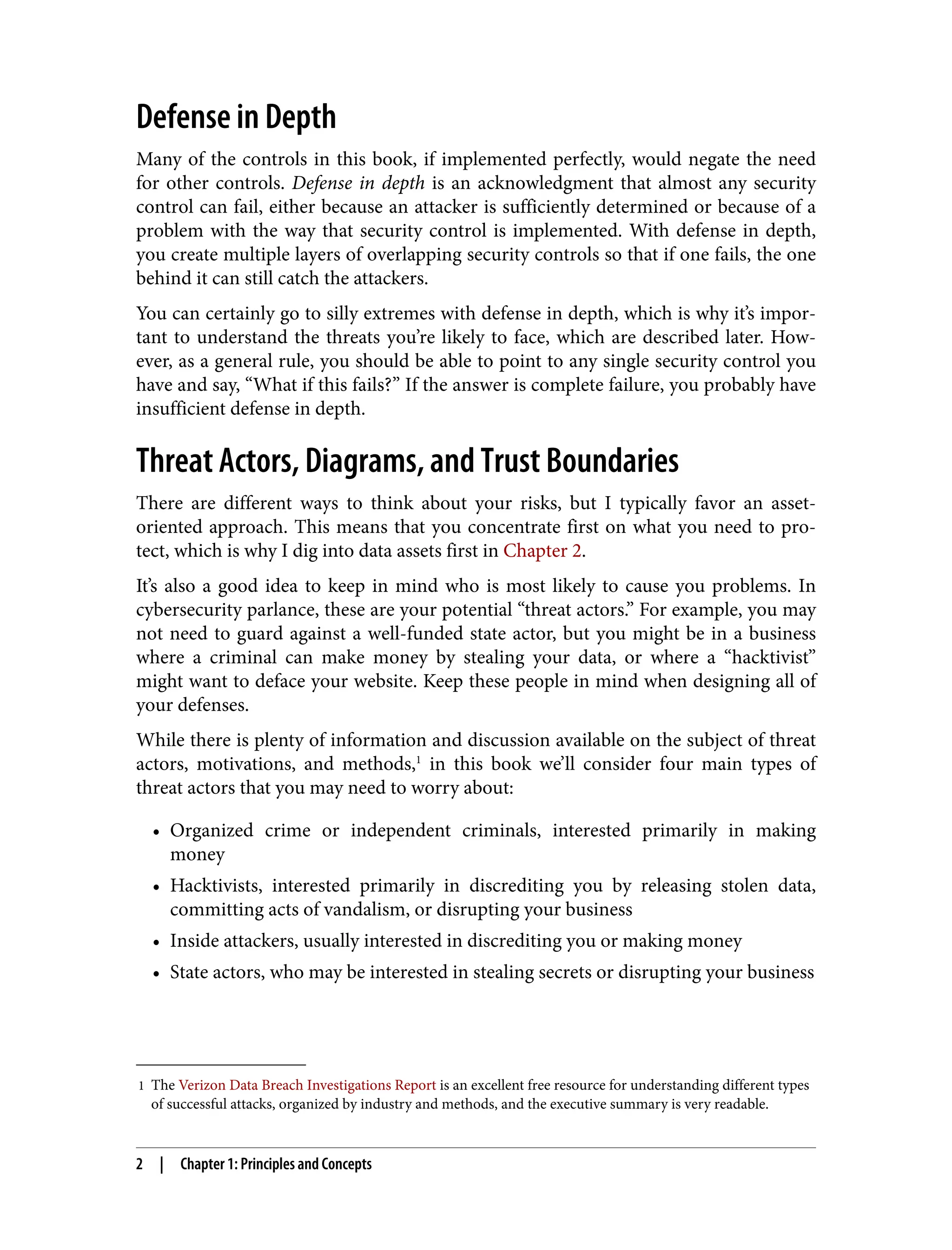
1. Draw a stick figure and label it “user.” Draw another stick figure and label it
“administrator” (Figure 1-1). You may find later that you have multiple types of
users and administrators, or other roles, but this is a good start.
Figure 1-1. User and administrator roles
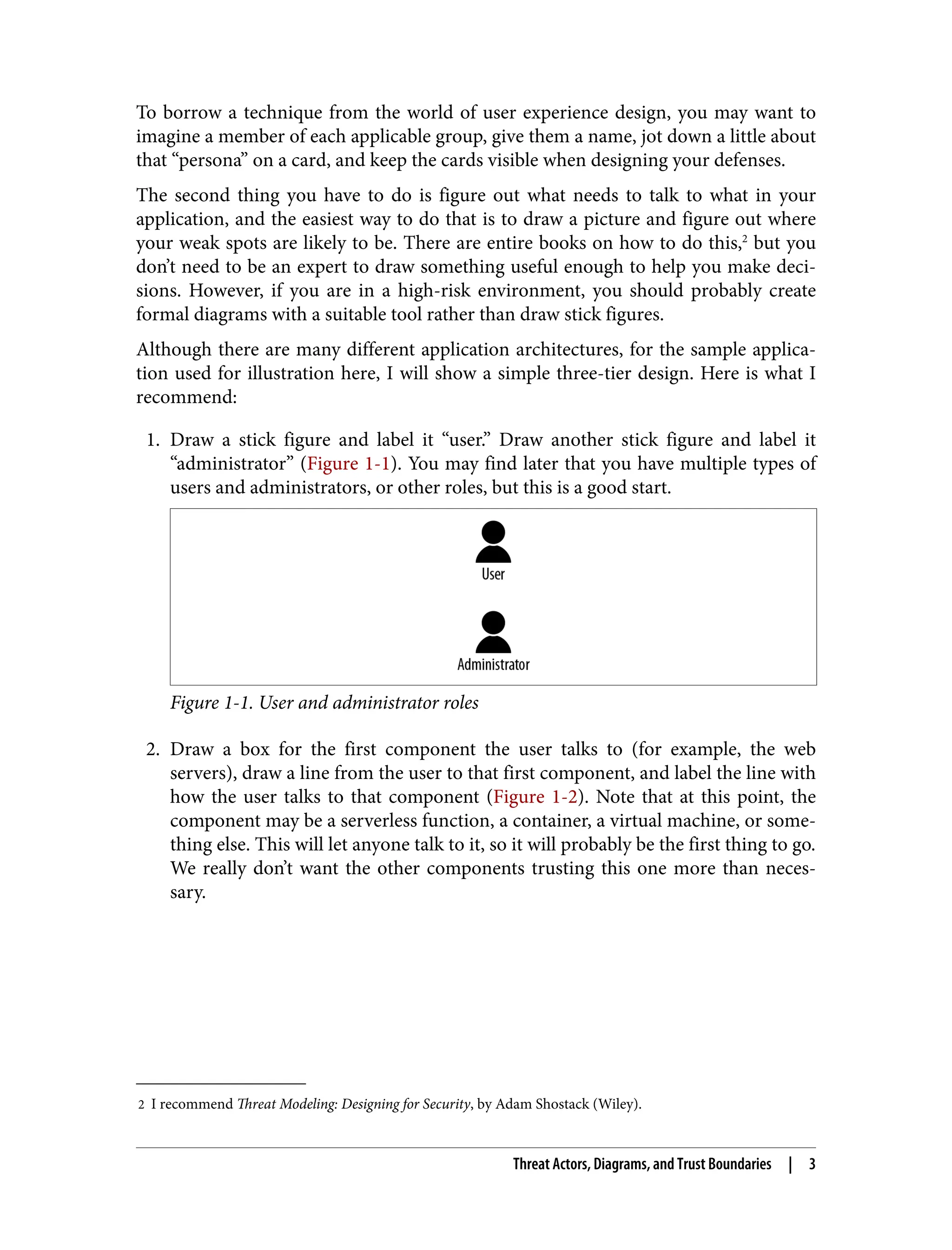
2. Draw a box for the first component the user talks to (for example, the web
servers), draw a line from the user to that first component, and label the line with
how the user talks to that component (Figure 1-2). Note that at this point, the
component may be a serverless function, a container, a virtual machine, or some‐
thing else. This will let anyone talk to it, so it will probably be the first thing to go.
We really don’t want the other components trusting this one more than neces‐
sary.
Threat Actors, Diagrams, and Trust Boundaries | 3
Figure 1-2. First component
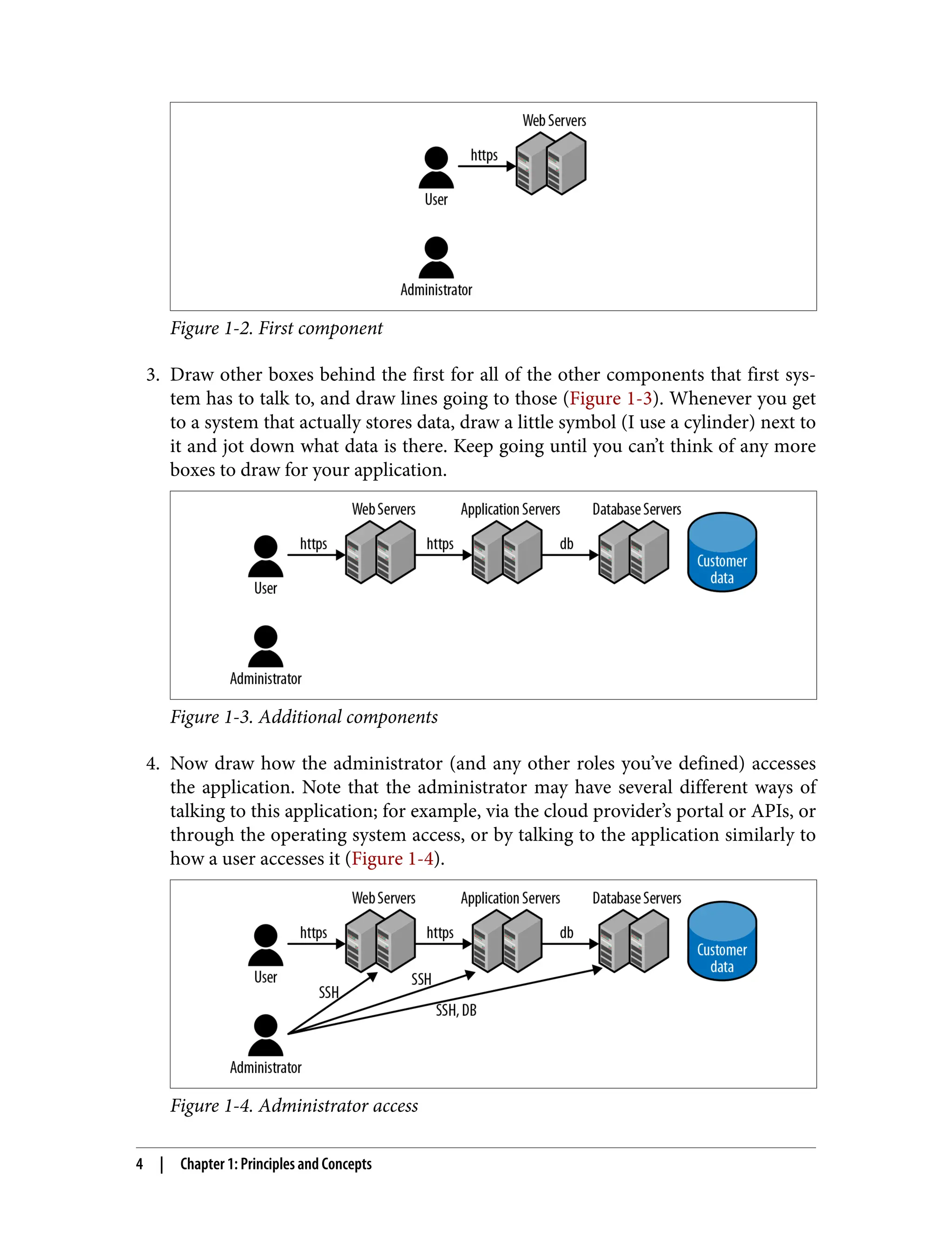
3. Draw other boxes behind the first for all of the other components that first sys‐
tem has to talk to, and draw lines going to those (Figure 1-3). Whenever you get
to a system that actually stores data, draw a little symbol (I use a cylinder) next to
it and jot down what data is there. Keep going until you can’t think of any more
boxes to draw for your application.
Figure 1-3. Additional components
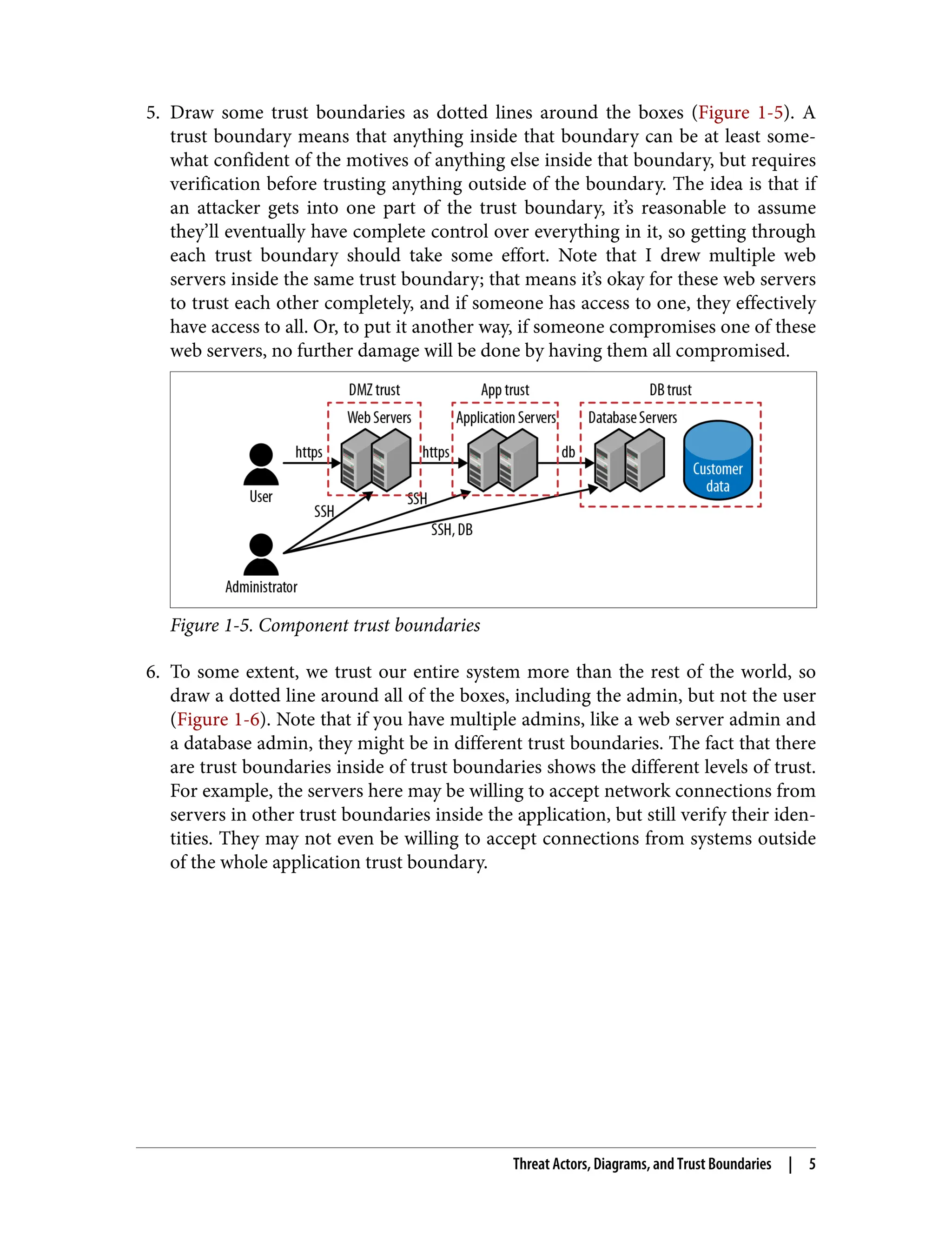
4. Now draw how the administrator (and any other roles you’ve defined) accesses
the application. Note that the administrator may have several different ways of
talking to this application; for example, via the cloud provider’s portal or APIs, or
through the operating system access, or by talking to the application similarly to
how a user accesses it (Figure 1-4).
Figure 1-4. Administrator access
4 | Chapter 1: Principles and Concepts
5. Draw some trust boundaries as dotted lines around the boxes (Figure 1-5). A
trust boundary means that anything inside that boundary can be at least some‐
what confident of the motives of anything else inside that boundary, but requires
verification before trusting anything outside of the boundary. The idea is that if
an attacker gets into one part of the trust boundary, it’s reasonable to assume
they’ll eventually have complete control over everything in it, so getting through
each trust boundary should take some effort. Note that I drew multiple web
servers inside the same trust boundary; that means it’s okay for these web servers
to trust each other completely, and if someone has access to one, they effectively
have access to all. Or, to put it another way, if someone compromises one of these
web servers, no further damage will be done by having them all compromised.
Figure 1-5. Component trust boundaries
6. To some extent, we trust our entire system more than the rest of the world, so
draw a dotted line around all of the boxes, including the admin, but not the user
(Figure 1-6). Note that if you have multiple admins, like a web server admin and
a database admin, they might be in different trust boundaries. The fact that there
are trust boundaries inside of trust boundaries shows the different levels of trust.
For example, the servers here may be willing to accept network connections from
servers in other trust boundaries inside the application, but still verify their iden‐
tities. They may not even be willing to accept connections from systems outside
of the whole application trust boundary.
Threat Actors, Diagrams, and Trust Boundaries | 5
Figure 1-6. Whole application trust boundary
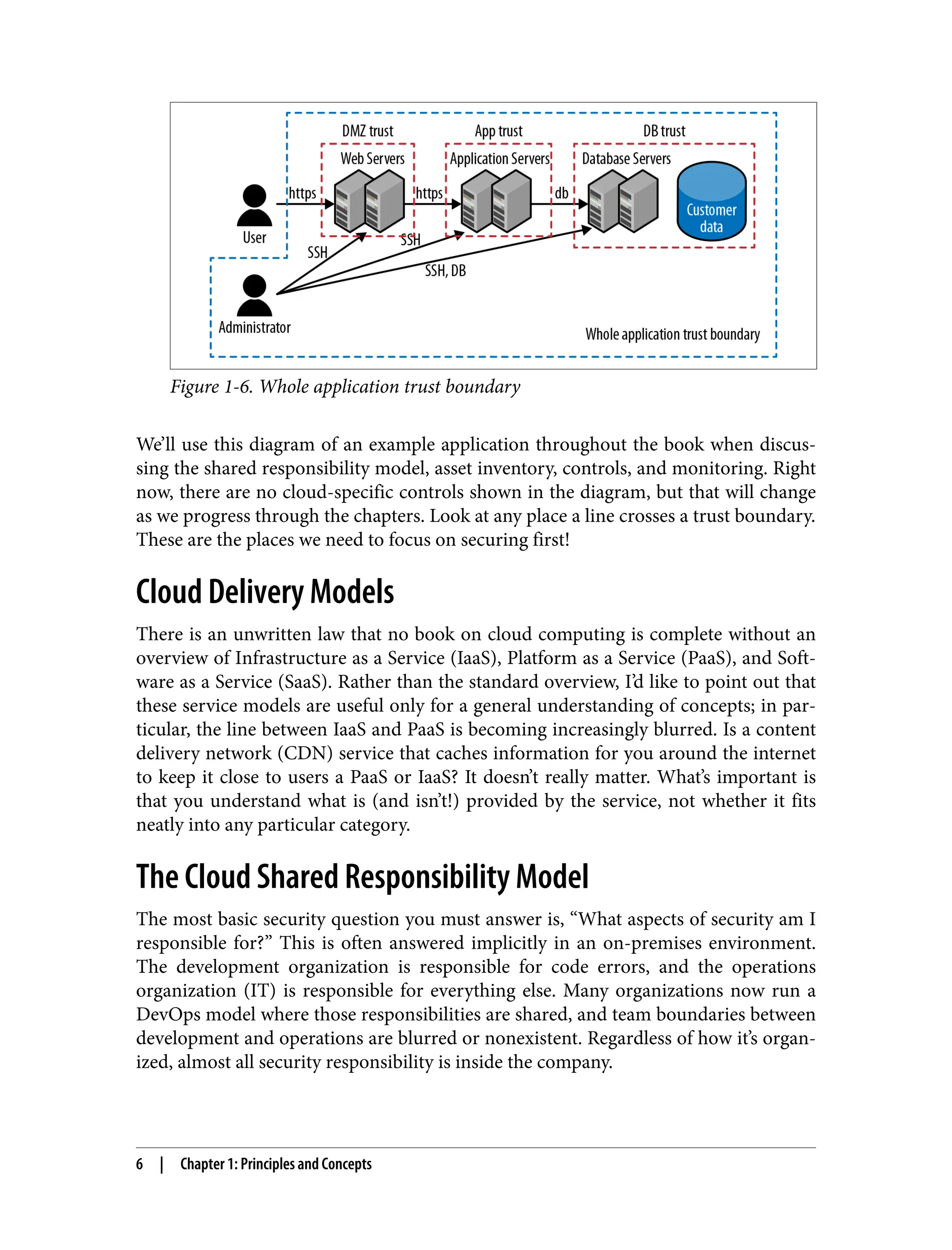
We’ll use this diagram of an example application throughout the book when discus‐
sing the shared responsibility model, asset inventory, controls, and monitoring. Right
now, there are no cloud-specific controls shown in the diagram, but that will change
as we progress through the chapters. Look at any place a line crosses a trust boundary.
These are the places we need to focus on securing first!
Cloud Delivery Models
There is an unwritten law that no book on cloud computing is complete without an
overview of Infrastructure as a Service (IaaS), Platform as a Service (PaaS), and Soft‐
ware as a Service (SaaS). Rather than the standard overview, I’d like to point out that
these service models are useful only for a general understanding of concepts; in par‐
ticular, the line between IaaS and PaaS is becoming increasingly blurred. Is a content
delivery network (CDN) service that caches information for you around the internet
to keep it close to users a PaaS or IaaS? It doesn’t really matter. What’s important is
that you understand what is (and isn’t!) provided by the service, not whether it fits
neatly into any particular category.
The Cloud Shared Responsibility Model
The most basic security question you must answer is, “What aspects of security am I
responsible for?” This is often answered implicitly in an on-premises environment.
The development organization is responsible for code errors, and the operations
organization (IT) is responsible for everything else. Many organizations now run a
DevOps model where those responsibilities are shared, and team boundaries between
development and operations are blurred or nonexistent. Regardless of how it’s organ‐
ized, almost all security responsibility is inside the company.
6 | Chapter 1: Principles and Concepts
3 Original concept from an article by Albert Barron.
Perhaps one of the most jarring changes when moving from an on-premises environ‐
ment to a cloud environment is a more complicated shared responsibility model for
security. In an on-premises environment, you may have had some sort of internal
document of understanding or contract with IT or some other department that ran
servers for you. However, in many cases business users of IT were used to handing
the requirements or code to an internal provider and having everything else done for
them, particularly in the realm of security.
Even if you’ve been operating in a cloud environment for a while, you may not have
stopped to think about where the cloud provider’s responsibility ends and where
yours begins. This line of demarcation is different depending on the types of cloud
service you’re purchasing. Almost all cloud providers address this in some way in
their documentation and education, but the best way to explain it is to use the anal‐
ogy of eating pizza.
With Pizza-as-a-Service,3
you’re hungry for pizza. There are a lot of choices! You
could just make a pizza at home, although you’d need to have quite a few ingredients
and it would take a while. You could run up to the grocery store and grab a take-and-
bake; that only requires you to have an oven and a place to eat it. You could call your
favorite pizza delivery place. Or, you could just go sit down at a restaurant and order
a pizza. If we draw a diagram of the various components and who’s responsible for
them, we get something like Figure 1-7.
The traditional on-premises world is like making a pizza at home. You have to buy a
lot of different components and put them together yourself, but you get complete
flexibility. Anchovies and cinnamon on wheat crust? If you can stomach it, you can
make it.
When you use Infrastructure as a Service, though, the base layer is already done for
you. You can bake it to taste and add a salad and drinks, and you’re responsible for
those things. When you move up to Platform as a Service, even more decisions are
already made for you, and you just use that service as part of developing your overall
solution. (As mentioned in the previous section, sometimes it can be difficult to cate‐
gorize a service as IaaS or PaaS, and they’re growing together in many cases. The
exact classification isn’t important; what’s important is that you understand what the
service provides and what your responsibilities are.)
When you get to Software as a Service (compared to dining out in Figure 1-7), it
seems like everything is done for you. It’s not, though. You still have a responsibility
to eat safely, and the restaurant is not responsible if you choke on your food. In the
SaaS world, this largely comes down to managing access control properly.
The Cloud Shared Responsibility Model | 7
Exploring the Variety of Random
Documents with Different Content
Leaving Moselekatze Kop, going to Kanya, the road turns
west, then north-west for thirteen miles, to a deep and
stony watercourse, that comes down from the mountain two
miles distant, which is a branch of the river Tans and Sand,
into the Notuane. Many picturesque sandstone hills of every
variety of form, covered with rich subtropical vegetation to
their summits, with gigantic rocks peeping out between the
bushes, give a peculiar feature to the landscape. Some of
the finest tree-aloes grow here to perfection, the stems
measuring twenty-five feet, and in girth six feet, their long
light-green pointed leaves measuring four feet, and when in
bloom their many crimson flowers are beautiful objects. The
country being so lovely, I remained at this stony river three
days to sketch and prospect, and was rewarded by finding
in the bed of the river, mixed up in the large stones, ancient
flint implements, that had been washed down in heavy
rains. Several of them were so jambed in between large
boulders of many tons weight, that I had to get a crowbar
to remove them. Some of these boulders measured over
four feet in diameter, showing the force of the stream and
quantity of water that falls in these thunderstorms.
The temperature at night in my waggon in April was 68
degrees, and at mid-day 84 degrees. No large game has
been seen, although the natives tell me there are koodoos,
blue wildebeest or gnu, hartebeest and springbok.
From this river the road winds through these beautiful
valleys, passing a remarkable granite rock standing alone in
the veldt, round like a Kaffir hut, twenty feet in height,
continuing on through the same kind of country to Kanya.
Another, in fact two other roads, leave Rinokano, and go
direct to Molapololo, the chief Sechele’s station; one round
by Ramoocha Khotla, named after an old chief, passing
through Base Poort, a lovely spot, plenty of baboons and
beautiful birds; we cross the Sand river four times, very
stony, on to Sneyman’s farms, past the Spitz Kop, another
remarkable hill, over an open flat, park-like, with beautiful
clumps of trees, to Dwasberg, passing on the right
Kolobekatze mountain, leaving on the left the Quagga and
Kopani hills, and on to Ramoocha, where the chief Makose
has a large station. These people belong to the Bamankitse
tribe of the Bechuana family. It is a mission in charge of the
Rev. Mr Schonenburg, of the Berlin Society. From this kraal
the road divides, one going to Chene Chene, where the
chief Maklapan lives on the bank of the Notuane, and then
to Motsode, taking the Limpopo river road to Ba-Mangwato.
The second goes direct to Molapololo; the third to the same
town, through the Kaffir station Monope, under the chief
Kuanette, of the Bahurutsi-Bamangane of the Bakatla tribe
of the Bechuana family. Monope is also a Berlin Mission
station, in charge of the Rev. Mr Tanson.
The large Kaffir station of Monope is well situated on
elevated ground, a gentle rise from the river Coloben, a
branch of the Notuane, being protected by several large
stone koptjies. The people are very quiet and civil, cultivate
extensively Kaffir corn, and make karosses, which they sell
to traders. When I first knew the people, twenty years ago,
there was not a man or woman that dressed in European
clothes; at the present time most of them are getting into
the way of dressing. The men wear clothes, and will have
the best.
The Notuane river has many tributaries, that take their rise
in this territory and at Rinokano, which drains the whole of
this district, and falls into the Limpopo. The town of Kanya,
as I have stated, stands on a hill, much higher by several
hundred feet than the surrounding country. There are seven
stores kept by colonial traders, who did, before the
Transvaal rebellion, a good trade with the natives in corn,
cattle, feathers, ivory, skins, karosses, and other native
produce, but which have been almost destroyed through the
Boer disturbances. The chief Gaseitsive is a quiet and
peaceful man, and his son Bathoen is also well-disposed. All
the men dress in European clothes, and the women are
taking to them. It is one of the most difficult things to
change the habits and customs of a people, but in my time
great strides have been made in this direction up even to
the Zambese. The large station at Mashonen, eighteen
miles to the west of Kanya, is now occupied by this chief’s
people, since Montsioa left to live on his own ground at
Sehuba. The country between Kanya and Masepa station is
very picturesque, lovely valleys, some well cultivated; many
of the hills that surround them are clothed in lovely
vegetation—the euphorbia, wild fig, and other subtropical
plants; creepers of every variety climbing up between the
large masses of sandstone rocks that stand out in grotesque
forms, piled one upon another, add much to the beauty of
the landscape. Such charming scenery could not be passed
over in haste, particularly when surveying the country,
which, detained me from time to time many weeks in
treking through.
The different streams that drain this part rise to the west in
the Kalahara desert and fall into the Sand, Tuns, and
Coloben branches of the Notuane river. The climate is
splendid, so far as perpetual sunshine for eight months of
the year goes; the summer from December to April being
the rainy season, when severe thunderstorms and a
downpour of rain are almost of daily occurrence; but with
such a long drought vegetation does not seem to suffer.
The natives are most friendly, bringing milk, green mealies,
sugar-cane, pumpkins, anything they possess, to the
waggon, in exchange for beads, tobacco, or such trifles as
they might require.
At one of my outspans, close to the highest range of hills
between Masepa and Coloben, I formed my camp under
some fine trees, as it was my intention to ascend the
highest hill, to take observations with my servant, the next
day. During the night several wolves visited us; the smell of
the fresh meat in the waggons brought them nearer than
was prudent, for we shot two very large ones in the early
part of the night. Their skins are very useful for many
purposes. This occurred when few white men visited Africa;
consequently, lions, wolves, and other animals were seen
and heard daily, and therefore necessary precautions had to
be taken to guard against any attack upon my oxen. In the
early morning of the following day I saddled-up my horse,
and with my rifle started for the hills. It is always a practice
in such a country never to be without your rifle, for it is
impossible to say when you may require to make use of it.
Finding the hill much too steep to ride up, I led the horse
along a winding path between bushes and trees, and
reached the top, which was level and open. The view from
this point repaid me for the trouble of ascending. The lofty
and well-wooded hills in the immediate vicinity, the distant
mountains with their rugged outlines, clothed in purple
mist, with the rich valleys beneath, was a landscape worth
looking at. The clear atmosphere brought out all the
inequalities and projecting rocks of quaint forms into
prominence. I was not, however, allowed to remain long in
this peaceful solitude before I became aware I had invaded
Mr Baboon’s stronghold and look-out station. Making a more
minute survey of my surroundings, I observed that many of
the trees and bushes concealed one or more of these
monkeys, and others perched upon rocks not far off intently
watching my movements. Not a sound escaped them; I
believe the presence of my horse had much to do with
keeping them quiet, for horses then were never seen in
those parts. If I had been alone some of the old ones might
have given me trouble; many of them appeared to be
nearly my own size. To see what effect a shot would have, I
fired one chamber of my revolver. Then the music
commenced—barks, screams, half-human grunts sounded
from a hundred different places as they scrambled from
branch to branch to gain cover amongst the rocks and small
caves in the side of the hill, which, in days long since
passed away, were occupied by Bushmen. The height of this
elevation was 4560 feet above sea-level.
On arriving at my waggon I found one of my oxen stuck in a
mud-hole, and with difficulty released him and proceeded
on to Masepa, the petty chief Pelan’s station, where the
Kaffir women brought me thick milk, which is very good and
acceptable in this hot weather. There are many Kaffir
stations along these roads of the Bakwana and
Bangweketse tribe of Bechuana, who live under their
respective chiefs. From my earliest visits in this country, up
to the present time, the Boers have been a murdering and
unprincipled people, over all these parts, stealing the native
cattle and encroaching on the land. In 1852 Dr Livingstone,
in a letter to Sir John Pakington, states,—“Frequent
attempts were made by the Transvaal Boers to induce the
chief Sechele to prevent the English from passing him in
their way north; and, because he refused to comply with
this policy, a commando was sent against him by Mr
Pretorius, which, on the 30th September last, attacked and
destroyed his town, killing sixty of his people, and carried
off upwards of 200 women and children. I can declare most
positively that, except in the matter of refusing to throw
obstacles in the way of English traders, Sechele never
offended the Boers by either word or deed. They wished to
divert the trade into their own hands. They also plundered
my house of property which would cost in England at least
335 pounds. They smashed all the bottles containing
medicine, and tore all the books of my library, scattering
the leaves to the winds; and besides my personal property,
they carried off or destroyed a large amount of property
belonging to English gentlemen and traders. Of the women
and children captured, many of the former will escape, but
the latter are reduced to hopeless slavery. They are sold
and bought as slaves; and I have myself seen and
conversed with such taken from other tribes, and living as
slaves in the houses of the Boers. One of Sechele’s children
is amongst the number captured, and the Boer who owns
him can, if necessary, be pointed out.” The above statement
is perfectly true in every particular. This murderous attack
on Sechele and his people took place at Monope, and the
old men at the station took me up into one of the stone hills
close to the town, and showed me the small cave, about ten
feet square, in the side of the hill, where Sechele and his
wife took refuge with several guns and ammunition, and
were pursued by the Boers, who kept up a constant fire into
the cave, whilst Sechele and his wife, protected by the
projecting rock, kept them off, Sechele firing, whilst his wife
loaded the pieces. And the Kaffirs called my attention to the
bullet-marks on the opposite rocks, where portions of the
bullets still remained. Finding that Sechele shot a Boer
whenever he showed himself, killing five, they withdrew,
and Sechele and his wife came out. After this affair Sechele
went a few miles north with his people, and settled at
Coloben, and then on to his present station, Molapololo.
There is no denying the fact that the Boers, from the time
they crossed the Vaal river into Transvaal, have been a
greater curse to the country, wherever they have set foot,
than Moselekatze ever was when he marched north from
Zululand. Some think they are excellent pioneers in a new
country. They advance into native territories, killing the
people by thousands, enslaving women and children,
robbing them of all their lands and cattle, and occupying
their country, with no ulterior benefit to themselves or
others, but merely as a field for further cruelties and
spoliation of native races, so that the country may be
cleared of them, but not for civilisation or improving the
country, because they leave a dark spot wherever they
settle from the ruthless cruelties they perpetrate upon
unoffending and innocent people. Are they then good
pioneers? All the sophistry in the world cannot make it
right. To murder, enslave, and rob innocent human beings,
living on their own lands, who have done no harm, and
have as much right to live and enjoy their own as any other
people, black or white, that they should be so ruthlessly
treated by men who profess Christianity and to be a God-
fearing people, is an anomaly, and cannot be tolerated by a
just and upright people like the British nation. And yet these
atrocities are at the present moment being carried on in
Bechuanaland by the Boers of the Transvaal and Orange
Free State and other scum of European nationality, who
have lost all sense of honour and justice, for the purpose of
gaining a footing in the country; and we allow them to
commit these lawless and criminal acts unchecked. They do
not even civilise or improve the country they take. Look at
the Transvaal; for forty years the Boers have had
possession of it. What is it now? No more civilised than
when they entered it, but the contrary. The Boers are more
demoralised, as we know, who know them. Their acts alone
are a sufficient answer to this question, and South Africa
will not advance in prosperity and wealth until the Boer
element is brought to a sense of justice; and that will never
be while the Boers hold an independent position in the
Transvaal.
The population of the Bechuanas in Gaseitsive’s territory,
including those under the chief Kuanette at Monope and
Pelan at Masepa, does not exceed 35,000, exclusive of
Bushmen; and against this the entire white population of
the Transvaal at the present time does not exceed 40,000,
including English and other nationalities. Then why should
this handful of men be allowed to keep all South Africa in a
perpetual state of disquietude, to the immense injury of the
trade of the country? The gold re-discoveries, however, will
settle this question, and that within the next year or two.
The bulk of the most intelligent and influential Boers are
determined to be annexed, and the hoisting of the British
flag is only delayed by the savage, ignorant “Doppers,” with
whom the diggers will make short work whenever they
think fit to do so. The population now cannot be less than
50,000, of whom 20,000 are Europeans, and all fighting-
men, whilst the Boers cannot muster more than 10,000, of
whom the half are on our side.
Chapter Nine.
The chief Sechele of the Bakwana tribe of the
Bechuana family.
On entering this chief’s territory from the south, that is from
Kanya and Masepa, the country is undulating and densely
wooded with trees and bush, the road stony and uneven.
Approaching Molapololo, Sechele’s chief town, a long range
of lofty hills comes in view, and as you near them a bold
outline presenting many perpendicular and lofty cliffs, which
gain in magnitude as you advance along the road with your
waggon, passing between many Kaffir gardens. This range
reminded me very forcibly of the Devonshire coast-line at
Bolthead, and requires a short description to make more
clear the general outline, as in no other region I have
visited is there so singular a mountain, and one that
conveys so plainly to the mind the history of remote times,
and which appears so little changed from what it was at
that period.
On leaving the low and level country to enter Molapololo,
the entrance is in a break of these hills, which rise from
their base several hundred feet. In this opening is the
remains of a considerable river. On passing through this
entrance, which is about 250 yards wide, we come into an
open space, surrounded by lofty hills, with an opening on
the west side where this ancient river enters from the
Kalahara desert, passing through this open space and
through the entrance just described. On the east side of this
open space is another entrance, flanked with lofty and
almost perpendicular cliffs. The open space itself is about
half a mile both ways, of an irregular shape, and has every
appearance of being at one time a splendid harbour, with
two entrances, surrounded by lofty hills, leaving the
opening on the west side, where the once ancient river
passed in between a narrow opening of light sandstone
rocks. The soil of this open space is clear light sand, and is
now occupied by several hundred native huts, and is also
the residence of the missionary, the Rev. Mr Price, of the
London Missionary Society, and also traders who have six
stores. The outer face of the range of hills above-named
that faces the south, present a bold and perpendicular front
many hundred feet in height, half-way down; then it slopes
at an angle of fifty-five to the foot, which is the
accumulation of soil fallen from the upper cliffs; at the base
a level sandy space of some hundred feet, clear of bush,
similar to our sea-coast sands; and beyond for thirty miles
the country is almost level, but thickly wooded. The
principal formation of these hills is sandstone, the
stratification is almost horizontal, but dips towards the
north. The entrance on the eastern side is most interesting,
and showing the action of the sea on the outer face of the
lofty cliffs, which were exposed to its force. Half-way up one
of the faces, 400 feet above the base, is a large cave
extending some distance into the hill; the entrance is
shaped like the portal of a castle, with perpendicular sides
fifty feet wide and seventy feet in height, the rock round
and smooth on both sides of the entrance. The interior has
several chambers, similar in form to many caverns along
the rocky shores in various parts of the world formed by the
action of the waves. The land-face of this ancient harbour,
the hill, rises 400 feet at an angle of 30 degrees. On the
summit is another extensive level space, surrounded on the
west and east by lofty rocks; the north is open to the level
country beyond. On this open ground the main portion of
the town of Molapololo is situated, and the residence of the
chief Sechele, who has two well-built houses furnished after
European fashion: an entrance-hall, fitted up with weapons
of war, a dining and drawing-room, bedrooms and offices,
sideboards, tables, chairs, with the usual glasses,
decanters, silver stands, and such things as are required in
a dining-room. The drawing-room has sofas and lounging-
chairs, pictures, and everything nice—quite as comfortable
as any house I have ever been in in South Africa, except in
the principal towns in the colony. Sechele dresses well in
English clothes, and his eldest son, Sebele, is also a well-
dressed, handsome Kaffir. In 1866, when I first saw
Sechele, he was not so particular in his dress, and most of
his people had skin dresses; now many wear English clothes
of the best quality. I am describing now the state of the
natives in 1880, my last visit. But now since the Transvaal
has been handed back to the Boers, trade has become
paralysed and little or nothing is doing with the colony, as
the Transvaal Boers have closed all the interior roads, and
not only done so, but robbed and burnt traders’ waggons on
their way to the interior, and driven the traders out of
Montsioa’s and Monkuruan’s territories, and by their lawless
acts have devastated the country.
At my last visit but one, in 1877, I was received with great
kindness, and as an old friend, by Sechele, who had on
former occasions shown me great kindness and hospitality.
I arrived at the town on Sunday afternoon, the 1st of
September, after suffering much from want of water, and
bad grass, since leaving Masepa. I called on the Rev. Mr J.
Moffat, and then returned to my waggon, where I found
Sechele’s brother, who had been sent by his chief, inviting
me up to see him. On Monday morning I walked up to his
house; he was sitting in his kotla with his councillors, then
stood up, shook hands, took my arm without speaking, and
walked to his house, a few steps from the kotla, as the
enclosure is called where he and his councillors transact
business, and took me into his drawing-room, seated me
beside him on the sofa, still holding my hand, and ordered
coffee. After giving him the particulars of my journey and
the news of the country, he asked me to take dinner with
him, and was pleased to see me. The table was laid similar
to any white man’s—stewed beef and pumpkins, Kaffir beer,
for which he is famous. Then had I to listen to all his
troubles respecting the chief Linsey, who lives at
Kgamanyane or Motsode, a station forty-two miles on the
east of Molapololo, who had robbed him of all his cattle, and
he was now a poor man. Having examined some papers he
placed in my hands, I gave him an outline of my journey to
the Matabeleland, and left him with a promise to see him on
my return from up-country, to give the news. Such is the
chief the British people look upon as a savage, and many
out here call a wily old fox, because he is guarded in what
he says and does; and can any one be surprised at his
reticence when he has so many enemies in the Boers, who
are watching for the first chance to make war on him and
his people in their thirst for land and plunder? He has
always been a good friend to the English, and recent events
have taught him to be more than careful how he acts,
seeing that no dependence can be placed on the English
Government in relation to South African affairs; and such is
the feeling of all the great chiefs from the Zambese down to
the Cape Colony.
A more romantic position for a native town could not well be
chosen, and with little labour this natural fortress could be
made impregnable. Many of the women wear petticoats,
others still retain their skin dresses with bead and brass
ornaments; and if left alone, without fear of Boer invasion,
these are the most happy people in the world. The English
people have hitherto been looked upon as friends and
protectors, and as one of them I felt proud of my country.
But since the Transvaal rebellion and its retrocession, an
Englishman is ashamed to travel the country, to be subject
to the taunts of the chiefs and people at the boasted honour
of England. As I have stated, the people are the most happy
of the human race—having no cares, no great division of
classes, no extravagant fashions or forms to keep up.
Luxuries of civilised life are unknown. They have their
amusements, their nightly music and dances, the usual reed
band already described; the women and children sing, and
keep excellent time to the music; their clear and musical
voices are pleasant to hear. The duty of the men is to
attend to the oxen and cows, make karosses and clothes,
hunt and work with their waggon and spans, fetching in the
corn when ripe, bringing in wood for the fires; the boys look
after the calves and goats. The women cook, bring water,
hoe the gardens, and keep the birds away, and cut the corn
when ripe—the labour being so divided, all goes on
pleasantly. Sechele assists the missionary in his services at
the church, which is a large building in the upper town. A
few days previous to my visit a troop of young elephants
marched up to the kraal from the Kalahara desert, having
lost themselves—a very unusual occurrence, as they seldom
come down so far south. The natives turned out and shot
them, causing great excitement.
In Sechele’s territory there are no other stations of any
size; he has many smaller kraals in outlying districts, and
several cattle-posts belonging to Kaffirs, some of whom are
rich in stock. Four roads branch from Molapololo to the
north, one passing through the desert to Lake N’gami, two
direct to Ba-Mangwato through the Bush Veldt, a fourth via
Motsode, by continuing down the Notuane river; another,
making a fifth, taking the river road by the Limpopo. The
distance by the direct roads to Mongwato is 133 miles. In
the dry season most of the transport-waggons take the river
road, as water is always to be obtained. In the direct roads,
many of the pans dry up; only at Selene Pan can water be
procured, which is eighty-eight miles from Sechele’s, and
forty-five from Mongwato. All that part of the country is
very pretty; there are no hills, small koptjies are numerous.
The trees and bush that grow in such park-like clumps, of
great variety, add to its charm. The first year I travelled
that road, eighteen years ago, the whole country swarmed
with game, lions, and wolves, that is, at the time I speak of.
The koodoo, with fine spiral horns from three to four feet in
length, is a noble animal, the size of an ordinary ox, of a
dun colour; their fine action when trotting or on the gallop,
carrying their heads well up, is a fine sight. Hartebeests,
roibok, with their beautiful fat sides and sleek coats. Well-
marked with black stripes and white is the zebra, and when
a troop of a hundred or more pass, it is a picture in itself.
The ostrich was then plentiful, but it was difficult to run
them down where the trees grow so thick, with bush
between.
I had a young and fleet horse who got quite used to hunting
them; if he saw any, it was difficult to keep him in hand,
and in a country of thick bush, wolf-holes, and ant-bears, it
required great caution to prevent a tumble of both horse
and man. The best plan I found was to stalk them between
the bushes. I had a narrow escape with a lion on one of my
ostrich hunts. When chasing them at full speed, I had to
leap a low bush, no other opening being near; when half-
way over, I saw a lion on the other side close under the
branches, who raised himself as if he had been asleep—I
partly passed over him. All I had time to see was his great
head and mane as he jumped up, but I was off and away
before he seemed to realise his position; at any rate he did
not give chase, as I thought he might do. I think my horse
had some inkling of the same, for he stretched out at his
full speed. At night they became very troublesome, prowling
round the waggon, keeping us awake to prevent them
coming disagreeably close to the oxen and two horses
fastened securely by reins to the trektow and waggon. Not
being hunted, they were very bold. One night they killed a
beautiful gemsbok within 100 yards of the waggon; the long
straight horns I secured the next morning.
Several Bushmen and their families kept with me during my
stay in these parts, and were of great assistance in fetching
water, cutting up the flesh to make biltong by drying it in
the sun, and bringing in the game when shot. Some of the
Bushmen and women were well-made, the old ones poor
specimens of humanity. One girl was a perfect model, with
rounded, well-formed limbs, and in good condition from
living on the game the men killed with their bows and
arrows. These people were quite black and small, a different
type altogether from the Bushmen of the south. They were
of the same family as those who occupy a great portion of
the Kalahara desert, of which this forms the eastern part.
Their language is also different; they are called Mesere
Bushmen from their small size; that word signifies woman.
They were perfectly naked, the weather never being cold, at
this time the thermometer being 102 degrees in the shade.
Their long rough grass huts being a broken bough or a few
sticks stuck up and long grass thrown over.
They have a very ingenious method of taking game by
pitfalls. They dig four or five pits eight feet deep, ten long
and four wide, fifty or sixty and sometimes 100 feet from
each other, not in a straight line, but so placed that when
they make a fence from one to the other it would form the
letter V; at the point would be the pit, and no hedge, so
that an animal wanting to pass through would walk down to
the opening, and as the pit would be beautifully covered
over with small sticks and grass, made a very inviting road
to walk over. It was at one of these openings I had a very
narrow escape of my life. Returning to my camp after a long
day out after game, I came upon this fence, seeming an
opening, and not having seen any before, I was going
through, my dog in front, when I saw him disappear all at
once, howling as dogs will howl when hurt or frightened.
Dismounting, I pulled away some of the sticks to make the
hole larger, and found one of these pits, with a large sharp-
pointed pole stuck upright in the centre, and there was the
dog at the bottom in a great state of mind; but how to get
him out was a puzzle. As there were several long straight
branches that formed the hedge, I got sufficient to put in
that I might go down to take hold of the dog’s neck and lift
him out, which took me an hour to perform. I took care to
give these hedges a wide berth when I saw any afterwards.
If a giraffe or elephant fell in he would be impaled and
unable to move. Smaller game like my dog are caught alive.
If I and my horse had gone in, he would have been
impaled, and I should have been probably killed.
The Bechuanas have another method of catching game by
pitfalls—at least many years ago it was in use, where
instead of securing one, they trapped hundreds at one time.
In those extensive open plains, where tens of thousands of
the antelope species roam, a favourable spot would be
selected, and from eight to twelve large pits dug, ranged in
a row fifteen feet apart, the earth taken out to the depth of
five feet, and thrown up between them, forming a steep
bank; at the bottom of this pit, it would be divided into
smaller pits, two feet in depth, leaving a wall of earth
between each; these would be square, and three in a row.
The full size of the opening would be about thirty by twelve
feet, placed longways. These would occupy a considerable
space; at the extreme ends a thick bush hedge would
prevent the game leaping over, and several hundred men
placed in addition to prevent the animals going round.
When all was prepared, men would drive the game by
thousands towards the pits, and as they were pressed on by
those behind they made for the pits to escape, where they
would fall in, and having no foothold in the small square pits
above-named, had to remain. Hundreds passing over them,
also got fixed, until the pits were full.
Then the grand slaughter commenced; as many as 1200
have been caught at one time. All the men, women, and
children set to work; fires made, cooking begins, the skins
taken off, and the meat cut up into lengths and hung up to
dry in the sun for future use; not a marrow-bone is wasted,
and it takes days to complete the work. This practice has
been given over for years, but the pits still remain, some
very perfect, which I measured. The Dutch name is
“fungcut,” the Kaffir name “hopo.” The game driven into
these pits would be composed of all kinds common to the
country. The Bechuanas have guns and shoot the game,
and have become very good shots.
At Molapololo when the people get short of meat, a hunt is
got up to go out for weeks to shoot game. Thirty or forty
men, each with a gun, and pack-oxen, with several
waggons, proceed to the Kalahara, where game is always to
be had, and when they have procured enough meat or
biltong to load up the oxen, they return home. Many women
and children go in the waggons with them; it is a grand
picnic. I was with them on one occasion when we had a
lion-hunt, and we killed three out of seven, but four of the
Bechuanas got fearfully wounded.
I was outspanned about 100 miles on the north-west of
Sechele’s, near a very pretty pan full of water, it being the
rainy season in February, when one of these hunts came
along, and outspanned a short distance from my waggon.
The night previous we had been on the watch, as lions kept
prowling about the waggons, but could not see any, the
night being very dark. The next night the Kaffirs lost one of
their largest pack-oxen, and as we saw by the spoor that
there were several, the Kaffirs came to me, they knowing
me very well, and asked if I would go with them and hunt
up the lions, as we had several good dogs to drive them out
of the bush. We mustered in all twenty-two guns—myself
and my driver, a Hottentot, a capital shot, and twenty of the
hunting party. Leaving the camp about two p.m., we took
the lions’ spoor for nearly a mile into a small koppie with
thick bush. The best part of the sport was to see the Kaffirs
in their excitement, as if they had never seen a lion before;
my fear was they might shoot me in their anxiety to have a
shot and be the first to kill; every man had his place
assigned him, but we could not draw the lions out of their
cover; the dogs made a great noise, but would not go in.
Finding they would not move, I placed three Kaffirs in a
good position for them to keep firing with their rifles into
the most likely part; this after a time brought four lions out,
three others slunk away to the rear. Two had evidently been
hit by the bullets, for they made for the nearest Kaffirs,
whom they seized. Three were killed, having received seven
to eight shots each; those that made their escape were
young, only half-grown. This was a glorious day for the
Kaffirs, to go home and tell their chief and friends of their
bravery.
All this part of the Kalahara belongs to and is in Gaseitsive’s
territory, a country nearly 200 miles square; the northern
part from Molapololo is a complete forest, fine trees, bush
and open glades, and is his hunting-ground, where his
people procure ostrich feathers, skins, and game, and also
ivory. It was, when I first knew it, full of game, but since
the natives have obtained rifles, they have greatly reduced
it. The Notuane river and its branches drain the country
belonging to Sechele and Gaseitsive, and is a tributary of
the Limpopo. Fifty miles to the east of Molapololo is a large
Kaffir station, Chene Chene, within the latter territory,
under the chief Maklapan. A beautiful and picturesque hill
stands close to it, which is visible at a great distance. The
whole country is forest and full of game. The town is
twenty-nine miles south from Motsodie. The river road to
the interior from Molapololo passes through a very pretty
and interesting part of the country, a long range of low
thickly wooded hills on the left. Twenty-two miles on the
road from Molapololo is Clokan, a small stream, another
branch of the Notuane, where water seldom fails.
On my last journey I found a trader, a Mr Okenshow,
outspanned, who told me several lions had killed three blue
wildebeest the previous night, and advised me not to let my
oxen go out of my sight in the thick bush. This spot is
famed for beautiful birds. After shooting some pheasants
and four of these little beauties.
I went on and passed another small stream call Koopong,
thirteen miles, and then to Motsodie, the large Kaffir station
under the chief Linsey, which is forty-two miles distant from
Molapololo; he cautioned me to look after my horses and
oxen, for the country was full of lions, and they were so
bold they came close up to the town. They follow the game,
more particularly quaggas or zebras, and, as there were
plenty of them, also koodoos, hartebeest, and wildebeest.
Previous to my first visit, a chief named Kgamanyane left
his country on the east side of the Limpopo river, crossed
over and settled at this station, with all his people, by
permission of Sechele, and built a large station up among
several hills, that it might be well protected in case of war
with any tribe. At his death, his son Linsey ruled jointly with
his uncle, and claimed the country as his own, and began
stealing Sechele’s cattle and killing his herds; this led to war
between them; several attacks were made by the latter on
the town, but they were driven off, with a few killed, and so
the war for a time was ended. This was the trouble Sechele
told me of. The town is well selected for defence, the hills
command every approach to it. Linsey lives in a brick
house, and he and his people dress in European clothes.
There is a mission station under the London Missionary
Society. The people are very civil and ready to help
strangers. Close up to the town are some very large ant-
hills, fifteen feet in height, and forty feet in circumference
at the base, terminating in a sharp point. They are the work
of the small white ant that is so destructive to furniture and
buildings; what motive they have for building them so lofty
and pointed I have never been able to discover, because all
their food supply is conveyed into it through little holes at
the base. They are wonderful works for so small an insect. I
remained here a week that I might explore the country,
which is of sandstone formation, granite below, iron-
conglomerate in large boulders on the slopes of the hills.
There are two roads to the Limpopo river, one on each side
of the Notuane, and another through the Bush Veldt, to the
Great Marico river, with branch roads to Chene Chene,
Ramoocha, and Rinokano stations, the two former ones
being very bad and crossing many sluits. I took the one
through the Bush Veldt. Leaving Motsodie in the afternoon,
I crossed the river, and as night would be dark, outspanned
early, to be prepared for any nocturnal visits from our feline
friends. Fixing upon a pretty little open space, the only one
I could find along the road, as it was one dense bush on
both sides, I outspanned, and made everything ready,
collecting plenty of wood to make big fires. Having made a
fire to cook our evening meal, my three Kaffirs, or rather
my Hottentot driver and two Kaffirs, were sitting smoking
over it, and having seen all secure, were ready to turn into
bed, when my driver, a first-class boy, called out there were
lions coming on. He was the first to hear them—their noise
is not to be mistaken when once heard. Having listened
some time, the sounds, which on a still night can be heard a
long distance off, appeared to be approaching. Our first care
was to replenish the fire and pile up wood for two more,
bring the foremost oxen close up to the waggon, making
them fast to the wheels; the horse was placed between the
waggon and fire, fastened to the front wheels, and more
wood collected. During this time the lions appeared to be
nearing us. After lighting the other two fires, I gave the
boys a rifle each; myself and driver took up our position on
the front waggon-box, that we might have a better view.
The night being very still, not a sound was heard, except
occasionally from our friends, as they evidently were very
near. When about one o’clock in the morning the sounds
ceased altogether; then we knew they had discovered us,
and meant mischief. The last sounds appeared to be about
300 yards distant. This was an exciting time, for at any
moment we might expect them in our midst, and to seize
some of the oxen or the horse. All was still as death, except
when the Kaffirs threw more wood on the fires. After
waiting nearly an hour, the first indication of their presence
was the restlessness of the oxen and horse, having scented
them in the still air; but with all the glare of the fires they
were not visible, the bush being so thick. We each took our
rifles and stood between the oxen and the wood. The first
warning sound was from my Hottentot driver, Dirk, who
called out, “Look sharp,” and the next moment the report of
his rifle. I was standing by his side, and saw the lion, not
thirty paces from us, turn round, when I gave him a second
bullet. He appeared to be severely wounded, as he only
retreated a little distance, when he received a third from my
driver, which brought him to the ground, and another in the
head to make sure: a fine, full-grown lion. The other we
never saw, he must have made his escape at the first shot.
Early in the morning, to save time, I had him skinned, and
inspanned to make my morning trek before breakfast. Two
treks a day, morning and evening, nine miles each, if
possible, but in this country you must be guided by water.
The smell of the lion-skin at the back of the waggon made
the oxen trek so fast that it was difficult to keep them under
command. It is a very strange fact that calves born in the
colony, grown into oxen, that have never seen or smelt a
lion, should be so frightened at even the smell. Instinct, I
suppose, tells them they are no friends. Those who have
never seen a lion in his wild state can have no idea what a
noble-looking animal he is. My driver Dirk was elated at
having given the first shot, being the first lion he ever shot
at. Every night in these parts we heard them at a distance.
Wolves came every night. A few nights after, one came
close to the waggon about midnight, not thirty yards away.
I merely took my rifle as I sat up in my bed and shot him in
the chest—one of those large-spotted brown sort. They
smelt the raw meat at the back of the waggon. Wild dogs
also this year came in large packs; they may be seen in one
district for a short time, then they disappear for months. It
is the same with the lions. The tiger (leopard) seldom
leaves his haunts.
The distance from Motsodie to the Great Marico river road is
forty-seven miles, from thence to the junction of the
Notuane river with the Limpopo, seventy-four miles. On the
road from whence I crossed the Notuane river to the Great
Marico road, the country is very dry and sandy, but the
bush in places is very lovely. A great fire was raging on our
right and coming down upon us with a strong wind; there
was no means of escaping it, as high grass was in every
direction, by trying to get past it; I therefore held still, set
fire to the grass on our left of the road, which went blazing
away at a great speed, that soon cleared a large extent of
ground, where I brought my waggon into a safe position; if
I had not done this, the waggon and all would have been
destroyed.
These grass-fires are very injurious to vegetation, killing the
young trees and causing grass of a very coarse kind. This
transport river road in dry weather is splendid, level and
free from stones; some of the sluits are bad to cross. At the
junction of the Great Marico river with the Limpopo is a drift
through the latter, and a pinkish granite crops up on its
banks. Wishing to have a swim, I took my towels from the
waggon, and walked towards the river. On arriving at the
bank, which is some fifty feet above the water, I saw on the
sand beneath me a fine crocodile, on the opposite sand-
bank, for the water was very low, three others basking in
the sun below me, and two in the water, with a part of their
heads and backs out. Those on the opposite side saw me
first, for they moved towards the water slowly, and entered
it and disappeared, without making the slightest ripple in
the water; their bright colours made them look anything but
ugly. I thought it advisable to defer my bath to some more
favourable opportunity. At this point Sechele’s territory
terminates and the chief Khama’s begins.
At the junction of the Notuane and Limpopo there are two
drifts. At the upper one I had to repair before I could take
my waggon through, which caused me a day’s delay; I
therefore fixed my camp under a very pretty clump of trees
on the bank, where we were in the evening fully occupied in
shooting wolves, this being a very noted place for them.
Having shot a hartebeest in the morning, we employed the
evening in making biltong of the flesh, and placed it on the
branches of the trees to dry, as it was getting dark, for in
this latitude (23 degrees 30 minutes), immediately under
the Tropic of Capricorn, night sets in very soon after
sundown. Several wolves came round the waggon; I
thought at first in the dim light they were dogs, but soon
discovered my mistake. We then made a plan to catch
them, by placing two pieces of the raw meat about fifty
yards from our camp, fastening them to a stump of a tree,
just before the moon rose at ten o’clock, that we might see
them when they came; then we all took up our position with
our rifles, and waited. About eleven o’clock three large ones
were seen coming from out of the wood towards the baits,
which they soon found and seized, but the pieces were too
firmly tied for them to take away, and then they began
fighting over them, when two more made their appearance,
creating quite a scene. It was then time to fire, and our four
bullets settled two; the others before we could reload made
off, although one was wounded as he made his escape.
Bringing the two dead ones to the camp, we watched a
short time longer, when another was seen coming on, and
when in the act of trying to drag the meat away, we shot
him also, and another soon afterwards, making four, and
very large ones. The next day they were skinned, as they
are very useful for many purposes, and the day after, I shot
a crocodile as he seemed asleep on the bank. He measured
eleven feet. Being only a short distance from the Limpopo
river, which is broad and in places very deep, these reptiles
seem to swarm; and its well-wooded banks give shelter to
hundreds of monkeys, and also to many beautiful birds.
At the junction of the Notuane river with the Limpopo, the
altitude is 2880 feet at the drift, which is one of the main
roads from Pretoria in the Transvaal to the trading-station
Mongwato, and the chief Khama’s capital; the distance by
road from the drift is seventy-three miles. The territory of
Sechele, which also includes those portions now claimed by
the petty chiefs Linsey at Motsodie, and Maklapan at Chene
Chene, are valuable and well-wooded districts, with many
native kraals; the people cultivate the land, use ploughs,
and grow corn which supplies largely the inhabitants on the
border of the Transvaal, and is taken in exchange for
English goods through traders from the Cape Colony, and
they also rear large herds of cattle. If a settled form of
government is established, and Boer invasions put down,
the country will soon become highly valuable as a market
for British merchandise, as the natives are very industrious,
and quite alive to the importance of trade; most of the
beautiful karosses that find such a ready sale in the home
markets are made by the Bechuana people. In all these
chiefs’ territories they are excellent mechanics,
manufacturing tools and utensils from native iron, and good
forges are now being introduced. They have hitherto used
for heating their metal, air-bags, connected by a tube, one
placed under each arm, which they press to their side,
which causes a blast sufficient to melt or heat the metal,
which they hammer into form with stones. But this primitive
mode is going out of use, and the ordinary bellows is being
adopted. They purchase extensively of colonial traders, iron
pots, kettles, saucepans, and tin utensils, as also every kind
of wearing apparel, and if the country is protected from
Boer marauders, the British merchant may look forward at
no distant date to an extension of trade in these regions,
over and above the present sales, up to several millions
annually, as the great stride towards civilisation during my
time has been most satisfactory. Twenty years ago, where
one trader’s waggon went in, in 1880 there were fifty, which
was stopped on the retrocession of the Transvaal to the
Boers, when a collapse took place, and has continued
through the murderous attacks and robbery of the Boers on
the natives, but which, I trust, will now be put an end to by
the British Government proclaiming a protectorate over all
this extensive and valuable region.
Chapter Ten.
The chief Khama’s territory of the Bakalihari tribe of
the Bechuana family.
From the last outspan on the Notuane, at the junction of
the Limpopo, mentioned in the last chapter, the road for
eight miles is close to the bank of the Limpopo river, where
I had some fishing, but instead of catching any fish, I
caught a young iguana, two feet long, and had great
difficulty to land him. It was necessary to kill the beast to
release the hook. At the bend of the river the road turns
north-west, and goes on to Ba-Mangwato. There are several
cattle-posts at the bend belonging to Khama’s people and
the traders at that station; and also immense ant-hills, of
the same kind as those at Motsodie. I measured one,
twenty feet high and nearly sixty feet in circumference,
made by these little white ants; my waggon looked quite
small beside it.
The climate here is very peculiar, hot sun, 99 degrees in the
shade, with cold blasts of wind every four or five minutes in
regular waves, reducing the heat to 70 degrees, which we
feel very cold. This is one great cause of rheumatism and
fever. To-day was almost melting with heat; I took shelter
under the waggon, but had not been there three minutes
when I had to get into the waggon, being so cold from the
wind, which feels as if it came from a frozen region. If in a
violent perspiration, fever comes on, if care is not taken to
prevent a chill. The road from this place to Mongwato is
fifty-five miles. In the dry season there are only three
places where water can be obtained.
On one of the tributaries of the Limpopo is a circular rock in
the veldt, no other stones near it, fifteen feet in diameter,
and similar in shape to a ball cut through the centre, and
placed on the ground, only it belongs to the rock beneath
the soil. This rock has been covered with carvings, the
greater portion of which is nearly smooth by large animals
rubbing against it, giving it quite a polish. Sufficient lines
are left to show it has been well cut with some sort of
figures, and on one side where it curves in a little, and is
out of the way of elephants, rhinoceros, and other animals,
the carvings are nearly perfect. They represent paths with
trees and fruit on each side; upon one is a snake crawling
down with a fruit or round ball in its mouth, near it is a
figure, and a little distance off another figure with wings,
almost like an iguana, flying towards a man who is running
away; his left foot is similar to that of a horse, the right one
has two points—evidently Satan; the intermediate spaces
have many stars. The upper part of the stone has, in the
centre, a small hollow of a cup-shape, with two circles of
the same round the centre one. It is a very interesting
monument, and appears to be very old, from the fact of the
other portions being partly obliterated by the rubbing of
animals against it. The rock is very hard and similar to
those geologists call igneous. There are many rocks of the
same description, with carvings of animals, snakes, and
figures on them, and from their position they have been
preserved from animals defacing them. In several parts of
the country many of them are well executed.
A few days previous to my arrival here in 1877, three
Boers, with their waggons, were endeavouring to find a new
drift in the Limpopo river, and went in to cross to the
opposite side. They had nearly reached the bank, when the
foremost looked round and saw a large crocodile come up
from the water and seize the head of the last man between
his jaws, and disappear with him. His name was Herman, a
married man, twenty-six years of age. Nothing more was
seen of him but blood in the water. His widow, a few months
after, consoled herself with another husband. At this time,
soon after the British Government had annexed the
Transvaal, the Boers, wherever I met them, were always
friendly—so much so, that I have often been invited to take
one of their daughters for a wife. They were rather proud to
have an Englishman for a son-in-law. I was outspanned not
many weeks back at a very pretty pool of water, or spring,
the water of which fell into the Notuane river, in what is
termed the Bush Veldt, that I might have a little shooting.
The second day an old Boer and his wife came to me to ask
if I would buy some ostrich feathers, taking me to be a
trader, for all Englishmen travelling through the country will
do a little in the way of barter; therefore I told them if they
were good I would. When coffee was handed to them as a
matter of custom, they asked where my wife was. On
stating I was single, the old vrow said I must have one of
her daughters; she had two mooi (pretty) girls, and would
bring them the next day for me to see when she brought
the feathers. Accordingly, the next day, true to her promise,
she came with the old man and her two girls to the waggon;
both very young, the eldest not more than seventeen, and
not bad-looking for Dutch girls, apparently very modest and
shy, with a conscious look of what they were brought for.
After settling about the feathers, the old mother pointed out
her daughters to me, and told me, pointing to the eldest,
she would make me a mooi vrow, and that she had a farm
of her own and some stock. Both the girls, sitting together
by their mother, looked down and giggled every now and
again, giving me sly glances from beneath their cappies
(the usual covering for the head for old and young), and
then another giggle. They had evidently been got up for the
occasion by their smart dresses, well-made English boots,
and clean white stockings, to show off a pretty foot and
ankle, which certainly they both possessed, and were not
backward in showing. This is very unusual, they generally
have clumsy feet. When at home these articles are never
worn, only leather shoes called veldtscoons, which the men
make. They say—which is quite true—that stockings are
dirty when you walk about in a sandy country. However,
after a long visit, coffee and biscuits, I arranged that on my
return I would come and pay them a visit, and talk over the
matter, as my opinion was either of them would make
excellent vrows, and left the best of friends. The old
woman’s last words were, “You can take my daughter as
soon as you come for her,” and an encouraging glance from
the daughter terminated this interesting meeting,
enhanced, as it was, by the anticipation of having the
felicity soon to possess so charming a young lady. I have
had many such offers from Boers, who were favourable to
Englishmen at that time. However, unfortunately my
pursuits called me in another direction.
The country between the Limpopo and Ba-Mangwato, the
chief Khama’s station, is very pretty, plenty of guinea-fowls,
partridges, and pows. Far away from the road on the left,
seven miles from the bend of the Limpopo, is a large pan
where lions are always known to be, and beyond is
Brakwater, where ten years before I lost an ox from out of
my cattle kraal one dark night when outspanned. It is the
custom, with all travellers when in the Lion Veldt to kraal
their cattle at night. Seventeen miles beyond Brakwater are
the Khamitsie Pits, where water seldom fails, and close to
them is a large dry pan quite a mile in length. The road
passing round at the upper end, and fifteen miles beyond,
winds through the veldt into the ancient river-bed leading to
Mongwato. The whole region for hundreds of miles is one
continuation of wood, inhabited by a few Bushmen. The
country for so many months without water is uninhabitable,
except at the springs. The distance by this river road from
Molapololo to Mongwato is 164 miles.
Ba-Mangwato, or Shoshong, is the chief town of Khama.
The chief Sekomo ruled at this station, until Machin, his
brother, drove him from the chieftainship, and at Machin’s
death, after considerable fighting, Khama, son of Sekomo,
became the chief of the people over this territory. They
belong to the Bakalihari tribe of the Bechuana family. It is a
very important station, situated at the foot of a long range
of beautiful hills, and up an opening in the range, where an
ancient river-bed passes through, and where the mission
station and church are situated, it is one of the most
romantic valleys in this part of the country. When I first
knew the station, the Rev. Mr Mackenzie had charge, now
the Rev. Mr Hepburn lives in a very comfortable house up
this kloof. The hills are formed of various kinds of sandstone
of a brown colour. At the back, some distance beyond the
church, is a very singular hill, with a perpendicular cliff on
the upper portion. The stratification makes it look like a
regular wall, with its horizontal layers so regularly placed.
In Sekomo’s and Machin’s time the town was much larger,
but since the wars it is considerably diminished. The chief
Khama lives in the lower town, and has only one wife, being
a good Christian and a great help to the missionary. The
traders’ stores are also in the lower town, and form quite a
little village by themselves. Messrs Francis and Clark have a
fine store, and a building which is occasionally used as a
concert-hall by the traders, who sometimes muster in
considerable numbers, and out of so many a good band is
got together. Most of those stationed there are splendid
musicians, both vocally and instrumentally, so that many an
enjoyable evening is spent to break the monotony of a life
so far removed from the outer world. They have also their
cricket matches, horse races, lawn tennis, football, and
other sports. Mr Hepburn is indefatigable in his mission
labour in civilising the natives, combined with the good
example set them by the traders at the station. The chief
Khama is a gentleman in every sense of the word. I have
met him and felt much pleasure in his society. He has
prohibited spirits being sold to his people, and on my last
visit but one he did me a great service, and helped me in
the most kind way by taking charge of my oxen when I had
been two days without water, having arrived at Mongwato
expecting to obtain some, but there was not a drop, not
sufficient even for the people. On hearing of my arrival, he
came down and took my oxen in his charge, sent them with
one of his herds to his cattle-post eighteen miles away on
the river Mokalapse, to the north of the town, and kept
them there for twelve days, until I could trek to
Matabeleland. He requires all travellers who enter his
territory to call upon him, that he may know who is passing
through, in case they require any help he can give. Those
who avoid doing so, if they get into trouble, must get out of
it the best way they can. All the roads from the south meet
at Mongwato; one goes to Lake N’gami, another to the
Chobe, two to the Zambese, and one main road to the
Matabeleland, with branches leading to the Victoria Falls.
The people at one time were very unruly and troublesome
to travellers. In 1868 I was at the station when a trader
came in with some brandy; we outspanned close together
outside the town. The next day the traders at the station,
and there were some fourteen, indulged too much; one in
particular had so far forgotten himself as to take a leg of
pork to the kotla or council enclosure, where the chief
Machin was sitting with his councillors, and held the leg of
pork in the chief’s face, and asked if he liked the smell.
These Kaffirs are like the Jews with respect to pork. This
created an uproar in the station; the trader was severely
beaten, and the whole town turned out to kill all the white
men. They, hearing of this, fortified themselves in their
stores. Hundreds of Kaffirs paraded the town, visiting the
waggons with their knobkerry and assagai, threatening
destruction to all the white men. The course which I
thought best to take was to sit on my front waggon-box and
smoke my pipe; time after time hundreds surrounding my
waggon, raising their assagais as if to hurl them at me, and
brandishing their kerries. Knowing the Kaffir character
pretty well, I went on smoking as if they were most friendly,
and seeing they could make no impression, they rushed
away to other parts of the town. At last the chief sent round
some of his councillors to all white men, ordering them all
out of the town, bag and baggage, by four o’clock the next
day. Mr Mackenzie, the missionary, left the day before to go
to England. Not having anything particular to do, I, with the
trader who came in with me, inspanned in the evening to
trek towards Selene Pan, forty-five miles on the road to
Molapololo, which we reached the following afternoon, and
all that night and the next day traders came treking in, until
thirty-six waggons had assembled and nearly fifty span of
oxen, which looked more like a commando than traders
Welcome to our website – the perfect destination for book lovers and
knowledge seekers. We believe that every book holds a new world,
offering opportunities for learning, discovery, and personal growth.
That’s why we are dedicated to bringing you a diverse collection of
books, ranging from classic literature and specialized publications to
self-development guides and children's books.
More than just a book-buying platform, we strive to be a bridge
connecting you with timeless cultural and intellectual values. With an
elegant, user-friendly interface and a smart search system, you can
quickly find the books that best suit your interests. Additionally,
our special promotions and home delivery services help you save time
and fully enjoy the joy of reading.
Join us on a journey of knowledge exploration, passion nurturing, and
personal growth every day!
ebookbell.com

Practical Cloud Security A Guide For Secure Design And Deployment 1st Edition Chris Dotson

  • 1.
    Practical Cloud SecurityA Guide For Secure Design And Deployment 1st Edition Chris Dotson download https://ebookbell.com/product/practical-cloud-security-a-guide- for-secure-design-and-deployment-1st-edition-chris-dotson-9983734 Explore and download more ebooks at ebookbell.com

  • 2.
    Here are somerecommended products that we believe you will be interested in. You can click the link to download. Practical Cloud Security A Guide For Secure Design And Deployment 2nd Edition 2nd Chris Dotson https://ebookbell.com/product/practical-cloud-security-a-guide-for- secure-design-and-deployment-2nd-edition-2nd-chris-dotson-53464616 Security For Cloud Native Applications The Practical Guide For Securing Modern Applications Using Aws Azure And Gcp Eyal Estrin https://ebookbell.com/product/security-for-cloud-native-applications- the-practical-guide-for-securing-modern-applications-using-aws-azure- and-gcp-eyal-estrin-58102034 Cloud Storage Security A Practical Guide Onlineausg Wheeler https://ebookbell.com/product/cloud-storage-security-a-practical- guide-onlineausg-wheeler-22042522 Google Certified Professional Cloud Security Engineer Study Guide With Practice Questions And Labs Second Edition 2nd Ip Specialist https://ebookbell.com/product/google-certified-professional-cloud- security-engineer-study-guide-with-practice-questions-and-labs-second- edition-2nd-ip-specialist-47548646
  • 3.
    Security Architecture ForHybrid Cloud A Practical Method For Designing Security Using Zero Trust Principles 1st Edition Mark Buckwell https://ebookbell.com/product/security-architecture-for-hybrid-cloud- a-practical-method-for-designing-security-using-zero-trust- principles-1st-edition-mark-buckwell-63479614 Security Architecture For Hybrid Cloud A Practical Method For Designing Security Using Zero Trust Principles Mark Buckwell https://ebookbell.com/product/security-architecture-for-hybrid-cloud- a-practical-method-for-designing-security-using-zero-trust-principles- mark-buckwell-58709254 Practical Cloud Security 2nd Edition Second Early Release Chris Dotson https://ebookbell.com/product/practical-cloud-security-2nd-edition- second-early-release-chris-dotson-50100576 Practical Cloud Security Chris Dotson https://ebookbell.com/product/practical-cloud-security-chris- dotson-50324532 Practical Cloud Security Greer Jr Melvin B https://ebookbell.com/product/practical-cloud-security-greer-jr- melvin-b-5674210
  • 5.
    Chris Dotson Practical Cloud Security AGuide for Secure Design and Deployment
  • 6.
    Chris Dotson Practical CloudSecurity A Guide for Secure Design and Deployment Boston Farnham Sebastopol Tokyo Beijing Boston Farnham Sebastopol Tokyo Beijing
  • 7.
    978-1-492-03751-4 [LSI] Practical Cloud Security byChris Dotson Copyright © 2019 Chris Dotson. All rights reserved. Printed in the United States of America. Published by O’Reilly Media, Inc., 1005 Gravenstein Highway North, Sebastopol, CA 95472. O’Reilly books may be purchased for educational, business, or sales promotional use. Online editions are also available for most titles (http://oreilly.com). For more information, contact our corporate/institutional sales department: 800-998-9938 or corporate@oreilly.com. Acquisitions Editor: Rachel Roumeliotis Developmental Editors: Andy Oram and Nikki McDonald Production Editor: Nan Barber Copyeditor: Rachel Head Proofreader: Amanda Kersey Indexer: Judith McConville Interior Designer: David Futato Cover Designer: Karen Montgomery Illustrator: Rebecca Demarest March 2019: First Edition Revision History for the First Edition 2019-03-01: First Release See http://oreilly.com/catalog/errata.csp?isbn=9781492037514 for release details. The O’Reilly logo is a registered trademark of O’Reilly Media, Inc. Practical Cloud Security, the cover image, and related trade dress are trademarks of O’Reilly Media, Inc. The views expressed in this work are those of the author, and do not represent the publisher’s views. While the publisher and the author have used good faith efforts to ensure that the information and instructions contained in this work are accurate, the publisher and the author disclaim all responsibility for errors or omissions, including without limitation responsibility for damages resulting from the use of or reliance on this work. Use of the information and instructions contained in this work is at your own risk. If any code samples or other technology this work contains or describes is subject to open source licenses or the intellectual property rights of others, it is your responsibility to ensure that your use thereof complies with such licenses and/or rights.
  • 8.
    Table of Contents Preface.. . . . . . . . . . . . . . . . . . . . . . . . . . . . . . . . . . . . . . . . . . . . . . . . . . . . . . . . . . . . . . . . . . . . . . ix 1. Principles and Concepts. . . . . . . . . . . . . . . . . . . . . . . . . . . . . . . . . . . . . . . . . . . . . . . . . . . . . . 1 Least Privilege 1 Defense in Depth 2 Threat Actors, Diagrams, and Trust Boundaries 2 Cloud Delivery Models 6 The Cloud Shared Responsibility Model 6 Risk Management 10 2. Data Asset Management and Protection. . . . . . . . . . . . . . . . . . . . . . . . . . . . . . . . . . . . . . . 13 Data Identification and Classification 13 Example Data Classification Levels 14 Relevant Industry or Regulatory Requirements 15 Data Asset Management in the Cloud 17 Tagging Cloud Resources 18 Protecting Data in the Cloud 19 Tokenization 19 Encryption 20 Summary 26 3. Cloud Asset Management and Protection. . . . . . . . . . . . . . . . . . . . . . . . . . . . . . . . . . . . . . 29 Differences from Traditional IT 29 Types of Cloud Assets 30 Compute Assets 31 Storage Assets 37 Network Assets 41 Asset Management Pipeline 42 iii
  • 9.
    Procurement Leaks 43 ProcessingLeaks 44 Tooling Leaks 45 Findings Leaks 45 Tagging Cloud Assets 46 Summary 48 4. Identity and Access Management. . . . . . . . . . . . . . . . . . . . . . . . . . . . . . . . . . . . . . . . . . . . . 49 Differences from Traditional IT 51 Life Cycle for Identity and Access 52 Request 53 Approve 54 Create, Delete, Grant, or Revoke 54 Authentication 55 Cloud IAM Identities 55 Business-to-Consumer and Business-to-Employee 56 Multi-Factor Authentication 57 Passwords and API Keys 59 Shared IDs 61 Federated Identity 61 Single Sign-On 61 Instance Metadata and Identity Documents 63 Secrets Management 64 Authorization 68 Centralized Authorization 69 Roles 70 Revalidate 71 Putting It All Together in the Sample Application 72 Summary 75 5. Vulnerability Management. . . . . . . . . . . . . . . . . . . . . . . . . . . . . . . . . . . . . . . . . . . . . . . . . . 77 Differences from Traditional IT 78 Vulnerable Areas 80 Data Access 80 Application 81 Middleware 82 Operating System 84 Network 84 Virtualized Infrastructure 85 Physical Infrastructure 85 Finding and Fixing Vulnerabilities 85 Network Vulnerability Scanners 87 iv | Table of Contents
  • 10.
    Agentless Scanners andConfiguration Management 88 Agent-Based Scanners and Configuration Management 89 Cloud Provider Security Management Tools 91 Container Scanners 91 Dynamic Application Scanners (DAST) 92 Static Application Scanners (SAST) 92 Software Composition Analysis Scanners (SCA) 93 Interactive Application Scanners (IAST) 93 Runtime Application Self-Protection Scanners (RASP) 93 Manual Code Reviews 94 Penetration Tests 94 User Reports 95 Example Tools for Vulnerability and Configuration Management 95 Risk Management Processes 98 Vulnerability Management Metrics 98 Tool Coverage 99 Mean Time to Remediate 99 Systems/Applications with Open Vulnerabilities 99 Percentage of False Positives 100 Percentage of False Negatives 100 Vulnerability Recurrence Rate 100 Change Management 101 Putting It All Together in the Sample Application 102 Summary 106 6. Network Security. . . . . . . . . . . . . . . . . . . . . . . . . . . . . . . . . . . . . . . . . . . . . . . . . . . . . . . . . . 109 Differences from Traditional IT 109 Concepts and Definitions 111 Whitelists and Blacklists 111 DMZs 112 Proxies 112 Software-Defined Networking 113 Network Features Virtualization 113 Overlay Networks and Encapsulation 113 Virtual Private Clouds 114 Network Address Translation 115 IPv6 116 Putting It All Together in the Sample Application 116 Encryption in Motion 118 Firewalls and Network Segmentation 121 Allowing Administrative Access 126 Web Application Firewalls and RASP 130 Table of Contents | v
  • 11.
    Anti-DDoS 132 Intrusion Detectionand Prevention Systems 133 Egress Filtering 134 Data Loss Prevention 136 Summary 137 7. Detecting, Responding to, and Recovering from Security Incidents. . . . . . . . . . . . . . . 139 Differences from Traditional IT 140 What to Watch 141 Privileged User Access 142 Logs from Defensive Tooling 144 Cloud Service Logs and Metrics 147 Operating System Logs and Metrics 148 Middleware Logs 148 Secrets Server 149 Your Application 149 How to Watch 149 Aggregation and Retention 150 Parsing Logs 151 Searching and Correlation 152 Alerting and Automated Response 152 Security Information and Event Managers 153 Threat Hunting 155 Preparing for an Incident 155 Team 156 Plans 157 Tools 159 Responding to an Incident 160 Cyber Kill Chains 161 The OODA Loop 162 Cloud Forensics 163 Blocking Unauthorized Access 164 Stopping Data Exfiltration and Command and Control 164 Recovery 164 Redeploying IT Systems 164 Notifications 165 Lessons Learned 165 Example Metrics 165 Example Tools for Detection, Response, and Recovery 166 Putting It All Together in the Sample Application 166 Monitoring the Protective Systems 168 Monitoring the Application 169 vi | Table of Contents
  • 12.
    Monitoring the Administrators169 Understanding the Auditing Infrastructure 170 Summary 171 Index. . . . . . . . . . . . . . . . . . . . . . . . . . . . . . . . . . . . . . . . . . . . . . . . . . . . . . . . . . . . . . . . . . . . . . . 173 Table of Contents | vii
  • 14.
    Preface As the titlestates, this book is a practical guide to securing your cloud environments. In almost all organizations, security has to fight for time and funding, and it often takes a back seat to implementing features and functions. Focusing on the “best bang for the buck,” security-wise, is important. This book is intended to help you get the most important security controls for your most important assets in place quickly and correctly, whether you’re a security profes‐ sional who is somewhat new to the cloud, or an architect or developer with security responsibilities. From that solid base, you can continue to build and mature your controls. While many of the security controls and principles are similar in cloud and on- premises environments, there are some important practical differences. For that rea‐ son, a few of the recommendations for practical cloud security may be surprising to those with an on-premises security background. While there are certainly legitimate differences of opinion among security professionals in almost any area of informa‐ tion security, the recommendations in this book stem from years of experience in securing cloud environments, and they are informed by some of the latest develop‐ ments in cloud computing offerings. The first few chapters deal with understanding your responsibilities in the cloud and how they differ from in on-premises environments, as well as understanding what assets you have, what the most likely threats are to those assets, and some protections for them. The next chapters of the book provide practical guidance, in priority order, of the most important security controls that you should consider first: • Identity and access management • Vulnerability management ix
  • 15.
    • Network controls Thefinal chapter deals with how to detect when something’s wrong and deal with it. It’s a good idea to read this chapter before something actually goes wrong! Do you need to get any certifications or attestations for your environment, like PCI certification or a SOC 2 report? If so, you’ll need to watch out for a few specific pit‐ falls, which will be noted. You’ll also need to make sure you’re aware of any applicable regulations—for example, if you’re handling PHI (protected health information) in the United States, or if you’re handling personal information for EU citizens, regard‐ less of where your application is hosted. Conventions Used in This Book The following typographical conventions are used in this book: Italic Indicates new terms, URLs, email addresses, filenames, and file extensions. Constant width Used for program listings, as well as within paragraphs to refer to program ele‐ ments such as variable or function names, databases, data types, environment variables, statements, and keywords. Constant width bold Shows commands or other text that should be typed literally by the user. Constant width italic Shows text that should be replaced with user-supplied values or by values deter‐ mined by context. This element signifies a tip or suggestion. This element signifies a general note. x | Preface
  • 16.
    This element indicatesa warning or caution. O’Reilly Online Learning Platform For almost 40 years, O’Reilly Media has provided technology and business training, knowledge, and insight to help compa‐ nies succeed. Our unique network of experts and innovators share their knowledge and expertise through books, articles, conferences, and our online learning platform. O’Reilly’s online learning platform gives you on-demand access to live training courses, in- depth learning paths, interactive coding environments, and a vast collection of text and video from O’Reilly and 200+ other publishers. For more information, please visit http://oreilly.com. How to Contact Us Please address comments and questions concerning this book to the publisher: O’Reilly Media, Inc. 1005 Gravenstein Highway North Sebastopol, CA 95472 800-998-9938 (in the United States or Canada) 707-829-0515 (international or local) 707-829-0104 (fax) We have a web page for this book, where we list errata, examples, and any additional information. You can access this page at http://bit.ly/practical-cloud-security. To comment or ask technical questions about this book, send email to bookques‐ tions@oreilly.com. For more information about our books, courses, conferences, and news, see our web‐ site at http://www.oreilly.com. Find us on Facebook: http://facebook.com/oreilly Follow us on Twitter: http://twitter.com/oreillymedia Watch us on YouTube: http://www.youtube.com/oreillymedia Preface | xi
  • 17.
    Acknowledgments This book wouldnot have happened without the encouragement and support of my wonderful wife, Tabitha Dotson, who told me that I couldn’t pass up this opportunity and juggled schedules and obligations for over a year to make it happen. I’d also like to thank my children, Samantha (for her extensive knowledge of Greek mythology) and Molly (for constantly challenging assumptions and thinking outside the box). It takes many people besides the author to bring a book to publication, and I didn’t fully appreciate this before writing one. I’d like to thank my editors, Andy Oram and Courtney Allen; my reviewers, Hans Donker, Darren Day, and Edgar Ter Danielyan; and the rest of the wonderful team at O’Reilly who have guided and supported me through this. Finally, I’d like to thank all of my friends, family, colleagues, and mentors over the years who have answered questions, bounced around ideas, listened to bad puns, laughed at my mistakes, and actually taught me most of the content in this book. xii | Preface
  • 18.
    CHAPTER 1 Principles andConcepts Yes, this is a practical guide, but we do need to cover a few cloud-relevant security principles at a high level before we dive into the practical bits. If you’re a seasoned security professional new to the cloud, you may want to skim down to “The Cloud Shared Responsibility Model” on page 6. Least Privilege The principle of least privilege simply states that people or automated tools should be able to access only what they need to do their jobs, and no more. It’s easy to forget the automation part of this; for example, a component accessing a database should not use credentials that allow write access to the database if write access isn’t needed. A practical application of least privilege often means that your access policies are deny by default. That is, users are granted no (or very few) privileges by default, and they need to go through the request and approval process for any privileges they require. For cloud environments, some of your administrators will need to have access to the cloud console—a web page that allows you to create, modify, and destroy cloud assets such as virtual machines. With many providers, anyone with access to your cloud console will have godlike privileges by default for everything managed by that cloud provider. This might include the ability to read, modify, or destroy data from any part of the cloud environment, regardless of what controls are in place on the operating systems of the provisioned systems. For this reason, you need to tightly control access to and privileges on the cloud console, much as you tightly control physical data cen‐ ter access in on-premises environments, and record what these users are doing. 1
  • 19.
    1 The VerizonData Breach Investigations Report is an excellent free resource for understanding different types of successful attacks, organized by industry and methods, and the executive summary is very readable. Defense in Depth Many of the controls in this book, if implemented perfectly, would negate the need for other controls. Defense in depth is an acknowledgment that almost any security control can fail, either because an attacker is sufficiently determined or because of a problem with the way that security control is implemented. With defense in depth, you create multiple layers of overlapping security controls so that if one fails, the one behind it can still catch the attackers. You can certainly go to silly extremes with defense in depth, which is why it’s impor‐ tant to understand the threats you’re likely to face, which are described later. How‐ ever, as a general rule, you should be able to point to any single security control you have and say, “What if this fails?” If the answer is complete failure, you probably have insufficient defense in depth. Threat Actors, Diagrams, and Trust Boundaries There are different ways to think about your risks, but I typically favor an asset- oriented approach. This means that you concentrate first on what you need to pro‐ tect, which is why I dig into data assets first in Chapter 2. It’s also a good idea to keep in mind who is most likely to cause you problems. In cybersecurity parlance, these are your potential “threat actors.” For example, you may not need to guard against a well-funded state actor, but you might be in a business where a criminal can make money by stealing your data, or where a “hacktivist” might want to deface your website. Keep these people in mind when designing all of your defenses. While there is plenty of information and discussion available on the subject of threat actors, motivations, and methods,1 in this book we’ll consider four main types of threat actors that you may need to worry about: • Organized crime or independent criminals, interested primarily in making money • Hacktivists, interested primarily in discrediting you by releasing stolen data, committing acts of vandalism, or disrupting your business • Inside attackers, usually interested in discrediting you or making money • State actors, who may be interested in stealing secrets or disrupting your business 2 | Chapter 1: Principles and Concepts
  • 20.
    2 I recommendThreat Modeling: Designing for Security, by Adam Shostack (Wiley). To borrow a technique from the world of user experience design, you may want to imagine a member of each applicable group, give them a name, jot down a little about that “persona” on a card, and keep the cards visible when designing your defenses. The second thing you have to do is figure out what needs to talk to what in your application, and the easiest way to do that is to draw a picture and figure out where your weak spots are likely to be. There are entire books on how to do this,2 but you don’t need to be an expert to draw something useful enough to help you make deci‐ sions. However, if you are in a high-risk environment, you should probably create formal diagrams with a suitable tool rather than draw stick figures. Although there are many different application architectures, for the sample applica‐ tion used for illustration here, I will show a simple three-tier design. Here is what I recommend: 1. Draw a stick figure and label it “user.” Draw another stick figure and label it “administrator” (Figure 1-1). You may find later that you have multiple types of users and administrators, or other roles, but this is a good start. Figure 1-1. User and administrator roles 2. Draw a box for the first component the user talks to (for example, the web servers), draw a line from the user to that first component, and label the line with how the user talks to that component (Figure 1-2). Note that at this point, the component may be a serverless function, a container, a virtual machine, or some‐ thing else. This will let anyone talk to it, so it will probably be the first thing to go. We really don’t want the other components trusting this one more than neces‐ sary. Threat Actors, Diagrams, and Trust Boundaries | 3
  • 21.
    Figure 1-2. Firstcomponent 3. Draw other boxes behind the first for all of the other components that first sys‐ tem has to talk to, and draw lines going to those (Figure 1-3). Whenever you get to a system that actually stores data, draw a little symbol (I use a cylinder) next to it and jot down what data is there. Keep going until you can’t think of any more boxes to draw for your application. Figure 1-3. Additional components 4. Now draw how the administrator (and any other roles you’ve defined) accesses the application. Note that the administrator may have several different ways of talking to this application; for example, via the cloud provider’s portal or APIs, or through the operating system access, or by talking to the application similarly to how a user accesses it (Figure 1-4). Figure 1-4. Administrator access 4 | Chapter 1: Principles and Concepts
  • 22.
    5. Draw sometrust boundaries as dotted lines around the boxes (Figure 1-5). A trust boundary means that anything inside that boundary can be at least some‐ what confident of the motives of anything else inside that boundary, but requires verification before trusting anything outside of the boundary. The idea is that if an attacker gets into one part of the trust boundary, it’s reasonable to assume they’ll eventually have complete control over everything in it, so getting through each trust boundary should take some effort. Note that I drew multiple web servers inside the same trust boundary; that means it’s okay for these web servers to trust each other completely, and if someone has access to one, they effectively have access to all. Or, to put it another way, if someone compromises one of these web servers, no further damage will be done by having them all compromised. Figure 1-5. Component trust boundaries 6. To some extent, we trust our entire system more than the rest of the world, so draw a dotted line around all of the boxes, including the admin, but not the user (Figure 1-6). Note that if you have multiple admins, like a web server admin and a database admin, they might be in different trust boundaries. The fact that there are trust boundaries inside of trust boundaries shows the different levels of trust. For example, the servers here may be willing to accept network connections from servers in other trust boundaries inside the application, but still verify their iden‐ tities. They may not even be willing to accept connections from systems outside of the whole application trust boundary. Threat Actors, Diagrams, and Trust Boundaries | 5
  • 23.
    Figure 1-6. Wholeapplication trust boundary We’ll use this diagram of an example application throughout the book when discus‐ sing the shared responsibility model, asset inventory, controls, and monitoring. Right now, there are no cloud-specific controls shown in the diagram, but that will change as we progress through the chapters. Look at any place a line crosses a trust boundary. These are the places we need to focus on securing first! Cloud Delivery Models There is an unwritten law that no book on cloud computing is complete without an overview of Infrastructure as a Service (IaaS), Platform as a Service (PaaS), and Soft‐ ware as a Service (SaaS). Rather than the standard overview, I’d like to point out that these service models are useful only for a general understanding of concepts; in par‐ ticular, the line between IaaS and PaaS is becoming increasingly blurred. Is a content delivery network (CDN) service that caches information for you around the internet to keep it close to users a PaaS or IaaS? It doesn’t really matter. What’s important is that you understand what is (and isn’t!) provided by the service, not whether it fits neatly into any particular category. The Cloud Shared Responsibility Model The most basic security question you must answer is, “What aspects of security am I responsible for?” This is often answered implicitly in an on-premises environment. The development organization is responsible for code errors, and the operations organization (IT) is responsible for everything else. Many organizations now run a DevOps model where those responsibilities are shared, and team boundaries between development and operations are blurred or nonexistent. Regardless of how it’s organ‐ ized, almost all security responsibility is inside the company. 6 | Chapter 1: Principles and Concepts
  • 24.
    3 Original conceptfrom an article by Albert Barron. Perhaps one of the most jarring changes when moving from an on-premises environ‐ ment to a cloud environment is a more complicated shared responsibility model for security. In an on-premises environment, you may have had some sort of internal document of understanding or contract with IT or some other department that ran servers for you. However, in many cases business users of IT were used to handing the requirements or code to an internal provider and having everything else done for them, particularly in the realm of security. Even if you’ve been operating in a cloud environment for a while, you may not have stopped to think about where the cloud provider’s responsibility ends and where yours begins. This line of demarcation is different depending on the types of cloud service you’re purchasing. Almost all cloud providers address this in some way in their documentation and education, but the best way to explain it is to use the anal‐ ogy of eating pizza. With Pizza-as-a-Service,3 you’re hungry for pizza. There are a lot of choices! You could just make a pizza at home, although you’d need to have quite a few ingredients and it would take a while. You could run up to the grocery store and grab a take-and- bake; that only requires you to have an oven and a place to eat it. You could call your favorite pizza delivery place. Or, you could just go sit down at a restaurant and order a pizza. If we draw a diagram of the various components and who’s responsible for them, we get something like Figure 1-7. The traditional on-premises world is like making a pizza at home. You have to buy a lot of different components and put them together yourself, but you get complete flexibility. Anchovies and cinnamon on wheat crust? If you can stomach it, you can make it. When you use Infrastructure as a Service, though, the base layer is already done for you. You can bake it to taste and add a salad and drinks, and you’re responsible for those things. When you move up to Platform as a Service, even more decisions are already made for you, and you just use that service as part of developing your overall solution. (As mentioned in the previous section, sometimes it can be difficult to cate‐ gorize a service as IaaS or PaaS, and they’re growing together in many cases. The exact classification isn’t important; what’s important is that you understand what the service provides and what your responsibilities are.) When you get to Software as a Service (compared to dining out in Figure 1-7), it seems like everything is done for you. It’s not, though. You still have a responsibility to eat safely, and the restaurant is not responsible if you choke on your food. In the SaaS world, this largely comes down to managing access control properly. The Cloud Shared Responsibility Model | 7
  • 25.
    Exploring the Varietyof Random Documents with Different Content
  • 26.
    Leaving Moselekatze Kop,going to Kanya, the road turns west, then north-west for thirteen miles, to a deep and stony watercourse, that comes down from the mountain two miles distant, which is a branch of the river Tans and Sand, into the Notuane. Many picturesque sandstone hills of every variety of form, covered with rich subtropical vegetation to their summits, with gigantic rocks peeping out between the bushes, give a peculiar feature to the landscape. Some of the finest tree-aloes grow here to perfection, the stems measuring twenty-five feet, and in girth six feet, their long light-green pointed leaves measuring four feet, and when in bloom their many crimson flowers are beautiful objects. The country being so lovely, I remained at this stony river three days to sketch and prospect, and was rewarded by finding in the bed of the river, mixed up in the large stones, ancient flint implements, that had been washed down in heavy rains. Several of them were so jambed in between large boulders of many tons weight, that I had to get a crowbar to remove them. Some of these boulders measured over four feet in diameter, showing the force of the stream and quantity of water that falls in these thunderstorms. The temperature at night in my waggon in April was 68 degrees, and at mid-day 84 degrees. No large game has been seen, although the natives tell me there are koodoos, blue wildebeest or gnu, hartebeest and springbok. From this river the road winds through these beautiful valleys, passing a remarkable granite rock standing alone in the veldt, round like a Kaffir hut, twenty feet in height, continuing on through the same kind of country to Kanya. Another, in fact two other roads, leave Rinokano, and go direct to Molapololo, the chief Sechele’s station; one round by Ramoocha Khotla, named after an old chief, passing through Base Poort, a lovely spot, plenty of baboons and beautiful birds; we cross the Sand river four times, very
  • 27.
    stony, on toSneyman’s farms, past the Spitz Kop, another remarkable hill, over an open flat, park-like, with beautiful clumps of trees, to Dwasberg, passing on the right Kolobekatze mountain, leaving on the left the Quagga and Kopani hills, and on to Ramoocha, where the chief Makose has a large station. These people belong to the Bamankitse tribe of the Bechuana family. It is a mission in charge of the Rev. Mr Schonenburg, of the Berlin Society. From this kraal the road divides, one going to Chene Chene, where the chief Maklapan lives on the bank of the Notuane, and then to Motsode, taking the Limpopo river road to Ba-Mangwato. The second goes direct to Molapololo; the third to the same town, through the Kaffir station Monope, under the chief Kuanette, of the Bahurutsi-Bamangane of the Bakatla tribe of the Bechuana family. Monope is also a Berlin Mission station, in charge of the Rev. Mr Tanson. The large Kaffir station of Monope is well situated on elevated ground, a gentle rise from the river Coloben, a branch of the Notuane, being protected by several large stone koptjies. The people are very quiet and civil, cultivate extensively Kaffir corn, and make karosses, which they sell to traders. When I first knew the people, twenty years ago, there was not a man or woman that dressed in European clothes; at the present time most of them are getting into the way of dressing. The men wear clothes, and will have the best. The Notuane river has many tributaries, that take their rise in this territory and at Rinokano, which drains the whole of this district, and falls into the Limpopo. The town of Kanya, as I have stated, stands on a hill, much higher by several hundred feet than the surrounding country. There are seven stores kept by colonial traders, who did, before the Transvaal rebellion, a good trade with the natives in corn, cattle, feathers, ivory, skins, karosses, and other native
  • 28.
    produce, but whichhave been almost destroyed through the Boer disturbances. The chief Gaseitsive is a quiet and peaceful man, and his son Bathoen is also well-disposed. All the men dress in European clothes, and the women are taking to them. It is one of the most difficult things to change the habits and customs of a people, but in my time great strides have been made in this direction up even to the Zambese. The large station at Mashonen, eighteen miles to the west of Kanya, is now occupied by this chief’s people, since Montsioa left to live on his own ground at Sehuba. The country between Kanya and Masepa station is very picturesque, lovely valleys, some well cultivated; many of the hills that surround them are clothed in lovely vegetation—the euphorbia, wild fig, and other subtropical plants; creepers of every variety climbing up between the large masses of sandstone rocks that stand out in grotesque forms, piled one upon another, add much to the beauty of the landscape. Such charming scenery could not be passed over in haste, particularly when surveying the country, which, detained me from time to time many weeks in treking through. The different streams that drain this part rise to the west in the Kalahara desert and fall into the Sand, Tuns, and Coloben branches of the Notuane river. The climate is splendid, so far as perpetual sunshine for eight months of the year goes; the summer from December to April being the rainy season, when severe thunderstorms and a downpour of rain are almost of daily occurrence; but with such a long drought vegetation does not seem to suffer. The natives are most friendly, bringing milk, green mealies, sugar-cane, pumpkins, anything they possess, to the waggon, in exchange for beads, tobacco, or such trifles as they might require.
  • 29.
    At one ofmy outspans, close to the highest range of hills between Masepa and Coloben, I formed my camp under some fine trees, as it was my intention to ascend the highest hill, to take observations with my servant, the next day. During the night several wolves visited us; the smell of the fresh meat in the waggons brought them nearer than was prudent, for we shot two very large ones in the early part of the night. Their skins are very useful for many purposes. This occurred when few white men visited Africa; consequently, lions, wolves, and other animals were seen and heard daily, and therefore necessary precautions had to be taken to guard against any attack upon my oxen. In the early morning of the following day I saddled-up my horse, and with my rifle started for the hills. It is always a practice in such a country never to be without your rifle, for it is impossible to say when you may require to make use of it. Finding the hill much too steep to ride up, I led the horse along a winding path between bushes and trees, and reached the top, which was level and open. The view from this point repaid me for the trouble of ascending. The lofty and well-wooded hills in the immediate vicinity, the distant mountains with their rugged outlines, clothed in purple mist, with the rich valleys beneath, was a landscape worth looking at. The clear atmosphere brought out all the inequalities and projecting rocks of quaint forms into prominence. I was not, however, allowed to remain long in this peaceful solitude before I became aware I had invaded Mr Baboon’s stronghold and look-out station. Making a more minute survey of my surroundings, I observed that many of the trees and bushes concealed one or more of these monkeys, and others perched upon rocks not far off intently watching my movements. Not a sound escaped them; I believe the presence of my horse had much to do with keeping them quiet, for horses then were never seen in those parts. If I had been alone some of the old ones might have given me trouble; many of them appeared to be
  • 30.
    nearly my ownsize. To see what effect a shot would have, I fired one chamber of my revolver. Then the music commenced—barks, screams, half-human grunts sounded from a hundred different places as they scrambled from branch to branch to gain cover amongst the rocks and small caves in the side of the hill, which, in days long since passed away, were occupied by Bushmen. The height of this elevation was 4560 feet above sea-level. On arriving at my waggon I found one of my oxen stuck in a mud-hole, and with difficulty released him and proceeded on to Masepa, the petty chief Pelan’s station, where the Kaffir women brought me thick milk, which is very good and acceptable in this hot weather. There are many Kaffir stations along these roads of the Bakwana and Bangweketse tribe of Bechuana, who live under their respective chiefs. From my earliest visits in this country, up to the present time, the Boers have been a murdering and unprincipled people, over all these parts, stealing the native cattle and encroaching on the land. In 1852 Dr Livingstone, in a letter to Sir John Pakington, states,—“Frequent attempts were made by the Transvaal Boers to induce the chief Sechele to prevent the English from passing him in their way north; and, because he refused to comply with this policy, a commando was sent against him by Mr Pretorius, which, on the 30th September last, attacked and destroyed his town, killing sixty of his people, and carried off upwards of 200 women and children. I can declare most positively that, except in the matter of refusing to throw obstacles in the way of English traders, Sechele never offended the Boers by either word or deed. They wished to divert the trade into their own hands. They also plundered my house of property which would cost in England at least 335 pounds. They smashed all the bottles containing medicine, and tore all the books of my library, scattering the leaves to the winds; and besides my personal property,
  • 31.
    they carried offor destroyed a large amount of property belonging to English gentlemen and traders. Of the women and children captured, many of the former will escape, but the latter are reduced to hopeless slavery. They are sold and bought as slaves; and I have myself seen and conversed with such taken from other tribes, and living as slaves in the houses of the Boers. One of Sechele’s children is amongst the number captured, and the Boer who owns him can, if necessary, be pointed out.” The above statement is perfectly true in every particular. This murderous attack on Sechele and his people took place at Monope, and the old men at the station took me up into one of the stone hills close to the town, and showed me the small cave, about ten feet square, in the side of the hill, where Sechele and his wife took refuge with several guns and ammunition, and were pursued by the Boers, who kept up a constant fire into the cave, whilst Sechele and his wife, protected by the projecting rock, kept them off, Sechele firing, whilst his wife loaded the pieces. And the Kaffirs called my attention to the bullet-marks on the opposite rocks, where portions of the bullets still remained. Finding that Sechele shot a Boer whenever he showed himself, killing five, they withdrew, and Sechele and his wife came out. After this affair Sechele went a few miles north with his people, and settled at Coloben, and then on to his present station, Molapololo. There is no denying the fact that the Boers, from the time they crossed the Vaal river into Transvaal, have been a greater curse to the country, wherever they have set foot, than Moselekatze ever was when he marched north from Zululand. Some think they are excellent pioneers in a new country. They advance into native territories, killing the people by thousands, enslaving women and children, robbing them of all their lands and cattle, and occupying their country, with no ulterior benefit to themselves or others, but merely as a field for further cruelties and spoliation of native races, so that the country may be
  • 32.
    cleared of them,but not for civilisation or improving the country, because they leave a dark spot wherever they settle from the ruthless cruelties they perpetrate upon unoffending and innocent people. Are they then good pioneers? All the sophistry in the world cannot make it right. To murder, enslave, and rob innocent human beings, living on their own lands, who have done no harm, and have as much right to live and enjoy their own as any other people, black or white, that they should be so ruthlessly treated by men who profess Christianity and to be a God- fearing people, is an anomaly, and cannot be tolerated by a just and upright people like the British nation. And yet these atrocities are at the present moment being carried on in Bechuanaland by the Boers of the Transvaal and Orange Free State and other scum of European nationality, who have lost all sense of honour and justice, for the purpose of gaining a footing in the country; and we allow them to commit these lawless and criminal acts unchecked. They do not even civilise or improve the country they take. Look at the Transvaal; for forty years the Boers have had possession of it. What is it now? No more civilised than when they entered it, but the contrary. The Boers are more demoralised, as we know, who know them. Their acts alone are a sufficient answer to this question, and South Africa will not advance in prosperity and wealth until the Boer element is brought to a sense of justice; and that will never be while the Boers hold an independent position in the Transvaal. The population of the Bechuanas in Gaseitsive’s territory, including those under the chief Kuanette at Monope and Pelan at Masepa, does not exceed 35,000, exclusive of Bushmen; and against this the entire white population of the Transvaal at the present time does not exceed 40,000, including English and other nationalities. Then why should this handful of men be allowed to keep all South Africa in a
  • 33.
    perpetual state ofdisquietude, to the immense injury of the trade of the country? The gold re-discoveries, however, will settle this question, and that within the next year or two. The bulk of the most intelligent and influential Boers are determined to be annexed, and the hoisting of the British flag is only delayed by the savage, ignorant “Doppers,” with whom the diggers will make short work whenever they think fit to do so. The population now cannot be less than 50,000, of whom 20,000 are Europeans, and all fighting- men, whilst the Boers cannot muster more than 10,000, of whom the half are on our side.
  • 34.
    Chapter Nine. The chiefSechele of the Bakwana tribe of the Bechuana family. On entering this chief’s territory from the south, that is from Kanya and Masepa, the country is undulating and densely wooded with trees and bush, the road stony and uneven. Approaching Molapololo, Sechele’s chief town, a long range of lofty hills comes in view, and as you near them a bold outline presenting many perpendicular and lofty cliffs, which gain in magnitude as you advance along the road with your waggon, passing between many Kaffir gardens. This range reminded me very forcibly of the Devonshire coast-line at Bolthead, and requires a short description to make more clear the general outline, as in no other region I have visited is there so singular a mountain, and one that conveys so plainly to the mind the history of remote times, and which appears so little changed from what it was at that period. On leaving the low and level country to enter Molapololo, the entrance is in a break of these hills, which rise from their base several hundred feet. In this opening is the remains of a considerable river. On passing through this entrance, which is about 250 yards wide, we come into an open space, surrounded by lofty hills, with an opening on the west side where this ancient river enters from the Kalahara desert, passing through this open space and through the entrance just described. On the east side of this open space is another entrance, flanked with lofty and almost perpendicular cliffs. The open space itself is about half a mile both ways, of an irregular shape, and has every appearance of being at one time a splendid harbour, with
  • 35.
    two entrances, surroundedby lofty hills, leaving the opening on the west side, where the once ancient river passed in between a narrow opening of light sandstone rocks. The soil of this open space is clear light sand, and is now occupied by several hundred native huts, and is also the residence of the missionary, the Rev. Mr Price, of the London Missionary Society, and also traders who have six stores. The outer face of the range of hills above-named that faces the south, present a bold and perpendicular front many hundred feet in height, half-way down; then it slopes at an angle of fifty-five to the foot, which is the accumulation of soil fallen from the upper cliffs; at the base a level sandy space of some hundred feet, clear of bush, similar to our sea-coast sands; and beyond for thirty miles the country is almost level, but thickly wooded. The principal formation of these hills is sandstone, the stratification is almost horizontal, but dips towards the north. The entrance on the eastern side is most interesting, and showing the action of the sea on the outer face of the lofty cliffs, which were exposed to its force. Half-way up one of the faces, 400 feet above the base, is a large cave extending some distance into the hill; the entrance is shaped like the portal of a castle, with perpendicular sides fifty feet wide and seventy feet in height, the rock round and smooth on both sides of the entrance. The interior has several chambers, similar in form to many caverns along the rocky shores in various parts of the world formed by the action of the waves. The land-face of this ancient harbour, the hill, rises 400 feet at an angle of 30 degrees. On the summit is another extensive level space, surrounded on the west and east by lofty rocks; the north is open to the level country beyond. On this open ground the main portion of the town of Molapololo is situated, and the residence of the chief Sechele, who has two well-built houses furnished after European fashion: an entrance-hall, fitted up with weapons of war, a dining and drawing-room, bedrooms and offices,
  • 36.
    sideboards, tables, chairs,with the usual glasses, decanters, silver stands, and such things as are required in a dining-room. The drawing-room has sofas and lounging- chairs, pictures, and everything nice—quite as comfortable as any house I have ever been in in South Africa, except in the principal towns in the colony. Sechele dresses well in English clothes, and his eldest son, Sebele, is also a well- dressed, handsome Kaffir. In 1866, when I first saw Sechele, he was not so particular in his dress, and most of his people had skin dresses; now many wear English clothes of the best quality. I am describing now the state of the natives in 1880, my last visit. But now since the Transvaal has been handed back to the Boers, trade has become paralysed and little or nothing is doing with the colony, as the Transvaal Boers have closed all the interior roads, and not only done so, but robbed and burnt traders’ waggons on their way to the interior, and driven the traders out of Montsioa’s and Monkuruan’s territories, and by their lawless acts have devastated the country. At my last visit but one, in 1877, I was received with great kindness, and as an old friend, by Sechele, who had on former occasions shown me great kindness and hospitality. I arrived at the town on Sunday afternoon, the 1st of September, after suffering much from want of water, and bad grass, since leaving Masepa. I called on the Rev. Mr J. Moffat, and then returned to my waggon, where I found Sechele’s brother, who had been sent by his chief, inviting me up to see him. On Monday morning I walked up to his house; he was sitting in his kotla with his councillors, then stood up, shook hands, took my arm without speaking, and walked to his house, a few steps from the kotla, as the enclosure is called where he and his councillors transact business, and took me into his drawing-room, seated me beside him on the sofa, still holding my hand, and ordered coffee. After giving him the particulars of my journey and
  • 37.
    the news ofthe country, he asked me to take dinner with him, and was pleased to see me. The table was laid similar to any white man’s—stewed beef and pumpkins, Kaffir beer, for which he is famous. Then had I to listen to all his troubles respecting the chief Linsey, who lives at Kgamanyane or Motsode, a station forty-two miles on the east of Molapololo, who had robbed him of all his cattle, and he was now a poor man. Having examined some papers he placed in my hands, I gave him an outline of my journey to the Matabeleland, and left him with a promise to see him on my return from up-country, to give the news. Such is the chief the British people look upon as a savage, and many out here call a wily old fox, because he is guarded in what he says and does; and can any one be surprised at his reticence when he has so many enemies in the Boers, who are watching for the first chance to make war on him and his people in their thirst for land and plunder? He has always been a good friend to the English, and recent events have taught him to be more than careful how he acts, seeing that no dependence can be placed on the English Government in relation to South African affairs; and such is the feeling of all the great chiefs from the Zambese down to the Cape Colony. A more romantic position for a native town could not well be chosen, and with little labour this natural fortress could be made impregnable. Many of the women wear petticoats, others still retain their skin dresses with bead and brass ornaments; and if left alone, without fear of Boer invasion, these are the most happy people in the world. The English people have hitherto been looked upon as friends and protectors, and as one of them I felt proud of my country. But since the Transvaal rebellion and its retrocession, an Englishman is ashamed to travel the country, to be subject to the taunts of the chiefs and people at the boasted honour of England. As I have stated, the people are the most happy
  • 38.
    of the humanrace—having no cares, no great division of classes, no extravagant fashions or forms to keep up. Luxuries of civilised life are unknown. They have their amusements, their nightly music and dances, the usual reed band already described; the women and children sing, and keep excellent time to the music; their clear and musical voices are pleasant to hear. The duty of the men is to attend to the oxen and cows, make karosses and clothes, hunt and work with their waggon and spans, fetching in the corn when ripe, bringing in wood for the fires; the boys look after the calves and goats. The women cook, bring water, hoe the gardens, and keep the birds away, and cut the corn when ripe—the labour being so divided, all goes on pleasantly. Sechele assists the missionary in his services at the church, which is a large building in the upper town. A few days previous to my visit a troop of young elephants marched up to the kraal from the Kalahara desert, having lost themselves—a very unusual occurrence, as they seldom come down so far south. The natives turned out and shot them, causing great excitement. In Sechele’s territory there are no other stations of any size; he has many smaller kraals in outlying districts, and several cattle-posts belonging to Kaffirs, some of whom are rich in stock. Four roads branch from Molapololo to the north, one passing through the desert to Lake N’gami, two direct to Ba-Mangwato through the Bush Veldt, a fourth via Motsode, by continuing down the Notuane river; another, making a fifth, taking the river road by the Limpopo. The distance by the direct roads to Mongwato is 133 miles. In the dry season most of the transport-waggons take the river road, as water is always to be obtained. In the direct roads, many of the pans dry up; only at Selene Pan can water be procured, which is eighty-eight miles from Sechele’s, and forty-five from Mongwato. All that part of the country is very pretty; there are no hills, small koptjies are numerous.
  • 39.
    The trees andbush that grow in such park-like clumps, of great variety, add to its charm. The first year I travelled that road, eighteen years ago, the whole country swarmed with game, lions, and wolves, that is, at the time I speak of. The koodoo, with fine spiral horns from three to four feet in length, is a noble animal, the size of an ordinary ox, of a dun colour; their fine action when trotting or on the gallop, carrying their heads well up, is a fine sight. Hartebeests, roibok, with their beautiful fat sides and sleek coats. Well- marked with black stripes and white is the zebra, and when a troop of a hundred or more pass, it is a picture in itself. The ostrich was then plentiful, but it was difficult to run them down where the trees grow so thick, with bush between. I had a young and fleet horse who got quite used to hunting them; if he saw any, it was difficult to keep him in hand, and in a country of thick bush, wolf-holes, and ant-bears, it required great caution to prevent a tumble of both horse and man. The best plan I found was to stalk them between the bushes. I had a narrow escape with a lion on one of my ostrich hunts. When chasing them at full speed, I had to leap a low bush, no other opening being near; when half- way over, I saw a lion on the other side close under the branches, who raised himself as if he had been asleep—I partly passed over him. All I had time to see was his great head and mane as he jumped up, but I was off and away before he seemed to realise his position; at any rate he did not give chase, as I thought he might do. I think my horse had some inkling of the same, for he stretched out at his full speed. At night they became very troublesome, prowling round the waggon, keeping us awake to prevent them coming disagreeably close to the oxen and two horses fastened securely by reins to the trektow and waggon. Not being hunted, they were very bold. One night they killed a
  • 40.
    beautiful gemsbok within100 yards of the waggon; the long straight horns I secured the next morning. Several Bushmen and their families kept with me during my stay in these parts, and were of great assistance in fetching water, cutting up the flesh to make biltong by drying it in the sun, and bringing in the game when shot. Some of the Bushmen and women were well-made, the old ones poor specimens of humanity. One girl was a perfect model, with rounded, well-formed limbs, and in good condition from living on the game the men killed with their bows and arrows. These people were quite black and small, a different type altogether from the Bushmen of the south. They were of the same family as those who occupy a great portion of the Kalahara desert, of which this forms the eastern part. Their language is also different; they are called Mesere Bushmen from their small size; that word signifies woman. They were perfectly naked, the weather never being cold, at this time the thermometer being 102 degrees in the shade. Their long rough grass huts being a broken bough or a few sticks stuck up and long grass thrown over. They have a very ingenious method of taking game by pitfalls. They dig four or five pits eight feet deep, ten long and four wide, fifty or sixty and sometimes 100 feet from each other, not in a straight line, but so placed that when they make a fence from one to the other it would form the letter V; at the point would be the pit, and no hedge, so that an animal wanting to pass through would walk down to the opening, and as the pit would be beautifully covered over with small sticks and grass, made a very inviting road to walk over. It was at one of these openings I had a very narrow escape of my life. Returning to my camp after a long day out after game, I came upon this fence, seeming an opening, and not having seen any before, I was going through, my dog in front, when I saw him disappear all at
  • 41.
    once, howling asdogs will howl when hurt or frightened. Dismounting, I pulled away some of the sticks to make the hole larger, and found one of these pits, with a large sharp- pointed pole stuck upright in the centre, and there was the dog at the bottom in a great state of mind; but how to get him out was a puzzle. As there were several long straight branches that formed the hedge, I got sufficient to put in that I might go down to take hold of the dog’s neck and lift him out, which took me an hour to perform. I took care to give these hedges a wide berth when I saw any afterwards. If a giraffe or elephant fell in he would be impaled and unable to move. Smaller game like my dog are caught alive. If I and my horse had gone in, he would have been impaled, and I should have been probably killed. The Bechuanas have another method of catching game by pitfalls—at least many years ago it was in use, where instead of securing one, they trapped hundreds at one time. In those extensive open plains, where tens of thousands of the antelope species roam, a favourable spot would be selected, and from eight to twelve large pits dug, ranged in a row fifteen feet apart, the earth taken out to the depth of five feet, and thrown up between them, forming a steep bank; at the bottom of this pit, it would be divided into smaller pits, two feet in depth, leaving a wall of earth between each; these would be square, and three in a row. The full size of the opening would be about thirty by twelve feet, placed longways. These would occupy a considerable space; at the extreme ends a thick bush hedge would prevent the game leaping over, and several hundred men placed in addition to prevent the animals going round. When all was prepared, men would drive the game by thousands towards the pits, and as they were pressed on by those behind they made for the pits to escape, where they would fall in, and having no foothold in the small square pits
  • 42.
    above-named, had toremain. Hundreds passing over them, also got fixed, until the pits were full. Then the grand slaughter commenced; as many as 1200 have been caught at one time. All the men, women, and children set to work; fires made, cooking begins, the skins taken off, and the meat cut up into lengths and hung up to dry in the sun for future use; not a marrow-bone is wasted, and it takes days to complete the work. This practice has been given over for years, but the pits still remain, some very perfect, which I measured. The Dutch name is “fungcut,” the Kaffir name “hopo.” The game driven into these pits would be composed of all kinds common to the country. The Bechuanas have guns and shoot the game, and have become very good shots. At Molapololo when the people get short of meat, a hunt is got up to go out for weeks to shoot game. Thirty or forty men, each with a gun, and pack-oxen, with several waggons, proceed to the Kalahara, where game is always to be had, and when they have procured enough meat or biltong to load up the oxen, they return home. Many women and children go in the waggons with them; it is a grand picnic. I was with them on one occasion when we had a lion-hunt, and we killed three out of seven, but four of the Bechuanas got fearfully wounded. I was outspanned about 100 miles on the north-west of Sechele’s, near a very pretty pan full of water, it being the rainy season in February, when one of these hunts came along, and outspanned a short distance from my waggon. The night previous we had been on the watch, as lions kept prowling about the waggons, but could not see any, the night being very dark. The next night the Kaffirs lost one of their largest pack-oxen, and as we saw by the spoor that there were several, the Kaffirs came to me, they knowing
  • 43.
    me very well,and asked if I would go with them and hunt up the lions, as we had several good dogs to drive them out of the bush. We mustered in all twenty-two guns—myself and my driver, a Hottentot, a capital shot, and twenty of the hunting party. Leaving the camp about two p.m., we took the lions’ spoor for nearly a mile into a small koppie with thick bush. The best part of the sport was to see the Kaffirs in their excitement, as if they had never seen a lion before; my fear was they might shoot me in their anxiety to have a shot and be the first to kill; every man had his place assigned him, but we could not draw the lions out of their cover; the dogs made a great noise, but would not go in. Finding they would not move, I placed three Kaffirs in a good position for them to keep firing with their rifles into the most likely part; this after a time brought four lions out, three others slunk away to the rear. Two had evidently been hit by the bullets, for they made for the nearest Kaffirs, whom they seized. Three were killed, having received seven to eight shots each; those that made their escape were young, only half-grown. This was a glorious day for the Kaffirs, to go home and tell their chief and friends of their bravery. All this part of the Kalahara belongs to and is in Gaseitsive’s territory, a country nearly 200 miles square; the northern part from Molapololo is a complete forest, fine trees, bush and open glades, and is his hunting-ground, where his people procure ostrich feathers, skins, and game, and also ivory. It was, when I first knew it, full of game, but since the natives have obtained rifles, they have greatly reduced it. The Notuane river and its branches drain the country belonging to Sechele and Gaseitsive, and is a tributary of the Limpopo. Fifty miles to the east of Molapololo is a large Kaffir station, Chene Chene, within the latter territory, under the chief Maklapan. A beautiful and picturesque hill stands close to it, which is visible at a great distance. The
  • 44.
    whole country isforest and full of game. The town is twenty-nine miles south from Motsodie. The river road to the interior from Molapololo passes through a very pretty and interesting part of the country, a long range of low thickly wooded hills on the left. Twenty-two miles on the road from Molapololo is Clokan, a small stream, another branch of the Notuane, where water seldom fails. On my last journey I found a trader, a Mr Okenshow, outspanned, who told me several lions had killed three blue wildebeest the previous night, and advised me not to let my oxen go out of my sight in the thick bush. This spot is famed for beautiful birds. After shooting some pheasants and four of these little beauties. I went on and passed another small stream call Koopong, thirteen miles, and then to Motsodie, the large Kaffir station under the chief Linsey, which is forty-two miles distant from Molapololo; he cautioned me to look after my horses and oxen, for the country was full of lions, and they were so bold they came close up to the town. They follow the game, more particularly quaggas or zebras, and, as there were plenty of them, also koodoos, hartebeest, and wildebeest. Previous to my first visit, a chief named Kgamanyane left his country on the east side of the Limpopo river, crossed over and settled at this station, with all his people, by permission of Sechele, and built a large station up among several hills, that it might be well protected in case of war with any tribe. At his death, his son Linsey ruled jointly with his uncle, and claimed the country as his own, and began stealing Sechele’s cattle and killing his herds; this led to war between them; several attacks were made by the latter on the town, but they were driven off, with a few killed, and so the war for a time was ended. This was the trouble Sechele told me of. The town is well selected for defence, the hills
  • 45.
    command every approachto it. Linsey lives in a brick house, and he and his people dress in European clothes. There is a mission station under the London Missionary Society. The people are very civil and ready to help strangers. Close up to the town are some very large ant- hills, fifteen feet in height, and forty feet in circumference at the base, terminating in a sharp point. They are the work of the small white ant that is so destructive to furniture and buildings; what motive they have for building them so lofty and pointed I have never been able to discover, because all their food supply is conveyed into it through little holes at the base. They are wonderful works for so small an insect. I remained here a week that I might explore the country, which is of sandstone formation, granite below, iron- conglomerate in large boulders on the slopes of the hills. There are two roads to the Limpopo river, one on each side of the Notuane, and another through the Bush Veldt, to the Great Marico river, with branch roads to Chene Chene, Ramoocha, and Rinokano stations, the two former ones being very bad and crossing many sluits. I took the one through the Bush Veldt. Leaving Motsodie in the afternoon, I crossed the river, and as night would be dark, outspanned early, to be prepared for any nocturnal visits from our feline friends. Fixing upon a pretty little open space, the only one I could find along the road, as it was one dense bush on both sides, I outspanned, and made everything ready, collecting plenty of wood to make big fires. Having made a fire to cook our evening meal, my three Kaffirs, or rather my Hottentot driver and two Kaffirs, were sitting smoking over it, and having seen all secure, were ready to turn into bed, when my driver, a first-class boy, called out there were lions coming on. He was the first to hear them—their noise is not to be mistaken when once heard. Having listened some time, the sounds, which on a still night can be heard a long distance off, appeared to be approaching. Our first care
  • 46.
    was to replenishthe fire and pile up wood for two more, bring the foremost oxen close up to the waggon, making them fast to the wheels; the horse was placed between the waggon and fire, fastened to the front wheels, and more wood collected. During this time the lions appeared to be nearing us. After lighting the other two fires, I gave the boys a rifle each; myself and driver took up our position on the front waggon-box, that we might have a better view. The night being very still, not a sound was heard, except occasionally from our friends, as they evidently were very near. When about one o’clock in the morning the sounds ceased altogether; then we knew they had discovered us, and meant mischief. The last sounds appeared to be about 300 yards distant. This was an exciting time, for at any moment we might expect them in our midst, and to seize some of the oxen or the horse. All was still as death, except when the Kaffirs threw more wood on the fires. After waiting nearly an hour, the first indication of their presence was the restlessness of the oxen and horse, having scented them in the still air; but with all the glare of the fires they were not visible, the bush being so thick. We each took our rifles and stood between the oxen and the wood. The first warning sound was from my Hottentot driver, Dirk, who called out, “Look sharp,” and the next moment the report of his rifle. I was standing by his side, and saw the lion, not thirty paces from us, turn round, when I gave him a second bullet. He appeared to be severely wounded, as he only retreated a little distance, when he received a third from my driver, which brought him to the ground, and another in the head to make sure: a fine, full-grown lion. The other we never saw, he must have made his escape at the first shot. Early in the morning, to save time, I had him skinned, and inspanned to make my morning trek before breakfast. Two treks a day, morning and evening, nine miles each, if possible, but in this country you must be guided by water. The smell of the lion-skin at the back of the waggon made
  • 47.
    the oxen trekso fast that it was difficult to keep them under command. It is a very strange fact that calves born in the colony, grown into oxen, that have never seen or smelt a lion, should be so frightened at even the smell. Instinct, I suppose, tells them they are no friends. Those who have never seen a lion in his wild state can have no idea what a noble-looking animal he is. My driver Dirk was elated at having given the first shot, being the first lion he ever shot at. Every night in these parts we heard them at a distance. Wolves came every night. A few nights after, one came close to the waggon about midnight, not thirty yards away. I merely took my rifle as I sat up in my bed and shot him in the chest—one of those large-spotted brown sort. They smelt the raw meat at the back of the waggon. Wild dogs also this year came in large packs; they may be seen in one district for a short time, then they disappear for months. It is the same with the lions. The tiger (leopard) seldom leaves his haunts. The distance from Motsodie to the Great Marico river road is forty-seven miles, from thence to the junction of the Notuane river with the Limpopo, seventy-four miles. On the road from whence I crossed the Notuane river to the Great Marico road, the country is very dry and sandy, but the bush in places is very lovely. A great fire was raging on our right and coming down upon us with a strong wind; there was no means of escaping it, as high grass was in every direction, by trying to get past it; I therefore held still, set fire to the grass on our left of the road, which went blazing away at a great speed, that soon cleared a large extent of ground, where I brought my waggon into a safe position; if I had not done this, the waggon and all would have been destroyed. These grass-fires are very injurious to vegetation, killing the young trees and causing grass of a very coarse kind. This
  • 48.
    transport river roadin dry weather is splendid, level and free from stones; some of the sluits are bad to cross. At the junction of the Great Marico river with the Limpopo is a drift through the latter, and a pinkish granite crops up on its banks. Wishing to have a swim, I took my towels from the waggon, and walked towards the river. On arriving at the bank, which is some fifty feet above the water, I saw on the sand beneath me a fine crocodile, on the opposite sand- bank, for the water was very low, three others basking in the sun below me, and two in the water, with a part of their heads and backs out. Those on the opposite side saw me first, for they moved towards the water slowly, and entered it and disappeared, without making the slightest ripple in the water; their bright colours made them look anything but ugly. I thought it advisable to defer my bath to some more favourable opportunity. At this point Sechele’s territory terminates and the chief Khama’s begins. At the junction of the Notuane and Limpopo there are two drifts. At the upper one I had to repair before I could take my waggon through, which caused me a day’s delay; I therefore fixed my camp under a very pretty clump of trees on the bank, where we were in the evening fully occupied in shooting wolves, this being a very noted place for them. Having shot a hartebeest in the morning, we employed the evening in making biltong of the flesh, and placed it on the branches of the trees to dry, as it was getting dark, for in this latitude (23 degrees 30 minutes), immediately under the Tropic of Capricorn, night sets in very soon after sundown. Several wolves came round the waggon; I thought at first in the dim light they were dogs, but soon discovered my mistake. We then made a plan to catch them, by placing two pieces of the raw meat about fifty yards from our camp, fastening them to a stump of a tree, just before the moon rose at ten o’clock, that we might see them when they came; then we all took up our position with
  • 49.
    our rifles, andwaited. About eleven o’clock three large ones were seen coming from out of the wood towards the baits, which they soon found and seized, but the pieces were too firmly tied for them to take away, and then they began fighting over them, when two more made their appearance, creating quite a scene. It was then time to fire, and our four bullets settled two; the others before we could reload made off, although one was wounded as he made his escape. Bringing the two dead ones to the camp, we watched a short time longer, when another was seen coming on, and when in the act of trying to drag the meat away, we shot him also, and another soon afterwards, making four, and very large ones. The next day they were skinned, as they are very useful for many purposes, and the day after, I shot a crocodile as he seemed asleep on the bank. He measured eleven feet. Being only a short distance from the Limpopo river, which is broad and in places very deep, these reptiles seem to swarm; and its well-wooded banks give shelter to hundreds of monkeys, and also to many beautiful birds. At the junction of the Notuane river with the Limpopo, the altitude is 2880 feet at the drift, which is one of the main roads from Pretoria in the Transvaal to the trading-station Mongwato, and the chief Khama’s capital; the distance by road from the drift is seventy-three miles. The territory of Sechele, which also includes those portions now claimed by the petty chiefs Linsey at Motsodie, and Maklapan at Chene Chene, are valuable and well-wooded districts, with many native kraals; the people cultivate the land, use ploughs, and grow corn which supplies largely the inhabitants on the border of the Transvaal, and is taken in exchange for English goods through traders from the Cape Colony, and they also rear large herds of cattle. If a settled form of government is established, and Boer invasions put down, the country will soon become highly valuable as a market for British merchandise, as the natives are very industrious,
  • 50.
    and quite aliveto the importance of trade; most of the beautiful karosses that find such a ready sale in the home markets are made by the Bechuana people. In all these chiefs’ territories they are excellent mechanics, manufacturing tools and utensils from native iron, and good forges are now being introduced. They have hitherto used for heating their metal, air-bags, connected by a tube, one placed under each arm, which they press to their side, which causes a blast sufficient to melt or heat the metal, which they hammer into form with stones. But this primitive mode is going out of use, and the ordinary bellows is being adopted. They purchase extensively of colonial traders, iron pots, kettles, saucepans, and tin utensils, as also every kind of wearing apparel, and if the country is protected from Boer marauders, the British merchant may look forward at no distant date to an extension of trade in these regions, over and above the present sales, up to several millions annually, as the great stride towards civilisation during my time has been most satisfactory. Twenty years ago, where one trader’s waggon went in, in 1880 there were fifty, which was stopped on the retrocession of the Transvaal to the Boers, when a collapse took place, and has continued through the murderous attacks and robbery of the Boers on the natives, but which, I trust, will now be put an end to by the British Government proclaiming a protectorate over all this extensive and valuable region.
  • 51.
    Chapter Ten. The chiefKhama’s territory of the Bakalihari tribe of the Bechuana family. From the last outspan on the Notuane, at the junction of the Limpopo, mentioned in the last chapter, the road for eight miles is close to the bank of the Limpopo river, where I had some fishing, but instead of catching any fish, I caught a young iguana, two feet long, and had great difficulty to land him. It was necessary to kill the beast to release the hook. At the bend of the river the road turns north-west, and goes on to Ba-Mangwato. There are several cattle-posts at the bend belonging to Khama’s people and the traders at that station; and also immense ant-hills, of the same kind as those at Motsodie. I measured one, twenty feet high and nearly sixty feet in circumference, made by these little white ants; my waggon looked quite small beside it. The climate here is very peculiar, hot sun, 99 degrees in the shade, with cold blasts of wind every four or five minutes in regular waves, reducing the heat to 70 degrees, which we feel very cold. This is one great cause of rheumatism and fever. To-day was almost melting with heat; I took shelter under the waggon, but had not been there three minutes when I had to get into the waggon, being so cold from the wind, which feels as if it came from a frozen region. If in a violent perspiration, fever comes on, if care is not taken to prevent a chill. The road from this place to Mongwato is fifty-five miles. In the dry season there are only three places where water can be obtained.
  • 52.
    On one ofthe tributaries of the Limpopo is a circular rock in the veldt, no other stones near it, fifteen feet in diameter, and similar in shape to a ball cut through the centre, and placed on the ground, only it belongs to the rock beneath the soil. This rock has been covered with carvings, the greater portion of which is nearly smooth by large animals rubbing against it, giving it quite a polish. Sufficient lines are left to show it has been well cut with some sort of figures, and on one side where it curves in a little, and is out of the way of elephants, rhinoceros, and other animals, the carvings are nearly perfect. They represent paths with trees and fruit on each side; upon one is a snake crawling down with a fruit or round ball in its mouth, near it is a figure, and a little distance off another figure with wings, almost like an iguana, flying towards a man who is running away; his left foot is similar to that of a horse, the right one has two points—evidently Satan; the intermediate spaces have many stars. The upper part of the stone has, in the
  • 53.
    centre, a smallhollow of a cup-shape, with two circles of the same round the centre one. It is a very interesting monument, and appears to be very old, from the fact of the other portions being partly obliterated by the rubbing of animals against it. The rock is very hard and similar to those geologists call igneous. There are many rocks of the same description, with carvings of animals, snakes, and figures on them, and from their position they have been preserved from animals defacing them. In several parts of the country many of them are well executed. A few days previous to my arrival here in 1877, three Boers, with their waggons, were endeavouring to find a new drift in the Limpopo river, and went in to cross to the opposite side. They had nearly reached the bank, when the foremost looked round and saw a large crocodile come up from the water and seize the head of the last man between his jaws, and disappear with him. His name was Herman, a married man, twenty-six years of age. Nothing more was seen of him but blood in the water. His widow, a few months after, consoled herself with another husband. At this time, soon after the British Government had annexed the Transvaal, the Boers, wherever I met them, were always friendly—so much so, that I have often been invited to take one of their daughters for a wife. They were rather proud to have an Englishman for a son-in-law. I was outspanned not many weeks back at a very pretty pool of water, or spring, the water of which fell into the Notuane river, in what is termed the Bush Veldt, that I might have a little shooting. The second day an old Boer and his wife came to me to ask if I would buy some ostrich feathers, taking me to be a trader, for all Englishmen travelling through the country will do a little in the way of barter; therefore I told them if they were good I would. When coffee was handed to them as a matter of custom, they asked where my wife was. On stating I was single, the old vrow said I must have one of
  • 54.
    her daughters; shehad two mooi (pretty) girls, and would bring them the next day for me to see when she brought the feathers. Accordingly, the next day, true to her promise, she came with the old man and her two girls to the waggon; both very young, the eldest not more than seventeen, and not bad-looking for Dutch girls, apparently very modest and shy, with a conscious look of what they were brought for. After settling about the feathers, the old mother pointed out her daughters to me, and told me, pointing to the eldest, she would make me a mooi vrow, and that she had a farm of her own and some stock. Both the girls, sitting together by their mother, looked down and giggled every now and again, giving me sly glances from beneath their cappies (the usual covering for the head for old and young), and then another giggle. They had evidently been got up for the occasion by their smart dresses, well-made English boots, and clean white stockings, to show off a pretty foot and ankle, which certainly they both possessed, and were not backward in showing. This is very unusual, they generally have clumsy feet. When at home these articles are never worn, only leather shoes called veldtscoons, which the men make. They say—which is quite true—that stockings are dirty when you walk about in a sandy country. However, after a long visit, coffee and biscuits, I arranged that on my return I would come and pay them a visit, and talk over the matter, as my opinion was either of them would make excellent vrows, and left the best of friends. The old woman’s last words were, “You can take my daughter as soon as you come for her,” and an encouraging glance from the daughter terminated this interesting meeting, enhanced, as it was, by the anticipation of having the felicity soon to possess so charming a young lady. I have had many such offers from Boers, who were favourable to Englishmen at that time. However, unfortunately my pursuits called me in another direction.
  • 55.
    The country betweenthe Limpopo and Ba-Mangwato, the chief Khama’s station, is very pretty, plenty of guinea-fowls, partridges, and pows. Far away from the road on the left, seven miles from the bend of the Limpopo, is a large pan where lions are always known to be, and beyond is Brakwater, where ten years before I lost an ox from out of my cattle kraal one dark night when outspanned. It is the custom, with all travellers when in the Lion Veldt to kraal their cattle at night. Seventeen miles beyond Brakwater are the Khamitsie Pits, where water seldom fails, and close to them is a large dry pan quite a mile in length. The road passing round at the upper end, and fifteen miles beyond, winds through the veldt into the ancient river-bed leading to Mongwato. The whole region for hundreds of miles is one continuation of wood, inhabited by a few Bushmen. The country for so many months without water is uninhabitable, except at the springs. The distance by this river road from Molapololo to Mongwato is 164 miles. Ba-Mangwato, or Shoshong, is the chief town of Khama. The chief Sekomo ruled at this station, until Machin, his brother, drove him from the chieftainship, and at Machin’s death, after considerable fighting, Khama, son of Sekomo, became the chief of the people over this territory. They belong to the Bakalihari tribe of the Bechuana family. It is a very important station, situated at the foot of a long range of beautiful hills, and up an opening in the range, where an ancient river-bed passes through, and where the mission station and church are situated, it is one of the most romantic valleys in this part of the country. When I first knew the station, the Rev. Mr Mackenzie had charge, now the Rev. Mr Hepburn lives in a very comfortable house up this kloof. The hills are formed of various kinds of sandstone of a brown colour. At the back, some distance beyond the church, is a very singular hill, with a perpendicular cliff on the upper portion. The stratification makes it look like a
  • 56.
    regular wall, withits horizontal layers so regularly placed. In Sekomo’s and Machin’s time the town was much larger, but since the wars it is considerably diminished. The chief Khama lives in the lower town, and has only one wife, being a good Christian and a great help to the missionary. The traders’ stores are also in the lower town, and form quite a little village by themselves. Messrs Francis and Clark have a fine store, and a building which is occasionally used as a concert-hall by the traders, who sometimes muster in considerable numbers, and out of so many a good band is got together. Most of those stationed there are splendid musicians, both vocally and instrumentally, so that many an enjoyable evening is spent to break the monotony of a life so far removed from the outer world. They have also their cricket matches, horse races, lawn tennis, football, and other sports. Mr Hepburn is indefatigable in his mission labour in civilising the natives, combined with the good example set them by the traders at the station. The chief Khama is a gentleman in every sense of the word. I have met him and felt much pleasure in his society. He has prohibited spirits being sold to his people, and on my last visit but one he did me a great service, and helped me in the most kind way by taking charge of my oxen when I had been two days without water, having arrived at Mongwato expecting to obtain some, but there was not a drop, not sufficient even for the people. On hearing of my arrival, he came down and took my oxen in his charge, sent them with one of his herds to his cattle-post eighteen miles away on the river Mokalapse, to the north of the town, and kept them there for twelve days, until I could trek to Matabeleland. He requires all travellers who enter his territory to call upon him, that he may know who is passing through, in case they require any help he can give. Those who avoid doing so, if they get into trouble, must get out of it the best way they can. All the roads from the south meet at Mongwato; one goes to Lake N’gami, another to the
  • 57.
    Chobe, two tothe Zambese, and one main road to the Matabeleland, with branches leading to the Victoria Falls. The people at one time were very unruly and troublesome to travellers. In 1868 I was at the station when a trader came in with some brandy; we outspanned close together outside the town. The next day the traders at the station, and there were some fourteen, indulged too much; one in particular had so far forgotten himself as to take a leg of pork to the kotla or council enclosure, where the chief Machin was sitting with his councillors, and held the leg of pork in the chief’s face, and asked if he liked the smell. These Kaffirs are like the Jews with respect to pork. This created an uproar in the station; the trader was severely beaten, and the whole town turned out to kill all the white men. They, hearing of this, fortified themselves in their stores. Hundreds of Kaffirs paraded the town, visiting the waggons with their knobkerry and assagai, threatening destruction to all the white men. The course which I thought best to take was to sit on my front waggon-box and smoke my pipe; time after time hundreds surrounding my waggon, raising their assagais as if to hurl them at me, and brandishing their kerries. Knowing the Kaffir character pretty well, I went on smoking as if they were most friendly, and seeing they could make no impression, they rushed away to other parts of the town. At last the chief sent round some of his councillors to all white men, ordering them all out of the town, bag and baggage, by four o’clock the next day. Mr Mackenzie, the missionary, left the day before to go to England. Not having anything particular to do, I, with the trader who came in with me, inspanned in the evening to trek towards Selene Pan, forty-five miles on the road to Molapololo, which we reached the following afternoon, and all that night and the next day traders came treking in, until thirty-six waggons had assembled and nearly fifty span of oxen, which looked more like a commando than traders
  • 58.
    Welcome to ourwebsite – the perfect destination for book lovers and knowledge seekers. We believe that every book holds a new world, offering opportunities for learning, discovery, and personal growth. That’s why we are dedicated to bringing you a diverse collection of books, ranging from classic literature and specialized publications to self-development guides and children's books. More than just a book-buying platform, we strive to be a bridge connecting you with timeless cultural and intellectual values. With an elegant, user-friendly interface and a smart search system, you can quickly find the books that best suit your interests. Additionally, our special promotions and home delivery services help you save time and fully enjoy the joy of reading. Join us on a journey of knowledge exploration, passion nurturing, and personal growth every day! ebookbell.com