MUHAMMAD JUNAID MIR


          11105084
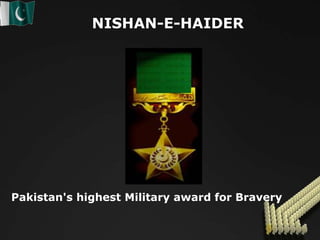
NISHAN-E-HAIDER


Pakistan's highest Military award for Bravery
SALUTE OF HONOUR


"We salute the Soldiers of Pakistan Army who
 fought and gave their lives for our great
 country, Pakistan. The Highest Military Award
 of Pakistan Has Been Awarded to Shaheed
 Soldiers Who Have Shown Bravery And
 Courage in Times Of War & Border Battles
 (1948, 1956, 1965, 1971, 1999)"
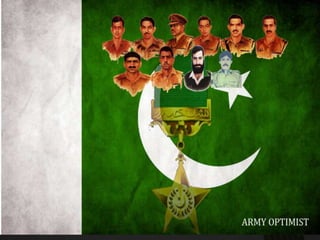
THERE ARE 10 RECIPIENTS OF NISHAN-E-
HAIDER

 Captain                                     Pilot
              Major Tufail   Major Raja     Officer
Muhammad
              Muhammad       Aziz Bhatti    Rashid
 Sarwar
                                            Minhas


              Lance Naik                     Jawan
  Major                        Major
              Muhammad                       Sowar
 Shabbir                     Mohammad
               Mahfooz                     Muhammad
  Sharif                       Akram
                                            Hussain


  Captain
Karnal Sher   Havaldaar
   Khan       Lalak Jan
There Are 10 Recipients Of Nishan-e-haider.

1. Captain Muhammad Sarwar

2. Major Tufail Muhammad

3. Major Raja Aziz Bhatti

4. Pilot Officer Rashid Minhas

5. Jawan Sowar Muhammad Hussain

6. Major Mohammad Akram

7. Lance Naik Muhammad Mahfooz

8. Major Shabbir Sharif

9. Captain Karnal Sher Khan

10. Havaldaar Lalak Jan
Captain Muhammad Sarwer Shaheed
•


•   Born 1910, Village Sanghori
    Commissioned into the Punjab Regiment, 1944.
    During the Kashmir Operations soon after the birth of Pakistan,
    as Company Commander in the 2nd Battalion of the Punjab
    Regiment, Captain Sarwar launched an attack causing heavy
    casualties against a strongly fortified enemy position in the Uri
    Sector under heavy machine-gun, grenade and mortar fire.
    But on 27 July 1948, as he moved forward with six of his men
    to cut their way through a barbed wire barrier, he died when
    his chest was riddled by a burst of automatic fire. He was 38
    years old.
Major Tufail Muhammad Shaheed


   Born 1914 in Hoshiarpur.
   Commissioned into the 16th Punjab Regiment, 1943.

   Early in August, 1958, Major Tufail, a Company
   Commander in the East Pakistan Rifles, and his patrol
   encircled an Indian post in the Lakshmipur area. And,
   though mortally wounded in the hand-to-hand
   encounter that followed, Major Tufail continued to lead
   his troops till the Indians were driven out, leaving four
   dead and three prisoners.

   He died the same day on 7 August 1958 at the age of
   44.
Major Raja Aziz Bhatti Shaheed


 Born 1928 in Hong Kong.
 Commissioned into the Punjab Regiment, 1950.
 On 6 September 1965, as Company Commander in the Burki
 area of the Lahore sector, Major Bhatti chose to move with his
 forward platton under incessant artillery and tank attacks for
 five days and nights in the defence of the strategic BRB canal.
 Throughout, undaunted by constant fire from enemy shell
 arms, tanks and artillery, he organized the defence of the
 canal, directing his men to answer the fire until he was hit by
 an enemy tank shell which killed him on 10 September 1965.
 He was 37 years old.
Pilot Office Rashid Minhas Shaheed


  Born 17 February 1951
  Commissioned as a pilot in the Pakistan Air Force.
  Pilot Officer Minhas was taxiing for take-off on a routine
  training flight when an Instructor Pilot forced his way into the
  rear cockpit, seized control of the aircraft and took off. When
  Minhas realized that the absconding pilot was heading towards
  India, he tried to regain control of the plane but was unable to
  do so.
  Knowing that it meant certain death, he damaged the controls
  and forced the aircraft to crash thirty two miles short of the
  border on 20 August 1971. He died at the age of 20.
Jawan Sawar Muhammad Hussain Shaheed


Born 18th June 1949 in Dhok Pir Baksh (now Dhok Mohammad Husain
Janjua).

Enlisted as a driver on 3 September 1966.
Although only a driver in the 20th Lancers, when war broke out in
1971, Sawar Mohammad Hussein took an active part in every battle in
which his unit was engaged unmindful of any danger, no matter how
grave.
When he spotted the enemy digging in along a minefield near the village
of Harar Khurd in December 1971 on his own initiative he directed
accurate fire at the enemy resulting in the destruction of sixteen enemy
tanks.
But while directing fire from recoilless rifles, he was hit in the chest by a
burst of machine-gun fire and died on 10 December 1971 at the age of
22.
Major Muhammad Akram Shaheed


Born 4 April 1938 in Dingha, Gujrat District.
Commissioned in the Frontier Force Regiment on 13 October 1963.

Major Mohammad Akram and a company of 4 FF Regiment which he
commanded in the forward area in Hilli district, in East Pakistan in 1971, came
under incessant air, artillery and armour attacks.

But for an entire fortnight, despite enemy superiority in both numbers and fire
power, he and his men repulsed every attack, inflicting heavy casualties on the
enemy.

Major Akram died during this epic battle in 1971 at the age of 33.
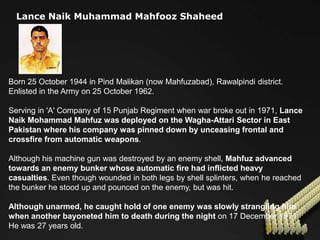
Lance Naik Muhammad Mahfooz Shaheed


Born 25 October 1944 in Pind Malikan (now Mahfuzabad), Rawalpindi district.
Enlisted in the Army on 25 October 1962.

Serving in 'A' Company of 15 Punjab Regiment when war broke out in 1971, Lance
Naik Mohammad Mahfuz was deployed on the Wagha-Attari Sector in East
Pakistan where his company was pinned down by unceasing frontal and
crossfire from automatic weapons.

Although his machine gun was destroyed by an enemy shell, Mahfuz advanced
towards an enemy bunker whose automatic fire had inflicted heavy
casualties. Even though wounded in both legs by shell splinters, when he reached
the bunker he stood up and pounced on the enemy, but was hit.

Although unarmed, he caught hold of one enemy was slowly strangling him
when another bayoneted him to death during the night on 17 December 1971.
He was 27 years old.
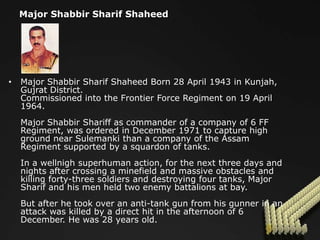
Major Shabbir Sharif Shaheed


•   Major Shabbir Sharif Shaheed Born 28 April 1943 in Kunjah,
    Gujrat District.
    Commissioned into the Frontier Force Regiment on 19 April
    1964.
    Major Shabbir Shariff as commander of a company of 6 FF
    Regiment, was ordered in December 1971 to capture high
    ground near Sulemanki than a company of the Assam
    Regiment supported by a squardon of tanks.
    In a wellnigh superhuman action, for the next three days and
    nights after crossing a minefield and massive obstacles and
    killing forty-three soldiers and destroying four tanks, Major
    Sharif and his men held two enemy battalions at bay.
    But after he took over an anti-tank gun from his gunner in an
    attack was killed by a direct hit in the afternoon of 6
    December. He was 28 years old.
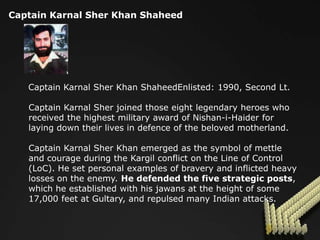
Captain Karnal Sher Khan Shaheed


   Captain Karnal Sher Khan ShaheedEnlisted: 1990, Second Lt.

   Captain Karnal Sher joined those eight legendary heroes who
   received the highest military award of Nishan-i-Haider for
   laying down their lives in defence of the beloved motherland.

   Captain Karnal Sher Khan emerged as the symbol of mettle
   and courage during the Kargil conflict on the Line of Control
   (LoC). He set personal examples of bravery and inflicted heavy
   losses on the enemy. He defended the five strategic posts,
   which he established with his jawans at the height of some
   17,000 feet at Gultary, and repulsed many Indian attacks.
 After many abortive attempts, the enemy on July 5 ringed
  the post of Capt. Sher Khan with the help of two battalion
  and unleashed heavy mortar firing and managed to capture
  some part of the post. Despite facing all odds, he lead a
  counter-attack and re- captured the lost parts.

  But during the course he was hit by the machine-gun fire
  and embraced Shahadat at the same post. He is the first
  officer from the NWFP province to be awarded with Nishan-
  i-Haider.
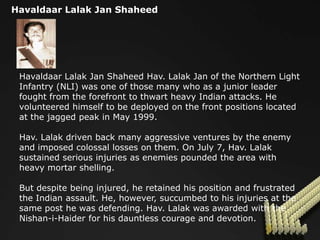
Havaldaar Lalak Jan Shaheed


 Havaldaar Lalak Jan Shaheed Hav. Lalak Jan of the Northern Light
 Infantry (NLI) was one of those many who as a junior leader
 fought from the forefront to thwart heavy Indian attacks. He
 volunteered himself to be deployed on the front positions located
 at the jagged peak in May 1999.

 Hav. Lalak driven back many aggressive ventures by the enemy
 and imposed colossal losses on them. On July 7, Hav. Lalak
 sustained serious injuries as enemies pounded the area with
 heavy mortar shelling.

 But despite being injured, he retained his position and frustrated
 the Indian assault. He, however, succumbed to his injuries at the
 same post he was defending. Hav. Lalak was awarded with the
 Nishan-i-Haider for his dauntless courage and devotion.
Chain Of Command:

  – The chain of command is line of authority extending
  from upper organizational levels to the lowest
  organization level, which clarifies who reports to
  whom.


                CEO


             Senior
             officers                 Employees
Span of control:


 The Span of Control of Masters is that
 employees report directly to one supervisor.
Centralization & Decentralization:

• In Master, mostly decisions are made by CEO along with the
  senior employees by holding meetings.


• All of employees have right to share their views on the
  matters then ending decisions are made by choosing best
  points.
Recruitment:

Master tile has defined certain criteria for the selection of its
employees.


 For Low Level Employee
       Selection is based on training


 On High Level Job
       For selection interviewing is done by the directors.
Employee Training:

• Master tile follow the traditional training methods
that are on job training, experimental exercises
and Job rotation on the higher level.
Motivational Environment:

Compensation and Benefits:
• Master attracts and retains the competent employees who
  help them in meeting the desired goals and mission.


Health And Safety of Employees
    Fire extinguishers
    Safety gloves and safety glasses
Leadership Styles:

•      Authoritarian or Autocratic
•      Participative or Democratic
•      Delegated or Laissez faire


• Master tiles uses autocratic style in the organization.
Organizational heroes:

• The hero of the Master Tiles is Mr. Irfan who is the
  marketing manager of the company and Mahmood Iqbal
  CEO of the company is also the hero of Master Tiles.


• Their managers are very loyal with company and work for
  the success of the company.
Types of Control:

• Feedforward Control
• Concurrent Control
• Feedback Control


• Master uses concurrent type of control and correct the
  problems when they occur.
Role of Technology:

• Master Tiles uses latest technology in their production
  process.
• Its helps in making low cost.
• And quality of the products is become high due to latest
  technology.


Entrepreneurship encouraged?
• Master Tiles encouraged entrepreneurship for innovation in
  the company.
Recommendations:

 They should increase their capacity of production because
  of the increasing demand and the increasing trend of
  people.
 They should modernize their research and development
  department with advance technology.
 They should seriously work on their supply chain problems
  that arises in the matter of conflict among the divisions and
  zones of the whole country.
 As there is an increasing demand of tiles in the foreign
  countries so, they should increase their exports.
Recommendations:

 As they don’t have any special alternatives needed in the
  run time like maintenance or repairing so, they should work
  on it.
 The main server should be made more efficient and the
  data should have a backup because the whole network
  system is disturbed if the main server is out of order.
 They should increase the variety of tiles as the competition
  is increasing at a speed.
Any
Question?
Nishan e haider

Nishan e haider

  • 2.
  • 3.
  • 4.
    SALUTE OF HONOUR "Wesalute the Soldiers of Pakistan Army who fought and gave their lives for our great country, Pakistan. The Highest Military Award of Pakistan Has Been Awarded to Shaheed Soldiers Who Have Shown Bravery And Courage in Times Of War & Border Battles (1948, 1956, 1965, 1971, 1999)"
  • 6.
    THERE ARE 10RECIPIENTS OF NISHAN-E- HAIDER Captain Pilot Major Tufail Major Raja Officer Muhammad Muhammad Aziz Bhatti Rashid Sarwar Minhas Lance Naik Jawan Major Major Muhammad Sowar Shabbir Mohammad Mahfooz Muhammad Sharif Akram Hussain Captain Karnal Sher Havaldaar Khan Lalak Jan
  • 7.
    There Are 10Recipients Of Nishan-e-haider. 1. Captain Muhammad Sarwar 2. Major Tufail Muhammad 3. Major Raja Aziz Bhatti 4. Pilot Officer Rashid Minhas 5. Jawan Sowar Muhammad Hussain 6. Major Mohammad Akram 7. Lance Naik Muhammad Mahfooz 8. Major Shabbir Sharif 9. Captain Karnal Sher Khan 10. Havaldaar Lalak Jan
  • 8.
    Captain Muhammad SarwerShaheed • • Born 1910, Village Sanghori Commissioned into the Punjab Regiment, 1944. During the Kashmir Operations soon after the birth of Pakistan, as Company Commander in the 2nd Battalion of the Punjab Regiment, Captain Sarwar launched an attack causing heavy casualties against a strongly fortified enemy position in the Uri Sector under heavy machine-gun, grenade and mortar fire. But on 27 July 1948, as he moved forward with six of his men to cut their way through a barbed wire barrier, he died when his chest was riddled by a burst of automatic fire. He was 38 years old.
  • 9.
    Major Tufail MuhammadShaheed Born 1914 in Hoshiarpur. Commissioned into the 16th Punjab Regiment, 1943. Early in August, 1958, Major Tufail, a Company Commander in the East Pakistan Rifles, and his patrol encircled an Indian post in the Lakshmipur area. And, though mortally wounded in the hand-to-hand encounter that followed, Major Tufail continued to lead his troops till the Indians were driven out, leaving four dead and three prisoners. He died the same day on 7 August 1958 at the age of 44.
  • 10.
    Major Raja AzizBhatti Shaheed Born 1928 in Hong Kong. Commissioned into the Punjab Regiment, 1950. On 6 September 1965, as Company Commander in the Burki area of the Lahore sector, Major Bhatti chose to move with his forward platton under incessant artillery and tank attacks for five days and nights in the defence of the strategic BRB canal. Throughout, undaunted by constant fire from enemy shell arms, tanks and artillery, he organized the defence of the canal, directing his men to answer the fire until he was hit by an enemy tank shell which killed him on 10 September 1965. He was 37 years old.
  • 11.
    Pilot Office RashidMinhas Shaheed Born 17 February 1951 Commissioned as a pilot in the Pakistan Air Force. Pilot Officer Minhas was taxiing for take-off on a routine training flight when an Instructor Pilot forced his way into the rear cockpit, seized control of the aircraft and took off. When Minhas realized that the absconding pilot was heading towards India, he tried to regain control of the plane but was unable to do so. Knowing that it meant certain death, he damaged the controls and forced the aircraft to crash thirty two miles short of the border on 20 August 1971. He died at the age of 20.
  • 12.
    Jawan Sawar MuhammadHussain Shaheed Born 18th June 1949 in Dhok Pir Baksh (now Dhok Mohammad Husain Janjua). Enlisted as a driver on 3 September 1966. Although only a driver in the 20th Lancers, when war broke out in 1971, Sawar Mohammad Hussein took an active part in every battle in which his unit was engaged unmindful of any danger, no matter how grave. When he spotted the enemy digging in along a minefield near the village of Harar Khurd in December 1971 on his own initiative he directed accurate fire at the enemy resulting in the destruction of sixteen enemy tanks. But while directing fire from recoilless rifles, he was hit in the chest by a burst of machine-gun fire and died on 10 December 1971 at the age of 22.
  • 13.
    Major Muhammad AkramShaheed Born 4 April 1938 in Dingha, Gujrat District. Commissioned in the Frontier Force Regiment on 13 October 1963. Major Mohammad Akram and a company of 4 FF Regiment which he commanded in the forward area in Hilli district, in East Pakistan in 1971, came under incessant air, artillery and armour attacks. But for an entire fortnight, despite enemy superiority in both numbers and fire power, he and his men repulsed every attack, inflicting heavy casualties on the enemy. Major Akram died during this epic battle in 1971 at the age of 33.
  • 14.
    Lance Naik MuhammadMahfooz Shaheed Born 25 October 1944 in Pind Malikan (now Mahfuzabad), Rawalpindi district. Enlisted in the Army on 25 October 1962. Serving in 'A' Company of 15 Punjab Regiment when war broke out in 1971, Lance Naik Mohammad Mahfuz was deployed on the Wagha-Attari Sector in East Pakistan where his company was pinned down by unceasing frontal and crossfire from automatic weapons. Although his machine gun was destroyed by an enemy shell, Mahfuz advanced towards an enemy bunker whose automatic fire had inflicted heavy casualties. Even though wounded in both legs by shell splinters, when he reached the bunker he stood up and pounced on the enemy, but was hit. Although unarmed, he caught hold of one enemy was slowly strangling him when another bayoneted him to death during the night on 17 December 1971. He was 27 years old.
  • 15.
    Major Shabbir SharifShaheed • Major Shabbir Sharif Shaheed Born 28 April 1943 in Kunjah, Gujrat District. Commissioned into the Frontier Force Regiment on 19 April 1964. Major Shabbir Shariff as commander of a company of 6 FF Regiment, was ordered in December 1971 to capture high ground near Sulemanki than a company of the Assam Regiment supported by a squardon of tanks. In a wellnigh superhuman action, for the next three days and nights after crossing a minefield and massive obstacles and killing forty-three soldiers and destroying four tanks, Major Sharif and his men held two enemy battalions at bay. But after he took over an anti-tank gun from his gunner in an attack was killed by a direct hit in the afternoon of 6 December. He was 28 years old.
  • 16.
    Captain Karnal SherKhan Shaheed Captain Karnal Sher Khan ShaheedEnlisted: 1990, Second Lt. Captain Karnal Sher joined those eight legendary heroes who received the highest military award of Nishan-i-Haider for laying down their lives in defence of the beloved motherland. Captain Karnal Sher Khan emerged as the symbol of mettle and courage during the Kargil conflict on the Line of Control (LoC). He set personal examples of bravery and inflicted heavy losses on the enemy. He defended the five strategic posts, which he established with his jawans at the height of some 17,000 feet at Gultary, and repulsed many Indian attacks.
  • 17.
     After manyabortive attempts, the enemy on July 5 ringed the post of Capt. Sher Khan with the help of two battalion and unleashed heavy mortar firing and managed to capture some part of the post. Despite facing all odds, he lead a counter-attack and re- captured the lost parts. But during the course he was hit by the machine-gun fire and embraced Shahadat at the same post. He is the first officer from the NWFP province to be awarded with Nishan- i-Haider.
  • 18.
    Havaldaar Lalak JanShaheed Havaldaar Lalak Jan Shaheed Hav. Lalak Jan of the Northern Light Infantry (NLI) was one of those many who as a junior leader fought from the forefront to thwart heavy Indian attacks. He volunteered himself to be deployed on the front positions located at the jagged peak in May 1999. Hav. Lalak driven back many aggressive ventures by the enemy and imposed colossal losses on them. On July 7, Hav. Lalak sustained serious injuries as enemies pounded the area with heavy mortar shelling. But despite being injured, he retained his position and frustrated the Indian assault. He, however, succumbed to his injuries at the same post he was defending. Hav. Lalak was awarded with the Nishan-i-Haider for his dauntless courage and devotion.
  • 20.
    Chain Of Command: – The chain of command is line of authority extending from upper organizational levels to the lowest organization level, which clarifies who reports to whom. CEO Senior officers Employees
  • 21.
    Span of control: The Span of Control of Masters is that employees report directly to one supervisor.
  • 22.
    Centralization & Decentralization: •In Master, mostly decisions are made by CEO along with the senior employees by holding meetings. • All of employees have right to share their views on the matters then ending decisions are made by choosing best points.
  • 23.
    Recruitment: Master tile hasdefined certain criteria for the selection of its employees.  For Low Level Employee Selection is based on training  On High Level Job For selection interviewing is done by the directors.
  • 24.
    Employee Training: • Mastertile follow the traditional training methods that are on job training, experimental exercises and Job rotation on the higher level.
  • 25.
    Motivational Environment: Compensation andBenefits: • Master attracts and retains the competent employees who help them in meeting the desired goals and mission. Health And Safety of Employees  Fire extinguishers  Safety gloves and safety glasses
  • 26.
    Leadership Styles: • Authoritarian or Autocratic • Participative or Democratic • Delegated or Laissez faire • Master tiles uses autocratic style in the organization.
  • 27.
    Organizational heroes: • Thehero of the Master Tiles is Mr. Irfan who is the marketing manager of the company and Mahmood Iqbal CEO of the company is also the hero of Master Tiles. • Their managers are very loyal with company and work for the success of the company.
  • 28.
    Types of Control: •Feedforward Control • Concurrent Control • Feedback Control • Master uses concurrent type of control and correct the problems when they occur.
  • 29.
    Role of Technology: •Master Tiles uses latest technology in their production process. • Its helps in making low cost. • And quality of the products is become high due to latest technology. Entrepreneurship encouraged? • Master Tiles encouraged entrepreneurship for innovation in the company.
  • 30.
    Recommendations:  They shouldincrease their capacity of production because of the increasing demand and the increasing trend of people.  They should modernize their research and development department with advance technology.  They should seriously work on their supply chain problems that arises in the matter of conflict among the divisions and zones of the whole country.  As there is an increasing demand of tiles in the foreign countries so, they should increase their exports.
  • 31.
    Recommendations:  As theydon’t have any special alternatives needed in the run time like maintenance or repairing so, they should work on it.  The main server should be made more efficient and the data should have a backup because the whole network system is disturbed if the main server is out of order.  They should increase the variety of tiles as the competition is increasing at a speed.
  • 32.