NICKEL(Ni)
Overview
• Use – not essential, metal alloy, stainless steel
• Source – food supply, jewelry, workplace
• Absorption – intestine, skin
• Toxicity – carcinogen (lung), contact dermatitis
• Facts – discovered in 1751, 200,000 metric tons
used yearly
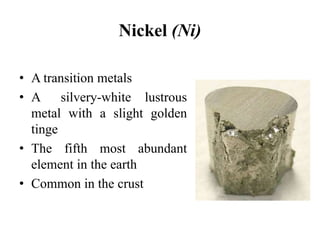
Nickel (Ni)
• A transition metals
• A silvery-white lustrous
metal with a slight golden
tinge
• The fifth most abundant
element in the earth
• Common in the crust
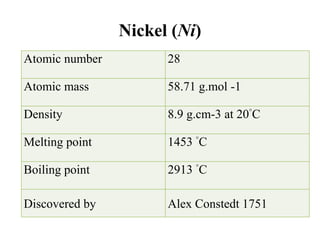
Nickel (Ni)
Atomic number 28
Atomic mass 58.71 g.mol -1
Density 8.9 g.cm-3 at 20°C
Melting point 1453 °C
Boiling point 2913 °C
Discovered by Alex Constedt 1751
Absorption
• Nickel absorption from foods is thought to be less
than 10%.
• Absorption of nickel is higher (~20%, but it can
be upto 50%) from water than from other
beverages (such as coffee, tea< cow's milk, and
orange juice) to which nickel has been added.
Cont…
• It absorbed across the enterocytes brush border
membrane by both a career and passive diffusion.
• Nickel compete with iron for carrier transport on
divalent mineral transporter one (DMT1) in the
proximal small intestine; consequently, nickel
absorption increase with iron deficiency.
Transport
• Transport across the basolateral membrane is
thought to occur by diffusion or as part of a
complex with amino acid or other binding
ligands.
• In the blood, nickel binds mainly to albumin and
to a lesser extent to small ligands like peptides
and amino acid, including histidine, cysteine and
aspartic acid.
Cont…
• Uptake of nickel into cell may occur with amino
acids, with transferring a divalent cation channel.
• Nickel is widely distributed in the body. The
highest concentrations of nickel are found in
thyroid and adrenal glands as well as in hairs,
bones and soft tissues such as the heart , kidney
and liver, total body nickel is estimated at about
10 mg
Excretion
• Most nickel is excreted in the urine in amounts
less than about 14μg.
• Within the renal cells, nickel complexes with low
molecular weight compounds such as uronic acid.
• In addition to urinary losses, small amounts (1.5-
3.3μg/day) of nickel can are excreted in the bille.
• Nickel can also be lost through sweat in fairly
high (up to 69.9μg) concentrations associated
with active secretion of the element by sweat
glands.

nickel

  • 1.
  • 2.
    Overview • Use –not essential, metal alloy, stainless steel • Source – food supply, jewelry, workplace • Absorption – intestine, skin • Toxicity – carcinogen (lung), contact dermatitis • Facts – discovered in 1751, 200,000 metric tons used yearly
  • 3.
    Nickel (Ni) • Atransition metals • A silvery-white lustrous metal with a slight golden tinge • The fifth most abundant element in the earth • Common in the crust
  • 4.
    Nickel (Ni) Atomic number28 Atomic mass 58.71 g.mol -1 Density 8.9 g.cm-3 at 20°C Melting point 1453 °C Boiling point 2913 °C Discovered by Alex Constedt 1751
  • 5.
    Absorption • Nickel absorptionfrom foods is thought to be less than 10%. • Absorption of nickel is higher (~20%, but it can be upto 50%) from water than from other beverages (such as coffee, tea< cow's milk, and orange juice) to which nickel has been added.
  • 6.
    Cont… • It absorbedacross the enterocytes brush border membrane by both a career and passive diffusion. • Nickel compete with iron for carrier transport on divalent mineral transporter one (DMT1) in the proximal small intestine; consequently, nickel absorption increase with iron deficiency.
  • 7.
    Transport • Transport acrossthe basolateral membrane is thought to occur by diffusion or as part of a complex with amino acid or other binding ligands. • In the blood, nickel binds mainly to albumin and to a lesser extent to small ligands like peptides and amino acid, including histidine, cysteine and aspartic acid.
  • 8.
    Cont… • Uptake ofnickel into cell may occur with amino acids, with transferring a divalent cation channel. • Nickel is widely distributed in the body. The highest concentrations of nickel are found in thyroid and adrenal glands as well as in hairs, bones and soft tissues such as the heart , kidney and liver, total body nickel is estimated at about 10 mg
  • 9.
    Excretion • Most nickelis excreted in the urine in amounts less than about 14μg. • Within the renal cells, nickel complexes with low molecular weight compounds such as uronic acid.
  • 10.
    • In additionto urinary losses, small amounts (1.5- 3.3μg/day) of nickel can are excreted in the bille. • Nickel can also be lost through sweat in fairly high (up to 69.9μg) concentrations associated with active secretion of the element by sweat glands.