Clinical Biochemistry
Dr Sarath Krishnan M P MBBS
Junior Resident 2
Department of biochemistry
All India Institute of Medical Sciences, Rishikesh-249203
What will we do?
 Medical biochemistry.
 Concerned with analysis of body fluids.
25-11-2022
Dr Sarath Krishnan M P/Dept of Biochemistry/AIIMS
Rishikesh
2
Body fluids
25-11-2022
Dr Sarath Krishnan M P/Dept of Biochemistry/AIIMS
Rishikesh
3
Body Fluid Investigation
Performed
Method of Collection
WHOLE
BLOOD
Blood gases, Urea
Glucose
Obtained by arterial or venipuncture; collected
with anticoagulants like heparin;
PLASMA Enzymes, Metabolites
Electrolytes
Blood with anticoagulants centrifuged at 2000
rpm; the supernatant is plasma
SERUM Enzymes
Metabolites
Electrolytes
Blood collected in a plain glass container,
without any anticoagulant, centrifuged at 2000
rpm after clotting, the supernatant is serum
URINE Glucose, Proteins
Bile salts & pigments,
Blood, Steroids
Directly passed into a glass container,
sometimes a catheter is introduced into the
bladder
CEREBRO- SPINAL
FLUID
Glucose, Protein,
Chloride
Lumbar puncture from subarachnoid space
GASTRIC
JUICE
HCl, Blood Aspiration by Ryle’s tube
SEROUS
FLUIDS
Proteins Needle puncture to the serous space
(E.g.,Pleural, Peritoneal)
SWEAT Chloride Soaked into a filter paper
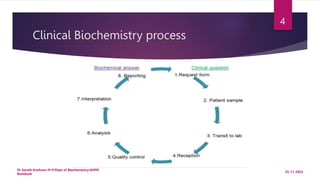
Clinical Biochemistry process
25-11-2022
Dr Sarath Krishnan M P/Dept of Biochemistry/AIIMS
Rishikesh
4
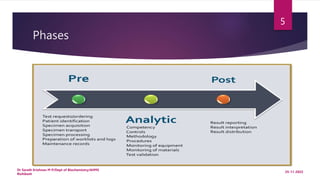
Phases
25-11-2022
Dr Sarath Krishnan M P/Dept of Biochemistry/AIIMS
Rishikesh
5
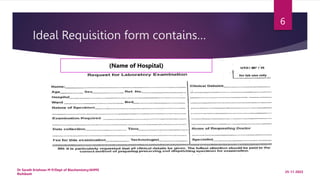
Ideal Requisition form contains…
25-11-2022
Dr Sarath Krishnan M P/Dept of Biochemistry/AIIMS
Rishikesh
6
(Name of Hospital)
Collection And Transportation of
Specimens
25-11-2022
Dr Sarath Krishnan M P/Dept of Biochemistry/AIIMS
Rishikesh
7
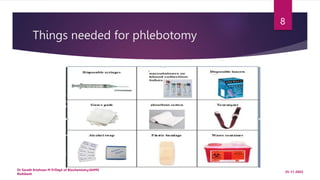
Things needed for phlebotomy
25-11-2022
Dr Sarath Krishnan M P/Dept of Biochemistry/AIIMS
Rishikesh
8
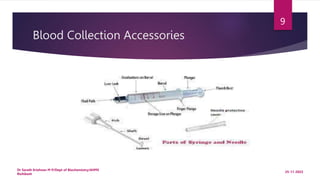
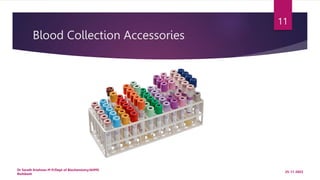
Blood Collection Accessories
25-11-2022
Dr Sarath Krishnan M P/Dept of Biochemistry/AIIMS
Rishikesh
9
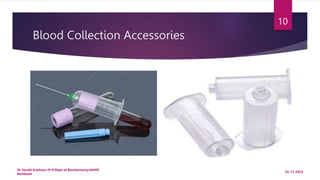
Blood Collection Accessories
25-11-2022
Dr Sarath Krishnan M P/Dept of Biochemistry/AIIMS
Rishikesh
10
Blood Collection Accessories
25-11-2022
Dr Sarath Krishnan M P/Dept of Biochemistry/AIIMS
Rishikesh
11
25-11-2022
Dr Sarath Krishnan M P/Dept of Biochemistry/AIIMS Rishikesh
12
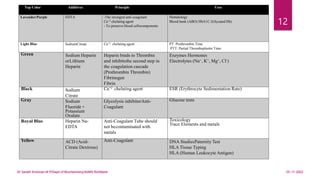
Top Color Additives Principle Uses
Lavender/Purple EDTA -The strongest anti-coagulant
Ca+2 chelating agent
- To preserve blood cellscomponents
Hematology
Blood bank (ABO) HbA1C (Glycated Hb)
Light Blue SodiumCitrate Ca+2 chelating agent PT: Prothrombin Time
PTT: Partial Thromboplastin Time
Green Sodium Heparin
orLithium
Heparin
Heparin binds to Thrombin
and inhibitsthe second step in
the coagulation cascade
(Prothrombin Thrombin)
Fibrinogen
Fibrin
Enzymes Hormones
Electrolytes (Na+, K+, Mg+, Cl-)
Black Sodium
Citrate
Ca+2 chelating agent ESR (Erythrocyte Sedimentation Rate)
Gray Sodium
Fluoride +
Potassium
Oxalate
Glycolysis inhibitorAnti-
Coagulant
Glucose tests
Royal Blue Heparin Na-
EDTA
Anti-Coagulant Tube should
not becontaminated with
metals
Toxicology
Trace Elements and metals
Yellow ACD (Acid-
Citrate Dextrose)
Anti-Coagulant DNA StudiesPaternity Test
HLA Tissue Typing
HLA (Human Leukocyte Antigen)
25-11-2022
Dr Sarath Krishnan M P/Dept of Biochemistry/AIIMS Rishikesh
13
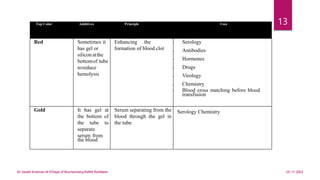
Top Color Additives Principle Uses
Red Sometimes it
has gel or
silicon atthe
bottomof tube
toreduce
hemolysis
Enhancing the
formation of blood clot
- Serology
- Antibodies
- Hormones
- Drugs
- Virology
- Chemistry
- Blood cross matching before blood
transfusion
Gold It has gel at
the bottom of
the tube to
separate
serum from
the blood
Serum separating from the
blood through the gel in
the tube
Serology Chemistry
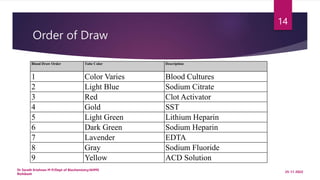
Order of Draw
25-11-2022
Dr Sarath Krishnan M P/Dept of Biochemistry/AIIMS
Rishikesh
14
Blood Draw Order Tube Color Description
1 Color Varies Blood Cultures
2 Light Blue Sodium Citrate
3 Red Clot Activator
4 Gold SST
5 Light Green Lithium Heparin
6 Dark Green Sodium Heparin
7 Lavender EDTA
8 Gray Sodium Fluoride
9 Yellow ACD Solution
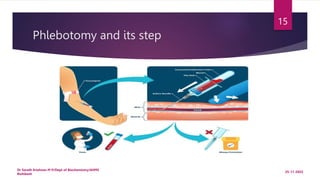
Phlebotomy and its step
25-11-2022
Dr Sarath Krishnan M P/Dept of Biochemistry/AIIMS
Rishikesh
15
25-11-2022
Dr Sarath Krishnan M P/Dept of Biochemistry/AIIMS Rishikesh
16
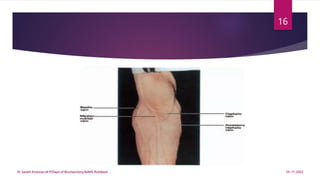
Common site
 Median Cubital vein
Avoid
 IV line
 Mastectomy
 Scarring
 Hematoma
25-11-2022
Dr Sarath Krishnan M P/Dept of Biochemistry/AIIMS
Rishikesh
17
Rejection Criteria For Specimens
I. Hemolyzed Specimen
II. Lipemic Sera
III. Mislabeled/Wrongly Labeled Specimen
IV. No Requisition Form
25-11-2022
Dr Sarath Krishnan M P/Dept of Biochemistry/AIIMS
Rishikesh
18
Turn Around Time
 Time taken from receipt of Specimen in Lab to dispatch of
the report out from lab
 For most of the Clinical Biochemistry Stat investigations TAT
is 2 to 4 hours.
 Same day Specimens Received, Analyzed and Reports
Dispatched.
25-11-2022
Dr Sarath Krishnan M P/Dept of Biochemistry/AIIMS
Rishikesh
19
Functional Instrumentations
 Fully Automated Chemical Analyzers
 Chemiluminescence Immuno Assay Analyzer
 Electrolyte Analyzers
 Blood Gas Analyzers
25-11-2022
Dr Sarath Krishnan M P/Dept of Biochemistry/AIIMS
Rishikesh
20
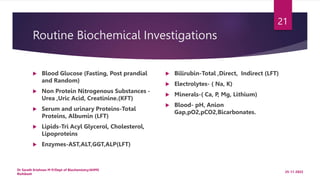
Routine Biochemical Investigations
 Blood Glucose {Fasting, Post prandial
and Random}
 Non Protein Nitrogenous Substances -
Urea ,Uric Acid, Creatinine.(KFT)
 Serum and urinary Proteins-Total
Proteins, Albumin (LFT)
 Lipids-Tri Acyl Glycerol, Cholesterol,
Lipoproteins
 Enzymes-AST,ALT,GGT,ALP(LFT)
 Bilirubin-Total ,Direct, Indirect (LFT)
 Electrolytes- ( Na, K)
 Minerals-( Ca, P, Mg, Lithium)
 Blood- pH, Anion
Gap,pO2,pCO2,Bicarbonates.
25-11-2022
Dr Sarath Krishnan M P/Dept of Biochemistry/AIIMS
Rishikesh
21
Normal values of important biochemical
parameters
25-11-2022
Dr Sarath Krishnan M P/Dept of Biochemistry/AIIMS Rishikesh
22
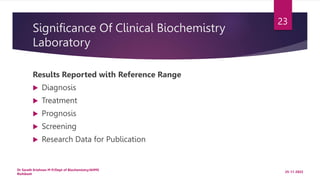
Significance Of Clinical Biochemistry
Laboratory
Results Reported with Reference Range
 Diagnosis
 Treatment
 Prognosis
 Screening
 Research Data for Publication
25-11-2022
Dr Sarath Krishnan M P/Dept of Biochemistry/AIIMS
Rishikesh
23
Thank you 
25-11-2022
24

Clinical Biochemistry.pptx

  • 1.
    Clinical Biochemistry Dr SarathKrishnan M P MBBS Junior Resident 2 Department of biochemistry All India Institute of Medical Sciences, Rishikesh-249203
  • 2.
    What will wedo?  Medical biochemistry.  Concerned with analysis of body fluids. 25-11-2022 Dr Sarath Krishnan M P/Dept of Biochemistry/AIIMS Rishikesh 2
  • 3.
    Body fluids 25-11-2022 Dr SarathKrishnan M P/Dept of Biochemistry/AIIMS Rishikesh 3 Body Fluid Investigation Performed Method of Collection WHOLE BLOOD Blood gases, Urea Glucose Obtained by arterial or venipuncture; collected with anticoagulants like heparin; PLASMA Enzymes, Metabolites Electrolytes Blood with anticoagulants centrifuged at 2000 rpm; the supernatant is plasma SERUM Enzymes Metabolites Electrolytes Blood collected in a plain glass container, without any anticoagulant, centrifuged at 2000 rpm after clotting, the supernatant is serum URINE Glucose, Proteins Bile salts & pigments, Blood, Steroids Directly passed into a glass container, sometimes a catheter is introduced into the bladder CEREBRO- SPINAL FLUID Glucose, Protein, Chloride Lumbar puncture from subarachnoid space GASTRIC JUICE HCl, Blood Aspiration by Ryle’s tube SEROUS FLUIDS Proteins Needle puncture to the serous space (E.g.,Pleural, Peritoneal) SWEAT Chloride Soaked into a filter paper
  • 4.
    Clinical Biochemistry process 25-11-2022 DrSarath Krishnan M P/Dept of Biochemistry/AIIMS Rishikesh 4
  • 5.
    Phases 25-11-2022 Dr Sarath KrishnanM P/Dept of Biochemistry/AIIMS Rishikesh 5
  • 6.
    Ideal Requisition formcontains… 25-11-2022 Dr Sarath Krishnan M P/Dept of Biochemistry/AIIMS Rishikesh 6 (Name of Hospital)
  • 7.
    Collection And Transportationof Specimens 25-11-2022 Dr Sarath Krishnan M P/Dept of Biochemistry/AIIMS Rishikesh 7
  • 8.
    Things needed forphlebotomy 25-11-2022 Dr Sarath Krishnan M P/Dept of Biochemistry/AIIMS Rishikesh 8
  • 9.
    Blood Collection Accessories 25-11-2022 DrSarath Krishnan M P/Dept of Biochemistry/AIIMS Rishikesh 9
  • 10.
    Blood Collection Accessories 25-11-2022 DrSarath Krishnan M P/Dept of Biochemistry/AIIMS Rishikesh 10
  • 11.
    Blood Collection Accessories 25-11-2022 DrSarath Krishnan M P/Dept of Biochemistry/AIIMS Rishikesh 11
  • 12.
    25-11-2022 Dr Sarath KrishnanM P/Dept of Biochemistry/AIIMS Rishikesh 12 Top Color Additives Principle Uses Lavender/Purple EDTA -The strongest anti-coagulant Ca+2 chelating agent - To preserve blood cellscomponents Hematology Blood bank (ABO) HbA1C (Glycated Hb) Light Blue SodiumCitrate Ca+2 chelating agent PT: Prothrombin Time PTT: Partial Thromboplastin Time Green Sodium Heparin orLithium Heparin Heparin binds to Thrombin and inhibitsthe second step in the coagulation cascade (Prothrombin Thrombin) Fibrinogen Fibrin Enzymes Hormones Electrolytes (Na+, K+, Mg+, Cl-) Black Sodium Citrate Ca+2 chelating agent ESR (Erythrocyte Sedimentation Rate) Gray Sodium Fluoride + Potassium Oxalate Glycolysis inhibitorAnti- Coagulant Glucose tests Royal Blue Heparin Na- EDTA Anti-Coagulant Tube should not becontaminated with metals Toxicology Trace Elements and metals Yellow ACD (Acid- Citrate Dextrose) Anti-Coagulant DNA StudiesPaternity Test HLA Tissue Typing HLA (Human Leukocyte Antigen)
  • 13.
    25-11-2022 Dr Sarath KrishnanM P/Dept of Biochemistry/AIIMS Rishikesh 13 Top Color Additives Principle Uses Red Sometimes it has gel or silicon atthe bottomof tube toreduce hemolysis Enhancing the formation of blood clot - Serology - Antibodies - Hormones - Drugs - Virology - Chemistry - Blood cross matching before blood transfusion Gold It has gel at the bottom of the tube to separate serum from the blood Serum separating from the blood through the gel in the tube Serology Chemistry
  • 14.
    Order of Draw 25-11-2022 DrSarath Krishnan M P/Dept of Biochemistry/AIIMS Rishikesh 14 Blood Draw Order Tube Color Description 1 Color Varies Blood Cultures 2 Light Blue Sodium Citrate 3 Red Clot Activator 4 Gold SST 5 Light Green Lithium Heparin 6 Dark Green Sodium Heparin 7 Lavender EDTA 8 Gray Sodium Fluoride 9 Yellow ACD Solution
  • 15.
    Phlebotomy and itsstep 25-11-2022 Dr Sarath Krishnan M P/Dept of Biochemistry/AIIMS Rishikesh 15
  • 16.
    25-11-2022 Dr Sarath KrishnanM P/Dept of Biochemistry/AIIMS Rishikesh 16
  • 17.
    Common site  MedianCubital vein Avoid  IV line  Mastectomy  Scarring  Hematoma 25-11-2022 Dr Sarath Krishnan M P/Dept of Biochemistry/AIIMS Rishikesh 17
  • 18.
    Rejection Criteria ForSpecimens I. Hemolyzed Specimen II. Lipemic Sera III. Mislabeled/Wrongly Labeled Specimen IV. No Requisition Form 25-11-2022 Dr Sarath Krishnan M P/Dept of Biochemistry/AIIMS Rishikesh 18
  • 19.
    Turn Around Time Time taken from receipt of Specimen in Lab to dispatch of the report out from lab  For most of the Clinical Biochemistry Stat investigations TAT is 2 to 4 hours.  Same day Specimens Received, Analyzed and Reports Dispatched. 25-11-2022 Dr Sarath Krishnan M P/Dept of Biochemistry/AIIMS Rishikesh 19
  • 20.
    Functional Instrumentations  FullyAutomated Chemical Analyzers  Chemiluminescence Immuno Assay Analyzer  Electrolyte Analyzers  Blood Gas Analyzers 25-11-2022 Dr Sarath Krishnan M P/Dept of Biochemistry/AIIMS Rishikesh 20
  • 21.
    Routine Biochemical Investigations Blood Glucose {Fasting, Post prandial and Random}  Non Protein Nitrogenous Substances - Urea ,Uric Acid, Creatinine.(KFT)  Serum and urinary Proteins-Total Proteins, Albumin (LFT)  Lipids-Tri Acyl Glycerol, Cholesterol, Lipoproteins  Enzymes-AST,ALT,GGT,ALP(LFT)  Bilirubin-Total ,Direct, Indirect (LFT)  Electrolytes- ( Na, K)  Minerals-( Ca, P, Mg, Lithium)  Blood- pH, Anion Gap,pO2,pCO2,Bicarbonates. 25-11-2022 Dr Sarath Krishnan M P/Dept of Biochemistry/AIIMS Rishikesh 21
  • 22.
    Normal values ofimportant biochemical parameters 25-11-2022 Dr Sarath Krishnan M P/Dept of Biochemistry/AIIMS Rishikesh 22
  • 23.
    Significance Of ClinicalBiochemistry Laboratory Results Reported with Reference Range  Diagnosis  Treatment  Prognosis  Screening  Research Data for Publication 25-11-2022 Dr Sarath Krishnan M P/Dept of Biochemistry/AIIMS Rishikesh 23
  • 24.