www.wildpackets.com© WildPackets, Inc.
VoIP and VoFi
Monitoring and Analysis
January 2015
Jay Botelho
Director of Product Management
WildPackets
jbotelho@wildpackets.com
Follow me @jaybotelho
© WildPackets, Inc. 2
Agenda
• VoIP – Still Top of Mind in Network Performance
Monitoring
• VoIP/VoFi/Video Is Just Different!
• Key Metrics
• Monitoring and Analyzing VoIP/VoFi Issues
www.wildpackets.com© WildPackets, Inc.
VoIP – Still Top of Mind in
Network Performance Monitoring
© WildPackets, Inc. 4
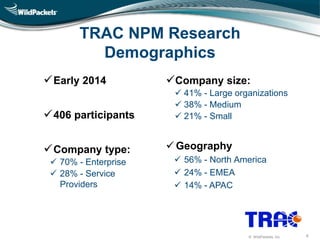
TRAC NPM Research
Demographics
Early 2014
406 participants
Company type:
 70% - Enterprise
 28% - Service
Providers
Company size:
 41% - Large organizations
 38% - Medium
 21% - Small
Geography
 56% - North America
 24% - EMEA
 14% - APAC
© WildPackets, Inc. 5
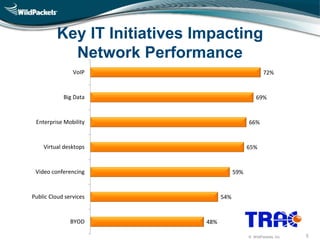
Key IT Initiatives Impacting
Network Performance
48%
54%
59%
65%
66%
69%
72%
BYOD
Public Cloud services
Video conferencing
Virtual desktops
Enterprise Mobility
Big Data
VoIP
© WildPackets, Inc. 6
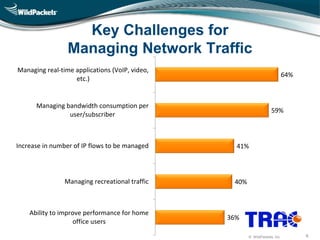
36%
40%
41%
59%
64%
Ability to improve performance for home
office users
Managing recreational traffic
Increase in number of IP flows to be managed
Managing bandwidth consumption per
user/subscriber
Managing real-time applications (VoIP, video,
etc.)
Key Challenges for
Managing Network Traffic
© WildPackets, Inc. 7
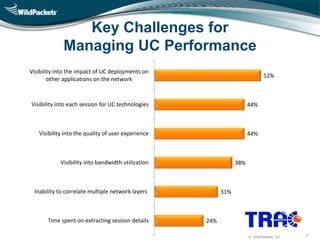
Key Challenges for
Managing UC Performance
24%
31%
38%
44%
44%
52%
Time spent on extracting session details
Inability to correlate multiple network layers
Visibility into bandwidth utilization
Visibility into the quality of user experience
Visibility into each session for UC technologies
Visibility into the impact of UC deployments on
other applications on the network
© WildPackets, Inc. 8
And It’s Not Just VoIP …
• Percentage of all forms of video (TV, VoD, Internet,
and P2P) will be approximately 90 percent of global
consumer traffic by 2015
• Internet video to TVs will increase 17-fold by 2015
http://www.cisco.com/en/US/solutions/collateral/ns341/n
s525/ns537/ns705/ns827/white_paper_c11-481360.pdf
www.wildpackets.com© WildPackets, Inc.
VoIP/Video Is Just Different!
© WildPackets, Inc. 10
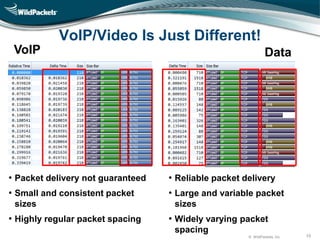
VoIP/Video Is Just Different!
• Packet delivery not guaranteed
• Small and consistent packet
sizes
• Highly regular packet spacing
• Reliable packet delivery
• Large and variable packet
sizes
• Widely varying packet
spacing
VoIP Data
© WildPackets, Inc. 11
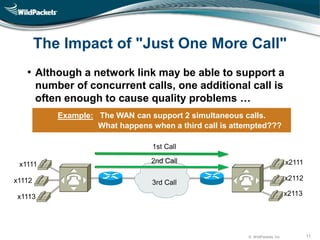
The Impact of "Just One More Call"
• Although a network link may be able to support a
number of concurrent calls, one additional call is
often enough to cause quality problems …
x1113
x2111
x1112
x1111
1st Call
2nd Call
3rd Call
x2112
x2113
Example: The WAN can support 2 simultaneous calls.
What happens when a third call is attempted???
© WildPackets, Inc. 12
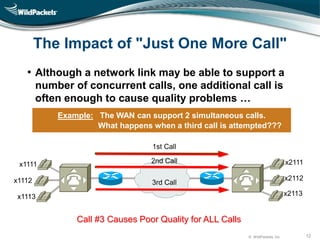
The Impact of "Just One More Call"
• Although a network link may be able to support a
number of concurrent calls, one additional call is
often enough to cause quality problems …
x1113
x2111
x1112
x1111
1st Call
2nd Call
3rd Call
x2112
x2113
Example: The WAN can support 2 simultaneous calls.
What happens when a third call is attempted???
Call #3 Causes Poor Quality for ALL Calls
© WildPackets, Inc. 13
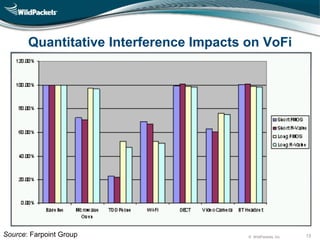
Quantitative Interference Impacts on VoFi
Source: Farpoint Group
© WildPackets, Inc. 14
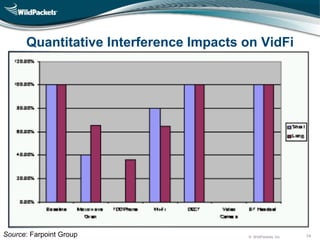
Quantitative Interference Impacts on VidFi
Source: Farpoint Group
© WildPackets, Inc. 15
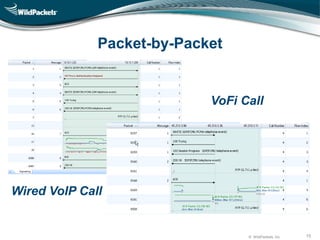
Packet-by-Packet
VoFi Call
Wired VoIP Call
www.wildpackets.com© WildPackets, Inc.
Key Metrics
© WildPackets, Inc. 17
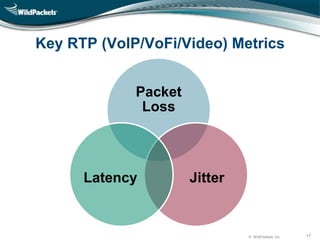
Key RTP (VoIP/VoFi/Video) Metrics
CAMP IT Pinpointing the Problem 17
Packet
Loss
JitterLatency
© WildPackets, Inc. 18
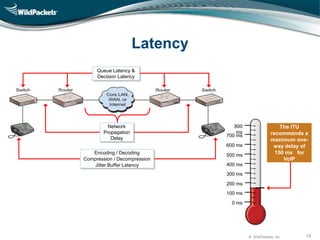
Latency
Queue Latency &
Decision Latency
Network
Propagation
Delay
Encoding / Decoding
Compression / Decompression
Jitter Buffer Latency
0 ms
100 ms
200 ms
300 ms
400 ms
500 ms
600 ms
700 ms
800
ms
The ITU
recommends a
maximum one-
way delay of
150 ms for
VoIP
© WildPackets, Inc. 19
Latency's Effects
• Talkover
‒ Occurs when excessive latency delays audio
– Conversation cadence is not natural or comfortable
– Callers feel as if they must “push to talk” or say “over” to control the
conversation
• Echo
‒ The speaker’s voice feeds back into the listener’s microphone
‒ The speaker then hears his own voice returning from the listener’s end,
but delayed due to latency
‒ Most callers find it difficult to maintain normal speech when echo delay
is prolonged
‒ Some VoIP systems attempt to cancel echo, but are not always
successful
High latency may also cause additional troubles such as loss of
synchronization between audio and video for multimedia sessions.
© WildPackets, Inc. 20
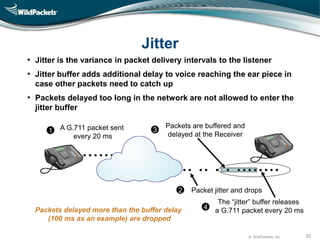
Jitter
• Jitter is the variance in packet delivery intervals to the listener
• Jitter buffer adds additional delay to voice reaching the ear piece in
case other packets need to catch up
• Packets delayed too long in the network are not allowed to enter the
jitter buffer
Packets delayed more than the buffer delay
(100 ms as an example) are dropped
. . .. .. . . ........
......
Packets are buffered and
delayed at the Receiver
The “jitter” buffer releases
a G.711 packet every 20 ms
A G.711 packet sent
every 20 ms
Packet jitter and drops
31
2
4
© WildPackets, Inc. 21
Jitter's Effects
• Jitter causes weird “sound effects” that vary with
jitter severity and environmental factors
• Examples include:
‒ Static
‒ Stuttering or uneven audio – abnormal speech rhythm
‒ For multimedia systems, video may be “jerky” or irregular
• If jitter levels are high, packet loss can result
‒ In some cases, severe jitter may sound similar to packet loss,
even if no packets are actually dropped
© WildPackets, Inc. 22
Packet Loss
• Packet dropped due to physical layer corruption
• Congestion without adequate QoS provisions
• Jitter buffer discards due to excessive latency
© WildPackets, Inc. 23
Packet Loss Effects
• Causes missing sounds, syllables, words, or phrases
‒ DSP algorithms may compensate for up to 30 ms of missing data
‒ More than 30 ms of missing audio is noticeable by listeners
• An average person speaks at a rate of about 200 words per
minute
‒ That’s 3.33 words/sec = 300 ms per word
‒ For G.711, we would need to lose 15 consecutive RTP packets to lose
a whole word
‒ Dropping 15 packets/sec for G.711 would be a loss rate of 30%
• But losing only a few packets can still be very noticeable
‒ Loss of more than 2 consecutive packets will be heard
‒ Loss rates ≥ 2% will have a strong impact on quality
‒ Losses of 5 – 10% make calls all but intolerable
‒ Bursty periods of packet loss are worse than more dispersed loss
© WildPackets, Inc. 24
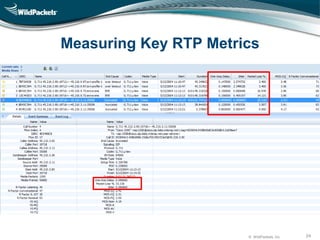
Measuring Key RTP Metrics
© WildPackets, Inc. 25
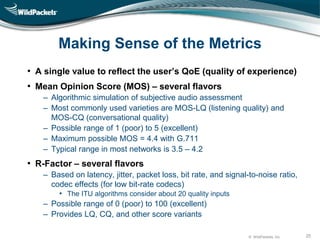
Making Sense of the Metrics
• A single value to reflect the user’s QoE (quality of experience)
• Mean Opinion Score (MOS) – several flavors
‒ Algorithmic simulation of subjective audio assessment
‒ Most commonly used varieties are MOS-LQ (listening quality) and
MOS-CQ (conversational quality)
‒ Possible range of 1 (poor) to 5 (excellent)
‒ Maximum possible MOS = 4.4 with G.711
‒ Typical range in most networks is 3.5 – 4.2
• R-Factor – several flavors
‒ Based on latency, jitter, packet loss, bit rate, and signal-to-noise ratio,
codec effects (for low bit-rate codecs)
• The ITU algorithms consider about 20 quality inputs
‒ Possible range of 0 (poor) to 100 (excellent)
‒ Provides LQ, CQ, and other score variants
© WildPackets, Inc. 26
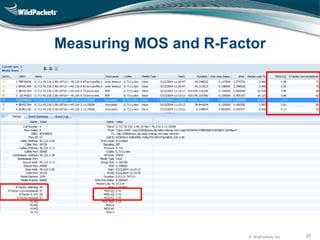
Measuring MOS and R-Factor
© WildPackets, Inc. 27
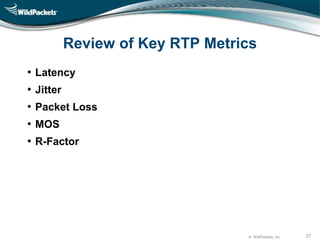
Review of Key RTP Metrics
• Latency
• Jitter
• Packet Loss
• MOS
• R-Factor
© WildPackets, Inc. 28
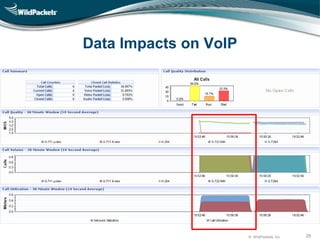
Data Impacts on VoIP
© WildPackets, Inc. 29
Got QoS?
• One of the most potent weapons for fighting VoIP
troubles is to provision Quality of Service (QoS)
• QoS enables network devices to prioritize and give
preference to packet streams that are sensitive to delay,
packet loss, jitter, and other performance inhibitors
• Standards-based QoS methods include:
‒ IP Differentiated Services (DiffServ)
‒ MAC Layer QoS with IEEE 802.1p
‒ VLANs
• QoS may be obtained or supplemented via proprietary
means, such as traffic shaping via various flow
processing algorithms
• Watch for too much differentiated traffic!
© WildPackets, Inc. 30
Ready for QoS?
• QoS provisions are based on the “weakest link”
concept
‒ If any device in a data path does not support QoS, then media
streams will not be afforded the preference they require for good
performance
• Pre-deployment assessment must ensure that ALL
devices can recognize and respond to QoS
parameters in packet headers
‒ Switches, routers, firewalls, proxies, and any other devices that
touch RTP packets must be “VoIP-friendly”
© WildPackets, Inc. 31
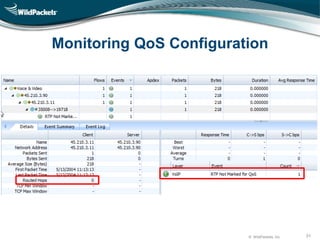
Monitoring QoS Configuration
www.wildpackets.com© WildPackets, Inc.
Troubleshooting RTP Issues
© WildPackets, Inc. 33
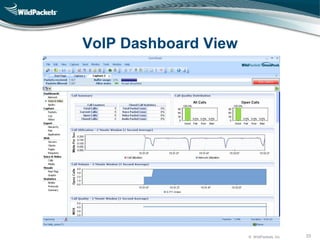
VoIP Dashboard View
© WildPackets, Inc. 34
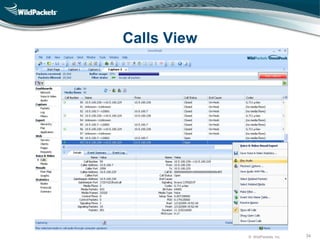
Calls View
© WildPackets, Inc. 35
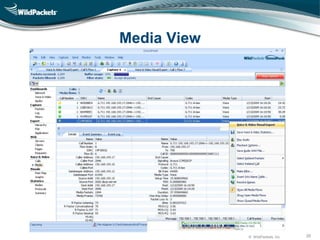
Media View
© WildPackets, Inc. 36
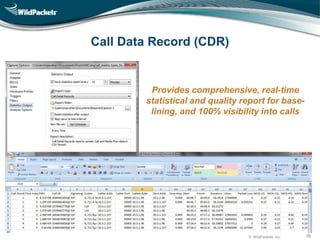
Call Data Record (CDR)
Provides comprehensive, real-time
statistical and quality report for base-
lining, and 100% visibility into calls
© WildPackets, Inc. 37
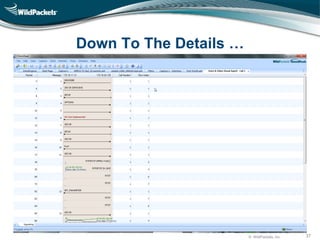
Down To The Details …
© WildPackets, Inc. 38
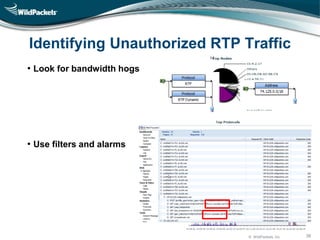
Identifying Unauthorized RTP Traffic
• Look for bandwidth hogs
• Use filters and alarms
www.wildpackets.com© WildPackets, Inc.
Q&A
Thank You!
WildPackets, Inc.
1340 Treat Boulevard, Suite 500
Walnut Creek, CA 94597
(925) 937-3200

Bright talk voip vofi webinar jan2015-v2

  • 1.
    www.wildpackets.com© WildPackets, Inc. VoIPand VoFi Monitoring and Analysis January 2015 Jay Botelho Director of Product Management WildPackets jbotelho@wildpackets.com Follow me @jaybotelho
  • 2.
    © WildPackets, Inc.2 Agenda • VoIP – Still Top of Mind in Network Performance Monitoring • VoIP/VoFi/Video Is Just Different! • Key Metrics • Monitoring and Analyzing VoIP/VoFi Issues
  • 3.
    www.wildpackets.com© WildPackets, Inc. VoIP– Still Top of Mind in Network Performance Monitoring
  • 4.
    © WildPackets, Inc.4 TRAC NPM Research Demographics Early 2014 406 participants Company type:  70% - Enterprise  28% - Service Providers Company size:  41% - Large organizations  38% - Medium  21% - Small Geography  56% - North America  24% - EMEA  14% - APAC
  • 5.
    © WildPackets, Inc.5 Key IT Initiatives Impacting Network Performance 48% 54% 59% 65% 66% 69% 72% BYOD Public Cloud services Video conferencing Virtual desktops Enterprise Mobility Big Data VoIP
  • 6.
    © WildPackets, Inc.6 36% 40% 41% 59% 64% Ability to improve performance for home office users Managing recreational traffic Increase in number of IP flows to be managed Managing bandwidth consumption per user/subscriber Managing real-time applications (VoIP, video, etc.) Key Challenges for Managing Network Traffic
  • 7.
    © WildPackets, Inc.7 Key Challenges for Managing UC Performance 24% 31% 38% 44% 44% 52% Time spent on extracting session details Inability to correlate multiple network layers Visibility into bandwidth utilization Visibility into the quality of user experience Visibility into each session for UC technologies Visibility into the impact of UC deployments on other applications on the network
  • 8.
    © WildPackets, Inc.8 And It’s Not Just VoIP … • Percentage of all forms of video (TV, VoD, Internet, and P2P) will be approximately 90 percent of global consumer traffic by 2015 • Internet video to TVs will increase 17-fold by 2015 http://www.cisco.com/en/US/solutions/collateral/ns341/n s525/ns537/ns705/ns827/white_paper_c11-481360.pdf
  • 9.
  • 10.
    © WildPackets, Inc.10 VoIP/Video Is Just Different! • Packet delivery not guaranteed • Small and consistent packet sizes • Highly regular packet spacing • Reliable packet delivery • Large and variable packet sizes • Widely varying packet spacing VoIP Data
  • 11.
    © WildPackets, Inc.11 The Impact of "Just One More Call" • Although a network link may be able to support a number of concurrent calls, one additional call is often enough to cause quality problems … x1113 x2111 x1112 x1111 1st Call 2nd Call 3rd Call x2112 x2113 Example: The WAN can support 2 simultaneous calls. What happens when a third call is attempted???
  • 12.
    © WildPackets, Inc.12 The Impact of "Just One More Call" • Although a network link may be able to support a number of concurrent calls, one additional call is often enough to cause quality problems … x1113 x2111 x1112 x1111 1st Call 2nd Call 3rd Call x2112 x2113 Example: The WAN can support 2 simultaneous calls. What happens when a third call is attempted??? Call #3 Causes Poor Quality for ALL Calls
  • 13.
    © WildPackets, Inc.13 Quantitative Interference Impacts on VoFi Source: Farpoint Group
  • 14.
    © WildPackets, Inc.14 Quantitative Interference Impacts on VidFi Source: Farpoint Group
  • 15.
    © WildPackets, Inc.15 Packet-by-Packet VoFi Call Wired VoIP Call
  • 16.
  • 17.
    © WildPackets, Inc.17 Key RTP (VoIP/VoFi/Video) Metrics CAMP IT Pinpointing the Problem 17 Packet Loss JitterLatency
  • 18.
    © WildPackets, Inc.18 Latency Queue Latency & Decision Latency Network Propagation Delay Encoding / Decoding Compression / Decompression Jitter Buffer Latency 0 ms 100 ms 200 ms 300 ms 400 ms 500 ms 600 ms 700 ms 800 ms The ITU recommends a maximum one- way delay of 150 ms for VoIP
  • 19.
    © WildPackets, Inc.19 Latency's Effects • Talkover ‒ Occurs when excessive latency delays audio – Conversation cadence is not natural or comfortable – Callers feel as if they must “push to talk” or say “over” to control the conversation • Echo ‒ The speaker’s voice feeds back into the listener’s microphone ‒ The speaker then hears his own voice returning from the listener’s end, but delayed due to latency ‒ Most callers find it difficult to maintain normal speech when echo delay is prolonged ‒ Some VoIP systems attempt to cancel echo, but are not always successful High latency may also cause additional troubles such as loss of synchronization between audio and video for multimedia sessions.
  • 20.
    © WildPackets, Inc.20 Jitter • Jitter is the variance in packet delivery intervals to the listener • Jitter buffer adds additional delay to voice reaching the ear piece in case other packets need to catch up • Packets delayed too long in the network are not allowed to enter the jitter buffer Packets delayed more than the buffer delay (100 ms as an example) are dropped . . .. .. . . ........ ...... Packets are buffered and delayed at the Receiver The “jitter” buffer releases a G.711 packet every 20 ms A G.711 packet sent every 20 ms Packet jitter and drops 31 2 4
  • 21.
    © WildPackets, Inc.21 Jitter's Effects • Jitter causes weird “sound effects” that vary with jitter severity and environmental factors • Examples include: ‒ Static ‒ Stuttering or uneven audio – abnormal speech rhythm ‒ For multimedia systems, video may be “jerky” or irregular • If jitter levels are high, packet loss can result ‒ In some cases, severe jitter may sound similar to packet loss, even if no packets are actually dropped
  • 22.
    © WildPackets, Inc.22 Packet Loss • Packet dropped due to physical layer corruption • Congestion without adequate QoS provisions • Jitter buffer discards due to excessive latency
  • 23.
    © WildPackets, Inc.23 Packet Loss Effects • Causes missing sounds, syllables, words, or phrases ‒ DSP algorithms may compensate for up to 30 ms of missing data ‒ More than 30 ms of missing audio is noticeable by listeners • An average person speaks at a rate of about 200 words per minute ‒ That’s 3.33 words/sec = 300 ms per word ‒ For G.711, we would need to lose 15 consecutive RTP packets to lose a whole word ‒ Dropping 15 packets/sec for G.711 would be a loss rate of 30% • But losing only a few packets can still be very noticeable ‒ Loss of more than 2 consecutive packets will be heard ‒ Loss rates ≥ 2% will have a strong impact on quality ‒ Losses of 5 – 10% make calls all but intolerable ‒ Bursty periods of packet loss are worse than more dispersed loss
  • 24.
    © WildPackets, Inc.24 Measuring Key RTP Metrics
  • 25.
    © WildPackets, Inc.25 Making Sense of the Metrics • A single value to reflect the user’s QoE (quality of experience) • Mean Opinion Score (MOS) – several flavors ‒ Algorithmic simulation of subjective audio assessment ‒ Most commonly used varieties are MOS-LQ (listening quality) and MOS-CQ (conversational quality) ‒ Possible range of 1 (poor) to 5 (excellent) ‒ Maximum possible MOS = 4.4 with G.711 ‒ Typical range in most networks is 3.5 – 4.2 • R-Factor – several flavors ‒ Based on latency, jitter, packet loss, bit rate, and signal-to-noise ratio, codec effects (for low bit-rate codecs) • The ITU algorithms consider about 20 quality inputs ‒ Possible range of 0 (poor) to 100 (excellent) ‒ Provides LQ, CQ, and other score variants
  • 26.
    © WildPackets, Inc.26 Measuring MOS and R-Factor
  • 27.
    © WildPackets, Inc.27 Review of Key RTP Metrics • Latency • Jitter • Packet Loss • MOS • R-Factor
  • 28.
    © WildPackets, Inc.28 Data Impacts on VoIP
  • 29.
    © WildPackets, Inc.29 Got QoS? • One of the most potent weapons for fighting VoIP troubles is to provision Quality of Service (QoS) • QoS enables network devices to prioritize and give preference to packet streams that are sensitive to delay, packet loss, jitter, and other performance inhibitors • Standards-based QoS methods include: ‒ IP Differentiated Services (DiffServ) ‒ MAC Layer QoS with IEEE 802.1p ‒ VLANs • QoS may be obtained or supplemented via proprietary means, such as traffic shaping via various flow processing algorithms • Watch for too much differentiated traffic!
  • 30.
    © WildPackets, Inc.30 Ready for QoS? • QoS provisions are based on the “weakest link” concept ‒ If any device in a data path does not support QoS, then media streams will not be afforded the preference they require for good performance • Pre-deployment assessment must ensure that ALL devices can recognize and respond to QoS parameters in packet headers ‒ Switches, routers, firewalls, proxies, and any other devices that touch RTP packets must be “VoIP-friendly”
  • 31.
    © WildPackets, Inc.31 Monitoring QoS Configuration
  • 32.
  • 33.
    © WildPackets, Inc.33 VoIP Dashboard View
  • 34.
    © WildPackets, Inc.34 Calls View
  • 35.
    © WildPackets, Inc.35 Media View
  • 36.
    © WildPackets, Inc.36 Call Data Record (CDR) Provides comprehensive, real-time statistical and quality report for base- lining, and 100% visibility into calls
  • 37.
    © WildPackets, Inc.37 Down To The Details …
  • 38.
    © WildPackets, Inc.38 Identifying Unauthorized RTP Traffic • Look for bandwidth hogs • Use filters and alarms
  • 39.
    www.wildpackets.com© WildPackets, Inc. Q&A ThankYou! WildPackets, Inc. 1340 Treat Boulevard, Suite 500 Walnut Creek, CA 94597 (925) 937-3200