
DESIGN AND IMPLEMENTATION  OF THE SUN NETWORK FILESYSTEM  R. Sandberg, D. Goldberg S. Kleinman, D. Walsh, R. Lyon Sun Microsystems
What is NFS? First commercially successful network file system: Developed by Sun Microsystems for their diskless workstations Designed for robustness and “adequate performance” Sun published all protocol specifications  Many many implementations
Paper highlights NFS is stateless All client requests must be self-contained The virtual filesystem interface VFS operations V NODE operations Performance issues Impact of tuning on NFS performance
Objectives (I) Machine and Operating System Independence Could be implemented on low-end machines of the mid-80’s Fast Crash Recovery Major reason behind stateless design Transparent Access Remote files should be accessed in exactly the same way as local files
Objectives (II) UNIX semantics should be maintained on client Best way to achieve transparent access “ Reasonable” performance Robustness and preservation of UNIX semantics were much more important Contrast with Sprite and Coda
Basic design Three important parts The protocol The server side The client side
The protocol (I) Uses the Sun RPC mechanism and Sun eXternal Data Representation (XDR) standard Defined as a set of remote procedures Protocol is  stateless Each procedure call contains   all the information necessary to complete the call Server maintains no “between call” information
Advantages of statelessness Crash recovery is very easy: When a server crashes, client just resends request until it gets an answer from the rebooted server Client cannot tell difference between a server that has crashed and recovered and a slow server Client can always  repeat any request
Consequences of statelessness Read and writes must specify their start offset Server does not keep track of current position in the file User still use conventional UNIX reads and writes Open system call translates into several lookup calls to server No NFS equivalent to UNIX close system call
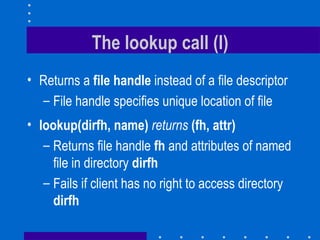
The lookup call (I) Returns a  file handle  instead of a file descriptor File handle specifies unique location of file lookup(dirfh, name)   returns   (fh, attr) Returns file handle   fh  and attributes of named file in directory  dirfh   Fails if client has no right to access directory  dirfh
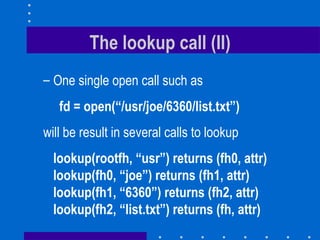
The lookup call (II) One single open call such as fd = open(“/usr/joe/6360/list.txt”) will be result in several calls to lookup lookup(rootfh, “usr”) returns (fh0, attr) lookup(fh0, “joe”) returns (fh1, attr) lookup(fh1, “6360”) returns (fh2, attr) lookup(fh2, “list.txt”) returns (fh, attr)
The lookup call (III) Why all these steps? Any of components of  /usr/joe/6360/list.txt could be a   mount point Mount points are  client dependent   and mount information is kept above the lookup() level
Server side (I) Server implements a  write-through  policy Required by statelessness Any blocks modified by a write request (including i-nodes and indirect blocks) must be written back to disk before the call completes
Server side (II) File handle   consists of Filesystem id  identifying disk partition I-node number  identifying file within partition Generation number  changed every time i-node is reused to store a new file Server will store Filesystem id  in filesystem  superblock I-node   generation number  in  i-node
Client side (I) Provides transparent interface to NFS Mapping between remote file names and remote file addresses is done a server boot time through  remote mount Extension of UNIX mounts Specified in a  mount table Makes a remote subtree appear part of a local subtree
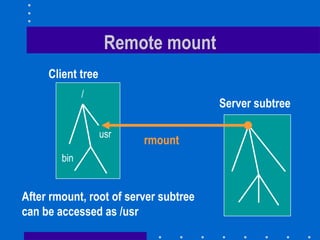
Remote mount Client tree bin usr / Server subtree rmount After rmount, root of server subtree  can be accessed as /usr
Client side (II) Provides transparent access to NFS  Other file systems (including UNIX FFS)  New virtual filesystem interface supports VFS calls, which operate on whole file system V NODE calls, which operate on individual files Treats all files in the same fashion
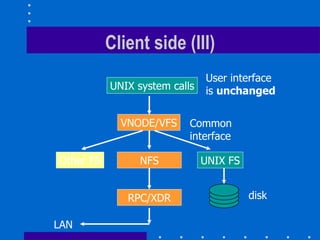
Client side (III) UNIX system calls VNODE/VFS Other FS NFS UNIX FS User interface is  unchanged RPC/XDR disk LAN Common interface
File consistency issues Cannot build an efficient network file system without  client caching   Cannot send each and every read or write to the server Client caching introduces  consistency issues
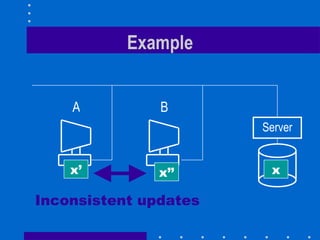
Example Consider a one-block file X that is concurrently modified by two workstations If file is cached at  both   workstations A will not see changes made by B B will not see changes made by A We will have Inconsistent updates Non respect of UNIX semantics
Example Server x’ x x’’ A B Inconsistent updates
UNIX file access semantics (I) Conventional timeshared UNIX semantics guarantee that All writes are executed in strict sequential fashion Their effect is immediately visible to all other processes accessing the file Interleaving of writes coming from different processes is left to the kernel discretion
UNIX file access semantics (II) UNIX file access semantics result from the use of a single I/O buffer containing all cached blocks and i-nodes Server caching is not a problem Disabling client caching is not an option: Would be too slow Would overload the file server
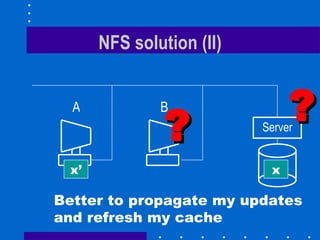
NFS solution (I) Stateless server does not know how many users are accessing a given file Clients do not know either Clients  must Frequently send their modified blocks to the server Frequently ask the server to revalidate the blocks they have in their cache
NFS solution (II) Server x’ x A B Better to propagate my updates and refresh my cache   ? ?
Implementation VNODE interface only made the kernel 2% slower Few of the UNIX FS were modified MOUNT was first included into the NFS protocol Later broken into a separate user-level RPC process
Hard issues (I) NFS root file systems cannot be shared: Too many problems Clients can mount any remote subtree any way they want: Could have different names for same subtree by mounting it in different places NFS uses a set of basic mounted filesystems on each machine and let users do the rest
Hard issues (II) NFS passes user id, group id and groups on each call Requires  same mapping  from user id and group id to user on all machines Achieved by  Yellow Pages  (YP) service NFS has no file locking
Hard issues (III) UNIX allows removal of opened files File becomes  nameless Processes that have the file opened can continue to access the file Other processes cannot NFS cannot do that and remain stateless NFS client detecting removal of an opened file renames it and deletes renamed file at close time
Hard issues (IV) In general, NFS tries to preserve UNIX open file semantics but does not always succeed If an opened file is removed by a process on another client, file is immediately deleted
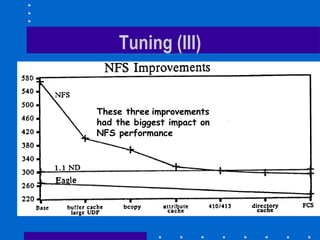
Tuning (I) First version of NFS was much slower than Sun Network Disk (ND) First improvement Added client buffer cache  Increased the size of UDP packets from 2048 to 9000 bytes Next improvement reduced the amount of buffer to buffer copying in NFS and RPC (bcopy)
Tuning (II) Third improvement introduced a client-side  attribute cache Cache is updated every time new attributes arrive from the server Cached attributes are discarded after 3 seconds for  file attributes 30 seconds for  directory attributes These three improvements cut benchmark run time by 50%
Tuning (III) These three   improvements had the biggest impact on NFS performance
My conclusion NFS succeeded because it was Robust Reasonably efficient Tuned to the needs of diskless workstations In addition, NFS was able to evolve and incorporate concepts such as close-to-open consistency (see next paper)

Nfs1

  • 1.
    DESIGN AND IMPLEMENTATION OF THE SUN NETWORK FILESYSTEM R. Sandberg, D. Goldberg S. Kleinman, D. Walsh, R. Lyon Sun Microsystems
  • 2.
    What is NFS?First commercially successful network file system: Developed by Sun Microsystems for their diskless workstations Designed for robustness and “adequate performance” Sun published all protocol specifications Many many implementations
  • 3.
    Paper highlights NFSis stateless All client requests must be self-contained The virtual filesystem interface VFS operations V NODE operations Performance issues Impact of tuning on NFS performance
  • 4.
    Objectives (I) Machineand Operating System Independence Could be implemented on low-end machines of the mid-80’s Fast Crash Recovery Major reason behind stateless design Transparent Access Remote files should be accessed in exactly the same way as local files
  • 5.
    Objectives (II) UNIXsemantics should be maintained on client Best way to achieve transparent access “ Reasonable” performance Robustness and preservation of UNIX semantics were much more important Contrast with Sprite and Coda
  • 6.
    Basic design Threeimportant parts The protocol The server side The client side
  • 7.
    The protocol (I)Uses the Sun RPC mechanism and Sun eXternal Data Representation (XDR) standard Defined as a set of remote procedures Protocol is stateless Each procedure call contains all the information necessary to complete the call Server maintains no “between call” information
  • 8.
    Advantages of statelessnessCrash recovery is very easy: When a server crashes, client just resends request until it gets an answer from the rebooted server Client cannot tell difference between a server that has crashed and recovered and a slow server Client can always repeat any request
  • 9.
    Consequences of statelessnessRead and writes must specify their start offset Server does not keep track of current position in the file User still use conventional UNIX reads and writes Open system call translates into several lookup calls to server No NFS equivalent to UNIX close system call
  • 10.
    The lookup call(I) Returns a file handle instead of a file descriptor File handle specifies unique location of file lookup(dirfh, name) returns (fh, attr) Returns file handle fh and attributes of named file in directory dirfh Fails if client has no right to access directory dirfh
  • 11.
    The lookup call(II) One single open call such as fd = open(“/usr/joe/6360/list.txt”) will be result in several calls to lookup lookup(rootfh, “usr”) returns (fh0, attr) lookup(fh0, “joe”) returns (fh1, attr) lookup(fh1, “6360”) returns (fh2, attr) lookup(fh2, “list.txt”) returns (fh, attr)
  • 12.
    The lookup call(III) Why all these steps? Any of components of /usr/joe/6360/list.txt could be a mount point Mount points are client dependent and mount information is kept above the lookup() level
  • 13.
    Server side (I)Server implements a write-through policy Required by statelessness Any blocks modified by a write request (including i-nodes and indirect blocks) must be written back to disk before the call completes
  • 14.
    Server side (II)File handle consists of Filesystem id identifying disk partition I-node number identifying file within partition Generation number changed every time i-node is reused to store a new file Server will store Filesystem id in filesystem superblock I-node generation number in i-node
  • 15.
    Client side (I)Provides transparent interface to NFS Mapping between remote file names and remote file addresses is done a server boot time through remote mount Extension of UNIX mounts Specified in a mount table Makes a remote subtree appear part of a local subtree
  • 16.
    Remote mount Clienttree bin usr / Server subtree rmount After rmount, root of server subtree can be accessed as /usr
  • 17.
    Client side (II)Provides transparent access to NFS Other file systems (including UNIX FFS) New virtual filesystem interface supports VFS calls, which operate on whole file system V NODE calls, which operate on individual files Treats all files in the same fashion
  • 18.
    Client side (III)UNIX system calls VNODE/VFS Other FS NFS UNIX FS User interface is unchanged RPC/XDR disk LAN Common interface
  • 19.
    File consistency issuesCannot build an efficient network file system without client caching Cannot send each and every read or write to the server Client caching introduces consistency issues
  • 20.
    Example Consider aone-block file X that is concurrently modified by two workstations If file is cached at both workstations A will not see changes made by B B will not see changes made by A We will have Inconsistent updates Non respect of UNIX semantics
  • 21.
    Example Server x’x x’’ A B Inconsistent updates
  • 22.
    UNIX file accesssemantics (I) Conventional timeshared UNIX semantics guarantee that All writes are executed in strict sequential fashion Their effect is immediately visible to all other processes accessing the file Interleaving of writes coming from different processes is left to the kernel discretion
  • 23.
    UNIX file accesssemantics (II) UNIX file access semantics result from the use of a single I/O buffer containing all cached blocks and i-nodes Server caching is not a problem Disabling client caching is not an option: Would be too slow Would overload the file server
  • 24.
    NFS solution (I)Stateless server does not know how many users are accessing a given file Clients do not know either Clients must Frequently send their modified blocks to the server Frequently ask the server to revalidate the blocks they have in their cache
  • 25.
    NFS solution (II)Server x’ x A B Better to propagate my updates and refresh my cache ? ?
  • 26.
    Implementation VNODE interfaceonly made the kernel 2% slower Few of the UNIX FS were modified MOUNT was first included into the NFS protocol Later broken into a separate user-level RPC process
  • 27.
    Hard issues (I)NFS root file systems cannot be shared: Too many problems Clients can mount any remote subtree any way they want: Could have different names for same subtree by mounting it in different places NFS uses a set of basic mounted filesystems on each machine and let users do the rest
  • 28.
    Hard issues (II)NFS passes user id, group id and groups on each call Requires same mapping from user id and group id to user on all machines Achieved by Yellow Pages (YP) service NFS has no file locking
  • 29.
    Hard issues (III)UNIX allows removal of opened files File becomes nameless Processes that have the file opened can continue to access the file Other processes cannot NFS cannot do that and remain stateless NFS client detecting removal of an opened file renames it and deletes renamed file at close time
  • 30.
    Hard issues (IV)In general, NFS tries to preserve UNIX open file semantics but does not always succeed If an opened file is removed by a process on another client, file is immediately deleted
  • 31.
    Tuning (I) Firstversion of NFS was much slower than Sun Network Disk (ND) First improvement Added client buffer cache Increased the size of UDP packets from 2048 to 9000 bytes Next improvement reduced the amount of buffer to buffer copying in NFS and RPC (bcopy)
  • 32.
    Tuning (II) Thirdimprovement introduced a client-side attribute cache Cache is updated every time new attributes arrive from the server Cached attributes are discarded after 3 seconds for file attributes 30 seconds for directory attributes These three improvements cut benchmark run time by 50%
  • 33.
    Tuning (III) Thesethree improvements had the biggest impact on NFS performance
  • 34.
    My conclusion NFSsucceeded because it was Robust Reasonably efficient Tuned to the needs of diskless workstations In addition, NFS was able to evolve and incorporate concepts such as close-to-open consistency (see next paper)