By
G.Satya Machindra
(19891A0579)
CONTENTS
• WHAT IS NFC
• Evolution of NFC Technology
• How NFC Works
• NFC Communication Modes
• NFC Uses
• NFC Applications
• Comparison with Bluetooth
• NFC issues
• NFC security
• Conclusion and Future Scope
WHAT IS NFC
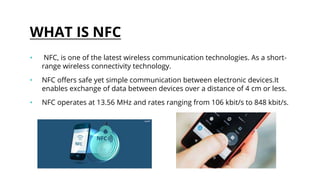
• NFC, is one of the latest wireless communication technologies. As a short-
range wireless connectivity technology.
• NFC offers safe yet simple communication between electronic devices.It
enables exchange of data between devices over a distance of 4 cm or less.
• NFC operates at 13.56 MHz and rates ranging from 106 kbit/s to 848 kbit/s.
Evolution of NFC
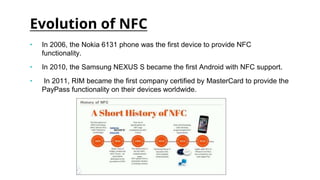
• In 2006, the Nokia 6131 phone was the first device to provide NFC
functionality.
• In 2010, the Samsung NEXUS S became the first Android with NFC support.
• In 2011, RIM became the first company certified by MasterCard to provide the
PayPass functionality on their devices worldwide.
How NFC works
• NFC is based on RFID (Radio-Frequency IDentification) technology that
uses magnetic field induction between electronic devices in close
proximity.
• For two devices to communicate using NFC, one device must have an NFC
reader/writer and one must have an NFC tag.
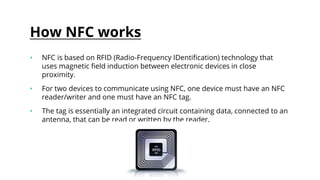
• The tag is essentially an integrated circuit containing data, connected to an
antenna, that can be read or written by the reader.
NFC Communication Modes
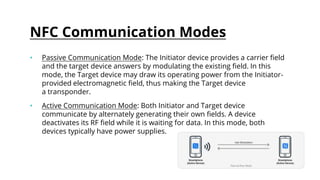
• Passive Communication Mode: The Initiator device provides a carrier field
and the target device answers by modulating the existing field. In this
mode, the Target device may draw its operating power from the Initiator-
provided electromagnetic field, thus making the Target device
a transponder.
• Active Communication Mode: Both Initiator and Target device
communicate by alternately generating their own fields. A device
deactivates its RF field while it is waiting for data. In this mode, both
devices typically have power supplies.
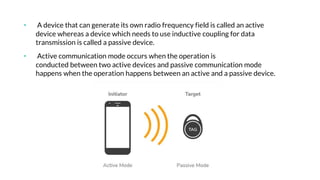
• A device that can generate its own radio frequency field is called an active
device whereas a device which needs to use inductive coupling for data
transmission is called a passive device.
• Active communication mode occurs when the operation is
conducted between two active devices and passive communication mode
happens when the operation happens between an active and a passive device.
NFC employs two different coding to
transfer data:
• NFC employs two different coding to transfer data. If an active device
transfers data at 106 kbit/s
• In all other cases Manchester coding is used with a modulation ratio of
10%.
• NFC devices are able to receive and transmit data at the same time.
• Thus, they need to check the radio frequency field and can detect a
collision if the received signal matches the transmitted signal's modulated
frequency band.
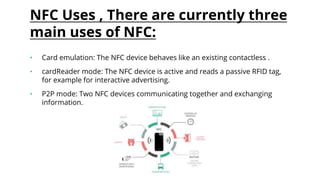
NFC Uses , There are currently three
main uses of NFC:
• Card emulation: The NFC device behaves like an existing contactless .
• cardReader mode: The NFC device is active and reads a passive RFID tag,
for example for interactive advertising.
• P2P mode: Two NFC devices communicating together and exchanging
information.
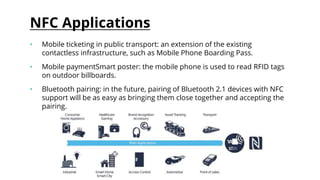
NFC Applications
• Mobile ticketing in public transport: an extension of the existing
contactless infrastructure, such as Mobile Phone Boarding Pass.
• Mobile paymentSmart poster: the mobile phone is used to read RFID tags
on outdoor billboards.
• Bluetooth pairing: in the future, pairing of Bluetooth 2.1 devices with NFC
support will be as easy as bringing them close together and accepting the
pairing.
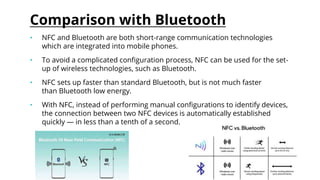
Comparison with Bluetooth
• NFC and Bluetooth are both short-range communication technologies
which are integrated into mobile phones.
• To avoid a complicated configuration process, NFC can be used for the set-
up of wireless technologies, such as Bluetooth.
• NFC sets up faster than standard Bluetooth, but is not much faster
than Bluetooth low energy.
• With NFC, instead of performing manual configurations to identify devices,
the connection between two NFC devices is automatically established
quickly — in less than a tenth of a second.
NFC security issues
• One of the most important and considerable aspects of Near Field
Communication is the security issue.
• However this type of short range wireless communication which is limited to
few centimeters and the technology is user aware interaction but still this
awareness does not guarantee a safe and secure communication, because there
may be are different types of threads toward NFC communication.
• One of the major threads is that the communicator
device has been manipulated physically where this can be done in different ways
as follows;
• By removing a tag from the tagged device
• By wrapping the tag of the tagged device in a metal foil to shield the RF signal
• By many other possible physical manipulation
NFC security
• NFC Specific key Agreement : Along with standard key agreement mechanism in
NFC protocol, there is a possibility to implement an NFC specific key agreement
where this agreement the computational requirement and theoretically
increases the communication security.
• This specific key agreement is not part of ISO standard and it just works with
100% modulation.
• During sending random bits of 0 or 1, each single device listens to the RF
field. The scheme is so that if the devices send a zero, the sum of the signals will
become zero and if both of them send 1’s then the sum of the signals will be the
doubleRF signal.
Conclusion
• NFC is a new technology developed over RFID, in a way that it consists of an
interface and protocol are based on RFID which makes NFC device to a part of
this standard and compatible with existing RFID technology.
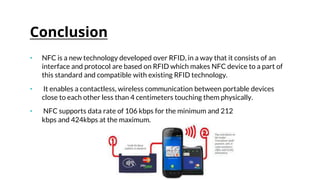
• It enables a contactless, wireless communication between portable devices
close to each other less than 4 centimeters touching them physically.
• NFC supports data rate of 106 kbps for the minimum and 212
kbps and 424kbps at the maximum.
Future scope
• As the future work, it seems that in many applications of NFC, the ASK
modulation technique is applied.
• Therefore this could be suggested that by using MATLAB, the other
techniques can be applied in the model of NFC .
• So it is possible to think on and developing new application that still does not
exist. Beside as the applications are growing then security issue comes to
importance first and still there could be new techniques to be defined in order to
accessing the attackers to the ongoing information between communicating
parties.
THANK YOU

NFC - Near Field Communication Technology TECHNICAL SEMINAR.pptx

  • 1.
  • 2.
    CONTENTS • WHAT ISNFC • Evolution of NFC Technology • How NFC Works • NFC Communication Modes • NFC Uses • NFC Applications • Comparison with Bluetooth • NFC issues • NFC security • Conclusion and Future Scope
  • 3.
    WHAT IS NFC •NFC, is one of the latest wireless communication technologies. As a short- range wireless connectivity technology. • NFC offers safe yet simple communication between electronic devices.It enables exchange of data between devices over a distance of 4 cm or less. • NFC operates at 13.56 MHz and rates ranging from 106 kbit/s to 848 kbit/s.
  • 4.
    Evolution of NFC •In 2006, the Nokia 6131 phone was the first device to provide NFC functionality. • In 2010, the Samsung NEXUS S became the first Android with NFC support. • In 2011, RIM became the first company certified by MasterCard to provide the PayPass functionality on their devices worldwide.
  • 5.
    How NFC works •NFC is based on RFID (Radio-Frequency IDentification) technology that uses magnetic field induction between electronic devices in close proximity. • For two devices to communicate using NFC, one device must have an NFC reader/writer and one must have an NFC tag. • The tag is essentially an integrated circuit containing data, connected to an antenna, that can be read or written by the reader.
  • 6.
    NFC Communication Modes •Passive Communication Mode: The Initiator device provides a carrier field and the target device answers by modulating the existing field. In this mode, the Target device may draw its operating power from the Initiator- provided electromagnetic field, thus making the Target device a transponder. • Active Communication Mode: Both Initiator and Target device communicate by alternately generating their own fields. A device deactivates its RF field while it is waiting for data. In this mode, both devices typically have power supplies.
  • 7.
    • A devicethat can generate its own radio frequency field is called an active device whereas a device which needs to use inductive coupling for data transmission is called a passive device. • Active communication mode occurs when the operation is conducted between two active devices and passive communication mode happens when the operation happens between an active and a passive device.
  • 8.
    NFC employs twodifferent coding to transfer data: • NFC employs two different coding to transfer data. If an active device transfers data at 106 kbit/s • In all other cases Manchester coding is used with a modulation ratio of 10%. • NFC devices are able to receive and transmit data at the same time. • Thus, they need to check the radio frequency field and can detect a collision if the received signal matches the transmitted signal's modulated frequency band.
  • 9.
    NFC Uses ,There are currently three main uses of NFC: • Card emulation: The NFC device behaves like an existing contactless . • cardReader mode: The NFC device is active and reads a passive RFID tag, for example for interactive advertising. • P2P mode: Two NFC devices communicating together and exchanging information.
  • 10.
    NFC Applications • Mobileticketing in public transport: an extension of the existing contactless infrastructure, such as Mobile Phone Boarding Pass. • Mobile paymentSmart poster: the mobile phone is used to read RFID tags on outdoor billboards. • Bluetooth pairing: in the future, pairing of Bluetooth 2.1 devices with NFC support will be as easy as bringing them close together and accepting the pairing.
  • 11.
    Comparison with Bluetooth •NFC and Bluetooth are both short-range communication technologies which are integrated into mobile phones. • To avoid a complicated configuration process, NFC can be used for the set- up of wireless technologies, such as Bluetooth. • NFC sets up faster than standard Bluetooth, but is not much faster than Bluetooth low energy. • With NFC, instead of performing manual configurations to identify devices, the connection between two NFC devices is automatically established quickly — in less than a tenth of a second.
  • 12.
    NFC security issues •One of the most important and considerable aspects of Near Field Communication is the security issue. • However this type of short range wireless communication which is limited to few centimeters and the technology is user aware interaction but still this awareness does not guarantee a safe and secure communication, because there may be are different types of threads toward NFC communication.
  • 13.
    • One ofthe major threads is that the communicator device has been manipulated physically where this can be done in different ways as follows; • By removing a tag from the tagged device • By wrapping the tag of the tagged device in a metal foil to shield the RF signal • By many other possible physical manipulation
  • 14.
    NFC security • NFCSpecific key Agreement : Along with standard key agreement mechanism in NFC protocol, there is a possibility to implement an NFC specific key agreement where this agreement the computational requirement and theoretically increases the communication security. • This specific key agreement is not part of ISO standard and it just works with 100% modulation. • During sending random bits of 0 or 1, each single device listens to the RF field. The scheme is so that if the devices send a zero, the sum of the signals will become zero and if both of them send 1’s then the sum of the signals will be the doubleRF signal.
  • 15.
    Conclusion • NFC isa new technology developed over RFID, in a way that it consists of an interface and protocol are based on RFID which makes NFC device to a part of this standard and compatible with existing RFID technology. • It enables a contactless, wireless communication between portable devices close to each other less than 4 centimeters touching them physically. • NFC supports data rate of 106 kbps for the minimum and 212 kbps and 424kbps at the maximum.
  • 16.
    Future scope • Asthe future work, it seems that in many applications of NFC, the ASK modulation technique is applied. • Therefore this could be suggested that by using MATLAB, the other techniques can be applied in the model of NFC . • So it is possible to think on and developing new application that still does not exist. Beside as the applications are growing then security issue comes to importance first and still there could be new techniques to be defined in order to accessing the attackers to the ongoing information between communicating parties.
  • 17.