© 2011 Frank Nielsen . Lecture 1
INF555
Fundamentals of 3D
Lecture 1:
Abstract Data Structures
Stacks, queues and hashing with...
...applications in visual computing
Mercredi 14 Septembre 2011
© 2011 Frank Nielsen . Lecture 1
INF555: Fundamentals of 3D
● L1. Abstract data structures
● L2. Transformations and coordinate pipelines
● L3. Advanced transformations
● L4. Images and colors
● L5. Meshes
● L6. Animation
● L7. Randomized algorithms
● L8. High-dimensions for 3D
● L9. Robustness
→ Examen 20 min oral en Décembre
© 2011 Frank Nielsen . Lecture 1
Débouchés de la filière Image (4A)
··Formation complementaire intégrée (FCI) avec l'··École des Ponts ParisTech
Master II ··Mathématiques / Vision / Apprentissage (MVA)
Master II à l'··École Polytechnique Fédérale de Lausanne (EPFL), Suisse :
Master II d'informatique/ Master II de robotique et systèmes autonomes
··Télécom ParisTech (ENST) :
+ Master ··spécialité imagerie du vivant (IMA)
+ Master ··Intelligence Artificielle et Décision (IAD) à UPMC
Cadre du Corps de l'Armement (filière recherche) :
··Royal Institute of Technology (KTH, Stockholm, Suéde. )
Master à l'étranger (notamment aux Etats-Unis et au Japon) :
Master à Columbia University, USA en infographie
Master en Electrical and Computer Engineering, Cornell University, USA
Master II ··Master Parisien de Recherche en Informatique (MPRI)
Master II ··Mathématiques / Vision / Apprentissage (MVA)
··ENSIMAG
··ENSTA
Masters européens:
Master ··ETH Zürich ··TU Munchen, Computer Science Dept.
Master in ··Biomedical Engineering à Oxford
· Masters internationaux : États-Unis / Japon
· etc.
http://www.lix.polytechnique.fr/~nielsen/INF555/devenir.html
© 2011 Frank Nielsen . Lecture 1
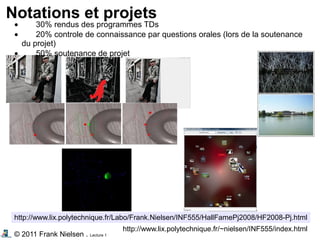
Notations et projets
http://www.lix.polytechnique.fr/Labo/Frank.Nielsen/INF555/HallFamePj2008/HF2008-Pj.html
http://www.lix.polytechnique.fr/~nielsen/INF555/index.html
• 30% rendus des programmes TDs
• 20% controle de connaissance par questions orales (lors de la soutenance
du projet)
• 50% soutenance de projet
© 2011 Frank Nielsen . Lecture 1
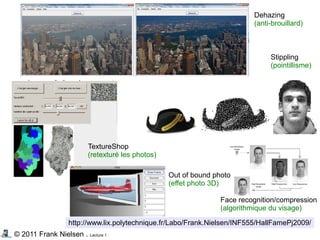
http://www.lix.polytechnique.fr/Labo/Frank.Nielsen/INF555/HallFamePj2009/
Dehazing
(anti-brouillard)
Stippling
(pointillisme)
TextureShop
(retexturé les photos)
Face recognition/compression
(algorithmique du visage)
Out of bound photo
(effet photo 3D)
© 2011 Frank Nielsen . Lecture 1
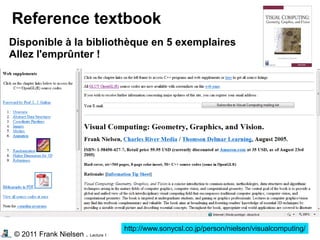
Reference textbook
http://www.sonycsl.co.jp/person/nielsen/visualcomputing/
Disponible à la bibliothèque en 5 exemplaires
Allez l'emprûnter !
© 2011 Frank Nielsen . Lecture 1
Abstract Data Structures
● Concepts encapsulated into an interface
● Multiple implementations (various trade-offs)
→ Good for code reuse (APIs):
→ Actual implementation is hidden
© 2011 Frank Nielsen . Lecture 1
Outline of Abstract DS
● Abstract data-structures in Java
● Area Flood filling (← stacks and ← queues)
● Any segment pair intersection (← dictionary)
● Image segmentation (← union-find disjoint elements)
● Object recognition (← geometric hashing)
© 2011 Frank Nielsen . Lecture 1
I. Abstract Data Structures: Stack
Interface (method prototypes):
isEmpty
push(Element)
pop (or pull)
For example, two implementations:
● Array
● Linked list
public static void main(String
[] args)
{
Stack myStack=new Stack();
int i;
for(i=0;i<10;i++)
myStack.Push(i);
for(i=0;i<15;i++)
System.out.println(myStack.Pull(
));
}
© 2011 Frank Nielsen . Lecture 1
class StackArray
{
int nbmax;
int index;
int [ ] array;
// Constructors
StackArray(int n)
{
this.nbmax=n;
array=new int[nbmax]; index=-1;
System.out.println("Succesfully created a
stack array object...");
}
// Methods: INTERFACE
void Push(int element)
{
if (index<nbmax-1)
array[++index]=element; }
int Pull()
{
if (index>=0 ) return array[index--];
else return -1;
}
Stack (array)
© 2011 Frank Nielsen . Lecture 1
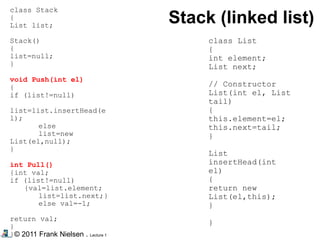
Stack (linked list)
class Stack
{
List list;
Stack()
{
list=null;
}
void Push(int el)
{
if (list!=null)
list=list.insertHead(e
l);
else
list=new
List(el,null);
}
int Pull()
{int val;
if (list!=null)
{val=list.element;
list=list.next;}
else val=-1;
return val;
}
}
class List
{
int element;
List next;
// Constructor
List(int el, List
tail)
{
this.element=el;
this.next=tail;
}
List
insertHead(int
el)
{
return new
List(el,this);
}
}
© 2011 Frank Nielsen . Lecture 1
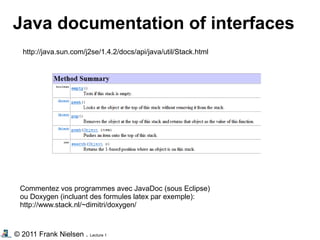
http://java.sun.com/j2se/1.4.2/docs/api/java/util/Stack.html
Java documentation of interfaces
Commentez vos programmes avec JavaDoc (sous Eclipse)
ou Doxygen (incluant des formules latex par exemple):
http://www.stack.nl/~dimitri/doxygen/
© 2011 Frank Nielsen . Lecture 1
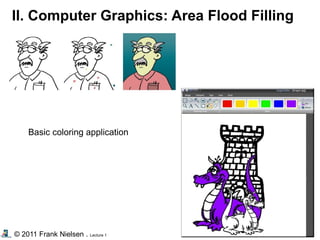
II. Computer Graphics: Area Flood Filling
Basic coloring application
© 2011 Frank Nielsen . Lecture 1
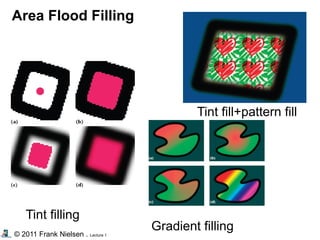
Area Flood Filling
Tint filling
Tint fill+pattern fill
Gradient filling
© 2011 Frank Nielsen . Lecture 1
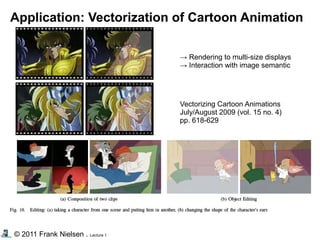
Application: Vectorization of Cartoon Animation
→ Rendering to multi-size displays
→ Interaction with image semantic
Vectorizing Cartoon Animations
July/August 2009 (vol. 15 no. 4)
pp. 618-629
© 2011 Frank Nielsen . Lecture 1
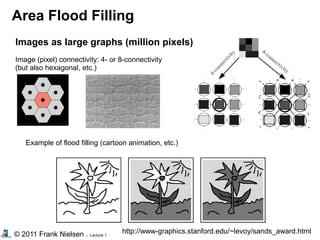
Area Flood Filling
Images as large graphs (million pixels):
Image (pixel) connectivity: 4- or 8-connectivity
(but also hexagonal, etc.)
Example of flood filling (cartoon animation, etc.)
http://www-graphics.stanford.edu/~levoy/sands_award.html
© 2011 Frank Nielsen . Lecture 1
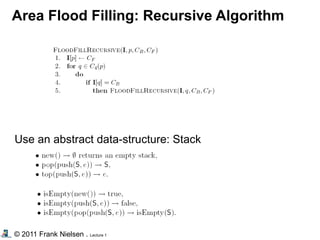
Area Flood Filling: Recursive Algorithm
Use an abstract data-structure: Stack
© 2011 Frank Nielsen . Lecture 1
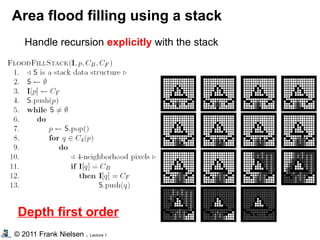
Area flood filling using a stack
Handle recursion explicitly with the stack
Depth first order
© 2011 Frank Nielsen . Lecture 1
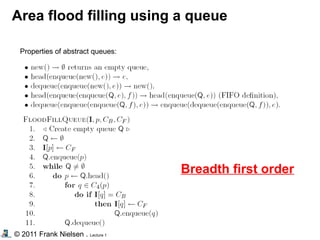
Area flood filling using a queue
Properties of abstract queues:
Breadth first order
© 2011 Frank Nielsen . Lecture 1
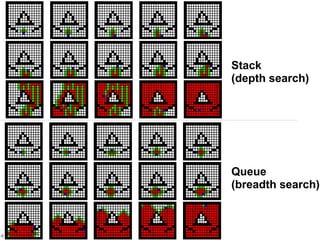
Stack
(depth search)
Queue
(breadth search)
© 2011 Frank Nielsen . Lecture 1
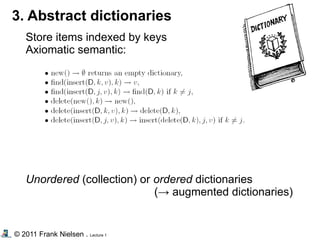
3. Abstract dictionaries
Store items indexed by keys
Axiomatic semantic:
Unordered (collection) or ordered dictionaries
(→ augmented dictionaries)
© 2011 Frank Nielsen . Lecture 1
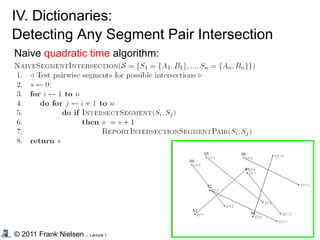
IV. Dictionaries:
Detecting Any Segment Pair Intersection
Naive quadratic time algorithm:
© 2011 Frank Nielsen . Lecture 1
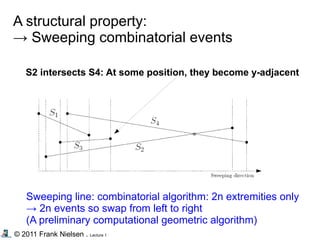
S2 intersects S4: At some position, they become y-adjacent
Sweeping line: combinatorial algorithm: 2n extremities only
→ 2n events so swap from left to right
(A preliminary computational geometric algorithm)
A structural property:
→ Sweeping combinatorial events
© 2011 Frank Nielsen . Lecture 1
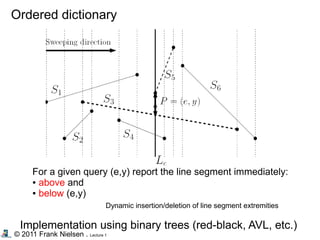
Ordered dictionary
For a given query (e,y) report the line segment immediately:
● above and
● below (e,y)
Dynamic insertion/deletion of line segment extremities
Implementation using binary trees (red-black, AVL, etc.)
© 2011 Frank Nielsen . Lecture 1
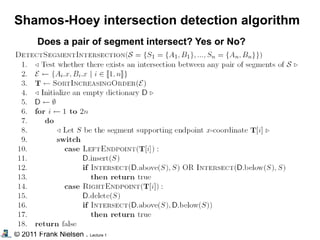
Shamos-Hoey intersection detection algorithm
Does a pair of segment intersect? Yes or No?
© 2011 Frank Nielsen . Lecture 1
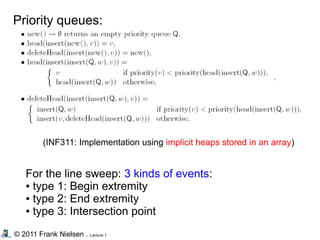
Priority queues:
(INF311: Implementation using implicit heaps stored in an array)
For the line sweep: 3 kinds of events:
● type 1: Begin extremity
● type 2: End extremity
● type 3: Intersection point
© 2011 Frank Nielsen . Lecture 1
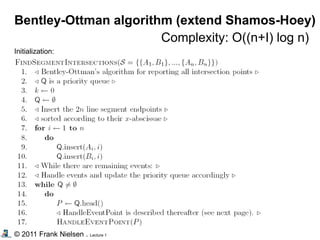
Bentley-Ottman algorithm (extend Shamos-Hoey)
Complexity: O((n+I) log n)
Initialization:
© 2011 Frank Nielsen . Lecture 1
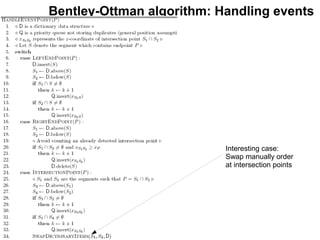
Bentley-Ottman algorithm: Handling events
Interesting case:
Swap manually order
at intersection points
© 2011 Frank Nielsen . Lecture 1
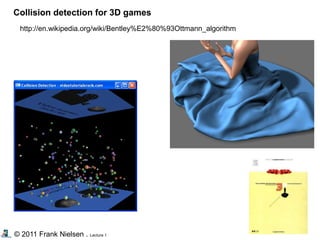
http://en.wikipedia.org/wiki/Bentley%E2%80%93Ottmann_algorithm
Collision detection for 3D games
© 2011 Frank Nielsen . Lecture 1
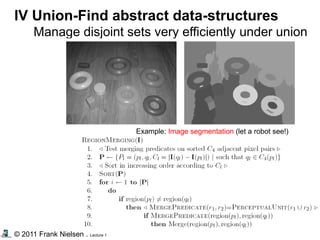
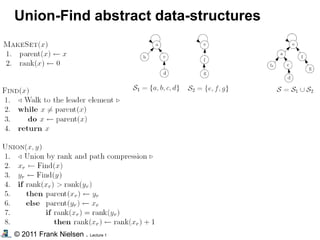
IV Union-Find abstract data-structures
Manage disjoint sets very efficiently under union
Example: Image segmentation (let a robot see!)
© 2011 Frank Nielsen . Lecture 1
Union-Find abstract data-structures
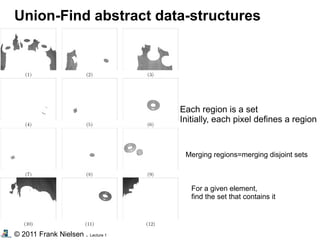
Each region is a set
Initially, each pixel defines a region
Merging regions=merging disjoint sets
For a given element,
find the set that contains it
© 2011 Frank Nielsen . Lecture 1
Union-Find abstract data-structures
© 2011 Frank Nielsen . Lecture 1
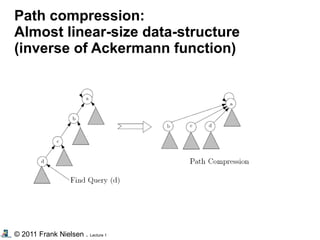
Path compression:
Almost linear-size data-structure
(inverse of Ackermann function)
© 2011 Frank Nielsen . Lecture 1
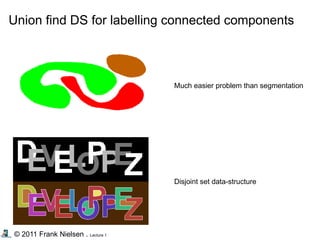
Union find DS for labelling connected components
Much easier problem than segmentation
Disjoint set data-structure
© 2011 Frank Nielsen . Lecture 1
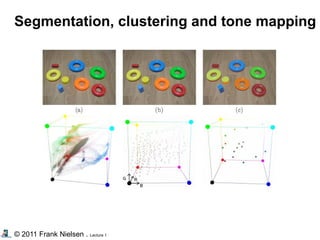
Segmentation, clustering and tone mapping
© 2011 Frank Nielsen . Lecture 1
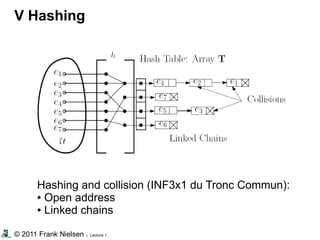
V Hashing
Hashing and collision (INF3x1 du Tronc Commun):
● Open address
● Linked chains
© 2011 Frank Nielsen . Lecture 1
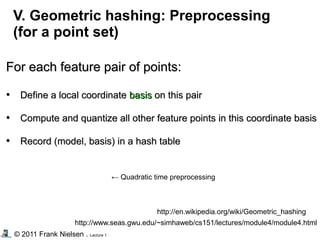
For each feature pair of points:
•
• Define a local coordinate
Define a local coordinate basis
basis on this pair
on this pair
•
• Compute and quantize all other feature points in this coordinate basis
Compute and quantize all other feature points in this coordinate basis
•
• Record (model, basis) in a hash table
Record (model, basis) in a hash table
V. Geometric hashing: Preprocessing
(for a point set)
http://en.wikipedia.org/wiki/Geometric_hashing
http://www.seas.gwu.edu/~simhaweb/cs151/lectures/module4/module4.html
← Quadratic time preprocessing
© 2011 Frank Nielsen . Lecture 1
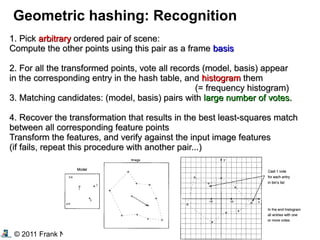
1. Pick
1. Pick arbitrary
arbitrary ordered pair of scene:
ordered pair of scene:
Compute the other points using this pair as a frame
Compute the other points using this pair as a frame basis
basis
2. For all the transformed points, vote all records (model, basis) appear
in the corresponding entry in the hash table, and
in the corresponding entry in the hash table, and histogram
histogram them
them
(= frequency histogram)
3. Matching candidates: (model, basis) pairs with
3. Matching candidates: (model, basis) pairs with large number of votes.
large number of votes.
4. Recover the transformation that results in the best least-squares match
between all corresponding feature points
Transform the features, and verify against the input image features
(if fails, repeat this procedure with another pair...)
Geometric hashing: Recognition
© 2011 Frank Nielsen . Lecture 1
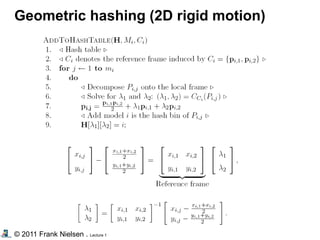
Geometric hashing (2D rigid motion)
© 2011 Frank Nielsen . Lecture 1
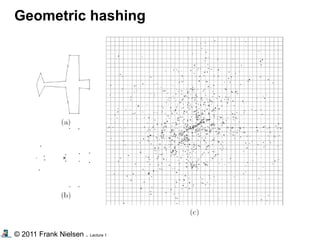
Geometric hashing
© 2011 Frank Nielsen . Lecture 1
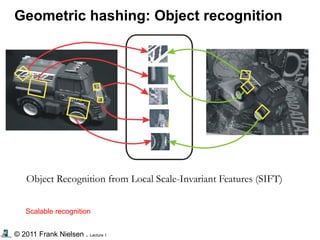
Geometric hashing: Object recognition
Object Recognition from Local Scale-Invariant Features (SIFT)
Scalable recognition
© 2011 Frank Nielsen . Lecture 1
Further readings
http://www.lix.polytechnique.fr/~nielsen/INF555/index.html
● Wolfson, H.J. & Rigoutsos, I (1997).
Geometric Hashing: An Overview.
IEEE Computational Science and Engineering, 4(4), 10-21.
● Andrew S. Glassner: Fill 'Er Up!
IEEE Computer Graphics and Applications 21(1): 78-85 (2001)
© 2011 Frank Nielsen . Lecture 1
Java I/O Image
Several APIs
public Image(String filename) {
java.awt.Image img = Toolkit.getDefaultToolkit().getImage(filename);
if (img != null) {
PixelGrabber pg = new PixelGrabber(img, 0, 0, -1, -1, true);
try {
pg.grabPixels();
} catch (InterruptedException e) {
}
raster = (int[]) pg.getPixels();
height = pg.getHeight();
width = pg.getWidth();
} else {
throw new IllegalArgumentException("Error opening file "
+ filename);
}
}
Can use also
processing.org
© 2011 Frank Nielsen . Lecture 1
Java I/O Image
public int getBlue(int x, int y) {
if (x < 0 || x >= width || y < 0 || y >= height) {
throw new IllegalArgumentException();
}
return (raster[y * width + x] & 0xFF);
}
public int getGreen(int x, int y) {
if (x < 0 || x >= width || y < 0 || y >= height) {
throw new IllegalArgumentException();
}
return ((raster[y * width + x] & 0xFF00) >> 8);
}
public int getRed(int x, int y) {
if (x < 0 || x >= width || y < 0 || y >= height) {
throw new IllegalArgumentException();
}
return ((raster[y * width + x] & 0xFF0000) >> 16);
}
Alpha Red Green Blue
Opacity is 255 (0xFF)
© 2011 Frank Nielsen . Lecture 1
public void setGreen(int x, int y, int value) {
if (x < 0 || x >= width || y < 0 || y >= height) {
throw new IllegalArgumentException();
}
raster[y * width + x] = raster[y * width + x] | ((value&0xff)<<8);
}
public void setRed(int x, int y, int value) {
if (x < 0 || x >= width || y < 0 || y >= height) {
throw new IllegalArgumentException();
}
raster[y * width + x] = raster[y * width + x] | ((value&0xff)<<16);
}
public void setBlue(int x, int y, int value ) {
if (x < 0 || x >= width || y < 0 || y >= height) {
throw new IllegalArgumentException();
}
raster[y * width + x] = raster[y * width + x] | (value&0xff);
}
Java I/O Image Alpha Red Green Blue
© 2011 Frank Nielsen . Lecture 1
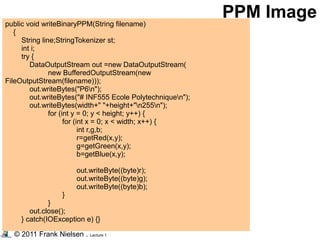
public void writeBinaryPPM(String filename)
{
String line;StringTokenizer st;
int i;
try {
DataOutputStream out =new DataOutputStream(
new BufferedOutputStream(new
FileOutputStream(filename)));
out.writeBytes("P6n");
out.writeBytes("# INF555 Ecole Polytechniquen");
out.writeBytes(width+" "+height+"n255n");
for (int y = 0; y < height; y++) {
for (int x = 0; x < width; x++) {
int r,g,b;
r=getRed(x,y);
g=getGreen(x,y);
b=getBlue(x,y);
out.writeByte((byte)r);
out.writeByte((byte)g);
out.writeByte((byte)b);
}
}
out.close();
} catch(IOException e) {}
PPM Image

(slides 1) Visual Computing: Geometry, Graphics, and Vision

  • 1.
    © 2011 FrankNielsen . Lecture 1 INF555 Fundamentals of 3D Lecture 1: Abstract Data Structures Stacks, queues and hashing with... ...applications in visual computing Mercredi 14 Septembre 2011
  • 2.
    © 2011 FrankNielsen . Lecture 1 INF555: Fundamentals of 3D ● L1. Abstract data structures ● L2. Transformations and coordinate pipelines ● L3. Advanced transformations ● L4. Images and colors ● L5. Meshes ● L6. Animation ● L7. Randomized algorithms ● L8. High-dimensions for 3D ● L9. Robustness → Examen 20 min oral en Décembre
  • 3.
    © 2011 FrankNielsen . Lecture 1 Débouchés de la filière Image (4A) ··Formation complementaire intégrée (FCI) avec l'··École des Ponts ParisTech Master II ··Mathématiques / Vision / Apprentissage (MVA) Master II à l'··École Polytechnique Fédérale de Lausanne (EPFL), Suisse : Master II d'informatique/ Master II de robotique et systèmes autonomes ··Télécom ParisTech (ENST) : + Master ··spécialité imagerie du vivant (IMA) + Master ··Intelligence Artificielle et Décision (IAD) à UPMC Cadre du Corps de l'Armement (filière recherche) : ··Royal Institute of Technology (KTH, Stockholm, Suéde. ) Master à l'étranger (notamment aux Etats-Unis et au Japon) : Master à Columbia University, USA en infographie Master en Electrical and Computer Engineering, Cornell University, USA Master II ··Master Parisien de Recherche en Informatique (MPRI) Master II ··Mathématiques / Vision / Apprentissage (MVA) ··ENSIMAG ··ENSTA Masters européens: Master ··ETH Zürich ··TU Munchen, Computer Science Dept. Master in ··Biomedical Engineering à Oxford · Masters internationaux : États-Unis / Japon · etc. http://www.lix.polytechnique.fr/~nielsen/INF555/devenir.html
  • 4.
    © 2011 FrankNielsen . Lecture 1 Notations et projets http://www.lix.polytechnique.fr/Labo/Frank.Nielsen/INF555/HallFamePj2008/HF2008-Pj.html http://www.lix.polytechnique.fr/~nielsen/INF555/index.html • 30% rendus des programmes TDs • 20% controle de connaissance par questions orales (lors de la soutenance du projet) • 50% soutenance de projet
  • 5.
    © 2011 FrankNielsen . Lecture 1 http://www.lix.polytechnique.fr/Labo/Frank.Nielsen/INF555/HallFamePj2009/ Dehazing (anti-brouillard) Stippling (pointillisme) TextureShop (retexturé les photos) Face recognition/compression (algorithmique du visage) Out of bound photo (effet photo 3D)
  • 6.
    © 2011 FrankNielsen . Lecture 1 Reference textbook http://www.sonycsl.co.jp/person/nielsen/visualcomputing/ Disponible à la bibliothèque en 5 exemplaires Allez l'emprûnter !
  • 7.
    © 2011 FrankNielsen . Lecture 1 Abstract Data Structures ● Concepts encapsulated into an interface ● Multiple implementations (various trade-offs) → Good for code reuse (APIs): → Actual implementation is hidden
  • 8.
    © 2011 FrankNielsen . Lecture 1 Outline of Abstract DS ● Abstract data-structures in Java ● Area Flood filling (← stacks and ← queues) ● Any segment pair intersection (← dictionary) ● Image segmentation (← union-find disjoint elements) ● Object recognition (← geometric hashing)
  • 9.
    © 2011 FrankNielsen . Lecture 1 I. Abstract Data Structures: Stack Interface (method prototypes): isEmpty push(Element) pop (or pull) For example, two implementations: ● Array ● Linked list public static void main(String [] args) { Stack myStack=new Stack(); int i; for(i=0;i<10;i++) myStack.Push(i); for(i=0;i<15;i++) System.out.println(myStack.Pull( )); }
  • 10.
    © 2011 FrankNielsen . Lecture 1 class StackArray { int nbmax; int index; int [ ] array; // Constructors StackArray(int n) { this.nbmax=n; array=new int[nbmax]; index=-1; System.out.println("Succesfully created a stack array object..."); } // Methods: INTERFACE void Push(int element) { if (index<nbmax-1) array[++index]=element; } int Pull() { if (index>=0 ) return array[index--]; else return -1; } Stack (array)
  • 11.
    © 2011 FrankNielsen . Lecture 1 Stack (linked list) class Stack { List list; Stack() { list=null; } void Push(int el) { if (list!=null) list=list.insertHead(e l); else list=new List(el,null); } int Pull() {int val; if (list!=null) {val=list.element; list=list.next;} else val=-1; return val; } } class List { int element; List next; // Constructor List(int el, List tail) { this.element=el; this.next=tail; } List insertHead(int el) { return new List(el,this); } }
  • 12.
    © 2011 FrankNielsen . Lecture 1 http://java.sun.com/j2se/1.4.2/docs/api/java/util/Stack.html Java documentation of interfaces Commentez vos programmes avec JavaDoc (sous Eclipse) ou Doxygen (incluant des formules latex par exemple): http://www.stack.nl/~dimitri/doxygen/
  • 13.
    © 2011 FrankNielsen . Lecture 1 II. Computer Graphics: Area Flood Filling Basic coloring application
  • 14.
    © 2011 FrankNielsen . Lecture 1 Area Flood Filling Tint filling Tint fill+pattern fill Gradient filling
  • 15.
    © 2011 FrankNielsen . Lecture 1 Application: Vectorization of Cartoon Animation → Rendering to multi-size displays → Interaction with image semantic Vectorizing Cartoon Animations July/August 2009 (vol. 15 no. 4) pp. 618-629
  • 16.
    © 2011 FrankNielsen . Lecture 1 Area Flood Filling Images as large graphs (million pixels): Image (pixel) connectivity: 4- or 8-connectivity (but also hexagonal, etc.) Example of flood filling (cartoon animation, etc.) http://www-graphics.stanford.edu/~levoy/sands_award.html
  • 17.
    © 2011 FrankNielsen . Lecture 1 Area Flood Filling: Recursive Algorithm Use an abstract data-structure: Stack
  • 18.
    © 2011 FrankNielsen . Lecture 1 Area flood filling using a stack Handle recursion explicitly with the stack Depth first order
  • 19.
    © 2011 FrankNielsen . Lecture 1 Area flood filling using a queue Properties of abstract queues: Breadth first order
  • 20.
    © 2011 FrankNielsen . Lecture 1 Stack (depth search) Queue (breadth search)
  • 21.
    © 2011 FrankNielsen . Lecture 1 3. Abstract dictionaries Store items indexed by keys Axiomatic semantic: Unordered (collection) or ordered dictionaries (→ augmented dictionaries)
  • 22.
    © 2011 FrankNielsen . Lecture 1 IV. Dictionaries: Detecting Any Segment Pair Intersection Naive quadratic time algorithm:
  • 23.
    © 2011 FrankNielsen . Lecture 1 S2 intersects S4: At some position, they become y-adjacent Sweeping line: combinatorial algorithm: 2n extremities only → 2n events so swap from left to right (A preliminary computational geometric algorithm) A structural property: → Sweeping combinatorial events
  • 24.
    © 2011 FrankNielsen . Lecture 1 Ordered dictionary For a given query (e,y) report the line segment immediately: ● above and ● below (e,y) Dynamic insertion/deletion of line segment extremities Implementation using binary trees (red-black, AVL, etc.)
  • 25.
    © 2011 FrankNielsen . Lecture 1 Shamos-Hoey intersection detection algorithm Does a pair of segment intersect? Yes or No?
  • 26.
    © 2011 FrankNielsen . Lecture 1 Priority queues: (INF311: Implementation using implicit heaps stored in an array) For the line sweep: 3 kinds of events: ● type 1: Begin extremity ● type 2: End extremity ● type 3: Intersection point
  • 27.
    © 2011 FrankNielsen . Lecture 1 Bentley-Ottman algorithm (extend Shamos-Hoey) Complexity: O((n+I) log n) Initialization:
  • 28.
    © 2011 FrankNielsen . Lecture 1 Bentley-Ottman algorithm: Handling events Interesting case: Swap manually order at intersection points
  • 29.
    © 2011 FrankNielsen . Lecture 1 http://en.wikipedia.org/wiki/Bentley%E2%80%93Ottmann_algorithm Collision detection for 3D games
  • 30.
    © 2011 FrankNielsen . Lecture 1 IV Union-Find abstract data-structures Manage disjoint sets very efficiently under union Example: Image segmentation (let a robot see!)
  • 31.
    © 2011 FrankNielsen . Lecture 1 Union-Find abstract data-structures Each region is a set Initially, each pixel defines a region Merging regions=merging disjoint sets For a given element, find the set that contains it
  • 32.
    © 2011 FrankNielsen . Lecture 1 Union-Find abstract data-structures
  • 33.
    © 2011 FrankNielsen . Lecture 1 Path compression: Almost linear-size data-structure (inverse of Ackermann function)
  • 34.
    © 2011 FrankNielsen . Lecture 1 Union find DS for labelling connected components Much easier problem than segmentation Disjoint set data-structure
  • 35.
    © 2011 FrankNielsen . Lecture 1 Segmentation, clustering and tone mapping
  • 36.
    © 2011 FrankNielsen . Lecture 1 V Hashing Hashing and collision (INF3x1 du Tronc Commun): ● Open address ● Linked chains
  • 37.
    © 2011 FrankNielsen . Lecture 1 For each feature pair of points: For each feature pair of points: • • Define a local coordinate Define a local coordinate basis basis on this pair on this pair • • Compute and quantize all other feature points in this coordinate basis Compute and quantize all other feature points in this coordinate basis • • Record (model, basis) in a hash table Record (model, basis) in a hash table V. Geometric hashing: Preprocessing (for a point set) http://en.wikipedia.org/wiki/Geometric_hashing http://www.seas.gwu.edu/~simhaweb/cs151/lectures/module4/module4.html ← Quadratic time preprocessing
  • 38.
    © 2011 FrankNielsen . Lecture 1 1. Pick 1. Pick arbitrary arbitrary ordered pair of scene: ordered pair of scene: Compute the other points using this pair as a frame Compute the other points using this pair as a frame basis basis 2. For all the transformed points, vote all records (model, basis) appear 2. For all the transformed points, vote all records (model, basis) appear in the corresponding entry in the hash table, and in the corresponding entry in the hash table, and histogram histogram them them (= frequency histogram) (= frequency histogram) 3. Matching candidates: (model, basis) pairs with 3. Matching candidates: (model, basis) pairs with large number of votes. large number of votes. 4. Recover the transformation that results in the best least-squares match 4. Recover the transformation that results in the best least-squares match between all corresponding feature points between all corresponding feature points Transform the features, and verify against the input image features Transform the features, and verify against the input image features (if fails, repeat this procedure with another pair...) (if fails, repeat this procedure with another pair...) Geometric hashing: Recognition
  • 39.
    © 2011 FrankNielsen . Lecture 1 Geometric hashing (2D rigid motion)
  • 40.
    © 2011 FrankNielsen . Lecture 1 Geometric hashing
  • 41.
    © 2011 FrankNielsen . Lecture 1 Geometric hashing: Object recognition Object Recognition from Local Scale-Invariant Features (SIFT) Scalable recognition
  • 42.
    © 2011 FrankNielsen . Lecture 1 Further readings http://www.lix.polytechnique.fr/~nielsen/INF555/index.html ● Wolfson, H.J. & Rigoutsos, I (1997). Geometric Hashing: An Overview. IEEE Computational Science and Engineering, 4(4), 10-21. ● Andrew S. Glassner: Fill 'Er Up! IEEE Computer Graphics and Applications 21(1): 78-85 (2001)
  • 43.
    © 2011 FrankNielsen . Lecture 1 Java I/O Image Several APIs public Image(String filename) { java.awt.Image img = Toolkit.getDefaultToolkit().getImage(filename); if (img != null) { PixelGrabber pg = new PixelGrabber(img, 0, 0, -1, -1, true); try { pg.grabPixels(); } catch (InterruptedException e) { } raster = (int[]) pg.getPixels(); height = pg.getHeight(); width = pg.getWidth(); } else { throw new IllegalArgumentException("Error opening file " + filename); } } Can use also processing.org
  • 44.
    © 2011 FrankNielsen . Lecture 1 Java I/O Image public int getBlue(int x, int y) { if (x < 0 || x >= width || y < 0 || y >= height) { throw new IllegalArgumentException(); } return (raster[y * width + x] & 0xFF); } public int getGreen(int x, int y) { if (x < 0 || x >= width || y < 0 || y >= height) { throw new IllegalArgumentException(); } return ((raster[y * width + x] & 0xFF00) >> 8); } public int getRed(int x, int y) { if (x < 0 || x >= width || y < 0 || y >= height) { throw new IllegalArgumentException(); } return ((raster[y * width + x] & 0xFF0000) >> 16); } Alpha Red Green Blue Opacity is 255 (0xFF)
  • 45.
    © 2011 FrankNielsen . Lecture 1 public void setGreen(int x, int y, int value) { if (x < 0 || x >= width || y < 0 || y >= height) { throw new IllegalArgumentException(); } raster[y * width + x] = raster[y * width + x] | ((value&0xff)<<8); } public void setRed(int x, int y, int value) { if (x < 0 || x >= width || y < 0 || y >= height) { throw new IllegalArgumentException(); } raster[y * width + x] = raster[y * width + x] | ((value&0xff)<<16); } public void setBlue(int x, int y, int value ) { if (x < 0 || x >= width || y < 0 || y >= height) { throw new IllegalArgumentException(); } raster[y * width + x] = raster[y * width + x] | (value&0xff); } Java I/O Image Alpha Red Green Blue
  • 46.
    © 2011 FrankNielsen . Lecture 1 public void writeBinaryPPM(String filename) { String line;StringTokenizer st; int i; try { DataOutputStream out =new DataOutputStream( new BufferedOutputStream(new FileOutputStream(filename))); out.writeBytes("P6n"); out.writeBytes("# INF555 Ecole Polytechniquen"); out.writeBytes(width+" "+height+"n255n"); for (int y = 0; y < height; y++) { for (int x = 0; x < width; x++) { int r,g,b; r=getRed(x,y); g=getGreen(x,y); b=getBlue(x,y); out.writeByte((byte)r); out.writeByte((byte)g); out.writeByte((byte)b); } } out.close(); } catch(IOException e) {} PPM Image