Algorithms & Data Structures
Lecture 1
L.J. Bel
iCSC 2018
Outline
Lecture I
1. Motivation
2. Sorting algorithms
3. Complexity analysis
4. Linear data structures
Lecture II
5. Nonlinear data structures
6. Abstract data types
7. Dijkstra’s algorithm
8. Summary
2
Attention!
Lecture aimed at non-computer scientists.
Focus is on explaining concepts,
rather than technical correctness.
3
1. Motivation
4
Motivation
● Algorithms
● Data Structures
1. Everything running on your
computer is an algorithm
2. Analysing them is paramount
to writing, maintaining and
improving them
3. Several tools exist to help
achieve this
5
Motivation
● Algorithms
● Data Structures
1. Data Structures define how
data is stored in RAM
2. Many variations, each with
advantages and
disadvantages
3. Strongly coupled to algorithmic
complexity
6
2. Sorting algorithms
7
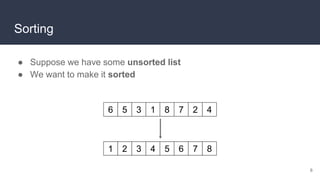
Sorting
● Suppose we have some unsorted list
● We want to make it sorted
8
3 1
5
6 8 7 2 4
3 4
2
1 5 6 7 8
N steps
N steps
● In pseudocode:
i ← 1
while i < length(A)
j ← i
while j > 0 and A[j-1] > A[j]
swap A[j] and A[j-1]
j ← j - 1
end while
i ← i + 1
end while
Insertion sort
● “Naive” sorting algorithm
● One-by-one, take each
element and move it
● When all elements have been
moved, list is sorted!
9
● In pseudocode:
i ← 1
while i < length(A)
j ← i
while j > 0 and A[j-1] > A[j]
swap A[j] and A[j-1]
j ← j - 1
end while
i ← i + 1
end while
Total: N² steps
By Swfung8 (Own work) [CC BY-SA
3.0], via Wikimedia Commons
Bubble sort
● Traverse the list, taking pairs
of elements
● Swap if order incorrect
● Repeat N times
● Now it’s sorted!
10
Total: N² steps
By Swfung8 (Own work) [CC BY-SA 3.0],
via Wikimedia Commons
N steps
N steps
Intermezzo: Divide and conquer
● Generic algorithm strategy
○ Divide the problem into smaller parts
○ Solve (conquer) the problem for each part
○ Recombine the parts
● Straightforward to parallelise
● Closely related to map-reduce
● Has been advocated by Caesar, Machiavelli, Napoleon...
11
Merge sort
● Much smarter sort
○ Split the dataset into chunks
○ Sort each chunk
○ Merge the chunks back together
● Example of divide-and-conquer
● Splitting & sorting takes log₂(N) steps
● Merging takes N steps
12
By Swfung8 (Own work) [CC BY-SA 3.0],
via Wikimedia Commons
Total: N log(N) steps
3. Complexity analysis
13
Complexity – O
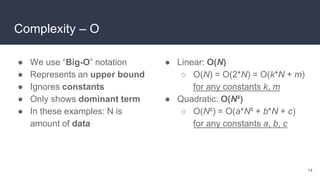
● We use “Big-O” notation
● Represents an upper bound
● Ignores constants
● Only shows dominant term
● In these examples: N is
amount of data
● Linear: O(N)
○ O(N) = O(2*N) = O(k*N + m)
for any constants k, m
● Quadratic: O(N²)
○ O(N²) = O(a*N² + b*N + c)
for any constants a, b, c
14
Complexity – O
● Roughly three categories, in decreasing
order:
○ Exponential – O(kN)
○ Polynomial – O(Nk)
○ Polylogarithmic – O(log(N)k)
● This is an abstraction!
○ Does not directly relate to runtimes
○ A good O(N²) algorithm may be faster than
a bad O(log(N)) one
○ Depends on your input data! 15
By Cmglee (Own work) [CC BY-SA 4.0],
via Wikimedia Commons
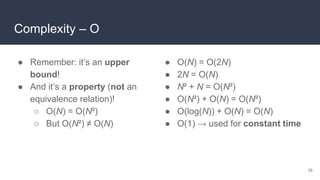
Complexity – O
● Remember: it’s an upper
bound!
● And it’s a property (not an
equivalence relation)!
○ O(N) = O(N²)
○ But O(N²) ≠ O(N)
● O(N) = O(2N)
● 2N = O(N)
● N² + N = O(N²)
● O(N²) + O(N) = O(N²)
● O(log(N)) + O(N) = O(N)
● O(1) → used for constant time
16
Complexity – O
● Formal definition:
f(N) = O(g(N)) ↔
∃ N₀, M : ∀ N > N₀ : f(N) ≤ M g(N)
● In words: starting from N₀, f is bounded
from above by g (up to some constant M)
17
By Cmglee (Own work) [CC BY-SA 4.0],
via Wikimedia Commons
Complexity – Ω
● Ω: lower bound
○ Formal definition:
f(N) = Ω(g(N)) ↔
∃ N₀, M : ∀ N > N₀ : f(N) ≥ M g(N)
○ In words: starting from N₀, f is bounded
from below by g (up to some constant M)
● Examples:
○ N = Ω(log(N))
○ N² = Ω(N)
18
By Cmglee (Own work) [CC BY-SA 4.0],
via Wikimedia Commons
Complexity – Θ
● Θ: exact bound
○ Formal definition:
f(N) = Θ(g(N)) ↔
f(N) = O(g(N)) and f(N) = Ω(g(N))
● Examples:
○ N = Θ(N)
○ 2N = Θ(N)
○ 3N²+5N+1 = Θ(N²)
○ N ≠ Θ(N²) (even though N = O(N²))
19
By Cmglee (Own work) [CC BY-SA 4.0],
via Wikimedia Commons
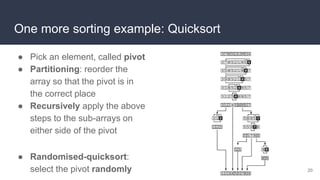
One more sorting example: Quicksort
● Pick an element, called pivot
● Partitioning: reorder the
array so that the pivot is in
the correct place
● Recursively apply the above
steps to the sub-arrays on
either side of the pivot
20
● Randomised-quicksort:
select the pivot randomly
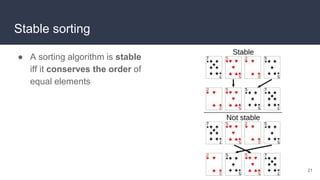
Stable sorting
● A sorting algorithm is stable
iff it conserves the order of
equal elements
21
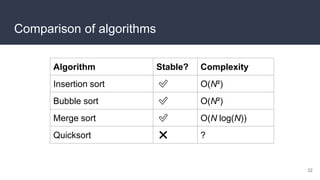
Comparison of algorithms
22
Algorithm Stable? Complexity
Insertion sort ✅ O(N²)
Bubble sort ✅ O(N²)
Merge sort ✅ O(N log(N))
Quicksort ❌ ?
4. Linear data structures
23
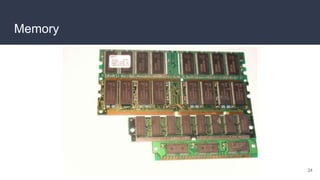
Memory
24
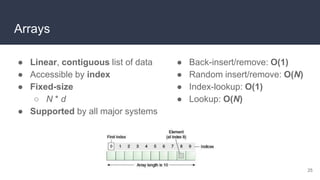
Arrays
● Linear, contiguous list of data
● Accessible by index
● Fixed-size
○ N * d
● Supported by all major systems
25
● Back-insert/remove: O(1)
● Random insert/remove: O(N)
● Index-lookup: O(1)
● Lookup: O(N)
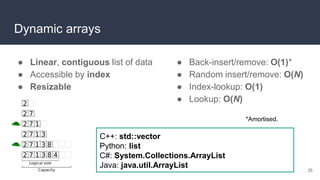
Dynamic arrays
● Linear, contiguous list of data
● Accessible by index
● Resizable
26
C++: std::vector
Python: list
C#: System.Collections.ArrayList
Java: java.util.ArrayList
● Back-insert/remove: O(1)*
● Random insert/remove: O(N)
● Index-lookup: O(1)
● Lookup: O(N)
*Amortised.
Pointers
27
By Sven (Own work) [CC BY-SA
3.0],
via Wikimedia Commons
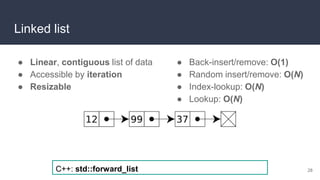
Linked list
● Linear, contiguous list of data
● Accessible by iteration
● Resizable
28
● Back-insert/remove: O(1)
● Random insert/remove: O(N)
● Index-lookup: O(N)
● Lookup: O(N)
C++: std::forward_list
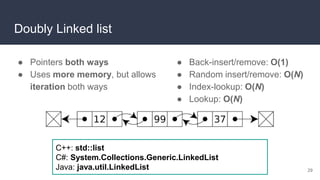
Doubly Linked list
● Pointers both ways
● Uses more memory, but allows
iteration both ways
29
● Back-insert/remove: O(1)
● Random insert/remove: O(N)
● Index-lookup: O(N)
● Lookup: O(N)
C++: std::list
C#: System.Collections.Generic.LinkedList
Java: java.util.LinkedList
Binary search
● Searches a sorted linear data structure
● Takes Θ(log(N))
● Example of divide and conquer
30
By AlwaysAngry (Own work) [CC BY-SA 4.0],
via Wikimedia Commons
Algorithms & Data Structures
Lecture 2
L.J. Bel
iCSC 2018
Outline
Lecture I
1. Motivation
2. Sorting algorithms
3. Complexity analysis
4. Linear data structures
Lecture II
5. Nonlinear data structures
6. Abstract data types
7. Dijkstra’s algorithm
8. Summary
32
5. Nonlinear data structures
33
Recall: Binary search
● Searches a sorted linear data structure
● Takes Θ(log(N))
● … let’s use this as inspiration for a data structure!
34
By AlwaysAngry (Own work) [CC BY-SA 4.0],
via Wikimedia Commons
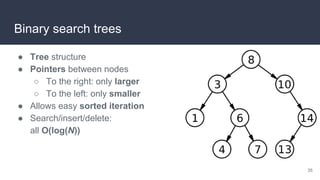
Binary search trees
● Tree structure
● Pointers between nodes
○ To the right: only larger
○ To the left: only smaller
● Allows easy sorted iteration
● Search/insert/delete:
all O(log(N))
35
Hash tables
● Idea: create buckets
numbered 1 to B
● For each item, compute in
which bucket it belongs
● Put the item in that bucket
● Search/insert/delete:
all O(1)
36
By Jorge Stolfi (Own work) [CC BY-SA 3.0],
via Wikimedia Commons
Hash tables
● Problem: clashing hashes!
● Solution: replace entry with
linked list (chaining)
● New problem: load factor
can become too high!
● Solution: copy to new table
with more buckets
37
By Jorge Stolfi (Own work) [CC BY-SA 3.0],
via Wikimedia Commons
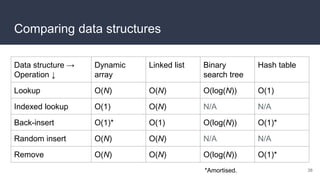
Comparing data structures
38
Data structure →
Operation ↓
Dynamic
array
Linked list Binary
search tree
Hash table
Lookup O(N) O(N) O(log(N)) O(1)
Indexed lookup O(1) O(N) N/A N/A
Back-insert O(1)* O(1) O(log(N)) O(1)*
Random insert O(N) O(N) N/A N/A
Remove O(N) O(N) O(log(N)) O(1)*
*Amortised.
6. Abstract data types
39
Why “Abstract”?
● Abstract Data Type (ADT) does not define a real data structure
○ Only defines an interface
○ Implemented using one of the “real” data structures
● Usually limits operations compared to actual DS
● Enhances flexibility
Related to several core programming principles:
● Program against the interface, not the implementation!
● Use high cohesion, loose coupling
● Separate the concerns 40
Operations:
● Enqueue: add item to beginning
of queue
● Dequeue: retrieve and remove
item from end of queue
Typical underlying data structure:
● Linked list
● Dynamic array
Queue
41
By Vegpuff (Own work) [CC BY-SA 3.0],
via Wikimedia Commons
FIF
O
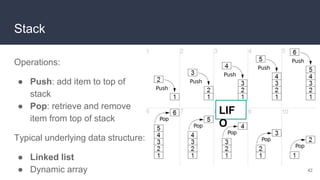
Operations:
● Push: add item to top of
stack
● Pop: retrieve and remove
item from top of stack
Typical underlying data structure:
● Linked list
● Dynamic array
Stack
42
LIF
O
Map
● Map: dataset that maps
(associates) keys to values
● Keys are unique
(values need not be)
● Values can be retrieved by
key
● Not indexed…
○ ...although an array could
be seen as a map with
integer keys! 43
By Jorge Stolfi (Own work) [CC BY-SA 3.0],
via Wikimedia Commons
Map
Operations:
● Lookup: retrieve value for a
key
● Insert: add key-value pair
● Replace: replace value for a
specified key
● Remove: remove key-value
pair
44
By Jorge Stolfi (Own work) [CC BY-SA 3.0],
via Wikimedia Commons
Map
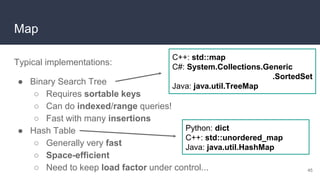
Typical implementations:
● Binary Search Tree
○ Requires sortable keys
○ Can do indexed/range queries!
○ Fast with many insertions
● Hash Table
○ Generally very fast
○ Space-efficient
○ Need to keep load factor under control... 45
Python: dict
C++: std::unordered_map
Java: java.util.HashMap
C++: std::map
C#: System.Collections.Generic
.SortedSet
Java: java.util.TreeMap
Set
● Set: dataset that contains
certain values
● No ordering, no
multiplicity
● A value is either present
or not
46
Adapted by L.J. Bel from Jorge Stolfi (Own work) [CC BY-SA 3.0],
via Wikimedia Commons
Set
Operations:
● Contains: check whether a
value is present
● Add: add a value
● Remove: remove a value
47
Adapted by L.J. Bel from Jorge Stolfi (Own work) [CC BY-SA 3.0],
via Wikimedia Commons
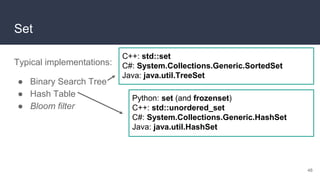
Set
Typical implementations:
● Binary Search Tree
● Hash Table
● Bloom filter
48
Python: set (and frozenset)
C++: std::unordered_set
C#: System.Collections.Generic.HashSet
Java: java.util.HashSet
C++: std::set
C#: System.Collections.Generic.SortedSet
Java: java.util.TreeSet
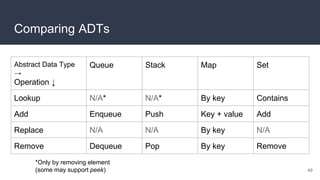
Comparing ADTs
49
Abstract Data Type
→
Operation ↓
Queue Stack Map Set
Lookup N/A* N/A* By key Contains
Add Enqueue Push Key + value Add
Replace N/A N/A By key N/A
Remove Dequeue Pop By key Remove
*Only by removing element
(some may support peek)
7. Dijkstra’s algorithm
50
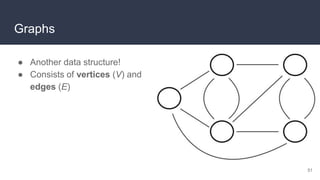
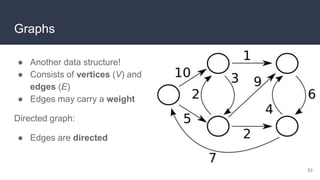
Graphs
● Another data structure!
● Consists of vertices (V) and
edges (E)
51
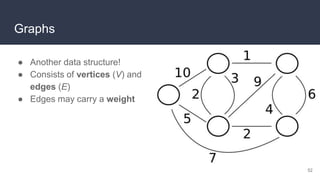
Graphs
● Another data structure!
● Consists of vertices (V) and
edges (E)
● Edges may carry a weight
52
Graphs
● Another data structure!
● Consists of vertices (V) and
edges (E)
● Edges may carry a weight
Directed graph:
● Edges are directed
53
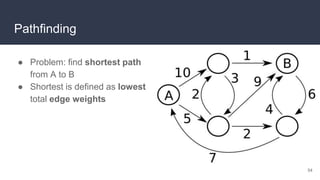
Pathfinding
● Problem: find shortest path
from A to B
● Shortest is defined as lowest
total edge weights
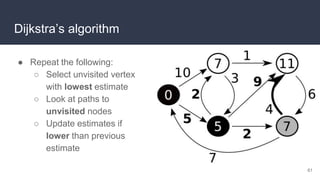
54
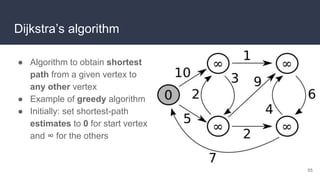
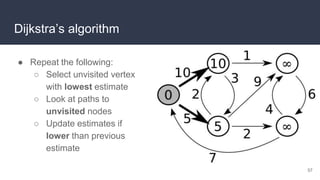
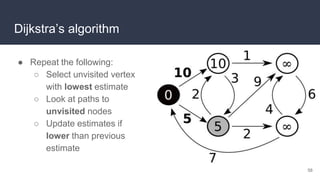
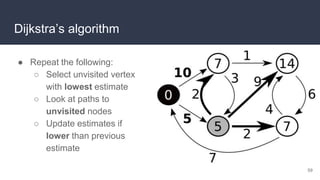
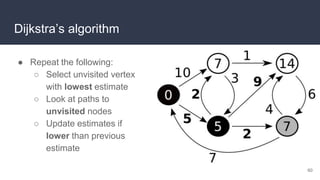
Dijkstra’s algorithm
● Algorithm to obtain shortest
path from a given vertex to
any other vertex
● Example of greedy algorithm
● Initially: set shortest-path
estimates to 0 for start vertex
and ∞ for the others
55
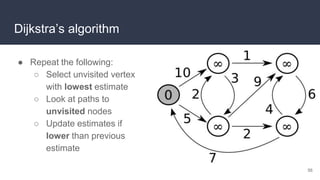
Dijkstra’s algorithm
● Repeat the following:
○ Select unvisited vertex
with lowest estimate
○ Look at paths to
unvisited nodes
○ Update estimates if
lower than previous
estimate
56
Dijkstra’s algorithm
● Repeat the following:
○ Select unvisited vertex
with lowest estimate
○ Look at paths to
unvisited nodes
○ Update estimates if
lower than previous
estimate
57
Dijkstra’s algorithm
● Repeat the following:
○ Select unvisited vertex
with lowest estimate
○ Look at paths to
unvisited nodes
○ Update estimates if
lower than previous
estimate
58
Dijkstra’s algorithm
● Repeat the following:
○ Select unvisited vertex
with lowest estimate
○ Look at paths to
unvisited nodes
○ Update estimates if
lower than previous
estimate
59
Dijkstra’s algorithm
● Repeat the following:
○ Select unvisited vertex
with lowest estimate
○ Look at paths to
unvisited nodes
○ Update estimates if
lower than previous
estimate
60
Dijkstra’s algorithm
● Repeat the following:
○ Select unvisited vertex
with lowest estimate
○ Look at paths to
unvisited nodes
○ Update estimates if
lower than previous
estimate
61
Dijkstra’s algorithm
● Repeat the following:
○ Select unvisited vertex
with lowest estimate
○ Look at paths to
unvisited nodes
○ Update estimates if
lower than previous
estimate
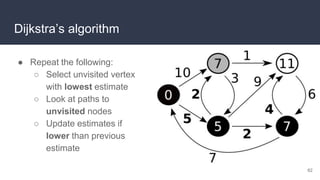
62
Dijkstra’s algorithm
● Repeat the following:
○ Select unvisited vertex
with lowest estimate
○ Look at paths to
unvisited nodes
○ Update estimates if
lower than previous
estimate
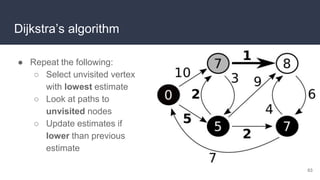
63
Dijkstra’s algorithm
● Repeat the following:
○ Select unvisited vertex
with lowest estimate
○ Look at paths to
unvisited nodes
○ Update estimates if lower
than previous estimate
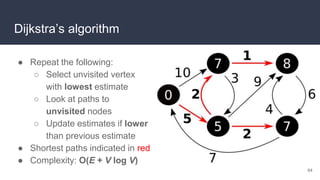
● Shortest paths indicated in red
● Complexity: O(E + V log V)
64
8. Summary
65
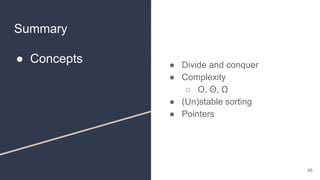
Summary
● Concepts ● Divide and conquer
● Complexity
○ O, Θ, Ω
● (Un)stable sorting
● Pointers
66
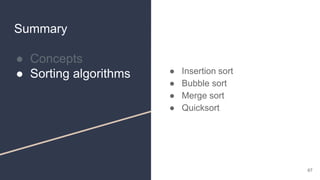
Summary
● Concepts
● Sorting algorithms ● Insertion sort
● Bubble sort
● Merge sort
● Quicksort
67
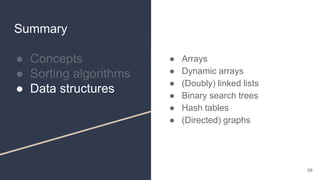
Summary
● Concepts
● Sorting algorithms
● Data structures
● Arrays
● Dynamic arrays
● (Doubly) linked lists
● Binary search trees
● Hash tables
● (Directed) graphs
68
Summary
● Concepts
● Sorting algorithms
● Data structures
● Abstract data types
● Queues
● Stacks
● Maps
● Sets
69
Summary
● Concepts
● Sorting algorithms
● Data structures
● Abstract data types
● Algorithms
● Binary search
● Dijkstra’s algorithm
70

Algorithms__Data_Structures_-_iCSC_2018.pptx

  • 1.
    Algorithms & DataStructures Lecture 1 L.J. Bel iCSC 2018
  • 2.
    Outline Lecture I 1. Motivation 2.Sorting algorithms 3. Complexity analysis 4. Linear data structures Lecture II 5. Nonlinear data structures 6. Abstract data types 7. Dijkstra’s algorithm 8. Summary 2
  • 3.
    Attention! Lecture aimed atnon-computer scientists. Focus is on explaining concepts, rather than technical correctness. 3
  • 4.
  • 5.
    Motivation ● Algorithms ● DataStructures 1. Everything running on your computer is an algorithm 2. Analysing them is paramount to writing, maintaining and improving them 3. Several tools exist to help achieve this 5
  • 6.
    Motivation ● Algorithms ● DataStructures 1. Data Structures define how data is stored in RAM 2. Many variations, each with advantages and disadvantages 3. Strongly coupled to algorithmic complexity 6
  • 7.
  • 8.
    Sorting ● Suppose wehave some unsorted list ● We want to make it sorted 8 3 1 5 6 8 7 2 4 3 4 2 1 5 6 7 8
  • 9.
    N steps N steps ●In pseudocode: i ← 1 while i < length(A) j ← i while j > 0 and A[j-1] > A[j] swap A[j] and A[j-1] j ← j - 1 end while i ← i + 1 end while Insertion sort ● “Naive” sorting algorithm ● One-by-one, take each element and move it ● When all elements have been moved, list is sorted! 9 ● In pseudocode: i ← 1 while i < length(A) j ← i while j > 0 and A[j-1] > A[j] swap A[j] and A[j-1] j ← j - 1 end while i ← i + 1 end while Total: N² steps By Swfung8 (Own work) [CC BY-SA 3.0], via Wikimedia Commons
  • 10.
    Bubble sort ● Traversethe list, taking pairs of elements ● Swap if order incorrect ● Repeat N times ● Now it’s sorted! 10 Total: N² steps By Swfung8 (Own work) [CC BY-SA 3.0], via Wikimedia Commons N steps N steps
  • 11.
    Intermezzo: Divide andconquer ● Generic algorithm strategy ○ Divide the problem into smaller parts ○ Solve (conquer) the problem for each part ○ Recombine the parts ● Straightforward to parallelise ● Closely related to map-reduce ● Has been advocated by Caesar, Machiavelli, Napoleon... 11
  • 12.
    Merge sort ● Muchsmarter sort ○ Split the dataset into chunks ○ Sort each chunk ○ Merge the chunks back together ● Example of divide-and-conquer ● Splitting & sorting takes log₂(N) steps ● Merging takes N steps 12 By Swfung8 (Own work) [CC BY-SA 3.0], via Wikimedia Commons Total: N log(N) steps
  • 13.
  • 14.
    Complexity – O ●We use “Big-O” notation ● Represents an upper bound ● Ignores constants ● Only shows dominant term ● In these examples: N is amount of data ● Linear: O(N) ○ O(N) = O(2*N) = O(k*N + m) for any constants k, m ● Quadratic: O(N²) ○ O(N²) = O(a*N² + b*N + c) for any constants a, b, c 14
  • 15.
    Complexity – O ●Roughly three categories, in decreasing order: ○ Exponential – O(kN) ○ Polynomial – O(Nk) ○ Polylogarithmic – O(log(N)k) ● This is an abstraction! ○ Does not directly relate to runtimes ○ A good O(N²) algorithm may be faster than a bad O(log(N)) one ○ Depends on your input data! 15 By Cmglee (Own work) [CC BY-SA 4.0], via Wikimedia Commons
  • 16.
    Complexity – O ●Remember: it’s an upper bound! ● And it’s a property (not an equivalence relation)! ○ O(N) = O(N²) ○ But O(N²) ≠ O(N) ● O(N) = O(2N) ● 2N = O(N) ● N² + N = O(N²) ● O(N²) + O(N) = O(N²) ● O(log(N)) + O(N) = O(N) ● O(1) → used for constant time 16
  • 17.
    Complexity – O ●Formal definition: f(N) = O(g(N)) ↔ ∃ N₀, M : ∀ N > N₀ : f(N) ≤ M g(N) ● In words: starting from N₀, f is bounded from above by g (up to some constant M) 17 By Cmglee (Own work) [CC BY-SA 4.0], via Wikimedia Commons
  • 18.
    Complexity – Ω ●Ω: lower bound ○ Formal definition: f(N) = Ω(g(N)) ↔ ∃ N₀, M : ∀ N > N₀ : f(N) ≥ M g(N) ○ In words: starting from N₀, f is bounded from below by g (up to some constant M) ● Examples: ○ N = Ω(log(N)) ○ N² = Ω(N) 18 By Cmglee (Own work) [CC BY-SA 4.0], via Wikimedia Commons
  • 19.
    Complexity – Θ ●Θ: exact bound ○ Formal definition: f(N) = Θ(g(N)) ↔ f(N) = O(g(N)) and f(N) = Ω(g(N)) ● Examples: ○ N = Θ(N) ○ 2N = Θ(N) ○ 3N²+5N+1 = Θ(N²) ○ N ≠ Θ(N²) (even though N = O(N²)) 19 By Cmglee (Own work) [CC BY-SA 4.0], via Wikimedia Commons
  • 20.
    One more sortingexample: Quicksort ● Pick an element, called pivot ● Partitioning: reorder the array so that the pivot is in the correct place ● Recursively apply the above steps to the sub-arrays on either side of the pivot 20 ● Randomised-quicksort: select the pivot randomly
  • 21.
    Stable sorting ● Asorting algorithm is stable iff it conserves the order of equal elements 21
  • 22.
    Comparison of algorithms 22 AlgorithmStable? Complexity Insertion sort ✅ O(N²) Bubble sort ✅ O(N²) Merge sort ✅ O(N log(N)) Quicksort ❌ ?
  • 23.
    4. Linear datastructures 23
  • 24.
  • 25.
    Arrays ● Linear, contiguouslist of data ● Accessible by index ● Fixed-size ○ N * d ● Supported by all major systems 25 ● Back-insert/remove: O(1) ● Random insert/remove: O(N) ● Index-lookup: O(1) ● Lookup: O(N)
  • 26.
    Dynamic arrays ● Linear,contiguous list of data ● Accessible by index ● Resizable 26 C++: std::vector Python: list C#: System.Collections.ArrayList Java: java.util.ArrayList ● Back-insert/remove: O(1)* ● Random insert/remove: O(N) ● Index-lookup: O(1) ● Lookup: O(N) *Amortised.
  • 27.
    Pointers 27 By Sven (Ownwork) [CC BY-SA 3.0], via Wikimedia Commons
  • 28.
    Linked list ● Linear,contiguous list of data ● Accessible by iteration ● Resizable 28 ● Back-insert/remove: O(1) ● Random insert/remove: O(N) ● Index-lookup: O(N) ● Lookup: O(N) C++: std::forward_list
  • 29.
    Doubly Linked list ●Pointers both ways ● Uses more memory, but allows iteration both ways 29 ● Back-insert/remove: O(1) ● Random insert/remove: O(N) ● Index-lookup: O(N) ● Lookup: O(N) C++: std::list C#: System.Collections.Generic.LinkedList Java: java.util.LinkedList
  • 30.
    Binary search ● Searchesa sorted linear data structure ● Takes Θ(log(N)) ● Example of divide and conquer 30 By AlwaysAngry (Own work) [CC BY-SA 4.0], via Wikimedia Commons
  • 31.
    Algorithms & DataStructures Lecture 2 L.J. Bel iCSC 2018
  • 32.
    Outline Lecture I 1. Motivation 2.Sorting algorithms 3. Complexity analysis 4. Linear data structures Lecture II 5. Nonlinear data structures 6. Abstract data types 7. Dijkstra’s algorithm 8. Summary 32
  • 33.
    5. Nonlinear datastructures 33
  • 34.
    Recall: Binary search ●Searches a sorted linear data structure ● Takes Θ(log(N)) ● … let’s use this as inspiration for a data structure! 34 By AlwaysAngry (Own work) [CC BY-SA 4.0], via Wikimedia Commons
  • 35.
    Binary search trees ●Tree structure ● Pointers between nodes ○ To the right: only larger ○ To the left: only smaller ● Allows easy sorted iteration ● Search/insert/delete: all O(log(N)) 35
  • 36.
    Hash tables ● Idea:create buckets numbered 1 to B ● For each item, compute in which bucket it belongs ● Put the item in that bucket ● Search/insert/delete: all O(1) 36 By Jorge Stolfi (Own work) [CC BY-SA 3.0], via Wikimedia Commons
  • 37.
    Hash tables ● Problem:clashing hashes! ● Solution: replace entry with linked list (chaining) ● New problem: load factor can become too high! ● Solution: copy to new table with more buckets 37 By Jorge Stolfi (Own work) [CC BY-SA 3.0], via Wikimedia Commons
  • 38.
    Comparing data structures 38 Datastructure → Operation ↓ Dynamic array Linked list Binary search tree Hash table Lookup O(N) O(N) O(log(N)) O(1) Indexed lookup O(1) O(N) N/A N/A Back-insert O(1)* O(1) O(log(N)) O(1)* Random insert O(N) O(N) N/A N/A Remove O(N) O(N) O(log(N)) O(1)* *Amortised.
  • 39.
  • 40.
    Why “Abstract”? ● AbstractData Type (ADT) does not define a real data structure ○ Only defines an interface ○ Implemented using one of the “real” data structures ● Usually limits operations compared to actual DS ● Enhances flexibility Related to several core programming principles: ● Program against the interface, not the implementation! ● Use high cohesion, loose coupling ● Separate the concerns 40
  • 41.
    Operations: ● Enqueue: additem to beginning of queue ● Dequeue: retrieve and remove item from end of queue Typical underlying data structure: ● Linked list ● Dynamic array Queue 41 By Vegpuff (Own work) [CC BY-SA 3.0], via Wikimedia Commons FIF O
  • 42.
    Operations: ● Push: additem to top of stack ● Pop: retrieve and remove item from top of stack Typical underlying data structure: ● Linked list ● Dynamic array Stack 42 LIF O
  • 43.
    Map ● Map: datasetthat maps (associates) keys to values ● Keys are unique (values need not be) ● Values can be retrieved by key ● Not indexed… ○ ...although an array could be seen as a map with integer keys! 43 By Jorge Stolfi (Own work) [CC BY-SA 3.0], via Wikimedia Commons
  • 44.
    Map Operations: ● Lookup: retrievevalue for a key ● Insert: add key-value pair ● Replace: replace value for a specified key ● Remove: remove key-value pair 44 By Jorge Stolfi (Own work) [CC BY-SA 3.0], via Wikimedia Commons
  • 45.
    Map Typical implementations: ● BinarySearch Tree ○ Requires sortable keys ○ Can do indexed/range queries! ○ Fast with many insertions ● Hash Table ○ Generally very fast ○ Space-efficient ○ Need to keep load factor under control... 45 Python: dict C++: std::unordered_map Java: java.util.HashMap C++: std::map C#: System.Collections.Generic .SortedSet Java: java.util.TreeMap
  • 46.
    Set ● Set: datasetthat contains certain values ● No ordering, no multiplicity ● A value is either present or not 46 Adapted by L.J. Bel from Jorge Stolfi (Own work) [CC BY-SA 3.0], via Wikimedia Commons
  • 47.
    Set Operations: ● Contains: checkwhether a value is present ● Add: add a value ● Remove: remove a value 47 Adapted by L.J. Bel from Jorge Stolfi (Own work) [CC BY-SA 3.0], via Wikimedia Commons
  • 48.
    Set Typical implementations: ● BinarySearch Tree ● Hash Table ● Bloom filter 48 Python: set (and frozenset) C++: std::unordered_set C#: System.Collections.Generic.HashSet Java: java.util.HashSet C++: std::set C#: System.Collections.Generic.SortedSet Java: java.util.TreeSet
  • 49.
    Comparing ADTs 49 Abstract DataType → Operation ↓ Queue Stack Map Set Lookup N/A* N/A* By key Contains Add Enqueue Push Key + value Add Replace N/A N/A By key N/A Remove Dequeue Pop By key Remove *Only by removing element (some may support peek)
  • 50.
  • 51.
    Graphs ● Another datastructure! ● Consists of vertices (V) and edges (E) 51
  • 52.
    Graphs ● Another datastructure! ● Consists of vertices (V) and edges (E) ● Edges may carry a weight 52
  • 53.
    Graphs ● Another datastructure! ● Consists of vertices (V) and edges (E) ● Edges may carry a weight Directed graph: ● Edges are directed 53
  • 54.
    Pathfinding ● Problem: findshortest path from A to B ● Shortest is defined as lowest total edge weights 54
  • 55.
    Dijkstra’s algorithm ● Algorithmto obtain shortest path from a given vertex to any other vertex ● Example of greedy algorithm ● Initially: set shortest-path estimates to 0 for start vertex and ∞ for the others 55
  • 56.
    Dijkstra’s algorithm ● Repeatthe following: ○ Select unvisited vertex with lowest estimate ○ Look at paths to unvisited nodes ○ Update estimates if lower than previous estimate 56
  • 57.
    Dijkstra’s algorithm ● Repeatthe following: ○ Select unvisited vertex with lowest estimate ○ Look at paths to unvisited nodes ○ Update estimates if lower than previous estimate 57
  • 58.
    Dijkstra’s algorithm ● Repeatthe following: ○ Select unvisited vertex with lowest estimate ○ Look at paths to unvisited nodes ○ Update estimates if lower than previous estimate 58
  • 59.
    Dijkstra’s algorithm ● Repeatthe following: ○ Select unvisited vertex with lowest estimate ○ Look at paths to unvisited nodes ○ Update estimates if lower than previous estimate 59
  • 60.
    Dijkstra’s algorithm ● Repeatthe following: ○ Select unvisited vertex with lowest estimate ○ Look at paths to unvisited nodes ○ Update estimates if lower than previous estimate 60
  • 61.
    Dijkstra’s algorithm ● Repeatthe following: ○ Select unvisited vertex with lowest estimate ○ Look at paths to unvisited nodes ○ Update estimates if lower than previous estimate 61
  • 62.
    Dijkstra’s algorithm ● Repeatthe following: ○ Select unvisited vertex with lowest estimate ○ Look at paths to unvisited nodes ○ Update estimates if lower than previous estimate 62
  • 63.
    Dijkstra’s algorithm ● Repeatthe following: ○ Select unvisited vertex with lowest estimate ○ Look at paths to unvisited nodes ○ Update estimates if lower than previous estimate 63
  • 64.
    Dijkstra’s algorithm ● Repeatthe following: ○ Select unvisited vertex with lowest estimate ○ Look at paths to unvisited nodes ○ Update estimates if lower than previous estimate ● Shortest paths indicated in red ● Complexity: O(E + V log V) 64
  • 65.
  • 66.
    Summary ● Concepts ●Divide and conquer ● Complexity ○ O, Θ, Ω ● (Un)stable sorting ● Pointers 66
  • 67.
    Summary ● Concepts ● Sortingalgorithms ● Insertion sort ● Bubble sort ● Merge sort ● Quicksort 67
  • 68.
    Summary ● Concepts ● Sortingalgorithms ● Data structures ● Arrays ● Dynamic arrays ● (Doubly) linked lists ● Binary search trees ● Hash tables ● (Directed) graphs 68
  • 69.
    Summary ● Concepts ● Sortingalgorithms ● Data structures ● Abstract data types ● Queues ● Stacks ● Maps ● Sets 69
  • 70.
    Summary ● Concepts ● Sortingalgorithms ● Data structures ● Abstract data types ● Algorithms ● Binary search ● Dijkstra’s algorithm 70

Editor's Notes